1Module 2aTourism PlanningDestination Marketing and PlanningProfessor  Alastair M. MorrisonLesson 4
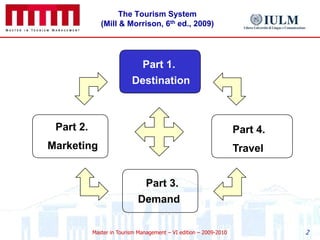
2The Tourism System(Mill & Morrison, 6th ed., 2009)Part 1. DestinationPart 2. Part 4.MarketingTravelPart 3.Demand
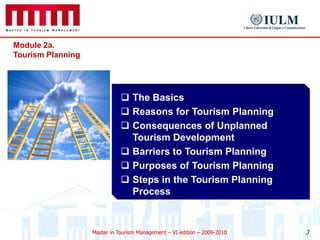
3Module 2a. Tourism PlanningThe Basics
Reasons for Tourism Planning
Consequences of Unplanned Tourism Development
Barriers to Tourism Planning
Purposes of Tourism Planning
Steps in the Tourism Planning ProcessThe BasicsDue to range of impacts, and the wide spectrum of stakeholders involved, there is a need for a holistic approach to tourism development, management and monitoring. 4
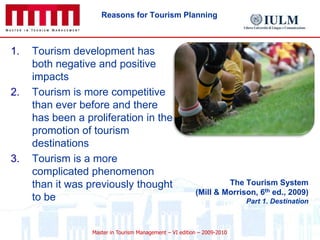
Reasons for Tourism PlanningTourism development has both negative and positive impactsTourism is more competitive than ever before and there has been a proliferation in the promotion of tourism destinationsTourism is a more complicated phenomenon than it was previously thought to beThe Tourism System(Mill & Morrison, 6th ed., 2009)Part 1. Destination
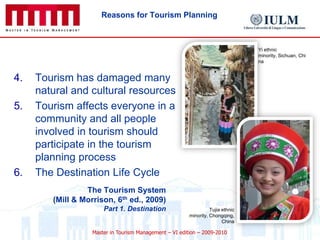
Reasons for Tourism PlanningYi ethnic minority, Sichuan, ChinaTourism has damaged many natural and cultural resourcesTourism affects everyone in a community and all people involved in tourism should participate in the tourism planning processThe Destination Life CycleThe Tourism System(Mill & Morrison, 6th ed., 2009)Part 1. DestinationTujia ethnic minority, Chongqing, China
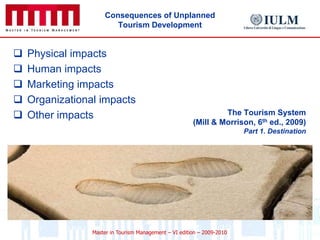
Consequences of Unplanned Tourism DevelopmentPhysical impacts
Human impacts
Marketing impacts
Organizational impacts
Other impactsThe Tourism System(Mill & Morrison, 6th ed., 2009)Part 1. Destination
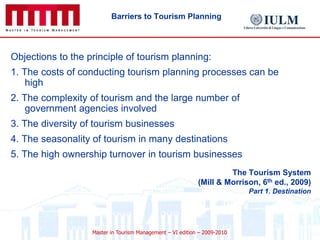
Barriers to Tourism PlanningObjections to the principle of tourism planning:1. The costs of conducting tourism planning processes can be high2. The complexity of tourism and the large number of government agencies involved3. The diversity of tourism businesses4. The seasonality of tourism in many destinations5. The high ownership turnover in tourism businessesThe Tourism System(Mill & Morrison, 6th ed., 2009)Part 1. Destination
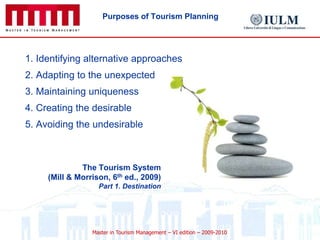
Purposes of Tourism Planning1. Identifying alternative approaches2. Adapting to the unexpected3. Maintaining uniqueness4. Creating the desirable5. Avoiding the undesirableThe Tourism System(Mill & Morrison, 6th ed., 2009)Part 1. Destination
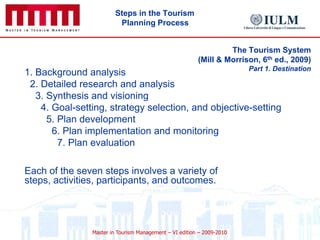
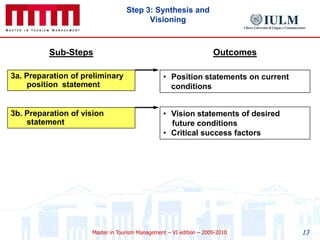
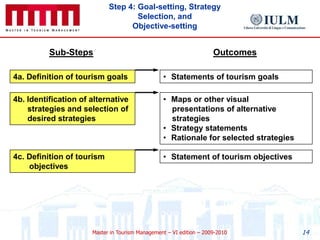
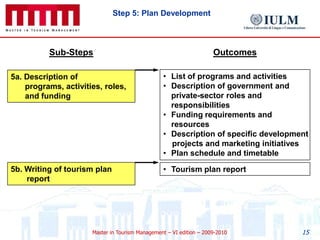
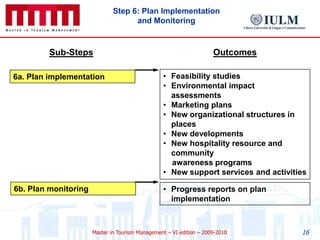
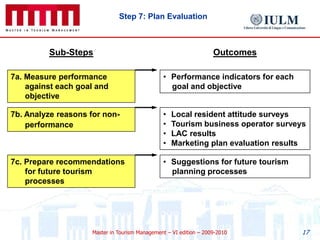
Steps in the Tourism Planning ProcessThe Tourism System(Mill & Morrison, 6th ed., 2009)Part 1. Destination1. Background analysis  2. Detailed research and analysis    3. Synthesis and visioning      4. Goal-setting, strategy selection, and objective-setting         5. Plan development           6. Plan implementation and monitoring            7. Plan evaluationEach of the seven steps involves a variety of steps, activities, participants, and outcomes.
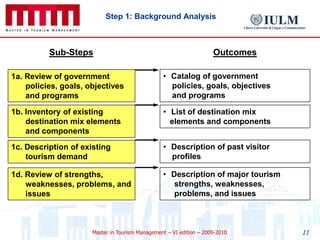
11Step 1: Background AnalysisSub-StepsOutcomesCatalog of government policies, goals, objectives    and programs1a. Review of government policies, goals, objectives and programsList of destination mix    elements and components1b. Inventory of existing destination mix elements and componentsDescription of past visitor     profiles1c. Description of existing tourism demandDescription of major tourism     strengths, weaknesses,      problems, and issues1d. Review of strengths, weaknesses, problems, and issues
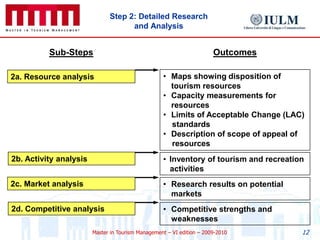
12Step 2: Detailed Research and AnalysisSub-StepsOutcomesMaps showing disposition of tourism resources

Module 2a 2010 morrison

  • 1.
    1Module 2aTourism PlanningDestinationMarketing and PlanningProfessor Alastair M. MorrisonLesson 4
  • 2.
    2The Tourism System(Mill& Morrison, 6th ed., 2009)Part 1. DestinationPart 2. Part 4.MarketingTravelPart 3.Demand
  • 3.
    3Module 2a. TourismPlanningThe Basics
  • 4.
  • 5.
    Consequences of UnplannedTourism Development
  • 6.
  • 7.
  • 8.
    Steps in theTourism Planning ProcessThe BasicsDue to range of impacts, and the wide spectrum of stakeholders involved, there is a need for a holistic approach to tourism development, management and monitoring. 4
  • 9.
    Reasons for TourismPlanningTourism development has both negative and positive impactsTourism is more competitive than ever before and there has been a proliferation in the promotion of tourism destinationsTourism is a more complicated phenomenon than it was previously thought to beThe Tourism System(Mill & Morrison, 6th ed., 2009)Part 1. Destination
  • 10.
    Reasons for TourismPlanningYi ethnic minority, Sichuan, ChinaTourism has damaged many natural and cultural resourcesTourism affects everyone in a community and all people involved in tourism should participate in the tourism planning processThe Destination Life CycleThe Tourism System(Mill & Morrison, 6th ed., 2009)Part 1. DestinationTujia ethnic minority, Chongqing, China
  • 11.
    Consequences of UnplannedTourism DevelopmentPhysical impacts
  • 12.
  • 13.
  • 14.
  • 15.
    Other impactsThe TourismSystem(Mill & Morrison, 6th ed., 2009)Part 1. Destination
  • 16.
    Barriers to TourismPlanningObjections to the principle of tourism planning:1. The costs of conducting tourism planning processes can be high2. The complexity of tourism and the large number of government agencies involved3. The diversity of tourism businesses4. The seasonality of tourism in many destinations5. The high ownership turnover in tourism businessesThe Tourism System(Mill & Morrison, 6th ed., 2009)Part 1. Destination
  • 17.
    Purposes of TourismPlanning1. Identifying alternative approaches2. Adapting to the unexpected3. Maintaining uniqueness4. Creating the desirable5. Avoiding the undesirableThe Tourism System(Mill & Morrison, 6th ed., 2009)Part 1. Destination
  • 18.
    Steps in theTourism Planning ProcessThe Tourism System(Mill & Morrison, 6th ed., 2009)Part 1. Destination1. Background analysis 2. Detailed research and analysis 3. Synthesis and visioning 4. Goal-setting, strategy selection, and objective-setting 5. Plan development 6. Plan implementation and monitoring 7. Plan evaluationEach of the seven steps involves a variety of steps, activities, participants, and outcomes.
  • 19.
    11Step 1: BackgroundAnalysisSub-StepsOutcomesCatalog of government policies, goals, objectives and programs1a. Review of government policies, goals, objectives and programsList of destination mix elements and components1b. Inventory of existing destination mix elements and componentsDescription of past visitor profiles1c. Description of existing tourism demandDescription of major tourism strengths, weaknesses, problems, and issues1d. Review of strengths, weaknesses, problems, and issues
  • 20.
    12Step 2: DetailedResearch and AnalysisSub-StepsOutcomesMaps showing disposition of tourism resources