1/4/2013
1
Basic Approaches in
Tourism Planning
Tourism System
Lecture Outline
1. Elements of Tourism System
2. Demand Factors
3. Supply Factors
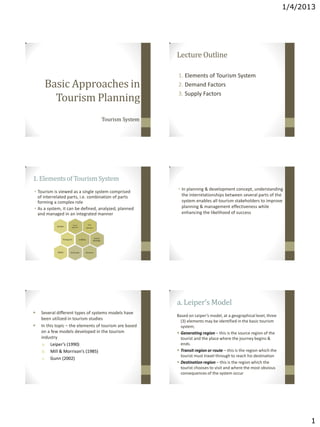
1. Elementsof TourismSystem
• Tourism is viewed as a single system comprised
of interrelated parts, i.e. combination of parts
forming a complex role
• As a system, it can be defined, analyzed, planned
and managed in an integrated manner
Tour
Operator
Travel
Agencies
Lodging
Food &
Beverage
AttractionsGovernment
Transport
NGOs
Guides
• In planning & development concept, understanding
the interrelationships between several parts of the
system enables all tourism stakeholders to improve
planning & management effectiveness while
enhancing the likelihood of success
 Several different types of systems models have
been utilized in tourism studies
 In this topic – the elements of tourism are based
on a few models developed in the tourism
industry
a. Leiper’s (1990)
b. Mill & Morrison’s (1985)
c. Gunn (2002)
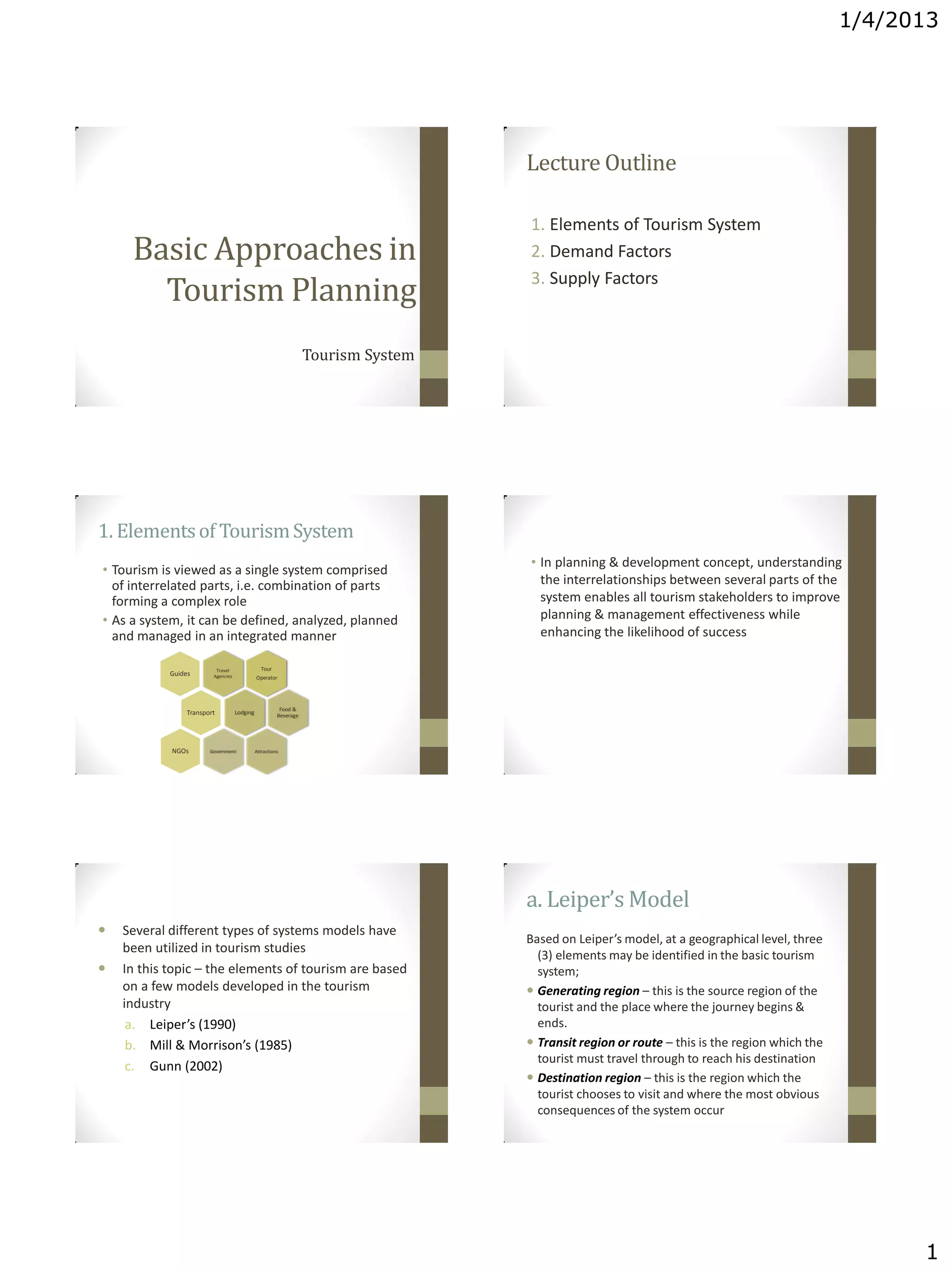
a. Leiper’s Model
Based on Leiper’s model, at a geographical level, three
(3) elements may be identified in the basic tourism
system;
 Generating region – this is the source region of the
tourist and the place where the journey begins &
ends.
 Transit region or route – this is the region which the
tourist must travel through to reach his destination
 Destination region – this is the region which the
tourist chooses to visit and where the most obvious
consequences of the system occur
1/4/2013
2
Departing
Tourist
Returning
Tourist
Tourist
Destination
Regions
Tourist
Generating
Regions
Transit
Routes
Environments: Human, Sociocultural,
Economical, Technological, Physical,
Political, Legal, etc.
Leiper’s Tourism Model
Leiper, 1990
b. Mill and Morrison’s Model
A more commercially oriented system – who argued
that the system consist of four parts;
• Market – highlights the decision of the individual
to travel and or become a tourist
• Travel – describes & analyses the where, when
and how of the individual tourist’s travel
behaviour
• Destination – consists of the study of the
destination mix, i.e. the attractions and services
that are used by the tourist
• Marketing – highlights the importance of
marketing in encouraging people to travel
• In this model, they observed that the development
of a marketing plan, the selection of an appropriate
marketing mix and the choice of a distribution
channel will bring success or failure for the
destination’s attempt to encourage tourist to travel
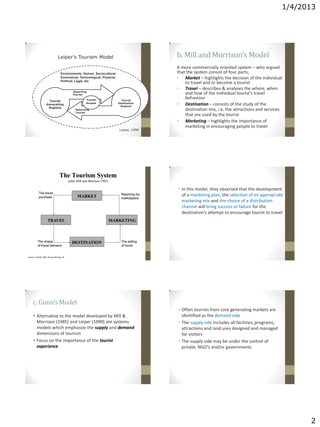
c. Gunn’sModel
 Alternative to the model developed by Mill &
Morrison (1985) and Leiper (1990) are systems
models which emphasize the supply and demand
dimensions of tourism
 Focus on the importance of the tourist
experience
• Often tourists from core generating markets are
identified as the demand side
• The supply side includes all facilities, programs,
attractions and land uses designed and managed
for visitors
• The supply side may be under the control of
private, NGO’s and/or governments
1/4/2013
3
Gunn’s (2002) Tourism System - supply and demand
2. Demand Factors
• Demand is comprised of the motivations,
perceptions, previous experiences and
expectations of tourist
• The motivations arise from a variety of socio-
cultural factors
• Many tourist motivations have arise from the
demands made on the individual by modern
industrial society
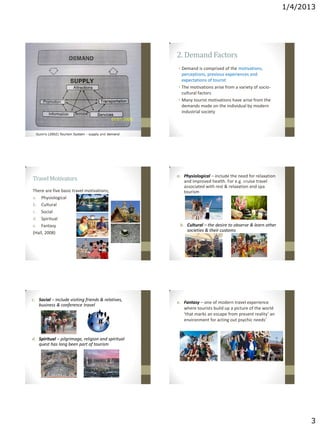
There are five basic travel motivations;
a. Physiological
b. Cultural
c. Social
d. Spiritual
e. Fantasy
(Hall, 2008)
Travel Motivators a. Physiological – include the need for relaxation
and improved health. For e.g. cruise travel
associated with rest & relaxation and spa
tourism
b. Cultural – the desire to observe & learn other
societies & their customs
c. Social – include visiting friends & relatives,
business & conference travel
d. Spiritual – pilgrimage, religion and spiritual
quest has long been part of tourism
e. Fantasy – one of modern travel experience
where tourists build up a picture of the world
‘that marks an escape from present reality’ an
environment for acting out psychic needs’
1/4/2013
4
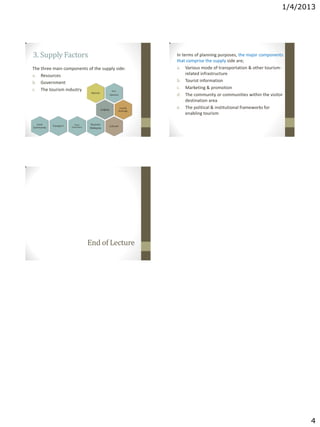
3. Supply Factors
The three main components of the supply side:
a. Resources
b. Government
c. The tourism industry Tour
Operator
Natural
Lodging
Food &
Beverage
Cultural
Tourism
Malaysia
Travel
Associations
Transport
Local
Community
In terms of planning purposes, the major components
that comprise the supply side are;
a. Various mode of transportation & other tourism-
related infrastructure
b. Tourist information
c. Marketing & promotion
d. The community or communities within the visitor
destination area
e. The political & institutional frameworks for
enabling tourism
End of Lecture

002b. tourism system

  • 1.
    1/4/2013 1 Basic Approaches in TourismPlanning Tourism System Lecture Outline 1. Elements of Tourism System 2. Demand Factors 3. Supply Factors 1. Elementsof TourismSystem • Tourism is viewed as a single system comprised of interrelated parts, i.e. combination of parts forming a complex role • As a system, it can be defined, analyzed, planned and managed in an integrated manner Tour Operator Travel Agencies Lodging Food & Beverage AttractionsGovernment Transport NGOs Guides • In planning & development concept, understanding the interrelationships between several parts of the system enables all tourism stakeholders to improve planning & management effectiveness while enhancing the likelihood of success  Several different types of systems models have been utilized in tourism studies  In this topic – the elements of tourism are based on a few models developed in the tourism industry a. Leiper’s (1990) b. Mill & Morrison’s (1985) c. Gunn (2002) a. Leiper’s Model Based on Leiper’s model, at a geographical level, three (3) elements may be identified in the basic tourism system;  Generating region – this is the source region of the tourist and the place where the journey begins & ends.  Transit region or route – this is the region which the tourist must travel through to reach his destination  Destination region – this is the region which the tourist chooses to visit and where the most obvious consequences of the system occur
  • 2.
    1/4/2013 2 Departing Tourist Returning Tourist Tourist Destination Regions Tourist Generating Regions Transit Routes Environments: Human, Sociocultural, Economical,Technological, Physical, Political, Legal, etc. Leiper’s Tourism Model Leiper, 1990 b. Mill and Morrison’s Model A more commercially oriented system – who argued that the system consist of four parts; • Market – highlights the decision of the individual to travel and or become a tourist • Travel – describes & analyses the where, when and how of the individual tourist’s travel behaviour • Destination – consists of the study of the destination mix, i.e. the attractions and services that are used by the tourist • Marketing – highlights the importance of marketing in encouraging people to travel • In this model, they observed that the development of a marketing plan, the selection of an appropriate marketing mix and the choice of a distribution channel will bring success or failure for the destination’s attempt to encourage tourist to travel c. Gunn’sModel  Alternative to the model developed by Mill & Morrison (1985) and Leiper (1990) are systems models which emphasize the supply and demand dimensions of tourism  Focus on the importance of the tourist experience • Often tourists from core generating markets are identified as the demand side • The supply side includes all facilities, programs, attractions and land uses designed and managed for visitors • The supply side may be under the control of private, NGO’s and/or governments
  • 3.
    1/4/2013 3 Gunn’s (2002) TourismSystem - supply and demand 2. Demand Factors • Demand is comprised of the motivations, perceptions, previous experiences and expectations of tourist • The motivations arise from a variety of socio- cultural factors • Many tourist motivations have arise from the demands made on the individual by modern industrial society There are five basic travel motivations; a. Physiological b. Cultural c. Social d. Spiritual e. Fantasy (Hall, 2008) Travel Motivators a. Physiological – include the need for relaxation and improved health. For e.g. cruise travel associated with rest & relaxation and spa tourism b. Cultural – the desire to observe & learn other societies & their customs c. Social – include visiting friends & relatives, business & conference travel d. Spiritual – pilgrimage, religion and spiritual quest has long been part of tourism e. Fantasy – one of modern travel experience where tourists build up a picture of the world ‘that marks an escape from present reality’ an environment for acting out psychic needs’
  • 4.
    1/4/2013 4 3. Supply Factors Thethree main components of the supply side: a. Resources b. Government c. The tourism industry Tour Operator Natural Lodging Food & Beverage Cultural Tourism Malaysia Travel Associations Transport Local Community In terms of planning purposes, the major components that comprise the supply side are; a. Various mode of transportation & other tourism- related infrastructure b. Tourist information c. Marketing & promotion d. The community or communities within the visitor destination area e. The political & institutional frameworks for enabling tourism End of Lecture