Organizer and
Sponsor
TOPIC
Jl IKPN Bintaro No 1, Pesanggrahan,
Tanah Kusir, Jakarta, Special Capital
Region of Jakarta 12330, Indonesia
How to Organize
Your Event
i
. . . . . . . . . . . . . . . . . . . . . . . . . . . . . . . . . . . . . . . . . . . . . . . . . . . . . . . . . . . . . . . . . . . . . . . . . . .
A. SECTOR OVERVIEW—MEETINGS
Learning Objectives:
•	 Understand the meaning of each sector of MICE
•	 Explain what meetings are
•	 Identify the types of meetings
In general, MICE events are events and activities that involve attendees who share a common interest
and gather in a place. The place for the gathering needs to be a venue arranged before hand. The venue
will provide space and facilities necessary to satisfy the needs of those who attend the gathering. We
can further explain the gatherings by their different formats:
M	 =	Meetings (Corporate)
I	 =	Incentives
C	 =	Conventions (Association)
E	 =	Exhibitions
MEETING
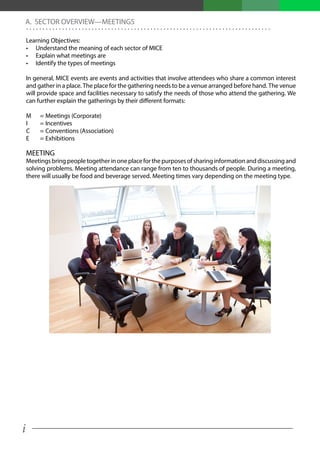
Meetingsbringpeopletogetherinoneplaceforthepurposesofsharinginformationanddiscussingand
solving problems. Meeting attendance can range from ten to thousands of people. During a meeting,
there will usually be food and beverage served. Meeting times vary depending on the meeting type.
ii
Most of the time, meetings refer to corporate meetings which are held by companies in the following
ways:
•	 Board meetings – Meetings of the board of the directors of a corporation, usually held annually
•	 Management Meetings – The managers from different regions of a corporation meet when
necessary to make decisions for the corporation
•	 Shareholder Meetings – Investors who own a share in a company meet quarterly
•	 Training Seminars – A company conducts these to train employees when needed
•	 Meetings with partners, suppliers and clients – A gathering to discuss business deals, usually held
. . . . . . . . . . . . . . . . . . . . . . . . . . . . . . . . . . . . . . . . . . . . . . . . . . . . . . . . . . . . . . . . . . . . . . . . . . .
B. SECTOR OVERVIEW – INCENTIVES
Learning Objectives:
•	 Explain what incentives are
•	 Get an overview of incentives development
•	 Understand the factors behind incentive travel decisions
Incentive travel is a management tool for rewarding and motivating sales representatives, dealers,
distributors, production workers, support staff, and in some cases, customers. The company rewards
sales representatives who reach sales targets by sending them on trips. Usually, the incentive trip will last
three days, with hotel stays, tour packages and planned activities such as dinners, parties and games.
The incentive travel market is mature in the U.S. and Europe, and is developing in Asia; especially in
Singapore and Japan.
Factors Behind Incentive Travel Decisions
•	 Incentive budget economy – How strong is the economy in the country in which the sponsoring
group is headquartered?
•	 Buying power – Strength of the exchange rate in the countries being considered as the destination
for the trip
•	 Political climate – Terrorist alert levels after the 911 incident
•	 Value - How do facilities and services compare with other choices of destination
•	 Uniqueness of experience – Takes into consideration whether these participants have experienced
this type of trip before
. . . . . . . . . . . . . . . . . . . . . . . . . . . . . . . . . . . . . . . . . . . . . . . . . . . . . . . . . . . . . . . . . . . . . . . . . . .
C. SECTOR OVERVIEW – CONVENTIONS
Learning Objectives:
•	 Explain what conventions are
•	 Observe an example of a convention
•	 Understand the difference between meetings and conventions
Similar to meetings, conventions are gatherings of people with common objectives, organized to
exchange ideas, views and information of common interest to the group. An organization, usually an
association, will organize a convention each year with a theme related to the organization’s topic. Those
interested in registering for the convention can pay the association a fee for all the sessions, discussions,
food and beverage, dinners, and site visits.
i
The major differences between a meetings and conventions is that a convention:
•	 Is a large event often lasting for several days and involving a social programme
•	 Is organized by associations: o Professional and trade associations, e.g. the Dentist Association o
Voluntary associations and societies o Charities o Political parties
•	 Usually conducted once a year
•	 Generates income for the association
•	 A long time is spent on selecting the site of the convention
. . . . . . . . . . . . . . . . . . . . . . . . . . . . . . . . . . . . . . . . . . . . . . . . . . . . . . . . . . . . . . . . . . . . . . . . . . .
D. SECTOR OVERVIEW – EXHIBITIONS
Learning Objectives:
•	 Explain what exhibitions are
•	 Identify the purpose of exhibitions
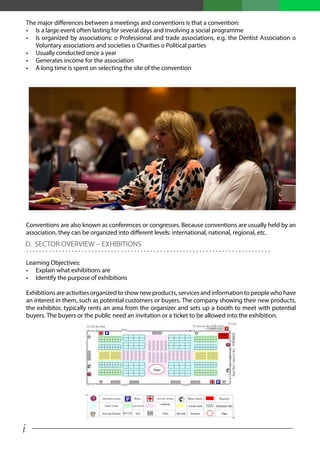
Exhibitions are activities organized to show new products, services and information to people who have
an interest in them, such as potential customers or buyers. The company showing their new products,
the exhibitor, typically rents an area from the organizer and sets up a booth to meet with potential
buyers. The buyers or the public need an invitation or a ticket to be allowed into the exhibition.
Conventions are also known as conferences or congresses. Because conventions are usually held by an
association, they can be organized into different levels: international, national, regional, etc.
ii
Value of MICE
Many cities would like to develop MICE because of the benefits MICE bring to a city.
•	 Higher expenditures – A business traveller usually spends on more than the average tourist, as they
stay in better hotels and dine at fine restaurants since they are meeting with business clients.
•	 Demand period occurs on low seasons – Many destinations have different travel seasons. Because
the business traveller travels to a destination with the main purpose of attending a MICE event,
the MICE event does not have to be scheduled during the peak season when most tourists tend to
travel. The business traveller can help the city by taking up some of the empty hotel rooms available
during off seasons.
•	 Stable arrangement well in advance – Usually the planning of a MICE event takes one to two years
in advance, and even three to five years for international events due to the number of participants
at the event. The event planners also need to book well before the event in order to select their
preferred rooms and venues. Repeat events also require a stable method of booking. If the book fair
goes well this year, the planner will book similar halls and rooms the year after.
•	 Large scale – Most MICE events may have a large number of attendees. An international convention
usually requires 500 hotel rooms per night and big conference rooms in the day. An exhibition,
either local or international, expects to have over thousands of attendees and requires several large
exhibition halls.
•	 Standardized services – All attendees for the same MICE event will have very similar requirements
as to service standards while similar MICE events would usually have similar programmes and thus
standardized services are required
•	 Enhance secondary businesses – Many suppliers are needed for MICE events. Booth set-up
companies and decoration experts are necessary for the exhibition. Entertainment agencies are
needed for incentive travel parties.
•	 Improve host city image – The city which holds the international MICE event can give travellers a
professional image
•	 Indifference to lack of tourism attractions – Business travellers travel primarily for the purpose of
attending a MICE event, not for the attractions of a destination. Even if a city does not have unique
attractions, it can still be chosen to hold an event due to other reasons, such as ease of access
•	 With no particular fixed destination, there is a free field for competition – Many MICE events are not
fixed on a host city or country. As long as a city has adequate MICE venues and facilities, it is possible
for the city to be selected to hold the event
•	 Using facilities for other purposes – Other than traditional venues such as exhibition centres or
conference halls, MICE events can make use of existing facilities that may originally have other
purposes, e.g. universities.
To be the most outstanding convention host ever to have organized a Kiwanis International convention
andforthe2015nationalconventiontobethemostmemorable,mosttechnologicallyefficientandmost
awe-inspiring event ever to be held anywhere in the country thru use of state-of-the-art equipment
and utilities.
ii

How to organize your event

  • 1.
    Organizer and Sponsor TOPIC Jl IKPNBintaro No 1, Pesanggrahan, Tanah Kusir, Jakarta, Special Capital Region of Jakarta 12330, Indonesia How to Organize Your Event
  • 2.
    i . . .. . . . . . . . . . . . . . . . . . . . . . . . . . . . . . . . . . . . . . . . . . . . . . . . . . . . . . . . . . . . . . . . . . . . . . . . A. SECTOR OVERVIEW—MEETINGS Learning Objectives: • Understand the meaning of each sector of MICE • Explain what meetings are • Identify the types of meetings In general, MICE events are events and activities that involve attendees who share a common interest and gather in a place. The place for the gathering needs to be a venue arranged before hand. The venue will provide space and facilities necessary to satisfy the needs of those who attend the gathering. We can further explain the gatherings by their different formats: M = Meetings (Corporate) I = Incentives C = Conventions (Association) E = Exhibitions MEETING Meetingsbringpeopletogetherinoneplaceforthepurposesofsharinginformationanddiscussingand solving problems. Meeting attendance can range from ten to thousands of people. During a meeting, there will usually be food and beverage served. Meeting times vary depending on the meeting type.
  • 3.
    ii Most of thetime, meetings refer to corporate meetings which are held by companies in the following ways: • Board meetings – Meetings of the board of the directors of a corporation, usually held annually • Management Meetings – The managers from different regions of a corporation meet when necessary to make decisions for the corporation • Shareholder Meetings – Investors who own a share in a company meet quarterly • Training Seminars – A company conducts these to train employees when needed • Meetings with partners, suppliers and clients – A gathering to discuss business deals, usually held . . . . . . . . . . . . . . . . . . . . . . . . . . . . . . . . . . . . . . . . . . . . . . . . . . . . . . . . . . . . . . . . . . . . . . . . . . . B. SECTOR OVERVIEW – INCENTIVES Learning Objectives: • Explain what incentives are • Get an overview of incentives development • Understand the factors behind incentive travel decisions Incentive travel is a management tool for rewarding and motivating sales representatives, dealers, distributors, production workers, support staff, and in some cases, customers. The company rewards sales representatives who reach sales targets by sending them on trips. Usually, the incentive trip will last three days, with hotel stays, tour packages and planned activities such as dinners, parties and games. The incentive travel market is mature in the U.S. and Europe, and is developing in Asia; especially in Singapore and Japan. Factors Behind Incentive Travel Decisions • Incentive budget economy – How strong is the economy in the country in which the sponsoring group is headquartered? • Buying power – Strength of the exchange rate in the countries being considered as the destination for the trip • Political climate – Terrorist alert levels after the 911 incident • Value - How do facilities and services compare with other choices of destination • Uniqueness of experience – Takes into consideration whether these participants have experienced this type of trip before . . . . . . . . . . . . . . . . . . . . . . . . . . . . . . . . . . . . . . . . . . . . . . . . . . . . . . . . . . . . . . . . . . . . . . . . . . . C. SECTOR OVERVIEW – CONVENTIONS Learning Objectives: • Explain what conventions are • Observe an example of a convention • Understand the difference between meetings and conventions Similar to meetings, conventions are gatherings of people with common objectives, organized to exchange ideas, views and information of common interest to the group. An organization, usually an association, will organize a convention each year with a theme related to the organization’s topic. Those interested in registering for the convention can pay the association a fee for all the sessions, discussions, food and beverage, dinners, and site visits.
  • 4.
    i The major differencesbetween a meetings and conventions is that a convention: • Is a large event often lasting for several days and involving a social programme • Is organized by associations: o Professional and trade associations, e.g. the Dentist Association o Voluntary associations and societies o Charities o Political parties • Usually conducted once a year • Generates income for the association • A long time is spent on selecting the site of the convention . . . . . . . . . . . . . . . . . . . . . . . . . . . . . . . . . . . . . . . . . . . . . . . . . . . . . . . . . . . . . . . . . . . . . . . . . . . D. SECTOR OVERVIEW – EXHIBITIONS Learning Objectives: • Explain what exhibitions are • Identify the purpose of exhibitions Exhibitions are activities organized to show new products, services and information to people who have an interest in them, such as potential customers or buyers. The company showing their new products, the exhibitor, typically rents an area from the organizer and sets up a booth to meet with potential buyers. The buyers or the public need an invitation or a ticket to be allowed into the exhibition. Conventions are also known as conferences or congresses. Because conventions are usually held by an association, they can be organized into different levels: international, national, regional, etc.
  • 5.
    ii Value of MICE Manycities would like to develop MICE because of the benefits MICE bring to a city. • Higher expenditures – A business traveller usually spends on more than the average tourist, as they stay in better hotels and dine at fine restaurants since they are meeting with business clients. • Demand period occurs on low seasons – Many destinations have different travel seasons. Because the business traveller travels to a destination with the main purpose of attending a MICE event, the MICE event does not have to be scheduled during the peak season when most tourists tend to travel. The business traveller can help the city by taking up some of the empty hotel rooms available during off seasons. • Stable arrangement well in advance – Usually the planning of a MICE event takes one to two years in advance, and even three to five years for international events due to the number of participants at the event. The event planners also need to book well before the event in order to select their preferred rooms and venues. Repeat events also require a stable method of booking. If the book fair goes well this year, the planner will book similar halls and rooms the year after. • Large scale – Most MICE events may have a large number of attendees. An international convention usually requires 500 hotel rooms per night and big conference rooms in the day. An exhibition, either local or international, expects to have over thousands of attendees and requires several large exhibition halls. • Standardized services – All attendees for the same MICE event will have very similar requirements as to service standards while similar MICE events would usually have similar programmes and thus standardized services are required • Enhance secondary businesses – Many suppliers are needed for MICE events. Booth set-up companies and decoration experts are necessary for the exhibition. Entertainment agencies are needed for incentive travel parties. • Improve host city image – The city which holds the international MICE event can give travellers a professional image • Indifference to lack of tourism attractions – Business travellers travel primarily for the purpose of attending a MICE event, not for the attractions of a destination. Even if a city does not have unique attractions, it can still be chosen to hold an event due to other reasons, such as ease of access • With no particular fixed destination, there is a free field for competition – Many MICE events are not fixed on a host city or country. As long as a city has adequate MICE venues and facilities, it is possible for the city to be selected to hold the event • Using facilities for other purposes – Other than traditional venues such as exhibition centres or conference halls, MICE events can make use of existing facilities that may originally have other purposes, e.g. universities. To be the most outstanding convention host ever to have organized a Kiwanis International convention andforthe2015nationalconventiontobethemostmemorable,mosttechnologicallyefficientandmost awe-inspiring event ever to be held anywhere in the country thru use of state-of-the-art equipment and utilities.
  • 6.