Nature of Tourism Development Plan
What’s the way
to approach &
convince my
best targets?
Who am
I?
What is my
mission?
Who are
they?
What do
they want?
How can I get
to know them
better?
How can I
reach them?
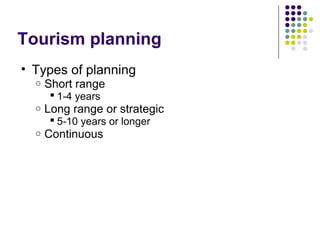
Tourism planning
• Types of planning
o Short range
 1-4 years
o Long range or strategic
 5-10 years or longer
o Continuous
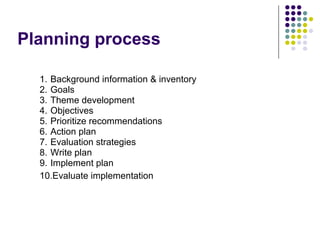
Planning process
1. Background information & inventory
2. Goals
3. Theme development
4. Objectives
5. Prioritize recommendations
6. Action plan
7. Evaluation strategies
8. Write plan
9. Implement plan
10.Evaluate implementation
1. Background information & inventory
2. Goals
3. Theme development
4. Objectives
5. Prioritize recommendations
6. Action plan
7. Evaluation strategies
8. Write plan
9. Implement plan
10.Evaluate implementation
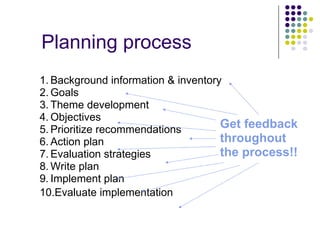
Planning process
Get feedback
throughout
the process!!
Planning process
Adapt it for your
planning area!!
1. Background information & inventory
2. Goals
3. Theme development
4. Objectives
5. Prioritize recommendations
6. Action plan
7. Evaluation strategies
8. Write plan
9. Implement plan
10.Evaluate implementation
1. Background Information
• Issues & constraints
• Concerns of residents
• Inventory
• Marketing analysis
• Local decision makers, government agencies,
& NGOs to be involved
Example: Issues & constraints
Potential & existing issues/constraints:
• Environmental impacts
• Social impacts
• Economic impacts
What are some existing issues and
constraints for the Town of Eden?
Example: Resident concerns
• Protecting and improving water quality
• Maintaining small town atmosphere
• Protecting natural & cultural resources
• Developing a sustainable economy
What are some concerns of residents of the
Town of Eden?
Example: Inventory
• Resources
• Attractions
• Facilities & services
Example: Marketing analysis
• Market identification
o Visitor interests & needs
o Group composition
o Visitor area of origin
o Education
o Gender
o Length of stay
Example: Marketing analysis
• Market position
o What is the market position of the Town of Eden?
Example: Public participation
Who are the following for Eden?
• Local decision makers
• Government agencies
• Non-governmental organizations
• Residents
2. Goals
• The end product resulting from
implementation of the tourism plan.
• Goals should be:
o Specific
o Attainable
o Feasible
3. Theme development
• The concept or idea that...
o unifies the attractions and resources in an area
AND
o that you want visitors to leave with.
• Themes are written in sentence format and
are used for staff purposes only!
• The theme should reflect the marketing
position.
Example: Theme
• Central New York is a rich and dynamic
mixture of landscape narratives that reveal
opportunities for an individual and collective
sense of belonging, understanding,
stewardship, and celebration of the evolving
natural world.
CNE theme
4. Objectives
• Objectives = Recommendations
• Statements that clearly identify how goals
will be accomplished.
• Objective statements should include
WHO - WHAT- WHERE - WHEN - WHY
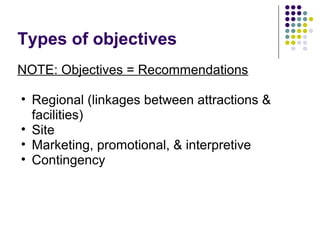
Types of objectives
NOTE: Objectives = Recommendations
• Regional (linkages between attractions &
facilities)
• Site
• Marketing, promotional, & interpretive
• Contingency
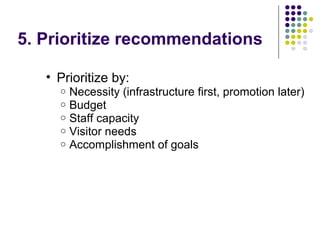
5. Prioritize recommendations
• Prioritize by:
o Necessity (infrastructure first, promotion later)
o Budget
o Staff capacity
o Visitor needs
o Accomplishment of goals
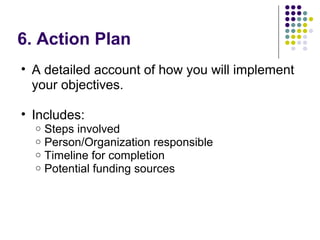
6. Action Plan
• A detailed account of how you will implement
your objectives.
• Includes:
o Steps involved
o Person/Organization responsible
o Timeline for completion
o Potential funding sources
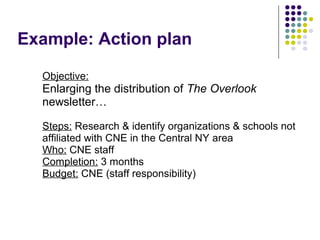
Example: Action plan
Objective:
Enlarging the distribution of The Overlook
newsletter…
Steps: Research & identify organizations & schools not
affiliated with CNE in the Central NY area
Who: CNE staff
Completion: 3 months
Budget: CNE (staff responsibility)
7. Identify evaluation strategies
• Identify evaluation & monitoring strategies
before plan is implemented!
8. Write plan
• Introduction
• Area assessment & enhancement
• Facility/service assessment & enhancement
• Marketing, promotions, & interpretation
• Evaluation
• Public participation & support
• Recommendations
• Conclusion
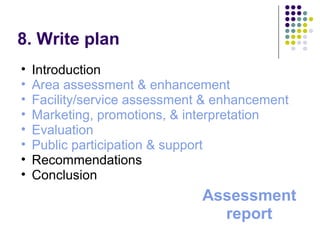
8. Write plan
• Introduction
• Area assessment & enhancement
• Facility/service assessment & enhancement
• Marketing, promotions, & interpretation
• Evaluation
• Public participation & support
• Recommendations
• Conclusion
Assessment
report
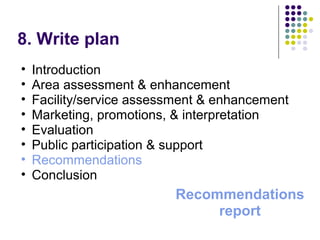
8. Write plan
• Introduction
• Area assessment & enhancement
• Facility/service assessment & enhancement
• Marketing, promotions, & interpretation
• Evaluation
• Public participation & support
• Recommendations
• Conclusion
Recommendations
report
9. Implementation
• The hardest step of the planning process!
• What holds up implementation?
o Budget constraints
o Time constraints
o Lack of staff or volunteers
o Lack of leadership
o Political issues
10. Evaluate implementation
• Use evaluation strategies identified in step
7 to monitor & evaluate the implementation
of plan.
• Evaluation should occur at scheduled
intervals (e.g., every 3 years).
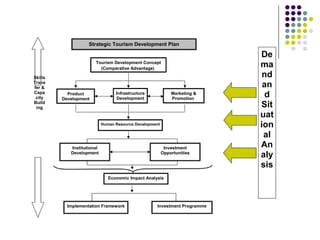
Strategic Tourism Development Plan
Product
Development
Infrastructure
Development
Marketing &
Promotion
Tourism Development Concept
(Comparative Advantage)
Human Resource Development
Skills
Trans
fer &
Capa
city
Build
ing
Institutional
Development
Investment
Opportunities
Implementation Framework
Economic Impact Analysis
Investment Programme
De
ma
nd
an
d
Sit
uat
ion
al
An
aly
sis

Writing tourism development plan

  • 1.
    Nature of TourismDevelopment Plan
  • 2.
    What’s the way toapproach & convince my best targets? Who am I? What is my mission? Who are they? What do they want? How can I get to know them better? How can I reach them?
  • 3.
    Tourism planning • Typesof planning o Short range  1-4 years o Long range or strategic  5-10 years or longer o Continuous
  • 4.
    Planning process 1. Backgroundinformation & inventory 2. Goals 3. Theme development 4. Objectives 5. Prioritize recommendations 6. Action plan 7. Evaluation strategies 8. Write plan 9. Implement plan 10.Evaluate implementation
  • 5.
    1. Background information& inventory 2. Goals 3. Theme development 4. Objectives 5. Prioritize recommendations 6. Action plan 7. Evaluation strategies 8. Write plan 9. Implement plan 10.Evaluate implementation Planning process Get feedback throughout the process!!
  • 6.
    Planning process Adapt itfor your planning area!! 1. Background information & inventory 2. Goals 3. Theme development 4. Objectives 5. Prioritize recommendations 6. Action plan 7. Evaluation strategies 8. Write plan 9. Implement plan 10.Evaluate implementation
  • 7.
    1. Background Information •Issues & constraints • Concerns of residents • Inventory • Marketing analysis • Local decision makers, government agencies, & NGOs to be involved
  • 8.
    Example: Issues &constraints Potential & existing issues/constraints: • Environmental impacts • Social impacts • Economic impacts What are some existing issues and constraints for the Town of Eden?
  • 9.
    Example: Resident concerns •Protecting and improving water quality • Maintaining small town atmosphere • Protecting natural & cultural resources • Developing a sustainable economy What are some concerns of residents of the Town of Eden?
  • 10.
    Example: Inventory • Resources •Attractions • Facilities & services
  • 11.
    Example: Marketing analysis •Market identification o Visitor interests & needs o Group composition o Visitor area of origin o Education o Gender o Length of stay
  • 12.
    Example: Marketing analysis •Market position o What is the market position of the Town of Eden?
  • 13.
    Example: Public participation Whoare the following for Eden? • Local decision makers • Government agencies • Non-governmental organizations • Residents
  • 14.
    2. Goals • Theend product resulting from implementation of the tourism plan. • Goals should be: o Specific o Attainable o Feasible
  • 15.
    3. Theme development •The concept or idea that... o unifies the attractions and resources in an area AND o that you want visitors to leave with. • Themes are written in sentence format and are used for staff purposes only! • The theme should reflect the marketing position.
  • 16.
    Example: Theme • CentralNew York is a rich and dynamic mixture of landscape narratives that reveal opportunities for an individual and collective sense of belonging, understanding, stewardship, and celebration of the evolving natural world. CNE theme
  • 17.
    4. Objectives • Objectives= Recommendations • Statements that clearly identify how goals will be accomplished. • Objective statements should include WHO - WHAT- WHERE - WHEN - WHY
  • 18.
    Types of objectives NOTE:Objectives = Recommendations • Regional (linkages between attractions & facilities) • Site • Marketing, promotional, & interpretive • Contingency
  • 19.
    5. Prioritize recommendations •Prioritize by: o Necessity (infrastructure first, promotion later) o Budget o Staff capacity o Visitor needs o Accomplishment of goals
  • 20.
    6. Action Plan •A detailed account of how you will implement your objectives. • Includes: o Steps involved o Person/Organization responsible o Timeline for completion o Potential funding sources
  • 21.
    Example: Action plan Objective: Enlargingthe distribution of The Overlook newsletter… Steps: Research & identify organizations & schools not affiliated with CNE in the Central NY area Who: CNE staff Completion: 3 months Budget: CNE (staff responsibility)
  • 22.
    7. Identify evaluationstrategies • Identify evaluation & monitoring strategies before plan is implemented!
  • 23.
    8. Write plan •Introduction • Area assessment & enhancement • Facility/service assessment & enhancement • Marketing, promotions, & interpretation • Evaluation • Public participation & support • Recommendations • Conclusion
  • 24.
    8. Write plan •Introduction • Area assessment & enhancement • Facility/service assessment & enhancement • Marketing, promotions, & interpretation • Evaluation • Public participation & support • Recommendations • Conclusion Assessment report
  • 25.
    8. Write plan •Introduction • Area assessment & enhancement • Facility/service assessment & enhancement • Marketing, promotions, & interpretation • Evaluation • Public participation & support • Recommendations • Conclusion Recommendations report
  • 26.
    9. Implementation • Thehardest step of the planning process! • What holds up implementation? o Budget constraints o Time constraints o Lack of staff or volunteers o Lack of leadership o Political issues
  • 27.
    10. Evaluate implementation •Use evaluation strategies identified in step 7 to monitor & evaluate the implementation of plan. • Evaluation should occur at scheduled intervals (e.g., every 3 years).
  • 28.
    Strategic Tourism DevelopmentPlan Product Development Infrastructure Development Marketing & Promotion Tourism Development Concept (Comparative Advantage) Human Resource Development Skills Trans fer & Capa city Build ing Institutional Development Investment Opportunities Implementation Framework Economic Impact Analysis Investment Programme De ma nd an d Sit uat ion al An aly sis