Scope forExpansion
Inability to move large volumes of tourists to other parts of the
Philippines outside the NCR;
Lack of trained human resources at the required standard and
quantity;
Institutional overlap and human resources shortages in the
tourism planning, development, financing, and management
area;
Strong competition for public and private sector finance;
Land use planning and development policies that make it
difficult to readily develop large resort estates;
Unpredictable events such as earthquakes, volcanic
eruptions, regional conflicts, internal political disputes and
insurgency.
Philippine Tourism Master
Plan
1991 - 2010
Goals and Objectives
Optimize the contribution of tourism to economic growth at the
national and local levels;
Enhance and contribute to social cohesion and cultural
preservation at a local level;
Develop tourism on an environmentally sustainble basis; and
Develop DIVERSITY of destinations, attractions and markets
to minimize exposure to major internal and external threats to
tourism activity.
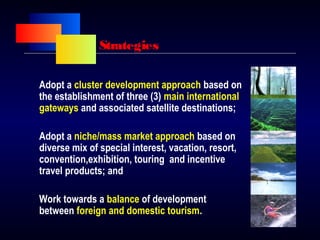
Strategies
Adopt a cluster development approach based on
the establishment of three (3) main international
gateways and associated satellite destinations;
Adopt a niche/mass market approach based on
diverse mix of special interest, vacation, resort,
convention,exhibition, touring and incentive
travel products; and
Work towards a balance of development
between foreign and domestic tourism.
TMPPolicies
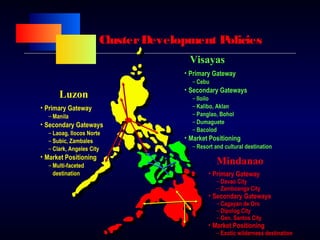
ClusterDevelopment Policies
• Primary Gateway
– Manila
• Secondary Gateways
– Laoag, Ilocos Norte
– Subic, Zambales
– Clark, Angeles City
• Market Positioning
– Multi-faceted
destination
• Primary Gateway
– Cebu
• Secondary Gateways
– Iloilo
– Kalibo, Aklan
– Panglao, Bohol
– Dumaguete
– Bacolod
• Market Positioning
– Resort and cultural destination
• Primary Gateway
– Davao City
– Zamboanga City
• Secondary Gateways
– Cagayan de Oro
– Dipolog City
– Gen. Santos City
• Market Positioning
– Exotic wilderness destination
Luzon
Visayas
Mindanao
Accommodation
Development Policies
Provision of incentives to encourage upgrading and
development of accommodation outside the NCR within the
recommended satellite destinations;
Create major resort estates in the Visayas and Mindanao
clusters as well as the northern part of Luzon cluster; and
Provision of transportation infrastructure and services with
the development of proposed resort estates.
AirTransportation Policies
Adopt a more flexible approach to approving inbound air inclusive
charters and provision of scheduled air services on the part of
other carriers;
Designate other domestic and international carriers to service
secondary airports in the Philippines;
Expand domestic and international terminal facilities at the main
gateways to handle growth; and
De-regulate the economics of domestic air operation and
introduce greater competition on all domestic routes.
Sea and Land (Road and Rail)
Transportation Policies
Upgrade and develop road connections between air and
sea ports and centers of tourism activity;
Develop inter-island cruising activities for foreign
markets and improve the quality of domestic ferry
services;
Upgrade rail systems.
Domestic Marketing Policies
Formulate and implement a major domestic marketing
program to include
Market segmentation research
Packaging a range of “Special Offers”
Mounting a major promotional campaign
Strengthen existing programs designed to promote
domestic tourism (Pasyal/Lakbay Aral, Fly Now Pay Later)
Foreign Marketing Policies
Overcome loss of confidence on the safety and security of the
Philippines in key markets through:
Showing positive and wholesome side of tourism
Promoting tourism’s “Good Value”
Providing “Special Offers”
Repositioning and repackaging existing destinations
Market the Philippines in primary markets through:
Projecting the Philippines as a major and revived destination
Establishing new brand identities (“wow factor”)
Marketing newly developed resort areas
Product Development
Policies
Focus on one or two attractions in each gateway location;
Create at least one “must-see” attraction close to each cluster/ gateway;
Improve access to, and information on, existing tourism products;
Improve standards of existing tour products and programs;
Develop additional day visitor activities at destination areas;
Improve reliability of domestic transportation services; and
Create new resort, special interests and tour products based on the
unique competitive features of the Philippines (“only in the Phils.”)
ManpowerTraining Policies
Establish a Tourism Industry Training Board;
Establish regional training centers in Metro Manila, Baguio,
Cebu and Davao;
Establish an internationally acceptable standard setting and
certification program; and
Establish a faculty/ trainor development program.
Development Standards
and Guidelines
Suitability study based on location, land use, social values,
landscape and the environment;
Assessment of the capacity and density standards;
Site planning standards related to earthworks, roads, parking,
construction works and landscape protection;
Housing standards based on style, building heights, setbacks
and materials; and
Utility standards for solid waste disposal, sewage treatment,
power, water, drainage, fire and communications
TMPPrograms
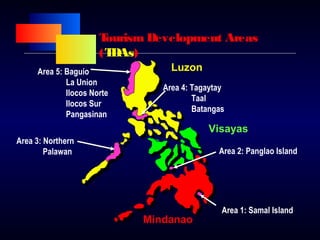
Tourism Development Areas
(TDAs)
Luzon
Visayas
Mindanao
Area 1: Samal Island
Area 2: Panglao Island
Area 3: Northern
Palawan
Area 4: Tagaytay
Taal
Batangas
Area 5: Baguio
La Union
Ilocos Norte
Ilocos Sur
Pangasinan
Transportation and
Infrastructure Program
Domestic Air Services
Deregulate the domestic air transportation sector
Simplify the granting of operating franchise
Develop a centralized computer booking, reservation and
ticketing system
Increase utilization, capacity and frequency of services
International Air Services
Privatize the Philippine Airlines
Develop consensus building for the adoption of more
flexible and competitive approach to air transport
operation
Establish a second Philippine carrier
Include the DOT in the negotiating panels for routes
Secure a seat in the CAB as Vice-Chairperson
Transportation and
Infrastructure Program
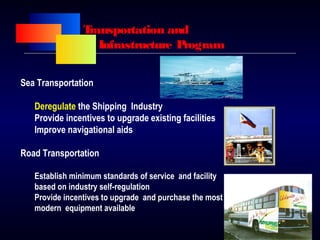
Sea Transportation
Deregulate the Shipping Industry
Provide incentives to upgrade existing facilities
Improve navigational aids
Road Transportation
Establish minimum standards of service and facility
based on industry self-regulation
Provide incentives to upgrade and purchase the most
modern equipment available
Transportation and
Infrastructure Program
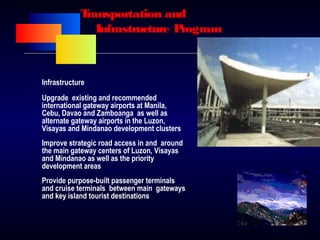
Infrastructure
Upgrade existing and recommended
international gateway airports at Manila,
Cebu, Davao and Zamboanga as well as
alternate gateway airports in the Luzon,
Visayas and Mindanao development clusters
Improve strategic road access in and around
the main gateway centers of Luzon, Visayas
and Mindanao as well as the priority
development areas
Provide purpose-built passenger terminals
and cruise terminals between main gateways
and key island tourist destinations
Marketing and Product
Development Program
Develop marketing programs
Domestic market
Foreign market
Undertake product development
Product enhancement
Product diversification
Product-Market matching
Human Resources
Training Programs
Establish the policy framework
Develop training programs
Trainers
Trainees
Develop training standards and
certification
Establish regional training centers
OtherPrograms
Prepare environmental protection and management
programs
Implement socio-cultural impact assessment studies
Define projects/programs with high economic linkages
Handicraft improvement
Local competitions
Support to local businesses
OtherPrograms
Coordinate and implement land and land use programs
Establish development standards and guidelines
Establish international affiliations
World Tourism Organization
East Asian Travel Association
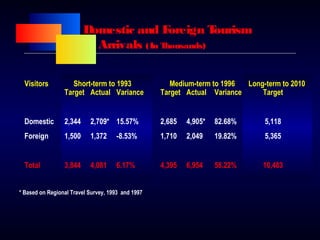
Domestic and Foreign Tourism
Arrivals (In Thousands)
Visitors Short-term to 1993 Medium-term to 1996 Long-term to 2010
Target Actual Variance Target Actual Variance Target
Domestic 2,344 2,709* 15.57% 2,685 4,905* 82.68% 5,118
Foreign 1,500 1,372 -8.53% 1,710 2,049 19.82% 5,365
Total 3,844 4,081 6.17% 4,395 6,954 58.22% 10,483
* Based on Regional Travel Survey, 1993 and 1997
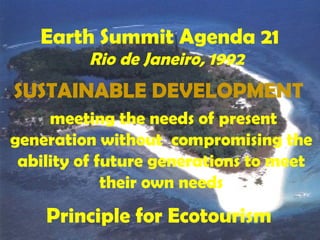
Earth Summit Agenda 21
SUSTAINABLE DEVELOPMENT
meeting the needs of present
generation without compromising the
ability of future generations to meet
their own needs
Principle for Ecotourism
Rio de Janeiro, 1992
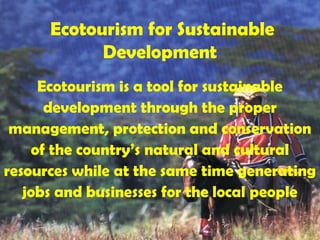
Ecotourism for Sustainable
Development
Ecotourism is a tool for sustainable
development through the proper
management, protection and conservation
of the country’s natural and cultural
resources while at the same time generating
jobs and businesses for the local people
What is ecotourism?
According to the Joint Memorandum Circular No.
98-02 of the Department of Tourism and the
Department of Environment and Natural
Resources, through the Protected Areas and
Wildlife Bureau:
“ecotourism is a low impact,
environmentally-sound and community-
participatory tourism activity in a given
natural environment that enhances the
conservation of biophysical and cultural
diversity, promotes environmental
understanding and education, and yields
socio-economic benefits to the concerned
Launching a
Marine Life Tour
in the
Philippines
Department of Tourism
Philippines
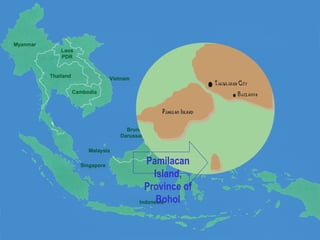
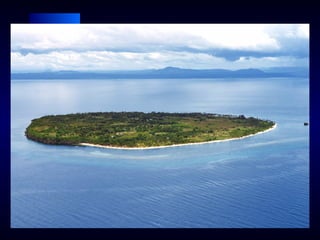
Pamilacan
Island,
Province of
Bohol
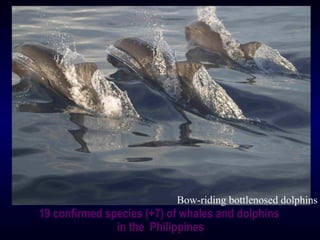
19 confirmed species (+7) of whales and dolphins
in the Philippines
Bow-riding bottlenosed dolphins
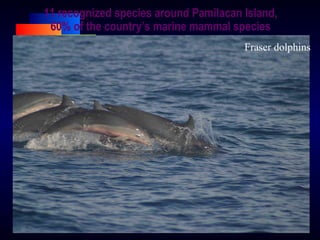
11 recognized species around Pamilacan Island,
60% of the country’s marine mammal species
Fraser dolphins
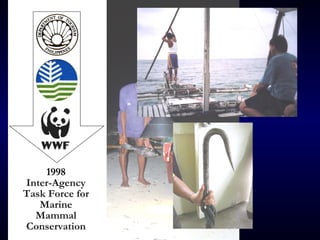
• 8 whales at US$300–600 each
• 100 whalesharks at US$ 2000-3000 each
• countless dolphins at US$10-15 each
Average volumes hunted in a season (1992-93)
The decline in the frequency of marine mammals sightings in
the mid-1990s was a sign that their volumes were waning.
1998
Inter-Agency
Task Force for
Marine
Mammal
Conservation
Pamilacan Island Dolphin and
Whale Watching Organization
(PIDWWO)
 4 officers
 144 members
= 80 families
System of Operation:
Rotation of members who
acted as tour crew
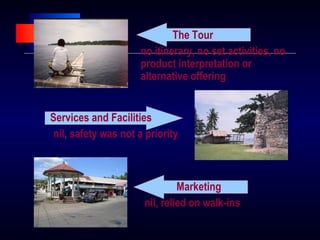
The Tour
no itinerary, no set activities, no
product interpretation or
alternative offering
Services and Facilities
nil, safety was not a priority
Marketing
nil, relied on walk-ins
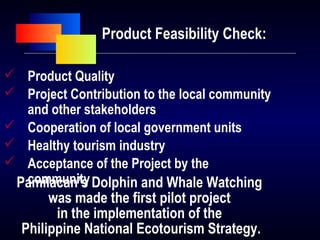
Product Feasibility Check:
 Product Quality
 Project Contribution to the local community
and other stakeholders
 Cooperation of local government units
 Healthy tourism industry
 Acceptance of the Project by the
communityPamilacan’s Dolphin and Whale Watching
was made the first pilot project
in the implementation of the
Philippine National Ecotourism Strategy.
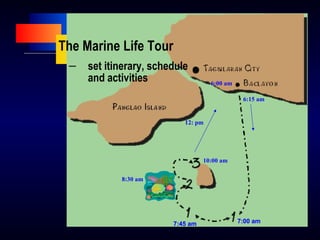
The Marine Life Tour
6:00 am
8:30 am
10:00 am
6:15 am
12: pm
7:00 am7:45 am 7:00 am7:45 am
― set itinerary, schedule
and activities
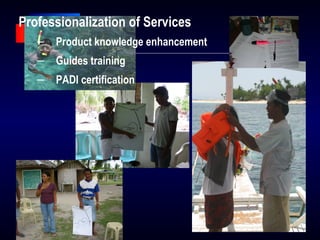
Professionalization of Services
― Product knowledge enhancement
― Guides training
― PADI certification
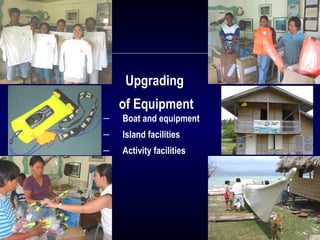
Upgrading
of Equipment
― Boat and equipment
― Island facilities
― Activity facilities
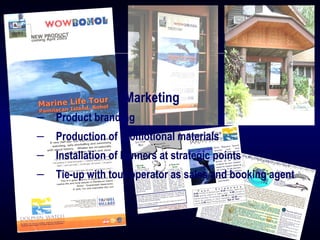
Marketing
― Product branding
― Production of promotional materials
― Installation of banners at strategic points
― Tie-up with tour operator as sales and booking agent
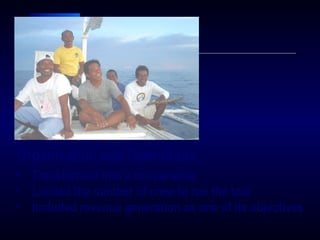
Organization and Operations
 Transformed into a cooperative
 Limited the number of crew to run the tour
 Included revenue generation as one of its objectives
PIDWWO’s Business Plan:
Focuses on programmed contributions to community
endeavors and village requirements
 Largest contributor to the local government unit’s
environmental fund
 Installation of mooring buoys
 Plan 1: start-up of secondary/support businesses
 Plan 2: hiring of an island physician
PIDWWO’s Contribution to the Industry
and to the Environment
Guidelines on Tourist Safety in the Waters
Guidelines on Cetacean Interaction
(in aid of legislation)
• guidelines are to be passed as ordinances
with compliance requisites and violation
penalty implementing procedures
• after testing period within locality, guidelines
are to be elevated to national level
Lessons Learned:
• An ecotourism project benefits the entire community, but
not necessarily hires the entire community.
• Ecotourism is not for all sites or peoples. Cooperation
among all sectors is of utmost importance.
• Ecotourism is not all advocacy but food for the family.
Launching a
Marine Life Tour
in the
Philippines
Thank you
and
Mabuhay!

Philippine Tourism Master Plan

  • 1.
    Scope forExpansion Inability tomove large volumes of tourists to other parts of the Philippines outside the NCR; Lack of trained human resources at the required standard and quantity; Institutional overlap and human resources shortages in the tourism planning, development, financing, and management area; Strong competition for public and private sector finance; Land use planning and development policies that make it difficult to readily develop large resort estates; Unpredictable events such as earthquakes, volcanic eruptions, regional conflicts, internal political disputes and insurgency.
  • 2.
  • 3.
    Goals and Objectives Optimizethe contribution of tourism to economic growth at the national and local levels; Enhance and contribute to social cohesion and cultural preservation at a local level; Develop tourism on an environmentally sustainble basis; and Develop DIVERSITY of destinations, attractions and markets to minimize exposure to major internal and external threats to tourism activity.
  • 4.
    Strategies Adopt a clusterdevelopment approach based on the establishment of three (3) main international gateways and associated satellite destinations; Adopt a niche/mass market approach based on diverse mix of special interest, vacation, resort, convention,exhibition, touring and incentive travel products; and Work towards a balance of development between foreign and domestic tourism.
  • 5.
  • 6.
    ClusterDevelopment Policies • PrimaryGateway – Manila • Secondary Gateways – Laoag, Ilocos Norte – Subic, Zambales – Clark, Angeles City • Market Positioning – Multi-faceted destination • Primary Gateway – Cebu • Secondary Gateways – Iloilo – Kalibo, Aklan – Panglao, Bohol – Dumaguete – Bacolod • Market Positioning – Resort and cultural destination • Primary Gateway – Davao City – Zamboanga City • Secondary Gateways – Cagayan de Oro – Dipolog City – Gen. Santos City • Market Positioning – Exotic wilderness destination Luzon Visayas Mindanao
  • 7.
    Accommodation Development Policies Provision ofincentives to encourage upgrading and development of accommodation outside the NCR within the recommended satellite destinations; Create major resort estates in the Visayas and Mindanao clusters as well as the northern part of Luzon cluster; and Provision of transportation infrastructure and services with the development of proposed resort estates.
  • 8.
    AirTransportation Policies Adopt amore flexible approach to approving inbound air inclusive charters and provision of scheduled air services on the part of other carriers; Designate other domestic and international carriers to service secondary airports in the Philippines; Expand domestic and international terminal facilities at the main gateways to handle growth; and De-regulate the economics of domestic air operation and introduce greater competition on all domestic routes.
  • 9.
    Sea and Land(Road and Rail) Transportation Policies Upgrade and develop road connections between air and sea ports and centers of tourism activity; Develop inter-island cruising activities for foreign markets and improve the quality of domestic ferry services; Upgrade rail systems.
  • 10.
    Domestic Marketing Policies Formulateand implement a major domestic marketing program to include Market segmentation research Packaging a range of “Special Offers” Mounting a major promotional campaign Strengthen existing programs designed to promote domestic tourism (Pasyal/Lakbay Aral, Fly Now Pay Later)
  • 11.
    Foreign Marketing Policies Overcomeloss of confidence on the safety and security of the Philippines in key markets through: Showing positive and wholesome side of tourism Promoting tourism’s “Good Value” Providing “Special Offers” Repositioning and repackaging existing destinations Market the Philippines in primary markets through: Projecting the Philippines as a major and revived destination Establishing new brand identities (“wow factor”) Marketing newly developed resort areas
  • 12.
    Product Development Policies Focus onone or two attractions in each gateway location; Create at least one “must-see” attraction close to each cluster/ gateway; Improve access to, and information on, existing tourism products; Improve standards of existing tour products and programs; Develop additional day visitor activities at destination areas; Improve reliability of domestic transportation services; and Create new resort, special interests and tour products based on the unique competitive features of the Philippines (“only in the Phils.”)
  • 13.
    ManpowerTraining Policies Establish aTourism Industry Training Board; Establish regional training centers in Metro Manila, Baguio, Cebu and Davao; Establish an internationally acceptable standard setting and certification program; and Establish a faculty/ trainor development program.
  • 14.
    Development Standards and Guidelines Suitabilitystudy based on location, land use, social values, landscape and the environment; Assessment of the capacity and density standards; Site planning standards related to earthworks, roads, parking, construction works and landscape protection; Housing standards based on style, building heights, setbacks and materials; and Utility standards for solid waste disposal, sewage treatment, power, water, drainage, fire and communications
  • 18.
  • 19.
    Tourism Development Areas (TDAs) Luzon Visayas Mindanao Area1: Samal Island Area 2: Panglao Island Area 3: Northern Palawan Area 4: Tagaytay Taal Batangas Area 5: Baguio La Union Ilocos Norte Ilocos Sur Pangasinan
  • 20.
    Transportation and Infrastructure Program DomesticAir Services Deregulate the domestic air transportation sector Simplify the granting of operating franchise Develop a centralized computer booking, reservation and ticketing system Increase utilization, capacity and frequency of services International Air Services Privatize the Philippine Airlines Develop consensus building for the adoption of more flexible and competitive approach to air transport operation Establish a second Philippine carrier Include the DOT in the negotiating panels for routes Secure a seat in the CAB as Vice-Chairperson
  • 21.
    Transportation and Infrastructure Program SeaTransportation Deregulate the Shipping Industry Provide incentives to upgrade existing facilities Improve navigational aids Road Transportation Establish minimum standards of service and facility based on industry self-regulation Provide incentives to upgrade and purchase the most modern equipment available
  • 22.
    Transportation and Infrastructure Program Infrastructure Upgradeexisting and recommended international gateway airports at Manila, Cebu, Davao and Zamboanga as well as alternate gateway airports in the Luzon, Visayas and Mindanao development clusters Improve strategic road access in and around the main gateway centers of Luzon, Visayas and Mindanao as well as the priority development areas Provide purpose-built passenger terminals and cruise terminals between main gateways and key island tourist destinations
  • 23.
    Marketing and Product DevelopmentProgram Develop marketing programs Domestic market Foreign market Undertake product development Product enhancement Product diversification Product-Market matching
  • 25.
    Human Resources Training Programs Establishthe policy framework Develop training programs Trainers Trainees Develop training standards and certification Establish regional training centers
  • 26.
    OtherPrograms Prepare environmental protectionand management programs Implement socio-cultural impact assessment studies Define projects/programs with high economic linkages Handicraft improvement Local competitions Support to local businesses
  • 27.
    OtherPrograms Coordinate and implementland and land use programs Establish development standards and guidelines Establish international affiliations World Tourism Organization East Asian Travel Association
  • 28.
    Domestic and ForeignTourism Arrivals (In Thousands) Visitors Short-term to 1993 Medium-term to 1996 Long-term to 2010 Target Actual Variance Target Actual Variance Target Domestic 2,344 2,709* 15.57% 2,685 4,905* 82.68% 5,118 Foreign 1,500 1,372 -8.53% 1,710 2,049 19.82% 5,365 Total 3,844 4,081 6.17% 4,395 6,954 58.22% 10,483 * Based on Regional Travel Survey, 1993 and 1997
  • 29.
    Earth Summit Agenda21 SUSTAINABLE DEVELOPMENT meeting the needs of present generation without compromising the ability of future generations to meet their own needs Principle for Ecotourism Rio de Janeiro, 1992
  • 30.
    Ecotourism for Sustainable Development Ecotourismis a tool for sustainable development through the proper management, protection and conservation of the country’s natural and cultural resources while at the same time generating jobs and businesses for the local people
  • 31.
    What is ecotourism? Accordingto the Joint Memorandum Circular No. 98-02 of the Department of Tourism and the Department of Environment and Natural Resources, through the Protected Areas and Wildlife Bureau: “ecotourism is a low impact, environmentally-sound and community- participatory tourism activity in a given natural environment that enhances the conservation of biophysical and cultural diversity, promotes environmental understanding and education, and yields socio-economic benefits to the concerned
  • 32.
    Launching a Marine LifeTour in the Philippines Department of Tourism Philippines
  • 33.
  • 35.
    19 confirmed species(+7) of whales and dolphins in the Philippines Bow-riding bottlenosed dolphins
  • 36.
    11 recognized speciesaround Pamilacan Island, 60% of the country’s marine mammal species Fraser dolphins
  • 37.
    • 8 whalesat US$300–600 each • 100 whalesharks at US$ 2000-3000 each • countless dolphins at US$10-15 each Average volumes hunted in a season (1992-93)
  • 38.
    The decline inthe frequency of marine mammals sightings in the mid-1990s was a sign that their volumes were waning.
  • 39.
  • 40.
    Pamilacan Island Dolphinand Whale Watching Organization (PIDWWO)  4 officers  144 members = 80 families System of Operation: Rotation of members who acted as tour crew
  • 41.
    The Tour no itinerary,no set activities, no product interpretation or alternative offering Services and Facilities nil, safety was not a priority Marketing nil, relied on walk-ins
  • 42.
    Product Feasibility Check: Product Quality  Project Contribution to the local community and other stakeholders  Cooperation of local government units  Healthy tourism industry  Acceptance of the Project by the communityPamilacan’s Dolphin and Whale Watching was made the first pilot project in the implementation of the Philippine National Ecotourism Strategy.
  • 43.
    The Marine LifeTour 6:00 am 8:30 am 10:00 am 6:15 am 12: pm 7:00 am7:45 am 7:00 am7:45 am ― set itinerary, schedule and activities
  • 44.
    Professionalization of Services ―Product knowledge enhancement ― Guides training ― PADI certification
  • 45.
    Upgrading of Equipment ― Boatand equipment ― Island facilities ― Activity facilities
  • 46.
    Marketing ― Product branding ―Production of promotional materials ― Installation of banners at strategic points ― Tie-up with tour operator as sales and booking agent
  • 47.
    Organization and Operations Transformed into a cooperative  Limited the number of crew to run the tour  Included revenue generation as one of its objectives
  • 48.
    PIDWWO’s Business Plan: Focuseson programmed contributions to community endeavors and village requirements  Largest contributor to the local government unit’s environmental fund  Installation of mooring buoys  Plan 1: start-up of secondary/support businesses  Plan 2: hiring of an island physician
  • 49.
    PIDWWO’s Contribution tothe Industry and to the Environment Guidelines on Tourist Safety in the Waters Guidelines on Cetacean Interaction (in aid of legislation) • guidelines are to be passed as ordinances with compliance requisites and violation penalty implementing procedures • after testing period within locality, guidelines are to be elevated to national level
  • 50.
    Lessons Learned: • Anecotourism project benefits the entire community, but not necessarily hires the entire community. • Ecotourism is not for all sites or peoples. Cooperation among all sectors is of utmost importance. • Ecotourism is not all advocacy but food for the family.
  • 51.
    Launching a Marine LifeTour in the Philippines Thank you and Mabuhay!

Editor's Notes

  • #7 The fastest way to develop tourism in several areas simultaneously is through a CLUSTER DEVELOPMENT APPROACH with identified gateways and specific themes or image for the cluster. For the Phils., the most appropriate clustering scheme is based on its major islands of Luzon Visayas and Mindanao.