Department of Mechanical Engineering
JSS Academy of Technical Education, Bangalore-560060
Velocity in Mechanisms
(Instantaneous Centre Method)
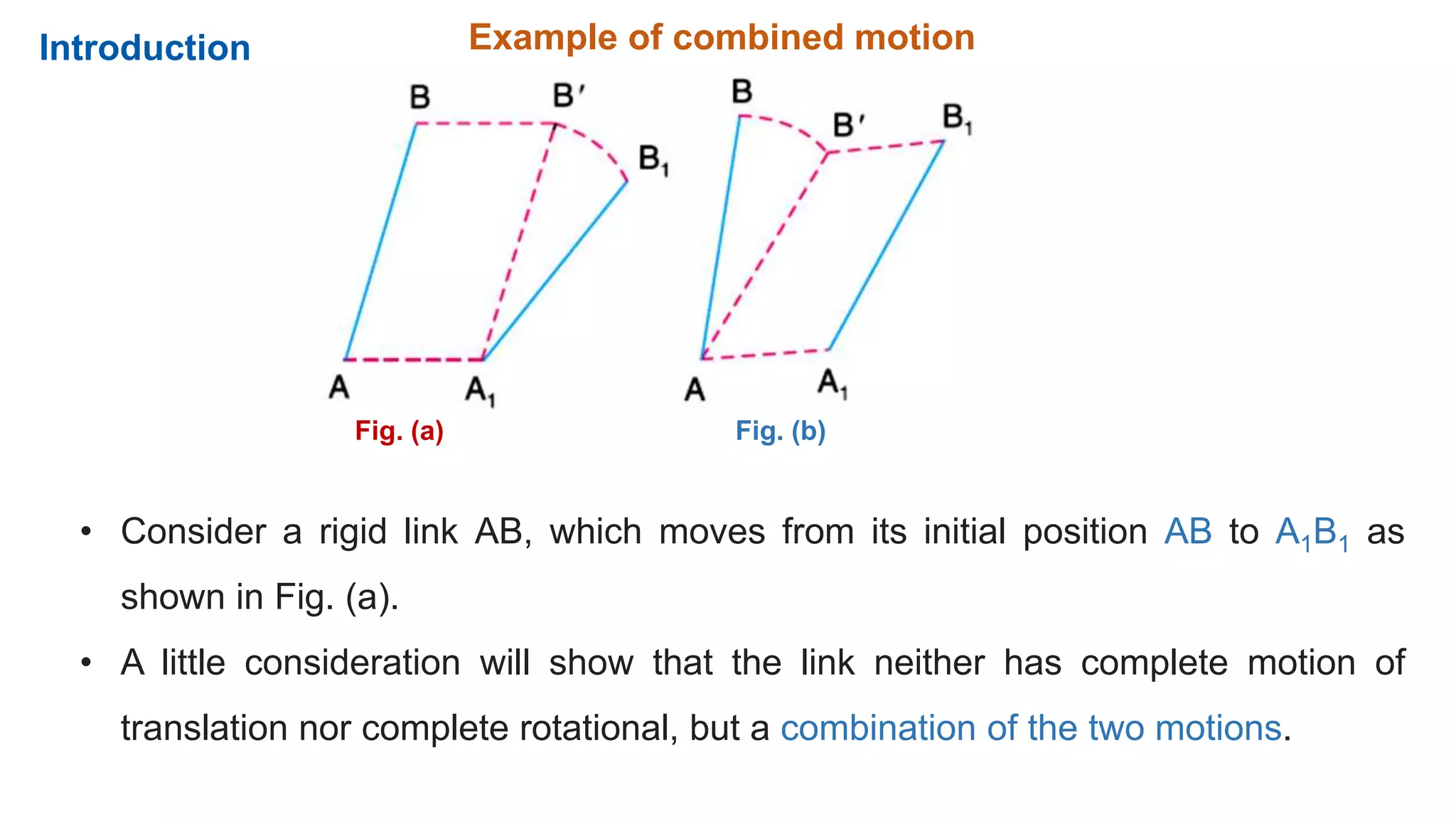
• Consider a rigid link AB, which moves from its initial position AB to A1B1 as
shown in Fig. (a).
• A little consideration will show that the link neither has complete motion of
translation nor complete rotational, but a combination of the two motions.
Fig. (a) Fig. (b)
Introduction Example of combined motion
Introduction
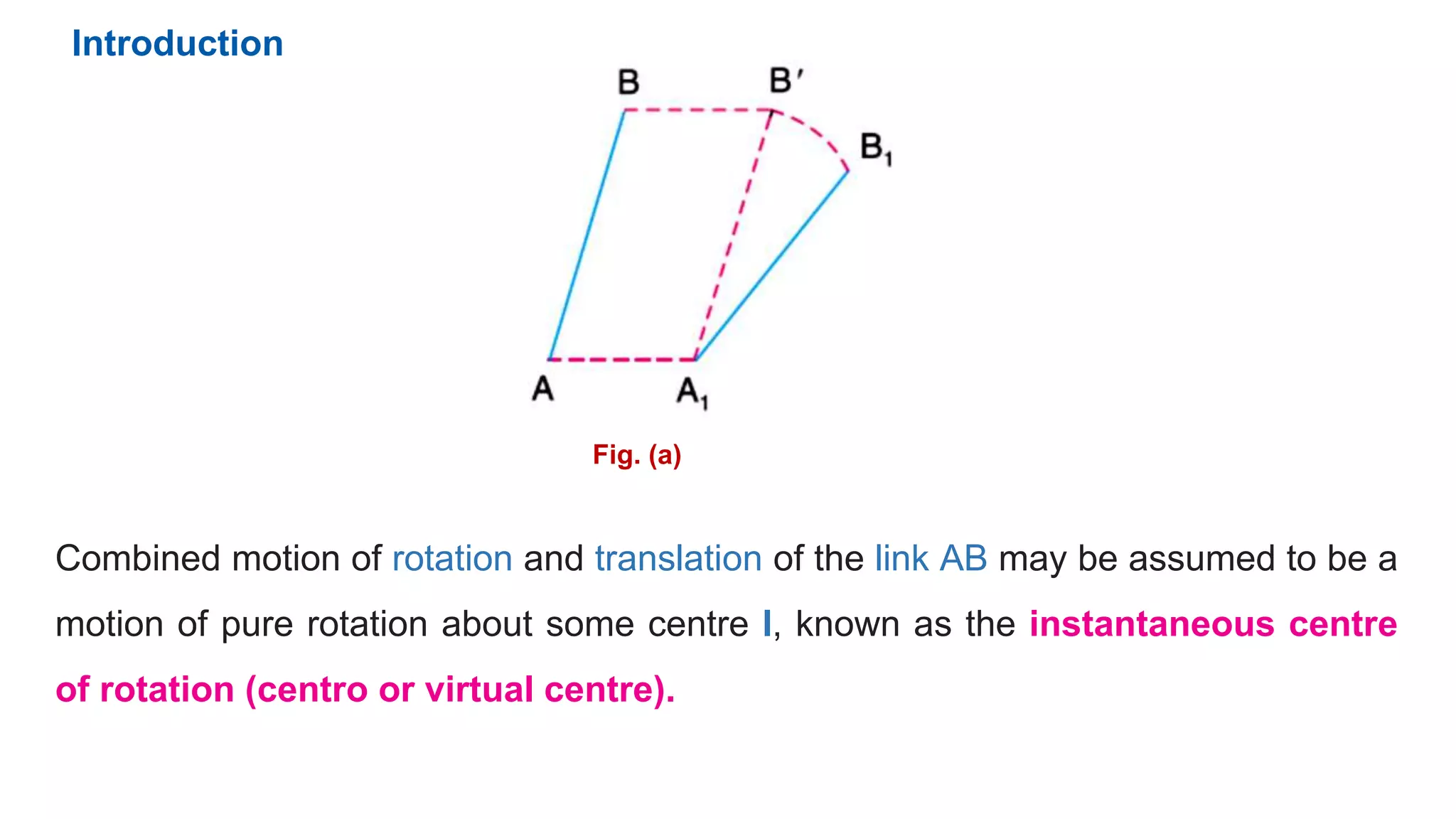
Combined motion of rotation and translation of the link AB may be assumed to be a
motion of pure rotation about some centre I, known as the instantaneous centre
of rotation (centro or virtual centre).
Fig. (a)
Location of position of instantaneous centre
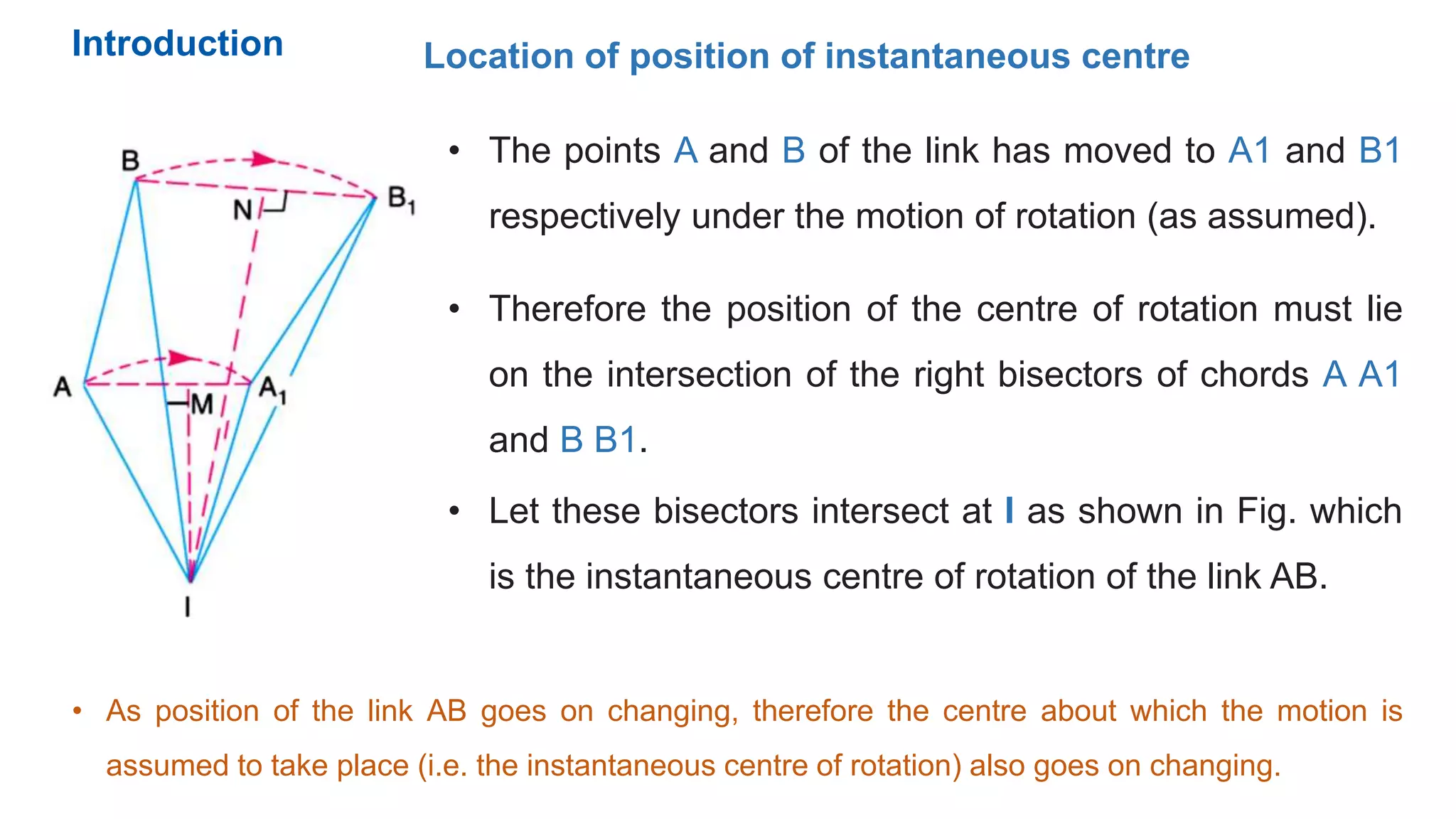
• The points A and B of the link has moved to A1 and B1
respectively under the motion of rotation (as assumed).
• Therefore the position of the centre of rotation must lie
on the intersection of the right bisectors of chords A A1
and B B1.
• Let these bisectors intersect at I as shown in Fig. which
is the instantaneous centre of rotation of the link AB.
• As position of the link AB goes on changing, therefore the centre about which the motion is
assumed to take place (i.e. the instantaneous centre of rotation) also goes on changing.
Introduction
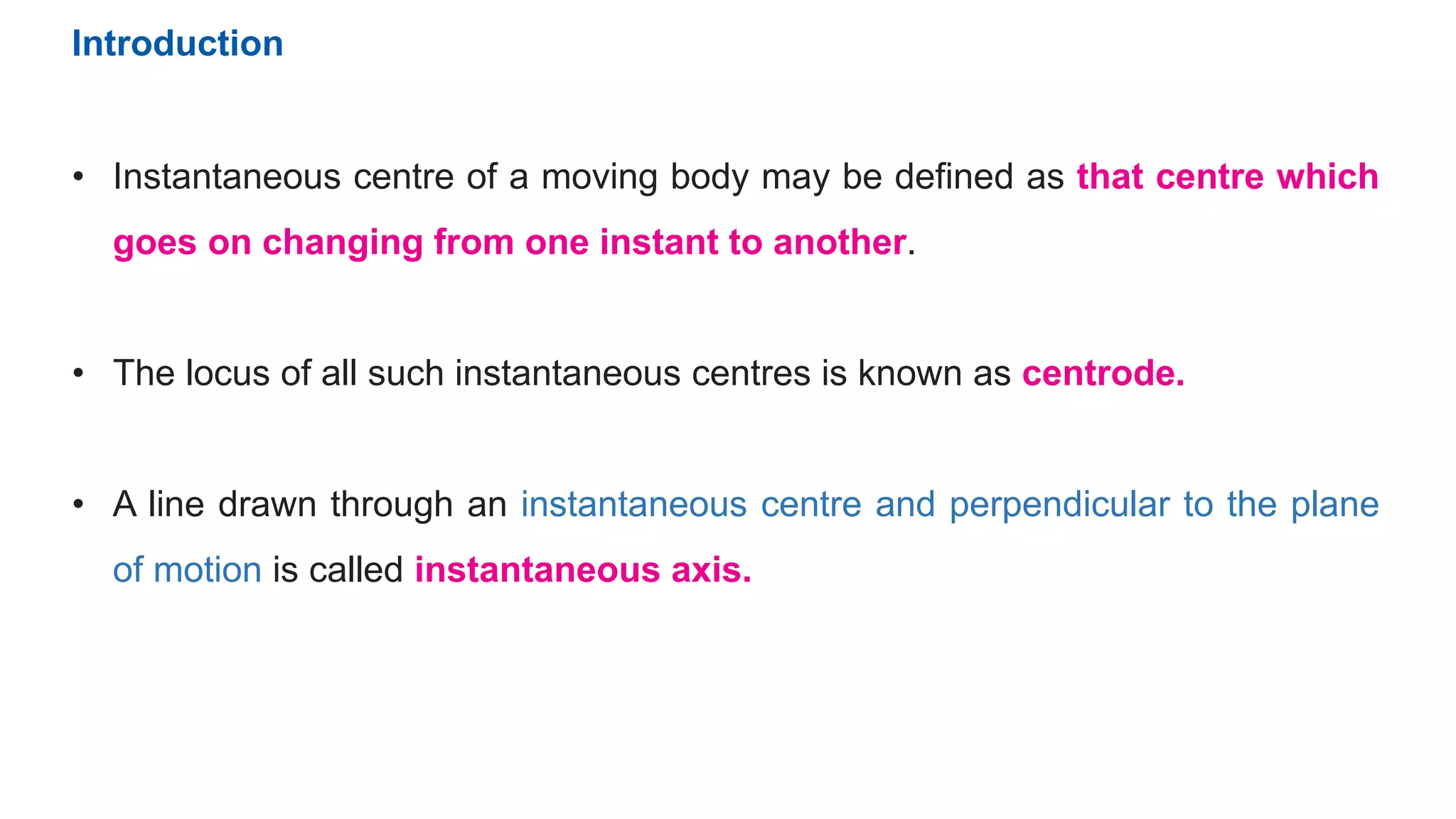
• Instantaneous centre of a moving body may be defined as that centre which
goes on changing from one instant to another.
• The locus of all such instantaneous centres is known as centrode.
• A line drawn through an instantaneous centre and perpendicular to the plane
of motion is called instantaneous axis.
Introduction
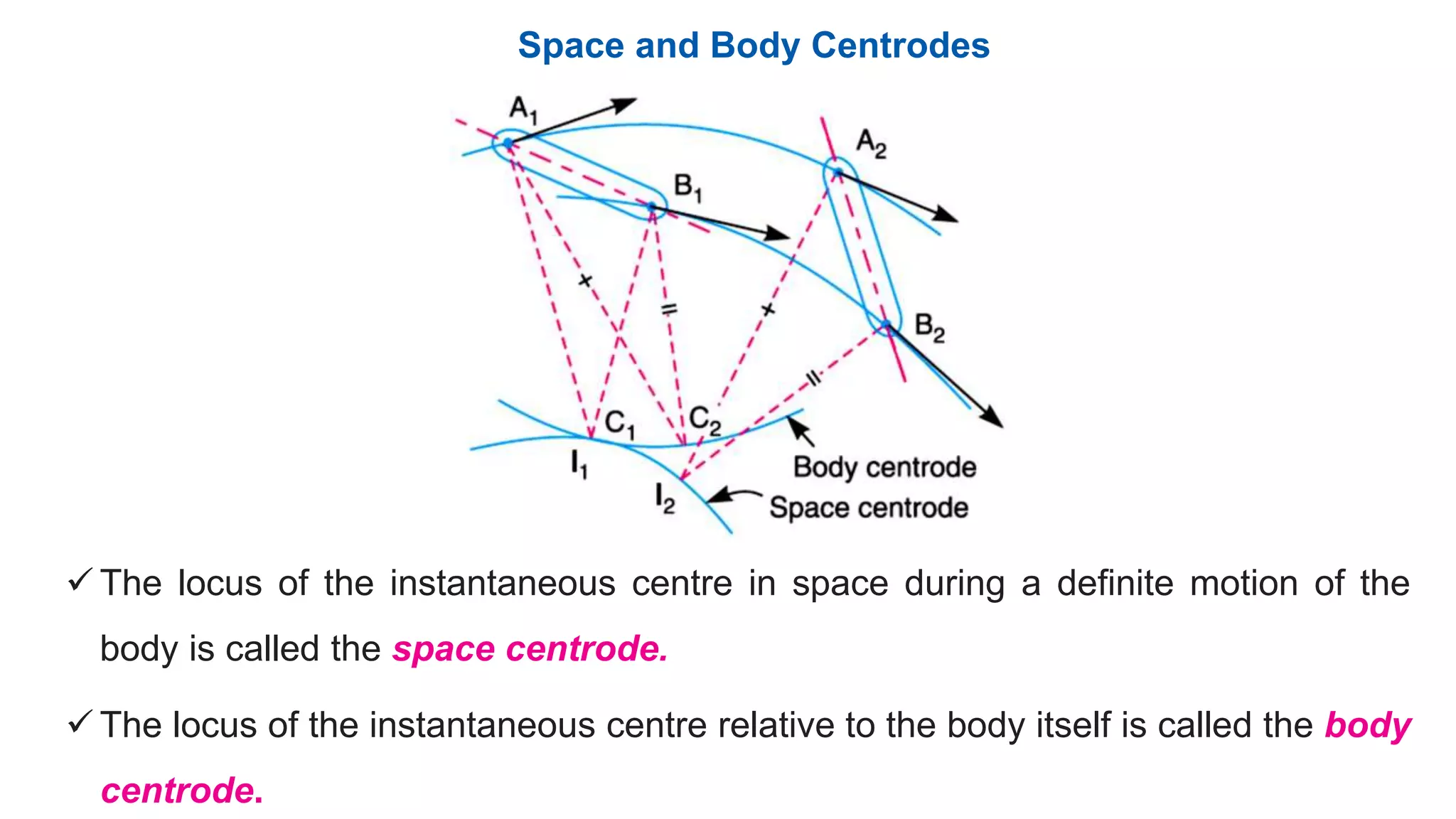
Space and Body Centrodes
 The locus of the instantaneous centre in space during a definite motion of the
body is called the space centrode.
 The locus of the instantaneous centre relative to the body itself is called the body
centrode.
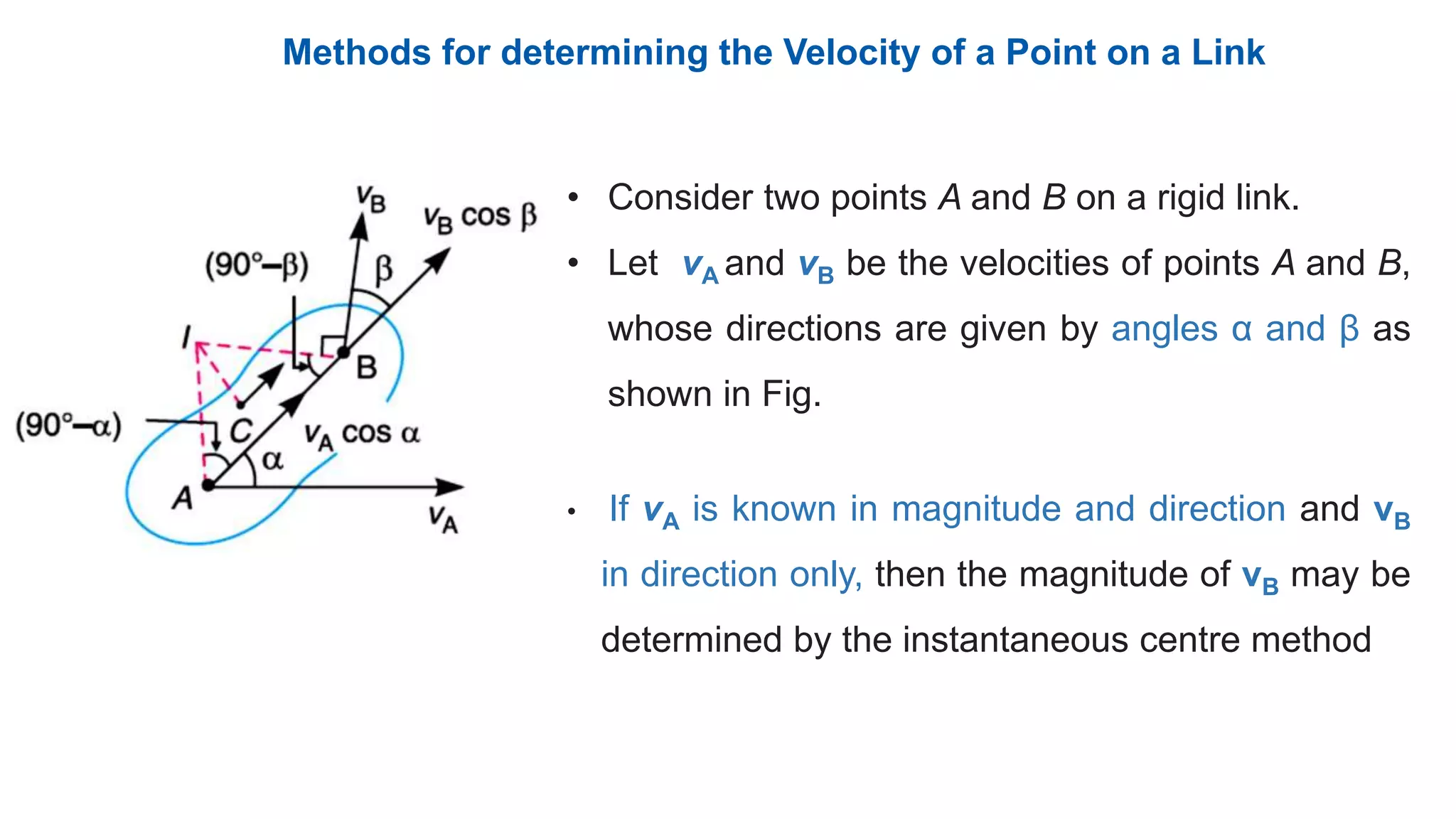
Methods for determining the Velocity of a Point on a Link
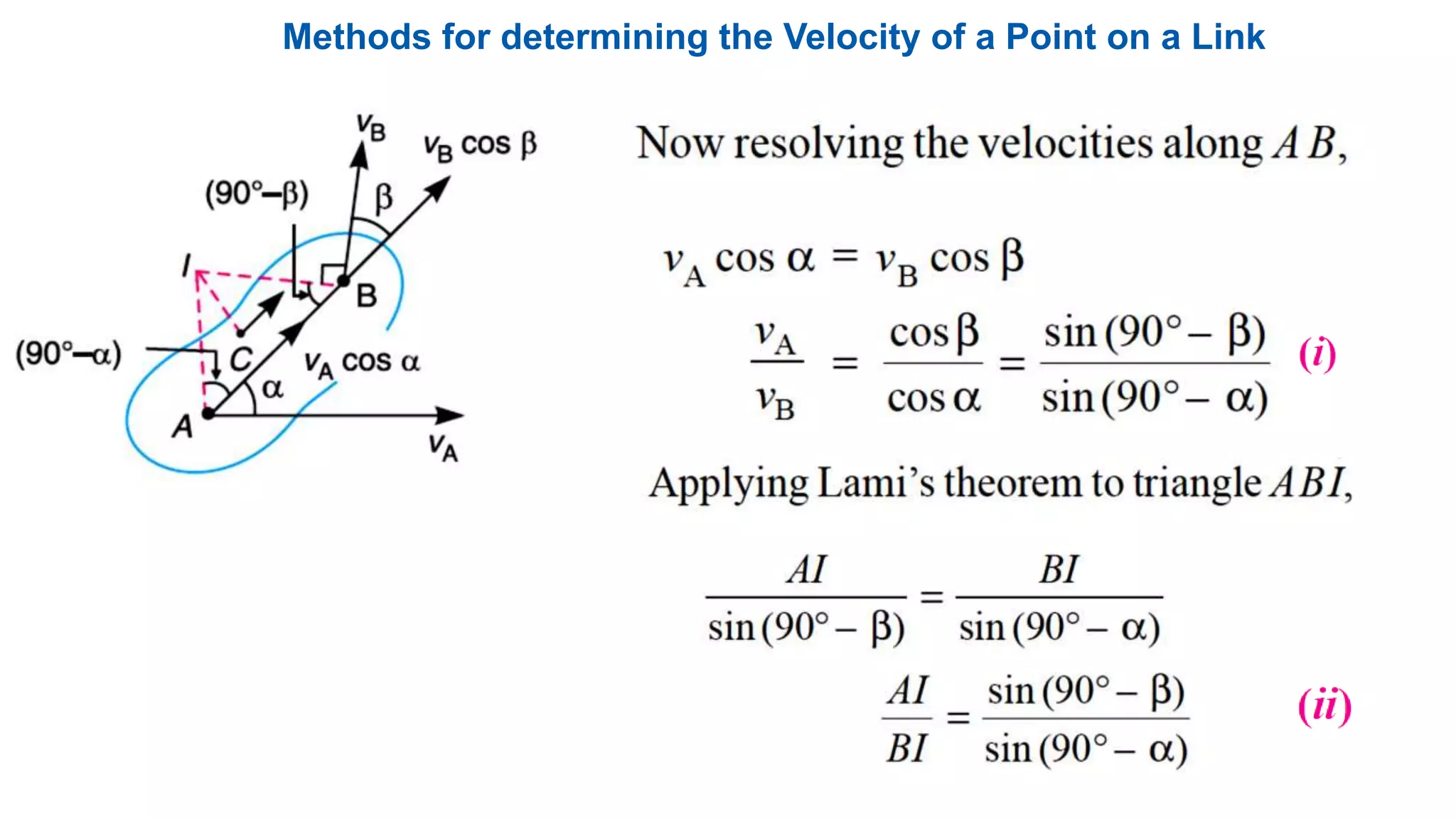
• Consider two points A and B on a rigid link.
• Let vA and vB be the velocities of points A and B,
whose directions are given by angles α and β as
shown in Fig.
• If vA is known in magnitude and direction and vB
in direction only, then the magnitude of vB may be
determined by the instantaneous centre method
Methods for determining the Velocity of a Point on a Link
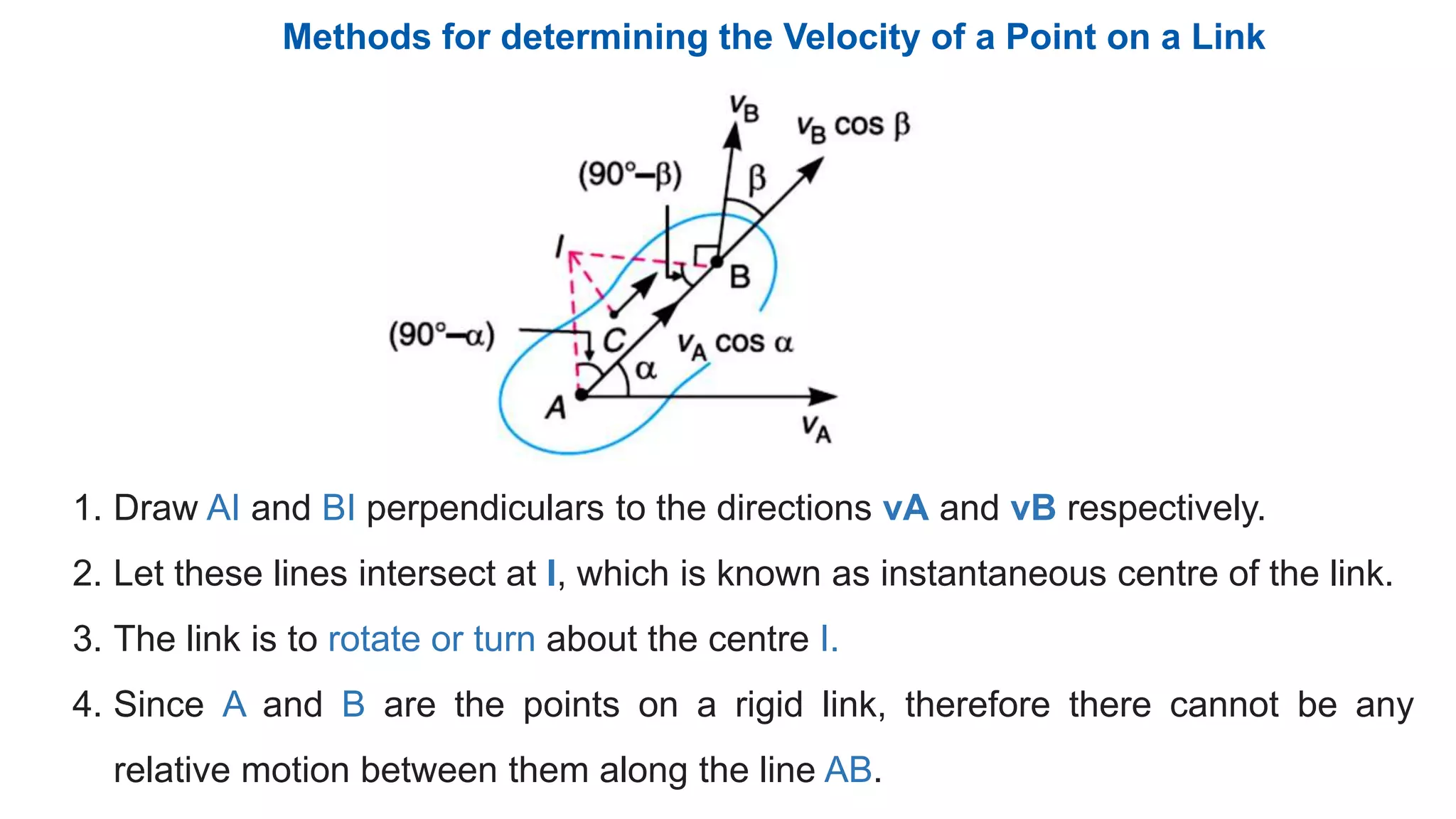
1. Draw AI and BI perpendiculars to the directions vA and vB respectively.
2. Let these lines intersect at I, which is known as instantaneous centre of the link.
3. The link is to rotate or turn about the centre I.
4. Since A and B are the points on a rigid link, therefore there cannot be any
relative motion between them along the line AB.
Methods for determining the Velocity of a Point on a Link
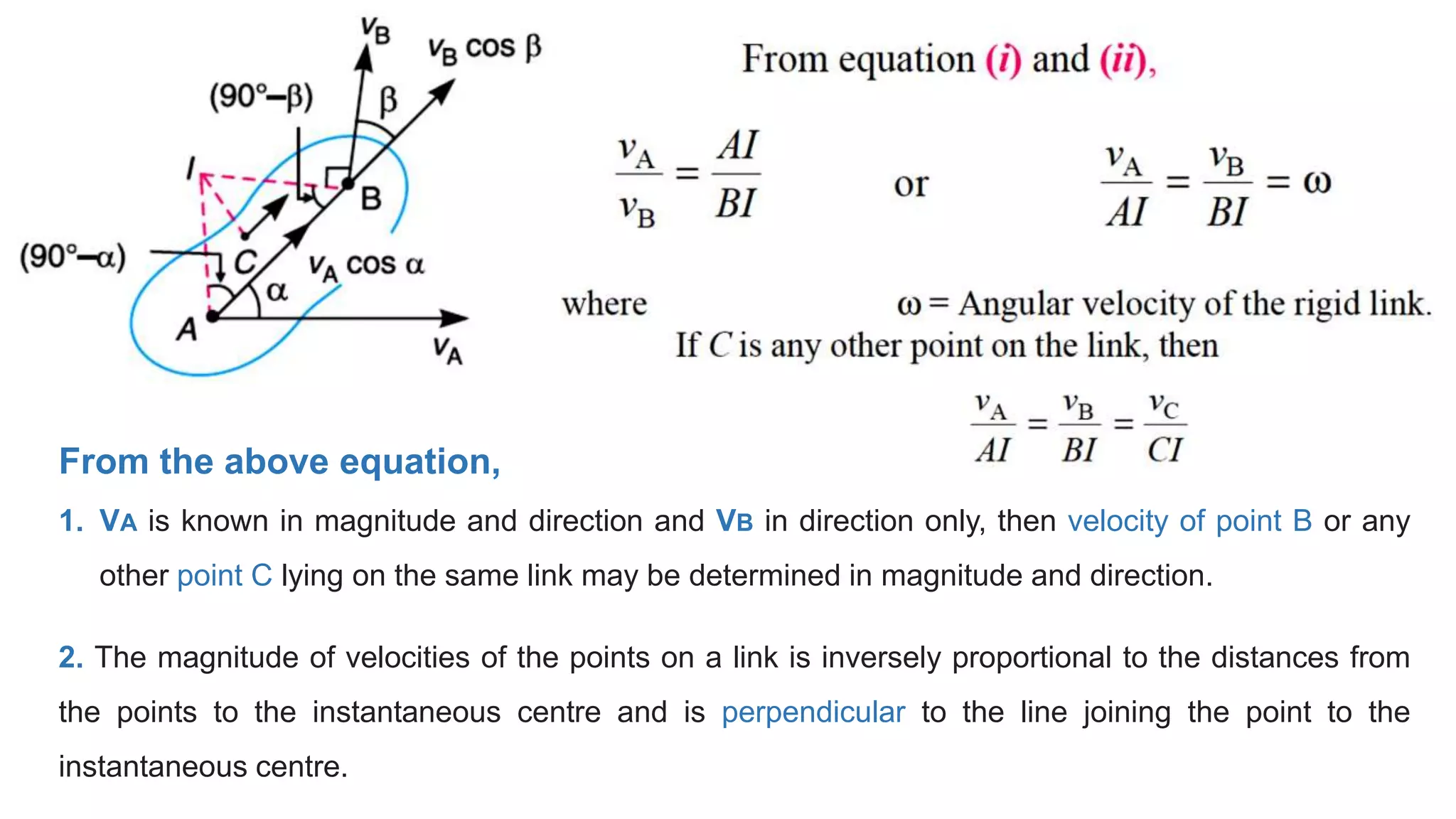
From the above equation,
1. VA is known in magnitude and direction and VB in direction only, then velocity of point B or any
other point C lying on the same link may be determined in magnitude and direction.
2. The magnitude of velocities of the points on a link is inversely proportional to the distances from
the points to the instantaneous centre and is perpendicular to the line joining the point to the
instantaneous centre.
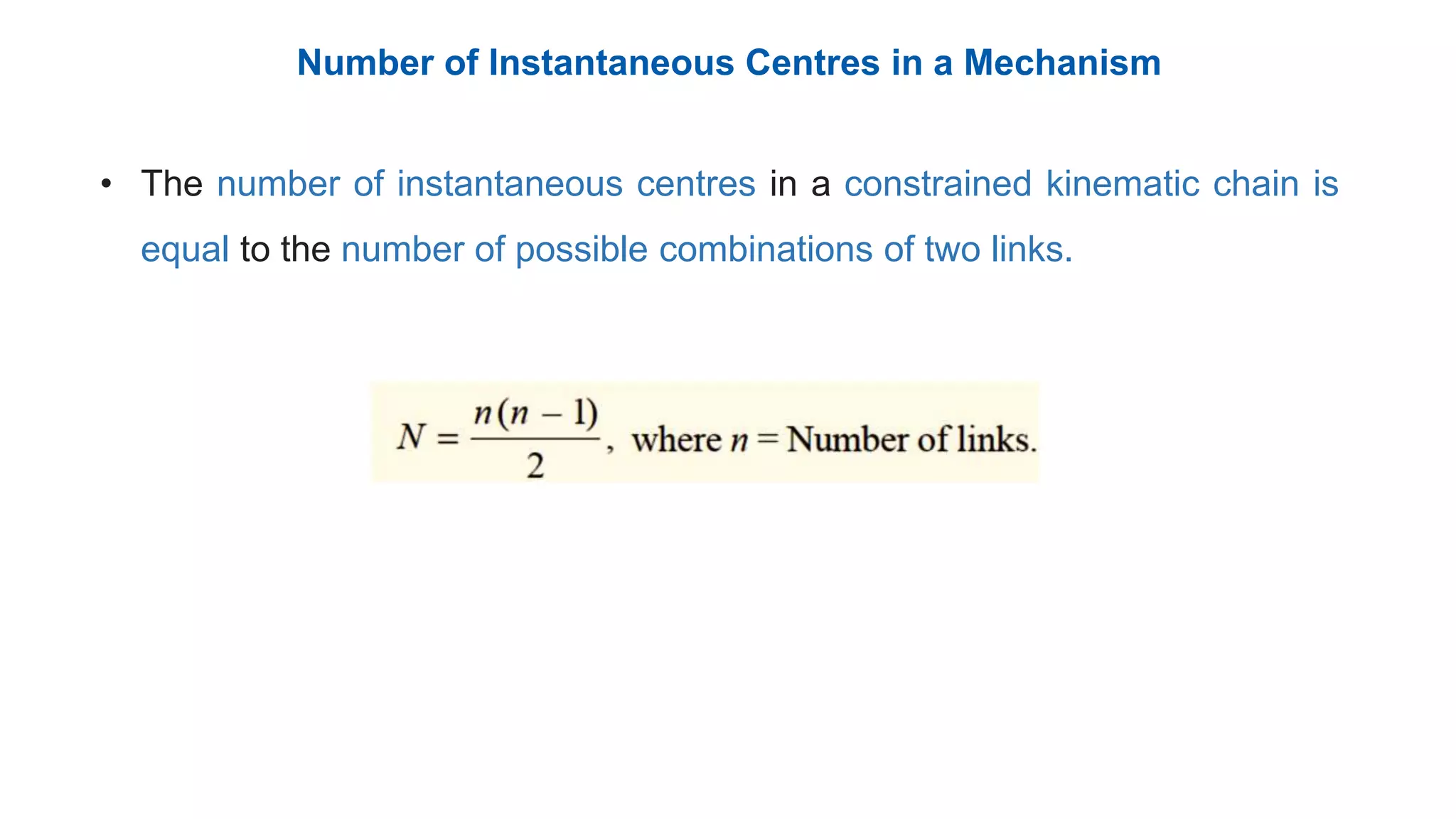
Number of Instantaneous Centres in a Mechanism
• The number of instantaneous centres in a constrained kinematic chain is
equal to the number of possible combinations of two links.
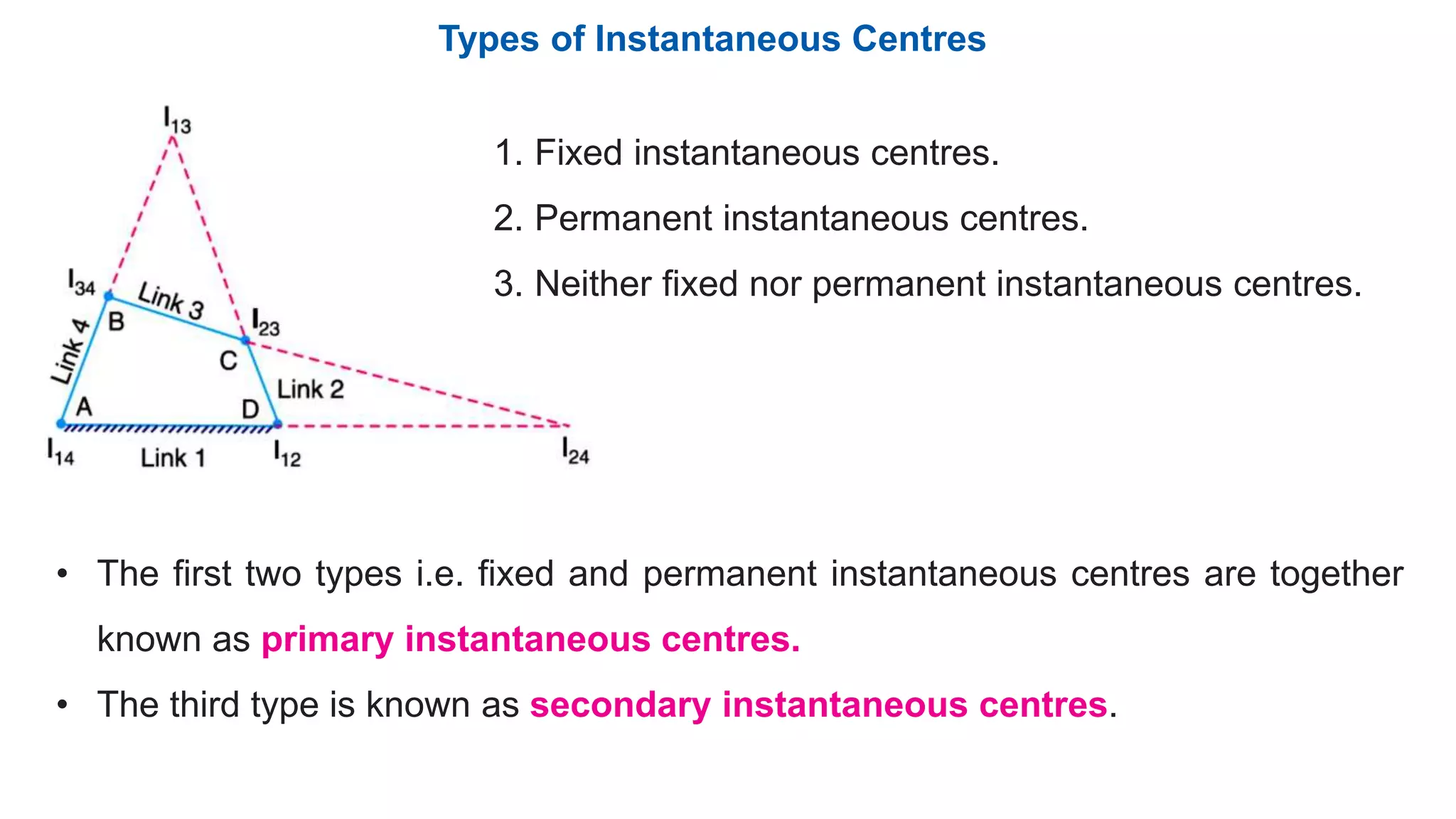
Types of Instantaneous Centres
1. Fixed instantaneous centres.
2. Permanent instantaneous centres.
3. Neither fixed nor permanent instantaneous centres.
• The first two types i.e. fixed and permanent instantaneous centres are together
known as primary instantaneous centres.
• The third type is known as secondary instantaneous centres.
Types of Instantaneous Centres
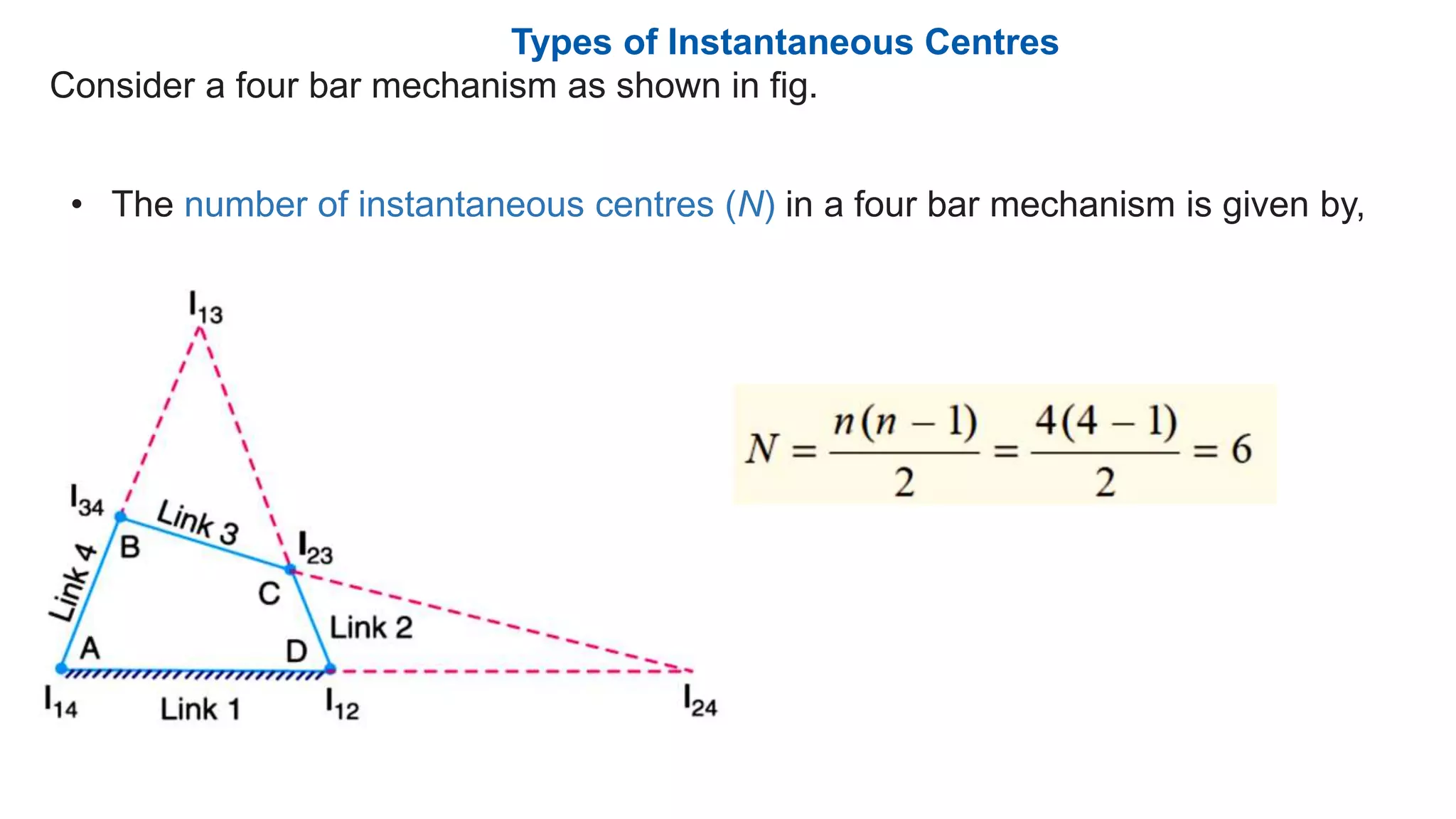
Consider a four bar mechanism as shown in fig.
• The number of instantaneous centres (N) in a four bar mechanism is given by,
Types of Instantaneous Centres
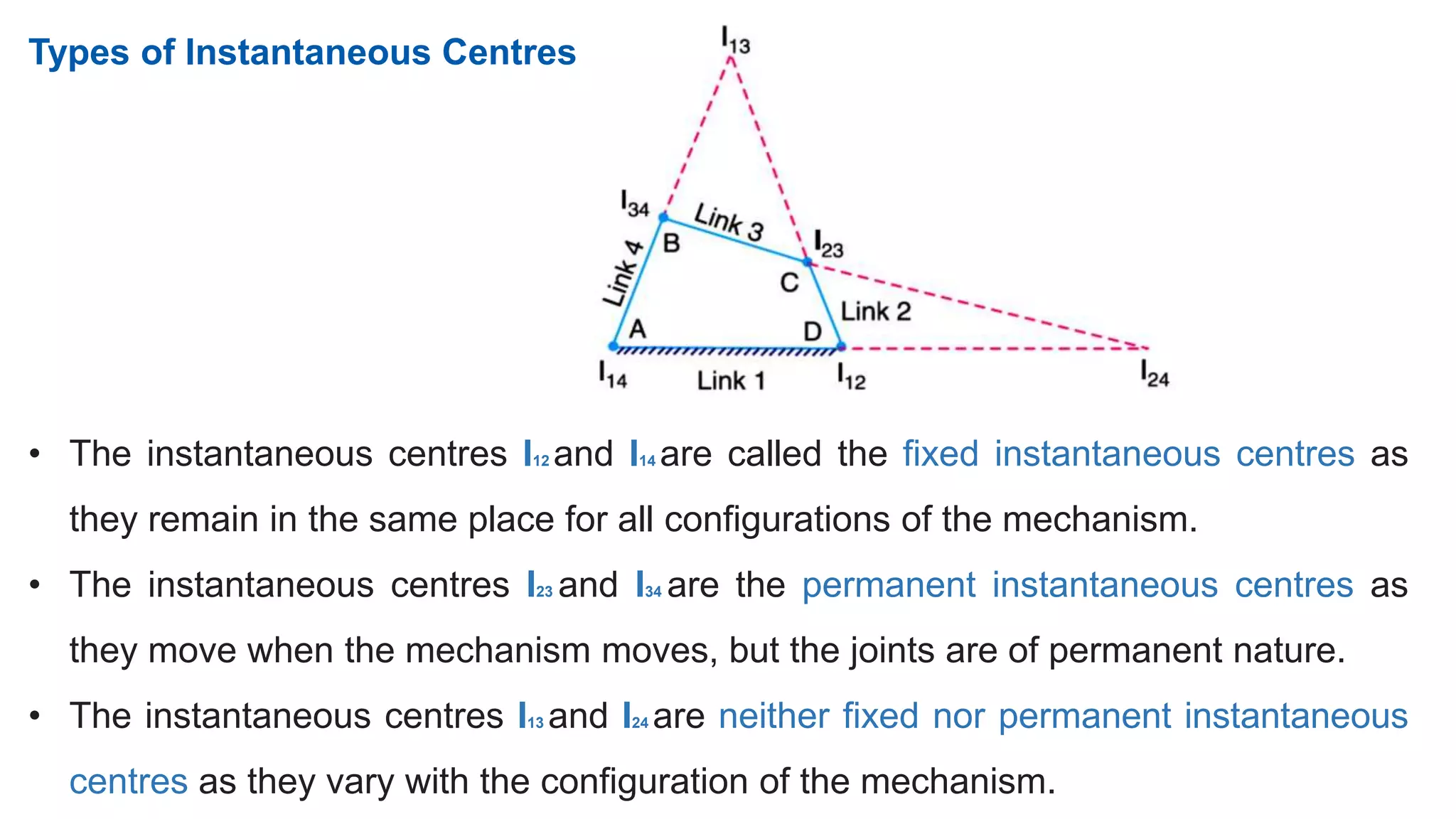
• The instantaneous centres I12 and I14 are called the fixed instantaneous centres as
they remain in the same place for all configurations of the mechanism.
• The instantaneous centres I23 and I34 are the permanent instantaneous centres as
they move when the mechanism moves, but the joints are of permanent nature.
• The instantaneous centres I13 and I24 are neither fixed nor permanent instantaneous
centres as they vary with the configuration of the mechanism.
Location of Instantaneous Centres
The following rules may be used in locating the instantaneous centres in a
mechanism :
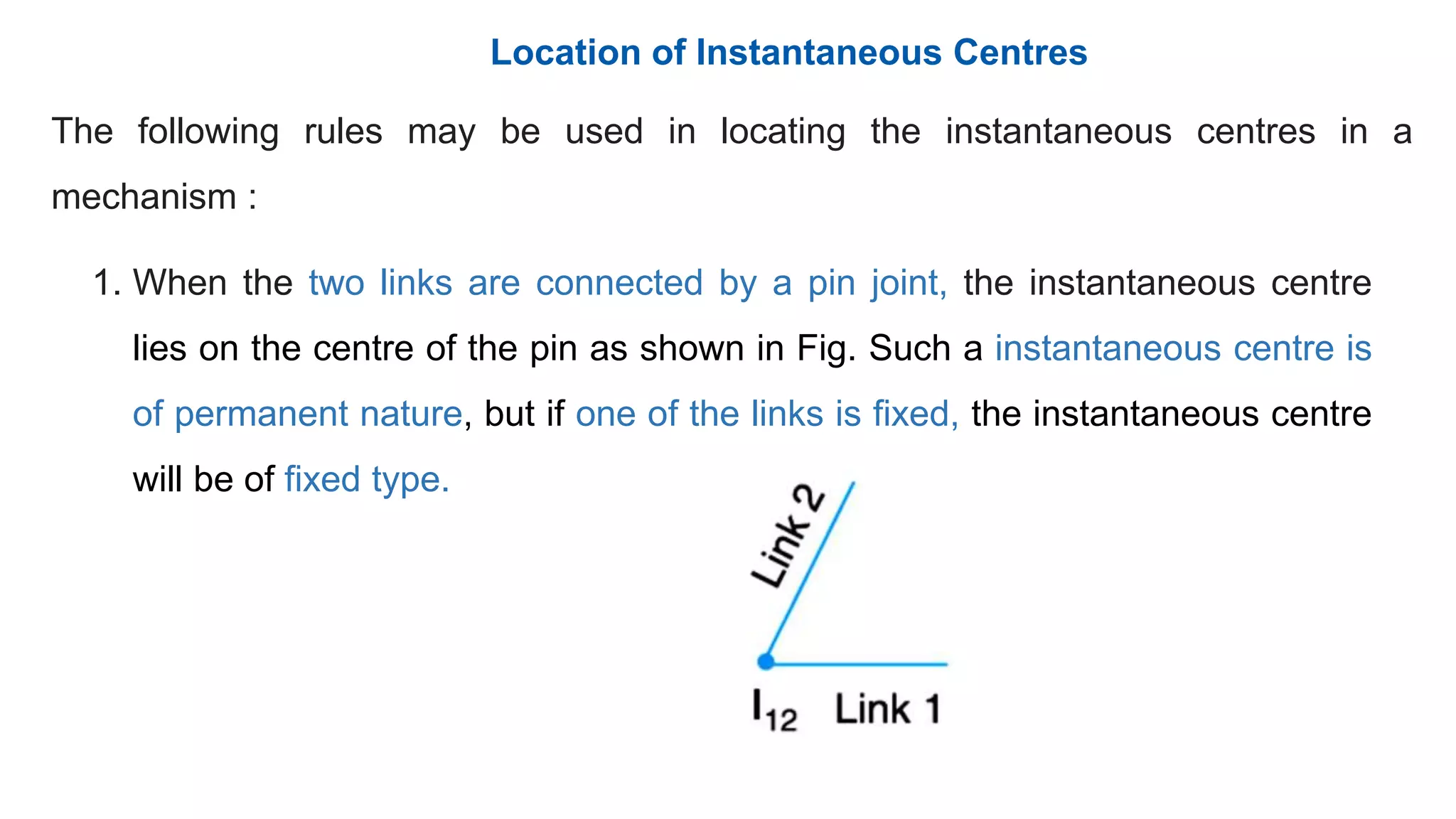
1. When the two links are connected by a pin joint, the instantaneous centre
lies on the centre of the pin as shown in Fig. Such a instantaneous centre is
of permanent nature, but if one of the links is fixed, the instantaneous centre
will be of fixed type.
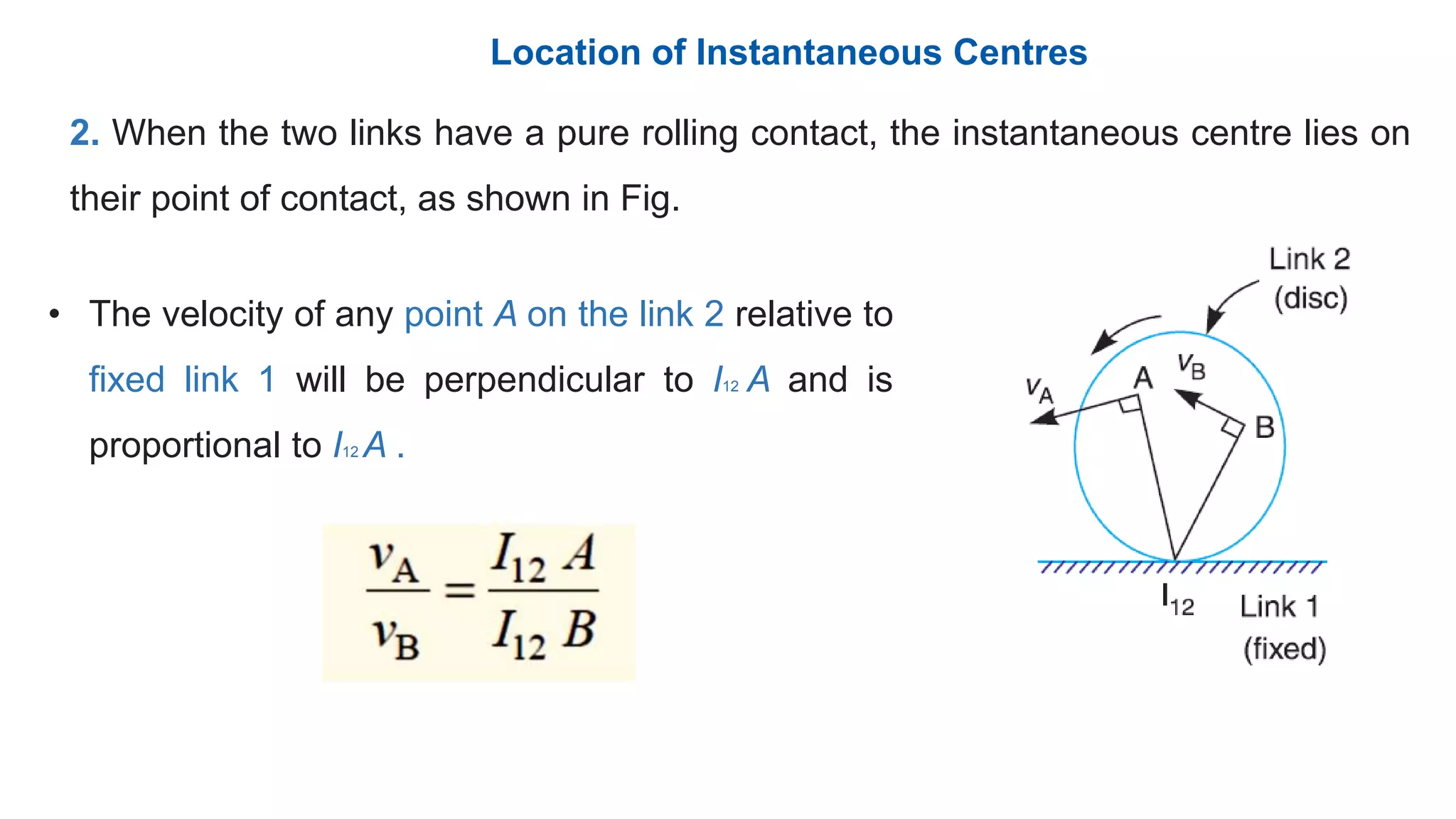
2. When the two links have a pure rolling contact, the instantaneous centre lies on
their point of contact, as shown in Fig.
• The velocity of any point A on the link 2 relative to
fixed link 1 will be perpendicular to I12 A and is
proportional to I12 A .
Location of Instantaneous Centres
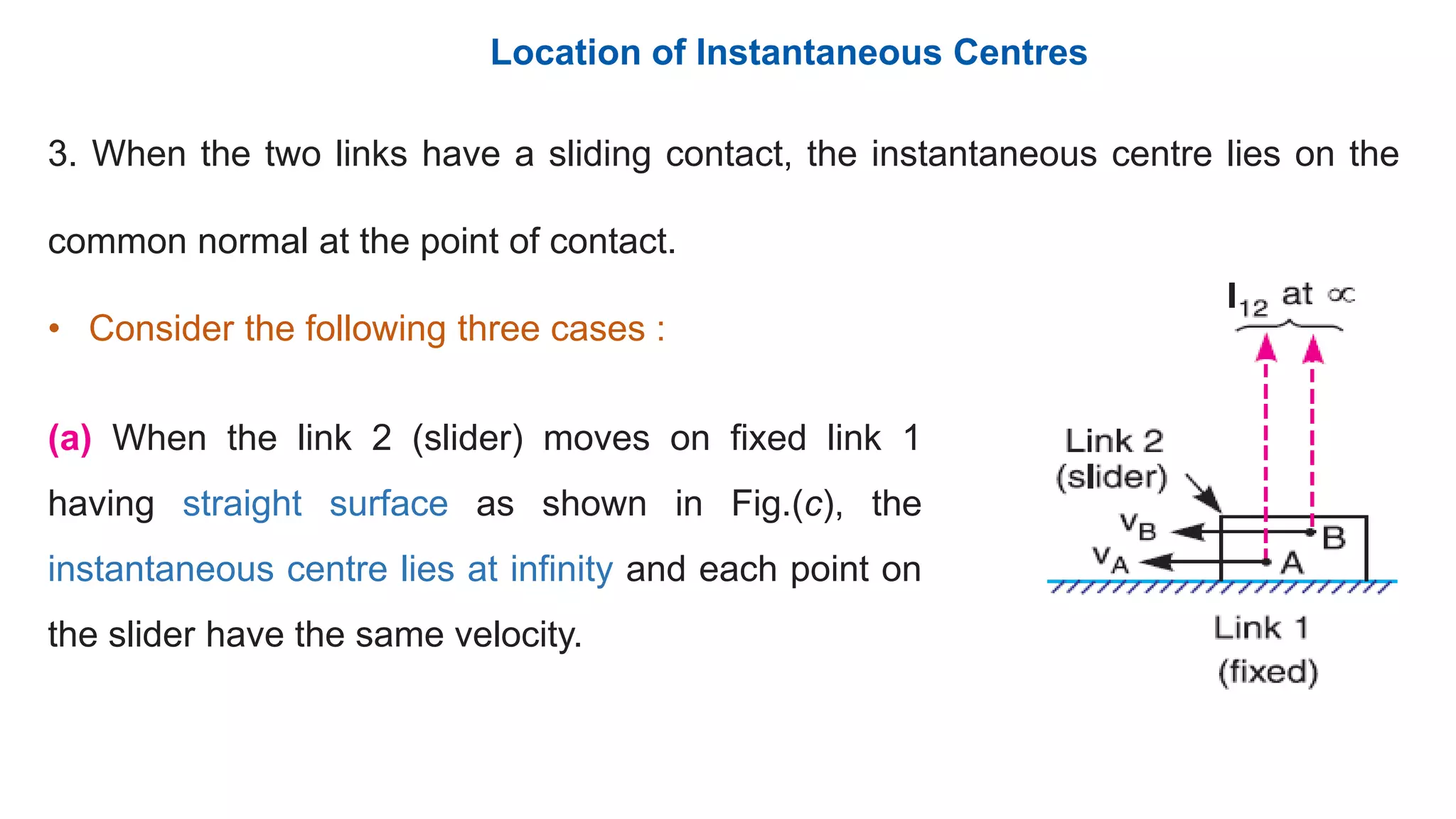
3. When the two links have a sliding contact, the instantaneous centre lies on the
common normal at the point of contact.
• Consider the following three cases :
Location of Instantaneous Centres
(a) When the link 2 (slider) moves on fixed link 1
having straight surface as shown in Fig.(c), the
instantaneous centre lies at infinity and each point on
the slider have the same velocity.
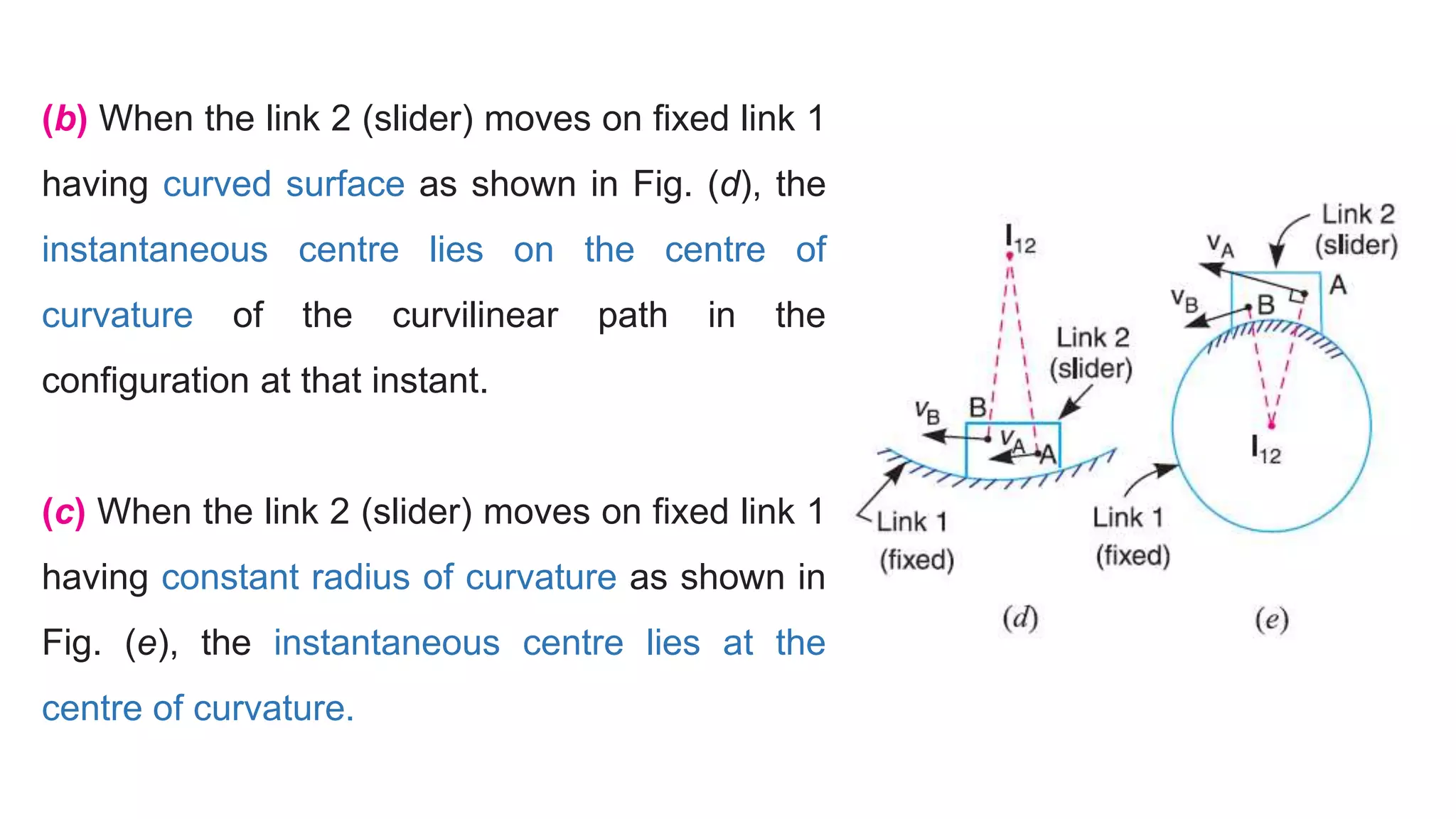
(b) When the link 2 (slider) moves on fixed link 1
having curved surface as shown in Fig. (d), the
instantaneous centre lies on the centre of
curvature of the curvilinear path in the
configuration at that instant.
(c) When the link 2 (slider) moves on fixed link 1
having constant radius of curvature as shown in
Fig. (e), the instantaneous centre lies at the
centre of curvature.
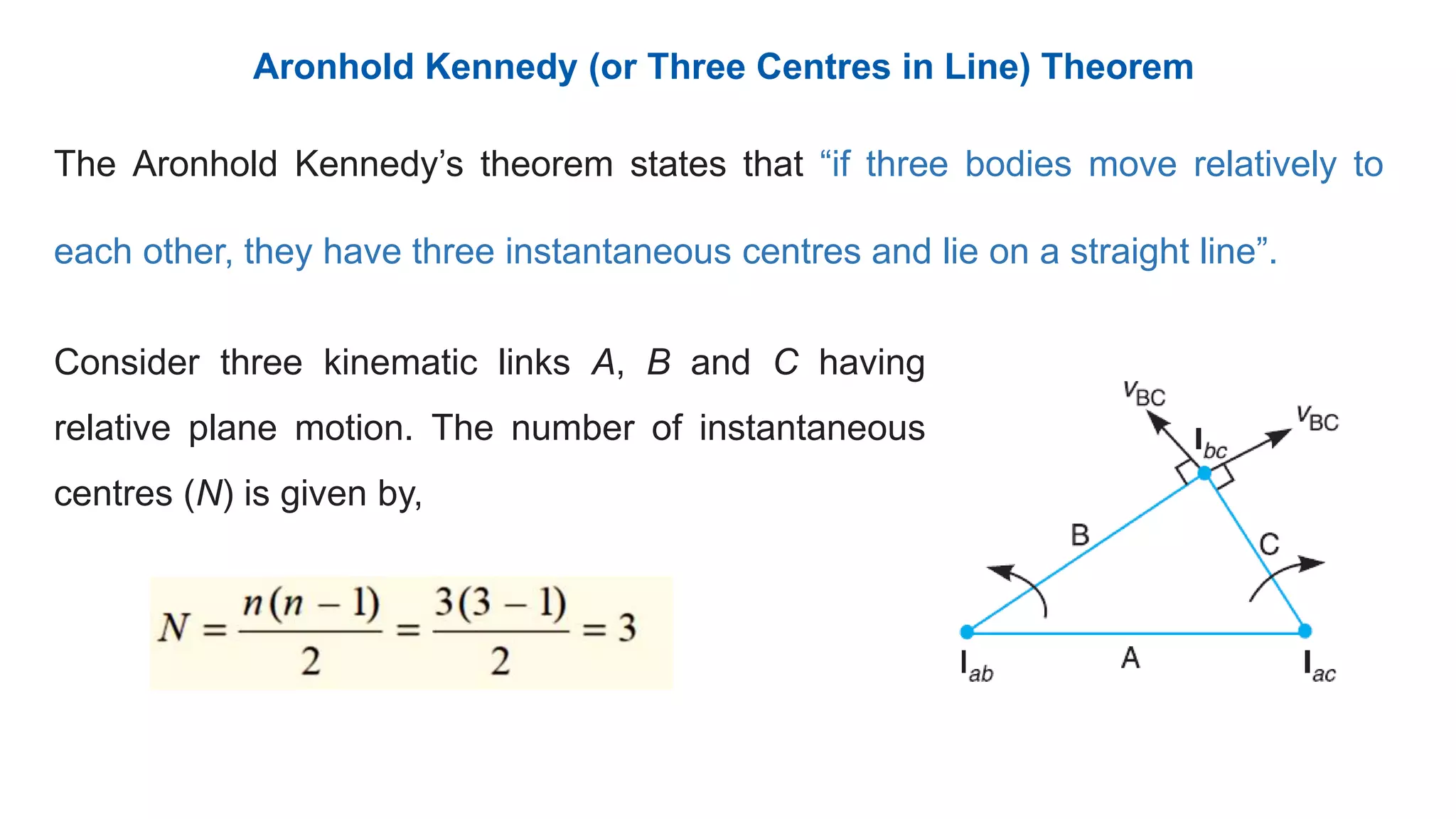
Aronhold Kennedy (or Three Centres in Line) Theorem
The Aronhold Kennedy’s theorem states that “if three bodies move relatively to
each other, they have three instantaneous centres and lie on a straight line”.
Consider three kinematic links A, B and C having
relative plane motion. The number of instantaneous
centres (N) is given by,
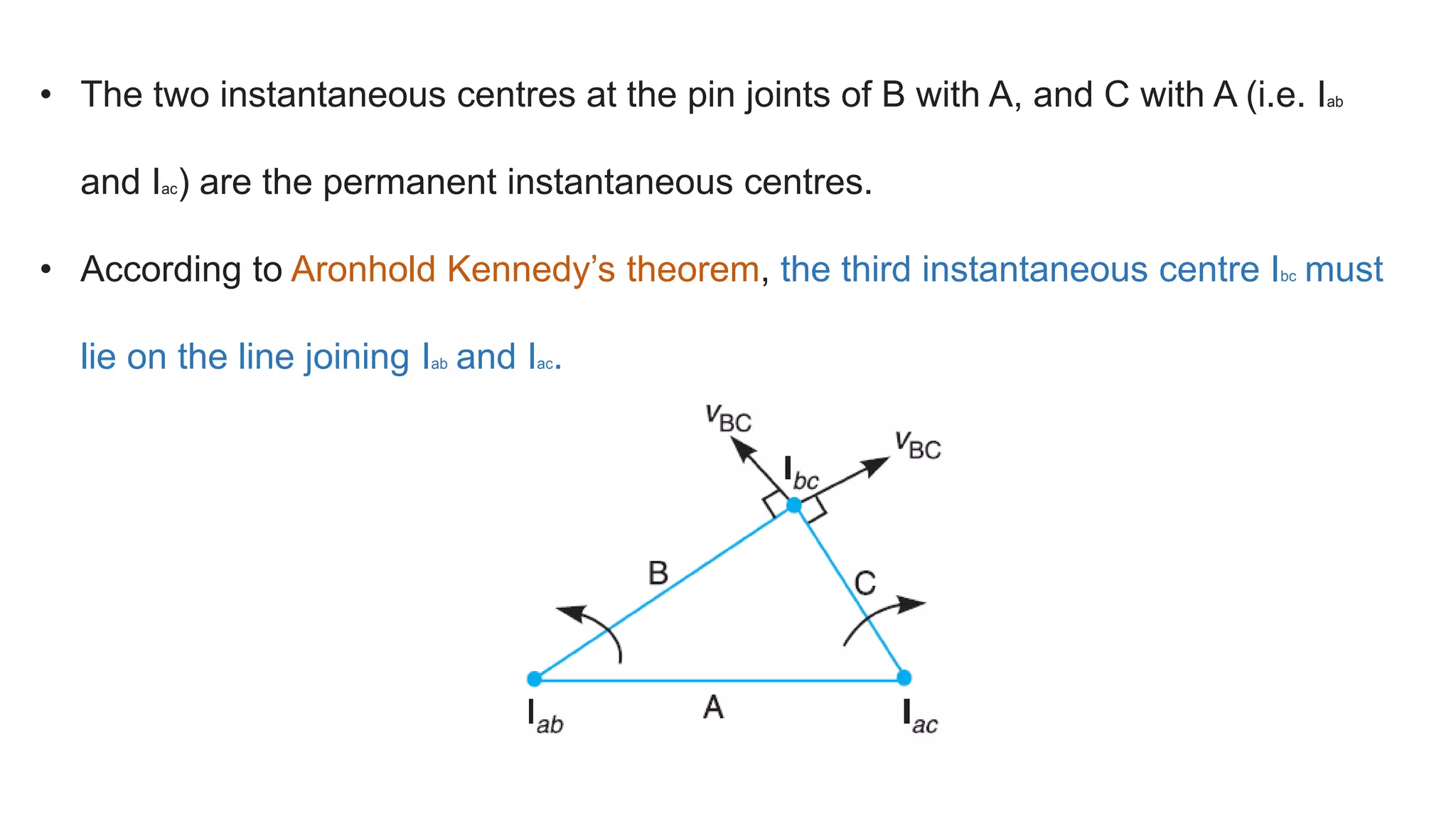
• The two instantaneous centres at the pin joints of B with A, and C with A (i.e. Iab
and Iac) are the permanent instantaneous centres.
• According to Aronhold Kennedy’s theorem, the third instantaneous centre Ibc must
lie on the line joining Iab and Iac.
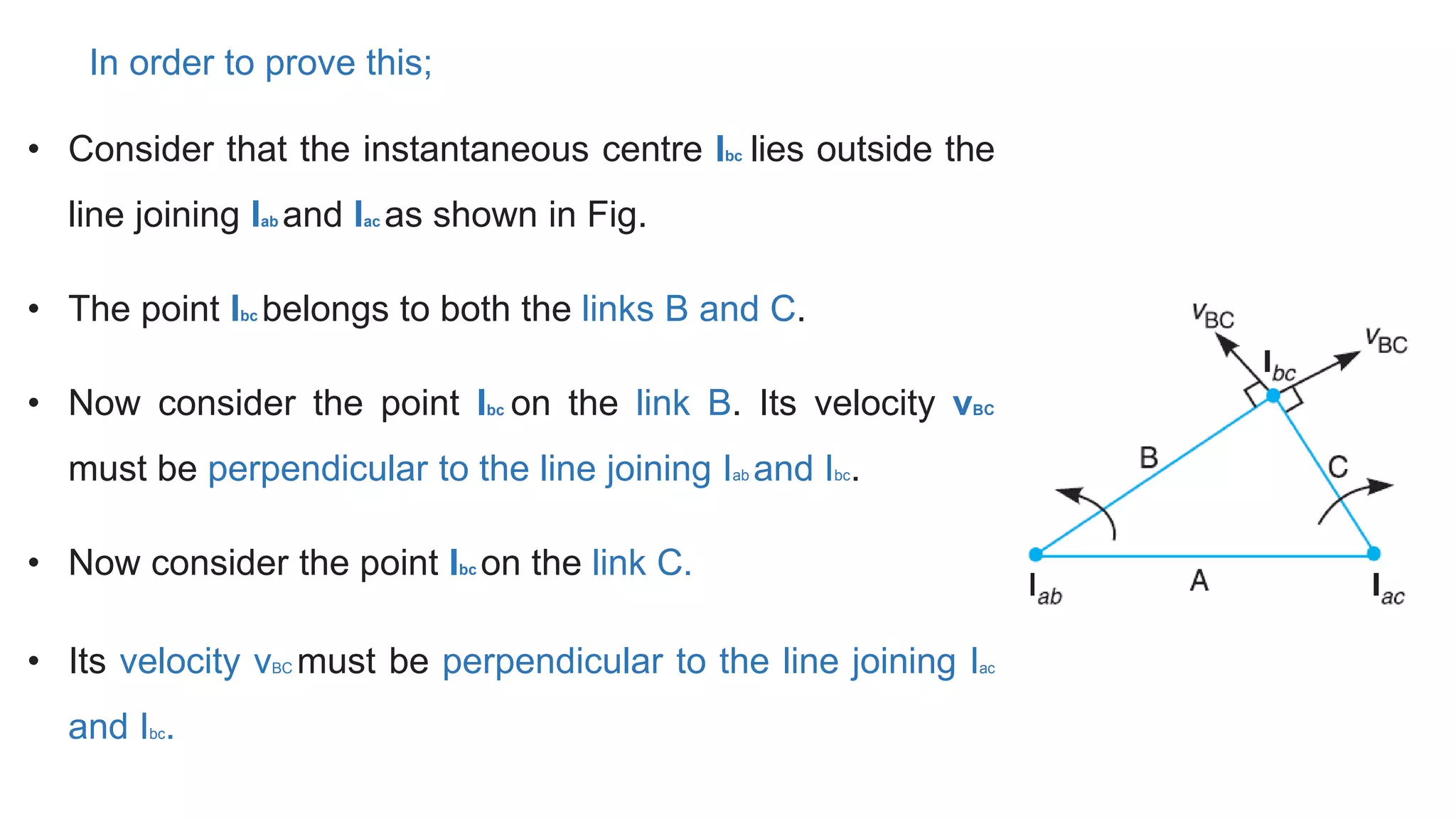
In order to prove this;
• Consider that the instantaneous centre Ibc lies outside the
line joining Iab and Iac as shown in Fig.
• The point Ibc belongs to both the links B and C.
• Now consider the point Ibc on the link B. Its velocity vBC
must be perpendicular to the line joining Iab and Ibc.
• Now consider the point Ibc on the link C.
• Its velocity vBC must be perpendicular to the line joining Iac
and Ibc.
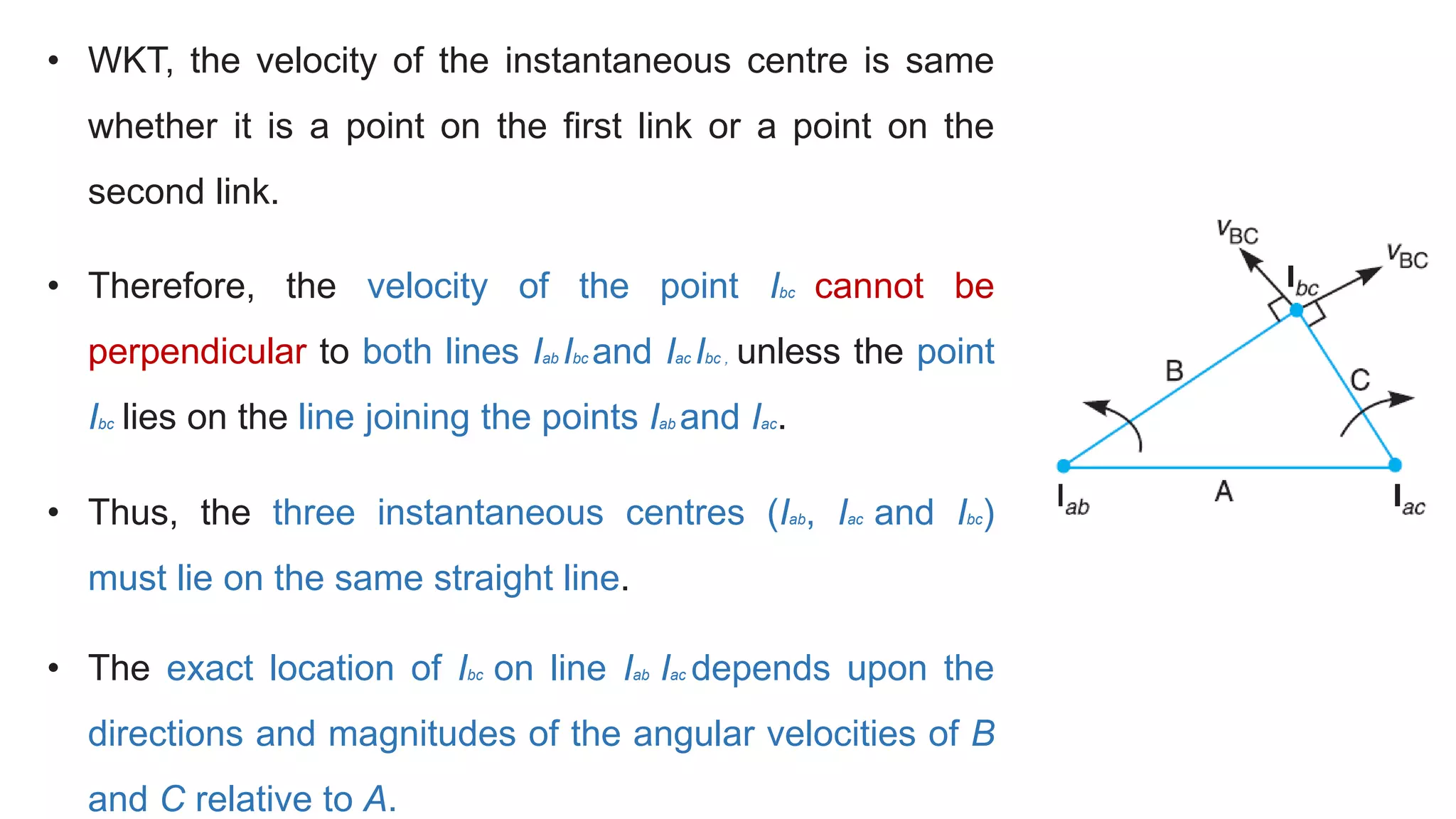
• WKT, the velocity of the instantaneous centre is same
whether it is a point on the first link or a point on the
second link.
• Therefore, the velocity of the point Ibc cannot be
perpendicular to both lines Iab Ibc and Iac Ibc , unless the point
Ibc lies on the line joining the points Iab and Iac.
• Thus, the three instantaneous centres (Iab, Iac and Ibc)
must lie on the same straight line.
• The exact location of Ibc on line Iab Iac depends upon the
directions and magnitudes of the angular velocities of B
and C relative to A.
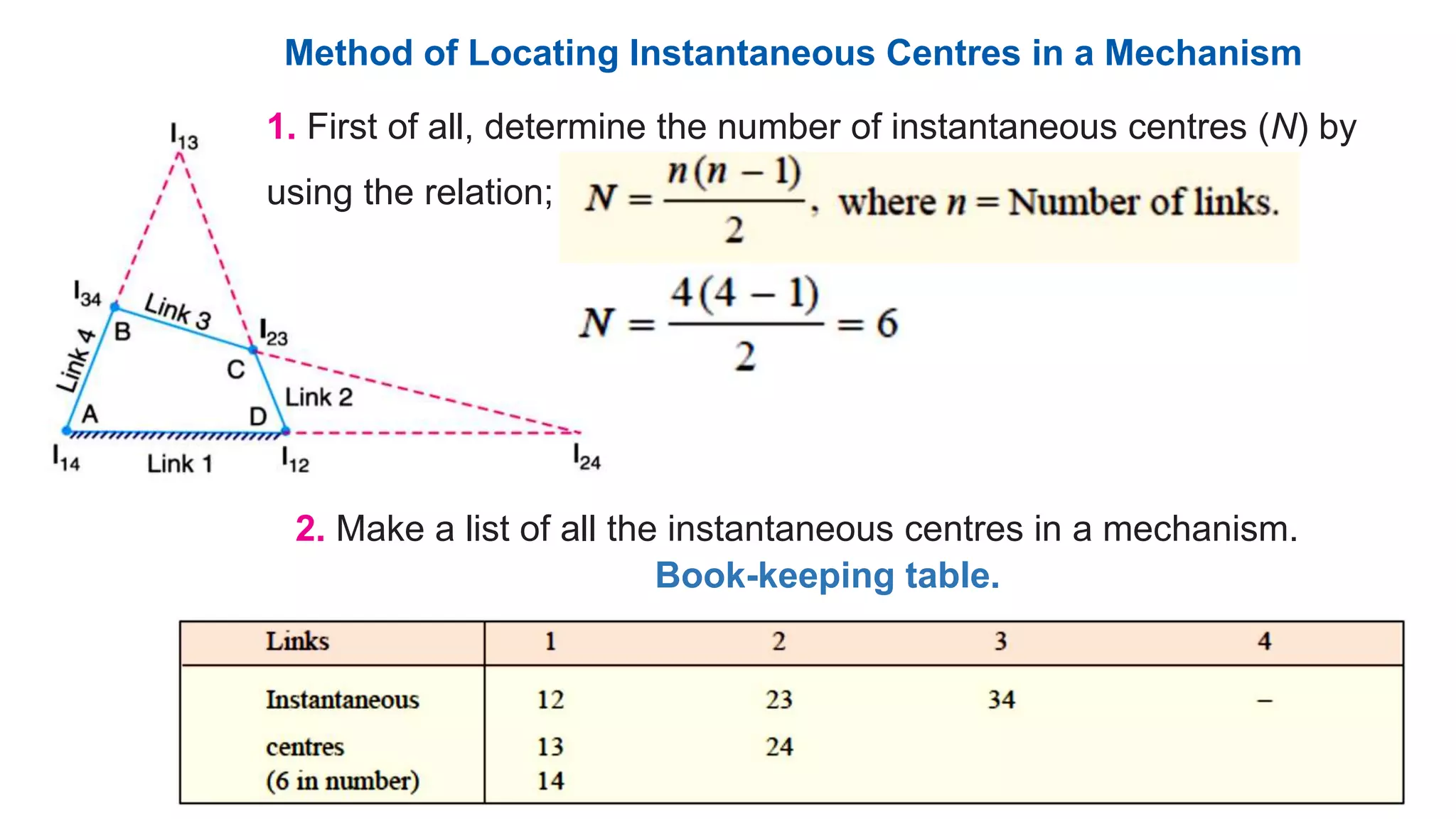
Method of Locating Instantaneous Centres in a Mechanism
1. First of all, determine the number of instantaneous centres (N) by
using the relation;
2. Make a list of all the instantaneous centres in a mechanism.
Book-keeping table.
3. Locate the fixed and permanent instantaneous centres by inspection. In Fig. I12
& I14 are fixed instantaneous centres & I23 and I34 are permanent instantaneous
centres.
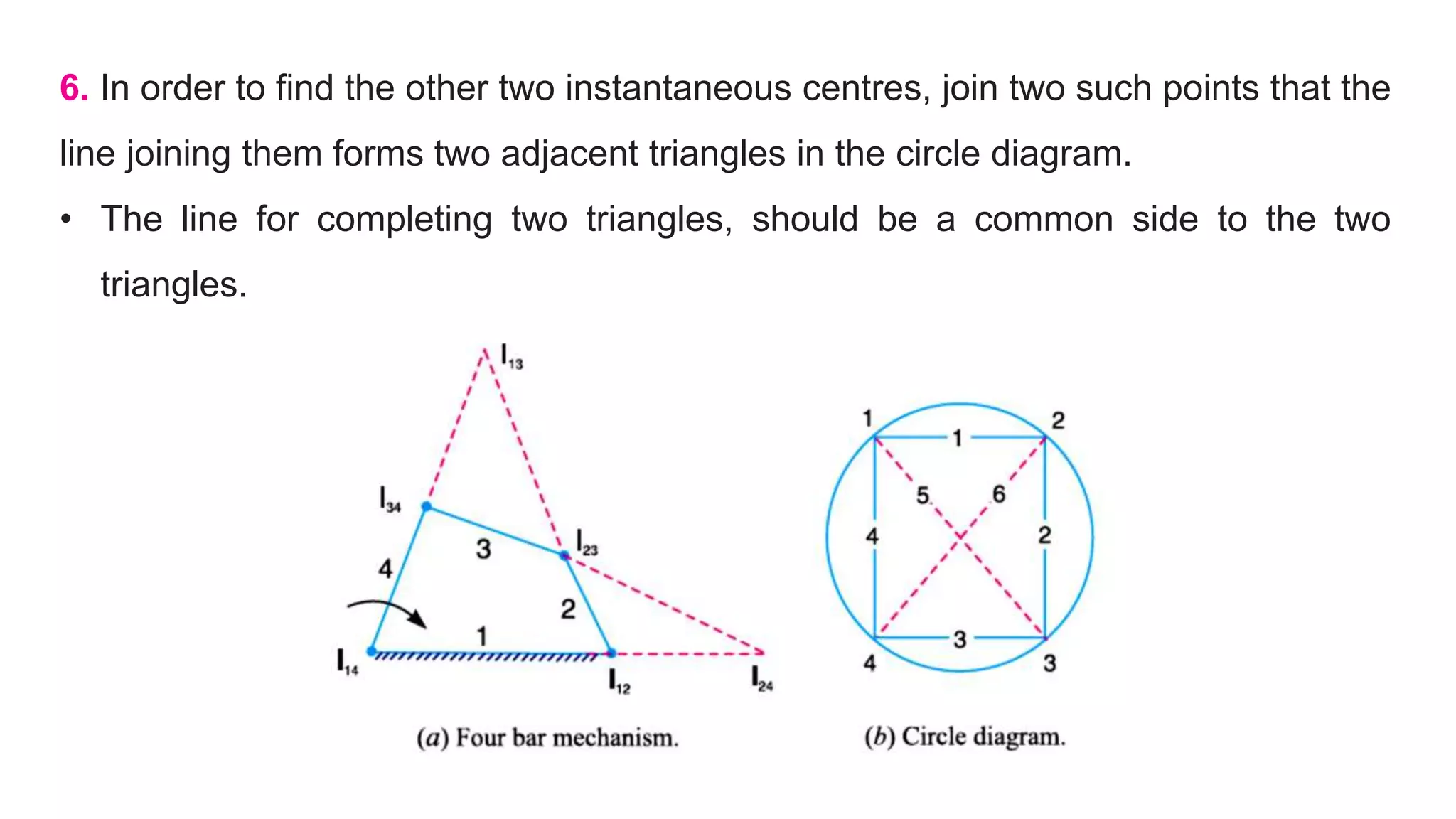
4. Locate the neither fixed nor permanent instantaneous centres by Kennedy’s
theorem. This is done by circle diagram as shown in Fig. (b).
• Mark points on a circle equal to the number of links in a mechanism. In the
present case, mark 1, 2, 3, and 4 on the circle.
5. Join the points by solid lines to show that these centres are already found.
• In the circle diagram [Fig. 6.8 (b)] these lines are 12, 23, 34 and 14 to indicate the
centres I12, I23, I34 and I14.
6. In order to find the other two instantaneous centres, join two such points that the
line joining them forms two adjacent triangles in the circle diagram.
• The line for completing two triangles, should be a common side to the two
triangles.
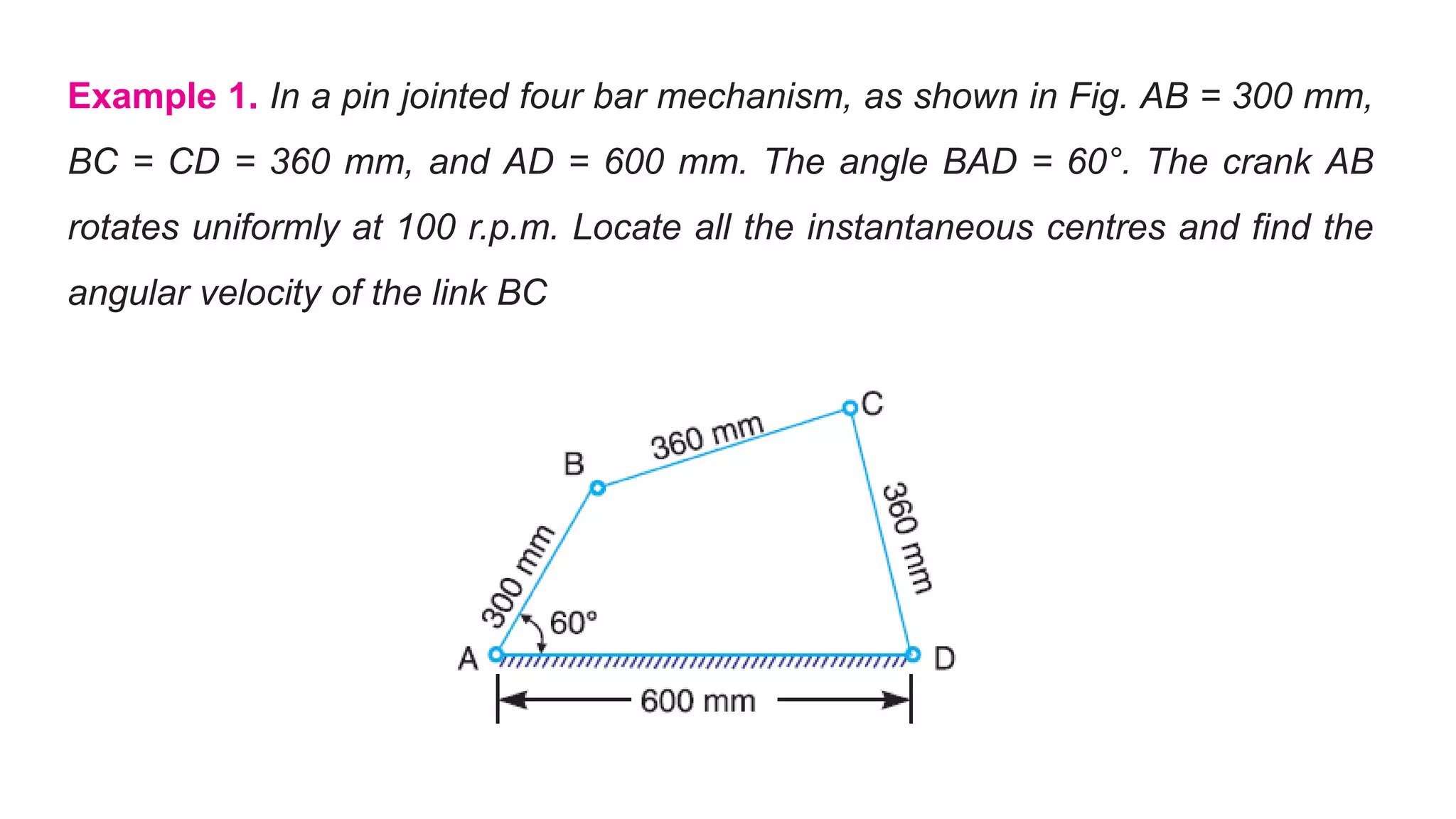
Example 1. In a pin jointed four bar mechanism, as shown in Fig. AB = 300 mm,
BC = CD = 360 mm, and AD = 600 mm. The angle BAD = 60°. The crank AB
rotates uniformly at 100 r.p.m. Locate all the instantaneous centres and find the
angular velocity of the link BC
End of Module

Module 2 instantenous center method

  • 1.
    Department of MechanicalEngineering JSS Academy of Technical Education, Bangalore-560060 Velocity in Mechanisms (Instantaneous Centre Method)
  • 2.
    • Consider arigid link AB, which moves from its initial position AB to A1B1 as shown in Fig. (a). • A little consideration will show that the link neither has complete motion of translation nor complete rotational, but a combination of the two motions. Fig. (a) Fig. (b) Introduction Example of combined motion
  • 3.
    Introduction Combined motion ofrotation and translation of the link AB may be assumed to be a motion of pure rotation about some centre I, known as the instantaneous centre of rotation (centro or virtual centre). Fig. (a)
  • 4.
    Location of positionof instantaneous centre • The points A and B of the link has moved to A1 and B1 respectively under the motion of rotation (as assumed). • Therefore the position of the centre of rotation must lie on the intersection of the right bisectors of chords A A1 and B B1. • Let these bisectors intersect at I as shown in Fig. which is the instantaneous centre of rotation of the link AB. • As position of the link AB goes on changing, therefore the centre about which the motion is assumed to take place (i.e. the instantaneous centre of rotation) also goes on changing. Introduction
  • 5.
    • Instantaneous centreof a moving body may be defined as that centre which goes on changing from one instant to another. • The locus of all such instantaneous centres is known as centrode. • A line drawn through an instantaneous centre and perpendicular to the plane of motion is called instantaneous axis. Introduction
  • 6.
    Space and BodyCentrodes  The locus of the instantaneous centre in space during a definite motion of the body is called the space centrode.  The locus of the instantaneous centre relative to the body itself is called the body centrode.
  • 7.
    Methods for determiningthe Velocity of a Point on a Link • Consider two points A and B on a rigid link. • Let vA and vB be the velocities of points A and B, whose directions are given by angles α and β as shown in Fig. • If vA is known in magnitude and direction and vB in direction only, then the magnitude of vB may be determined by the instantaneous centre method
  • 8.
    Methods for determiningthe Velocity of a Point on a Link 1. Draw AI and BI perpendiculars to the directions vA and vB respectively. 2. Let these lines intersect at I, which is known as instantaneous centre of the link. 3. The link is to rotate or turn about the centre I. 4. Since A and B are the points on a rigid link, therefore there cannot be any relative motion between them along the line AB.
  • 9.
    Methods for determiningthe Velocity of a Point on a Link
  • 10.
    From the aboveequation, 1. VA is known in magnitude and direction and VB in direction only, then velocity of point B or any other point C lying on the same link may be determined in magnitude and direction. 2. The magnitude of velocities of the points on a link is inversely proportional to the distances from the points to the instantaneous centre and is perpendicular to the line joining the point to the instantaneous centre.
  • 11.
    Number of InstantaneousCentres in a Mechanism • The number of instantaneous centres in a constrained kinematic chain is equal to the number of possible combinations of two links.
  • 12.
    Types of InstantaneousCentres 1. Fixed instantaneous centres. 2. Permanent instantaneous centres. 3. Neither fixed nor permanent instantaneous centres. • The first two types i.e. fixed and permanent instantaneous centres are together known as primary instantaneous centres. • The third type is known as secondary instantaneous centres.
  • 13.
    Types of InstantaneousCentres Consider a four bar mechanism as shown in fig. • The number of instantaneous centres (N) in a four bar mechanism is given by,
  • 14.
    Types of InstantaneousCentres • The instantaneous centres I12 and I14 are called the fixed instantaneous centres as they remain in the same place for all configurations of the mechanism. • The instantaneous centres I23 and I34 are the permanent instantaneous centres as they move when the mechanism moves, but the joints are of permanent nature. • The instantaneous centres I13 and I24 are neither fixed nor permanent instantaneous centres as they vary with the configuration of the mechanism.
  • 15.
    Location of InstantaneousCentres The following rules may be used in locating the instantaneous centres in a mechanism : 1. When the two links are connected by a pin joint, the instantaneous centre lies on the centre of the pin as shown in Fig. Such a instantaneous centre is of permanent nature, but if one of the links is fixed, the instantaneous centre will be of fixed type.
  • 16.
    2. When thetwo links have a pure rolling contact, the instantaneous centre lies on their point of contact, as shown in Fig. • The velocity of any point A on the link 2 relative to fixed link 1 will be perpendicular to I12 A and is proportional to I12 A . Location of Instantaneous Centres
  • 17.
    3. When thetwo links have a sliding contact, the instantaneous centre lies on the common normal at the point of contact. • Consider the following three cases : Location of Instantaneous Centres (a) When the link 2 (slider) moves on fixed link 1 having straight surface as shown in Fig.(c), the instantaneous centre lies at infinity and each point on the slider have the same velocity.
  • 18.
    (b) When thelink 2 (slider) moves on fixed link 1 having curved surface as shown in Fig. (d), the instantaneous centre lies on the centre of curvature of the curvilinear path in the configuration at that instant. (c) When the link 2 (slider) moves on fixed link 1 having constant radius of curvature as shown in Fig. (e), the instantaneous centre lies at the centre of curvature.
  • 19.
    Aronhold Kennedy (orThree Centres in Line) Theorem The Aronhold Kennedy’s theorem states that “if three bodies move relatively to each other, they have three instantaneous centres and lie on a straight line”. Consider three kinematic links A, B and C having relative plane motion. The number of instantaneous centres (N) is given by,
  • 20.
    • The twoinstantaneous centres at the pin joints of B with A, and C with A (i.e. Iab and Iac) are the permanent instantaneous centres. • According to Aronhold Kennedy’s theorem, the third instantaneous centre Ibc must lie on the line joining Iab and Iac.
  • 21.
    In order toprove this; • Consider that the instantaneous centre Ibc lies outside the line joining Iab and Iac as shown in Fig. • The point Ibc belongs to both the links B and C. • Now consider the point Ibc on the link B. Its velocity vBC must be perpendicular to the line joining Iab and Ibc. • Now consider the point Ibc on the link C. • Its velocity vBC must be perpendicular to the line joining Iac and Ibc.
  • 22.
    • WKT, thevelocity of the instantaneous centre is same whether it is a point on the first link or a point on the second link. • Therefore, the velocity of the point Ibc cannot be perpendicular to both lines Iab Ibc and Iac Ibc , unless the point Ibc lies on the line joining the points Iab and Iac. • Thus, the three instantaneous centres (Iab, Iac and Ibc) must lie on the same straight line. • The exact location of Ibc on line Iab Iac depends upon the directions and magnitudes of the angular velocities of B and C relative to A.
  • 23.
    Method of LocatingInstantaneous Centres in a Mechanism 1. First of all, determine the number of instantaneous centres (N) by using the relation; 2. Make a list of all the instantaneous centres in a mechanism. Book-keeping table.
  • 24.
    3. Locate thefixed and permanent instantaneous centres by inspection. In Fig. I12 & I14 are fixed instantaneous centres & I23 and I34 are permanent instantaneous centres. 4. Locate the neither fixed nor permanent instantaneous centres by Kennedy’s theorem. This is done by circle diagram as shown in Fig. (b). • Mark points on a circle equal to the number of links in a mechanism. In the present case, mark 1, 2, 3, and 4 on the circle. 5. Join the points by solid lines to show that these centres are already found. • In the circle diagram [Fig. 6.8 (b)] these lines are 12, 23, 34 and 14 to indicate the centres I12, I23, I34 and I14.
  • 25.
    6. In orderto find the other two instantaneous centres, join two such points that the line joining them forms two adjacent triangles in the circle diagram. • The line for completing two triangles, should be a common side to the two triangles.
  • 26.
    Example 1. Ina pin jointed four bar mechanism, as shown in Fig. AB = 300 mm, BC = CD = 360 mm, and AD = 600 mm. The angle BAD = 60°. The crank AB rotates uniformly at 100 r.p.m. Locate all the instantaneous centres and find the angular velocity of the link BC
  • 27.