11/10/2016 By - T.S.SENTHILKUMAR/AP 1
Mechanics
Dynamics
Kinetics Kinematics
Statics
11/10/2016 By - T.S.SENTHILKUMAR/AP 2
• The branch of scientific analysis that deals
with motions, time and forces is called
mechanics.
• It is divided in to two parts statics and
dynamics.
11/10/2016 By - T.S.SENTHILKUMAR/AP 3
STATICS
• It deals with the analysis of stationary systems.
But time is not considered.
DYNAMICS
• It deals with the systems that change with
time.
11/10/2016 By - T.S.SENTHILKUMAR/AP 4
KINEMATICS
• It is the study of motion, quite apart from the
forces which produce that motion.
• It is the study of position, displacement,
rotation, speed, velocity and acceleration.
KINETICS
• It is the study of motion and its causes
11/10/2016 By - T.S.SENTHILKUMAR/AP 5
The subject matter which deals with this
geometric constant of relative motion, without
any reference to the cause of the motion that is
the force is called kinematics.
For the study of kinematics, a machine may be
referred to as a mechanism, which is a
combination of inter connected rigid bodies
capable of relative motion.
11/10/2016 By - T.S.SENTHILKUMAR/AP 6
Machinery is defined as a mechanical device or
the parts that keep something working.
Machines or machine parts considered as a group.
The working parts of a particular machine.
An assemblage of machines.
The parts of a machine collectively.
An assemblage of machines or mechanical
apparatuses
11/10/2016 By - T.S.SENTHILKUMAR/AP 7
• It is defined as the combination of rigid or
resistance bodies assembled in such a way that
the motion of one causes constrained and
predictable motion to others is known as
mechanism.
• If one of the links of a kinematic chain is
fixed, then the chain is known as mechanism.
11/10/2016 By - T.S.SENTHILKUMAR/AP 8
An assembly of moving parts performing a complete
functional motion.
A mechanism is a device designed to transform input
forces and movement into a desired set of output forces
and movement.
Mechanisms generally consist of moving components
such as gears and gear trains, belt and chain drives, cam
and follower mechanisms, and linkages as well as
friction devices such as brakes and clutches, and
structural components such as the frame, fasteners,
bearings, springs, lubricants and seals, as well as a
variety of specialized machine elements such as splines,
pins and keys.
11/10/2016 By - T.S.SENTHILKUMAR/AP 9
• It is defined as a device which receives energy
and transforms it into some useful work.
• If the mechanism is used to transmit power
(or) to do work, then it is known as machine.
• The main function of the machine is to obtain
mechanical advantage.
11/10/2016 By - T.S.SENTHILKUMAR/AP 10
We can define machine as a device for
transferring and transforming motion and force
or power from the input that is, the source to
the output that is the load.
The motion needs to be transformed as it is
being transferred from the source to the load.
11/10/2016 By - T.S.SENTHILKUMAR/AP 11
11/10/2016 By - T.S.SENTHILKUMAR/AP 12
• It is a resistant body or assembly of resistant
body of a machine connecting other parts of
the machine with relative motion between
them.
• There are three types of links available in order
to transmit motion. They are as follows:
» Rigid link
» Flexible link
» Fluid link
11/10/2016 By - T.S.SENTHILKUMAR/AP 13
Rigid link
A rigid link is one which does not undergo any
deformation while transmitting motion. Practically rigid
link does not exists. Ex : crank shaft, piston etc.,
Flexible link
A flexible link is one which undergoes partial deformation
without affecting the transfer motion. Ex : ropes, belts,
chains, springs etc.,
Fluid link
A fluid link is a link which has fluid inside the container
and motion is transmitted through the fluid by pressure or
compression. Ex: fluids used in hydraulic press, hydraulic
jack, hydraulic crane etc.,
11/10/2016 By - T.S.SENTHILKUMAR/AP 14
Binary link, Ternary link, Quaternary link
11/10/2016 By - T.S.SENTHILKUMAR/AP 15
• A joint of two links that permits relative motion
is called pair.
Types of kinematic pair
1. Nature of relative motion between the links.
2. Nature of contact between the links.
3. Nature of mechanical arrangement.
11/10/2016 By - T.S.SENTHILKUMAR/AP 16
Nature of relative motion
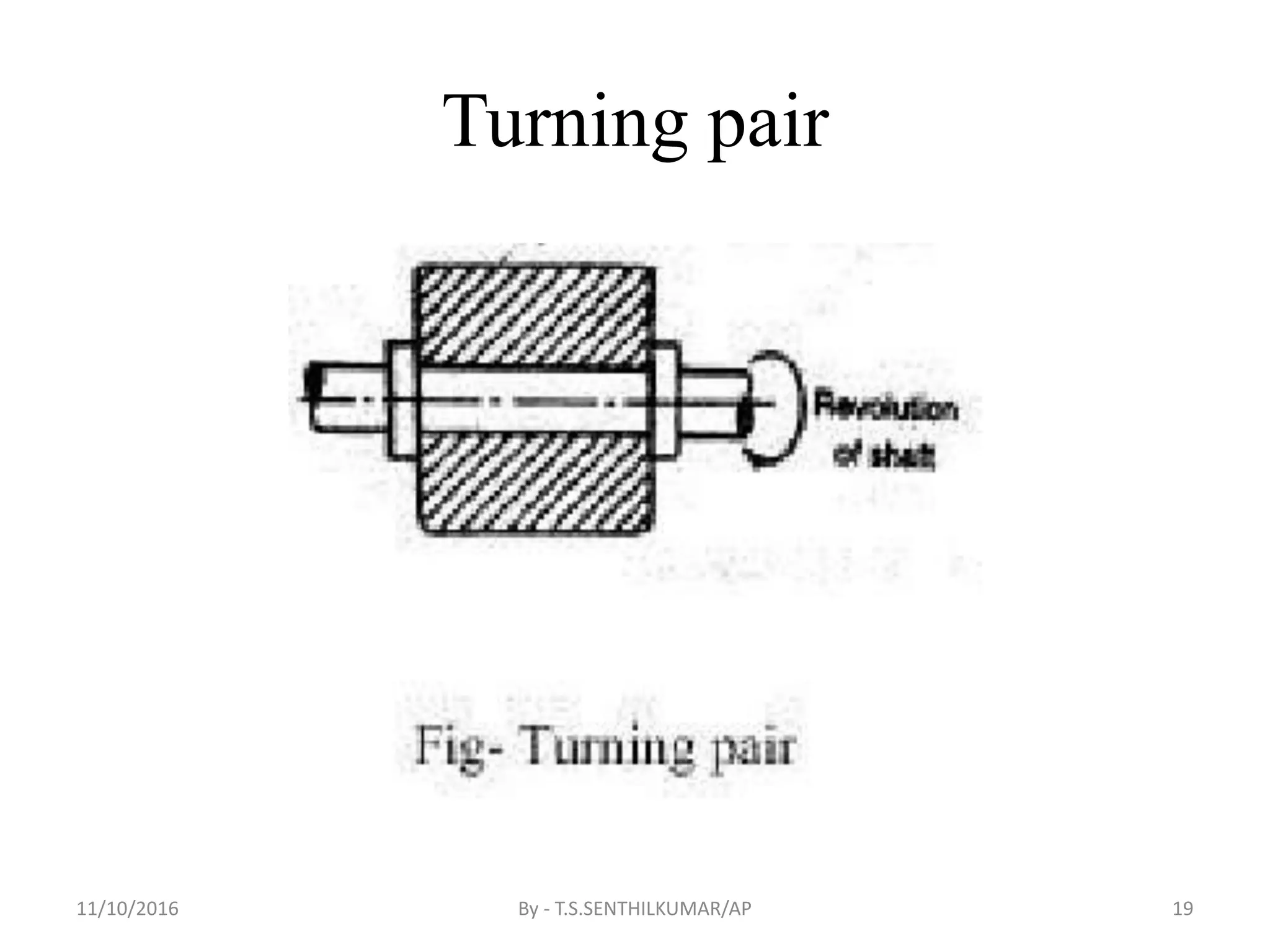
» Sliding pair
» Turning pair
» Cylindrical pair
» Rolling pair
» Spherical pair
» Helical pair
Nature of contact
» Lower pair
» Higher pair
Nature of mechanical constraint
» Closed pair
» Unclosed pair11/10/2016 By - T.S.SENTHILKUMAR/AP 17
Sliding pair
11/10/2016 By - T.S.SENTHILKUMAR/AP 18
Turning pair
11/10/2016 By - T.S.SENTHILKUMAR/AP 19
Cylindrical pair
11/10/2016 By - T.S.SENTHILKUMAR/AP 20
Rolling pair
11/10/2016 By - T.S.SENTHILKUMAR/AP 21
Spherical pair
11/10/2016 By - T.S.SENTHILKUMAR/AP 22
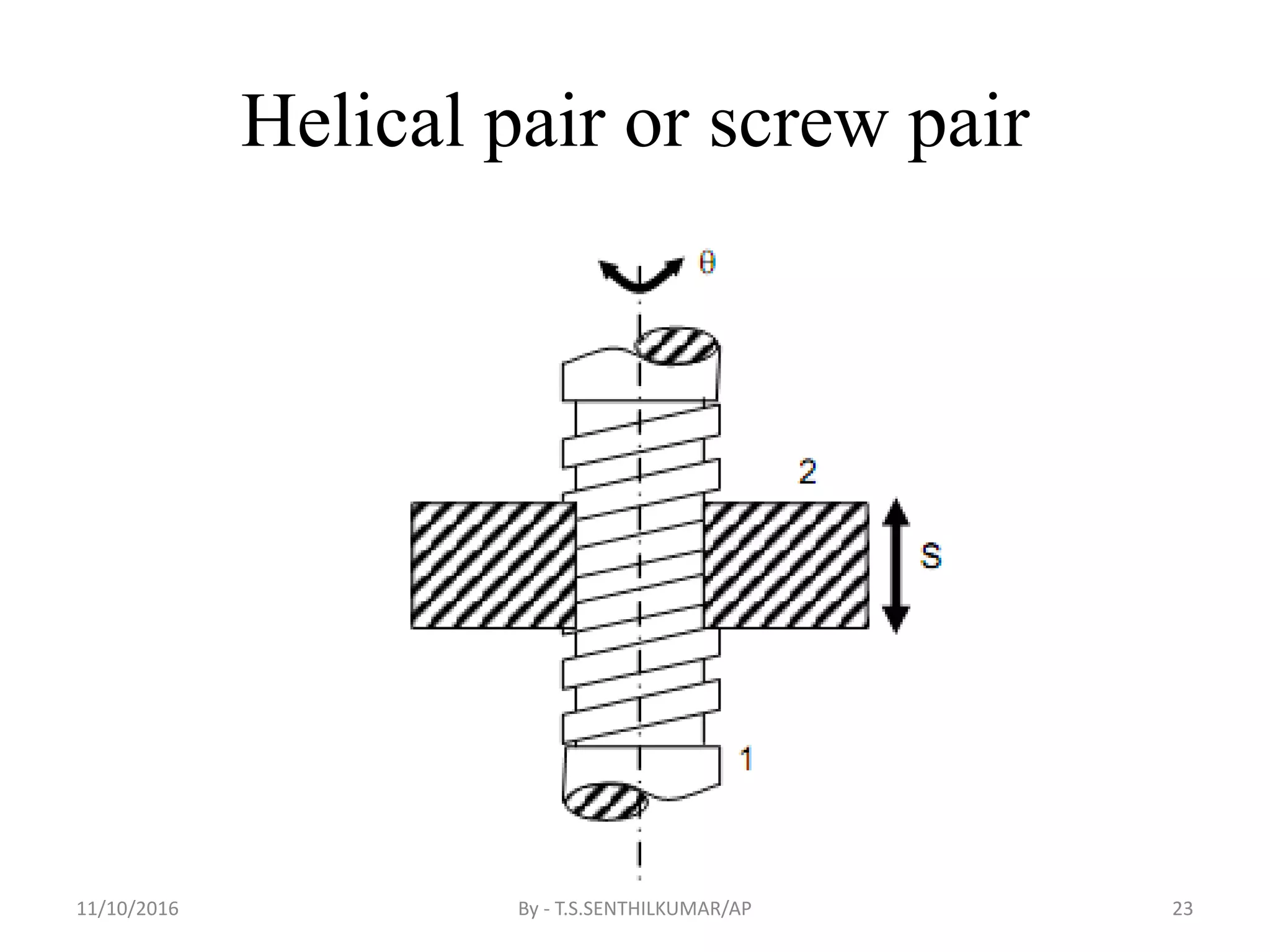
Helical pair or screw pair
11/10/2016 By - T.S.SENTHILKUMAR/AP 23
Lower pair
11/10/2016 By - T.S.SENTHILKUMAR/AP 24
Higher pair
11/10/2016 By - T.S.SENTHILKUMAR/AP 25
Closed pair
• When two elements of a pair are held together
mechanically, they constitute a closed pair.
Ex : All pair
Un closed pair
• When two elements of a pair are not held
together mechanically, they constitute a
unclosed pair.
Ex : cam and follower
11/10/2016 By - T.S.SENTHILKUMAR/AP 26
• If the last link is joined to first link to transmit
definite motion, then it is known as kinematic
chain.
• To determine the given assemblage of links form
the kinematic chain or not:
• The two equations are:
l = 2p – 4
j = (3/2) * l – 2
Where, l = number of links
p = number of pairs
j = number of joints
11/10/2016 By - T.S.SENTHILKUMAR/AP 27
Constrained
Motions
Completely
Constrained Motion
Uncompletely
Constrained Motion
Successfully
Constrained Motion
11/10/2016 By - T.S.SENTHILKUMAR/AP 28
JOINTS
Ternary
joint
Binary joint
Quaternary
joint
11/10/2016 By - T.S.SENTHILKUMAR/AP 29
The analysis of mechanism is the number of
degrees of freedom, also called the mobility of
the device.
The mobility of a mechanism is defined as the
number of input parameters which must be
controlled independently in order to bring the
device in to a particular position.
It is the number of independent coordinates
required to describe the position of a body in
space.
11/10/2016 By - T.S.SENTHILKUMAR/AP 30
11/10/2016 By - T.S.SENTHILKUMAR/AP 31
Movability includes the six degrees of freedom
of the device as a whole, as through the ground
link were not fixed and thus applies to a
kinematic chain.
Mobility neglects these and considers only the
internal motions, thus applying to a
mechanism.
11/10/2016 By - T.S.SENTHILKUMAR/AP 32
A link is to have ‘n’ degree of freedom if it has n
independent variables associated with its position
in the plane.
11/10/2016 By - T.S.SENTHILKUMAR/AP 33
Then the number of degree of freedom of a
mechanism (n) is given by,
n = 3 (l-1) – 2j – h
where, l = number of links
j = number of binary joints
h = number of higher pairs
This equation is called kutzbach criterion for
the mobility of a mechanism.
If there is no higher pair, then h = 0. then
kutzbach criterion, n = 3 (l-1) – 2j
11/10/2016 By - T.S.SENTHILKUMAR/AP 34
• Mechanism with lower pairs
– Three bar mechanism
– Four bar mechanism
– Five bar mechanism
– Six bar mechanism
• Mechanism with higher pairs
11/10/2016 By - T.S.SENTHILKUMAR/AP 35
n = 6(l-1) – 5P1 – 4P2 – 3P3 – 2P4 – 1P5
Where, n = Number of degree of freedom
l = Number of links
P1 = Number of pair having one degree of
freedom
P2 = Number of pair having two degree of
freedom
11/10/2016 By - T.S.SENTHILKUMAR/AP 36
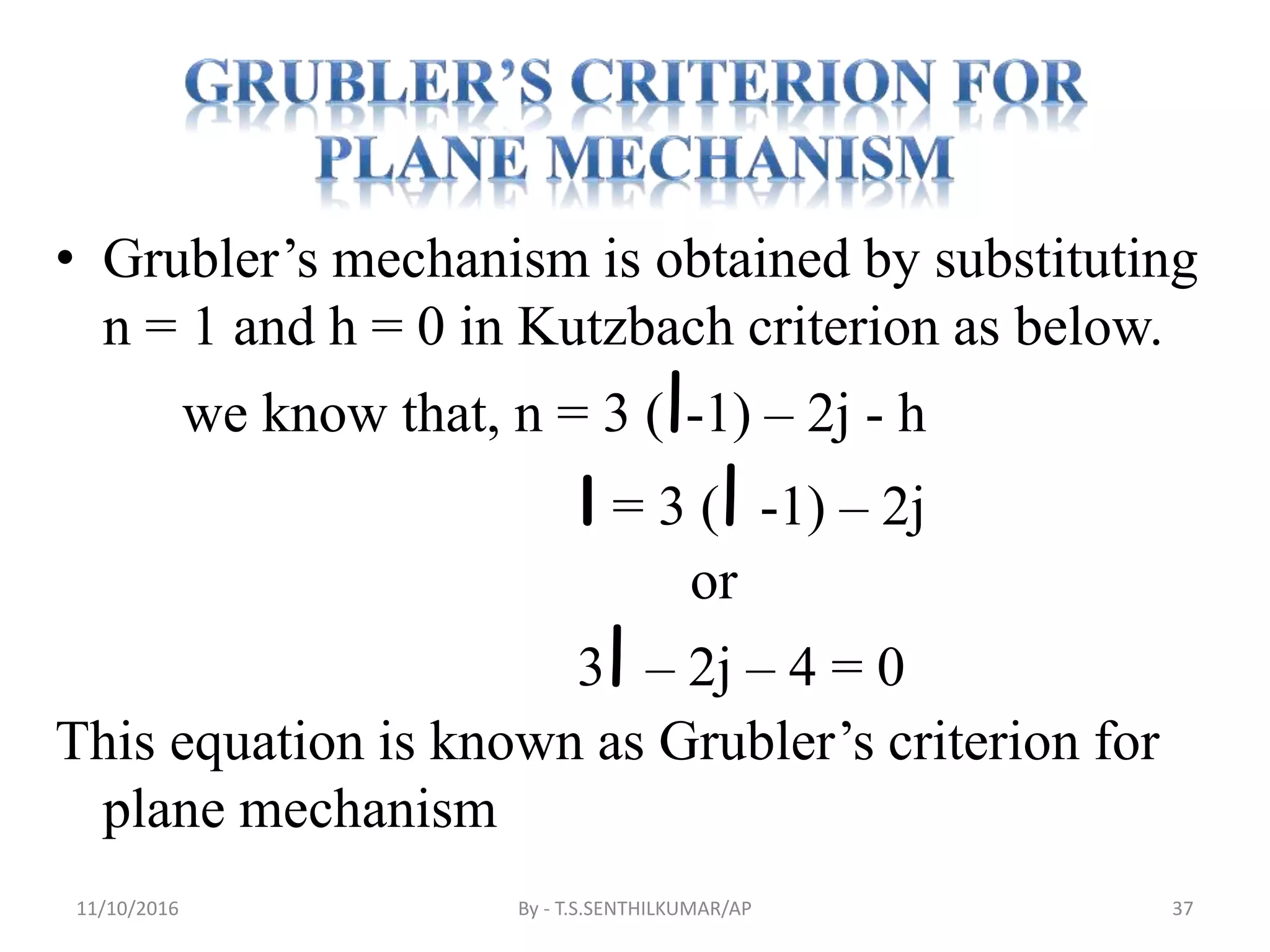
• Grubler’s mechanism is obtained by substituting
n = 1 and h = 0 in Kutzbach criterion as below.
we know that, n = 3 (l-1) – 2j - h
l = 3 (l -1) – 2j
or
3l – 2j – 4 = 0
This equation is known as Grubler’s criterion for
plane mechanism
11/10/2016 By - T.S.SENTHILKUMAR/AP 37
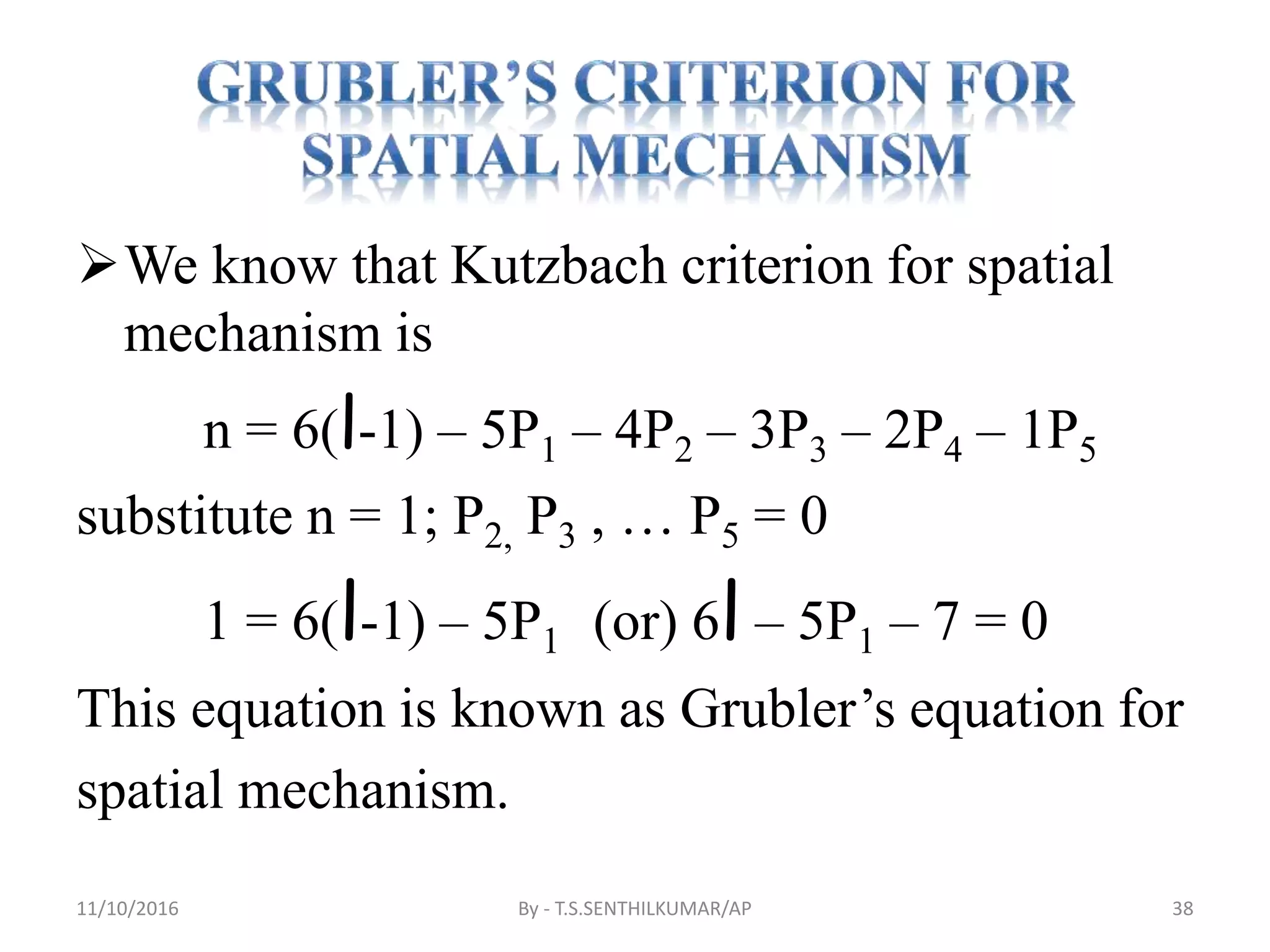
We know that Kutzbach criterion for spatial
mechanism is
n = 6(l-1) – 5P1 – 4P2 – 3P3 – 2P4 – 1P5
substitute n = 1; P2, P3 , … P5 = 0
1 = 6(l-1) – 5P1 (or) 6l – 5P1 – 7 = 0
This equation is known as Grubler’s equation for
spatial mechanism.
11/10/2016 By - T.S.SENTHILKUMAR/AP 38
• When one of the links of kinematic chain is
fixed, then the chain is known as mechanism.
11/10/2016 By - T.S.SENTHILKUMAR/AP 39
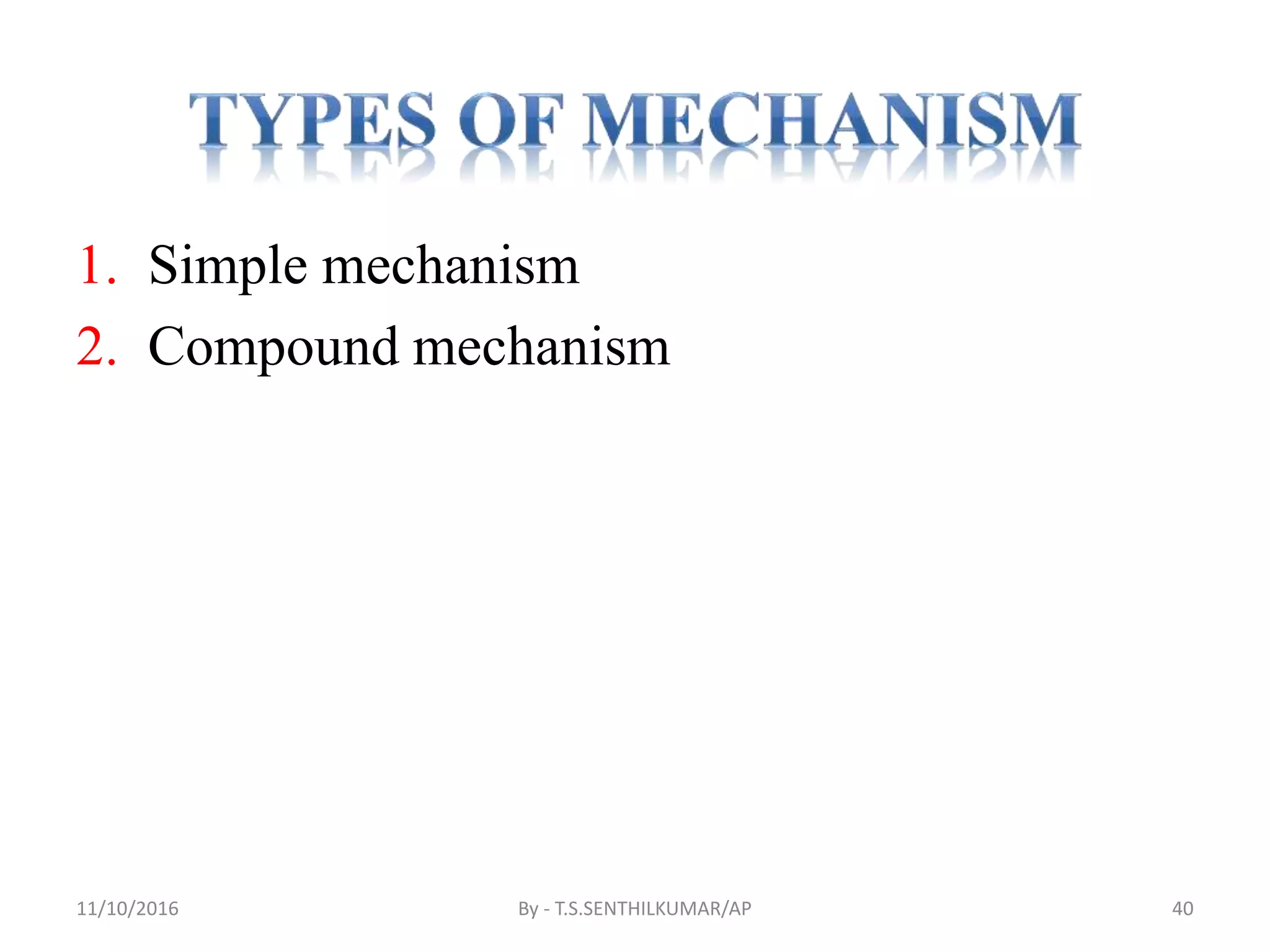
1. Simple mechanism
2. Compound mechanism
11/10/2016 By - T.S.SENTHILKUMAR/AP 40
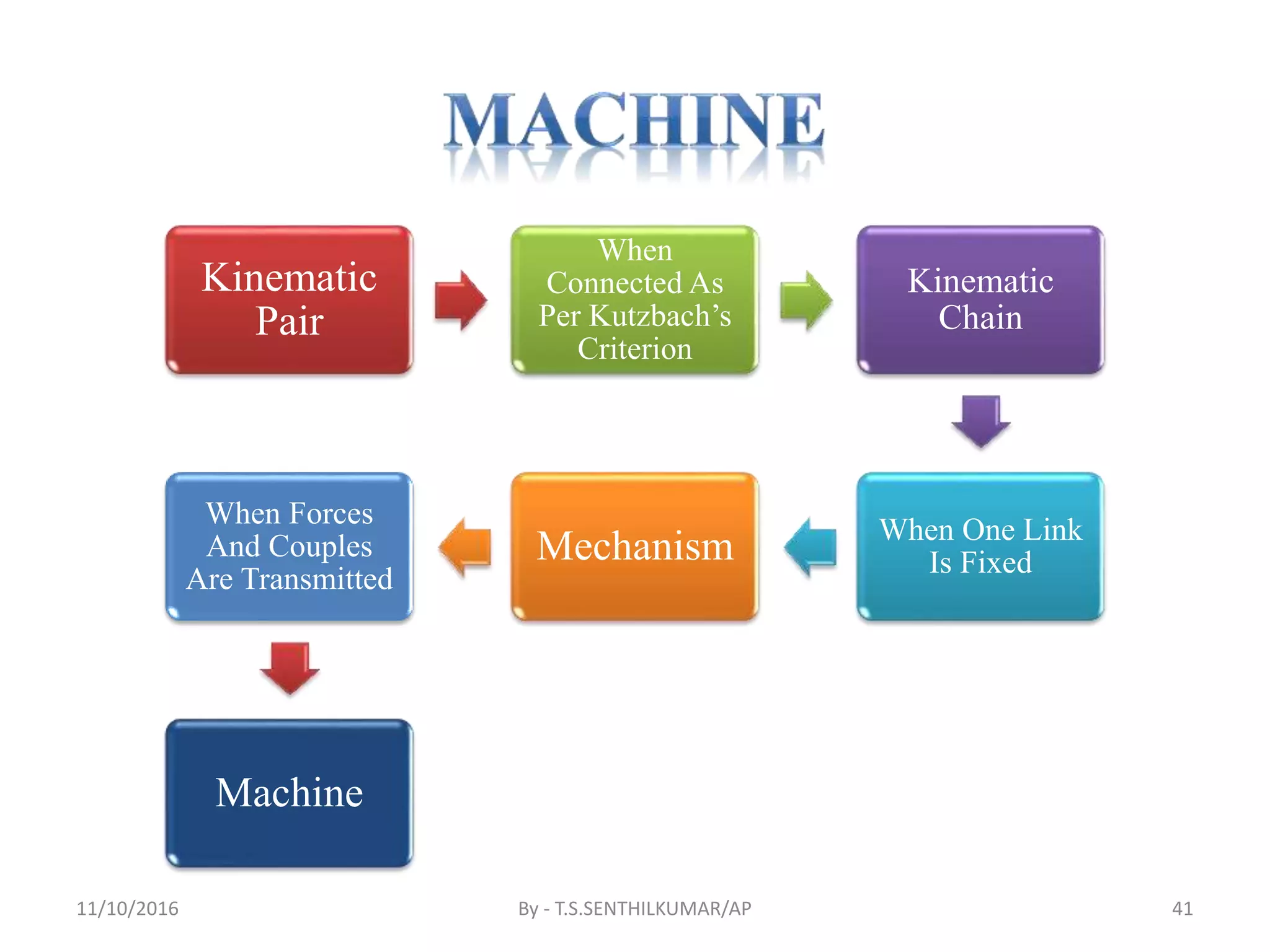
Kinematic
Pair
When
Connected As
Per Kutzbach’s
Criterion
Kinematic
Chain
When One Link
Is FixedMechanism
When Forces
And Couples
Are Transmitted
Machine
11/10/2016 By - T.S.SENTHILKUMAR/AP 41
The method of obtaining different mechanisms
by fixing different links in a kinematic chain,
is known as inversion of the mechanism.
11/10/2016 By - T.S.SENTHILKUMAR/AP 42
Kinematic chain
Four bar chain
Slider crank
chain
Double crank
chain
11/10/2016 By - T.S.SENTHILKUMAR/AP 43
11/10/2016 By - T.S.SENTHILKUMAR/AP 44
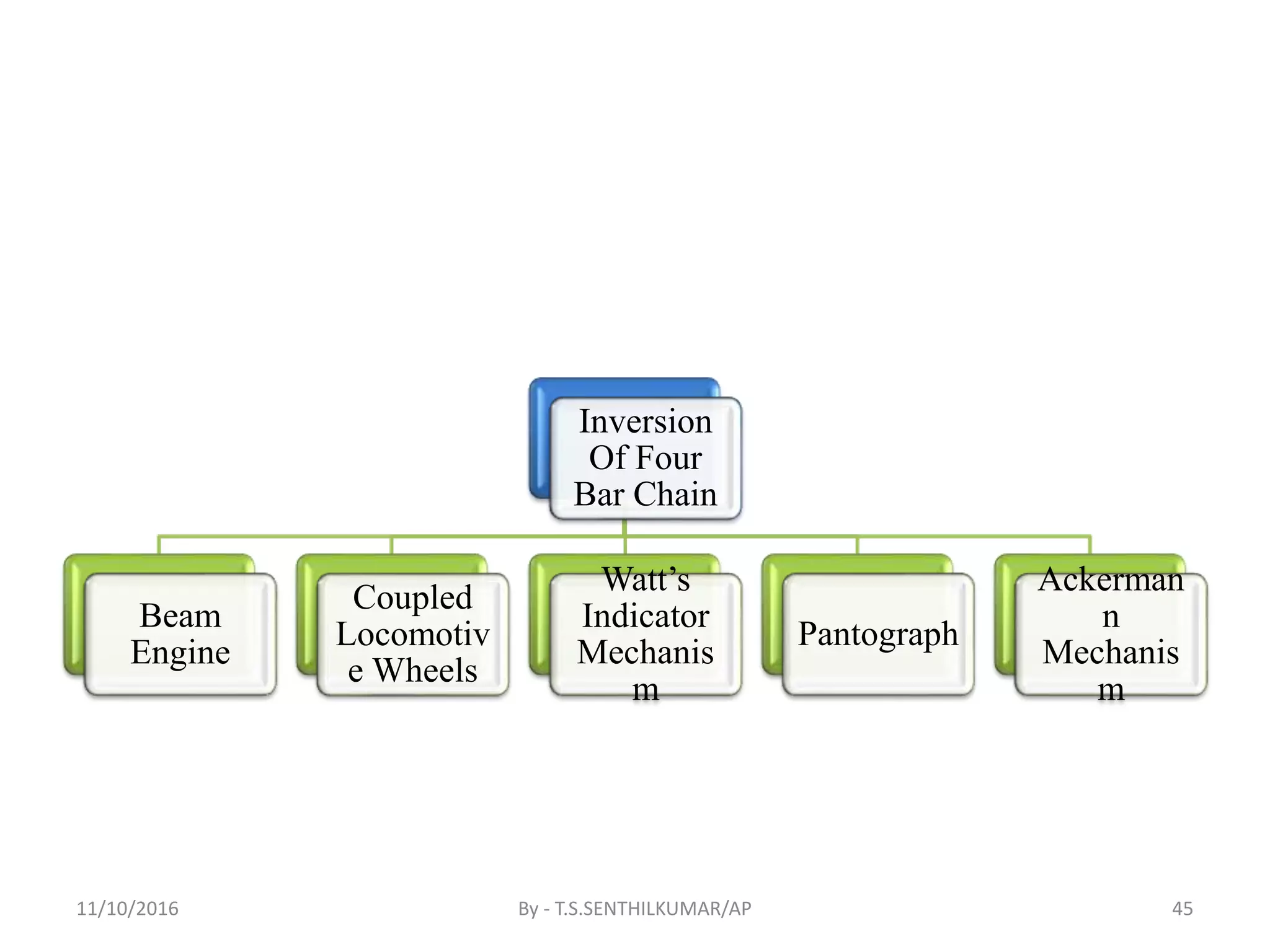
Inversion
Of Four
Bar Chain
Beam
Engine
Coupled
Locomotiv
e Wheels
Watt’s
Indicator
Mechanis
m
Pantograph
Ackerman
n
Mechanis
m
11/10/2016 By - T.S.SENTHILKUMAR/AP 45
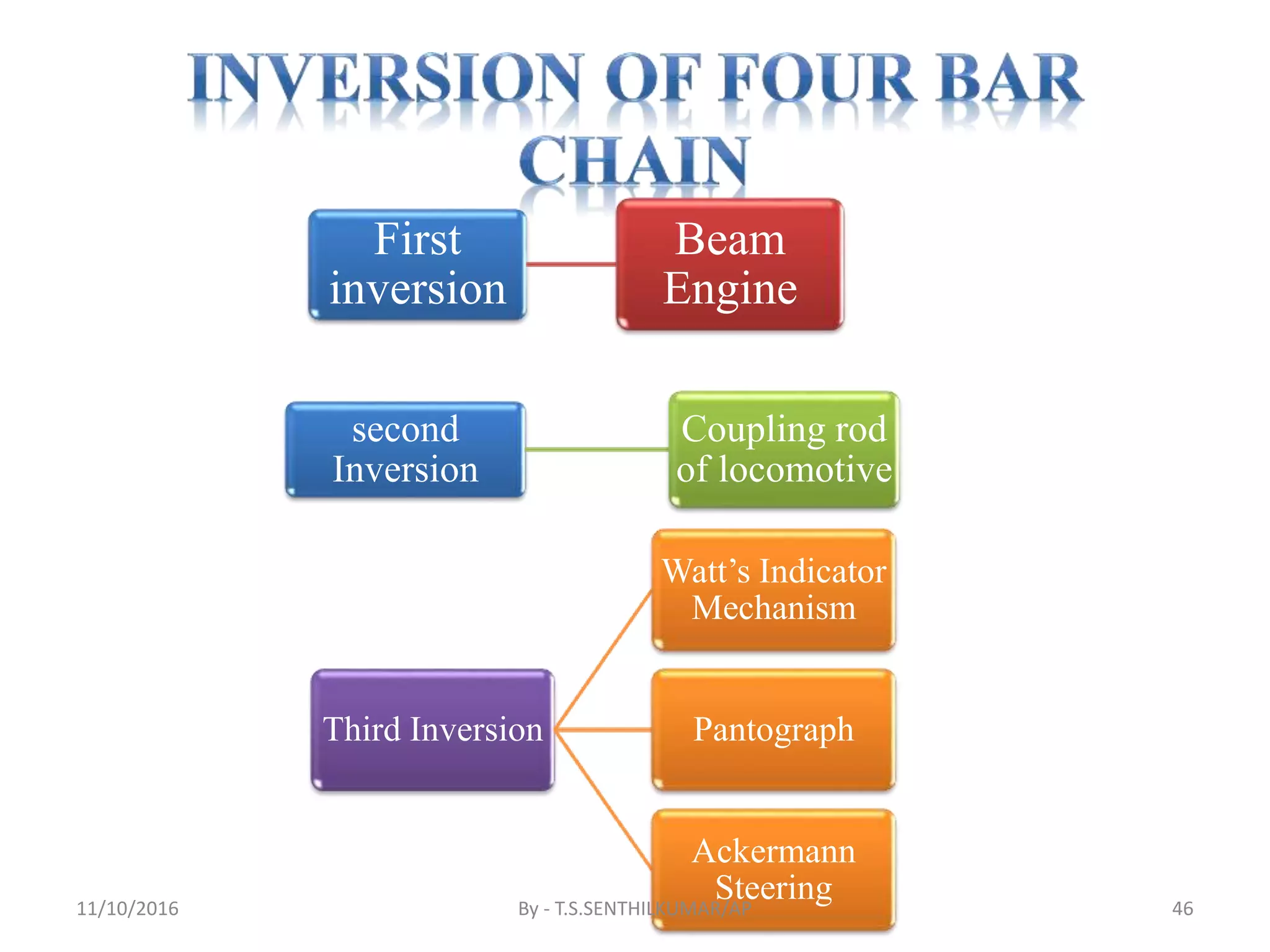
First
inversion
Beam
Engine
second
Inversion
Coupling rod
of locomotive
Third Inversion
Watt’s Indicator
Mechanism
Pantograph
Ackermann
Steering11/10/2016 By - T.S.SENTHILKUMAR/AP 46
Beam engine
• Mechanism.Gifinversion of four bar chainbeam-
engine-o.Gif
11/10/2016 By - T.S.SENTHILKUMAR/AP 47
Coupling rod of a locomotive
11/10/2016 By - T.S.SENTHILKUMAR/AP 48
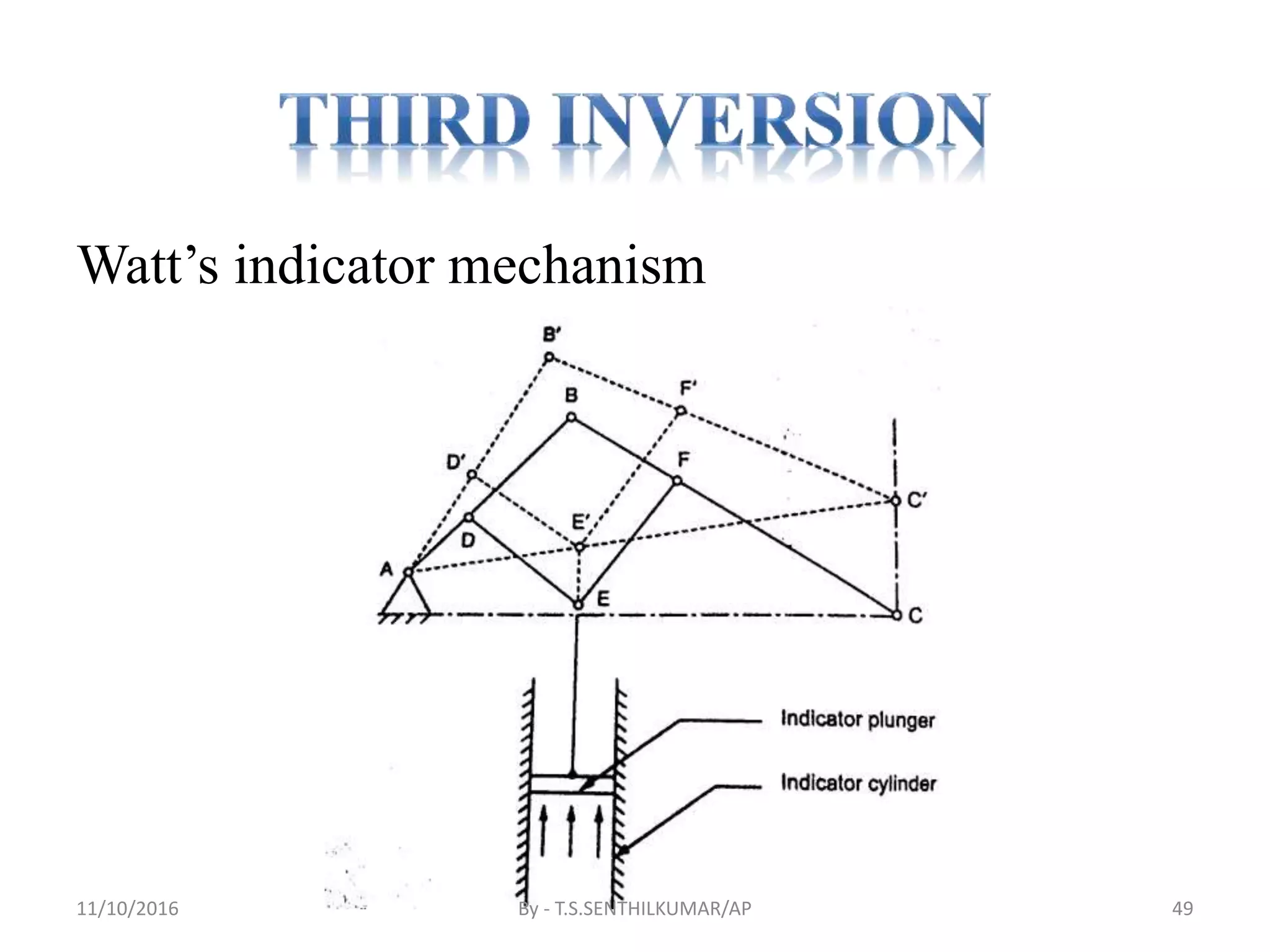
Watt’s indicator mechanism
11/10/2016 By - T.S.SENTHILKUMAR/AP 49
Pantograph
11/10/2016 By - T.S.SENTHILKUMAR/AP 50
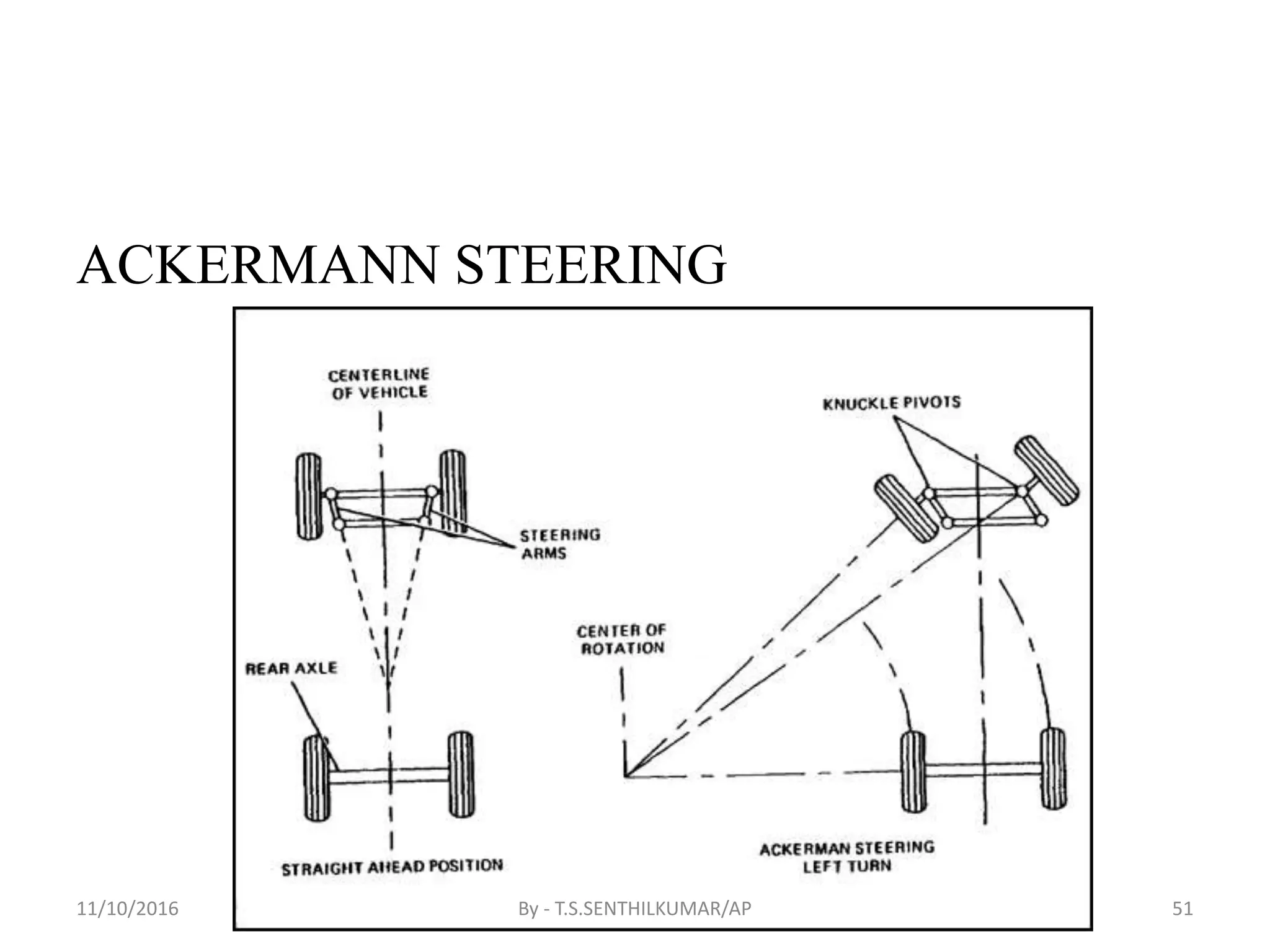
ACKERMANN STEERING
11/10/2016 By - T.S.SENTHILKUMAR/AP 51
11/10/2016 By - T.S.SENTHILKUMAR/AP 52
Singleslidercrank
chain
Reciprocating
engine
Reciprocating
compressor
Whitworth quick
return mechanism
Rotary or Gnome
engine
Crank and slotted
lever mechanism
Oscillating
cylinder engine
Bull engine
Pump engine11/10/2016 By - T.S.SENTHILKUMAR/AP 53
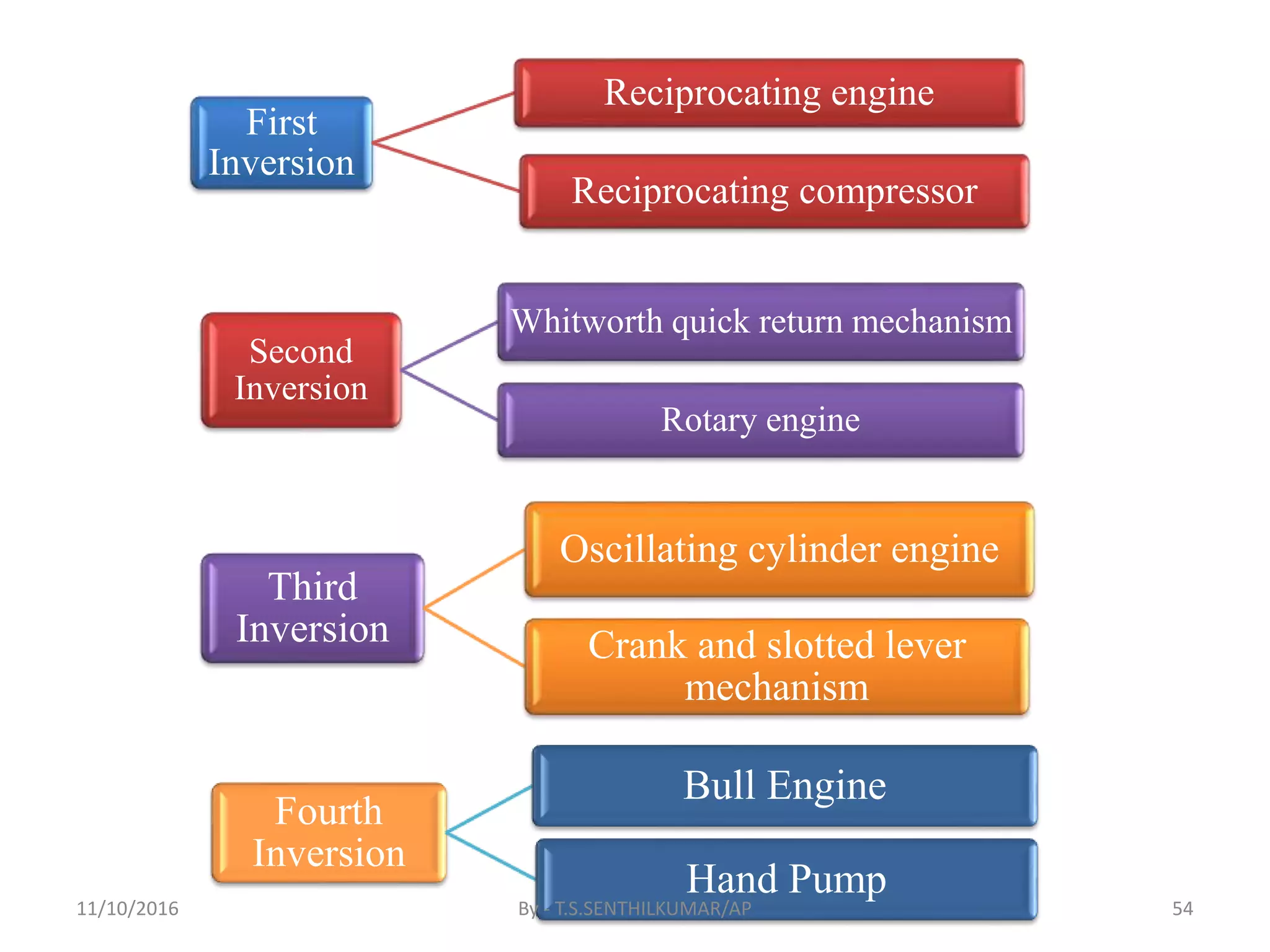
First
Inversion
Reciprocating engine
Reciprocating compressor
Second
Inversion
Whitworth quick return mechanism
Rotary engine
Third
Inversion
Oscillating cylinder engine
Crank and slotted lever
mechanism
Fourth
Inversion
Bull Engine
Hand Pump
11/10/2016 By - T.S.SENTHILKUMAR/AP 54
• Reciprocating engine
11/10/2016 By - T.S.SENTHILKUMAR/AP 55
• Reciprocating compressor
11/10/2016 By - T.S.SENTHILKUMAR/AP 56
• Whitworth Quick Return Mechanism
11/10/2016 By - T.S.SENTHILKUMAR/AP 57
• Rotary Engine
11/10/2016 By - T.S.SENTHILKUMAR/AP 58
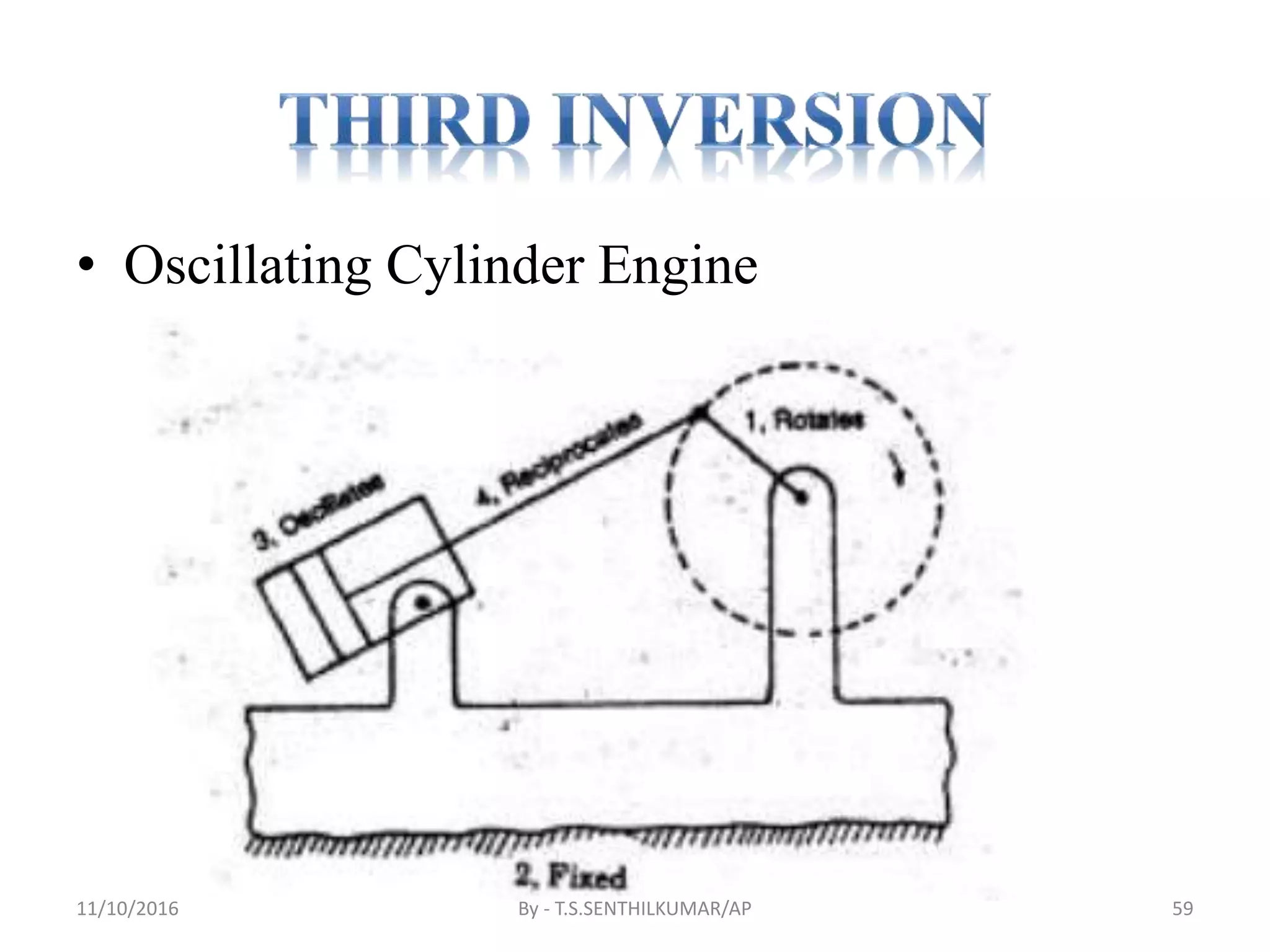
• Oscillating Cylinder Engine
11/10/2016 By - T.S.SENTHILKUMAR/AP 59
• Crank and Slotted lever Quick return Mechanism
basic1_quickreturn.gif
11/10/2016 By - T.S.SENTHILKUMAR/AP 60
• Pendulum pump or bull engine
11/10/2016 By - T.S.SENTHILKUMAR/AP 61
• Hand pump
11/10/2016 By - T.S.SENTHILKUMAR/AP 62
11/10/2016 By - T.S.SENTHILKUMAR/AP 63
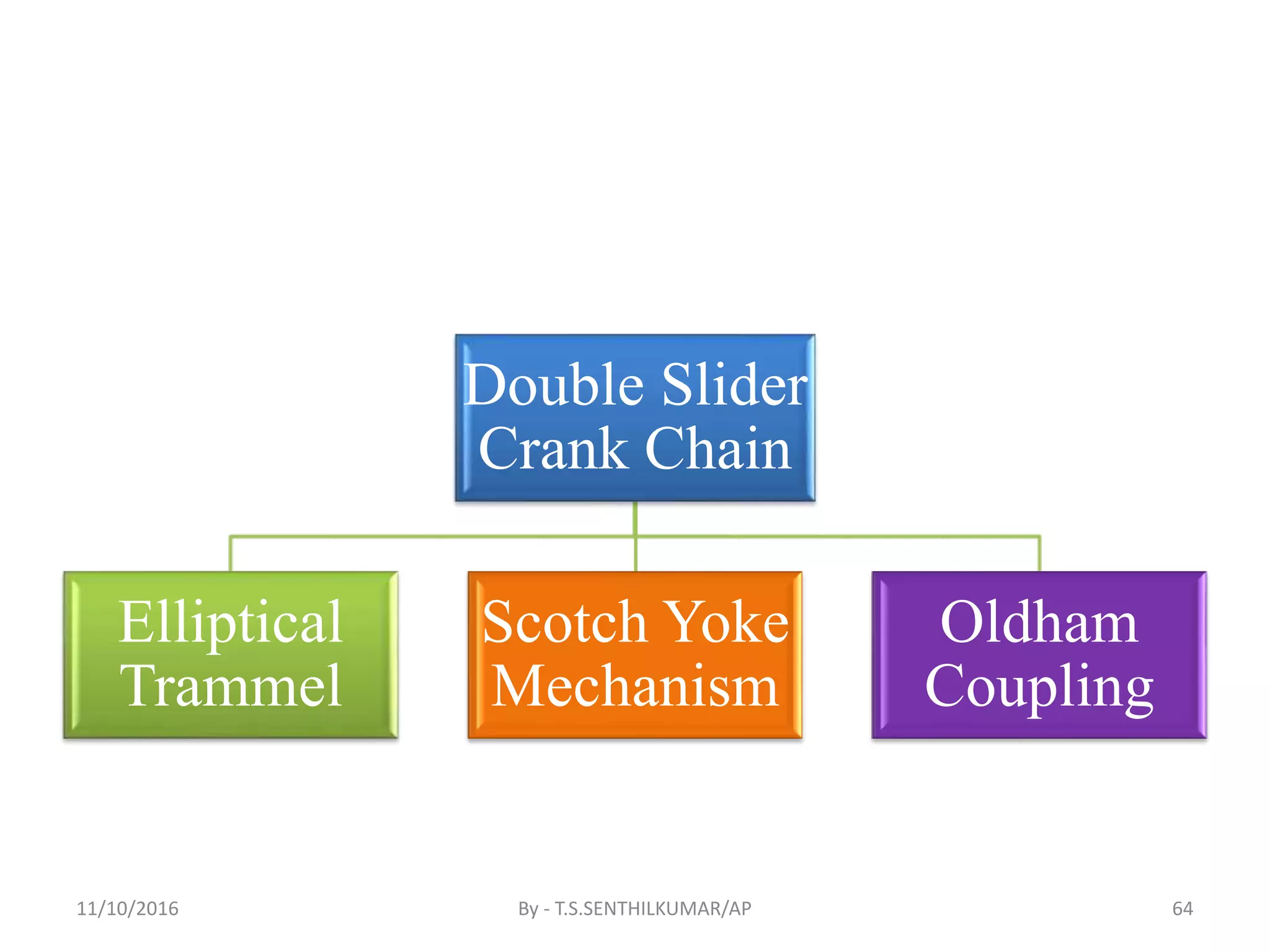
Double Slider
Crank Chain
Elliptical
Trammel
Scotch Yoke
Mechanism
Oldham
Coupling
11/10/2016 By - T.S.SENTHILKUMAR/AP 64
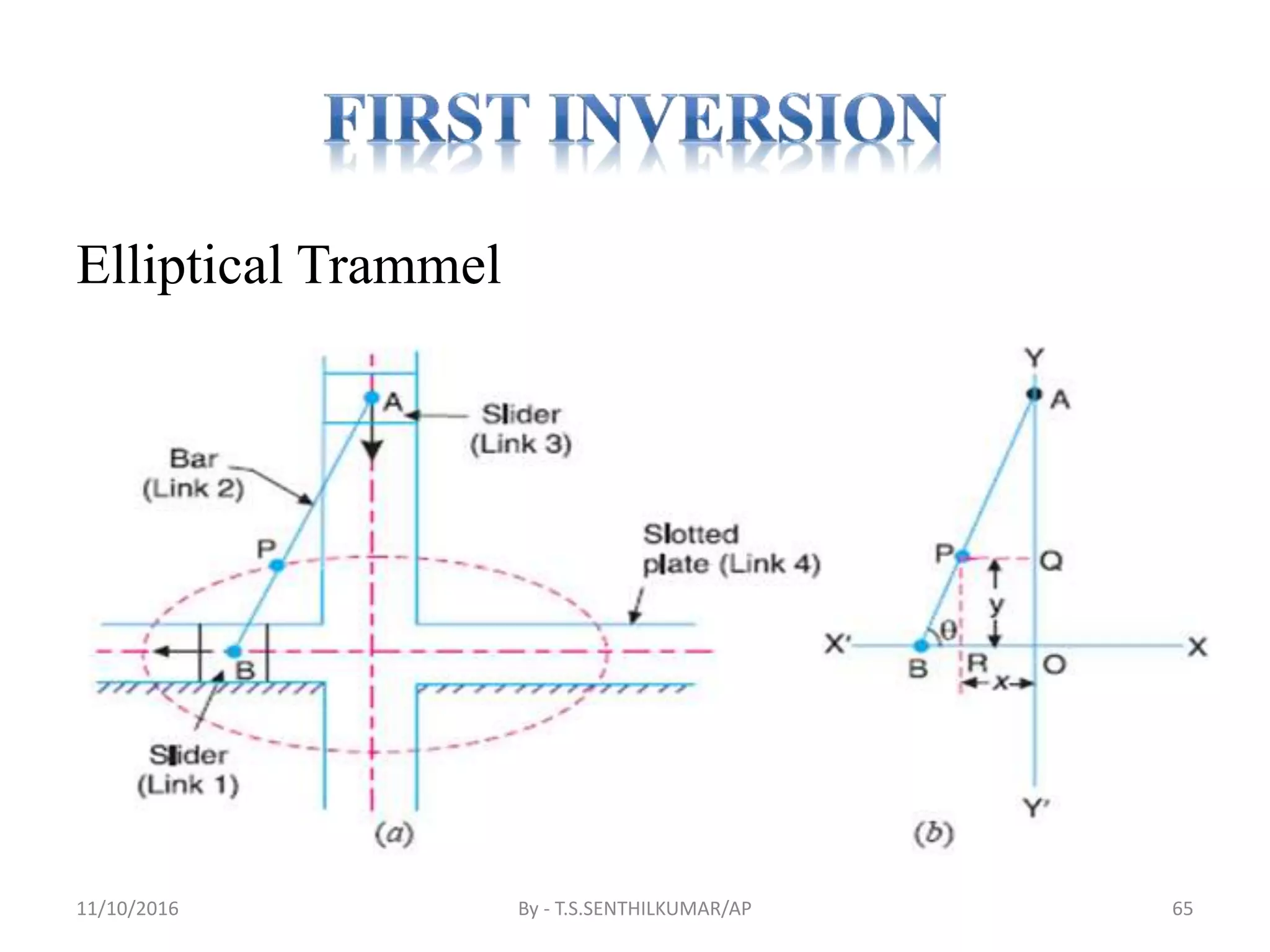
Elliptical Trammel
11/10/2016 By - T.S.SENTHILKUMAR/AP 65
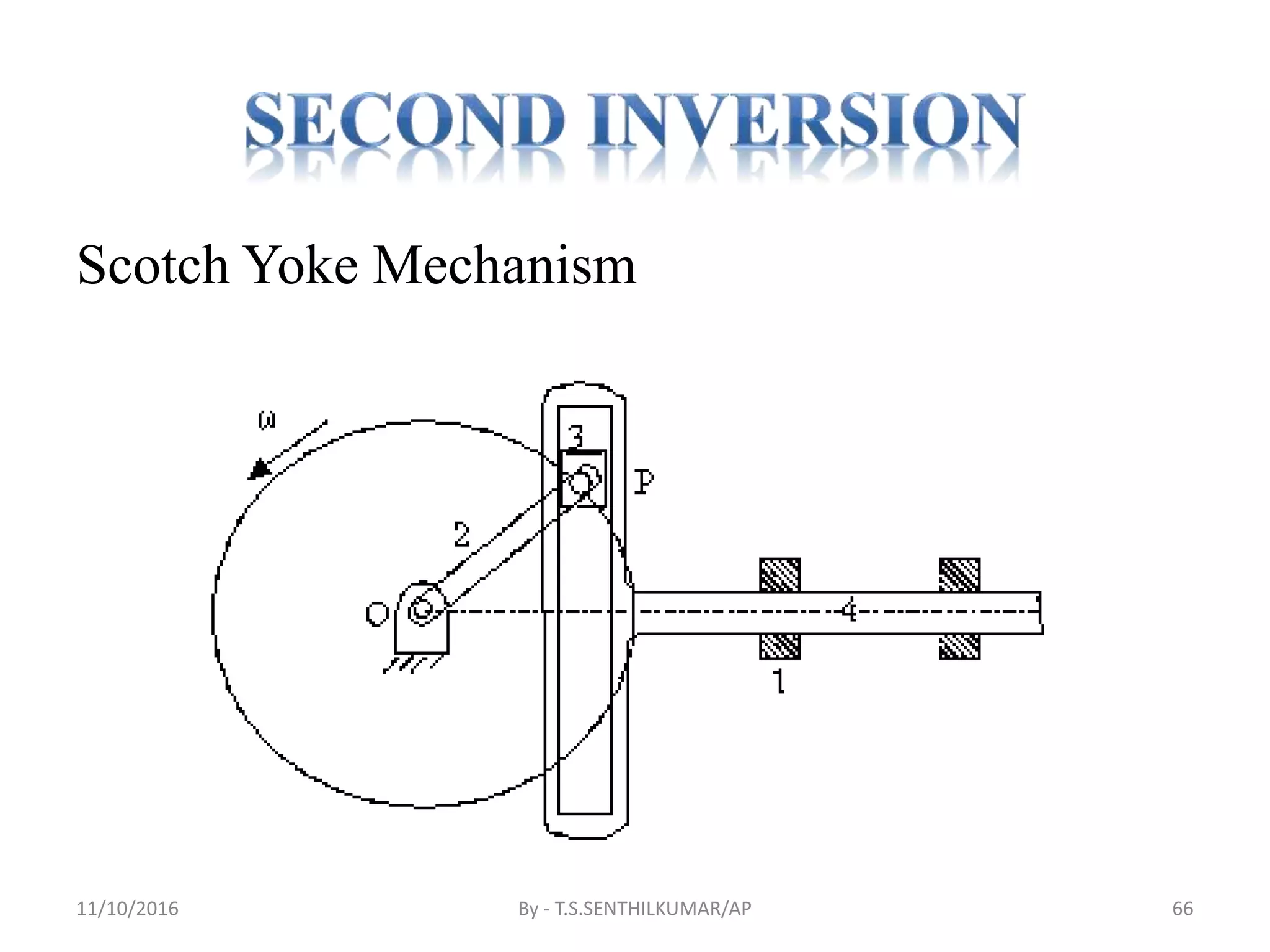
Scotch Yoke Mechanism
11/10/2016 By - T.S.SENTHILKUMAR/AP 66
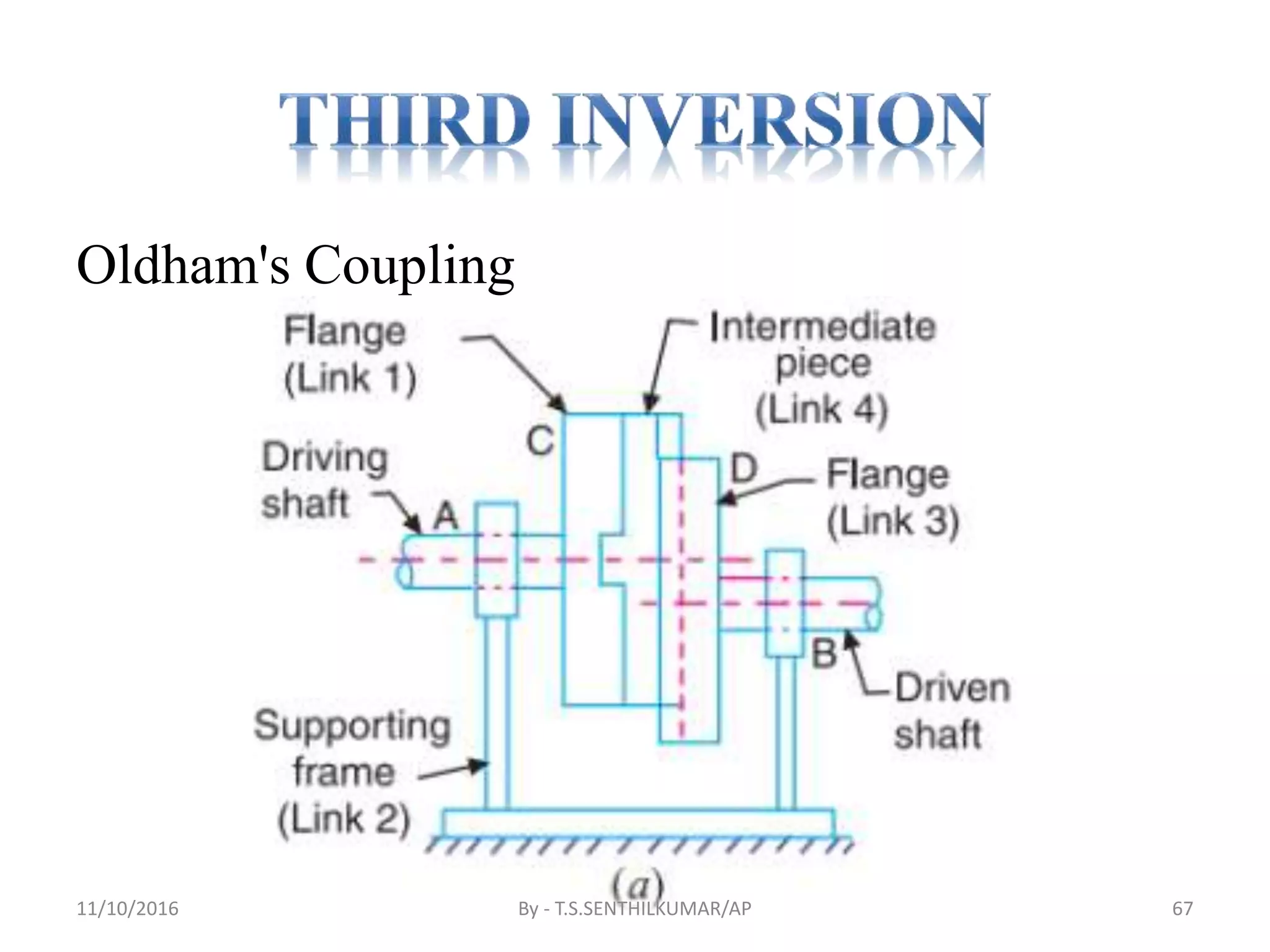
Oldham's Coupling
11/10/2016 By - T.S.SENTHILKUMAR/AP 67
• Oldham's Coupling
11/10/2016 By - T.S.SENTHILKUMAR/AP 68
11/10/2016 By - T.S.SENTHILKUMAR/AP 69
11/10/2016 By - T.S.SENTHILKUMAR/AP 70
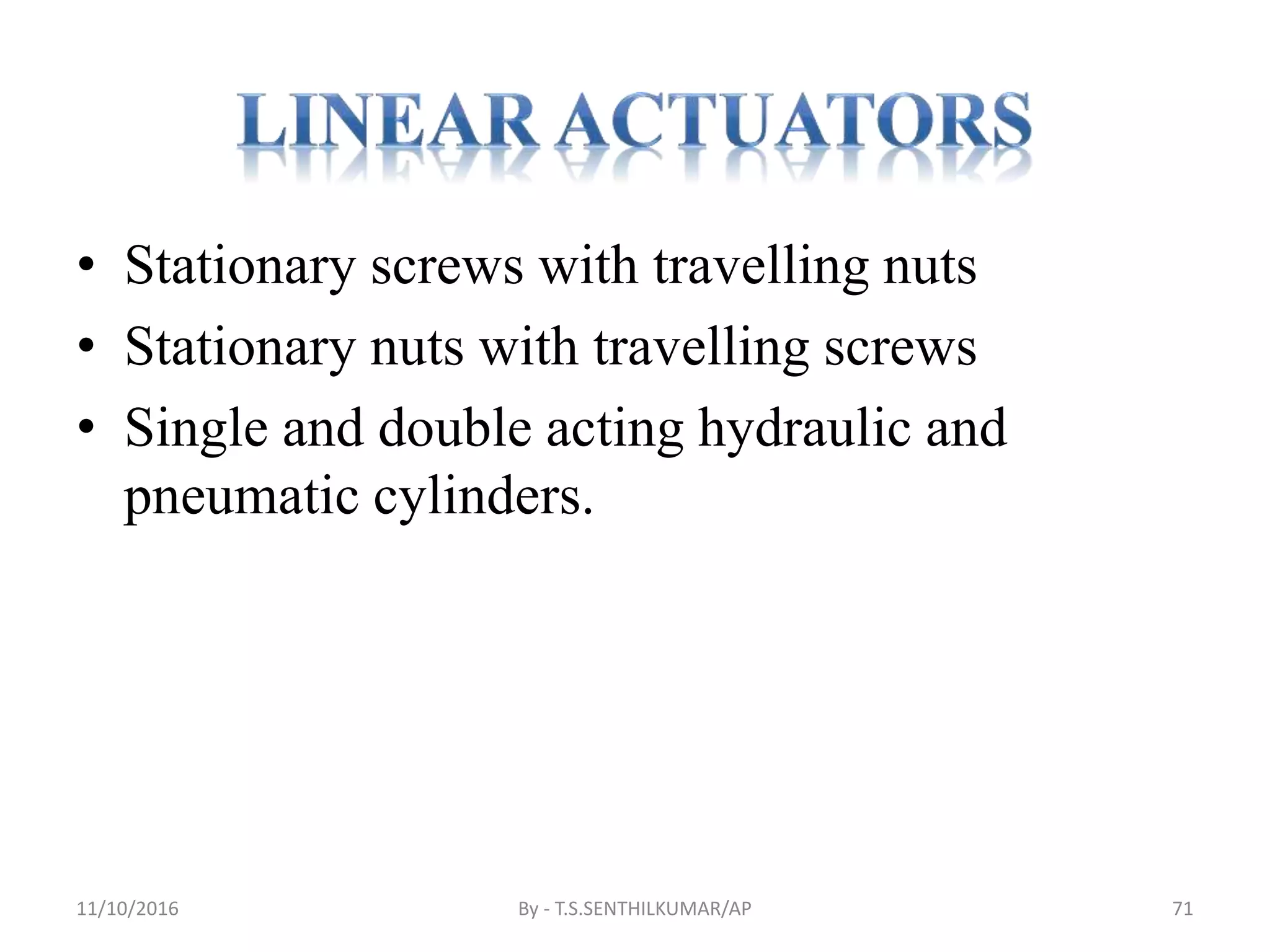
• Stationary screws with travelling nuts
• Stationary nuts with travelling screws
• Single and double acting hydraulic and
pneumatic cylinders.
11/10/2016 By - T.S.SENTHILKUMAR/AP 71
11/10/2016 By - T.S.SENTHILKUMAR/AP 72
• C-Clamp
11/10/2016 By - T.S.SENTHILKUMAR/AP 73
• This type of mechanism produces a swinging or
rocking motion of a link. The motion is generally less
than 360o and is an oscillatory motion.
Toothed Rack System
• This is simply a rotating arm (b) with a link fitted with
a toothed rack (c) which meshes with a gear (d) to
produce a rocking motion of the gear.
11/10/2016 By - T.S.SENTHILKUMAR/AP 74
Crank and Rocker Mechanism
• This is simply a four bar linkage (the frame
provides the first link). The operating
characteristics are dependent on the length of
the links and the design of the frame setting
the pivot points..Rotation of the arm (b)
produces a rocking motion of arm (d).
11/10/2016 By - T.S.SENTHILKUMAR/AP 75
Crank and Rocker Mechanism
11/10/2016 By - T.S.SENTHILKUMAR/AP 76
Quick Return linkage
• The arm (b) rotates and results in a rocking
motion of arm (d)via the slider (c). The
action is a quick return action because the
angle (b) rotates through in one direction
,assumed to be the forward direction, is greater
than the angle which result in the return
motion.
11/10/2016 By - T.S.SENTHILKUMAR/AP 77
Quick Return linkage
11/10/2016 By - T.S.SENTHILKUMAR/AP 78
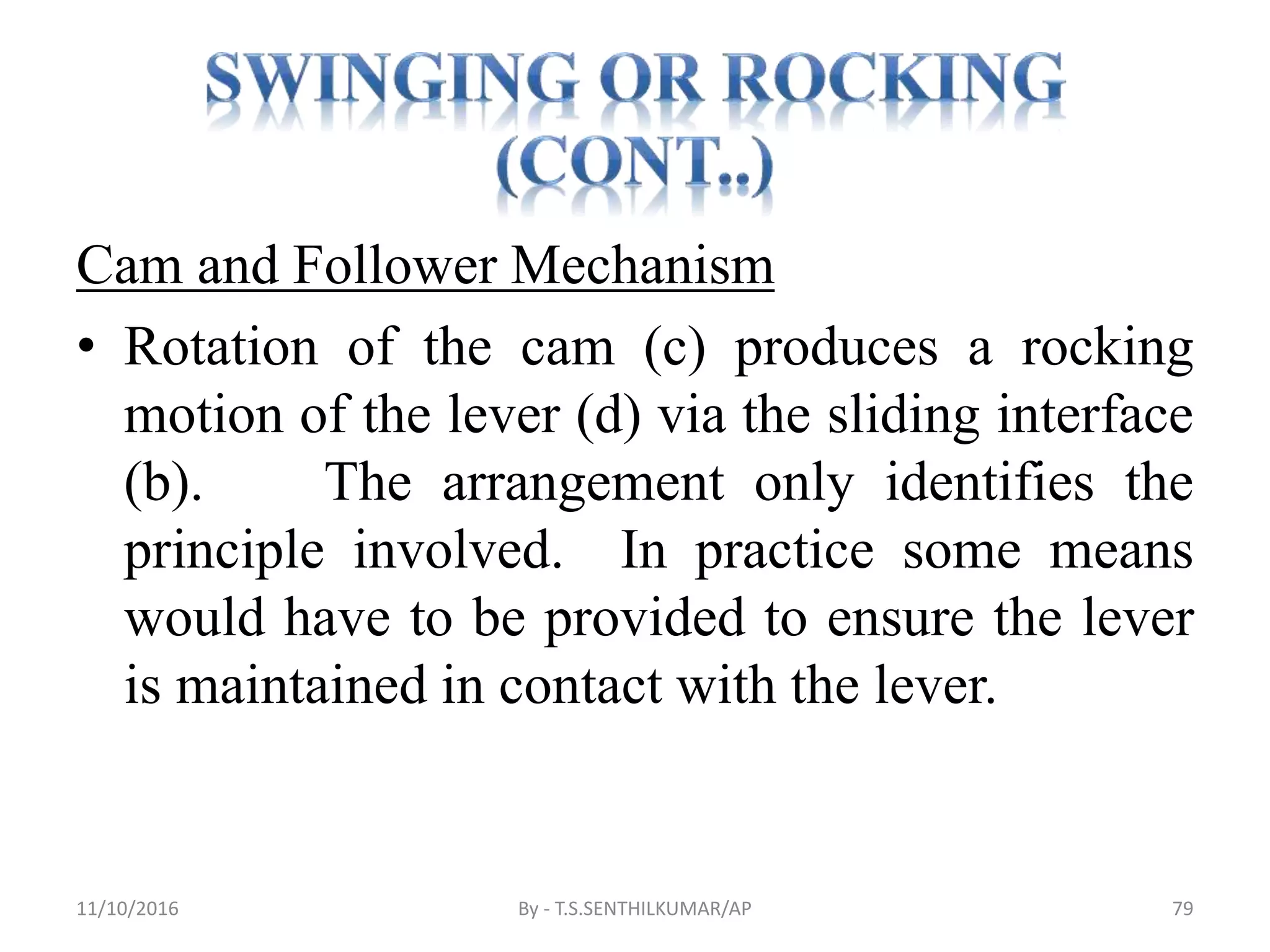
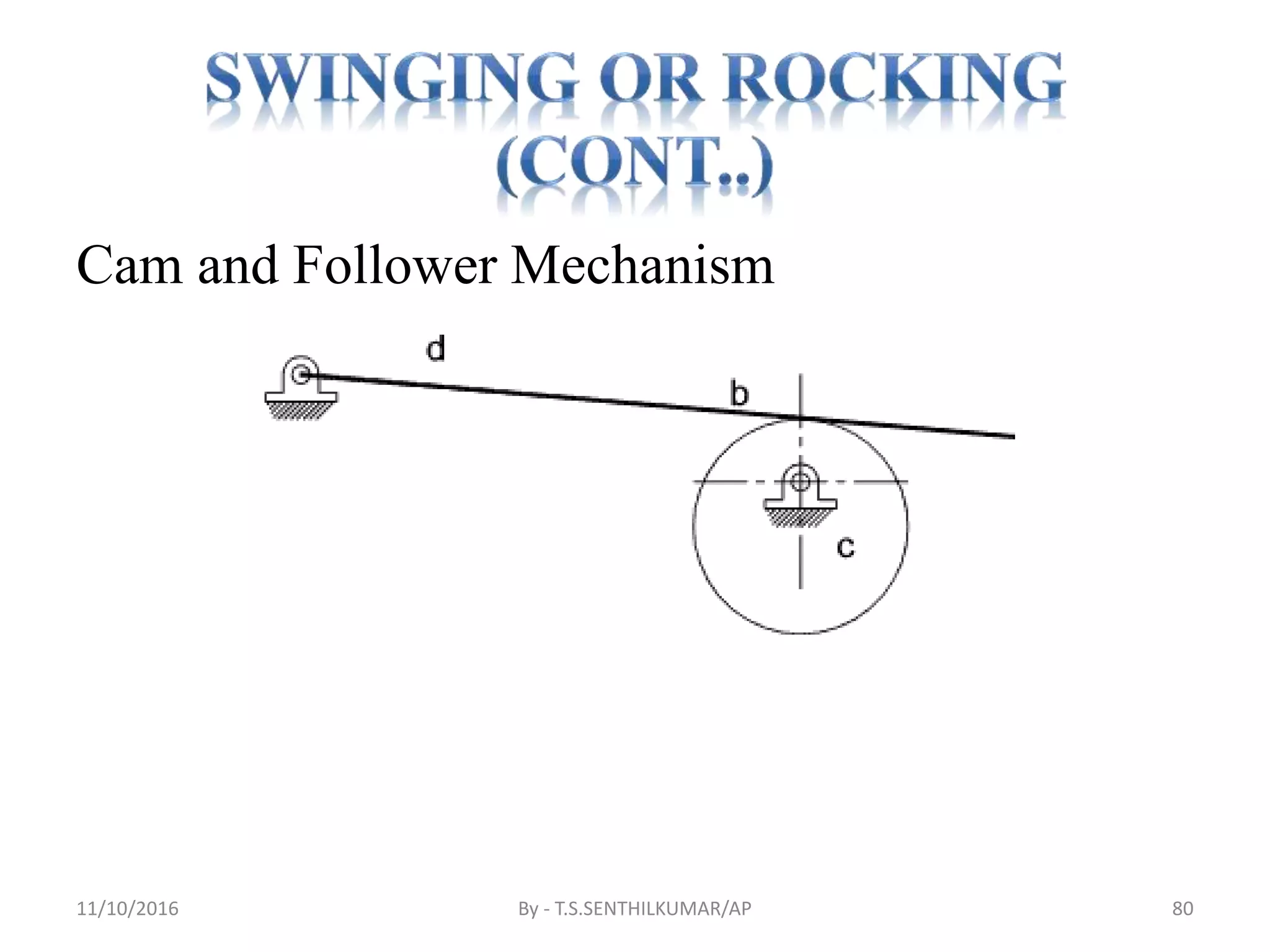
Cam and Follower Mechanism
• Rotation of the cam (c) produces a rocking
motion of the lever (d) via the sliding interface
(b). The arrangement only identifies the
principle involved. In practice some means
would have to be provided to ensure the lever
is maintained in contact with the lever.
11/10/2016 By - T.S.SENTHILKUMAR/AP 79
Cam and Follower Mechanism
11/10/2016 By - T.S.SENTHILKUMAR/AP 80
• This mechanism is for rectilinear motion
11/10/2016 By - T.S.SENTHILKUMAR/AP 81
• This mechanism is used to regulate the
movement of clock.
11/10/2016 By - T.S.SENTHILKUMAR/AP 82
11/10/2016 By - T.S.SENTHILKUMAR/AP 83
11/10/2016 By - T.S.SENTHILKUMAR/AP 84
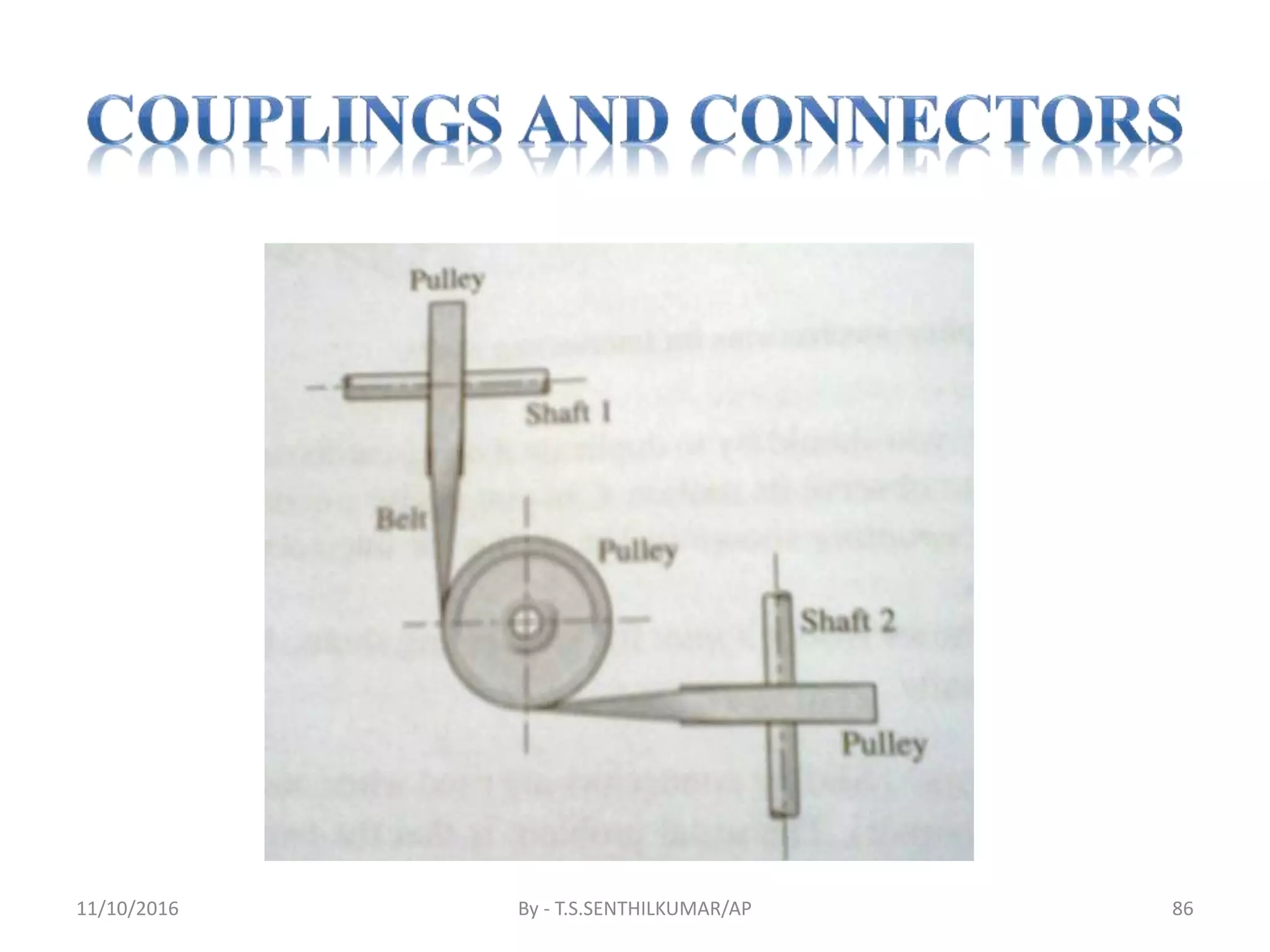
• When a mechanism is desired which is capable
of delivering output rotation in the either
direction, some form of reversing mechanism
is required.
• Ex : gear shifting
11/10/2016 By - T.S.SENTHILKUMAR/AP 85
11/10/2016 By - T.S.SENTHILKUMAR/AP 86
11/10/2016 By - T.S.SENTHILKUMAR/AP 87
11/10/2016 By - T.S.SENTHILKUMAR/AP 88
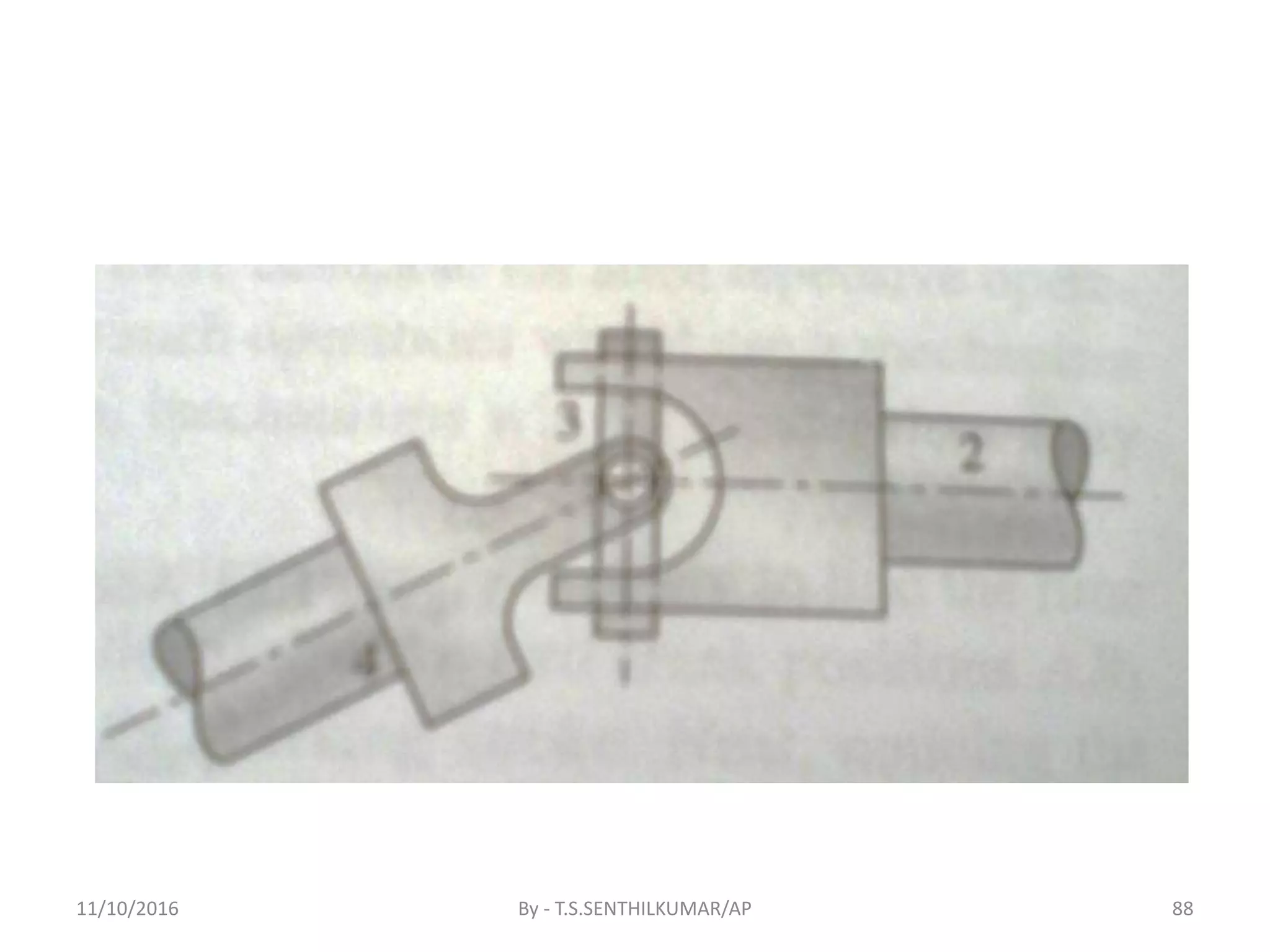
• C:UserssenthilDesktopGeneva_mechanism
_6spoke_animation.gif
11/10/2016 By - T.S.SENTHILKUMAR/AP 89
Application of the Geneva drive
• One is movie projectors : the film does not run
continuously through the projector. Instead, the
film is advanced frame by frame, each frame
standing still in front of the lens for 1/24 of a
second
11/10/2016 By - T.S.SENTHILKUMAR/AP 90
11/10/2016 By - T.S.SENTHILKUMAR/AP 91
• Peaucellier Mechanism
C:UserssenthilDesktopPeaucellier_linkage_anim
ation.gif11/10/2016 By - T.S.SENTHILKUMAR/AP 92
• Robert’s Mechanism
C:UserssenthilDesktopRoberts_linkage.gif
11/10/2016 By - T.S.SENTHILKUMAR/AP 93
• Chebychev Mechanism
C:UserssenthilDesktopChebyshev_linkage.gif
11/10/2016 By - T.S.SENTHILKUMAR/AP 94
• This connectors are used when one slider is to
drive another slider.
11/10/2016 By - T.S.SENTHILKUMAR/AP 95
• In an automobile engine a valve must open,
remain open for a period of time, and then
close.
Ex : cam and follower
11/10/2016 By - T.S.SENTHILKUMAR/AP 96
• The connecting rod of a planar four bar linkage
may be imagined as an infinite plane extending
in all directions but pin connected to the input
and output links.
• Then, during motion of the linkage, any point
attached to the plane of the coupler generates
some path with respect to the fixed link, this
path is called coupler curve.
11/10/2016 By - T.S.SENTHILKUMAR/AP 97

Kinematics of machinery

  • 1.
    11/10/2016 By -T.S.SENTHILKUMAR/AP 1
  • 2.
  • 3.
    • The branchof scientific analysis that deals with motions, time and forces is called mechanics. • It is divided in to two parts statics and dynamics. 11/10/2016 By - T.S.SENTHILKUMAR/AP 3
  • 4.
    STATICS • It dealswith the analysis of stationary systems. But time is not considered. DYNAMICS • It deals with the systems that change with time. 11/10/2016 By - T.S.SENTHILKUMAR/AP 4
  • 5.
    KINEMATICS • It isthe study of motion, quite apart from the forces which produce that motion. • It is the study of position, displacement, rotation, speed, velocity and acceleration. KINETICS • It is the study of motion and its causes 11/10/2016 By - T.S.SENTHILKUMAR/AP 5
  • 6.
    The subject matterwhich deals with this geometric constant of relative motion, without any reference to the cause of the motion that is the force is called kinematics. For the study of kinematics, a machine may be referred to as a mechanism, which is a combination of inter connected rigid bodies capable of relative motion. 11/10/2016 By - T.S.SENTHILKUMAR/AP 6
  • 7.
    Machinery is definedas a mechanical device or the parts that keep something working. Machines or machine parts considered as a group. The working parts of a particular machine. An assemblage of machines. The parts of a machine collectively. An assemblage of machines or mechanical apparatuses 11/10/2016 By - T.S.SENTHILKUMAR/AP 7
  • 8.
    • It isdefined as the combination of rigid or resistance bodies assembled in such a way that the motion of one causes constrained and predictable motion to others is known as mechanism. • If one of the links of a kinematic chain is fixed, then the chain is known as mechanism. 11/10/2016 By - T.S.SENTHILKUMAR/AP 8
  • 9.
    An assembly ofmoving parts performing a complete functional motion. A mechanism is a device designed to transform input forces and movement into a desired set of output forces and movement. Mechanisms generally consist of moving components such as gears and gear trains, belt and chain drives, cam and follower mechanisms, and linkages as well as friction devices such as brakes and clutches, and structural components such as the frame, fasteners, bearings, springs, lubricants and seals, as well as a variety of specialized machine elements such as splines, pins and keys. 11/10/2016 By - T.S.SENTHILKUMAR/AP 9
  • 10.
    • It isdefined as a device which receives energy and transforms it into some useful work. • If the mechanism is used to transmit power (or) to do work, then it is known as machine. • The main function of the machine is to obtain mechanical advantage. 11/10/2016 By - T.S.SENTHILKUMAR/AP 10
  • 11.
    We can definemachine as a device for transferring and transforming motion and force or power from the input that is, the source to the output that is the load. The motion needs to be transformed as it is being transferred from the source to the load. 11/10/2016 By - T.S.SENTHILKUMAR/AP 11
  • 12.
    11/10/2016 By -T.S.SENTHILKUMAR/AP 12
  • 13.
    • It isa resistant body or assembly of resistant body of a machine connecting other parts of the machine with relative motion between them. • There are three types of links available in order to transmit motion. They are as follows: » Rigid link » Flexible link » Fluid link 11/10/2016 By - T.S.SENTHILKUMAR/AP 13
  • 14.
    Rigid link A rigidlink is one which does not undergo any deformation while transmitting motion. Practically rigid link does not exists. Ex : crank shaft, piston etc., Flexible link A flexible link is one which undergoes partial deformation without affecting the transfer motion. Ex : ropes, belts, chains, springs etc., Fluid link A fluid link is a link which has fluid inside the container and motion is transmitted through the fluid by pressure or compression. Ex: fluids used in hydraulic press, hydraulic jack, hydraulic crane etc., 11/10/2016 By - T.S.SENTHILKUMAR/AP 14
  • 15.
    Binary link, Ternarylink, Quaternary link 11/10/2016 By - T.S.SENTHILKUMAR/AP 15
  • 16.
    • A jointof two links that permits relative motion is called pair. Types of kinematic pair 1. Nature of relative motion between the links. 2. Nature of contact between the links. 3. Nature of mechanical arrangement. 11/10/2016 By - T.S.SENTHILKUMAR/AP 16
  • 17.
    Nature of relativemotion » Sliding pair » Turning pair » Cylindrical pair » Rolling pair » Spherical pair » Helical pair Nature of contact » Lower pair » Higher pair Nature of mechanical constraint » Closed pair » Unclosed pair11/10/2016 By - T.S.SENTHILKUMAR/AP 17
  • 18.
    Sliding pair 11/10/2016 By- T.S.SENTHILKUMAR/AP 18
  • 19.
    Turning pair 11/10/2016 By- T.S.SENTHILKUMAR/AP 19
  • 20.
    Cylindrical pair 11/10/2016 By- T.S.SENTHILKUMAR/AP 20
  • 21.
    Rolling pair 11/10/2016 By- T.S.SENTHILKUMAR/AP 21
  • 22.
    Spherical pair 11/10/2016 By- T.S.SENTHILKUMAR/AP 22
  • 23.
    Helical pair orscrew pair 11/10/2016 By - T.S.SENTHILKUMAR/AP 23
  • 24.
    Lower pair 11/10/2016 By- T.S.SENTHILKUMAR/AP 24
  • 25.
    Higher pair 11/10/2016 By- T.S.SENTHILKUMAR/AP 25
  • 26.
    Closed pair • Whentwo elements of a pair are held together mechanically, they constitute a closed pair. Ex : All pair Un closed pair • When two elements of a pair are not held together mechanically, they constitute a unclosed pair. Ex : cam and follower 11/10/2016 By - T.S.SENTHILKUMAR/AP 26
  • 27.
    • If thelast link is joined to first link to transmit definite motion, then it is known as kinematic chain. • To determine the given assemblage of links form the kinematic chain or not: • The two equations are: l = 2p – 4 j = (3/2) * l – 2 Where, l = number of links p = number of pairs j = number of joints 11/10/2016 By - T.S.SENTHILKUMAR/AP 27
  • 28.
  • 29.
  • 30.
    The analysis ofmechanism is the number of degrees of freedom, also called the mobility of the device. The mobility of a mechanism is defined as the number of input parameters which must be controlled independently in order to bring the device in to a particular position. It is the number of independent coordinates required to describe the position of a body in space. 11/10/2016 By - T.S.SENTHILKUMAR/AP 30
  • 31.
    11/10/2016 By -T.S.SENTHILKUMAR/AP 31
  • 32.
    Movability includes thesix degrees of freedom of the device as a whole, as through the ground link were not fixed and thus applies to a kinematic chain. Mobility neglects these and considers only the internal motions, thus applying to a mechanism. 11/10/2016 By - T.S.SENTHILKUMAR/AP 32
  • 33.
    A link isto have ‘n’ degree of freedom if it has n independent variables associated with its position in the plane. 11/10/2016 By - T.S.SENTHILKUMAR/AP 33
  • 34.
    Then the numberof degree of freedom of a mechanism (n) is given by, n = 3 (l-1) – 2j – h where, l = number of links j = number of binary joints h = number of higher pairs This equation is called kutzbach criterion for the mobility of a mechanism. If there is no higher pair, then h = 0. then kutzbach criterion, n = 3 (l-1) – 2j 11/10/2016 By - T.S.SENTHILKUMAR/AP 34
  • 35.
    • Mechanism withlower pairs – Three bar mechanism – Four bar mechanism – Five bar mechanism – Six bar mechanism • Mechanism with higher pairs 11/10/2016 By - T.S.SENTHILKUMAR/AP 35
  • 36.
    n = 6(l-1)– 5P1 – 4P2 – 3P3 – 2P4 – 1P5 Where, n = Number of degree of freedom l = Number of links P1 = Number of pair having one degree of freedom P2 = Number of pair having two degree of freedom 11/10/2016 By - T.S.SENTHILKUMAR/AP 36
  • 37.
    • Grubler’s mechanismis obtained by substituting n = 1 and h = 0 in Kutzbach criterion as below. we know that, n = 3 (l-1) – 2j - h l = 3 (l -1) – 2j or 3l – 2j – 4 = 0 This equation is known as Grubler’s criterion for plane mechanism 11/10/2016 By - T.S.SENTHILKUMAR/AP 37
  • 38.
    We know thatKutzbach criterion for spatial mechanism is n = 6(l-1) – 5P1 – 4P2 – 3P3 – 2P4 – 1P5 substitute n = 1; P2, P3 , … P5 = 0 1 = 6(l-1) – 5P1 (or) 6l – 5P1 – 7 = 0 This equation is known as Grubler’s equation for spatial mechanism. 11/10/2016 By - T.S.SENTHILKUMAR/AP 38
  • 39.
    • When oneof the links of kinematic chain is fixed, then the chain is known as mechanism. 11/10/2016 By - T.S.SENTHILKUMAR/AP 39
  • 40.
    1. Simple mechanism 2.Compound mechanism 11/10/2016 By - T.S.SENTHILKUMAR/AP 40
  • 41.
    Kinematic Pair When Connected As Per Kutzbach’s Criterion Kinematic Chain WhenOne Link Is FixedMechanism When Forces And Couples Are Transmitted Machine 11/10/2016 By - T.S.SENTHILKUMAR/AP 41
  • 42.
    The method ofobtaining different mechanisms by fixing different links in a kinematic chain, is known as inversion of the mechanism. 11/10/2016 By - T.S.SENTHILKUMAR/AP 42
  • 43.
    Kinematic chain Four barchain Slider crank chain Double crank chain 11/10/2016 By - T.S.SENTHILKUMAR/AP 43
  • 44.
    11/10/2016 By -T.S.SENTHILKUMAR/AP 44
  • 45.
    Inversion Of Four Bar Chain Beam Engine Coupled Locomotiv eWheels Watt’s Indicator Mechanis m Pantograph Ackerman n Mechanis m 11/10/2016 By - T.S.SENTHILKUMAR/AP 45
  • 46.
    First inversion Beam Engine second Inversion Coupling rod of locomotive ThirdInversion Watt’s Indicator Mechanism Pantograph Ackermann Steering11/10/2016 By - T.S.SENTHILKUMAR/AP 46
  • 47.
    Beam engine • Mechanism.Gifinversionof four bar chainbeam- engine-o.Gif 11/10/2016 By - T.S.SENTHILKUMAR/AP 47
  • 48.
    Coupling rod ofa locomotive 11/10/2016 By - T.S.SENTHILKUMAR/AP 48
  • 49.
    Watt’s indicator mechanism 11/10/2016By - T.S.SENTHILKUMAR/AP 49
  • 50.
    Pantograph 11/10/2016 By -T.S.SENTHILKUMAR/AP 50
  • 51.
    ACKERMANN STEERING 11/10/2016 By- T.S.SENTHILKUMAR/AP 51
  • 52.
    11/10/2016 By -T.S.SENTHILKUMAR/AP 52
  • 53.
    Singleslidercrank chain Reciprocating engine Reciprocating compressor Whitworth quick return mechanism Rotaryor Gnome engine Crank and slotted lever mechanism Oscillating cylinder engine Bull engine Pump engine11/10/2016 By - T.S.SENTHILKUMAR/AP 53
  • 54.
    First Inversion Reciprocating engine Reciprocating compressor Second Inversion Whitworthquick return mechanism Rotary engine Third Inversion Oscillating cylinder engine Crank and slotted lever mechanism Fourth Inversion Bull Engine Hand Pump 11/10/2016 By - T.S.SENTHILKUMAR/AP 54
  • 55.
    • Reciprocating engine 11/10/2016By - T.S.SENTHILKUMAR/AP 55
  • 56.
    • Reciprocating compressor 11/10/2016By - T.S.SENTHILKUMAR/AP 56
  • 57.
    • Whitworth QuickReturn Mechanism 11/10/2016 By - T.S.SENTHILKUMAR/AP 57
  • 58.
    • Rotary Engine 11/10/2016By - T.S.SENTHILKUMAR/AP 58
  • 59.
    • Oscillating CylinderEngine 11/10/2016 By - T.S.SENTHILKUMAR/AP 59
  • 60.
    • Crank andSlotted lever Quick return Mechanism basic1_quickreturn.gif 11/10/2016 By - T.S.SENTHILKUMAR/AP 60
  • 61.
    • Pendulum pumpor bull engine 11/10/2016 By - T.S.SENTHILKUMAR/AP 61
  • 62.
    • Hand pump 11/10/2016By - T.S.SENTHILKUMAR/AP 62
  • 63.
    11/10/2016 By -T.S.SENTHILKUMAR/AP 63
  • 64.
    Double Slider Crank Chain Elliptical Trammel ScotchYoke Mechanism Oldham Coupling 11/10/2016 By - T.S.SENTHILKUMAR/AP 64
  • 65.
    Elliptical Trammel 11/10/2016 By- T.S.SENTHILKUMAR/AP 65
  • 66.
    Scotch Yoke Mechanism 11/10/2016By - T.S.SENTHILKUMAR/AP 66
  • 67.
    Oldham's Coupling 11/10/2016 By- T.S.SENTHILKUMAR/AP 67
  • 68.
    • Oldham's Coupling 11/10/2016By - T.S.SENTHILKUMAR/AP 68
  • 69.
    11/10/2016 By -T.S.SENTHILKUMAR/AP 69
  • 70.
    11/10/2016 By -T.S.SENTHILKUMAR/AP 70
  • 71.
    • Stationary screwswith travelling nuts • Stationary nuts with travelling screws • Single and double acting hydraulic and pneumatic cylinders. 11/10/2016 By - T.S.SENTHILKUMAR/AP 71
  • 72.
    11/10/2016 By -T.S.SENTHILKUMAR/AP 72
  • 73.
    • C-Clamp 11/10/2016 By- T.S.SENTHILKUMAR/AP 73
  • 74.
    • This typeof mechanism produces a swinging or rocking motion of a link. The motion is generally less than 360o and is an oscillatory motion. Toothed Rack System • This is simply a rotating arm (b) with a link fitted with a toothed rack (c) which meshes with a gear (d) to produce a rocking motion of the gear. 11/10/2016 By - T.S.SENTHILKUMAR/AP 74
  • 75.
    Crank and RockerMechanism • This is simply a four bar linkage (the frame provides the first link). The operating characteristics are dependent on the length of the links and the design of the frame setting the pivot points..Rotation of the arm (b) produces a rocking motion of arm (d). 11/10/2016 By - T.S.SENTHILKUMAR/AP 75
  • 76.
    Crank and RockerMechanism 11/10/2016 By - T.S.SENTHILKUMAR/AP 76
  • 77.
    Quick Return linkage •The arm (b) rotates and results in a rocking motion of arm (d)via the slider (c). The action is a quick return action because the angle (b) rotates through in one direction ,assumed to be the forward direction, is greater than the angle which result in the return motion. 11/10/2016 By - T.S.SENTHILKUMAR/AP 77
  • 78.
    Quick Return linkage 11/10/2016By - T.S.SENTHILKUMAR/AP 78
  • 79.
    Cam and FollowerMechanism • Rotation of the cam (c) produces a rocking motion of the lever (d) via the sliding interface (b). The arrangement only identifies the principle involved. In practice some means would have to be provided to ensure the lever is maintained in contact with the lever. 11/10/2016 By - T.S.SENTHILKUMAR/AP 79
  • 80.
    Cam and FollowerMechanism 11/10/2016 By - T.S.SENTHILKUMAR/AP 80
  • 81.
    • This mechanismis for rectilinear motion 11/10/2016 By - T.S.SENTHILKUMAR/AP 81
  • 82.
    • This mechanismis used to regulate the movement of clock. 11/10/2016 By - T.S.SENTHILKUMAR/AP 82
  • 83.
    11/10/2016 By -T.S.SENTHILKUMAR/AP 83
  • 84.
    11/10/2016 By -T.S.SENTHILKUMAR/AP 84
  • 85.
    • When amechanism is desired which is capable of delivering output rotation in the either direction, some form of reversing mechanism is required. • Ex : gear shifting 11/10/2016 By - T.S.SENTHILKUMAR/AP 85
  • 86.
    11/10/2016 By -T.S.SENTHILKUMAR/AP 86
  • 87.
    11/10/2016 By -T.S.SENTHILKUMAR/AP 87
  • 88.
    11/10/2016 By -T.S.SENTHILKUMAR/AP 88
  • 89.
  • 90.
    Application of theGeneva drive • One is movie projectors : the film does not run continuously through the projector. Instead, the film is advanced frame by frame, each frame standing still in front of the lens for 1/24 of a second 11/10/2016 By - T.S.SENTHILKUMAR/AP 90
  • 91.
    11/10/2016 By -T.S.SENTHILKUMAR/AP 91
  • 92.
  • 93.
  • 94.
  • 95.
    • This connectorsare used when one slider is to drive another slider. 11/10/2016 By - T.S.SENTHILKUMAR/AP 95
  • 96.
    • In anautomobile engine a valve must open, remain open for a period of time, and then close. Ex : cam and follower 11/10/2016 By - T.S.SENTHILKUMAR/AP 96
  • 97.
    • The connectingrod of a planar four bar linkage may be imagined as an infinite plane extending in all directions but pin connected to the input and output links. • Then, during motion of the linkage, any point attached to the plane of the coupler generates some path with respect to the fixed link, this path is called coupler curve. 11/10/2016 By - T.S.SENTHILKUMAR/AP 97