STRAIGHT LINE MOTION
MECHANISM
Submitted to:
Mr. N.S.GAIRA
DEPARTMENT OF
MECHANICAL ENGINEERING
SUBMITTED BY:
ABHISHEK JOSHI
ROLL NO - 07
B.TECH (M.E) IV SEM
CONTENT
 WHAT IS MECHANISM ?
 STRAIGHT LINE MOTION MECHANISM
 PAUCELLIER MECHANISM
 APPLICATIONS OF PAUCELLIER MECHANISM
 ROBERT MECHANISM
 APPLICATIONS OF ROBERT MECHANISM
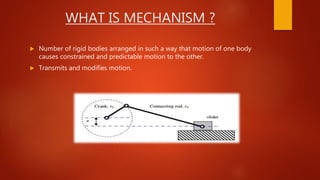
WHAT IS MECHANISM ?
 Number of rigid bodies arranged in such a way that motion of one body
causes constrained and predictable motion to the other.
 Transmits and modifies motion.
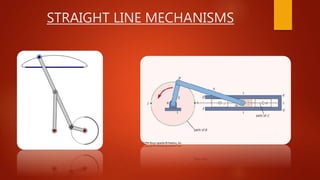
STRAIGHT LINE MOTION MECHANISM
 Converts rotary motion into a straight line motion.
 Developed by James Watt for reciprocating piston of steam engine.
 Classified in two types:
1- Exact straight line mechanisms:- Paucellier mechanism, Hart
mechanism, Scott-Russel mechanism, Kempe mechanism,etc.
2- Approximate straight line mechanisms:- Modified Scott-Russel
mechanism, Grasshopper mechanism, Watt mechanism, Robert
mechanism, etc.
STRAIGHT LINE MECHANISMS
PAUCELLIER MECHANISM
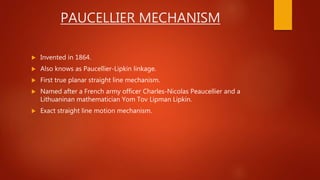
 Invented in 1864.
 Also knows as Paucellier-Lipkin linkage.
 First true planar straight line mechanism.
 Named after a French army officer Charles-Nicolas Peaucellier and a
Lithuaninan mathematician Yom Tov Lipman Lipkin.
 Exact straight line motion mechanism.
GEOMETRY
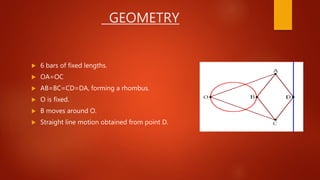
 6 bars of fixed lengths.
 OA=OC
 AB=BC=CD=DA, forming a rhombus.
 O is fixed.
 B moves around O.
 Straight line motion obtained from point D.
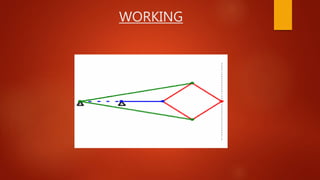
WORKING
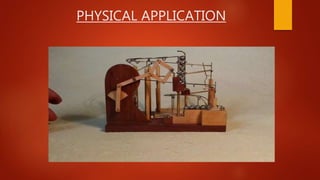
PHYSICAL APPLICATION
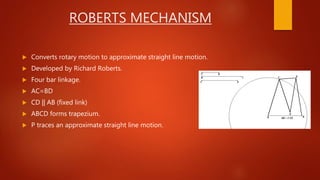
ROBERTS MECHANISM
 Converts rotary motion to approximate straight line motion.
 Developed by Richard Roberts.
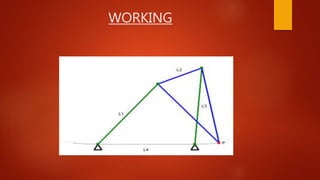
 Four bar linkage.
 AC=BD
 CD || AB (fixed link)
 ABCD forms trapezium.
 P traces an approximate straight line motion.
WORKING
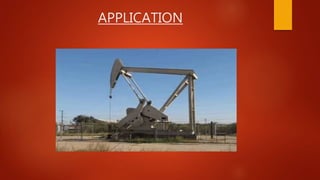
APPLICATION
THANK YOU

straight line motion mechanism

  • 1.
    STRAIGHT LINE MOTION MECHANISM Submittedto: Mr. N.S.GAIRA DEPARTMENT OF MECHANICAL ENGINEERING SUBMITTED BY: ABHISHEK JOSHI ROLL NO - 07 B.TECH (M.E) IV SEM
  • 2.
    CONTENT  WHAT ISMECHANISM ?  STRAIGHT LINE MOTION MECHANISM  PAUCELLIER MECHANISM  APPLICATIONS OF PAUCELLIER MECHANISM  ROBERT MECHANISM  APPLICATIONS OF ROBERT MECHANISM
  • 3.
    WHAT IS MECHANISM?  Number of rigid bodies arranged in such a way that motion of one body causes constrained and predictable motion to the other.  Transmits and modifies motion.
  • 4.
    STRAIGHT LINE MOTIONMECHANISM  Converts rotary motion into a straight line motion.  Developed by James Watt for reciprocating piston of steam engine.  Classified in two types: 1- Exact straight line mechanisms:- Paucellier mechanism, Hart mechanism, Scott-Russel mechanism, Kempe mechanism,etc. 2- Approximate straight line mechanisms:- Modified Scott-Russel mechanism, Grasshopper mechanism, Watt mechanism, Robert mechanism, etc.
  • 5.
  • 6.
    PAUCELLIER MECHANISM  Inventedin 1864.  Also knows as Paucellier-Lipkin linkage.  First true planar straight line mechanism.  Named after a French army officer Charles-Nicolas Peaucellier and a Lithuaninan mathematician Yom Tov Lipman Lipkin.  Exact straight line motion mechanism.
  • 7.
    GEOMETRY  6 barsof fixed lengths.  OA=OC  AB=BC=CD=DA, forming a rhombus.  O is fixed.  B moves around O.  Straight line motion obtained from point D.
  • 8.
  • 9.
  • 10.
    ROBERTS MECHANISM  Convertsrotary motion to approximate straight line motion.  Developed by Richard Roberts.  Four bar linkage.  AC=BD  CD || AB (fixed link)  ABCD forms trapezium.  P traces an approximate straight line motion.
  • 11.
  • 12.
  • 13.