KINEMATICS OF MACHINERY
KINEMATICS OF LINKAGE
MECHANISMS
Mr.T.L.Vijayakumar, M.E., (Ph.D).
Assistant Professor / Mechanical Engineering,
KLN College of Engineering
1
Instantaneous centre
• The instantaneous centre of a moving body may
be defined as that centre which goes on
changing from one instant to another.
• The locus of all such instantaneous centres is
known as centrode.
• A line drawn through an instantaneous centre
and perpendicular to the plane of motion is
called instantaneous axis.
Space centrode and Body centrode
The locus of the instantaneous centre in
space during a definite motion of the body is
called the space centrode and the locus of the
instantaneous centre relative to the body itself
is called the body centrode.
Properties of the Instantaneous Centre
1. A rigid link rotates instantaneously relative to another link
at the instantaneous centre for the configuration of the
mechanism considered.
2. The two rigid links have no linear velocity relative to each
other at the instantaneous centre. At this point (i.e.
instantaneous centre), the two rigid links have the same
linear velocity relative to the third rigid link.
In other words, the velocity of the instantaneous centre
relative to any third rigid link will be same whether the
instantaneous centre is regarded as a point on the first rigid
link or on the second rigid link.
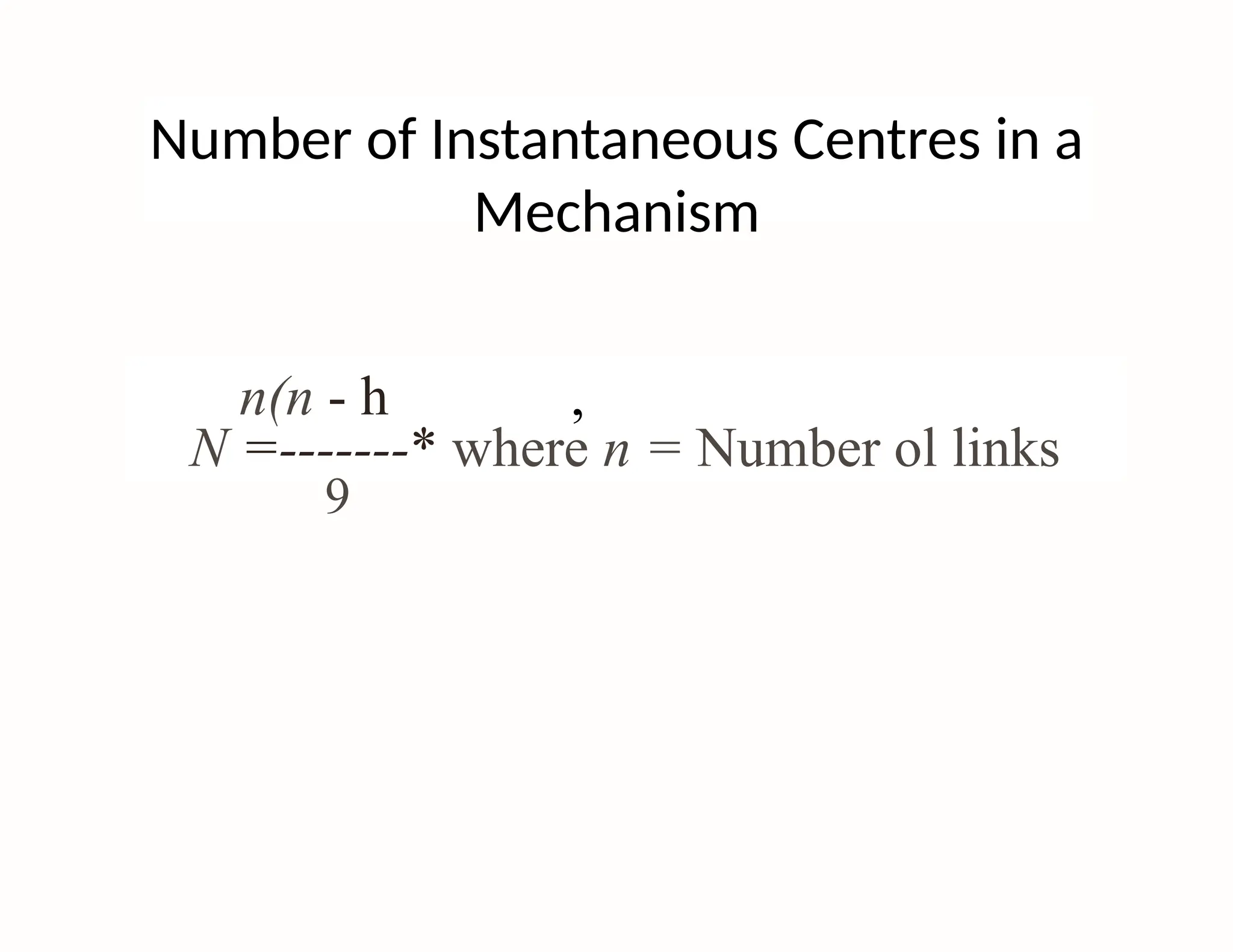
Number of Instantaneous Centres in a
Mechanism
n(n - h ,
N =-------* where n = Number ol links
9
Types of Instantaneous Centres
The instantaneous centres for a mechanism are of the
following three types:
1. Fixed instantaneous centres,
2. Permanent instantaneous centres, and
3. Neither fixed nor permanent instantaneous centres.
Note:
The first two types i.e. fixed and permanent instantaneous
centres are together known as primary instantaneous
centres and the third type is known as secondary
instantaneous centres.
Types of Instantaneous Centres -
Example
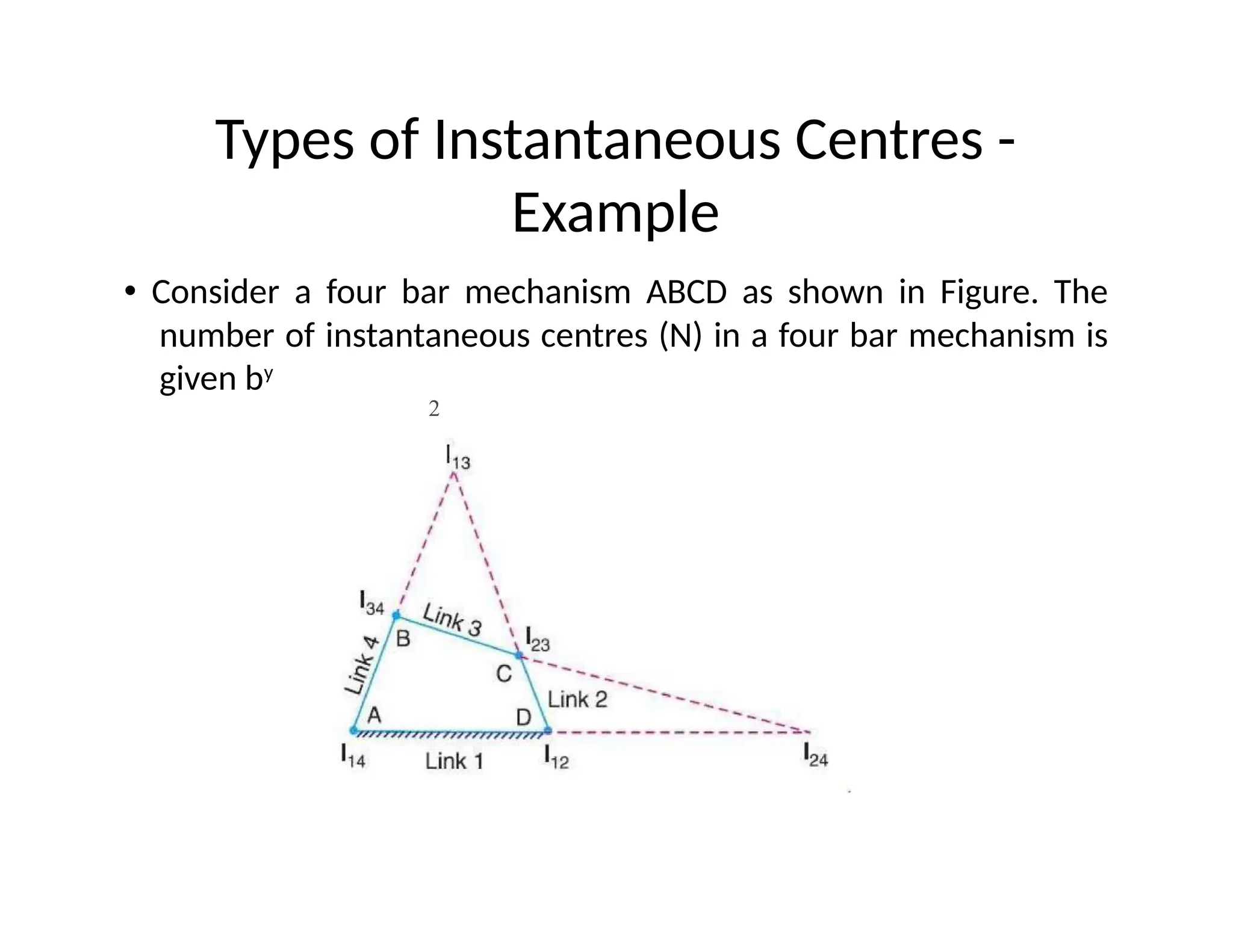
• Consider a four bar mechanism ABCD as shown in Figure. The
number of instantaneous centres (N) in a four bar mechanism is
given by
2
Types of Instantaneous Centres -
Example
• The instantaneous centres I12 and I 14 are called the fixed
instantaneous centres as they remain in the same place for all
configurations of the mechanism.
• The instantaneous centres I 23 and I 34 are the permanent
instantaneous centres as they move when the mechanism
moves, but the joints are of permanent nature.
• The instantaneous centres I 13 and I 24 are neither fixed nor
permanent instantaneous centres as they vary with the
configuration of the mechanism.
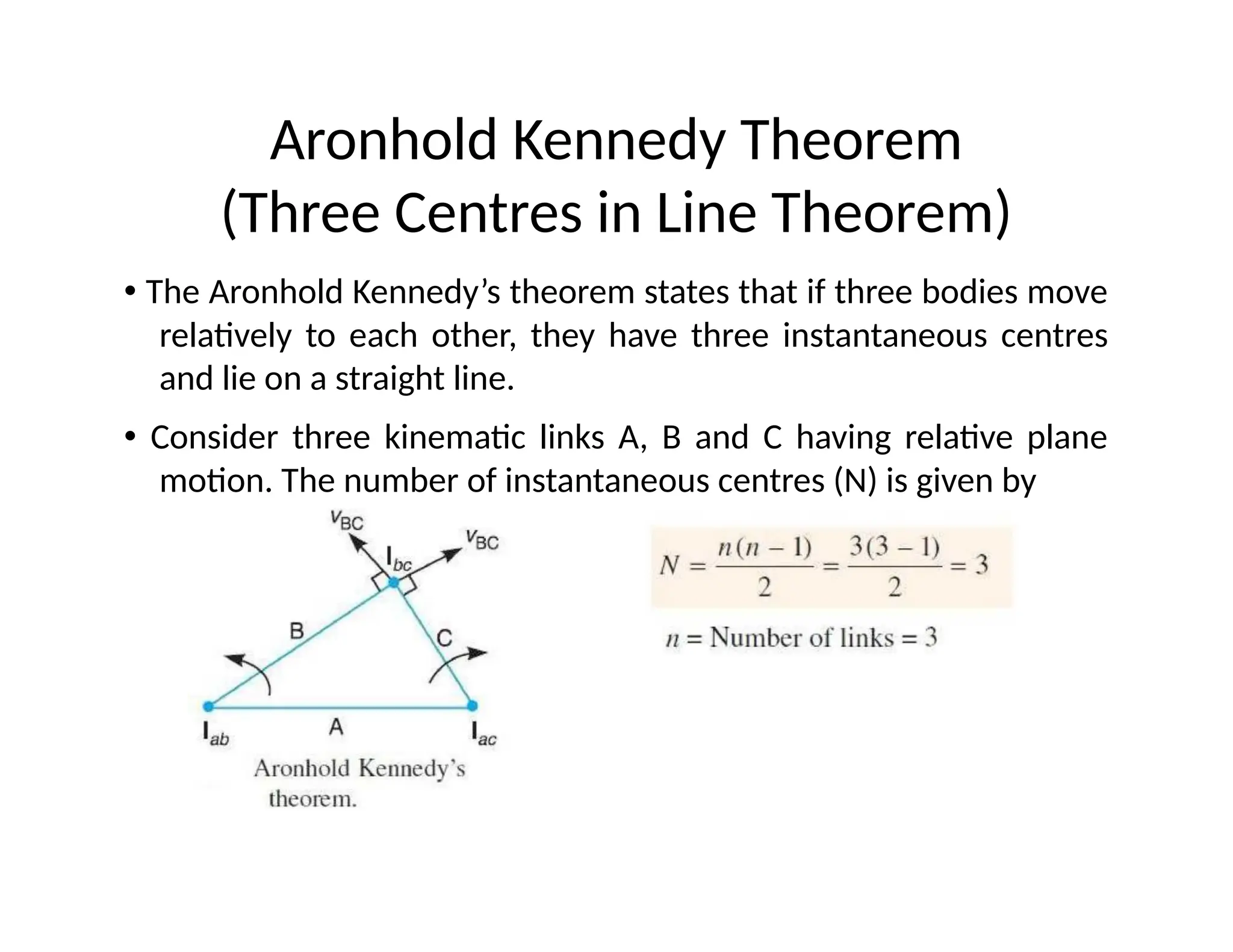
Aronhold Kennedy Theorem
(Three Centres in Line Theorem)
• The Aronhold Kennedy’s theorem states that if three bodies move
relatively to each other, they have three instantaneous centres
and lie on a straight line.
• Consider three kinematic links A, B and C having relative plane
motion. The number of instantaneous centres (N) is given by
Velocity Analysis - Methods
Methods for Determining the Velocity of a
Point on a Link
1. Instantaneous centre method
2. Relative velocity method.

Unit 2 PPT.pptx kinematics aand machiner

  • 1.
    KINEMATICS OF MACHINERY KINEMATICSOF LINKAGE MECHANISMS Mr.T.L.Vijayakumar, M.E., (Ph.D). Assistant Professor / Mechanical Engineering, KLN College of Engineering 1
  • 2.
    Instantaneous centre • Theinstantaneous centre of a moving body may be defined as that centre which goes on changing from one instant to another. • The locus of all such instantaneous centres is known as centrode. • A line drawn through an instantaneous centre and perpendicular to the plane of motion is called instantaneous axis.
  • 3.
    Space centrode andBody centrode The locus of the instantaneous centre in space during a definite motion of the body is called the space centrode and the locus of the instantaneous centre relative to the body itself is called the body centrode.
  • 4.
    Properties of theInstantaneous Centre 1. A rigid link rotates instantaneously relative to another link at the instantaneous centre for the configuration of the mechanism considered. 2. The two rigid links have no linear velocity relative to each other at the instantaneous centre. At this point (i.e. instantaneous centre), the two rigid links have the same linear velocity relative to the third rigid link. In other words, the velocity of the instantaneous centre relative to any third rigid link will be same whether the instantaneous centre is regarded as a point on the first rigid link or on the second rigid link.
  • 5.
    Number of InstantaneousCentres in a Mechanism n(n - h , N =-------* where n = Number ol links 9
  • 6.
    Types of InstantaneousCentres The instantaneous centres for a mechanism are of the following three types: 1. Fixed instantaneous centres, 2. Permanent instantaneous centres, and 3. Neither fixed nor permanent instantaneous centres. Note: The first two types i.e. fixed and permanent instantaneous centres are together known as primary instantaneous centres and the third type is known as secondary instantaneous centres.
  • 7.
    Types of InstantaneousCentres - Example • Consider a four bar mechanism ABCD as shown in Figure. The number of instantaneous centres (N) in a four bar mechanism is given by 2
  • 8.
    Types of InstantaneousCentres - Example • The instantaneous centres I12 and I 14 are called the fixed instantaneous centres as they remain in the same place for all configurations of the mechanism. • The instantaneous centres I 23 and I 34 are the permanent instantaneous centres as they move when the mechanism moves, but the joints are of permanent nature. • The instantaneous centres I 13 and I 24 are neither fixed nor permanent instantaneous centres as they vary with the configuration of the mechanism.
  • 9.
    Aronhold Kennedy Theorem (ThreeCentres in Line Theorem) • The Aronhold Kennedy’s theorem states that if three bodies move relatively to each other, they have three instantaneous centres and lie on a straight line. • Consider three kinematic links A, B and C having relative plane motion. The number of instantaneous centres (N) is given by
  • 10.
    Velocity Analysis -Methods Methods for Determining the Velocity of a Point on a Link 1. Instantaneous centre method 2. Relative velocity method.