Module 2
Velocity and acceleration analysis of
mechanism
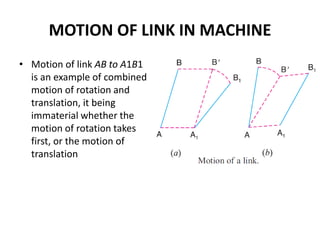
MOTION OF LINK IN MACHINE
• Motion of link AB to A1B1
is an example of combined
motion of rotation and
translation, it being
immaterial whether the
motion of rotation takes
first, or the motion of
translation
METHODS FOR DETERMINING THE VELOCITY
OF A POINT ON A LINK
1. Relative velocity method
• Can be used in any configuration
2. Instantaneous centre method
• convenient and easy to apply in simple mechanisms
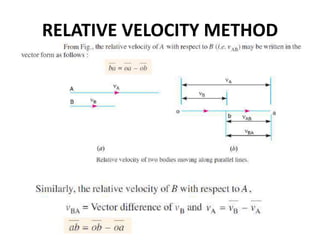
RELATIVE VELOCITY METHOD
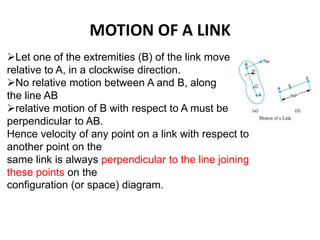
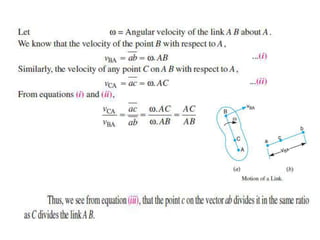
MOTION OF A LINK
Let one of the extremities (B) of the link move
relative to A, in a clockwise direction.
No relative motion between A and B, along
the line AB
relative motion of B with respect to A must be
perpendicular to AB.
Hence velocity of any point on a link with respect to
another point on the
same link is always perpendicular to the line joining
these points on the
configuration (or space) diagram.
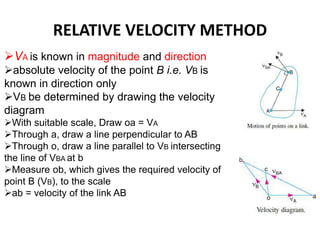
RELATIVE VELOCITY METHOD
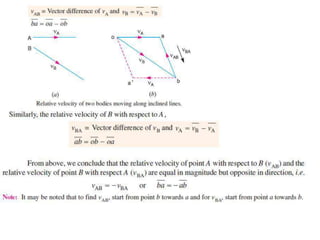
VA is known in magnitude and direction
absolute velocity of the point B i.e. VB is
known in direction only
VB be determined by drawing the velocity
diagram
With suitable scale, Draw oa = VA
Through a, draw a line perpendicular to AB
Through o, draw a line parallel to VB intersecting
the line of VBA at b
Measure ob, which gives the required velocity of
point B (VB), to the scale
ab = velocity of the link AB
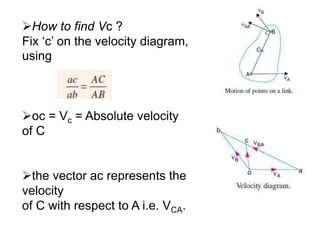
How to find Vc ?
Fix ‘c’ on the velocity diagram,
using
oc = Vc = Absolute velocity
of C
the vector ac represents the
velocity
of C with respect to A i.e. VCA.
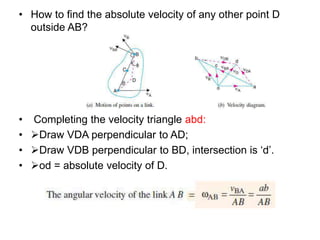
• How to find the absolute velocity of any other point D
outside AB?
• Completing the velocity triangle abd:
• Draw VDA perpendicular to AD;
• Draw VDB perpendicular to BD, intersection is ‘d’.
• od = absolute velocity of D.
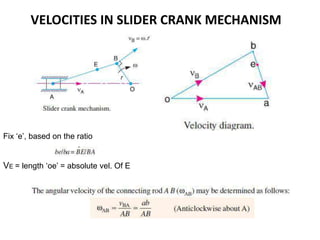
VELOCITIES IN SLIDER CRANK MECHANISM
Fix ‘e’, based on the ratio
VE = length ‘oe’ = absolute vel. Of E
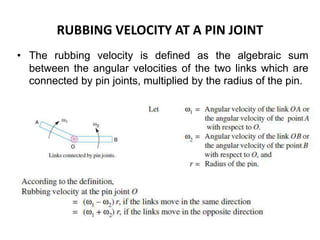
RUBBING VELOCITY AT A PIN JOINT
• The rubbing velocity is defined as the algebraic sum
between the angular velocities of the two links which are
connected by pin joints, multiplied by the radius of the pin.
INSTANTANEOUS CENTRE METHOD
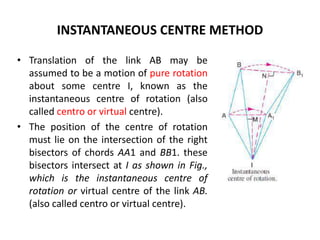
• Translation of the link AB may be
assumed to be a motion of pure rotation
about some centre I, known as the
instantaneous centre of rotation (also
called centro or virtual centre).
• The position of the centre of rotation
must lie on the intersection of the right
bisectors of chords AA1 and BB1. these
bisectors intersect at I as shown in Fig.,
which is the instantaneous centre of
rotation or virtual centre of the link AB.
(also called centro or virtual centre).
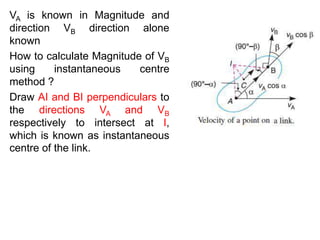
VA is known in Magnitude and
direction VB direction alone
known
How to calculate Magnitude of VB
using instantaneous centre
method ?
Draw AI and BI perpendiculars to
the directions VA and VB
respectively to intersect at I,
which is known as instantaneous
centre of the link.
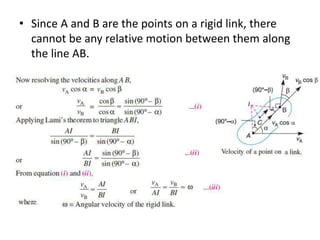
• Since A and B are the points on a rigid link, there
cannot be any relative motion between them along
the line AB.
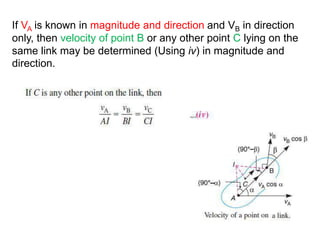
If VA is known in magnitude and direction and VB in direction
only, then velocity of point B or any other point C lying on the
same link may be determined (Using iv) in magnitude and
direction.
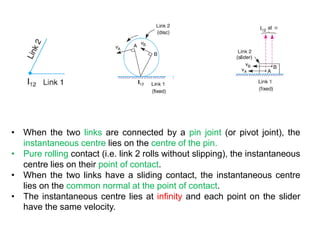
• When the two links are connected by a pin joint (or pivot joint), the
instantaneous centre lies on the centre of the pin.
• Pure rolling contact (i.e. link 2 rolls without slipping), the instantaneous
centre lies on their point of contact.
• When the two links have a sliding contact, the instantaneous centre
lies on the common normal at the point of contact.
• The instantaneous centre lies at infinity and each point on the slider
have the same velocity.
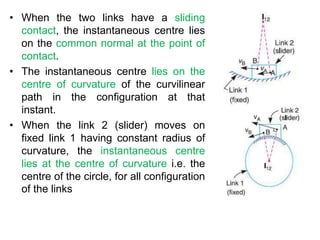
• When the two links have a sliding
contact, the instantaneous centre lies
on the common normal at the point of
contact.
• The instantaneous centre lies on the
centre of curvature of the curvilinear
path in the configuration at that
instant.
• When the link 2 (slider) moves on
fixed link 1 having constant radius of
curvature, the instantaneous centre
lies at the centre of curvature i.e. the
centre of the circle, for all configuration
of the links
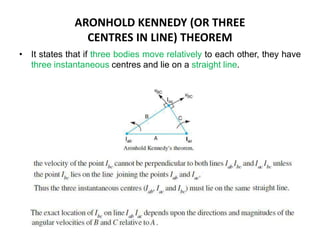
ARONHOLD KENNEDY (OR THREE
CENTRES IN LINE) THEOREM
• It states that if three bodies move relatively to each other, they have
three instantaneous centres and lie on a straight line.
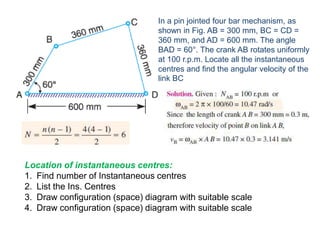
In a pin jointed four bar mechanism, as
shown in Fig. AB = 300 mm, BC = CD =
360 mm, and AD = 600 mm. The angle
BAD = 60°. The crank AB rotates uniformly
at 100 r.p.m. Locate all the instantaneous
centres and find the angular velocity of the
link BC
Location of instantaneous centres:
1. Find number of Instantaneous centres
2. List the Ins. Centres
3. Draw configuration (space) diagram with suitable scale
4. Draw configuration (space) diagram with suitable scale
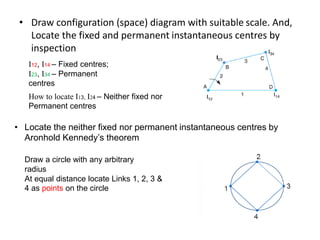
• Draw configuration (space) diagram with suitable scale. And,
Locate the fixed and permanent instantaneous centres by
inspection
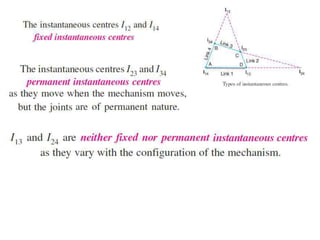
I12, I14 – Fixed centres;
I23, I34 – Permanent
centres
How to locate I13, I24 – Neither fixed nor
Permanent centres
• Locate the neither fixed nor permanent instantaneous centres by
Aronhold Kennedy’s theorem
Draw a circle with any arbitrary
radius
At equal distance locate Links 1, 2, 3 &
4 as points on the circle
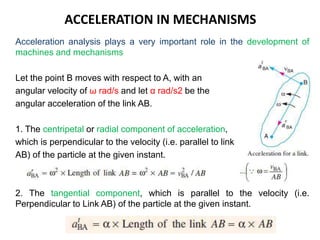
ACCELERATION IN MECHANISMS
Acceleration analysis plays a very important role in the development of
machines and mechanisms
Let the point B moves with respect to A, with an
angular velocity of ω rad/s and let α rad/s2 be the
angular acceleration of the link AB.
1. The centripetal or radial component of acceleration,
which is perpendicular to the velocity (i.e. parallel to link
AB) of the particle at the given instant.
2. The tangential component, which is parallel to the velocity (i.e.
Perpendicular to Link AB) of the particle at the given instant.
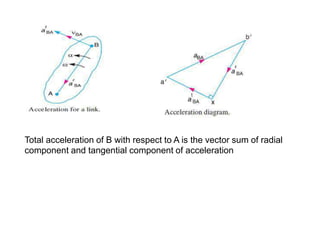
Total acceleration of B with respect to A is the vector sum of radial
component and tangential component of acceleration
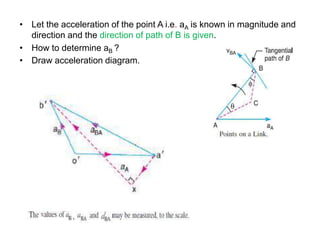
• Let the acceleration of the point A i.e. aA is known in magnitude and
direction and the direction of path of B is given.
• How to determine aB ?
• Draw acceleration diagram.
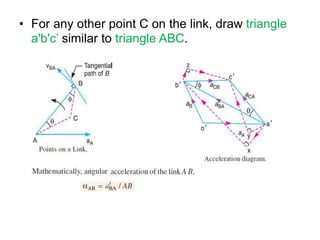
• For any other point C on the link, draw triangle
a'b'c’ similar to triangle ABC.
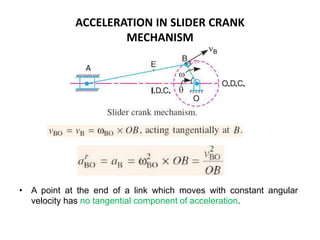
ACCELERATION IN SLIDER CRANK
MECHANISM
• A point at the end of a link which moves with constant angular
velocity has no tangential component of acceleration.
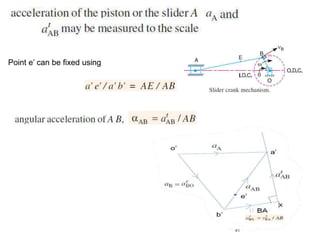
Point e’ can be fixed using
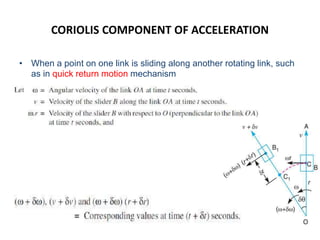
CORIOLIS COMPONENT OF ACCELERATION
• When a point on one link is sliding along another rotating link, such
as in quick return motion mechanism
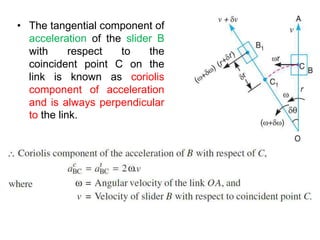
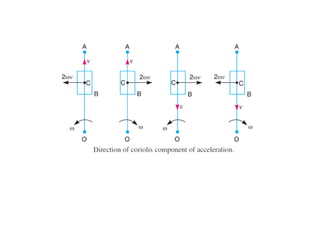
• The tangential component of
acceleration of the slider B
with respect to the
coincident point C on the
link is known as coriolis
component of acceleration
and is always perpendicular
to the link.
Module 2.pptx

Module 2.pptx

  • 1.
    Module 2 Velocity andacceleration analysis of mechanism
  • 2.
    MOTION OF LINKIN MACHINE • Motion of link AB to A1B1 is an example of combined motion of rotation and translation, it being immaterial whether the motion of rotation takes first, or the motion of translation
  • 3.
    METHODS FOR DETERMININGTHE VELOCITY OF A POINT ON A LINK 1. Relative velocity method • Can be used in any configuration 2. Instantaneous centre method • convenient and easy to apply in simple mechanisms
  • 4.
  • 6.
    MOTION OF ALINK Let one of the extremities (B) of the link move relative to A, in a clockwise direction. No relative motion between A and B, along the line AB relative motion of B with respect to A must be perpendicular to AB. Hence velocity of any point on a link with respect to another point on the same link is always perpendicular to the line joining these points on the configuration (or space) diagram.
  • 8.
    RELATIVE VELOCITY METHOD VAis known in magnitude and direction absolute velocity of the point B i.e. VB is known in direction only VB be determined by drawing the velocity diagram With suitable scale, Draw oa = VA Through a, draw a line perpendicular to AB Through o, draw a line parallel to VB intersecting the line of VBA at b Measure ob, which gives the required velocity of point B (VB), to the scale ab = velocity of the link AB
  • 9.
    How to findVc ? Fix ‘c’ on the velocity diagram, using oc = Vc = Absolute velocity of C the vector ac represents the velocity of C with respect to A i.e. VCA.
  • 10.
    • How tofind the absolute velocity of any other point D outside AB? • Completing the velocity triangle abd: • Draw VDA perpendicular to AD; • Draw VDB perpendicular to BD, intersection is ‘d’. • od = absolute velocity of D.
  • 11.
    VELOCITIES IN SLIDERCRANK MECHANISM Fix ‘e’, based on the ratio VE = length ‘oe’ = absolute vel. Of E
  • 12.
    RUBBING VELOCITY ATA PIN JOINT • The rubbing velocity is defined as the algebraic sum between the angular velocities of the two links which are connected by pin joints, multiplied by the radius of the pin.
  • 13.
    INSTANTANEOUS CENTRE METHOD •Translation of the link AB may be assumed to be a motion of pure rotation about some centre I, known as the instantaneous centre of rotation (also called centro or virtual centre). • The position of the centre of rotation must lie on the intersection of the right bisectors of chords AA1 and BB1. these bisectors intersect at I as shown in Fig., which is the instantaneous centre of rotation or virtual centre of the link AB. (also called centro or virtual centre).
  • 14.
    VA is knownin Magnitude and direction VB direction alone known How to calculate Magnitude of VB using instantaneous centre method ? Draw AI and BI perpendiculars to the directions VA and VB respectively to intersect at I, which is known as instantaneous centre of the link.
  • 15.
    • Since Aand B are the points on a rigid link, there cannot be any relative motion between them along the line AB.
  • 16.
    If VA isknown in magnitude and direction and VB in direction only, then velocity of point B or any other point C lying on the same link may be determined (Using iv) in magnitude and direction.
  • 18.
    • When thetwo links are connected by a pin joint (or pivot joint), the instantaneous centre lies on the centre of the pin. • Pure rolling contact (i.e. link 2 rolls without slipping), the instantaneous centre lies on their point of contact. • When the two links have a sliding contact, the instantaneous centre lies on the common normal at the point of contact. • The instantaneous centre lies at infinity and each point on the slider have the same velocity.
  • 19.
    • When thetwo links have a sliding contact, the instantaneous centre lies on the common normal at the point of contact. • The instantaneous centre lies on the centre of curvature of the curvilinear path in the configuration at that instant. • When the link 2 (slider) moves on fixed link 1 having constant radius of curvature, the instantaneous centre lies at the centre of curvature i.e. the centre of the circle, for all configuration of the links
  • 20.
    ARONHOLD KENNEDY (ORTHREE CENTRES IN LINE) THEOREM • It states that if three bodies move relatively to each other, they have three instantaneous centres and lie on a straight line.
  • 21.
    In a pinjointed four bar mechanism, as shown in Fig. AB = 300 mm, BC = CD = 360 mm, and AD = 600 mm. The angle BAD = 60°. The crank AB rotates uniformly at 100 r.p.m. Locate all the instantaneous centres and find the angular velocity of the link BC Location of instantaneous centres: 1. Find number of Instantaneous centres 2. List the Ins. Centres 3. Draw configuration (space) diagram with suitable scale 4. Draw configuration (space) diagram with suitable scale
  • 22.
    • Draw configuration(space) diagram with suitable scale. And, Locate the fixed and permanent instantaneous centres by inspection I12, I14 – Fixed centres; I23, I34 – Permanent centres How to locate I13, I24 – Neither fixed nor Permanent centres • Locate the neither fixed nor permanent instantaneous centres by Aronhold Kennedy’s theorem Draw a circle with any arbitrary radius At equal distance locate Links 1, 2, 3 & 4 as points on the circle
  • 23.
    ACCELERATION IN MECHANISMS Accelerationanalysis plays a very important role in the development of machines and mechanisms Let the point B moves with respect to A, with an angular velocity of ω rad/s and let α rad/s2 be the angular acceleration of the link AB. 1. The centripetal or radial component of acceleration, which is perpendicular to the velocity (i.e. parallel to link AB) of the particle at the given instant. 2. The tangential component, which is parallel to the velocity (i.e. Perpendicular to Link AB) of the particle at the given instant.
  • 24.
    Total acceleration ofB with respect to A is the vector sum of radial component and tangential component of acceleration
  • 25.
    • Let theacceleration of the point A i.e. aA is known in magnitude and direction and the direction of path of B is given. • How to determine aB ? • Draw acceleration diagram.
  • 26.
    • For anyother point C on the link, draw triangle a'b'c’ similar to triangle ABC.
  • 27.
    ACCELERATION IN SLIDERCRANK MECHANISM • A point at the end of a link which moves with constant angular velocity has no tangential component of acceleration.
  • 28.
    Point e’ canbe fixed using
  • 29.
    CORIOLIS COMPONENT OFACCELERATION • When a point on one link is sliding along another rotating link, such as in quick return motion mechanism
  • 30.
    • The tangentialcomponent of acceleration of the slider B with respect to the coincident point C on the link is known as coriolis component of acceleration and is always perpendicular to the link.