MODULAR NATURE OF
PROTEINS By
S.M.SHEIKHASINAH
?????.....
CONTENTS!
 Introduction
 Role of domains in PROTEIN EVOLUTION
 Reuse of particular domain
 Subunit sharing
 New domain combinations
 Regulation of protein expression by domain
shuffling
 Syntactical and semantic shift in the function
of proteins
1.
Introduction
“Function of a protein ???
Domains and nature of their interactions
Domain
 Proteins are composed of evolutionary units called domains
 Can either have an independent function or contribute to the
function of a multidomain protein in cooperation with other
domains.
 Once a domain has duplicated, it can evolve a new or
modified function.
 Based on sequence, structural and functional evidence are
grouped into superfamilies.
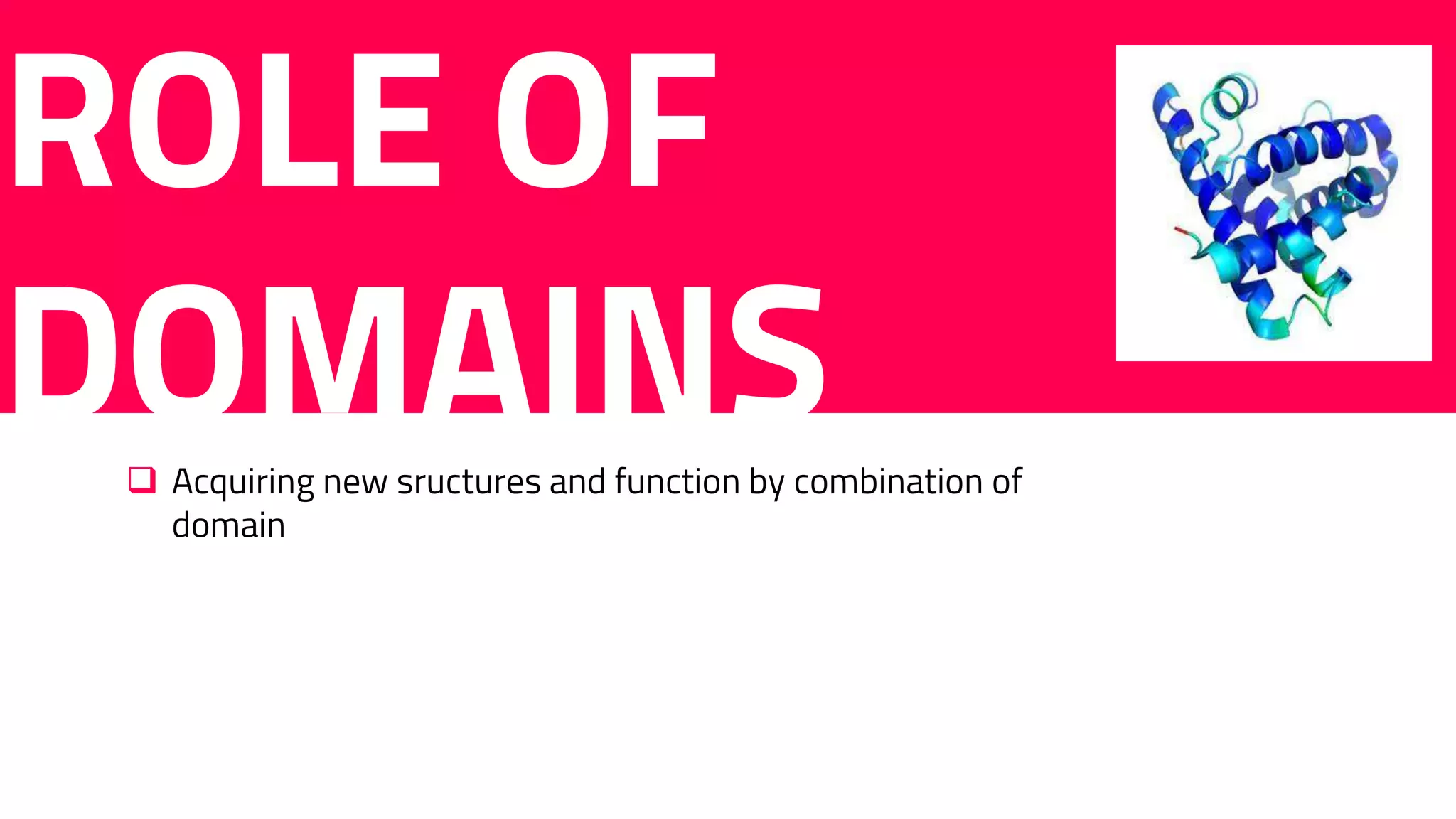
ROLE OF
DOMAINS Acquiring new sructures and function by combination of
domain
☺ Formation of new domain combinations is an important mechanism
in protein evolution.
☺ Proteins contain several thousand different combinations of two
superfamilies.
☺ Duplication is one of the main sources for creation of new proteins.
☺ After duplication ,it evolve a new or modified function either by
sequence divergence or by combining with other domains to form a
multidomain protein with a new series of domains.
☺ Formation of multidomain proteins by duplication and recombination,
and the geometry and functional relationships .
☺ Supradomains are two- or three-domain combinations that occur in
different domain architectures with different N- and C-terminal
neighbours.
New domain
combinatons
Overview of different aspects of
multidomain proteins :
Domains belonging to the same
superfamily are represented as
rectangles of the same colour. {1}
Supradomains are two- or three-
domain combinations that occur in
different domain architectures {2}
Forms different geometry with
different functions.{3}
These domains forms a functional
units{4}
Reuse of particular
domains
A few domain
superfamilies are highly
versatile and have
neighbouring domains
from many
superfamilies.
Each superfamily has
its own feature.
* Some superfamilies
are highly versatile,
some are highly
abundant and some
superfamilies are both.
* It depends on the
structure and function
of the domains and
domain combinations
that determine the
selection.
Cntd…
• Important examples of the reuse of particular domains
come from signal transduction.
&.The SH3 and SH2 domains in signal transduction.
&. Combination and addition of several domains
determine the versatility of the protein.
To have the SAME
FUNCTION
-- Sequential order of
domains are conserved
 If the same domain combination is
observed in two different
proteins,they are closely related with
each other phylogenetically.
* Domain architecture have evolved
from the same ancestor.
* EG:Rossmann fold
* Proteins sharing the same series
of domains tend to have the same
function.
Geometry of domain
combinations
~Sequential order of domains are largely conserved.
~The geometry of Rossmann domains and their
partner domains -conserved - same superfamily.
~~Proteins of unknown structure - based on
homologous polypeptide(s) of known structure.
*EG :yeast ribosome and exosome
~the more similar the domain sequences -interaction
of protein domains is more conserved.
Functional relationships of
domains in multi-domain
proteins!
@.Domain-centric scheme emphasises domain function.
In this domain-centric functional classification scheme, domains are
classified into several categories
1.catalytic activity,
2. cofactor binding,
3.responsibility for subcellular localisation,
4. protein–protein interaction etc..
TWO principle
1. A domain can perform the same function, but in different protein contexts
(i.e. with different partner domains).Eg:sensory, regulatory and enzymatic
domains.
2. Some domains modify their function according to the partner
domain.Eg:WHD domain (Winged Helix Domain)
Place your screenshot here
Syntactical and semantic
shift
1.WHD with Restriction endonuclease.-
FokI protein
2.WHD with sensory or regulatory
domain-FadR
3. Performs the same role (i.e. it
targets the protein to a specific
sequence), but the range of
functions is achieved by combining
the WHD with different partner
domains, so it is exhibiting a
syntactical shift.
4. ) A semantic shift is found in
human methionine aminopeptidase -
WHD acts as a substrate specificity
pocket -no DNA-binding activity
THANK YOU

MODULAR NATURE OF PROTEINS

  • 1.
    MODULAR NATURE OF PROTEINSBy S.M.SHEIKHASINAH
  • 2.
  • 3.
    CONTENTS!  Introduction  Roleof domains in PROTEIN EVOLUTION  Reuse of particular domain  Subunit sharing  New domain combinations  Regulation of protein expression by domain shuffling  Syntactical and semantic shift in the function of proteins
  • 4.
  • 5.
    “Function of aprotein ??? Domains and nature of their interactions
  • 6.
    Domain  Proteins arecomposed of evolutionary units called domains  Can either have an independent function or contribute to the function of a multidomain protein in cooperation with other domains.  Once a domain has duplicated, it can evolve a new or modified function.  Based on sequence, structural and functional evidence are grouped into superfamilies.
  • 7.
    ROLE OF DOMAINS Acquiringnew sructures and function by combination of domain
  • 8.
    ☺ Formation ofnew domain combinations is an important mechanism in protein evolution. ☺ Proteins contain several thousand different combinations of two superfamilies. ☺ Duplication is one of the main sources for creation of new proteins. ☺ After duplication ,it evolve a new or modified function either by sequence divergence or by combining with other domains to form a multidomain protein with a new series of domains. ☺ Formation of multidomain proteins by duplication and recombination, and the geometry and functional relationships . ☺ Supradomains are two- or three-domain combinations that occur in different domain architectures with different N- and C-terminal neighbours. New domain combinatons
  • 9.
    Overview of differentaspects of multidomain proteins : Domains belonging to the same superfamily are represented as rectangles of the same colour. {1} Supradomains are two- or three- domain combinations that occur in different domain architectures {2} Forms different geometry with different functions.{3} These domains forms a functional units{4}
  • 10.
  • 11.
    A few domain superfamiliesare highly versatile and have neighbouring domains from many superfamilies. Each superfamily has its own feature. * Some superfamilies are highly versatile, some are highly abundant and some superfamilies are both. * It depends on the structure and function of the domains and domain combinations that determine the selection.
  • 12.
    Cntd… • Important examplesof the reuse of particular domains come from signal transduction. &.The SH3 and SH2 domains in signal transduction. &. Combination and addition of several domains determine the versatility of the protein.
  • 13.
    To have theSAME FUNCTION -- Sequential order of domains are conserved
  • 14.
     If thesame domain combination is observed in two different proteins,they are closely related with each other phylogenetically. * Domain architecture have evolved from the same ancestor. * EG:Rossmann fold * Proteins sharing the same series of domains tend to have the same function.
  • 15.
  • 16.
    ~Sequential order ofdomains are largely conserved. ~The geometry of Rossmann domains and their partner domains -conserved - same superfamily. ~~Proteins of unknown structure - based on homologous polypeptide(s) of known structure. *EG :yeast ribosome and exosome ~the more similar the domain sequences -interaction of protein domains is more conserved.
  • 17.
    Functional relationships of domainsin multi-domain proteins!
  • 18.
    @.Domain-centric scheme emphasisesdomain function. In this domain-centric functional classification scheme, domains are classified into several categories 1.catalytic activity, 2. cofactor binding, 3.responsibility for subcellular localisation, 4. protein–protein interaction etc.. TWO principle 1. A domain can perform the same function, but in different protein contexts (i.e. with different partner domains).Eg:sensory, regulatory and enzymatic domains. 2. Some domains modify their function according to the partner domain.Eg:WHD domain (Winged Helix Domain)
  • 19.
    Place your screenshothere Syntactical and semantic shift 1.WHD with Restriction endonuclease.- FokI protein 2.WHD with sensory or regulatory domain-FadR 3. Performs the same role (i.e. it targets the protein to a specific sequence), but the range of functions is achieved by combining the WHD with different partner domains, so it is exhibiting a syntactical shift. 4. ) A semantic shift is found in human methionine aminopeptidase - WHD acts as a substrate specificity pocket -no DNA-binding activity
  • 20.