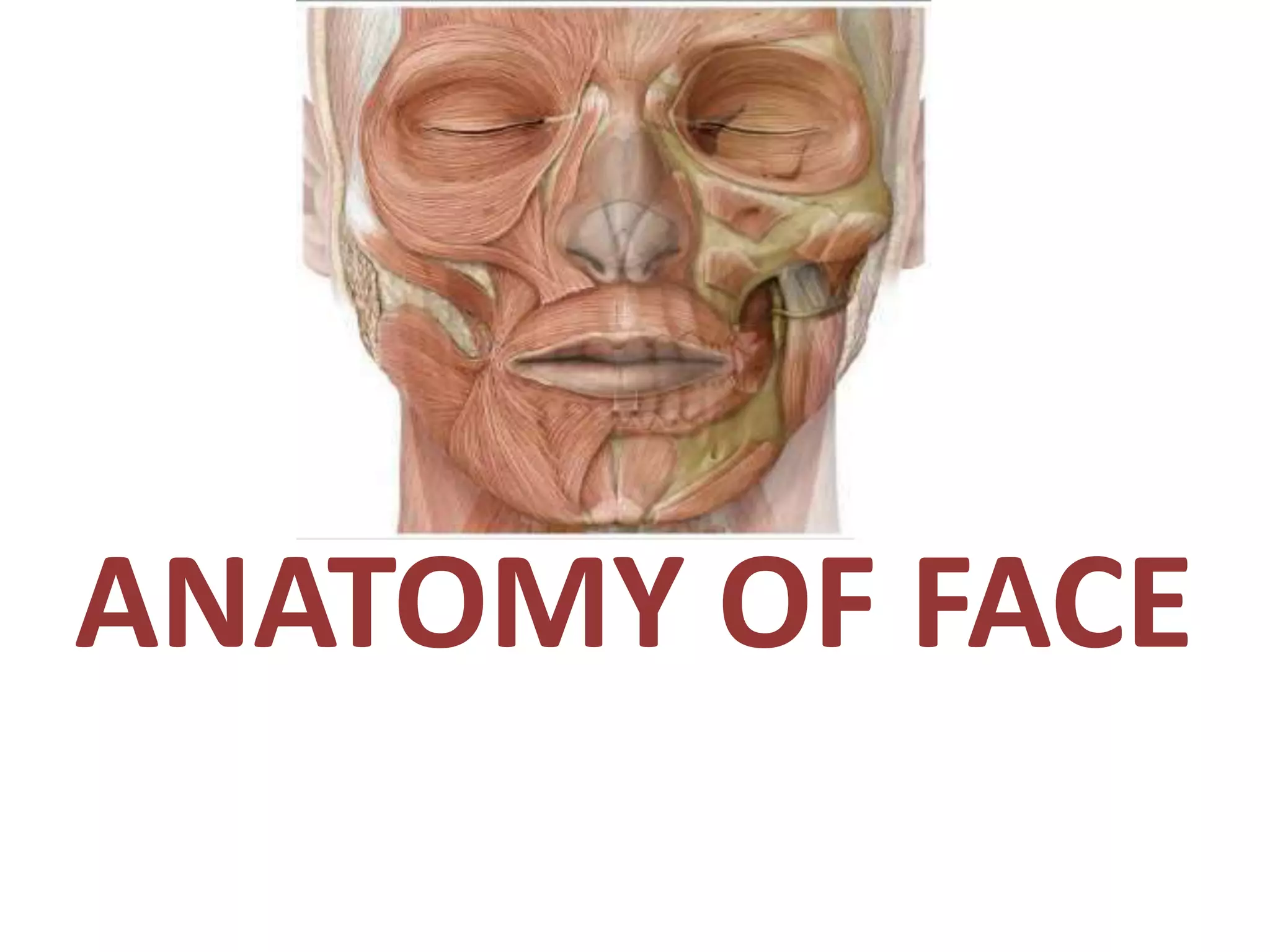
ANATOMY OF FACE
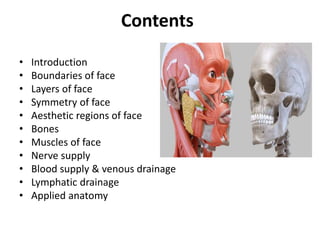
Contents
• Introduction
• Boundaries of face
• Layers of face
• Symmetry of face
• Aesthetic regions of face
• Bones
• Muscles of face
• Nerve supply
• Blood supply & venous drainage
• Lymphatic drainage
• Applied anatomy
Introduction
• Very vascular
• Due to rich vascularity face blush and blanch.
• Facial skin is rich in sebaceous gland and sweat
gland.
• Wounds of face bleed profusely but heal rapidly.
• Sebaceous glands keep the skin oily but also cause acne in
adult.
• No deep fascia is present in the face.
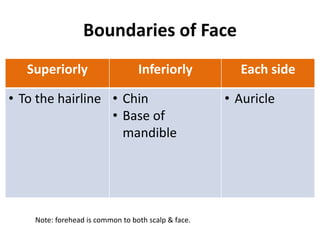
Boundaries of Face
Superiorly Inferiorly Each side
• To the hairline • Chin
• Base of
mandible
• Auricle
Note: forehead is common to both scalp & face.
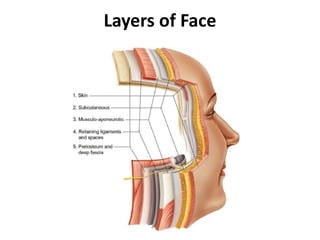
Layers of Face
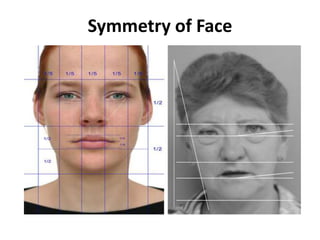
Symmetry of Face
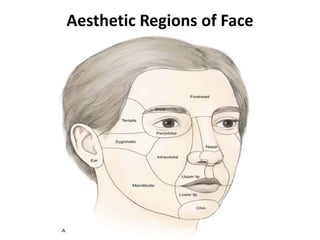
Aesthetic Regions of Face
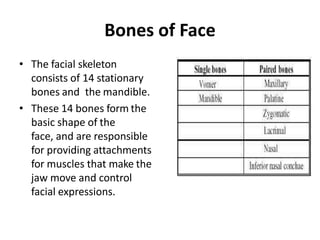
Bones of Face
• The facial skeleton
consists of 14 stationary
bones and the mandible.
• These 14 bones form the
basic shape of the
face, and are responsible
for providing attachments
for muscles that make the
jaw move and control
facial expressions.
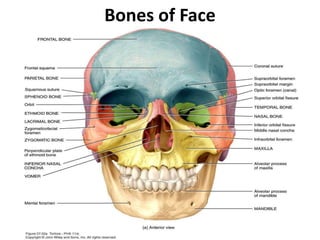
Bones of Face
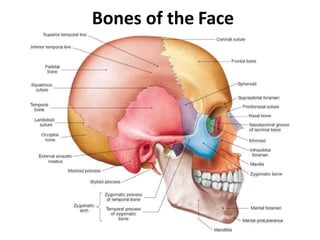
Bones of the Face
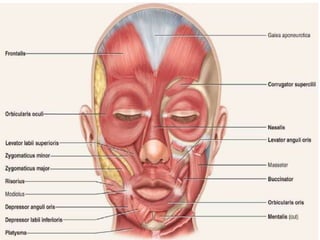
Muscles of Face
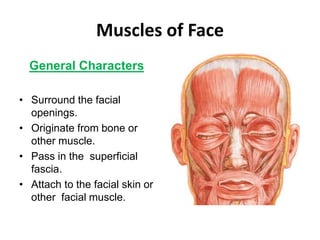
General Characters
• Called muscle of facial
expression and lie in
superficial fascia.
• Develop from mesoderm
of 2nd pharyngeal arch.
• Supplied by the Facial
nerve.
• Act as closers and
openers of facial orifices.
Muscles of Face
General Characters
• Surround the facial
openings.
• Originate from bone or
other muscle.
• Pass in the superficial
fascia.
• Attach to the facial skin or
other facial muscle.
Muscles of Face
Classification:
1. Muscles of
the eyelid
2. Muscles of
the mouth
3. Muscles of
the nose
4. Muscles of
the neck
5. Muscles of
the ear
Muscles of Eyelid
A. Corrugator supercillii
Origin: Medial end of
superciliary arch
Insertion: Skin of mid-
eyebrow
Action: Vertical lines in
forehead: frowning
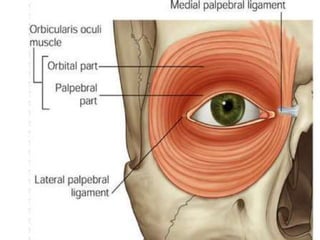
B. Orbicularis Oris
ORBITAL
PART
[OUTER]
PALPEBRAL
PART
[INNER]
LACRIMAL
PART
[SMALL]
PARTS OF ORBICULARIS OCULI
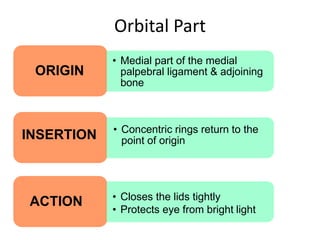
Orbital Part
ORIGIN
INSERTION
ACTION
• Medial part of the medial
palpebral ligament & adjoining
bone
• Concentric rings return to the
point of origin
• Closes the lids tightly
• Protects eye from bright light
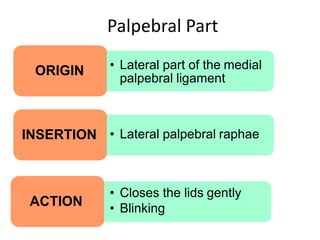
Palpebral Part
ORIGIN
INSERTION
ACTION
• Lateral part of the medial
palpebral ligament
• Lateral palpebral raphae
• Closes the lids gently
• Blinking
Lacrimal Part
ORIGIN
INSERTION
ACTION
• Lacrimal fascia &
lacrimal bone
• Upper & lower
eyelids
• Dilates the lacrimal
sac
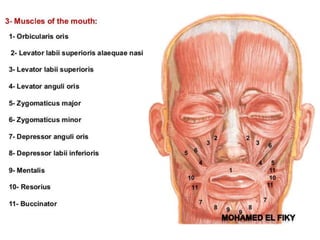
Muscles of The Mouth
• Orbicularis oris
• Buccinator
• Lower group of oral muscles
• depressor anguli oris
• depressor labii inferioris
• Mentalis
• Upper group of oral muscles
• risorius
• zygomaticus major and zygomaticus minor
• levator labii superioris
• levator labii superioris alaeque nasi
• levator anguli oris
Orbicularis oris
Two parts:
1. Intrinsic part [Deep stratum]
Origin: Superior incisivus from maxilla
& Inferior incisivus from
mandible
Insertion: Angle of mouth
Action: Closes & purses the mouth
2. Extrinsic part [Two strata]
Origin:
• Thickest middle stratum – Buccinator
• Thick superficial stratum – Elevators &
depressors of lips & angles
Insertion: Lips & the angle of the mouth
Action: Closes & purses the mouth
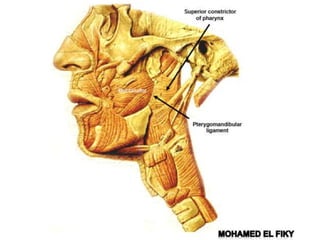
Buccinator
• Origin :
• Upper fibers from maxilla above three
molar
• Lower fibers : from the mandible below
three molar
• Ptergomandibular raphe which separates
it from the constrictor pharyngis superior.
• Insertion :
• Upper fibers : to the upper lip
• Lower fibers : lower lip
• Middle fibers decussate lower ascend to
upper lib & lower descend to the lower
limb
• Action :
• Aids in holding the cheek to the teeth and
prevent accumulation of food in the
Buccinator
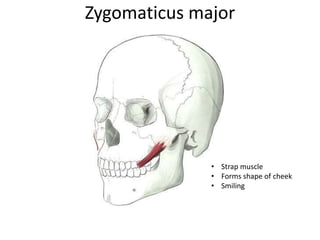
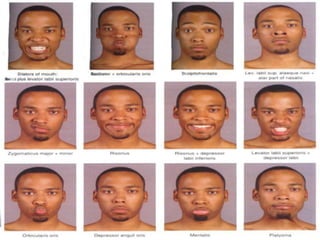
Zygomaticus major
• Strap muscle
• Forms shape of cheek
• Smiling
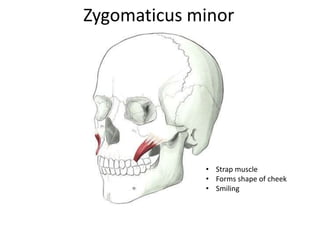
Zygomaticus minor
• Strap muscle
• Forms shape of cheek
• Smiling
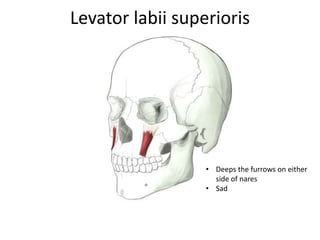
Levator labii superioris
• Deeps the furrows on either
side of nares
• Sad
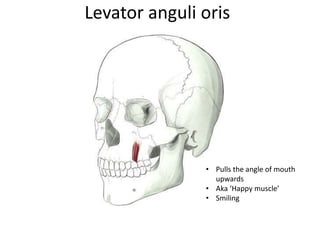
Levator anguli oris
• Pulls the angle of mouth
upwards
• Aka ‘Happy muscle’
• Smiling
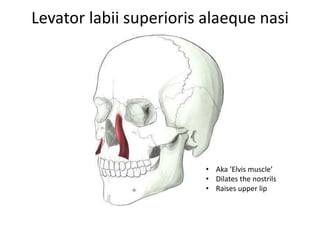
Levator labii superioris alaeque nasi
• Aka ‘Elvis muscle’
• Dilates the nostrils
• Raises upper lip
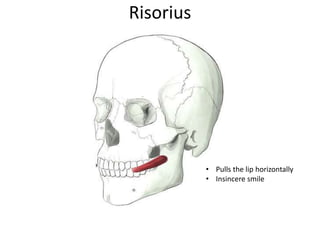
Risorius
• Pulls the lip horizontally
• Insincere smile
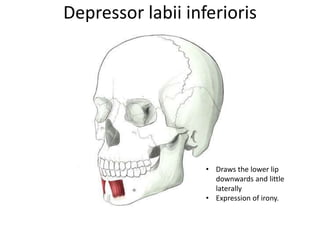
Depressor labii inferioris
• Draws the lower lip
downwards and little
laterally
• Expression of irony.
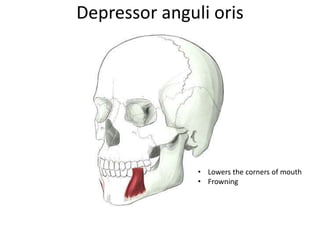
Depressor anguli oris
• Lowers the corners of mouth
• Frowning
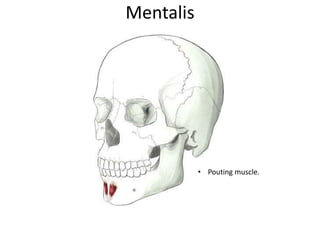
Mentalis
• Pouting muscle.
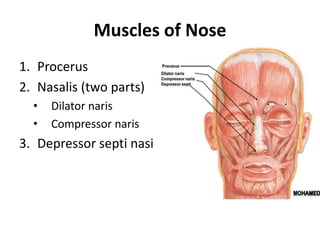
Muscles of Nose
1. Procerus
2. Nasalis (two parts)
• Dilator naris
• Compressor naris
3. Depressor septi nasi
Procerus
• Origin: nasal bone and
lateral nasal cartilage
• Insertion: skin
between the eyebrows
• Action:
– pulls down the medial
end of the eyebrow
– wrinkles the skin of the
nose transversely in
frowning
Dilator naris
• Origin : Maxilla bone
• Insertion: Ala of the
nose
• Action: Widens the nasal
aperture (by pulling the
alar laterally) in deep
inspiration; is also a sign
of anger
Compressor naris
• Origin: Frontal process of
the maxilla
• Insertion: Aponeurosis
which crosses the bridge of
the nose
• Action: Compresses the
mobile nasal cartilages
Depressor septi nasi
• Origin: incisive fossa of
maxilla
• Insertion:nasal septum &
back part of the alar part of
nasalis muscle
• Action: depression of nasal
septum. Dilates the nostril.
Moves the ape of nose
during movement of upper
lip (talking).
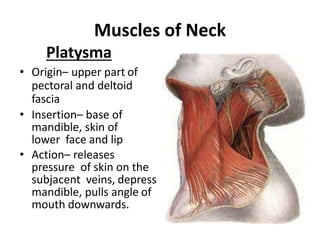
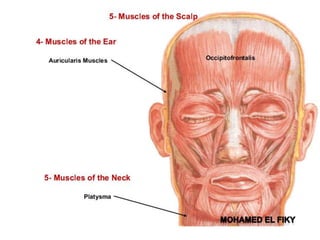
Muscles of Neck
Platysma
• Origin– upper part of
pectoral and deltoid
fascia
• Insertion– base of
mandible, skin of
lower face and lip
• Action– releases
pressure of skin on the
subjacent veins, depress
mandible, pulls angle of
mouth downwards.
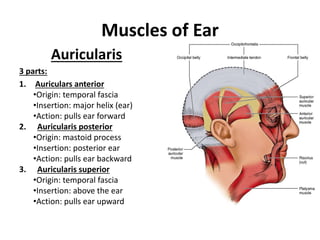
Muscles of Ear
Auricularis
3 parts:
1. Auriculars anterior
•Origin: temporal fascia
•Insertion: major helix (ear)
•Action: pulls ear forward
2. Auricularis posterior
•Origin: mastoid process
•Insertion: posterior ear
•Action: pulls ear backward
3. Auricularis superior
•Origin: temporal fascia
•Insertion: above the ear
•Action: pulls ear upward
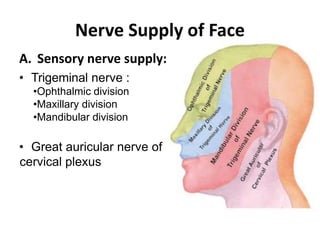
Nerve Supply of Face
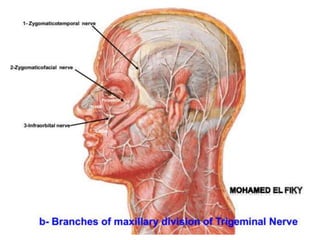
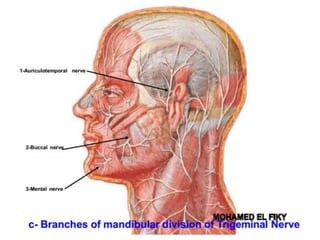
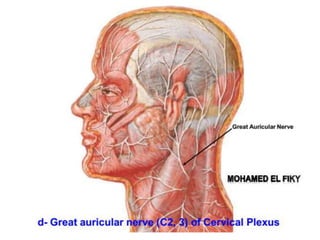
A. Sensory nerve supply:
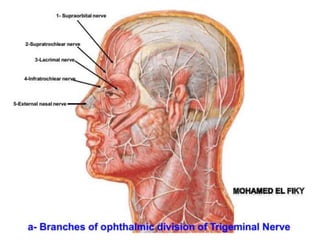
• Trigeminal nerve :
•Ophthalmic division
•Maxillary division
•Mandibular division
• Great auricular nerve of
cervical plexus
B. Motor Supply of Face
(Facial Nerve)
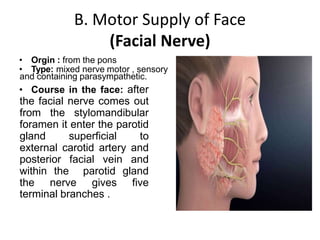
• Orgin : from the pons
• Type: mixed nerve motor , sensory
and containing parasympathetic.
• Course in the face: after
the facial nerve comes out
from the stylomandibular
foramen it enter the parotid
gland superficial to
external carotid artery and
posterior facial vein and
within the parotid gland
the nerve gives five
terminal branches .
Branches of facial nerve
• Before it enter the parotid gland
(distal to the stylomastoid foramen:
1. Postetrior auricular- to the
occiptal belly of
occiptofrontalis muscle
and muscles around ear
2. Branch to posterior belly
of digasteric and
stylohyoid muscle
• Within the parotid gland:
1. Temporal
2. Zygomatic
3. Buccal
4. Marginal mandibular
5. Cervical
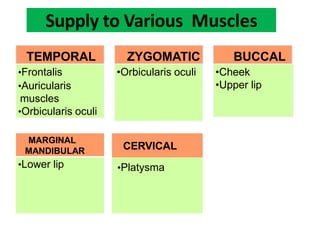
TEMPORAL
•Frontalis
•Auricularis
muscles
•Orbicularis oculi
ZYGOMATIC
•Orbicularis oculi
BUCCAL
•Cheek
•Upper lip
•Lower lip
MARGINAL
MANDIBULAR CERVICAL
•Platysma
Supply to Various Muscles
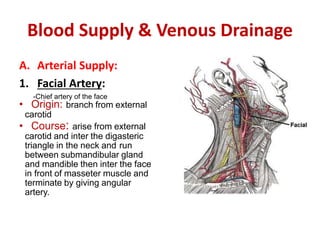
Blood Supply & Venous Drainage
A. Arterial Supply:
1. Facial Artery:
-Chief artery of the face
• Origin: branch from external
carotid
• Course: arise from external
carotid and inter the digasteric
triangle in the neck and run
between submandibular gland
and mandible then inter the face
in front of masseter muscle and
terminate by giving angular
artery.
•Branches of facial artery
A. In the neck (cervical
branches)
1. Ascending palatine
2. Tonsilar
3. Submental
4. Glandular branches
B. In the face (facial
branches)
1. Inferior labial
2. Superior labial
3. Lateral nasal
4. Angular (terminal)
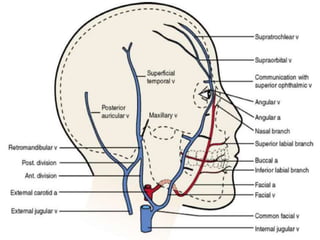
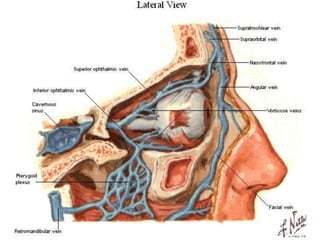
B. Venous drainage
• Veins accompany the arteries
• Drains into common facial & retromandibular
veins.
• W-shaped arrangement
• Facial vein – Largest – No valves
Facial vein
• Begins as angular vein @ medial angle of
the eye
• Formed by the union of Supratrochlear &
Supraorbital veins
• Angular vein – Continues as facial vein –
Running downwards & backwards behind
facial artery – STRAIGHT COURSE
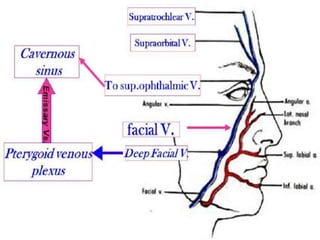
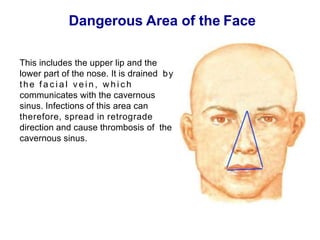
Dangerous Area of the Face
This includes the upper lip and the
lower part of the nose. It is drained by
the f a c i a l v e i n , w h i c h
communicates with the cavernous
sinus. Infections of this area can
therefore, spread in retrograde
direction and cause thrombosis of the
cavernous sinus.
Lymphatic Drainage of Face
Applied Anatomy of Face
• Trigeminal neuralgia
– Maxillary and mandibular nerve are involved
– Excruciating pain in the region of distribution of these nerve
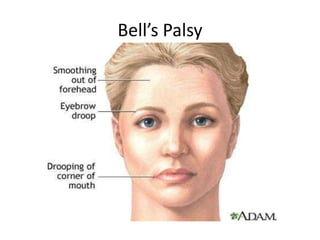
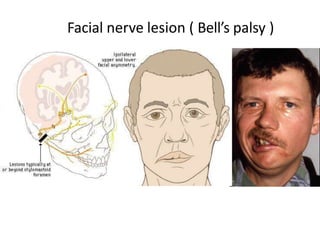
• In infranuclear lesions of facial nerve (eg, bell’s palsy)-
Ipsilateral whole face is paralyzed
– c/f
• Affected side is motionless
• Loss of wrinkles
• Eye cannot be closed
• In smiling the mouth is drawn to normal side
• During mastication food accumulates in vestibule of mouth
Bell’s Palsy
Facial nerve lesion ( Bell’s palsy )
References
• Text book of Human anatomy by B D
Chaurasia
• Atlas of Human Anatomy by
Nater
• Gray’s anatomy
• Internet sources
Anatomy of face

Anatomy of face

  • 1.
  • 2.
    Contents • Introduction • Boundariesof face • Layers of face • Symmetry of face • Aesthetic regions of face • Bones • Muscles of face • Nerve supply • Blood supply & venous drainage • Lymphatic drainage • Applied anatomy
  • 3.
    Introduction • Very vascular •Due to rich vascularity face blush and blanch. • Facial skin is rich in sebaceous gland and sweat gland. • Wounds of face bleed profusely but heal rapidly. • Sebaceous glands keep the skin oily but also cause acne in adult. • No deep fascia is present in the face.
  • 4.
    Boundaries of Face SuperiorlyInferiorly Each side • To the hairline • Chin • Base of mandible • Auricle Note: forehead is common to both scalp & face.
  • 5.
  • 6.
  • 7.
  • 8.
    Bones of Face •The facial skeleton consists of 14 stationary bones and the mandible. • These 14 bones form the basic shape of the face, and are responsible for providing attachments for muscles that make the jaw move and control facial expressions.
  • 9.
  • 10.
  • 11.
    Muscles of Face GeneralCharacters • Called muscle of facial expression and lie in superficial fascia. • Develop from mesoderm of 2nd pharyngeal arch. • Supplied by the Facial nerve. • Act as closers and openers of facial orifices.
  • 12.
    Muscles of Face GeneralCharacters • Surround the facial openings. • Originate from bone or other muscle. • Pass in the superficial fascia. • Attach to the facial skin or other facial muscle.
  • 13.
    Muscles of Face Classification: 1.Muscles of the eyelid 2. Muscles of the mouth 3. Muscles of the nose 4. Muscles of the neck 5. Muscles of the ear
  • 17.
    Muscles of Eyelid A.Corrugator supercillii Origin: Medial end of superciliary arch Insertion: Skin of mid- eyebrow Action: Vertical lines in forehead: frowning
  • 18.
  • 19.
    Orbital Part ORIGIN INSERTION ACTION • Medialpart of the medial palpebral ligament & adjoining bone • Concentric rings return to the point of origin • Closes the lids tightly • Protects eye from bright light
  • 21.
    Palpebral Part ORIGIN INSERTION ACTION • Lateralpart of the medial palpebral ligament • Lateral palpebral raphae • Closes the lids gently • Blinking
  • 22.
    Lacrimal Part ORIGIN INSERTION ACTION • Lacrimalfascia & lacrimal bone • Upper & lower eyelids • Dilates the lacrimal sac
  • 24.
    Muscles of TheMouth • Orbicularis oris • Buccinator • Lower group of oral muscles • depressor anguli oris • depressor labii inferioris • Mentalis • Upper group of oral muscles • risorius • zygomaticus major and zygomaticus minor • levator labii superioris • levator labii superioris alaeque nasi • levator anguli oris
  • 26.
    Orbicularis oris Two parts: 1.Intrinsic part [Deep stratum] Origin: Superior incisivus from maxilla & Inferior incisivus from mandible Insertion: Angle of mouth Action: Closes & purses the mouth 2. Extrinsic part [Two strata] Origin: • Thickest middle stratum – Buccinator • Thick superficial stratum – Elevators & depressors of lips & angles Insertion: Lips & the angle of the mouth Action: Closes & purses the mouth
  • 27.
    Buccinator • Origin : •Upper fibers from maxilla above three molar • Lower fibers : from the mandible below three molar • Ptergomandibular raphe which separates it from the constrictor pharyngis superior. • Insertion : • Upper fibers : to the upper lip • Lower fibers : lower lip • Middle fibers decussate lower ascend to upper lib & lower descend to the lower limb • Action : • Aids in holding the cheek to the teeth and prevent accumulation of food in the Buccinator
  • 29.
    Zygomaticus major • Strapmuscle • Forms shape of cheek • Smiling
  • 30.
    Zygomaticus minor • Strapmuscle • Forms shape of cheek • Smiling
  • 31.
    Levator labii superioris •Deeps the furrows on either side of nares • Sad
  • 32.
    Levator anguli oris •Pulls the angle of mouth upwards • Aka ‘Happy muscle’ • Smiling
  • 33.
    Levator labii superiorisalaeque nasi • Aka ‘Elvis muscle’ • Dilates the nostrils • Raises upper lip
  • 34.
    Risorius • Pulls thelip horizontally • Insincere smile
  • 35.
    Depressor labii inferioris •Draws the lower lip downwards and little laterally • Expression of irony.
  • 36.
    Depressor anguli oris •Lowers the corners of mouth • Frowning
  • 37.
  • 38.
    Muscles of Nose 1.Procerus 2. Nasalis (two parts) • Dilator naris • Compressor naris 3. Depressor septi nasi
  • 39.
    Procerus • Origin: nasalbone and lateral nasal cartilage • Insertion: skin between the eyebrows • Action: – pulls down the medial end of the eyebrow – wrinkles the skin of the nose transversely in frowning
  • 40.
    Dilator naris • Origin: Maxilla bone • Insertion: Ala of the nose • Action: Widens the nasal aperture (by pulling the alar laterally) in deep inspiration; is also a sign of anger
  • 41.
    Compressor naris • Origin:Frontal process of the maxilla • Insertion: Aponeurosis which crosses the bridge of the nose • Action: Compresses the mobile nasal cartilages
  • 42.
    Depressor septi nasi •Origin: incisive fossa of maxilla • Insertion:nasal septum & back part of the alar part of nasalis muscle • Action: depression of nasal septum. Dilates the nostril. Moves the ape of nose during movement of upper lip (talking).
  • 43.
    Muscles of Neck Platysma •Origin– upper part of pectoral and deltoid fascia • Insertion– base of mandible, skin of lower face and lip • Action– releases pressure of skin on the subjacent veins, depress mandible, pulls angle of mouth downwards.
  • 44.
    Muscles of Ear Auricularis 3parts: 1. Auriculars anterior •Origin: temporal fascia •Insertion: major helix (ear) •Action: pulls ear forward 2. Auricularis posterior •Origin: mastoid process •Insertion: posterior ear •Action: pulls ear backward 3. Auricularis superior •Origin: temporal fascia •Insertion: above the ear •Action: pulls ear upward
  • 46.
    Nerve Supply ofFace A. Sensory nerve supply: • Trigeminal nerve : •Ophthalmic division •Maxillary division •Mandibular division • Great auricular nerve of cervical plexus
  • 52.
    B. Motor Supplyof Face (Facial Nerve) • Orgin : from the pons • Type: mixed nerve motor , sensory and containing parasympathetic. • Course in the face: after the facial nerve comes out from the stylomandibular foramen it enter the parotid gland superficial to external carotid artery and posterior facial vein and within the parotid gland the nerve gives five terminal branches .
  • 53.
    Branches of facialnerve • Before it enter the parotid gland (distal to the stylomastoid foramen: 1. Postetrior auricular- to the occiptal belly of occiptofrontalis muscle and muscles around ear 2. Branch to posterior belly of digasteric and stylohyoid muscle • Within the parotid gland: 1. Temporal 2. Zygomatic 3. Buccal 4. Marginal mandibular 5. Cervical
  • 54.
    TEMPORAL •Frontalis •Auricularis muscles •Orbicularis oculi ZYGOMATIC •Orbicularis oculi BUCCAL •Cheek •Upperlip •Lower lip MARGINAL MANDIBULAR CERVICAL •Platysma Supply to Various Muscles
  • 55.
    Blood Supply &Venous Drainage A. Arterial Supply: 1. Facial Artery: -Chief artery of the face • Origin: branch from external carotid • Course: arise from external carotid and inter the digasteric triangle in the neck and run between submandibular gland and mandible then inter the face in front of masseter muscle and terminate by giving angular artery.
  • 56.
    •Branches of facialartery A. In the neck (cervical branches) 1. Ascending palatine 2. Tonsilar 3. Submental 4. Glandular branches B. In the face (facial branches) 1. Inferior labial 2. Superior labial 3. Lateral nasal 4. Angular (terminal)
  • 60.
    B. Venous drainage •Veins accompany the arteries • Drains into common facial & retromandibular veins. • W-shaped arrangement • Facial vein – Largest – No valves
  • 61.
    Facial vein • Beginsas angular vein @ medial angle of the eye • Formed by the union of Supratrochlear & Supraorbital veins • Angular vein – Continues as facial vein – Running downwards & backwards behind facial artery – STRAIGHT COURSE
  • 65.
    Dangerous Area ofthe Face This includes the upper lip and the lower part of the nose. It is drained by the f a c i a l v e i n , w h i c h communicates with the cavernous sinus. Infections of this area can therefore, spread in retrograde direction and cause thrombosis of the cavernous sinus.
  • 66.
  • 67.
    Applied Anatomy ofFace • Trigeminal neuralgia – Maxillary and mandibular nerve are involved – Excruciating pain in the region of distribution of these nerve • In infranuclear lesions of facial nerve (eg, bell’s palsy)- Ipsilateral whole face is paralyzed – c/f • Affected side is motionless • Loss of wrinkles • Eye cannot be closed • In smiling the mouth is drawn to normal side • During mastication food accumulates in vestibule of mouth
  • 68.
  • 70.
    Facial nerve lesion( Bell’s palsy )
  • 71.
    References • Text bookof Human anatomy by B D Chaurasia • Atlas of Human Anatomy by Nater • Gray’s anatomy • Internet sources