ANATOMY OF FACE
DR.MEHER MOIN KHAN
LEARNING
OBJECTIVES
• Muscles of facial expressions
• Arterial supply of face
• Venous supply of face
• Sensory and motor supply of face
• Clinical scenarios
Face
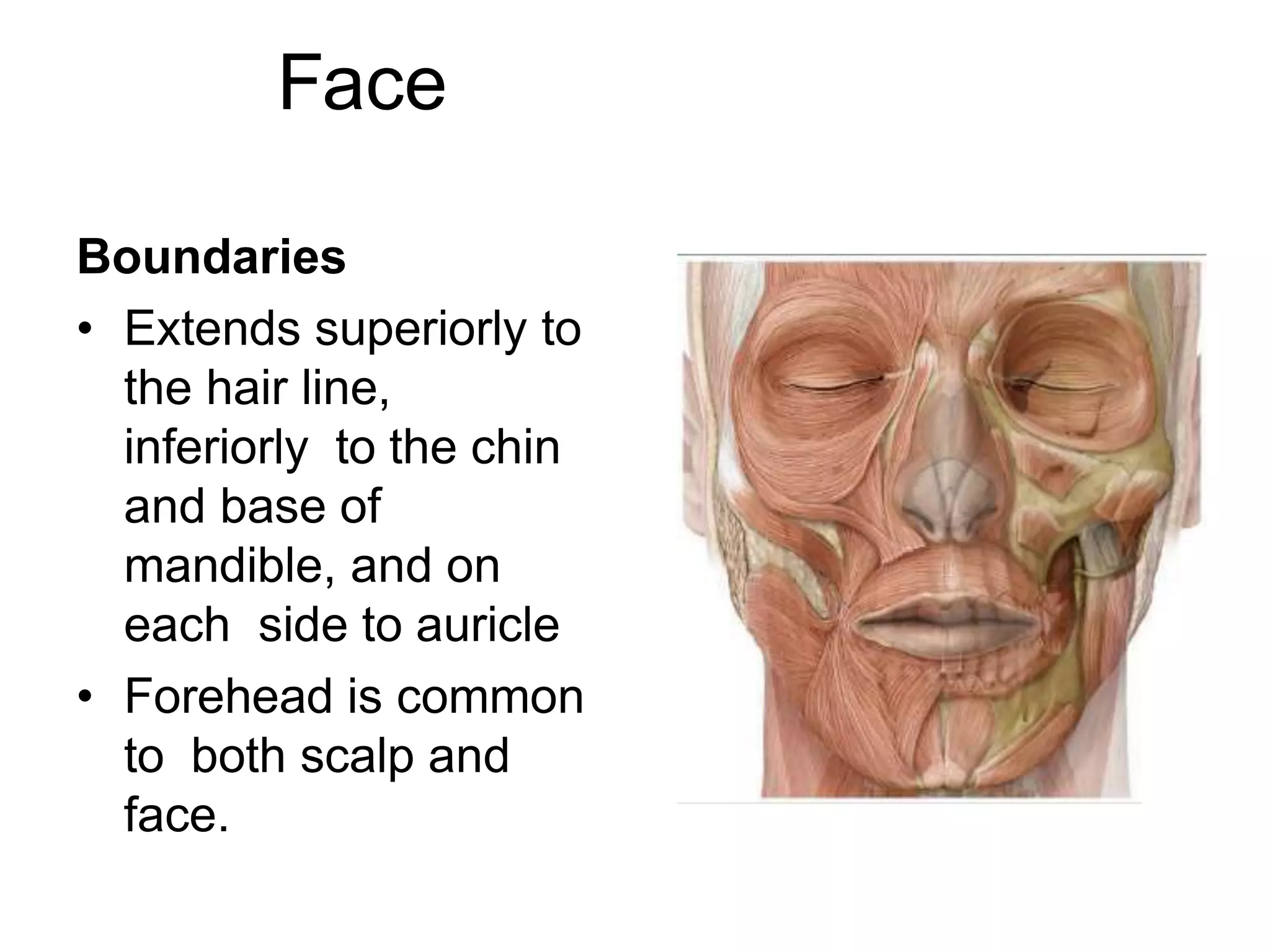
Boundaries
• Extends superiorly to
the hair line,
inferiorly to the chin
and base of
mandible, and on
each side to auricle
• Forehead is common
to both scalp and
face.
Face
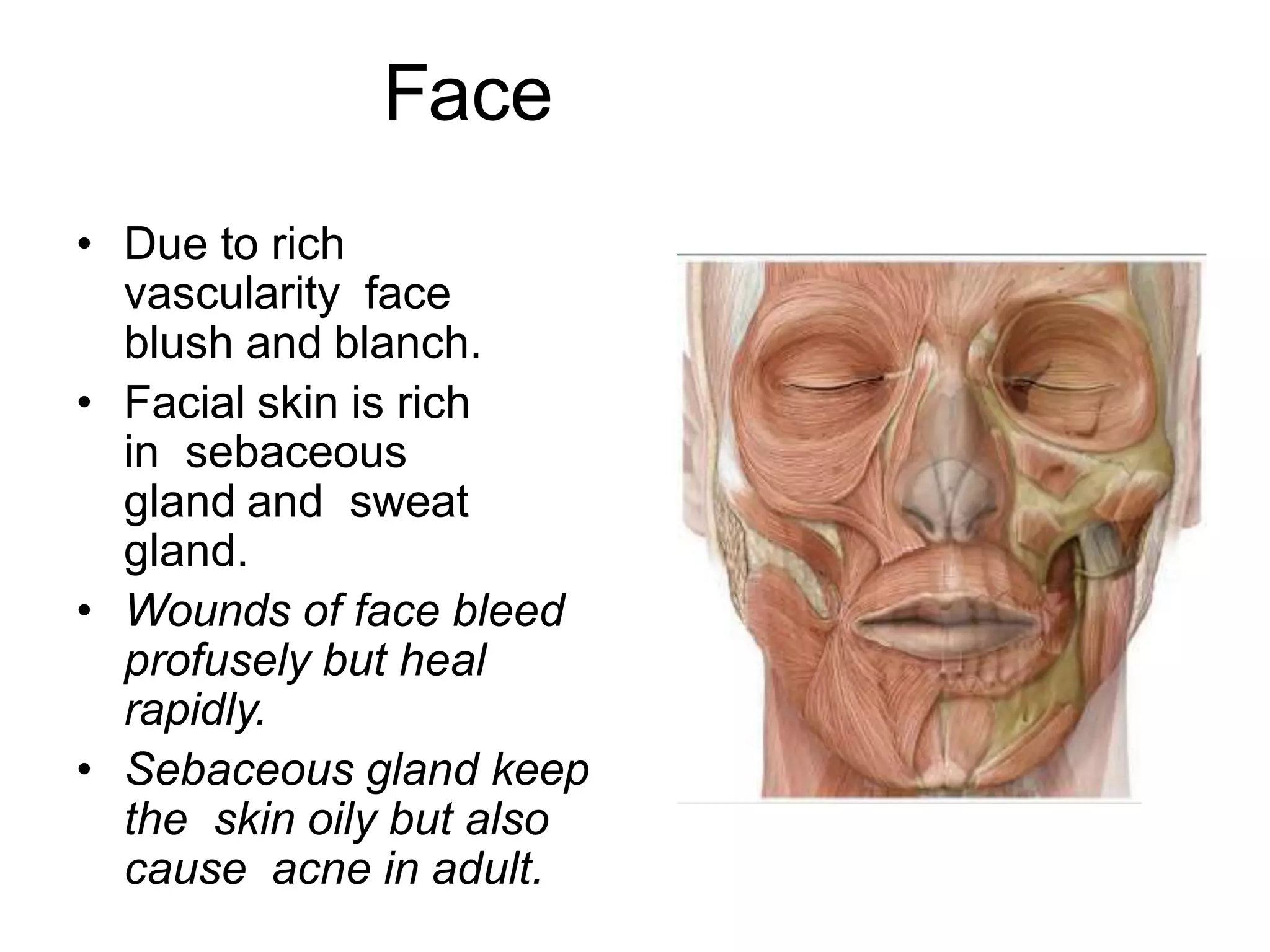
• Due to rich
vascularity face
blush and blanch.
• Facial skin is rich
in sebaceous
gland and sweat
gland.
• Wounds of face bleed
profusely but heal
rapidly.
• Sebaceous gland keep
the skin oily but also
cause acne in adult.
Face
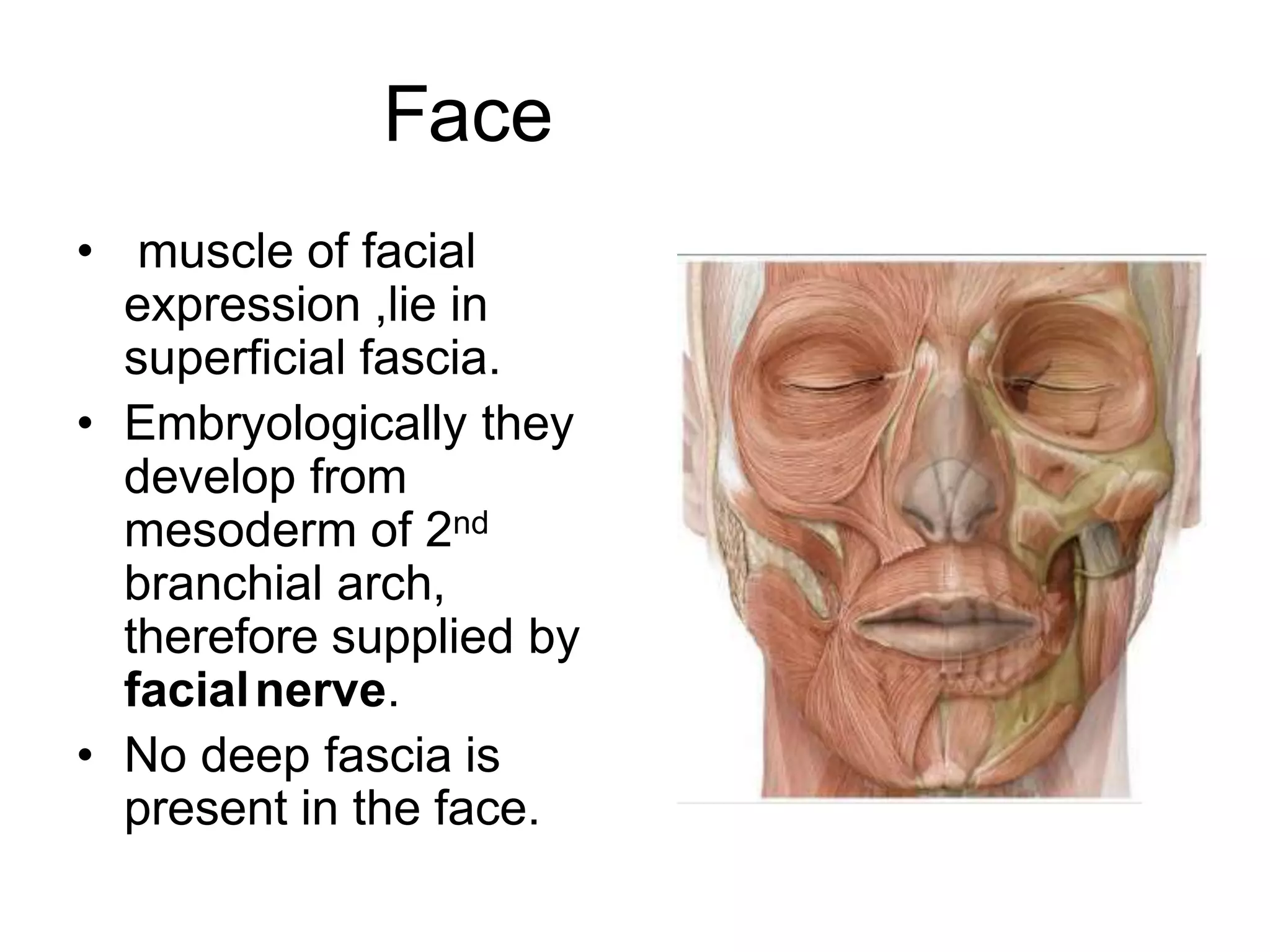
• muscle of facial
expression ,lie in
superficial fascia.
• Embryologically they
develop from
mesoderm of 2nd
branchial arch,
therefore supplied by
facialnerve.
• No deep fascia is
present in the face.
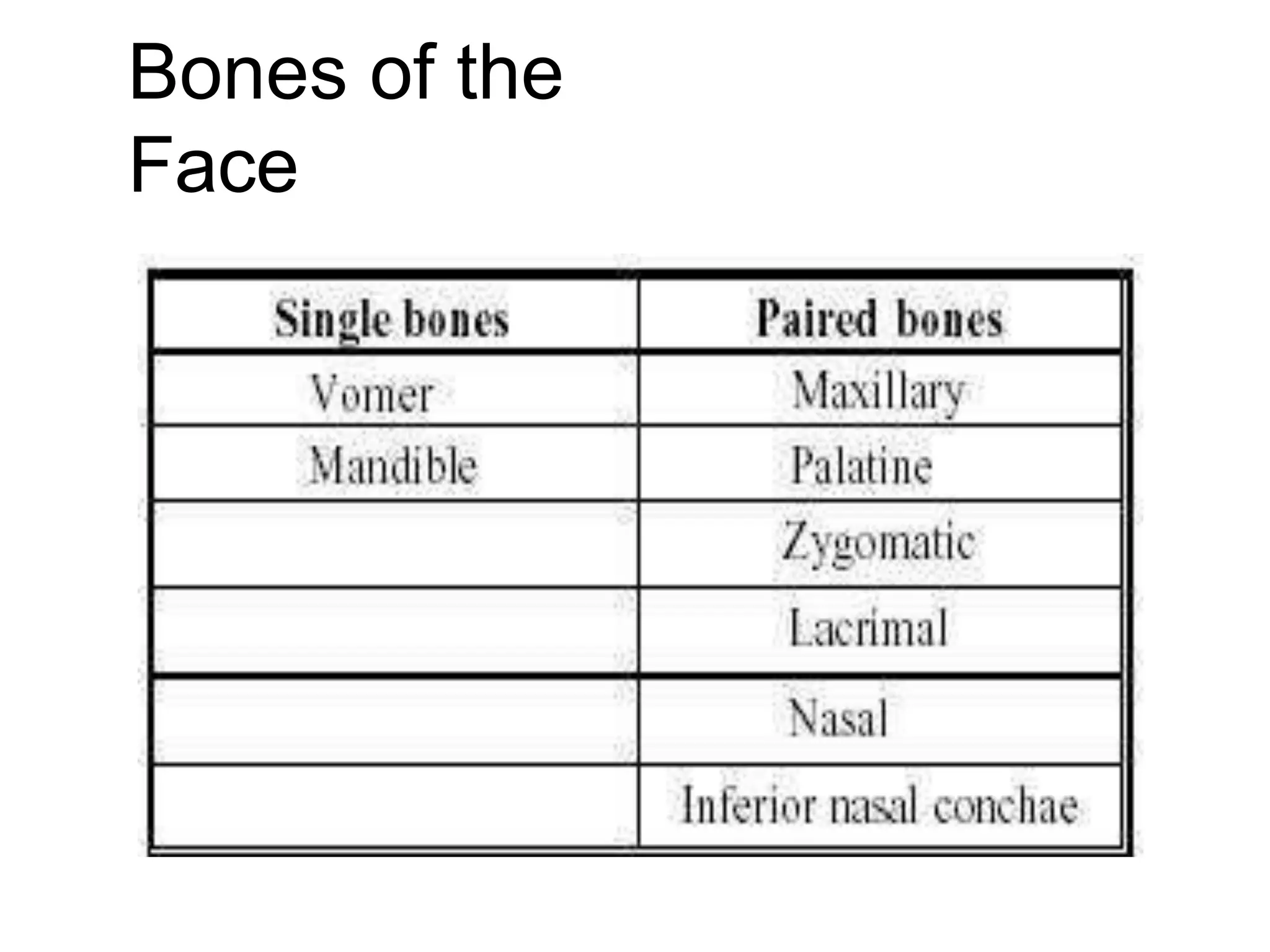
Bones of the
Face
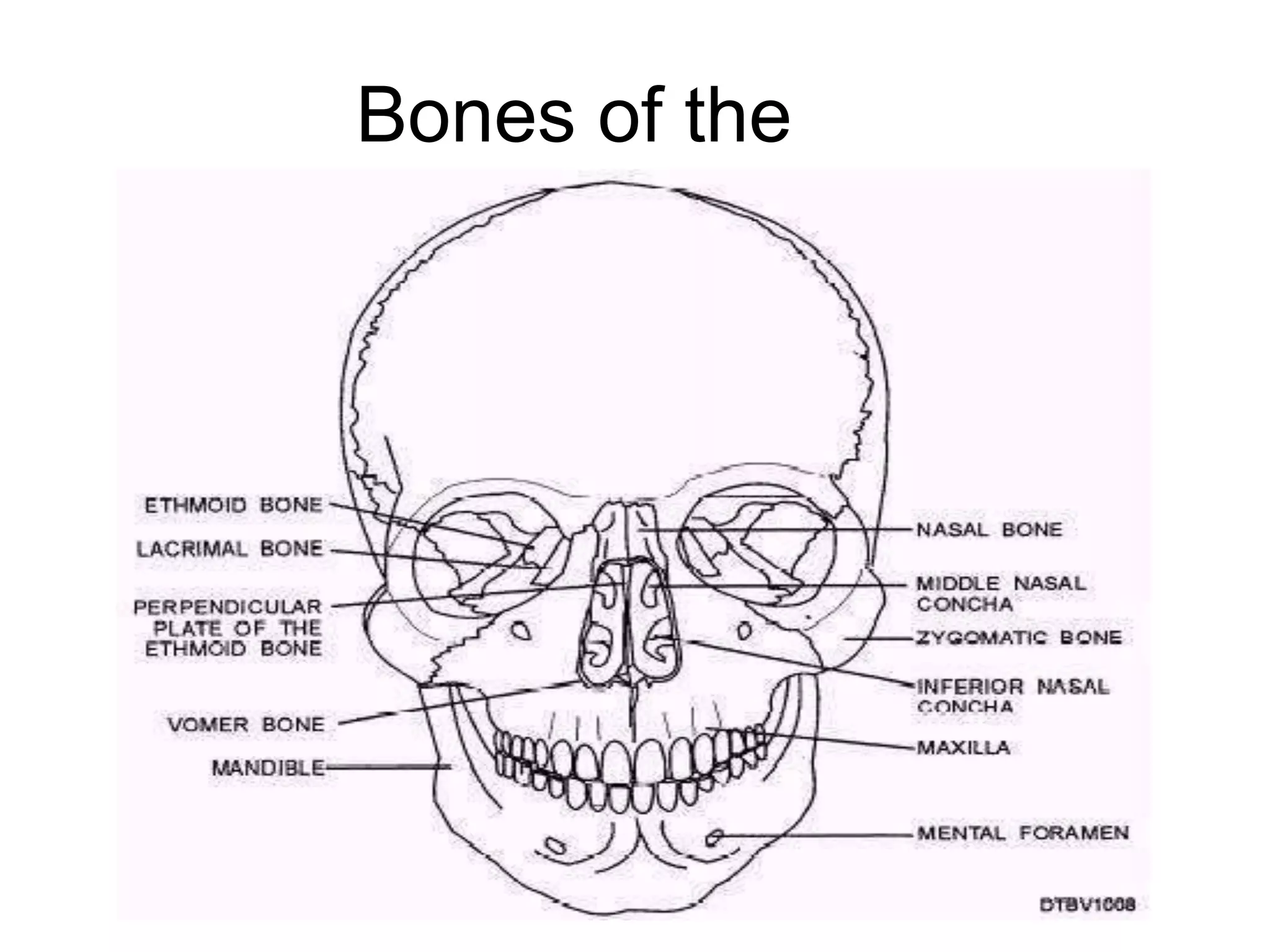
Bones of the
Face
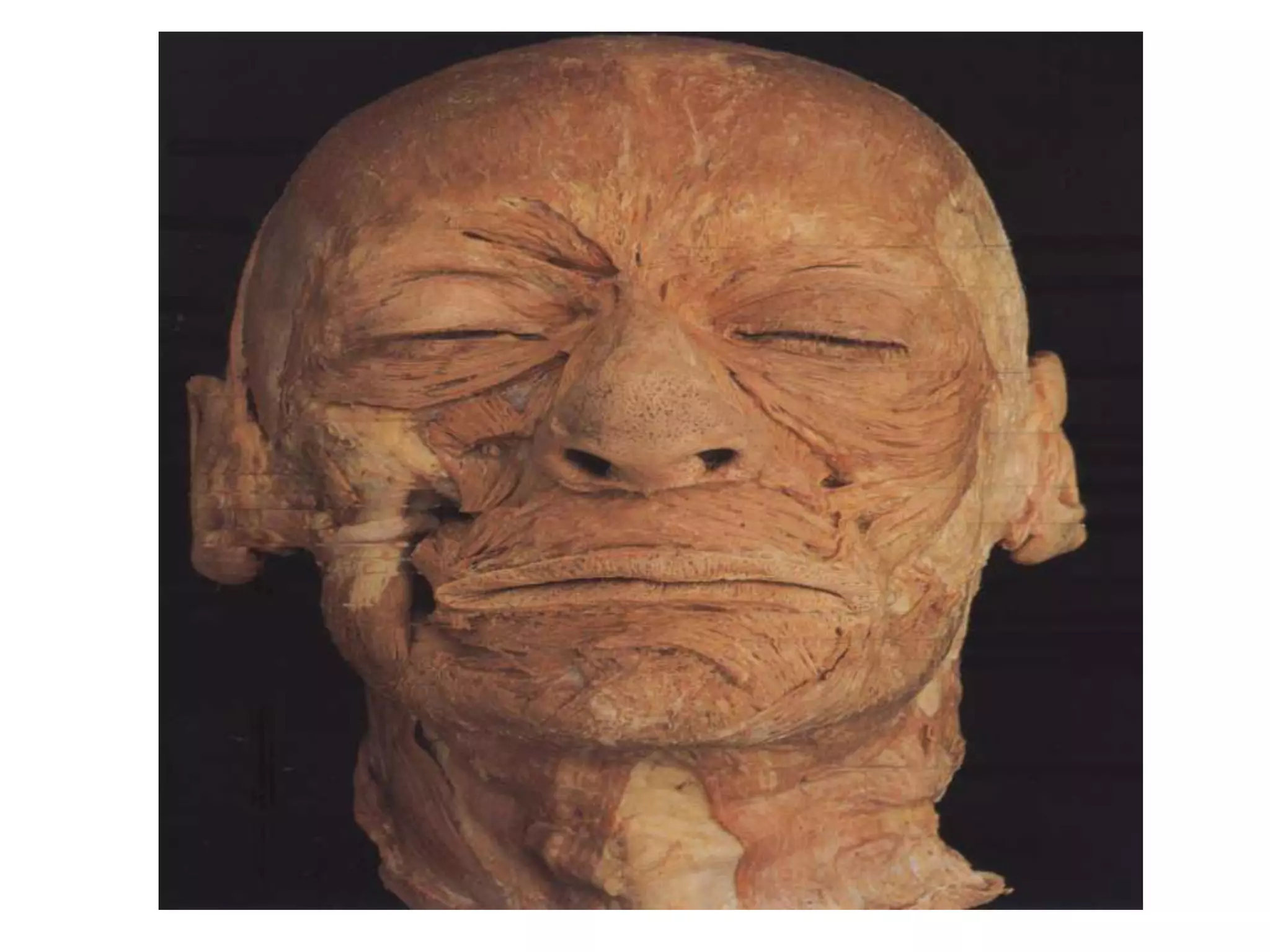
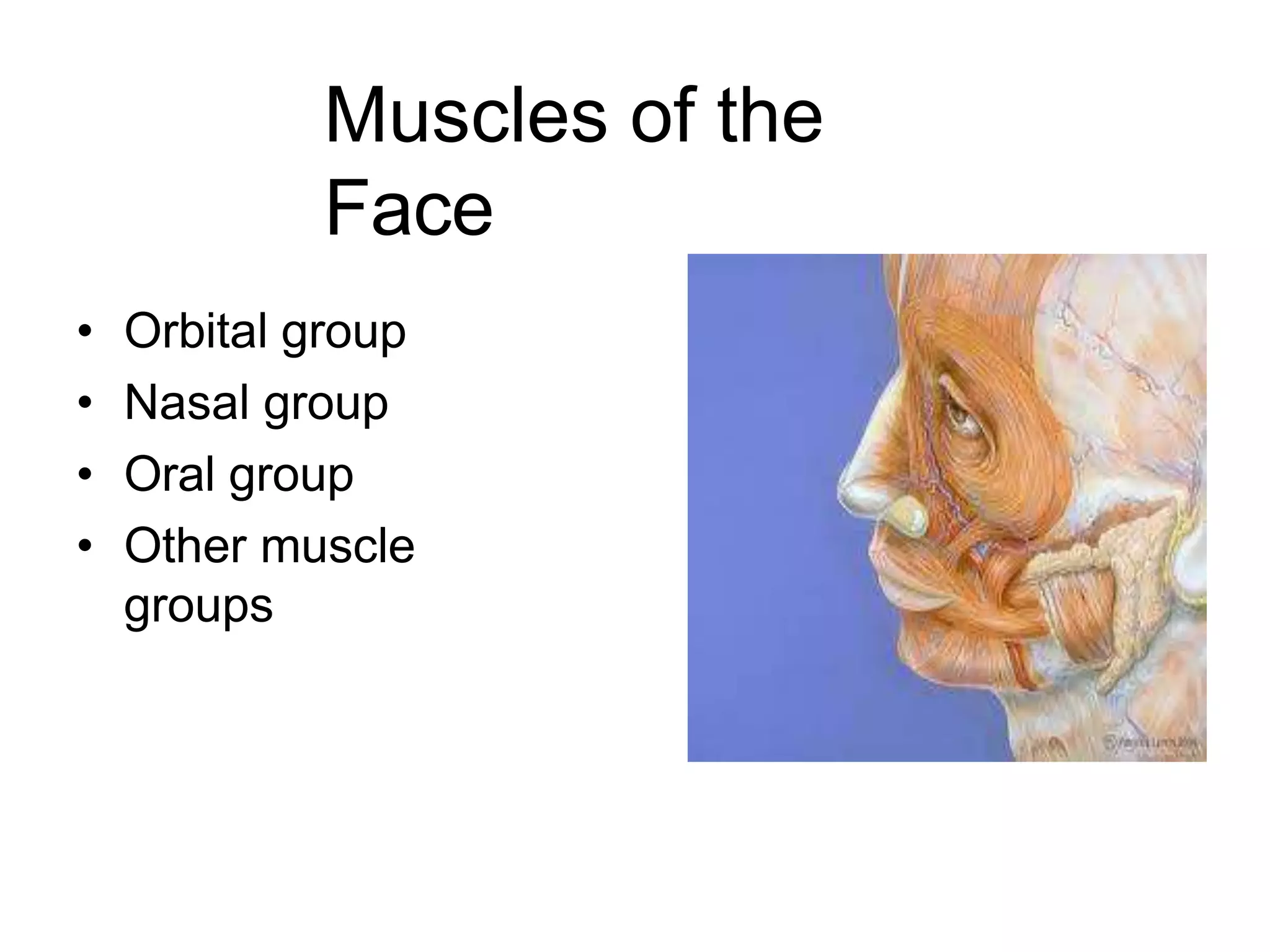
Muscles of the Face
• The muscles of the face develop from the
2nd pharyngeal arch and are innervated by
branches of the facial nerve [VII].
• They are in the superficial fascia, with
origins from either bone or fascia, and
insertions into the skin.
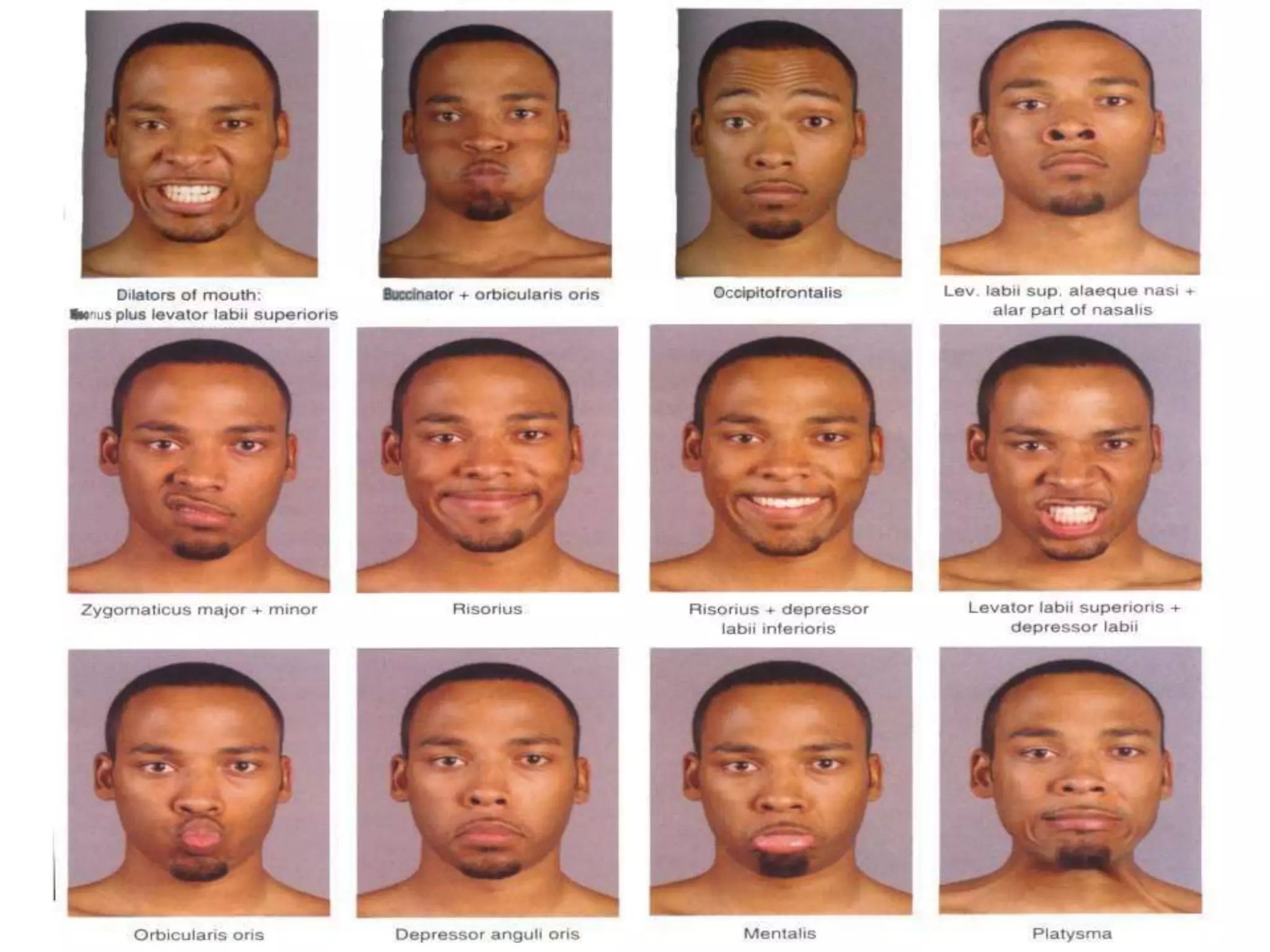
• these muscles control expressions of the
face.
• They act as sphincters and dilators of the
orifices of the face (i.e. the orbits, nose, and
mouth).
Muscles of the
Face
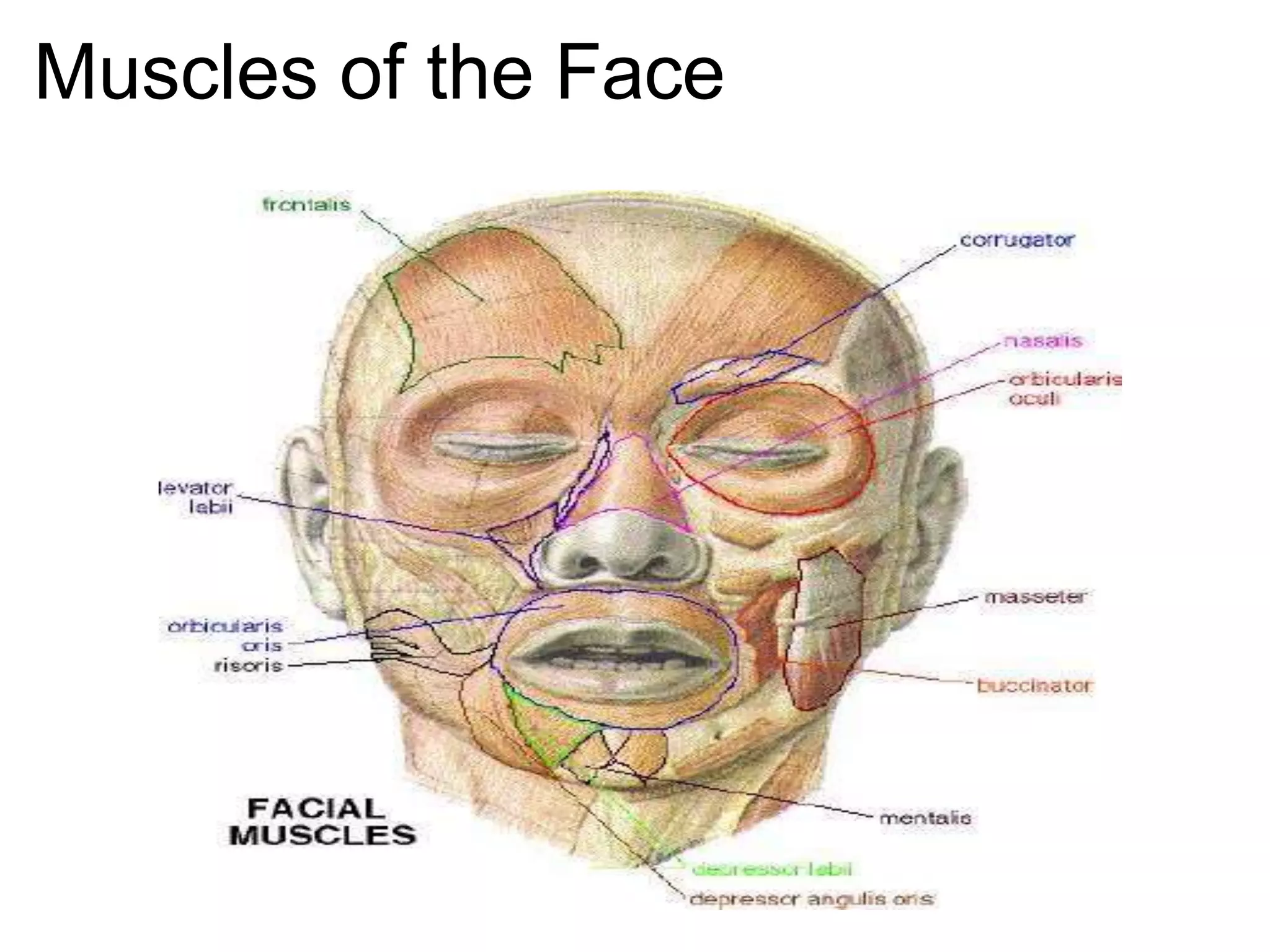
• Orbital group
• Nasal group
• Oral group
• Other muscle
groups
Muscles of the Face
Orbital
group
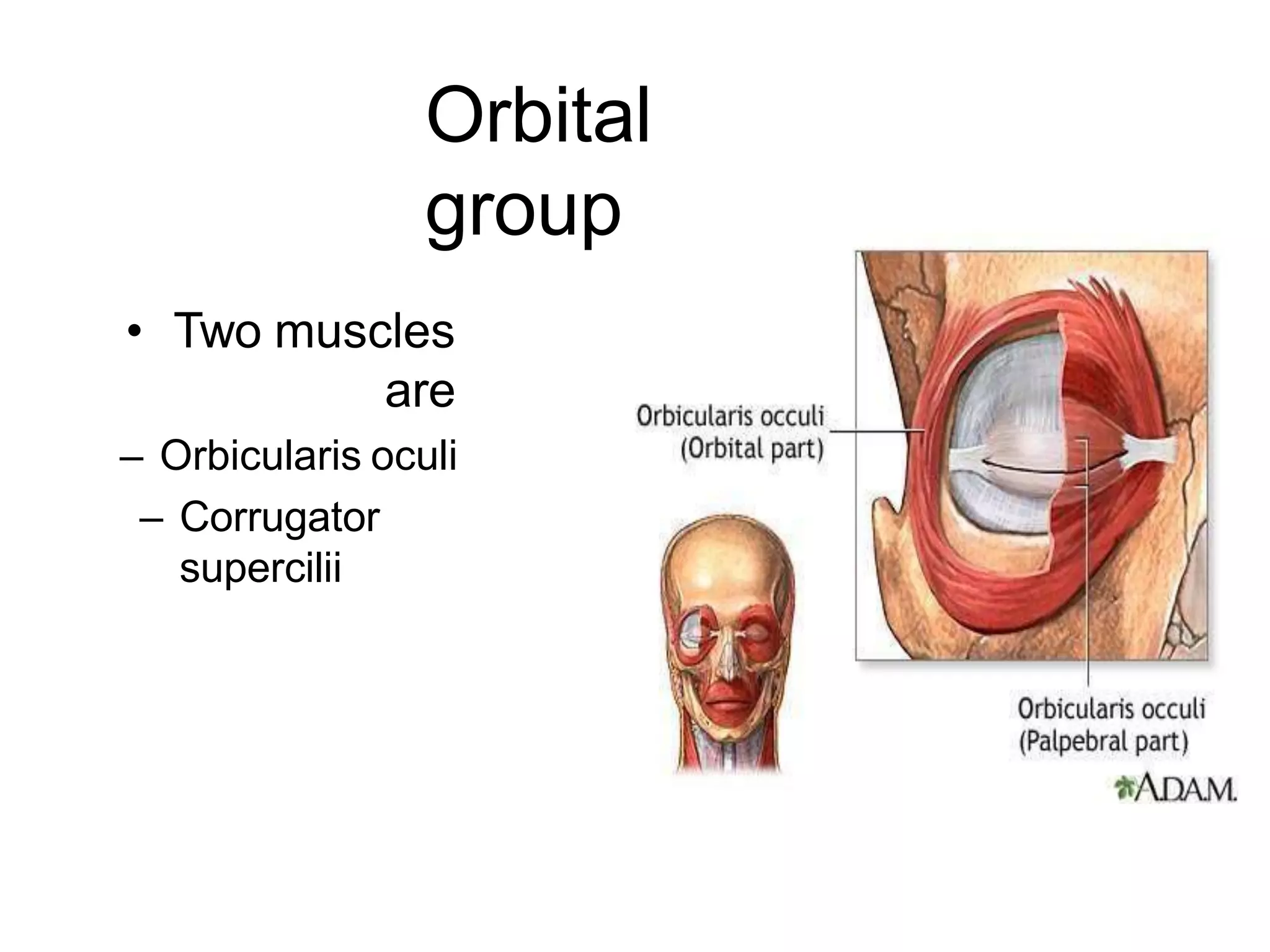
• Two muscles
are
– Orbicularis oculi
– Corrugator
supercilii
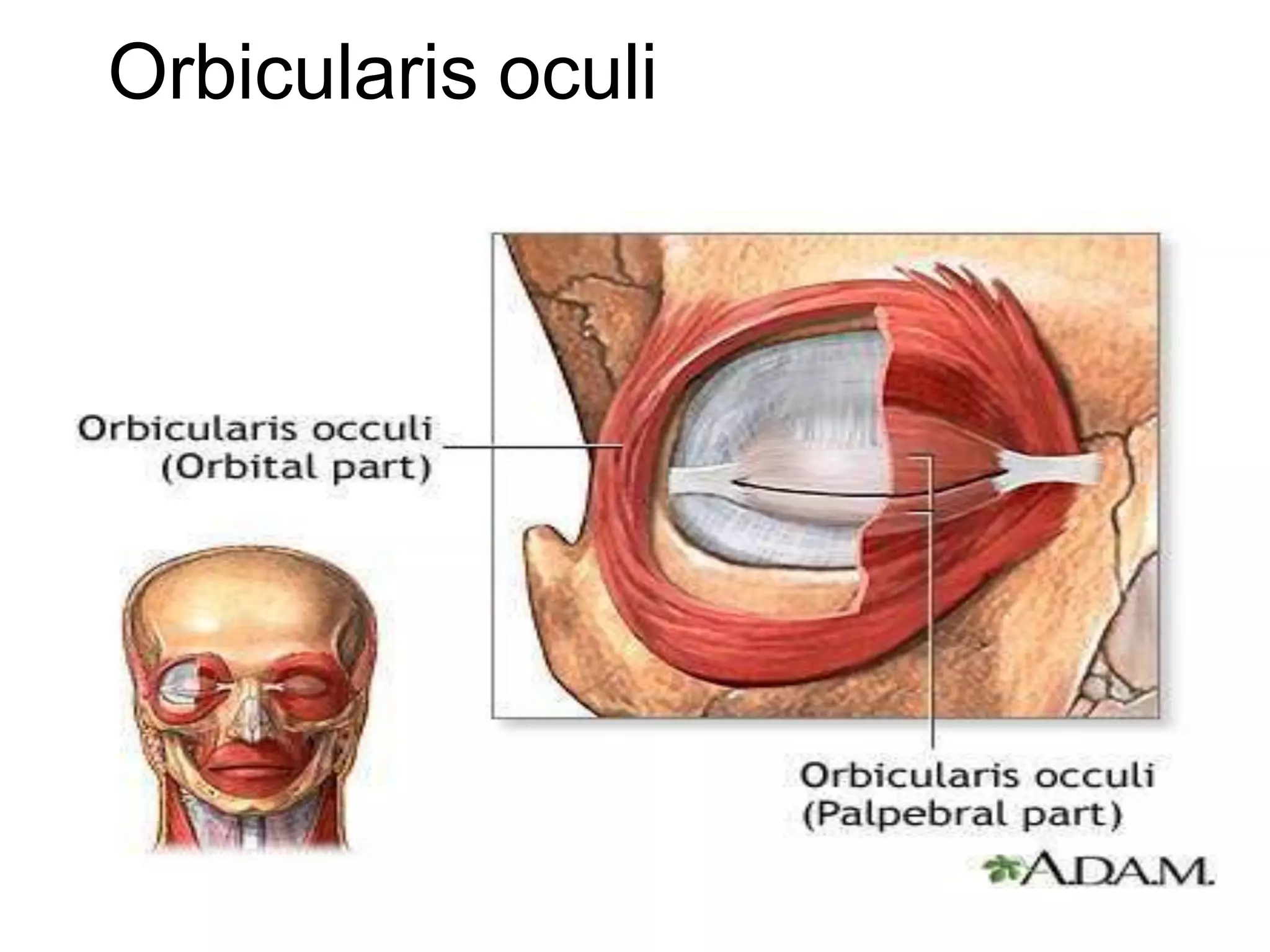
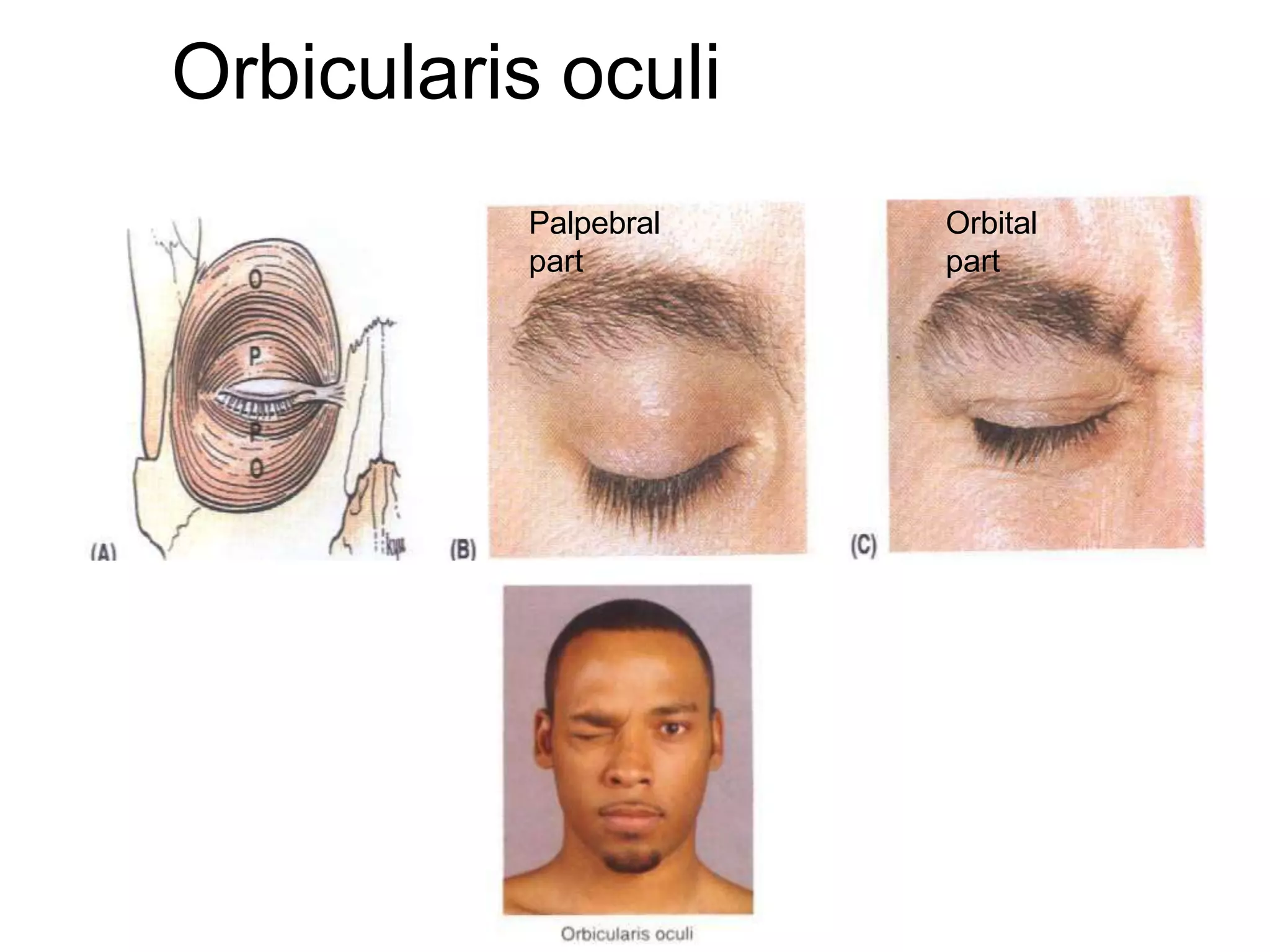
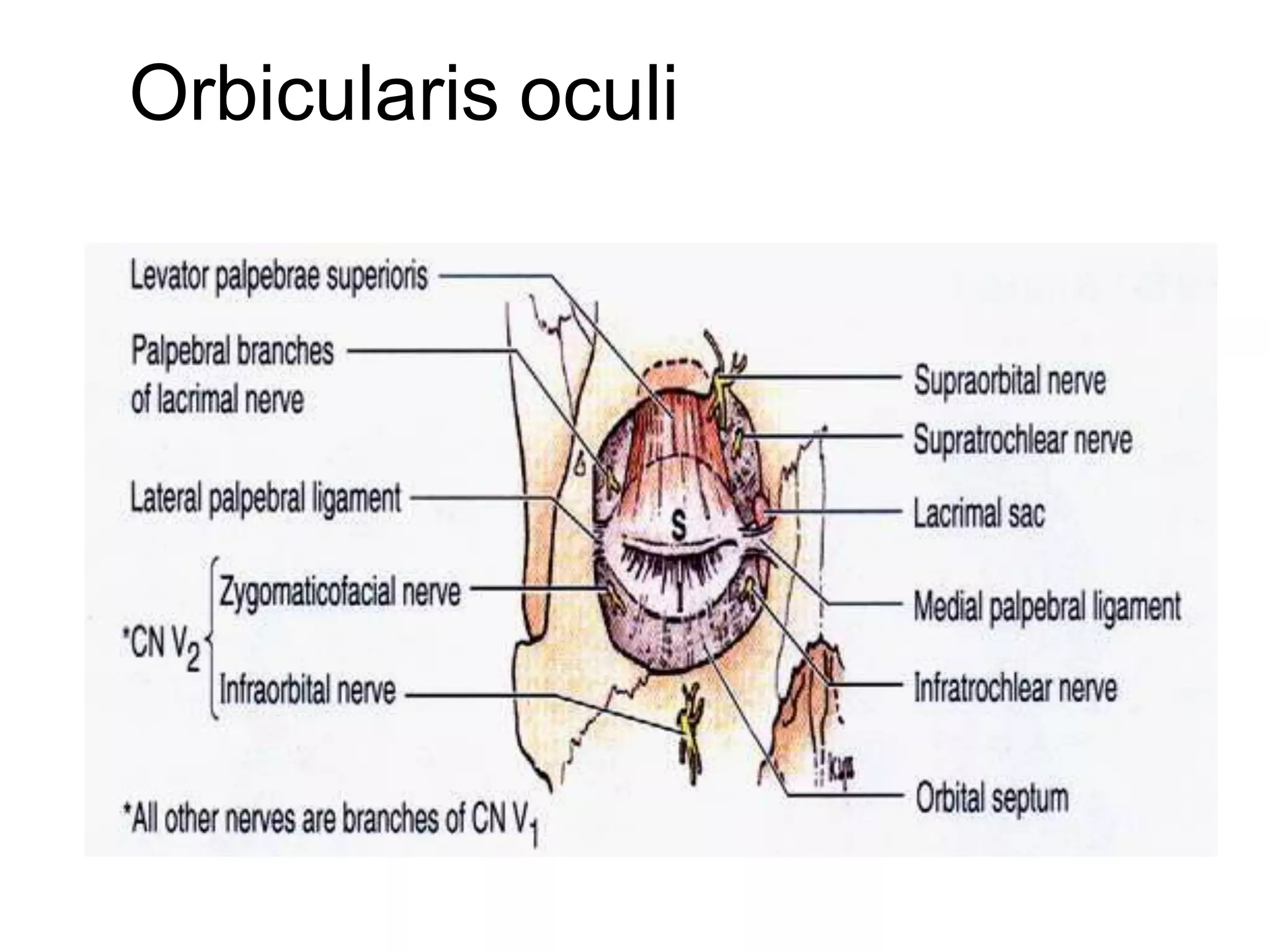
Orbicularis
oculi• 3 parts-
• Orbital part(outer)
– Originate from medial part of medial palpebral ligament and form
concentric
rings, return to point of origin
Action –closes the lids tightly
• Palpebral part(Inner)
– Originate from lateral part of medial palpebral ligament
– Insert into lateral palpebral raphe
Action-closes the lids gently
• Lacrimal part(Small)
– Originate from lacrimal fascia& lacrimal bone
– Insert into upper &lower tarsi
Action-dilate lacrimal sac
Orbicularis oculi
Orbicularis oculi
Palpebral
part
Orbital
part
Orbicularis oculi
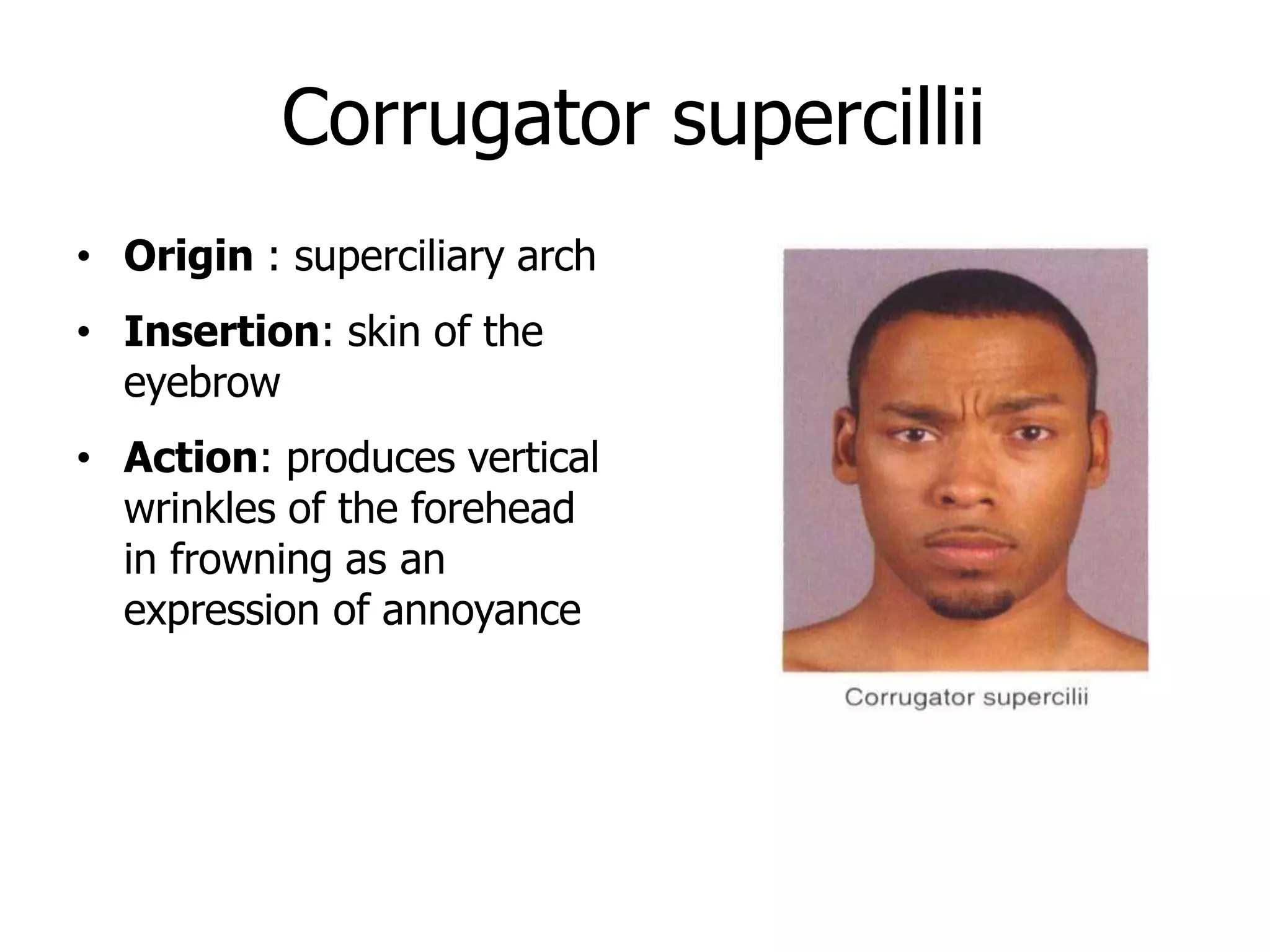
Corrugator supercillii
• Origin : superciliary arch
• Insertion: skin of the
eyebrow
• Action: produces vertical
wrinkles of the forehead
in frowning as an
expression of annoyance
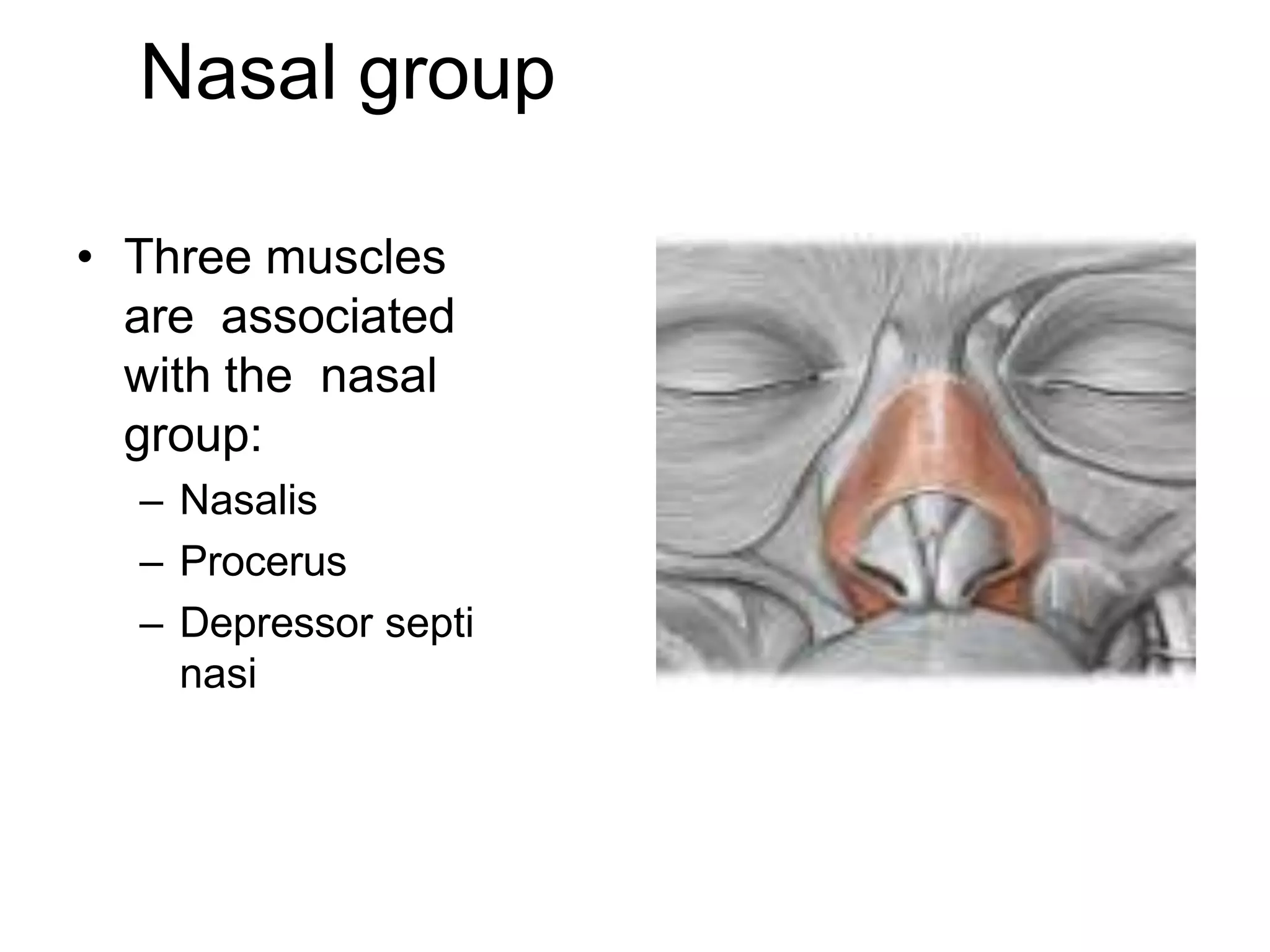
Nasal group
• Three muscles
are associated
with the nasal
group:
– Nasalis
– Procerus
– Depressor septi
nasi
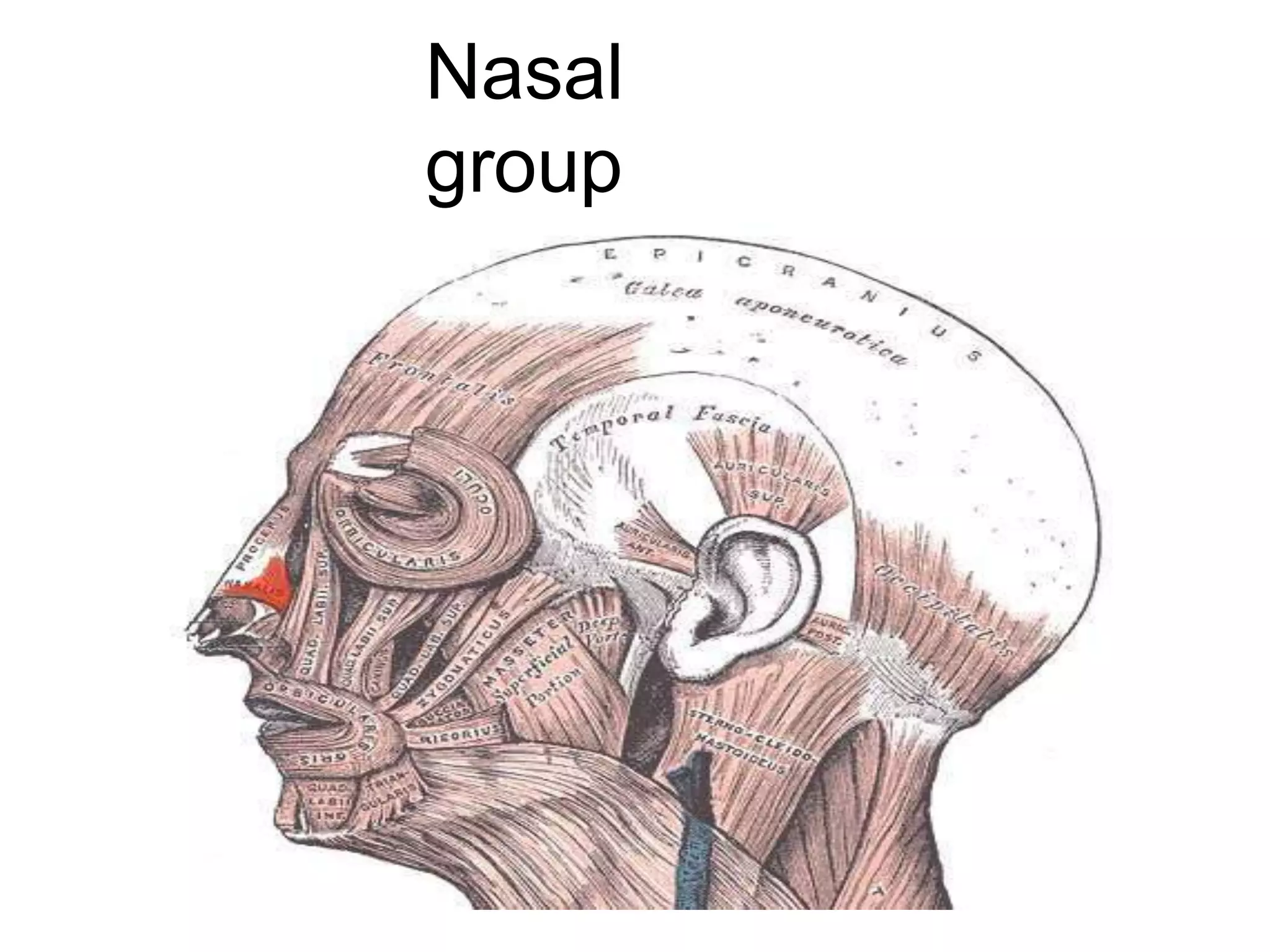
Nasal
group
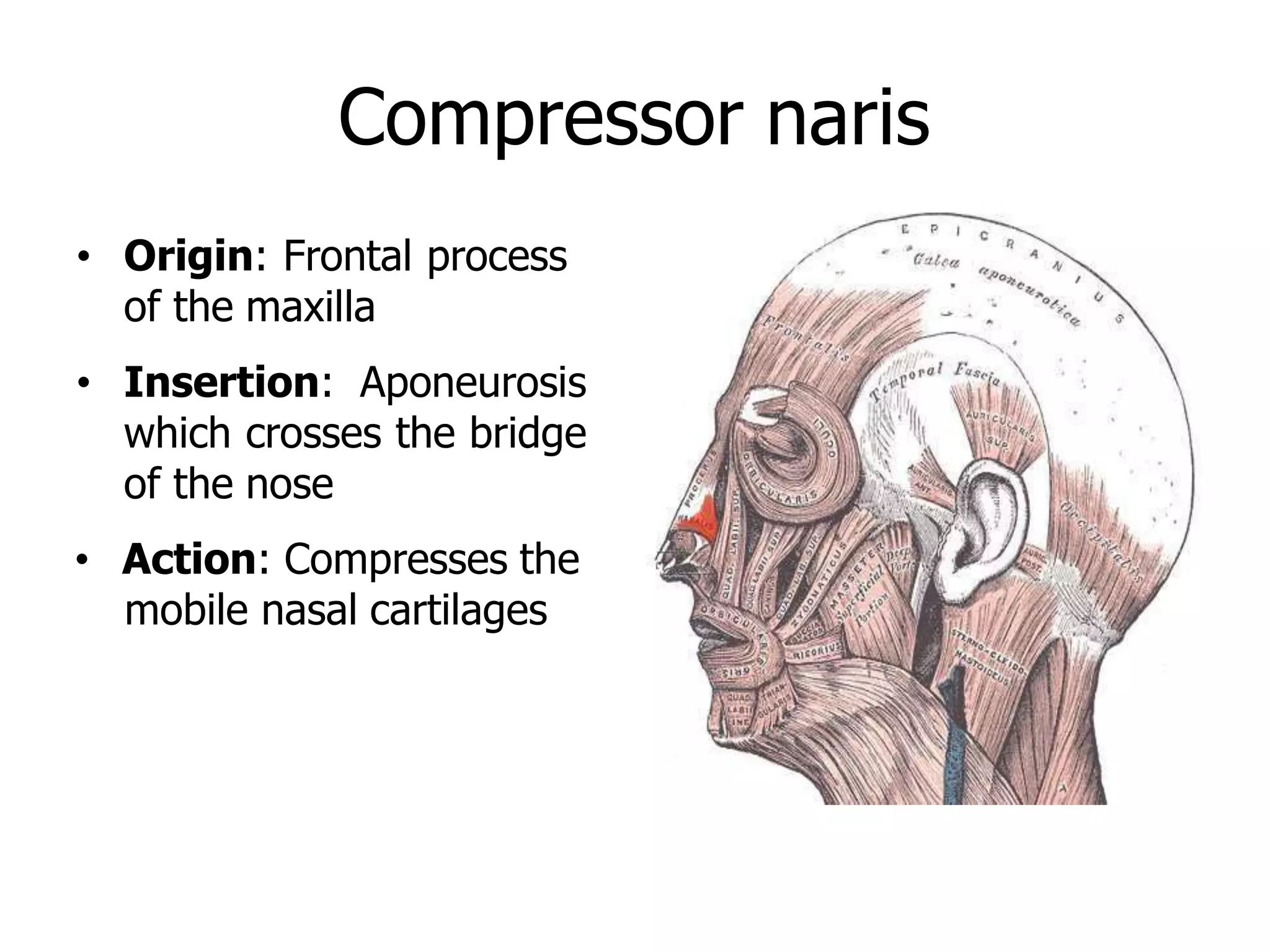
Compressor naris
• Origin: Frontal process
of the maxilla
• Insertion: Aponeurosis
which crosses the bridge
of the nose
• Action: Compresses the
mobile nasal cartilages
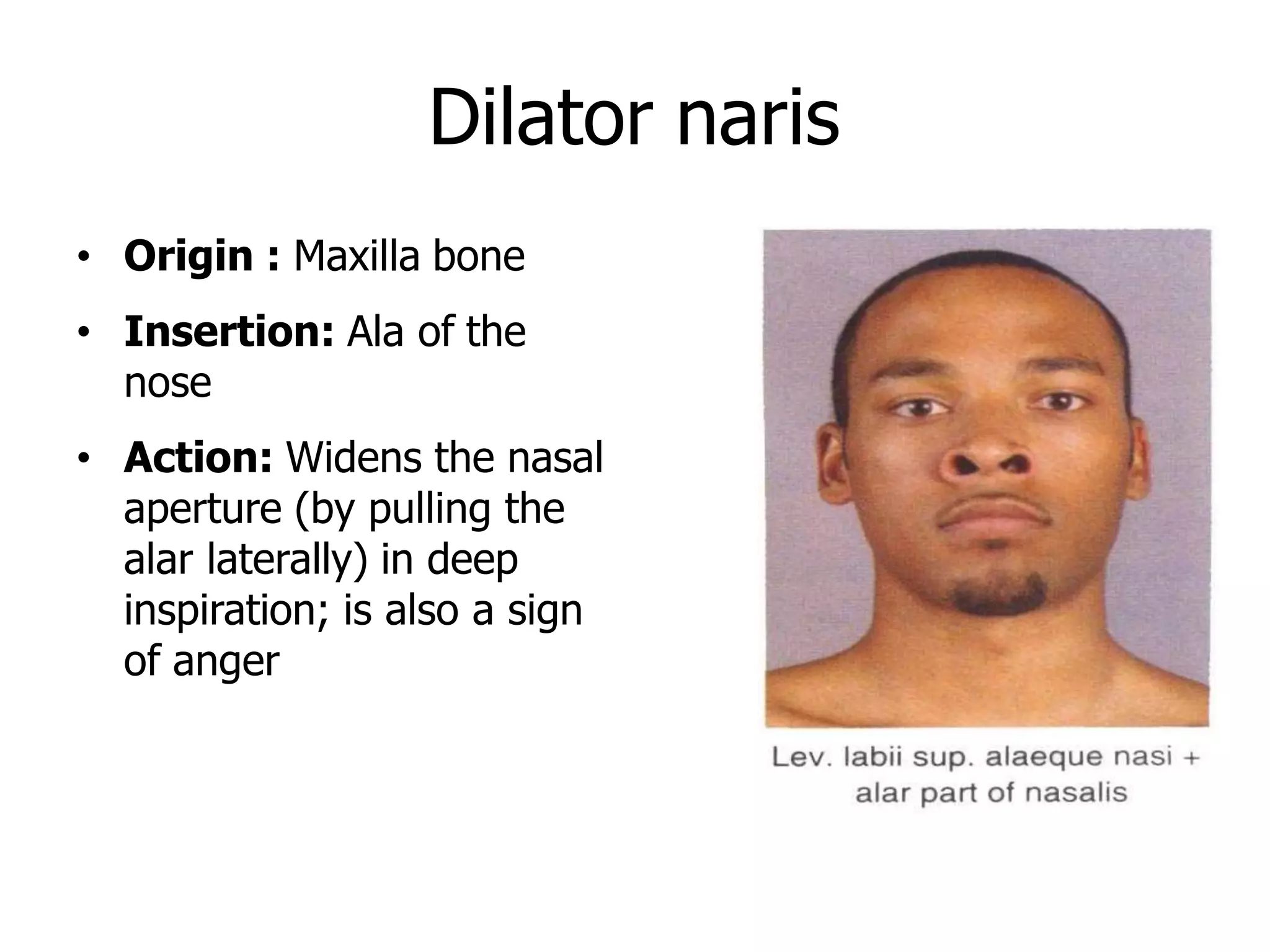
Dilator naris
• Origin : Maxilla bone
• Insertion: Ala of the
nose
• Action: Widens the nasal
aperture (by pulling the
alar laterally) in deep
inspiration; is also a sign
of anger
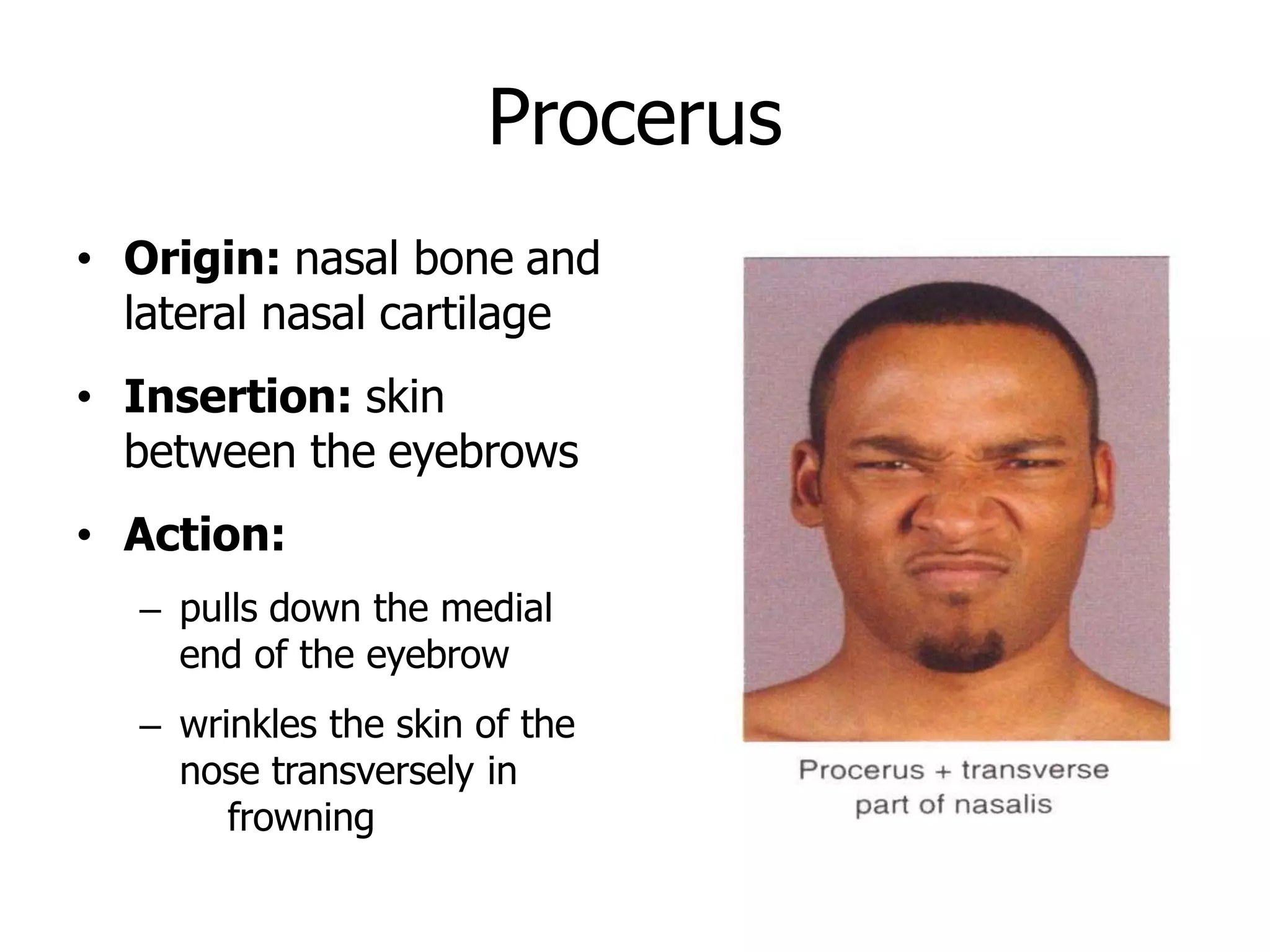
Procerus
• Origin: nasal bone and
lateral nasal cartilage
• Insertion: skin
between the eyebrows
• Action:
– pulls down the medial
end of the eyebrow
– wrinkles the skin of the
nose transversely in
frowning
Oral group
• The muscles in the oral group move the lips and
cheek:
– Orbicularis oris
– Buccinator
– Lower group of oral muscles
• depressor anguli oris
• depressor labii inferioris
• Mentalis
– Upper group of oral muscles
• risorius
• zygomaticus major and zygomaticus minor
• levator labii superioris
• levator labii superioris alaeque nasi
• levator anguli oris
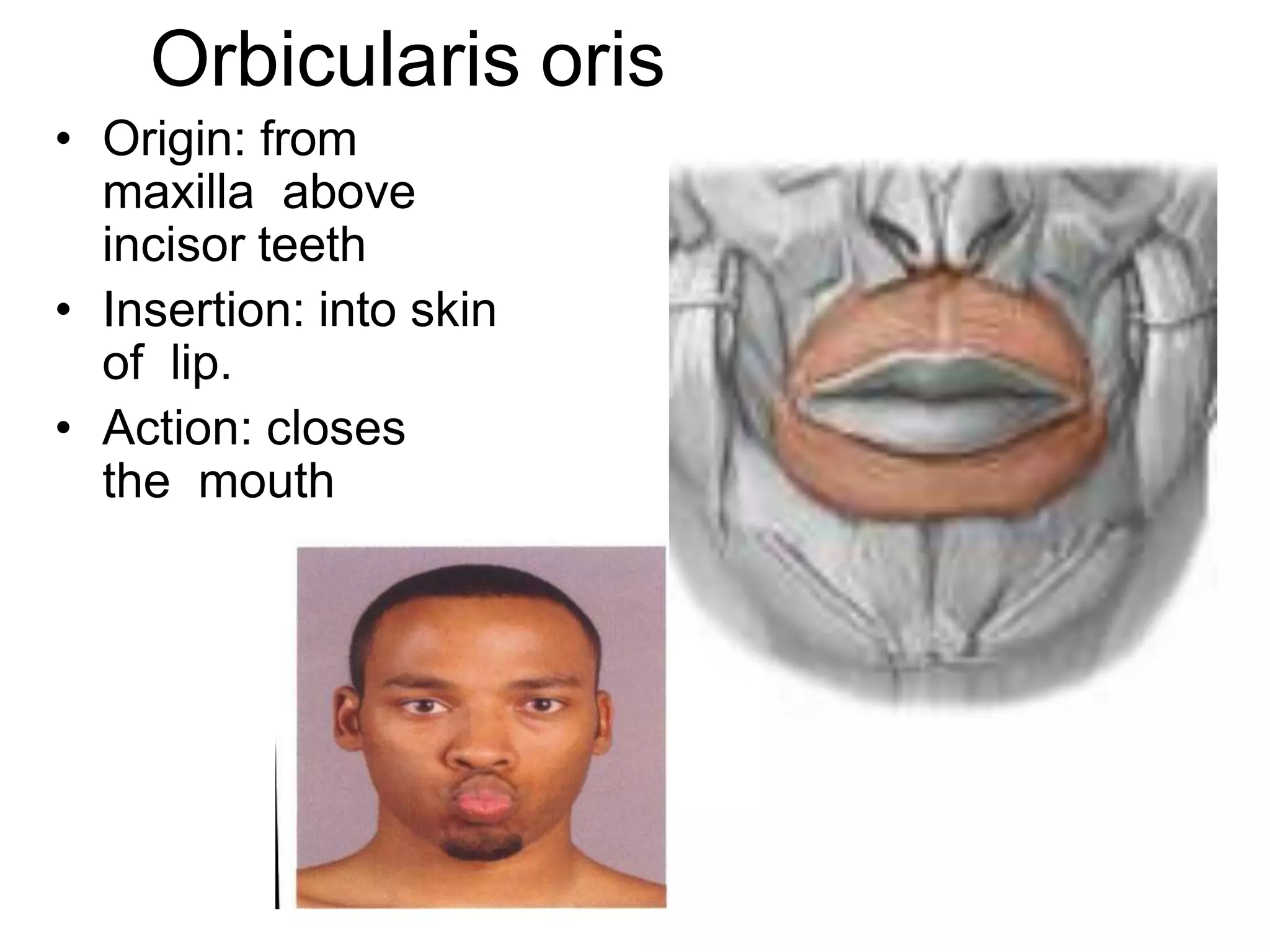
Orbicularis oris
• Origin: from
maxilla above
incisor teeth
• Insertion: into skin
of lip.
• Action: closes
the mouth
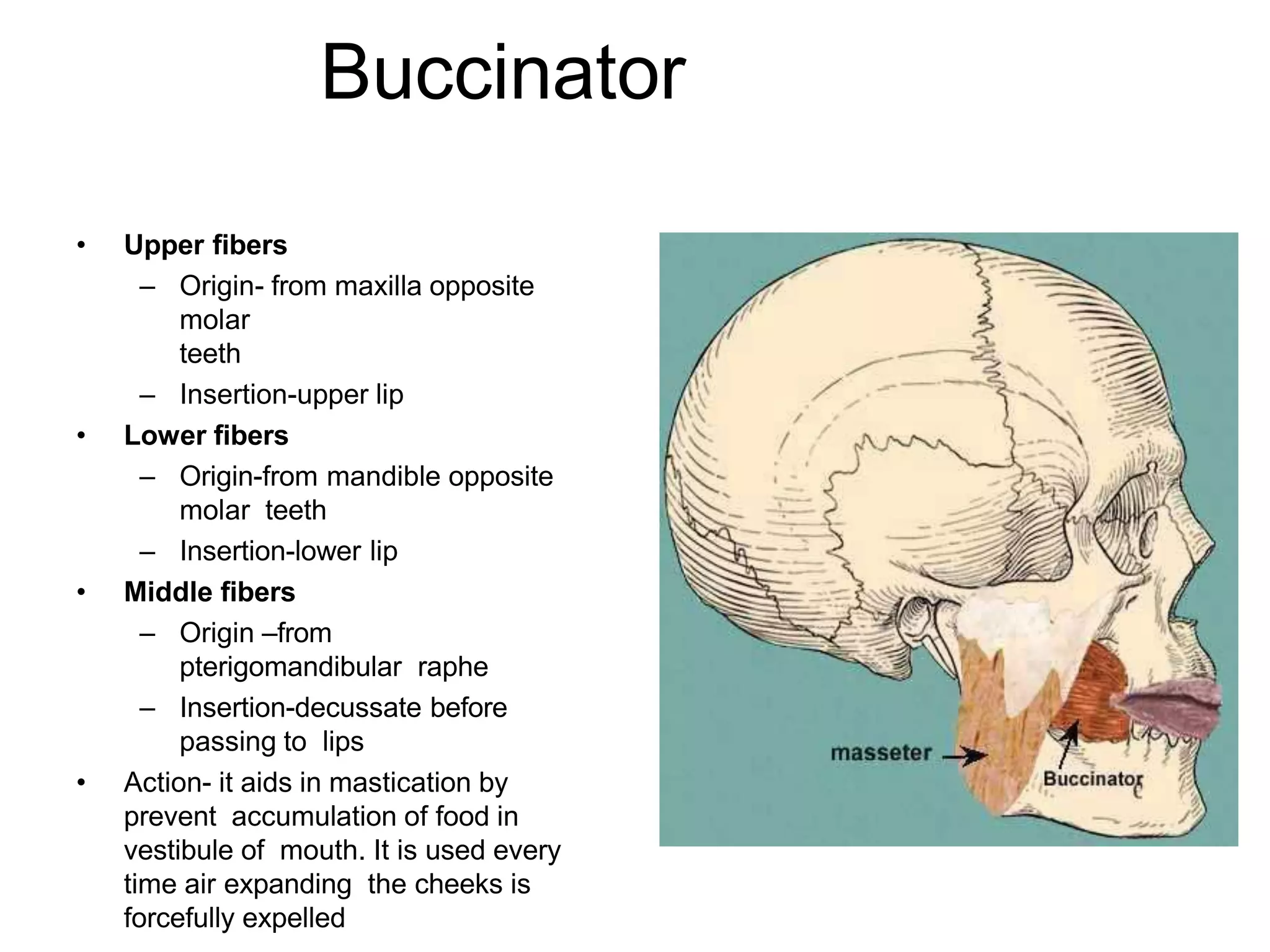
Buccinator
• Upper fibers
– Origin- from maxilla opposite
molar
teeth
– Insertion-upper lip
• Lower fibers
– Origin-from mandible opposite
molar teeth
– Insertion-lower lip
• Middle fibers
– Origin –from
pterigomandibular raphe
– Insertion-decussate before
passing to lips
• Action- it aids in mastication by
prevent accumulation of food in
vestibule of mouth. It is used every
time air expanding the cheeks is
forcefully expelled
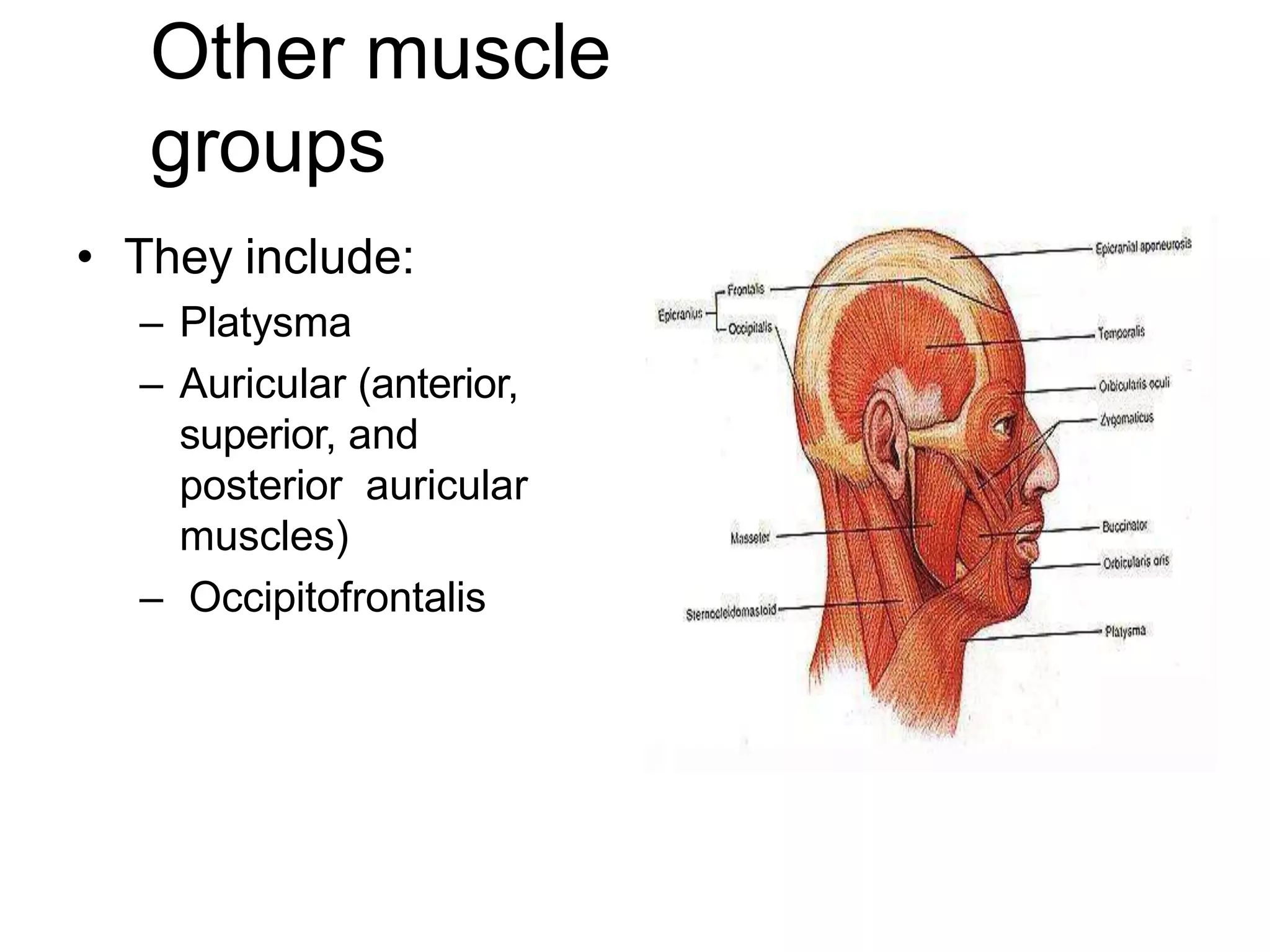
Other muscle
groups
• They include:
– Platysma
– Auricular (anterior,
superior, and
posterior auricular
muscles)
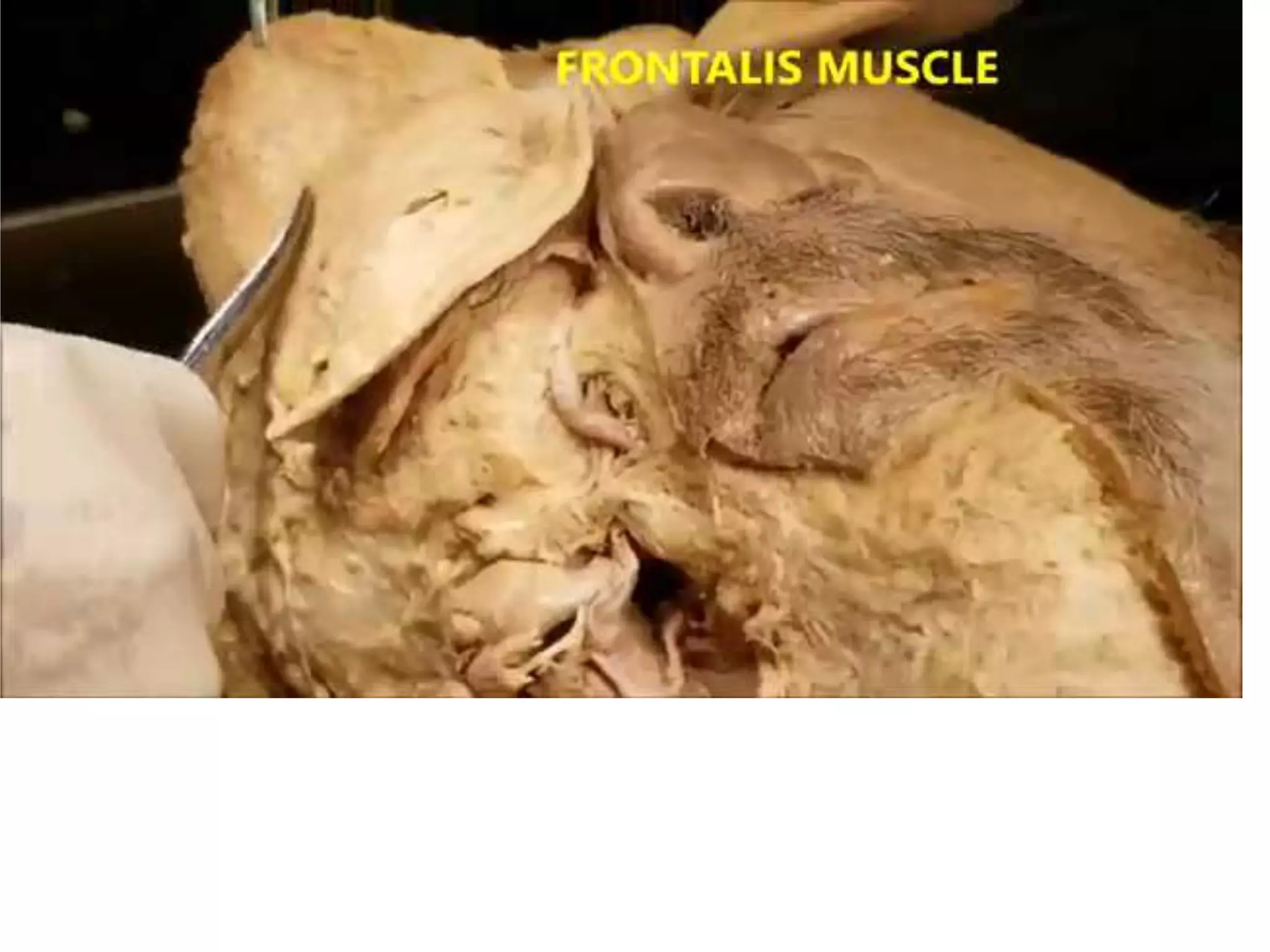
– Occipitofrontalis
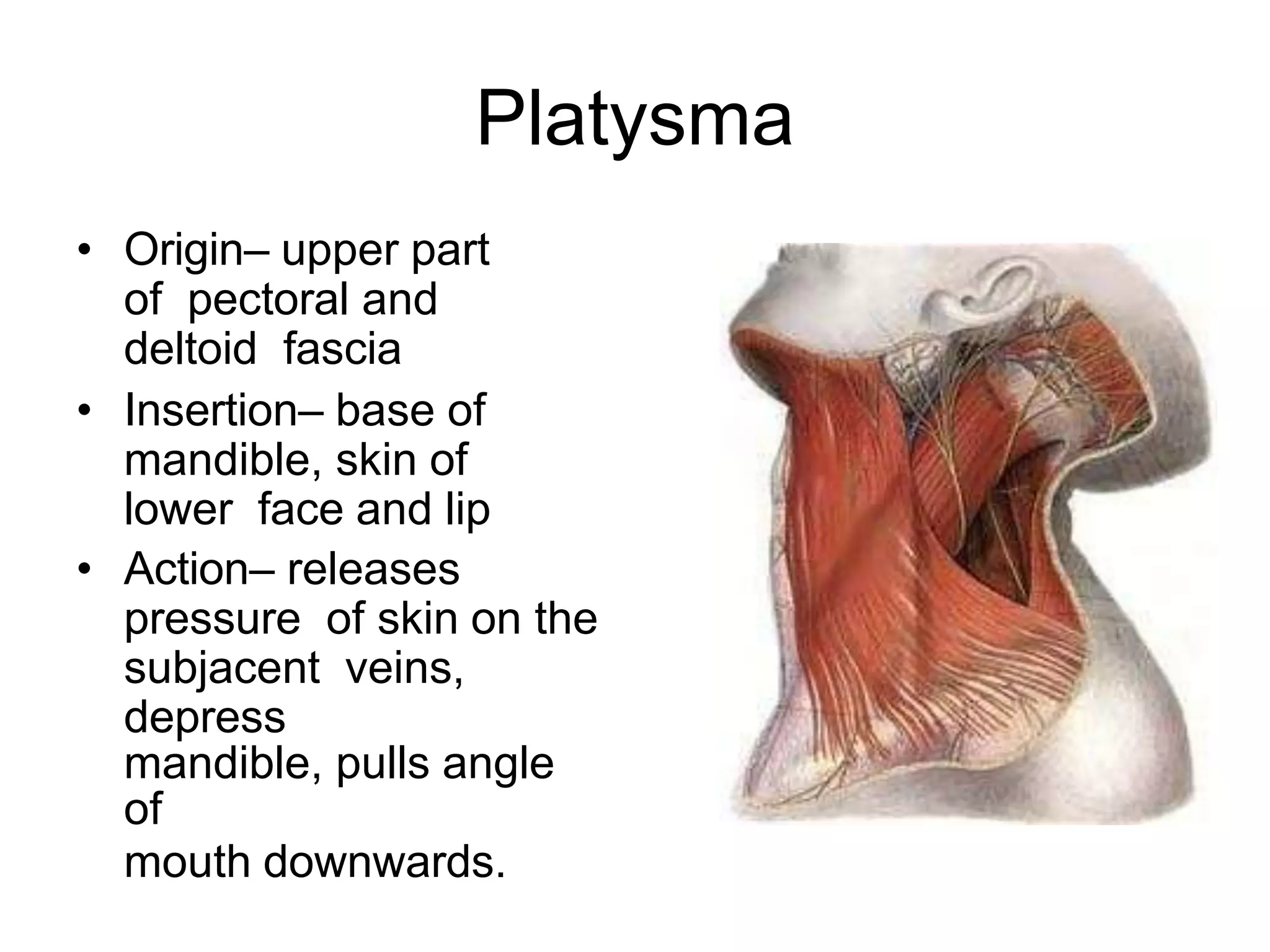
Platysma
• Origin– upper part
of pectoral and
deltoid fascia
• Insertion– base of
mandible, skin of
lower face and lip
• Action– releases
pressure of skin on the
subjacent veins,
depress
mandible, pulls angle
of
mouth downwards.
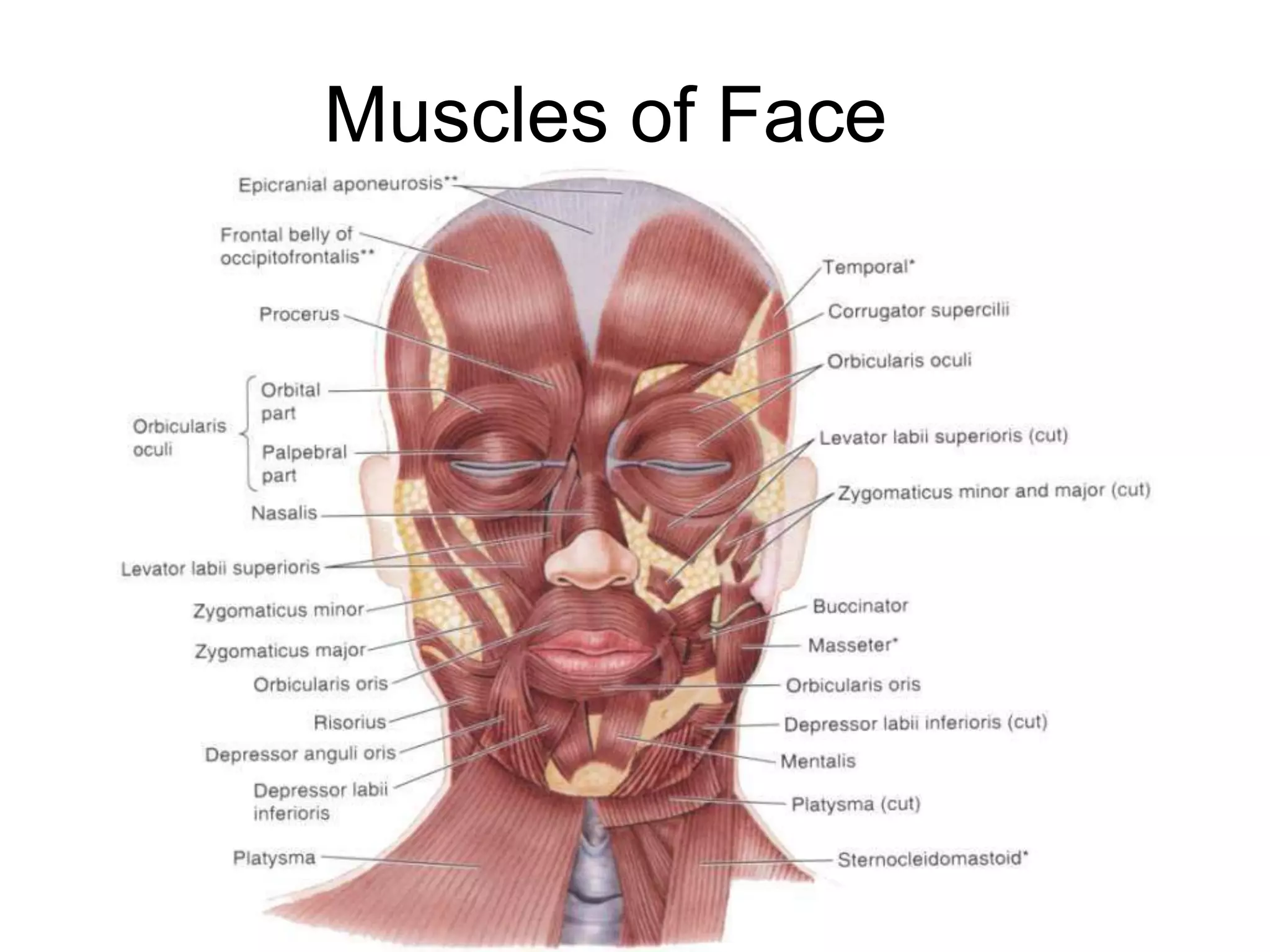
Muscles of Face
Sensory Nerves of the
Face
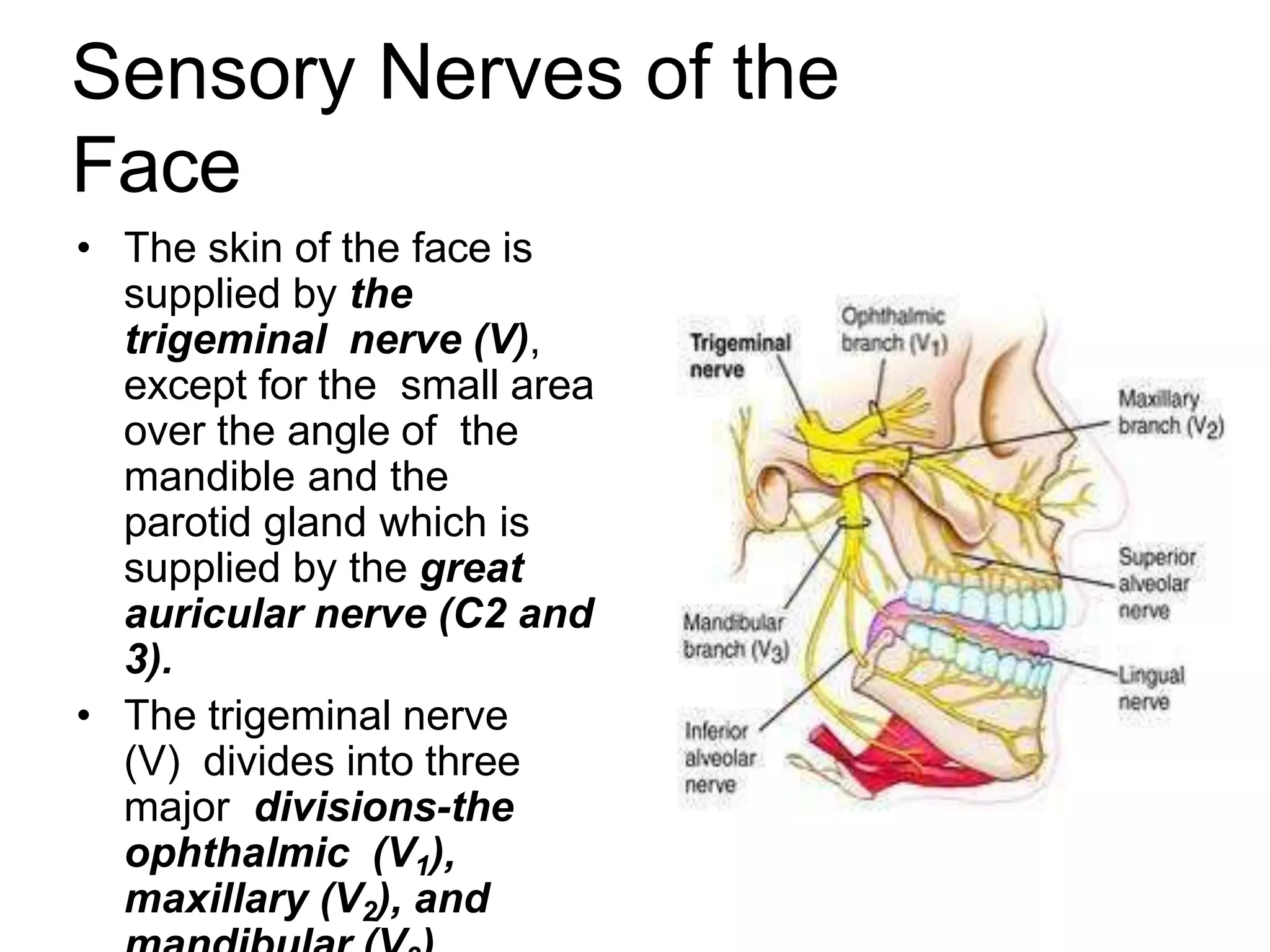
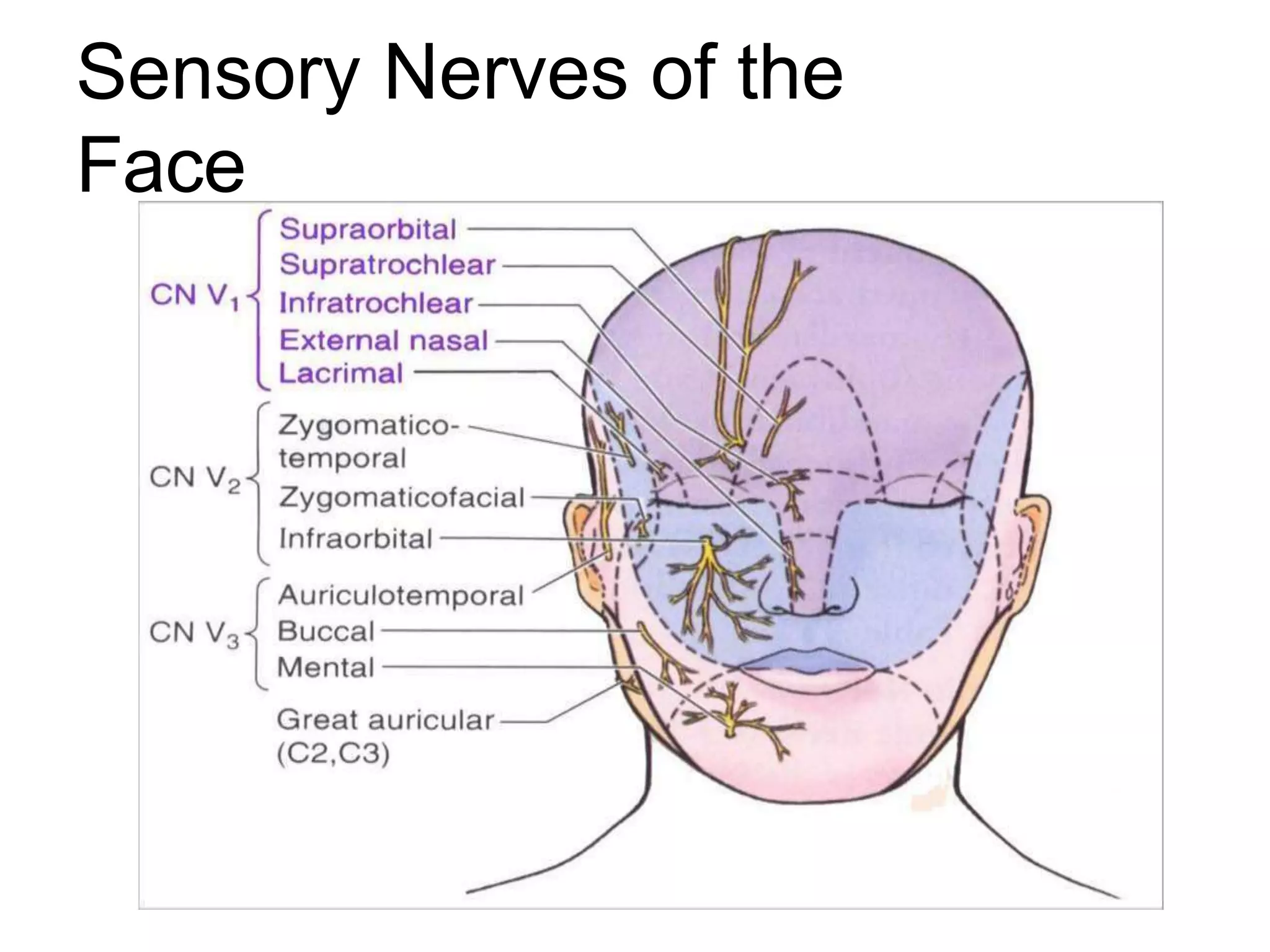
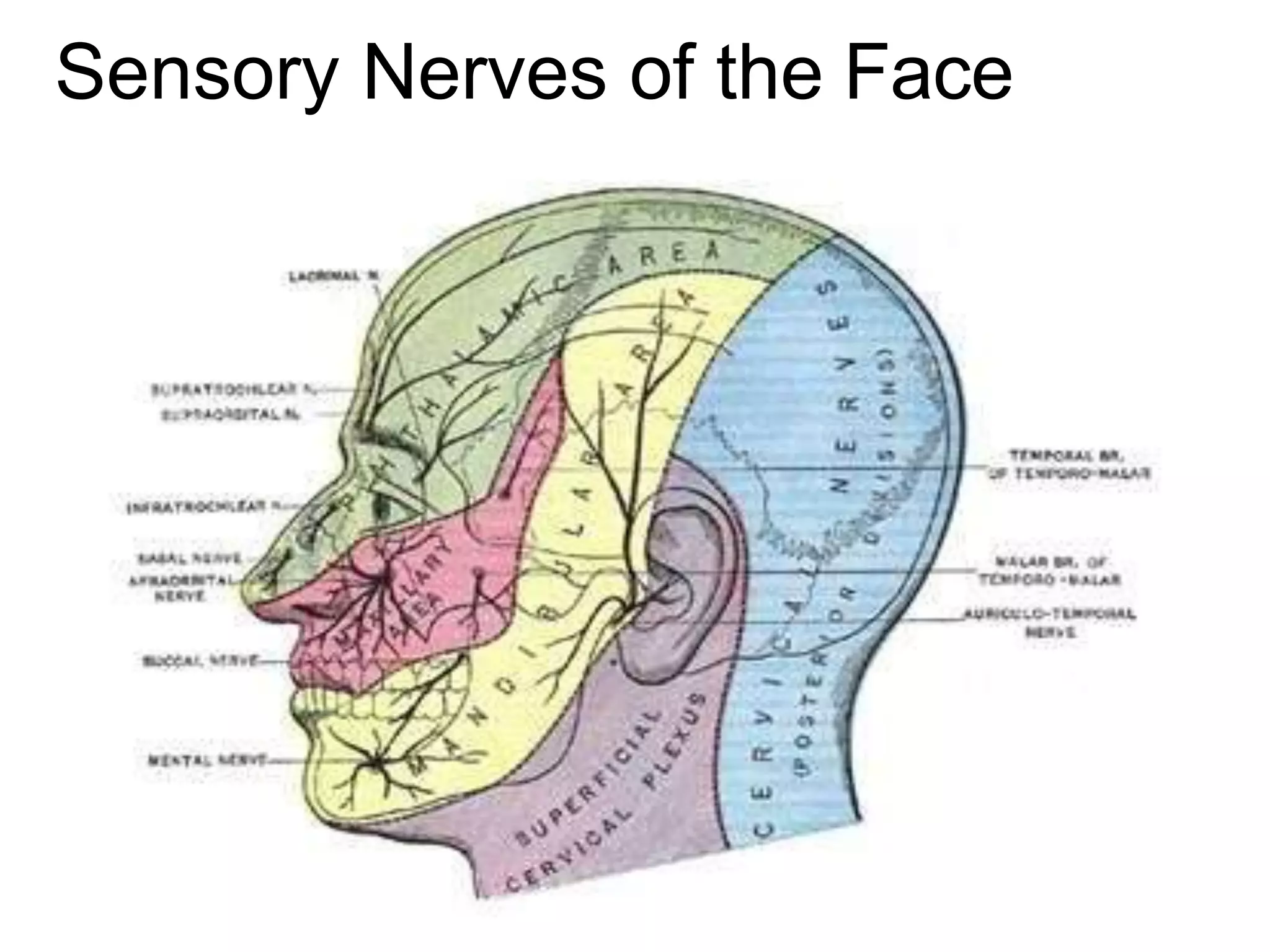
• The skin of the face is
supplied by the
trigeminal nerve (V),
except for the small area
over the angle of the
mandible and the
parotid gland which is
supplied by the great
auricular nerve (C2 and
3).
• The trigeminal nerve
(V) divides into three
major divisions-the
ophthalmic (V1),
maxillary (V2), and
Sensory Nerves of the
Face
Sensory Nerves of the Face
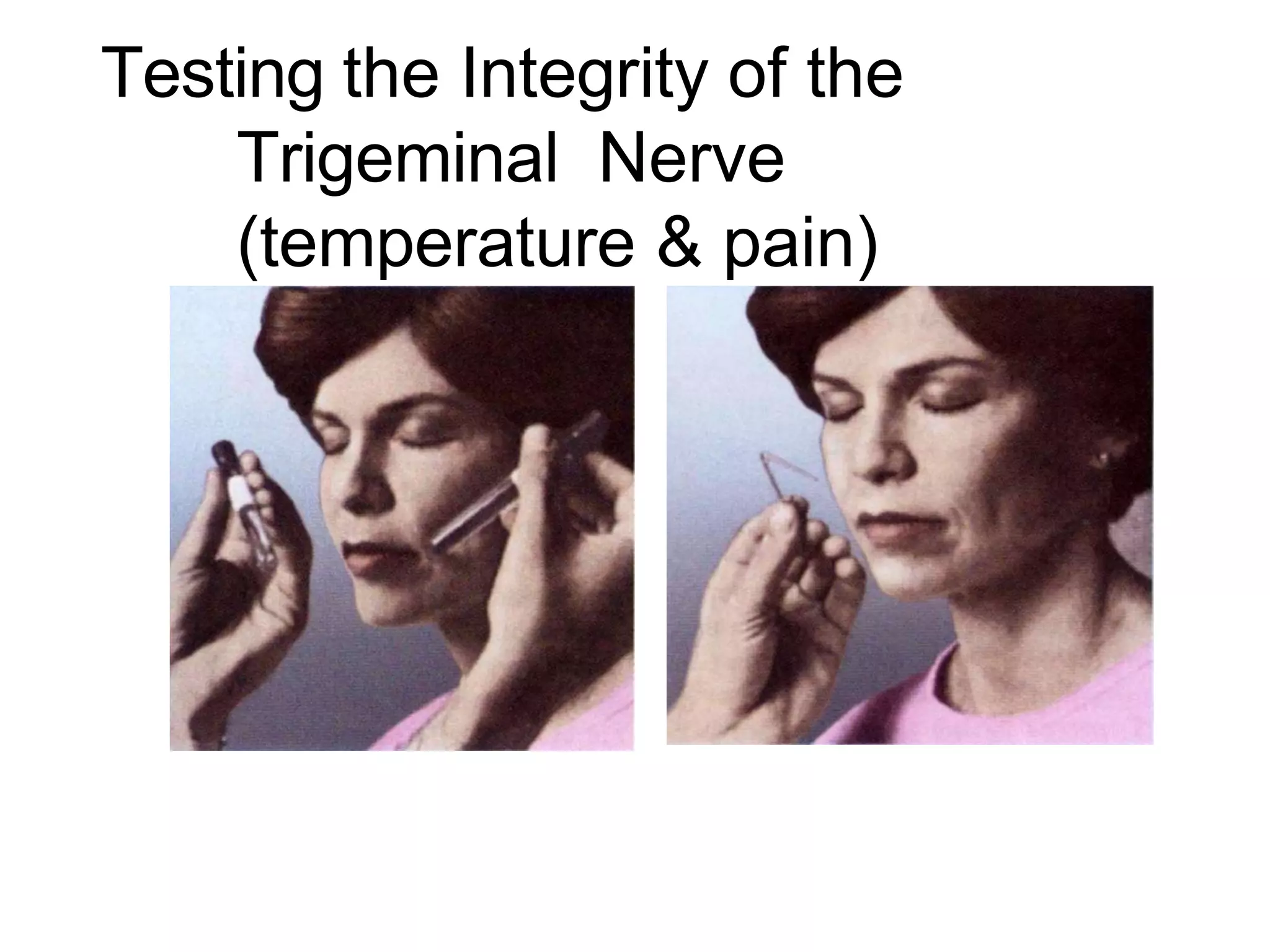
Testing the Integrity of the
Trigeminal Nerve
(temperature & pain)
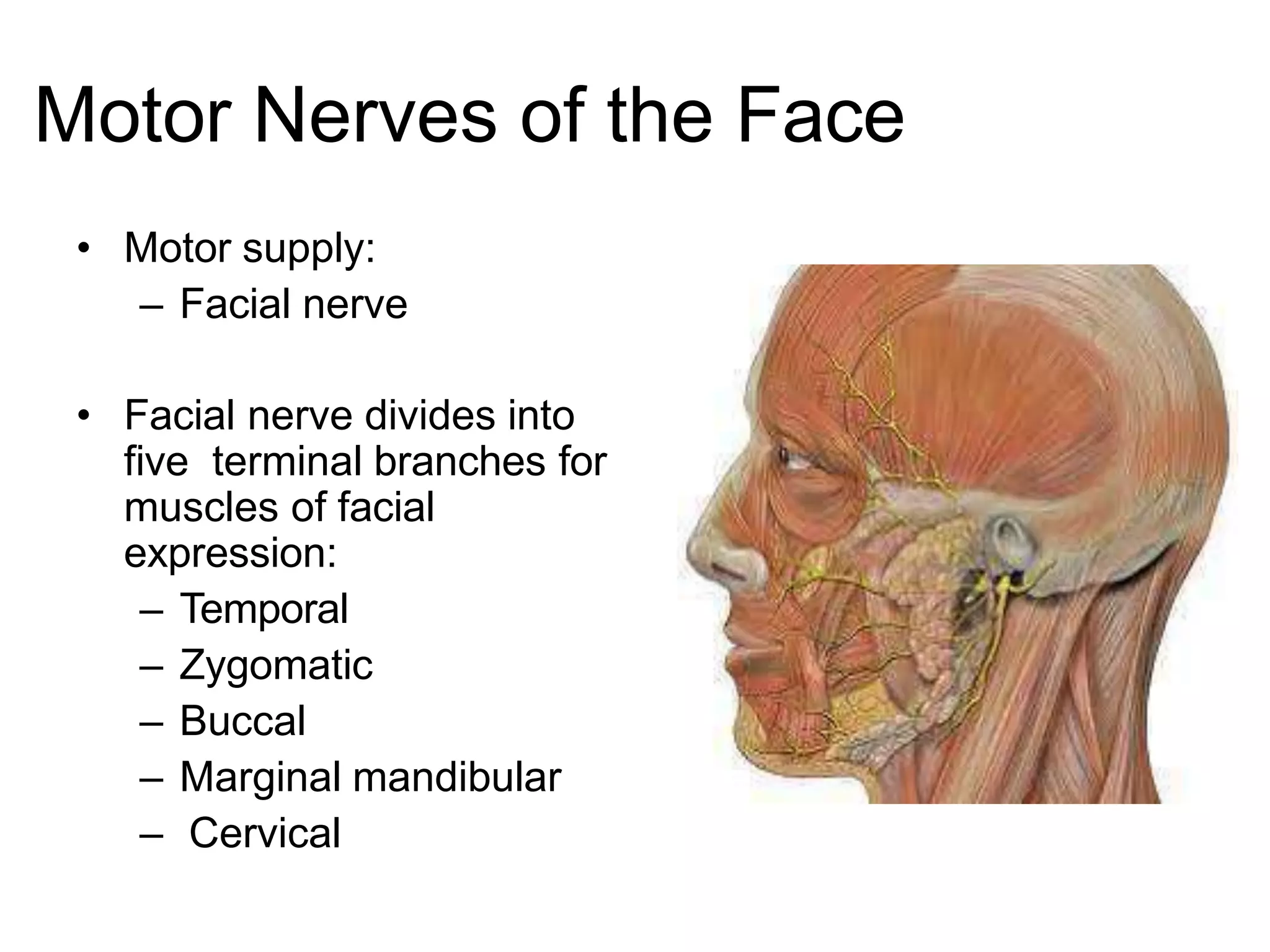
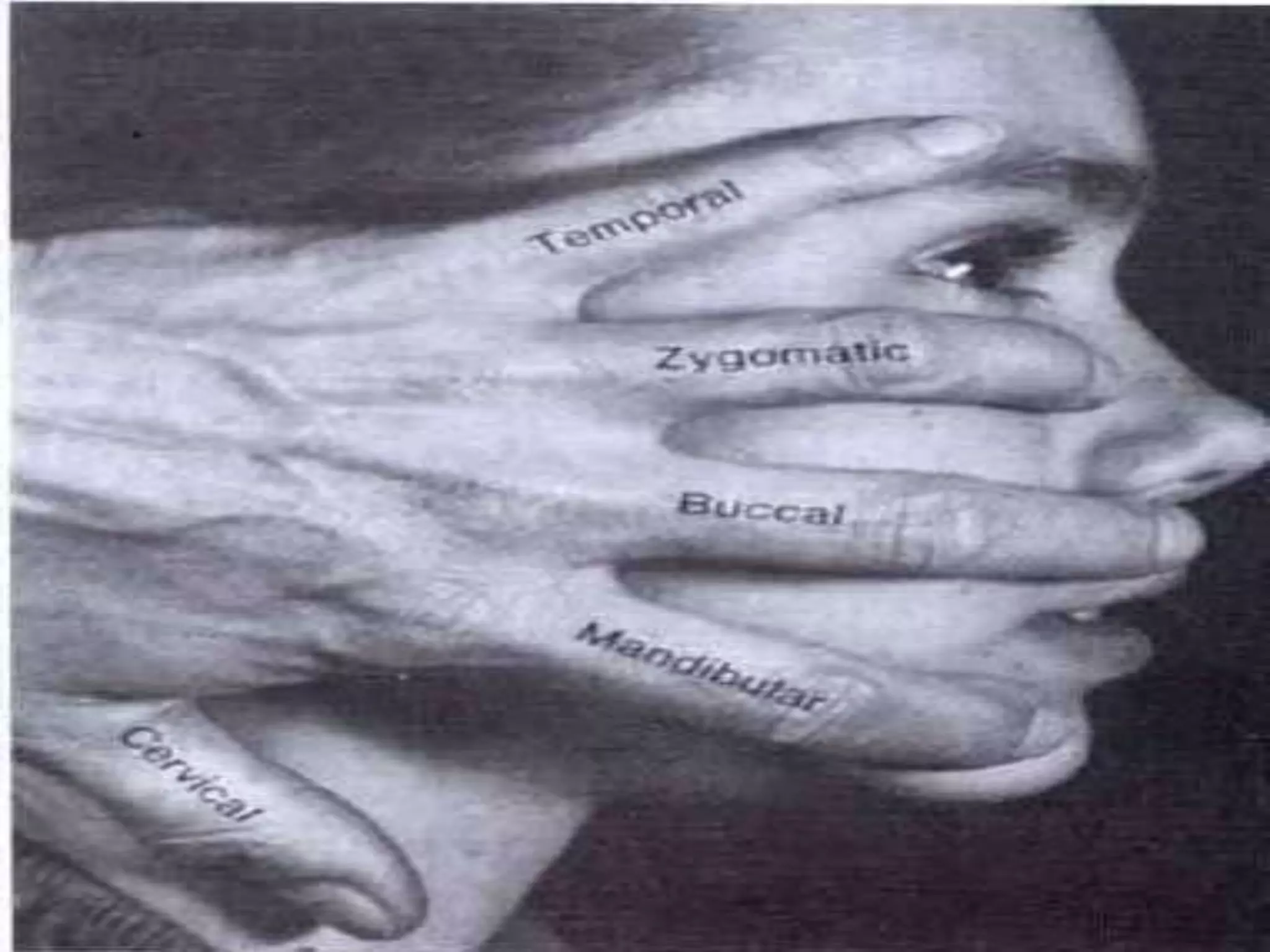
Motor Nerves of the Face
• Motor supply:
– Facial nerve
• Facial nerve divides into
five terminal branches for
muscles of facial
expression:
– Temporal
– Zygomatic
– Buccal
– Marginal mandibular
– Cervical
Applied
• Trigeminal neuralgia
– Maxillary and mandibular nerve are involved
– Excruciating pain in the region of distribution of these nerve
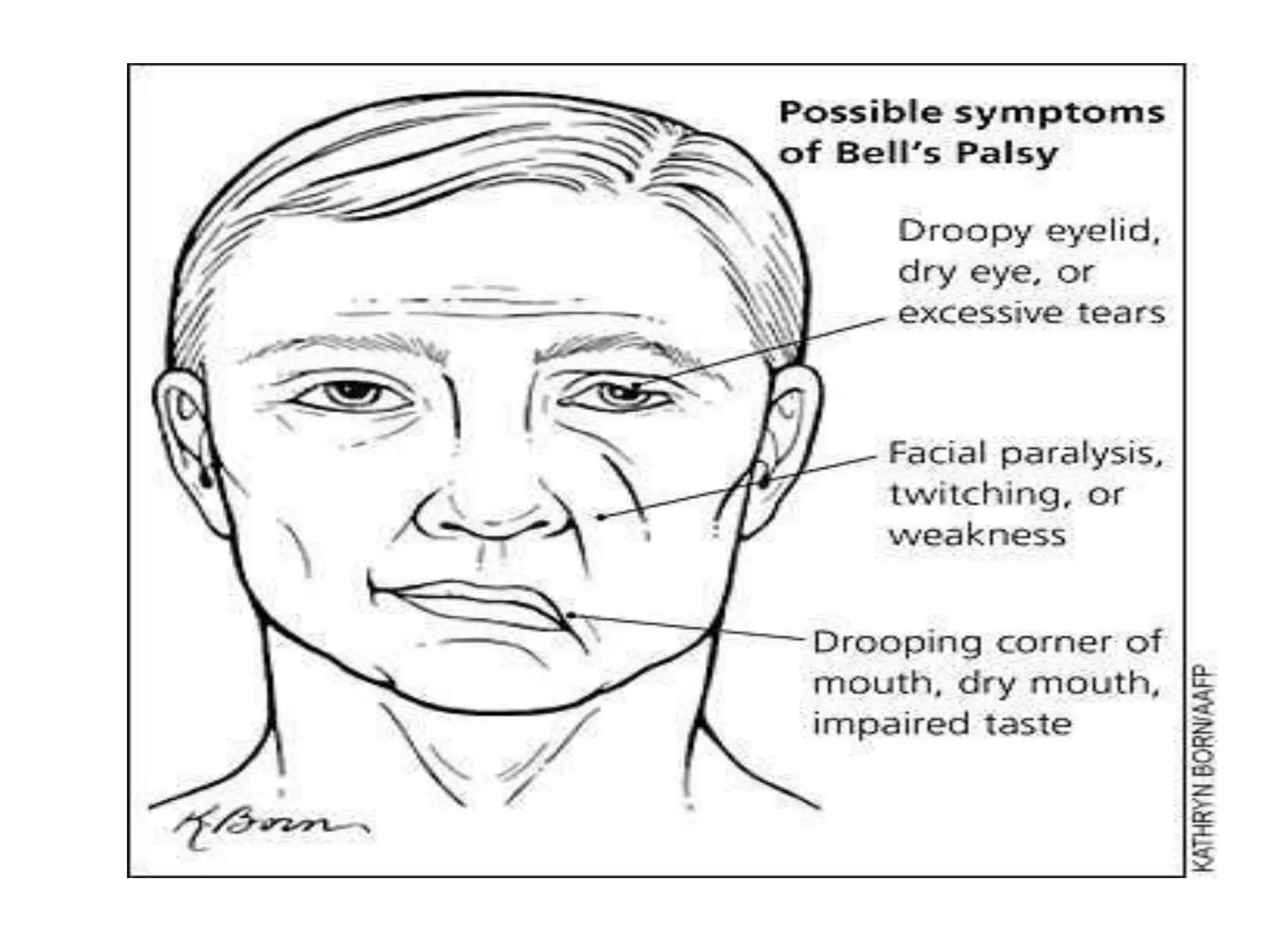
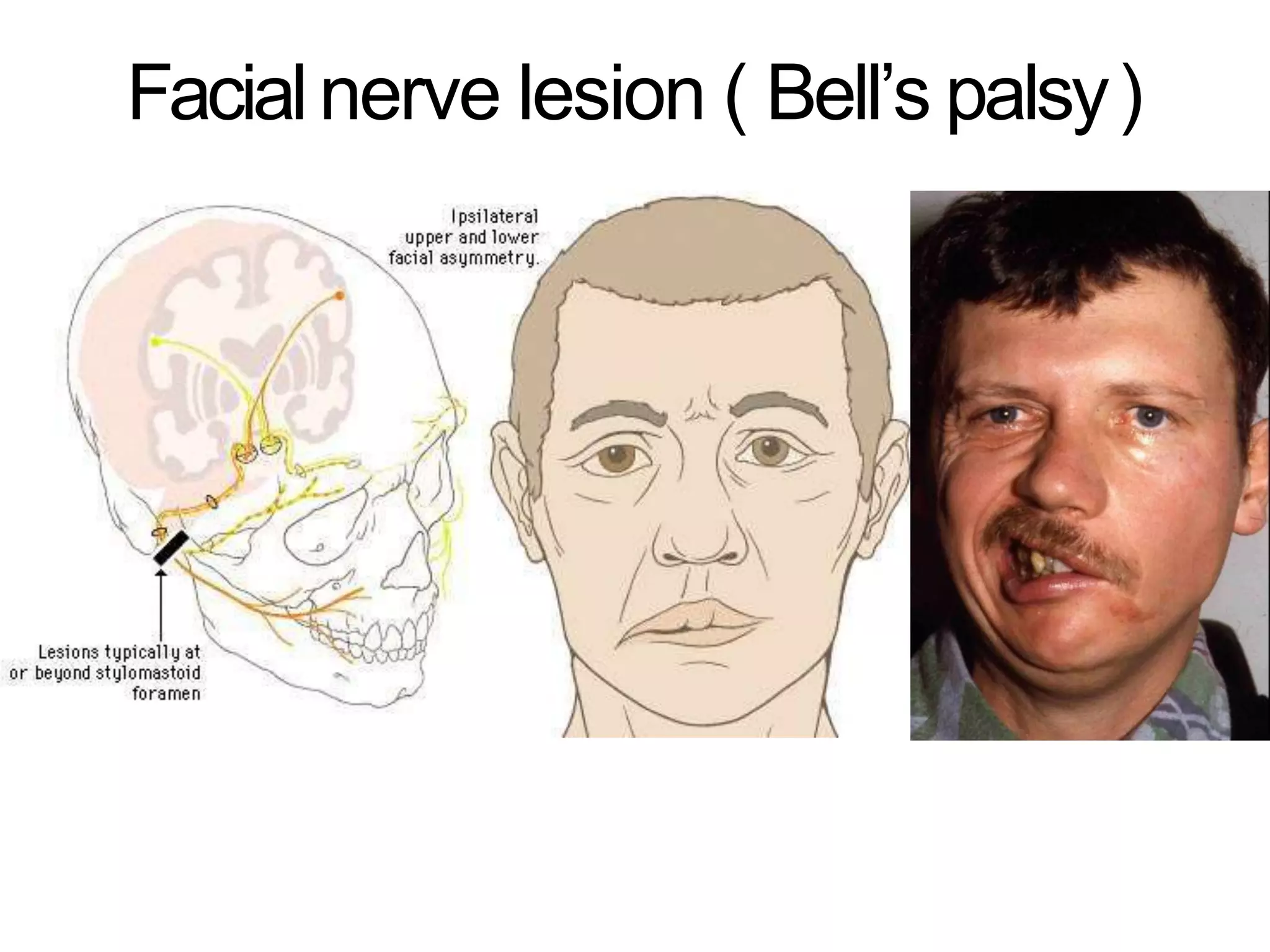
• In infranuclear lesions of facial nerve (eg, bell’spalsy)-
whole face is paralyzed
– c/f
• Affected side is motionless
• Loss of wrinkles
• Eye cannot be closed
• In smiling the mouth is drawn to normal side
• During mastication food accumulates in vestibule of mouth
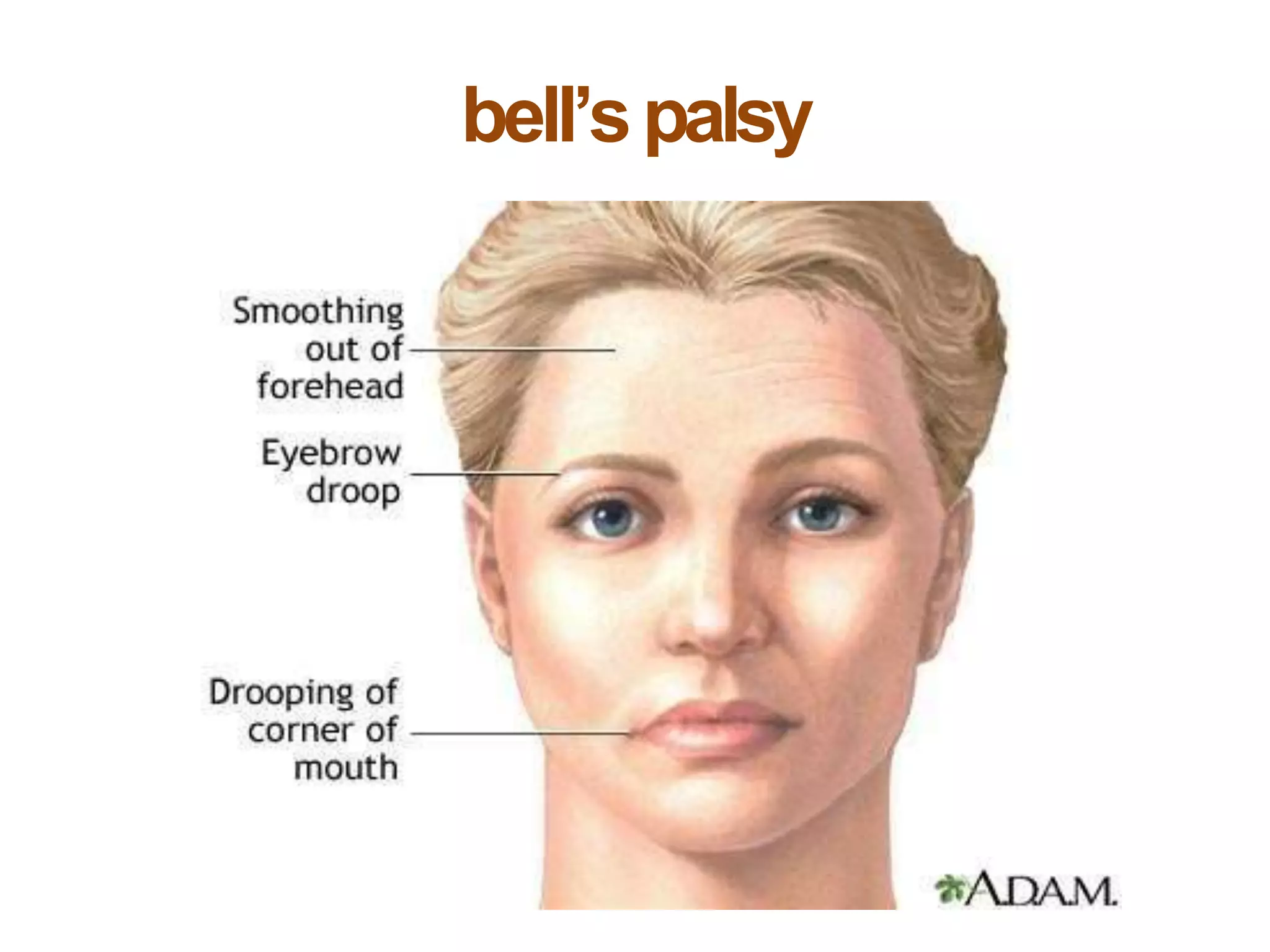
bell’spalsy
Facialnerve lesion ( Bell’s palsy)
Read about
•Arterial supply of the face
•Venous drainage of the face
•Lymphatic drainage of the
face.
Scalpface scalp to face muscles and nerve supply

Scalpface scalp to face muscles and nerve supply

  • 1.
  • 2.
    LEARNING OBJECTIVES • Muscles offacial expressions • Arterial supply of face • Venous supply of face • Sensory and motor supply of face • Clinical scenarios
  • 3.
    Face Boundaries • Extends superiorlyto the hair line, inferiorly to the chin and base of mandible, and on each side to auricle • Forehead is common to both scalp and face.
  • 4.
    Face • Due torich vascularity face blush and blanch. • Facial skin is rich in sebaceous gland and sweat gland. • Wounds of face bleed profusely but heal rapidly. • Sebaceous gland keep the skin oily but also cause acne in adult.
  • 5.
    Face • muscle offacial expression ,lie in superficial fascia. • Embryologically they develop from mesoderm of 2nd branchial arch, therefore supplied by facialnerve. • No deep fascia is present in the face.
  • 6.
  • 7.
  • 8.
    Muscles of theFace • The muscles of the face develop from the 2nd pharyngeal arch and are innervated by branches of the facial nerve [VII]. • They are in the superficial fascia, with origins from either bone or fascia, and insertions into the skin. • these muscles control expressions of the face. • They act as sphincters and dilators of the orifices of the face (i.e. the orbits, nose, and mouth).
  • 10.
    Muscles of the Face •Orbital group • Nasal group • Oral group • Other muscle groups
  • 11.
  • 12.
    Orbital group • Two muscles are –Orbicularis oculi – Corrugator supercilii
  • 13.
    Orbicularis oculi• 3 parts- •Orbital part(outer) – Originate from medial part of medial palpebral ligament and form concentric rings, return to point of origin Action –closes the lids tightly • Palpebral part(Inner) – Originate from lateral part of medial palpebral ligament – Insert into lateral palpebral raphe Action-closes the lids gently • Lacrimal part(Small) – Originate from lacrimal fascia& lacrimal bone – Insert into upper &lower tarsi Action-dilate lacrimal sac
  • 14.
  • 15.
  • 16.
  • 17.
    Corrugator supercillii • Origin: superciliary arch • Insertion: skin of the eyebrow • Action: produces vertical wrinkles of the forehead in frowning as an expression of annoyance
  • 18.
    Nasal group • Threemuscles are associated with the nasal group: – Nasalis – Procerus – Depressor septi nasi
  • 19.
  • 20.
    Compressor naris • Origin:Frontal process of the maxilla • Insertion: Aponeurosis which crosses the bridge of the nose • Action: Compresses the mobile nasal cartilages
  • 21.
    Dilator naris • Origin: Maxilla bone • Insertion: Ala of the nose • Action: Widens the nasal aperture (by pulling the alar laterally) in deep inspiration; is also a sign of anger
  • 22.
    Procerus • Origin: nasalbone and lateral nasal cartilage • Insertion: skin between the eyebrows • Action: – pulls down the medial end of the eyebrow – wrinkles the skin of the nose transversely in frowning
  • 23.
    Oral group • Themuscles in the oral group move the lips and cheek: – Orbicularis oris – Buccinator – Lower group of oral muscles • depressor anguli oris • depressor labii inferioris • Mentalis – Upper group of oral muscles • risorius • zygomaticus major and zygomaticus minor • levator labii superioris • levator labii superioris alaeque nasi • levator anguli oris
  • 24.
    Orbicularis oris • Origin:from maxilla above incisor teeth • Insertion: into skin of lip. • Action: closes the mouth
  • 25.
    Buccinator • Upper fibers –Origin- from maxilla opposite molar teeth – Insertion-upper lip • Lower fibers – Origin-from mandible opposite molar teeth – Insertion-lower lip • Middle fibers – Origin –from pterigomandibular raphe – Insertion-decussate before passing to lips • Action- it aids in mastication by prevent accumulation of food in vestibule of mouth. It is used every time air expanding the cheeks is forcefully expelled
  • 26.
    Other muscle groups • Theyinclude: – Platysma – Auricular (anterior, superior, and posterior auricular muscles) – Occipitofrontalis
  • 27.
    Platysma • Origin– upperpart of pectoral and deltoid fascia • Insertion– base of mandible, skin of lower face and lip • Action– releases pressure of skin on the subjacent veins, depress mandible, pulls angle of mouth downwards.
  • 28.
  • 30.
    Sensory Nerves ofthe Face • The skin of the face is supplied by the trigeminal nerve (V), except for the small area over the angle of the mandible and the parotid gland which is supplied by the great auricular nerve (C2 and 3). • The trigeminal nerve (V) divides into three major divisions-the ophthalmic (V1), maxillary (V2), and
  • 31.
  • 32.
  • 33.
    Testing the Integrityof the Trigeminal Nerve (temperature & pain)
  • 34.
    Motor Nerves ofthe Face • Motor supply: – Facial nerve • Facial nerve divides into five terminal branches for muscles of facial expression: – Temporal – Zygomatic – Buccal – Marginal mandibular – Cervical
  • 36.
    Applied • Trigeminal neuralgia –Maxillary and mandibular nerve are involved – Excruciating pain in the region of distribution of these nerve • In infranuclear lesions of facial nerve (eg, bell’spalsy)- whole face is paralyzed – c/f • Affected side is motionless • Loss of wrinkles • Eye cannot be closed • In smiling the mouth is drawn to normal side • During mastication food accumulates in vestibule of mouth
  • 37.
  • 39.
    Facialnerve lesion (Bell’s palsy)
  • 40.
    Read about •Arterial supplyof the face •Venous drainage of the face •Lymphatic drainage of the face.