



The Future of Software
Security Assurance:
Cloudy, with Storms Likely


 Rafal Los
 Enterprise & Cloud Security Strategist
 HP Software

 ©2011 Hewlett-Packard Development Company, L.P.
 The information contained herein is subject to change without notice
SSA
                   Software Security Assurance


©2011 Hewlett-Packard Development Company, L.P.
The information contained herein is subject to change without notice
Software Security Assurance


Can you trust your software?
THE FUTURE         …of software security.


©2011 Hewlett-Packard Development Company, L.P.
The information contained herein is subject to change without notice
5 Inevitables
1 – Application Modernization
Catalysts:
•   Your corporate applications are aging
•   Aging application technologies are hindering your business productivity
•   Applications deployed ‘before security’ are critically exposed


Opportunity:
•   Address software security as a core
    business requirement
•   Modernize security controls, “bolt-ons”
2 – Cloud Adoption
Catalysts:
•   Organizations are adopting cloud whether they acknowledge it or not
•   Extreme confusion: what is “cloud security”?
•   “The Cloud” brings fundamentally different security challenges


Opportunity:
•   A forceful re-evaluation of security paradigms
•   Shift security from perimeter, to application
•   Engage providers, fully understand risks of the cloud model
3 – Consumerization of the Enterprise
Catalysts:
•   Enterprises functions being performed across consumer devices
•   Corporate data is spread across devices enterprises don’t control
•   Applications must run on diverse platforms, pose unique risks


Opportunity:
•   Understand application risk profiles across consumer use-cases
•   Focus on minimizing data sprawl, centralizing logic processing
•   Create strategic mobile application defenses
4 – Technology Overrun
Catalysts:
•   Bleeding-edge client-side technology adoption
•   Mobile development is hot, security is lacking
•   Development technology over-running security capability


Opportunity:
•   Adopt technology-independent security controls
•   Control application release processes (ITIL change control)
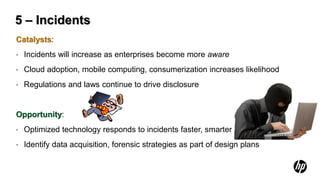
5 – Incidents
Catalysts:
•   Incidents will increase as enterprises become more aware
•   Cloud adoption, mobile computing, consumerization increases likelihood
•   Regulations and laws continue to drive disclosure


Opportunity:
•   Optimized technology responds to incidents faster, smarter
•   Identify data acquisition, forensic strategies as part of design plans
8 Evolutions
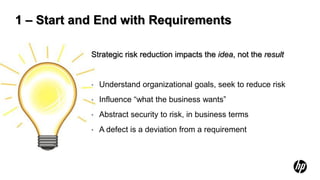
1 – Start and End with Requirements

            Strategic risk reduction impacts the idea, not the result


            •   Understand organizational goals, seek to reduce risk
            •   Influence “what the business wants”
            •   Abstract security to risk, in business terms
            •   A defect is a deviation from a requirement
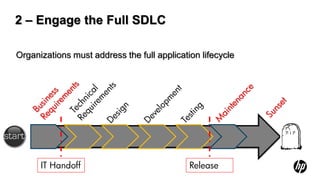
2 – Engage the Full SDLC

Organizations must address the full application lifecycle


      IT Handoff                             Release
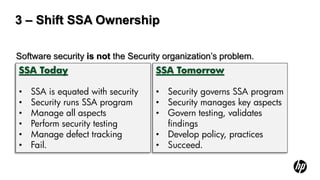
3 – Shift SSA Ownership

Software security is not the Security organization’s problem.
SSA Today                          SSA Tomorrow

•   SSA is equated with security   • Security governs SSA program
•   Security runs SSA program      • Security manages key aspects
•   Manage all aspects             • Govern testing, validates
•   Perform security testing         findings
•   Manage defect tracking         • Develop policy, practices
•   Fail.                          • Succeed.
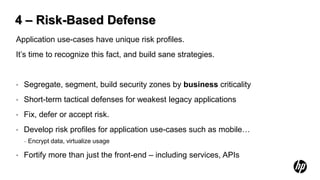
4 – Risk-Based Defense
Application use-cases have unique risk profiles.
It’s time to recognize this fact, and build sane strategies.


•   Segregate, segment, build security zones by business criticality
•   Short-term tactical defenses for weakest legacy applications
•   Fix, defer or accept risk.
•   Develop risk profiles for application use-cases such as mobile…
    –   Encrypt data, virtualize usage

•   Fortify more than just the front-end – including services, APIs
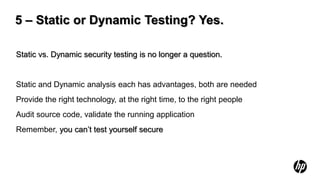
5 – Static or Dynamic Testing? Yes.

Static vs. Dynamic security testing is no longer a question.


Static and Dynamic analysis each has advantages, both are needed
Provide the right technology, at the right time, to the right people
Audit source code, validate the running application
Remember, you can’t test yourself secure
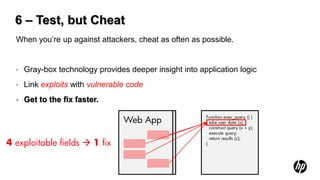
6 – Test, but Cheat
  When you’re up against attackers, cheat as often as possible.


  •   Gray-box technology provides deeper insight into application logic
  •   Link exploits with vulnerable code
  •   Get to the fix faster.

                                  Web App                Function exec_query () {
                                                           take user data (x);
                                                           construct query (x + y);
                                                           execute query;
                                                           return results (z);
4 exploitable fields  1 fix                             }
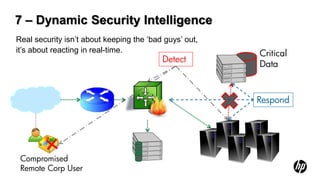
7 – Dynamic Security Intelligence
Real security isn’t about keeping the ‘bad guys’ out,
it’s about reacting in real-time.                       Critical
                                          Detect
                                                        Data


                                                        Respond


 Compromised
 Remote Corp User
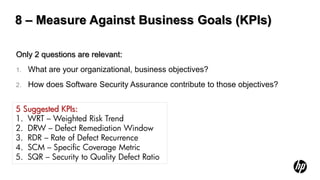
8 – Measure Against Business Goals (KPIs)

Only 2 questions are relevant:
1.   What are your organizational, business objectives?
2.   How does Software Security Assurance contribute to those objectives?


5 Suggested KPIs:
1. WRT – Weighted Risk Trend
2. DRW – Defect Remediation Window
3. RDR – Rate of Defect Recurrence
4. SCM – Specific Coverage Metric
5. SQR – Security to Quality Defect Ratio
1 Cold Hard Fact
You will be breached.
 You will lose data, trust, and money.


   The incident is will matter.
   The response will be the deciding factor.
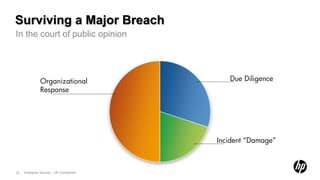
Surviving a Major Breach
In the court of public opinion


                Organizational                  Due Diligence
                Response


                                             Incident “Damage”


22   Enterprise Security – HP Confidential
SOFTWARE SECURITY ASSURANCE
                                                MUST EVOLVE


Enterprise Security – HP Confidential
  23
Twitter:     @Wh1t3Rabbit
Blog:        http://hp.com/go/white-rabbit
Podcast:     http://podcast.wh1t3rabbit.net


           THANK YOU, LET’S TALK!

The Future of Software Security Assurance

  • 1.
    The Future ofSoftware Security Assurance: Cloudy, with Storms Likely Rafal Los Enterprise & Cloud Security Strategist HP Software ©2011 Hewlett-Packard Development Company, L.P. The information contained herein is subject to change without notice
  • 2.
    SSA Software Security Assurance ©2011 Hewlett-Packard Development Company, L.P. The information contained herein is subject to change without notice
  • 3.
    Software Security Assurance Canyou trust your software?
  • 4.
    THE FUTURE …of software security. ©2011 Hewlett-Packard Development Company, L.P. The information contained herein is subject to change without notice
  • 5.
  • 6.
    1 – ApplicationModernization Catalysts: • Your corporate applications are aging • Aging application technologies are hindering your business productivity • Applications deployed ‘before security’ are critically exposed Opportunity: • Address software security as a core business requirement • Modernize security controls, “bolt-ons”
  • 7.
    2 – CloudAdoption Catalysts: • Organizations are adopting cloud whether they acknowledge it or not • Extreme confusion: what is “cloud security”? • “The Cloud” brings fundamentally different security challenges Opportunity: • A forceful re-evaluation of security paradigms • Shift security from perimeter, to application • Engage providers, fully understand risks of the cloud model
  • 8.
    3 – Consumerizationof the Enterprise Catalysts: • Enterprises functions being performed across consumer devices • Corporate data is spread across devices enterprises don’t control • Applications must run on diverse platforms, pose unique risks Opportunity: • Understand application risk profiles across consumer use-cases • Focus on minimizing data sprawl, centralizing logic processing • Create strategic mobile application defenses
  • 9.
    4 – TechnologyOverrun Catalysts: • Bleeding-edge client-side technology adoption • Mobile development is hot, security is lacking • Development technology over-running security capability Opportunity: • Adopt technology-independent security controls • Control application release processes (ITIL change control)
  • 10.
    5 – Incidents Catalysts: • Incidents will increase as enterprises become more aware • Cloud adoption, mobile computing, consumerization increases likelihood • Regulations and laws continue to drive disclosure Opportunity: • Optimized technology responds to incidents faster, smarter • Identify data acquisition, forensic strategies as part of design plans
  • 11.
  • 12.
    1 – Startand End with Requirements Strategic risk reduction impacts the idea, not the result • Understand organizational goals, seek to reduce risk • Influence “what the business wants” • Abstract security to risk, in business terms • A defect is a deviation from a requirement
  • 13.
    2 – Engagethe Full SDLC Organizations must address the full application lifecycle IT Handoff Release
  • 14.
    3 – ShiftSSA Ownership Software security is not the Security organization’s problem. SSA Today SSA Tomorrow • SSA is equated with security • Security governs SSA program • Security runs SSA program • Security manages key aspects • Manage all aspects • Govern testing, validates • Perform security testing findings • Manage defect tracking • Develop policy, practices • Fail. • Succeed.
  • 15.
    4 – Risk-BasedDefense Application use-cases have unique risk profiles. It’s time to recognize this fact, and build sane strategies. • Segregate, segment, build security zones by business criticality • Short-term tactical defenses for weakest legacy applications • Fix, defer or accept risk. • Develop risk profiles for application use-cases such as mobile… – Encrypt data, virtualize usage • Fortify more than just the front-end – including services, APIs
  • 16.
    5 – Staticor Dynamic Testing? Yes. Static vs. Dynamic security testing is no longer a question. Static and Dynamic analysis each has advantages, both are needed Provide the right technology, at the right time, to the right people Audit source code, validate the running application Remember, you can’t test yourself secure
  • 17.
    6 – Test,but Cheat When you’re up against attackers, cheat as often as possible. • Gray-box technology provides deeper insight into application logic • Link exploits with vulnerable code • Get to the fix faster. Web App Function exec_query () { take user data (x); construct query (x + y); execute query; return results (z); 4 exploitable fields  1 fix }
  • 18.
    7 – DynamicSecurity Intelligence Real security isn’t about keeping the ‘bad guys’ out, it’s about reacting in real-time. Critical Detect Data Respond Compromised Remote Corp User
  • 19.
    8 – MeasureAgainst Business Goals (KPIs) Only 2 questions are relevant: 1. What are your organizational, business objectives? 2. How does Software Security Assurance contribute to those objectives? 5 Suggested KPIs: 1. WRT – Weighted Risk Trend 2. DRW – Defect Remediation Window 3. RDR – Rate of Defect Recurrence 4. SCM – Specific Coverage Metric 5. SQR – Security to Quality Defect Ratio
  • 20.
  • 21.
    You will bebreached. You will lose data, trust, and money. The incident is will matter. The response will be the deciding factor.
  • 22.
    Surviving a MajorBreach In the court of public opinion Organizational Due Diligence Response Incident “Damage” 22 Enterprise Security – HP Confidential
  • 23.
    SOFTWARE SECURITY ASSURANCE MUST EVOLVE Enterprise Security – HP Confidential 23
  • 24.
    Twitter: @Wh1t3Rabbit Blog: http://hp.com/go/white-rabbit Podcast: http://podcast.wh1t3rabbit.net THANK YOU, LET’S TALK!