Managing Software Security Risk
treamlining AppSec Policy Definition and Implementati
                                            	

                               For Chicago Security Meetup	

                                      April 18, 2013	


m	
  Bain	
  
 ector,	
  Product	
  Marke4ng	
  
curity	
  Innova4on	
  
ector,	
  Product	
  Marke0ng,	


curity	
  Innova0on	
  
 merly	
  with	
  Q1	
  Labs	
  (an	
  IBM	
  Company)	
  
d	
  Applica0on	
  Security,	
  Inc.	
  
0ve	
  blogger,	
  presenter	
  
 ,	
  Communica0ons,	
  RIC;	
  MS,	
  Interna0onal	
  
  a0ons/Public	
  Affairs,	
  UMASS	
  
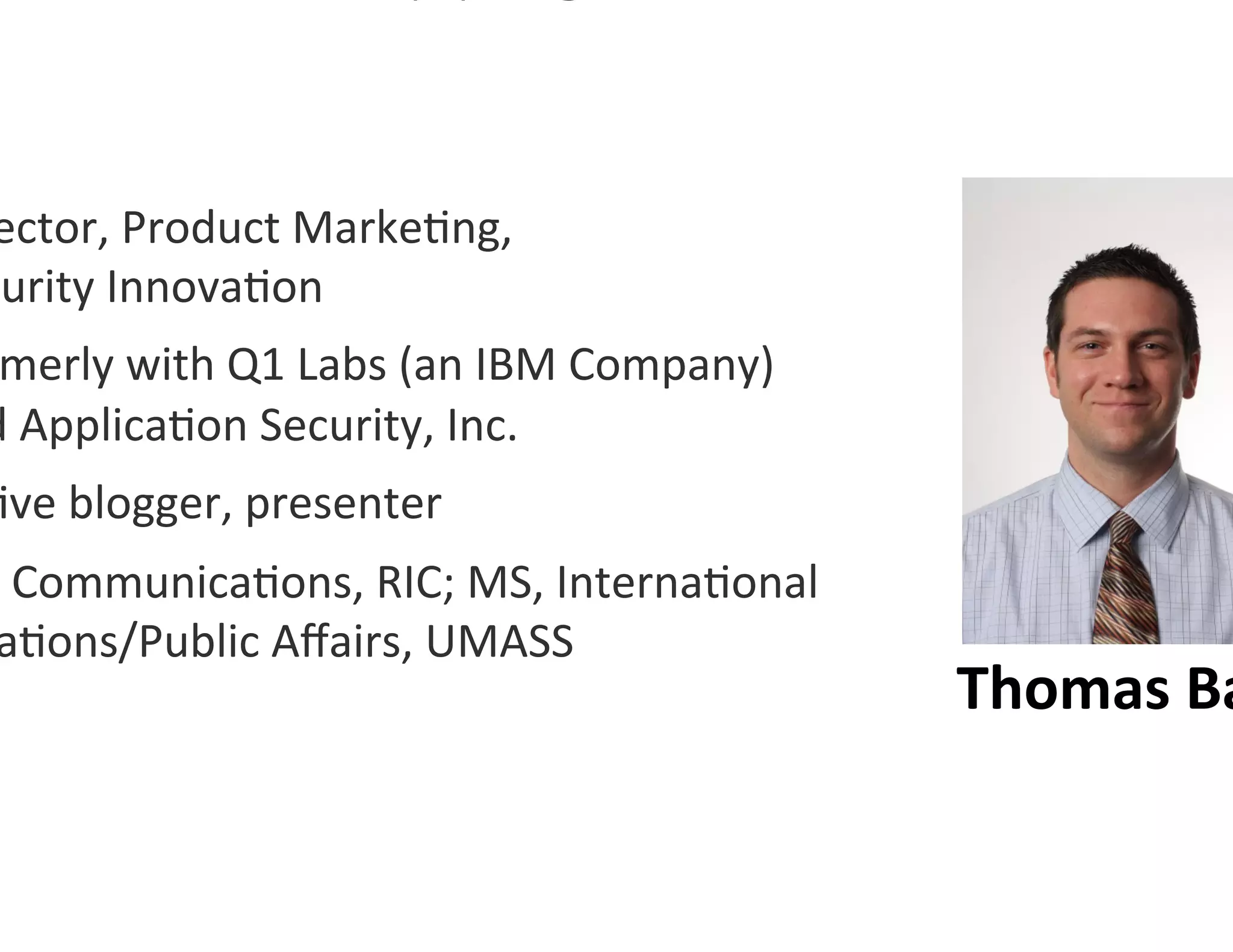
                                                                                                      Thomas	
  Ba
Why	
  SoOware	
  Security?	
  	
  
  ts/Trends	
  
  	
  vs	
  IT	
  Sec	
  Need	
  
  portance	
  of	
  Priori0zing	
  AppSec	
  
 ifferences	
  Between	
  App	
  &	
  IT	
  Sec	
  
 olicy	
  
  remental	
  policy	
  construc0on	
  
 al-­‐world	
  policy	
  improvement	
  
 escrip0ve	
  mapping	
  to	
  compliance	
  
Map	
  AppSec	
  to	
  Compliance	
  Ac0vity	
  
 ecommenda0ons	
  
 eps	
  you	
  should	
  consider	
  
plication Security Experts	

+	
  Years	
  vulnerability	
  research	
  	
  
curity	
  Tes0ng	
  Methodology	
  adopted	
  by	
  SAP,	


crosoO,	
  Symantec	
  
 thors	
  of	
  8+	
  books	
  
 ducts and Services	

andards	
  -­‐	
  Best	
  Prac0ces	
  
 uca0on	
  -­‐	
  CBT	
  &	
  Instructor-­‐Led	
  
sessment	
  -­‐	
  SoOware	
  and	
  SDLC	
  
ducing Application Security Risk	

 0cal	
  Vulnerability	
  Discovery	
  
cure	
  SDLC	
  Rollout	
  
I. Why Software Security
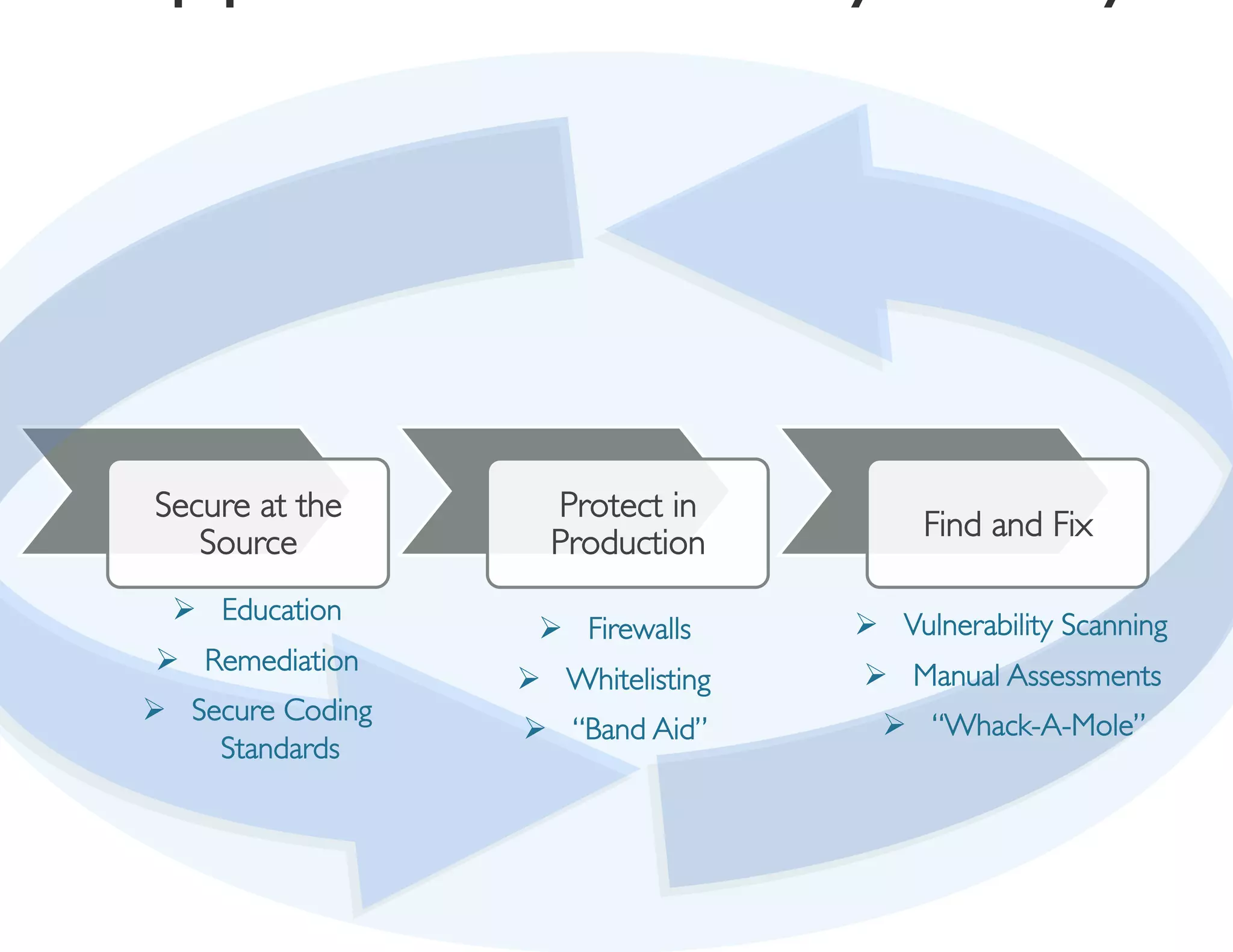
Secure at the            Protect in
                                                   Find and Fix	

    Source	

             Production	

  Ø  Education	

                           Ø  Vulnerability Scanning	

                         Ø  Firewalls	

 Ø  Remediation	

                          Ø  Manual Assessments	

                       Ø  Whitelisting	

Ø  Secure Coding                           Ø  “Whack-A-Mole”	

                       Ø  “Band Aid”	

      Standards
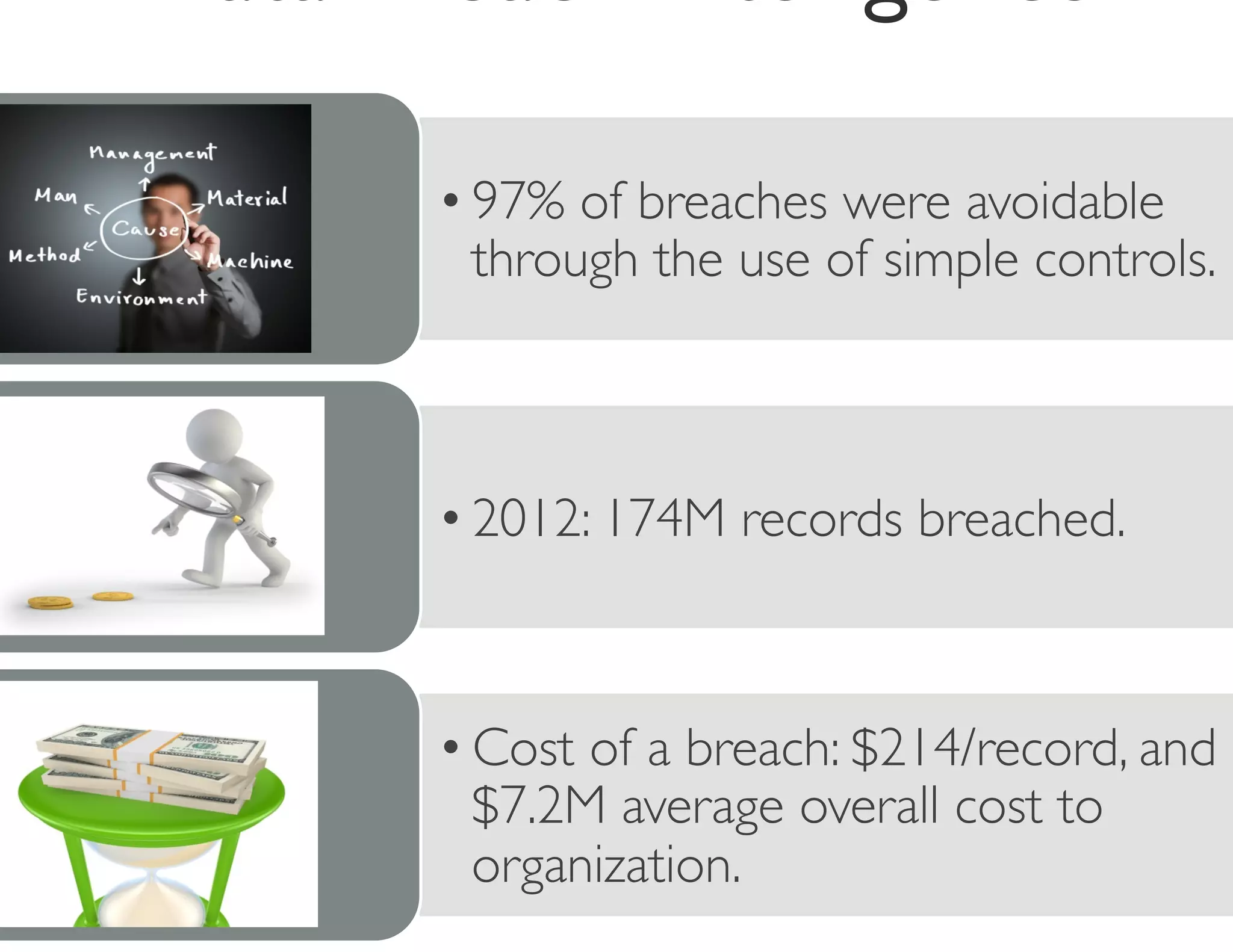
• 97% of breaches were avoidable
  through the use of simple controls. 	


• 2012: 174M records breached.	


• Cost of a breach: $214/record, and
  $7.2M average overall cost to
  organization.
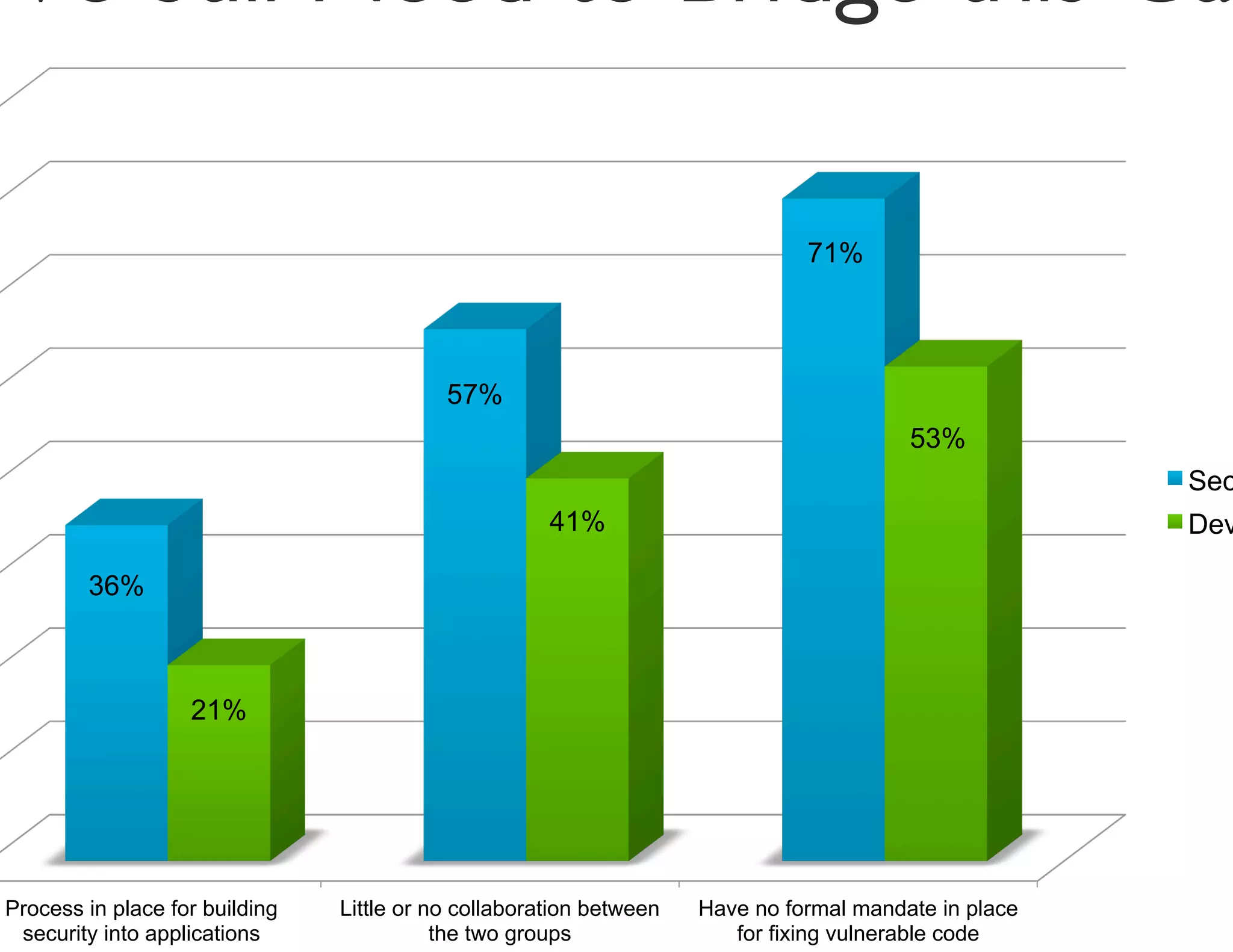
We Still Need to Bridge this Ga

                                                                               71%


                                           57%
                                                                                         53%
                                                                                                       Sec
                                                      41%                                              Dev

        36%


                   21%


Process in place for building   Little or no collaboration between   Have no formal mandate in place
 security into applications                the two groups               for fixing vulnerable code
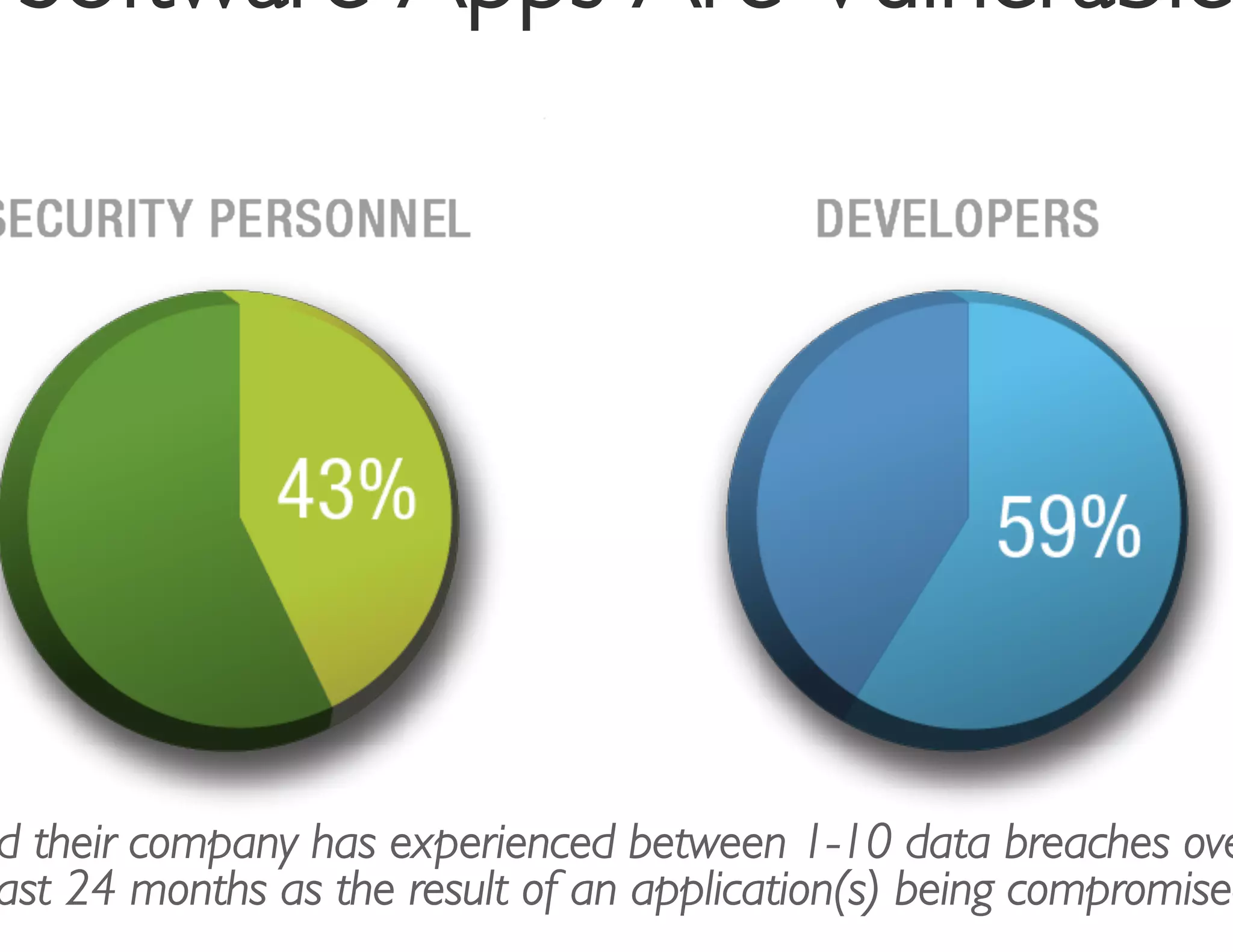
Software Apps Are Vulnerable


d their company has experienced between 1-10 data breaches ove
ast 24 months as the result of an application(s) being compromised
s	
  lose	
  autonomy	
  with	
  
  rity	
  policies	
  that	
  aren’t	
  well-­‐
 ned.	
  
 ormance	
  +	
  capabili0es	
  oOen	
  
mp	
  security	
  =	
  IT	
  headache.	
  	
  
  s	
  expect	
  an	
  always-­‐on,	
  
  re	
  connec0on	
  and	
  
  0onality	
  
 e	
  to	
  market	
  pressures	
  hurt	
  
  rity:	
  But	
  good	
  architecture	
  
 backend	
  systems	
  can	
  help.	
  
  	
  frameworks	
  can	
  help	
  you	
  
  o	
  market	
  quickly	
  can	
  
II. AppSec vs InfoSec Policy
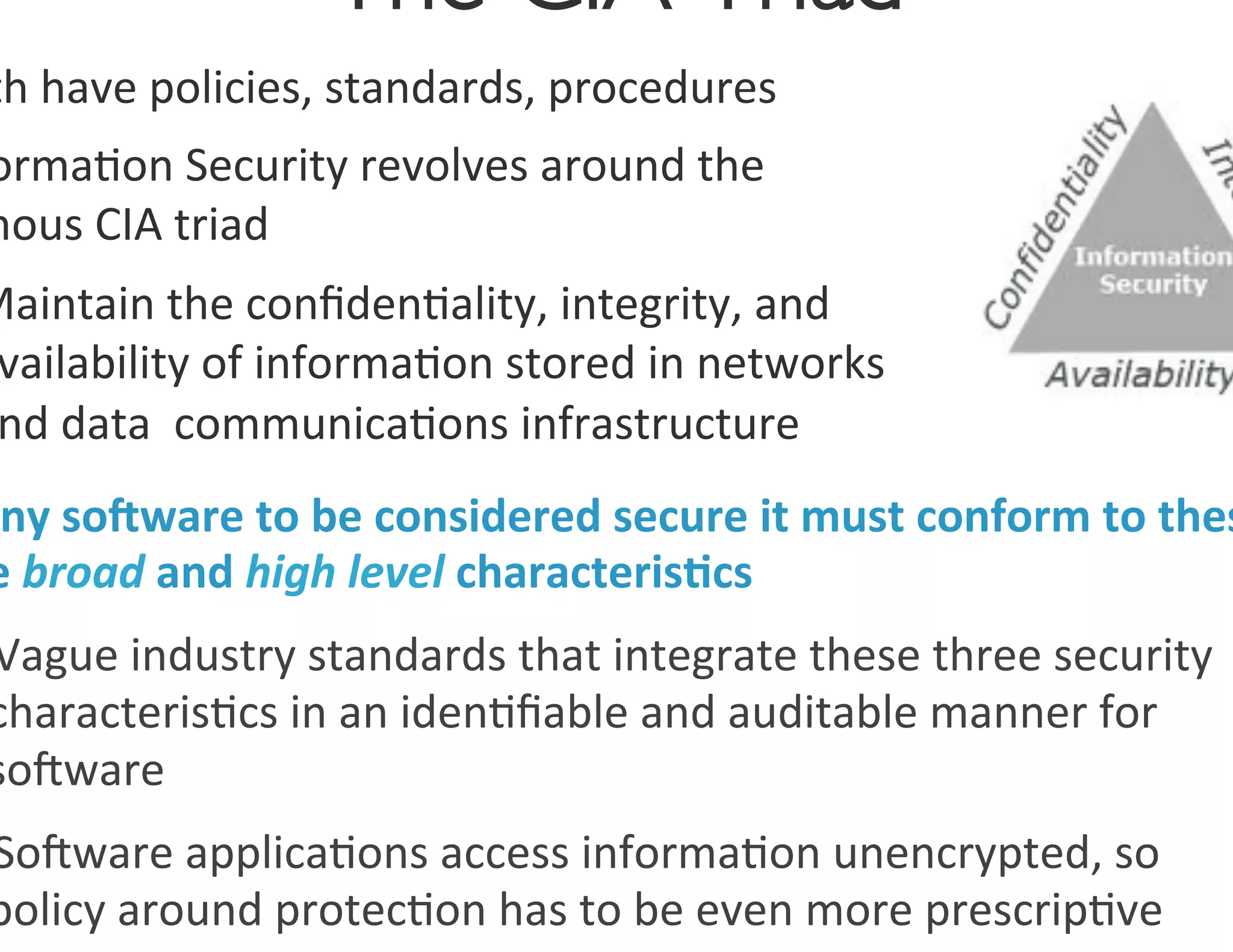
The CIA Triad
                                    	

th	
  have	
  policies,	
  standards,	
  procedures	
  
orma0on	
  Security	
  revolves	
  around	
  the	
  
mous	
  CIA	
  triad	
  
Maintain	
  the	
  confiden0ality,	
  integrity,	
  and	
  
 vailability	
  of	
  informa0on	
  stored	
  in	
  networks	
  
 nd	
  data	
  	
  communica0ons	
  infrastructure	
  	
  
 ny	
  so.ware	
  to	
  be	
  considered	
  secure	
  it	
  must	
  conform	
  to	
  thes
e	
  broad	
  and	
  high	
  level	
  characteris7cs	
  
Vague	
  industry	
  standards	
  that	
  integrate	
  these	
  three	
  security	
  
characteris0cs	
  in	
  an	
  iden0fiable	
  and	
  auditable	
  manner	
  for	
  
soOware	
  
SoOware	
  applica0ons	
  access	
  informa0on	
  unencrypted,	
  so	
  
policy	
  around	
  protec0on	
  has	
  to	
  be	
  even	
  more	
  prescrip0ve	
  
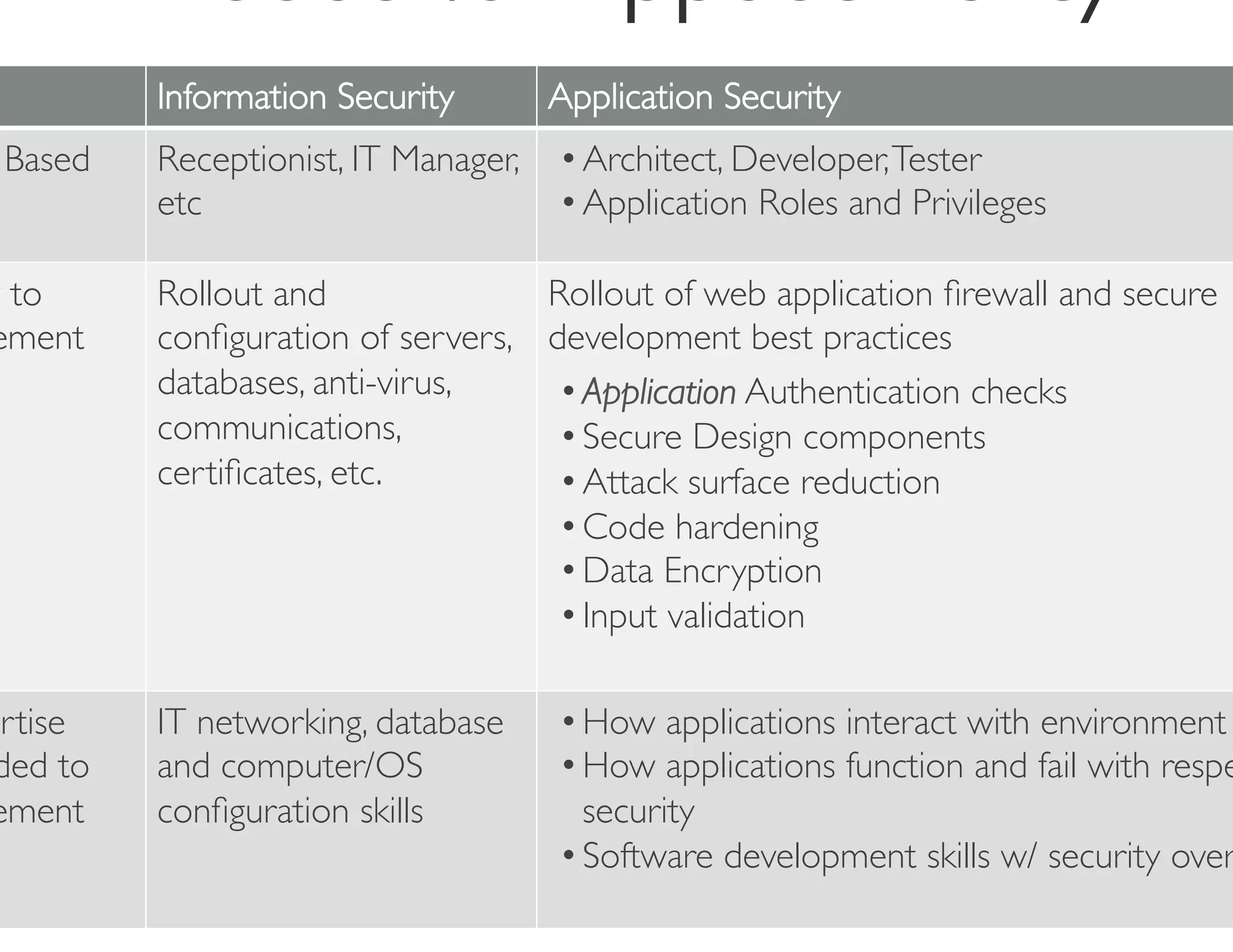
Information Security 	

    Application Security	

  Based	

   Receptionist, IT Manager,    • Architect, Developer, Tester	

             etc	

                       • Application Roles and Privileges	


w to         Rollout and              Rollout of web application firewall and secure
 ement	

    configuration of servers, development best practices	

             databases, anti-virus,       • Application Authentication checks	

             communications,              • Secure Design components	

             certificates, etc.	

         • Attack surface reduction	

                                          • Code hardening	

                                          • Data Encryption	

                                          • Input validation	


ertise       IT networking, database      • How applications interact with environment	

 ded to      and computer/OS              • How applications function and fail with respe
ement	

     configuration skills	

         security	

                                          • Software development skills w/ security over
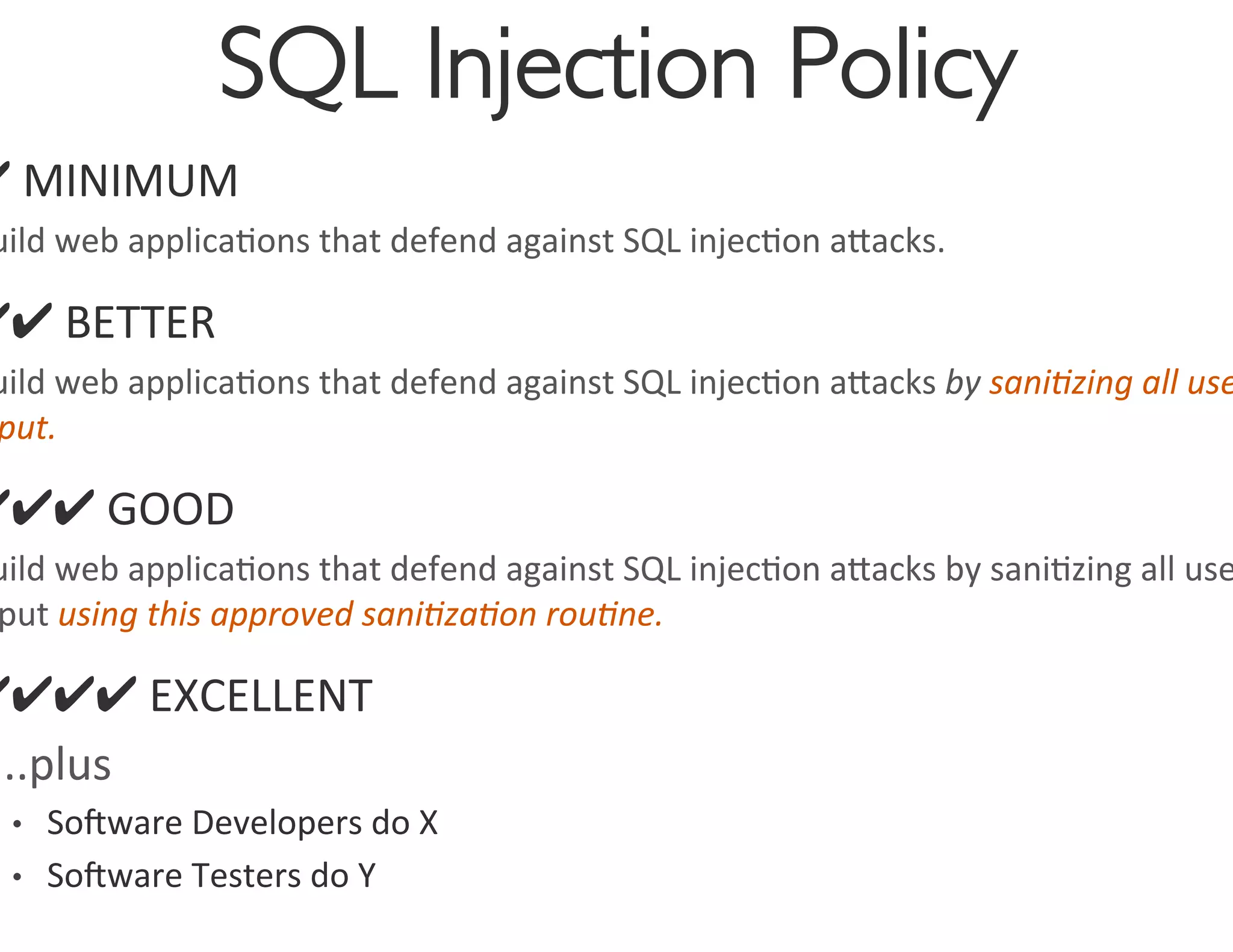
SQL Injection Policy
                                         	

✔	
  MINIMUM	
  
 uild	
  web	
  applica0ons	
  that	
  defend	
  against	
  SQL	
  injec0on	
  agacks.	
  

✔✔	
  BETTER	
  
 uild	
  web	
  applica0ons	
  that	
  defend	
  against	
  SQL	
  injec0on	
  agacks	
  by	
  sani4zing	
  all	
  use
 put.	


✔✔✔	
  GOOD	
  
 uild	
  web	
  applica0ons	
  that	
  defend	
  against	
  SQL	
  injec0on	
  agacks	
  by	
  sani0zing	
  all	
  use
 put	
  using	
  this	
  approved	
  sani4za4on	
  rou4ne.	
  

✔✔✔✔	
  EXCELLENT	
  
…..plus	
  
  •  SoOware	
  Developers	
  do	
  X	
  
  •  SoOware	
  Testers	
  do	
  Y	
  	
  
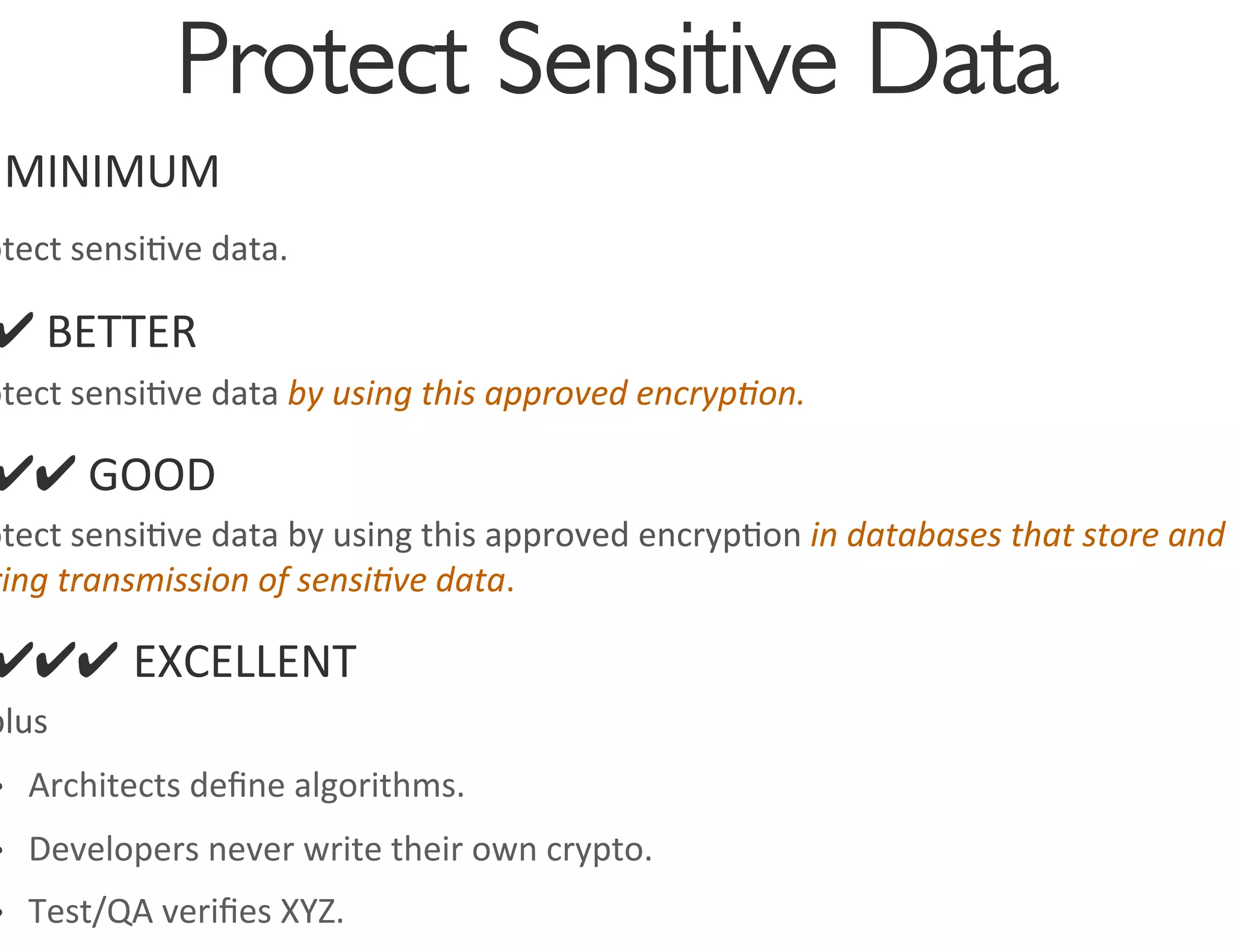
Protect Sensitive Data


  MINIMUM	
  
otect	
  sensi0ve	
  data.	


 ✔	
  BETTER	
  
otect	
  sensi0ve	
  data	
  by	
  using	
  this	
  approved	
  encryp4on.	
  

 ✔✔	
  GOOD	
  
otect	
  sensi0ve	
  data	
  by	
  using	
  this	
  approved	
  encryp0on	
  in	
  databases	
  that	
  store	
  and	
  
ring	
  transmission	
  of	
  sensi4ve	
  data.	
  

 ✔✔✔ EXCELLENT	
  
plus	
  
•    Architects	
  define	
  algorithms.	
  
•    Developers	
  never	
  write	
  their	
  own	
  crypto.	
  
•    Test/QA	
  verifies	
  XYZ.	
  
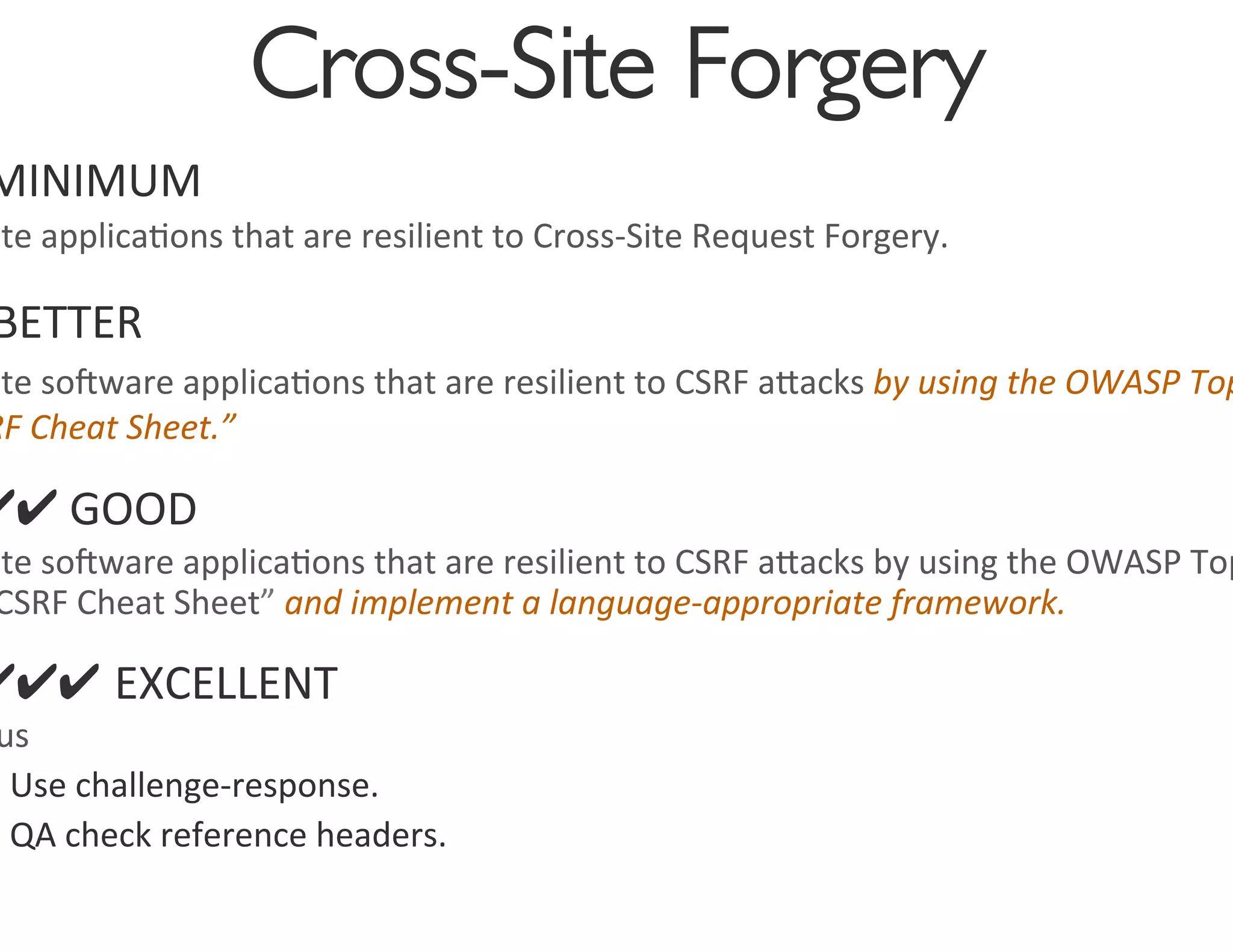
Cross-Site Forgery
                                           	

MINIMUM	
  
ate	
  applica0ons	
  that	
  are	
  resilient	
  to	
  Cross-­‐Site	
  Request	
  Forgery.	


 BETTER	
  
ate	
  soOware	
  applica0ons	
  that	
  are	
  resilient	
  to	
  CSRF	
  agacks	
  by	
  using	
  the	
  OWASP	
  Top
RF	
  Cheat	
  Sheet.”	


✔✔	
  GOOD	
  
ate	
  soOware	
  applica0ons	
  that	
  are	
  resilient	
  to	
  CSRF	
  agacks	
  by	
  using	
  the	
  OWASP	
  Top
 CSRF	
  Cheat	
  Sheet”	
  and	
  implement	
  a	
  language-­‐appropriate	
  framework.	


✔✔✔ EXCELLENT	
  
 us	
  
  Use	
  challenge-­‐response.	
  
  QA	
  check	
  reference	
  headers.	
  
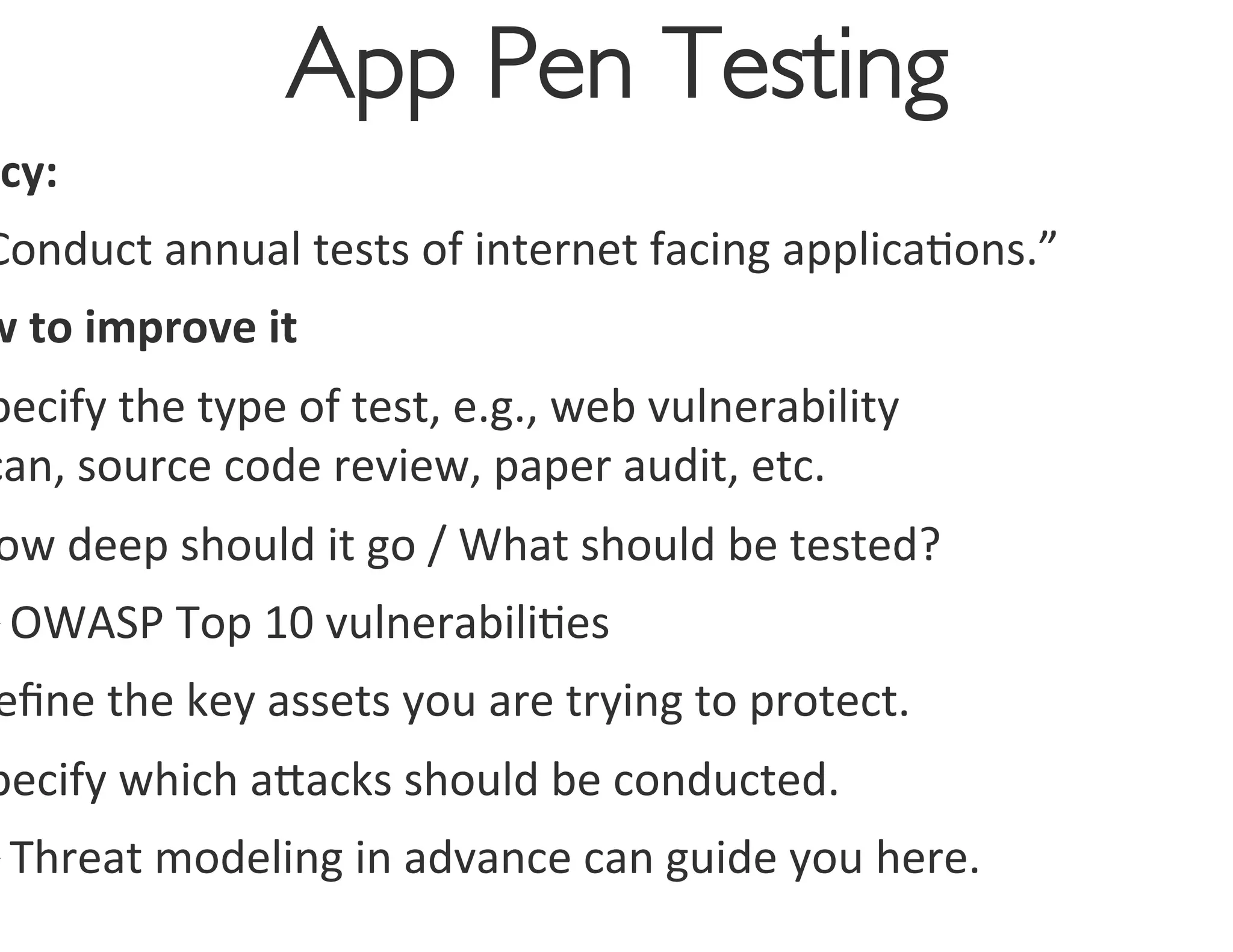
App Pen Testing
                                        	

 icy:	
  
Conduct	
  annual	
  tests	
  of	
  internet	
  facing	
  applica0ons.”	
  
w	
  to	
  improve	
  it	
  
pecify	
  the	
  type	
  of	
  test,	
  e.g.,	
  web	
  vulnerability	
  
can,	
  source	
  code	
  review,	
  paper	
  audit,	
  etc.	
  
 ow	
  deep	
  should	
  it	
  go	
  /	
  What	
  should	
  be	
  tested?	
  
Ø OWASP	
  Top	
  10	
  vulnerabili0es	
  
 efine	
  the	
  key	
  assets	
  you	
  are	
  trying	
  to	
  protect.	
  
pecify	
  which	
  agacks	
  should	
  be	
  conducted.	
  
Ø Threat	
  modeling	
  in	
  advance	
  can	
  guide	
  you	
  here.	
  
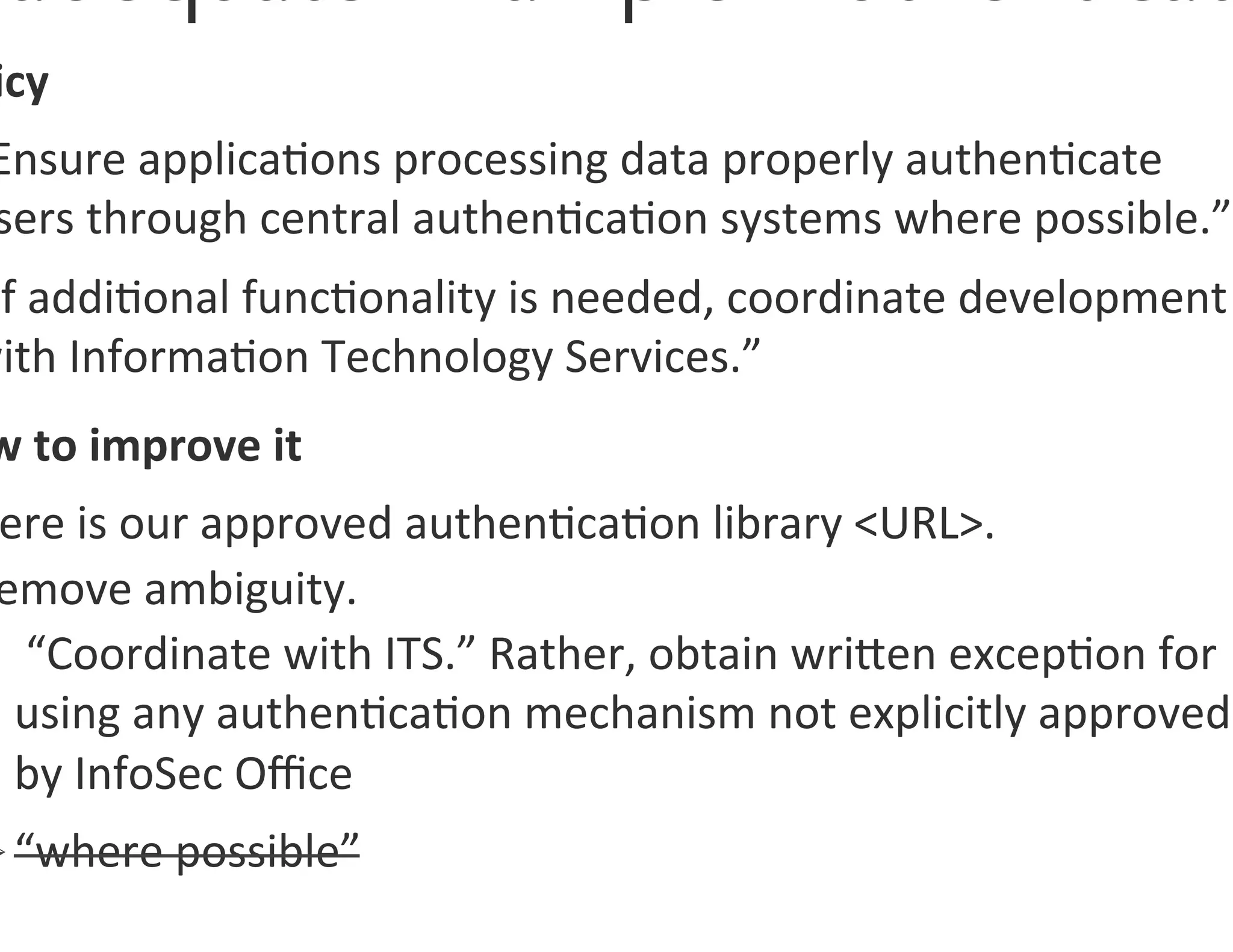
icy	
  
 Ensure	
  applica0ons	
  processing	
  data	
  properly	
  authen0cate	
  
 sers	
  through	
  central	
  authen0ca0on	
  systems	
  where	
  possible.”	
  
 If	
  addi0onal	
  func0onality	
  is	
  needed,	
  coordinate	
  development	
  
with	
  Informa0on	
  Technology	
  Services.”	
  	
  
 w	
  to	
  improve	
  it	
  
 ere	
  is	
  our	
  approved	
  authen0ca0on	
  library	
  URL.	
  
 emove	
  ambiguity.	
  
   	
  “Coordinate	
  with	
  ITS.”	
  Rather,	
  obtain	
  wrigen	
  excep0on	
  for	
  
   using	
  any	
  authen0ca0on	
  mechanism	
  not	
  explicitly	
  approved	
  
   by	
  InfoSec	
  Office	
  	
  
Ø “where	
  possible”	
  
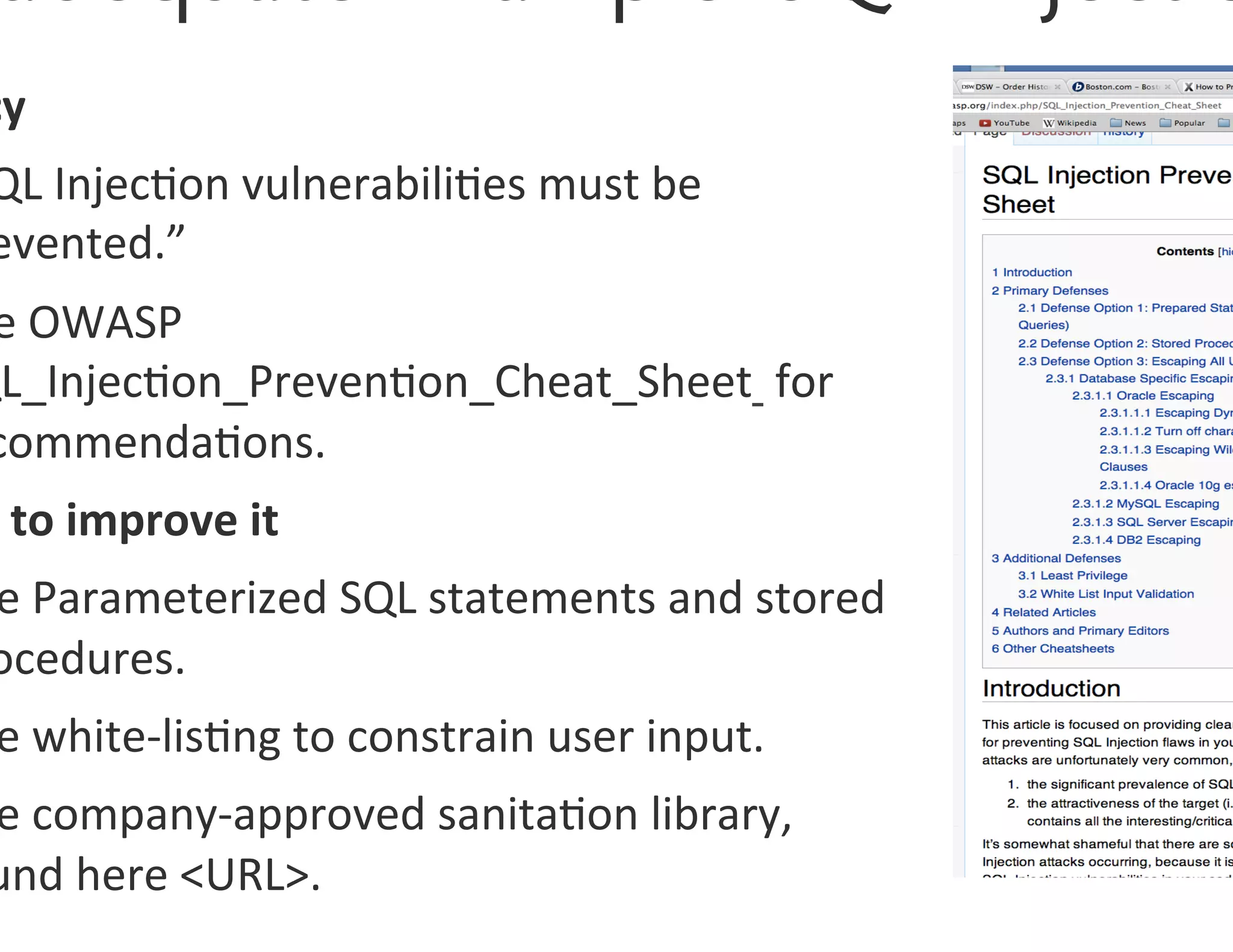
cy	
  
 QL	
  Injec0on	
  vulnerabili0es	
  must	
  be	
  
 evented.”	
  
 e	
  OWASP	
  
QL_Injec0on_Preven0on_Cheat_Sheet	
  	
  for	
  
 commenda0ons.	
  
 	
  to	
  improve	
  it	
  
 e	
  Parameterized	
  SQL	
  statements	
  and	
  stored	
  
 ocedures.	
  
 e	
  white-­‐lis0ng	
  to	
  constrain	
  user	
  input.	
  
 e	
  company-­‐approved	
  sanita0on	
  library,	
  	
  
 und	
  here	
  URL.	
  
III. Map AppSec to	

Compliance Initiatives
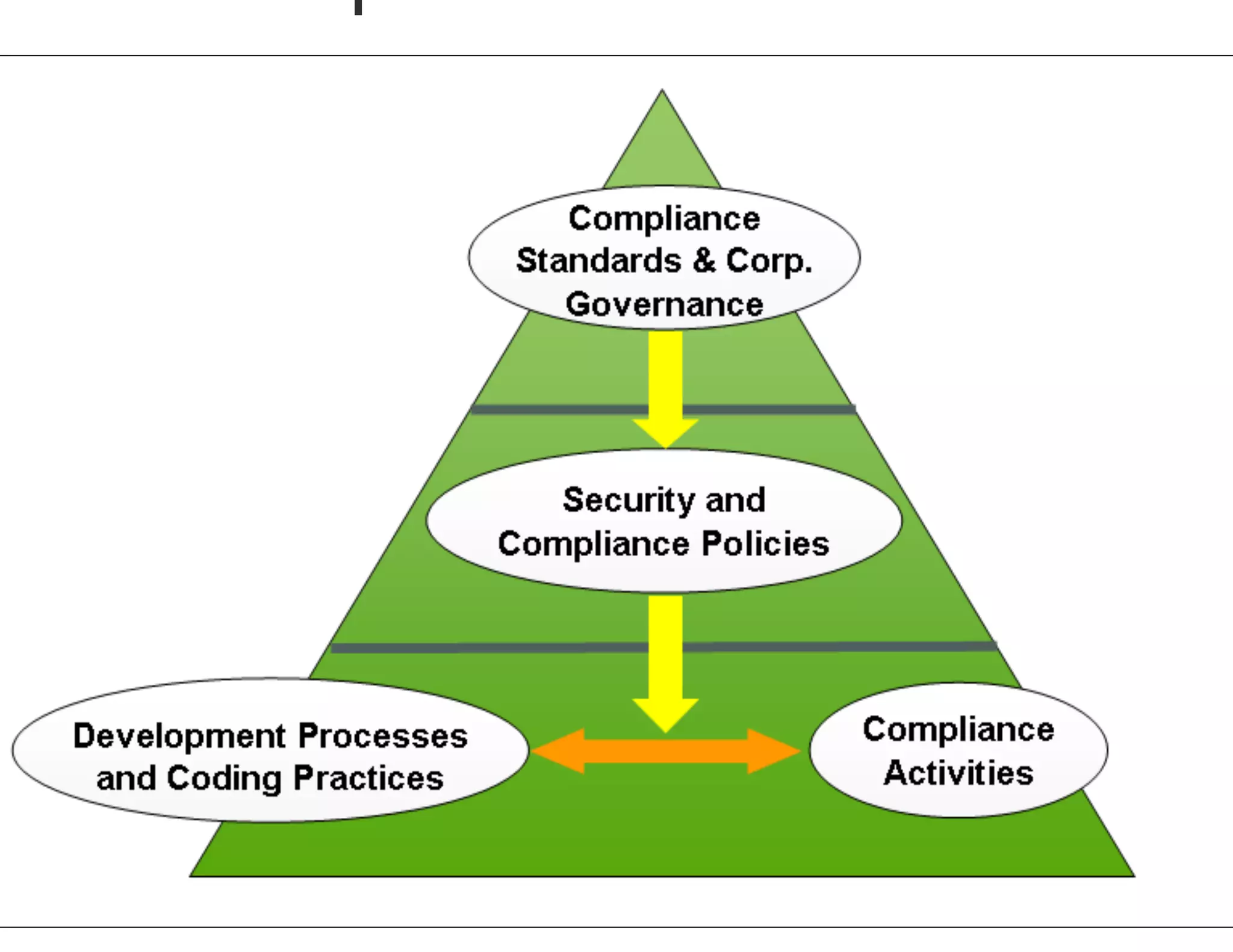
terprise	
  Risk	
  Management,	
  HR,	
  and	
  Legal	
  define	
  the	
  global	
  
 pe,	
  objec7ves	
  and	
  requirements	
  for	
  corporate	
  
vernance	
  
Applicable	
  legisla0on	
  (Sarbanes-­‐Oxley,	
  HIPAA,	
  California	
  SB	
  
 386)	
  
ndustry	
  standards	
  (ISO	
  2700x,	
  FISMA/NIST	
  standards)	
  
 ompliance	
  mandates	
  (PCI	
  DSS)	
  
egal	
  and	
  human	
  resources	
  requirements	
  (data	
  privacy	
  
aws)	
  
 oten0al	
  impacts	
  of	
  security	
  breaches	
  
 osts	
  of	
  security	
  breaches	
  and	
  agacks	
  
M,	
  GRC	
  	
  Security	
  teams	
  add	
  detail	
  to	
  create	
  policies	
  
igh-­‐level	
  guidelines	
  for	
  opera0onal	
  security	
  and	
  compliance	
  
c0vi0es	
  
an	
  be	
  contextualized	
  for	
  specific	
  business	
  units	
  and	
  func0onal
oles	
  
 ical	
  tasks	
  include:	
  
tudying	
  the	
  applicable	
  regula0ons	
  and	
  standards	
  
onduc0ng	
  a	
  threat	
  assessment	
  to	
  determine	
  the	
  security	
  brea
oten0ally	
  most	
  damaging	
  to	
  the	
  enterprise	
  
lassifying	
  data	
  assets	
  to	
  define	
  levels	
  of	
  data	
  sensi0vity	
  
 efining	
  concrete	
  applica0on	
  security	
  objec0ves	
  
curity	
  	
  Compliance	
  teams	
  define	
  specific	
  development	
  
 ocesses,	
  coding	
  prac7ces,	
  and	
  procedures	
  for	
  compliance	
  
ocumenta7on	
  
 Ensures	
  they’re	
  relevant	
  to	
  local	
  requirements	
  and	
  technology
 and	
  consistent	
  with	
  corporate	
  security	
  and	
  compliance	
  policie
 Address	
  regional	
  and	
  business-­‐unit	
  specific	
  regula0ons	
  and	
  th
 technologies	
  used	
  by	
  each	
  team	
  

ontextualizing	
  policies	
  for	
  each	
  team	
  can	
  be	
  a	
  labor-­‐intensive
nd	
  deeply	
  technical	
  process	
  
 Saves	
  a	
  TON	
  of	
  0me	
  long-­‐term	
  
 Reduce	
  risk	
  over	
  0me	
  with	
  specific	
  	
  prac0cal	
  the	
  guidance	
  
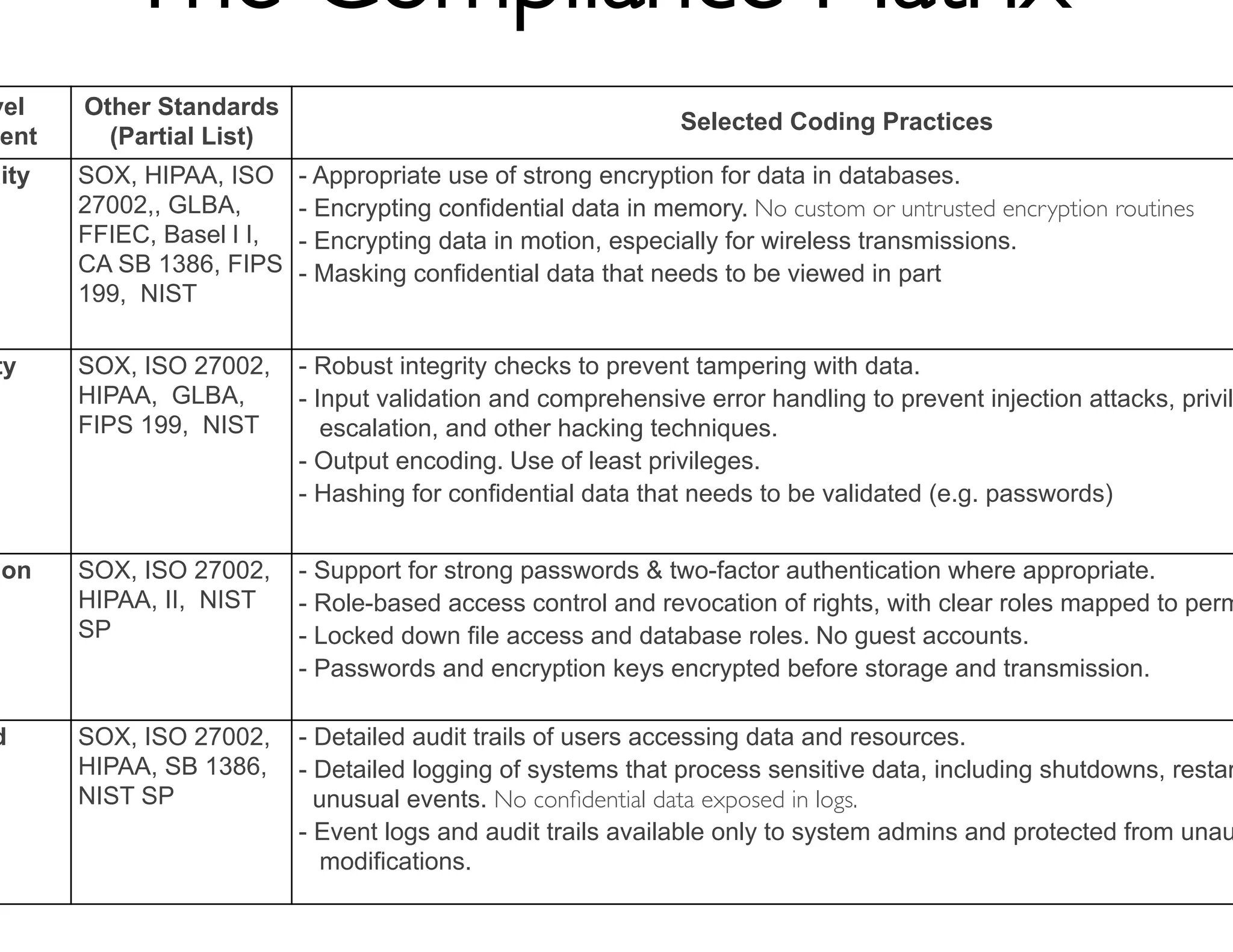
The Compliance Matrix	

vel    Other Standards
                                                              Selected Coding Practices
 ent     (Partial List)
lity   SOX, HIPAA, ISO     - Appropriate use of strong encryption for data in databases.
       27002,, GLBA,       - Encrypting confidential data in memory. No custom or untrusted encryption routines
       FFIEC, Basel l I,   - Encrypting data in motion, especially for wireless transmissions.
       CA SB 1386, FIPS    - Masking confidential data that needs to be viewed in part
       199, NIST

ty     SOX, ISO 27002,     - Robust integrity checks to prevent tampering with data.
       HIPAA, GLBA,        - Input validation and comprehensive error handling to prevent injection attacks, privil
       FIPS 199, NIST         escalation, and other hacking techniques.
                           - Output encoding. Use of least privileges.
                           - Hashing for confidential data that needs to be validated (e.g. passwords)


ion    SOX, ISO 27002,     - Support for strong passwords  two-factor authentication where appropriate.
       HIPAA, II, NIST     - Role-based access control and revocation of rights, with clear roles mapped to perm
       SP                  - Locked down file access and database roles. No guest accounts.
                           - Passwords and encryption keys encrypted before storage and transmission.

d      SOX, ISO 27002,     - Detailed audit trails of users accessing data and resources.
       HIPAA, SB 1386,     - Detailed logging of systems that process sensitive data, including shutdowns, restar
       NIST SP               unusual events. No confidential data exposed in logs.
                           - Event logs and audit trails available only to system admins and protected from unau
                             modifications.
IV. Streamline AppSec Policy
Development to Fit Your Busines
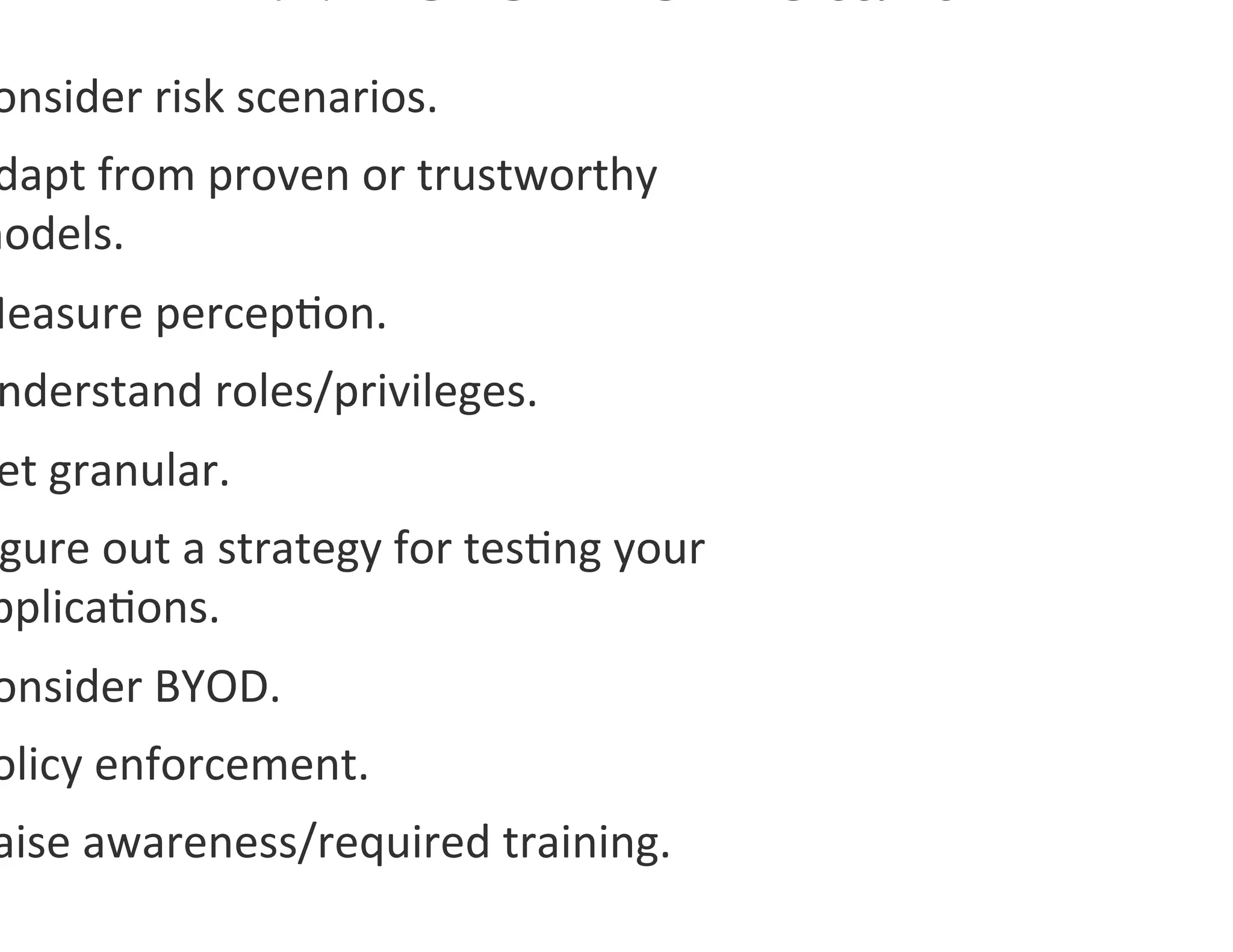
onsider	
  risk	
  scenarios.	
  
 dapt	
  from	
  proven	
  or	
  trustworthy	
  
models.	
  
Measure	
  percep0on.	
  
  nderstand	
  roles/privileges.	
  
  et	
  granular.	
  
 gure	
  out	
  a	
  strategy	
  for	
  tes0ng	
  your	
  
 pplica0ons.	
  	
  
 onsider	
  BYOD.	
  	
  
 olicy	
  enforcement.	
  
 aise	
  awareness/required	
  training.	
  
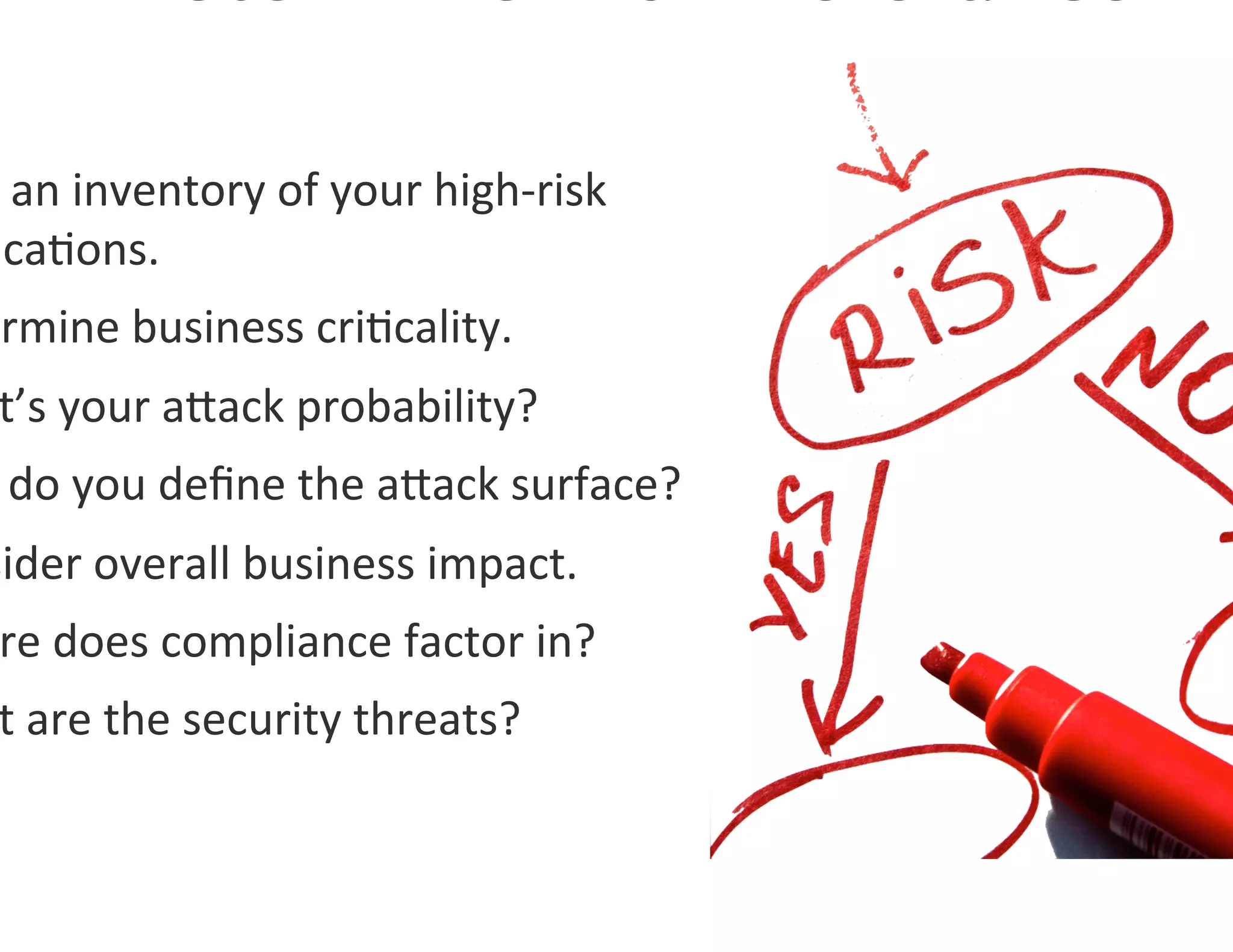
 an	
  inventory	
  of	
  your	
  high-­‐risk	
  
 ica0ons.	
  
ermine	
  business	
  cri0cality.	
  	
  
 t’s	
  your	
  agack	
  probability?	
  
 	
  do	
  you	
  define	
  the	
  agack	
  surface?	
  
sider	
  overall	
  business	
  impact.	
  
 re	
  does	
  compliance	
  factor	
  in?	
  
 t	
  are	
  the	
  security	
  threats?	
  
njec0on	
                                       •  A6	
  Sensi0ve	
  Data	
  Exposure
Broken	
  Authen0ca0on	
  and	
                    (merged	
  from	
  former	
  	
  
 ion	
  Management	
  	
                        •  A7	
  Insecure	
  Cryptographic
Cross-­‐Site	
  Scrip0ng	
  (XSS)	
  (was	
        Storage	
  
merly	
  A2)	
                                  •  A8	
  Cross-­‐Site	
  Request	
  Forg
nsecure	
  Direct	
  Object	
                      (CSRF)	
  
erences	
                                       •  A9	
  Using	
  Known	
  Vulnerabl
 ecurity	
  Misconfigura0on	
  (was	
               Components	
  
merly	
  A6)	
                                  •  A10	
  Unvalidated	
  Redirects
                                                   Forwards	
  
tudes	
  of	
  general	
  popula0on	
  toward	
  
urity	
  (suppor0ve,	
  antagonis0c,	
  
fferent?)	
  
tudes	
  of	
  general	
  popula0on	
  toward	
  
nagement	
  (suppor0ve,	
  antagonis0c,	
  
fferent?)	
  	
  
w	
  does	
  management	
  view	
  the	
  
c0on	
  of	
  security?	
  
at’s	
  the	
  percep0on	
  of	
  current	
  
cy?	
  
e	
  there	
  been	
  related	
  security	
  
dents?	
  	
  
h	
  departments/groups/individuals	
  
	
  been	
  most	
  ac0ve	
  in	
  developing	
  
ies?	
  	
  
 ous	
  collabora0on	
  between	
  policies	
  
authors?	
  
n0al	
  champion(s)	
  to	
  support?	
  	
  
s	
  of	
  agreement	
  in	
  commonly	
  
emented	
  controls	
  re:	
  policies?	
  
ort	
  docs,	
  materials	
  and	
  related	
  
ies	
  should	
  be	
  cited	
  in	
  mobile	
  device	
  
y.	
  
	
  to	
  understand	
  user	
  access	
  and	
  
 eges.	
  
hich	
  applica0ons	
  would	
  be	
  used?	
  
 w	
  will	
  web	
  applica0ons	
  be	
  used?	
  
hat	
  will	
  access	
  and	
  levels	
  of	
  privilege	
  look	
  like?	
  	
  
hat	
  informa0on	
  is	
  accessible	
  through	
  web	
  applica0ons?	
  	
  
hat	
  informa0on	
  will	
  be	
  stored	
  on	
  web	
  applica0ons?	
  	
  
 w	
  will	
  data	
  be	
  shared	
  to/from	
  web	
  applica0ons?	
  	
  
ho’s	
  ul0mately	
  responsible	
  for	
  applica0on	
  security?	
  	
  
hich	
  applica0ons	
  are	
  acceptable	
  to	
  use?	
  	
  
hich	
  applica0ons	
  should	
  not	
  be	
  used?	
  
hat	
  levels	
  of	
  support	
  are	
  expected?	
  	
  
 sensi0ve	
  is	
  your	
  data?	
  
 t	
  kind	
  of	
  data	
  is	
  it?	
  PII,	
  customer	
  
 ,	
  credit	
  card	
  data,	
  proprietary,	
  IP,	
  

subject	
  to	
  regulatory	
  mandates?	
  
ch	
  ones?	
  
you	
  encryp0ng	
  data?	
  At	
  rest?	
  In	
  
sit?	
  
duct	
  a	
  threat	
  model:	
  
 termine	
  threats	
  
en0fy	
  poten0al	
  agacks	
  
nderstand	
  the	
  frequency	
  	
  severity	
  
 th	
  which	
  they	
  are	
  executed.	
  
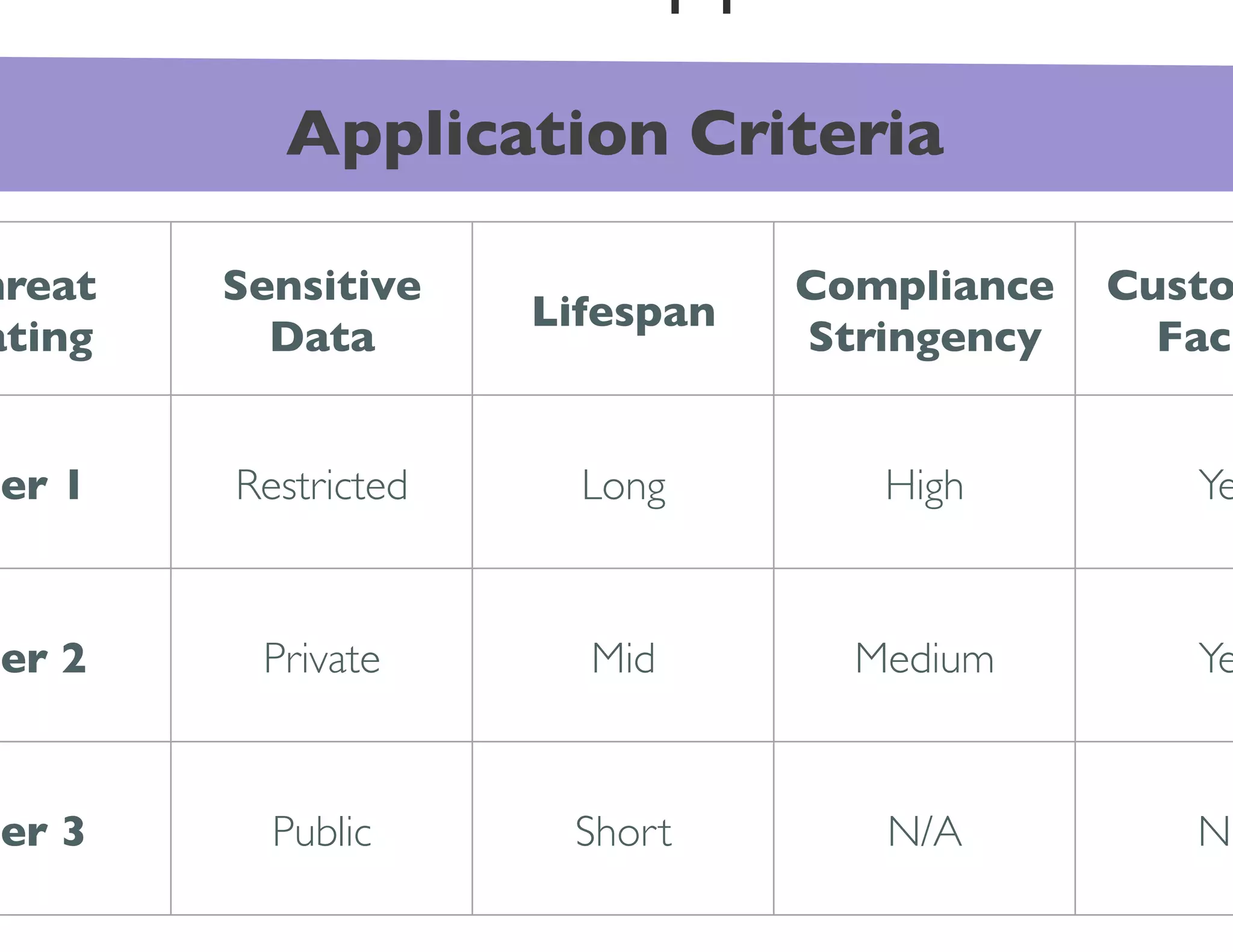
Application Criteria	


hreat      Sensitive                     Compliance      Custo
                           Lifespan	

ating	

     Data	

                     Stringency	

     Faci


ier 1	

   Restricted	

     Long	

         High	

         Ye


ier 2	

    Private 	

       Mid	

       Medium	

         Ye


ier 3	

     Public	

       Short	

        N/A	

         No
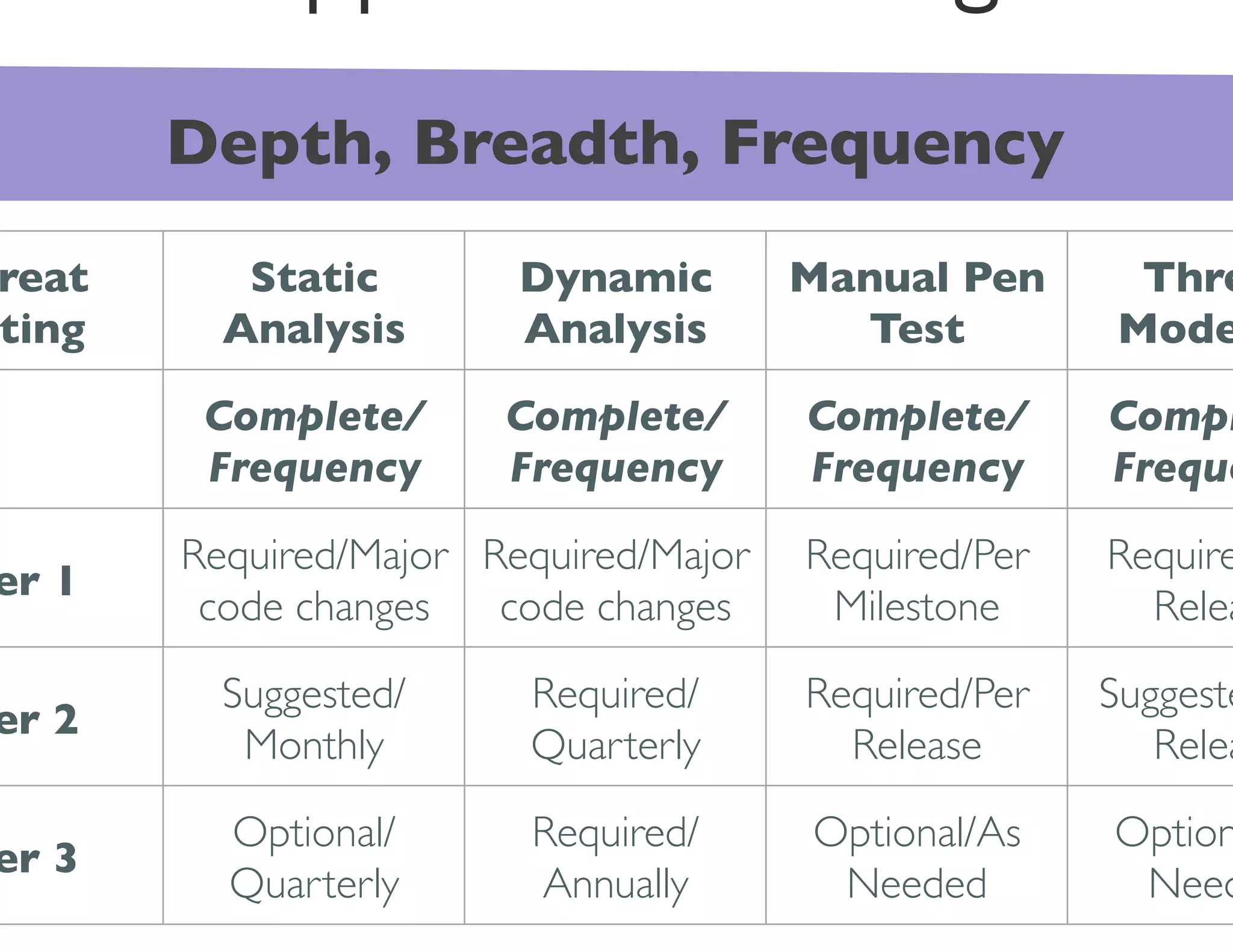
Depth, Breadth, Frequency	

reat         Static          Dynamic         Manual Pen       Thre
ting	

     Analysis 	

     Analysis	

       Test	

       Mode

           Complete/        Complete/        Complete/       Compl
           Frequency	

     Frequency	

     Frequency	

    Freque

          Required/Major Required/Major      Required/Per    Require
er 1	

           code changes	

 code changes	

    Milestone	

     Relea

            Suggested/       Required/       Required/Per    Suggeste
er 2	

             Monthly	

      Quarterly	

      Release	

       Relea

            Optional/        Required/       Optional/As     Option
er 3	

            Quarterly	

     Annually	

      Needed	

       Need
ile	
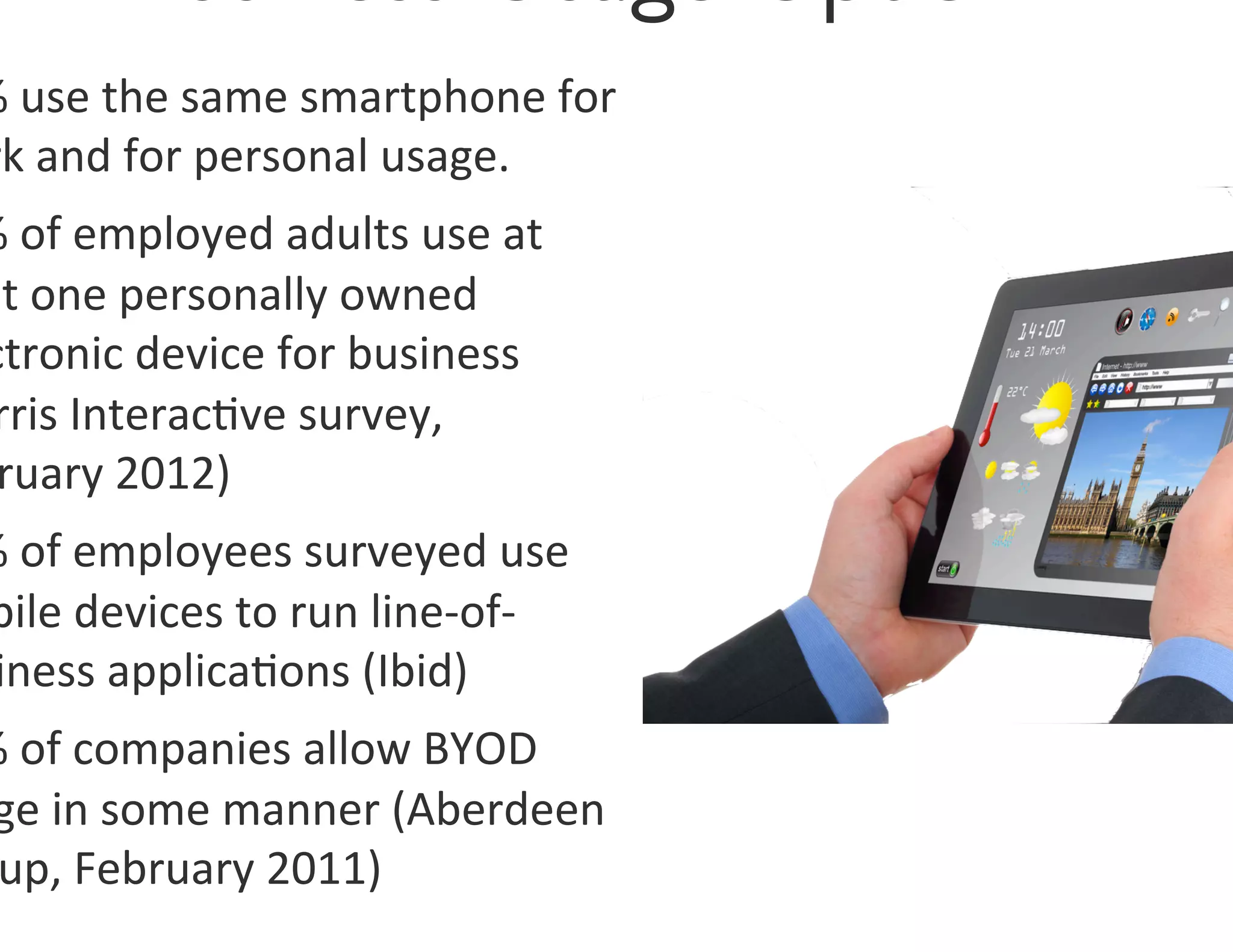
  devices	
  help	
  employees	
  increase	
  
uc0vity	
  –	
  staying	
  connected	
  is	
  not	
  
y	
  op0onal	
  anymore!	
  
ge	
  has	
  experienced	
  a	
  massive	
  up0ck:	
  
	
  of	
  today’s	
  workforce	
  is	
  using	
  a	
  
rtphone	
  specifically	
  for	
  business	
  use.	
  
 struggling	
  to	
  keep	
  up	
  with	
  device	
  
 agement.	
  
 ility	
  by	
  its	
  nature	
  opens	
  up	
  a	
  larger	
  
ck	
  surface	
  with	
  more	
  points	
  of	
  entry.	
  
cult	
  to	
  measure	
  business	
  need	
  
ugh	
  IT	
  Security	
  lens.	
  
%	
  use	
  the	
  same	
  smartphone	
  for	
  
rk	
  and	
  for	
  personal	
  usage.	
  
%	
  of	
  employed	
  adults	
  use	
  at	
  
st	
  one	
  personally	
  owned	
  
ctronic	
  device	
  for	
  business	
  
 rris	
  Interac0ve	
  survey,	
  
 ruary	
  2012)	
  
%	
  of	
  employees	
  surveyed	
  use	
  
bile	
  devices	
  to	
  run	
  line-­‐of-­‐
 iness	
  applica0ons	
  (Ibid)	
  
%	
  of	
  companies	
  allow	
  BYOD	
  
 ge	
  in	
  some	
  manner	
  (Aberdeen	
  
 up,	
  February	
  2011)	
  
%	
  of	
  companies	
  have	
  experienced	
  
ata	
  breach	
  due	
  to	
  inadequate	
  
 ice	
  security	
  (Ponemon	
  survey,	
  
 2)	
  
%	
  don’t	
  have	
  a	
  password	
  on	
  their	
  
bile	
  phone.	
  
%	
  stated	
  their	
  companies	
  couldn’t	
  
 cute	
  a	
  remote	
  wipe	
  if	
  lost	
  or	
  
 en.	
  
%	
  said	
  mobile	
  security	
  has	
  not	
  
 n	
  addressed	
  with	
  them	
  by	
  IT.	
  
Why is BYOD a Security Problem
 evice	
  turn-­‐over:	
  What	
  happens	
  to	
  the	
  old	
  device?	
  	
  
 ew	
  devices:	
  Default	
  or	
  customized	
  se|ngs?	
  
 ow	
  can	
  you	
  know	
  everything	
  about	
  every	
  device?	
  
  Oware	
  updates	
  –	
  user	
  vs	
  IT.	
  
 pp	
  Stores:	
  Approved	
  apps?	
  	
  
 pplica0ons:	
  
 What	
  data	
  is	
  on	
  your	
  device?	
  
 What	
  enterprise	
  applica0ons	
  can	
  you	
  connect	
  to?	
  
 Which	
  apps	
  are	
  connected	
  to	
  other	
  apps?	
  EX:	
  Your	
  blog	
  app	
  is
 connected	
  to	
  your	
  CMS,	
  which	
  feeds	
  to	
  Twiger,	
  etc.	
  	
  
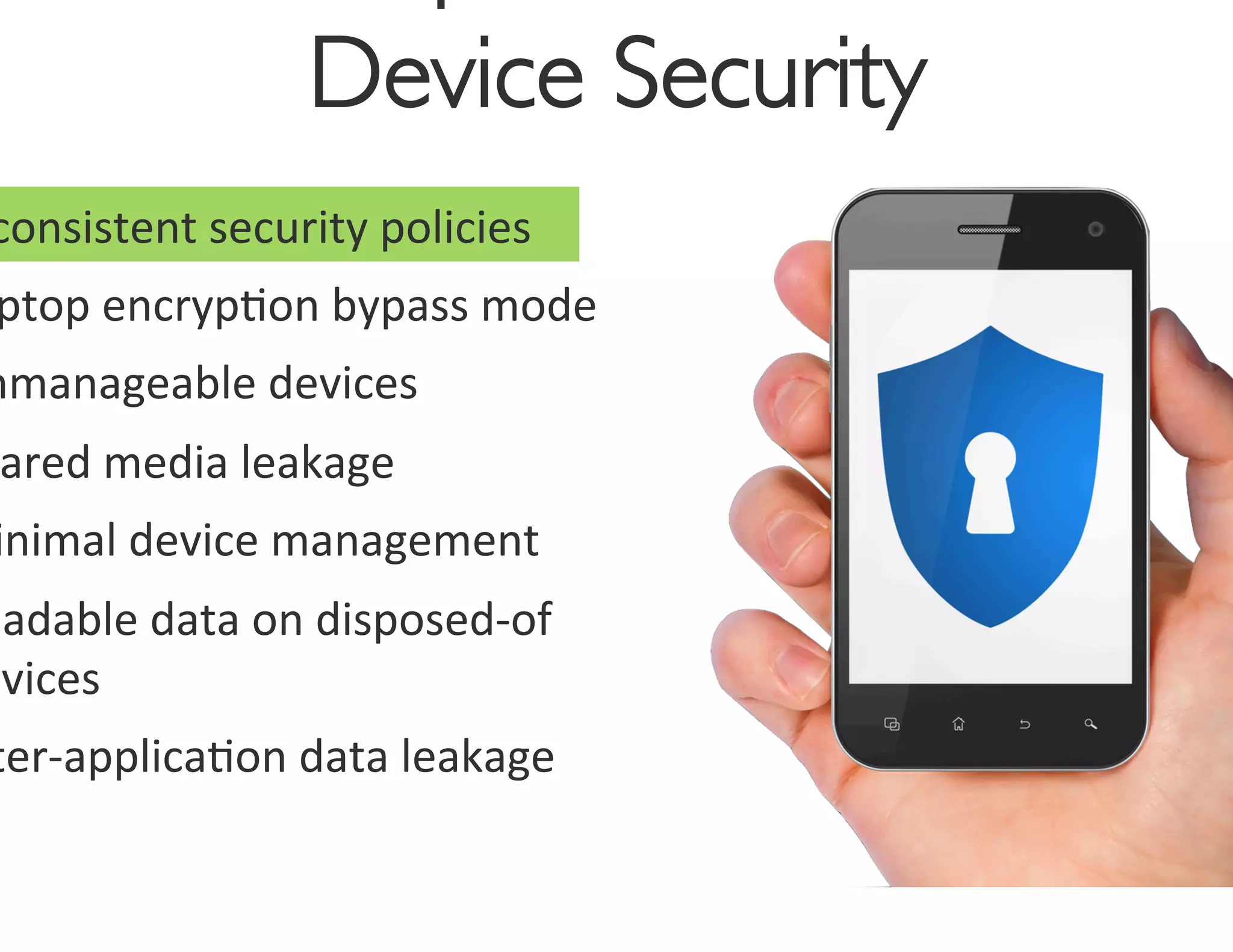
Device Security
                                     	

consistent	
  security	
  policies	
  
 ptop	
  encryp0on	
  bypass	
  mode	
  
nmanageable	
  devices	
  
 ared	
  media	
  leakage	
  
 inimal	
  device	
  management	
  
eadable	
  data	
  on	
  disposed-­‐of	
  
evices	
  
ter-­‐applica0on	
  data	
  leakage	
  
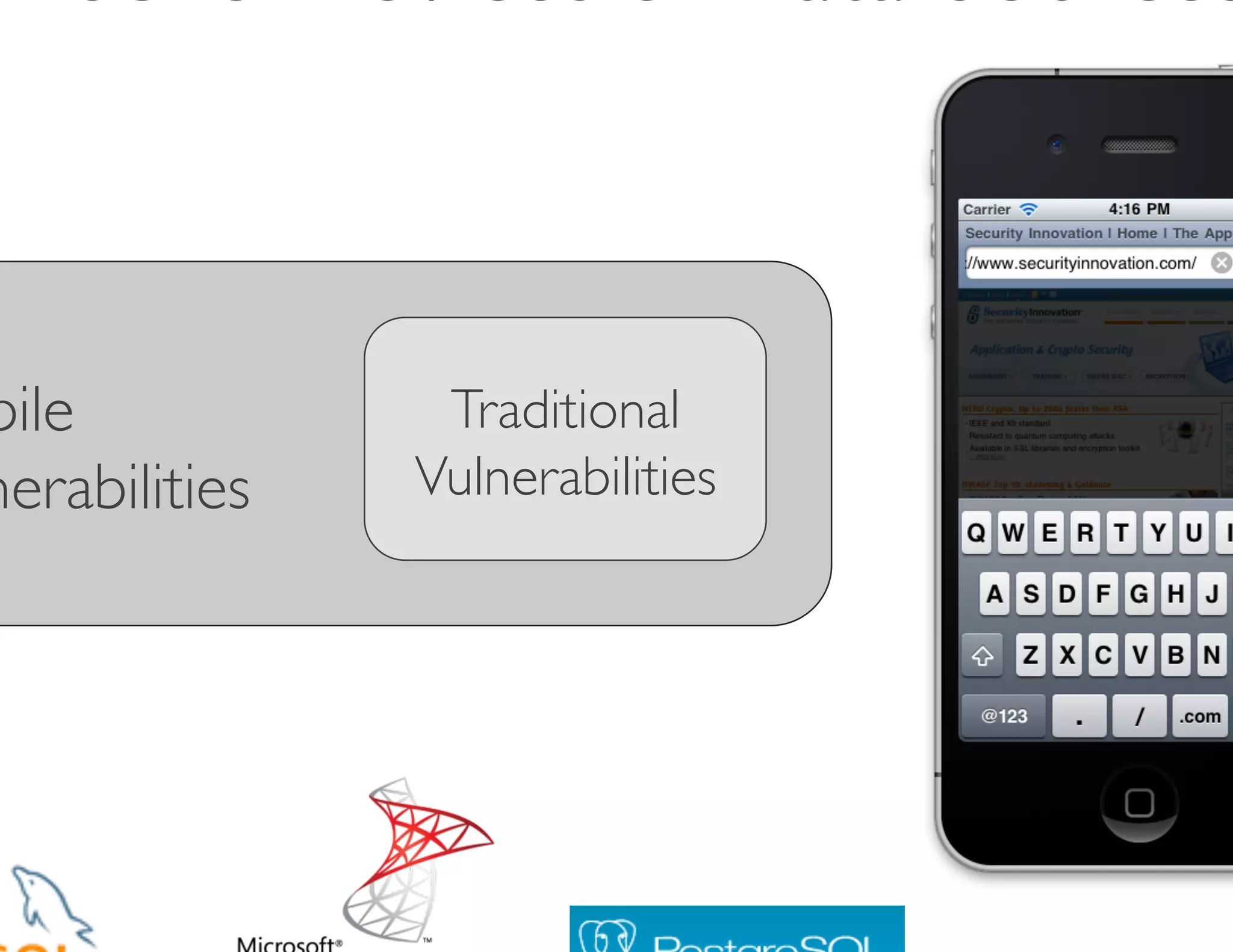
bile	

            Traditional
nerabilities	

   Vulnerabilities
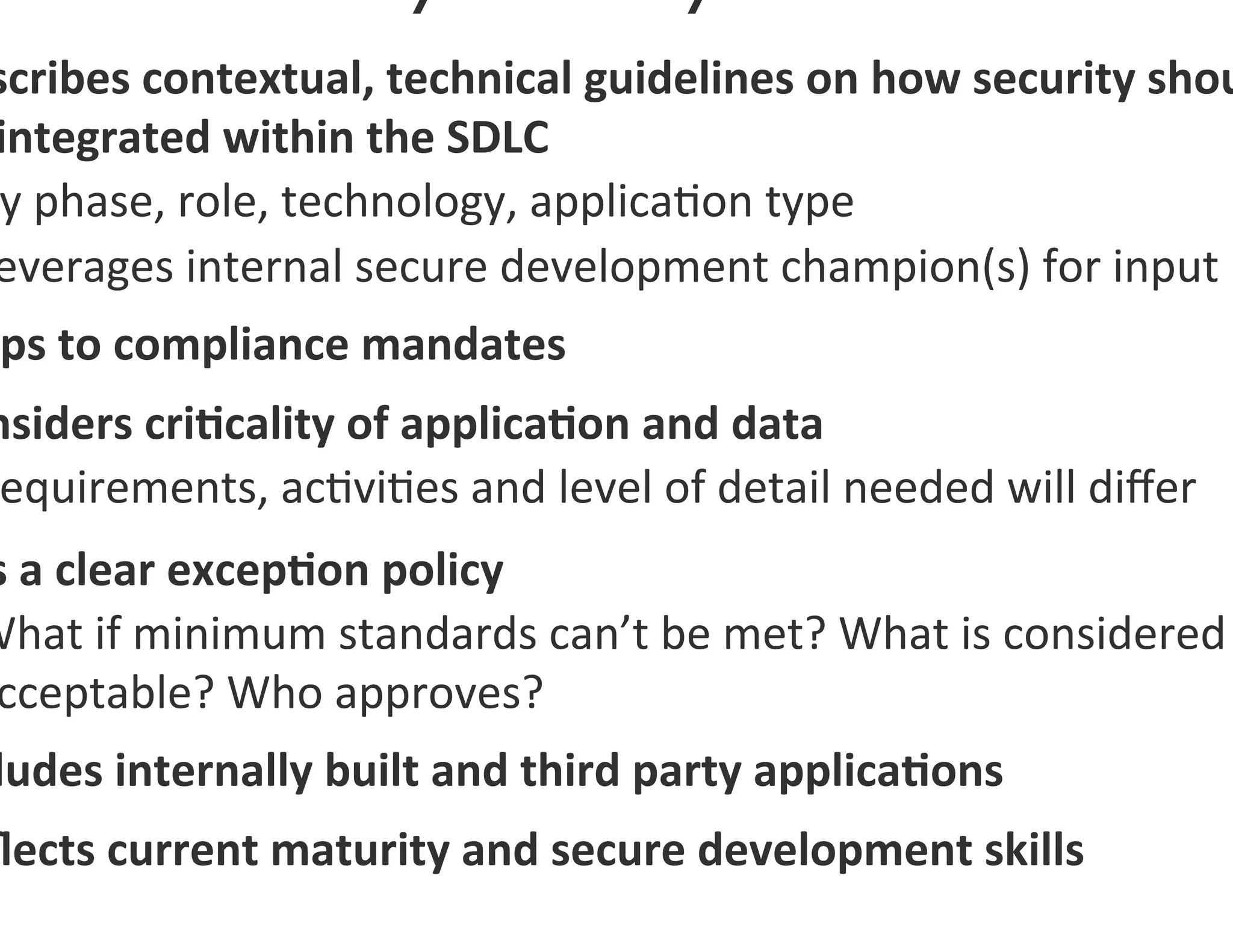
scribes	
  contextual,	
  technical	
  guidelines	
  on	
  how	
  security	
  shou
 integrated	
  within	
  the	
  SDLC	
  
  y	
  phase,	
  role,	
  technology,	
  applica0on	
  type	
  
 everages	
  internal	
  secure	
  development	
  champion(s)	
  for	
  input	
  
 ps	
  to	
  compliance	
  mandates	
  
nsiders	
  cri7cality	
  of	
  applica7on	
  and	
  data	
  
 equirements,	
  ac0vi0es	
  and	
  level	
  of	
  detail	
  needed	
  will	
  differ	
  
s	
  a	
  clear	
  excep7on	
  policy	
  
What	
  if	
  minimum	
  standards	
  can’t	
  be	
  met?	
  What	
  is	
  considered	
  
 cceptable?	
  Who	
  approves?	
  
 ludes	
  internally	
  built	
  and	
  third	
  party	
  applica7ons	
  
flects	
  current	
  maturity	
  and	
  secure	
  development	
  skills	
  
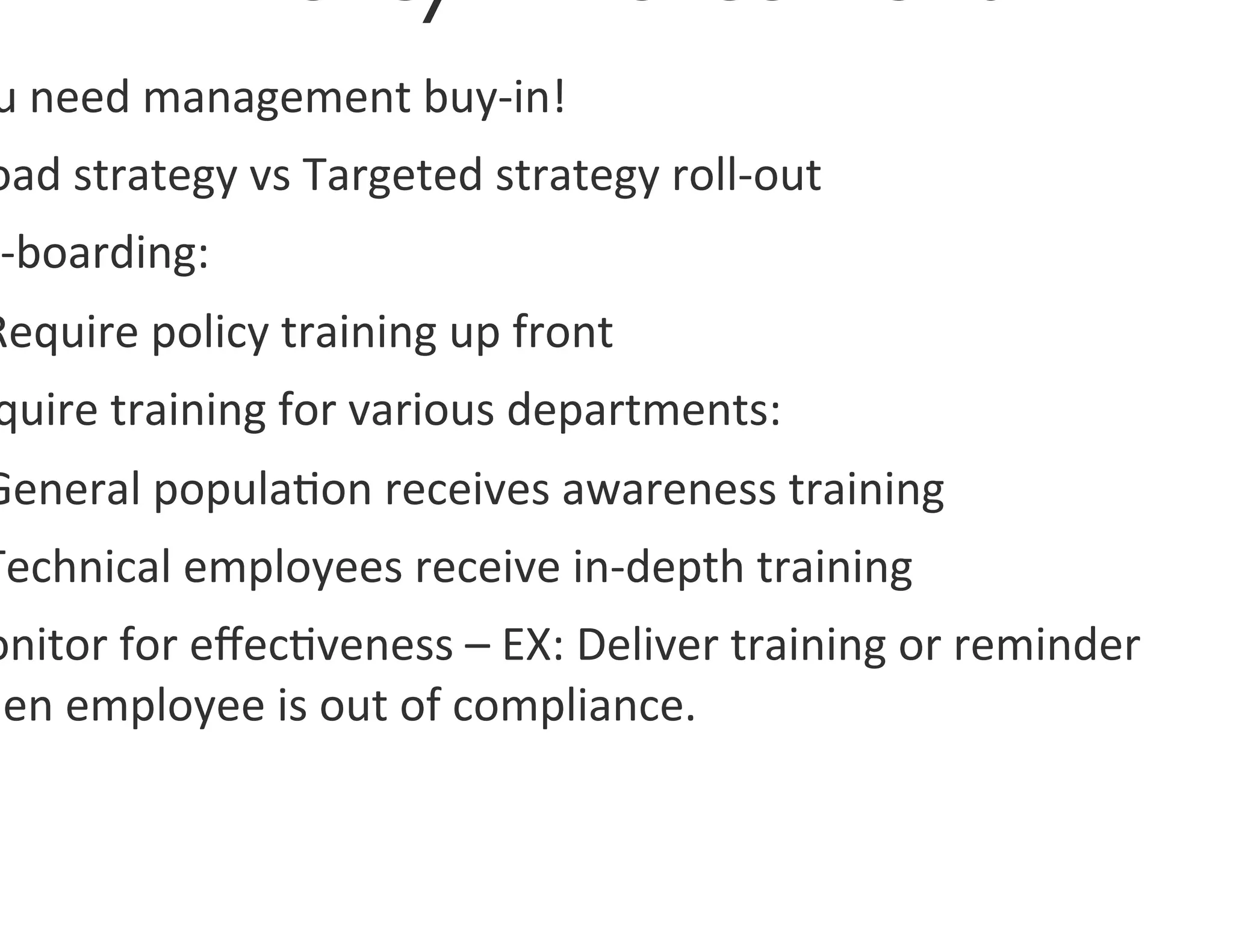
u	
  need	
  management	
  buy-­‐in!	
  
oad	
  strategy	
  vs	
  Targeted	
  strategy	
  roll-­‐out	
  
n-­‐boarding:	
  	
  
Require	
  policy	
  training	
  up	
  front	
  
 quire	
  training	
  for	
  various	
  departments:	
  
General	
  popula0on	
  receives	
  awareness	
  training	
  
Technical	
  employees	
  receive	
  in-­‐depth	
  training	
  
onitor	
  for	
  effec0veness	
  –	
  EX:	
  Deliver	
  training	
  or	
  reminder	
  
hen	
  employee	
  is	
  out	
  of	
  compliance.	
  	
  
Thank You!!
            	

tbain@securityinnova4on.com	
  
    TwiTer:	
  @tmbainjr1	


Streamlining AppSec Policy Definition.pptx

  • 1.
    Managing Software SecurityRisk treamlining AppSec Policy Definition and Implementati For Chicago Security Meetup April 18, 2013 m  Bain   ector,  Product  Marke4ng   curity  Innova4on  
  • 2.
    ector,  Product  Marke0ng,                                   curity  Innova0on   merly  with  Q1  Labs  (an  IBM  Company)   d  Applica0on  Security,  Inc.   0ve  blogger,  presenter   ,  Communica0ons,  RIC;  MS,  Interna0onal   a0ons/Public  Affairs,  UMASS   Thomas  Ba
  • 3.
    Why  SoOware  Security?     ts/Trends    vs  IT  Sec  Need   portance  of  Priori0zing  AppSec   ifferences  Between  App  &  IT  Sec   olicy   remental  policy  construc0on   al-­‐world  policy  improvement   escrip0ve  mapping  to  compliance   Map  AppSec  to  Compliance  Ac0vity   ecommenda0ons   eps  you  should  consider  
  • 4.
    plication Security Experts +  Years  vulnerability  research     curity  Tes0ng  Methodology  adopted  by  SAP,                 crosoO,  Symantec   thors  of  8+  books   ducts and Services andards  -­‐  Best  Prac0ces   uca0on  -­‐  CBT  &  Instructor-­‐Led   sessment  -­‐  SoOware  and  SDLC   ducing Application Security Risk 0cal  Vulnerability  Discovery   cure  SDLC  Rollout  
  • 5.
  • 6.
    Secure at the Protect in Find and Fix Source Production Ø  Education Ø  Vulnerability Scanning Ø  Firewalls Ø  Remediation Ø  Manual Assessments Ø  Whitelisting Ø  Secure Coding Ø  “Whack-A-Mole” Ø  “Band Aid” Standards
  • 7.
    • 97% of breacheswere avoidable through the use of simple controls. • 2012: 174M records breached. • Cost of a breach: $214/record, and $7.2M average overall cost to organization.
  • 8.
    We Still Needto Bridge this Ga 71% 57% 53% Sec 41% Dev 36% 21% Process in place for building Little or no collaboration between Have no formal mandate in place security into applications the two groups for fixing vulnerable code
  • 9.
    Software Apps AreVulnerable d their company has experienced between 1-10 data breaches ove ast 24 months as the result of an application(s) being compromised
  • 10.
    s  lose  autonomy  with   rity  policies  that  aren’t  well-­‐ ned.   ormance  +  capabili0es  oOen   mp  security  =  IT  headache.     s  expect  an  always-­‐on,   re  connec0on  and   0onality   e  to  market  pressures  hurt   rity:  But  good  architecture   backend  systems  can  help.    frameworks  can  help  you   o  market  quickly  can  
  • 11.
    II. AppSec vsInfoSec Policy
  • 12.
    The CIA Triad th  have  policies,  standards,  procedures   orma0on  Security  revolves  around  the   mous  CIA  triad   Maintain  the  confiden0ality,  integrity,  and   vailability  of  informa0on  stored  in  networks   nd  data    communica0ons  infrastructure     ny  so.ware  to  be  considered  secure  it  must  conform  to  thes e  broad  and  high  level  characteris7cs   Vague  industry  standards  that  integrate  these  three  security   characteris0cs  in  an  iden0fiable  and  auditable  manner  for   soOware   SoOware  applica0ons  access  informa0on  unencrypted,  so   policy  around  protec0on  has  to  be  even  more  prescrip0ve  
  • 13.
    Information Security Application Security Based Receptionist, IT Manager, • Architect, Developer, Tester etc • Application Roles and Privileges w to Rollout and Rollout of web application firewall and secure ement configuration of servers, development best practices databases, anti-virus, • Application Authentication checks communications, • Secure Design components certificates, etc. • Attack surface reduction • Code hardening • Data Encryption • Input validation ertise IT networking, database • How applications interact with environment ded to and computer/OS • How applications function and fail with respe ement configuration skills security • Software development skills w/ security over
  • 14.
    SQL Injection Policy ✔  MINIMUM   uild  web  applica0ons  that  defend  against  SQL  injec0on  agacks.   ✔✔  BETTER   uild  web  applica0ons  that  defend  against  SQL  injec0on  agacks  by  sani4zing  all  use put.     ✔✔✔  GOOD   uild  web  applica0ons  that  defend  against  SQL  injec0on  agacks  by  sani0zing  all  use put  using  this  approved  sani4za4on  rou4ne.   ✔✔✔✔  EXCELLENT   …..plus   •  SoOware  Developers  do  X   •  SoOware  Testers  do  Y    
  • 15.
    Protect Sensitive Data  MINIMUM   otect  sensi0ve  data.     ✔  BETTER   otect  sensi0ve  data  by  using  this  approved  encryp4on.   ✔✔  GOOD   otect  sensi0ve  data  by  using  this  approved  encryp0on  in  databases  that  store  and   ring  transmission  of  sensi4ve  data.   ✔✔✔ EXCELLENT   plus   •  Architects  define  algorithms.   •  Developers  never  write  their  own  crypto.   •  Test/QA  verifies  XYZ.  
  • 16.
    Cross-Site Forgery MINIMUM   ate  applica0ons  that  are  resilient  to  Cross-­‐Site  Request  Forgery.     BETTER   ate  soOware  applica0ons  that  are  resilient  to  CSRF  agacks  by  using  the  OWASP  Top RF  Cheat  Sheet.”     ✔✔  GOOD   ate  soOware  applica0ons  that  are  resilient  to  CSRF  agacks  by  using  the  OWASP  Top CSRF  Cheat  Sheet”  and  implement  a  language-­‐appropriate  framework.     ✔✔✔ EXCELLENT   us   Use  challenge-­‐response.   QA  check  reference  headers.  
  • 17.
    App Pen Testing icy:   Conduct  annual  tests  of  internet  facing  applica0ons.”   w  to  improve  it   pecify  the  type  of  test,  e.g.,  web  vulnerability   can,  source  code  review,  paper  audit,  etc.   ow  deep  should  it  go  /  What  should  be  tested?   Ø OWASP  Top  10  vulnerabili0es   efine  the  key  assets  you  are  trying  to  protect.   pecify  which  agacks  should  be  conducted.   Ø Threat  modeling  in  advance  can  guide  you  here.  
  • 18.
    icy   Ensure  applica0ons  processing  data  properly  authen0cate   sers  through  central  authen0ca0on  systems  where  possible.”   If  addi0onal  func0onality  is  needed,  coordinate  development   with  Informa0on  Technology  Services.”     w  to  improve  it   ere  is  our  approved  authen0ca0on  library  URL.   emove  ambiguity.      “Coordinate  with  ITS.”  Rather,  obtain  wrigen  excep0on  for   using  any  authen0ca0on  mechanism  not  explicitly  approved   by  InfoSec  Office     Ø “where  possible”  
  • 19.
    cy   QL  Injec0on  vulnerabili0es  must  be   evented.”   e  OWASP   QL_Injec0on_Preven0on_Cheat_Sheet    for   commenda0ons.    to  improve  it   e  Parameterized  SQL  statements  and  stored   ocedures.   e  white-­‐lis0ng  to  constrain  user  input.   e  company-­‐approved  sanita0on  library,     und  here  URL.  
  • 20.
    III. Map AppSecto Compliance Initiatives
  • 22.
    terprise  Risk  Management,  HR,  and  Legal  define  the  global   pe,  objec7ves  and  requirements  for  corporate   vernance   Applicable  legisla0on  (Sarbanes-­‐Oxley,  HIPAA,  California  SB   386)   ndustry  standards  (ISO  2700x,  FISMA/NIST  standards)   ompliance  mandates  (PCI  DSS)   egal  and  human  resources  requirements  (data  privacy   aws)   oten0al  impacts  of  security  breaches   osts  of  security  breaches  and  agacks  
  • 23.
    M,  GRC    Security  teams  add  detail  to  create  policies   igh-­‐level  guidelines  for  opera0onal  security  and  compliance   c0vi0es   an  be  contextualized  for  specific  business  units  and  func0onal oles   ical  tasks  include:   tudying  the  applicable  regula0ons  and  standards   onduc0ng  a  threat  assessment  to  determine  the  security  brea oten0ally  most  damaging  to  the  enterprise   lassifying  data  assets  to  define  levels  of  data  sensi0vity   efining  concrete  applica0on  security  objec0ves  
  • 24.
    curity    Compliance  teams  define  specific  development   ocesses,  coding  prac7ces,  and  procedures  for  compliance   ocumenta7on   Ensures  they’re  relevant  to  local  requirements  and  technology and  consistent  with  corporate  security  and  compliance  policie Address  regional  and  business-­‐unit  specific  regula0ons  and  th technologies  used  by  each  team   ontextualizing  policies  for  each  team  can  be  a  labor-­‐intensive nd  deeply  technical  process   Saves  a  TON  of  0me  long-­‐term   Reduce  risk  over  0me  with  specific    prac0cal  the  guidance  
  • 25.
    The Compliance Matrix vel Other Standards Selected Coding Practices ent (Partial List) lity SOX, HIPAA, ISO - Appropriate use of strong encryption for data in databases. 27002,, GLBA, - Encrypting confidential data in memory. No custom or untrusted encryption routines FFIEC, Basel l I, - Encrypting data in motion, especially for wireless transmissions. CA SB 1386, FIPS - Masking confidential data that needs to be viewed in part 199, NIST ty SOX, ISO 27002, - Robust integrity checks to prevent tampering with data. HIPAA, GLBA, - Input validation and comprehensive error handling to prevent injection attacks, privil FIPS 199, NIST escalation, and other hacking techniques. - Output encoding. Use of least privileges. - Hashing for confidential data that needs to be validated (e.g. passwords) ion SOX, ISO 27002, - Support for strong passwords two-factor authentication where appropriate. HIPAA, II, NIST - Role-based access control and revocation of rights, with clear roles mapped to perm SP - Locked down file access and database roles. No guest accounts. - Passwords and encryption keys encrypted before storage and transmission. d SOX, ISO 27002, - Detailed audit trails of users accessing data and resources. HIPAA, SB 1386, - Detailed logging of systems that process sensitive data, including shutdowns, restar NIST SP unusual events. No confidential data exposed in logs. - Event logs and audit trails available only to system admins and protected from unau modifications.
  • 26.
    IV. Streamline AppSecPolicy Development to Fit Your Busines
  • 27.
    onsider  risk  scenarios.   dapt  from  proven  or  trustworthy   models.   Measure  percep0on.   nderstand  roles/privileges.   et  granular.   gure  out  a  strategy  for  tes0ng  your   pplica0ons.     onsider  BYOD.     olicy  enforcement.   aise  awareness/required  training.  
  • 28.
     an  inventory  of  your  high-­‐risk   ica0ons.   ermine  business  cri0cality.     t’s  your  agack  probability?    do  you  define  the  agack  surface?   sider  overall  business  impact.   re  does  compliance  factor  in?   t  are  the  security  threats?  
  • 29.
    njec0on   •  A6  Sensi0ve  Data  Exposure Broken  Authen0ca0on  and   (merged  from  former     ion  Management     •  A7  Insecure  Cryptographic Cross-­‐Site  Scrip0ng  (XSS)  (was   Storage   merly  A2)   •  A8  Cross-­‐Site  Request  Forg nsecure  Direct  Object   (CSRF)   erences   •  A9  Using  Known  Vulnerabl ecurity  Misconfigura0on  (was   Components   merly  A6)   •  A10  Unvalidated  Redirects Forwards  
  • 30.
    tudes  of  general  popula0on  toward   urity  (suppor0ve,  antagonis0c,   fferent?)   tudes  of  general  popula0on  toward   nagement  (suppor0ve,  antagonis0c,   fferent?)     w  does  management  view  the   c0on  of  security?   at’s  the  percep0on  of  current   cy?   e  there  been  related  security   dents?    
  • 31.
    h  departments/groups/individuals    been  most  ac0ve  in  developing   ies?     ous  collabora0on  between  policies   authors?   n0al  champion(s)  to  support?     s  of  agreement  in  commonly   emented  controls  re:  policies?   ort  docs,  materials  and  related   ies  should  be  cited  in  mobile  device   y.    to  understand  user  access  and   eges.  
  • 32.
    hich  applica0ons  would  be  used?   w  will  web  applica0ons  be  used?   hat  will  access  and  levels  of  privilege  look  like?     hat  informa0on  is  accessible  through  web  applica0ons?     hat  informa0on  will  be  stored  on  web  applica0ons?     w  will  data  be  shared  to/from  web  applica0ons?     ho’s  ul0mately  responsible  for  applica0on  security?     hich  applica0ons  are  acceptable  to  use?     hich  applica0ons  should  not  be  used?   hat  levels  of  support  are  expected?    
  • 33.
     sensi0ve  is  your  data?   t  kind  of  data  is  it?  PII,  customer   ,  credit  card  data,  proprietary,  IP,   subject  to  regulatory  mandates?   ch  ones?   you  encryp0ng  data?  At  rest?  In   sit?   duct  a  threat  model:   termine  threats   en0fy  poten0al  agacks   nderstand  the  frequency    severity   th  which  they  are  executed.  
  • 34.
    Application Criteria hreat Sensitive Compliance Custo Lifespan ating Data Stringency Faci ier 1 Restricted Long High Ye ier 2 Private Mid Medium Ye ier 3 Public Short N/A No
  • 35.
    Depth, Breadth, Frequency reat Static Dynamic Manual Pen Thre ting Analysis Analysis Test Mode Complete/ Complete/ Complete/ Compl Frequency Frequency Frequency Freque Required/Major Required/Major Required/Per Require er 1 code changes code changes Milestone Relea Suggested/ Required/ Required/Per Suggeste er 2 Monthly Quarterly Release Relea Optional/ Required/ Optional/As Option er 3 Quarterly Annually Needed Need
  • 36.
    ile  devices  help  employees  increase   uc0vity  –  staying  connected  is  not   y  op0onal  anymore!   ge  has  experienced  a  massive  up0ck:    of  today’s  workforce  is  using  a   rtphone  specifically  for  business  use.   struggling  to  keep  up  with  device   agement.   ility  by  its  nature  opens  up  a  larger   ck  surface  with  more  points  of  entry.   cult  to  measure  business  need   ugh  IT  Security  lens.  
  • 37.
    %  use  the  same  smartphone  for   rk  and  for  personal  usage.   %  of  employed  adults  use  at   st  one  personally  owned   ctronic  device  for  business   rris  Interac0ve  survey,   ruary  2012)   %  of  employees  surveyed  use   bile  devices  to  run  line-­‐of-­‐ iness  applica0ons  (Ibid)   %  of  companies  allow  BYOD   ge  in  some  manner  (Aberdeen   up,  February  2011)  
  • 38.
    %  of  companies  have  experienced   ata  breach  due  to  inadequate   ice  security  (Ponemon  survey,   2)   %  don’t  have  a  password  on  their   bile  phone.   %  stated  their  companies  couldn’t   cute  a  remote  wipe  if  lost  or   en.   %  said  mobile  security  has  not   n  addressed  with  them  by  IT.  
  • 39.
    Why is BYODa Security Problem evice  turn-­‐over:  What  happens  to  the  old  device?     ew  devices:  Default  or  customized  se|ngs?   ow  can  you  know  everything  about  every  device?   Oware  updates  –  user  vs  IT.   pp  Stores:  Approved  apps?     pplica0ons:   What  data  is  on  your  device?   What  enterprise  applica0ons  can  you  connect  to?   Which  apps  are  connected  to  other  apps?  EX:  Your  blog  app  is connected  to  your  CMS,  which  feeds  to  Twiger,  etc.    
  • 40.
    Device Security consistent  security  policies   ptop  encryp0on  bypass  mode   nmanageable  devices   ared  media  leakage   inimal  device  management   eadable  data  on  disposed-­‐of   evices   ter-­‐applica0on  data  leakage  
  • 41.
    bile Traditional nerabilities Vulnerabilities
  • 42.
    scribes  contextual,  technical  guidelines  on  how  security  shou integrated  within  the  SDLC   y  phase,  role,  technology,  applica0on  type   everages  internal  secure  development  champion(s)  for  input   ps  to  compliance  mandates   nsiders  cri7cality  of  applica7on  and  data   equirements,  ac0vi0es  and  level  of  detail  needed  will  differ   s  a  clear  excep7on  policy   What  if  minimum  standards  can’t  be  met?  What  is  considered   cceptable?  Who  approves?   ludes  internally  built  and  third  party  applica7ons   flects  current  maturity  and  secure  development  skills  
  • 43.
    u  need  management  buy-­‐in!   oad  strategy  vs  Targeted  strategy  roll-­‐out   n-­‐boarding:     Require  policy  training  up  front   quire  training  for  various  departments:   General  popula0on  receives  awareness  training   Technical  employees  receive  in-­‐depth  training   onitor  for  effec0veness  –  EX:  Deliver  training  or  reminder   hen  employee  is  out  of  compliance.    
  • 44.
    Thank You!! tbain@securityinnova4on.com   TwiTer:  @tmbainjr1