Security Testing
Fundamentals
Presented by Cygnet Infotech Pvt. Ltd.
Overview
• Security Testing is deemed successful when the
below attributes of an application are intact
• Authentication
• Authorization
• Availability
• Confidentiality
• Integrity
• Non-Repudiation
www.cygnet-infotech.com
Authentication
• To confirm that something or someone is
authentic – true to the claims.
• The digital identity of a user is validated and
verified.
www.cygnet-infotech.com
Authorization
• To ensure that a person/program is authorized to
see the contents or make changes in an
application.
• User/Access rights are used.
www.cygnet-infotech.com
Availability
• To ensure that an application is up and running; its
services and information available as and when
needed.
• Number of failures are reduced and backups are
kept ready.
www.cygnet-infotech.com
Confidentiality
• To make sure that the information and services
are available only when requested by and for
intended users.
• Penetration testing is done and defects are fixed.
www.cygnet-infotech.com
Integrity
• To ensure that the service provides the user with
correct information.
• It is also essential to make sure that no obsolete
or outdated information is presented.
www.cygnet-infotech.com
Non-repudiation
• To ensure that the message was sent and received
by authentic users only.
• The sender/receiver must not be able to deny
their involvement.
www.cygnet-infotech.com
When to start Security Testing?
• In general, testing must start early to minimize
defects and cost of quality.
• Security testing must start right from the
Requirements Gathering phase to make sure that
the quality of end-product is high.
• This is to ensure that any intentional/unintentional
unforeseen action does not halt or delay the
system.
www.cygnet-infotech.com
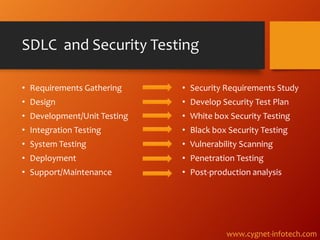
SDLC and Security Testing
• Requirements Gathering
• Design
• Development/Unit Testing
• Integration Testing
• System Testing
• Deployment
• Support/Maintenance
• Security Requirements Study
• Develop Security Test Plan
• White box Security Testing
• Black box Security Testing
• Vulnerability Scanning
• Penetration Testing
• Post-production analysis
www.cygnet-infotech.com
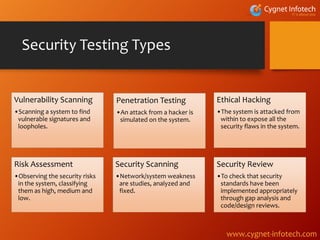
Security Testing Types
www.cygnet-infotech.com
Vulnerability Scanning
•Scanning a system to find
vulnerable signatures and
loopholes.
Penetration Testing
•An attack from a hacker is
simulated on the system.
Ethical Hacking
•The system is attacked from
within to expose all the
security flaws in the system.
Risk Assessment
•Observing the security risks
in the system, classifying
them as high, medium and
low.
Security Scanning
•Network/system weakness
are studies, analyzed and
fixed.
Security Review
•To check that security
standards have been
implemented appropriately
through gap analysis and
code/design reviews.
About Cygnet Infotech
• We are a global IT services & solutions provider.
• We provide custom software development services
across technologies and domains to our clients in
over 23 countries.
• We are ISO 9001, ISO 27001 and CMMi Level III
Certified
www.cygnet-infotech.com
Enterprise QA & Software Testing
• We provide following testing services
• Functional Testing
• Performance Testing
• Load Testing
• Automated Testing
• Security Testing
• Mobile Testing
www.cygnet-infotech.com
Contact Us
• Email: info@cygnet-infotech.com
• Twitter: @cygnetinfotech
• Skype: cygnet-infotech-pvt-ltd

Security testing fundamentals

  • 1.
  • 2.
    Overview • Security Testingis deemed successful when the below attributes of an application are intact • Authentication • Authorization • Availability • Confidentiality • Integrity • Non-Repudiation www.cygnet-infotech.com
  • 3.
    Authentication • To confirmthat something or someone is authentic – true to the claims. • The digital identity of a user is validated and verified. www.cygnet-infotech.com
  • 4.
    Authorization • To ensurethat a person/program is authorized to see the contents or make changes in an application. • User/Access rights are used. www.cygnet-infotech.com
  • 5.
    Availability • To ensurethat an application is up and running; its services and information available as and when needed. • Number of failures are reduced and backups are kept ready. www.cygnet-infotech.com
  • 6.
    Confidentiality • To makesure that the information and services are available only when requested by and for intended users. • Penetration testing is done and defects are fixed. www.cygnet-infotech.com
  • 7.
    Integrity • To ensurethat the service provides the user with correct information. • It is also essential to make sure that no obsolete or outdated information is presented. www.cygnet-infotech.com
  • 8.
    Non-repudiation • To ensurethat the message was sent and received by authentic users only. • The sender/receiver must not be able to deny their involvement. www.cygnet-infotech.com
  • 9.
    When to startSecurity Testing? • In general, testing must start early to minimize defects and cost of quality. • Security testing must start right from the Requirements Gathering phase to make sure that the quality of end-product is high. • This is to ensure that any intentional/unintentional unforeseen action does not halt or delay the system. www.cygnet-infotech.com
  • 10.
    SDLC and SecurityTesting • Requirements Gathering • Design • Development/Unit Testing • Integration Testing • System Testing • Deployment • Support/Maintenance • Security Requirements Study • Develop Security Test Plan • White box Security Testing • Black box Security Testing • Vulnerability Scanning • Penetration Testing • Post-production analysis www.cygnet-infotech.com
  • 11.
    Security Testing Types www.cygnet-infotech.com VulnerabilityScanning •Scanning a system to find vulnerable signatures and loopholes. Penetration Testing •An attack from a hacker is simulated on the system. Ethical Hacking •The system is attacked from within to expose all the security flaws in the system. Risk Assessment •Observing the security risks in the system, classifying them as high, medium and low. Security Scanning •Network/system weakness are studies, analyzed and fixed. Security Review •To check that security standards have been implemented appropriately through gap analysis and code/design reviews.
  • 12.
    About Cygnet Infotech •We are a global IT services & solutions provider. • We provide custom software development services across technologies and domains to our clients in over 23 countries. • We are ISO 9001, ISO 27001 and CMMi Level III Certified www.cygnet-infotech.com
  • 13.
    Enterprise QA &Software Testing • We provide following testing services • Functional Testing • Performance Testing • Load Testing • Automated Testing • Security Testing • Mobile Testing www.cygnet-infotech.com
  • 14.
    Contact Us • Email:info@cygnet-infotech.com • Twitter: @cygnetinfotech • Skype: cygnet-infotech-pvt-ltd