
MODERN OPERATIONAL
       RISK
   MANAGEMENT

   PRESENTATION
GROUP MEMBERS


b) SAIFULLAHMALIK
c) RAHEEM ANSER

SUBMITTED TO
MISS SHAFAQ
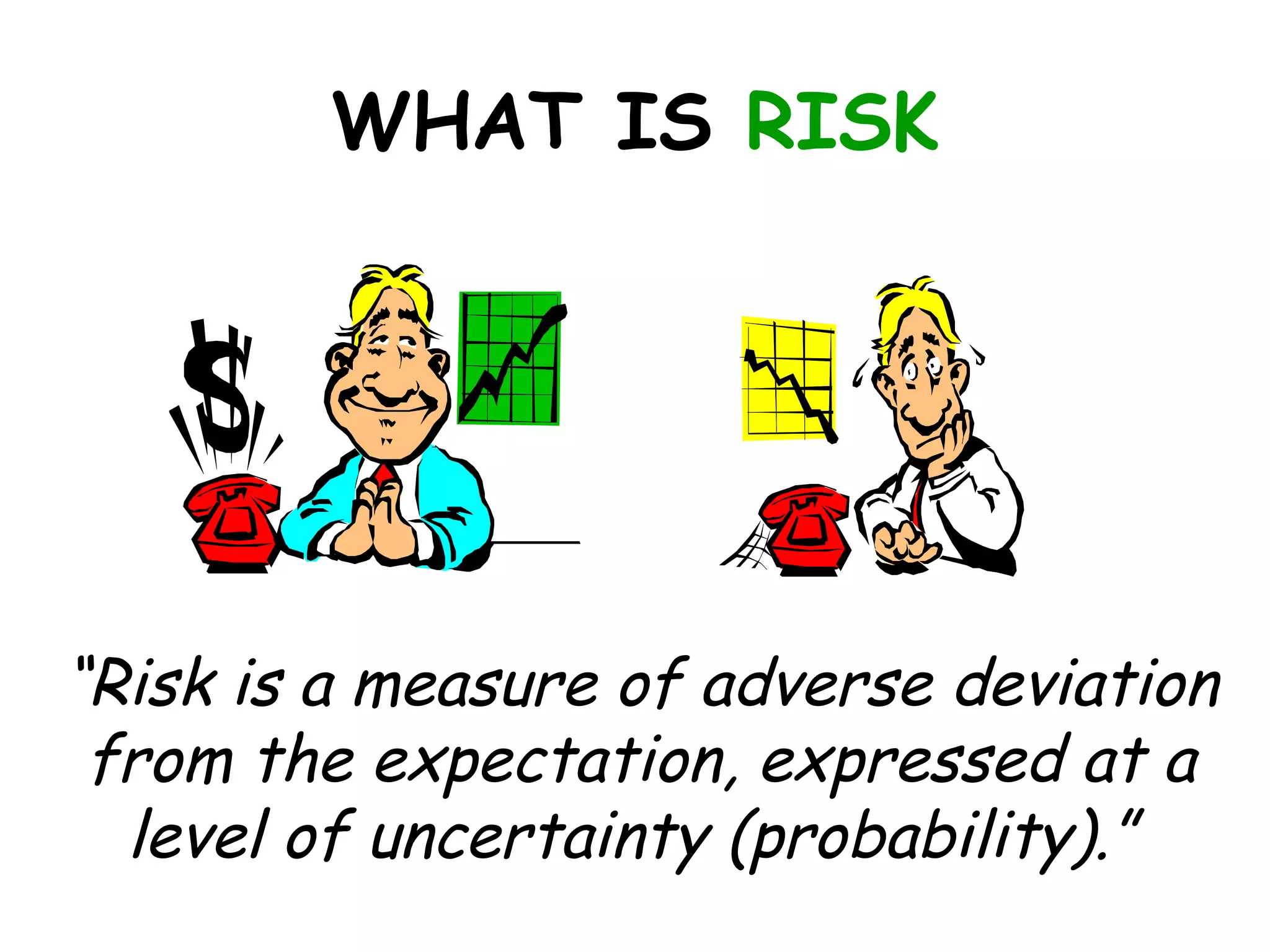
WHAT IS RISK


“Risk is a measure of adverse deviation
 from the expectation, expressed at a
  level of uncertainty (probability).”
BASEL II(OPERATIONAL RISK)
"The risk of loss resulting from inadequate or
failed internal processes, people and systems or
from external events."
SCOPE EXCLUSION
f. Strategic Risk - the risk of a loss arising
  from a poor strategic business decision.
h. Reputational Risk (damage to an organization
  through loss of its reputation or standing) can
  arise as a consequence (or impact) of
  operational failures
BASEL II EVENT TYPE
         CATEGORIES
i. Internal Fraud
ii. External Fraud
iii. Employment Practices and Workplace
     Safety
iv. Damage to Physical Assets
v. Business Disruption & Systems
     Failures
vi. Execution, Delivery, & Process
     Management
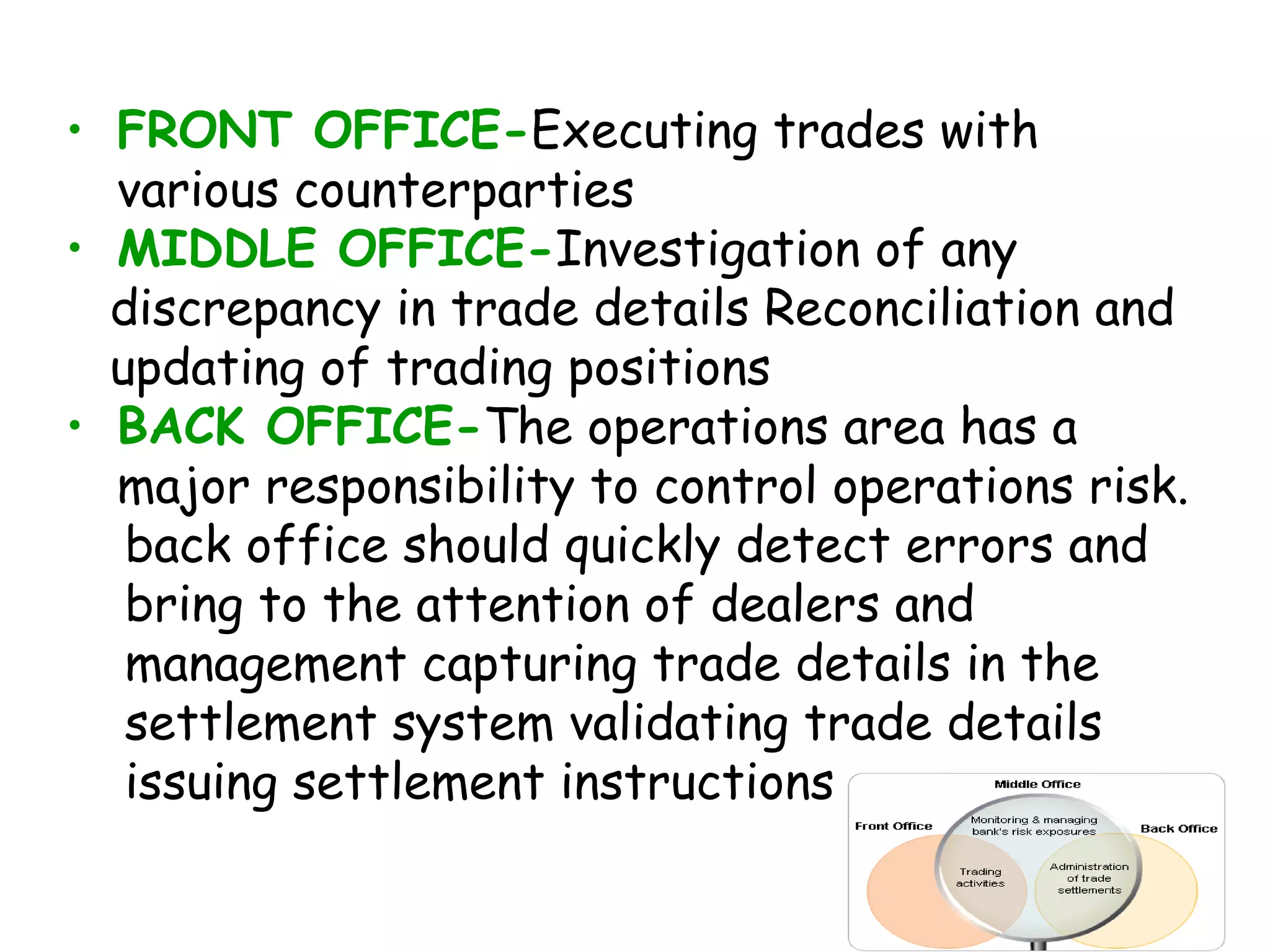
• FRONT OFFICE-Executing trades with
  various counterparties
• MIDDLE OFFICE-Investigation of any
  discrepancy in trade details Reconciliation and
  updating of trading positions
• BACK OFFICE-The operations area has a
  major responsibility to control operations risk.
   back office should quickly detect errors and
   bring to the attention of dealers and
   management capturing trade details in the
   settlement system validating trade details
   issuing settlement instructions
OPERATIONAL RISK
        (CHARACTERIZED)
unconscious execution errors and
processing are normal operational failures
Operational risk, by contrast, is driven
primarily by “non-normal” operational
failures, particularly conscious violations
of professional or moral standards and
excessive risk taking. Examples include
sales practice violations and unauthorized
trading activities
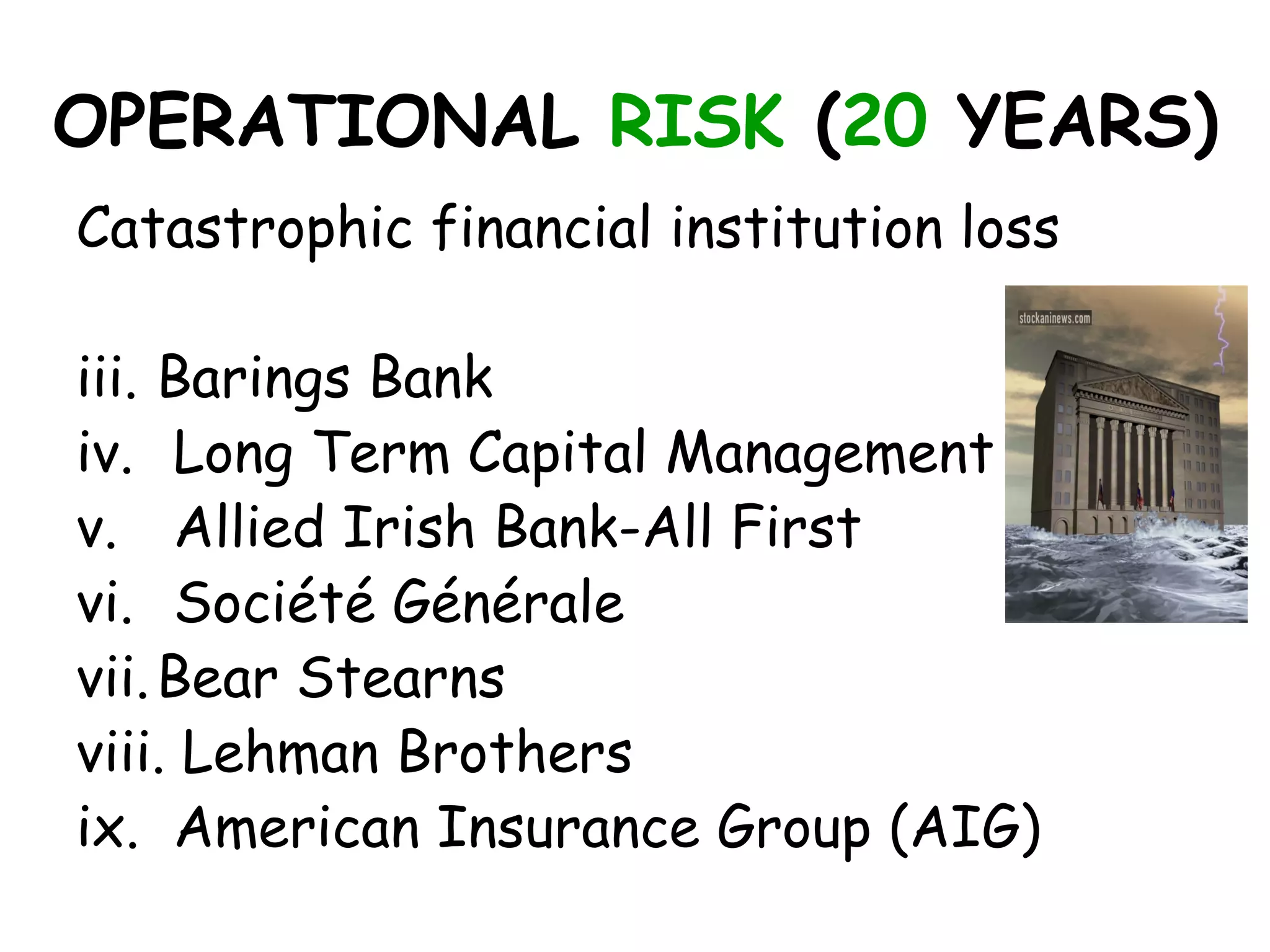
OPERATIONAL RISK (20 YEARS)
Catastrophic financial institution loss

iii. Barings Bank
iv. Long Term Capital Management
v. Allied Irish Bank-All First
vi. Société Générale
vii. Bear Stearns
viii. Lehman Brothers
ix. American Insurance Group (AIG)
TRADITIONAL ORM
        (PROBLEM-Example)
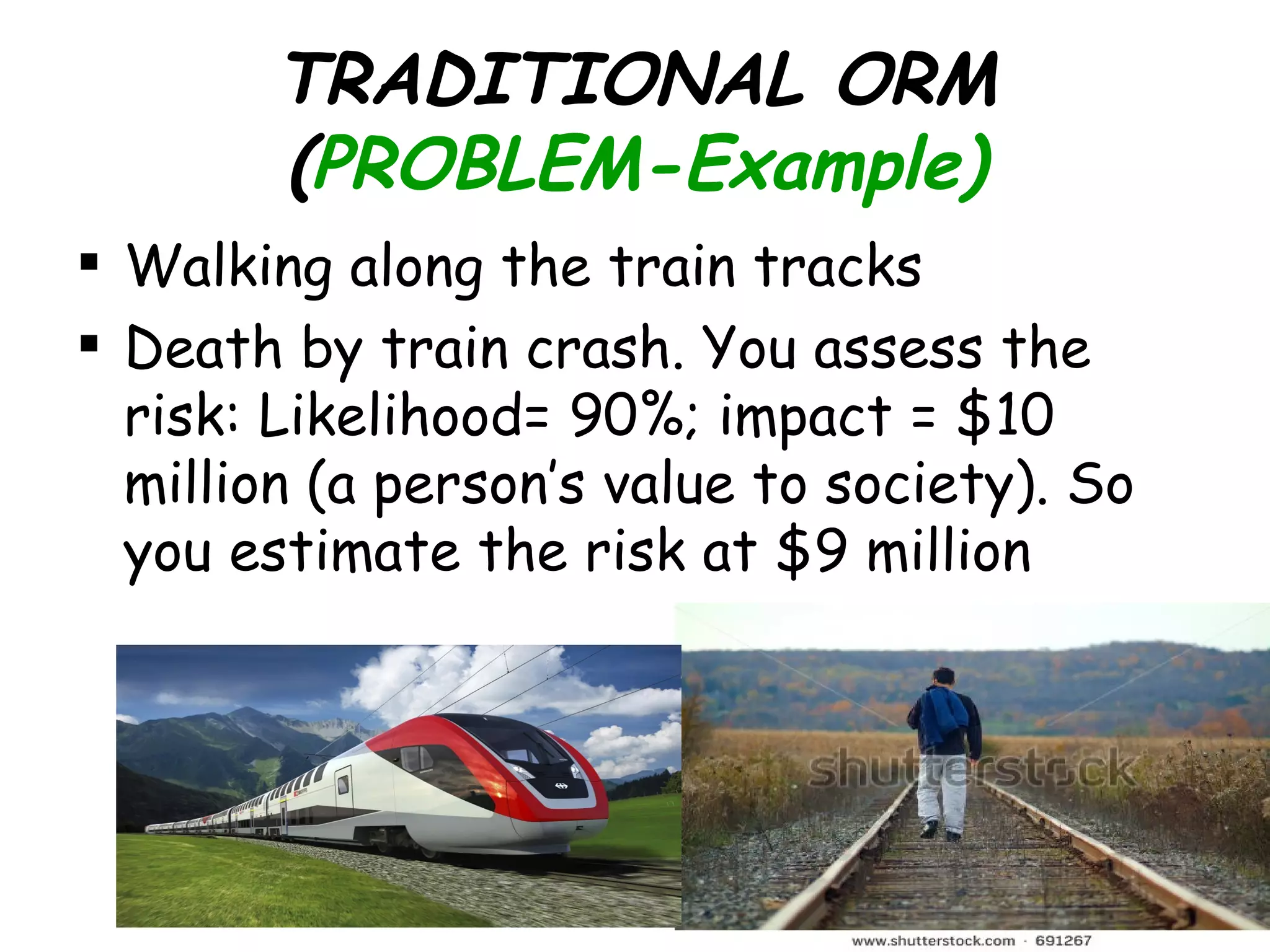
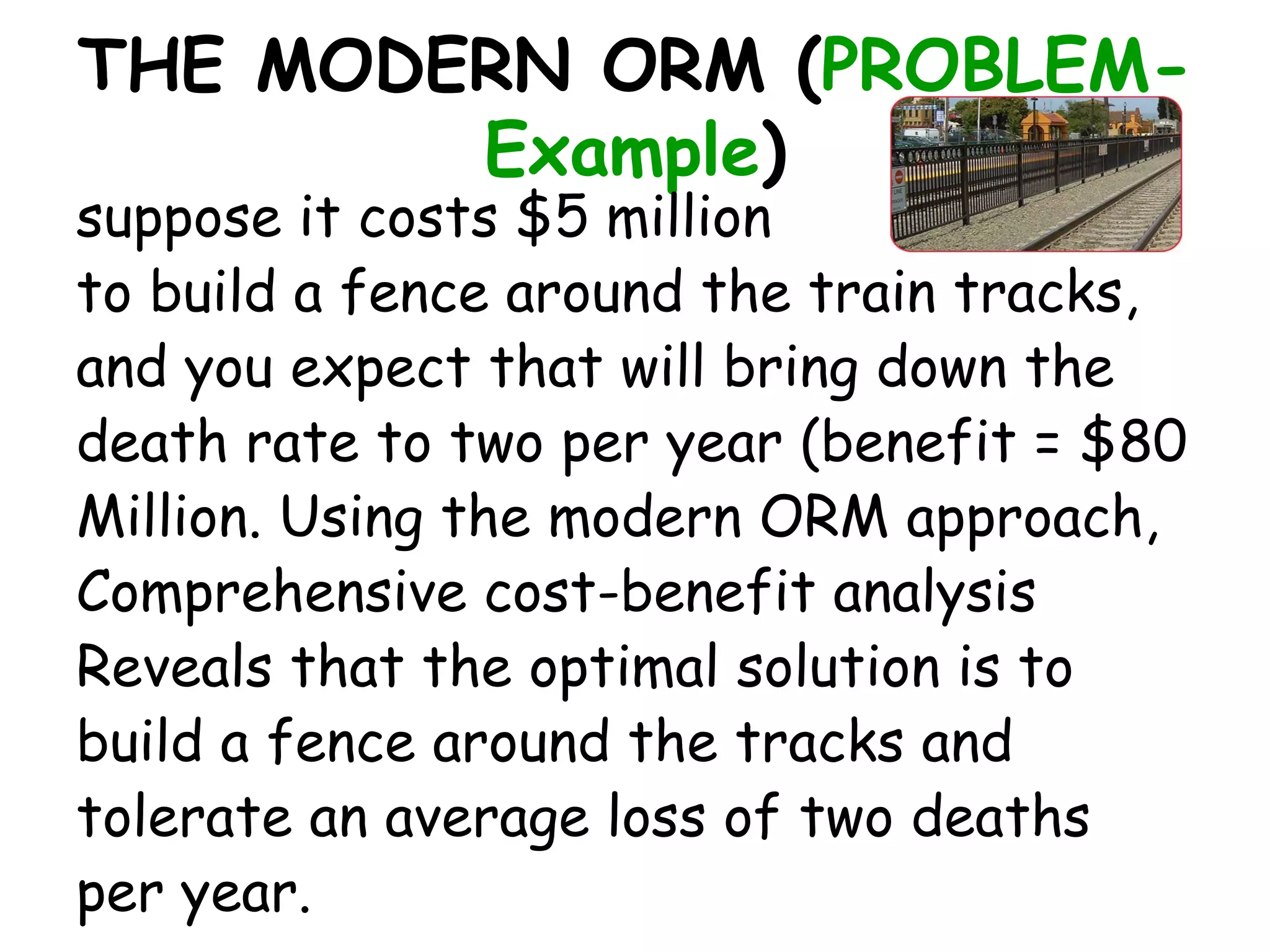
 Walking along the train tracks
 Death by train crash. You assess the
  risk: Likelihood= 90%; impact = $10
  million (a person’s value to society). So
  you estimate the risk at $9 million
THE MODERN ORM (PROBLEM-
        Example)
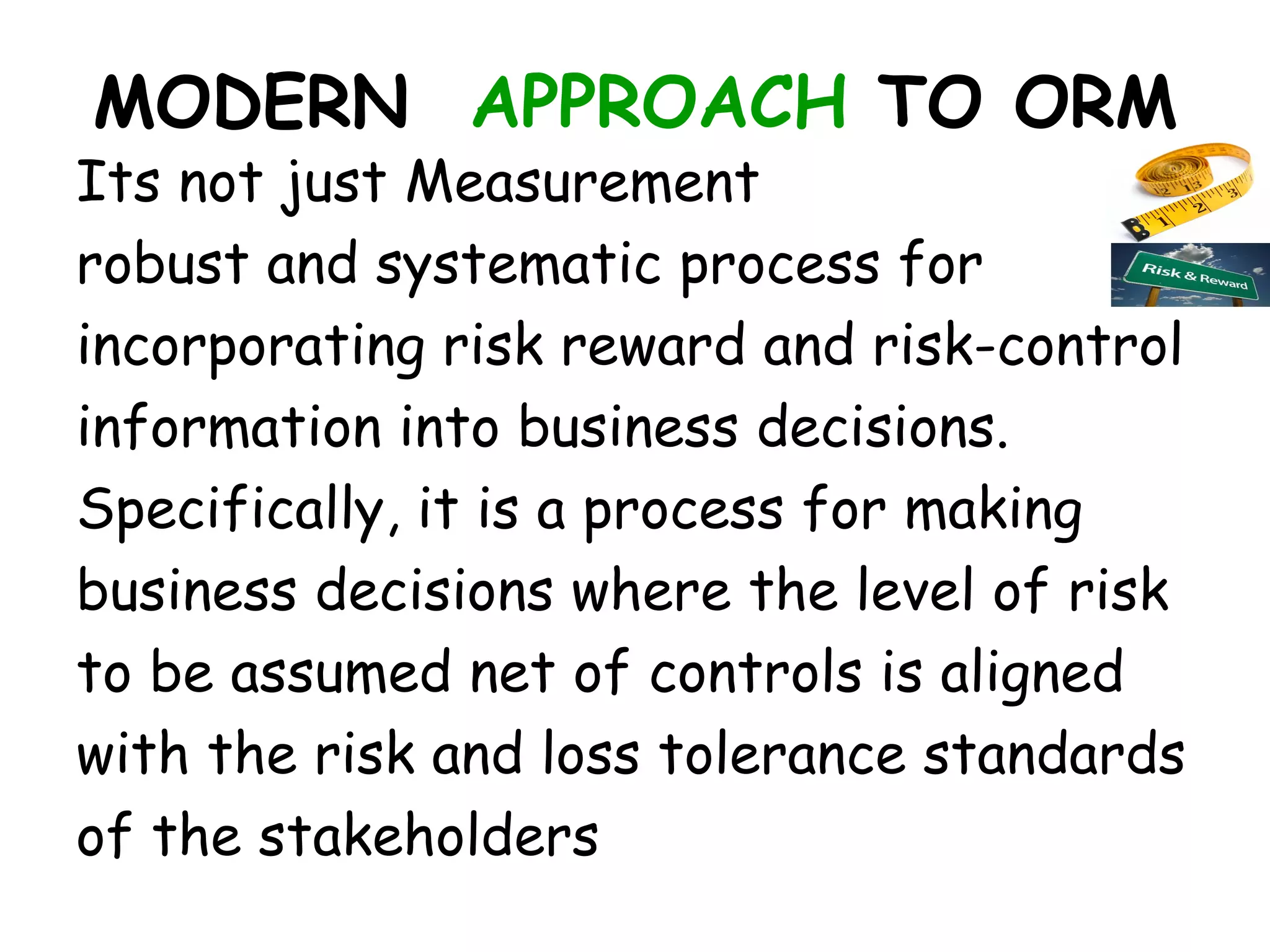
suppose it costs $5 million
to build a fence around the train tracks,
and you expect that will bring down the
death rate to two per year (benefit = $80
Million. Using the modern ORM approach,
Comprehensive cost-benefit analysis
Reveals that the optimal solution is to
build a fence around the tracks and
tolerate an average loss of two deaths
per year.
MODERN APPROACH TO ORM
Its not just Measurement
robust and systematic process for
incorporating risk reward and risk-control
information into business decisions.
Specifically, it is a process for making
business decisions where the level of risk
to be assumed net of controls is aligned
with the risk and loss tolerance standards
of the stakeholders
MODERN ORM FRAMEWORK
       (RISK ASSESSMENT)
i.   Portfolio of risks using an
     “organizational unit-risk class” matrix.
ii. Determining which businesses to
     invest in based on their risk-reward
     relationship
iii. Which risk mitigation strategies to
      employ by optimizing the risk-reward
     and risk control relationship across
     the full spectrum of exposures
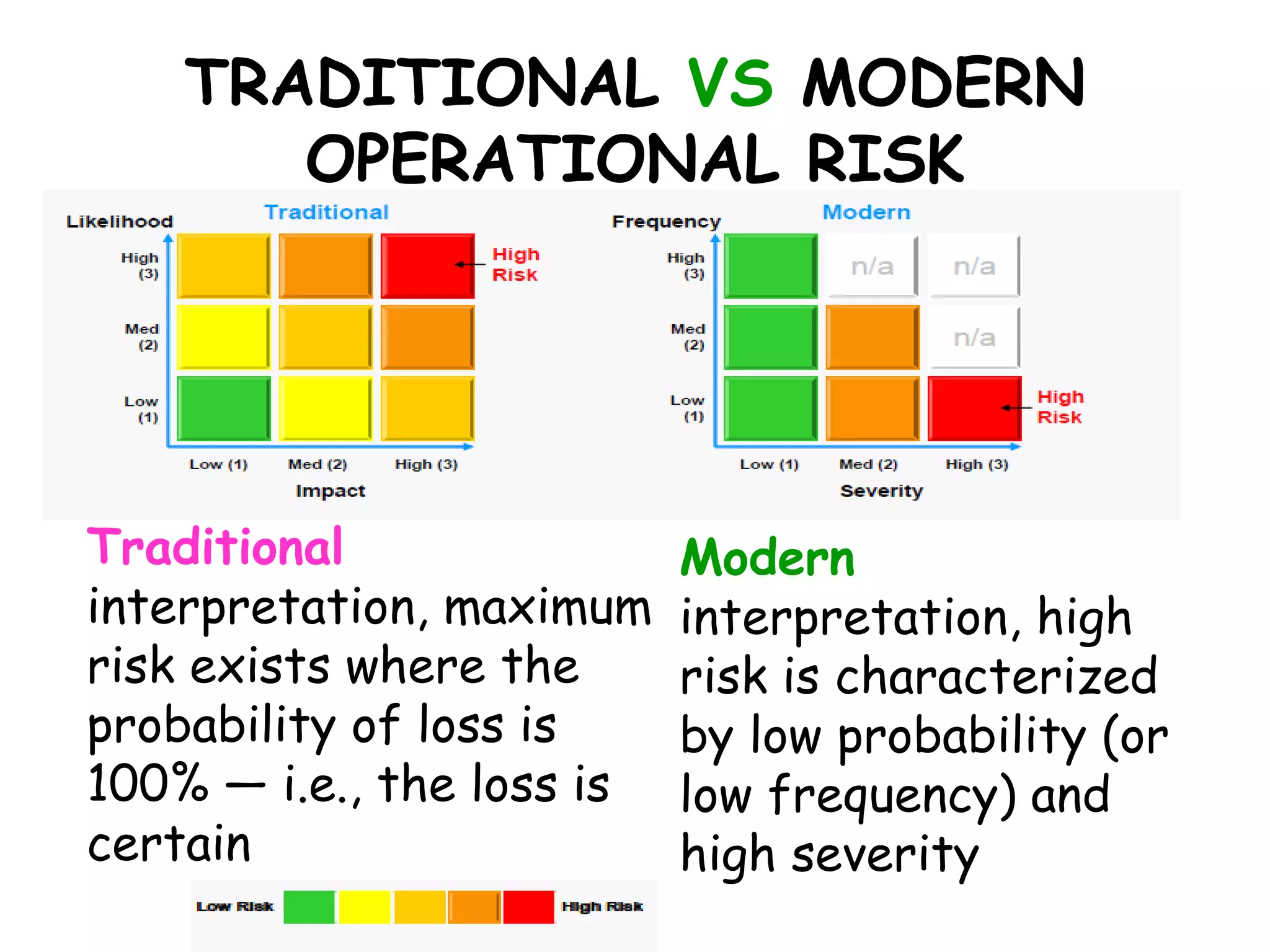
TRADITIONAL VS MODERN
       OPERATIONAL RISK


Traditional                Modern
interpretation, maximum    interpretation, high
risk exists where the      risk is characterized
probability of loss is     by low probability (or
100% — i.e., the loss is   low frequency) and
certain                    high severity
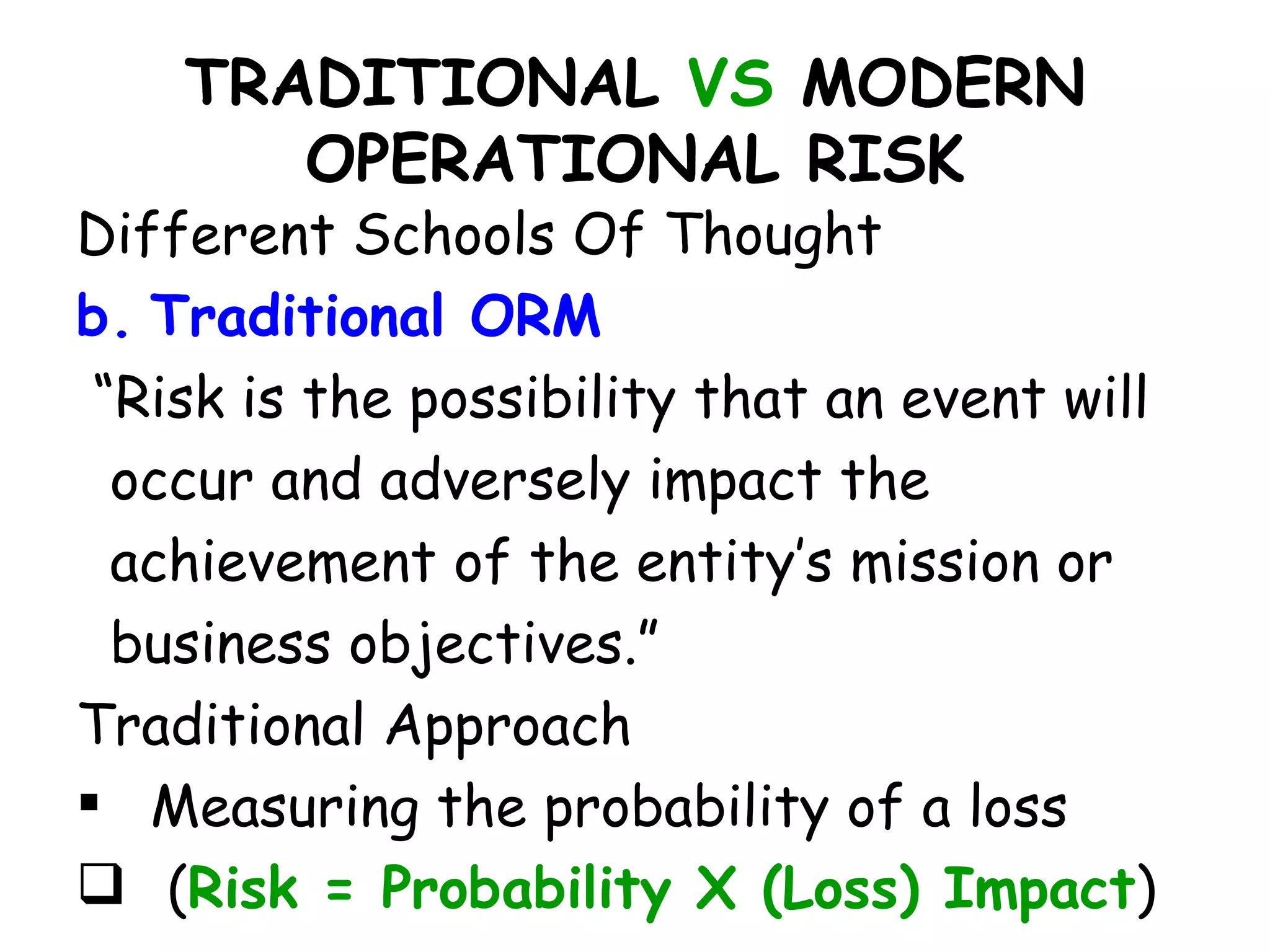
TRADITIONAL VS MODERN
       OPERATIONAL RISK
Different Schools Of Thought
b. Traditional ORM
 “Risk is the possibility that an event will
  occur and adversely impact the
  achievement of the entity’s mission or
  business objectives.”
Traditional Approach
 Measuring the probability of a loss
 (Risk = Probability X (Loss) Impact)
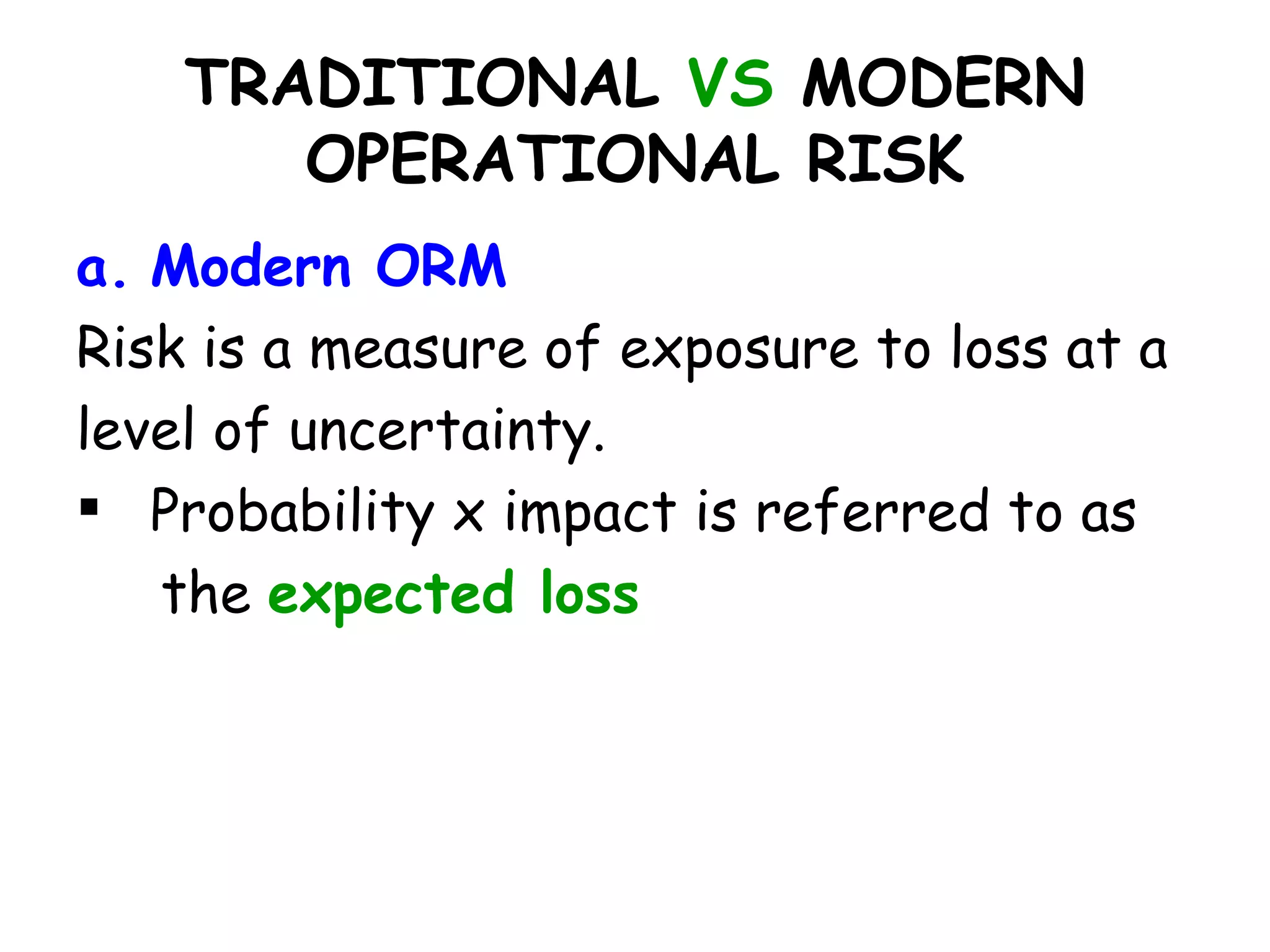
TRADITIONAL VS MODERN
       OPERATIONAL RISK
a. Modern ORM
Risk is a measure of exposure to loss at a
level of uncertainty.
 Probability x impact is referred to as
   the expected loss
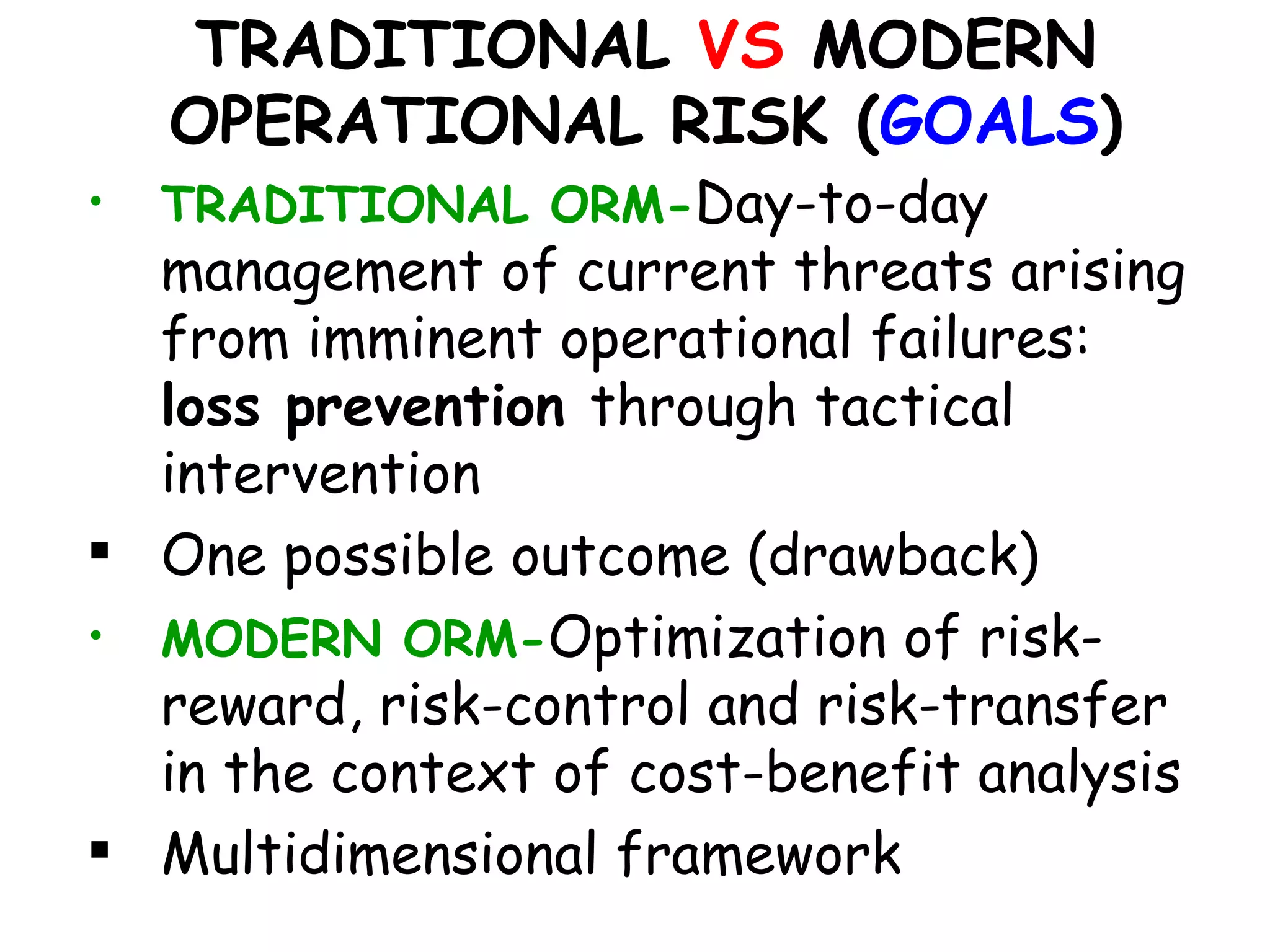
TRADITIONAL VS MODERN
    OPERATIONAL RISK (GOALS)
•   TRADITIONAL ORM-Day-to-day
  management of current threats arising
  from imminent operational failures:
  loss prevention through tactical
  intervention
 One possible outcome (drawback)
• MODERN ORM-Optimization of risk-
  reward, risk-control and risk-transfer
  in the context of cost-benefit analysis
 Multidimensional framework
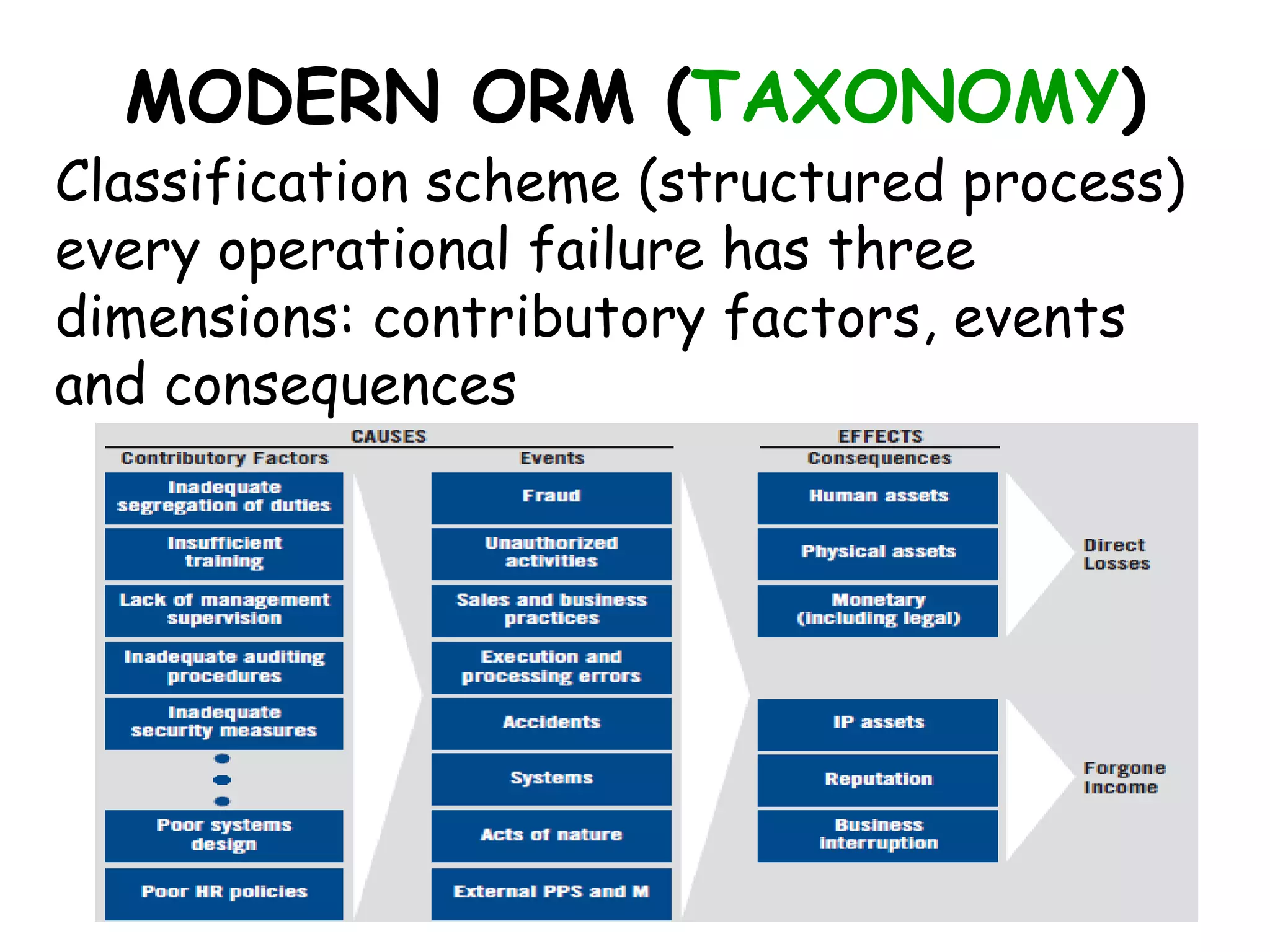
MODERN ORM (TAXONOMY)
Classification scheme (structured process)
every operational failure has three
dimensions: contributory factors, events
and consequences
THANKS
Traditional ORM, the terms likelihood and
  frequency are often used synonymously,
  but under Modern ORM these terms have
  very different meanings. Likelihood means
  probability and is generally used in the
  context of a single incident or scenario
  (e.g., the likelihood of getting into a car
  accident today is 5%). Likelihood is
  measured on a scale of 0 to 1 (or 0 to
  100%)
Frequency describes the number of events
  (e.g., 10 losses per year). Frequency is
  measured on a scale of 0 to infinity. Mean
  frequency is the average number of
  events that have taken place or are
  expected to take place during a specified
  period of time.

Modern operational risk

  • 1.
    MODERN OPERATIONAL RISK MANAGEMENT PRESENTATION
  • 2.
    GROUP MEMBERS b) SAIFULLAHMALIK c)RAHEEM ANSER SUBMITTED TO MISS SHAFAQ
  • 3.
    WHAT IS RISK “Riskis a measure of adverse deviation from the expectation, expressed at a level of uncertainty (probability).”
  • 4.
    BASEL II(OPERATIONAL RISK) "Therisk of loss resulting from inadequate or failed internal processes, people and systems or from external events." SCOPE EXCLUSION f. Strategic Risk - the risk of a loss arising from a poor strategic business decision. h. Reputational Risk (damage to an organization through loss of its reputation or standing) can arise as a consequence (or impact) of operational failures
  • 5.
    BASEL II EVENTTYPE CATEGORIES i. Internal Fraud ii. External Fraud iii. Employment Practices and Workplace Safety iv. Damage to Physical Assets v. Business Disruption & Systems Failures vi. Execution, Delivery, & Process Management
  • 6.
    • FRONT OFFICE-Executingtrades with various counterparties • MIDDLE OFFICE-Investigation of any discrepancy in trade details Reconciliation and updating of trading positions • BACK OFFICE-The operations area has a major responsibility to control operations risk. back office should quickly detect errors and bring to the attention of dealers and management capturing trade details in the settlement system validating trade details issuing settlement instructions
  • 7.
    OPERATIONAL RISK (CHARACTERIZED) unconscious execution errors and processing are normal operational failures Operational risk, by contrast, is driven primarily by “non-normal” operational failures, particularly conscious violations of professional or moral standards and excessive risk taking. Examples include sales practice violations and unauthorized trading activities
  • 8.
    OPERATIONAL RISK (20YEARS) Catastrophic financial institution loss iii. Barings Bank iv. Long Term Capital Management v. Allied Irish Bank-All First vi. Société Générale vii. Bear Stearns viii. Lehman Brothers ix. American Insurance Group (AIG)
  • 9.
    TRADITIONAL ORM (PROBLEM-Example)  Walking along the train tracks  Death by train crash. You assess the risk: Likelihood= 90%; impact = $10 million (a person’s value to society). So you estimate the risk at $9 million
  • 10.
    THE MODERN ORM(PROBLEM- Example) suppose it costs $5 million to build a fence around the train tracks, and you expect that will bring down the death rate to two per year (benefit = $80 Million. Using the modern ORM approach, Comprehensive cost-benefit analysis Reveals that the optimal solution is to build a fence around the tracks and tolerate an average loss of two deaths per year.
  • 11.
    MODERN APPROACH TOORM Its not just Measurement robust and systematic process for incorporating risk reward and risk-control information into business decisions. Specifically, it is a process for making business decisions where the level of risk to be assumed net of controls is aligned with the risk and loss tolerance standards of the stakeholders
  • 12.
    MODERN ORM FRAMEWORK (RISK ASSESSMENT) i. Portfolio of risks using an “organizational unit-risk class” matrix. ii. Determining which businesses to invest in based on their risk-reward relationship iii. Which risk mitigation strategies to employ by optimizing the risk-reward and risk control relationship across the full spectrum of exposures
  • 13.
    TRADITIONAL VS MODERN OPERATIONAL RISK Traditional Modern interpretation, maximum interpretation, high risk exists where the risk is characterized probability of loss is by low probability (or 100% — i.e., the loss is low frequency) and certain high severity
  • 14.
    TRADITIONAL VS MODERN OPERATIONAL RISK Different Schools Of Thought b. Traditional ORM “Risk is the possibility that an event will occur and adversely impact the achievement of the entity’s mission or business objectives.” Traditional Approach  Measuring the probability of a loss  (Risk = Probability X (Loss) Impact)
  • 15.
    TRADITIONAL VS MODERN OPERATIONAL RISK a. Modern ORM Risk is a measure of exposure to loss at a level of uncertainty.  Probability x impact is referred to as the expected loss
  • 16.
    TRADITIONAL VS MODERN OPERATIONAL RISK (GOALS) • TRADITIONAL ORM-Day-to-day management of current threats arising from imminent operational failures: loss prevention through tactical intervention  One possible outcome (drawback) • MODERN ORM-Optimization of risk- reward, risk-control and risk-transfer in the context of cost-benefit analysis  Multidimensional framework
  • 17.
    MODERN ORM (TAXONOMY) Classificationscheme (structured process) every operational failure has three dimensions: contributory factors, events and consequences
  • 18.
  • 19.
    Traditional ORM, theterms likelihood and frequency are often used synonymously, but under Modern ORM these terms have very different meanings. Likelihood means probability and is generally used in the context of a single incident or scenario (e.g., the likelihood of getting into a car accident today is 5%). Likelihood is measured on a scale of 0 to 1 (or 0 to 100%)
  • 20.
    Frequency describes thenumber of events (e.g., 10 losses per year). Frequency is measured on a scale of 0 to infinity. Mean frequency is the average number of events that have taken place or are expected to take place during a specified period of time.