Operational risk (OR) has not been a well-defined concept. It refers to various potential
failures in the operation of the firm, unrelated to uncertainties with regard to the demand
function for the products and services of the firm. These failures can stem from a computer
breakdown, a bug in a major computer software, an error of
a decision maker in special situations, etc. The academic literature generally relates operational
risk to operational leverage (i.e. to the shape of the production cost function) and in particular
to the relationship between fixed and variable cost.
Therefore the management of a bank should first define what is included in OR.
In other words, the typology of OR must be clearly articulated and codified. A
key problem lies in quantifying operational risk. For example, how can one
quantify the risk of a computer breakdown? The risk is a product of the
probability and the cost of a computer breakdown..
The problems in assessing OR does not imply that they should be ignored and neglected. On the
contrary, management should pay a lot of attention to understanding OR and its potential sources in
the organization precisely because it is hard to quantify OR. Possible events or scenarios leading to
OR should be analyzed. In the next section we define OR and discuss its typology. In some cases OR
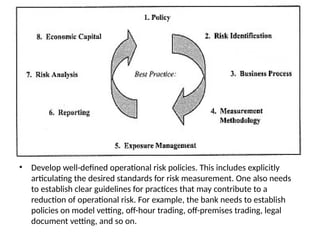
can be insured or hedged. For example, computer hardware problems can be insured or the bank can
have a backup system. Given the price of insurance or the cost of hedging risks, a question arises
concerning the economic rationale of removing the risks. There is the economic issue of assessing
the potential loss against the certain insurance cost for each OR event.
• Failure to identify an operational risk, or to defuse it in a timely manner, can
translate into a huge loss. Most notoriously, the actions of a single trader at
Barings Bank (who was able to take extremely risky positions in a market
without authority or detection) led to losses ($1.5 billion) that brought about
the liquidation of the bank.
Regulators require a minimum amount of regulatory capital for price risk in
the Operational risk trading book (BIS 98) and credit risk in the banking book
(BIS 88), but there are currently no formal capital requirements against
operational risk.
• Looking to the future, banks are becoming aware that technology is a
double edged sword. The increasing complexity of instruments and
information systems increase the potential for operational risk.
Unfamiliarity with instruments may lead to their misuse, and raise the
chances of mispricing and wrong hedging; errors in data feeds may also
distort the bank’s assessment of its risks. At the same time, advanced
analytical techniques combined with sophisticated computer technology
create new ways to add value to operational risk management
What is operational risk?
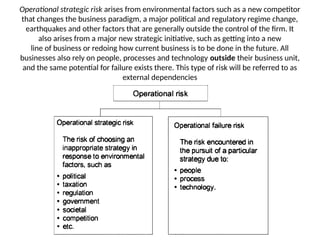
Operational risk is the risk associated with operating the business. One can
subdivide operational risk into two components: operational failure risk and
operational strategic risk.
• Operational failure risk arises from the potential for failure in the course of
operating the business. A firm uses people, process, and technology to
achieve business plans, and any one of these factors may experience a
failure of some kind. Accordingly, operational failure risk is the risk that
exists within the business unit cause by the failure of people, process or
technology. A certain level of the failures may be anticipated and should be
built into the business plan.
Operational strategic risk arises from environmental factors such as a new competitor
that changes the business paradigm, a major political and regulatory regime change,
earthquakes and other factors that are generally outside the control of the firm. It
also arises from a major new strategic initiative, such as getting into a new
line of business or redoing how current business is to be done in the future. All
businesses also rely on people, processes and technology outside their business unit,
and the same potential for failure exists there. This type of risk will be referred to as
external dependencies
Operational risk is often thought to be limited to losses that can occur in
operations or processing centers (i.e. where transaction processing errors can
occur). This type of operational risk, sometimes referred to as operations risk,
is an important component but by no means all of the operational risks facing
the firm
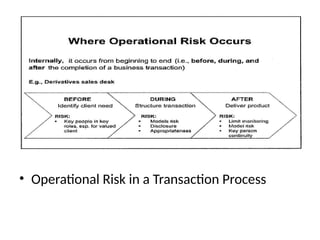
• Operational risk is often thought to be limited to losses that can occur in
operations or processing centers (i.e., where transaction processing errors
can occur). This type of operational risk, sometimes referred to as
operations risk, is an important component, but it by no means covers all
of the operational risks facing the firm. If we take the example of a
derivative sales desk, then one can see that operational risk can arise
before, during, and after a transaction is processed (Figure) Risk begins to
accumulate even before the design of the potential transaction gets
underway. It is present during negotiations with the client (regardless of
whether the negotiation is a lengthy structuring exercise, or a routine
electronic negotiation) and continues after the negotiation as the
transaction is serviced
• Operational Risk in a Transaction Process
During the processing of the transaction, the firm is exposed to several further
risks. First, the sales person may knowingly not disclose the full range of the
risks of the transaction to the client. This risk might be associated with periods
when staff are under intense pressure to meet bonus targets for their desk.
Similarly, the sales person might persuade the client to engage in a transaction
that is totally inappropriate for the client, exposing the firm to potential
lawsuits and regulatory sanctions
• "People risks" are not the only form of risk found early in a transaction.
The sales person may rely on sophisticated financial models to price the
transaction. This creates what is commonly called model risk Model risk
can arise because the wrong parameters are input to the model, or
because the model is used inappropriately (e.g., outside its domain of
applicability), and so on.
"People risks" are not the only form of risk found early in a transaction. The sales person
may rely on sophisticated financial models to price the transaction. This creates what is
commonly called model risk Model risk can arise because the wrong parameters are input
to the model, or because the model is used inappropriately (e.g., outside its domain of
applicability), and so on.
Who Should Manage Operational Risk?
The responsibility for setting policies concerning operational risk remains with
senior management, even though the development of those policies may be
delegated, and submitted to the board of directors for approval.
• The authority to take action generally rests with business management,
which is responsible for controlling the amount of operational risk taken
within each business line. The infrastructure and governance groups share
with business management the responsibility for managing operational
risk.
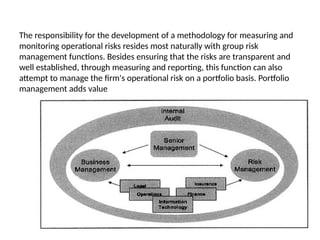
The responsibility for the development of a methodology for measuring and
monitoring operational risks resides most naturally with group risk
management functions. Besides ensuring that the risks are transparent and
well established, through measuring and reporting, this function can also
attempt to manage the firm's operational risk on a portfolio basis. Portfolio
management adds value
by ensuring that operational risk is adequately capitalized. Portfolio
management also involves providing regular reviews of trends, as well as
analyzing concentrations of operational risk. The risk management function
also needs to ensure that proper operational risk/reward analysis is
performed in the review of existing businesses and before the introduction of
new initiatives and products. In this regard, the risk management function
works very closely with, but independently from, business management,
infrastructure, and the other governance groups.
• Managing Operational Risk as a Partnership
• First of all, we ought to admit that at present many banks manage
operational risk on an ad hoc basis. There is often a lack of coordination
among functions such as risk management, internal audit, and business
management. Most often there are no common bank-wide policies,
methodologies, or infrastructure and thus no consistent reporting on the
extent of operational risk within the bank as a whole. Bank-wide capital
attribution models rarely incorporate meaningful measures of operational
risk.
First, the necessary operational risk information has to travel from the
operational environment, which includes infrastructure, corporate
governance, and business units, to the operational risk management function.
In return, the operational risk management function must provide
operational risk analyses and policies to all units on a timely basis—as well as
generating firm-wide and regulatory risk reports, and working with the audit
function.
• Second, the various businesses in the bank implement the policy, manage
the risks, and generally run their business.
Third, at regular intervals the internal audit function needs to ensure that the
operational risk, management process has integrity, and is indeed being
implemented along with the appropriate controls. In other words, auditors
analyze the degree to which businesses are in compliance with the designated
operational risk management process. They also offer an independent assessment
of the underlying design of the operational risk management process. This
includes examining the process surrounding the building of operational risk
measurement models, the adequacy and reliability of the operations risk
management systems and compliance with external regulatory guidelines, and so
on. Audit thus provides an overall assurance on the adequacy of operational risk
management
• A key audit objective is to evaluate the design and conceptual soundness of
the operational risk value-at-risk (operational risk VaR) measure, including
any methodologies associated with stress testing, and the reliability of the
reporting framework.
Regulatory guidelines typically also call for auditors to address the approval
process for vetting risk pricing models and valuation systems used by front- and
back-office personnel, the validation of any significant change in the risk
measurement process, and the scope of risks captured by the risk
measurement model.
• Finally, auditors should examine the verification of the model's accuracy
through an examination of the back-testing process
The bank's risk management team, to achieve all this, will need to develop
policy, design the operational risk measurement methodology, and build the
necessary infrastructure. The operational risk management group will then be
able to monitor and analyze the risks, implement methodologies
such as risk-adjusted return on capital (RAROC), and actively manage residual
risk using tools such as insurance.
• The residual risk is the risk or danger of an action or an event, a method
or a (technical) process that, although being abreast with science, still
conceives these dangers, even if all theoretically possible safety measures
would be applied (scientifically conceivable measures).
The Key to Implementing Bank-Wide Operational Risk
Management
In our experience, eight key elements, as shown in Figure 13.4,
are necessary to successfully implement a bank-wide operational
risk management framework. They involve setting policy and
identifying risk as an outgrowth of having designed a common
language, constructing business process maps, building a best-
practice measurement methodology, providing exposure
management, installing a timely reporting capability, performing
risk analysis inclusive of stress testing, and allocating economic
capital as a function of operational risk.
• Eight Key Elements to Achieve Best-Practice Operational Risk
Management
• Develop well-defined operational risk policies. This includes explicitly
articulating the desired standards for risk measurement. One also needs
to establish clear guidelines for practices that may contribute to a
reduction of operational risk. For example, the bank needs to establish
policies on model vetting, off-hour trading, off-premises trading, legal
document vetting, and so on.
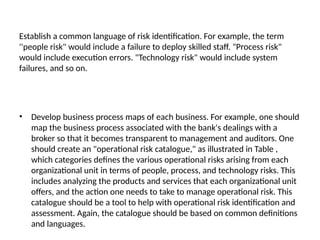
Establish a common language of risk identification. For example, the term
''people risk" would include a failure to deploy skilled staff. "Process risk"
would include execution errors. "Technology risk" would include system
failures, and so on.
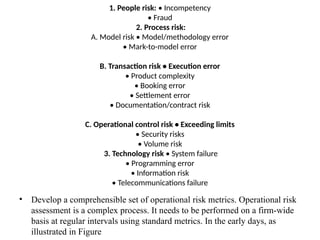
• Develop business process maps of each business. For example, one should
map the business process associated with the bank's dealings with a
broker so that it becomes transparent to management and auditors. One
should create an "operational risk catalogue," as illustrated in Table ,
which categories defines the various operational risks arising from each
organizational unit in terms of people, process, and technology risks. This
includes analyzing the products and services that each organizational unit
offers, and the action one needs to take to manage operational risk. This
catalogue should be a tool to help with operational risk identification and
assessment. Again, the catalogue should be based on common definitions
and languages.
1. People risk: • Incompetency
• Fraud
2. Process risk:
A. Model risk • Model/methodology error
• Mark-to-model error
B. Transaction risk • Execution error
• Product complexity
• Booking error
• Settlement error
• Documentation/contract risk
C. Operational control risk • Exceeding limits
• Security risks
• Volume risk
3. Technology risk • System failure
• Programming error
• Information risk
• Telecommunications failure
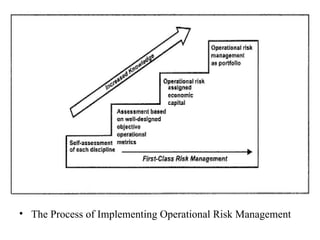
• Develop a comprehensible set of operational risk metrics. Operational risk
assessment is a complex process. It needs to be performed on a firm-wide
basis at regular intervals using standard metrics. In the early days, as
illustrated in Figure
• The Process of Implementing Operational Risk Management
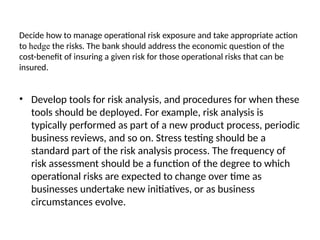
Decide how to manage operational risk exposure and take appropriate action
to hedge the risks. The bank should address the economic question of the
cost-benefit of insuring a given risk for those operational risks that can be
insured.
• Develop tools for risk analysis, and procedures for when these
tools should be deployed. For example, risk analysis is
typically performed as part of a new product process, periodic
business reviews, and so on. Stress testing should be a
standard part of the risk analysis process. The frequency of
risk assessment should be a function of the degree to which
operational risks are expected to change over time as
businesses undertake new initiatives, or as business
circumstances evolve.
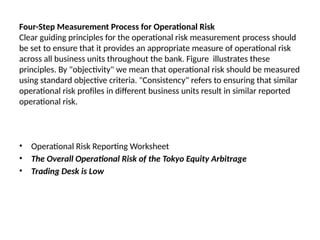
Four-Step Measurement Process for Operational Risk
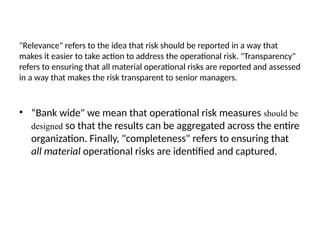
Clear guiding principles for the operational risk measurement process should
be set to ensure that it provides an appropriate measure of operational risk
across all business units throughout the bank. Figure illustrates these
principles. By "objectivity" we mean that operational risk should be measured
using standard objective criteria. "Consistency" refers to ensuring that similar
operational risk profiles in different business units result in similar reported
operational risk.
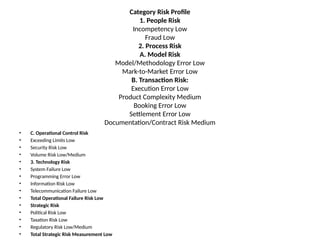
• Operational Risk Reporting Worksheet
• The Overall Operational Risk of the Tokyo Equity Arbitrage
• Trading Desk is Low
Category Risk Profile
1. People Risk
Incompetency Low
Fraud Low
2. Process Risk
A. Model Risk
Model/Methodology Error Low
Mark-to-Market Error Low
B. Transaction Risk:
Execution Error Low
Product Complexity Medium
Booking Error Low
Settlement Error Low
Documentation/Contract Risk Medium
• C. Operational Control Risk
• Exceeding Limits Low
• Security Risk Low
• Volume Risk Low/Medium
• 3. Technology Risk
• System Failure Low
• Programming Error Low
• Information Risk Low
• Telecommunication Failure Low
• Total Operational Failure Risk Low
• Strategic Risk
• Political Risk Low
• Taxation Risk Low
• Regulatory Risk Low/Medium
• Total Strategic Risk Measurement Low
• Guiding Principles for Operational Risk Measurement
"Relevance" refers to the idea that risk should be reported in a way that
makes it easier to take action to address the operational risk. "Transparency"
refers to ensuring that all material operational risks are reported and assessed
in a way that makes the risk transparent to senior managers.
• “Bank wide" we mean that operational risk measures should be
designed so that the results can be aggregated across the entire
organization. Finally, "completeness" refers to ensuring that
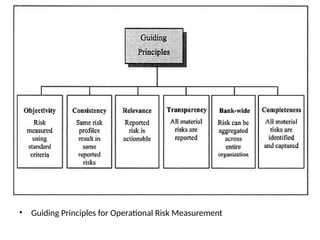
all material operational risks are identified and captured.
The centralized operational risk management group (ORMG) will
need to validate any such self-assessment by a business unit in a
disciplined way. Often this amounts to a ‘reasonableness’ check that
makes use of historical information on operational losses within the
business and within the industry as a whole. The time frame
employed for all aspects of the assessment process is typically one
year. The one-year time horizon is usually selected to align with the
business planning cycle of the bank. Nevertheless, while some
serious potential operational failures may not occur until after the
one-year time horizon
Sources of information in the measurement process
of operational risk – the input Assessment for:
Likelihood of occurrence Severity
Ω Audit reports Ω Management interviews, Ω Regulatory reports
Ω Loss history, Ω Management reports Ω etc., Ω Expert opinion,
Ω BRP (Business Recovery Plan), Ω Y2K (year 2000) reports, Ω
Business plans, Ω Budget plans, Ω Operations plans, Ω etc.
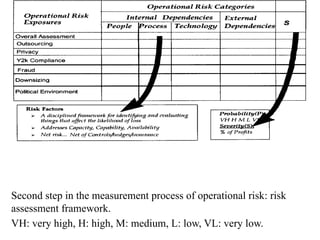
Second step in the measurement process of operational risk: risk
assessment framework.
VH: very high, H: high, M: medium, L: low, VL: very low.
Risk assessment framework (step 2)
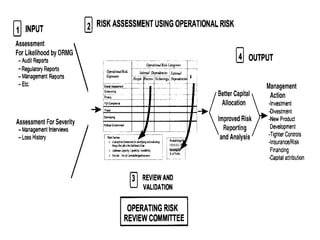
The ‘input’ information gathered in step 1 needs to be analyzed and
processed through the risk assessment framework sketched in
Figure. The risk of unexpected operational failure, as well as the
adequacy of management processes and controls to manage this risk,
needs to be identified and assessed. This assessment
leads to a measure of the net operational risk, in terms of likelihood
and severity.
Risk categories
We mentioned earlier that operational risk can be broken down into four
headline risk categories (representing the risk of unexpected loss) due to
operational failures in people, process and technology deployed within the
business, collectively the internal dependencies and external dependencies.
Internal dependencies should each be reviewed according to a common set
of factors. Assume, for illustrative purposes, that the common set of factors
consist of three key components of capacity, capability and availability. For
example, if we examine operational risk arising from the people risk
category then one can ask
Does the business have enough people (capacity) to accomplish its
business plan?
Do the people have the right skills (capability)?
Are the people going to be there when needed (availability)?
Net operational risk
Operational risks should be evaluated net of risk mitigants. For example, if
one has insurance to cover a potential fraud then one needs to adjust the
degree of fraud risk by the amount of insurance. We expect over time that
insurance products will play can increasingly larger role in the area of
mitigating operational risk.
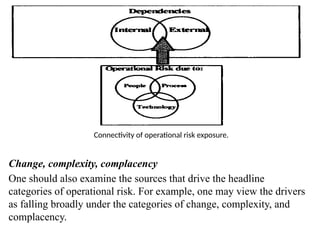
Connectivity and interdependencies
The headline risk categories cannot be viewed in isolation from one another.
Figure, illustrates the idea that one needs to examine the degree of
interconnected risk exposure across the headline operational risk categories
in order to understand the full impact of any risk. For example, assume that a
business unit is introducing a new computer technology. The implementation
of that new technology may generate a set of interconnected risks across
people, process and technology.
Connectivity of operational risk exposure.
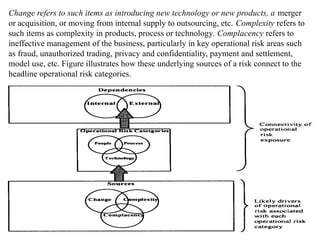
Change, complexity, complacency
One should also examine the sources that drive the headline
categories of operational risk. For example, one may view the drivers
as falling broadly under the categories of change, complexity, and
complacency.
Connectivity of operational risk exposure.
Change refers to such items as introducing new technology or new products, a merger
or acquisition, or moving from internal supply to outsourcing, etc. Complexity refers to
such items as complexity in products, process or technology. Complacency refers to
ineffective management of the business, particularly in key operational risk areas such
as fraud, unauthorized trading, privacy and confidentiality, payment and settlement,
model use, etc. Figure illustrates how these underlying sources of a risk connect to the
headline operational risk categories.
Net likelihood assessment
The likelihood that an operational failure may occur within the next
year should be assessed (net of risk mitigants such as insurance) for
each identified risk exposure and for each of the four headline risk
categories (i.e. people, process and technology, and external
dependencies). This assessment can be expressed as a rating along a
five-point likelihood continuum from very low (VL) to very high
(VH) as set out in Table.
Table - Five-point likelihood continuum
Likelihood that an operational failure will occur within the next year
VL Very low (very unlikely to happen: less than 2%)
L Low (unlikely: 2-5%)
M Medium (may happen: 5–10%)
H High (likely to happen: 10–20%)
VH Very high (very likely: greater than 20%)
Severity assessment
Severity describes the potential loss to the bank given that an operational
failure has occurred. Typically, this will be expressed as a range of dollars
(e.g. $50–$100 million), as exact measurements will not usually be possible.
Combining likelihood and severity into an overall operational risk assessment
Operational risk measures are not exact in that there is usually no easy way to
combine the individual likelihood of loss and severity assessments into an overall
measure of operational risk within a business unit. To do so, the likelihood of loss
would need to be expressed in numerical terms , e.g. a medium risk represents a
5–10% probability of occurrence. This cannot be accomplished without
statistically significant historical data on operational losses.
The financial industry for the moment measures operational risk using a
combination of both quantitative and qualitative points of view. To be sure, one
should strive to take a quantitative approach based on statistical data. However,
where the data is unavailable or unreliable – and this is the case for many risk
sources a qualitative approach can be used to generate a risk rating. quantitative
approach is often too rigid, while the qualitative
approach is often too vague.
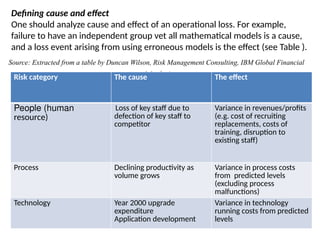
Defining cause and effect
One should analyze cause and effect of an operational loss. For example,
failure to have an independent group vet all mathematical models is a cause,
and a loss event arising from using erroneous models is the effect (see Table ).
Source: Extracted from a table by Duncan Wilson, Risk Management Consulting, IBM Global Financial
Markets
Risk category The cause The effect
People (human
resource)
Loss of key staff due to
defection of key staff to
competitor
Variance in revenues/profits
(e.g. cost of recruiting
replacements, costs of
training, disruption to
existing staff)
Process Declining productivity as
volume grows
Variance in process costs
from predicted levels
(excluding process
malfunctions)
Technology Year 2000 upgrade
expenditure
Application development
Variance in technology
running costs from predicted
levels
Sample risk assessment report
What does this approach lead to when put into practice? Assume we have
examined Business Unit A and have determined that the sources of
operational risk are related to:
Ω outsourcing
Ω privacy
Ω compliance
Ω fraud
Ω downsizing and
Ω the political environment.
Review and validation (step 3)
What happens after such a report has been generated? First. the centralized
operational risk management group (ORMG) reviews the assessment results with
senior business unit management and key officers in order to finalize the proposed
operational risk rating. Key officers include those with responsibility for the
management and control of operational activities (such as internal audit,
compliance, IT, human resources, etc.). Second, ORMG can present its
recommended rating to an operational risk rating review committee – a process
similar that followed by credit rating agencies
The operational risk committee comments on the ratings prior to
publication. ORMG may clarify or amend its original assessment based
on feedback from the committee. The perational risk committee reviews
the individual risk assessments to ensure that the framework has been
consistently applied across businesses. The committee should have
representation from business management, audit, functional areas, and
chaired by risk management. Risk management retains the right to veto.
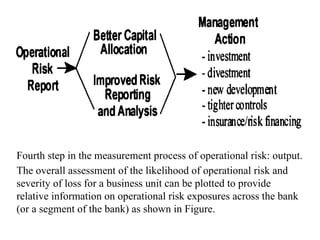
Output (step 4)
The final assessment of operational risk should be formally reported to
business management, the centralized Raroc group, and the partners in
corporate governance (such as internal audit. compliance, etc.). As
illustrated in Figure 12.11, the output of the assessment process has two
main uses. First, the assessment provides better operational risk information
to management for use in improving risk management decisions. Second,
the assessment improves the allocation of economic capital to better reflect
the extent of operational risk being taken by a business unit
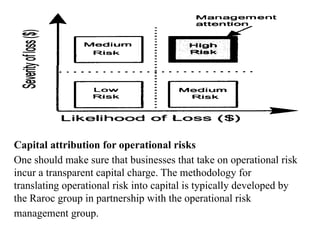
Fourth step in the measurement process of operational risk: output.
The overall assessment of the likelihood of operational risk and
severity of loss for a business unit can be plotted to provide
relative information on operational risk exposures across the bank
(or a segment of the bank) as shown in Figure.
Capital attribution for operational risks
One should make sure that businesses that take on operational risk
incur a transparent capital charge. The methodology for
translating operational risk into capital is typically developed by
the Raroc group in partnership with the operational risk
management group.
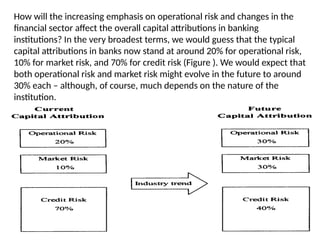
How will the increasing emphasis on operational risk and changes in the
financial sector affect the overall capital attributions in banking
institutions? In the very broadest terms, we would guess that the typical
capital attributions in banks now stand at around 20% for operational risk,
10% for market risk, and 70% for credit risk (Figure ). We would expect that
both operational risk and market risk might evolve in the future to around
30% each – although, of course, much depends on the nature of the
institution.
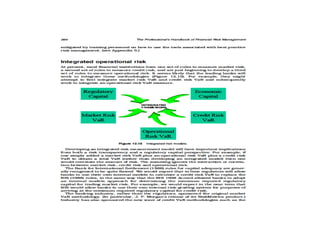
Integrated operational risk
At present, most financial institutions have one set of rules to measure
market risk, a second set of rules to measure credit risk, and are just
beginning to develop a third set of rules to measure operational risk. It
seems likely that the leading banks will work to integrate these
methodologies (Figure ). For example, they might attempt to first
integrate market risk VaR and credit risk VaR and subsequently
work to integrate an operational risk VaR measure.
Conclusions
An integrated goal-congruent risk management process that puts all the
elements together, as illustrated in Figure 12.16, will open the door to
optimal firm-wide management of risk. ‘Integrated’ refers to the need to
avoid a fragmented approach to risk management – risk management is only
as strong as the weakest link. ‘Goal congruent’ refers to the need to ensure
that policies and methodologies are consistent with each other.
Infrastructure includes having the right people, operations technology and
data to appropriately control risk
Operational risk management process by s&p

Operational risk management process by s&p

  • 1.
    Operational risk (OR)has not been a well-defined concept. It refers to various potential failures in the operation of the firm, unrelated to uncertainties with regard to the demand function for the products and services of the firm. These failures can stem from a computer breakdown, a bug in a major computer software, an error of a decision maker in special situations, etc. The academic literature generally relates operational risk to operational leverage (i.e. to the shape of the production cost function) and in particular to the relationship between fixed and variable cost. Therefore the management of a bank should first define what is included in OR. In other words, the typology of OR must be clearly articulated and codified. A key problem lies in quantifying operational risk. For example, how can one quantify the risk of a computer breakdown? The risk is a product of the probability and the cost of a computer breakdown..
  • 2.
    The problems inassessing OR does not imply that they should be ignored and neglected. On the contrary, management should pay a lot of attention to understanding OR and its potential sources in the organization precisely because it is hard to quantify OR. Possible events or scenarios leading to OR should be analyzed. In the next section we define OR and discuss its typology. In some cases OR can be insured or hedged. For example, computer hardware problems can be insured or the bank can have a backup system. Given the price of insurance or the cost of hedging risks, a question arises concerning the economic rationale of removing the risks. There is the economic issue of assessing the potential loss against the certain insurance cost for each OR event. • Failure to identify an operational risk, or to defuse it in a timely manner, can translate into a huge loss. Most notoriously, the actions of a single trader at Barings Bank (who was able to take extremely risky positions in a market without authority or detection) led to losses ($1.5 billion) that brought about the liquidation of the bank.
  • 3.
    Regulators require aminimum amount of regulatory capital for price risk in the Operational risk trading book (BIS 98) and credit risk in the banking book (BIS 88), but there are currently no formal capital requirements against operational risk. • Looking to the future, banks are becoming aware that technology is a double edged sword. The increasing complexity of instruments and information systems increase the potential for operational risk. Unfamiliarity with instruments may lead to their misuse, and raise the chances of mispricing and wrong hedging; errors in data feeds may also distort the bank’s assessment of its risks. At the same time, advanced analytical techniques combined with sophisticated computer technology create new ways to add value to operational risk management
  • 4.
    What is operationalrisk? Operational risk is the risk associated with operating the business. One can subdivide operational risk into two components: operational failure risk and operational strategic risk. • Operational failure risk arises from the potential for failure in the course of operating the business. A firm uses people, process, and technology to achieve business plans, and any one of these factors may experience a failure of some kind. Accordingly, operational failure risk is the risk that exists within the business unit cause by the failure of people, process or technology. A certain level of the failures may be anticipated and should be built into the business plan.
  • 5.
    Operational strategic riskarises from environmental factors such as a new competitor that changes the business paradigm, a major political and regulatory regime change, earthquakes and other factors that are generally outside the control of the firm. It also arises from a major new strategic initiative, such as getting into a new line of business or redoing how current business is to be done in the future. All businesses also rely on people, processes and technology outside their business unit, and the same potential for failure exists there. This type of risk will be referred to as external dependencies
  • 6.
    Operational risk isoften thought to be limited to losses that can occur in operations or processing centers (i.e. where transaction processing errors can occur). This type of operational risk, sometimes referred to as operations risk, is an important component but by no means all of the operational risks facing the firm • Operational risk is often thought to be limited to losses that can occur in operations or processing centers (i.e., where transaction processing errors can occur). This type of operational risk, sometimes referred to as operations risk, is an important component, but it by no means covers all of the operational risks facing the firm. If we take the example of a derivative sales desk, then one can see that operational risk can arise before, during, and after a transaction is processed (Figure) Risk begins to accumulate even before the design of the potential transaction gets underway. It is present during negotiations with the client (regardless of whether the negotiation is a lengthy structuring exercise, or a routine electronic negotiation) and continues after the negotiation as the transaction is serviced
  • 7.
    • Operational Riskin a Transaction Process
  • 8.
    During the processingof the transaction, the firm is exposed to several further risks. First, the sales person may knowingly not disclose the full range of the risks of the transaction to the client. This risk might be associated with periods when staff are under intense pressure to meet bonus targets for their desk. Similarly, the sales person might persuade the client to engage in a transaction that is totally inappropriate for the client, exposing the firm to potential lawsuits and regulatory sanctions • "People risks" are not the only form of risk found early in a transaction. The sales person may rely on sophisticated financial models to price the transaction. This creates what is commonly called model risk Model risk can arise because the wrong parameters are input to the model, or because the model is used inappropriately (e.g., outside its domain of applicability), and so on. "People risks" are not the only form of risk found early in a transaction. The sales person may rely on sophisticated financial models to price the transaction. This creates what is commonly called model risk Model risk can arise because the wrong parameters are input to the model, or because the model is used inappropriately (e.g., outside its domain of applicability), and so on.
  • 9.
    Who Should ManageOperational Risk? The responsibility for setting policies concerning operational risk remains with senior management, even though the development of those policies may be delegated, and submitted to the board of directors for approval. • The authority to take action generally rests with business management, which is responsible for controlling the amount of operational risk taken within each business line. The infrastructure and governance groups share with business management the responsibility for managing operational risk.
  • 10.
    The responsibility forthe development of a methodology for measuring and monitoring operational risks resides most naturally with group risk management functions. Besides ensuring that the risks are transparent and well established, through measuring and reporting, this function can also attempt to manage the firm's operational risk on a portfolio basis. Portfolio management adds value
  • 11.
    by ensuring thatoperational risk is adequately capitalized. Portfolio management also involves providing regular reviews of trends, as well as analyzing concentrations of operational risk. The risk management function also needs to ensure that proper operational risk/reward analysis is performed in the review of existing businesses and before the introduction of new initiatives and products. In this regard, the risk management function works very closely with, but independently from, business management, infrastructure, and the other governance groups. • Managing Operational Risk as a Partnership • First of all, we ought to admit that at present many banks manage operational risk on an ad hoc basis. There is often a lack of coordination among functions such as risk management, internal audit, and business management. Most often there are no common bank-wide policies, methodologies, or infrastructure and thus no consistent reporting on the extent of operational risk within the bank as a whole. Bank-wide capital attribution models rarely incorporate meaningful measures of operational risk.
  • 12.
    First, the necessaryoperational risk information has to travel from the operational environment, which includes infrastructure, corporate governance, and business units, to the operational risk management function. In return, the operational risk management function must provide operational risk analyses and policies to all units on a timely basis—as well as generating firm-wide and regulatory risk reports, and working with the audit function. • Second, the various businesses in the bank implement the policy, manage the risks, and generally run their business.
  • 13.
    Third, at regularintervals the internal audit function needs to ensure that the operational risk, management process has integrity, and is indeed being implemented along with the appropriate controls. In other words, auditors analyze the degree to which businesses are in compliance with the designated operational risk management process. They also offer an independent assessment of the underlying design of the operational risk management process. This includes examining the process surrounding the building of operational risk measurement models, the adequacy and reliability of the operations risk management systems and compliance with external regulatory guidelines, and so on. Audit thus provides an overall assurance on the adequacy of operational risk management • A key audit objective is to evaluate the design and conceptual soundness of the operational risk value-at-risk (operational risk VaR) measure, including any methodologies associated with stress testing, and the reliability of the reporting framework.
  • 14.
    Regulatory guidelines typicallyalso call for auditors to address the approval process for vetting risk pricing models and valuation systems used by front- and back-office personnel, the validation of any significant change in the risk measurement process, and the scope of risks captured by the risk measurement model. • Finally, auditors should examine the verification of the model's accuracy through an examination of the back-testing process
  • 15.
    The bank's riskmanagement team, to achieve all this, will need to develop policy, design the operational risk measurement methodology, and build the necessary infrastructure. The operational risk management group will then be able to monitor and analyze the risks, implement methodologies such as risk-adjusted return on capital (RAROC), and actively manage residual risk using tools such as insurance. • The residual risk is the risk or danger of an action or an event, a method or a (technical) process that, although being abreast with science, still conceives these dangers, even if all theoretically possible safety measures would be applied (scientifically conceivable measures).
  • 16.
    The Key toImplementing Bank-Wide Operational Risk Management In our experience, eight key elements, as shown in Figure 13.4, are necessary to successfully implement a bank-wide operational risk management framework. They involve setting policy and identifying risk as an outgrowth of having designed a common language, constructing business process maps, building a best- practice measurement methodology, providing exposure management, installing a timely reporting capability, performing risk analysis inclusive of stress testing, and allocating economic capital as a function of operational risk. • Eight Key Elements to Achieve Best-Practice Operational Risk Management
  • 17.
    • Develop well-definedoperational risk policies. This includes explicitly articulating the desired standards for risk measurement. One also needs to establish clear guidelines for practices that may contribute to a reduction of operational risk. For example, the bank needs to establish policies on model vetting, off-hour trading, off-premises trading, legal document vetting, and so on.
  • 18.
    Establish a commonlanguage of risk identification. For example, the term ''people risk" would include a failure to deploy skilled staff. "Process risk" would include execution errors. "Technology risk" would include system failures, and so on. • Develop business process maps of each business. For example, one should map the business process associated with the bank's dealings with a broker so that it becomes transparent to management and auditors. One should create an "operational risk catalogue," as illustrated in Table , which categories defines the various operational risks arising from each organizational unit in terms of people, process, and technology risks. This includes analyzing the products and services that each organizational unit offers, and the action one needs to take to manage operational risk. This catalogue should be a tool to help with operational risk identification and assessment. Again, the catalogue should be based on common definitions and languages.
  • 19.
    1. People risk:• Incompetency • Fraud 2. Process risk: A. Model risk • Model/methodology error • Mark-to-model error B. Transaction risk • Execution error • Product complexity • Booking error • Settlement error • Documentation/contract risk C. Operational control risk • Exceeding limits • Security risks • Volume risk 3. Technology risk • System failure • Programming error • Information risk • Telecommunications failure • Develop a comprehensible set of operational risk metrics. Operational risk assessment is a complex process. It needs to be performed on a firm-wide basis at regular intervals using standard metrics. In the early days, as illustrated in Figure
  • 20.
    • The Processof Implementing Operational Risk Management
  • 21.
    Decide how tomanage operational risk exposure and take appropriate action to hedge the risks. The bank should address the economic question of the cost-benefit of insuring a given risk for those operational risks that can be insured. • Develop tools for risk analysis, and procedures for when these tools should be deployed. For example, risk analysis is typically performed as part of a new product process, periodic business reviews, and so on. Stress testing should be a standard part of the risk analysis process. The frequency of risk assessment should be a function of the degree to which operational risks are expected to change over time as businesses undertake new initiatives, or as business circumstances evolve.
  • 22.
    Four-Step Measurement Processfor Operational Risk Clear guiding principles for the operational risk measurement process should be set to ensure that it provides an appropriate measure of operational risk across all business units throughout the bank. Figure illustrates these principles. By "objectivity" we mean that operational risk should be measured using standard objective criteria. "Consistency" refers to ensuring that similar operational risk profiles in different business units result in similar reported operational risk. • Operational Risk Reporting Worksheet • The Overall Operational Risk of the Tokyo Equity Arbitrage • Trading Desk is Low
  • 23.
    Category Risk Profile 1.People Risk Incompetency Low Fraud Low 2. Process Risk A. Model Risk Model/Methodology Error Low Mark-to-Market Error Low B. Transaction Risk: Execution Error Low Product Complexity Medium Booking Error Low Settlement Error Low Documentation/Contract Risk Medium • C. Operational Control Risk • Exceeding Limits Low • Security Risk Low • Volume Risk Low/Medium • 3. Technology Risk • System Failure Low • Programming Error Low • Information Risk Low • Telecommunication Failure Low • Total Operational Failure Risk Low • Strategic Risk • Political Risk Low • Taxation Risk Low • Regulatory Risk Low/Medium • Total Strategic Risk Measurement Low
  • 24.
    • Guiding Principlesfor Operational Risk Measurement
  • 25.
    "Relevance" refers tothe idea that risk should be reported in a way that makes it easier to take action to address the operational risk. "Transparency" refers to ensuring that all material operational risks are reported and assessed in a way that makes the risk transparent to senior managers. • “Bank wide" we mean that operational risk measures should be designed so that the results can be aggregated across the entire organization. Finally, "completeness" refers to ensuring that all material operational risks are identified and captured.
  • 27.
    The centralized operationalrisk management group (ORMG) will need to validate any such self-assessment by a business unit in a disciplined way. Often this amounts to a ‘reasonableness’ check that makes use of historical information on operational losses within the business and within the industry as a whole. The time frame employed for all aspects of the assessment process is typically one year. The one-year time horizon is usually selected to align with the business planning cycle of the bank. Nevertheless, while some serious potential operational failures may not occur until after the one-year time horizon Sources of information in the measurement process of operational risk – the input Assessment for: Likelihood of occurrence Severity Ω Audit reports Ω Management interviews, Ω Regulatory reports Ω Loss history, Ω Management reports Ω etc., Ω Expert opinion, Ω BRP (Business Recovery Plan), Ω Y2K (year 2000) reports, Ω Business plans, Ω Budget plans, Ω Operations plans, Ω etc.
  • 28.
    Second step inthe measurement process of operational risk: risk assessment framework. VH: very high, H: high, M: medium, L: low, VL: very low.
  • 29.
    Risk assessment framework(step 2) The ‘input’ information gathered in step 1 needs to be analyzed and processed through the risk assessment framework sketched in Figure. The risk of unexpected operational failure, as well as the adequacy of management processes and controls to manage this risk, needs to be identified and assessed. This assessment leads to a measure of the net operational risk, in terms of likelihood and severity. Risk categories We mentioned earlier that operational risk can be broken down into four headline risk categories (representing the risk of unexpected loss) due to operational failures in people, process and technology deployed within the business, collectively the internal dependencies and external dependencies. Internal dependencies should each be reviewed according to a common set of factors. Assume, for illustrative purposes, that the common set of factors consist of three key components of capacity, capability and availability. For example, if we examine operational risk arising from the people risk category then one can ask
  • 30.
    Does the businesshave enough people (capacity) to accomplish its business plan? Do the people have the right skills (capability)? Are the people going to be there when needed (availability)? Net operational risk Operational risks should be evaluated net of risk mitigants. For example, if one has insurance to cover a potential fraud then one needs to adjust the degree of fraud risk by the amount of insurance. We expect over time that insurance products will play can increasingly larger role in the area of mitigating operational risk. Connectivity and interdependencies The headline risk categories cannot be viewed in isolation from one another. Figure, illustrates the idea that one needs to examine the degree of interconnected risk exposure across the headline operational risk categories in order to understand the full impact of any risk. For example, assume that a business unit is introducing a new computer technology. The implementation of that new technology may generate a set of interconnected risks across people, process and technology.
  • 31.
    Connectivity of operationalrisk exposure. Change, complexity, complacency One should also examine the sources that drive the headline categories of operational risk. For example, one may view the drivers as falling broadly under the categories of change, complexity, and complacency. Connectivity of operational risk exposure.
  • 32.
    Change refers tosuch items as introducing new technology or new products, a merger or acquisition, or moving from internal supply to outsourcing, etc. Complexity refers to such items as complexity in products, process or technology. Complacency refers to ineffective management of the business, particularly in key operational risk areas such as fraud, unauthorized trading, privacy and confidentiality, payment and settlement, model use, etc. Figure illustrates how these underlying sources of a risk connect to the headline operational risk categories.
  • 33.
    Net likelihood assessment Thelikelihood that an operational failure may occur within the next year should be assessed (net of risk mitigants such as insurance) for each identified risk exposure and for each of the four headline risk categories (i.e. people, process and technology, and external dependencies). This assessment can be expressed as a rating along a five-point likelihood continuum from very low (VL) to very high (VH) as set out in Table. Table - Five-point likelihood continuum Likelihood that an operational failure will occur within the next year VL Very low (very unlikely to happen: less than 2%) L Low (unlikely: 2-5%) M Medium (may happen: 5–10%) H High (likely to happen: 10–20%) VH Very high (very likely: greater than 20%)
  • 34.
    Severity assessment Severity describesthe potential loss to the bank given that an operational failure has occurred. Typically, this will be expressed as a range of dollars (e.g. $50–$100 million), as exact measurements will not usually be possible. Combining likelihood and severity into an overall operational risk assessment Operational risk measures are not exact in that there is usually no easy way to combine the individual likelihood of loss and severity assessments into an overall measure of operational risk within a business unit. To do so, the likelihood of loss would need to be expressed in numerical terms , e.g. a medium risk represents a 5–10% probability of occurrence. This cannot be accomplished without statistically significant historical data on operational losses. The financial industry for the moment measures operational risk using a combination of both quantitative and qualitative points of view. To be sure, one should strive to take a quantitative approach based on statistical data. However, where the data is unavailable or unreliable – and this is the case for many risk sources a qualitative approach can be used to generate a risk rating. quantitative approach is often too rigid, while the qualitative approach is often too vague.
  • 35.
    Defining cause andeffect One should analyze cause and effect of an operational loss. For example, failure to have an independent group vet all mathematical models is a cause, and a loss event arising from using erroneous models is the effect (see Table ). Source: Extracted from a table by Duncan Wilson, Risk Management Consulting, IBM Global Financial Markets Risk category The cause The effect People (human resource) Loss of key staff due to defection of key staff to competitor Variance in revenues/profits (e.g. cost of recruiting replacements, costs of training, disruption to existing staff) Process Declining productivity as volume grows Variance in process costs from predicted levels (excluding process malfunctions) Technology Year 2000 upgrade expenditure Application development Variance in technology running costs from predicted levels
  • 36.
    Sample risk assessmentreport What does this approach lead to when put into practice? Assume we have examined Business Unit A and have determined that the sources of operational risk are related to: Ω outsourcing Ω privacy Ω compliance Ω fraud Ω downsizing and Ω the political environment. Review and validation (step 3) What happens after such a report has been generated? First. the centralized operational risk management group (ORMG) reviews the assessment results with senior business unit management and key officers in order to finalize the proposed operational risk rating. Key officers include those with responsibility for the management and control of operational activities (such as internal audit, compliance, IT, human resources, etc.). Second, ORMG can present its recommended rating to an operational risk rating review committee – a process similar that followed by credit rating agencies
  • 37.
    The operational riskcommittee comments on the ratings prior to publication. ORMG may clarify or amend its original assessment based on feedback from the committee. The perational risk committee reviews the individual risk assessments to ensure that the framework has been consistently applied across businesses. The committee should have representation from business management, audit, functional areas, and chaired by risk management. Risk management retains the right to veto. Output (step 4) The final assessment of operational risk should be formally reported to business management, the centralized Raroc group, and the partners in corporate governance (such as internal audit. compliance, etc.). As illustrated in Figure 12.11, the output of the assessment process has two main uses. First, the assessment provides better operational risk information to management for use in improving risk management decisions. Second, the assessment improves the allocation of economic capital to better reflect the extent of operational risk being taken by a business unit
  • 38.
    Fourth step inthe measurement process of operational risk: output. The overall assessment of the likelihood of operational risk and severity of loss for a business unit can be plotted to provide relative information on operational risk exposures across the bank (or a segment of the bank) as shown in Figure.
  • 39.
    Capital attribution foroperational risks One should make sure that businesses that take on operational risk incur a transparent capital charge. The methodology for translating operational risk into capital is typically developed by the Raroc group in partnership with the operational risk management group.
  • 41.
    How will theincreasing emphasis on operational risk and changes in the financial sector affect the overall capital attributions in banking institutions? In the very broadest terms, we would guess that the typical capital attributions in banks now stand at around 20% for operational risk, 10% for market risk, and 70% for credit risk (Figure ). We would expect that both operational risk and market risk might evolve in the future to around 30% each – although, of course, much depends on the nature of the institution.
  • 42.
    Integrated operational risk Atpresent, most financial institutions have one set of rules to measure market risk, a second set of rules to measure credit risk, and are just beginning to develop a third set of rules to measure operational risk. It seems likely that the leading banks will work to integrate these methodologies (Figure ). For example, they might attempt to first integrate market risk VaR and credit risk VaR and subsequently work to integrate an operational risk VaR measure. Conclusions An integrated goal-congruent risk management process that puts all the elements together, as illustrated in Figure 12.16, will open the door to optimal firm-wide management of risk. ‘Integrated’ refers to the need to avoid a fragmented approach to risk management – risk management is only as strong as the weakest link. ‘Goal congruent’ refers to the need to ensure that policies and methodologies are consistent with each other. Infrastructure includes having the right people, operations technology and data to appropriately control risk