For more on this topic, go to bcgperspectives.com
The Five Practices That
Set Operational Risk
Leaders Apart
By Jeanne Kwong Bickford, Marc D. Grüter, Gwenhaël Le Boulay, Duncan Martin,
and Brian O’Malley
Bank operating models continue to
evolve in response to new regulations,
digitization, a volatile economic and risk
environment, external threats, and advanc-
es by nontraditional competitors. This
evolution presents new types of operation-
al risk (OR), and many banks are suffering
large losses or embarrassing headlines from
cyberbreaches, new varieties of fraud, third-­
party issues, and unreliable technology.
In response, many banks have increased
their spending on OR management by
more than 50% in the past five years. Yet
boards and executive teams have begun to
question the effectiveness of these invest-
ments. One bank executive noted, “We can
invest an additional $10 to 20 million, but
not really know if what we’re doing is more
effective,” and then added, “We seem to
default to rote, tick-the-box exercises that
satisfy our regulators but aren’t risk based
or aligned with business value. There has
to be a better way to do this.”
To understand how banks are dealing with
the increased strategic importance of oper-
ational risk, BCG benchmarked the perfor-
mance of ten major banks globally. The re-
sults show that some banks have begun to
crack the code. Besides becoming more ef-
fective at managing operational risk, they
are achieving high performance without
sharply elevating their OR spending.
Learning from Leaders
Over the course of several months, we con-
ducted extensive interviews with execu-
tives and operational risk teams within the
traditional second line of defense or over-
sight role, and within the operating busi-
nesses themselves. The results indicate that
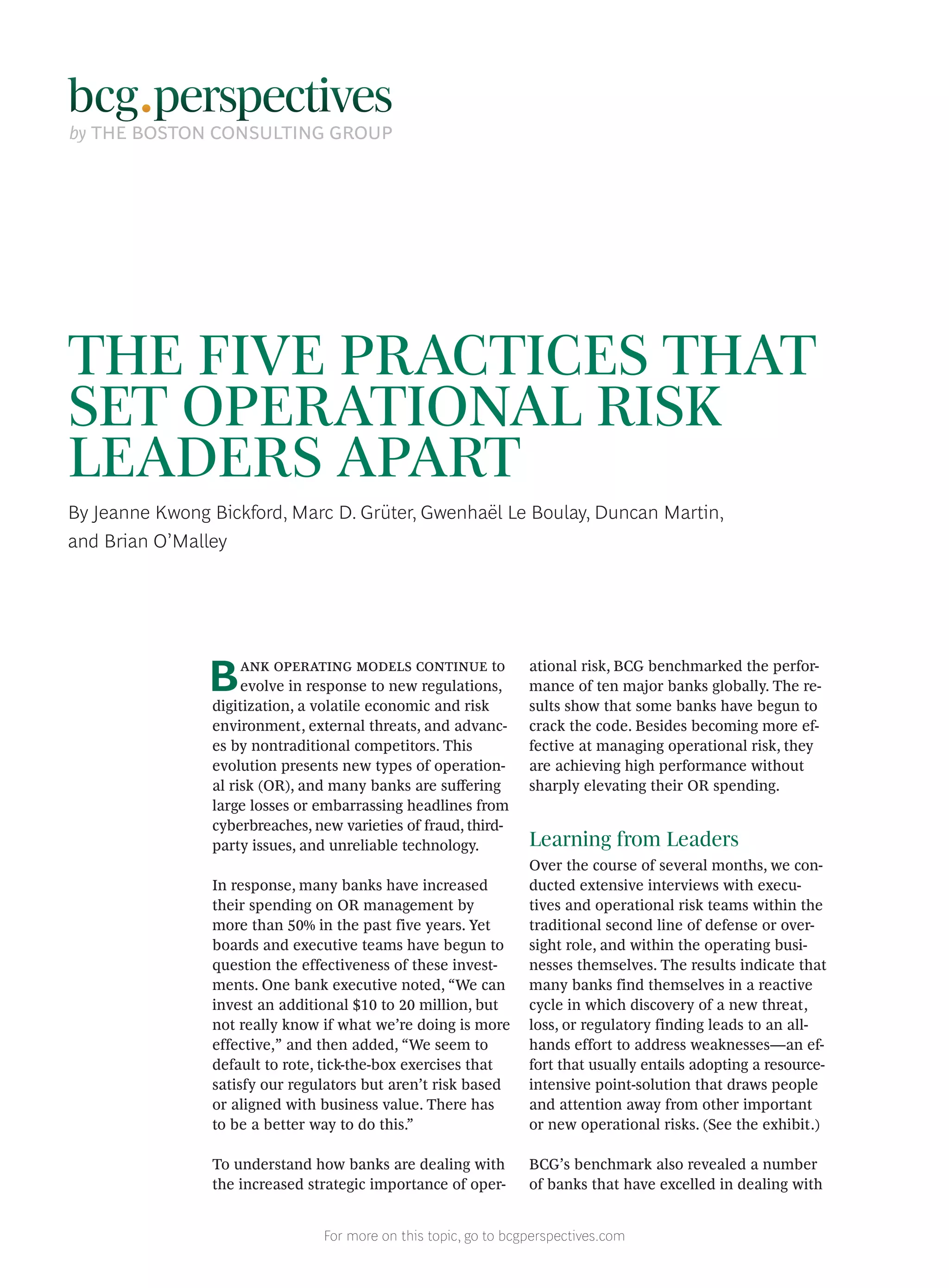
many banks find themselves in a reactive
cycle in which discovery of a new threat,
loss, or regulatory finding leads to an all-
hands effort to address weaknesses—an ef-
fort that usually entails adopting a resource-­
intensive point-solution that draws people
and attention away from other important
or new operational risks. (See the exhibit.)
BCG’s benchmark also revealed a number
of banks that have excelled in dealing with
|	 Five Practices of Operational Risk Leaders 2
OR. Three institutions—one from Europe
and two from North America—stood out
for their ability to create and execute a
more proactive, integrated, and sustainable
approach to operational risk. While they
had different strategies and risk profiles,
our analysis found that these leading OR
institutions do five things especially well.
They set clear objectives and maintain
discipline around strategic priorities.
Regulations require all large banks to have
a risk appetite statement that includes op-
erational risk, but often the goals stated for
OR do not align with senior business lead-
ers’ priorities. Often, the misalignment
stems from translation issues. OR teams
sometimes wade too deeply into technicali-
ties, don’t understand how to “speak busi-
ness,” or don’t discuss how risk issues re-
late to the bank’s overall goals. And some
business leaders lack the knowledge base
or fail to invest the time needed to keep up
with evolving risk topics.
The leading OR institutions in our bench-
mark do things differently. They start by
shaping consensus among senior leader-
ship on the overall OR program in the con-
text of the bank’s business objectives, and
then they design the OR program accord-
ingly. That process involves making
thoughtful and explicit tradeoffs between
risk reduction and operating cost. For ex-
ample, one leading OR institution needed
to make rapid changes to products and sys-
tems to gain competitive advantage and
found that risks related to these changes
were the primary driver of operational
losses. That insight shaped the bank’s OR
goals. The bank channeled spending to-
ward mitigating risks caused by product
and technology changes, and that focus
gave the bank a clear way to prioritize
spending and well-defined targets by which
to gauge the success of the OR program.
Leading banks also avoid scaremongering.
One board member complained that he
was “tired of the cyberrisk executive send-
ing alarmist articles without proposing any
solutions or concrete goals.” Such tactics
can gain attention and funding, but they
usually backfire in the longer term. Phras-
ing risk topics in more-familiar business
terms is often a more effective strategy. At
one leading OR institution we studied, the
OR team compares the process of manag-
ing risk to the more familiar process of
buying insurance. That construct helps ex-
ecutives think about “how much coverage
they want to buy and what it would cost.”
They manage mature risks cost effec-
tively to free up and reallocate staffing
and investment. Underperforming OR
programs tend to budget backward, not for-
ward. They typically revisit their strategy
and budget only in the wake of large losses
or when prompted by regulators, and they
BANKS MAY WORK
ON TEN OR MORE
OPERATIONAL
RISK–RELATED
REGULATORY
FINDINGS AT ANY TIME
—MAKING THIS
REACTIVE CYCLE
SLOW AND COSTLY
Deprioritizing
of other areas
of operational
risk
Response
to issue(s)
causing loss
or finding
Discovery
of issues or
losses in
deprioritized
areas
All-hands
effort to
address
weaknesses
New threat, large loss,
or regulatory finding
Many Banks Fall into a Reactive Risk Management Cycle
|	 Five Practices of Operational Risk Leaders 3
use additional investment to expand exist-
ing risk management processes past the
point of diminishing returns, with “tick-
box” exercises that grow more complex
and cumbersome from year to year.
Top-performing OR programs are more
flexible and strategic than other such pro-
grams. In mature areas of operational risk
(that is, in areas with flat or declining risk
and losses), the leading OR institutions in
our benchmark act more aggressively. In-
stead of basing their staffing estimates on
current levels (with some additional in-
crease for remediation and hot spots), lead-
ers regularly calibrate where their current
and emerging operational risks are greatest
and reallocate staff accordingly.
Further, whereas many banks leave proven
but people-intensive OR processes alone,
leading OR institutions use technology to
provide a more efficient, repeatable solution.
These leaders proactively create a cycle of
reducing headcount in mature areas of OR
through lean process redesign and automa-
tion to free up resources for newer, less ma-
ture areas. Those efforts significantly lower
costs while continuing to support a consis-
tent, high-quality control environment.
Our benchmark confirmed how difficult it
can be for banks to withdraw resources
from an established risk management area.
For instance, one bank in our study contin-
ued, through inertia, to build out its busi-
ness continuity program, increasing staff by
more than 40% over a five-year period,
even though the bank’s operational risk
capital needs for business continuity had
not grown and there had been no major
business continuity incidents.
Adjusting or reducing risk resources takes
boldness. But leading OR programs can af-
ford to be bold because they have stronger
risk assessment and risk capital processes.
As noted, they examine and refresh their
overall OR strategies at least every two
years, and they use those insights to guide
their investment decisions. One institution
actively reallocates staff based on its opera-
tional risk capital requirements. As a result,
that bank is far more successful in main-
taining effective cost control over mature
risks and is more nimble in scaling up its
risk resources in new areas.
They create a strong predictive risk
function to identify emerging risks. Be-
sides managing mature risks more effec-
tively, leading OR programs do a better job
of surfacing and tracking emerging risks.
Most have some type of “control tower”—a
small group, usually housed within the sec-
ond line of defense, that monitors the exist-
ing set of risks and spots new ones that
might become serious.
Such groups help operationalize the risk-­
sensing function. They detect risks from
various internal and external sources—by
investigating anomalous loss incidents, re-
searching external incidents within and
outside financial services, and collaborat-
ing with industry and public sector groups.
Individuals in one bank’s control tower
group regularly meet with managers across
banking disciplines, from business lines to
call centers, looking for insights into what’s
changing, where losses are emerging, and
where other risks may be tapering off.
They created a cyberrisk forum with peer
banks to stay current on potential threats
and mitigation efforts, and they use data
from the Operational Risk Exchange (ORX)
to monitor loss trends. That multifaceted
approach allows the bank to keep pace
with the evolving risk environment.
Effective control towers do more than track
risks, however. They also establish flexible
budgeting processes that allow them to re-
direct investment over the course of the
year as risks that require stronger manage-
ment emerge. In addition, they plan for
scalability, assigning triggers for when they
will make critical investments as the im-
portance of a particular emerging risk in-
creases. Should the risk level reach a stage
at which it merits its own policies, proce-
dures, and dedicated management team,
the control tower can recommend the cre-
ation of a separate formal risk program.
By maintaining a more responsive budget-
ing and management process around
emerging risks, the leading OR institutions
|	 Five Practices of Operational Risk Leaders 4
in our benchmark are better able to respond
to a dynamic risk environment, thereby im-
proving overall risk and cost performance.
They articulate clear roles and responsi-
bilities for each line of defense. Blurred
roles and responsibilities between lines of
defense hinder many OR programs, leading
to redundancy in some cases and to gaps in
others. In the absence of well-defined roles,
many second line OR functions may be
stretched to cover issues that the first line
might manage, to the detriment of their
core responsibilities. At one bank, business
managers felt ill-equipped to deal with
tracking OR issues, so they pushed the task
to the second line. But because the second
line team was understaffed and distracted
by several remediations, it missed two im-
portant trending risks that ultimately cost
the bank over $200 million.
Leading OR institutions spend time clarify-
ing the roles for each line of defense and
ensuring that each line has the skills need-
ed to perform its duties. Role charters de-
tail these assignments so that all stakehold-
ers understand their exact responsibilities.
This process helped one bank identify gaps
in its approach to cyberrisk and revealed
the need for improved training to help pro-
gramming teams execute their cyberrisk
responsibilities. Now the bank has an an-
nual process to evaluate the roles and re-
sponsibilities of every line of defense, en-
suring that each has the skills needed to
succeed. The bank also created a rotation
program that enables high-potential sec-
ond line staffers to spend time in audit and
first line operational risk roles to deepen
their skill base and, ultimately, improve the
quality of the second line.
To ensure effective oversight of all opera-
tional risk topics, leading institutions create
small teams within the second line to over-
see topics such as cyberrisk where the first
line organization formerly had sole respon-
sibility. The banks keep these teams small
so they cannot take on any operational
roles. By staffing the teams carefully, the
institutions ensure that they have the ex-
pertise to provide a credible challenge to
teams in the first line of defense (for exam-
ple, by hiring former cyberrisk consultants
to staff the second line cyberfunction). In
stark contrast, many less effective banks
manage certain critical risks exclusively
within the first line.
In addition, to help support the operation-
al risk needs of the business, some banks
have created a dedicated risk unit within
the first line—often called a “line 1.5”— to
manage aspects of its operational risk, such
as issues detected by the second line, by
audit, or by the first line staff. These struc-
tures are most effective when they support
specific first line needs (rather than dupli-
cating the functions of the second line),
such as cyberoperations or quality control.
They revise incentives to lock in the be-
havioral changes needed. Many regula-
tors now require that risk management be
part of senior leaders’ bonus calculations.
Not all such programs have been effective,
however—and in some cases, they have
even created perverse incentives. One insti-
tution, for example, rewarded business
leaders based on how many OR issues they
resolved, only to find that those leaders
self-identified many low-risk issues express-
ly to close them out.
Leading OR institutions try to find the right
balance by mixing formal rewards based
on risk outcomes with a strong set of infor-
mal incentives. They reward leaders who
proactively address risks and punish those
who hide them (by looking at such things
as the percentage of issues that are self-­
declared and at losses that fall outside the
formal list of top and emerging risks.) In
one case, a leading OR institution demoted
a rising star in a large business whose team
had presided over an unusually large oper-
ational loss—an action that sent a clear
message to other managers regarding the
importance of risk management.
Building a Leading Operational
Risk Program
Institutions that aspire to build a leading
program must take a few crucial steps. The
first is to create clarity around OR goals,
showing how and where superior OR man-
|	 Five Practices of Operational Risk Leaders 5
agement will add value in line with the
bank’s overall strategic direction. This
should lead to a concrete statement or set
of metrics defining success (phrased in
business terms) that board and senior man-
agement support. For example, a bank fo-
cused on customer service might say, “To
support an outstanding customer experi-
ence, our operational risk program’s goal is
to prevent material customer-facing disrup-
tion or error.” Agreeing on those goals re-
quires careful prioritization and, in some
instances, difficult tradeoffs.
The second step is to address critical obsta-
cles to achieving the bank’s OR goals. This
may require a short-term ramp-up in re-
sources to manage immediate priorities, so
as not to divert other resources from mov-
ing the rest of the program forward. For ex-
ample, one bank hired a team of contractors
to improve a technology risk program to
meet regulatory expectations. By focusing
these temporary resources on a specific
goal, the bank created goodwill with the
regulators, tapped technical experts to build
an effective program, and freed in-house
OR teams to focus on other improvements.
The third step is to build a set of OR com-
petencies (no more than three to five to
start) that support specific elements of the
bank’s business strategy. To help one bank
achieve its goal of differentiating the quali-
ty of the customer experience, the bank’s
OR leaders focused on controlling risks
from frequent changes in products, process-
es, systems, and organizations, which they
had identified as being the leading causes
of service disruption for customers. The
bank also sought to improve the reliability
of its core consumer platforms to prevent
further failures. By developing targeted sets
of competencies capable of evolving in line
with strategy, leading OR programs in our
benchmark have gained and sustained trac-
tion, notched measurable successes, and
built credibility.
Despite increased investment, many
banks feel unsure about whether their
OR programs are performing effectively in
what has become a more complicated and
volatile environment. With digitization,
regulation, and globalization disrupting the
business and operating landscape, banks
can no longer afford to rely on static, check-
box controls. Instead, as our benchmark
shows, the most effective OR programs
need to become as dynamic, targeted, and
responsive as the banks’ own operating
business lines, with a well-defined and
well-aligned series of objectives, better re-
source allocation, superior risk detection
and mitigation capabilities, clear roles, and
revised performance incentives calibrated
to sustain the desired behavioral changes.
The banks that most effectively channel
their OR efforts in these five areas will be
in the strongest position to anticipate and
protect against risks that threaten growth
and profitability in both the short run and
the long run.
About the Authors
Jeanne Kwong Bickford is a partner and managing director in the New York office of The Boston Con-
sulting Group. You may contact her by e-mail at bickford.jeanne@bcg.com.
Marc D. Grüter is a partner and managing director in the firm’s Zurich office. You may contact him by
e-mail at grueter.marc@bcg.com.
Gwenhaël Le Boulay is a partner and managing director in BCG’s Paris office. You may contact him by
e-mail at leboulay.gwenhael@bcg.com.
Duncan Martin is a senior partner and managing director in the firm’s London office. You may contact
him by e-mail at martin.duncan@bcg.com.
Brian O’Malley is a principal in BCG’s Minneapolis office. You may contact him by e-mail
at omalley.brian@bcg.com.
|	 Five Practices of Operational Risk Leaders 6
The Boston Consulting Group (BCG) is a global management consulting firm and the world’s leading advi-
sor on business strategy. We partner with clients from the private, public, and not-for-profit sectors in all
regions to identify their highest-value opportunities, address their most critical challenges, and transform
their enterprises. Our customized approach combines deep in­sight into the dynamics of companies and
markets with close collaboration at all levels of the client organization. This ensures that our clients
achieve sustainable compet­itive advantage, build more capable organizations, and secure lasting results.
Founded in 1963, BCG is a private company with 85 offices in 48 countries. For more information, please
visit bcg.com.
© The Boston Consulting Group, Inc. 2016.
All rights reserved.
10/16

BCG-Five-Practices-of-Operational-Risk-Leaders-Oct-2016_tcm80-214941

  • 1.
    For more onthis topic, go to bcgperspectives.com The Five Practices That Set Operational Risk Leaders Apart By Jeanne Kwong Bickford, Marc D. Grüter, Gwenhaël Le Boulay, Duncan Martin, and Brian O’Malley Bank operating models continue to evolve in response to new regulations, digitization, a volatile economic and risk environment, external threats, and advanc- es by nontraditional competitors. This evolution presents new types of operation- al risk (OR), and many banks are suffering large losses or embarrassing headlines from cyberbreaches, new varieties of fraud, third-­ party issues, and unreliable technology. In response, many banks have increased their spending on OR management by more than 50% in the past five years. Yet boards and executive teams have begun to question the effectiveness of these invest- ments. One bank executive noted, “We can invest an additional $10 to 20 million, but not really know if what we’re doing is more effective,” and then added, “We seem to default to rote, tick-the-box exercises that satisfy our regulators but aren’t risk based or aligned with business value. There has to be a better way to do this.” To understand how banks are dealing with the increased strategic importance of oper- ational risk, BCG benchmarked the perfor- mance of ten major banks globally. The re- sults show that some banks have begun to crack the code. Besides becoming more ef- fective at managing operational risk, they are achieving high performance without sharply elevating their OR spending. Learning from Leaders Over the course of several months, we con- ducted extensive interviews with execu- tives and operational risk teams within the traditional second line of defense or over- sight role, and within the operating busi- nesses themselves. The results indicate that many banks find themselves in a reactive cycle in which discovery of a new threat, loss, or regulatory finding leads to an all- hands effort to address weaknesses—an ef- fort that usually entails adopting a resource-­ intensive point-solution that draws people and attention away from other important or new operational risks. (See the exhibit.) BCG’s benchmark also revealed a number of banks that have excelled in dealing with
  • 2.
    | Five Practicesof Operational Risk Leaders 2 OR. Three institutions—one from Europe and two from North America—stood out for their ability to create and execute a more proactive, integrated, and sustainable approach to operational risk. While they had different strategies and risk profiles, our analysis found that these leading OR institutions do five things especially well. They set clear objectives and maintain discipline around strategic priorities. Regulations require all large banks to have a risk appetite statement that includes op- erational risk, but often the goals stated for OR do not align with senior business lead- ers’ priorities. Often, the misalignment stems from translation issues. OR teams sometimes wade too deeply into technicali- ties, don’t understand how to “speak busi- ness,” or don’t discuss how risk issues re- late to the bank’s overall goals. And some business leaders lack the knowledge base or fail to invest the time needed to keep up with evolving risk topics. The leading OR institutions in our bench- mark do things differently. They start by shaping consensus among senior leader- ship on the overall OR program in the con- text of the bank’s business objectives, and then they design the OR program accord- ingly. That process involves making thoughtful and explicit tradeoffs between risk reduction and operating cost. For ex- ample, one leading OR institution needed to make rapid changes to products and sys- tems to gain competitive advantage and found that risks related to these changes were the primary driver of operational losses. That insight shaped the bank’s OR goals. The bank channeled spending to- ward mitigating risks caused by product and technology changes, and that focus gave the bank a clear way to prioritize spending and well-defined targets by which to gauge the success of the OR program. Leading banks also avoid scaremongering. One board member complained that he was “tired of the cyberrisk executive send- ing alarmist articles without proposing any solutions or concrete goals.” Such tactics can gain attention and funding, but they usually backfire in the longer term. Phras- ing risk topics in more-familiar business terms is often a more effective strategy. At one leading OR institution we studied, the OR team compares the process of manag- ing risk to the more familiar process of buying insurance. That construct helps ex- ecutives think about “how much coverage they want to buy and what it would cost.” They manage mature risks cost effec- tively to free up and reallocate staffing and investment. Underperforming OR programs tend to budget backward, not for- ward. They typically revisit their strategy and budget only in the wake of large losses or when prompted by regulators, and they BANKS MAY WORK ON TEN OR MORE OPERATIONAL RISK–RELATED REGULATORY FINDINGS AT ANY TIME —MAKING THIS REACTIVE CYCLE SLOW AND COSTLY Deprioritizing of other areas of operational risk Response to issue(s) causing loss or finding Discovery of issues or losses in deprioritized areas All-hands effort to address weaknesses New threat, large loss, or regulatory finding Many Banks Fall into a Reactive Risk Management Cycle
  • 3.
    | Five Practicesof Operational Risk Leaders 3 use additional investment to expand exist- ing risk management processes past the point of diminishing returns, with “tick- box” exercises that grow more complex and cumbersome from year to year. Top-performing OR programs are more flexible and strategic than other such pro- grams. In mature areas of operational risk (that is, in areas with flat or declining risk and losses), the leading OR institutions in our benchmark act more aggressively. In- stead of basing their staffing estimates on current levels (with some additional in- crease for remediation and hot spots), lead- ers regularly calibrate where their current and emerging operational risks are greatest and reallocate staff accordingly. Further, whereas many banks leave proven but people-intensive OR processes alone, leading OR institutions use technology to provide a more efficient, repeatable solution. These leaders proactively create a cycle of reducing headcount in mature areas of OR through lean process redesign and automa- tion to free up resources for newer, less ma- ture areas. Those efforts significantly lower costs while continuing to support a consis- tent, high-quality control environment. Our benchmark confirmed how difficult it can be for banks to withdraw resources from an established risk management area. For instance, one bank in our study contin- ued, through inertia, to build out its busi- ness continuity program, increasing staff by more than 40% over a five-year period, even though the bank’s operational risk capital needs for business continuity had not grown and there had been no major business continuity incidents. Adjusting or reducing risk resources takes boldness. But leading OR programs can af- ford to be bold because they have stronger risk assessment and risk capital processes. As noted, they examine and refresh their overall OR strategies at least every two years, and they use those insights to guide their investment decisions. One institution actively reallocates staff based on its opera- tional risk capital requirements. As a result, that bank is far more successful in main- taining effective cost control over mature risks and is more nimble in scaling up its risk resources in new areas. They create a strong predictive risk function to identify emerging risks. Be- sides managing mature risks more effec- tively, leading OR programs do a better job of surfacing and tracking emerging risks. Most have some type of “control tower”—a small group, usually housed within the sec- ond line of defense, that monitors the exist- ing set of risks and spots new ones that might become serious. Such groups help operationalize the risk-­ sensing function. They detect risks from various internal and external sources—by investigating anomalous loss incidents, re- searching external incidents within and outside financial services, and collaborat- ing with industry and public sector groups. Individuals in one bank’s control tower group regularly meet with managers across banking disciplines, from business lines to call centers, looking for insights into what’s changing, where losses are emerging, and where other risks may be tapering off. They created a cyberrisk forum with peer banks to stay current on potential threats and mitigation efforts, and they use data from the Operational Risk Exchange (ORX) to monitor loss trends. That multifaceted approach allows the bank to keep pace with the evolving risk environment. Effective control towers do more than track risks, however. They also establish flexible budgeting processes that allow them to re- direct investment over the course of the year as risks that require stronger manage- ment emerge. In addition, they plan for scalability, assigning triggers for when they will make critical investments as the im- portance of a particular emerging risk in- creases. Should the risk level reach a stage at which it merits its own policies, proce- dures, and dedicated management team, the control tower can recommend the cre- ation of a separate formal risk program. By maintaining a more responsive budget- ing and management process around emerging risks, the leading OR institutions
  • 4.
    | Five Practicesof Operational Risk Leaders 4 in our benchmark are better able to respond to a dynamic risk environment, thereby im- proving overall risk and cost performance. They articulate clear roles and responsi- bilities for each line of defense. Blurred roles and responsibilities between lines of defense hinder many OR programs, leading to redundancy in some cases and to gaps in others. In the absence of well-defined roles, many second line OR functions may be stretched to cover issues that the first line might manage, to the detriment of their core responsibilities. At one bank, business managers felt ill-equipped to deal with tracking OR issues, so they pushed the task to the second line. But because the second line team was understaffed and distracted by several remediations, it missed two im- portant trending risks that ultimately cost the bank over $200 million. Leading OR institutions spend time clarify- ing the roles for each line of defense and ensuring that each line has the skills need- ed to perform its duties. Role charters de- tail these assignments so that all stakehold- ers understand their exact responsibilities. This process helped one bank identify gaps in its approach to cyberrisk and revealed the need for improved training to help pro- gramming teams execute their cyberrisk responsibilities. Now the bank has an an- nual process to evaluate the roles and re- sponsibilities of every line of defense, en- suring that each has the skills needed to succeed. The bank also created a rotation program that enables high-potential sec- ond line staffers to spend time in audit and first line operational risk roles to deepen their skill base and, ultimately, improve the quality of the second line. To ensure effective oversight of all opera- tional risk topics, leading institutions create small teams within the second line to over- see topics such as cyberrisk where the first line organization formerly had sole respon- sibility. The banks keep these teams small so they cannot take on any operational roles. By staffing the teams carefully, the institutions ensure that they have the ex- pertise to provide a credible challenge to teams in the first line of defense (for exam- ple, by hiring former cyberrisk consultants to staff the second line cyberfunction). In stark contrast, many less effective banks manage certain critical risks exclusively within the first line. In addition, to help support the operation- al risk needs of the business, some banks have created a dedicated risk unit within the first line—often called a “line 1.5”— to manage aspects of its operational risk, such as issues detected by the second line, by audit, or by the first line staff. These struc- tures are most effective when they support specific first line needs (rather than dupli- cating the functions of the second line), such as cyberoperations or quality control. They revise incentives to lock in the be- havioral changes needed. Many regula- tors now require that risk management be part of senior leaders’ bonus calculations. Not all such programs have been effective, however—and in some cases, they have even created perverse incentives. One insti- tution, for example, rewarded business leaders based on how many OR issues they resolved, only to find that those leaders self-identified many low-risk issues express- ly to close them out. Leading OR institutions try to find the right balance by mixing formal rewards based on risk outcomes with a strong set of infor- mal incentives. They reward leaders who proactively address risks and punish those who hide them (by looking at such things as the percentage of issues that are self-­ declared and at losses that fall outside the formal list of top and emerging risks.) In one case, a leading OR institution demoted a rising star in a large business whose team had presided over an unusually large oper- ational loss—an action that sent a clear message to other managers regarding the importance of risk management. Building a Leading Operational Risk Program Institutions that aspire to build a leading program must take a few crucial steps. The first is to create clarity around OR goals, showing how and where superior OR man-
  • 5.
    | Five Practicesof Operational Risk Leaders 5 agement will add value in line with the bank’s overall strategic direction. This should lead to a concrete statement or set of metrics defining success (phrased in business terms) that board and senior man- agement support. For example, a bank fo- cused on customer service might say, “To support an outstanding customer experi- ence, our operational risk program’s goal is to prevent material customer-facing disrup- tion or error.” Agreeing on those goals re- quires careful prioritization and, in some instances, difficult tradeoffs. The second step is to address critical obsta- cles to achieving the bank’s OR goals. This may require a short-term ramp-up in re- sources to manage immediate priorities, so as not to divert other resources from mov- ing the rest of the program forward. For ex- ample, one bank hired a team of contractors to improve a technology risk program to meet regulatory expectations. By focusing these temporary resources on a specific goal, the bank created goodwill with the regulators, tapped technical experts to build an effective program, and freed in-house OR teams to focus on other improvements. The third step is to build a set of OR com- petencies (no more than three to five to start) that support specific elements of the bank’s business strategy. To help one bank achieve its goal of differentiating the quali- ty of the customer experience, the bank’s OR leaders focused on controlling risks from frequent changes in products, process- es, systems, and organizations, which they had identified as being the leading causes of service disruption for customers. The bank also sought to improve the reliability of its core consumer platforms to prevent further failures. By developing targeted sets of competencies capable of evolving in line with strategy, leading OR programs in our benchmark have gained and sustained trac- tion, notched measurable successes, and built credibility. Despite increased investment, many banks feel unsure about whether their OR programs are performing effectively in what has become a more complicated and volatile environment. With digitization, regulation, and globalization disrupting the business and operating landscape, banks can no longer afford to rely on static, check- box controls. Instead, as our benchmark shows, the most effective OR programs need to become as dynamic, targeted, and responsive as the banks’ own operating business lines, with a well-defined and well-aligned series of objectives, better re- source allocation, superior risk detection and mitigation capabilities, clear roles, and revised performance incentives calibrated to sustain the desired behavioral changes. The banks that most effectively channel their OR efforts in these five areas will be in the strongest position to anticipate and protect against risks that threaten growth and profitability in both the short run and the long run. About the Authors Jeanne Kwong Bickford is a partner and managing director in the New York office of The Boston Con- sulting Group. You may contact her by e-mail at bickford.jeanne@bcg.com. Marc D. Grüter is a partner and managing director in the firm’s Zurich office. You may contact him by e-mail at grueter.marc@bcg.com. Gwenhaël Le Boulay is a partner and managing director in BCG’s Paris office. You may contact him by e-mail at leboulay.gwenhael@bcg.com. Duncan Martin is a senior partner and managing director in the firm’s London office. You may contact him by e-mail at martin.duncan@bcg.com. Brian O’Malley is a principal in BCG’s Minneapolis office. You may contact him by e-mail at omalley.brian@bcg.com.
  • 6.
    | Five Practicesof Operational Risk Leaders 6 The Boston Consulting Group (BCG) is a global management consulting firm and the world’s leading advi- sor on business strategy. We partner with clients from the private, public, and not-for-profit sectors in all regions to identify their highest-value opportunities, address their most critical challenges, and transform their enterprises. Our customized approach combines deep in­sight into the dynamics of companies and markets with close collaboration at all levels of the client organization. This ensures that our clients achieve sustainable compet­itive advantage, build more capable organizations, and secure lasting results. Founded in 1963, BCG is a private company with 85 offices in 48 countries. For more information, please visit bcg.com. © The Boston Consulting Group, Inc. 2016. All rights reserved. 10/16