OPERATIONAL RISK MANAGEMENT

07/03/20
14

1
What is Operational Risk?



The risk of loss resulting from inadequate or failed
internal processes, people and systems or from
external events (The Basel II Capital Accord)



FORMERLY any risk but market and credit risks



It is NOT a brand new stuff and it is the risk that affects
all businesses



Operational risk is inherent in carrying out a process/
operational activity.

07/03/20
14

2
Classification of Operational Risks
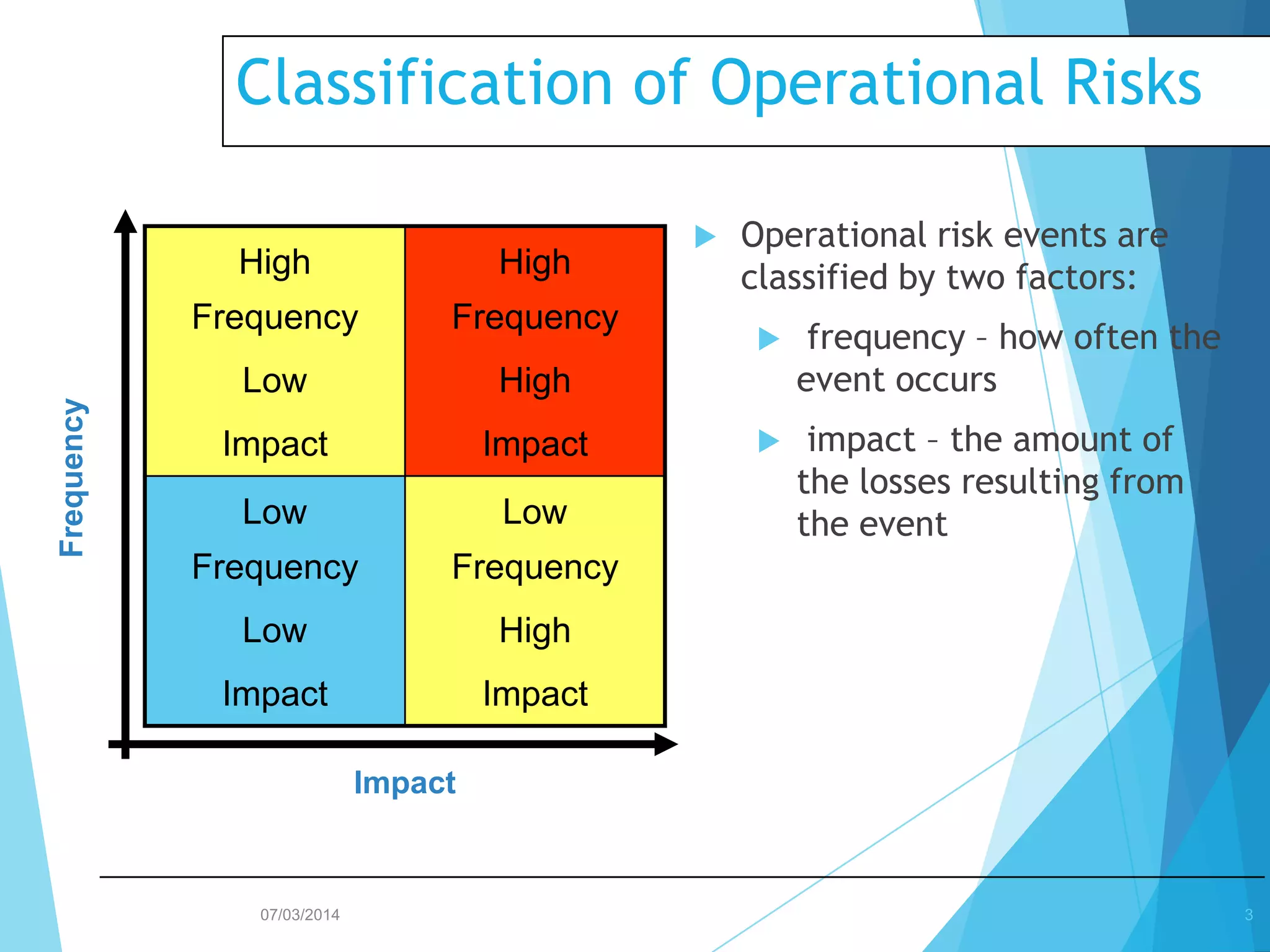
High

Frequency
Frequency

High

Frequency

Low

Impact

Low

Low

Frequency

Frequency

Low

High

Impact

Operational risk events are
classified by two factors:

High

Impact



Impact



frequency – how often the
event occurs



impact – the amount of
the losses resulting from
the event

Impact

07/03/2014

3
Classification of Operational Risks



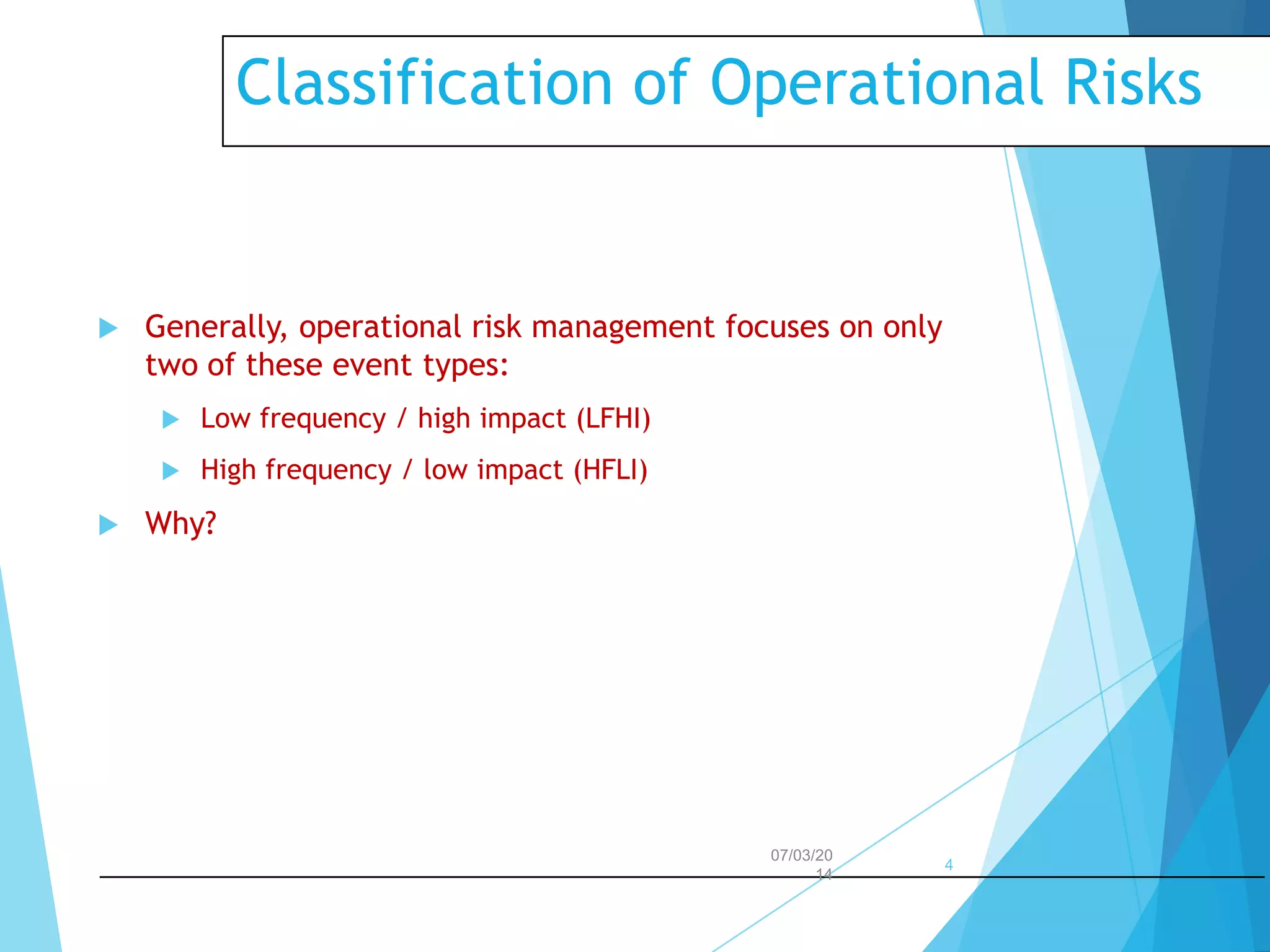
Generally, operational risk management focuses on only
two of these event types:





Low frequency / high impact (LFHI)
High frequency / low impact (HFLI)

Why?

07/03/20
14

4
Classification of Operational
Risks


High frequency/low impact events are managed to
improve business efficiency. These events tend to be
readily understood and are viewed as ‘the cost of doing
business’.



Examples?

07/03/20
14

5
Expected loss verses unexpected loss



Expected loss is the loss incurred as a bank conducts its
normal business.



Can be simply defined as the cost of doing business



The only way to totally prevent them is to cease doing
business.

07/03/20
14

6
Expected loss versus
unexpected loss


A bank uses statistical methods to predict its expected
losses.



In short, the firm uses past data and experience to
predict the future.



A simple method of calculating expected loss is to
compute the mean (average) of the actual losses over a
given time and accept this as the likely future level.

07/03/20
14

7
Expected loss verses unexpected
loss


A firm may also attempt to ‘predict’ its unexpected
losses using statistics, much like the way that is used to
predict expected losses.



The problems are the past data may not available and
therefore to calculate unexpected loss a firm uses:


available internal data



external data from other firms



data from operational risk scenarios

07/03/20
14

8
Operational risk event
categories



The simplest way of understanding operational risk in banks
is to categorize it as anything but credit risk or market risk.



However, this is a very broad definition and does not help
manage operational risk.



Generally, operational risk events can be subdivided into:


internal process risk



people risk



systems risk



external risk



legal risk
07/03/20
14

9
Internal Process Risk



Internal process risk is defined as the risk associated
with the failure of a bank’s processes or procedures.



During a bank’s day-to-day operations, staff follow
preset working practices.



These procedures and policies will include all the
checks, and controls required to ensure that customers
are correctly served and the bank remains within the
laws and regulations by which it is governed

07/03/20
14

10
Internal Process Risks



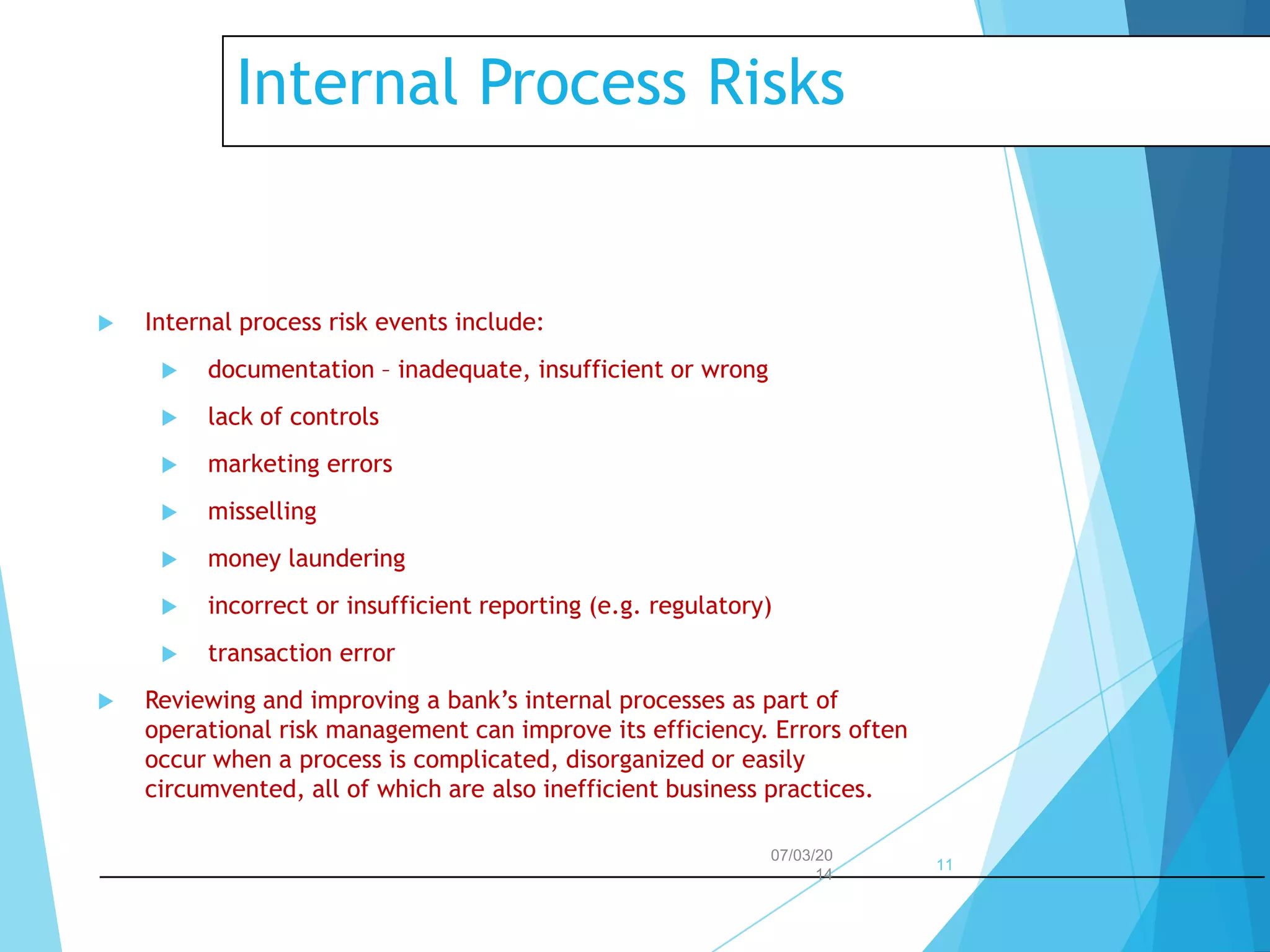
Internal process risk events include:



lack of controls



marketing errors



misselling



money laundering



incorrect or insufficient reporting (e.g. regulatory)




documentation – inadequate, insufficient or wrong

transaction error

Reviewing and improving a bank’s internal processes as part of
operational risk management can improve its efficiency. Errors often
occur when a process is complicated, disorganized or easily
circumvented, all of which are also inefficient business practices.
07/03/20
14

11
Risk Management Process Feedback Loop
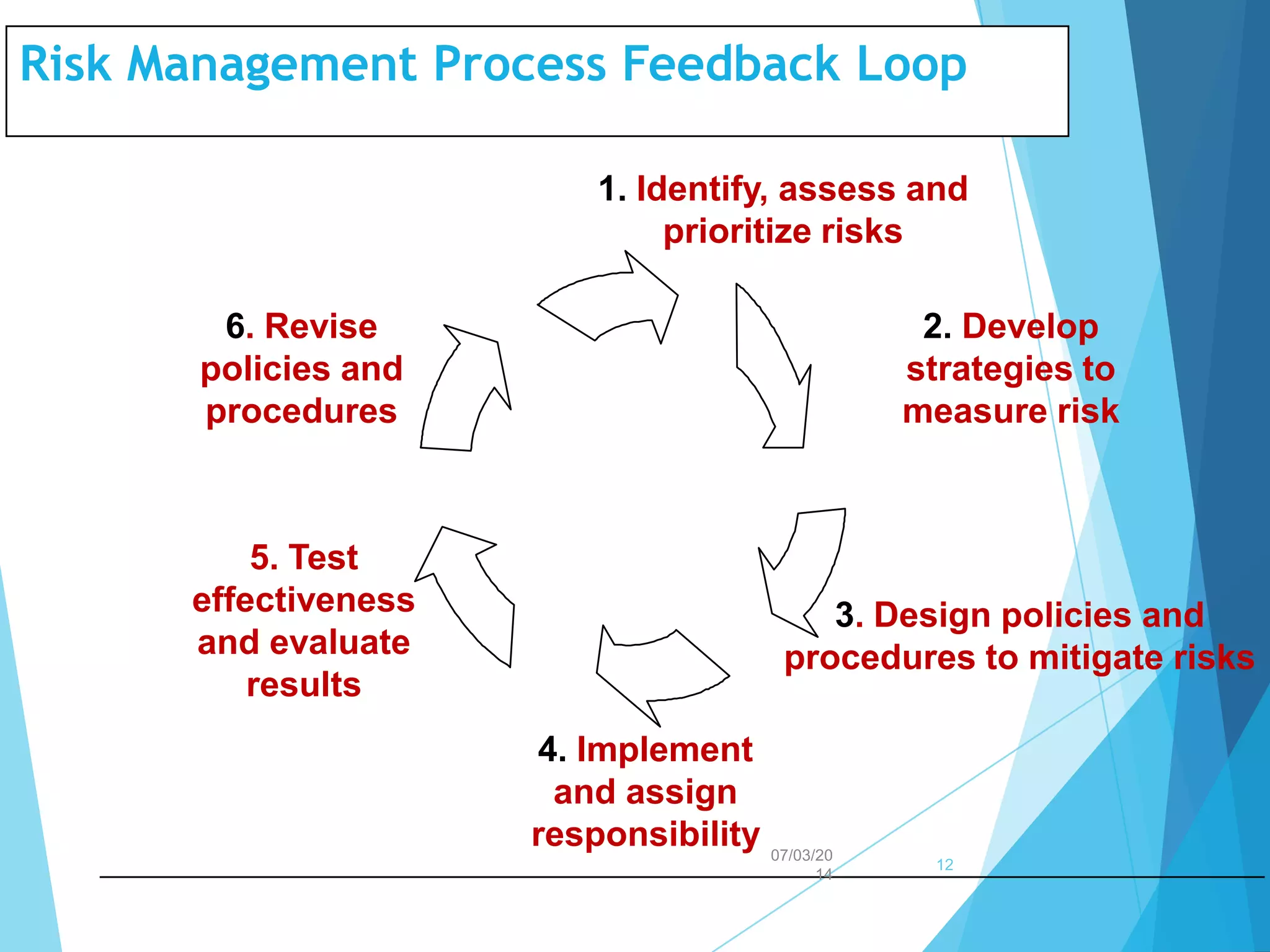
1. Identify, assess and
prioritize risks
6. Revise
policies and
procedures

2. Develop
strategies to
measure risk

5. Test
effectiveness
and evaluate
results

3. Design policies and
procedures to mitigate risks

4. Implement
and assign
responsibility 07/03/20
14

12
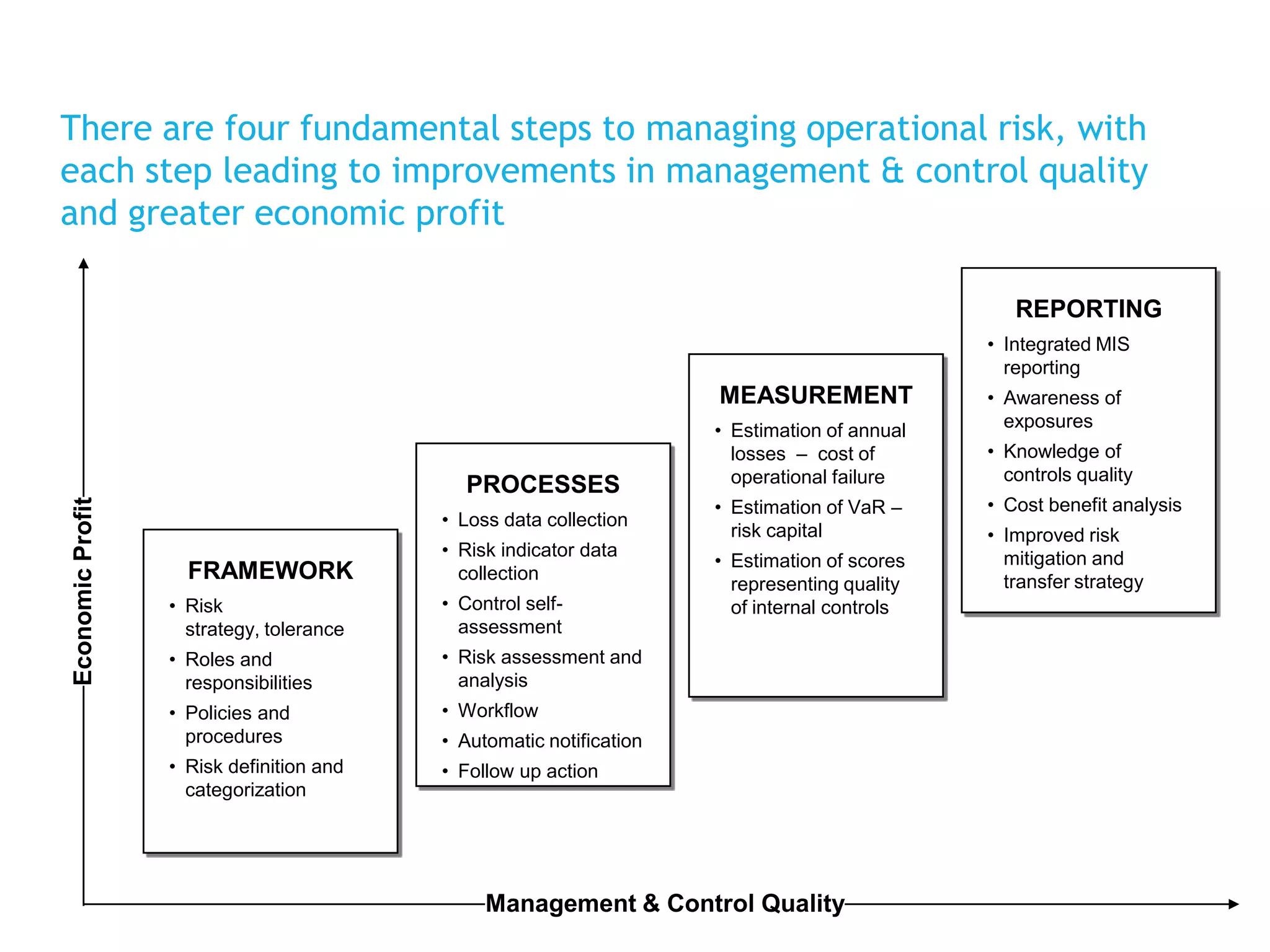
There are four fundamental steps to managing operational risk, with
each step leading to improvements in management & control quality
and greater economic profit
REPORTING
• Integrated MIS
reporting

Economic Profit

MEASUREMENT

PROCESSES
• Loss data collection

FRAMEWORK

• Risk indicator data
collection

• Risk
strategy, tolerance

• Control selfassessment

• Roles and
responsibilities

• Estimation of scores
representing quality
of internal controls

• Workflow

• Risk definition and
categorization

• Estimation of VaR –
risk capital

• Risk assessment and
analysis

• Policies and
procedures

• Estimation of annual
losses – cost of
operational failure

• Follow up action

• Automatic notification

Management & Control Quality

• Awareness of
exposures
• Knowledge of
controls quality
• Cost benefit analysis
• Improved risk
mitigation and
transfer strategy
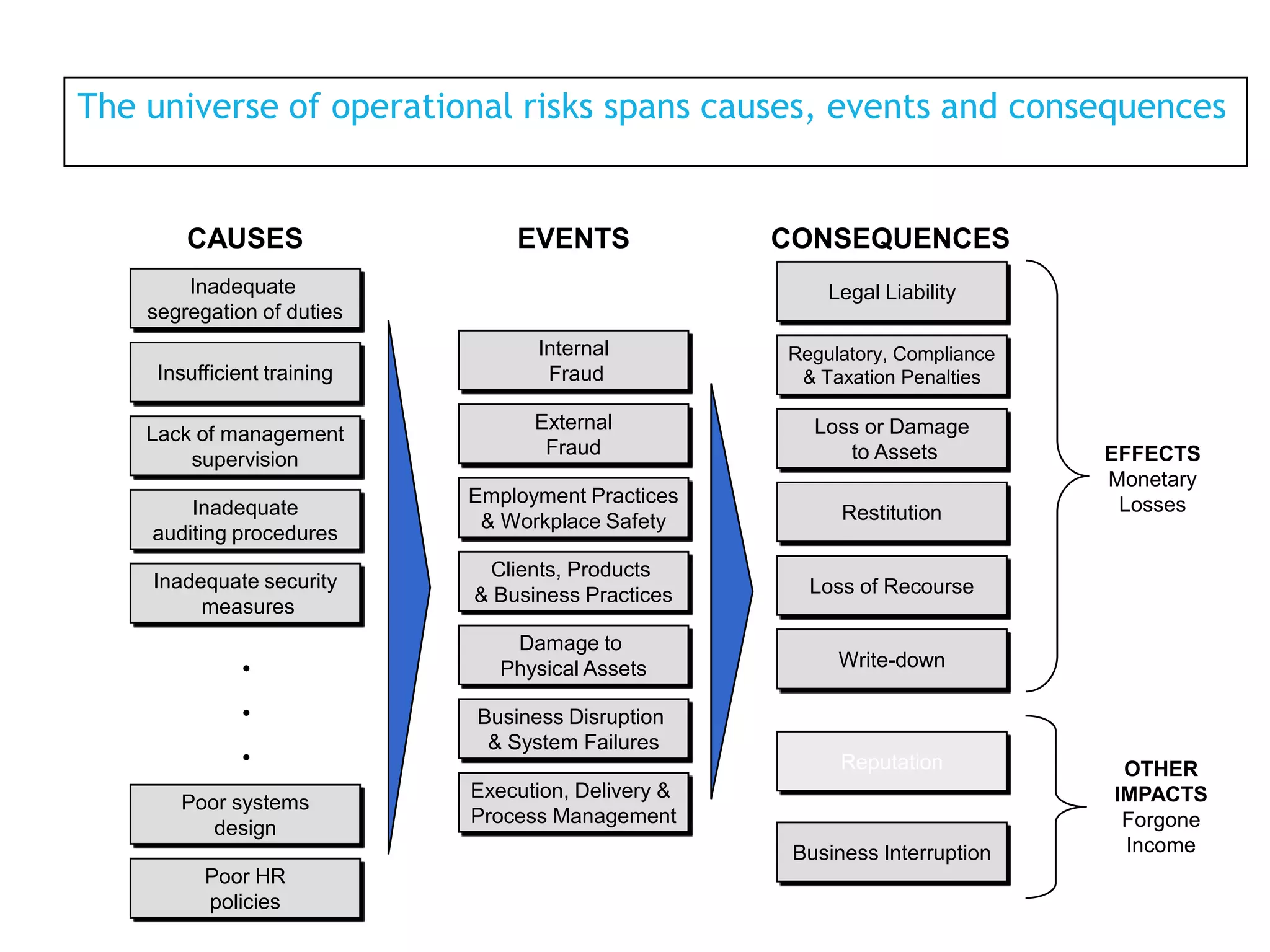
The universe of operational risks spans causes, events and consequences

CAUSES

EVENTS

Inadequate
segregation of duties
Insufficient training

Lack of management
supervision
Inadequate
auditing procedures
Inadequate security
measures

•

•
•
Poor systems
design

CONSEQUENCES
Legal Liability

Internal
Fraud

Regulatory, Compliance
& Taxation Penalties

External
Fraud

Loss or Damage
to Assets

Employment Practices
& Workplace Safety

Restitution

Clients, Products
& Business Practices

Loss of Recourse

Damage to
Physical Assets

Write-down

Business Disruption
& System Failures
Reputation
Execution, Delivery &
Process Management
Business Interruption

Poor HR
policies

EFFECTS
Monetary
Losses

OTHER
IMPACTS
Forgone
Income
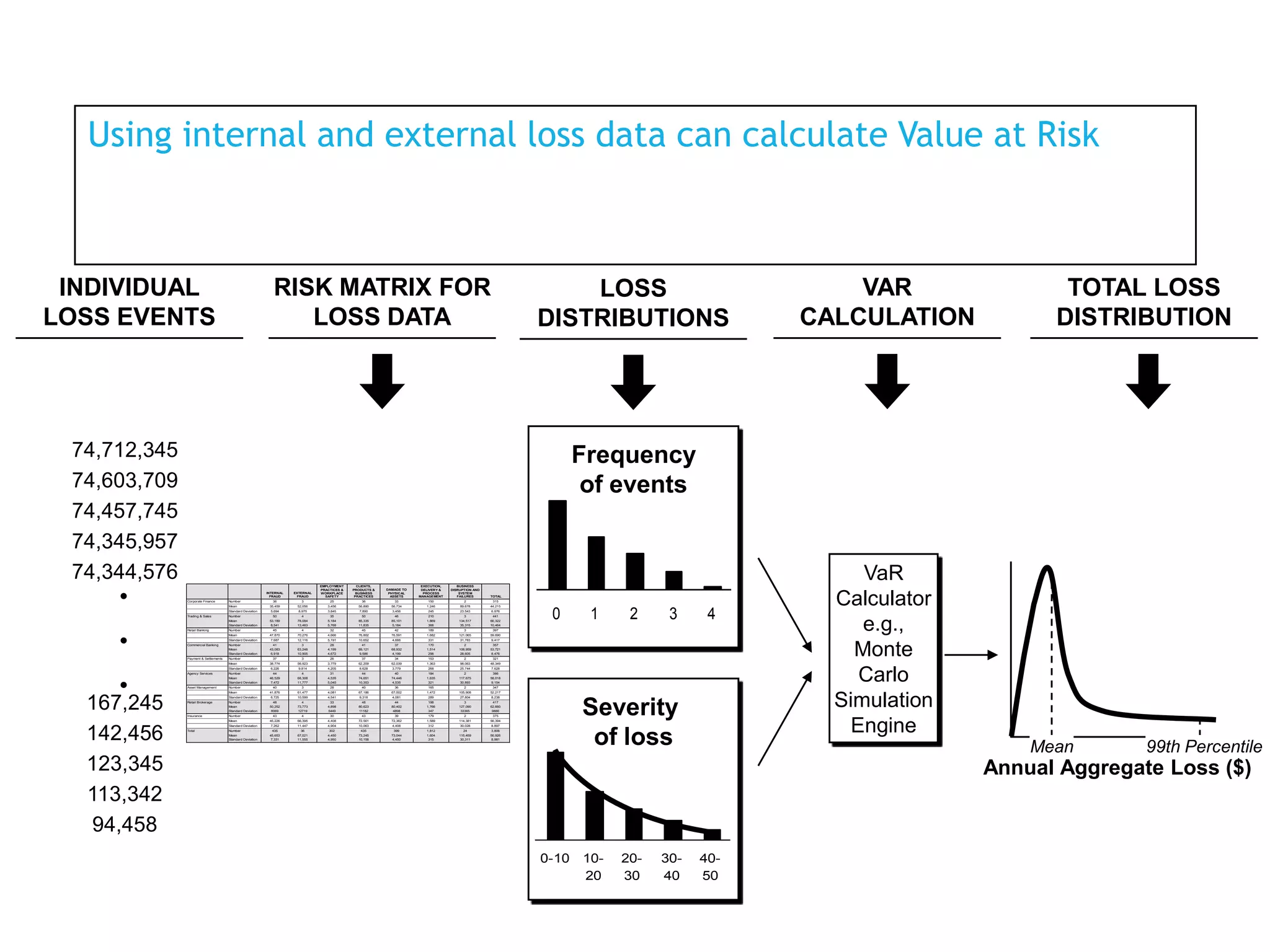
Using internal and external loss data can calculate Value at Risk

RISK MATRIX FOR
LOSS DATA

INDIVIDUAL
LOSS EVENTS

LOSS
DISTRIBUTIONS

74,712,345
74,603,709
74,457,745
74,345,957
74,344,576

•

INTERNAL
FRAUD
Corporate Finance

Number
Mean

EXTERNAL
FRAUD

EMPLOYMENT
PRACTICES &
WORKPLACE
SAFETY

CLIENTS,
PRODUCTS &
BUSINESS
PRACTICES

DAMAGE TO
PHYSICAL
ASSETS

EXECUTION,
DELIVERY &
PROCESS
MANAGEMENT

BUSINESS
DISRUPTION AND
SYSTEM
FAILURES

TOTAL

36

3

25

36

33

150

2

315

35,459

56,890

56,734

1,246

89,678

44,215

52,056

3,456

Standard Deviation

5,694

8,975

3,845

7,890

3,456

245

23,543

6,976

Number
Mean
Standard Deviation

50
53,189
8,541

4
78,084
13,463

35
5,184
5,768

50
85,335
11,835

46
85,101
5,184

210
1,869
368

3
134,517
35,315

441
66,322
10,464

Retail Banking

Number

45

4

32

45

42

189

3

397

47,870

70,276

4,666

76,802

76,591

1,682

121,065

Mean

7,687

12,116

5,191

10,652

4,666

331

31,783

Number
Mean
Standard Deviation

41
43,083
6,918

3
63,248
10,905

28
4,199
4,672

41
69,121
9,586

37
68,932
4,199

170
1,514
298

2
108,959
28,605

37

3

26

37

34

153

2

3

4

321

38,774

56,923

3,779

62,209

62,039

1,363

98,063

48,349

Standard Deviation

6,226

9,814

4,205

8,628

3,779

268

25,744

7,628

Agency Services

Number
Mean
Standard Deviation

44
46,529
7,472

4
68,308
11,777

31
4,535
5,045

44
74,651
10,353

40
74,446
4,535

184
1,635
321

2
117,675
30,893

386
58,018
9,154

Asset Management

Number

Mean

•

2

357
53,721
8,476

Number

1

9,417

Commercial Banking

0

59,690

Standard Deviation

Payment & Settlements

167,245
142,456
123,345
113,342
94,458

TOTAL LOSS
DISTRIBUTION

Frequency
of events

Trading & Sales

•

VAR
CALCULATION

40

3

28

40

36

165

2

347

41,876

61,477

4,081

67,186

67,002

1,472

105,908

52,217

Standard Deviation

6,725

10,599

4,541

9,318

4,081

289

27,804

8,238

Retail Brokerage

Number
Mean
Standard Deviation

48
50,252
8069

4
73,773
12719

33
4,898
5449

48
80,623
11182

44
80,402
4898

198
1,766
347

3
127,090
33365

417
62,660
9886

Insurance

Number

Mean

43

4

30

43

39

179

2

66,395

4,408

72,561

72,362

1,589

114,381

56,394

7,262

11,447

4,904

10,063

4,408

312

30,028

8,897

435
45,653
7,331

36
67,021
11,555

302
4,450
4,950

435
73,245
10,158

399
73,044
4,450

1,812
1,604
315

24
115,459
30,311

Severity
of loss

375

45,226

Standard Deviation
Number
Mean
Standard Deviation

3,806
56,926
8,981

Mean
Total

VaR
Calculator
e.g.,
Monte
Carlo
Simulation
Engine
Mean

99th Percentile

Annual Aggregate Loss ($)

0-10

1020

2030

3040

4050
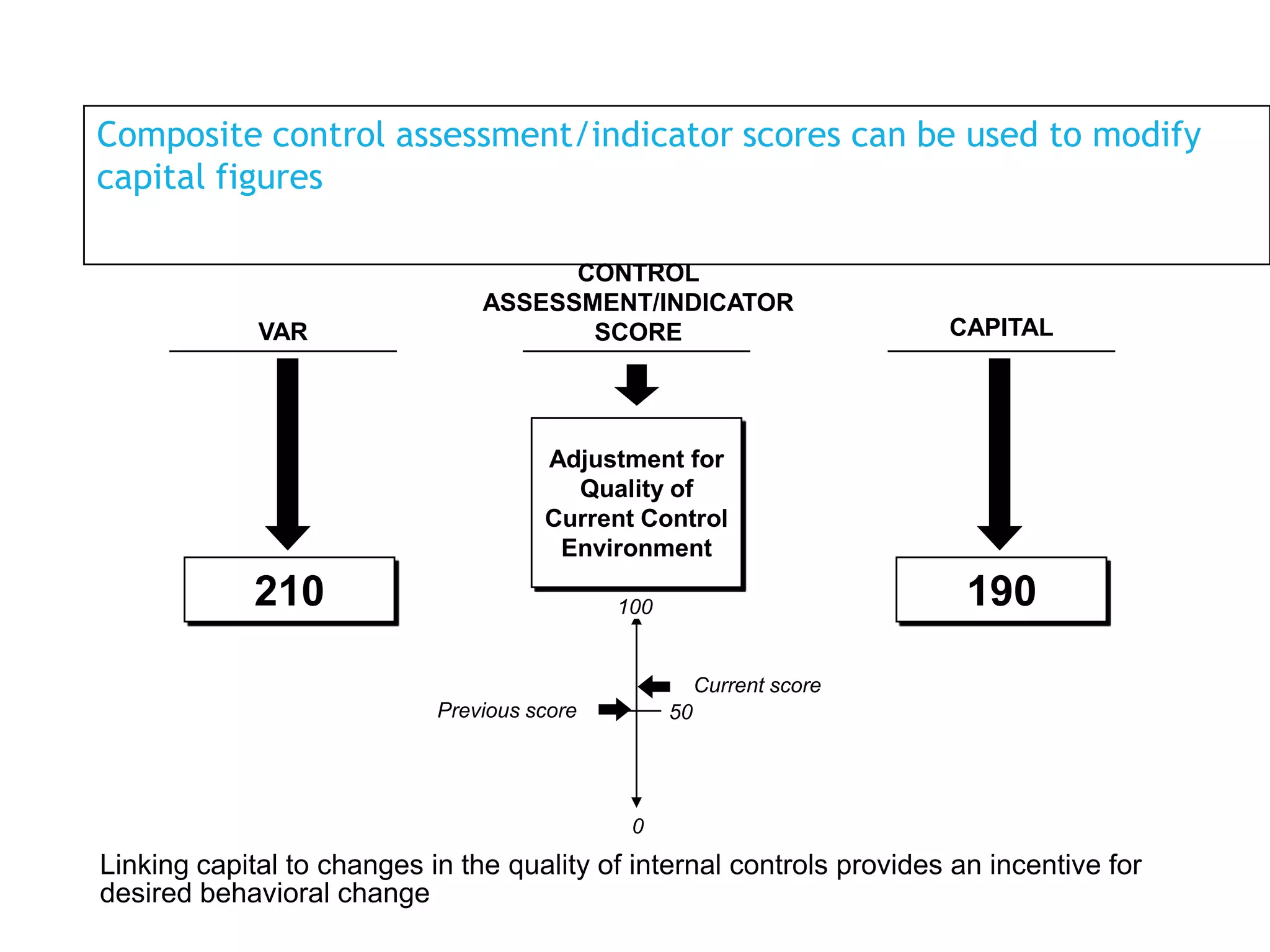
Composite control assessment/indicator scores can be used to modify
capital figures

VAR

CONTROL
ASSESSMENT/INDICATOR
SCORE

CAPITAL

Adjustment for
Quality of
Current Control
Environment

210

190

100

Current score

Previous score

50

0

Linking capital to changes in the quality of internal controls provides an incentive for
desired behavioral change
What does it tell us?

07/03/20
14

17
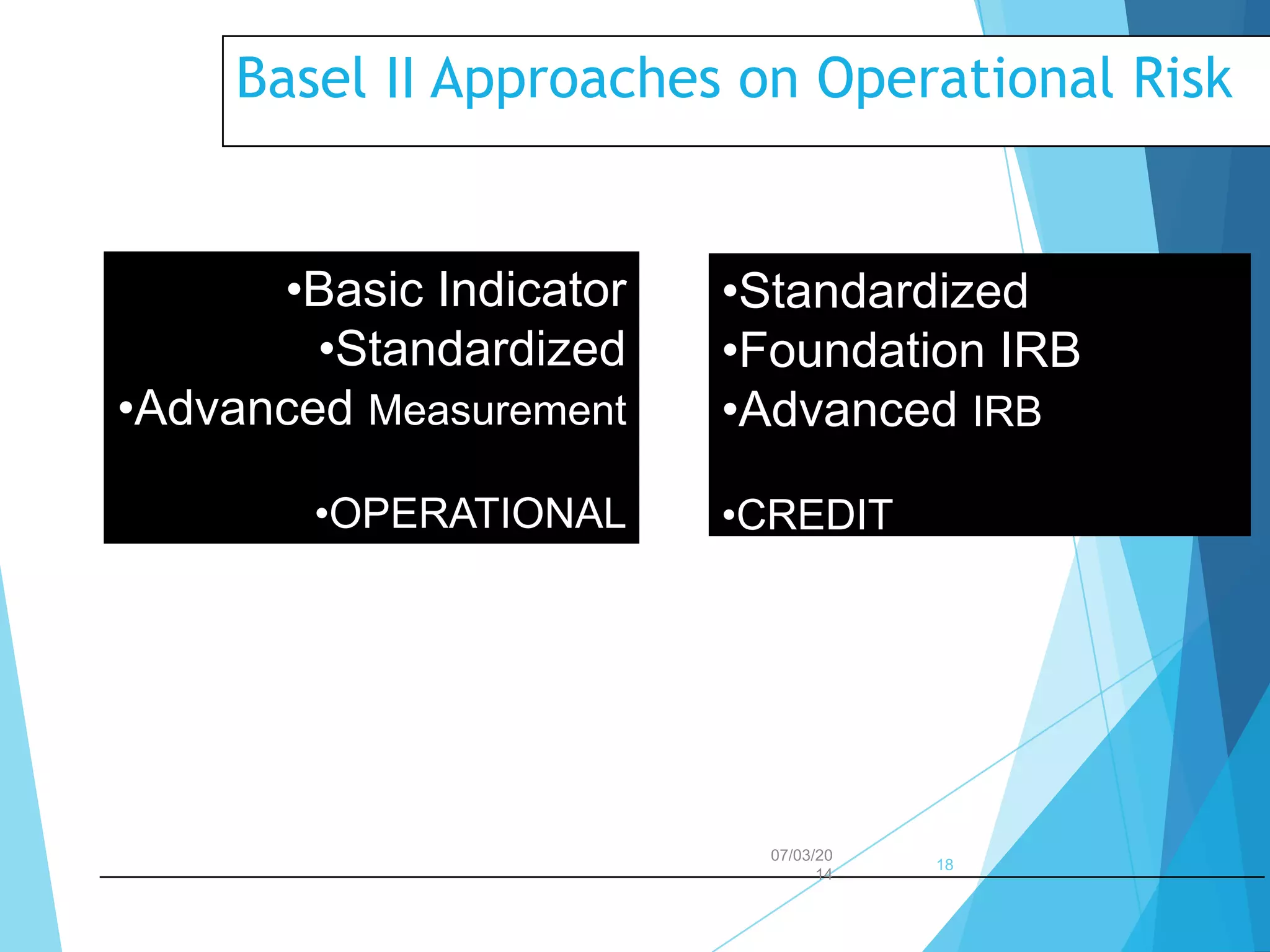
Basel II Approaches on Operational Risk

•Basic Indicator
•Standardized
•Advanced Measurement
•OPERATIONAL

•Standardized
•Foundation IRB
•Advanced IRB
•CREDIT

07/03/20
14

18
The Basic Indicator Approach



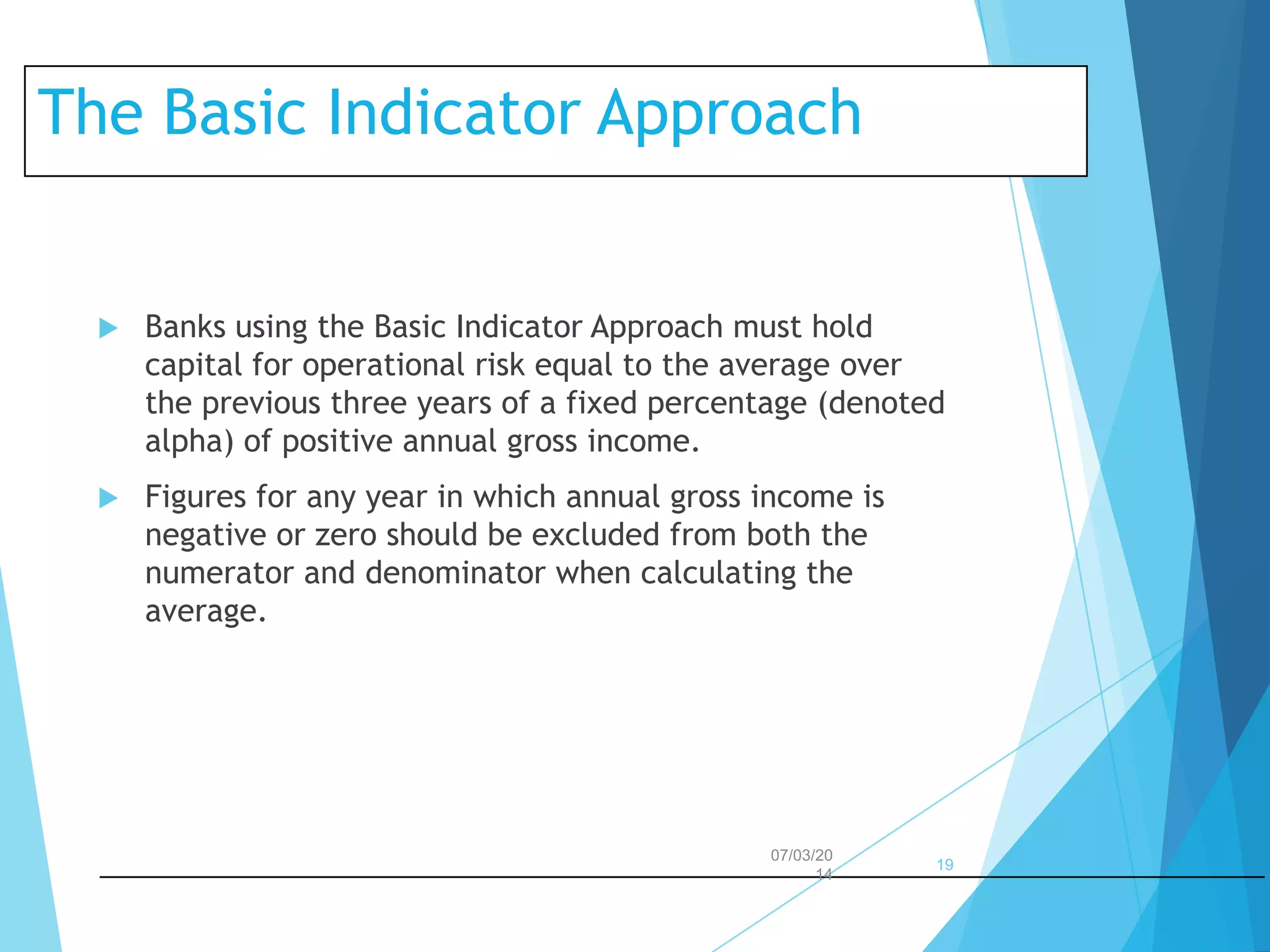
Banks using the Basic Indicator Approach must hold
capital for operational risk equal to the average over
the previous three years of a fixed percentage (denoted
alpha) of positive annual gross income.



Figures for any year in which annual gross income is
negative or zero should be excluded from both the
numerator and denominator when calculating the
average.

07/03/20
14

19
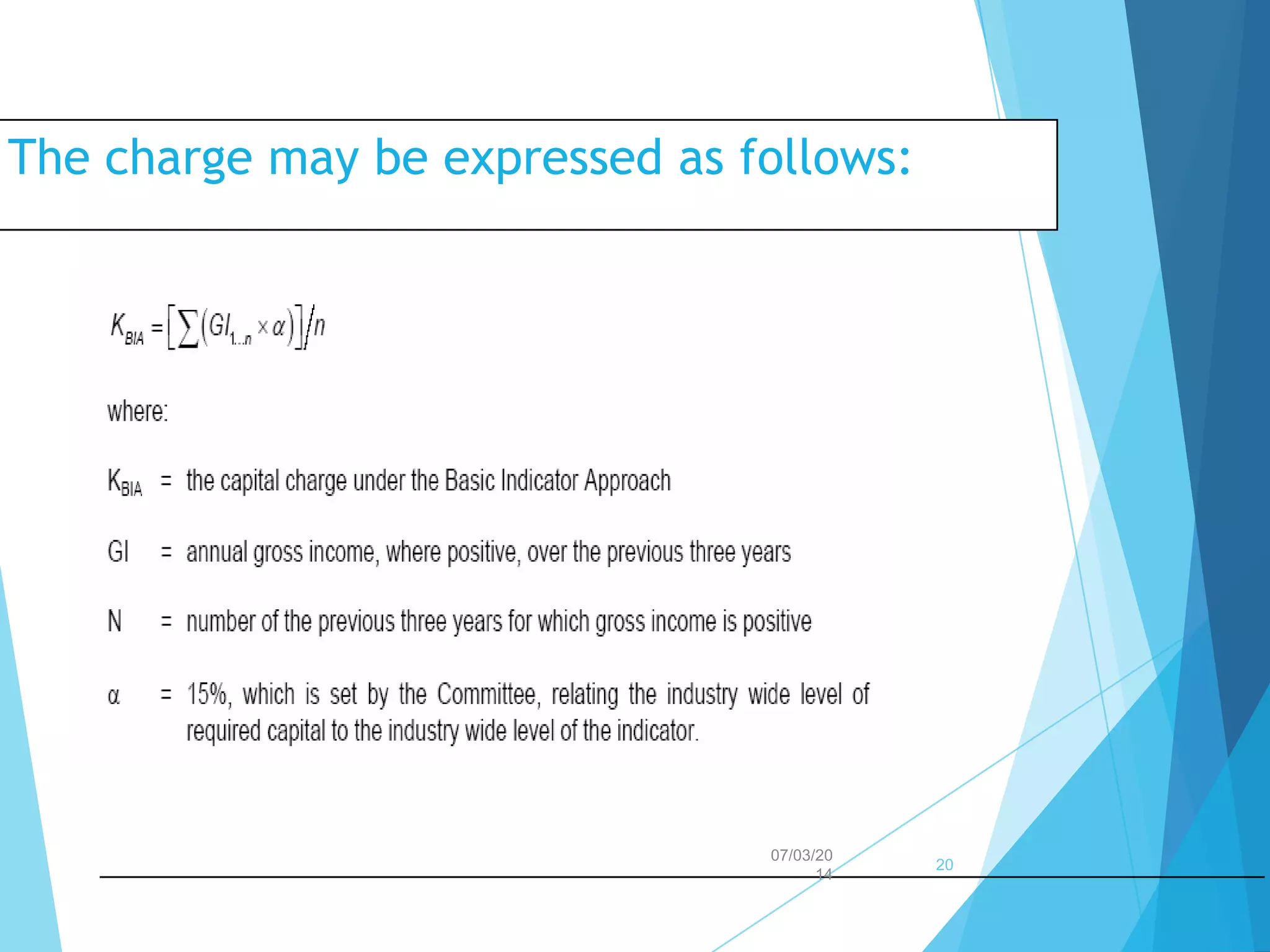
The charge may be expressed as follows:

07/03/20
14

20
The Standardized Approach


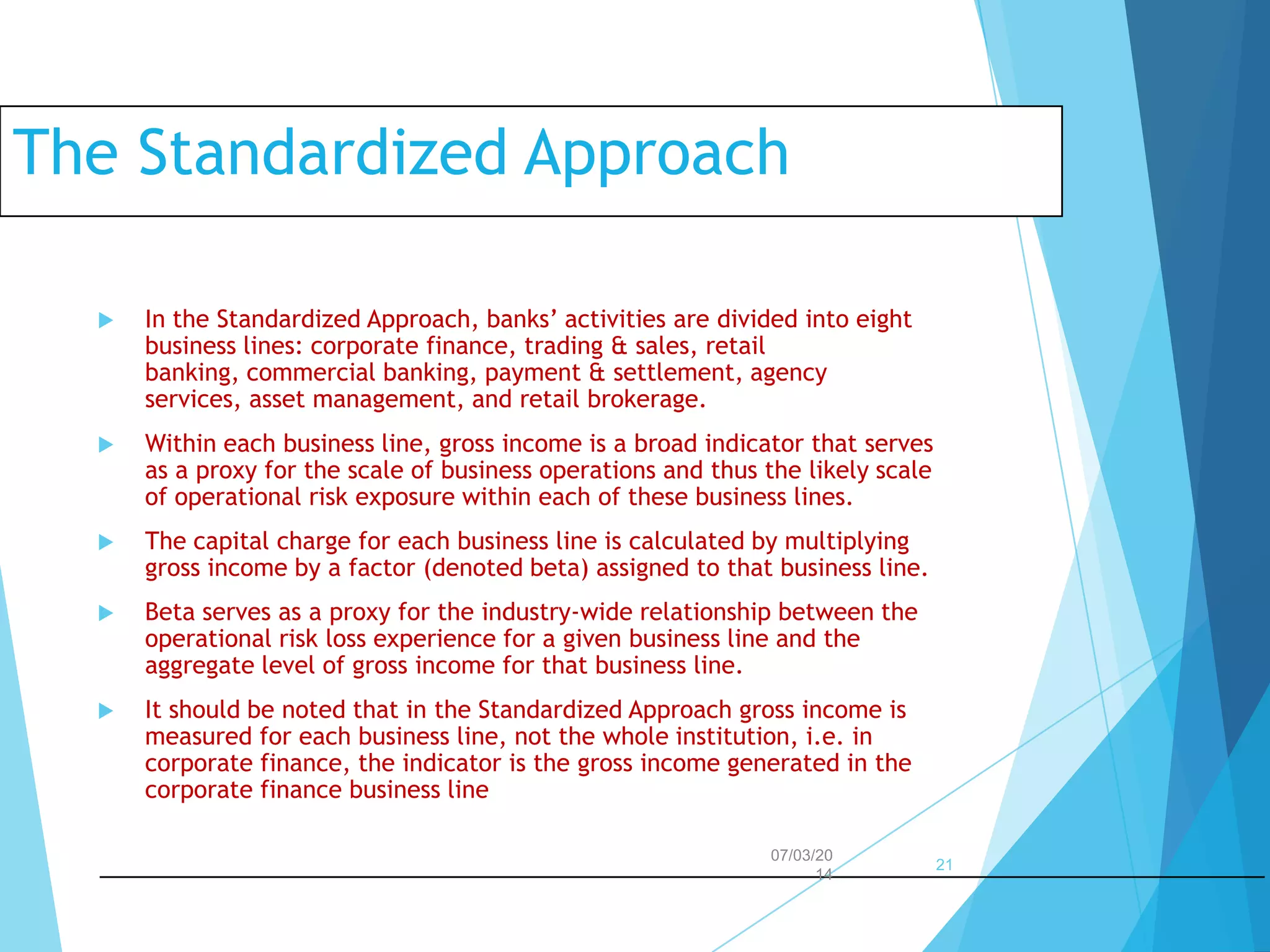
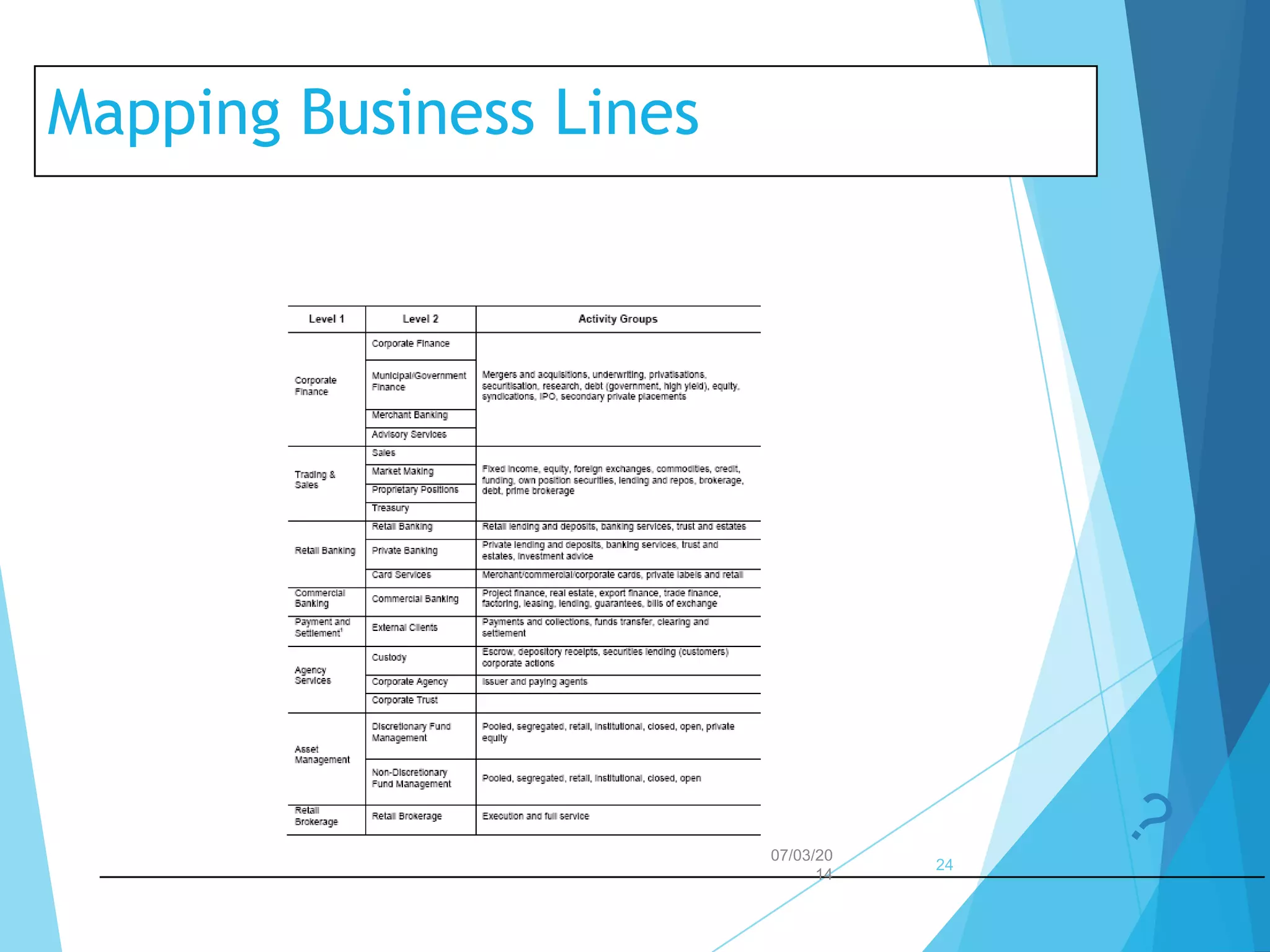
In the Standardized Approach, banks’ activities are divided into eight
business lines: corporate finance, trading & sales, retail
banking, commercial banking, payment & settlement, agency
services, asset management, and retail brokerage.



Within each business line, gross income is a broad indicator that serves
as a proxy for the scale of business operations and thus the likely scale
of operational risk exposure within each of these business lines.



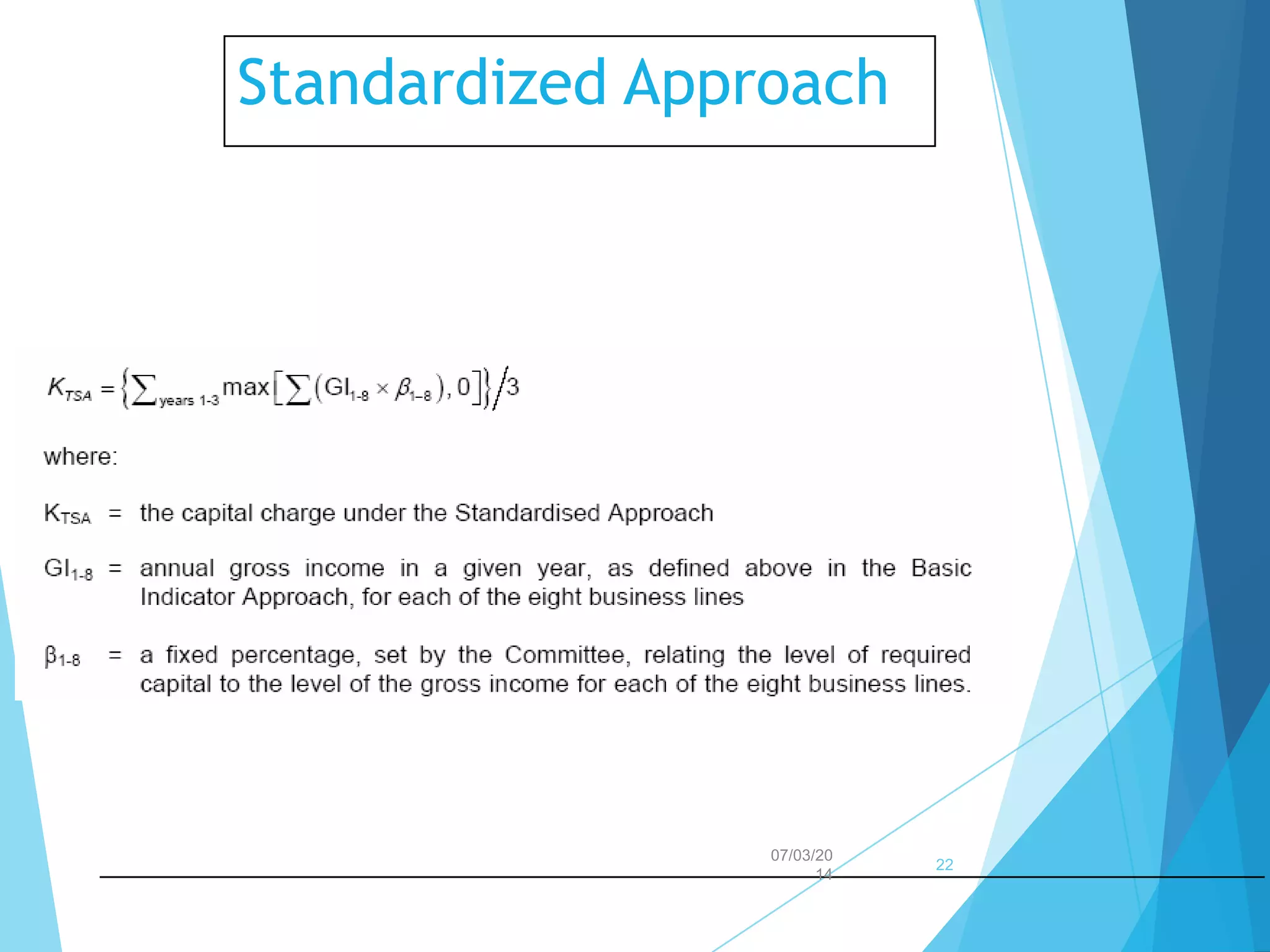
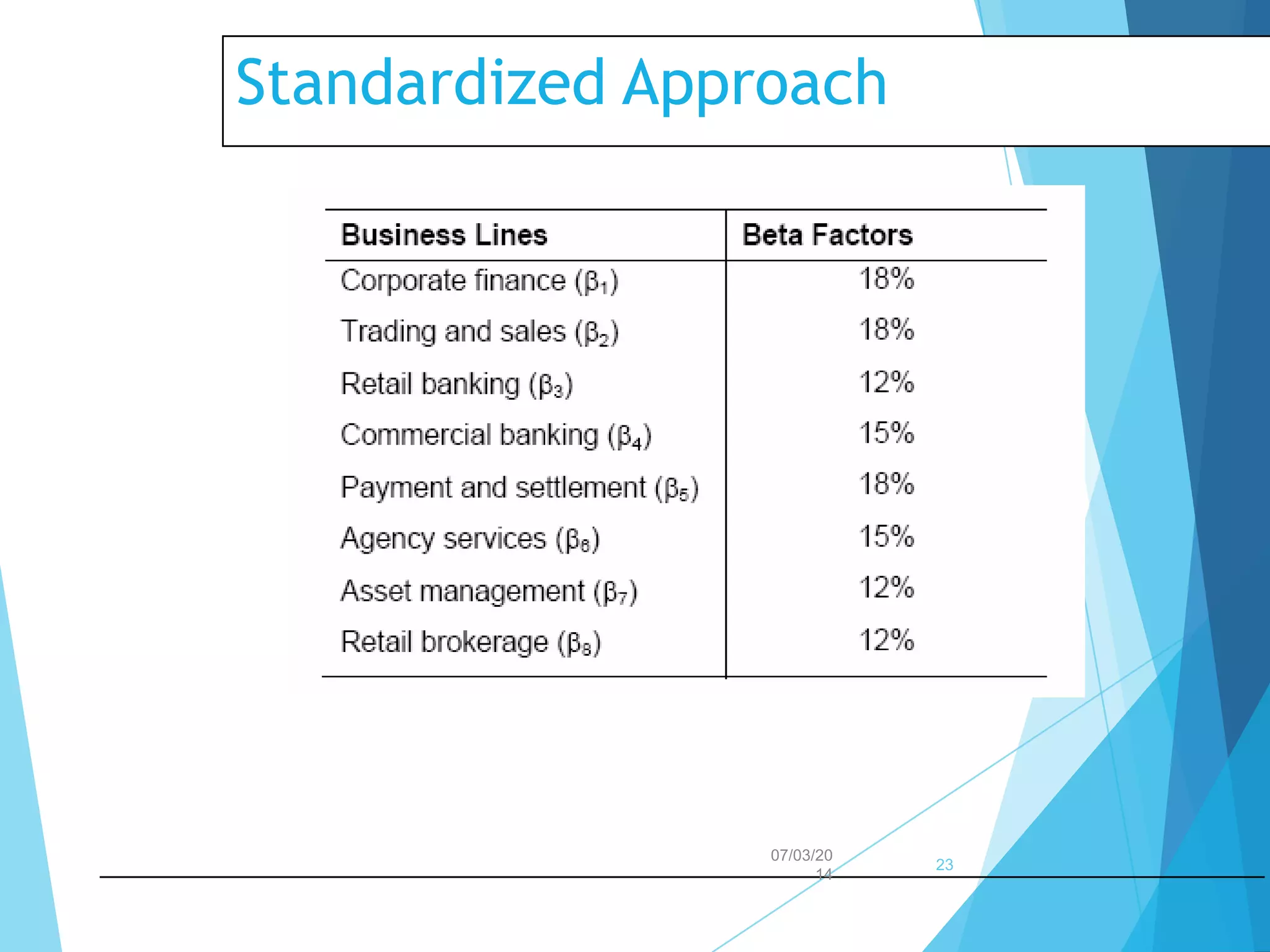
The capital charge for each business line is calculated by multiplying
gross income by a factor (denoted beta) assigned to that business line.



Beta serves as a proxy for the industry-wide relationship between the
operational risk loss experience for a given business line and the
aggregate level of gross income for that business line.



It should be noted that in the Standardized Approach gross income is
measured for each business line, not the whole institution, i.e. in
corporate finance, the indicator is the gross income generated in the
corporate finance business line
07/03/20
14

21
Standardized Approach

07/03/20
14

22
Standardized Approach

07/03/20
14

23
Mapping Business Lines

07/03/20
14

24
Advanced Measurement Approaches (AMA)



Under the AMA, the regulatory capital requirement will
equal the risk measure generated by the bank’s internal
operational risk measurement system using the
quantitative and qualitative criteria.



Use of the AMA is subject to supervisory approval.



A bank adopting the AMA may, with the approval of its
host supervisors and the support of its home
supervisor, use an allocation mechanism for the purpose
of determining the regulatory capital requirement

07/03/20
14

25
List of reference


Basel II: Revised international capital framework.
Bis.org. Retrieved 2013-06-06.



Jump up Solvency - European Commission.
Ec.europa.eu. 2012-11-26. Retrieved 2013-06-06

07/03/20
14

26

operations risk management power point presentation.

  • 1.
  • 2.
    What is OperationalRisk?  The risk of loss resulting from inadequate or failed internal processes, people and systems or from external events (The Basel II Capital Accord)  FORMERLY any risk but market and credit risks  It is NOT a brand new stuff and it is the risk that affects all businesses  Operational risk is inherent in carrying out a process/ operational activity. 07/03/20 14 2
  • 3.
    Classification of OperationalRisks High Frequency Frequency High Frequency Low Impact Low Low Frequency Frequency Low High Impact Operational risk events are classified by two factors: High Impact  Impact  frequency – how often the event occurs  impact – the amount of the losses resulting from the event Impact 07/03/2014 3
  • 4.
    Classification of OperationalRisks  Generally, operational risk management focuses on only two of these event types:    Low frequency / high impact (LFHI) High frequency / low impact (HFLI) Why? 07/03/20 14 4
  • 5.
    Classification of Operational Risks  Highfrequency/low impact events are managed to improve business efficiency. These events tend to be readily understood and are viewed as ‘the cost of doing business’.  Examples? 07/03/20 14 5
  • 6.
    Expected loss versesunexpected loss  Expected loss is the loss incurred as a bank conducts its normal business.  Can be simply defined as the cost of doing business  The only way to totally prevent them is to cease doing business. 07/03/20 14 6
  • 7.
    Expected loss versus unexpectedloss  A bank uses statistical methods to predict its expected losses.  In short, the firm uses past data and experience to predict the future.  A simple method of calculating expected loss is to compute the mean (average) of the actual losses over a given time and accept this as the likely future level. 07/03/20 14 7
  • 8.
    Expected loss versesunexpected loss  A firm may also attempt to ‘predict’ its unexpected losses using statistics, much like the way that is used to predict expected losses.  The problems are the past data may not available and therefore to calculate unexpected loss a firm uses:  available internal data  external data from other firms  data from operational risk scenarios 07/03/20 14 8
  • 9.
    Operational risk event categories  Thesimplest way of understanding operational risk in banks is to categorize it as anything but credit risk or market risk.  However, this is a very broad definition and does not help manage operational risk.  Generally, operational risk events can be subdivided into:  internal process risk  people risk  systems risk  external risk  legal risk 07/03/20 14 9
  • 10.
    Internal Process Risk  Internalprocess risk is defined as the risk associated with the failure of a bank’s processes or procedures.  During a bank’s day-to-day operations, staff follow preset working practices.  These procedures and policies will include all the checks, and controls required to ensure that customers are correctly served and the bank remains within the laws and regulations by which it is governed 07/03/20 14 10
  • 11.
    Internal Process Risks  Internalprocess risk events include:   lack of controls  marketing errors  misselling  money laundering  incorrect or insufficient reporting (e.g. regulatory)   documentation – inadequate, insufficient or wrong transaction error Reviewing and improving a bank’s internal processes as part of operational risk management can improve its efficiency. Errors often occur when a process is complicated, disorganized or easily circumvented, all of which are also inefficient business practices. 07/03/20 14 11
  • 12.
    Risk Management ProcessFeedback Loop 1. Identify, assess and prioritize risks 6. Revise policies and procedures 2. Develop strategies to measure risk 5. Test effectiveness and evaluate results 3. Design policies and procedures to mitigate risks 4. Implement and assign responsibility 07/03/20 14 12
  • 13.
    There are fourfundamental steps to managing operational risk, with each step leading to improvements in management & control quality and greater economic profit REPORTING • Integrated MIS reporting Economic Profit MEASUREMENT PROCESSES • Loss data collection FRAMEWORK • Risk indicator data collection • Risk strategy, tolerance • Control selfassessment • Roles and responsibilities • Estimation of scores representing quality of internal controls • Workflow • Risk definition and categorization • Estimation of VaR – risk capital • Risk assessment and analysis • Policies and procedures • Estimation of annual losses – cost of operational failure • Follow up action • Automatic notification Management & Control Quality • Awareness of exposures • Knowledge of controls quality • Cost benefit analysis • Improved risk mitigation and transfer strategy
  • 14.
    The universe ofoperational risks spans causes, events and consequences CAUSES EVENTS Inadequate segregation of duties Insufficient training Lack of management supervision Inadequate auditing procedures Inadequate security measures • • • Poor systems design CONSEQUENCES Legal Liability Internal Fraud Regulatory, Compliance & Taxation Penalties External Fraud Loss or Damage to Assets Employment Practices & Workplace Safety Restitution Clients, Products & Business Practices Loss of Recourse Damage to Physical Assets Write-down Business Disruption & System Failures Reputation Execution, Delivery & Process Management Business Interruption Poor HR policies EFFECTS Monetary Losses OTHER IMPACTS Forgone Income
  • 15.
    Using internal andexternal loss data can calculate Value at Risk RISK MATRIX FOR LOSS DATA INDIVIDUAL LOSS EVENTS LOSS DISTRIBUTIONS 74,712,345 74,603,709 74,457,745 74,345,957 74,344,576 • INTERNAL FRAUD Corporate Finance Number Mean EXTERNAL FRAUD EMPLOYMENT PRACTICES & WORKPLACE SAFETY CLIENTS, PRODUCTS & BUSINESS PRACTICES DAMAGE TO PHYSICAL ASSETS EXECUTION, DELIVERY & PROCESS MANAGEMENT BUSINESS DISRUPTION AND SYSTEM FAILURES TOTAL 36 3 25 36 33 150 2 315 35,459 56,890 56,734 1,246 89,678 44,215 52,056 3,456 Standard Deviation 5,694 8,975 3,845 7,890 3,456 245 23,543 6,976 Number Mean Standard Deviation 50 53,189 8,541 4 78,084 13,463 35 5,184 5,768 50 85,335 11,835 46 85,101 5,184 210 1,869 368 3 134,517 35,315 441 66,322 10,464 Retail Banking Number 45 4 32 45 42 189 3 397 47,870 70,276 4,666 76,802 76,591 1,682 121,065 Mean 7,687 12,116 5,191 10,652 4,666 331 31,783 Number Mean Standard Deviation 41 43,083 6,918 3 63,248 10,905 28 4,199 4,672 41 69,121 9,586 37 68,932 4,199 170 1,514 298 2 108,959 28,605 37 3 26 37 34 153 2 3 4 321 38,774 56,923 3,779 62,209 62,039 1,363 98,063 48,349 Standard Deviation 6,226 9,814 4,205 8,628 3,779 268 25,744 7,628 Agency Services Number Mean Standard Deviation 44 46,529 7,472 4 68,308 11,777 31 4,535 5,045 44 74,651 10,353 40 74,446 4,535 184 1,635 321 2 117,675 30,893 386 58,018 9,154 Asset Management Number Mean • 2 357 53,721 8,476 Number 1 9,417 Commercial Banking 0 59,690 Standard Deviation Payment & Settlements 167,245 142,456 123,345 113,342 94,458 TOTAL LOSS DISTRIBUTION Frequency of events Trading & Sales • VAR CALCULATION 40 3 28 40 36 165 2 347 41,876 61,477 4,081 67,186 67,002 1,472 105,908 52,217 Standard Deviation 6,725 10,599 4,541 9,318 4,081 289 27,804 8,238 Retail Brokerage Number Mean Standard Deviation 48 50,252 8069 4 73,773 12719 33 4,898 5449 48 80,623 11182 44 80,402 4898 198 1,766 347 3 127,090 33365 417 62,660 9886 Insurance Number Mean 43 4 30 43 39 179 2 66,395 4,408 72,561 72,362 1,589 114,381 56,394 7,262 11,447 4,904 10,063 4,408 312 30,028 8,897 435 45,653 7,331 36 67,021 11,555 302 4,450 4,950 435 73,245 10,158 399 73,044 4,450 1,812 1,604 315 24 115,459 30,311 Severity of loss 375 45,226 Standard Deviation Number Mean Standard Deviation 3,806 56,926 8,981 Mean Total VaR Calculator e.g., Monte Carlo Simulation Engine Mean 99th Percentile Annual Aggregate Loss ($) 0-10 1020 2030 3040 4050
  • 16.
    Composite control assessment/indicatorscores can be used to modify capital figures VAR CONTROL ASSESSMENT/INDICATOR SCORE CAPITAL Adjustment for Quality of Current Control Environment 210 190 100 Current score Previous score 50 0 Linking capital to changes in the quality of internal controls provides an incentive for desired behavioral change
  • 17.
    What does ittell us? 07/03/20 14 17
  • 18.
    Basel II Approacheson Operational Risk •Basic Indicator •Standardized •Advanced Measurement •OPERATIONAL •Standardized •Foundation IRB •Advanced IRB •CREDIT 07/03/20 14 18
  • 19.
    The Basic IndicatorApproach  Banks using the Basic Indicator Approach must hold capital for operational risk equal to the average over the previous three years of a fixed percentage (denoted alpha) of positive annual gross income.  Figures for any year in which annual gross income is negative or zero should be excluded from both the numerator and denominator when calculating the average. 07/03/20 14 19
  • 20.
    The charge maybe expressed as follows: 07/03/20 14 20
  • 21.
    The Standardized Approach  Inthe Standardized Approach, banks’ activities are divided into eight business lines: corporate finance, trading & sales, retail banking, commercial banking, payment & settlement, agency services, asset management, and retail brokerage.  Within each business line, gross income is a broad indicator that serves as a proxy for the scale of business operations and thus the likely scale of operational risk exposure within each of these business lines.  The capital charge for each business line is calculated by multiplying gross income by a factor (denoted beta) assigned to that business line.  Beta serves as a proxy for the industry-wide relationship between the operational risk loss experience for a given business line and the aggregate level of gross income for that business line.  It should be noted that in the Standardized Approach gross income is measured for each business line, not the whole institution, i.e. in corporate finance, the indicator is the gross income generated in the corporate finance business line 07/03/20 14 21
  • 22.
  • 23.
  • 24.
  • 25.
    Advanced Measurement Approaches(AMA)  Under the AMA, the regulatory capital requirement will equal the risk measure generated by the bank’s internal operational risk measurement system using the quantitative and qualitative criteria.  Use of the AMA is subject to supervisory approval.  A bank adopting the AMA may, with the approval of its host supervisors and the support of its home supervisor, use an allocation mechanism for the purpose of determining the regulatory capital requirement 07/03/20 14 25
  • 26.
    List of reference  BaselII: Revised international capital framework. Bis.org. Retrieved 2013-06-06.  Jump up Solvency - European Commission. Ec.europa.eu. 2012-11-26. Retrieved 2013-06-06 07/03/20 14 26