Risk Management
University of Economics, Kraków, 2012
              Tomasz Aleksandrowicz
operational risk management

                  operational risk
               tools & techniques
                 ORM in banking
operational risk
• risk due to organisation operations
• arising from execution of a company's business
  functions
• operational risk is the risk of loss resulting from
  inadequate or failed internal processes, people and
  systems, or from external events (Basel II)
• it is not used to generate profit
• to keep losses within limit (driven by risk appetite)
operational risk management
• there is no one size fits all approach
• operational risk is much harder to identify than
  market and credit risk
operational risk categories
• broad concept focuses on people, processes and
  systems and external factors
• more detailed approach under Basel II regulations:
   –   Internal Fraud
   –   External Fraud
   –   Employment Practices and Workplace Safety
   –   Clients, Products, & Business Practice
   –   Damage to Physical Assets
   –   Business Disruption & Systems Failures
   –   Execution, Delivery, & Process Management
operational risk categories (II)
• people - due to human error, loss of personnel and
  health and safety issues
• process - due to business performance processes or
  projects as well as capacity and reporting matters
• systems/technology - due to technical issues of
  systems, computers and equipment as well as data
  quality and security
• external events - due to external factors, regulatory
  environment and natural hazards
ORM exercise

                                 choose your company
                       list 2-3 risks with 4 categories:
people, process, systems/technology, external events
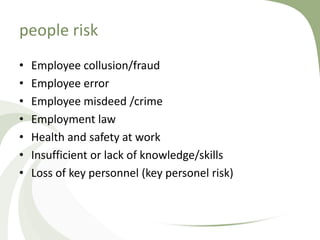
people risk
•   Employee collusion/fraud
•   Employee error
•   Employee misdeed /crime
•   Employment law
•   Health and safety at work
•   Insufficient or lack of knowledge/skills
•   Loss of key personnel (key personel risk)
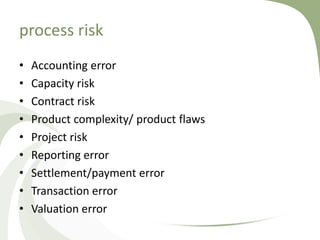
process risk
•   Accounting error
•   Capacity risk
•   Contract risk
•   Product complexity/ product flaws
•   Project risk
•   Reporting error
•   Settlement/payment error
•   Transaction error
•   Valuation error
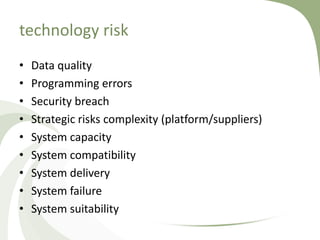
technology risk
•   Data quality
•   Programming errors
•   Security breach
•   Strategic risks complexity (platform/suppliers)
•   System capacity
•   System compatibility
•   System delivery
•   System failure
•   System suitability
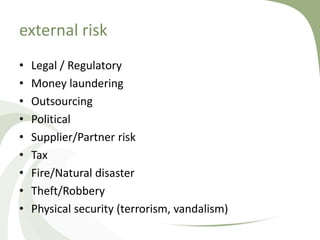
external risk
•   Legal / Regulatory
•   Money laundering
•   Outsourcing
•   Political
•   Supplier/Partner risk
•   Tax
•   Fire/Natural disaster
•   Theft/Robbery
•   Physical security (terrorism, vandalism)
ORM exercise 2

           propose a solution for
most common risks in each category
ORM tools & techniques
•   internal controls & audit
•   training & procedures
•   key risk indicators (KRI)
•   strategic diversification/outsourceing
•   insurance
•   hazard prevention - emergency management
•   business continuity planning (BCP)
KRI - Key Risk Indicators
• metrics used to monitor identified risk exposures
  over time
• measure used in management to indicate how risky
  an activity is
• differs from a Key Performance Indicator (KPI) which
  is measure of how well something is being done
• give us an early warning to identify potential risky
  event
KRI management
• effective indicator selection: relevance, measurable,
  predictive
• selection process approach: top-down or bottom-up
• using composite or index indicators
• indicator threshold and limits, escalation triggers
• indicator trending and scale (green, amber, red)
• reporting: level of reporting, frequency and
  presentation style
KRI examples
•   customer complaints volume
•   product return ratio
•   volume/value of products breakage
•   number of caught shoplifter / value of loss due to customer
    theft
•   staff turnover
•   staff sickness days
•   number of over-time hours utilized
•   number of data capture errors
•   number of virus or phishing attacks
•   number of server restart requested
ORM exercise 3

                           propose KRI
for most common risks in each category
BCP - business continuity planning
• is a roadmap for continuing operations under
  extreme conditions
• effective prevention and recovery for the
  organization
• active preparation and planning for emergencies
   – critical (urgent) organization functions/ activities
   – non-critical (non-urgent) organization functions/ activities
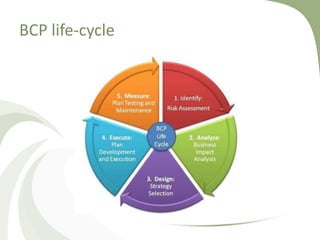
BCP life-cycle
operational risk management
  industry example: banking
          three approaches to ORM
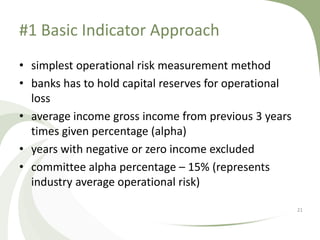
#1 Basic Indicator Approach
• simplest operational risk measurement method
• banks has to hold capital reserves for operational
  loss
• average income gross income from previous 3 years
  times given percentage (alpha)
• years with negative or zero income excluded
• committee alpha percentage – 15% (represents
  industry average operational risk)

                                                       21
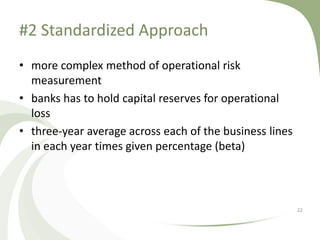
#2 Standardized Approach
• more complex method of operational risk
  measurement
• banks has to hold capital reserves for operational
  loss
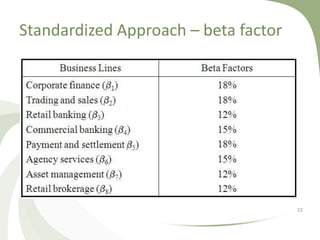
• three-year average across each of the business lines
  in each year times given percentage (beta)


                                                         22
Standardized Approach – beta factor


                                      23
#3 Advanced Measurement Approach
• comprehensive method based on bank’s internal
  operational risk measurement system
• quantitative and qualitative criteria
• subject of regulatory approval
• minimum five-year observation period of internal
  loss data
• external data could be used


                                                     24
Advanced Measurement Approach (II)
• bank must be able to demonstrate that its approach
  captures even unlikely events
• high-severity events must be subject of scenario
  analysis and use external data and expert advisory

Rm 11-1

  • 1.
    Risk Management University ofEconomics, Kraków, 2012 Tomasz Aleksandrowicz
  • 2.
    operational risk management operational risk tools & techniques ORM in banking
  • 3.
    operational risk • riskdue to organisation operations • arising from execution of a company's business functions • operational risk is the risk of loss resulting from inadequate or failed internal processes, people and systems, or from external events (Basel II) • it is not used to generate profit • to keep losses within limit (driven by risk appetite)
  • 4.
    operational risk management •there is no one size fits all approach • operational risk is much harder to identify than market and credit risk
  • 5.
    operational risk categories •broad concept focuses on people, processes and systems and external factors • more detailed approach under Basel II regulations: – Internal Fraud – External Fraud – Employment Practices and Workplace Safety – Clients, Products, & Business Practice – Damage to Physical Assets – Business Disruption & Systems Failures – Execution, Delivery, & Process Management
  • 6.
    operational risk categories(II) • people - due to human error, loss of personnel and health and safety issues • process - due to business performance processes or projects as well as capacity and reporting matters • systems/technology - due to technical issues of systems, computers and equipment as well as data quality and security • external events - due to external factors, regulatory environment and natural hazards
  • 7.
    ORM exercise choose your company list 2-3 risks with 4 categories: people, process, systems/technology, external events
  • 8.
    people risk • Employee collusion/fraud • Employee error • Employee misdeed /crime • Employment law • Health and safety at work • Insufficient or lack of knowledge/skills • Loss of key personnel (key personel risk)
  • 9.
    process risk • Accounting error • Capacity risk • Contract risk • Product complexity/ product flaws • Project risk • Reporting error • Settlement/payment error • Transaction error • Valuation error
  • 10.
    technology risk • Data quality • Programming errors • Security breach • Strategic risks complexity (platform/suppliers) • System capacity • System compatibility • System delivery • System failure • System suitability
  • 11.
    external risk • Legal / Regulatory • Money laundering • Outsourcing • Political • Supplier/Partner risk • Tax • Fire/Natural disaster • Theft/Robbery • Physical security (terrorism, vandalism)
  • 12.
    ORM exercise 2 propose a solution for most common risks in each category
  • 13.
    ORM tools &techniques • internal controls & audit • training & procedures • key risk indicators (KRI) • strategic diversification/outsourceing • insurance • hazard prevention - emergency management • business continuity planning (BCP)
  • 14.
    KRI - KeyRisk Indicators • metrics used to monitor identified risk exposures over time • measure used in management to indicate how risky an activity is • differs from a Key Performance Indicator (KPI) which is measure of how well something is being done • give us an early warning to identify potential risky event
  • 15.
    KRI management • effectiveindicator selection: relevance, measurable, predictive • selection process approach: top-down or bottom-up • using composite or index indicators • indicator threshold and limits, escalation triggers • indicator trending and scale (green, amber, red) • reporting: level of reporting, frequency and presentation style
  • 16.
    KRI examples • customer complaints volume • product return ratio • volume/value of products breakage • number of caught shoplifter / value of loss due to customer theft • staff turnover • staff sickness days • number of over-time hours utilized • number of data capture errors • number of virus or phishing attacks • number of server restart requested
  • 17.
    ORM exercise 3 propose KRI for most common risks in each category
  • 18.
    BCP - businesscontinuity planning • is a roadmap for continuing operations under extreme conditions • effective prevention and recovery for the organization • active preparation and planning for emergencies – critical (urgent) organization functions/ activities – non-critical (non-urgent) organization functions/ activities
  • 19.
  • 20.
    operational risk management industry example: banking three approaches to ORM
  • 21.
    #1 Basic IndicatorApproach • simplest operational risk measurement method • banks has to hold capital reserves for operational loss • average income gross income from previous 3 years times given percentage (alpha) • years with negative or zero income excluded • committee alpha percentage – 15% (represents industry average operational risk) 21
  • 22.
    #2 Standardized Approach •more complex method of operational risk measurement • banks has to hold capital reserves for operational loss • three-year average across each of the business lines in each year times given percentage (beta) 22
  • 23.
  • 24.
    #3 Advanced MeasurementApproach • comprehensive method based on bank’s internal operational risk measurement system • quantitative and qualitative criteria • subject of regulatory approval • minimum five-year observation period of internal loss data • external data could be used 24
  • 25.
    Advanced Measurement Approach(II) • bank must be able to demonstrate that its approach captures even unlikely events • high-severity events must be subject of scenario analysis and use external data and expert advisory