Modern Landfills
Group Members
• Ehsan Ullah Khan
• Syeda Fatima Shahid
• Muhammad Usama
• Suleman Ahmed
Subject Matter
• Introduction to Landfills
• Introduction to modern landfills
• Design of modern landfill
• Problems Addressed by Modern Landfill Design
Introduction to Landfills
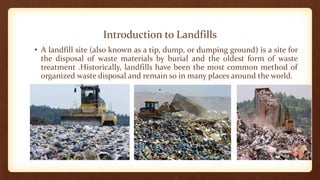
• A landfill site (also known as a tip, dump, or dumping ground) is a site for
the disposal of waste materials by burial and the oldest form of waste
treatment .Historically, landfills have been the most common method of
organized waste disposal and remain so in many places around the world.
Mechanism of Landfills
• Landfills use two common tools to handle and manage the discards
they receive:
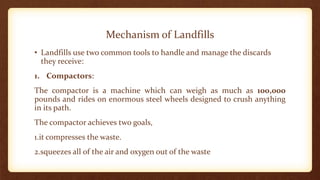
1. Compactors:
The compactor is a machine which can weigh as much as 100,000
pounds and rides on enormous steel wheels designed to crush anything
in its path.
The compactor achieves two goals,
1.it compresses the waste.
2.squeezes all of the air and oxygen out of the waste
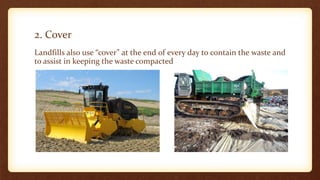
2. Cover
Landfills also use “cover” at the end of every day to contain the waste and
to assist in keeping the waste compacted
Advantages
• Landfills are often the most cost-efficient way to dispose of waste,
especially in countries with large open spaces.
• Landfills have fewer fixed or ongoing costs, allowing them to compete
favorably.
• In addition, landfill gas can be upgraded to natural gas landfill gas
utilization which is a potential revenue stream.
• Another advantage is having a specific location for disposal that can be
monitored, where waste can be processed to remove all recyclable
materials before tipping.
Disadvantages
Leachate:
• Leachate is a liquid which is produced when waste “rots” in a landfill. Leachate is also
created when liquids are dumped in the landfill (like old milk, paint or other household
products) or when rain or snow falls on a landfill.
• Extensive efforts are made to capture and treat leachate from landfills before it reaches
groundwater aquifers, but engineered liners always have a lifespan, though it may be
100 years or more. Eventually, every landfill liner will leak allowing the leachate to
contaminate the groundwater. Installation of composite liners with flexible membrane
and soil barrier is enforced by the EPA to ensure that leachate is withheld.
Dangerous gases:
• Rotting food and other decaying organic waste allows methane and
carbon dioxide to seep out of the ground and up into the air.
• Methane is a potent greenhouse gas, and can itself be a danger because
it is flammable and potentially explosive. In properly managed
landfills, gas is collected and utilized. This could range from
simple flaring to landfill gas utilization.
• Carbon dioxide is the most widely produced greenhouse gas. It traps
heat in the atmosphere, contributing to climate change
Infections:
• Poorly run landfills may become nuisances because of vectors such as
rats and flies which can cause infectious diseases. The occurrence of
such vectors can be mitigated through the use of daily cover.
Other potential issues:
• Wildlife disruption, dust, odor, noise pollution, and reduced local
property values.
Modern Landfill
• So, what is a modern landfill? You may have heard them called
municipal solid waste landfills and they are highly regulated and
advanced. They are very different than the old-fashioned “landfills or
dumps”.
• Initiated by the the Resource Conservation and Recovery Act
(RCRA), passed by Congress in 1976, these landfills were overhauled
and have become more efficient and environmentally conscious. The
RCRA expanded the federal government’s role in managing waste
disposal, divided waste into non-hazardous and hazardous categories,
and developed design and operational standards for sanitary landfills.
• In today’s municipal solid waste landfills we see evidence of advanced
regulation and sustainability efforts in the following improvements:
1. Locations & Operations
2. Better Designs
3. Environmental Protection
4. Reclamation & Reuse
Design of modern landfills
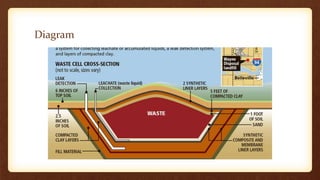
• The modern landfill uses a multi layer liner to ensure that waste do not
leak away from the landfill and into groundwater. As a landfill is being
built it is excavated to a specified shape using bull dozers and other
heavy equipment.
• modern landfills are carefully designed to contain waste and protect the
environmental integrity of the surrounding area – including the air,
water and soil. These engineered systems incorporate advanced design
features, including multi-layer liner construction, gas extraction and
leachate removal systems. In addition, regular monitoring is performed
to confirm the integrity of these systems. These engineered systems have
years of proven success with the multi-layer liner construction, gas
extraction and leachate removal systems.
Diagram
Utilization of modern landfills design
• Many of the environmental concerns attributed to landfills of the past
have been addressed and eliminated as modern landfill techniques
began to be used.
1. Unsafe and Inappropriate Locations:
Prior to RCRA regulation, dumps were potentially created on any large,
unused space with little concern for it’s impact on the surrounding areas.
Waste was compacted each day and covered with soil to reduce odor and
contamination. New landfills however, take into consideration the health
of individuals and the environment. Today’s landfills cannot be
constructed near floodplains, wetlands or fault area/unstable area.
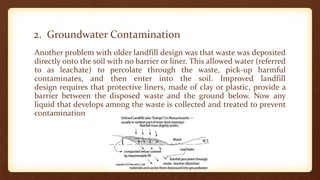
2. Groundwater Contamination
Another problem with older landfill design was that waste was deposited
directly onto the soil with no barrier or liner. This allowed water (referred
to as leachate) to percolate through the waste, pick-up harmful
contaminates, and then enter into the soil. Improved landfill
design requires that protective liners, made of clay or plastic, provide a
barrier between the disposed waste and the ground below. Now any
liquid that develops among the waste is collected and treated to prevent
contamination
3. Release of Methane Gases
Methane gas and carbon dioxide, also known as greenhouse gases, are a
natural by-product of any landfill, whether old or new. They are
created as organic waste matter decomposes. These gases are known to
trap and hold heat in the atmosphere, known as the greenhouse effect,
and are recognized as being a leading contributor to global warming.
Modern advances in landfill technology have made it possible to
minimize the amount of greenhouse gases released from landfill waste.
Under the Clean Air Act, larger facilities, where gas emissions reach 55
tons per year are required to install a gas collection and destruction
system. Additionally, many smaller facilities have voluntarily installed
similar systems. When greenhouse gases are captured, they can be
destroyed or treated to generate energy sources such as electricity and
fuel.
4. Reuse of Space
In the past, when dumps were no longer usable, a final layer of soil was
added to the top and, in some instances, vegetation was planted. But
often, vegetation couldn’t even grow due to the methane gas and
contaminated soil found below and the space was never useable again.
But limited land and growing interest in cultivating community and
green space has changed the way that closing landfills are used. Modern
landfills are designed from the start for reuse once the landfill closes.
Almost indistinguishable from other land, you can now find parks, sports
fields, parking lots, commercial space, and even agricultural land
thriving over landfill land.
Modern landfills

Modern landfills

  • 1.
  • 2.
    Group Members • EhsanUllah Khan • Syeda Fatima Shahid • Muhammad Usama • Suleman Ahmed
  • 3.
    Subject Matter • Introductionto Landfills • Introduction to modern landfills • Design of modern landfill • Problems Addressed by Modern Landfill Design
  • 4.
    Introduction to Landfills •A landfill site (also known as a tip, dump, or dumping ground) is a site for the disposal of waste materials by burial and the oldest form of waste treatment .Historically, landfills have been the most common method of organized waste disposal and remain so in many places around the world.
  • 5.
    Mechanism of Landfills •Landfills use two common tools to handle and manage the discards they receive: 1. Compactors: The compactor is a machine which can weigh as much as 100,000 pounds and rides on enormous steel wheels designed to crush anything in its path. The compactor achieves two goals, 1.it compresses the waste. 2.squeezes all of the air and oxygen out of the waste
  • 6.
    2. Cover Landfills alsouse “cover” at the end of every day to contain the waste and to assist in keeping the waste compacted
  • 7.
    Advantages • Landfills areoften the most cost-efficient way to dispose of waste, especially in countries with large open spaces. • Landfills have fewer fixed or ongoing costs, allowing them to compete favorably. • In addition, landfill gas can be upgraded to natural gas landfill gas utilization which is a potential revenue stream. • Another advantage is having a specific location for disposal that can be monitored, where waste can be processed to remove all recyclable materials before tipping.
  • 8.
    Disadvantages Leachate: • Leachate isa liquid which is produced when waste “rots” in a landfill. Leachate is also created when liquids are dumped in the landfill (like old milk, paint or other household products) or when rain or snow falls on a landfill. • Extensive efforts are made to capture and treat leachate from landfills before it reaches groundwater aquifers, but engineered liners always have a lifespan, though it may be 100 years or more. Eventually, every landfill liner will leak allowing the leachate to contaminate the groundwater. Installation of composite liners with flexible membrane and soil barrier is enforced by the EPA to ensure that leachate is withheld.
  • 9.
    Dangerous gases: • Rottingfood and other decaying organic waste allows methane and carbon dioxide to seep out of the ground and up into the air. • Methane is a potent greenhouse gas, and can itself be a danger because it is flammable and potentially explosive. In properly managed landfills, gas is collected and utilized. This could range from simple flaring to landfill gas utilization. • Carbon dioxide is the most widely produced greenhouse gas. It traps heat in the atmosphere, contributing to climate change
  • 10.
    Infections: • Poorly runlandfills may become nuisances because of vectors such as rats and flies which can cause infectious diseases. The occurrence of such vectors can be mitigated through the use of daily cover. Other potential issues: • Wildlife disruption, dust, odor, noise pollution, and reduced local property values.
  • 11.
    Modern Landfill • So,what is a modern landfill? You may have heard them called municipal solid waste landfills and they are highly regulated and advanced. They are very different than the old-fashioned “landfills or dumps”. • Initiated by the the Resource Conservation and Recovery Act (RCRA), passed by Congress in 1976, these landfills were overhauled and have become more efficient and environmentally conscious. The RCRA expanded the federal government’s role in managing waste disposal, divided waste into non-hazardous and hazardous categories, and developed design and operational standards for sanitary landfills.
  • 12.
    • In today’smunicipal solid waste landfills we see evidence of advanced regulation and sustainability efforts in the following improvements: 1. Locations & Operations 2. Better Designs 3. Environmental Protection 4. Reclamation & Reuse
  • 13.
    Design of modernlandfills • The modern landfill uses a multi layer liner to ensure that waste do not leak away from the landfill and into groundwater. As a landfill is being built it is excavated to a specified shape using bull dozers and other heavy equipment. • modern landfills are carefully designed to contain waste and protect the environmental integrity of the surrounding area – including the air, water and soil. These engineered systems incorporate advanced design features, including multi-layer liner construction, gas extraction and leachate removal systems. In addition, regular monitoring is performed to confirm the integrity of these systems. These engineered systems have years of proven success with the multi-layer liner construction, gas extraction and leachate removal systems.
  • 14.
  • 15.
    Utilization of modernlandfills design • Many of the environmental concerns attributed to landfills of the past have been addressed and eliminated as modern landfill techniques began to be used. 1. Unsafe and Inappropriate Locations: Prior to RCRA regulation, dumps were potentially created on any large, unused space with little concern for it’s impact on the surrounding areas. Waste was compacted each day and covered with soil to reduce odor and contamination. New landfills however, take into consideration the health of individuals and the environment. Today’s landfills cannot be constructed near floodplains, wetlands or fault area/unstable area.
  • 16.
    2. Groundwater Contamination Anotherproblem with older landfill design was that waste was deposited directly onto the soil with no barrier or liner. This allowed water (referred to as leachate) to percolate through the waste, pick-up harmful contaminates, and then enter into the soil. Improved landfill design requires that protective liners, made of clay or plastic, provide a barrier between the disposed waste and the ground below. Now any liquid that develops among the waste is collected and treated to prevent contamination
  • 17.
    3. Release ofMethane Gases Methane gas and carbon dioxide, also known as greenhouse gases, are a natural by-product of any landfill, whether old or new. They are created as organic waste matter decomposes. These gases are known to trap and hold heat in the atmosphere, known as the greenhouse effect, and are recognized as being a leading contributor to global warming. Modern advances in landfill technology have made it possible to minimize the amount of greenhouse gases released from landfill waste. Under the Clean Air Act, larger facilities, where gas emissions reach 55 tons per year are required to install a gas collection and destruction system. Additionally, many smaller facilities have voluntarily installed similar systems. When greenhouse gases are captured, they can be destroyed or treated to generate energy sources such as electricity and fuel.
  • 18.
    4. Reuse ofSpace In the past, when dumps were no longer usable, a final layer of soil was added to the top and, in some instances, vegetation was planted. But often, vegetation couldn’t even grow due to the methane gas and contaminated soil found below and the space was never useable again. But limited land and growing interest in cultivating community and green space has changed the way that closing landfills are used. Modern landfills are designed from the start for reuse once the landfill closes. Almost indistinguishable from other land, you can now find parks, sports fields, parking lots, commercial space, and even agricultural land thriving over landfill land.