20th Century
Modern Art
Early 20th Century Art
Modernism
• After 1900 artistic innovation in Europe and the US increased in a rapid
succession of movements, or “isms”. The modern movement lasted
through the first half of the 20th Century.
• Search for new forms of expression in a new era characterized by
industrialization, rapid social change, and advances in science and the
social sciences.
• Modernism rejects old, traditional ideas and styles in art and design.
• Modern art allows for more interpretation
Characteristics
of Modern Art
The Avant Garde
• Avant garde (French) means before the group
• Avant-garde art is cutting-edge and does not try to appeal to average
people
• Radical and Surprising / Shocking
• Revolutionary - breaks with tradition
• Critical of political and social institutions
https://www.youtube.com/watch?v=96hl5J47c3k
Color and Form
• Continuing from the 19th Century (influence of Impressionism, Post-
Impressionism, and artists such as Van Gogh and Gaugin)
• Symbolism of Color
• Focus on Formal Elements (shape, line, space, color, texture) as a way
to communicate
• Emotion / Feeling
Influence of Psychology
Developments in the study of Psychology
New understanding of Psychology influenced artists
Many artists befriended psychologists
Sigmund Freud
• developed psychoanalysis in early 20th century
• wrote The Interpretation of Dreams in 1900
Carl Jung
• Further studies of dreams and the subconscious / unconscious mind
• Art Therapy
Effects of Wars
People, including artists greatly affected by war
• World War I (1914 – 1919)
• World War II (1939 – 1945)
• Russian Revolution (1917 – 1923)
• Spanish Civil War (1937)
Some Modern art was reactionary against war
(Look toward Idealism / Utopianism / Purity)
Search for Truth as a result of politics / political propaganda
• Used pure hues (unmixed colors from the color wheel)
• Rejected “imitative” colors (colors that imitate real life) to create “stronger
reactions” to their work
• Color as a conveyer of meaning / symbolism
Fauvism
Henri Matisse, Red Room, 1908 – 1909, Oil on Canvas
https://www.youtube.com/watch?v=RMXQDV2PecE
Henri Matisse, Red Room, 1908 – 1909,
Oil on Canvas
Matisse was one of the main
artists in the Fauvist group
Feeling of warmth and comfort
in the room
Used color to express
emotions
, 1.8 m x 2.2 m
Egon Shiele, Self-Portrait, 1911, Drawing (Gouache and pencil on paper)
https://www.youtube.com/watch?v=BN73JesYJhc
Egon Shiele, Self-Portrait,
1911, Drawing (Gouache and
pencil on paper)
Physical and psychological
torment
Use of line and textures to
convey feeling
51.4 x 34.9 cm
Cubism
• Cubists rejected naturalistic / realistic art
• Preferred using abstract shapes and forms
• Viewing the subject from many different angles using
geometric forms
• Neutral Colors
• Interested in connecting music to visual art
• Analytic Cubism – first phase of cubism started by Georges
Braque and Pablo Picasso
• Synthetic Cubism – Collage (mixed media) – materials from
different sources
Pablo Picasso
Les Demoiselles d’Avignon
Oil on Canvas, 1907
243.9 x 233.7 cm
Pablo Picasso
Les Demoiselles d’Avignon
Oil on Canvas, 1907
• This work led to Picasso’s
development of Cubist style
• Five nude female figures
(prostitutes from a brothel in
Barcelona, Spain)
• Radical break from traditional
compositions and perspective
• Still Life in foreground
• Two of the faces inspired by
African masks (saw African art
in Paris museum)
243.9 x 233.7 cm
African Tribal Mask
Pablo Picasso, Still Life with Chair-Caning, 1911-1912, Oil and Collage on Canvas
29 x 37 cm
Pablo Picasso, Still Life with Chair-Caning,
1911-1912, Oil and Collage on Canvas
Synthetic Cubism
New Medium of collage
(from French word “to
stick”)
Illusion of real seat of a
chair with real rope as a
frame
Jou – from
“Journal” (French
newspaper) also word
refers to “play” and to
“game”29 x 37 cm
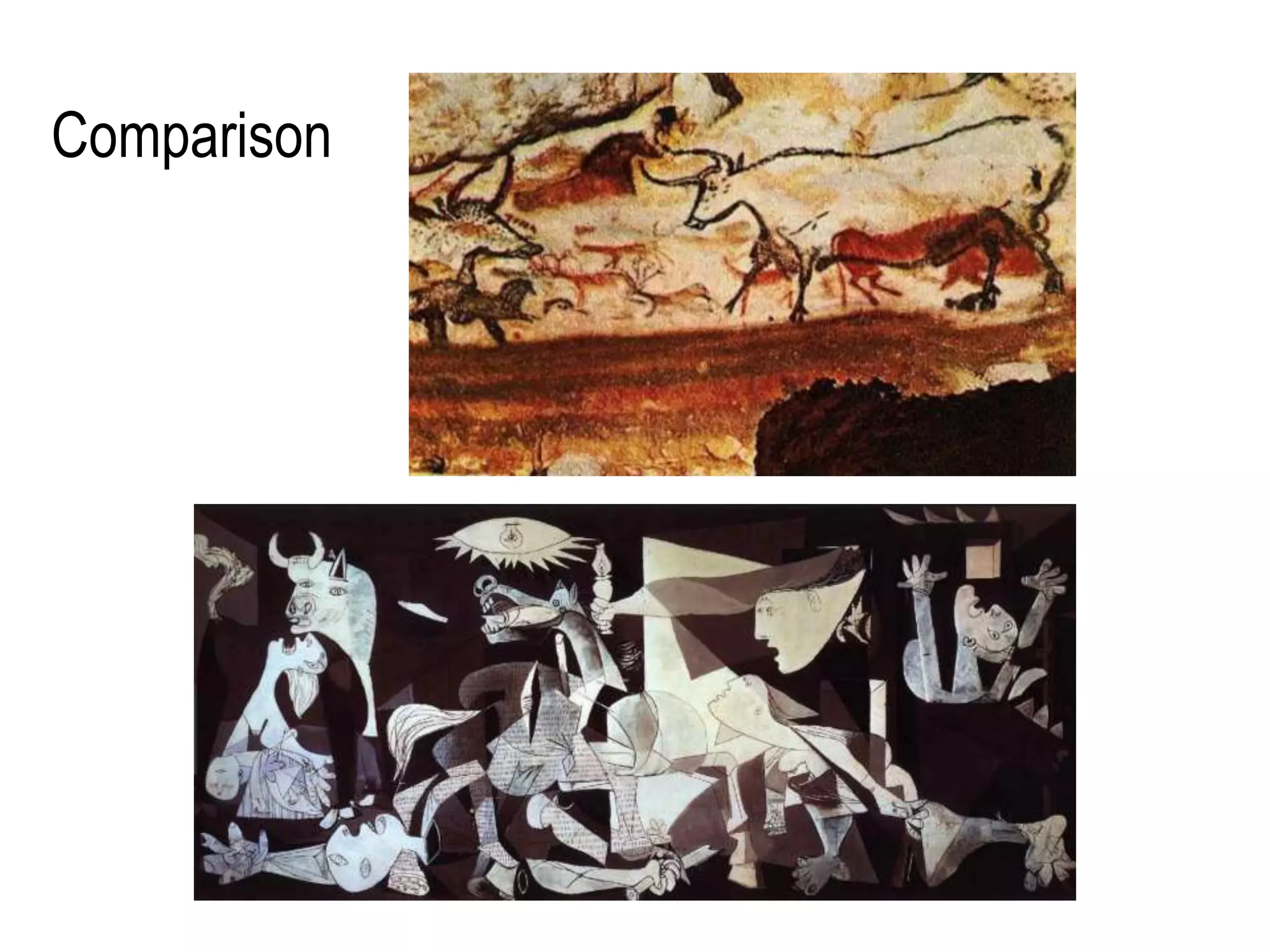
Pablo Picasso, Guernica, 1937, Oil on Canvas , 3.49 m x 7.77 m
https://www.youtube.com/watch?v=3lo5OSGg1k0
Pablo Picasso, Guernica, 1937,
Oil on Canvas
• Spanish Civil War bombing in
Guernica, Spain (Picasso was
Spanish)
• Horrors of War
• Based on images from black and
white photos in newspaper
• Later Cubist style
• Symbolism
• References to Spain - Bull and
Horse
3.49 m x 7.77 m
Comparison
Futurism
Began as a literary movement in Italy in 1909, but later
included visual arts, film, theater, music, and architecture
Inspired by the Cubists
Artists had a socio-political agenda
Published several manifestos – a written document that
explains the overall intentions of the group – in this case,
advocating a revolution in society and art
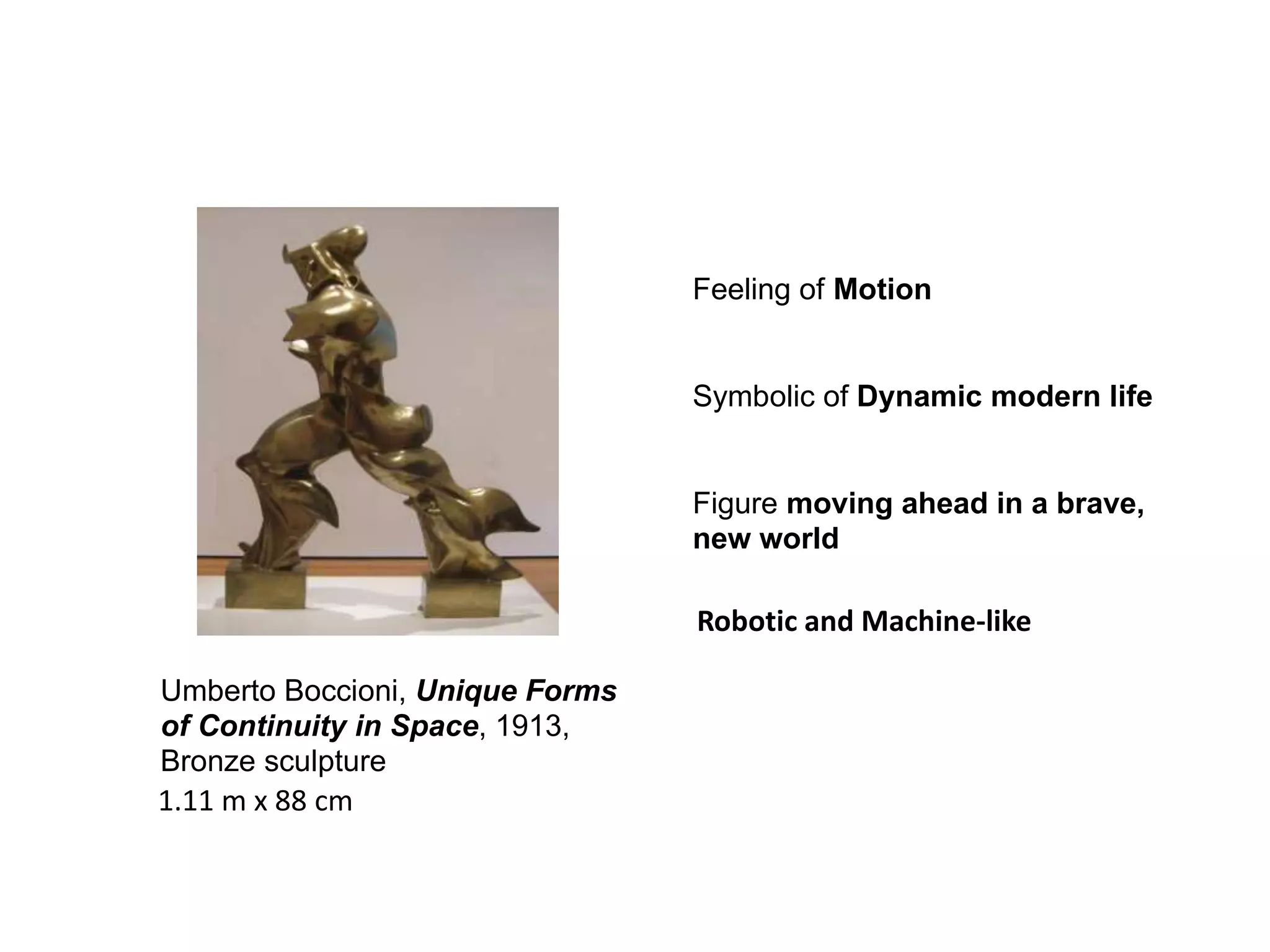
Umberto Boccioni
Unique Forms of Continuity in Space
1913
Bronze
1.11 m x 88 cm
https://www.youtube.com/watch?v=G5InIGJkYA4
Umberto Boccioni, Unique Forms
of Continuity in Space, 1913,
Bronze sculpture
Feeling of Motion
Symbolic of Dynamic modern life
Figure moving ahead in a brave,
new world
1.11 m x 88 cm
Robotic and Machine-like
Suprematism
• Russian movement
• Pure language of shape and color
• Non-objective (no recognizable image)
• Based on Inner Feelings
https://www.youtube.com/watch?v=e3YS6uZ87Ec
Kazimir Malevich, Suprematist Composition: Airplane Flying, 1915, oil on canvas
58 cm x 48 cm
Feeling unattached to objects
“The Suprematist artist does
not observe and does not touch
– they feel”
Dynamic movement of shapes
Kazimir Malevich, Suprematist
Composition: Airplane Flying,
1915, oil on canvas
58 cm x 48 cm
Non-representational
De Stijl
• De Stijl means “the style”
• Movement formed by a group of young artists in Holland in 1917
• Believed in “birth of a new age”
• Integration of Art and Life
• Focus on Universal, rather than the individual
https://www.youtube.com/watch?v=ygiPcUKDdtM
Piet Mondrian,
Composition in Red,
Blue, and Yellow,
1930, Oil on Canvas
59.5 x 59.5 cm
https://www.youtube.com/watch?v=1x8m-7N-Kjo
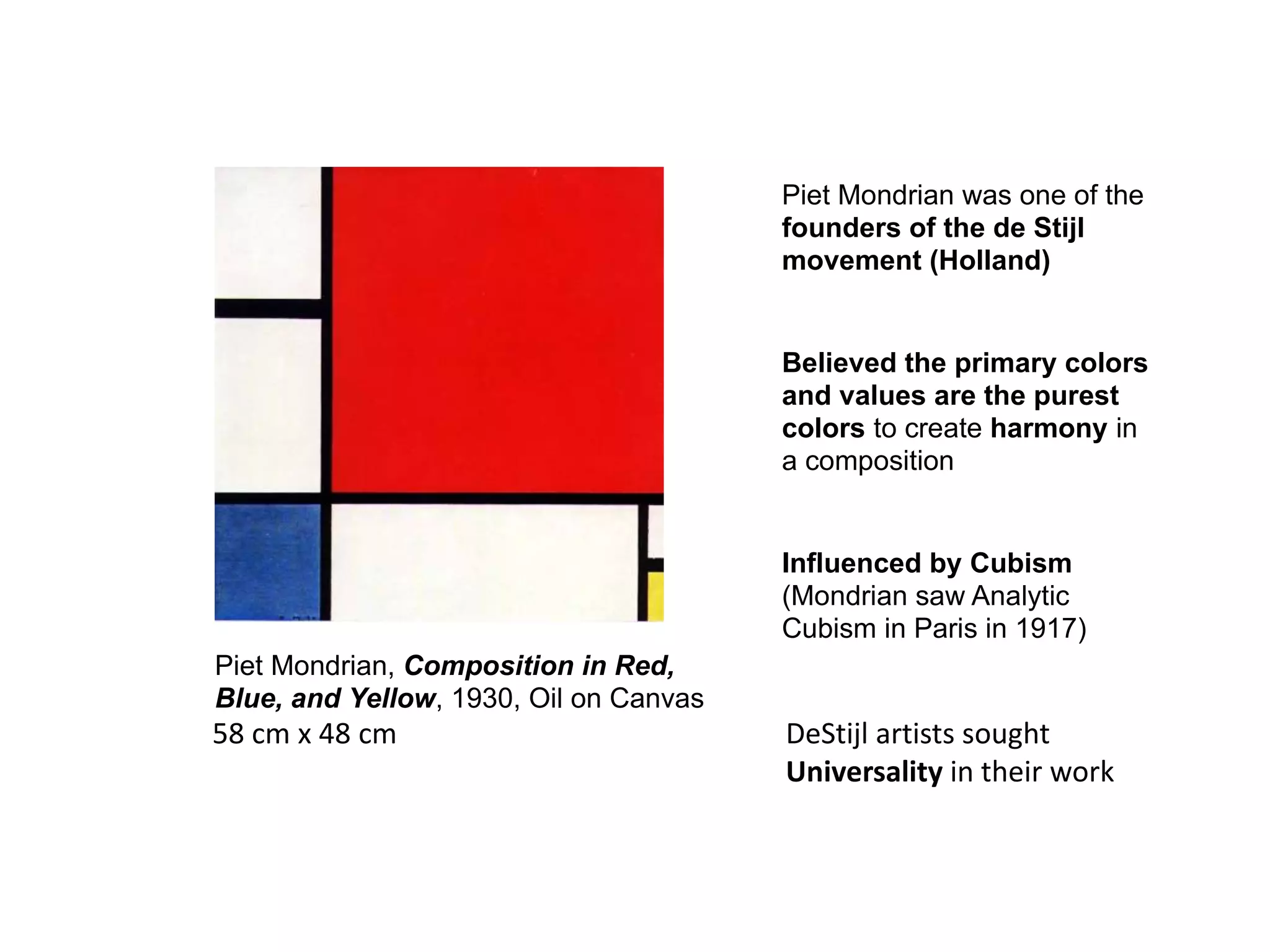
Piet Mondrian, Composition in Red,
Blue, and Yellow, 1930, Oil on Canvas
Piet Mondrian was one of the
founders of the de Stijl
movement (Holland)
Believed the primary colors
and values are the purest
colors to create harmony in
a composition
Influenced by Cubism
(Mondrian saw Analytic
Cubism in Paris in 1917)
58 cm x 48 cm DeStijl artists sought
Universality in their work
Garrit Rietveld, Schröder House (Utrecht, Holland), 1924
https://www.youtube.com/watch?v=EXl9vbF-ryA
Garrit Rietveld
Schröder House (Utrecht, Holland)
1924
• Built for an eccentric client who
was a widow with three children
who preferred to have no interior
walls (open space)
• built for an “active life” with
adaptability of the space
• Rietveld applied the principles of
deStijl throughout the house
(rectilinear shapes / squares and
rectangles, primary colors,
asymmetry)
• Rietveld later moved into the
house with his client after his wife
died (he lived there until his death in
1985)
• The house has since been fully
restored and is now a museum
chair designed by Garrit Rietveld, 1918
Dadaism
• Random word chosen from a French-German Dictionary
• Irrational and Intuitive
• Reaction to “insane” spectacle of war
• Anti-tradition
• Artistic and Literary Movement
• Dada is a “state of mind”
Marcel Duchamp, Fountain, 1917, Ready-made sculpture
61 x 36 x 48 cm
https://www.youtube.com/watch?v=2ZlrHyzIwcI
Marcel Duchamp, Fountain, 1917, Ready-
made sculpture
“Ready-made”
sculpture
Challenged the
idea of What is art?
Radical, avant-
garde
Irony
“R. Mutt” – Play
on words
61 x 36 x 48 cm
Hannah Hoch, Cut with the
Kitchen Knife, 1919-1920,
Photomontage (collage)
44 9/10 × 35 2/5 in
https://www.youtube.com/watch?v=9E1cA3j_xY8
Hannah Hoch, Cut with the Kitchen
Knife, 1919-1920, Photomontage
Chaotic and contradictory
Images of German Military leaders,
Dada artists, dancers, animals, etc.
Self-portrait in the lower corner
Found text – “The Great dada World”
44 9/10 × 35 2/5 in
Surrealism
• Dada artists joined the Surrealist movement
• Dreams and the Unconscious Mind (Psychology)
• Bring together outer and inner reality
https://www.youtube.com/watch?v=wtPBOwE0Qn0&t=59s
Rene Magritte,
The Treachery of
Images, 1928 –
1929, Oil on
Canvas
60.33 cm × 81.12 cm
https://www.youtube.com/watch?v=atHQpANmHCE
Rene Magritte, The Treachery of
Images, 1928 – 1929, Oil on Canvas
Ceci n’est pas une pipe
(This is not a pipe)
Discrepancy between the
image of the pipe and the
text (relationship of text
and image)
The illusion of art
Treachery - dishonesty
(from an old French word
meaning to trick)60.33 cm × 81.12 cm
Salvador Dali, The Persistence of Memory, 1931, Oil on Canvas
24 cm x 33 cm
https://www.youtube.com/watch?v=h7RIP2spwpg
Salvador Dali
The Persistence of Memory
1931, Oil on Canvas
Time and Memory
Landscape from Dali’s
childhood in Spain
Dreamlike
24 cm x 33 cm
Symbolic and Metaphorical
Frida Kahlo, The Two Fridas, 1939, Oil on Canvas
1.73 x 1.73 m
https://www.youtube.com/watch?v=B9XYtPqWLB4
Frida Kahlo, The Two Fridas,
1939, Oil on Canvas
• Kahlo is associated with the
Surrealist Movement, but she
never officially joined the
movement
• She was half Mexican and half
German
• Double Self-portrait - physical
and emotional pain
• Frida was in a serious
streetcar accident as a
university student
• Reference to retablo painting -
traditional Mexican folk art
involving Catholic iconography
• “My paintings are not a
dream, they are my reality” 1.73 x 1.73 m
Mid-to-Late
20th Century Art
Le Corbusier French
Le Corbusier,
Notre Dame du
Haut (Ronchamp,
France), 1950 -
1955
https://www.youtube.com/watch?v=hEkQvR-el3M
Le Corbusier French
Le Corbusier, Notre Dame du Haut
(Ronchamp, France), 1950 - 1955
• Small church
chapel which
replaced a building
destroyed in WWII
• Shape represents
praying hands or
wings of a dove
(symbol of peace)
• Reference to
Medieval Architecture
• Concrete over
metal structure
Alexander Calder, Red Lily Pads, Painted Sheet Metal and Metal Rods (Mobile), 1956,
106.7 x 442 x 256.5 cm
https://www.youtube.com/watch?v=fI5PRaTSMUI
Alexander Calder, Red Lily Pads,
Painted Sheet Metal and Metal
Rods (Mobile), 1956, 106.7 x 442
x 256.5 cm
Calder invented new forms of
sculpture, including mobiles
(kinetic sculpture / movement)
Influenced by European Avant
Garde Art
Abstraction
Inspired by organic forms
Red Lily Pads installed in
Guggenheim Museum in New York
City
Abstract Expressionism
• First major Avant-Garde art movement in USA (started in New
York in late 1940’s)
• Abstraction expressing raw emotion
• New York becomes the center of the art world (no longer Paris)
Jackson Pollock
Action Painting
Focus on the creative
process
Expressive feeling
through action
Used sticks to “throw”
paint onto the canvas
(walked on the canvas)
– artist literally “in” the
painting
https://www.youtube.com/watch?v=gOGDDh1thaQ
Jackson Pollock, Lavender Mist, 1950, Oil, enamel, aluminum
paint on canvas, 221 x 300 cm
Jackson Pollock, Lavender Mist,
1950, Oil, enamel, aluminum paint
on canvas, 221 x 300 cm
Large scale painting
with drips, splatters, and
dribbles of paint
Title refers to organic
nature of painting (color
and texture)
Controlled Randomness
Energetic
Oil Paint / Industrial
Paints (house and car
paint)
Willem de Kooning,
Woman I,
1950 – 1952,
Oil on Canvas,
1.93 x 1.47 m
https://www.youtube.com/watch?v=y0xbZTe1JSM
Willem de Kooning, Woman I,
1950 – 1952, Oil on Canvas,
1.93 x 1.47 m
Importance of Process – de Kooning
repainted this painting many times
(many layers)
“Rawness” and “Intensity”
Jumbled lines / Agitated patches of
color
“Ferocious” looking woman
Later Abstraction
• More “controlled” forms of painting
• Symbolism of color
• Post-painterly abstraction
• Hard-edge Painting
Mark Rothko,
Untitled, 1961,
Oil on Canvas,
69 x 50 inches
https://www.youtube.com/watch?v=1v1mBepDlOw
Mark Rothko, Untitled, 1961,
Oil on Canvas, 69 x 50 inches
Harmony and Spirituality /
simple and pure
“Color field” painting
Focus on Color / Symbolism
of Color / Emotion of Color
“Untitled” title leaves the
interpretation open for the
viewer
Ellsworth Kelly, Red Blue Green, 1963, Oil on canvas, 84 x 136 in
https://www.youtube.com/watch?v=hEcbvxszkfU
Hard-Edged Painting
Focus on Color
Flatness – painting as two-
dimensional
Absence of “the artist’s
hand”
Ellsworth Kelly, Red Blue Green,
1963, Oil on canvas, 84 x 136 in
Comparison
Minimal Art
• Sculptural Movement began in 1960’s
• “Limitation of sculpture”
• Geometric forms
• Very simple, pure aesthetic (less is more)
Donald Judd, Untitled, 1961,
Brass and Plexiglas
sculpture, 6 1/8 x 2 feet
https://www.youtube.com/watch?v=G37C5vKCwH4
Donald Judd, Untitled,
1961, Brass and
Plexiglas sculpture,
6 1/8 x 2 feet
Power of the materials (“message
in the medium”)
Basic geometric forms (simple
and clear)
Sculpture not intended to be
symbolic or metaphorical
Interplay between positive and
negative space
Rhythmic
https://www.youtube.com/watch?v=XR2yTmNOKJ0
Pop Art
• Movement began in UK in 1960’s (later became more popular in
USA)
• Art based on popular culture
• Art “for the people”
• Reaction against Abstract Expressionism
Roy Lichtenstein
Hopeless, 1963
Oil on canvas
111.8 cm × 111.8 cm
https://www.youtube.com/watch?v=6jowA-pH-Y8
Roy Lichtenstein
Hopeless, 1963
Oil on canvas
111.8 cm × 111.8 cm
Art based on comic books
Melodramatic scene /
Romance
“That’s the way it SHOULD
have BEGUN, but it’s
hopeless!”
Used dots to create the look of
comic book printing “benday
dots”
Andy Warhol, Campbell’s Soup Can, 1962, Synthetic Polymer Paint, 51 x 41 cm
Mass-production /
Consumerism
American Icon
Silkscreen (commercial form of
printmaking used for t-shirts,
etc.) / Package Design
Connection to Graphic
Design (Warhol studied
“Commercial Art”
Andy Warhol, Campbell’s Soup
Can, 1962, Synthetic Polymer
Paint, 51 x 41 cm
https://www.youtube.com/watch?v=7VH5MRtk9HQ
Andy Warhol, Marilyn Diptych, 1962, Oil, acrylic, and silk-screen on canvas,
205.44 cm × 289.56 cm
Andy Warhol, Marilyn Diptych, 1962,
Oil, acrylic, and silk-screen on canvas,
205.44 × 289.56 cm
Marilyn Monroe, American
Actress who committed
suicide in 1962
Marilyn Monroe as Icon
Fame and tragedy
Warhol – artist celebrity
Reference to film and to
Renaissance art (diptych
format)
144 x 144 x 72 in.
https://www.youtube.com/watch?v=-z05Yqg5L1w
Robert Indiana inspired by poetry,
typography, and old signs
Sculpture developed from a painting
he had created in 1966
Artist insists that the meaning is
religious as he got the idea from a
sign in church that reads “God is
Love”.
The word “love” became the mantra
of the hippie generation.
Many versions worldwide, including
one in Central Embassy in Bangkok!
20th Century Modern Art (+ Links)

20th Century Modern Art (+ Links)

  • 1.
  • 2.
  • 3.
    Modernism • After 1900artistic innovation in Europe and the US increased in a rapid succession of movements, or “isms”. The modern movement lasted through the first half of the 20th Century. • Search for new forms of expression in a new era characterized by industrialization, rapid social change, and advances in science and the social sciences. • Modernism rejects old, traditional ideas and styles in art and design. • Modern art allows for more interpretation
  • 4.
  • 5.
    The Avant Garde •Avant garde (French) means before the group • Avant-garde art is cutting-edge and does not try to appeal to average people • Radical and Surprising / Shocking • Revolutionary - breaks with tradition • Critical of political and social institutions
  • 6.
  • 7.
    Color and Form •Continuing from the 19th Century (influence of Impressionism, Post- Impressionism, and artists such as Van Gogh and Gaugin) • Symbolism of Color • Focus on Formal Elements (shape, line, space, color, texture) as a way to communicate • Emotion / Feeling
  • 8.
    Influence of Psychology Developmentsin the study of Psychology New understanding of Psychology influenced artists Many artists befriended psychologists Sigmund Freud • developed psychoanalysis in early 20th century • wrote The Interpretation of Dreams in 1900 Carl Jung • Further studies of dreams and the subconscious / unconscious mind • Art Therapy
  • 9.
    Effects of Wars People,including artists greatly affected by war • World War I (1914 – 1919) • World War II (1939 – 1945) • Russian Revolution (1917 – 1923) • Spanish Civil War (1937) Some Modern art was reactionary against war (Look toward Idealism / Utopianism / Purity) Search for Truth as a result of politics / political propaganda
  • 11.
    • Used purehues (unmixed colors from the color wheel) • Rejected “imitative” colors (colors that imitate real life) to create “stronger reactions” to their work • Color as a conveyer of meaning / symbolism Fauvism
  • 12.
    Henri Matisse, RedRoom, 1908 – 1909, Oil on Canvas https://www.youtube.com/watch?v=RMXQDV2PecE
  • 13.
    Henri Matisse, RedRoom, 1908 – 1909, Oil on Canvas Matisse was one of the main artists in the Fauvist group Feeling of warmth and comfort in the room Used color to express emotions , 1.8 m x 2.2 m
  • 15.
    Egon Shiele, Self-Portrait,1911, Drawing (Gouache and pencil on paper) https://www.youtube.com/watch?v=BN73JesYJhc
  • 16.
    Egon Shiele, Self-Portrait, 1911,Drawing (Gouache and pencil on paper) Physical and psychological torment Use of line and textures to convey feeling 51.4 x 34.9 cm
  • 17.
    Cubism • Cubists rejectednaturalistic / realistic art • Preferred using abstract shapes and forms • Viewing the subject from many different angles using geometric forms • Neutral Colors • Interested in connecting music to visual art • Analytic Cubism – first phase of cubism started by Georges Braque and Pablo Picasso • Synthetic Cubism – Collage (mixed media) – materials from different sources
  • 18.
    Pablo Picasso Les Demoisellesd’Avignon Oil on Canvas, 1907 243.9 x 233.7 cm
  • 19.
    Pablo Picasso Les Demoisellesd’Avignon Oil on Canvas, 1907 • This work led to Picasso’s development of Cubist style • Five nude female figures (prostitutes from a brothel in Barcelona, Spain) • Radical break from traditional compositions and perspective • Still Life in foreground • Two of the faces inspired by African masks (saw African art in Paris museum) 243.9 x 233.7 cm
  • 20.
  • 21.
    Pablo Picasso, StillLife with Chair-Caning, 1911-1912, Oil and Collage on Canvas 29 x 37 cm
  • 22.
    Pablo Picasso, StillLife with Chair-Caning, 1911-1912, Oil and Collage on Canvas Synthetic Cubism New Medium of collage (from French word “to stick”) Illusion of real seat of a chair with real rope as a frame Jou – from “Journal” (French newspaper) also word refers to “play” and to “game”29 x 37 cm
  • 23.
    Pablo Picasso, Guernica,1937, Oil on Canvas , 3.49 m x 7.77 m https://www.youtube.com/watch?v=3lo5OSGg1k0
  • 25.
    Pablo Picasso, Guernica,1937, Oil on Canvas • Spanish Civil War bombing in Guernica, Spain (Picasso was Spanish) • Horrors of War • Based on images from black and white photos in newspaper • Later Cubist style • Symbolism • References to Spain - Bull and Horse 3.49 m x 7.77 m
  • 26.
  • 27.
    Futurism Began as aliterary movement in Italy in 1909, but later included visual arts, film, theater, music, and architecture Inspired by the Cubists Artists had a socio-political agenda Published several manifestos – a written document that explains the overall intentions of the group – in this case, advocating a revolution in society and art
  • 28.
    Umberto Boccioni Unique Formsof Continuity in Space 1913 Bronze 1.11 m x 88 cm https://www.youtube.com/watch?v=G5InIGJkYA4
  • 29.
    Umberto Boccioni, UniqueForms of Continuity in Space, 1913, Bronze sculpture Feeling of Motion Symbolic of Dynamic modern life Figure moving ahead in a brave, new world 1.11 m x 88 cm Robotic and Machine-like
  • 30.
    Suprematism • Russian movement •Pure language of shape and color • Non-objective (no recognizable image) • Based on Inner Feelings https://www.youtube.com/watch?v=e3YS6uZ87Ec
  • 31.
    Kazimir Malevich, SuprematistComposition: Airplane Flying, 1915, oil on canvas 58 cm x 48 cm
  • 32.
    Feeling unattached toobjects “The Suprematist artist does not observe and does not touch – they feel” Dynamic movement of shapes Kazimir Malevich, Suprematist Composition: Airplane Flying, 1915, oil on canvas 58 cm x 48 cm Non-representational
  • 33.
    De Stijl • DeStijl means “the style” • Movement formed by a group of young artists in Holland in 1917 • Believed in “birth of a new age” • Integration of Art and Life • Focus on Universal, rather than the individual https://www.youtube.com/watch?v=ygiPcUKDdtM
  • 34.
    Piet Mondrian, Composition inRed, Blue, and Yellow, 1930, Oil on Canvas 59.5 x 59.5 cm https://www.youtube.com/watch?v=1x8m-7N-Kjo
  • 35.
    Piet Mondrian, Compositionin Red, Blue, and Yellow, 1930, Oil on Canvas Piet Mondrian was one of the founders of the de Stijl movement (Holland) Believed the primary colors and values are the purest colors to create harmony in a composition Influenced by Cubism (Mondrian saw Analytic Cubism in Paris in 1917) 58 cm x 48 cm DeStijl artists sought Universality in their work
  • 36.
    Garrit Rietveld, SchröderHouse (Utrecht, Holland), 1924 https://www.youtube.com/watch?v=EXl9vbF-ryA
  • 37.
    Garrit Rietveld Schröder House(Utrecht, Holland) 1924 • Built for an eccentric client who was a widow with three children who preferred to have no interior walls (open space) • built for an “active life” with adaptability of the space • Rietveld applied the principles of deStijl throughout the house (rectilinear shapes / squares and rectangles, primary colors, asymmetry) • Rietveld later moved into the house with his client after his wife died (he lived there until his death in 1985) • The house has since been fully restored and is now a museum
  • 38.
    chair designed byGarrit Rietveld, 1918
  • 39.
    Dadaism • Random wordchosen from a French-German Dictionary • Irrational and Intuitive • Reaction to “insane” spectacle of war • Anti-tradition • Artistic and Literary Movement • Dada is a “state of mind”
  • 40.
    Marcel Duchamp, Fountain,1917, Ready-made sculpture 61 x 36 x 48 cm https://www.youtube.com/watch?v=2ZlrHyzIwcI
  • 41.
    Marcel Duchamp, Fountain,1917, Ready- made sculpture “Ready-made” sculpture Challenged the idea of What is art? Radical, avant- garde Irony “R. Mutt” – Play on words 61 x 36 x 48 cm
  • 42.
    Hannah Hoch, Cutwith the Kitchen Knife, 1919-1920, Photomontage (collage) 44 9/10 × 35 2/5 in https://www.youtube.com/watch?v=9E1cA3j_xY8
  • 43.
    Hannah Hoch, Cutwith the Kitchen Knife, 1919-1920, Photomontage Chaotic and contradictory Images of German Military leaders, Dada artists, dancers, animals, etc. Self-portrait in the lower corner Found text – “The Great dada World” 44 9/10 × 35 2/5 in
  • 44.
    Surrealism • Dada artistsjoined the Surrealist movement • Dreams and the Unconscious Mind (Psychology) • Bring together outer and inner reality https://www.youtube.com/watch?v=wtPBOwE0Qn0&t=59s
  • 45.
    Rene Magritte, The Treacheryof Images, 1928 – 1929, Oil on Canvas 60.33 cm × 81.12 cm https://www.youtube.com/watch?v=atHQpANmHCE
  • 46.
    Rene Magritte, TheTreachery of Images, 1928 – 1929, Oil on Canvas Ceci n’est pas une pipe (This is not a pipe) Discrepancy between the image of the pipe and the text (relationship of text and image) The illusion of art Treachery - dishonesty (from an old French word meaning to trick)60.33 cm × 81.12 cm
  • 47.
    Salvador Dali, ThePersistence of Memory, 1931, Oil on Canvas 24 cm x 33 cm https://www.youtube.com/watch?v=h7RIP2spwpg
  • 48.
    Salvador Dali The Persistenceof Memory 1931, Oil on Canvas Time and Memory Landscape from Dali’s childhood in Spain Dreamlike 24 cm x 33 cm Symbolic and Metaphorical
  • 49.
    Frida Kahlo, TheTwo Fridas, 1939, Oil on Canvas 1.73 x 1.73 m https://www.youtube.com/watch?v=B9XYtPqWLB4
  • 50.
    Frida Kahlo, TheTwo Fridas, 1939, Oil on Canvas • Kahlo is associated with the Surrealist Movement, but she never officially joined the movement • She was half Mexican and half German • Double Self-portrait - physical and emotional pain • Frida was in a serious streetcar accident as a university student • Reference to retablo painting - traditional Mexican folk art involving Catholic iconography • “My paintings are not a dream, they are my reality” 1.73 x 1.73 m
  • 51.
  • 52.
    Le Corbusier French LeCorbusier, Notre Dame du Haut (Ronchamp, France), 1950 - 1955 https://www.youtube.com/watch?v=hEkQvR-el3M
  • 53.
    Le Corbusier French LeCorbusier, Notre Dame du Haut (Ronchamp, France), 1950 - 1955 • Small church chapel which replaced a building destroyed in WWII • Shape represents praying hands or wings of a dove (symbol of peace) • Reference to Medieval Architecture • Concrete over metal structure
  • 54.
    Alexander Calder, RedLily Pads, Painted Sheet Metal and Metal Rods (Mobile), 1956, 106.7 x 442 x 256.5 cm https://www.youtube.com/watch?v=fI5PRaTSMUI
  • 55.
    Alexander Calder, RedLily Pads, Painted Sheet Metal and Metal Rods (Mobile), 1956, 106.7 x 442 x 256.5 cm Calder invented new forms of sculpture, including mobiles (kinetic sculpture / movement) Influenced by European Avant Garde Art Abstraction Inspired by organic forms Red Lily Pads installed in Guggenheim Museum in New York City
  • 56.
    Abstract Expressionism • Firstmajor Avant-Garde art movement in USA (started in New York in late 1940’s) • Abstraction expressing raw emotion • New York becomes the center of the art world (no longer Paris)
  • 57.
    Jackson Pollock Action Painting Focuson the creative process Expressive feeling through action Used sticks to “throw” paint onto the canvas (walked on the canvas) – artist literally “in” the painting https://www.youtube.com/watch?v=gOGDDh1thaQ
  • 58.
    Jackson Pollock, LavenderMist, 1950, Oil, enamel, aluminum paint on canvas, 221 x 300 cm
  • 59.
    Jackson Pollock, LavenderMist, 1950, Oil, enamel, aluminum paint on canvas, 221 x 300 cm Large scale painting with drips, splatters, and dribbles of paint Title refers to organic nature of painting (color and texture) Controlled Randomness Energetic Oil Paint / Industrial Paints (house and car paint)
  • 60.
    Willem de Kooning, WomanI, 1950 – 1952, Oil on Canvas, 1.93 x 1.47 m https://www.youtube.com/watch?v=y0xbZTe1JSM
  • 61.
    Willem de Kooning,Woman I, 1950 – 1952, Oil on Canvas, 1.93 x 1.47 m Importance of Process – de Kooning repainted this painting many times (many layers) “Rawness” and “Intensity” Jumbled lines / Agitated patches of color “Ferocious” looking woman
  • 62.
    Later Abstraction • More“controlled” forms of painting • Symbolism of color • Post-painterly abstraction • Hard-edge Painting
  • 63.
    Mark Rothko, Untitled, 1961, Oilon Canvas, 69 x 50 inches https://www.youtube.com/watch?v=1v1mBepDlOw
  • 64.
    Mark Rothko, Untitled,1961, Oil on Canvas, 69 x 50 inches Harmony and Spirituality / simple and pure “Color field” painting Focus on Color / Symbolism of Color / Emotion of Color “Untitled” title leaves the interpretation open for the viewer
  • 65.
    Ellsworth Kelly, RedBlue Green, 1963, Oil on canvas, 84 x 136 in https://www.youtube.com/watch?v=hEcbvxszkfU
  • 66.
    Hard-Edged Painting Focus onColor Flatness – painting as two- dimensional Absence of “the artist’s hand” Ellsworth Kelly, Red Blue Green, 1963, Oil on canvas, 84 x 136 in
  • 68.
  • 69.
    Minimal Art • SculpturalMovement began in 1960’s • “Limitation of sculpture” • Geometric forms • Very simple, pure aesthetic (less is more)
  • 70.
    Donald Judd, Untitled,1961, Brass and Plexiglas sculpture, 6 1/8 x 2 feet https://www.youtube.com/watch?v=G37C5vKCwH4
  • 71.
    Donald Judd, Untitled, 1961,Brass and Plexiglas sculpture, 6 1/8 x 2 feet Power of the materials (“message in the medium”) Basic geometric forms (simple and clear) Sculpture not intended to be symbolic or metaphorical Interplay between positive and negative space Rhythmic
  • 73.
  • 75.
    Pop Art • Movementbegan in UK in 1960’s (later became more popular in USA) • Art based on popular culture • Art “for the people” • Reaction against Abstract Expressionism
  • 76.
    Roy Lichtenstein Hopeless, 1963 Oilon canvas 111.8 cm × 111.8 cm https://www.youtube.com/watch?v=6jowA-pH-Y8
  • 77.
    Roy Lichtenstein Hopeless, 1963 Oilon canvas 111.8 cm × 111.8 cm Art based on comic books Melodramatic scene / Romance “That’s the way it SHOULD have BEGUN, but it’s hopeless!” Used dots to create the look of comic book printing “benday dots”
  • 78.
    Andy Warhol, Campbell’sSoup Can, 1962, Synthetic Polymer Paint, 51 x 41 cm
  • 79.
    Mass-production / Consumerism American Icon Silkscreen(commercial form of printmaking used for t-shirts, etc.) / Package Design Connection to Graphic Design (Warhol studied “Commercial Art” Andy Warhol, Campbell’s Soup Can, 1962, Synthetic Polymer Paint, 51 x 41 cm https://www.youtube.com/watch?v=7VH5MRtk9HQ
  • 81.
    Andy Warhol, MarilynDiptych, 1962, Oil, acrylic, and silk-screen on canvas, 205.44 cm × 289.56 cm
  • 82.
    Andy Warhol, MarilynDiptych, 1962, Oil, acrylic, and silk-screen on canvas, 205.44 × 289.56 cm Marilyn Monroe, American Actress who committed suicide in 1962 Marilyn Monroe as Icon Fame and tragedy Warhol – artist celebrity Reference to film and to Renaissance art (diptych format)
  • 83.
    144 x 144x 72 in. https://www.youtube.com/watch?v=-z05Yqg5L1w
  • 84.
    Robert Indiana inspiredby poetry, typography, and old signs Sculpture developed from a painting he had created in 1966 Artist insists that the meaning is religious as he got the idea from a sign in church that reads “God is Love”. The word “love” became the mantra of the hippie generation. Many versions worldwide, including one in Central Embassy in Bangkok!