20 th  Century Art
Why is it so… weird?  Think of how much and how quickly the world has changed in the last 110 years. Modern art is a reflection of that turbulence. Cameras make realistic art obsolete. Mass production makes art marketable
Like the mannerists who followed Michelangelo and co., the artists of the 20 th  century valued originality and innovation over just beauty. If you can’t please the public, shock it. Realistic doesn’t equal “good” art.  Instead, go back to the 4 questions: What do I see? What do I know about what I see? What was the artist trying to do/say? How successful was he/she?
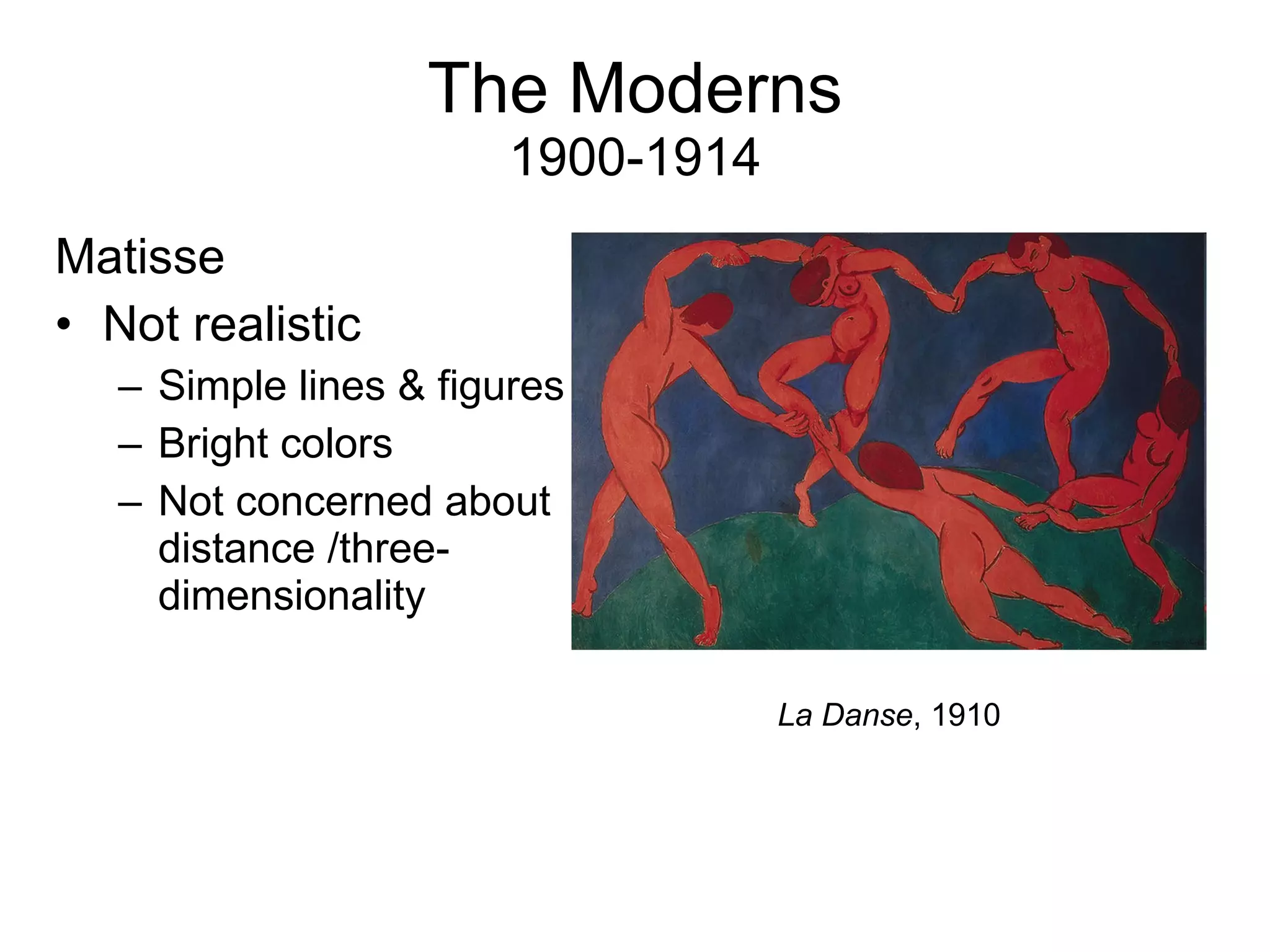
The Moderns 1900-1914 Matisse Not realistic Simple lines & figures  Bright colors Not concerned about distance /three-dimensionality La Danse , 1910
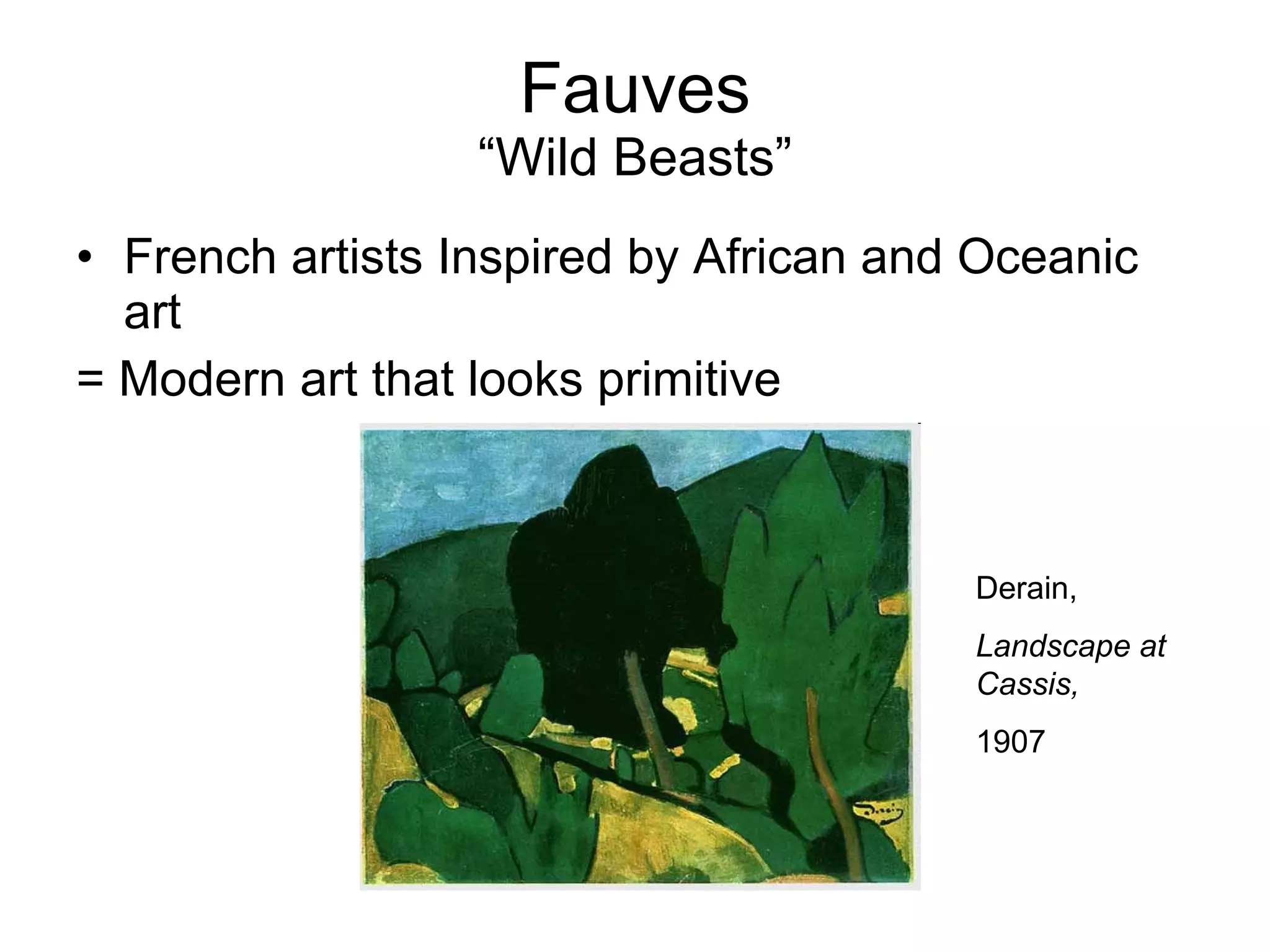
Fauves “Wild Beasts” French artists Inspired by African and Oceanic art = Modern art that looks primitive Derain, Landscape at  Cassis, 1907
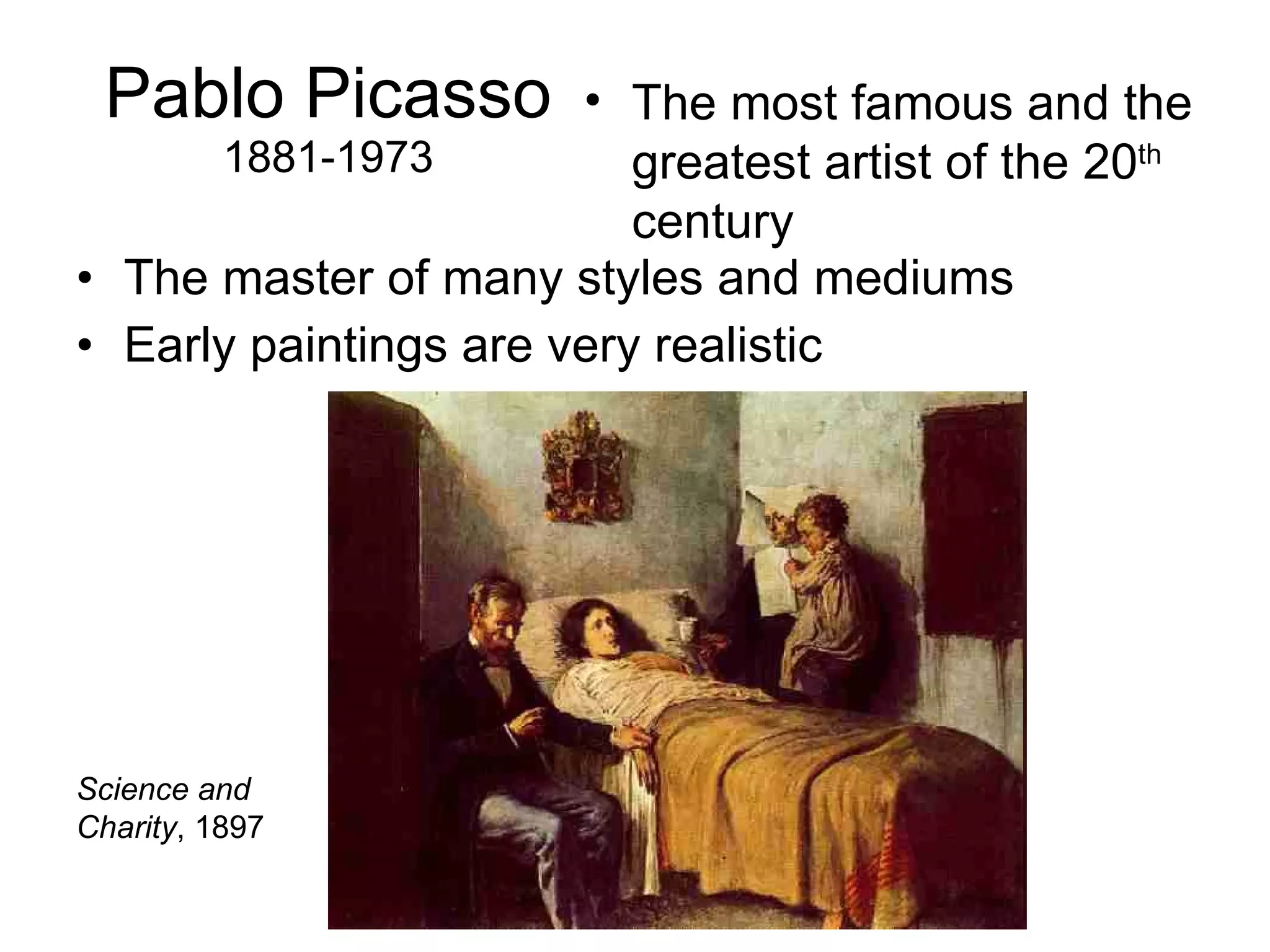
Pablo Picasso 1881-1973 The master of many styles and mediums Early paintings are very realistic The most famous and the greatest artist of the 20 th  century Science and Charity , 1897
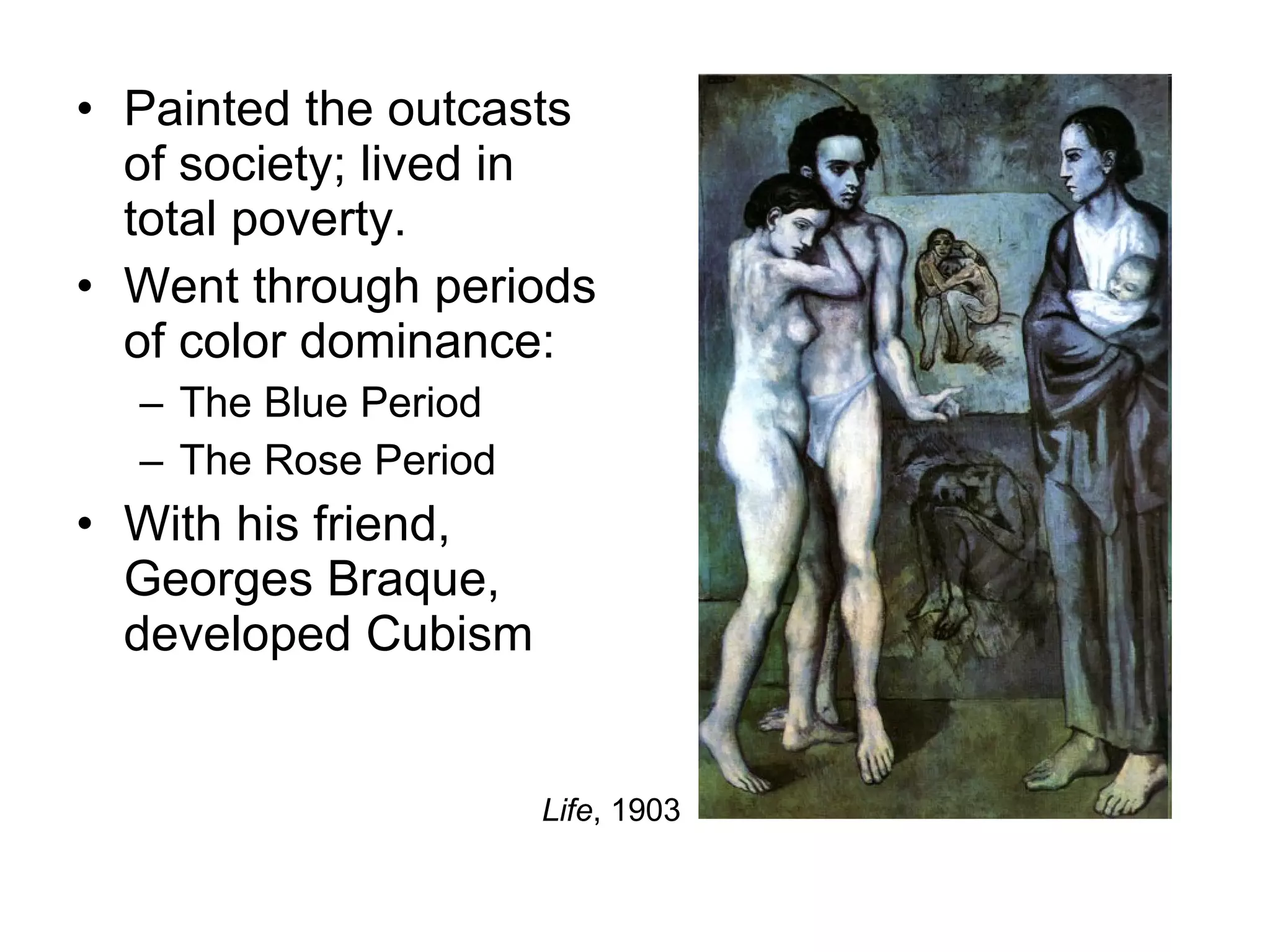
Painted the outcasts of society; lived in total poverty. Went through periods of color dominance: The Blue Period The Rose Period With his friend, Georges Braque, developed Cubism Life , 1903
Les Demoiselles d’Avignon 1907
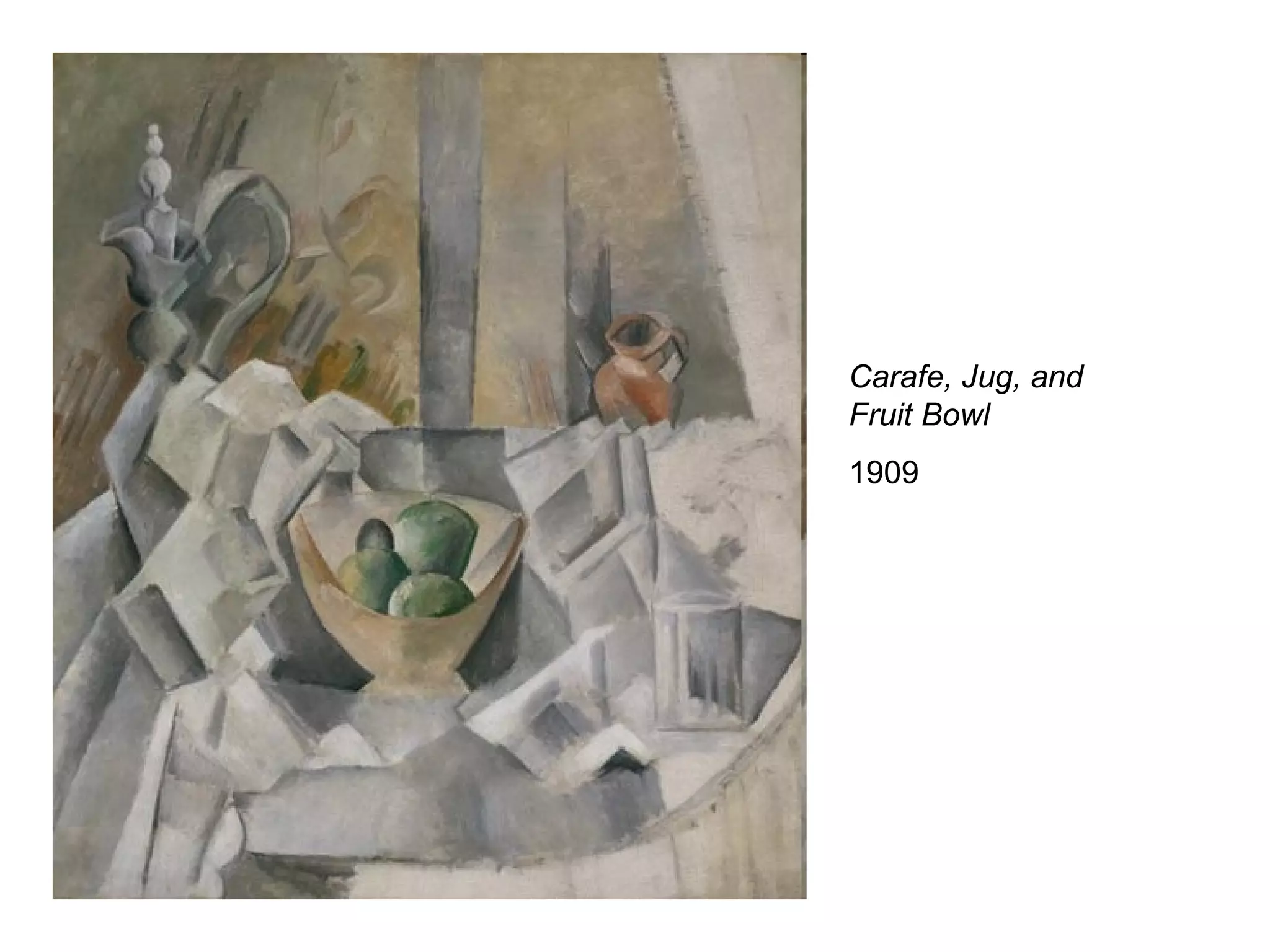
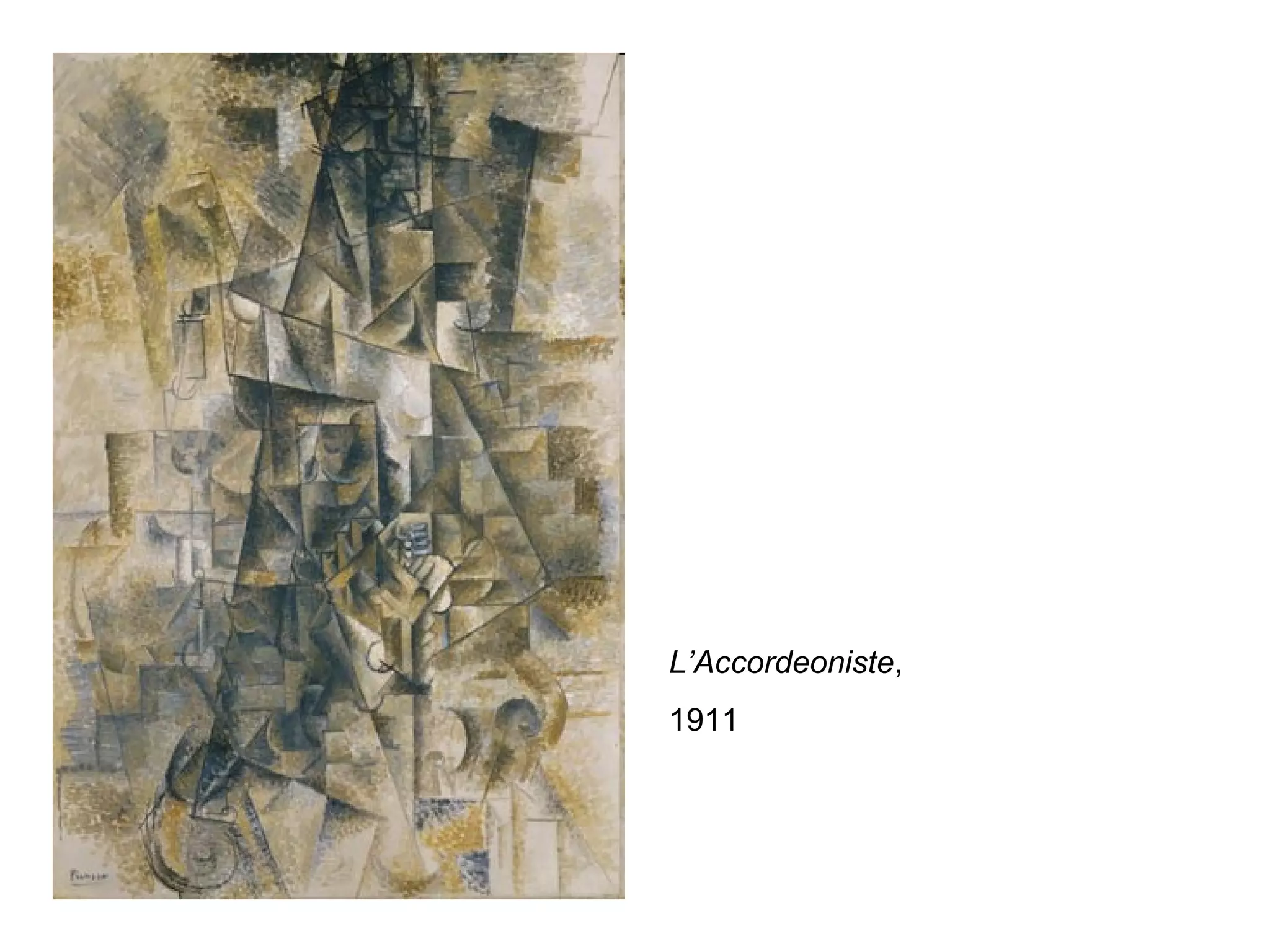
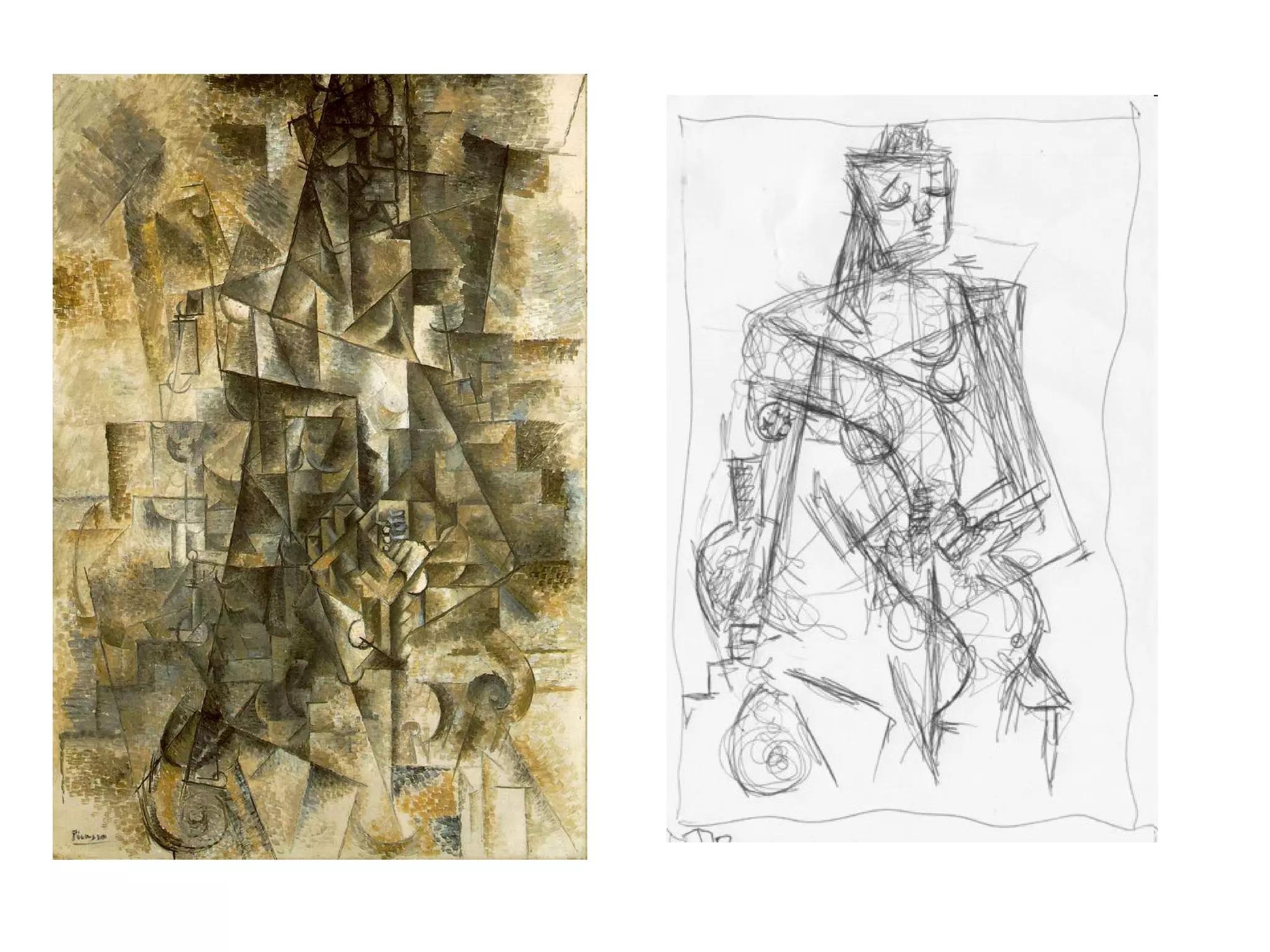
Cubism Shatter a glass sculpture, pick up the pieces, glue them on a canvas = Cubism! Shows several different perspectives of the same subject at the same time Like a round world sliced up to show all the parts. (Remember, this is the same time that Einstein’s coming up with the theory of relativity/the 4 th  dimension!) Background and foreground overlap, the subject dissolves into pattern.
Carafe, Jug, and Fruit Bowl 1909
L’Accordeoniste , 1911
 
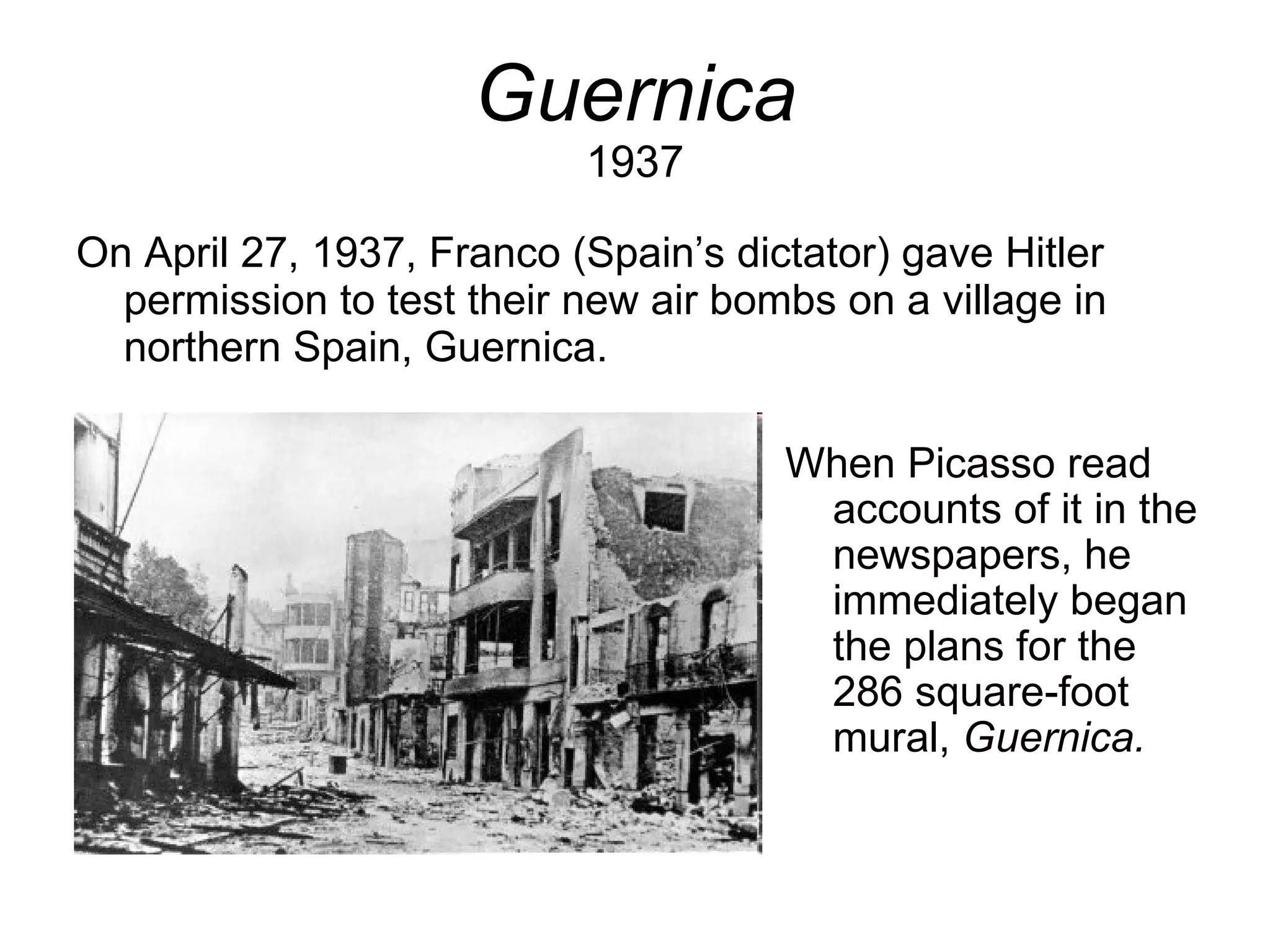
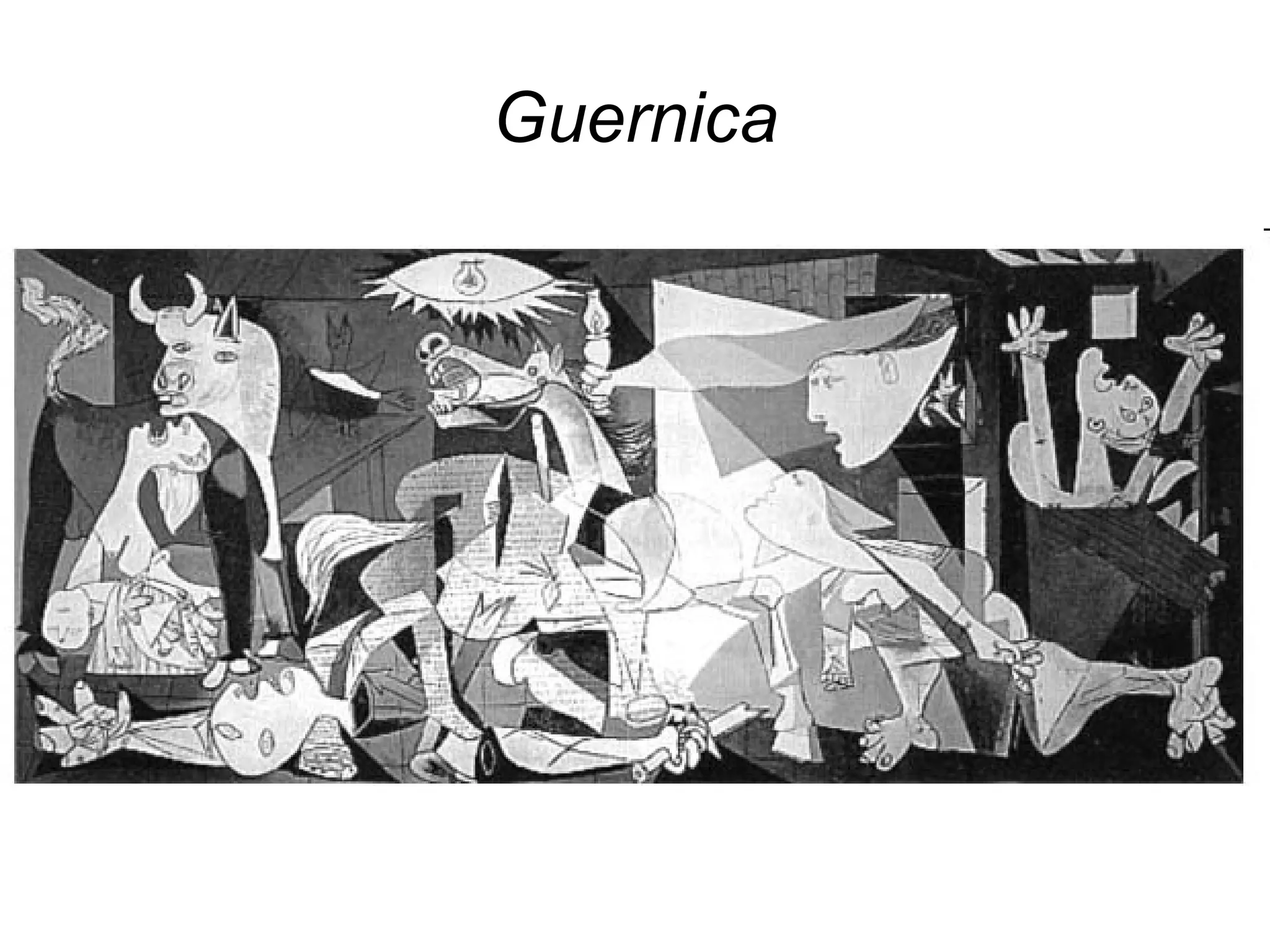
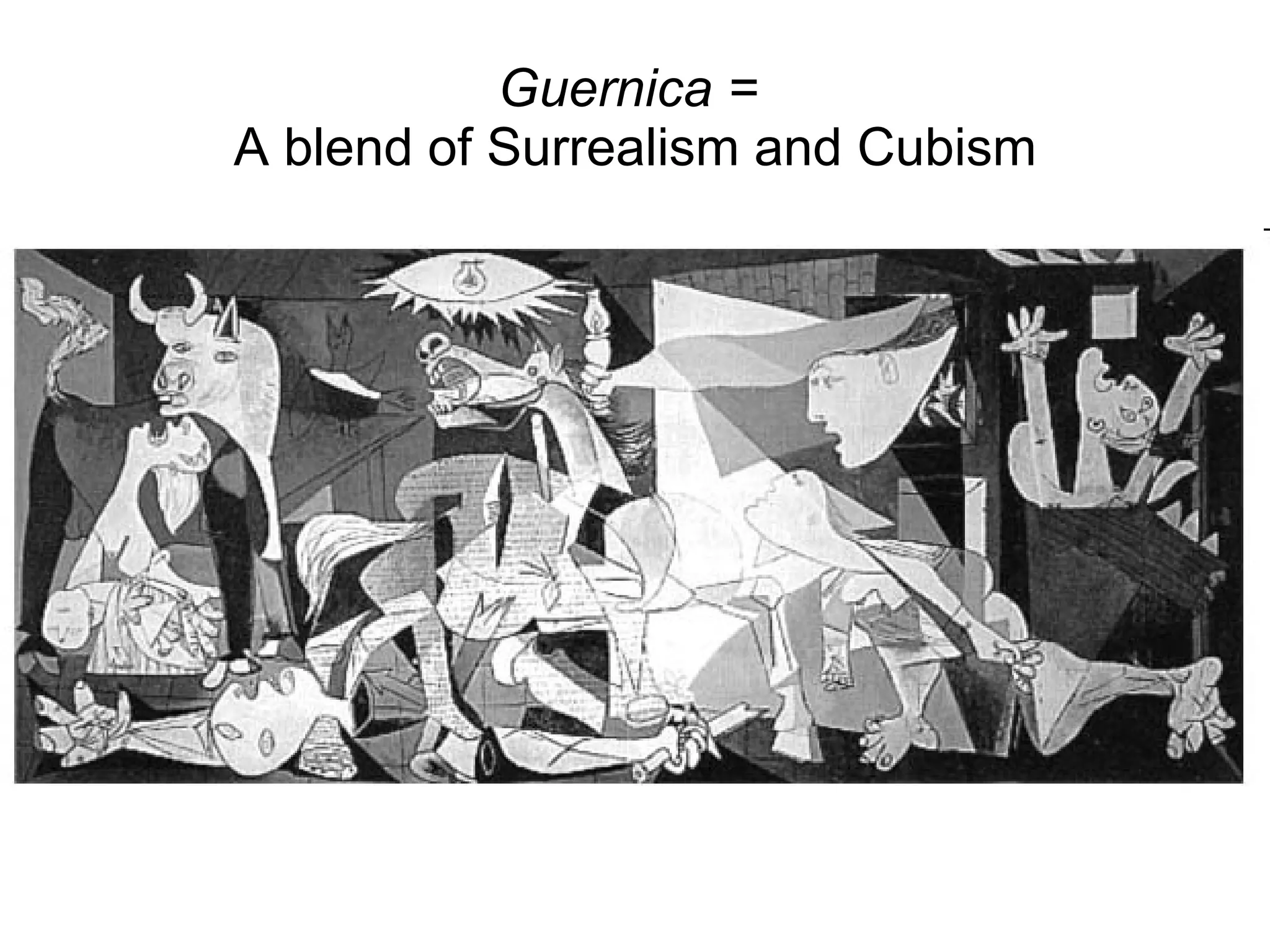
Guernica 1937 On April 27, 1937, Franco (Spain’s dictator) gave Hitler permission to test their new air bombs on a village in northern Spain, Guernica. When Picasso read accounts of it in the newspapers, he immediately began the plans for the 286 square-foot mural,  Guernica.
Guernica
Abstract Art Simplifies things – a man = a stick figure, a squiggle = a wave, red = anger It’s about symbolism, capturing the essence of reality in a few lines and colors Think “visual music” (this is when jazz was developed in America)
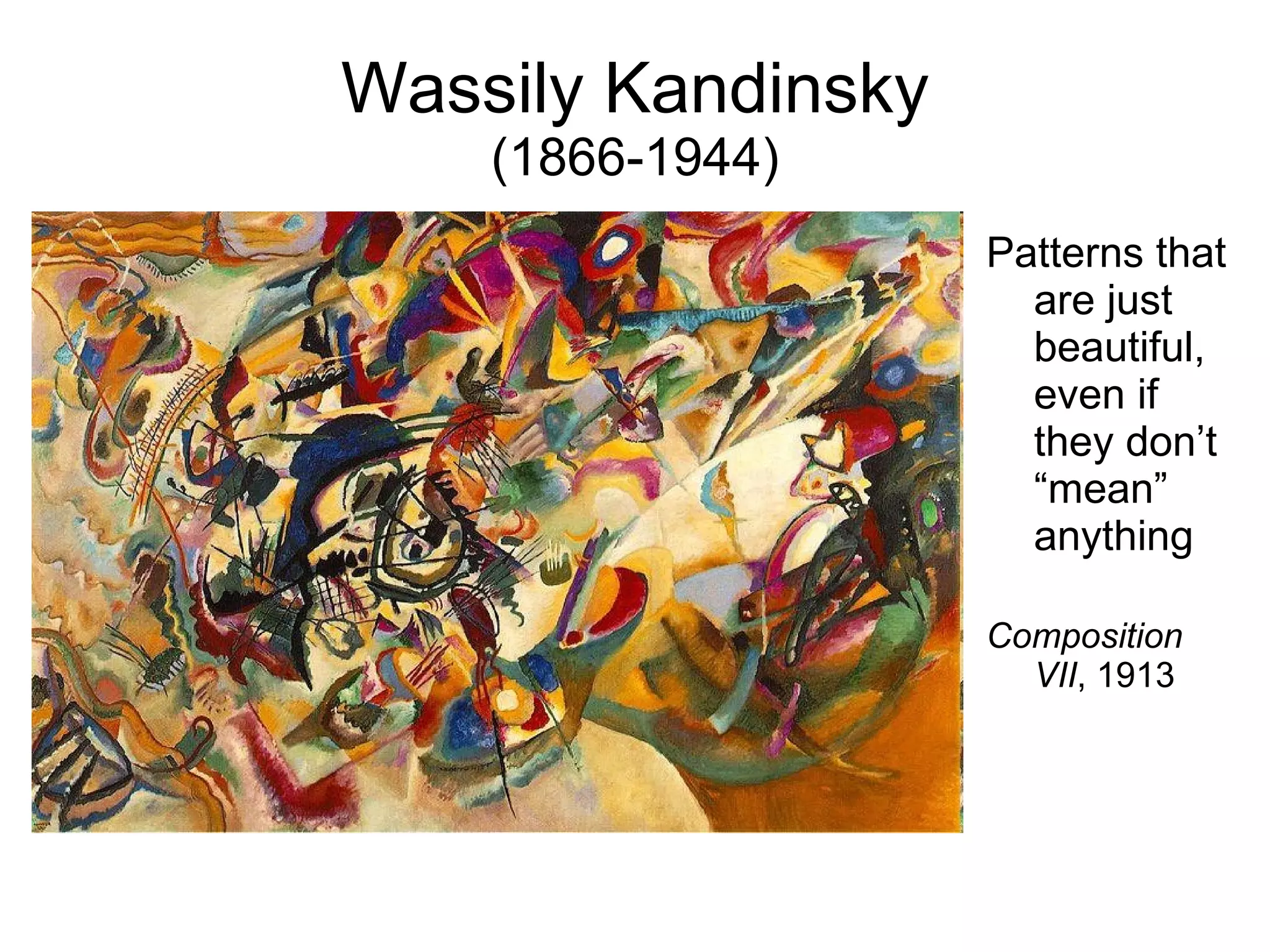
Wassily Kandinsky (1866-1944) Patterns that are just beautiful, even if they don’t “mean” anything Composition VII , 1913
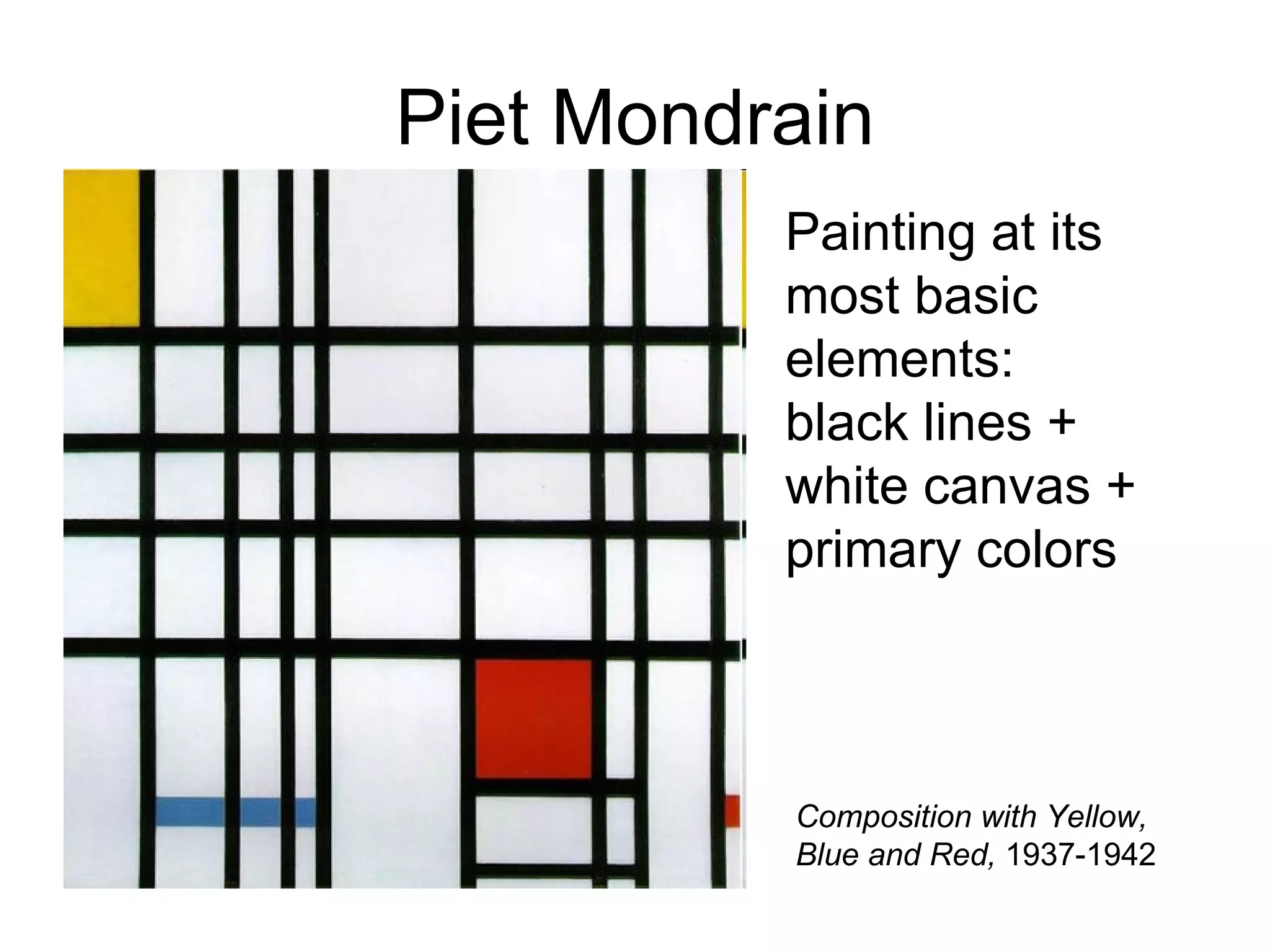
Piet Mondrain Composition with Yellow, Blue and Red,  1937-1942 Painting at its most basic elements: black lines + white canvas +  primary colors
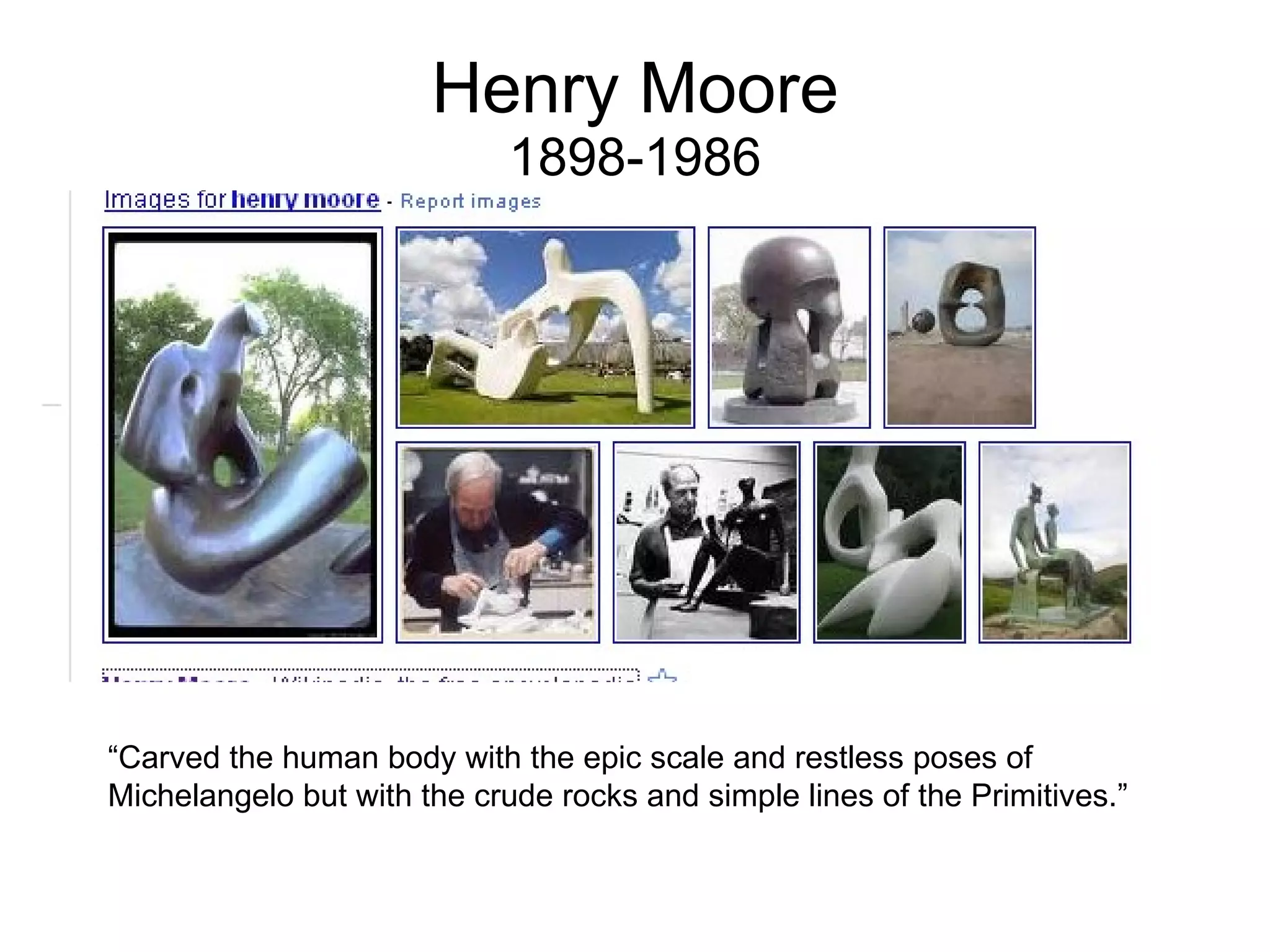
Henry Moore 1898-1986 “Carved the human body with the epic scale and restless poses of Michelangelo but with the crude rocks and simple lines of the Primitives.”
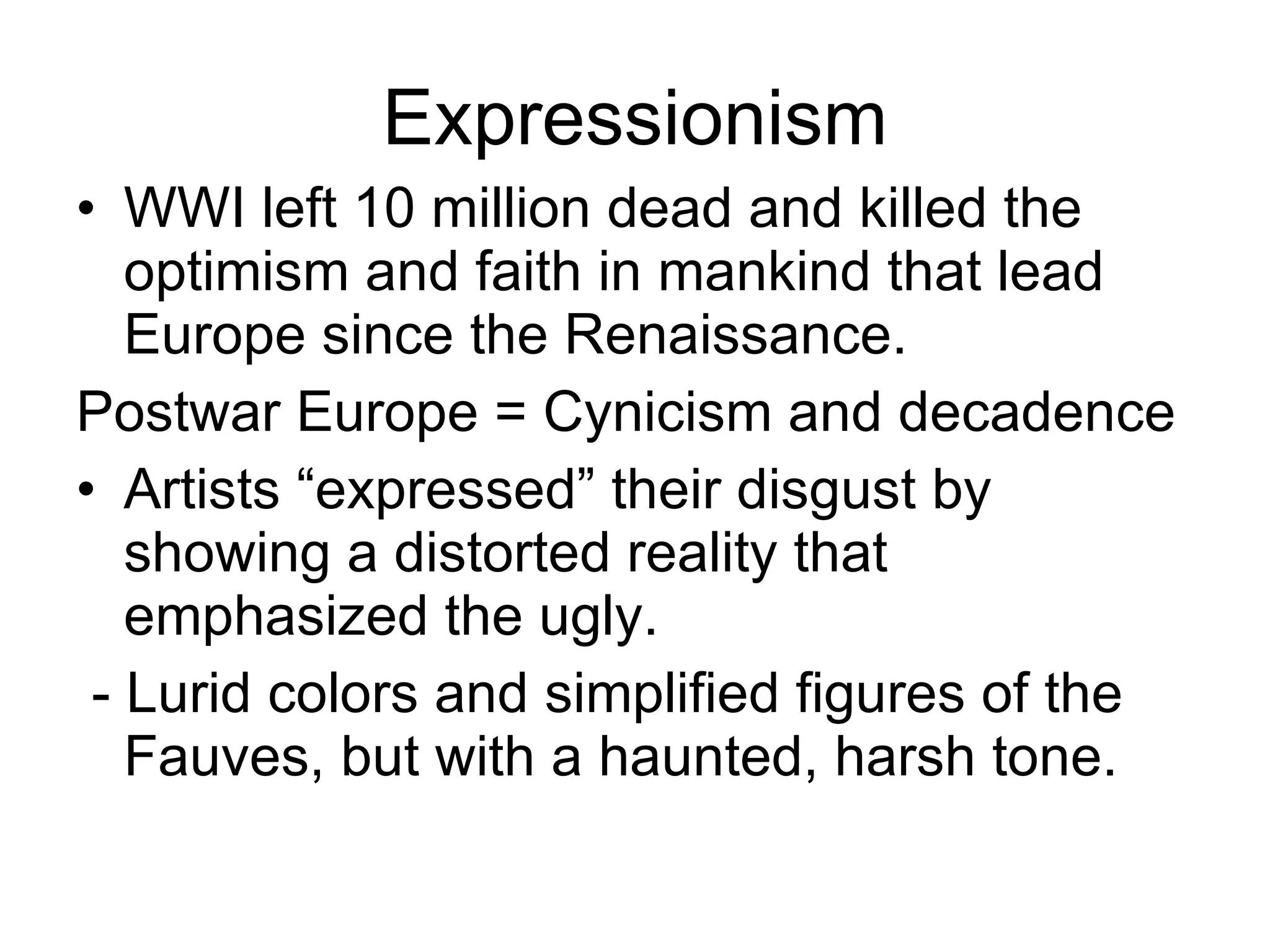
Expressionism WWI left 10 million dead and killed the optimism and faith in mankind that lead Europe since the Renaissance. Postwar Europe = Cynicism and decadence Artists “expressed” their disgust by showing a distorted reality that emphasized the ugly. - Lurid colors and simplified figures of the Fauves, but with a haunted, harsh tone.
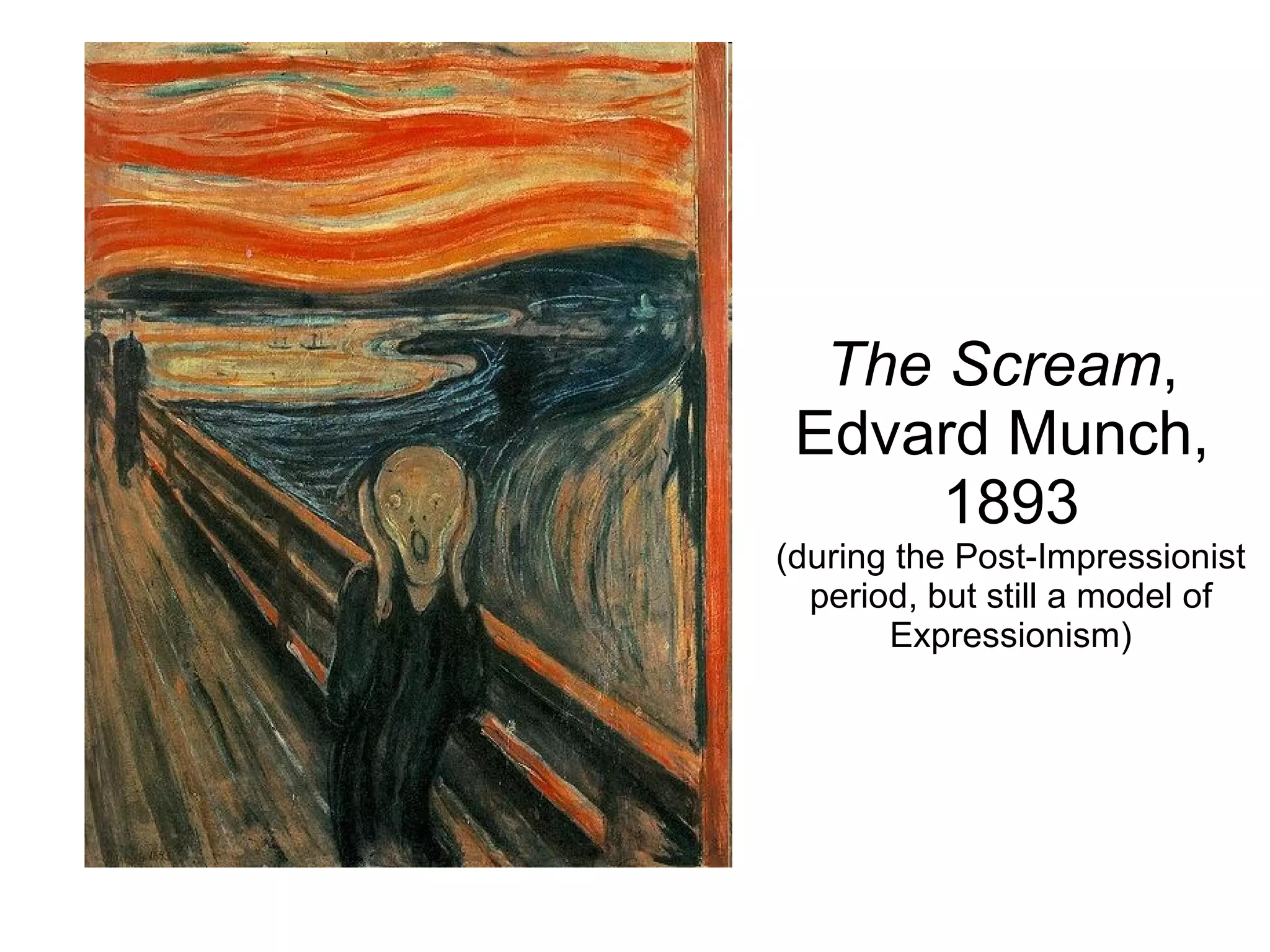
The Scream ,  Edvard Munch,  1893 (during the Post-Impressionist period, but still a model of Expressionism)
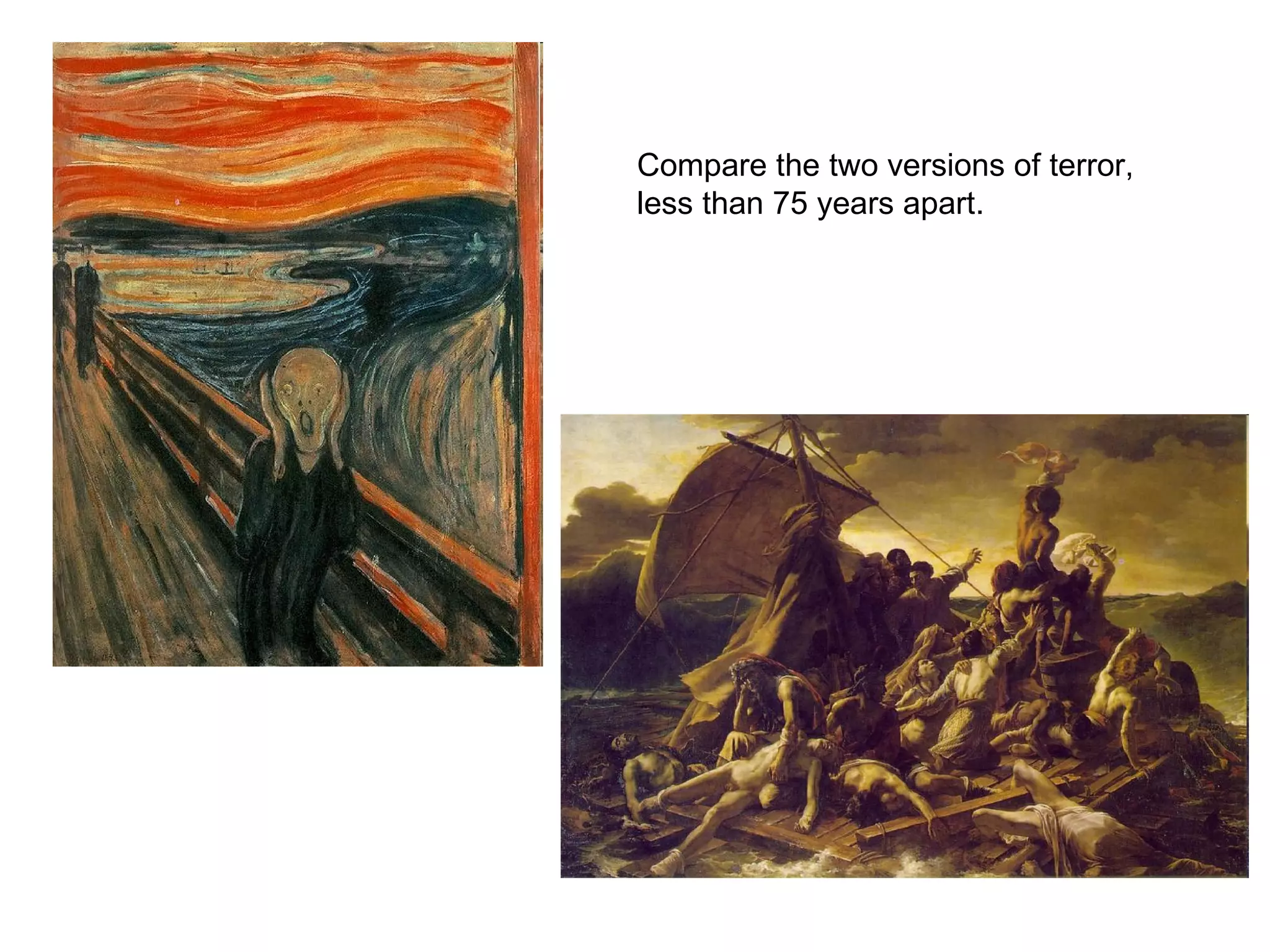
Compare the two versions of terror, less than 75 years apart.
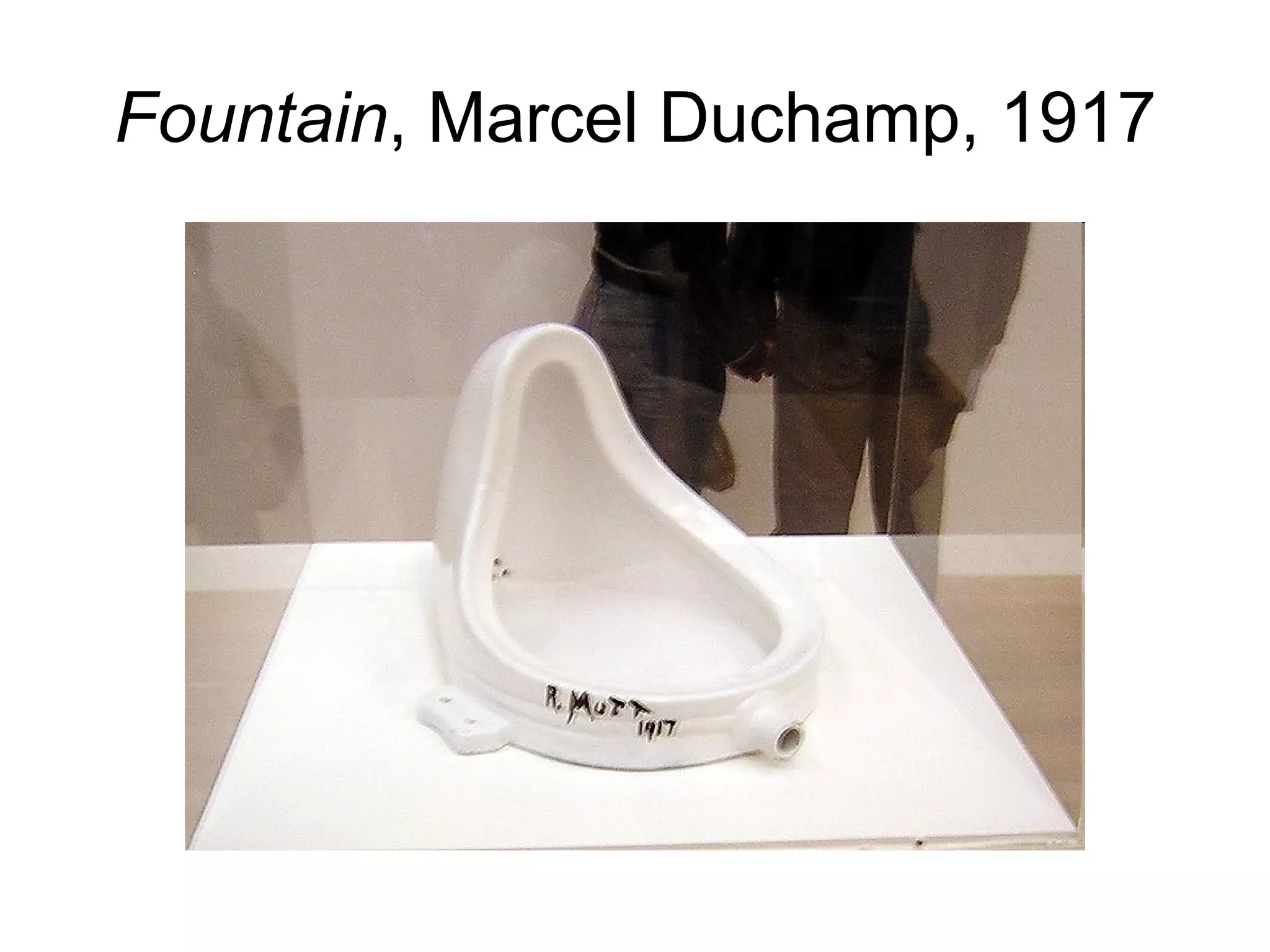
Dada Artistic grief became twisted humor + resentment of the bourgeoisie/pompous intellectuals = Art that is outrageous, offensive, and meant to give traditional culture the finger.
Fountain , Marcel Duchamp, 1917
 
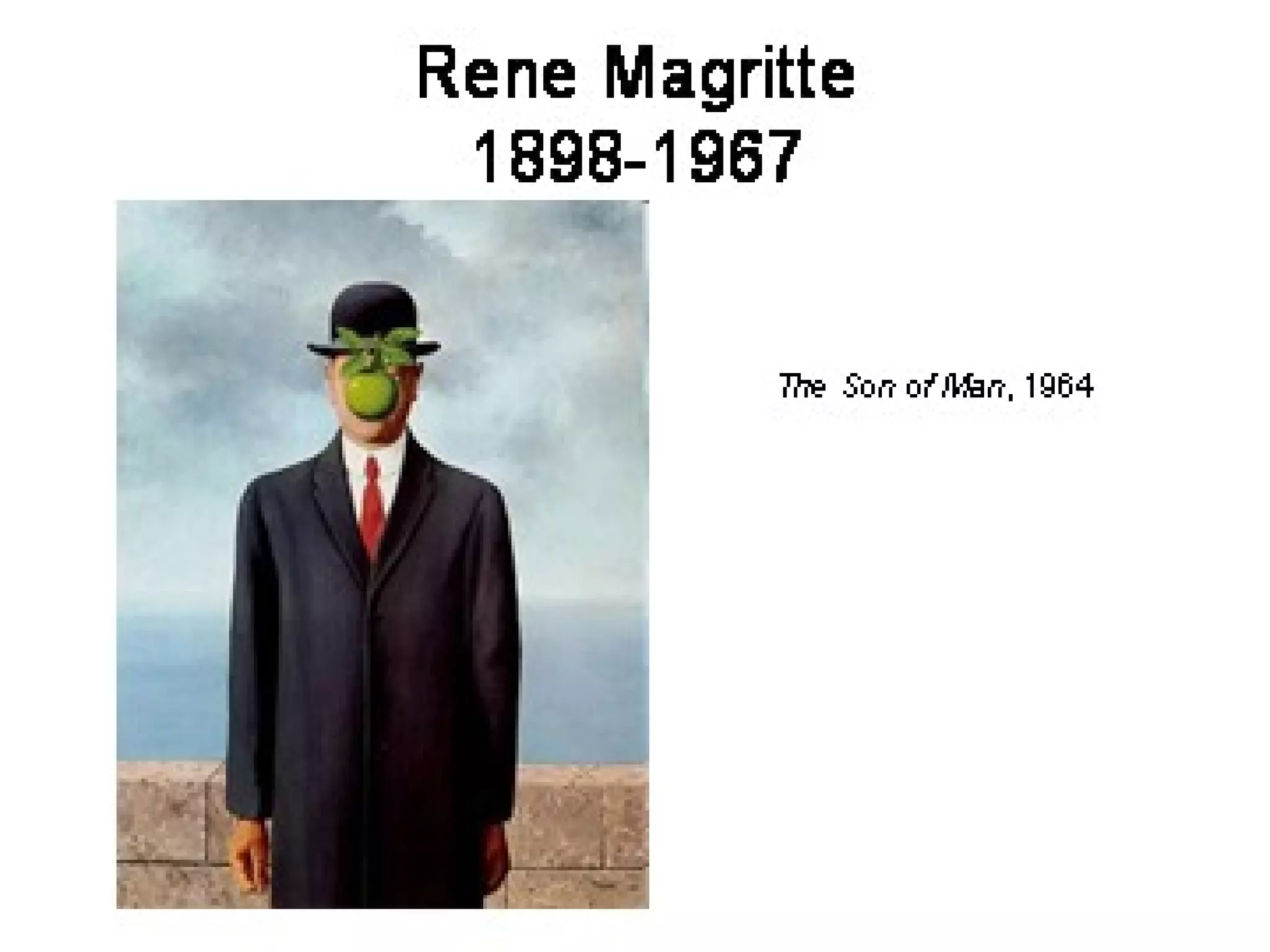
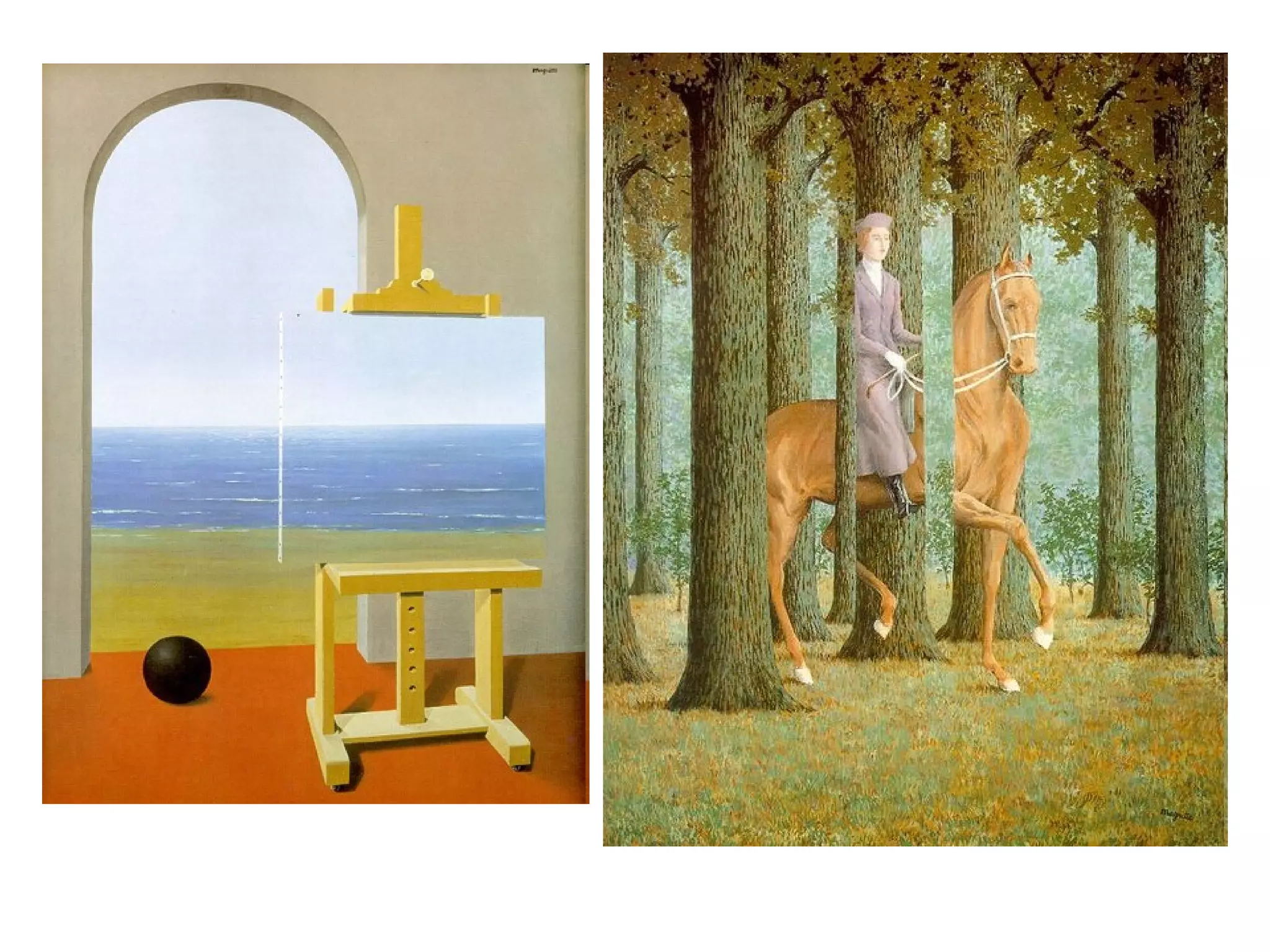
Surrealism “Beyond realism” – a mixed bag of reality A juxtaposition of images that you have to try to connect. If it doesn’t connect, then the artist has still forced you to think in new ways = success! Sigmund Freud also came along, introducing the idea of the subconscious and the importance of dreams.
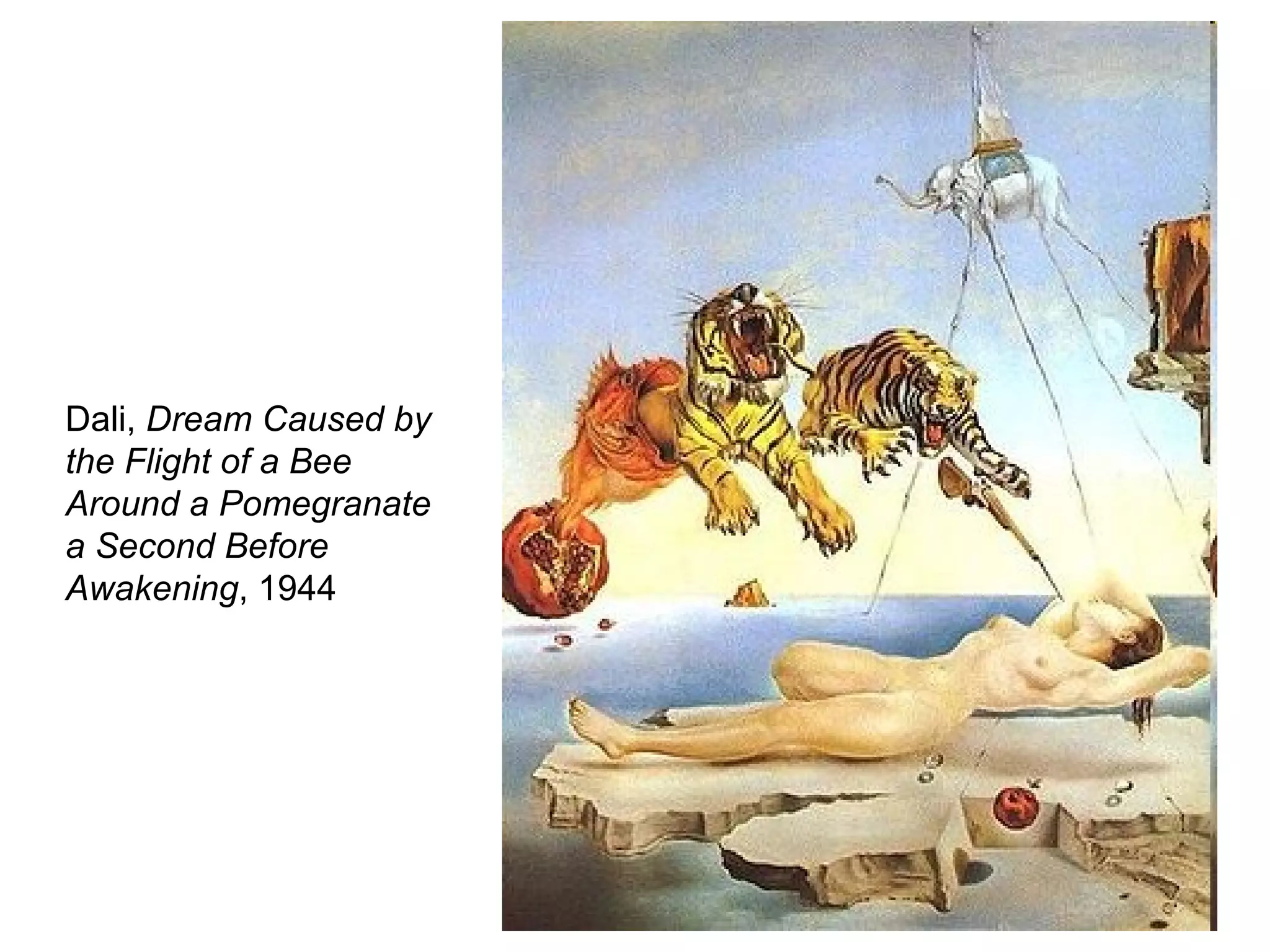
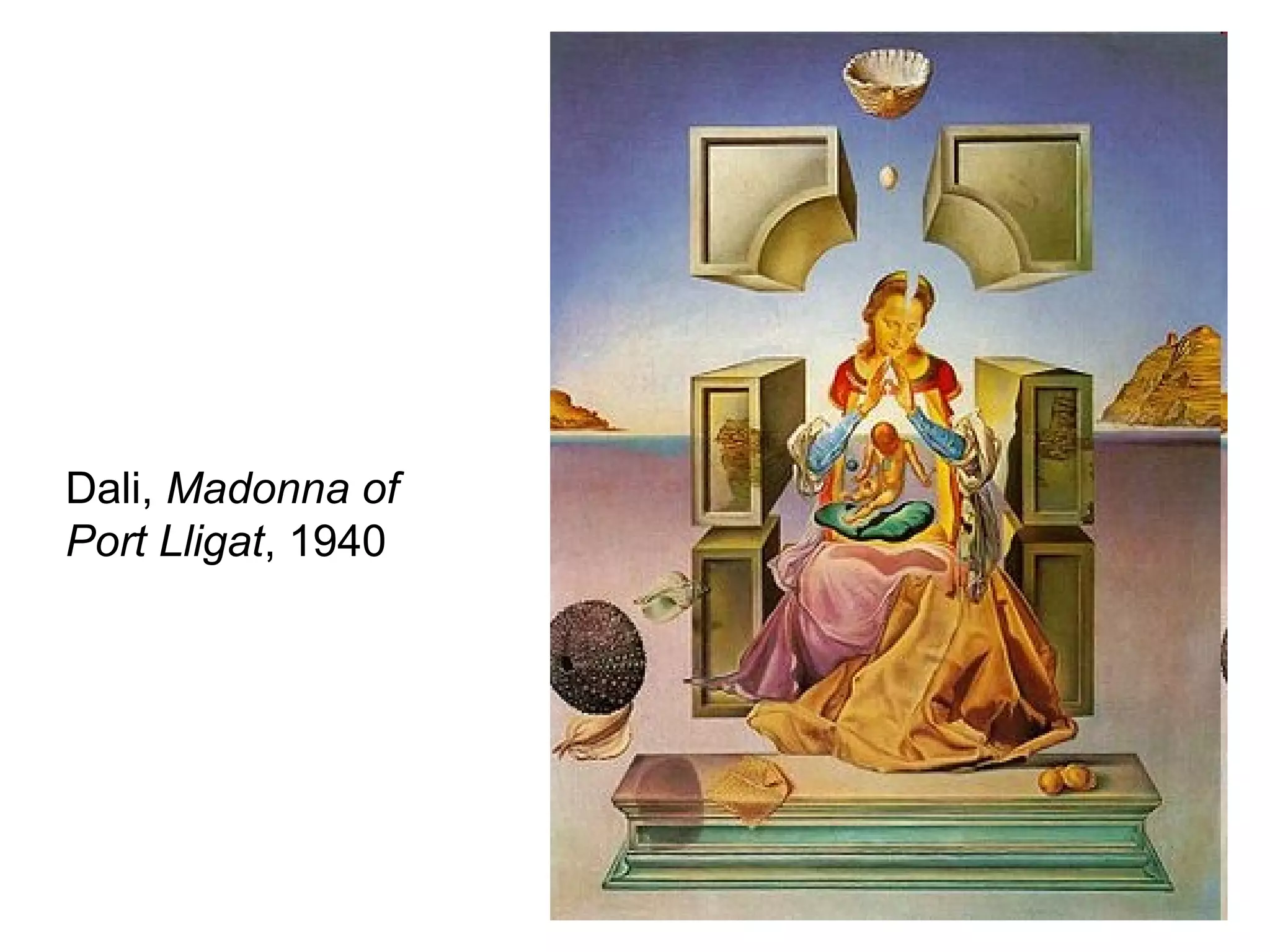
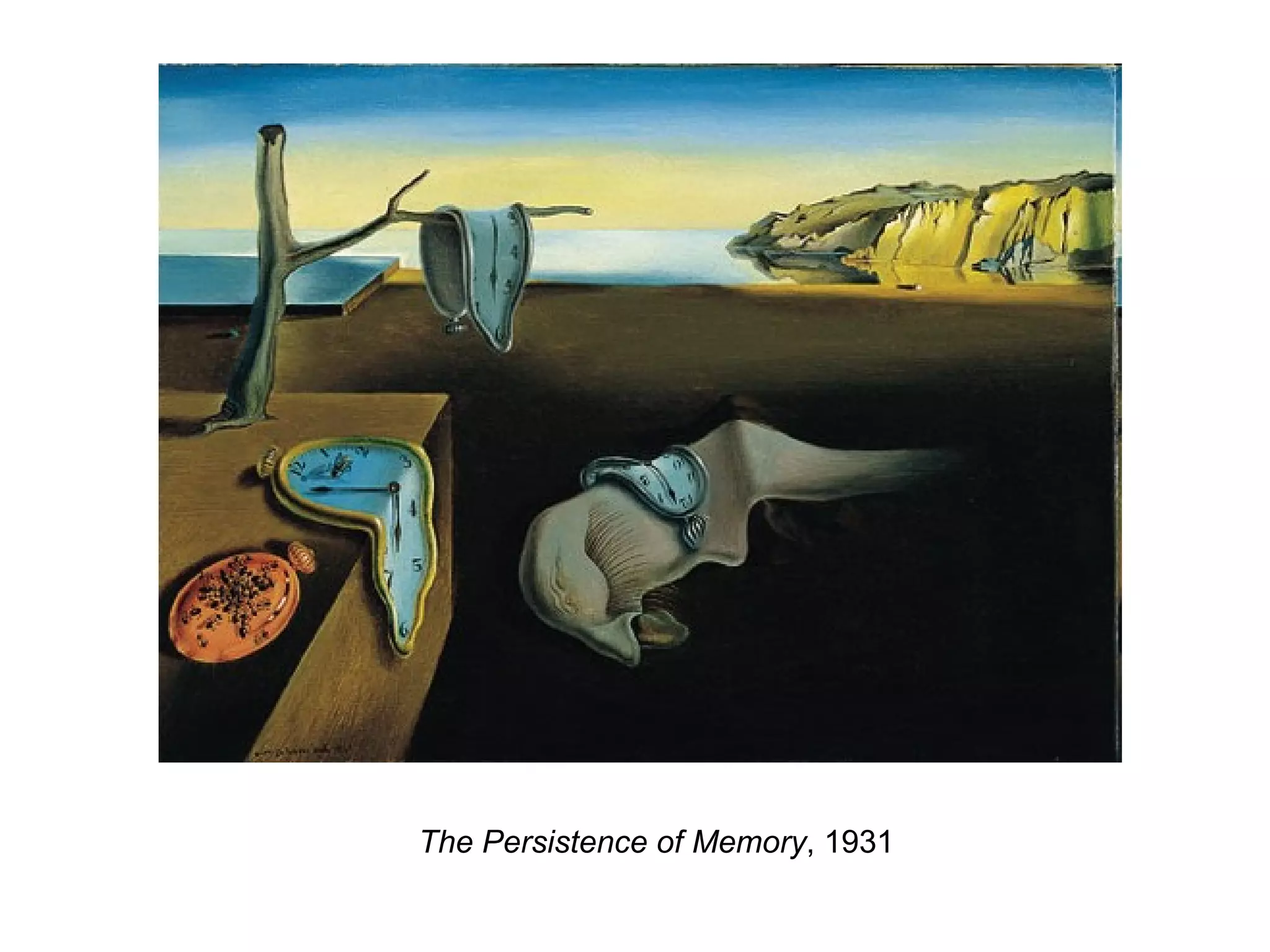
Salvador Dali (1904-1989) Most famous surrealist Painted, with amazing realism, “random” objects to create an emotional punch.
Dali,  Dream Caused by the Flight of a Bee Around a Pomegranate a Second Before Awakening , 1944
Dali,  Madonna of Port Lligat , 1940
The Persistence of Memory , 1931
Dali,  The Persistence of Memory , 1931
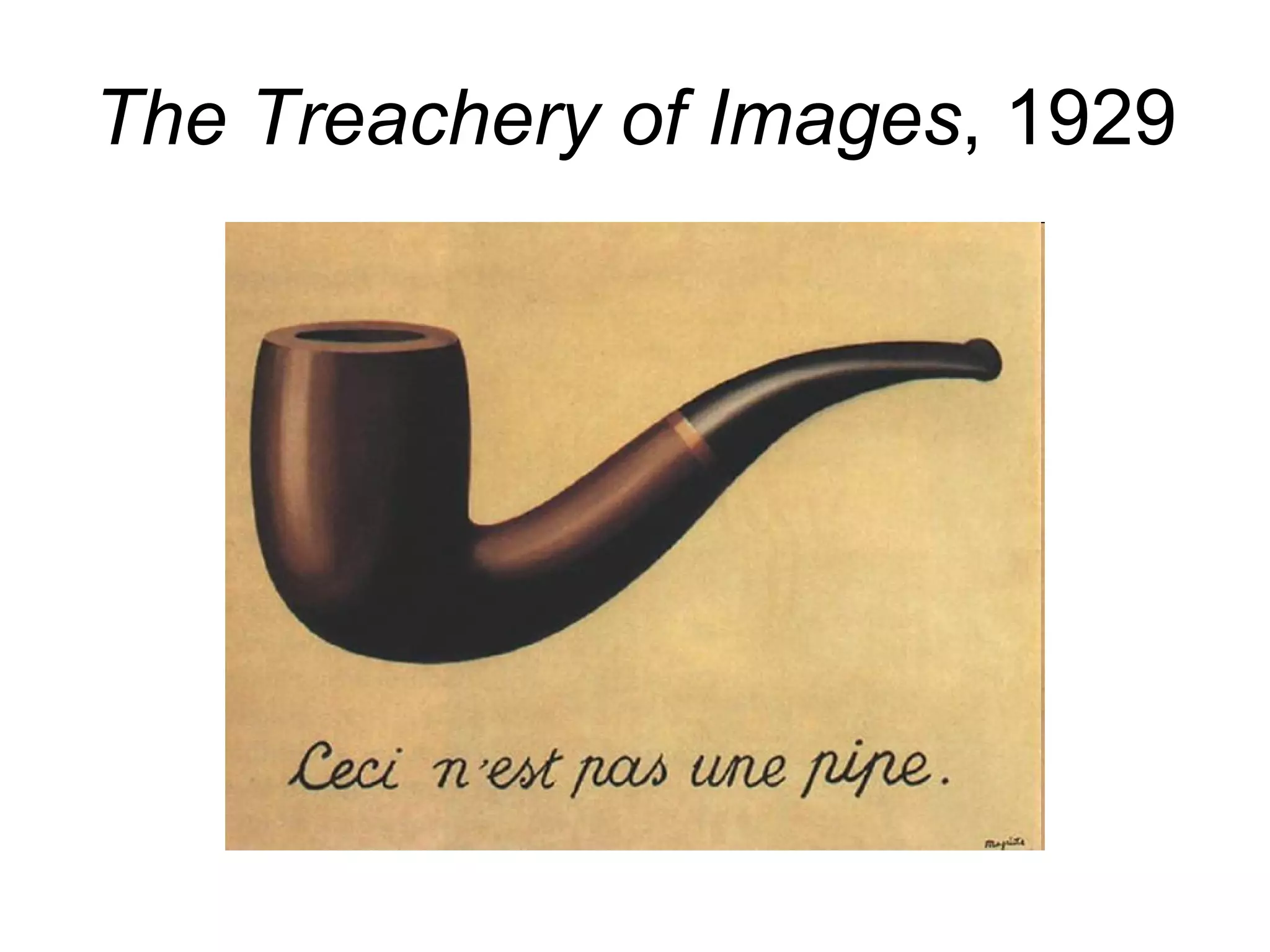
The Treachery of Images , 1929
 
Guernica =  A blend of Surrealism and Cubism
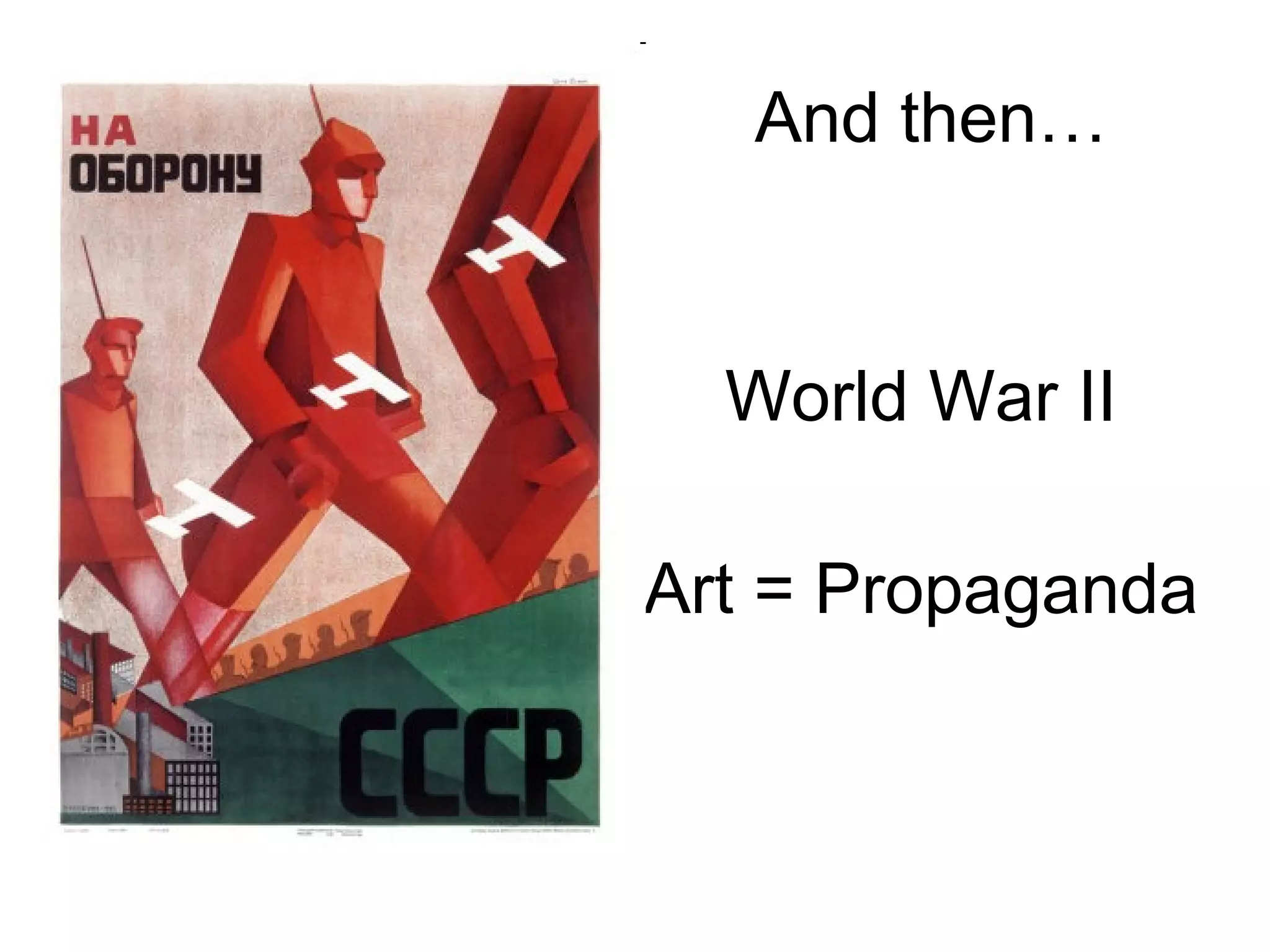
And then… World War II Art = Propaganda
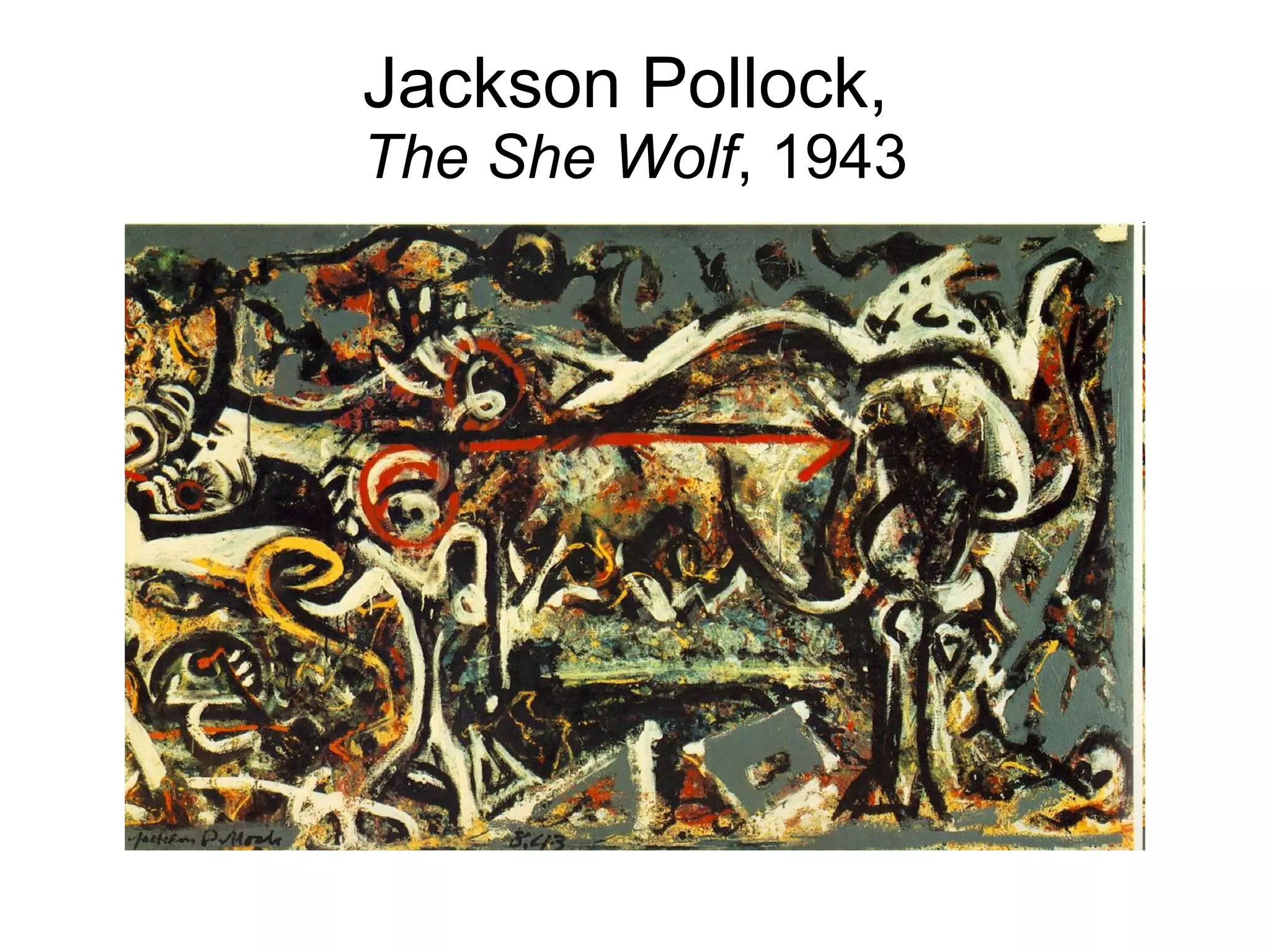
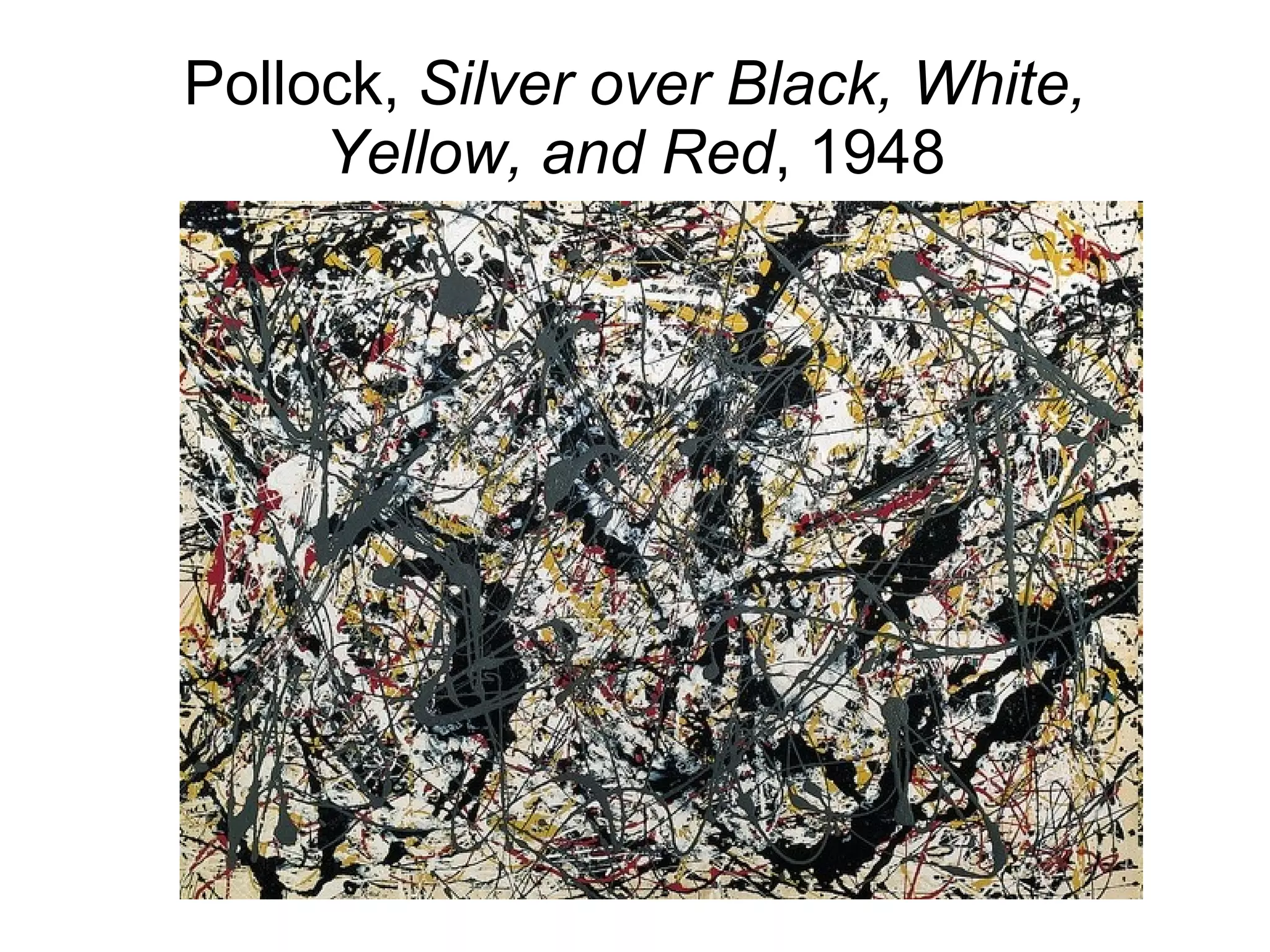
Abstract Expressionism Expressing emotions using only color and form The act of creation becomes more important than the final product
Jackson Pollock,  The She Wolf , 1943
Pollock,  Silver over Black, White, Yellow, and Red , 1948
Pop Art The consumer = king! Art created from “pop”-ular objects, mocking pop culture by embracing it.
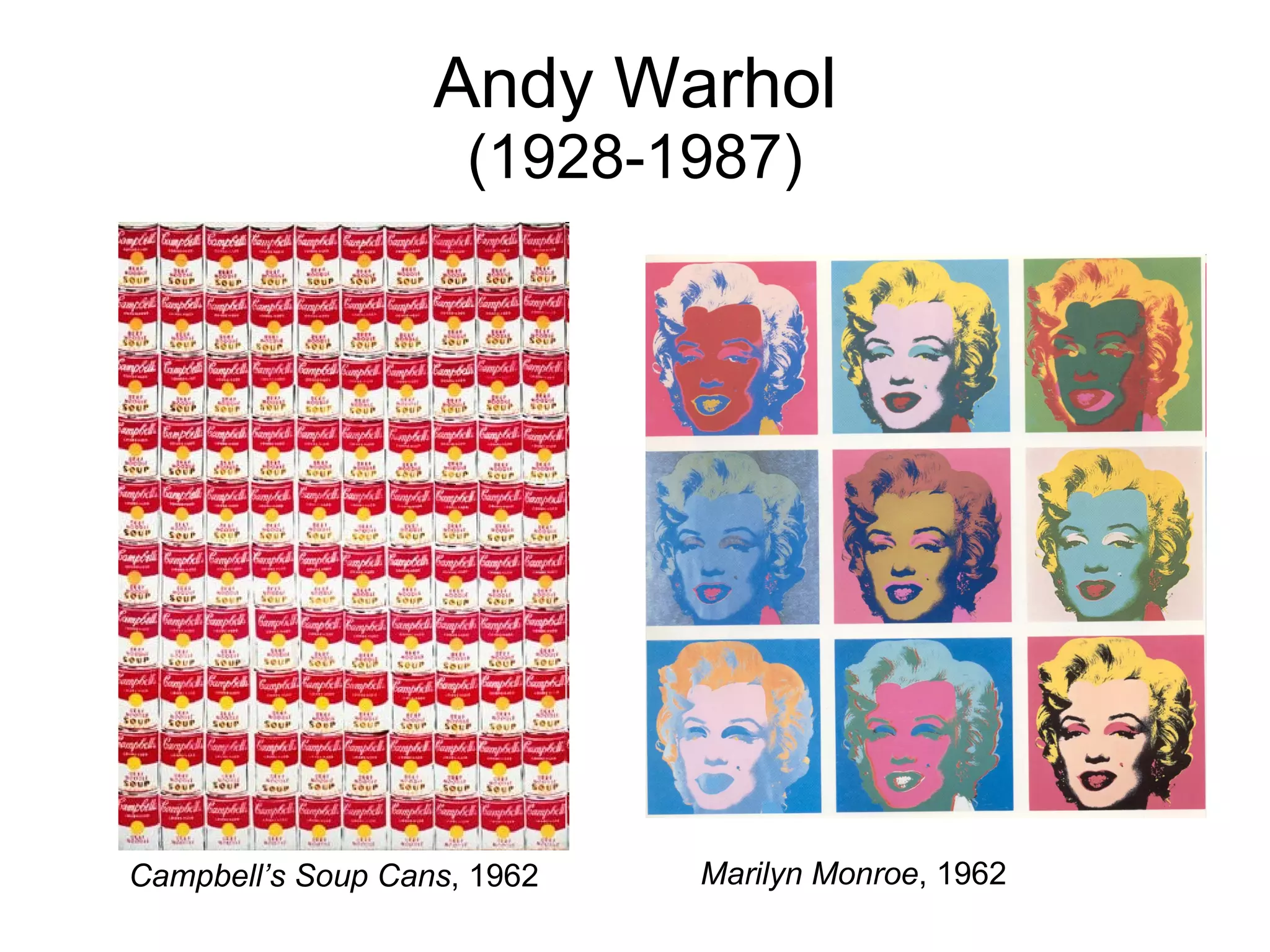
Andy Warhol (1928-1987) Campbell’s Soup Cans , 1962 Marilyn Monroe , 1962
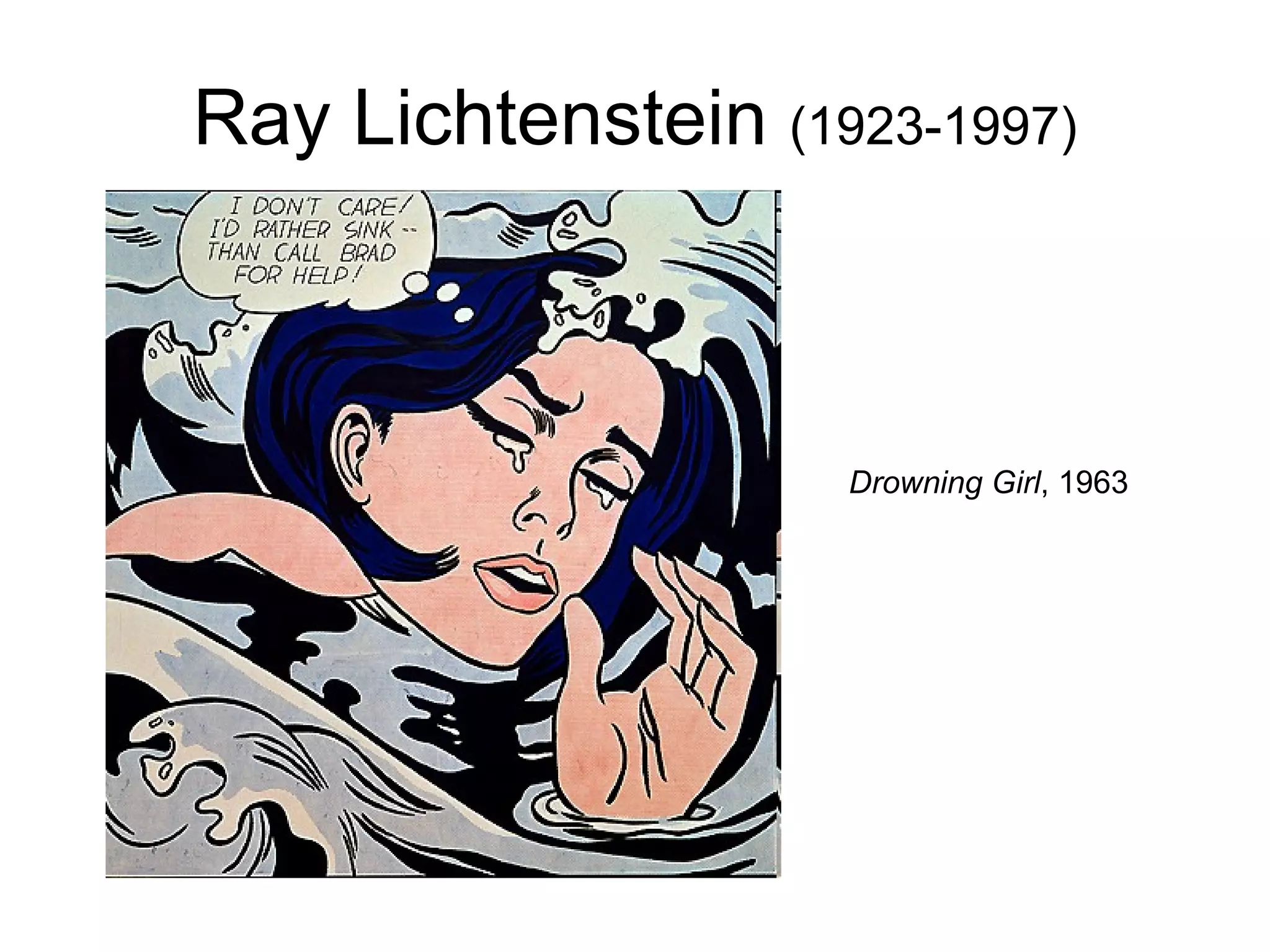
Ray Lichtenstein  (1923-1997) Drowning Girl , 1963
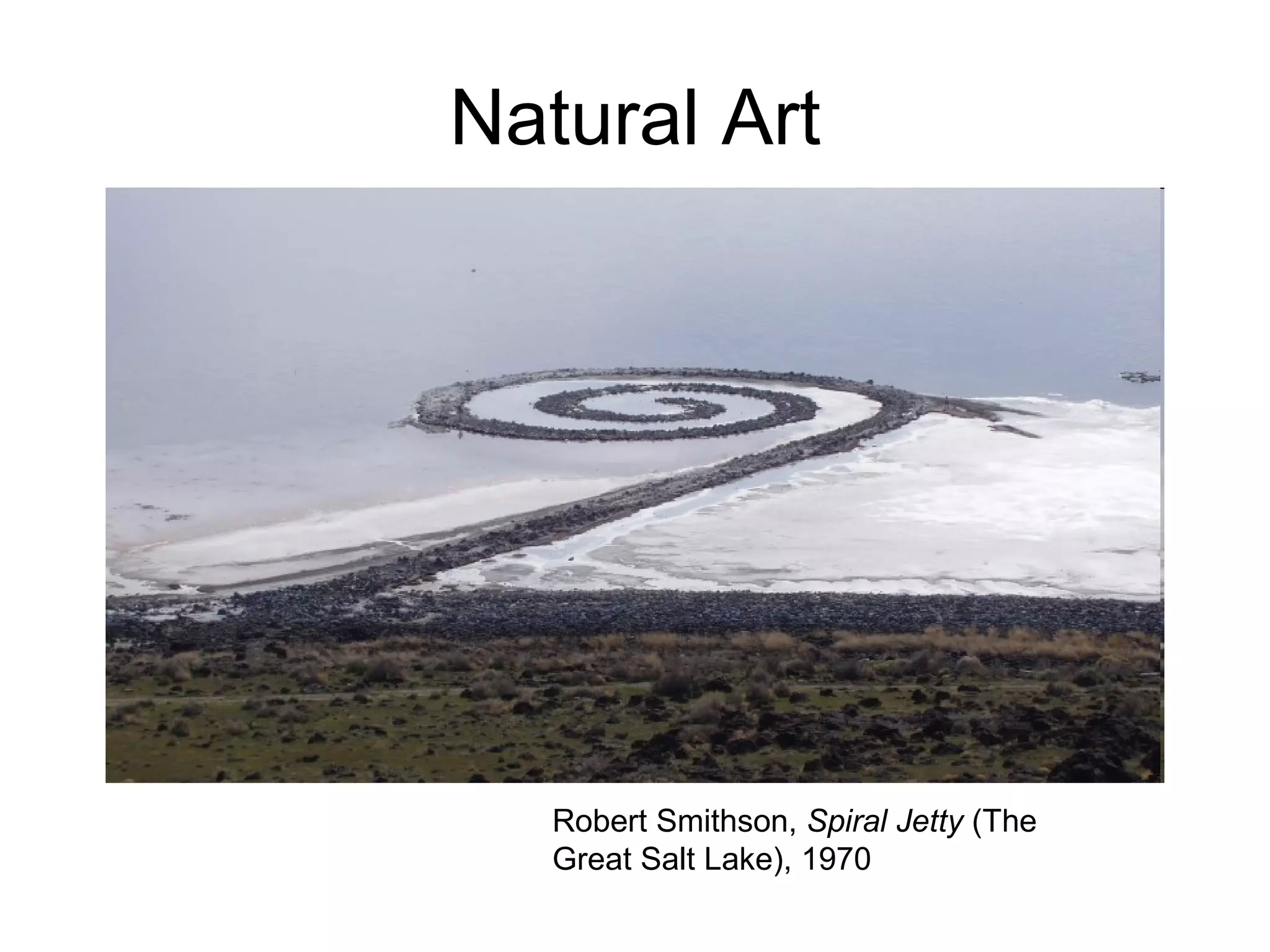
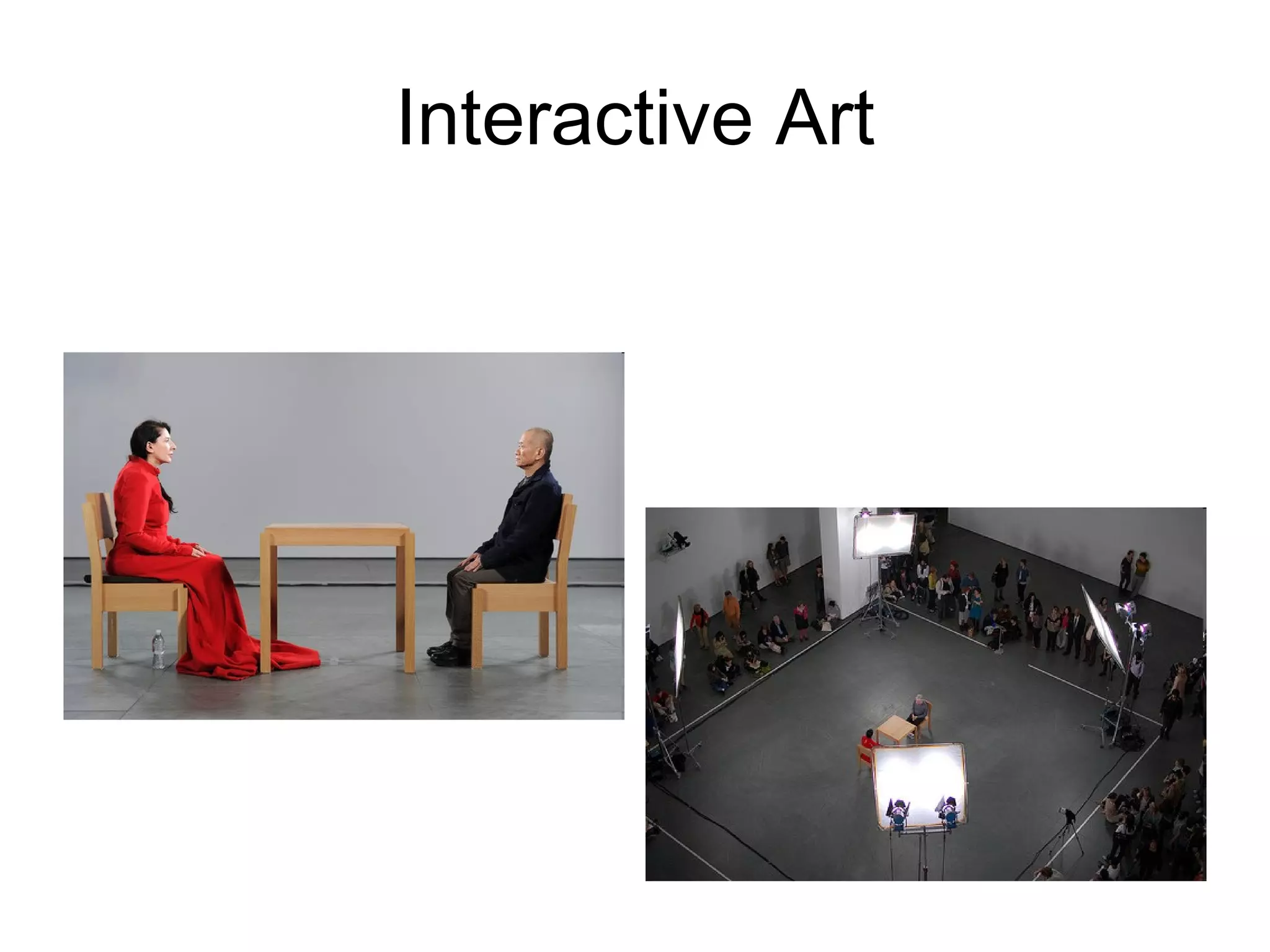
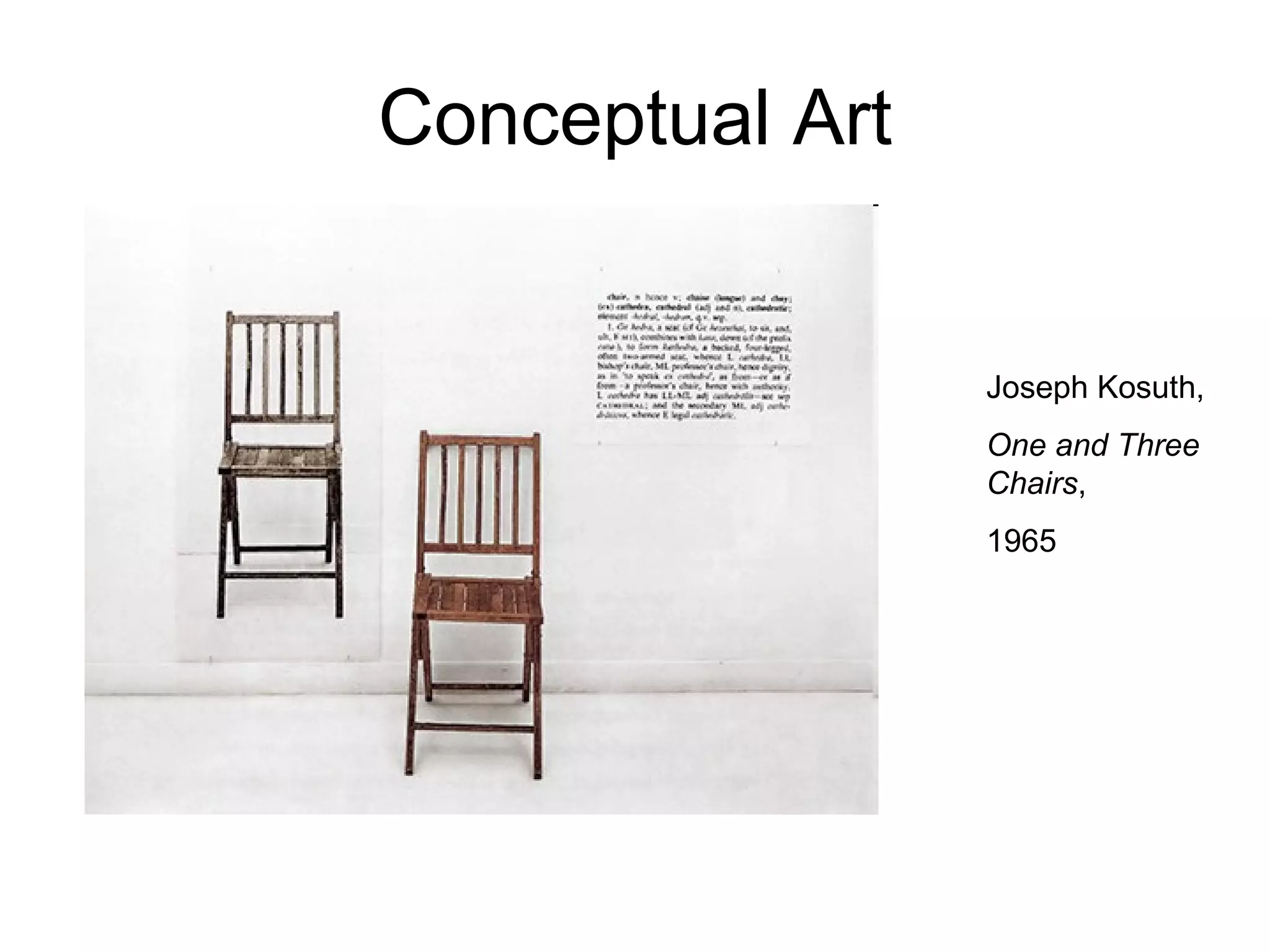
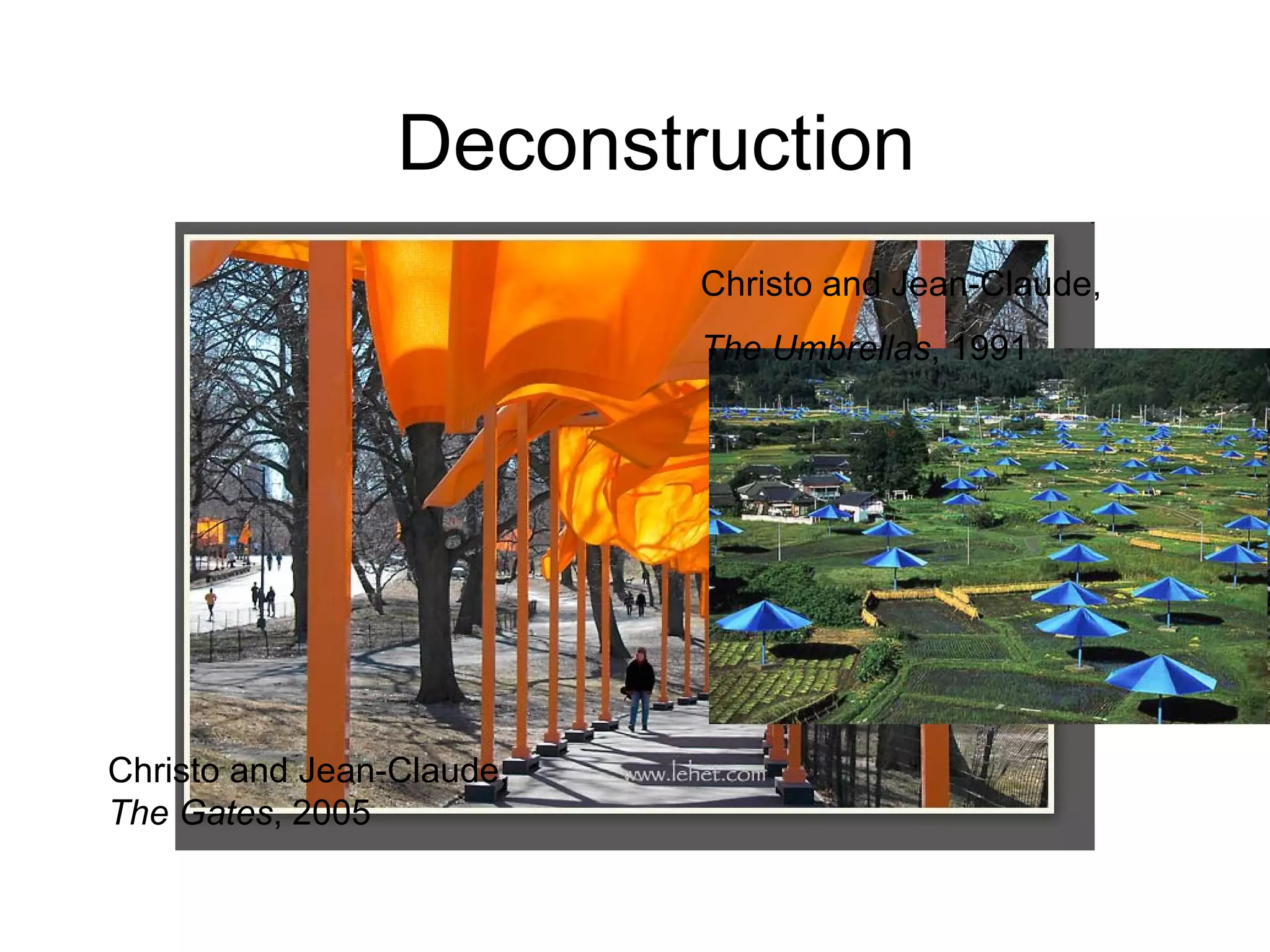
Post-Modernism 1970-present Art = big business Every object can be artistic, it just depends on context Installations : An artist takes over an entire room Assemblages : Recycle trash into larger sculptures Natural Objects : Art from nature’s objects Interaction : Viewer participation Conceptual Art : The idea/concept is the key Deconstruction:  Changing the familiar/Put a familiar object in a new setting Performance Art : Mixed-media live performance
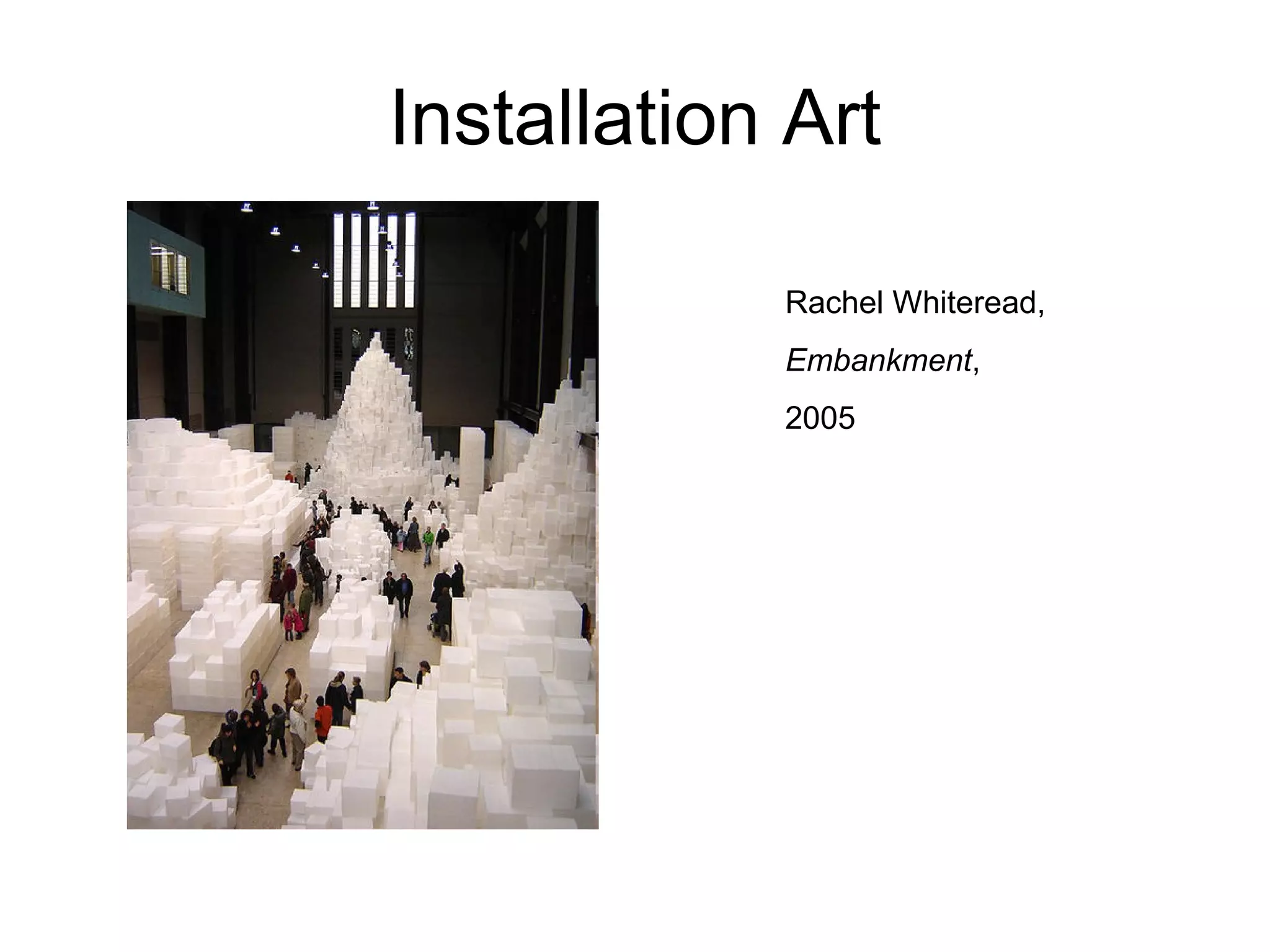
Installation Art Rachel Whiteread, Embankment , 2005
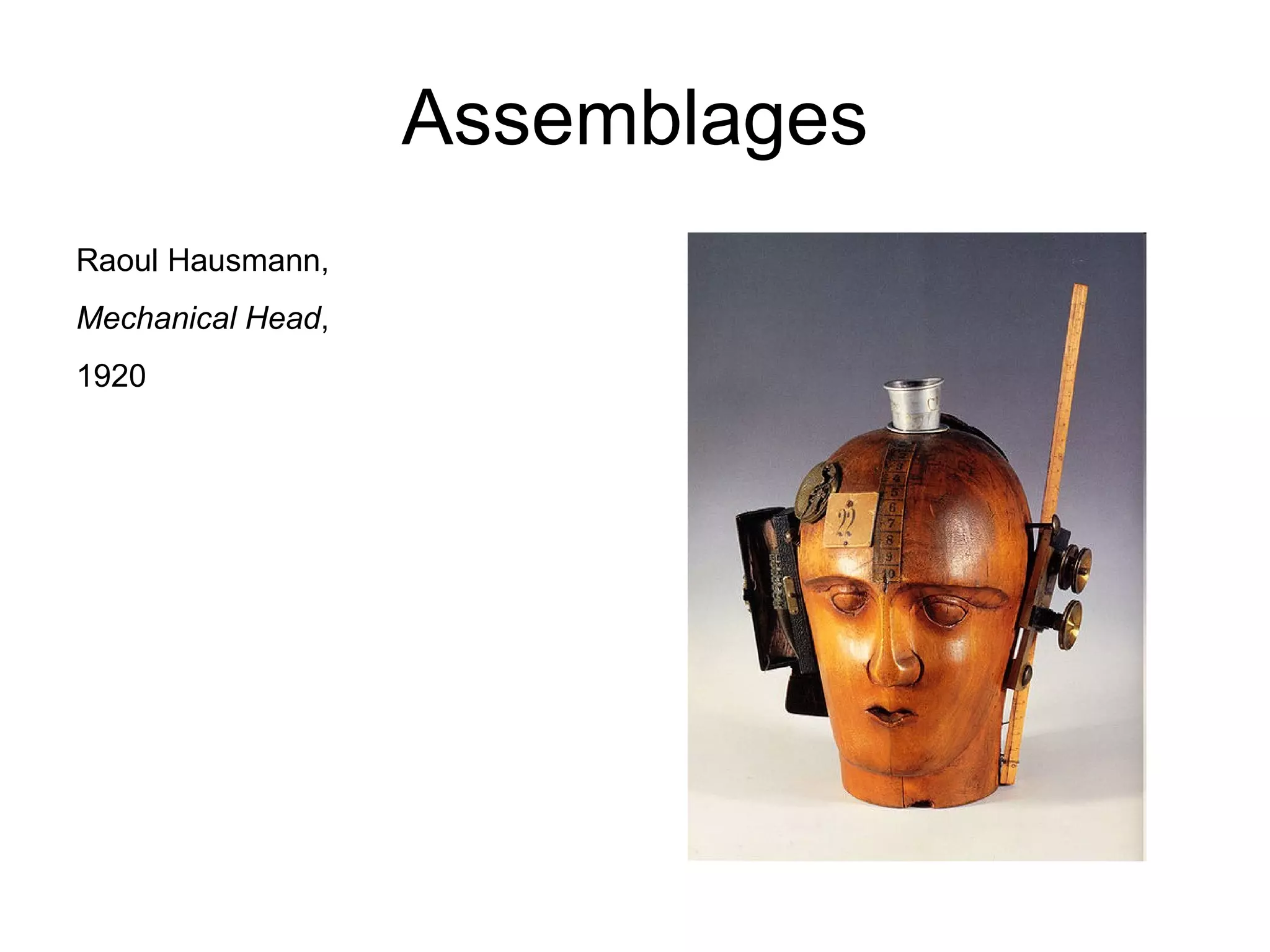
Assemblages Raoul Hausmann, Mechanical Head , 1920
Natural Art Robert Smithson,  Spiral Jetty  (The Great Salt Lake), 1970
Interactive Art
Conceptual Art Joseph Kosuth, One and Three Chairs , 1965
Christo and Jean-Claude,  The Gates , 2005 Christo and Jean-Claude, The Umbrellas , 1991 Deconstruction
Performance Art Video Clip:  “Over the Moon”, from the play  Rent , Jonathan Larsen

Art of the 20th Century (and Beyond)

  • 1.
    20 th Century Art
  • 2.
    Why is itso… weird? Think of how much and how quickly the world has changed in the last 110 years. Modern art is a reflection of that turbulence. Cameras make realistic art obsolete. Mass production makes art marketable
  • 3.
    Like the manneristswho followed Michelangelo and co., the artists of the 20 th century valued originality and innovation over just beauty. If you can’t please the public, shock it. Realistic doesn’t equal “good” art. Instead, go back to the 4 questions: What do I see? What do I know about what I see? What was the artist trying to do/say? How successful was he/she?
  • 4.
    The Moderns 1900-1914Matisse Not realistic Simple lines & figures Bright colors Not concerned about distance /three-dimensionality La Danse , 1910
  • 5.
    Fauves “Wild Beasts”French artists Inspired by African and Oceanic art = Modern art that looks primitive Derain, Landscape at Cassis, 1907
  • 6.
    Pablo Picasso 1881-1973The master of many styles and mediums Early paintings are very realistic The most famous and the greatest artist of the 20 th century Science and Charity , 1897
  • 7.
    Painted the outcastsof society; lived in total poverty. Went through periods of color dominance: The Blue Period The Rose Period With his friend, Georges Braque, developed Cubism Life , 1903
  • 8.
  • 9.
    Cubism Shatter aglass sculpture, pick up the pieces, glue them on a canvas = Cubism! Shows several different perspectives of the same subject at the same time Like a round world sliced up to show all the parts. (Remember, this is the same time that Einstein’s coming up with the theory of relativity/the 4 th dimension!) Background and foreground overlap, the subject dissolves into pattern.
  • 10.
    Carafe, Jug, andFruit Bowl 1909
  • 11.
  • 12.
  • 13.
    Guernica 1937 OnApril 27, 1937, Franco (Spain’s dictator) gave Hitler permission to test their new air bombs on a village in northern Spain, Guernica. When Picasso read accounts of it in the newspapers, he immediately began the plans for the 286 square-foot mural, Guernica.
  • 14.
  • 15.
    Abstract Art Simplifiesthings – a man = a stick figure, a squiggle = a wave, red = anger It’s about symbolism, capturing the essence of reality in a few lines and colors Think “visual music” (this is when jazz was developed in America)
  • 16.
    Wassily Kandinsky (1866-1944)Patterns that are just beautiful, even if they don’t “mean” anything Composition VII , 1913
  • 17.
    Piet Mondrain Compositionwith Yellow, Blue and Red, 1937-1942 Painting at its most basic elements: black lines + white canvas + primary colors
  • 18.
    Henry Moore 1898-1986“Carved the human body with the epic scale and restless poses of Michelangelo but with the crude rocks and simple lines of the Primitives.”
  • 19.
    Expressionism WWI left10 million dead and killed the optimism and faith in mankind that lead Europe since the Renaissance. Postwar Europe = Cynicism and decadence Artists “expressed” their disgust by showing a distorted reality that emphasized the ugly. - Lurid colors and simplified figures of the Fauves, but with a haunted, harsh tone.
  • 20.
    The Scream , Edvard Munch, 1893 (during the Post-Impressionist period, but still a model of Expressionism)
  • 21.
    Compare the twoversions of terror, less than 75 years apart.
  • 22.
    Dada Artistic griefbecame twisted humor + resentment of the bourgeoisie/pompous intellectuals = Art that is outrageous, offensive, and meant to give traditional culture the finger.
  • 23.
    Fountain , MarcelDuchamp, 1917
  • 24.
  • 25.
    Surrealism “Beyond realism”– a mixed bag of reality A juxtaposition of images that you have to try to connect. If it doesn’t connect, then the artist has still forced you to think in new ways = success! Sigmund Freud also came along, introducing the idea of the subconscious and the importance of dreams.
  • 26.
    Salvador Dali (1904-1989)Most famous surrealist Painted, with amazing realism, “random” objects to create an emotional punch.
  • 27.
    Dali, DreamCaused by the Flight of a Bee Around a Pomegranate a Second Before Awakening , 1944
  • 28.
    Dali, Madonnaof Port Lligat , 1940
  • 29.
    The Persistence ofMemory , 1931
  • 30.
    Dali, ThePersistence of Memory , 1931
  • 31.
    The Treachery ofImages , 1929
  • 32.
  • 33.
    Guernica = A blend of Surrealism and Cubism
  • 34.
    And then… WorldWar II Art = Propaganda
  • 35.
    Abstract Expressionism Expressingemotions using only color and form The act of creation becomes more important than the final product
  • 36.
    Jackson Pollock, The She Wolf , 1943
  • 37.
    Pollock, Silverover Black, White, Yellow, and Red , 1948
  • 38.
    Pop Art Theconsumer = king! Art created from “pop”-ular objects, mocking pop culture by embracing it.
  • 39.
    Andy Warhol (1928-1987)Campbell’s Soup Cans , 1962 Marilyn Monroe , 1962
  • 40.
    Ray Lichtenstein (1923-1997) Drowning Girl , 1963
  • 41.
    Post-Modernism 1970-present Art= big business Every object can be artistic, it just depends on context Installations : An artist takes over an entire room Assemblages : Recycle trash into larger sculptures Natural Objects : Art from nature’s objects Interaction : Viewer participation Conceptual Art : The idea/concept is the key Deconstruction: Changing the familiar/Put a familiar object in a new setting Performance Art : Mixed-media live performance
  • 42.
    Installation Art RachelWhiteread, Embankment , 2005
  • 43.
    Assemblages Raoul Hausmann,Mechanical Head , 1920
  • 44.
    Natural Art RobertSmithson, Spiral Jetty (The Great Salt Lake), 1970
  • 45.
  • 46.
    Conceptual Art JosephKosuth, One and Three Chairs , 1965
  • 47.
    Christo and Jean-Claude, The Gates , 2005 Christo and Jean-Claude, The Umbrellas , 1991 Deconstruction
  • 48.
    Performance Art VideoClip: “Over the Moon”, from the play Rent , Jonathan Larsen