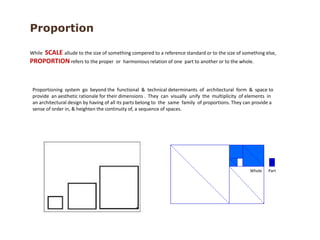
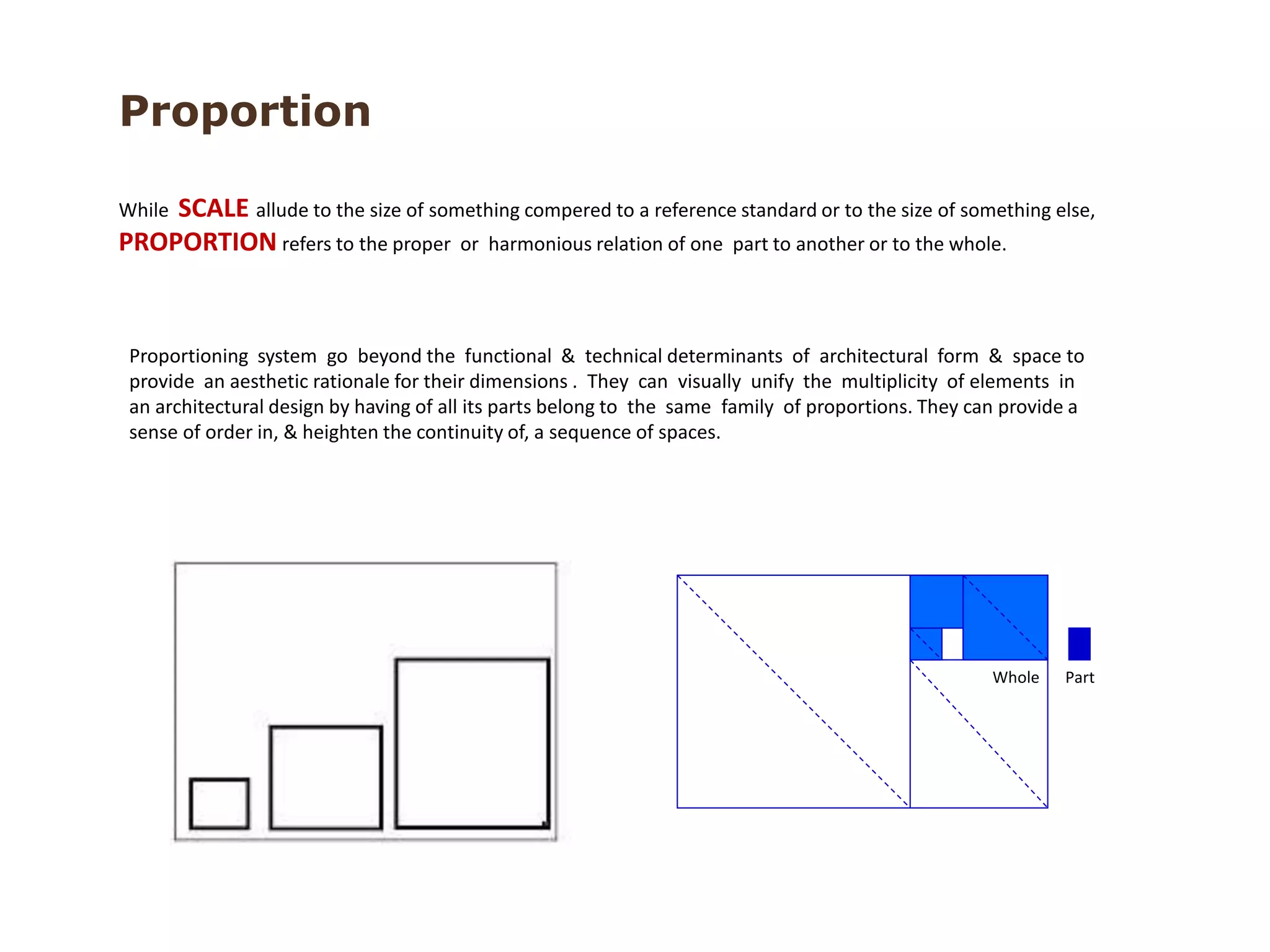

While SCALE allude to the size of something compered to a reference standard or to the size of something else,
PROPORTION refers to the proper or harmonious relation of one part to another or to the whole.
Proportioning system go beyond the functional & technical determinants of architectural form & space to
provide an aesthetic rationale for their dimensions . They can visually unify the multiplicity of elements in
an architectural design by having of all its parts belong to the same family of proportions. They can provide a
sense of order in, & heighten the continuity of, a sequence of spaces.
Whole Part
Proportion
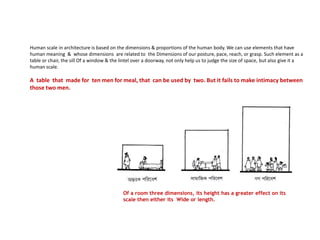
Human scale in architecture is based on the dimensions & proportions of the human body. We can use elements that have
human meaning & whose dimensions are related to the Dimensions of our posture, pace, reach, or grasp. Such element as a
table or chair, the sill Of a window & the lintel over a doorway, not only help us to judge the size of space, but also give it a
human scale.
A table that made for ten men for meal, that can be used by two. But it fails to make intimacy between
those two men.
Of a room three dimensions, its height has a greater effect on its
scale then either its Wide or length.
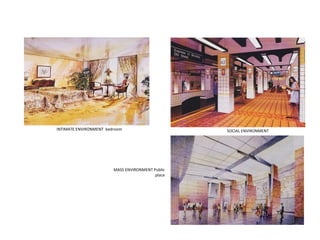
INTIMATE ENVIRONMENT bedroom
MASS ENVIRONMENT Public
place
SOCIAL ENVIRONMENT
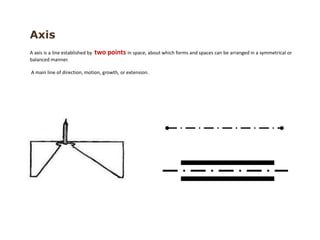
A axis is a line established by two points in space, about which forms and spaces can be arranged in a symmetrical or
balanced manner.
A main line of direction, motion, growth, or extension.
Axis
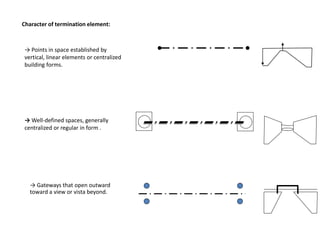
→ Well-defined spaces, generally
centralized or regular in form .
→ Points in space established by
vertical, linear elements or centralized
building forms.
→ Gateways that open outward
toward a view or vista beyond.
Character of termination element:
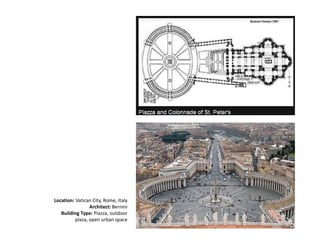
Location: Vatican City, Rome, Italy
Architect: Bernini
Building Type: Piazza, outdoor
plaza, open urban space
Itsukushima Temple
Hiroshima Prefecture
Japan
A symbolic gateway in the sea
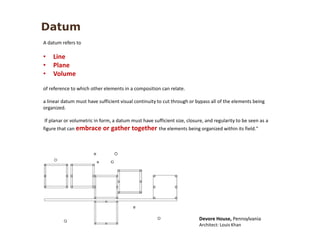
A datum refers to
• Line
• Plane
• Volume
of reference to which other elements in a composition can relate.
a linear datum must have sufficient visual continuity to cut through or bypass all of the elements being
organized.
If planar or volumetric in form, a datum must have sufficient size, closure, and regularity to be seen as a
figure that can embrace or gather together the elements being organized within its field."
Devore House, Pennsylvania
Architect: Louis Khan
Datum
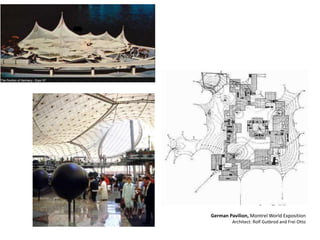
German Pavilion, Montrel World Exposition
Architect: Rolf Gutbrod and Frei Otto
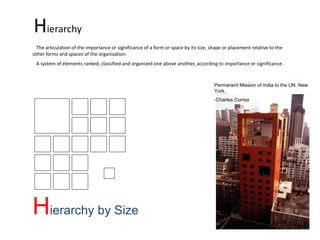
Hierarchy
The articulation of the importance or significance of a form or space by its size, shape or placement relative to the
other forms and spaces of the organization.
A system of elements ranked, classified and organized one above another, according to importance or significance.
Hierarchy by Size
Permanent Mission of India to the UN. New
York.
-Charles Correa
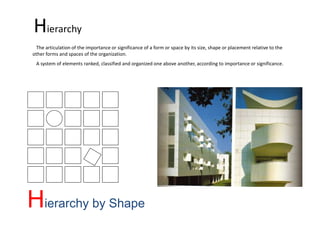
Hierarchy
The articulation of the importance or significance of a form or space by its size, shape or placement relative to the
other forms and spaces of the organization.
A system of elements ranked, classified and organized one above another, according to importance or significance.
Hierarchy by Shape
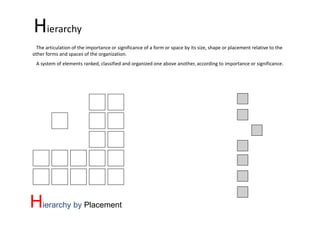
Hierarchy
The articulation of the importance or significance of a form or space by its size, shape or placement relative to the
other forms and spaces of the organization.
A system of elements ranked, classified and organized one above another, according to importance or significance.
Hierarchy by Placement
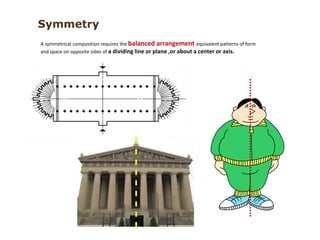
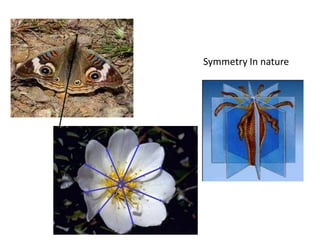
A symmetrical composition requires the balanced arrangement equivalent patterns of form
and space on opposite sides of a dividing line or plane ,or about a center or axis.
Symmetry
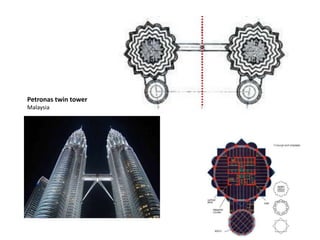
Petronas twin tower
Malaysia
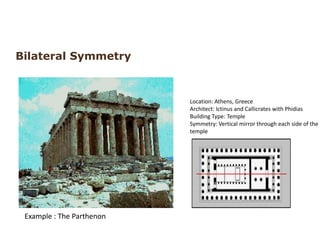
Bilateral Symmetry
Example : The Parthenon
Location: Athens, Greece
Architect: Ictinus and Callicrates with Phidias
Building Type: Temple
Symmetry: Vertical mirror through each side of the
temple
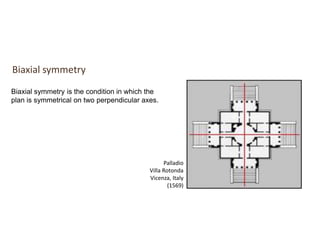
Biaxial symmetry is the condition in which the
plan is symmetrical on two perpendicular axes.
Palladio
Villa Rotonda
Vicenza, Italy
(1569)
Biaxial symmetry
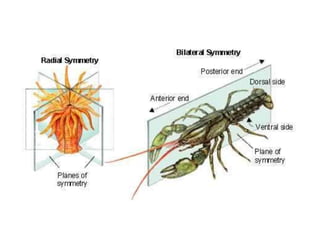
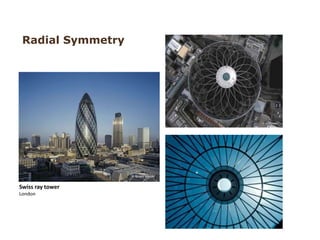
Radial Symmetry
Swiss ray tower
London
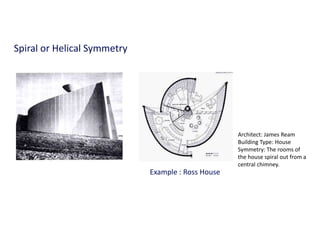
Architect: James Ream
Building Type: House
Symmetry: The rooms of
the house spiral out from a
central chimney.
Example : Ross House
Spiral or Helical Symmetry
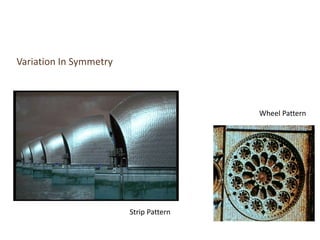
Wheel Pattern
Strip Pattern
Variation In Symmetry
Symmetry In nature
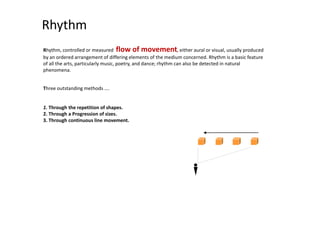
Rhythm
Rhythm, controlled or measured flow of movement, either aural or visual, usually produced
by an ordered arrangement of differing elements of the medium concerned. Rhythm is a basic feature
of all the arts, particularly music, poetry, and dance; rhythm can also be detected in natural
phenomena.
Three outstanding methods ….
1. Through the repetition of shapes.
2. Through a Progression of sizes.
3. Through continuous line movement.
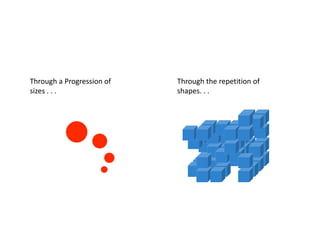
Through the repetition of
shapes. . .
Through a Progression of
sizes . . .
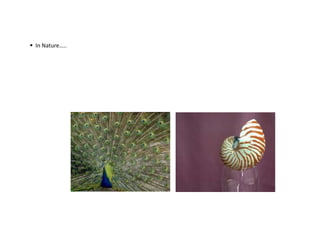
 In Nature…..
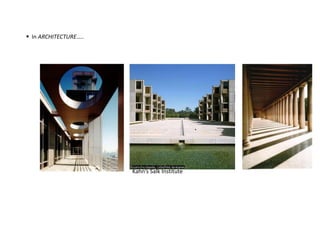
 In ARCHITECTURE…..
Kahn’s Salk Institute

Design principal

  • 1.
    While SCALE alludeto the size of something compered to a reference standard or to the size of something else, PROPORTION refers to the proper or harmonious relation of one part to another or to the whole. Proportioning system go beyond the functional & technical determinants of architectural form & space to provide an aesthetic rationale for their dimensions . They can visually unify the multiplicity of elements in an architectural design by having of all its parts belong to the same family of proportions. They can provide a sense of order in, & heighten the continuity of, a sequence of spaces. Whole Part Proportion
  • 2.
    Human scale inarchitecture is based on the dimensions & proportions of the human body. We can use elements that have human meaning & whose dimensions are related to the Dimensions of our posture, pace, reach, or grasp. Such element as a table or chair, the sill Of a window & the lintel over a doorway, not only help us to judge the size of space, but also give it a human scale. A table that made for ten men for meal, that can be used by two. But it fails to make intimacy between those two men. Of a room three dimensions, its height has a greater effect on its scale then either its Wide or length.
  • 3.
    INTIMATE ENVIRONMENT bedroom MASSENVIRONMENT Public place SOCIAL ENVIRONMENT
  • 4.
    A axis isa line established by two points in space, about which forms and spaces can be arranged in a symmetrical or balanced manner. A main line of direction, motion, growth, or extension. Axis
  • 5.
    → Well-defined spaces,generally centralized or regular in form . → Points in space established by vertical, linear elements or centralized building forms. → Gateways that open outward toward a view or vista beyond. Character of termination element:
  • 6.
    Location: Vatican City,Rome, Italy Architect: Bernini Building Type: Piazza, outdoor plaza, open urban space
  • 7.
  • 8.
    A datum refersto • Line • Plane • Volume of reference to which other elements in a composition can relate. a linear datum must have sufficient visual continuity to cut through or bypass all of the elements being organized. If planar or volumetric in form, a datum must have sufficient size, closure, and regularity to be seen as a figure that can embrace or gather together the elements being organized within its field." Devore House, Pennsylvania Architect: Louis Khan Datum
  • 9.
    German Pavilion, MontrelWorld Exposition Architect: Rolf Gutbrod and Frei Otto
  • 10.
    Hierarchy The articulation ofthe importance or significance of a form or space by its size, shape or placement relative to the other forms and spaces of the organization. A system of elements ranked, classified and organized one above another, according to importance or significance. Hierarchy by Size Permanent Mission of India to the UN. New York. -Charles Correa
  • 11.
    Hierarchy The articulation ofthe importance or significance of a form or space by its size, shape or placement relative to the other forms and spaces of the organization. A system of elements ranked, classified and organized one above another, according to importance or significance. Hierarchy by Shape
  • 12.
    Hierarchy The articulation ofthe importance or significance of a form or space by its size, shape or placement relative to the other forms and spaces of the organization. A system of elements ranked, classified and organized one above another, according to importance or significance. Hierarchy by Placement
  • 13.
    A symmetrical compositionrequires the balanced arrangement equivalent patterns of form and space on opposite sides of a dividing line or plane ,or about a center or axis. Symmetry
  • 15.
  • 16.
    Bilateral Symmetry Example :The Parthenon Location: Athens, Greece Architect: Ictinus and Callicrates with Phidias Building Type: Temple Symmetry: Vertical mirror through each side of the temple
  • 17.
    Biaxial symmetry isthe condition in which the plan is symmetrical on two perpendicular axes. Palladio Villa Rotonda Vicenza, Italy (1569) Biaxial symmetry
  • 18.
  • 19.
    Architect: James Ream BuildingType: House Symmetry: The rooms of the house spiral out from a central chimney. Example : Ross House Spiral or Helical Symmetry
  • 20.
  • 21.
  • 22.
    Rhythm Rhythm, controlled ormeasured flow of movement, either aural or visual, usually produced by an ordered arrangement of differing elements of the medium concerned. Rhythm is a basic feature of all the arts, particularly music, poetry, and dance; rhythm can also be detected in natural phenomena. Three outstanding methods …. 1. Through the repetition of shapes. 2. Through a Progression of sizes. 3. Through continuous line movement.
  • 23.
    Through the repetitionof shapes. . . Through a Progression of sizes . . .
  • 24.
  • 25.