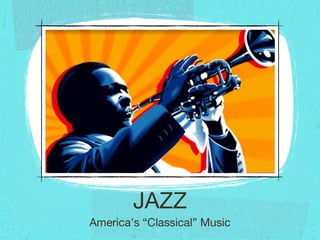
JAZZ
America’s “Classical” Music
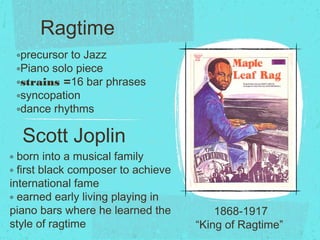
Scott Joplin
๏ born into a musical family
๏ first black composer to achieve
international fame
๏ earned early living playing in
piano bars where he learned the
style of ragtime
1868-1917
“King of Ragtime”
Ragtime
๏precursor to Jazz
๏Piano solo piece
๏strains =16 bar phrases
๏syncopation
๏dance rhythms
๏ American form of folk
music developed in southern
US by African American
musicians
๏ Original medium was solo
vocal plus guitar usually
played by one performer
๏GENRE: born in south and spread to popular cities:
New Orleans, Chicago, Memphis, Mississippi Delta
๏MOOD: uplifting, to combat the “woes” of everyday life.
work songs developed from slavery
๏NOTES: lowered scale tones, usually a “flat” 3rd, 5th, and 7th.
๏SCALE: 1 b3 4 b5 5 b7 - C, Eb, F, Gb, G, Bb
๏FORM: binary 12 measure form
poetic form is A (4 bars), A’ (4 bars), B (4 bars)
๏HARMONIC CHORD PROGRESSION: Chords built on lowered 7th
C7 (4 bars) F7 (2 bars) C7 (2bars) G7 (1 bar) F7 (1 bar) C7 (2
bars)
New Orleans Jazz
Improvisation is at the core of the jazz
style
Started as a small ensemble genre (7 or
less people) used marching brass
bands as a model as well as concepts
brought forth by orchestral ragtime
Jazz made popular to mainstream by
early recordings and public events of
traveling bands (dances, variety shows)
“King” Oliver (cornet), Sidney Bechet
(soprano sax), “Jelly Roll” Morton
(piano)
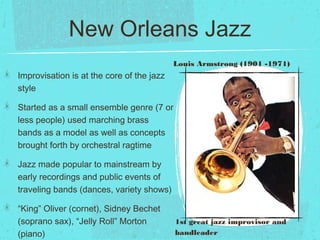
1st great jazz improvisor and
bandleader
Louis Armstrong (1901 -1971)
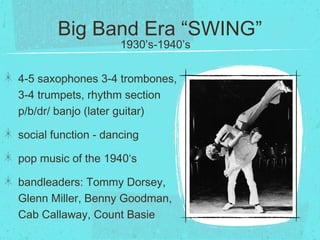
Big Band Era “SWING”
4-5 saxophones 3-4 trombones,
3-4 trumpets, rhythm section
p/b/dr/ banjo (later guitar)
social function - dancing
pop music of the 1940‘s
bandleaders: Tommy Dorsey,
Glenn Miller, Benny Goodman,
Cab Callaway, Count Basie
1930’s-1940’s
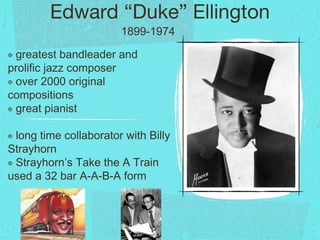
Edward “Duke” Ellington
๏ greatest bandleader and
prolific jazz composer
๏ over 2000 original
compositions
๏ great pianist
๏ long time collaborator with Billy
Strayhorn
๏ Strayhorn’s Take the A Train
used a 32 bar A-A-B-A form
1899-1974
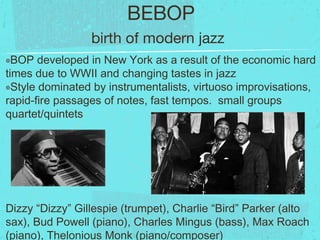
BEBOP
๏BOP developed in New York as a result of the economic hard
times due to WWII and changing tastes in jazz
๏Style dominated by instrumentalists, virtuoso improvisations,
rapid-fire passages of notes, fast tempos. small groups
quartet/quintets
Dizzy “Dizzy” Gillespie (trumpet), Charlie “Bird” Parker (alto
sax), Bud Powell (piano), Charles Mingus (bass), Max Roach
(piano), Thelonious Monk (piano/composer)
birth of modern jazz
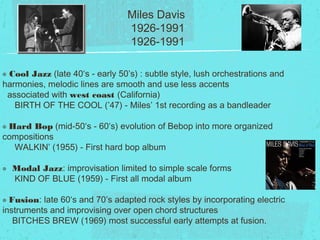
Miles Davis
1926-1991
๏ Cool Jazz (late 40‘s - early 50’s) : subtle style, lush orchestrations and
harmonies, melodic lines are smooth and use less accents
associated with west coast (California)
BIRTH OF THE COOL (’47) - Miles’ 1st recording as a bandleader
๏ Hard Bop (mid-50‘s - 60‘s) evolution of Bebop into more organized
compositions
WALKIN’ (1955) - First hard bop album
๏ Modal Jazz: improvisation limited to simple scale forms
KIND OF BLUE (1959) - First all modal album
๏ Fusion: late 60‘s and 70’s adapted rock styles by incorporating electric
instruments and improvising over open chord structures
BITCHES BREW (1969) most successful early attempts at fusion.
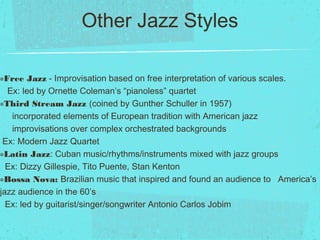
Other Jazz Styles
๏Free Jazz - Improvisation based on free interpretation of various scales.
Ex: led by Ornette Coleman’s “pianoless” quartet
๏Third Stream Jazz (coined by Gunther Schuller in 1957)
incorporated elements of European tradition with American jazz
improvisations over complex orchestrated backgrounds
Ex: Modern Jazz Quartet
๏Latin Jazz: Cuban music/rhythms/instruments mixed with jazz groups
Ex: Dizzy Gillespie, Tito Puente, Stan Kenton
๏Bossa Nova: Brazilian music that inspired and found an audience to America’s
jazz audience in the 60’s
Ex: led by guitarist/singer/songwriter Antonio Carlos Jobim
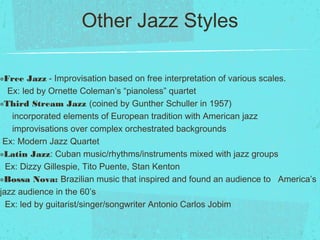
Other Jazz Styles
๏Free Jazz - Improvisation based on free interpretation of various scales.
Ex: led by Ornette Coleman’s “pianoless” quartet
๏Third Stream Jazz (coined by Gunther Schuller in 1957)
incorporated elements of European tradition with American jazz
improvisations over complex orchestrated backgrounds
Ex: Modern Jazz Quartet
๏Latin Jazz: Cuban music/rhythms/instruments mixed with jazz groups
Ex: Dizzy Gillespie, Tito Puente, Stan Kenton
๏Bossa Nova: Brazilian music that inspired and found an audience to America’s
jazz audience in the 60’s
Ex: led by guitarist/singer/songwriter Antonio Carlos Jobim

Jazz power point

  • 1.
  • 2.
    Scott Joplin ๏ borninto a musical family ๏ first black composer to achieve international fame ๏ earned early living playing in piano bars where he learned the style of ragtime 1868-1917 “King of Ragtime” Ragtime ๏precursor to Jazz ๏Piano solo piece ๏strains =16 bar phrases ๏syncopation ๏dance rhythms
  • 3.
    ๏ American formof folk music developed in southern US by African American musicians ๏ Original medium was solo vocal plus guitar usually played by one performer ๏GENRE: born in south and spread to popular cities: New Orleans, Chicago, Memphis, Mississippi Delta ๏MOOD: uplifting, to combat the “woes” of everyday life. work songs developed from slavery ๏NOTES: lowered scale tones, usually a “flat” 3rd, 5th, and 7th. ๏SCALE: 1 b3 4 b5 5 b7 - C, Eb, F, Gb, G, Bb ๏FORM: binary 12 measure form poetic form is A (4 bars), A’ (4 bars), B (4 bars) ๏HARMONIC CHORD PROGRESSION: Chords built on lowered 7th C7 (4 bars) F7 (2 bars) C7 (2bars) G7 (1 bar) F7 (1 bar) C7 (2 bars)
  • 4.
    New Orleans Jazz Improvisationis at the core of the jazz style Started as a small ensemble genre (7 or less people) used marching brass bands as a model as well as concepts brought forth by orchestral ragtime Jazz made popular to mainstream by early recordings and public events of traveling bands (dances, variety shows) “King” Oliver (cornet), Sidney Bechet (soprano sax), “Jelly Roll” Morton (piano) 1st great jazz improvisor and bandleader Louis Armstrong (1901 -1971)
  • 5.
    Big Band Era“SWING” 4-5 saxophones 3-4 trombones, 3-4 trumpets, rhythm section p/b/dr/ banjo (later guitar) social function - dancing pop music of the 1940‘s bandleaders: Tommy Dorsey, Glenn Miller, Benny Goodman, Cab Callaway, Count Basie 1930’s-1940’s
  • 6.
    Edward “Duke” Ellington ๏greatest bandleader and prolific jazz composer ๏ over 2000 original compositions ๏ great pianist ๏ long time collaborator with Billy Strayhorn ๏ Strayhorn’s Take the A Train used a 32 bar A-A-B-A form 1899-1974
  • 7.
    BEBOP ๏BOP developed inNew York as a result of the economic hard times due to WWII and changing tastes in jazz ๏Style dominated by instrumentalists, virtuoso improvisations, rapid-fire passages of notes, fast tempos. small groups quartet/quintets Dizzy “Dizzy” Gillespie (trumpet), Charlie “Bird” Parker (alto sax), Bud Powell (piano), Charles Mingus (bass), Max Roach (piano), Thelonious Monk (piano/composer) birth of modern jazz
  • 8.
    Miles Davis 1926-1991 ๏ CoolJazz (late 40‘s - early 50’s) : subtle style, lush orchestrations and harmonies, melodic lines are smooth and use less accents associated with west coast (California) BIRTH OF THE COOL (’47) - Miles’ 1st recording as a bandleader ๏ Hard Bop (mid-50‘s - 60‘s) evolution of Bebop into more organized compositions WALKIN’ (1955) - First hard bop album ๏ Modal Jazz: improvisation limited to simple scale forms KIND OF BLUE (1959) - First all modal album ๏ Fusion: late 60‘s and 70’s adapted rock styles by incorporating electric instruments and improvising over open chord structures BITCHES BREW (1969) most successful early attempts at fusion.
  • 9.
    Other Jazz Styles ๏FreeJazz - Improvisation based on free interpretation of various scales. Ex: led by Ornette Coleman’s “pianoless” quartet ๏Third Stream Jazz (coined by Gunther Schuller in 1957) incorporated elements of European tradition with American jazz improvisations over complex orchestrated backgrounds Ex: Modern Jazz Quartet ๏Latin Jazz: Cuban music/rhythms/instruments mixed with jazz groups Ex: Dizzy Gillespie, Tito Puente, Stan Kenton ๏Bossa Nova: Brazilian music that inspired and found an audience to America’s jazz audience in the 60’s Ex: led by guitarist/singer/songwriter Antonio Carlos Jobim
  • 10.
    Other Jazz Styles ๏FreeJazz - Improvisation based on free interpretation of various scales. Ex: led by Ornette Coleman’s “pianoless” quartet ๏Third Stream Jazz (coined by Gunther Schuller in 1957) incorporated elements of European tradition with American jazz improvisations over complex orchestrated backgrounds Ex: Modern Jazz Quartet ๏Latin Jazz: Cuban music/rhythms/instruments mixed with jazz groups Ex: Dizzy Gillespie, Tito Puente, Stan Kenton ๏Bossa Nova: Brazilian music that inspired and found an audience to America’s jazz audience in the 60’s Ex: led by guitarist/singer/songwriter Antonio Carlos Jobim