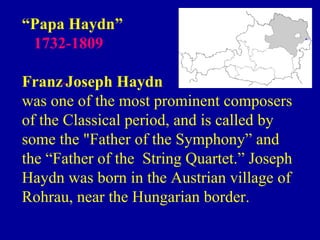
“Papa Haydn”
 1732-1809

Franz Joseph Haydn
was one of the most prominent composers
of the Classical period, and is called by
some the "Father of the Symphony” and
the “Father of the String Quartet.” Joseph
Haydn was born in the Austrian village of
Rohrau, near the Hungarian border.
Haydn was short in
stature, perhaps as a
result of having been
underfed throughout
most of his youth.
Like many in his day,
he was a survivor of
smallpox and his face
was pitted with the
scars of this disease.
Haydn's parents were perceptive enough to notice
  that their son was musically talented and knew
that in Rohrau he would have no chance to obtain
    any serious musical training. It was for this
    reason that they accepted a proposal from a
   relative, the schoolmaster and choirmaster in
Hainburg, that Haydn be apprenticed to train as a
  musician. Haydn therefore went off (ten miles
 away) and never again lived with his parents. At
            the time he was not quite six.
Life in the Franck household was
  not easy for Haydn, who later
  remembered being frequently
   hungry as well as constantly
 humiliated by the filthy state of
  his clothing. However, he did
begin his musical training there,
 and soon was able to play both
     harpsichord and violin.
Haydn was also a
  talented singer and
   passed an audition
    (for a choirboy at
         St. Stephan’s
 Cathedral) and soon
moved off to Vienna,
where he worked for
  the next nine years
        as a chorister.
After marriage, Haydn’s wife
  often cut up or rolled his
 manuscripts to roll her hair.
Needless to say, the marriage
    didn’t last very long.
What’s the deal with the national
           anthems?
In 1922 the Germans stole the old Austrian imperial anthem
  (composed by Austrian-- Joseph Haydn), and made it the
 national anthem of the Republic of Germany. It is still in use
 today. They used a text by Hoffmann von Fallersleben from
                            1841.

In 1929 the Austrians retaliated and declared the same Haydn
song the Austrian national anthem (with a new text by Ottokar
  Kernstock). So for several years the two countries used the
           same melody for their national anthem!
         www.viennaonline-ezine.com/ai/ai0302.html

World War II and the post war era changed everything again.
 The humble Austrians graciously let the Germans keep the
song and created their present national anthem with a text by
   Paula von Preradovic and a melody by W. A. Mozart.
            www.austria.org/nat_anthem.shtml
Translation of the Austrian National Anthem
    Land of mountains, land on the river,
      Land of fields, land of cathedrals,
     Land of hammers, rich in outlook.
   You are the native home of great sons,
  A people uniquely gifted for the beautiful,
          Much applauded Austria.

   Fiercely embattled, ferociously contested,
       You lie at the center of the globe,
              Like a strong heart.
    Since the days of your early ancestors
You have borne the burden of a sublime calling,
              Much-tried Austria.

             Courageously we stride
      Into the new times, free and devout,
         Industrious and of firm heart.
      In unison choruses of brotherhood
       We pledge our allegiance to thee,
                  Fatherland,

             Much-loved Austria.
During the 12 years of the Nazi era, the
 first stanza was the official anthem. In
      May 1952 the third stanza was
  proclaimed the official anthem of the
  Federal Republic of Germany (West
Germany) by President Theodor Heuss.
  (East Germany had its own anthem.)
The second stanza, while never verboten,
   was not very popular because of its
    “wine, women, and song” theme.
Deutschland, Deutschland über alles,    Germany, Germany above all,
Über alles in der Welt,                 Above everything in the world,
Wenn es stets zu Schutz und Trutze      When always, for protection,
Brüderlich zusammenhält,                We stand together as brothers.
Von der Maas bis an die Memel,          From the Maas to the Memel
Von der Etsch bis an den Belt -         From the Etsch to the Belt -
Deutschland, Deutschland über alles,    Germany, Germany above all
Über alles in der Welt.                 Above all in the world.

Deutsche Frauen, deutsche Treue,        German women, German loyalty,
Deutscher Wein und deutscher Sang       German wine and German song,
Sollen in der Welt behalten             Shall retain in the world,
Ihren alten schönen Klang,              Their old lovely ring
Uns zu edler Tat begeistern             To inspire us to noble deeds
Unser ganzes Leben lang.                 Our whole life long.
Deutsche Frauen, deutsche Treue,        German women, German loyalty,
Deutscher Wein und deutscher Sang       German wine and German song.

Einigkeit und Recht und Freiheit        Unity and law and freedom
für das deutsche Vaterland!             For the German Fatherland
Danach lasst uns alle streben           Let us all strive for that
Brüderlich mit Herz und Hand!           In brotherhood with heart and hand!
Einigkeit und Recht und Freiheit        Unity and law and freedom
Sind des Glückes Unterpfand;           Are the foundation for happiness
Blüh' im Glanze dieses Glückes,         Bloom in the glow of happiness
Blühe, deutsches Vaterland.             Bloom, German Fatherland.
Symphony No. 45 in F-sharp minor, known
 as the "Farewell" Symphony (Abschieds-
  Symphonie), was composed in 1772. It is
 particularly noteworthy that the symphony
 (along with others of this Sturm and Drang
    period of Haydn’s career) was highly
unconventional for the time. The symphony is
one of Haydn's better-known works from this
                   period.
This final adagio includes a bit of stage business that may not be obvious
to a listener hearing a recorded performance: several of the musicians are
 given little solos to play just before departing. The order of departure is:
  first oboe and second horn (solos), bassoon (no solo), second oboe and
  first horn (solos), double bass (solo), cello (no solo), orchestral violins
 (solos; first chair players silent), viola (no solo). The first chair violinists
                         remain to complete the work.
A typical performance of the Farewell Symphony lasts around twenty-five
                                     minutes.
Nickname (the Surprise)
 Haydn's music contains many jokes, and the 'Surprise' Symphony
 includes probably the most famous of all: a sudden loud chord in
 the theme of the variation-form second movement after a tranquil
opening. The music then returns to its original quiet dynamic, as if
nothing had happened, and the ensuing variations do not repeat the
                               joke.

                    Composition and Premiere
Haydn wrote the symphony in 1791 in London for a concert series.
     As with Haydn's England visits in general, the premiere was
  greatly successful. In his feeble old age Haydn remembered the
                       premiere with nostalgia:
...it was my wish to surprise the public with something new, and to
 make a debut in a brilliant manner, in order not to be outdone by
     my pupil Pleyel [who was leading a rival series of concerts].
More than any other composer's,
Haydn's music is known for its
           humor.

Haydn powerpoint pdf

  • 1.
    “Papa Haydn” 1732-1809 FranzJoseph Haydn was one of the most prominent composers of the Classical period, and is called by some the "Father of the Symphony” and the “Father of the String Quartet.” Joseph Haydn was born in the Austrian village of Rohrau, near the Hungarian border.
  • 2.
    Haydn was shortin stature, perhaps as a result of having been underfed throughout most of his youth. Like many in his day, he was a survivor of smallpox and his face was pitted with the scars of this disease.
  • 3.
    Haydn's parents wereperceptive enough to notice that their son was musically talented and knew that in Rohrau he would have no chance to obtain any serious musical training. It was for this reason that they accepted a proposal from a relative, the schoolmaster and choirmaster in Hainburg, that Haydn be apprenticed to train as a musician. Haydn therefore went off (ten miles away) and never again lived with his parents. At the time he was not quite six.
  • 4.
    Life in theFranck household was not easy for Haydn, who later remembered being frequently hungry as well as constantly humiliated by the filthy state of his clothing. However, he did begin his musical training there, and soon was able to play both harpsichord and violin.
  • 5.
    Haydn was alsoa talented singer and passed an audition (for a choirboy at St. Stephan’s Cathedral) and soon moved off to Vienna, where he worked for the next nine years as a chorister.
  • 6.
    After marriage, Haydn’swife often cut up or rolled his manuscripts to roll her hair. Needless to say, the marriage didn’t last very long.
  • 7.
    What’s the dealwith the national anthems?
  • 8.
    In 1922 theGermans stole the old Austrian imperial anthem (composed by Austrian-- Joseph Haydn), and made it the national anthem of the Republic of Germany. It is still in use today. They used a text by Hoffmann von Fallersleben from 1841. In 1929 the Austrians retaliated and declared the same Haydn song the Austrian national anthem (with a new text by Ottokar Kernstock). So for several years the two countries used the same melody for their national anthem! www.viennaonline-ezine.com/ai/ai0302.html World War II and the post war era changed everything again. The humble Austrians graciously let the Germans keep the song and created their present national anthem with a text by Paula von Preradovic and a melody by W. A. Mozart. www.austria.org/nat_anthem.shtml
  • 9.
    Translation of theAustrian National Anthem Land of mountains, land on the river, Land of fields, land of cathedrals, Land of hammers, rich in outlook. You are the native home of great sons, A people uniquely gifted for the beautiful, Much applauded Austria. Fiercely embattled, ferociously contested, You lie at the center of the globe, Like a strong heart. Since the days of your early ancestors You have borne the burden of a sublime calling, Much-tried Austria. Courageously we stride Into the new times, free and devout, Industrious and of firm heart. In unison choruses of brotherhood We pledge our allegiance to thee, Fatherland, Much-loved Austria.
  • 10.
    During the 12years of the Nazi era, the first stanza was the official anthem. In May 1952 the third stanza was proclaimed the official anthem of the Federal Republic of Germany (West Germany) by President Theodor Heuss. (East Germany had its own anthem.) The second stanza, while never verboten, was not very popular because of its “wine, women, and song” theme.
  • 11.
    Deutschland, Deutschland überalles, Germany, Germany above all, Über alles in der Welt, Above everything in the world, Wenn es stets zu Schutz und Trutze When always, for protection, Brüderlich zusammenhält, We stand together as brothers. Von der Maas bis an die Memel, From the Maas to the Memel Von der Etsch bis an den Belt - From the Etsch to the Belt - Deutschland, Deutschland über alles, Germany, Germany above all Über alles in der Welt. Above all in the world. Deutsche Frauen, deutsche Treue, German women, German loyalty, Deutscher Wein und deutscher Sang German wine and German song, Sollen in der Welt behalten Shall retain in the world, Ihren alten schönen Klang, Their old lovely ring Uns zu edler Tat begeistern To inspire us to noble deeds Unser ganzes Leben lang. Our whole life long. Deutsche Frauen, deutsche Treue, German women, German loyalty, Deutscher Wein und deutscher Sang German wine and German song. Einigkeit und Recht und Freiheit Unity and law and freedom für das deutsche Vaterland! For the German Fatherland Danach lasst uns alle streben Let us all strive for that Brüderlich mit Herz und Hand! In brotherhood with heart and hand! Einigkeit und Recht und Freiheit Unity and law and freedom Sind des Glückes Unterpfand; Are the foundation for happiness Blüh' im Glanze dieses Glückes, Bloom in the glow of happiness Blühe, deutsches Vaterland. Bloom, German Fatherland.
  • 12.
    Symphony No. 45in F-sharp minor, known as the "Farewell" Symphony (Abschieds- Symphonie), was composed in 1772. It is particularly noteworthy that the symphony (along with others of this Sturm and Drang period of Haydn’s career) was highly unconventional for the time. The symphony is one of Haydn's better-known works from this period.
  • 13.
    This final adagioincludes a bit of stage business that may not be obvious to a listener hearing a recorded performance: several of the musicians are given little solos to play just before departing. The order of departure is: first oboe and second horn (solos), bassoon (no solo), second oboe and first horn (solos), double bass (solo), cello (no solo), orchestral violins (solos; first chair players silent), viola (no solo). The first chair violinists remain to complete the work. A typical performance of the Farewell Symphony lasts around twenty-five minutes.
  • 14.
    Nickname (the Surprise) Haydn's music contains many jokes, and the 'Surprise' Symphony includes probably the most famous of all: a sudden loud chord in the theme of the variation-form second movement after a tranquil opening. The music then returns to its original quiet dynamic, as if nothing had happened, and the ensuing variations do not repeat the joke. Composition and Premiere Haydn wrote the symphony in 1791 in London for a concert series. As with Haydn's England visits in general, the premiere was greatly successful. In his feeble old age Haydn remembered the premiere with nostalgia: ...it was my wish to surprise the public with something new, and to make a debut in a brilliant manner, in order not to be outdone by my pupil Pleyel [who was leading a rival series of concerts].
  • 15.
    More than anyother composer's, Haydn's music is known for its humor.