MODEL-BASED DESIGN FOR FUEL CELL SYSTEM
Rui GAO Modelon
MECJ-2016, Kyushu University, Fukuoka
1Mechanics Engineering Congress, Japan, 2016
Mechanics Engineering Congress, 2016, Japan
9/14/2016
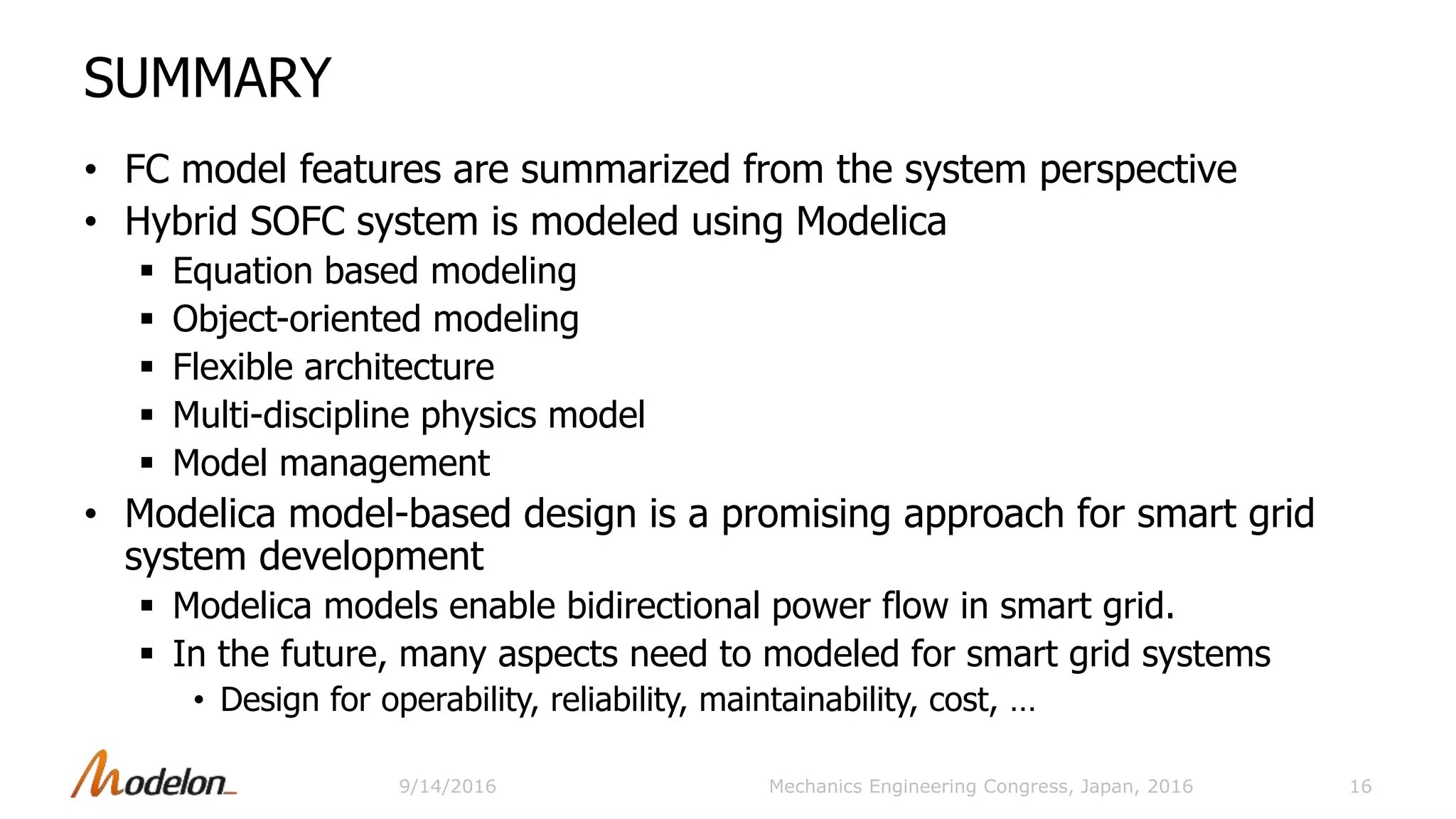
AGENDA
• System perspective to the fuel cell system
• Model-based design for fuel cell system
• Application to smart grid
• Summary
2Mechanics Engineering Congress, Japan, 20169/14/2016
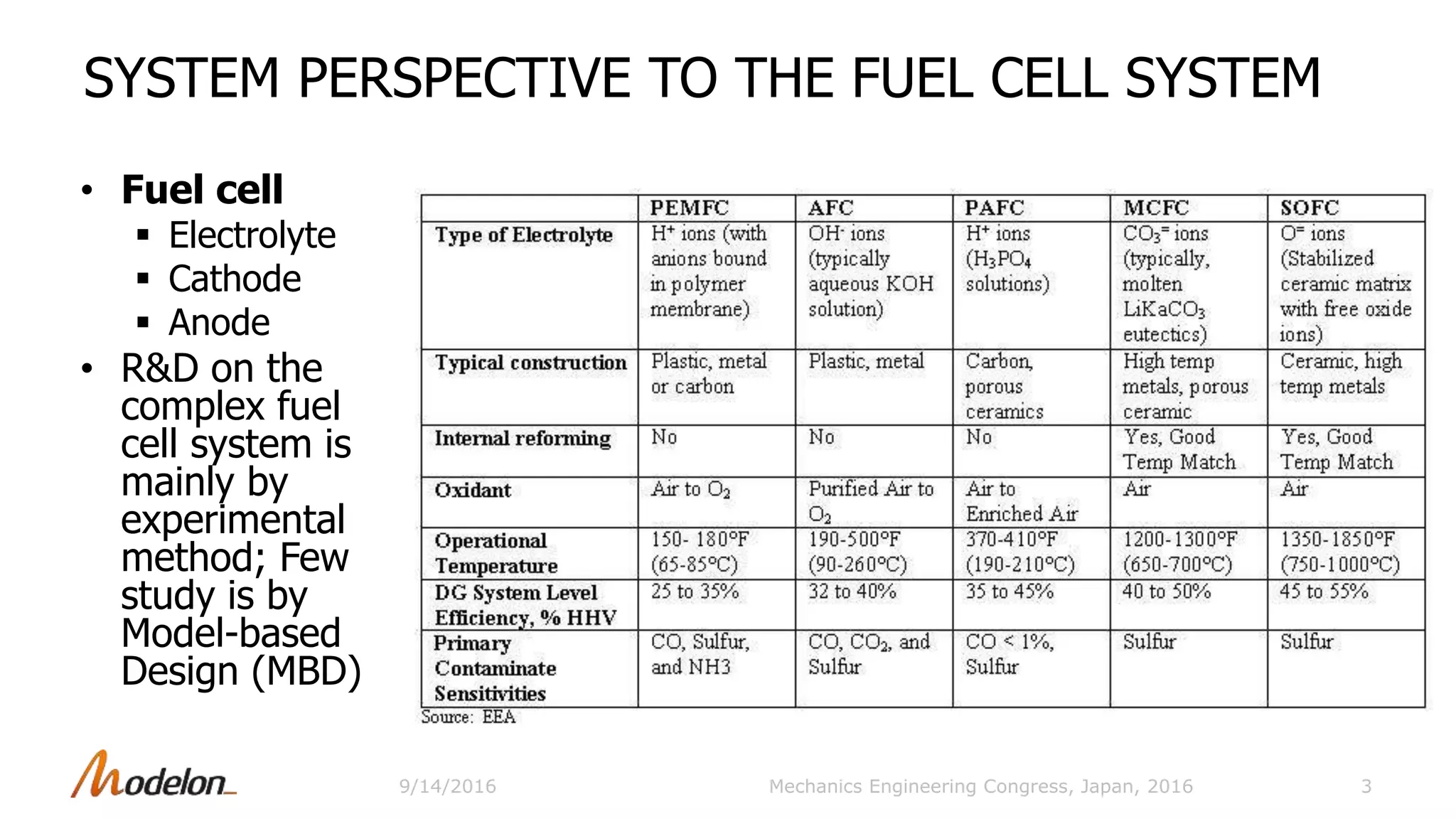
SYSTEM PERSPECTIVE TO THE FUEL CELL SYSTEM
• Fuel cell
 Electrolyte
 Cathode
 Anode
• R&D on the
complex fuel
cell system is
mainly by
experimental
method; Few
study is by
Model-based
Design (MBD)
3Mechanics Engineering Congress, Japan, 20169/14/2016
SYSTEM PERSPECTIVE TO THE FUEL CELL SYSTEM
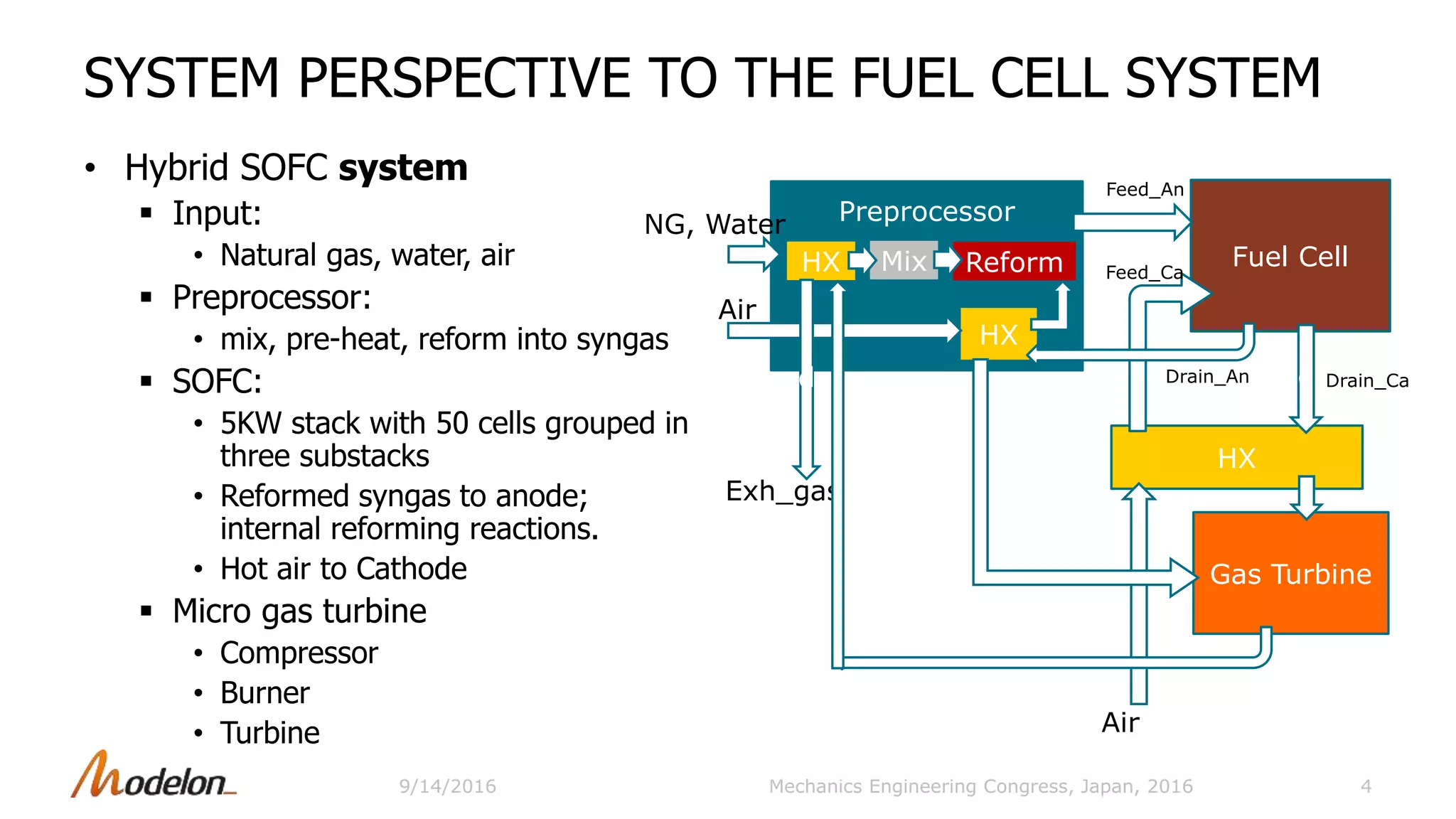
• Hybrid SOFC system
 Input:
• Natural gas, water, air
 Preprocessor:
• mix, pre-heat, reform into syngas
 SOFC:
• 5KW stack with 50 cells grouped in
three substacks
• Reformed syngas to anode;
internal reforming reactions.
• Hot air to Cathode
 Micro gas turbine
• Compressor
• Burner
• Turbine
4
Preprocessor
Fuel Cell
Gas Turbine
HX Mix Reform
HX
HX
dd Drain_An Drain_Ca
Exh_gas
NG, Water
Air
Air
Feed_An
Feed_Ca
Mechanics Engineering Congress, Japan, 20169/14/2016
SYSTEM PERSPECTIVE TO THE FUEL CELL SYSTEM
5
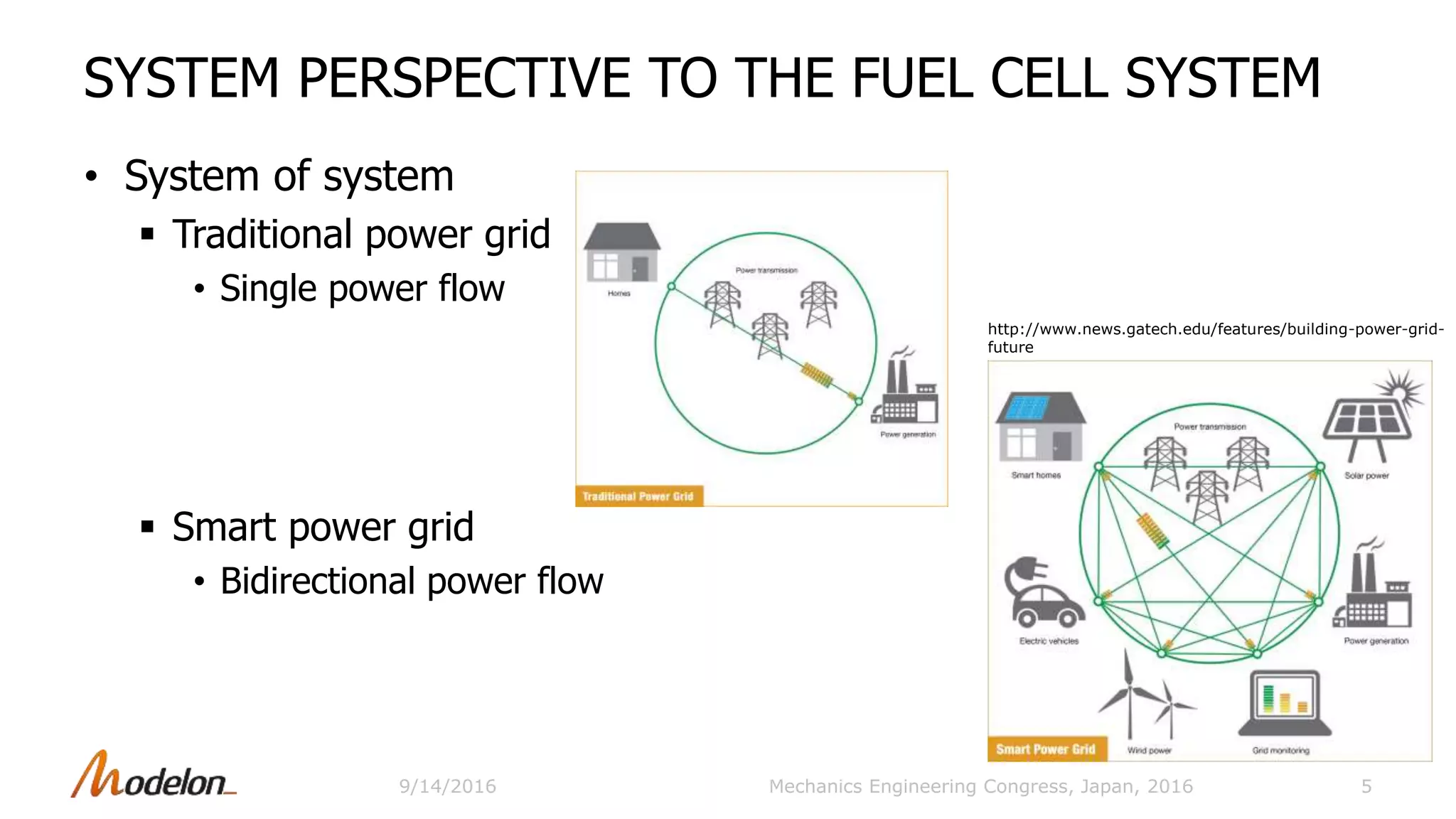
• System of system
 Traditional power grid
• Single power flow
 Smart power grid
• Bidirectional power flow
http://www.news.gatech.edu/features/building-power-grid-
future
Mechanics Engineering Congress, Japan, 20169/14/2016
FUEL CELL MODEL FROM SYSTEM’S DEMAND
6
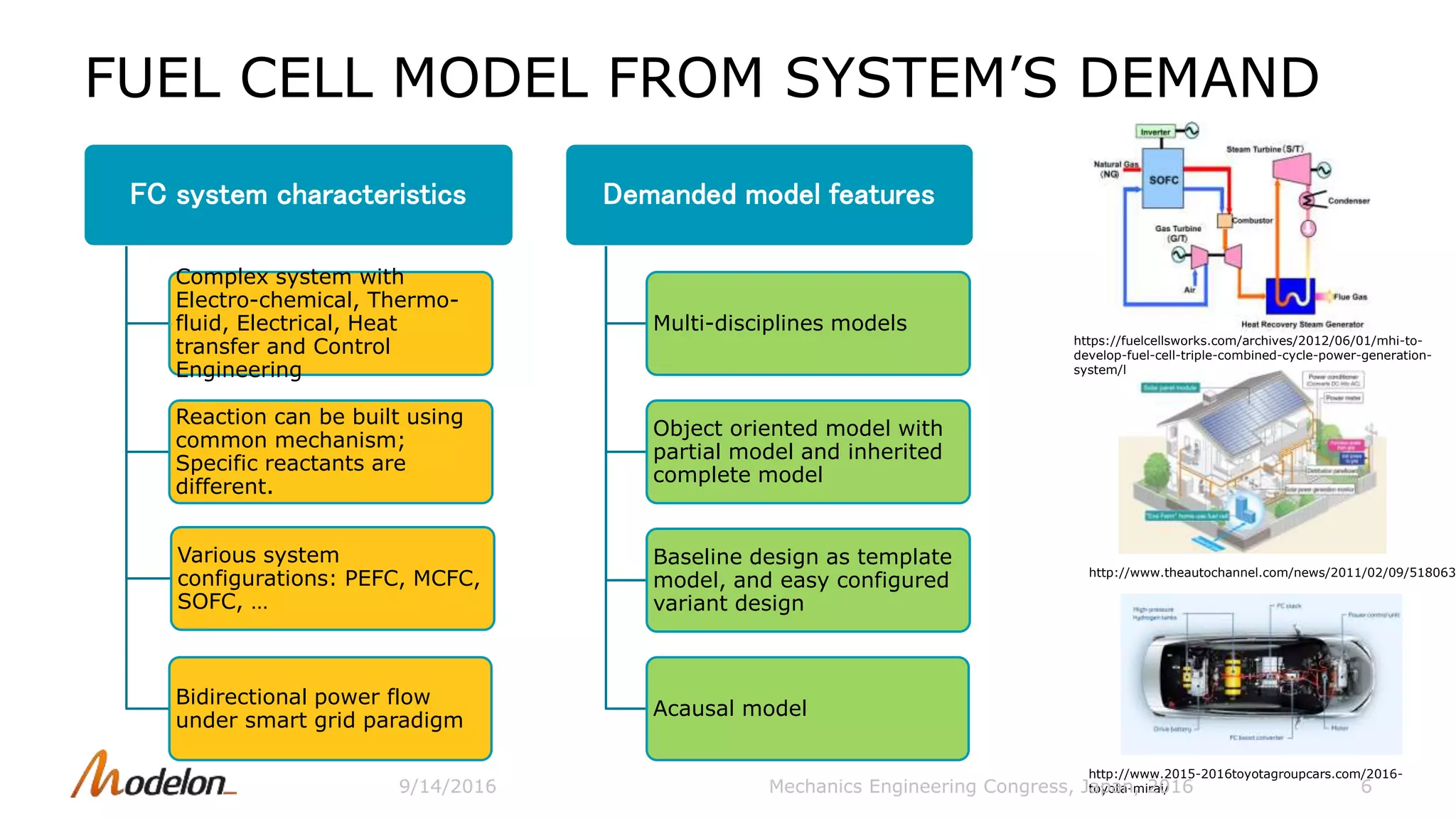
FC system characteristics
Complex system with
Electro-chemical, Thermo-
fluid, Electrical, Heat
transfer and Control
Engineering
Reaction can be built using
common mechanism;
Specific reactants are
different.
Various system
configurations: PEFC, MCFC,
SOFC, …
Bidirectional power flow
under smart grid paradigm
Demanded model features
Multi-disciplines models
Object oriented model with
partial model and inherited
complete model
Baseline design as template
model, and easy configured
variant design
Acausal model
http://www.2015-2016toyotagroupcars.com/2016-
toyota-mirai/
https://fuelcellsworks.com/archives/2012/06/01/mhi-to-
develop-fuel-cell-triple-combined-cycle-power-generation-
system/l
http://www.theautochannel.com/news/2011/02/09/518063
Mechanics Engineering Congress, Japan, 20169/14/2016
MODEL-BASED DESIGN FOR FUEL CELL SYSTEM
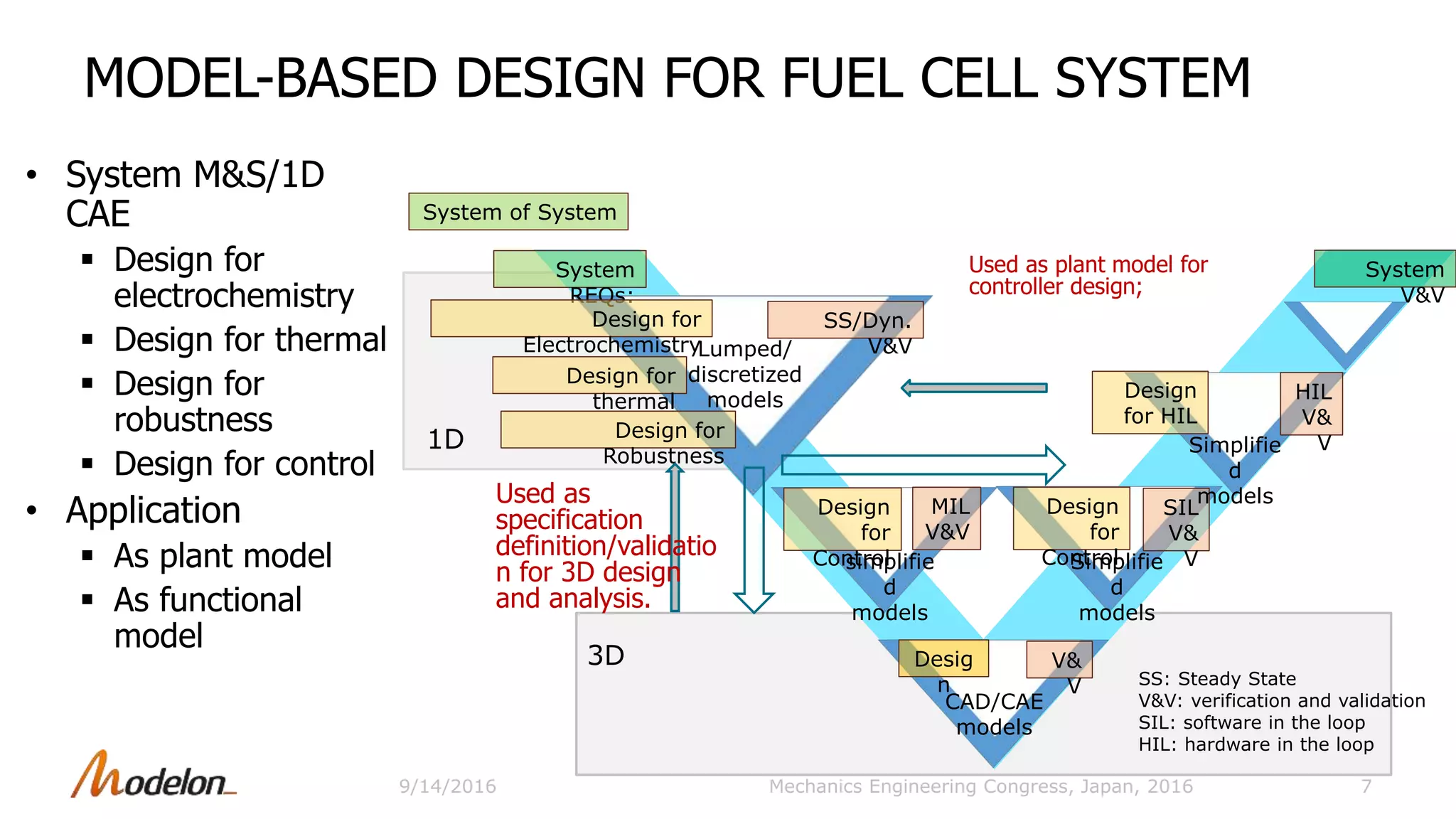
• System M&S/1D
CAE
 Design for
electrochemistry
 Design for thermal
 Design for
robustness
 Design for control
• Application
 As plant model
 As functional
model
7
MIL
V&V
SS/Dyn.
V&V
Design
for
Control
Design
for HIL
SIL
V&
V
Lumped/
discretized
models
Design for
Robustness
simplifie
d
models
HIL
V&
V
System
REQs:
System
V&V
Design for
Electrochemistry
Simplifie
d
models
Design for
thermal
Simplifie
d
models
Desig
n
1D
3D
Design
for
Control
CAD/CAE
models
V&
V
System of System
Mechanics Engineering Congress, Japan, 2016
Used as plant model for
controller design;
Used as
specification
definition/validatio
n for 3D design
and analysis.
SS: Steady State
V&V: verification and validation
SIL: software in the loop
HIL: hardware in the loop
9/14/2016
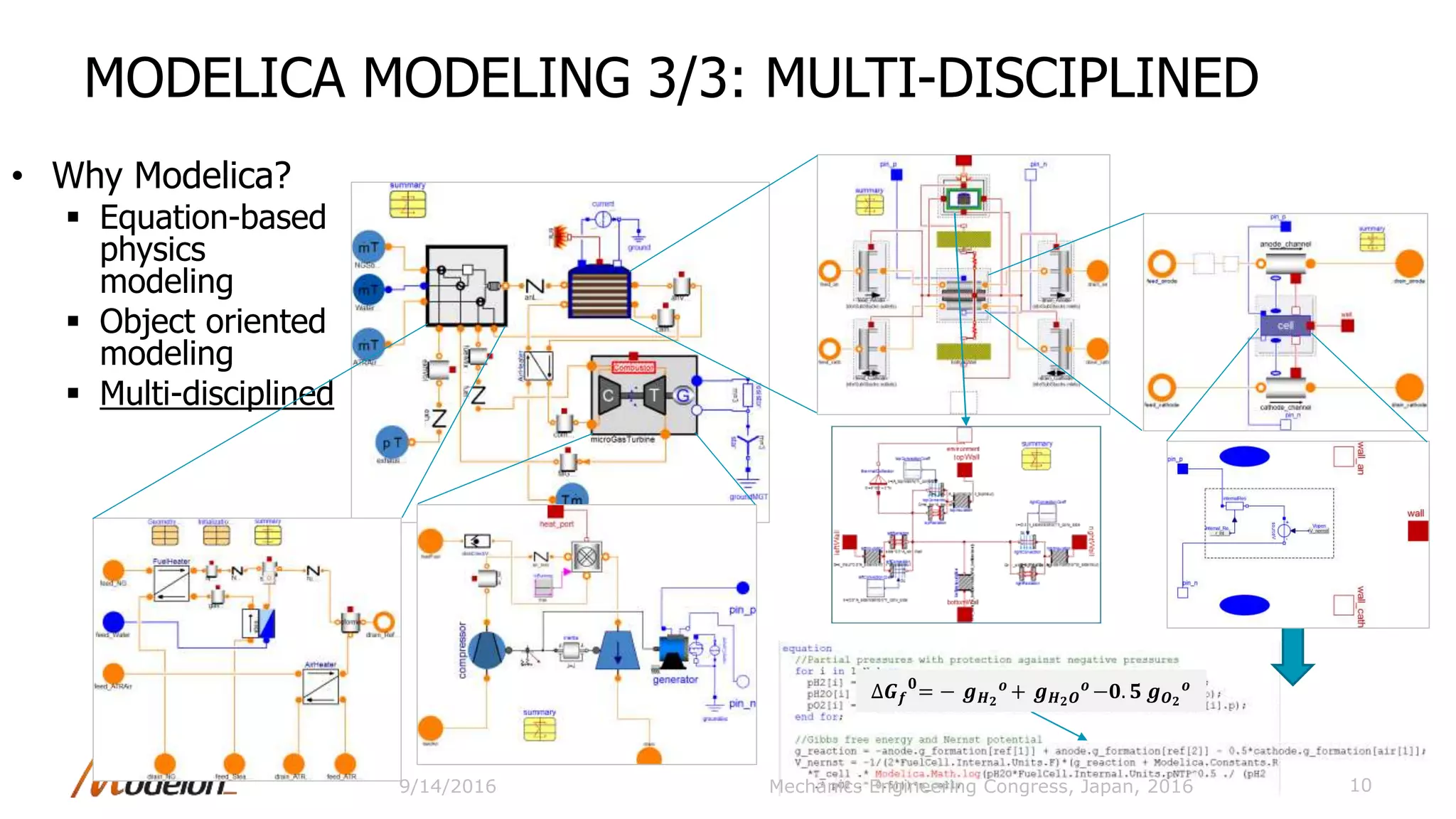
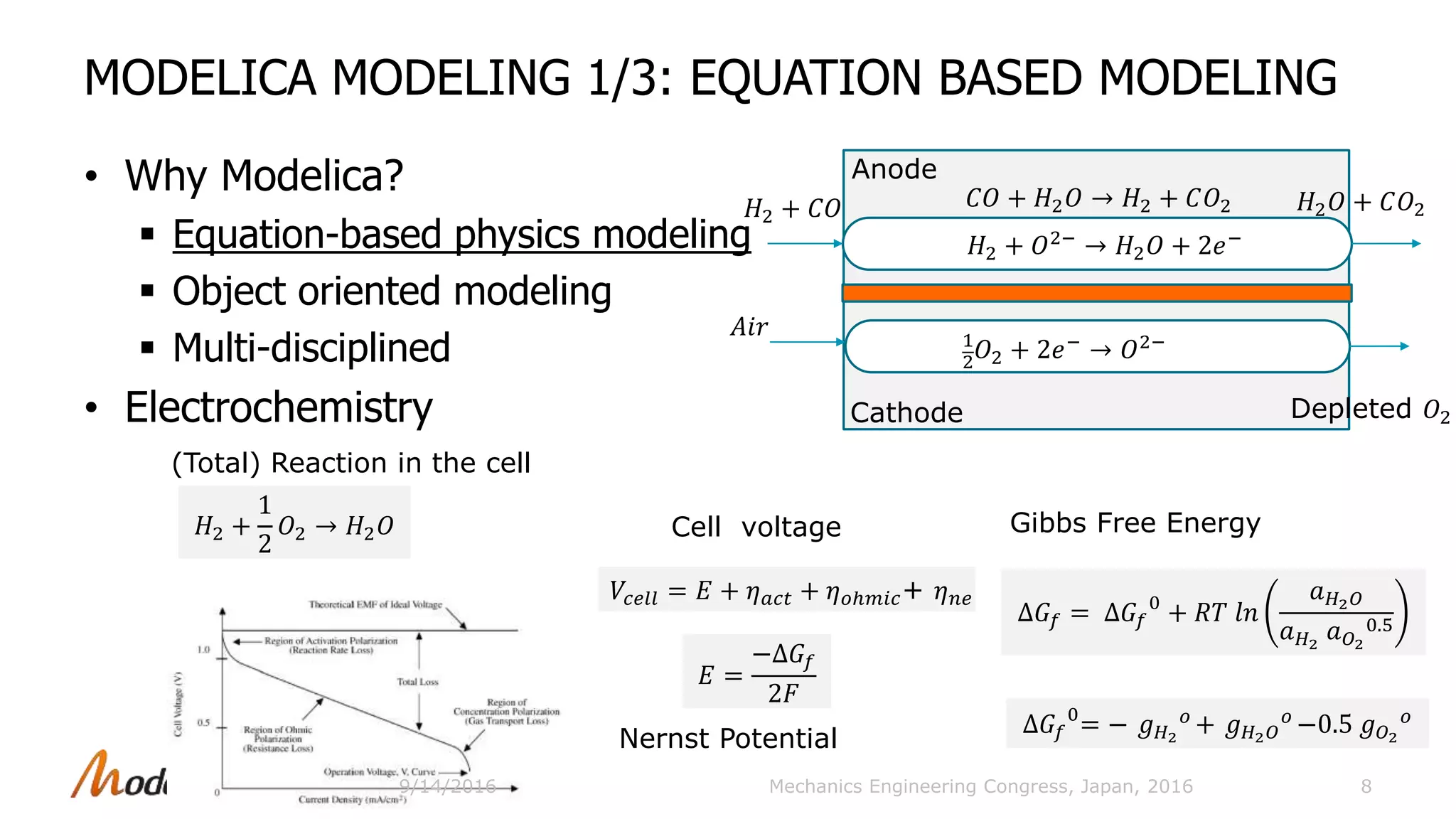
MODELICA MODELING 1/3: EQUATION BASED MODELING
• Why Modelica?
 Equation-based physics modeling
 Object oriented modeling
 Multi-disciplined
• Electrochemistry
8
∆𝐺𝑓 = ∆𝐺𝑓
0
+ 𝑅𝑇 𝑙𝑛
𝑎 𝐻2 𝑂
𝑎 𝐻2
𝑎 𝑂2
0.5
𝐸 =
−∆𝐺𝑓
2𝐹
∆𝐺𝑓
0
= − 𝑔 𝐻2
𝑜
+ 𝑔 𝐻2 𝑂
𝑜
−0.5 𝑔 𝑂2
𝑜
𝐻2 +
1
2
𝑂2 → 𝐻2 𝑂
(Total) Reaction in the cell
Nernst Potential
Gibbs Free EnergyCell voltage
𝑉𝑐𝑒𝑙𝑙 = 𝐸 + 𝜂 𝑎𝑐𝑡 + 𝜂 𝑜ℎ𝑚𝑖𝑐+ 𝜂 𝑛𝑒
Mechanics Engineering Congress, Japan, 20169/14/2016
Anode
Cathode
𝐻2 + 𝑂2−
→ 𝐻2 𝑂 + 2𝑒−
1
2
𝑂2 + 2𝑒− → 𝑂2−
𝐻2 + 𝐶𝑂
𝐴𝑖𝑟
𝐶𝑂 + 𝐻2 𝑂 → 𝐻2 + 𝐶𝑂2 𝐻2 𝑂 + 𝐶𝑂2
Depleted 𝑂2
MODELICA MODELING 2/3: OBJECT ORIENTED MODELING
• Why Modelica?
 Equation-based physics modeling
 Object oriented modeling
 Multi-disciplined
• Membrane example
 connector
 Interfaces to electrical, substance,
heat
9
∆𝑮 𝒇
𝟎
= − 𝒈 𝑯 𝟐
𝒐
+ 𝒈 𝑯 𝟐 𝑶
𝒐
−𝟎. 𝟓 𝒈 𝑶 𝟐
𝒐
connector MassPort
Medium medium;
Pressure p;
flow MassFlowRate m_flow;
SpecificEnthalpy h;
flow EnthalphFlowRate
H_flow;
MassFraction X[n.Xi];
flow MassFlowRate
mX_flow[nXi];
end MassPort;
Mechanics Engineering Congress, Japan, 20169/14/2016
MODELICA MODELING 3/3: MULTI-DISCIPLINED
• Why Modelica?
 Equation-based
physics
modeling
 Object oriented
modeling
 Multi-disciplined
10
∆𝑮 𝒇
𝟎
= − 𝒈 𝑯 𝟐
𝒐
+ 𝒈 𝑯 𝟐 𝑶
𝒐
−𝟎. 𝟓 𝒈 𝑶 𝟐
𝒐
Mechanics Engineering Congress, Japan, 20169/14/2016
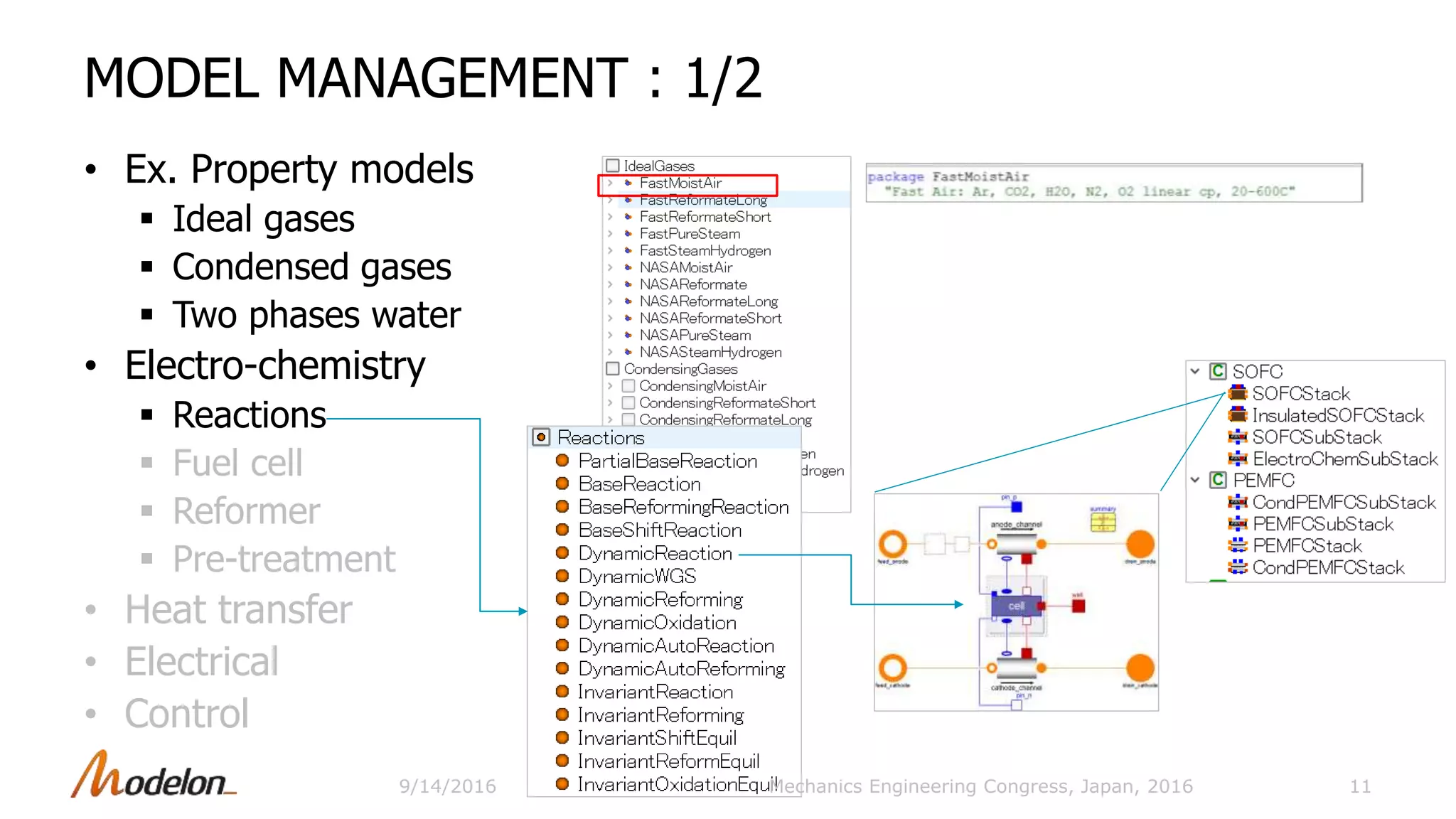
MODEL MANAGEMENT:1/2
• Ex. Property models
 Ideal gases
 Condensed gases
 Two phases water
• Electro-chemistry
 Reactions
 Fuel cell
 Reformer
 Pre-treatment
• Heat transfer
• Electrical
• Control
11Mechanics Engineering Congress, Japan, 20169/14/2016
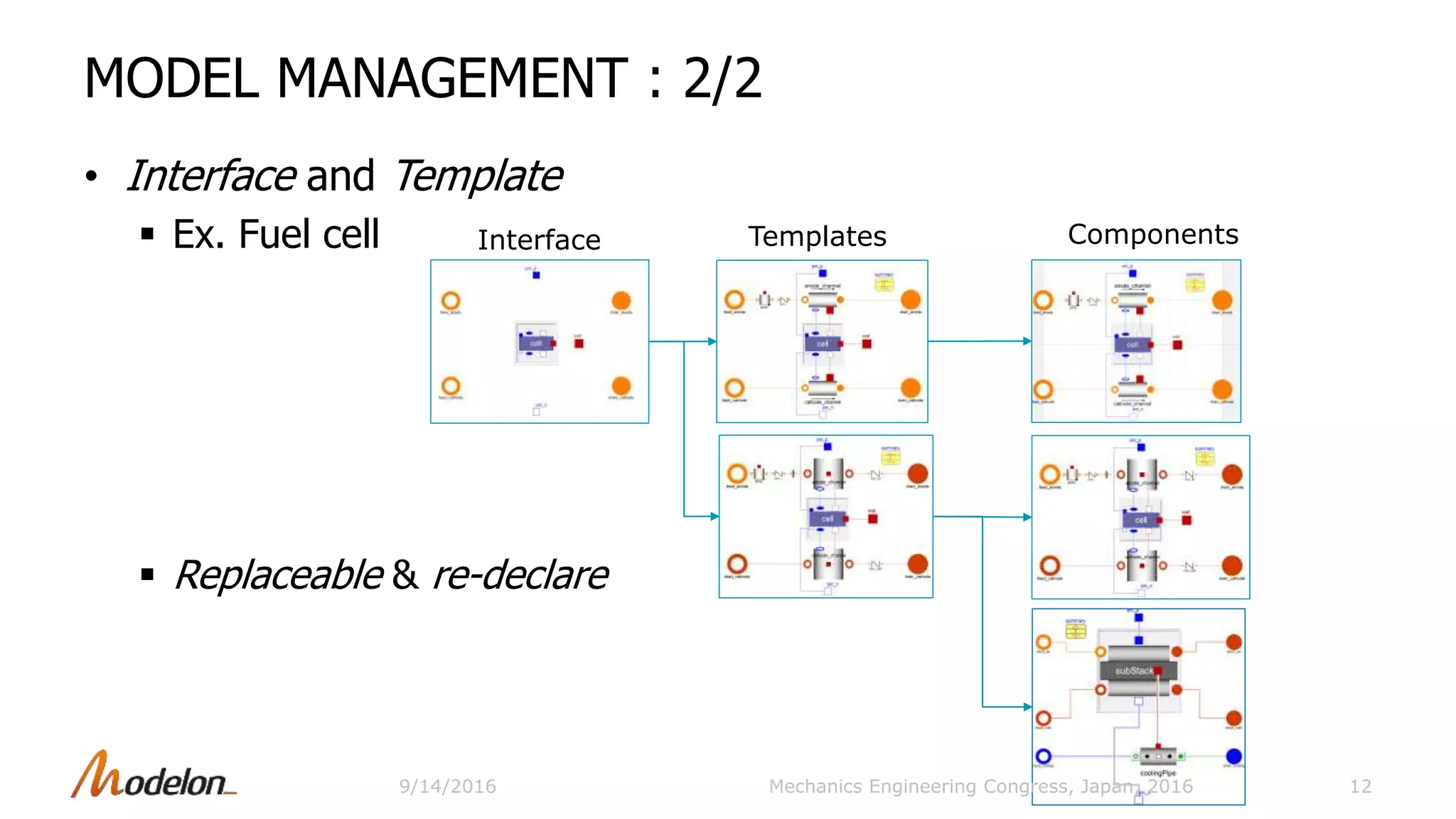
MODEL MANAGEMENT:2/2
• Interface and Template
 Ex. Fuel cell
 Replaceable & re-declare
12
Interface Templates Components
Mechanics Engineering Congress, Japan, 20169/14/2016
SUB-SYSTEM TESTS
• Sub-system
 Preprocessor
 Micro gas turbine
13Mechanics Engineering Congress, Japan, 2016
microGasTurbine
GC T
Combustor
feedFuel
mT
.
drainAir
pT
feedAir
mT
.
ground
combustorcombustor
isBurning
true
inertia
J=J
air_loss
summary
generator
groundExc
idealCheckValve
drain
heat_port
feedFuel
feedAir
pin_p
pin_n
0 100 200 300 400 500 600 700 800 900 1000
0.0
0.5
1.0
1.5
2.0
2.5
feedFuel.fluidPort.p feedAir.fluidPort.p
0 100 200 300 400 500 600 700 800 900 1000
-0.025
-0.020
-0.015
-0.010
-0.005
0.000
0.005
feedFuel.m_flow feedAir.fluidPort.m_flow
0 100 200 300 400 500 600 700 800 900 1000
-200
-150
-100
-50
0
50
100
150
200
250
resistor.i[1] resistor.i[2] resistor.i[3]
0 200 400 600 800 1000
-4000
-2000
0
microGasTurbine.generator.flange.tau
Test model
Test model
flowSource_Water
mT
.
flowSource_NG
mT
.
flowSource_AirATR
mT
.
Boundary_hotgas
p T
flowSource_Hotgas
mT
.
flowSource_ATRHeat
mT
.
Boundary_ATRHeat
pT
Boundary_Reformate
pT
turbulentLoss
preprocessor
0.0H2
CH4 0.0
CO 0.0
CO2 0.0
H2O 0.0
Mole %
N2 0.0
O2 0.0
0.0 0.0
0.0 0.0
p(bar)h(kJ/kg)
T(degC)(g/s)
reformer
steamMix_TZ
AirHeater
Geometry_Record Initialization_Record summary
FuelHeater
fuelLoss
gasMix
NGMix
NGLoss
drain_Reformate
feed_NG
drain_NGHeat feed_SteamHeat feed_ATRHeatdrain_ATRHeat
feed_Water
feed_ATRAir
9/14/2016
HYBRID SOFC SYSTEM SIMULATION RESULT
• Analysis
 Mass balance
 Fuel cell
voltage-current
density relation
 Thermal loss
 Power-current
density relation
 AC power
14Mechanics Engineering Congress, Japan, 2016
0 400 800 1200 1600 2000 2400 2800 3200 3600 4000
0.0E0
4.0E-5
8.0E-5
1.2E-4
1.6E-4
2.0E-4
checkMassBalanceSystem.mH_in
checkMassBalanceSystem.mH_out
checkMassBalanceSystem.mC_in
checkMassBalanceSystem.mC_out
Voltage [V] Power [W]
Stack
flowCathode
mT
.
ground
current
stack
summary
WaterSource
mT
.
NGSource
mT
.
ATRAirSource
mT
.
exhaustSink
p T
preprocessor
anLoss anVolume
cathVolume
microGasTurbine
GC T
Combustor
MGT_volOut
groundMGT
compMix
checkMassBalanceSystem
44.8 4478
0 1000 2000 3000 4000
0
50
100
150
current.i
0 1000 2000 3000 4000
35
40
45
50
55
current.v
500 1000 1500 2000 2500
40
42
44
46
48
50
stack.subStack[1].summary.j_external [A/m2]
current.v
0 400 800 1200 1600 2000 2400 2800 3200 3600 4000
0E0
1E5
2E5
3E5
4E5
resistor.resistor[1].LossPower
Mass balance
Fuel cell characteristic
Load current
AC power
0 400 800 1200 1600 2000 2400 2800 3200 3600 4000
750
760
770
780
790
800
810
stack.stackHeatLosses.topWall[1].T
stack.stackHeatLosses.topWall[2].T
stack.stackHeatLosses.topWall[3].T
stack.stackHeatLosses.topWall[4].T
Temperature of the stack top
500 1000 1500 2000 2500
40
42
44
46
48
50
0
500
1000
1500
2000
2500
3000
3500
4000
4500
5000
stack.subStack[1].summary.j_external [A/m2]
current.v stack.summary.PStkElec*
Voltage, power/current density relatio
9/14/2016
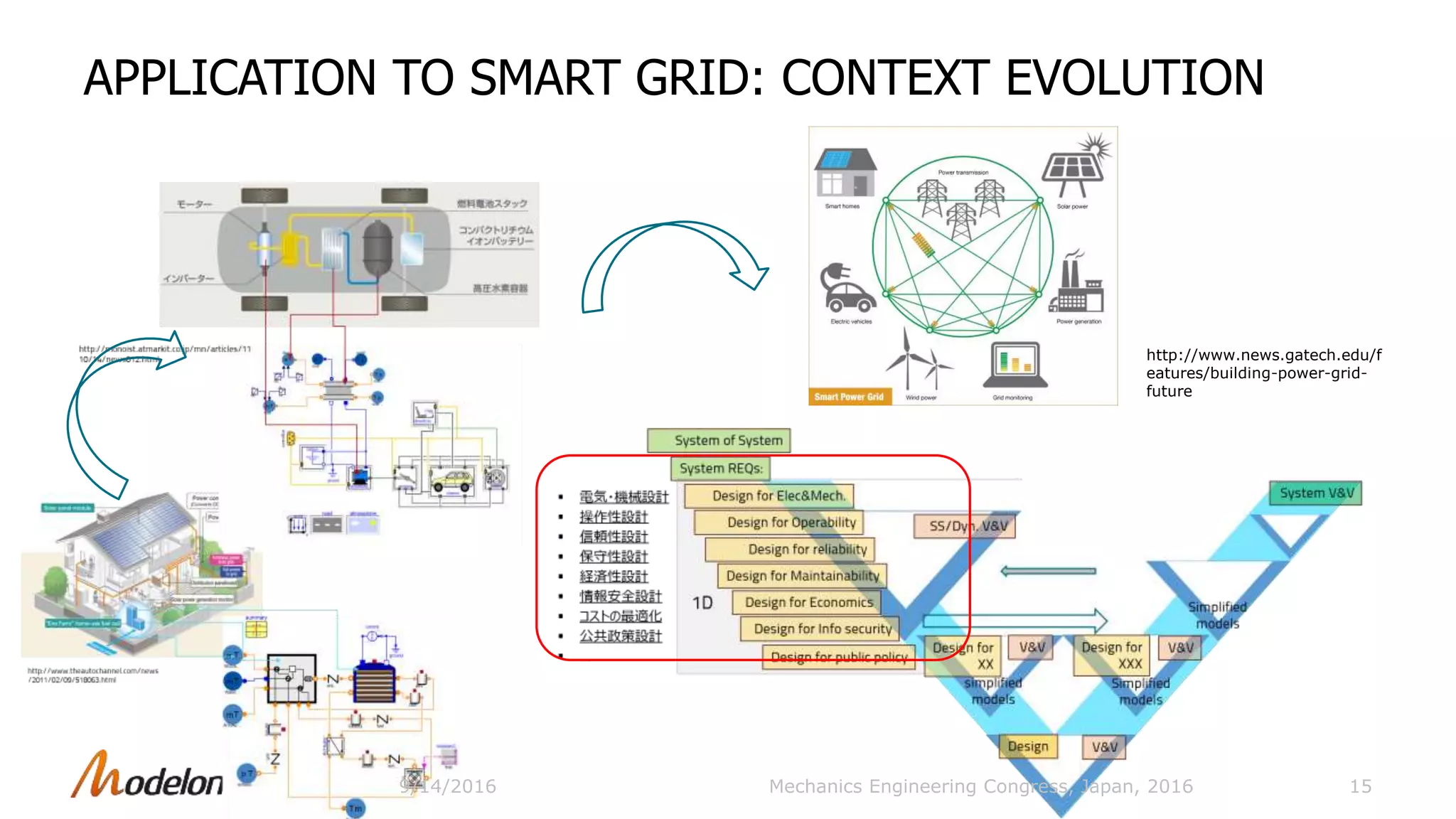
APPLICATION TO SMART GRID: CONTEXT EVOLUTION
15Mechanics Engineering Congress, Japan, 20169/14/2016
http://www.news.gatech.edu/f
eatures/building-power-grid-
future
SUMMARY
• FC model features are summarized from the system perspective
• Hybrid SOFC system is modeled using Modelica
 Equation based modeling
 Object-oriented modeling
 Flexible architecture
 Multi-discipline physics model
 Model management
• Modelica model-based design is a promising approach for smart grid
system development
 Modelica models enable bidirectional power flow in smart grid.
 In the future, many aspects need to modeled for smart grid systems
• Design for operability, reliability, maintainability, cost, …
16Mechanics Engineering Congress, Japan, 20169/14/2016
THANK YOU FOR YOUR ATTENTION
www.modelon.com
9/14/2016 Mechanics Engineering Congress, Japan, 2016 17

Modelon JSME 2016 - Model Based Design for Fuel Cell Systems

  • 1.
    MODEL-BASED DESIGN FORFUEL CELL SYSTEM Rui GAO Modelon MECJ-2016, Kyushu University, Fukuoka 1Mechanics Engineering Congress, Japan, 2016 Mechanics Engineering Congress, 2016, Japan 9/14/2016
  • 2.
    AGENDA • System perspectiveto the fuel cell system • Model-based design for fuel cell system • Application to smart grid • Summary 2Mechanics Engineering Congress, Japan, 20169/14/2016
  • 3.
    SYSTEM PERSPECTIVE TOTHE FUEL CELL SYSTEM • Fuel cell  Electrolyte  Cathode  Anode • R&D on the complex fuel cell system is mainly by experimental method; Few study is by Model-based Design (MBD) 3Mechanics Engineering Congress, Japan, 20169/14/2016
  • 4.
    SYSTEM PERSPECTIVE TOTHE FUEL CELL SYSTEM • Hybrid SOFC system  Input: • Natural gas, water, air  Preprocessor: • mix, pre-heat, reform into syngas  SOFC: • 5KW stack with 50 cells grouped in three substacks • Reformed syngas to anode; internal reforming reactions. • Hot air to Cathode  Micro gas turbine • Compressor • Burner • Turbine 4 Preprocessor Fuel Cell Gas Turbine HX Mix Reform HX HX dd Drain_An Drain_Ca Exh_gas NG, Water Air Air Feed_An Feed_Ca Mechanics Engineering Congress, Japan, 20169/14/2016
  • 5.
    SYSTEM PERSPECTIVE TOTHE FUEL CELL SYSTEM 5 • System of system  Traditional power grid • Single power flow  Smart power grid • Bidirectional power flow http://www.news.gatech.edu/features/building-power-grid- future Mechanics Engineering Congress, Japan, 20169/14/2016
  • 6.
    FUEL CELL MODELFROM SYSTEM’S DEMAND 6 FC system characteristics Complex system with Electro-chemical, Thermo- fluid, Electrical, Heat transfer and Control Engineering Reaction can be built using common mechanism; Specific reactants are different. Various system configurations: PEFC, MCFC, SOFC, … Bidirectional power flow under smart grid paradigm Demanded model features Multi-disciplines models Object oriented model with partial model and inherited complete model Baseline design as template model, and easy configured variant design Acausal model http://www.2015-2016toyotagroupcars.com/2016- toyota-mirai/ https://fuelcellsworks.com/archives/2012/06/01/mhi-to- develop-fuel-cell-triple-combined-cycle-power-generation- system/l http://www.theautochannel.com/news/2011/02/09/518063 Mechanics Engineering Congress, Japan, 20169/14/2016
  • 7.
    MODEL-BASED DESIGN FORFUEL CELL SYSTEM • System M&S/1D CAE  Design for electrochemistry  Design for thermal  Design for robustness  Design for control • Application  As plant model  As functional model 7 MIL V&V SS/Dyn. V&V Design for Control Design for HIL SIL V& V Lumped/ discretized models Design for Robustness simplifie d models HIL V& V System REQs: System V&V Design for Electrochemistry Simplifie d models Design for thermal Simplifie d models Desig n 1D 3D Design for Control CAD/CAE models V& V System of System Mechanics Engineering Congress, Japan, 2016 Used as plant model for controller design; Used as specification definition/validatio n for 3D design and analysis. SS: Steady State V&V: verification and validation SIL: software in the loop HIL: hardware in the loop 9/14/2016
  • 8.
    MODELICA MODELING 1/3:EQUATION BASED MODELING • Why Modelica?  Equation-based physics modeling  Object oriented modeling  Multi-disciplined • Electrochemistry 8 ∆𝐺𝑓 = ∆𝐺𝑓 0 + 𝑅𝑇 𝑙𝑛 𝑎 𝐻2 𝑂 𝑎 𝐻2 𝑎 𝑂2 0.5 𝐸 = −∆𝐺𝑓 2𝐹 ∆𝐺𝑓 0 = − 𝑔 𝐻2 𝑜 + 𝑔 𝐻2 𝑂 𝑜 −0.5 𝑔 𝑂2 𝑜 𝐻2 + 1 2 𝑂2 → 𝐻2 𝑂 (Total) Reaction in the cell Nernst Potential Gibbs Free EnergyCell voltage 𝑉𝑐𝑒𝑙𝑙 = 𝐸 + 𝜂 𝑎𝑐𝑡 + 𝜂 𝑜ℎ𝑚𝑖𝑐+ 𝜂 𝑛𝑒 Mechanics Engineering Congress, Japan, 20169/14/2016 Anode Cathode 𝐻2 + 𝑂2− → 𝐻2 𝑂 + 2𝑒− 1 2 𝑂2 + 2𝑒− → 𝑂2− 𝐻2 + 𝐶𝑂 𝐴𝑖𝑟 𝐶𝑂 + 𝐻2 𝑂 → 𝐻2 + 𝐶𝑂2 𝐻2 𝑂 + 𝐶𝑂2 Depleted 𝑂2
  • 9.
    MODELICA MODELING 2/3:OBJECT ORIENTED MODELING • Why Modelica?  Equation-based physics modeling  Object oriented modeling  Multi-disciplined • Membrane example  connector  Interfaces to electrical, substance, heat 9 ∆𝑮 𝒇 𝟎 = − 𝒈 𝑯 𝟐 𝒐 + 𝒈 𝑯 𝟐 𝑶 𝒐 −𝟎. 𝟓 𝒈 𝑶 𝟐 𝒐 connector MassPort Medium medium; Pressure p; flow MassFlowRate m_flow; SpecificEnthalpy h; flow EnthalphFlowRate H_flow; MassFraction X[n.Xi]; flow MassFlowRate mX_flow[nXi]; end MassPort; Mechanics Engineering Congress, Japan, 20169/14/2016
  • 10.
    MODELICA MODELING 3/3:MULTI-DISCIPLINED • Why Modelica?  Equation-based physics modeling  Object oriented modeling  Multi-disciplined 10 ∆𝑮 𝒇 𝟎 = − 𝒈 𝑯 𝟐 𝒐 + 𝒈 𝑯 𝟐 𝑶 𝒐 −𝟎. 𝟓 𝒈 𝑶 𝟐 𝒐 Mechanics Engineering Congress, Japan, 20169/14/2016
  • 11.
    MODEL MANAGEMENT:1/2 • Ex.Property models  Ideal gases  Condensed gases  Two phases water • Electro-chemistry  Reactions  Fuel cell  Reformer  Pre-treatment • Heat transfer • Electrical • Control 11Mechanics Engineering Congress, Japan, 20169/14/2016
  • 12.
    MODEL MANAGEMENT:2/2 • Interfaceand Template  Ex. Fuel cell  Replaceable & re-declare 12 Interface Templates Components Mechanics Engineering Congress, Japan, 20169/14/2016
  • 13.
    SUB-SYSTEM TESTS • Sub-system Preprocessor  Micro gas turbine 13Mechanics Engineering Congress, Japan, 2016 microGasTurbine GC T Combustor feedFuel mT . drainAir pT feedAir mT . ground combustorcombustor isBurning true inertia J=J air_loss summary generator groundExc idealCheckValve drain heat_port feedFuel feedAir pin_p pin_n 0 100 200 300 400 500 600 700 800 900 1000 0.0 0.5 1.0 1.5 2.0 2.5 feedFuel.fluidPort.p feedAir.fluidPort.p 0 100 200 300 400 500 600 700 800 900 1000 -0.025 -0.020 -0.015 -0.010 -0.005 0.000 0.005 feedFuel.m_flow feedAir.fluidPort.m_flow 0 100 200 300 400 500 600 700 800 900 1000 -200 -150 -100 -50 0 50 100 150 200 250 resistor.i[1] resistor.i[2] resistor.i[3] 0 200 400 600 800 1000 -4000 -2000 0 microGasTurbine.generator.flange.tau Test model Test model flowSource_Water mT . flowSource_NG mT . flowSource_AirATR mT . Boundary_hotgas p T flowSource_Hotgas mT . flowSource_ATRHeat mT . Boundary_ATRHeat pT Boundary_Reformate pT turbulentLoss preprocessor 0.0H2 CH4 0.0 CO 0.0 CO2 0.0 H2O 0.0 Mole % N2 0.0 O2 0.0 0.0 0.0 0.0 0.0 p(bar)h(kJ/kg) T(degC)(g/s) reformer steamMix_TZ AirHeater Geometry_Record Initialization_Record summary FuelHeater fuelLoss gasMix NGMix NGLoss drain_Reformate feed_NG drain_NGHeat feed_SteamHeat feed_ATRHeatdrain_ATRHeat feed_Water feed_ATRAir 9/14/2016
  • 14.
    HYBRID SOFC SYSTEMSIMULATION RESULT • Analysis  Mass balance  Fuel cell voltage-current density relation  Thermal loss  Power-current density relation  AC power 14Mechanics Engineering Congress, Japan, 2016 0 400 800 1200 1600 2000 2400 2800 3200 3600 4000 0.0E0 4.0E-5 8.0E-5 1.2E-4 1.6E-4 2.0E-4 checkMassBalanceSystem.mH_in checkMassBalanceSystem.mH_out checkMassBalanceSystem.mC_in checkMassBalanceSystem.mC_out Voltage [V] Power [W] Stack flowCathode mT . ground current stack summary WaterSource mT . NGSource mT . ATRAirSource mT . exhaustSink p T preprocessor anLoss anVolume cathVolume microGasTurbine GC T Combustor MGT_volOut groundMGT compMix checkMassBalanceSystem 44.8 4478 0 1000 2000 3000 4000 0 50 100 150 current.i 0 1000 2000 3000 4000 35 40 45 50 55 current.v 500 1000 1500 2000 2500 40 42 44 46 48 50 stack.subStack[1].summary.j_external [A/m2] current.v 0 400 800 1200 1600 2000 2400 2800 3200 3600 4000 0E0 1E5 2E5 3E5 4E5 resistor.resistor[1].LossPower Mass balance Fuel cell characteristic Load current AC power 0 400 800 1200 1600 2000 2400 2800 3200 3600 4000 750 760 770 780 790 800 810 stack.stackHeatLosses.topWall[1].T stack.stackHeatLosses.topWall[2].T stack.stackHeatLosses.topWall[3].T stack.stackHeatLosses.topWall[4].T Temperature of the stack top 500 1000 1500 2000 2500 40 42 44 46 48 50 0 500 1000 1500 2000 2500 3000 3500 4000 4500 5000 stack.subStack[1].summary.j_external [A/m2] current.v stack.summary.PStkElec* Voltage, power/current density relatio 9/14/2016
  • 15.
    APPLICATION TO SMARTGRID: CONTEXT EVOLUTION 15Mechanics Engineering Congress, Japan, 20169/14/2016 http://www.news.gatech.edu/f eatures/building-power-grid- future
  • 16.
    SUMMARY • FC modelfeatures are summarized from the system perspective • Hybrid SOFC system is modeled using Modelica  Equation based modeling  Object-oriented modeling  Flexible architecture  Multi-discipline physics model  Model management • Modelica model-based design is a promising approach for smart grid system development  Modelica models enable bidirectional power flow in smart grid.  In the future, many aspects need to modeled for smart grid systems • Design for operability, reliability, maintainability, cost, … 16Mechanics Engineering Congress, Japan, 20169/14/2016
  • 17.
    THANK YOU FORYOUR ATTENTION www.modelon.com 9/14/2016 Mechanics Engineering Congress, Japan, 2016 17

Editor's Notes

  • #2 モデロンの
  • #4 The SOFC properties 電解質: 直接な燃料と酸化剤の接触を阻止 電気的に繋がる。下記のものが通過 電子 酸化剤 イオン
  • #5 Example of a full SOFC system. Natural gas, water and air is fed to a fuel preprocessor where the components are mixed, pre-heated and reformed into syngas suitable as fuel for the SOFC stack. The reformed gas is fed to the anode side of a 5 kW SOFC stack, hot air is fed to the cathode side. The stack in this examples contains three substacks with a total of 50 cells. Reforming reactions are taking place in the anode channel of each substack so that more hydrogen gas is generated. The hydrogen reacts with oxygen in the cell membrane, which gives rise to a electrical current through the stack. The hot off gases from the stack is used for pre-heating of the air in the preprocessor and then supplied to the micro gas turbine. At the entrance of the micro gas turbine, the air is compressed and then mixed with the fuel to be burned. The exhaust gas from the burner is used to power a turbine, which drives the air compressor. Finally the exhaust gas from the micro gas turbine is used for steam generation and pre-heating of natural gas in the preprocessor. 5 kW SOFC stack Micro gas turbine ATR unit Pre-heating of gases
  • #6 https://en.wikipedia.org/wiki/Electric_power_transmission これからどんな燃料電池が必要?
  • #7 I emphasis the 3 features of Dymola that solves SOFC modeling and simulation problem: Overcome the walls between the division and disciplines Powerful enough for simulate continuous and discrete system Flexible to different architectures
  • #11 Example of a full SOFC system. Natural gas, water and air is fed to a fuel preprocessor where the components are mixed, pre-heated and reformed into syngas suitable as fuel for the SOFC stack. The reformed gas is fed to the anode side of a 5 kW SOFC stack, hot air is fed to the cathode side. The stack in this examples contains three substacks with a total of 50 cells. Reforming reactions are taking place in the anode channel of each substack so that more hydrogen gas is generated. The hydrogen reacts with oxygen in the cell membrane, which gives rise to a electrical current through the stack. The hot off gases from the stack is used for pre-heating of the air in the preprocessor and then supplied to the micro gas turbine. At the entrance of the micro gas turbine, the air is compressed and then mixed with the fuel to be burned. The exhaust gas from the burner is used to power a turbine, which drives the air compressor. Finally the exhaust gas from the micro gas turbine is used for steam generation and pre-heating of natural gas in the preprocessor. 5 kW SOFC stack Micro gas turbine ATR unit Pre-heating of gases
  • #13 Interfaces: PartialSubstack for comnon properties in all substacks, common parameters, connecters and a repalceable membrance interface Templates: standard CondensingSubstack template with ideal gas assumptions in anode and cathode channels Predefined