©2019 Modelon.
FUEL SYSTEM
LIBRARY
Overview
AGENDA
2©2019 Modelon
 About Fuel System Library
 Key Benefits
 Key Capabilities
 Key Applications
 Library Contents
 Modelon Compatibility
 Latest Release: 2019.2
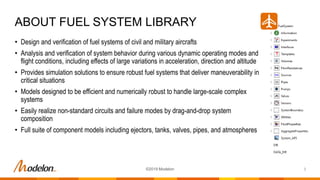
• Design and verification of fuel systems of civil and military aircrafts
• Analysis and verification of system behavior during various dynamic operating modes and
flight conditions, including effects of large variations in acceleration, direction and altitude
• Provides simulation solutions to ensure robust fuel systems that deliver maneuverability in
critical situations
• Models designed to be efficient and numerically robust to handle large-scale complex
systems
• Easily realize non-standard circuits and failure modes by drag-and-drop system
composition
• Full suite of component models including ejectors, tanks, valves, pipes, and atmospheres
ABOUT FUEL SYSTEM LIBRARY
3©2019 Modelon
Offline simulation of complete Fuel Systems
through complete flight envelope and all
operating conditions:
• Large systems
• Controls, sequential and feedback
Real-time simulation of the same system models:
• Some simplifications, but the same overall model
(real time capability achieved through model
configuration selection)
• To be included in the special flight simulator
hardware
ABOUT FUEL SYSTEM LIBRARY
4©2019 Modelon
• High performance and real-time capable
• Import of 3D tank geometries from CAD
• Physics-based models covering thermal, hydraulics, inerting, evaporation, solubility
• Full support for bidirectional flow
• Efficient property models of air-fuel mixtures
• Easily switch off the thermal effects for faster simulations
• Easy integration with other libraries
• Aircraft Dynamics Library
• Jet Propulsion Library
• Environmental Control Library
• Vapor Cycle Library
• Liquid Cooling Library
• Heat Exchanger Library
KEY BENEFITS
5©2019 Modelon
Medium properties
• Jet fuel
• Jet-A, Jet-B, JP-4, JP-5, and JP-8
• Liquid medium with slight compressibility
• Gas Mixture
• Moist air (water with dry air or ideal dry air mixture)
• No water condensation (𝜙 < 100%)
• Evaporated jet fuel with dry air mixture
• Mixture medium
• All components can contain a gas mixture and liquid fuel in an arbitrary combination
• Solubility of O2 and N2 gas in the liquid fuel
KEY CAPABILITIES
6©2019 Modelon
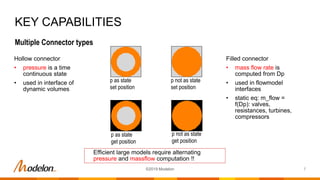
Multiple Connector types
KEY CAPABILITIES
7©2019 Modelon
Hollow connector
• pressure is a time
continuous state
• used in interface of
dynamic volumes
p not as state
set position
p as state
set position
p as state
get position
p not as state
get position
Filled connector
• mass flow rate is
computed from Dp
• used in flowmodel
interfaces
• static eq: m_flow =
f(Dp): valves,
resistances, turbines,
compressors
Efficient large models require alternating
pressure and massflow computation !!
Position information
Pipes
• Receive position information and cross sectional area from connected components
• Receive acceleration vector via inner/outer
• Optional dynamic momentum balance: pressure drop, static head and resistance losses can be computed
from massflow as state
All other components
• Set position information and cross section for each connection point
• Optional multibody frame connector can be enabled to set position
• Numerical states: p, T, X[1:nS-1]
• Acceleration is only accounted for in pipe and tank models
KEY CAPABILITIES
8©2019 Modelon
Position information
KEY CAPABILITIES
9©2019 Modelon
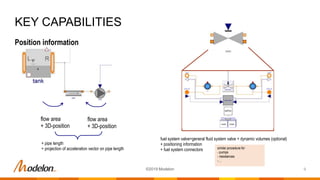
flow area
+ 3D-position
flow area
+ 3D-position
+ pipe length
+ projection of acceleration vector on pipe length
fuel system valve=general fluid system valve + dynamic volumes (optional)
+ positioning information
+ fuel system connectors similar procedure for
- pumps
- resistances
-…
Fuel tank inerting
Purpose:
• Fill air space in tanks with inert gas (N2) to reduce
concentrations of oxygen and fuel to prevent combustion
Medium properties use dry air mixture with variable
composition of O2 and N2
KEY CAPABILITIES
10©2019 Modelon
Fuel evaporation
Purpose:
• Track amount of evaporated fuel in ullage
Medium properties package for fuel evaporation
• Evaporated jet fuel, O2, N2 and liquid jet fuel
• Jet-A, JP-4, JP-5, and JP-8
Amount of evaporated fuel is based vapor pressure
Jet fuel pseudo compound modeled in liquid and vapor phases
KEY CAPABILITIES
11©2019 Modelon
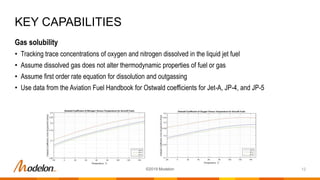
Gas solubility
• Tracking trace concentrations of oxygen and nitrogen dissolved in the liquid jet fuel
• Assume dissolved gas does not alter thermodynamic properties of fuel or gas
• Assume first order rate equation for dissolution and outgassing
• Use data from the Aviation Fuel Handbook for Ostwald coefficients for Jet-A, JP-4, and JP-5
KEY CAPABILITIES
12©2019 Modelon
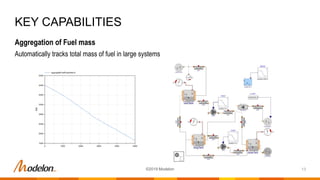
Aggregation of Fuel mass
Automatically tracks total mass of fuel in large systems
KEY CAPABILITIES
13©2019 Modelon
KEY APPLICATIONS
14©2019 Modelon
Real-time
Scope:
• Develop complex and accurate models that can be run in real time
• Use the same high-fidelity models throughout the design and validation process
Relevant solution features:
• Fuel Systems Library real-time mode
• Inline integration
• Mixed-mode integration
KEY APPLICATIONS
15©2019 Modelon
Inerting
Scope:
• Analyze the dynamic propagation of species like nitrogen and oxygen
• Size the inerting system to ensure admissible oxygen concentrations throughout the envelope
Relevant solution features:
• Dynamic balance equations including full support of flow reversal
• Set venting boundary conditions through ambient model
In particular:
• Gas mixtures distinguishing O2 and N2
KEY APPLICATIONS
16©2019 Modelon
Fuel transfer/refueling
Scope:
• Dynamically simulate fuel transfer and refueling of aircraft
• Validate line, orifice, pump/ejector and balance tube performance
• Simulate failure conditions including ejector induced and discharge flow reversal and pump cavitation
Relevant solution features:
• Ideal tank volume sensors
• Impose arbitrary aircraft altitude and attitude
• Visualization of simulation results
In particular:
• Arbitrary tank geometries to accurately predict level-volume relations
KEY APPLICATIONS
17©2019 Modelon
Flammability
Scope:
• Dynamically simulate mass and energy balance
• Assess temperatures in relation to flash point/lower and upper flammability limits
• Model heat transfer, mass transfer, solubility
Relevant solution features:
• Heat transfer to gas and liquid
• Convective transport of mass and energy
In particular:
• Evaporation of fuel
• Solubility of oxygen and nitrogen in fuel
• Heat transfer correlations
KEY APPLICATIONS
18©2019 Modelon
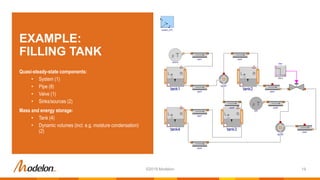
EXAMPLE:
FILLING TANK
Quasi-steady-state components:
• System (1)
• Pipe (8)
• Valve (1)
• Sinks/sources (2)
Mass and energy storage:
• Tank (4)
• Dynamic volumes (incl. e.g. moisture condensation)
(2)
19©2019 Modelon
©2019 Modelon.
LIBRARY CONTENTS
20©2019 Modelon
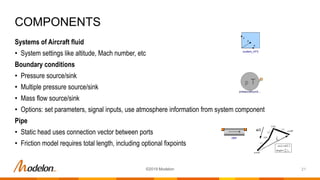
Systems of Aircraft fluid
• System settings like altitude, Mach number, etc
Boundary conditions
• Pressure source/sink
• Multiple pressure source/sink
• Mass flow source/sink
• Options: set parameters, signal inputs, use atmosphere information from system component
Pipe
• Static head uses connection vector between ports
• Friction model requires total length, including optional fixpoints
COMPONENTS
21©2019 Modelon
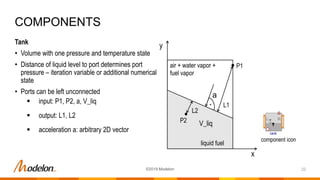
Tank
• Volume with one pressure and temperature state
• Distance of liquid level to port determines port
pressure – iteration variable or additional numerical
state
• Ports can be left unconnected
 input: P1, P2, a, V_liq
 output: L1, L2
 acceleration a: arbitrary 2D vector
COMPONENTS
22©2019 Modelon
x
y
air + water vapor +
fuel vapor
liquid fuel
a
P1
P2
L2
L1
V_liq
component icon
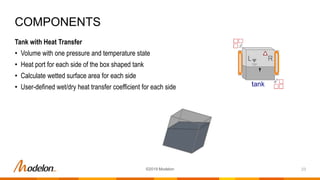
Tank with Heat Transfer
• Volume with one pressure and temperature state
• Heat port for each side of the box shaped tank
• Calculate wetted surface area for each side
• User-defined wet/dry heat transfer coefficient for each side
COMPONENTS
23©2019 Modelon
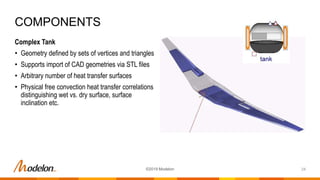
Complex Tank
• Geometry defined by sets of vertices and triangles
• Supports import of CAD geometries via STL files
• Arbitrary number of heat transfer surfaces
• Physical free convection heat transfer correlations
distinguishing wet vs. dry surface, surface
inclination etc.
COMPONENTS
24©2019 Modelon
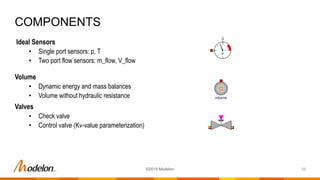
Ideal Sensors
• Single port sensors: p, T
• Two port flow sensors: m_flow, V_flow
Volume
• Dynamic energy and mass balances
• Volume without hydraulic resistance
Valves
• Check valve
• Control valve (Kv-value parameterization)
COMPONENTS
25©2019 Modelon
©2019 Modelon.
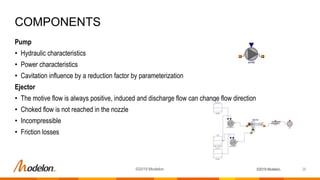
Pump
• Hydraulic characteristics
• Power characteristics
• Cavitation influence by a reduction factor by parameterization
Ejector
• The motive flow is always positive, induced and discharge flow can change flow direction
• Choked flow is not reached in the nozzle
• Incompressible
• Friction losses
COMPONENTS
26©2019 Modelon
©2019 Modelon.
MODELON COMPATIBILITY
27©2019 Modelon
• Environmental Control Library
• Moist air
• Turbines
• Fans
• Compressors
• Ejector
• Aircraft Dynamics Library
• Jet Propulsion Library
• Liquid Cooling Library
• Heat Exchanger Library
• Hydraulics Library
RECOMMENDED MODELON LIBRARY
COMPATIBILITY
28©2019 Modelon
EXAMPLE:
MODELON
PORTFOLIO MULTI-
DOMAIN SYSTEM
• Electric Power Library
• Environmental Control Library
• Fuel System Library
• Heat Exchanger Library
• Hydraulics Library
• Liquid Cooling Library
• Vapor Cycle Library
29©2019 Modelon
LATEST RELEASE: 2019.2
30©2019 Modelon
RELEASE:2019.2
New Features
31©2019 Modelon
• Pumps become compatible with Modelon Base library enabling more
characteristics choices, less time events and a cleaned-up code. This change
improved the power computation
• Added support to set position using frame connectors in components. Frame
connectors can be enabled in components
• A new linear fuel probe for measuring fuel levels in the convective complex tank.
The probes are compliant with all geometry kernels and including 3D animation
• CG (Center of Gravity) calculation on fuel inside of a tank for all flight conditions.
The fuel CG is available for all geometry kernels and including 3D animation
• Aggregate CG value is available in fuel properties
• A new pressure losses model for bends in pipes
RELEASE:2019.2
Enhancements
32©2019 Modelon
• Initialization parameters reorganized from "General" tab to a
separate “Components” tab
• Non-linear equation systems generation improvements for both
wall friction and lumped loss in pipe
• Spinning Tank experiments moved into a separate package
• The liquid level calculation accuracy improved

Fuel System Library Overview

  • 1.
  • 2.
    AGENDA 2©2019 Modelon  AboutFuel System Library  Key Benefits  Key Capabilities  Key Applications  Library Contents  Modelon Compatibility  Latest Release: 2019.2
  • 3.
    • Design andverification of fuel systems of civil and military aircrafts • Analysis and verification of system behavior during various dynamic operating modes and flight conditions, including effects of large variations in acceleration, direction and altitude • Provides simulation solutions to ensure robust fuel systems that deliver maneuverability in critical situations • Models designed to be efficient and numerically robust to handle large-scale complex systems • Easily realize non-standard circuits and failure modes by drag-and-drop system composition • Full suite of component models including ejectors, tanks, valves, pipes, and atmospheres ABOUT FUEL SYSTEM LIBRARY 3©2019 Modelon
  • 4.
    Offline simulation ofcomplete Fuel Systems through complete flight envelope and all operating conditions: • Large systems • Controls, sequential and feedback Real-time simulation of the same system models: • Some simplifications, but the same overall model (real time capability achieved through model configuration selection) • To be included in the special flight simulator hardware ABOUT FUEL SYSTEM LIBRARY 4©2019 Modelon
  • 5.
    • High performanceand real-time capable • Import of 3D tank geometries from CAD • Physics-based models covering thermal, hydraulics, inerting, evaporation, solubility • Full support for bidirectional flow • Efficient property models of air-fuel mixtures • Easily switch off the thermal effects for faster simulations • Easy integration with other libraries • Aircraft Dynamics Library • Jet Propulsion Library • Environmental Control Library • Vapor Cycle Library • Liquid Cooling Library • Heat Exchanger Library KEY BENEFITS 5©2019 Modelon
  • 6.
    Medium properties • Jetfuel • Jet-A, Jet-B, JP-4, JP-5, and JP-8 • Liquid medium with slight compressibility • Gas Mixture • Moist air (water with dry air or ideal dry air mixture) • No water condensation (𝜙 < 100%) • Evaporated jet fuel with dry air mixture • Mixture medium • All components can contain a gas mixture and liquid fuel in an arbitrary combination • Solubility of O2 and N2 gas in the liquid fuel KEY CAPABILITIES 6©2019 Modelon
  • 7.
    Multiple Connector types KEYCAPABILITIES 7©2019 Modelon Hollow connector • pressure is a time continuous state • used in interface of dynamic volumes p not as state set position p as state set position p as state get position p not as state get position Filled connector • mass flow rate is computed from Dp • used in flowmodel interfaces • static eq: m_flow = f(Dp): valves, resistances, turbines, compressors Efficient large models require alternating pressure and massflow computation !!
  • 8.
    Position information Pipes • Receiveposition information and cross sectional area from connected components • Receive acceleration vector via inner/outer • Optional dynamic momentum balance: pressure drop, static head and resistance losses can be computed from massflow as state All other components • Set position information and cross section for each connection point • Optional multibody frame connector can be enabled to set position • Numerical states: p, T, X[1:nS-1] • Acceleration is only accounted for in pipe and tank models KEY CAPABILITIES 8©2019 Modelon
  • 9.
    Position information KEY CAPABILITIES 9©2019Modelon flow area + 3D-position flow area + 3D-position + pipe length + projection of acceleration vector on pipe length fuel system valve=general fluid system valve + dynamic volumes (optional) + positioning information + fuel system connectors similar procedure for - pumps - resistances -…
  • 10.
    Fuel tank inerting Purpose: •Fill air space in tanks with inert gas (N2) to reduce concentrations of oxygen and fuel to prevent combustion Medium properties use dry air mixture with variable composition of O2 and N2 KEY CAPABILITIES 10©2019 Modelon
  • 11.
    Fuel evaporation Purpose: • Trackamount of evaporated fuel in ullage Medium properties package for fuel evaporation • Evaporated jet fuel, O2, N2 and liquid jet fuel • Jet-A, JP-4, JP-5, and JP-8 Amount of evaporated fuel is based vapor pressure Jet fuel pseudo compound modeled in liquid and vapor phases KEY CAPABILITIES 11©2019 Modelon
  • 12.
    Gas solubility • Trackingtrace concentrations of oxygen and nitrogen dissolved in the liquid jet fuel • Assume dissolved gas does not alter thermodynamic properties of fuel or gas • Assume first order rate equation for dissolution and outgassing • Use data from the Aviation Fuel Handbook for Ostwald coefficients for Jet-A, JP-4, and JP-5 KEY CAPABILITIES 12©2019 Modelon
  • 13.
    Aggregation of Fuelmass Automatically tracks total mass of fuel in large systems KEY CAPABILITIES 13©2019 Modelon
  • 14.
  • 15.
    Real-time Scope: • Develop complexand accurate models that can be run in real time • Use the same high-fidelity models throughout the design and validation process Relevant solution features: • Fuel Systems Library real-time mode • Inline integration • Mixed-mode integration KEY APPLICATIONS 15©2019 Modelon
  • 16.
    Inerting Scope: • Analyze thedynamic propagation of species like nitrogen and oxygen • Size the inerting system to ensure admissible oxygen concentrations throughout the envelope Relevant solution features: • Dynamic balance equations including full support of flow reversal • Set venting boundary conditions through ambient model In particular: • Gas mixtures distinguishing O2 and N2 KEY APPLICATIONS 16©2019 Modelon
  • 17.
    Fuel transfer/refueling Scope: • Dynamicallysimulate fuel transfer and refueling of aircraft • Validate line, orifice, pump/ejector and balance tube performance • Simulate failure conditions including ejector induced and discharge flow reversal and pump cavitation Relevant solution features: • Ideal tank volume sensors • Impose arbitrary aircraft altitude and attitude • Visualization of simulation results In particular: • Arbitrary tank geometries to accurately predict level-volume relations KEY APPLICATIONS 17©2019 Modelon
  • 18.
    Flammability Scope: • Dynamically simulatemass and energy balance • Assess temperatures in relation to flash point/lower and upper flammability limits • Model heat transfer, mass transfer, solubility Relevant solution features: • Heat transfer to gas and liquid • Convective transport of mass and energy In particular: • Evaporation of fuel • Solubility of oxygen and nitrogen in fuel • Heat transfer correlations KEY APPLICATIONS 18©2019 Modelon
  • 19.
    EXAMPLE: FILLING TANK Quasi-steady-state components: •System (1) • Pipe (8) • Valve (1) • Sinks/sources (2) Mass and energy storage: • Tank (4) • Dynamic volumes (incl. e.g. moisture condensation) (2) 19©2019 Modelon
  • 20.
  • 21.
    Systems of Aircraftfluid • System settings like altitude, Mach number, etc Boundary conditions • Pressure source/sink • Multiple pressure source/sink • Mass flow source/sink • Options: set parameters, signal inputs, use atmosphere information from system component Pipe • Static head uses connection vector between ports • Friction model requires total length, including optional fixpoints COMPONENTS 21©2019 Modelon
  • 22.
    Tank • Volume withone pressure and temperature state • Distance of liquid level to port determines port pressure – iteration variable or additional numerical state • Ports can be left unconnected  input: P1, P2, a, V_liq  output: L1, L2  acceleration a: arbitrary 2D vector COMPONENTS 22©2019 Modelon x y air + water vapor + fuel vapor liquid fuel a P1 P2 L2 L1 V_liq component icon
  • 23.
    Tank with HeatTransfer • Volume with one pressure and temperature state • Heat port for each side of the box shaped tank • Calculate wetted surface area for each side • User-defined wet/dry heat transfer coefficient for each side COMPONENTS 23©2019 Modelon
  • 24.
    Complex Tank • Geometrydefined by sets of vertices and triangles • Supports import of CAD geometries via STL files • Arbitrary number of heat transfer surfaces • Physical free convection heat transfer correlations distinguishing wet vs. dry surface, surface inclination etc. COMPONENTS 24©2019 Modelon
  • 25.
    Ideal Sensors • Singleport sensors: p, T • Two port flow sensors: m_flow, V_flow Volume • Dynamic energy and mass balances • Volume without hydraulic resistance Valves • Check valve • Control valve (Kv-value parameterization) COMPONENTS 25©2019 Modelon
  • 26.
    ©2019 Modelon. Pump • Hydrauliccharacteristics • Power characteristics • Cavitation influence by a reduction factor by parameterization Ejector • The motive flow is always positive, induced and discharge flow can change flow direction • Choked flow is not reached in the nozzle • Incompressible • Friction losses COMPONENTS 26©2019 Modelon
  • 27.
  • 28.
    • Environmental ControlLibrary • Moist air • Turbines • Fans • Compressors • Ejector • Aircraft Dynamics Library • Jet Propulsion Library • Liquid Cooling Library • Heat Exchanger Library • Hydraulics Library RECOMMENDED MODELON LIBRARY COMPATIBILITY 28©2019 Modelon
  • 29.
    EXAMPLE: MODELON PORTFOLIO MULTI- DOMAIN SYSTEM •Electric Power Library • Environmental Control Library • Fuel System Library • Heat Exchanger Library • Hydraulics Library • Liquid Cooling Library • Vapor Cycle Library 29©2019 Modelon
  • 30.
  • 31.
    RELEASE:2019.2 New Features 31©2019 Modelon •Pumps become compatible with Modelon Base library enabling more characteristics choices, less time events and a cleaned-up code. This change improved the power computation • Added support to set position using frame connectors in components. Frame connectors can be enabled in components • A new linear fuel probe for measuring fuel levels in the convective complex tank. The probes are compliant with all geometry kernels and including 3D animation • CG (Center of Gravity) calculation on fuel inside of a tank for all flight conditions. The fuel CG is available for all geometry kernels and including 3D animation • Aggregate CG value is available in fuel properties • A new pressure losses model for bends in pipes
  • 32.
    RELEASE:2019.2 Enhancements 32©2019 Modelon • Initializationparameters reorganized from "General" tab to a separate “Components” tab • Non-linear equation systems generation improvements for both wall friction and lumped loss in pipe • Spinning Tank experiments moved into a separate package • The liquid level calculation accuracy improved