





©2019 Modelon.
VAPOR CYCLE
LIBRARY
Overview
©2019 Modelon.
 About Vapor Cycle Library
 Key Features
 Key Capabilities
 Key Applications
 Library Contents
 Modelon Compatibility
 Latest Release: 2019.1
AGENDA
2
©2019 Modelon.
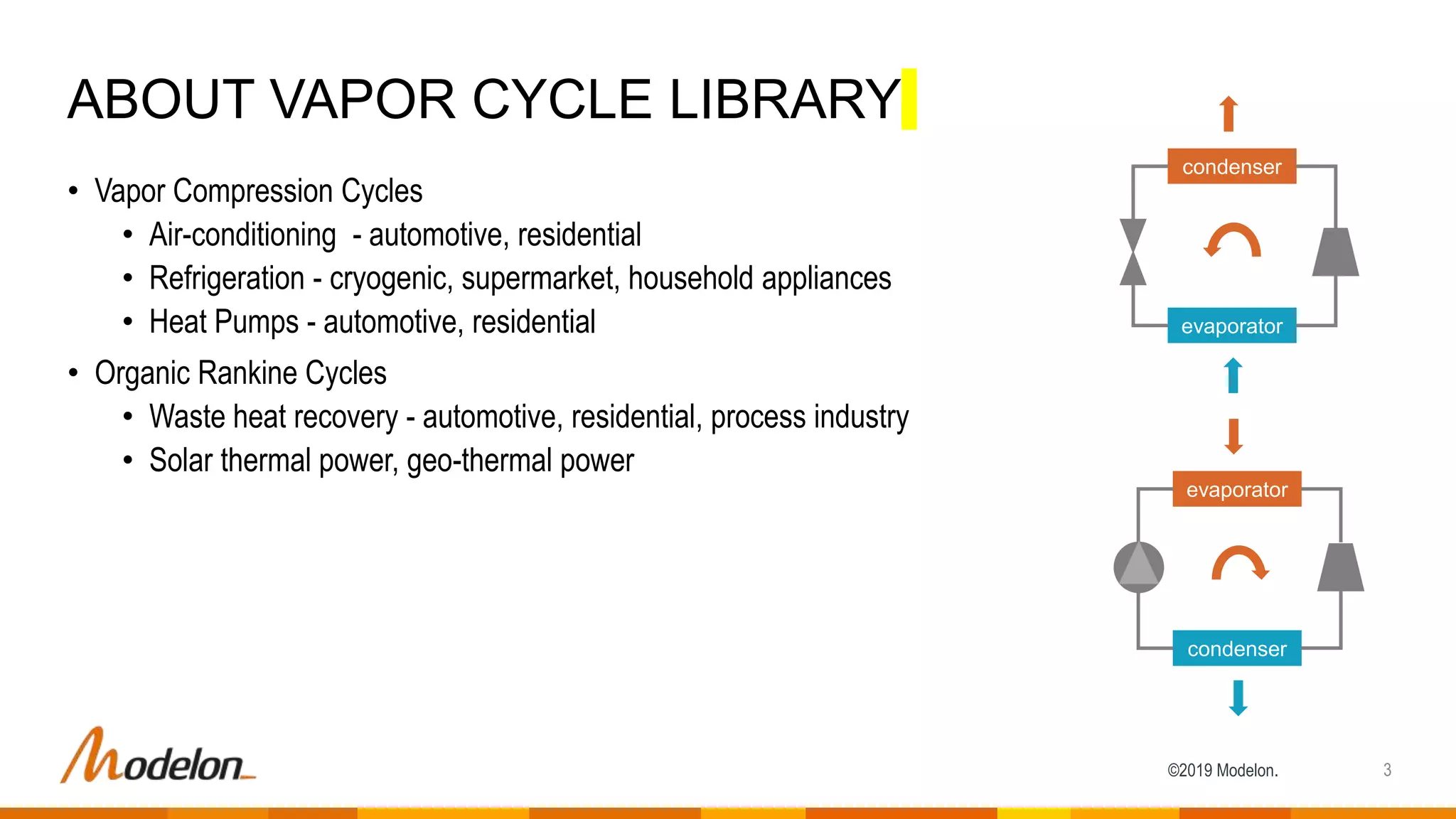
• Vapor Compression Cycles
• Air-conditioning - automotive, residential
• Refrigeration - cryogenic, supermarket, household appliances
• Heat Pumps - automotive, residential
• Organic Rankine Cycles
• Waste heat recovery - automotive, residential, process industry
• Solar thermal power, geo-thermal power
ABOUT VAPOR CYCLE LIBRARY
3
condenser
evaporator
evaporator
condenser
©2019 Modelon.
• Transient and steady-state simulation of component test rigs and
cycle systems
• Flexible composition of user-defined system architectures
• Wide range of different working fluids including R-134a, R-1234yf, R-
404a, R-407c, carbon dioxide, isobutane
• Plug and play compatible with other libraries for thermal
management:
• Liquid Cooling Library - Networks with incompressible fluids,
heating and cooling
• Heat Exchanger Library - Detailed geometry-based heat
exchangers, support of inhomogeneous air inlet profiles
KEY BENEFITS
4
©2019 Modelon.
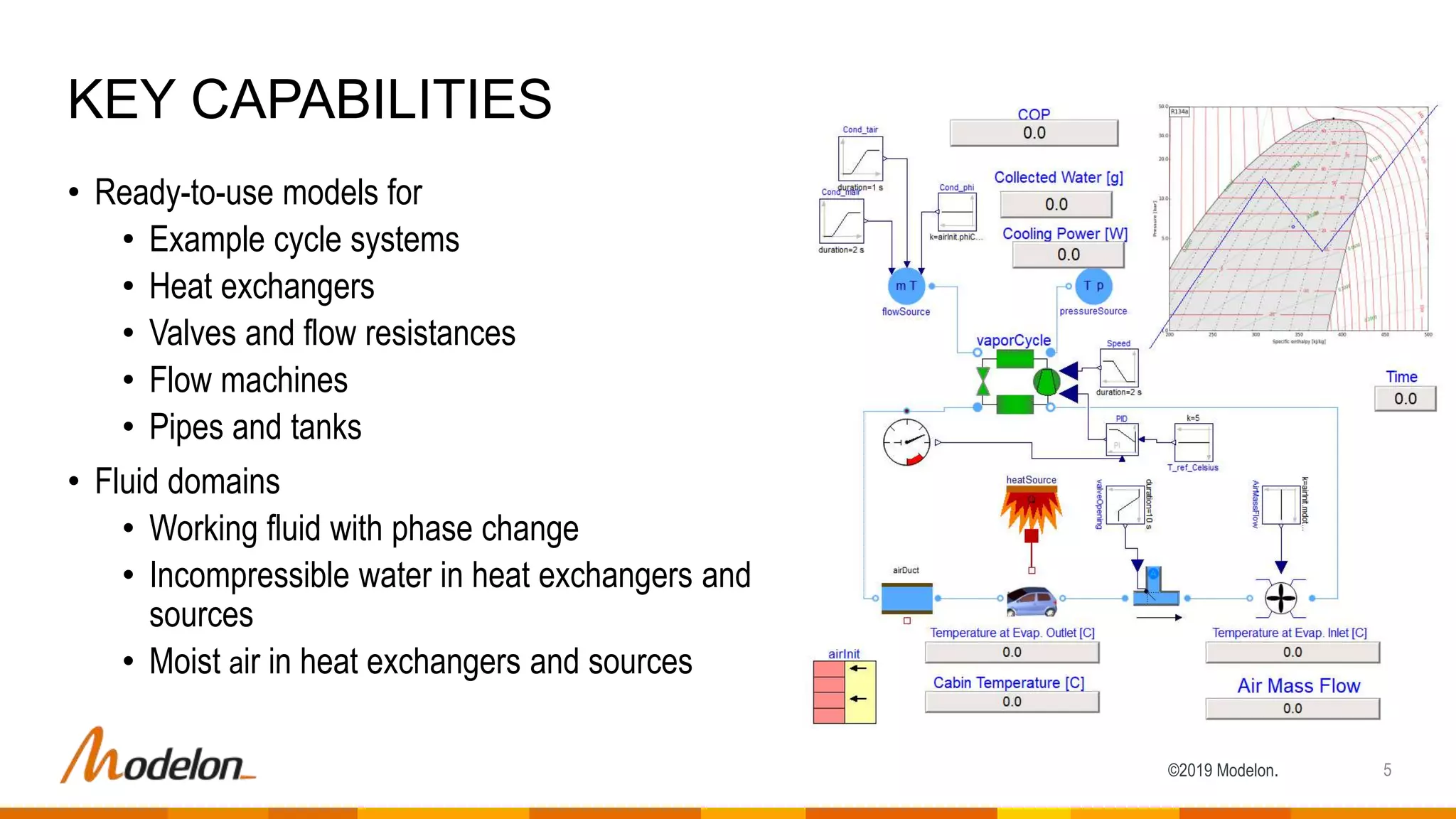
• Ready-to-use models for
• Example cycle systems
• Heat exchangers
• Valves and flow resistances
• Flow machines
• Pipes and tanks
• Fluid domains
• Working fluid with phase change
• Incompressible water in heat exchangers and
sources
• Moist air in heat exchangers and sources
KEY CAPABILITIES
5
©2019 Modelon.
KEY APPLICATIONS
6
©2019 Modelon.
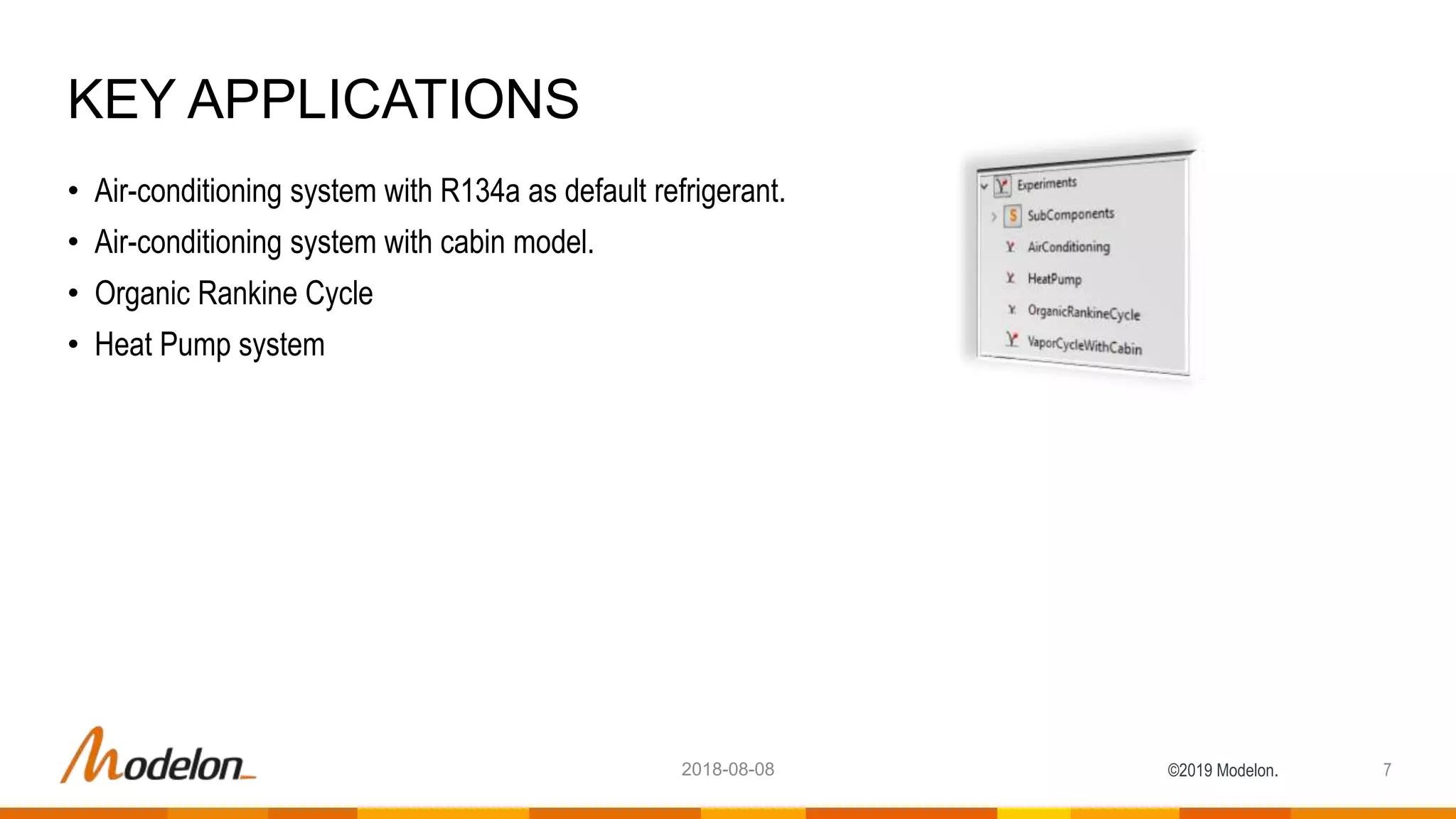
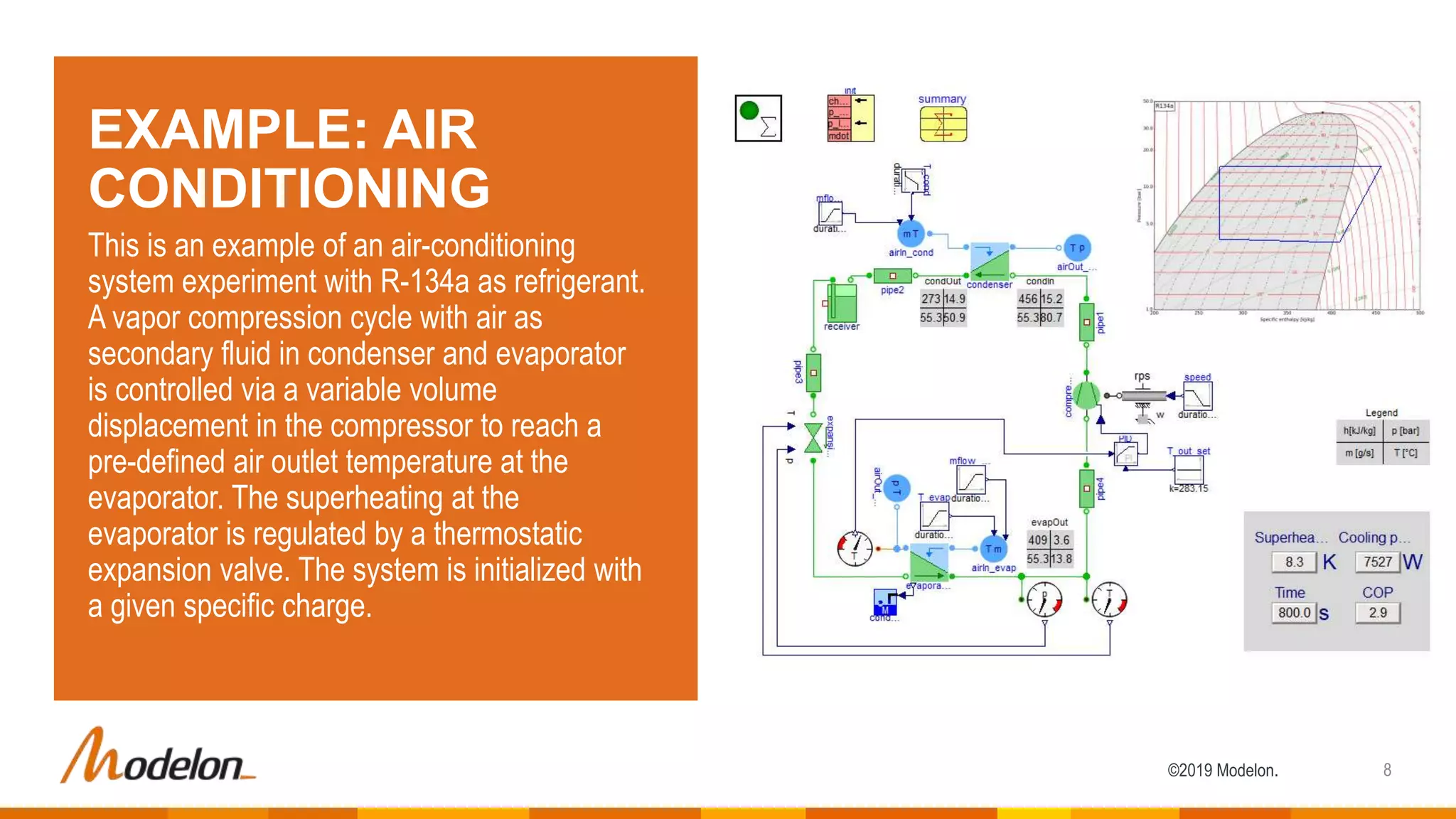
• Air-conditioning system with R134a as default refrigerant.
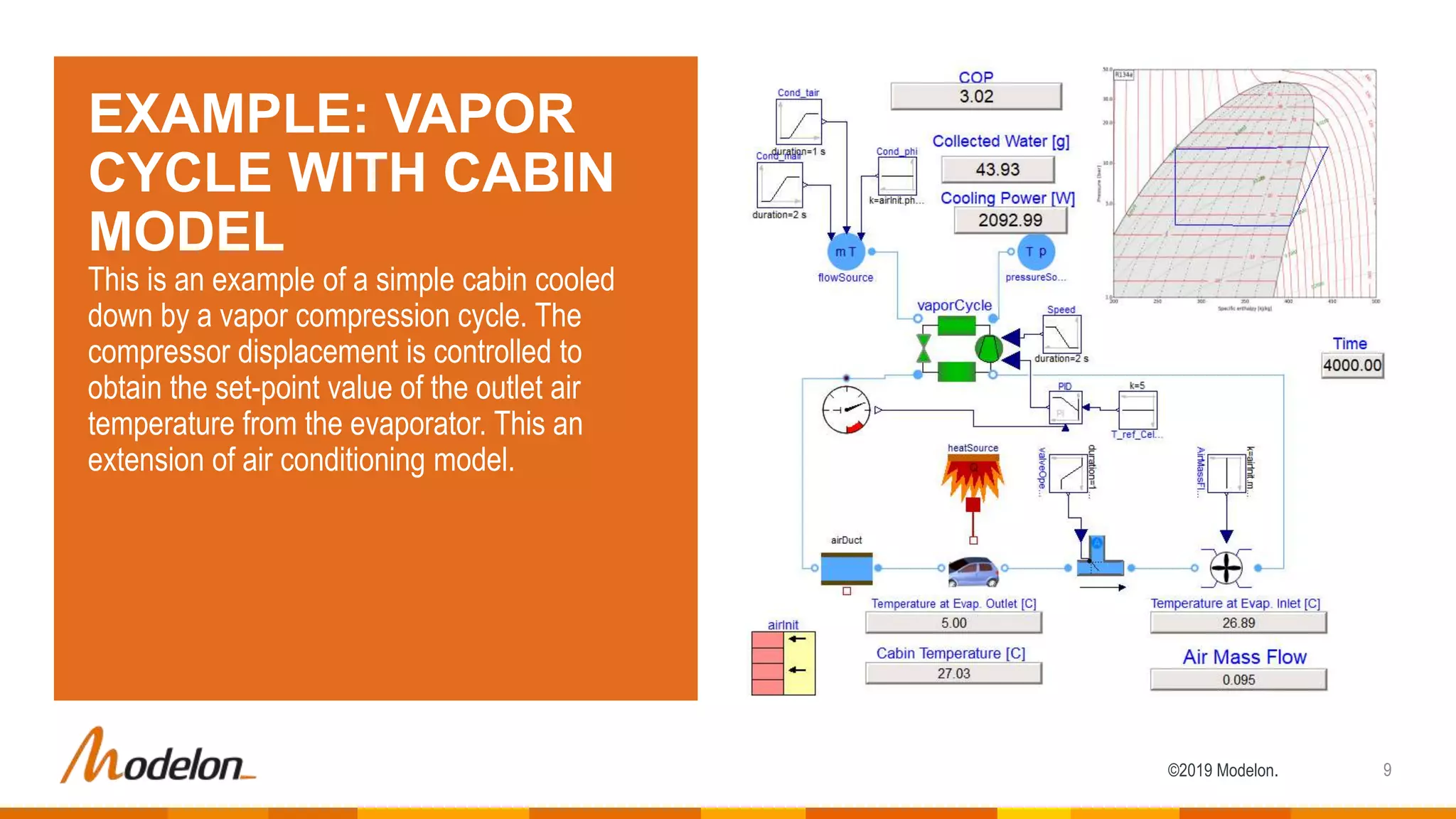
• Air-conditioning system with cabin model.
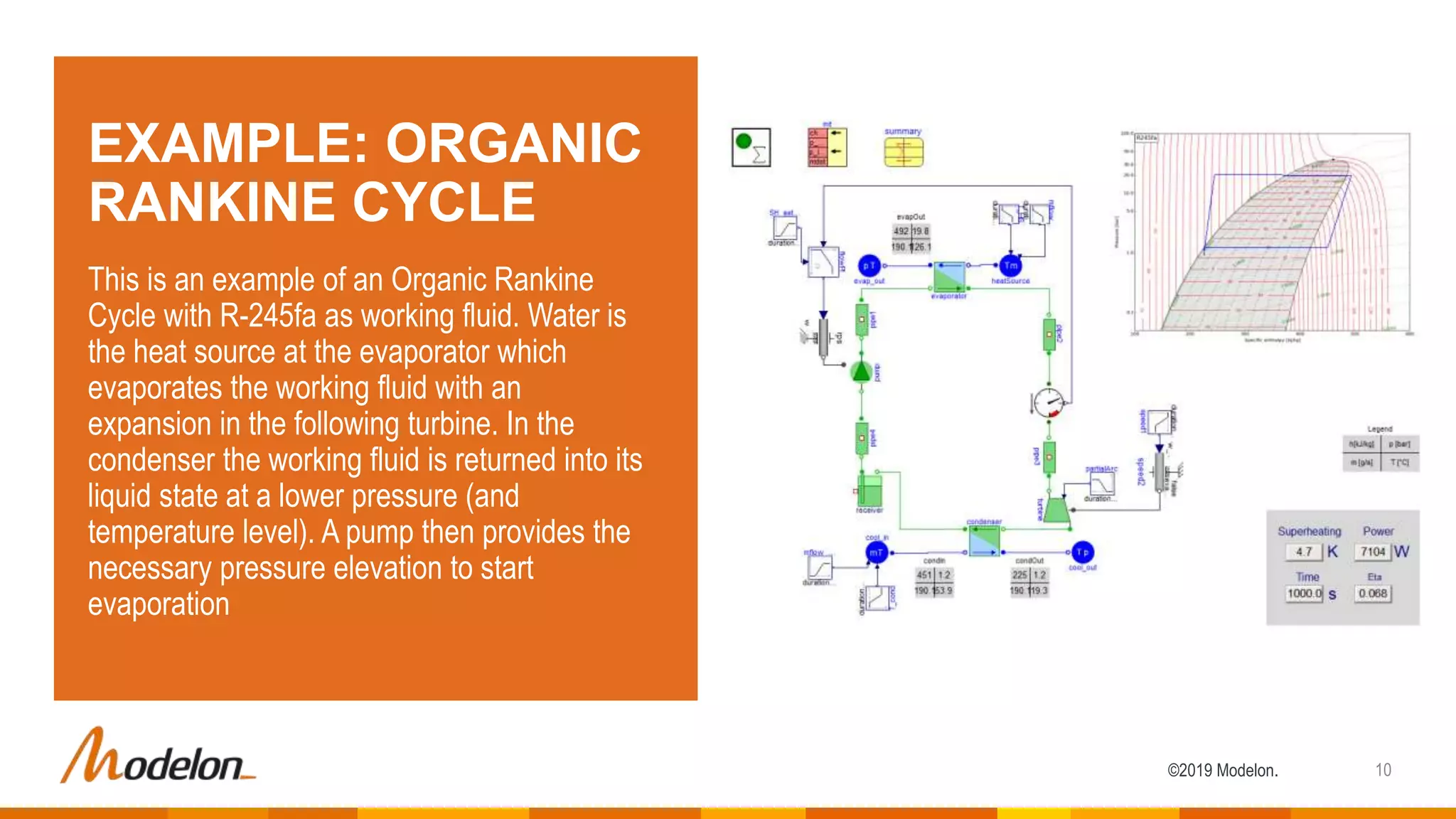
• Organic Rankine Cycle
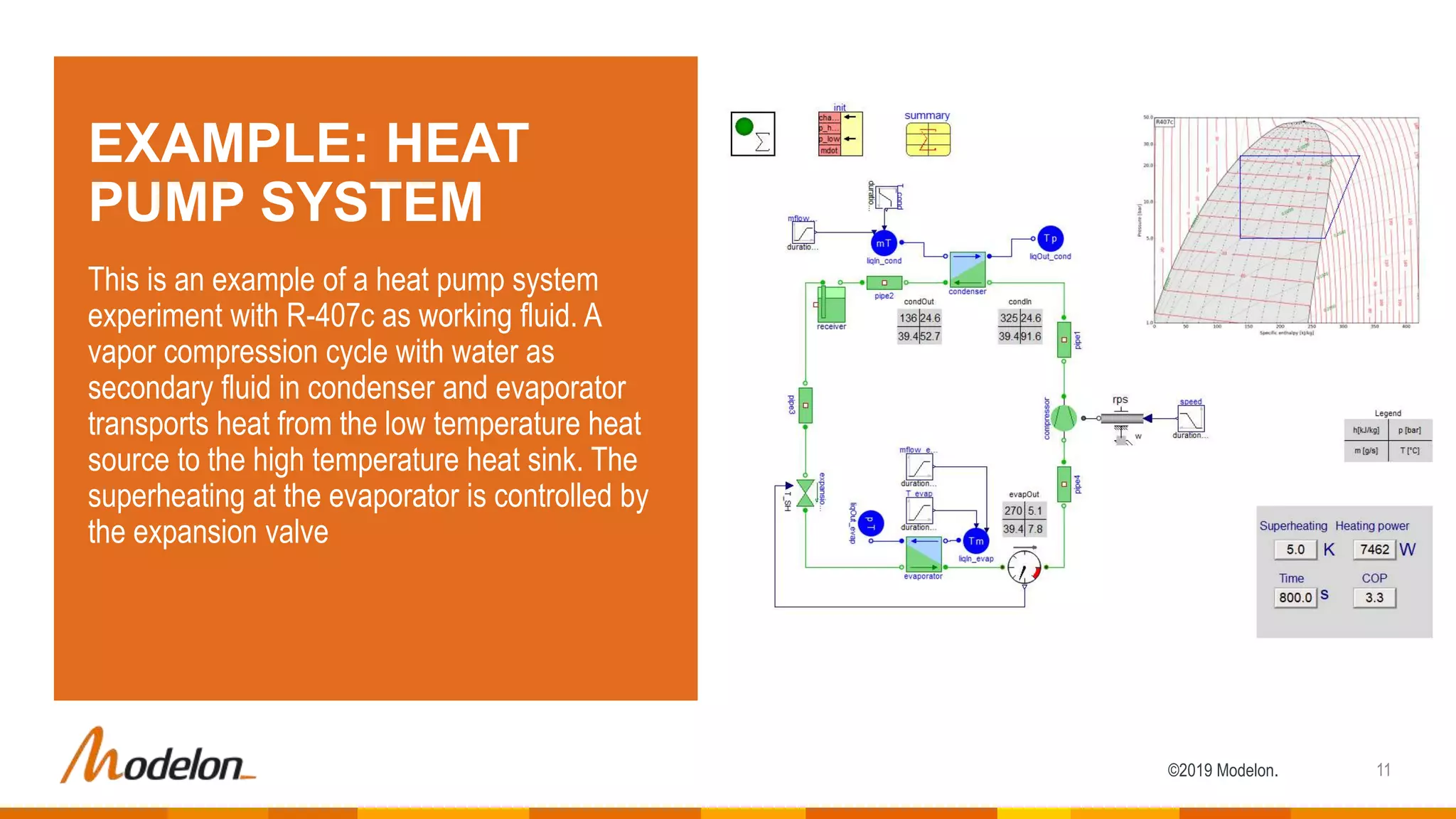
• Heat Pump system
KEY APPLICATIONS
72018-08-08
©2019 Modelon.
EXAMPLE: AIR
CONDITIONING
This is an example of an air-conditioning
system experiment with R-134a as refrigerant.
A vapor compression cycle with air as
secondary fluid in condenser and evaporator
is controlled via a variable volume
displacement in the compressor to reach a
pre-defined air outlet temperature at the
evaporator. The superheating at the
evaporator is regulated by a thermostatic
expansion valve. The system is initialized with
a given specific charge.
8
©2019 Modelon.
EXAMPLE: VAPOR
CYCLE WITH CABIN
MODEL
This is an example of a simple cabin cooled
down by a vapor compression cycle. The
compressor displacement is controlled to
obtain the set-point value of the outlet air
temperature from the evaporator. This an
extension of air conditioning model.
9
©2019 Modelon.
EXAMPLE: ORGANIC
RANKINE CYCLE
This is an example of an Organic Rankine
Cycle with R-245fa as working fluid. Water is
the heat source at the evaporator which
evaporates the working fluid with an
expansion in the following turbine. In the
condenser the working fluid is returned into its
liquid state at a lower pressure (and
temperature level). A pump then provides the
necessary pressure elevation to start
evaporation
10
©2019 Modelon.
EXAMPLE: HEAT
PUMP SYSTEM
This is an example of a heat pump system
experiment with R-407c as working fluid. A
vapor compression cycle with water as
secondary fluid in condenser and evaporator
transports heat from the low temperature heat
source to the high temperature heat sink. The
superheating at the evaporator is controlled by
the expansion valve
11
©2019 Modelon.
LIBRARY CONTENTS
12
©2019 Modelon.
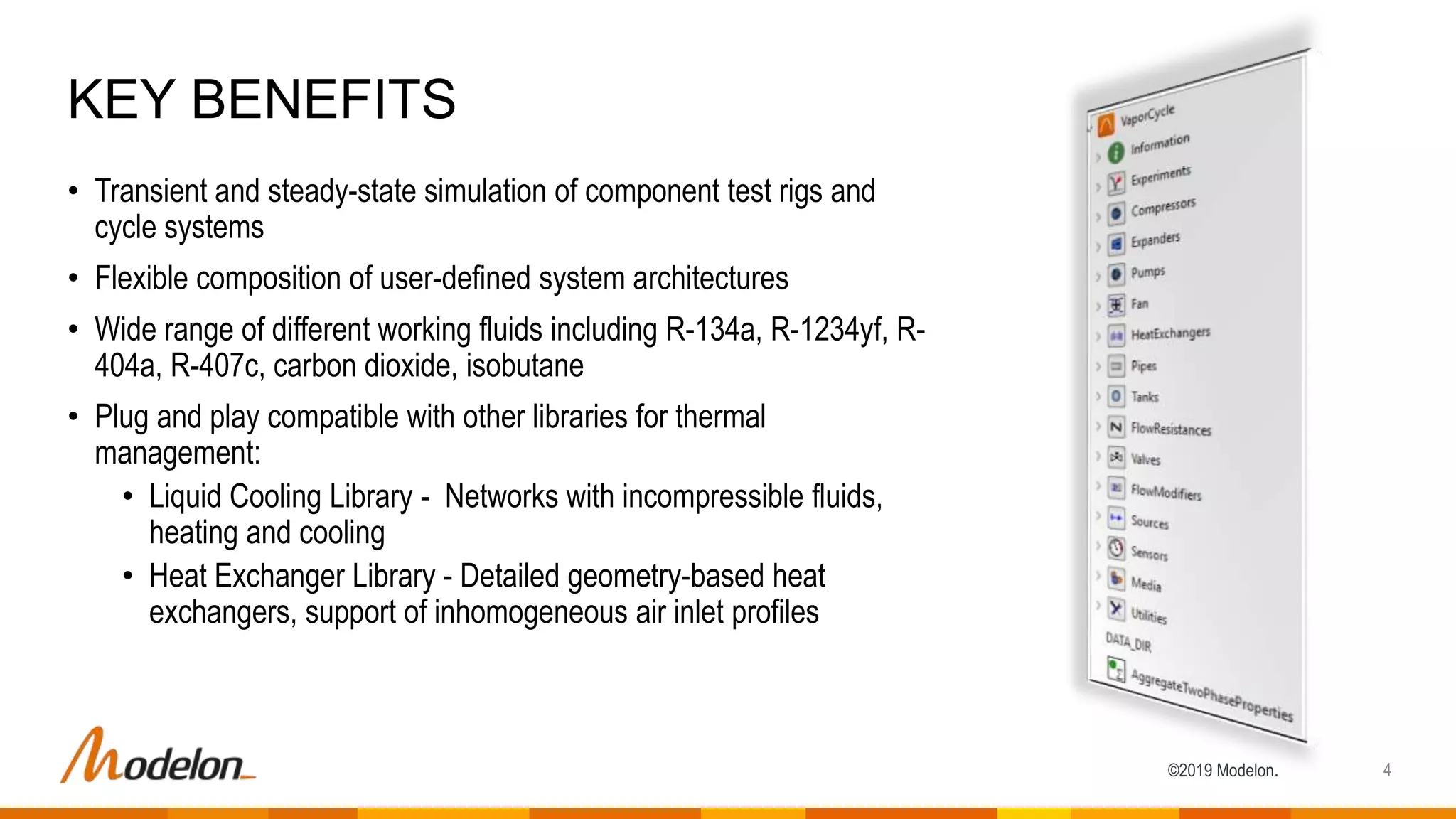
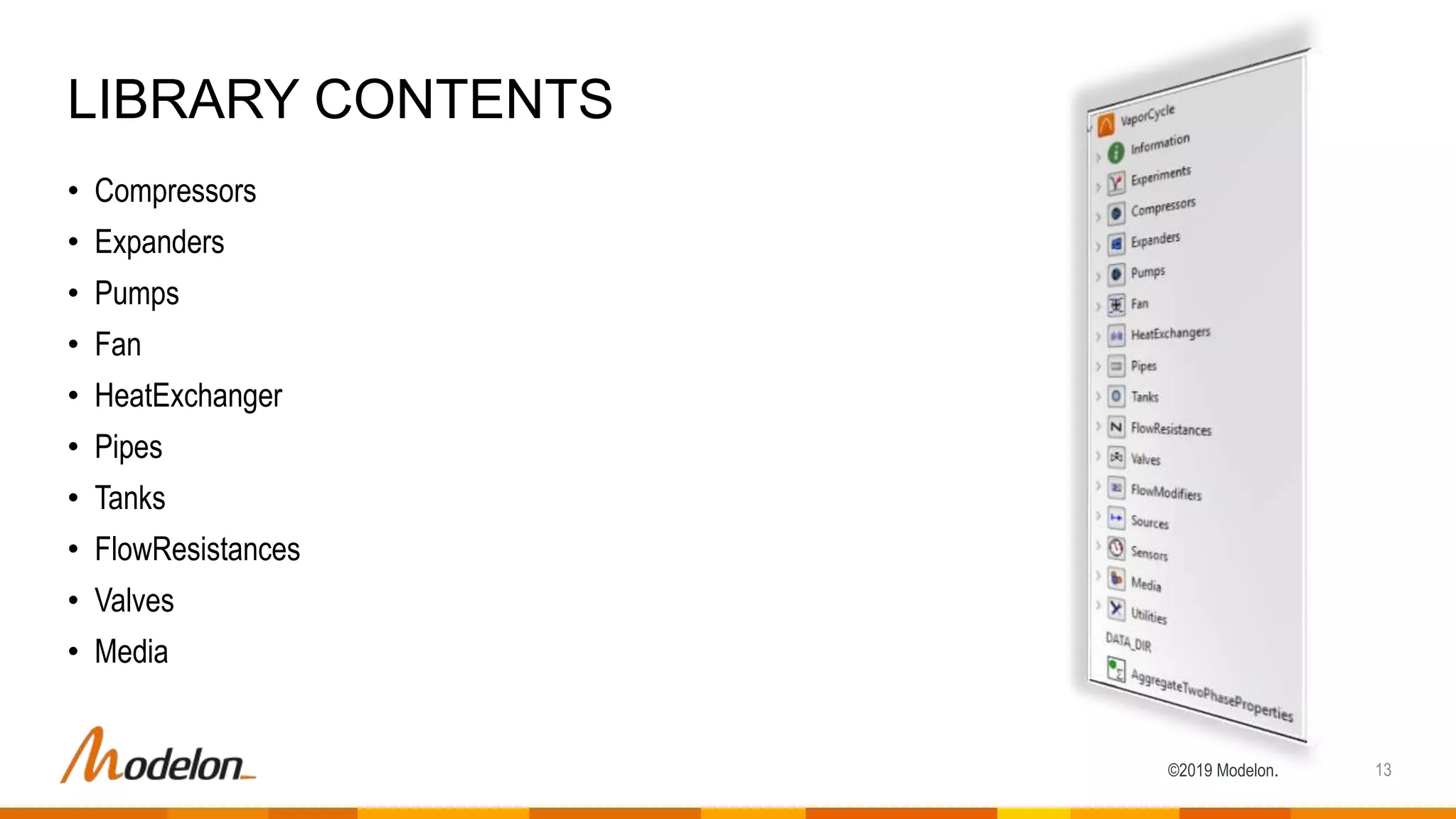
• Compressors
• Expanders
• Pumps
• Fan
• HeatExchanger
• Pipes
• Tanks
• FlowResistances
• Valves
• Media
LIBRARY CONTENTS
13
©2019 Modelon.
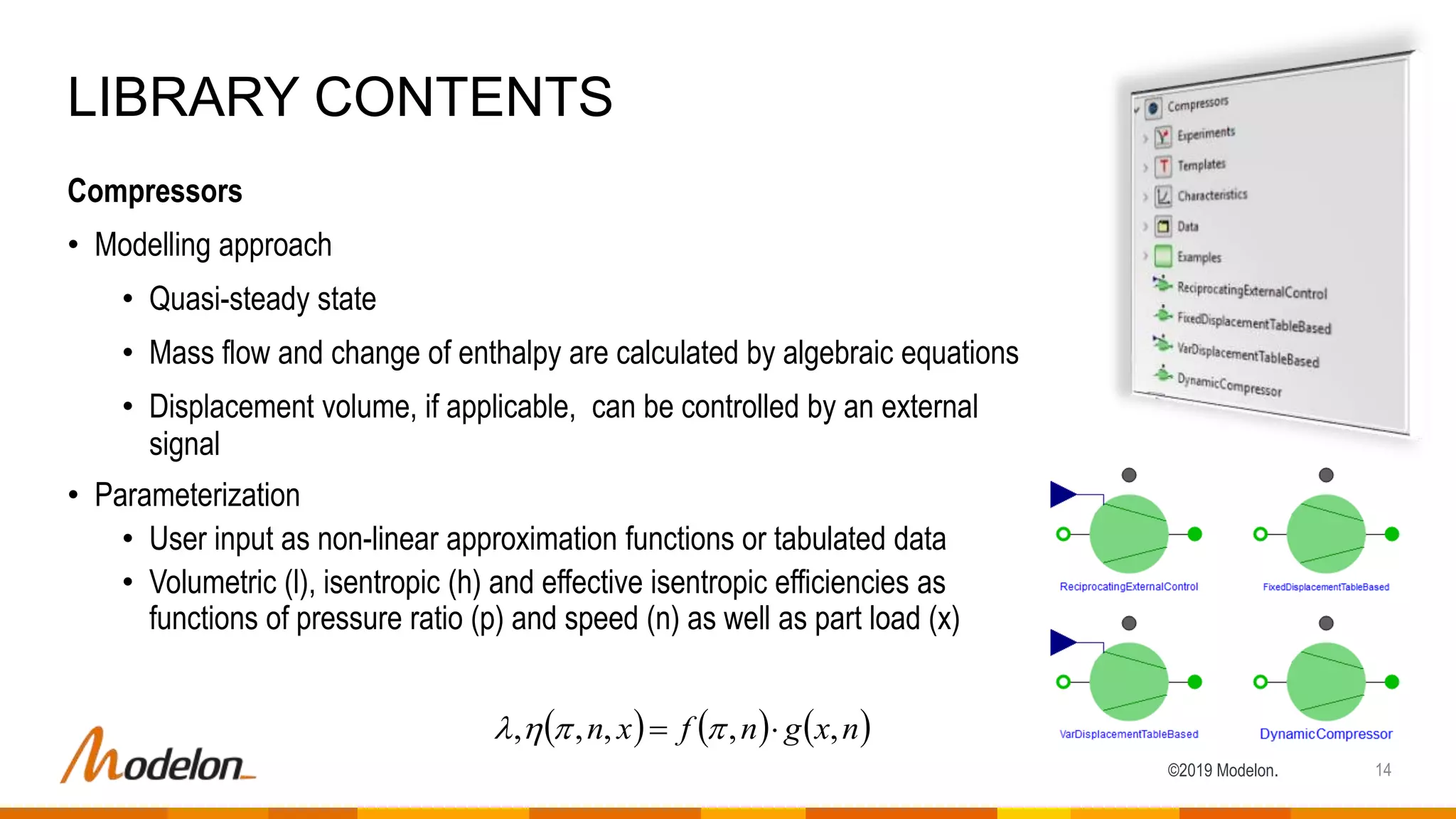
Compressors
• Modelling approach
• Quasi-steady state
• Mass flow and change of enthalpy are calculated by algebraic equations
• Displacement volume, if applicable, can be controlled by an external
signal
• Parameterization
• User input as non-linear approximation functions or tabulated data
• Volumetric (l), isentropic (h) and effective isentropic efficiencies as
functions of pressure ratio (p) and speed (n) as well as part load (x)
LIBRARY CONTENTS
14
     nxgnfxn ,,,,,  
©2019 Modelon.
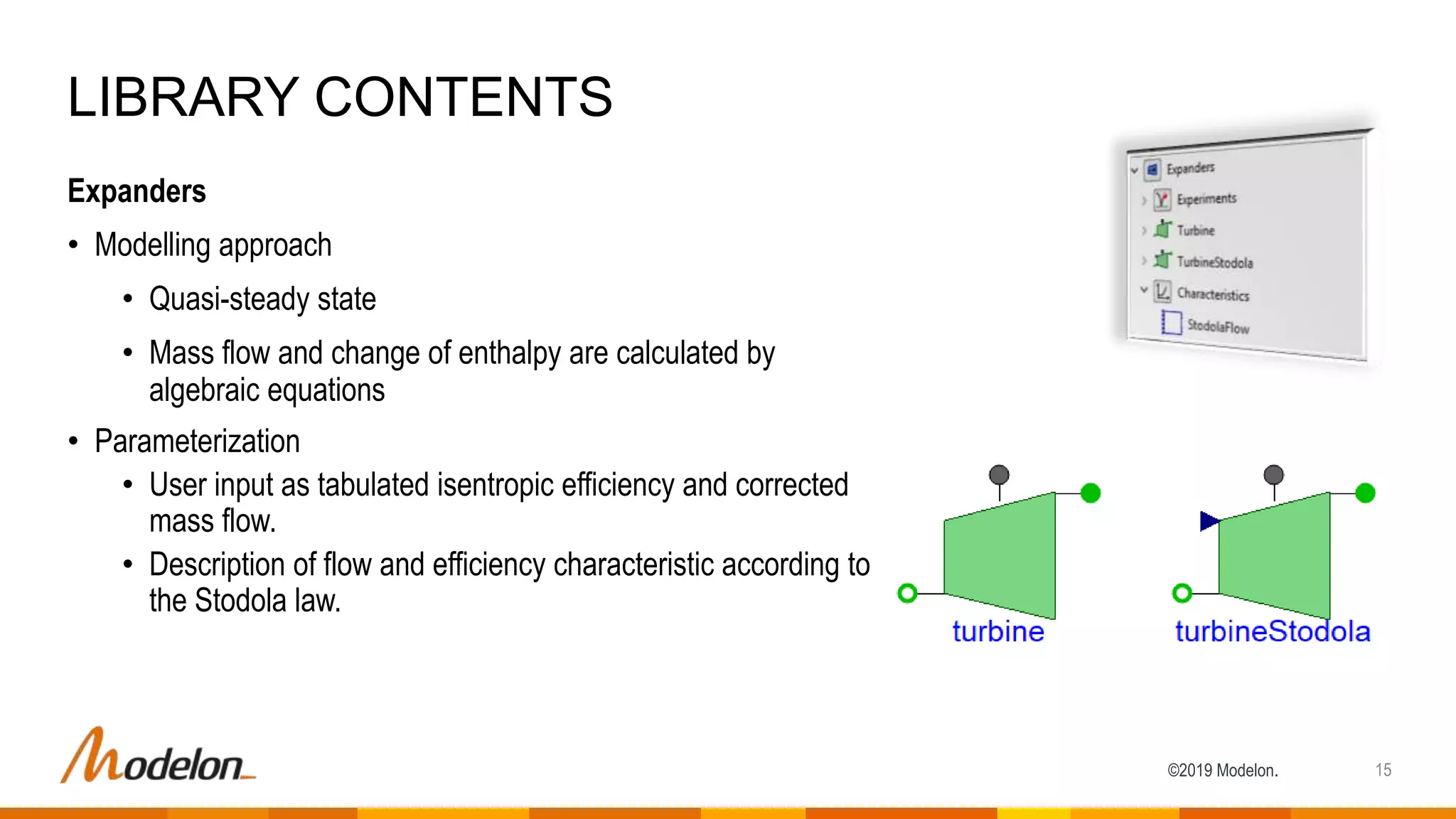
Expanders
• Modelling approach
• Quasi-steady state
• Mass flow and change of enthalpy are calculated by
algebraic equations
• Parameterization
• User input as tabulated isentropic efficiency and corrected
mass flow.
• Description of flow and efficiency characteristic according to
the Stodola law.
LIBRARY CONTENTS
15
©2019 Modelon.
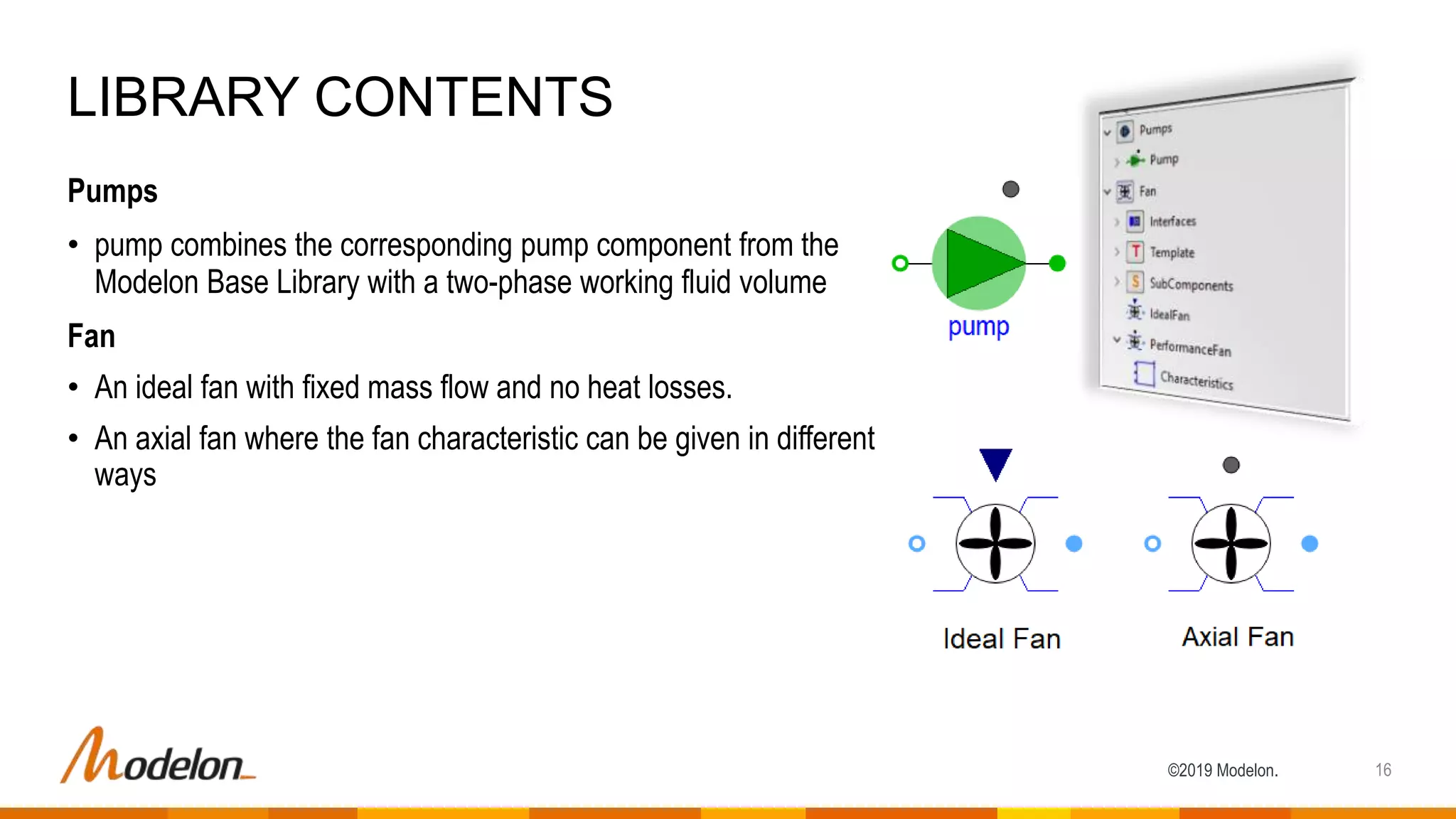
Pumps
• pump combines the corresponding pump component from the
Modelon Base Library with a two-phase working fluid volume
Fan
• An ideal fan with fixed mass flow and no heat losses.
• An axial fan where the fan characteristic can be given in different
ways
LIBRARY CONTENTS
16
©2019 Modelon.
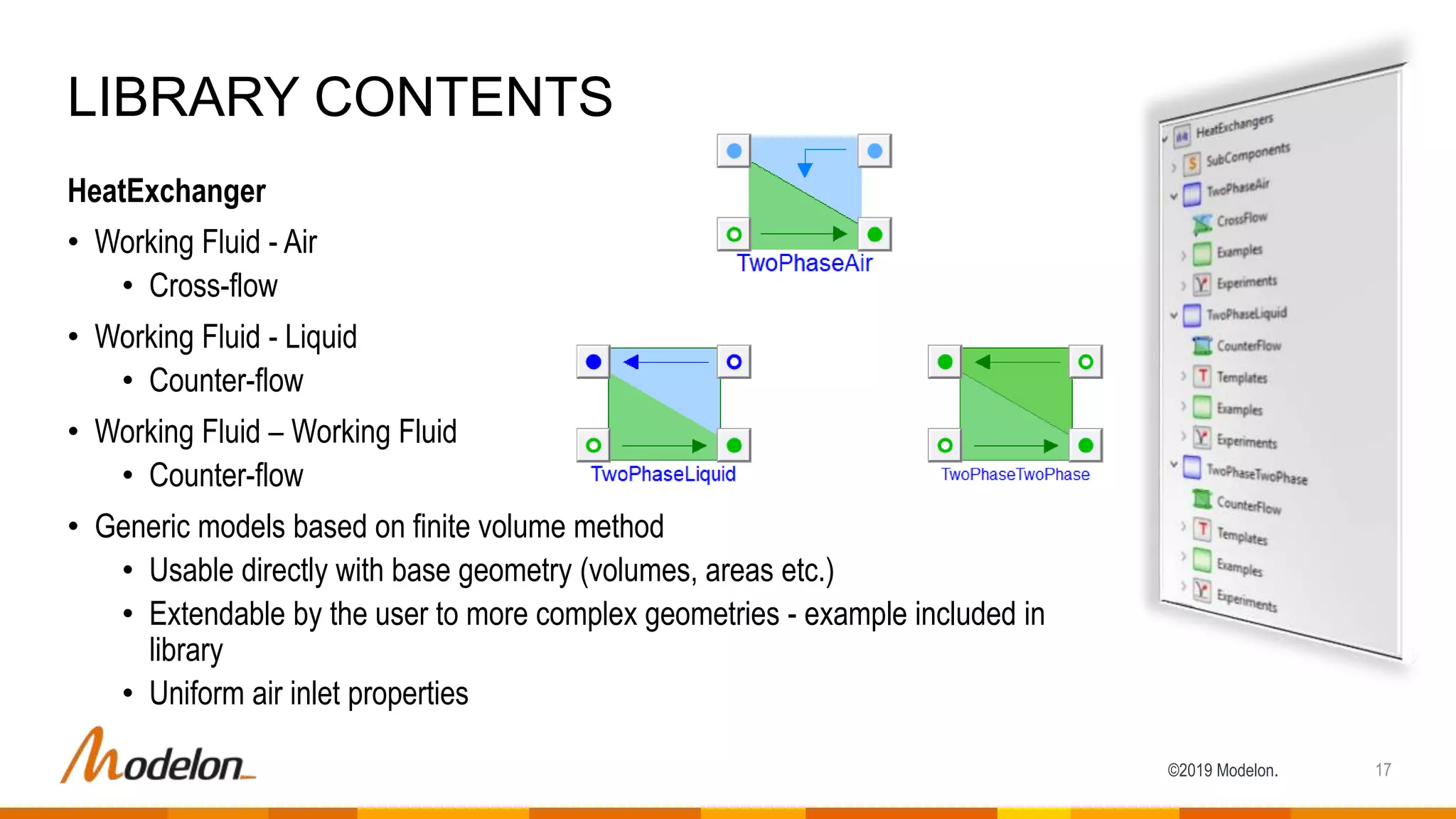
HeatExchanger
• Working Fluid - Air
• Cross-flow
• Working Fluid - Liquid
• Counter-flow
• Working Fluid – Working Fluid
• Counter-flow
• Generic models based on finite volume method
• Usable directly with base geometry (volumes, areas etc.)
• Extendable by the user to more complex geometries - example included in
library
• Uniform air inlet properties
LIBRARY CONTENTS
17
©2019 Modelon.
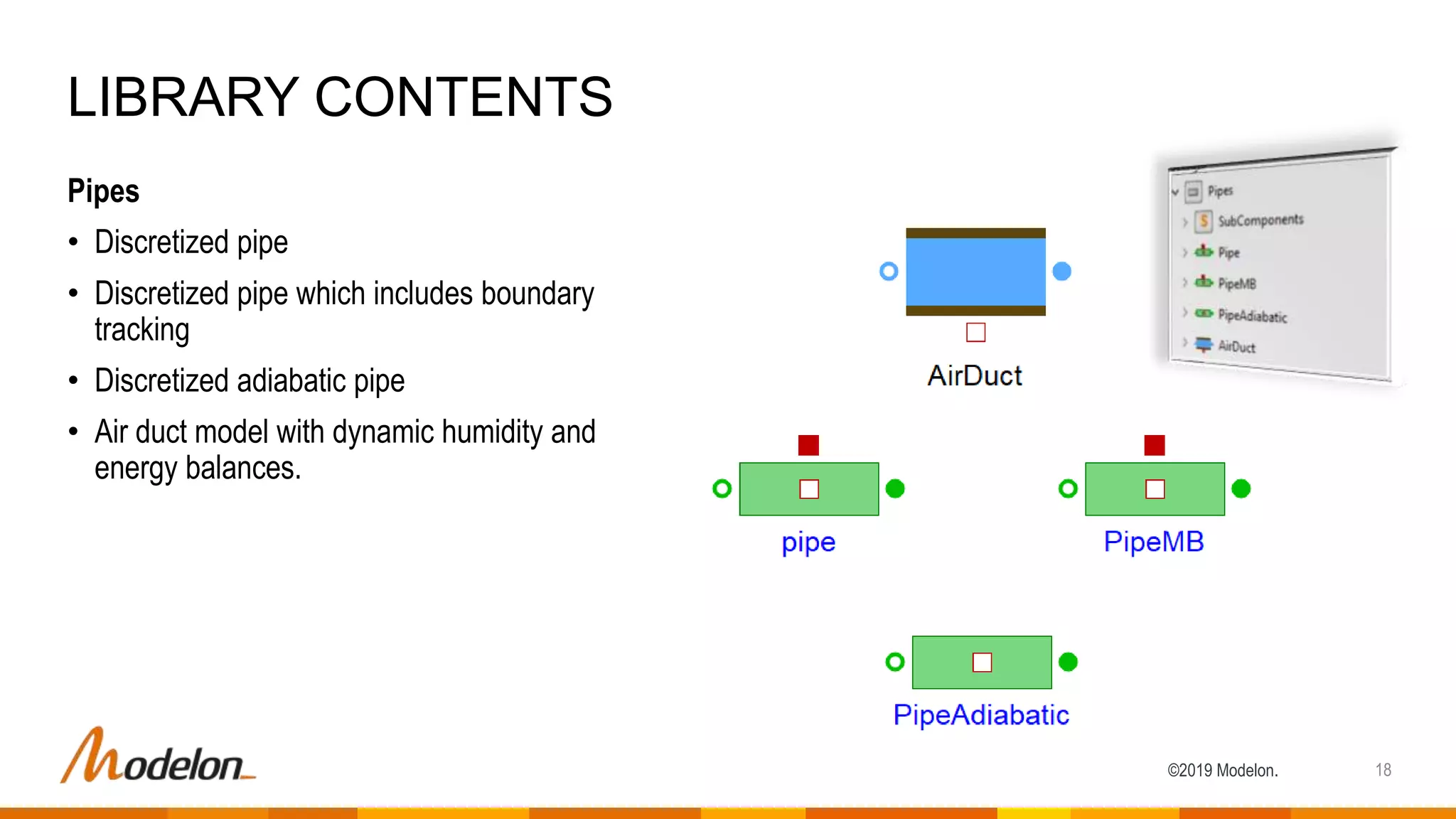
Pipes
• Discretized pipe
• Discretized pipe which includes boundary
tracking
• Discretized adiabatic pipe
• Air duct model with dynamic humidity and
energy balances.
LIBRARY CONTENTS
18
©2019 Modelon.
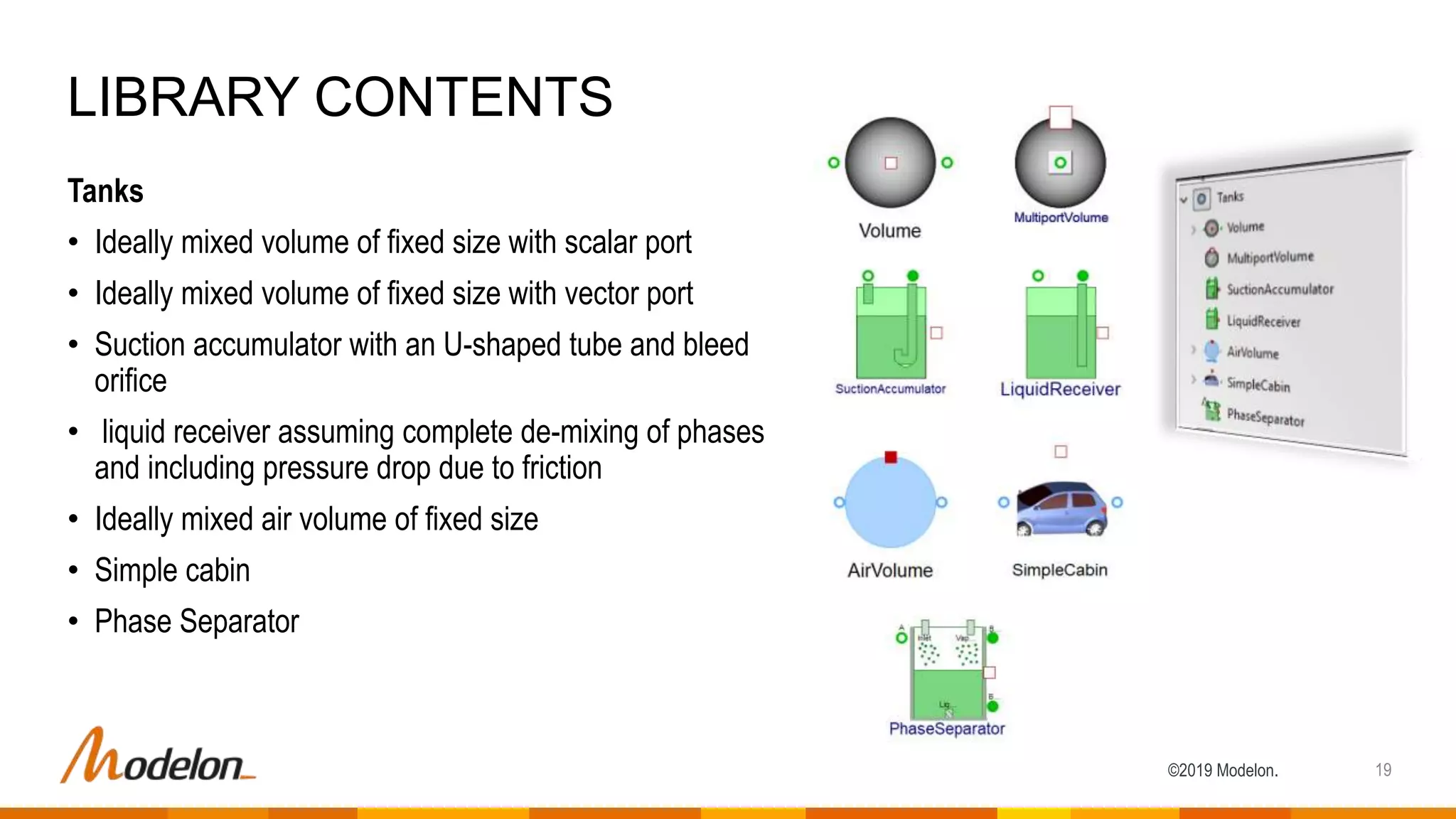
Tanks
• Ideally mixed volume of fixed size with scalar port
• Ideally mixed volume of fixed size with vector port
• Suction accumulator with an U-shaped tube and bleed
orifice
• liquid receiver assuming complete de-mixing of phases
and including pressure drop due to friction
• Ideally mixed air volume of fixed size
• Simple cabin
• Phase Separator
LIBRARY CONTENTS
19
©2019 Modelon.
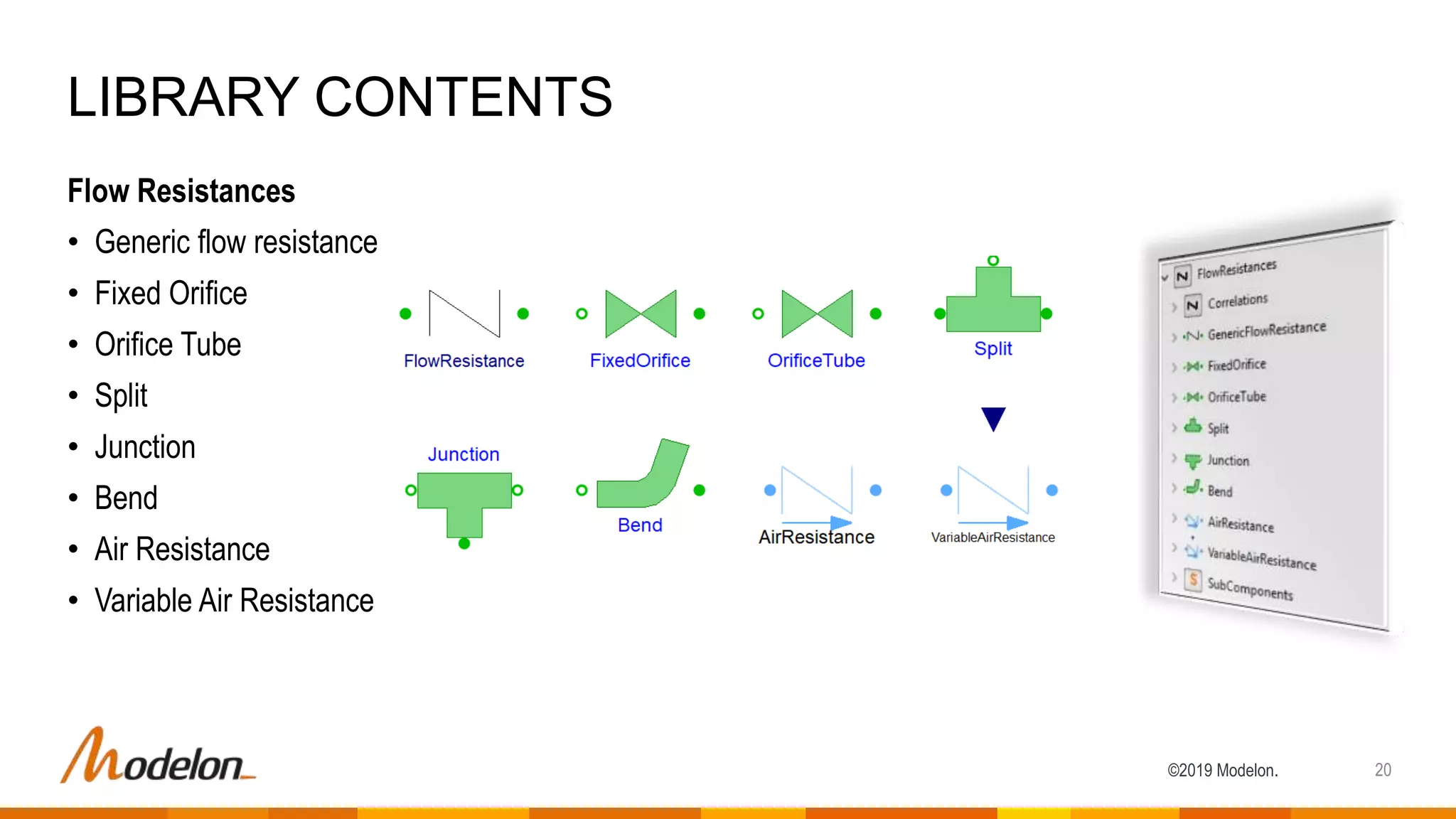
Flow Resistances
• Generic flow resistance
• Fixed Orifice
• Orifice Tube
• Split
• Junction
• Bend
• Air Resistance
• Variable Air Resistance
LIBRARY CONTENTS
20
©2019 Modelon.
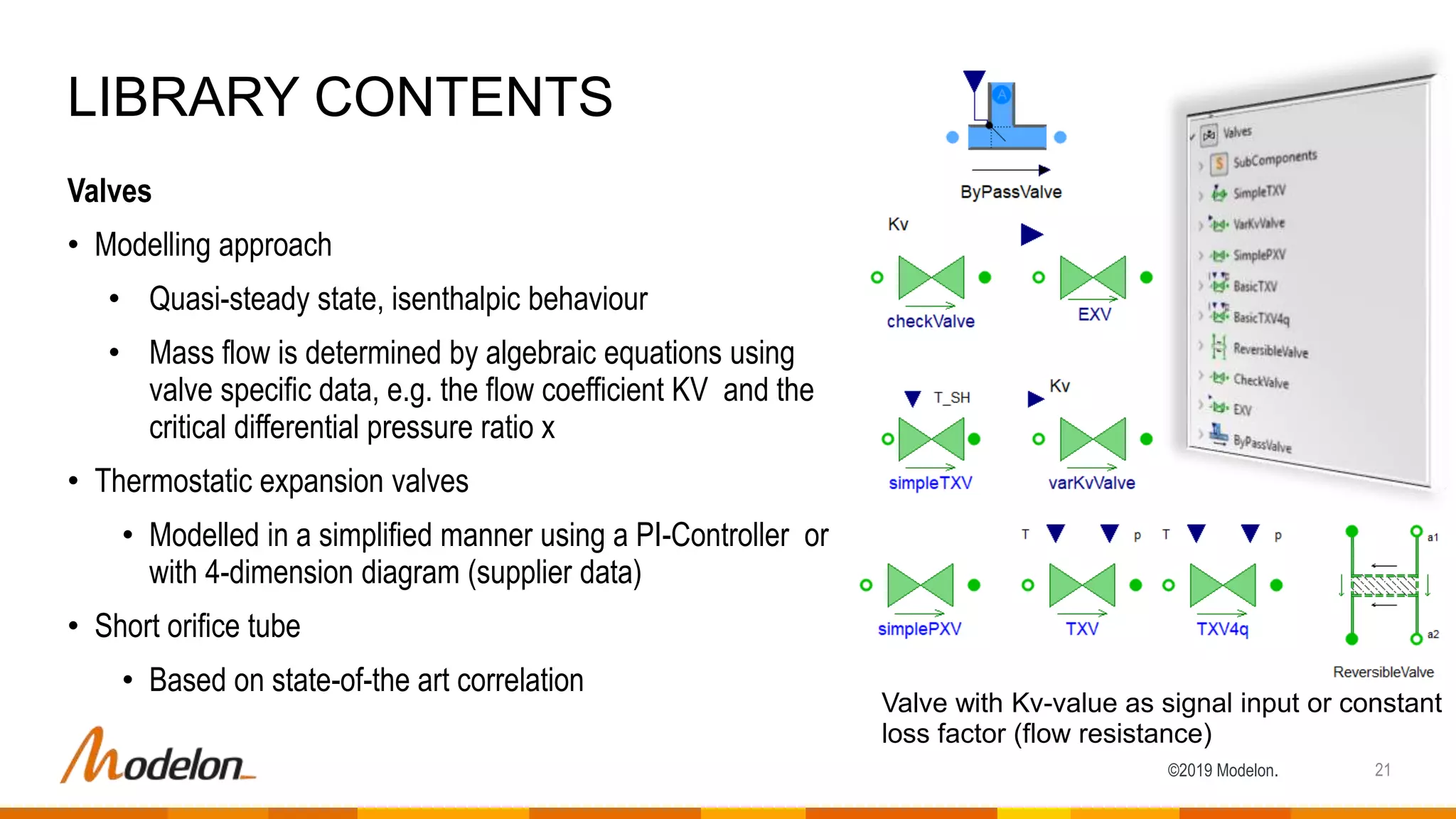
Valves
• Modelling approach
• Quasi-steady state, isenthalpic behaviour
• Mass flow is determined by algebraic equations using
valve specific data, e.g. the flow coefficient KV and the
critical differential pressure ratio x
• Thermostatic expansion valves
• Modelled in a simplified manner using a PI-Controller or
with 4-dimension diagram (supplier data)
• Short orifice tube
• Based on state-of-the art correlation
LIBRARY CONTENTS
21
Valve with Kv-value as signal input or constant
loss factor (flow resistance)
©2019 Modelon.
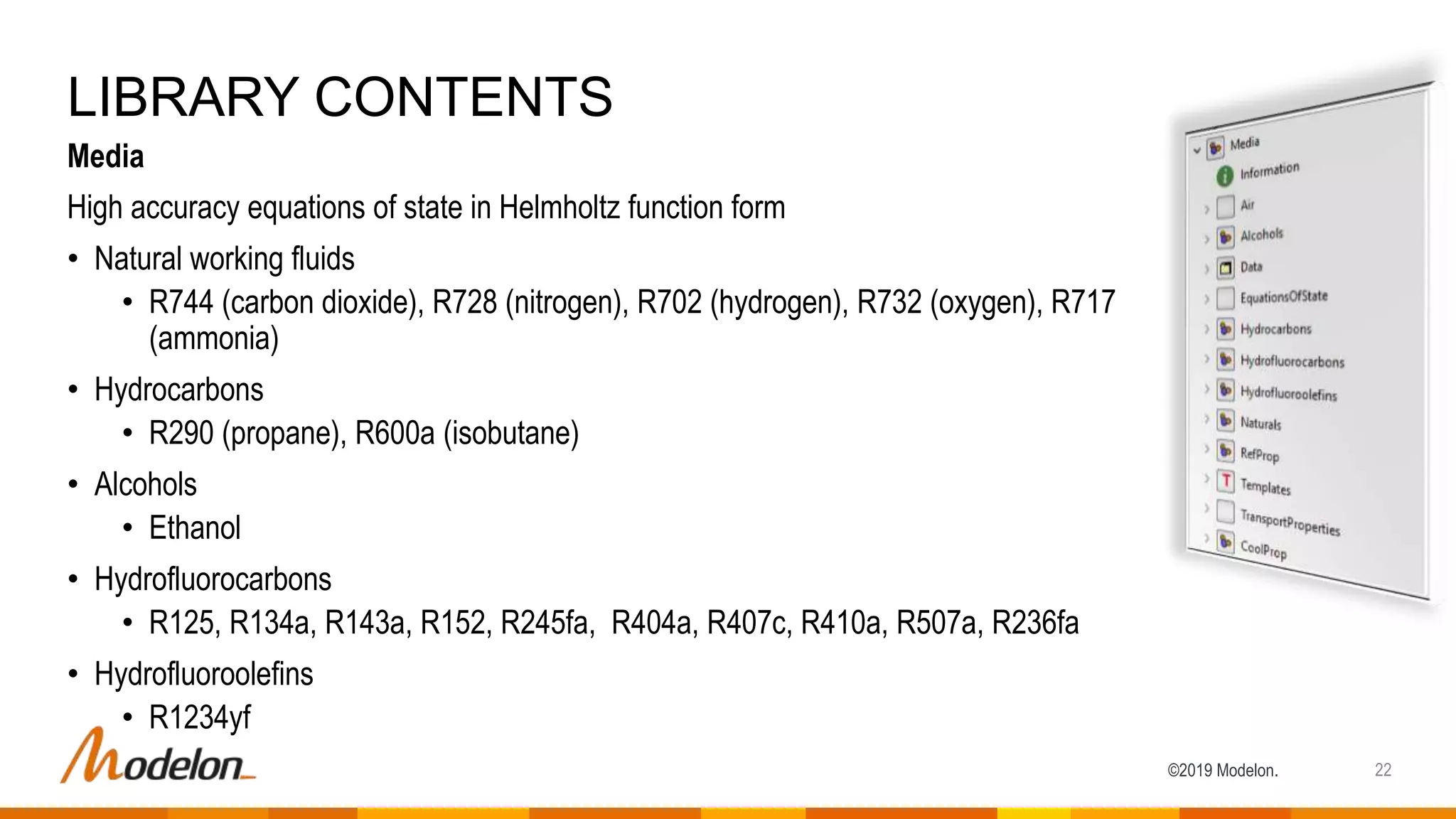
Media
High accuracy equations of state in Helmholtz function form
• Natural working fluids
• R744 (carbon dioxide), R728 (nitrogen), R702 (hydrogen), R732 (oxygen), R717
(ammonia)
• Hydrocarbons
• R290 (propane), R600a (isobutane)
• Alcohols
• Ethanol
• Hydrofluorocarbons
• R125, R134a, R143a, R152, R245fa, R404a, R407c, R410a, R507a, R236fa
• Hydrofluoroolefins
• R1234yf
LIBRARY CONTENTS
22
©2019 Modelon.
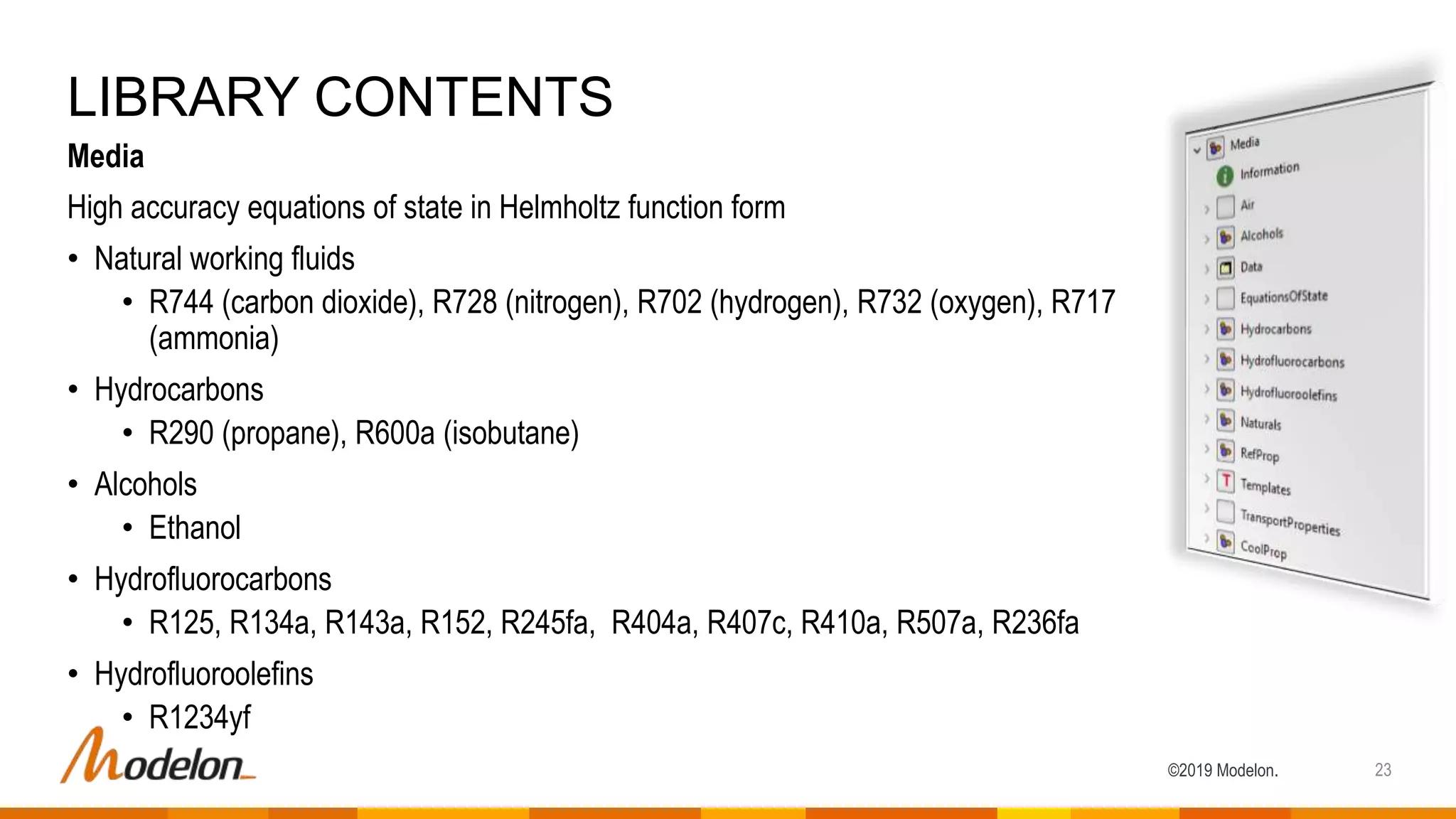
Media
High accuracy equations of state in Helmholtz function form
• Natural working fluids
• R744 (carbon dioxide), R728 (nitrogen), R702 (hydrogen), R732 (oxygen), R717
(ammonia)
• Hydrocarbons
• R290 (propane), R600a (isobutane)
• Alcohols
• Ethanol
• Hydrofluorocarbons
• R125, R134a, R143a, R152, R245fa, R404a, R407c, R410a, R507a, R236fa
• Hydrofluoroolefins
• R1234yf
LIBRARY CONTENTS
23
©2019 Modelon.
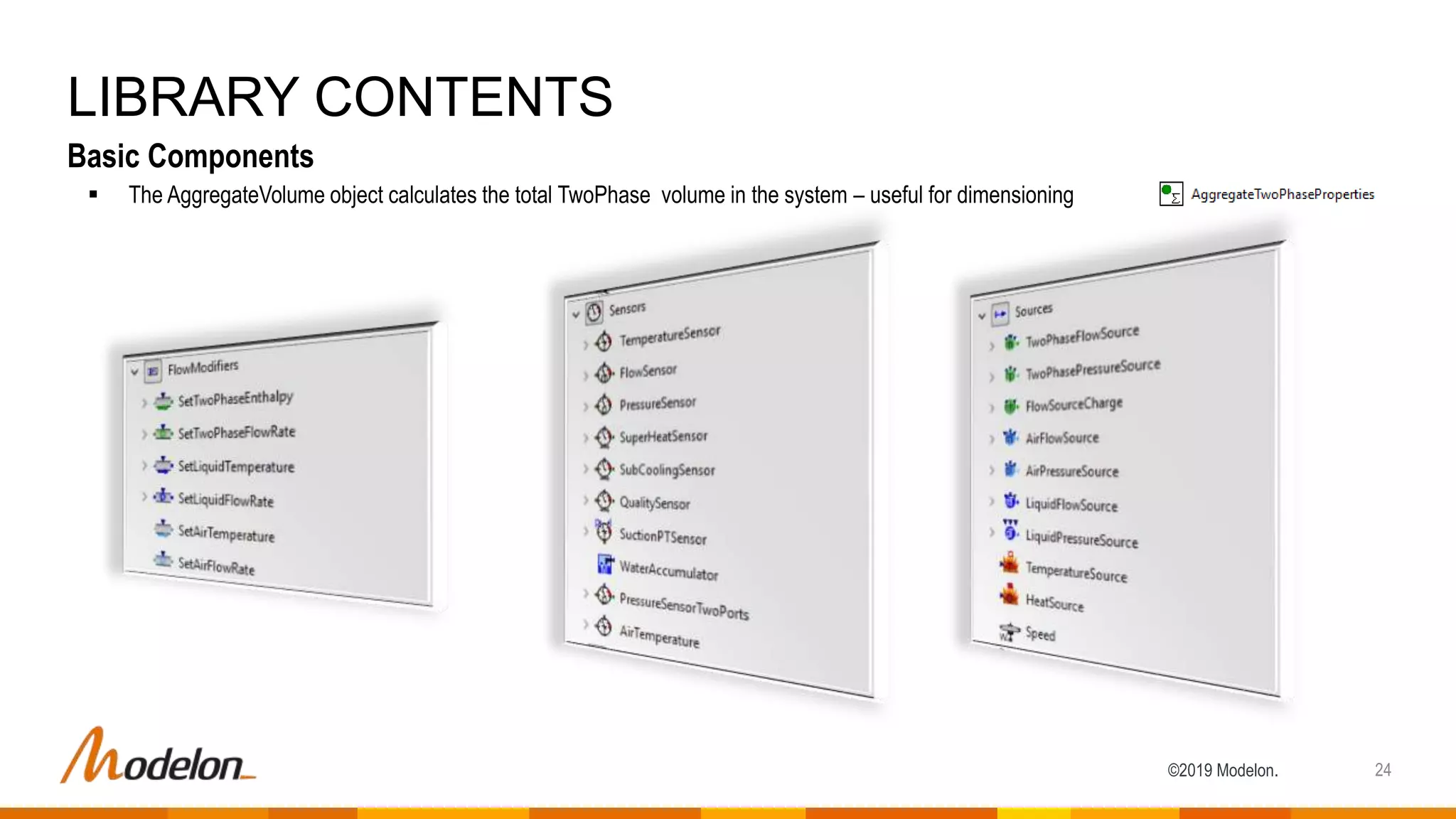
Basic Components
 The AggregateVolume object calculates the total TwoPhase volume in the system – useful for dimensioning
LIBRARY CONTENTS
24
©2019 Modelon.
MODELON COMPATIBILITY
25
©2019 Modelon.
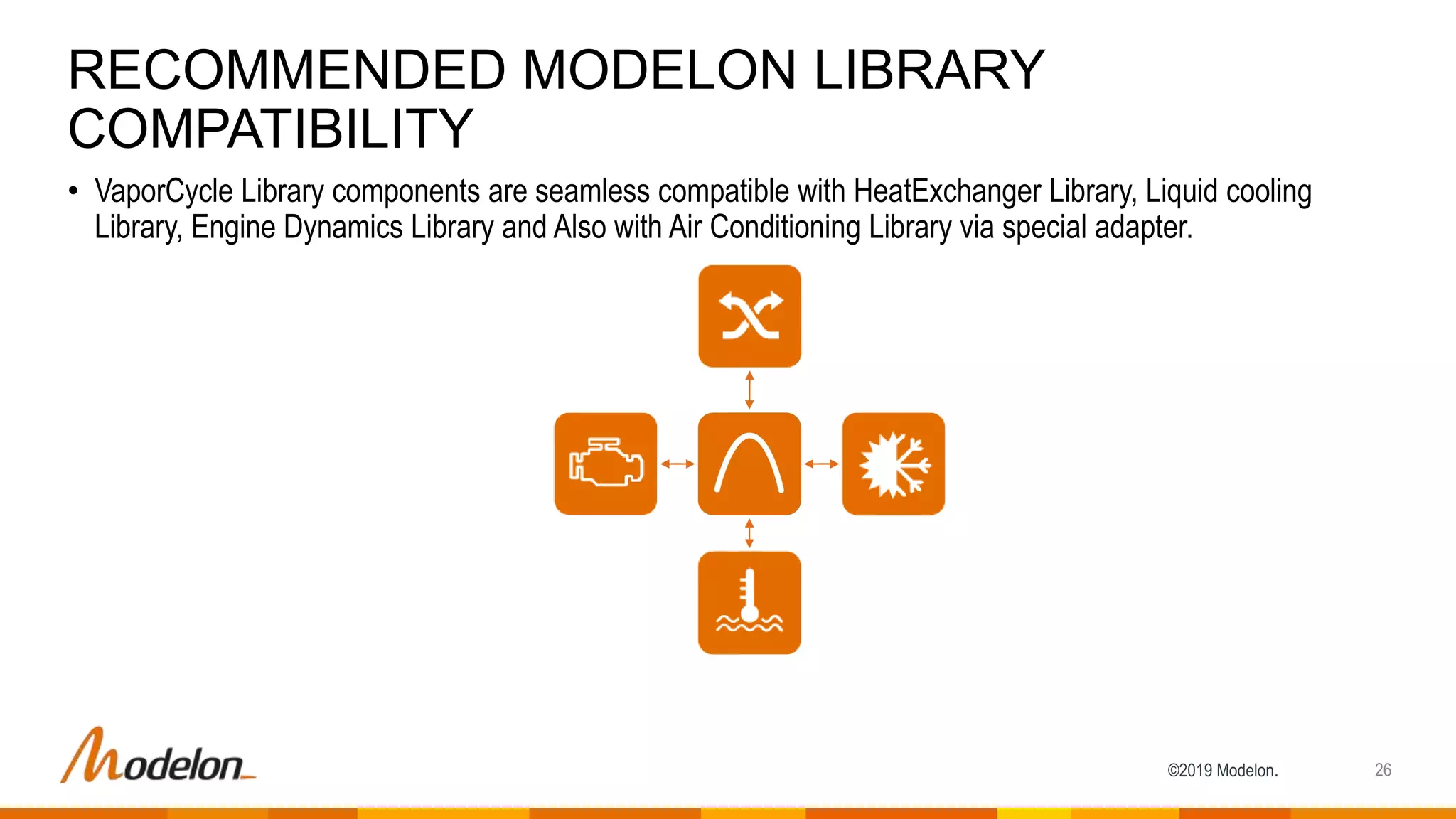
• VaporCycle Library components are seamless compatible with HeatExchanger Library, Liquid cooling
Library, Engine Dynamics Library and Also with Air Conditioning Library via special adapter.
RECOMMENDED MODELON LIBRARY
COMPATIBILITY
26
©2019 Modelon.
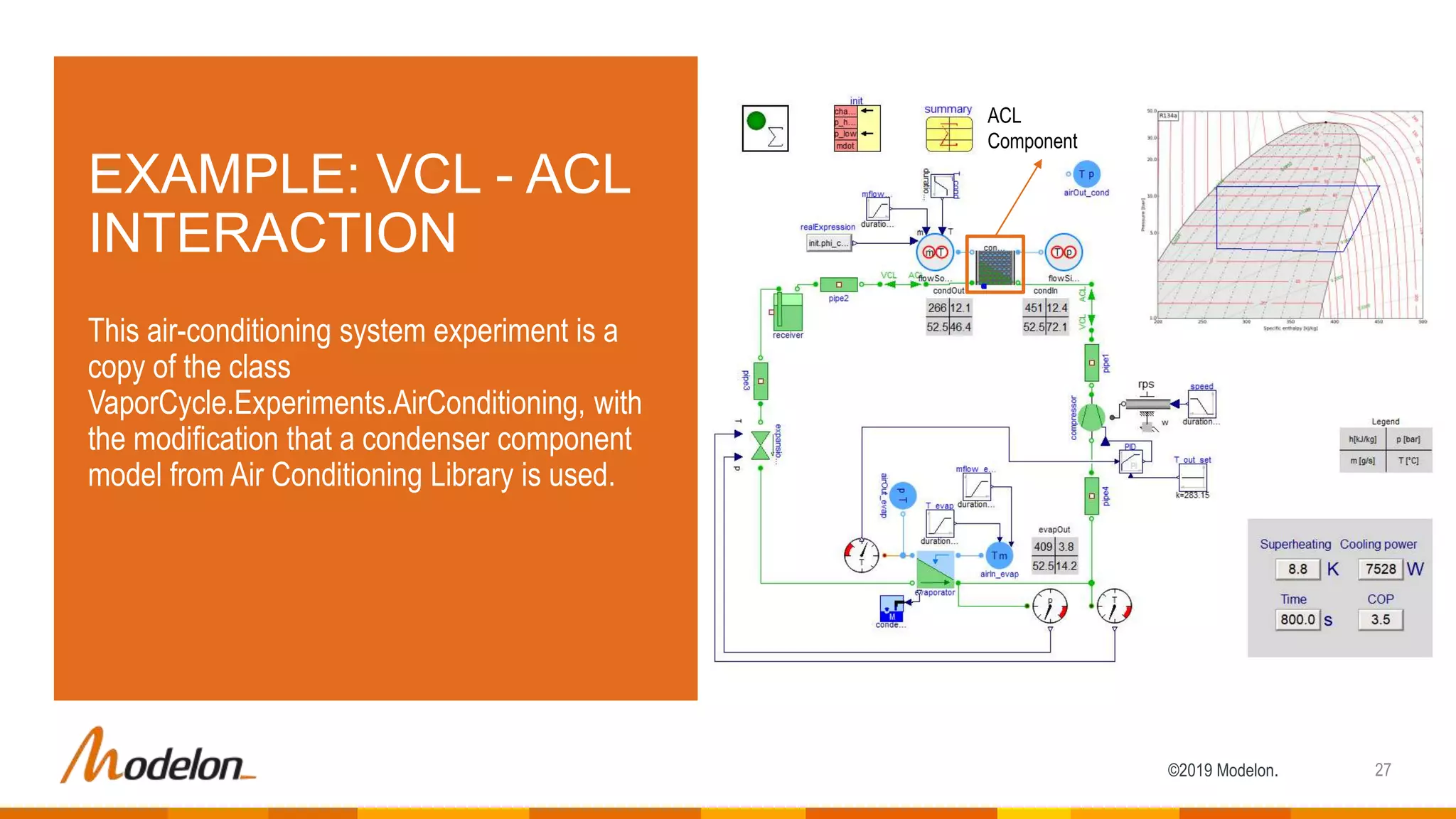
EXAMPLE: VCL - ACL
INTERACTION
This air-conditioning system experiment is a
copy of the class
VaporCycle.Experiments.AirConditioning, with
the modification that a condenser component
model from Air Conditioning Library is used.
27
ACL
Component
©2019 Modelon.
LATEST RELEASE: 2019.2
28
©2019 Modelon.
RELEASE:2019.2
New Features
29
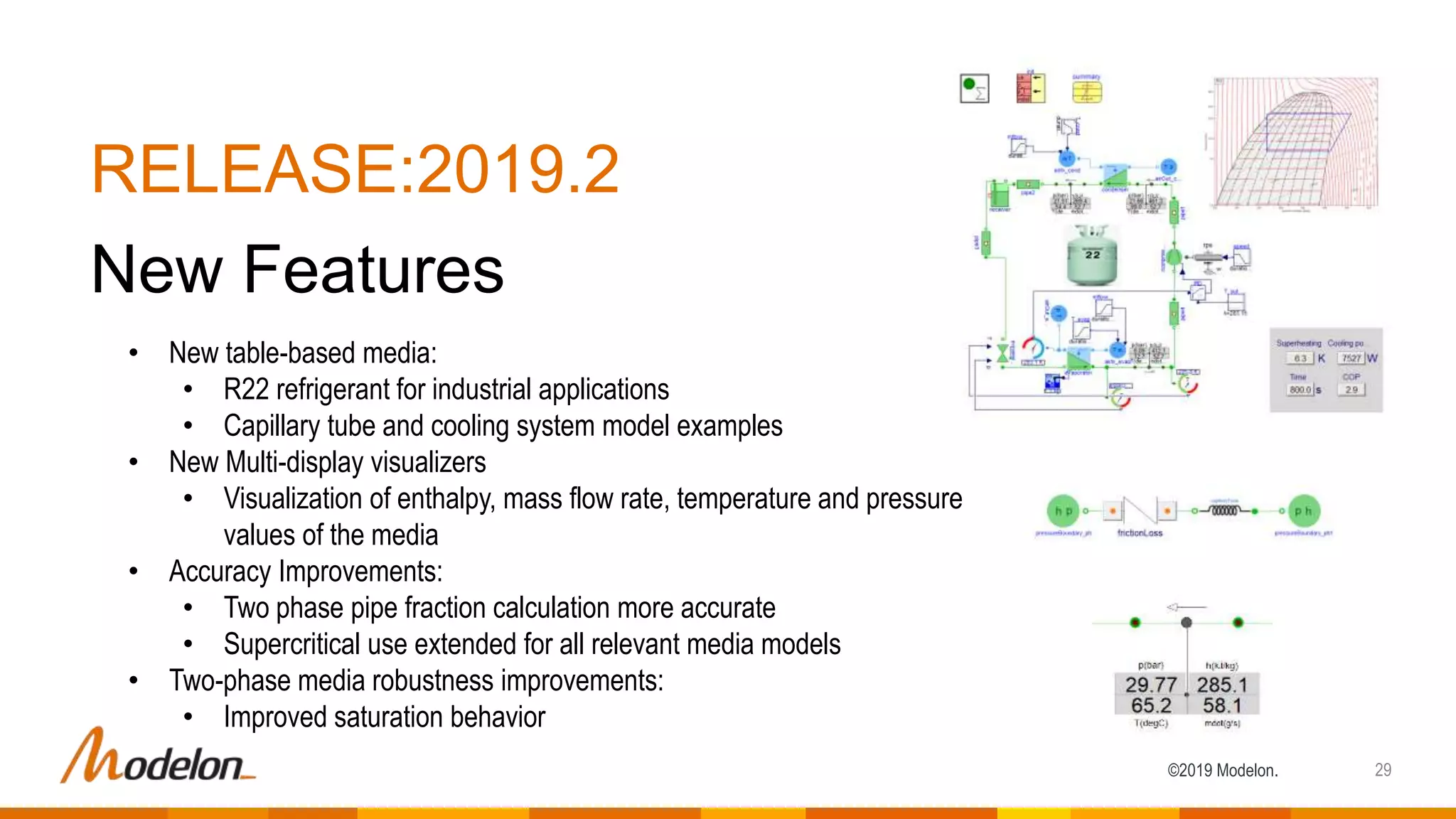
• New table-based media:
• R22 refrigerant for industrial applications
• Capillary tube and cooling system model examples
• New Multi-display visualizers
• Visualization of enthalpy, mass flow rate, temperature and pressure
values of the media
• Accuracy Improvements:
• Two phase pipe fraction calculation more accurate
• Supercritical use extended for all relevant media models
• Two-phase media robustness improvements:
• Improved saturation behavior

Vapor Cycle Library - Overview

  • 1.
  • 2.
    ©2019 Modelon.  AboutVapor Cycle Library  Key Features  Key Capabilities  Key Applications  Library Contents  Modelon Compatibility  Latest Release: 2019.1 AGENDA 2
  • 3.
    ©2019 Modelon. • VaporCompression Cycles • Air-conditioning - automotive, residential • Refrigeration - cryogenic, supermarket, household appliances • Heat Pumps - automotive, residential • Organic Rankine Cycles • Waste heat recovery - automotive, residential, process industry • Solar thermal power, geo-thermal power ABOUT VAPOR CYCLE LIBRARY 3 condenser evaporator evaporator condenser
  • 4.
    ©2019 Modelon. • Transientand steady-state simulation of component test rigs and cycle systems • Flexible composition of user-defined system architectures • Wide range of different working fluids including R-134a, R-1234yf, R- 404a, R-407c, carbon dioxide, isobutane • Plug and play compatible with other libraries for thermal management: • Liquid Cooling Library - Networks with incompressible fluids, heating and cooling • Heat Exchanger Library - Detailed geometry-based heat exchangers, support of inhomogeneous air inlet profiles KEY BENEFITS 4
  • 5.
    ©2019 Modelon. • Ready-to-usemodels for • Example cycle systems • Heat exchangers • Valves and flow resistances • Flow machines • Pipes and tanks • Fluid domains • Working fluid with phase change • Incompressible water in heat exchangers and sources • Moist air in heat exchangers and sources KEY CAPABILITIES 5
  • 6.
  • 7.
    ©2019 Modelon. • Air-conditioningsystem with R134a as default refrigerant. • Air-conditioning system with cabin model. • Organic Rankine Cycle • Heat Pump system KEY APPLICATIONS 72018-08-08
  • 8.
    ©2019 Modelon. EXAMPLE: AIR CONDITIONING Thisis an example of an air-conditioning system experiment with R-134a as refrigerant. A vapor compression cycle with air as secondary fluid in condenser and evaporator is controlled via a variable volume displacement in the compressor to reach a pre-defined air outlet temperature at the evaporator. The superheating at the evaporator is regulated by a thermostatic expansion valve. The system is initialized with a given specific charge. 8
  • 9.
    ©2019 Modelon. EXAMPLE: VAPOR CYCLEWITH CABIN MODEL This is an example of a simple cabin cooled down by a vapor compression cycle. The compressor displacement is controlled to obtain the set-point value of the outlet air temperature from the evaporator. This an extension of air conditioning model. 9
  • 10.
    ©2019 Modelon. EXAMPLE: ORGANIC RANKINECYCLE This is an example of an Organic Rankine Cycle with R-245fa as working fluid. Water is the heat source at the evaporator which evaporates the working fluid with an expansion in the following turbine. In the condenser the working fluid is returned into its liquid state at a lower pressure (and temperature level). A pump then provides the necessary pressure elevation to start evaporation 10
  • 11.
    ©2019 Modelon. EXAMPLE: HEAT PUMPSYSTEM This is an example of a heat pump system experiment with R-407c as working fluid. A vapor compression cycle with water as secondary fluid in condenser and evaporator transports heat from the low temperature heat source to the high temperature heat sink. The superheating at the evaporator is controlled by the expansion valve 11
  • 12.
  • 13.
    ©2019 Modelon. • Compressors •Expanders • Pumps • Fan • HeatExchanger • Pipes • Tanks • FlowResistances • Valves • Media LIBRARY CONTENTS 13
  • 14.
    ©2019 Modelon. Compressors • Modellingapproach • Quasi-steady state • Mass flow and change of enthalpy are calculated by algebraic equations • Displacement volume, if applicable, can be controlled by an external signal • Parameterization • User input as non-linear approximation functions or tabulated data • Volumetric (l), isentropic (h) and effective isentropic efficiencies as functions of pressure ratio (p) and speed (n) as well as part load (x) LIBRARY CONTENTS 14      nxgnfxn ,,,,,  
  • 15.
    ©2019 Modelon. Expanders • Modellingapproach • Quasi-steady state • Mass flow and change of enthalpy are calculated by algebraic equations • Parameterization • User input as tabulated isentropic efficiency and corrected mass flow. • Description of flow and efficiency characteristic according to the Stodola law. LIBRARY CONTENTS 15
  • 16.
    ©2019 Modelon. Pumps • pumpcombines the corresponding pump component from the Modelon Base Library with a two-phase working fluid volume Fan • An ideal fan with fixed mass flow and no heat losses. • An axial fan where the fan characteristic can be given in different ways LIBRARY CONTENTS 16
  • 17.
    ©2019 Modelon. HeatExchanger • WorkingFluid - Air • Cross-flow • Working Fluid - Liquid • Counter-flow • Working Fluid – Working Fluid • Counter-flow • Generic models based on finite volume method • Usable directly with base geometry (volumes, areas etc.) • Extendable by the user to more complex geometries - example included in library • Uniform air inlet properties LIBRARY CONTENTS 17
  • 18.
    ©2019 Modelon. Pipes • Discretizedpipe • Discretized pipe which includes boundary tracking • Discretized adiabatic pipe • Air duct model with dynamic humidity and energy balances. LIBRARY CONTENTS 18
  • 19.
    ©2019 Modelon. Tanks • Ideallymixed volume of fixed size with scalar port • Ideally mixed volume of fixed size with vector port • Suction accumulator with an U-shaped tube and bleed orifice • liquid receiver assuming complete de-mixing of phases and including pressure drop due to friction • Ideally mixed air volume of fixed size • Simple cabin • Phase Separator LIBRARY CONTENTS 19
  • 20.
    ©2019 Modelon. Flow Resistances •Generic flow resistance • Fixed Orifice • Orifice Tube • Split • Junction • Bend • Air Resistance • Variable Air Resistance LIBRARY CONTENTS 20
  • 21.
    ©2019 Modelon. Valves • Modellingapproach • Quasi-steady state, isenthalpic behaviour • Mass flow is determined by algebraic equations using valve specific data, e.g. the flow coefficient KV and the critical differential pressure ratio x • Thermostatic expansion valves • Modelled in a simplified manner using a PI-Controller or with 4-dimension diagram (supplier data) • Short orifice tube • Based on state-of-the art correlation LIBRARY CONTENTS 21 Valve with Kv-value as signal input or constant loss factor (flow resistance)
  • 22.
    ©2019 Modelon. Media High accuracyequations of state in Helmholtz function form • Natural working fluids • R744 (carbon dioxide), R728 (nitrogen), R702 (hydrogen), R732 (oxygen), R717 (ammonia) • Hydrocarbons • R290 (propane), R600a (isobutane) • Alcohols • Ethanol • Hydrofluorocarbons • R125, R134a, R143a, R152, R245fa, R404a, R407c, R410a, R507a, R236fa • Hydrofluoroolefins • R1234yf LIBRARY CONTENTS 22
  • 23.
    ©2019 Modelon. Media High accuracyequations of state in Helmholtz function form • Natural working fluids • R744 (carbon dioxide), R728 (nitrogen), R702 (hydrogen), R732 (oxygen), R717 (ammonia) • Hydrocarbons • R290 (propane), R600a (isobutane) • Alcohols • Ethanol • Hydrofluorocarbons • R125, R134a, R143a, R152, R245fa, R404a, R407c, R410a, R507a, R236fa • Hydrofluoroolefins • R1234yf LIBRARY CONTENTS 23
  • 24.
    ©2019 Modelon. Basic Components The AggregateVolume object calculates the total TwoPhase volume in the system – useful for dimensioning LIBRARY CONTENTS 24
  • 25.
  • 26.
    ©2019 Modelon. • VaporCycleLibrary components are seamless compatible with HeatExchanger Library, Liquid cooling Library, Engine Dynamics Library and Also with Air Conditioning Library via special adapter. RECOMMENDED MODELON LIBRARY COMPATIBILITY 26
  • 27.
    ©2019 Modelon. EXAMPLE: VCL- ACL INTERACTION This air-conditioning system experiment is a copy of the class VaporCycle.Experiments.AirConditioning, with the modification that a condenser component model from Air Conditioning Library is used. 27 ACL Component
  • 28.
  • 29.
    ©2019 Modelon. RELEASE:2019.2 New Features 29 •New table-based media: • R22 refrigerant for industrial applications • Capillary tube and cooling system model examples • New Multi-display visualizers • Visualization of enthalpy, mass flow rate, temperature and pressure values of the media • Accuracy Improvements: • Two phase pipe fraction calculation more accurate • Supercritical use extended for all relevant media models • Two-phase media robustness improvements: • Improved saturation behavior