©2019 Modelon.
ELECTRIFICATION
LIBRARY
Overview
©2019 Modelon.
 About Electrification Library
 Key Features
 Key Capabilities
 Key Applications
 Library Contents
 Modelon Compatibility
AGENDA
2
©2019 Modelon.
• Scalable architecture with compatible component models for systems modeling
• Multi-purpose: different use cases within the same modeling framework
• Multiple fidelity levels
• Scalable interfaces
• Thermal support for all components with scalable fidelity
• Multi-fidelity, multi-physics component models
• Batteries
• Machines
• Converters
• Loads
• Object-oriented, modular library with reusable components
• Reusable components
• Streamlined variant handling
KEY CAPABILITIES
3
©2019 Modelon.
• Extendable
• Adapts to customer specific interfaces
• Allows implementation of custom implementations and IP that plug into system architecture
• Supports integration of models from 3rd party libraries
• Adaptable
• Model topology that can reflect customer system topology and decomposition
KEY CAPABILITIES
4
©2019 Modelon.
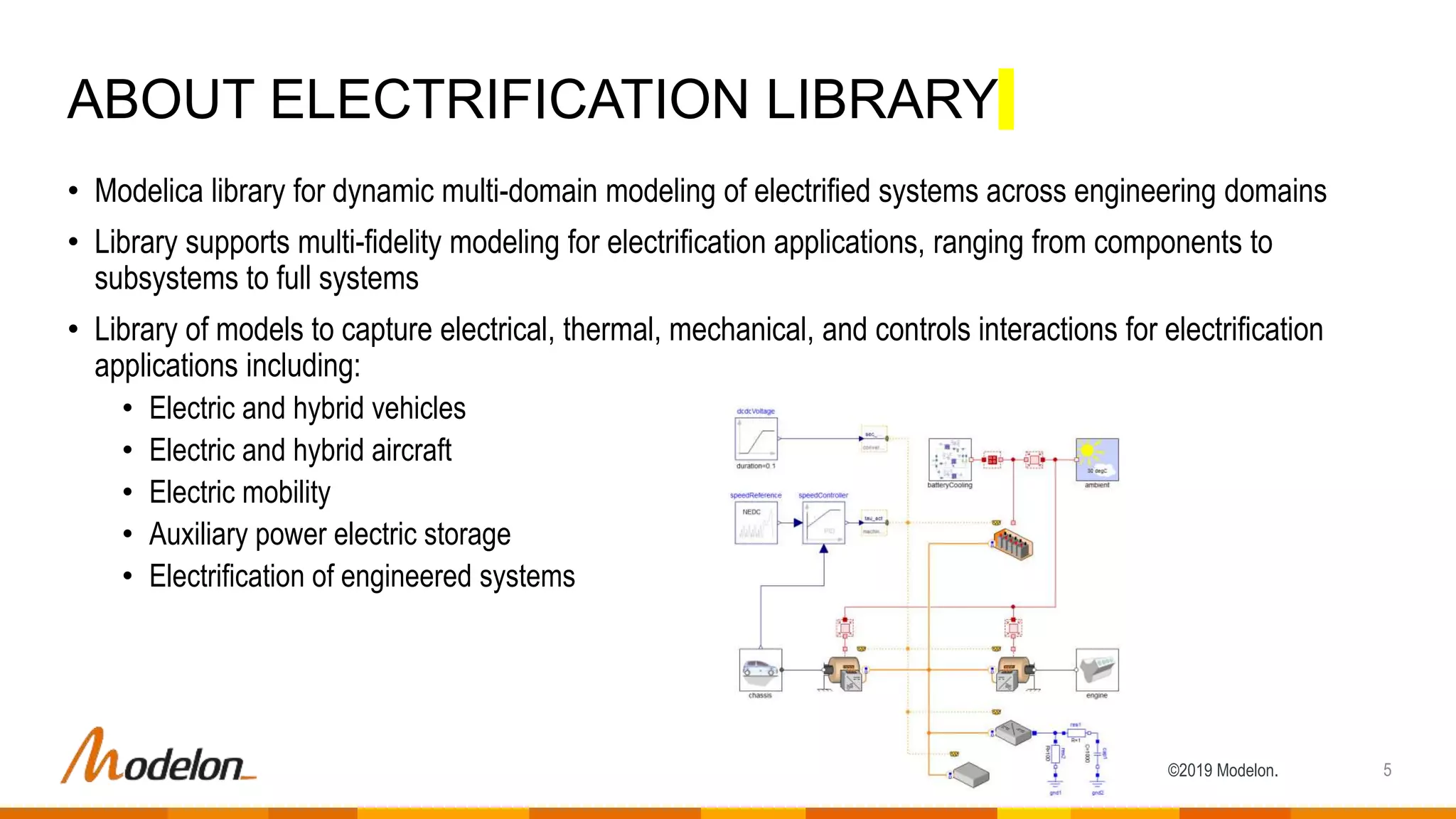
• Modelica library for dynamic multi-domain modeling of electrified systems across engineering domains
• Library supports multi-fidelity modeling for electrification applications, ranging from components to
subsystems to full systems
• Library of models to capture electrical, thermal, mechanical, and controls interactions for electrification
applications including:
• Electric and hybrid vehicles
• Electric and hybrid aircraft
• Electric mobility
• Auxiliary power electric storage
• Electrification of engineered systems
ABOUT ELECTRIFICATION LIBRARY
5
©2019 Modelon.
KEY BENEFITS
62018-08-08
©2019 Modelon.
• Accurate, computationally-efficient representation of electrical, mechanical, thermal, and control (software)
dynamics
• Support for a wide range of electrification applications with a common, collaborative approach
• Native configuration management to handle multi-purpose use cases (different systems, applications, level
of detail, computational requirements, interfaces, etc.)
• Streamlined modeling with reusable components and flexible architecture
• Robust model architecture for users to focus on application-specific modeling
• Extendable models for user customization and IP
• Standard interfaces to support integration with other models
KEY BENEFITS
7
©2019 Modelon.
KEY CAPABILITIES
8
©2019 Modelon.
KEY APPLICATIONS
9
©2019 Modelon.
• System performance including component and software limits
• System efficiency and range
• System design and virtual validation
• System/component sizing
• Thermal management
• Transient simulation including normal and off-design operation
• Electrical frequency analysis (EMC)
• Software/controls verification and validation (MIL/SIL/HIL)
KEY APPLICATIONS
10
©2019 Modelon.
EXAMPLE:
ELECTRIC VEHICLE
Series hybrid vehicle with integrated cooling
• System sizing
• Range
• Thermal management
11
©2019 Modelon.
EXAMPLE:
BATTERY
(THERMAL)
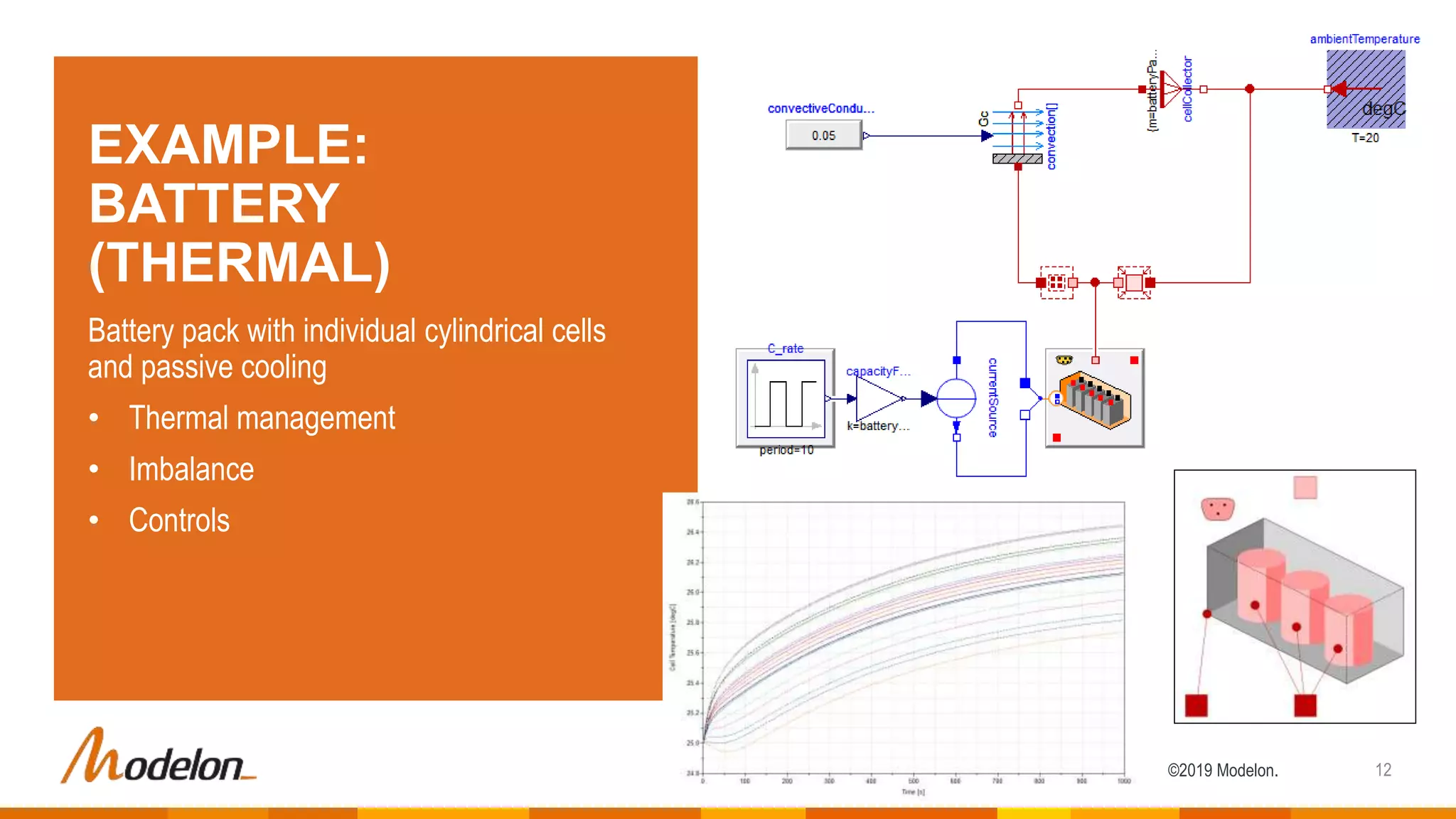
Battery pack with individual cylindrical cells
and passive cooling
• Thermal management
• Imbalance
• Controls
12
©2019 Modelon.
EXAMPLE:
BATTERY
(THERMAL)
Battery pack with individual prismatic cells and
active cooling
• Thermal management
• Imbalance
• Controls
13
©2019 Modelon.
EXAMPLE:
BATTERY
(IMBALANCE)
Battery pack with individual cylindrical cells
with non-uniform characteristics
• Electrical imbalance
• Thermal management
• Battery management and controls
14
©2019 Modelon.
EXAMPLE:
BATTERY (AGING)
Battery aging model with both calendar and
cyclic aging
• Cell capacity degradation
• Aging of battery physical parameters
(resistance, capacitance)
15
©2019 Modelon.
LIBRARY CONTENTS
16
©2019 Modelon.
• Suite of components for electrification systems including
• Batteries
• Machines
• Converters
• Loads
• Cable routing
• Controls
• Components include thermal interfaces and thermal models
• Modular component architectures for specification of electrical, thermal, and
mechanical dynamics
LIBRARY
17
©2019 Modelon.
• Battery models from cell to module to pack
• Scalable model fidelity from lumped packs to individual cells
• Model architecture with flexible specification of electrical architecture, control,
core, and thermal models
• Core model architecture with flexible specification of
• Electrical capacity
• Electrical potential
• Electrical impedance
• Self discharge
• Aging
• Aging models
• Cyclic
• Calendar
• Flexible tabular
BATTERY
18
©2019 Modelon.
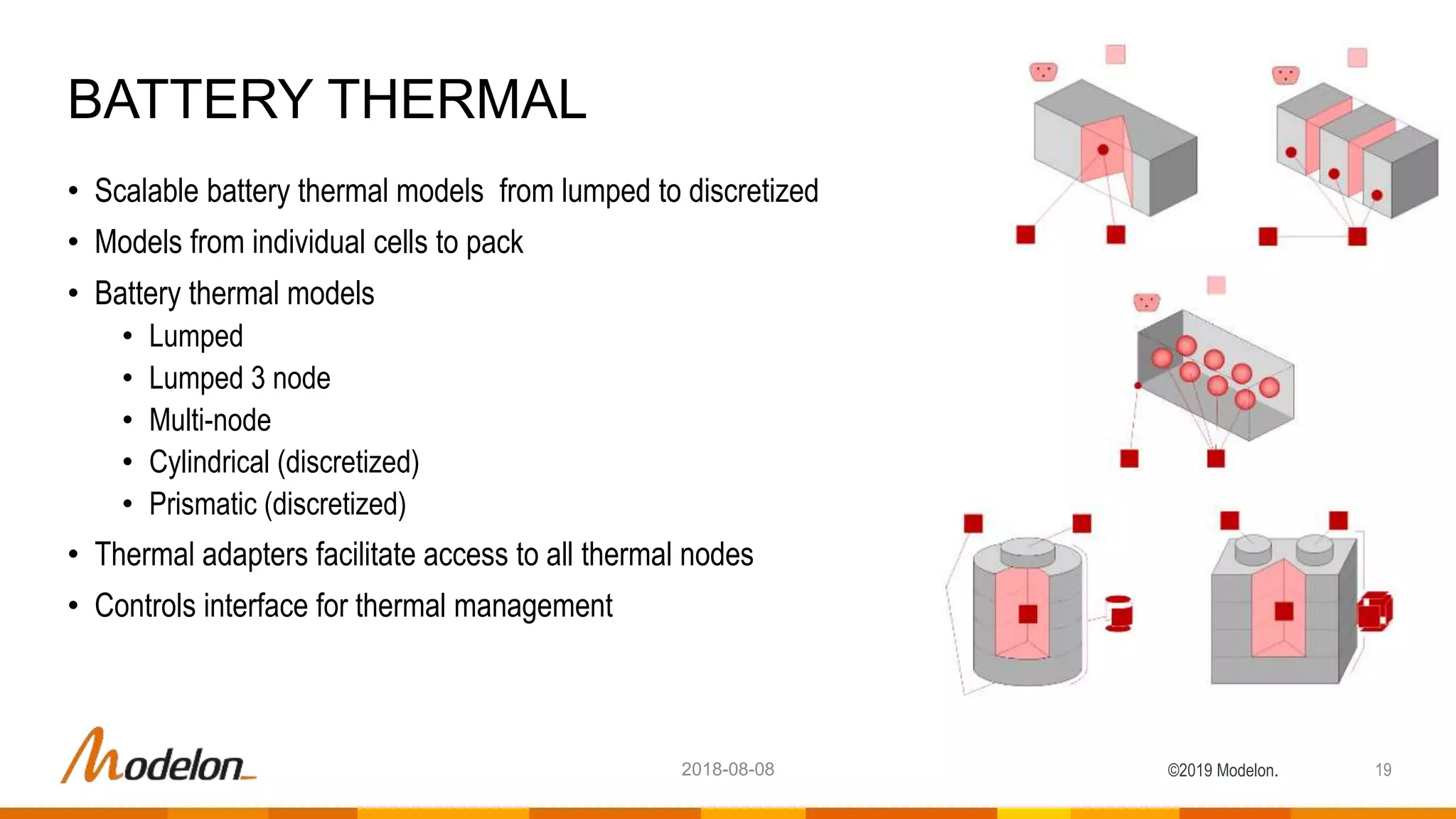
• Scalable battery thermal models from lumped to discretized
• Models from individual cells to pack
• Battery thermal models
• Lumped
• Lumped 3 node
• Multi-node
• Cylindrical (discretized)
• Prismatic (discretized)
• Thermal adapters facilitate access to all thermal nodes
• Controls interface for thermal management
BATTERY THERMAL
192018-08-08
©2019 Modelon.
• Model architecture with flexible specification of
• Electrical
• Control
• Machine core
• Mechanical
• Thermal
• Robust machine models including losses and thermal
• Controls interface
• Flexible mechanical interface from 1D to 3D
MACHINE
20
©2019 Modelon.
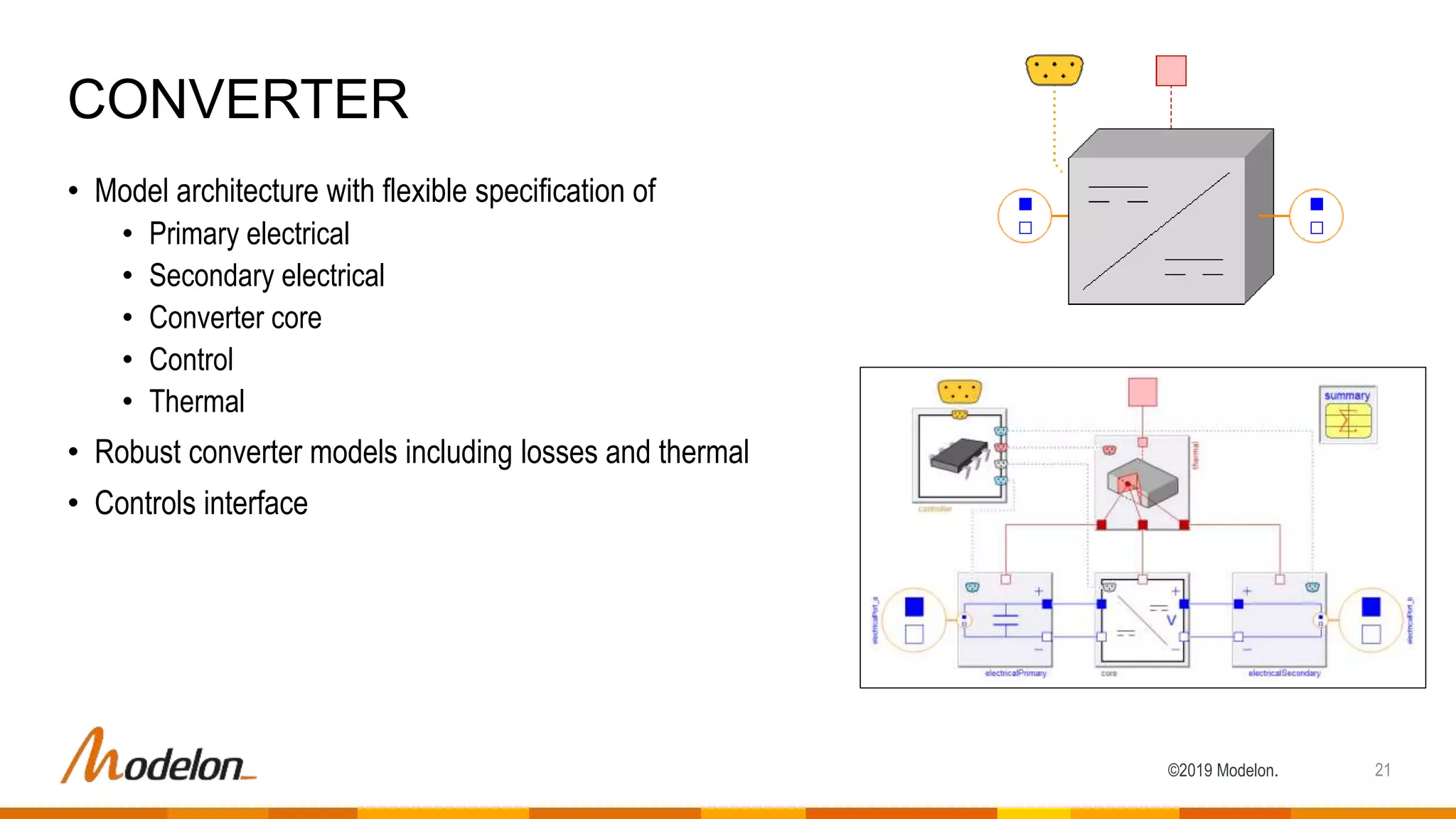
• Model architecture with flexible specification of
• Primary electrical
• Secondary electrical
• Converter core
• Control
• Thermal
• Robust converter models including losses and thermal
• Controls interface
CONVERTER
21
©2019 Modelon.
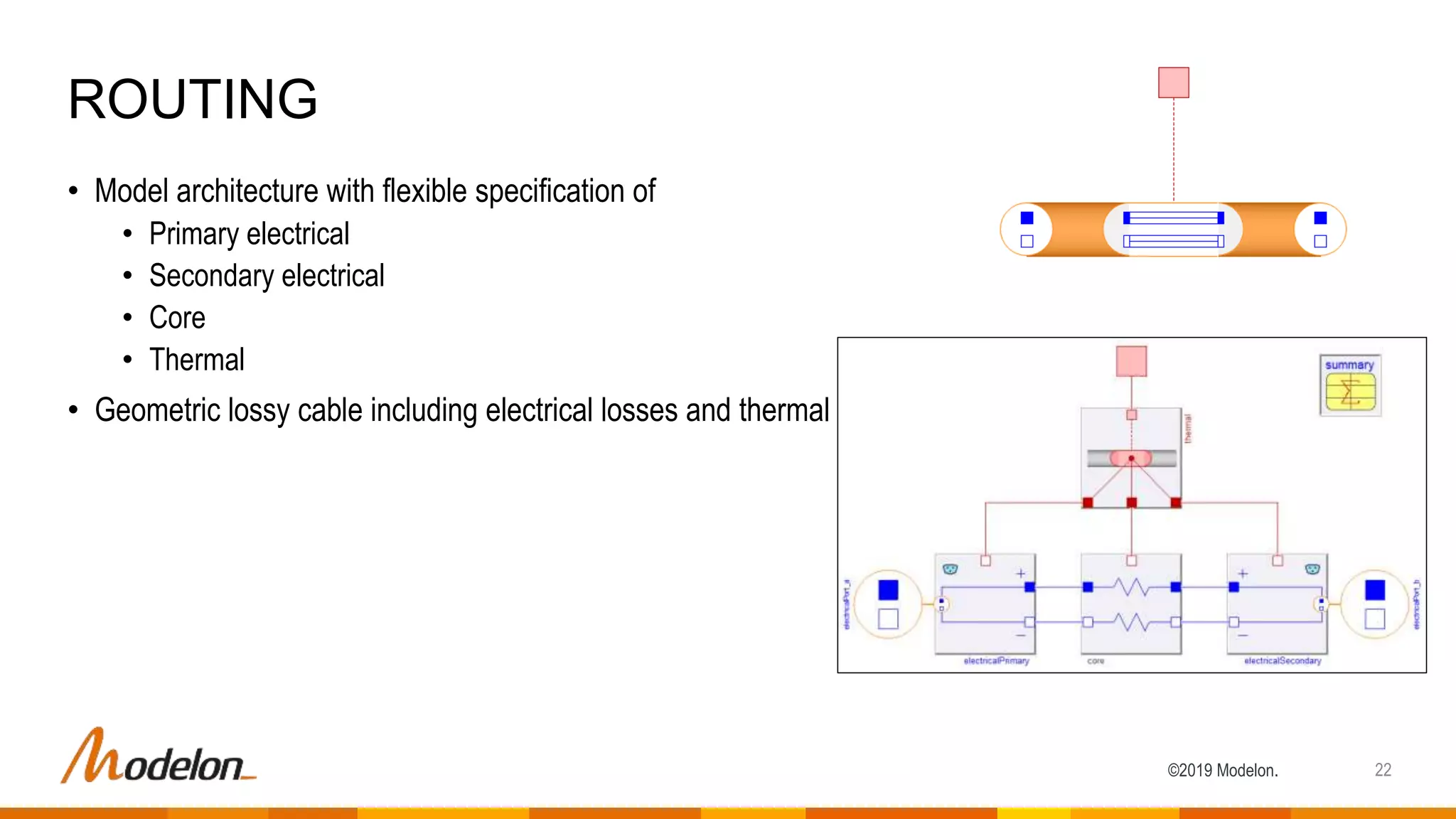
• Model architecture with flexible specification of
• Primary electrical
• Secondary electrical
• Core
• Thermal
• Geometric lossy cable including electrical losses and thermal
ROUTING
22
©2019 Modelon.
MODELON COMPATIBILITY
23
©2019 Modelon.
• Electrification Library integrates with the Modelon Library Suite
• Vehicle Dynamics Library
• Aircraft Dynamics Library
• Liquid Cooling Library
• Heat Exchanger Library
• Vapor Cycle Library
• Air Conditioning Library
• Fuel Cell Library
• Electric Power Library
• Thermal Power Library
RECOMMENDED MODELON LIBRARY
COMPATIBILITY
24
©2019 Modelon.
EXAMPLE:
BATTERY THERMAL
MANAGEMENT
Battery integrated with Liquid Cooling Library
• System sizing
• Cooling concept development
• Thermal constraints
• Thermal-electrical interactions
• BMS development
25
©2019 Modelon.
EXAMPLE:
BATTERY WITH
COLD PLATE
Battery integrated with Liquid Cooling Library
• Cooling concept design
• Thermal constraints
• Thermal-electrical interactions
• BMS development
26
©2019 Modelon.
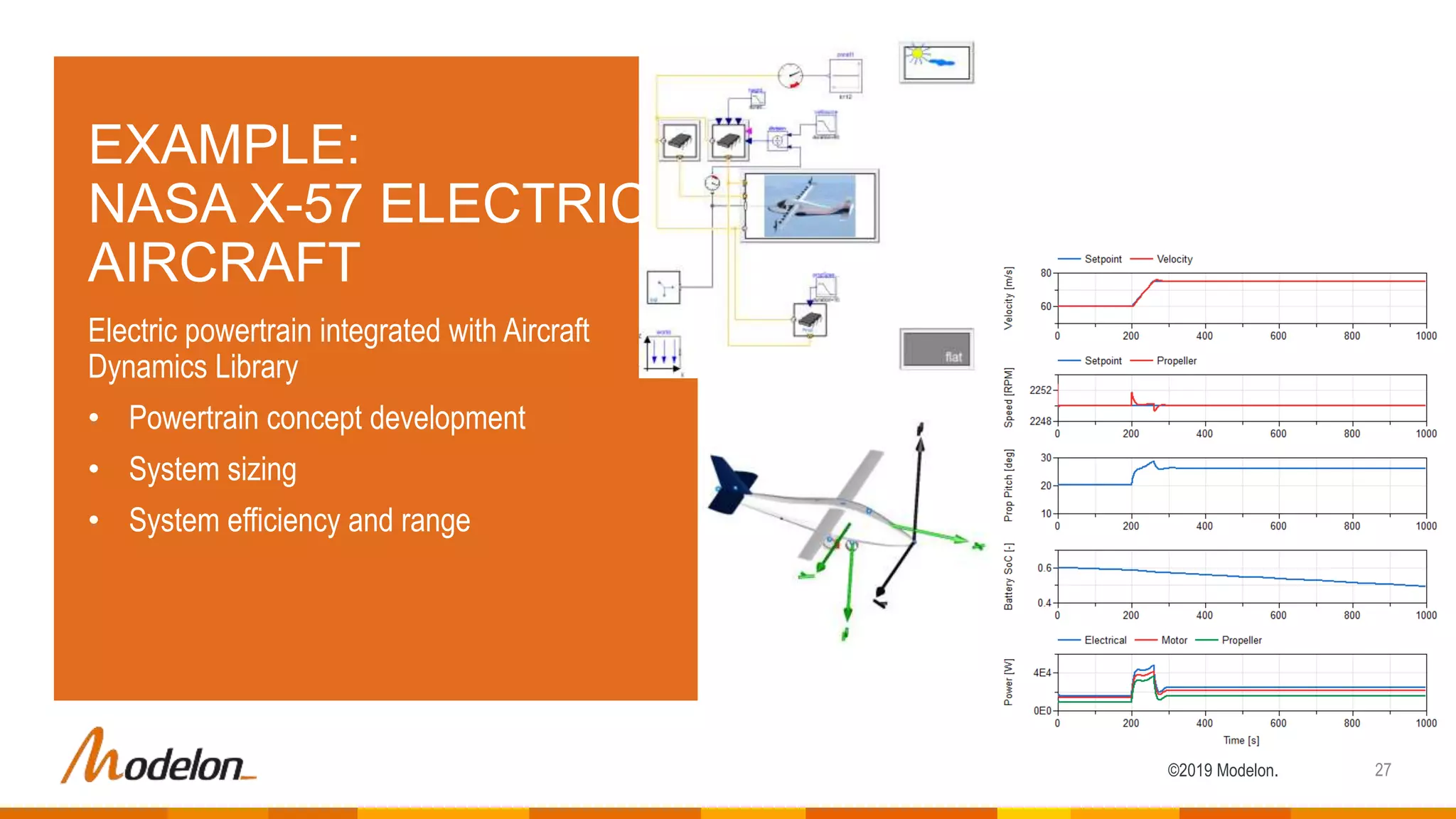
EXAMPLE:
NASA X-57 ELECTRIC
AIRCRAFT
Electric powertrain integrated with Aircraft
Dynamics Library
• Powertrain concept development
• System sizing
• System efficiency and range
27
©2019 Modelon.
EXAMPLE:
FUEL CELL VEHICLE
Electric powertrain integrated with Fuel Cell
Library and Vehicle Dynamics Library
• Powertrain concept development
• System sizing
• System efficiency and range
28
©2019 Modelon.
LATEST RELEASE: 2019.2
29
©2019 Modelon.
RELEASE: 2019.2
New Features
30
• New examples based on Rimac®
R&D battery cell:
• Cell validation
(electrical and thermal)
• Battery Cycler
with power de-rating
©2019 Modelon.
RELEASE: 2019.2
New Features
31
• Batteries:
• New loads and experiments for testing of battery packs and cells, with handling of limits.
• The detailed impedance models are now fully linear, and capable of inductive dynamics.
• New thermal models for battery packs and cells,
with improved simulation efficiency and parametrization.
• Converters:
• Improved parametrization and handling of limits.
• Electric Machines:
• New power-based controller
• Handling of zero or negative voltage robustness
• 3D Multibody:
• The 3D machine models can now be configured for either 1D or 3D mode, supporting both applications with a
single model.

Electrification Library - Overview

  • 1.
  • 2.
    ©2019 Modelon.  AboutElectrification Library  Key Features  Key Capabilities  Key Applications  Library Contents  Modelon Compatibility AGENDA 2
  • 3.
    ©2019 Modelon. • Scalablearchitecture with compatible component models for systems modeling • Multi-purpose: different use cases within the same modeling framework • Multiple fidelity levels • Scalable interfaces • Thermal support for all components with scalable fidelity • Multi-fidelity, multi-physics component models • Batteries • Machines • Converters • Loads • Object-oriented, modular library with reusable components • Reusable components • Streamlined variant handling KEY CAPABILITIES 3
  • 4.
    ©2019 Modelon. • Extendable •Adapts to customer specific interfaces • Allows implementation of custom implementations and IP that plug into system architecture • Supports integration of models from 3rd party libraries • Adaptable • Model topology that can reflect customer system topology and decomposition KEY CAPABILITIES 4
  • 5.
    ©2019 Modelon. • Modelicalibrary for dynamic multi-domain modeling of electrified systems across engineering domains • Library supports multi-fidelity modeling for electrification applications, ranging from components to subsystems to full systems • Library of models to capture electrical, thermal, mechanical, and controls interactions for electrification applications including: • Electric and hybrid vehicles • Electric and hybrid aircraft • Electric mobility • Auxiliary power electric storage • Electrification of engineered systems ABOUT ELECTRIFICATION LIBRARY 5
  • 6.
  • 7.
    ©2019 Modelon. • Accurate,computationally-efficient representation of electrical, mechanical, thermal, and control (software) dynamics • Support for a wide range of electrification applications with a common, collaborative approach • Native configuration management to handle multi-purpose use cases (different systems, applications, level of detail, computational requirements, interfaces, etc.) • Streamlined modeling with reusable components and flexible architecture • Robust model architecture for users to focus on application-specific modeling • Extendable models for user customization and IP • Standard interfaces to support integration with other models KEY BENEFITS 7
  • 8.
  • 9.
  • 10.
    ©2019 Modelon. • Systemperformance including component and software limits • System efficiency and range • System design and virtual validation • System/component sizing • Thermal management • Transient simulation including normal and off-design operation • Electrical frequency analysis (EMC) • Software/controls verification and validation (MIL/SIL/HIL) KEY APPLICATIONS 10
  • 11.
    ©2019 Modelon. EXAMPLE: ELECTRIC VEHICLE Serieshybrid vehicle with integrated cooling • System sizing • Range • Thermal management 11
  • 12.
    ©2019 Modelon. EXAMPLE: BATTERY (THERMAL) Battery packwith individual cylindrical cells and passive cooling • Thermal management • Imbalance • Controls 12
  • 13.
    ©2019 Modelon. EXAMPLE: BATTERY (THERMAL) Battery packwith individual prismatic cells and active cooling • Thermal management • Imbalance • Controls 13
  • 14.
    ©2019 Modelon. EXAMPLE: BATTERY (IMBALANCE) Battery packwith individual cylindrical cells with non-uniform characteristics • Electrical imbalance • Thermal management • Battery management and controls 14
  • 15.
    ©2019 Modelon. EXAMPLE: BATTERY (AGING) Batteryaging model with both calendar and cyclic aging • Cell capacity degradation • Aging of battery physical parameters (resistance, capacitance) 15
  • 16.
  • 17.
    ©2019 Modelon. • Suiteof components for electrification systems including • Batteries • Machines • Converters • Loads • Cable routing • Controls • Components include thermal interfaces and thermal models • Modular component architectures for specification of electrical, thermal, and mechanical dynamics LIBRARY 17
  • 18.
    ©2019 Modelon. • Batterymodels from cell to module to pack • Scalable model fidelity from lumped packs to individual cells • Model architecture with flexible specification of electrical architecture, control, core, and thermal models • Core model architecture with flexible specification of • Electrical capacity • Electrical potential • Electrical impedance • Self discharge • Aging • Aging models • Cyclic • Calendar • Flexible tabular BATTERY 18
  • 19.
    ©2019 Modelon. • Scalablebattery thermal models from lumped to discretized • Models from individual cells to pack • Battery thermal models • Lumped • Lumped 3 node • Multi-node • Cylindrical (discretized) • Prismatic (discretized) • Thermal adapters facilitate access to all thermal nodes • Controls interface for thermal management BATTERY THERMAL 192018-08-08
  • 20.
    ©2019 Modelon. • Modelarchitecture with flexible specification of • Electrical • Control • Machine core • Mechanical • Thermal • Robust machine models including losses and thermal • Controls interface • Flexible mechanical interface from 1D to 3D MACHINE 20
  • 21.
    ©2019 Modelon. • Modelarchitecture with flexible specification of • Primary electrical • Secondary electrical • Converter core • Control • Thermal • Robust converter models including losses and thermal • Controls interface CONVERTER 21
  • 22.
    ©2019 Modelon. • Modelarchitecture with flexible specification of • Primary electrical • Secondary electrical • Core • Thermal • Geometric lossy cable including electrical losses and thermal ROUTING 22
  • 23.
  • 24.
    ©2019 Modelon. • ElectrificationLibrary integrates with the Modelon Library Suite • Vehicle Dynamics Library • Aircraft Dynamics Library • Liquid Cooling Library • Heat Exchanger Library • Vapor Cycle Library • Air Conditioning Library • Fuel Cell Library • Electric Power Library • Thermal Power Library RECOMMENDED MODELON LIBRARY COMPATIBILITY 24
  • 25.
    ©2019 Modelon. EXAMPLE: BATTERY THERMAL MANAGEMENT Batteryintegrated with Liquid Cooling Library • System sizing • Cooling concept development • Thermal constraints • Thermal-electrical interactions • BMS development 25
  • 26.
    ©2019 Modelon. EXAMPLE: BATTERY WITH COLDPLATE Battery integrated with Liquid Cooling Library • Cooling concept design • Thermal constraints • Thermal-electrical interactions • BMS development 26
  • 27.
    ©2019 Modelon. EXAMPLE: NASA X-57ELECTRIC AIRCRAFT Electric powertrain integrated with Aircraft Dynamics Library • Powertrain concept development • System sizing • System efficiency and range 27
  • 28.
    ©2019 Modelon. EXAMPLE: FUEL CELLVEHICLE Electric powertrain integrated with Fuel Cell Library and Vehicle Dynamics Library • Powertrain concept development • System sizing • System efficiency and range 28
  • 29.
  • 30.
    ©2019 Modelon. RELEASE: 2019.2 NewFeatures 30 • New examples based on Rimac® R&D battery cell: • Cell validation (electrical and thermal) • Battery Cycler with power de-rating
  • 31.
    ©2019 Modelon. RELEASE: 2019.2 NewFeatures 31 • Batteries: • New loads and experiments for testing of battery packs and cells, with handling of limits. • The detailed impedance models are now fully linear, and capable of inductive dynamics. • New thermal models for battery packs and cells, with improved simulation efficiency and parametrization. • Converters: • Improved parametrization and handling of limits. • Electric Machines: • New power-based controller • Handling of zero or negative voltage robustness • 3D Multibody: • The 3D machine models can now be configured for either 1D or 3D mode, supporting both applications with a single model.