©2019 Modelon.
PNEUMATICS
LIBRARY
Overview
 About Product Name
 Key Benefits
 Key Capabilities
 Key Applications
 Library Contents
 Modelon Compatibility
 Latest Release: 2019.2
AGENDA
2©2019 Modelon
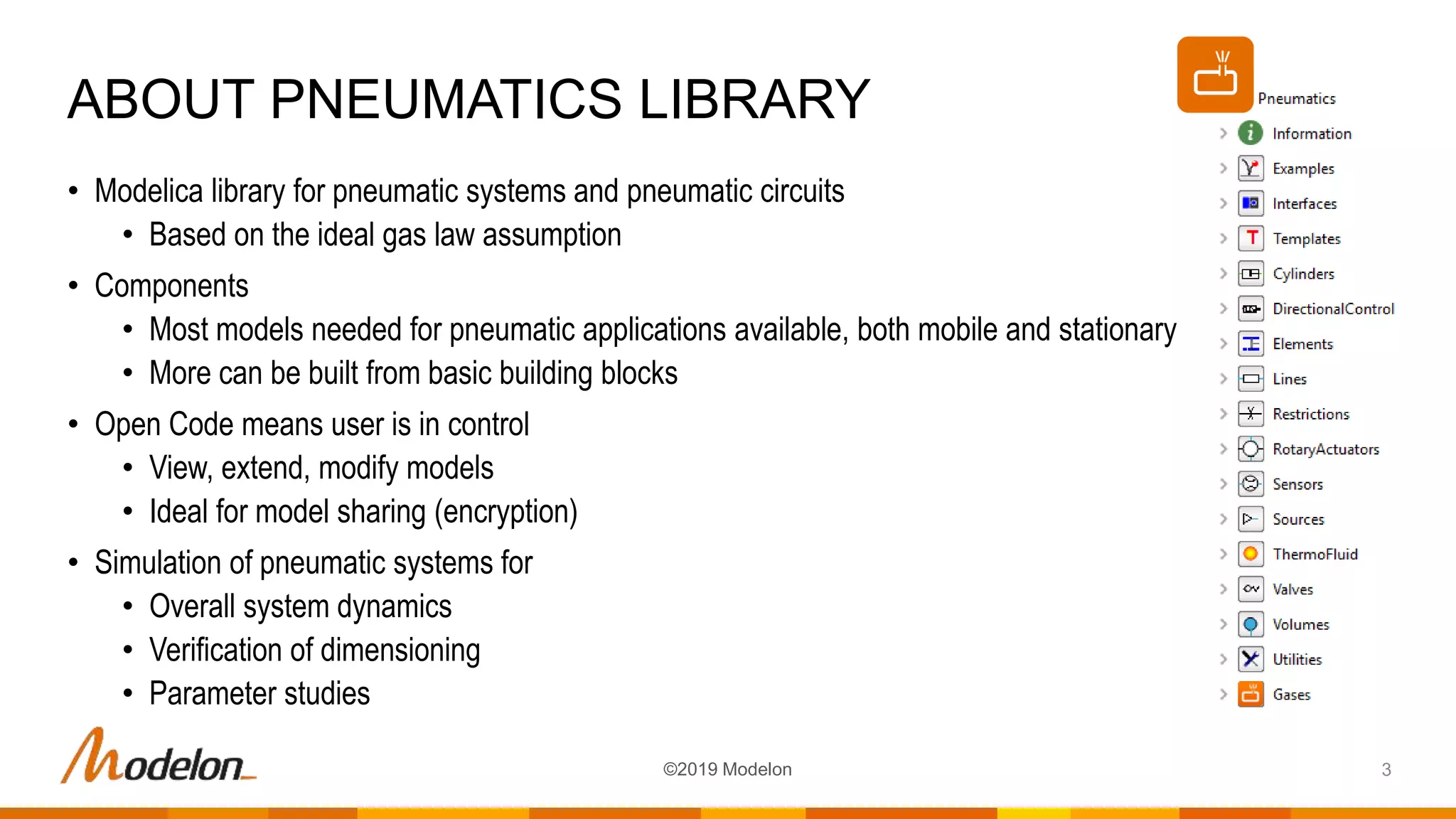
• Modelica library for pneumatic systems and pneumatic circuits
• Based on the ideal gas law assumption
• Components
• Most models needed for pneumatic applications available, both mobile and stationary
• More can be built from basic building blocks
• Open Code means user is in control
• View, extend, modify models
• Ideal for model sharing (encryption)
• Simulation of pneumatic systems for
• Overall system dynamics
• Verification of dimensioning
• Parameter studies
ABOUT PNEUMATICS LIBRARY
3©2019 Modelon
• Easy-to-Use yet powerful
• Wide range of predefined components
• Well suited for control design and validation
• True multi-engineering tool
 Modeling of multi-domain systems, combine with multibody
mechanics, control system etc.
• Visualization
• Easily visualize system behavior
• Graphical workspace looks like a pneumatic schematic
KEY BENEFITS
4©2019 Modelon
• Integration of pneumatic systems in wide range of multi-physics models
• Parametric studies of designs
• Deployment
• Design of experiment
• Optimization
• List of applications
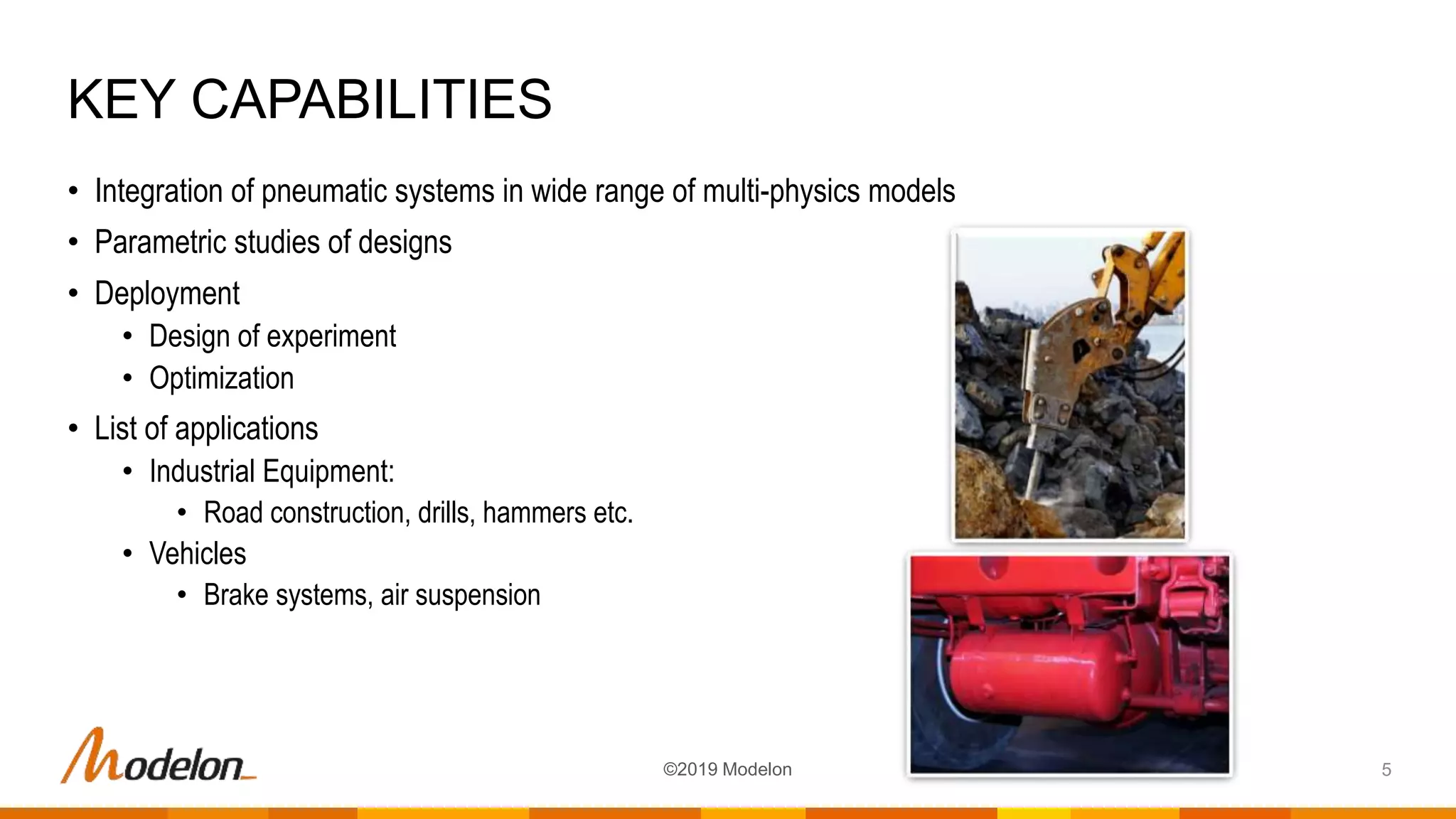
• Industrial Equipment:
• Road construction, drills, hammers etc.
• Vehicles
• Brake systems, air suspension
KEY CAPABILITIES
5©2019 Modelon
©2019 Modelon.
KEY APPLICATIONS
6©2019 Modelon
EXAMPLE: MOTOR
CONTROL
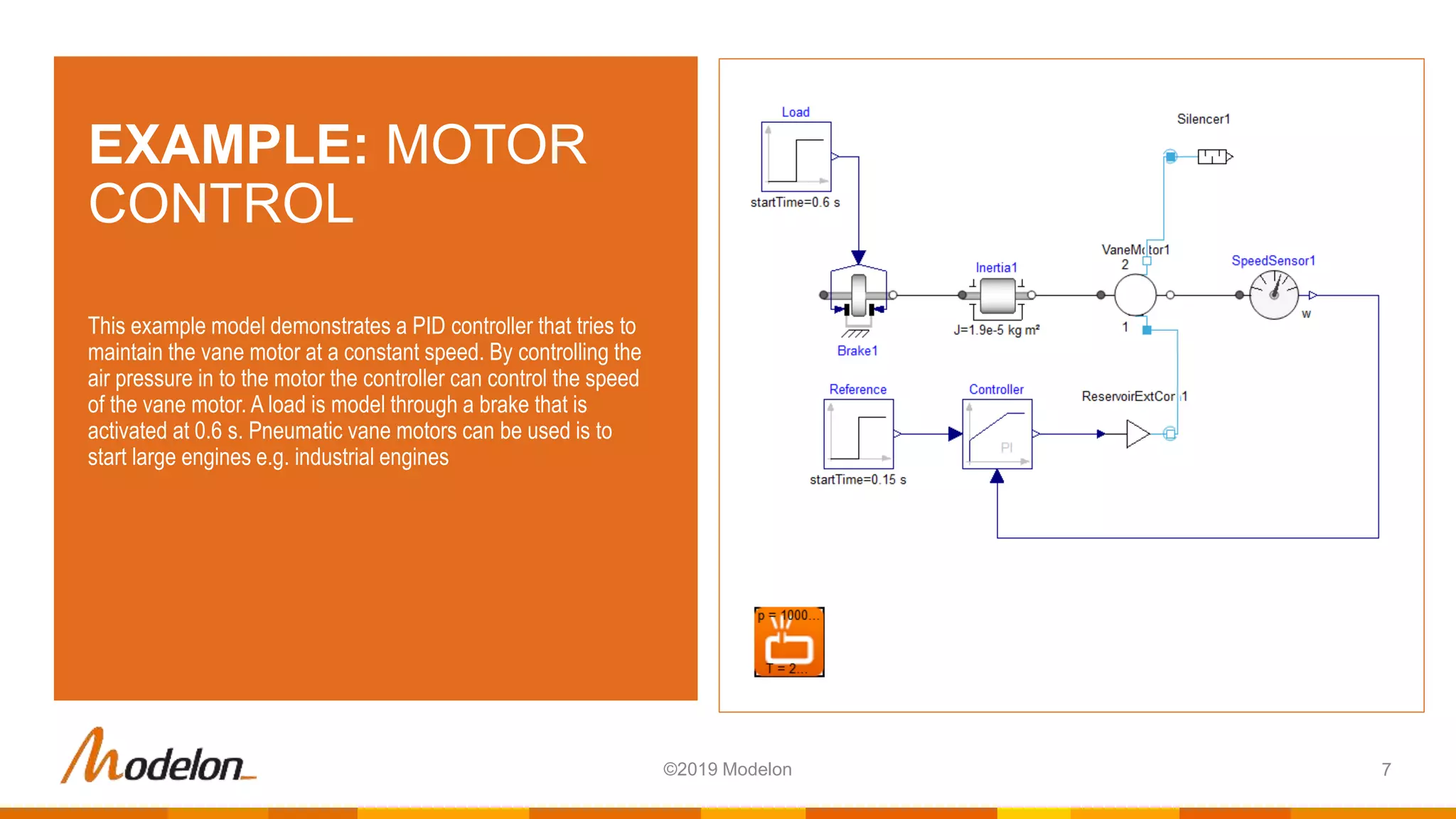
This example model demonstrates a PID controller that tries to
maintain the vane motor at a constant speed. By controlling the
air pressure in to the motor the controller can control the speed
of the vane motor. A load is model through a brake that is
activated at 0.6 s. Pneumatic vane motors can be used is to
start large engines e.g. industrial engines
7©2019 Modelon
EXAMPLE: MULTI-
POSITION CYLINDER
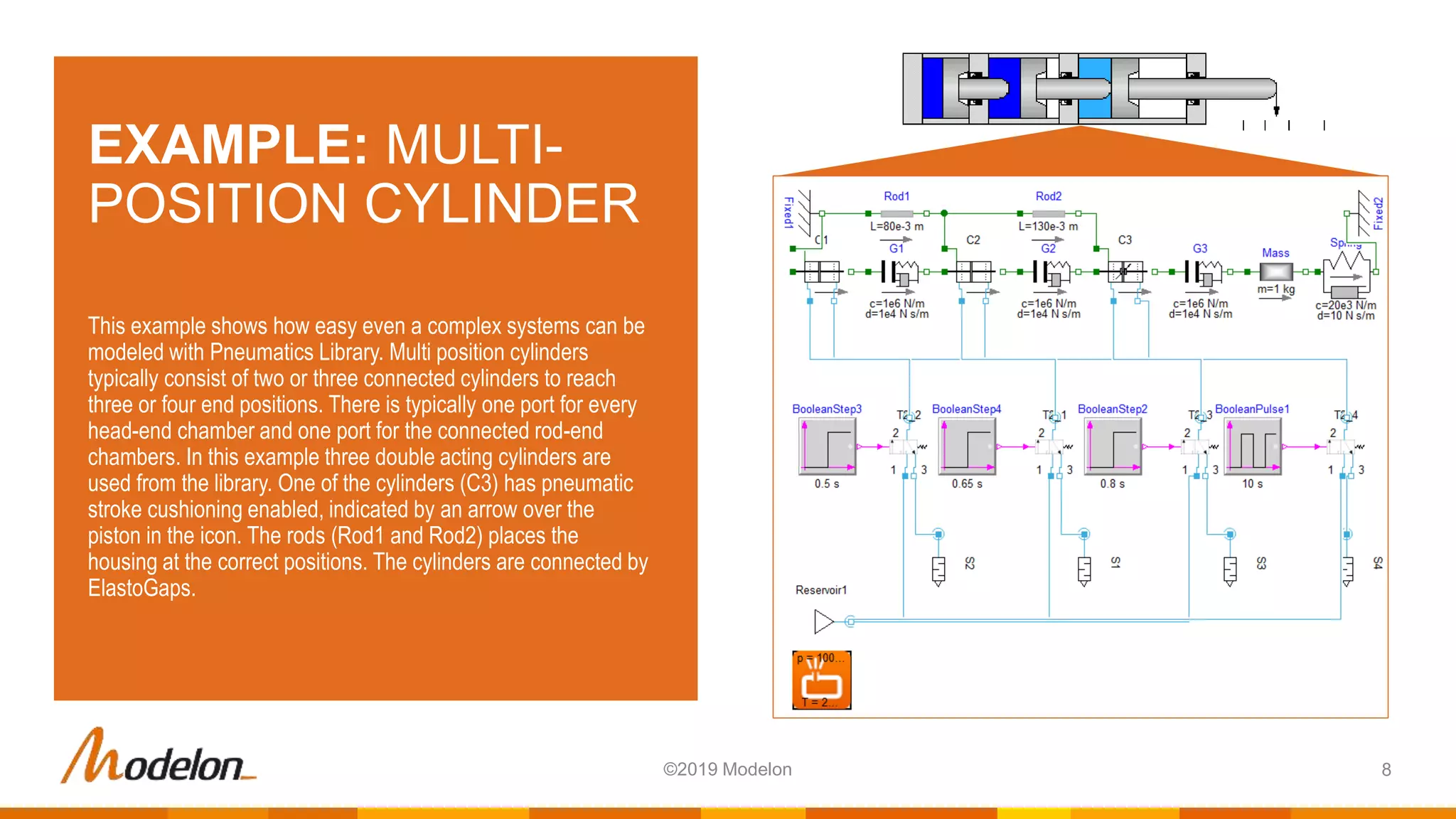
This example shows how easy even a complex systems can be
modeled with Pneumatics Library. Multi position cylinders
typically consist of two or three connected cylinders to reach
three or four end positions. There is typically one port for every
head-end chamber and one port for the connected rod-end
chambers. In this example three double acting cylinders are
used from the library. One of the cylinders (C3) has pneumatic
stroke cushioning enabled, indicated by an arrow over the
piston in the icon. The rods (Rod1 and Rod2) places the
housing at the correct positions. The cylinders are connected by
ElastoGaps.
8©2019 Modelon
EXAMPLE: LINEAR
ACTUATOR
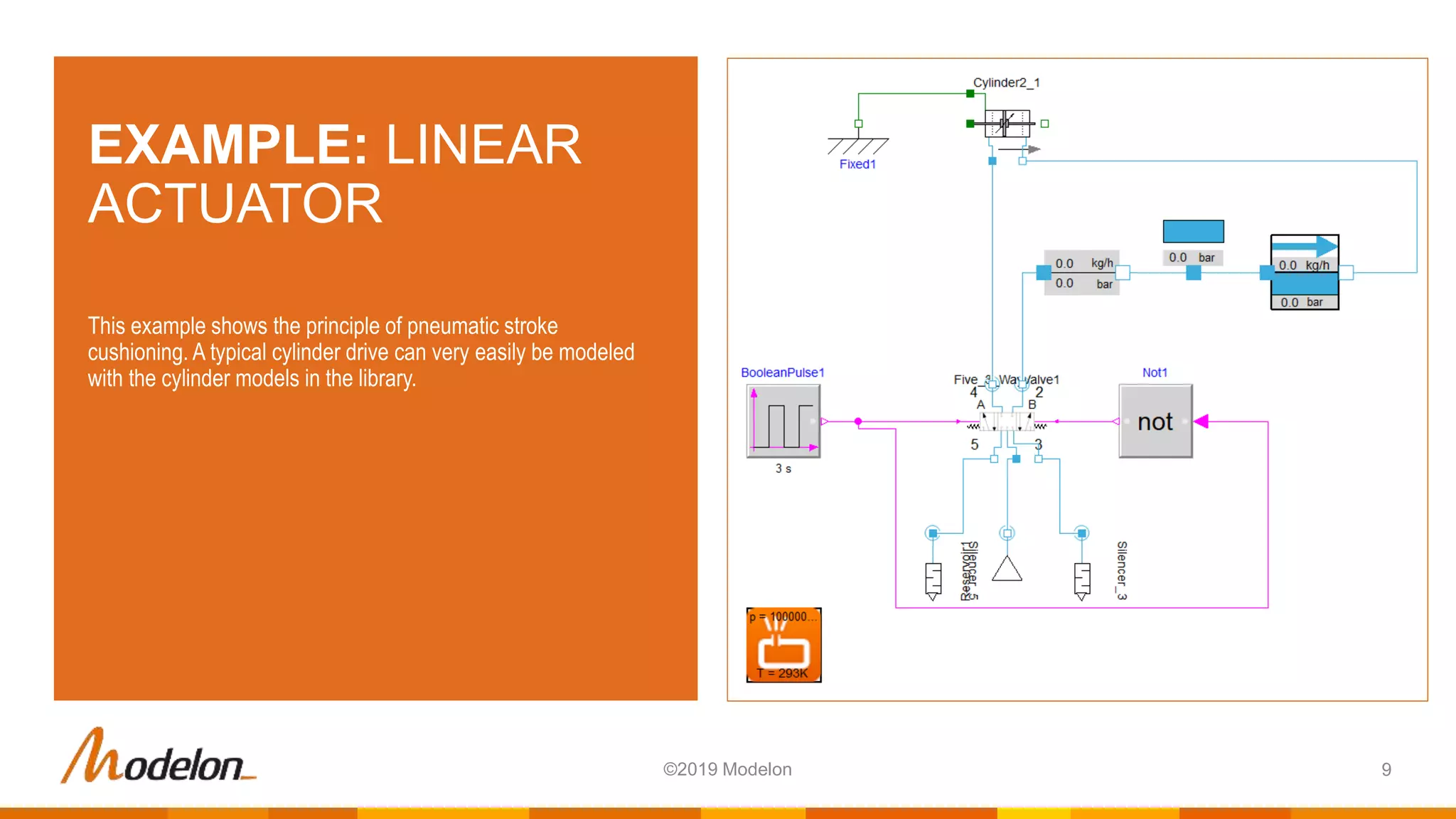
This example shows the principle of pneumatic stroke
cushioning. A typical cylinder drive can very easily be modeled
with the cylinder models in the library.
9©2019 Modelon
©2019 Modelon.
LIBRARY CONTENTS
10©2019 Modelon
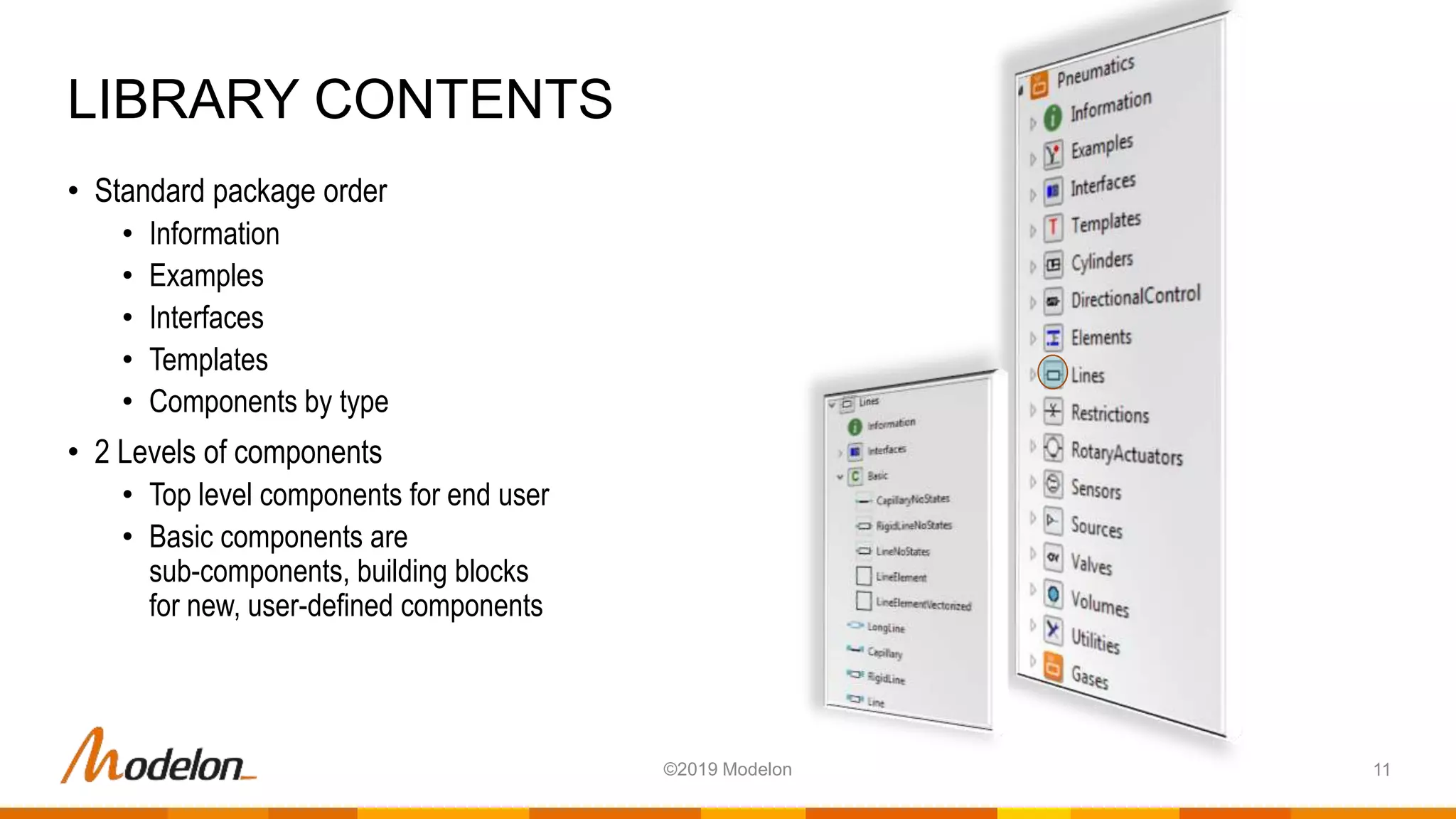
• Standard package order
• Information
• Examples
• Interfaces
• Templates
• Components by type
• 2 Levels of components
• Top level components for end user
• Basic components are
sub-components, building blocks
for new, user-defined components
LIBRARY CONTENTS
11©2019 Modelon
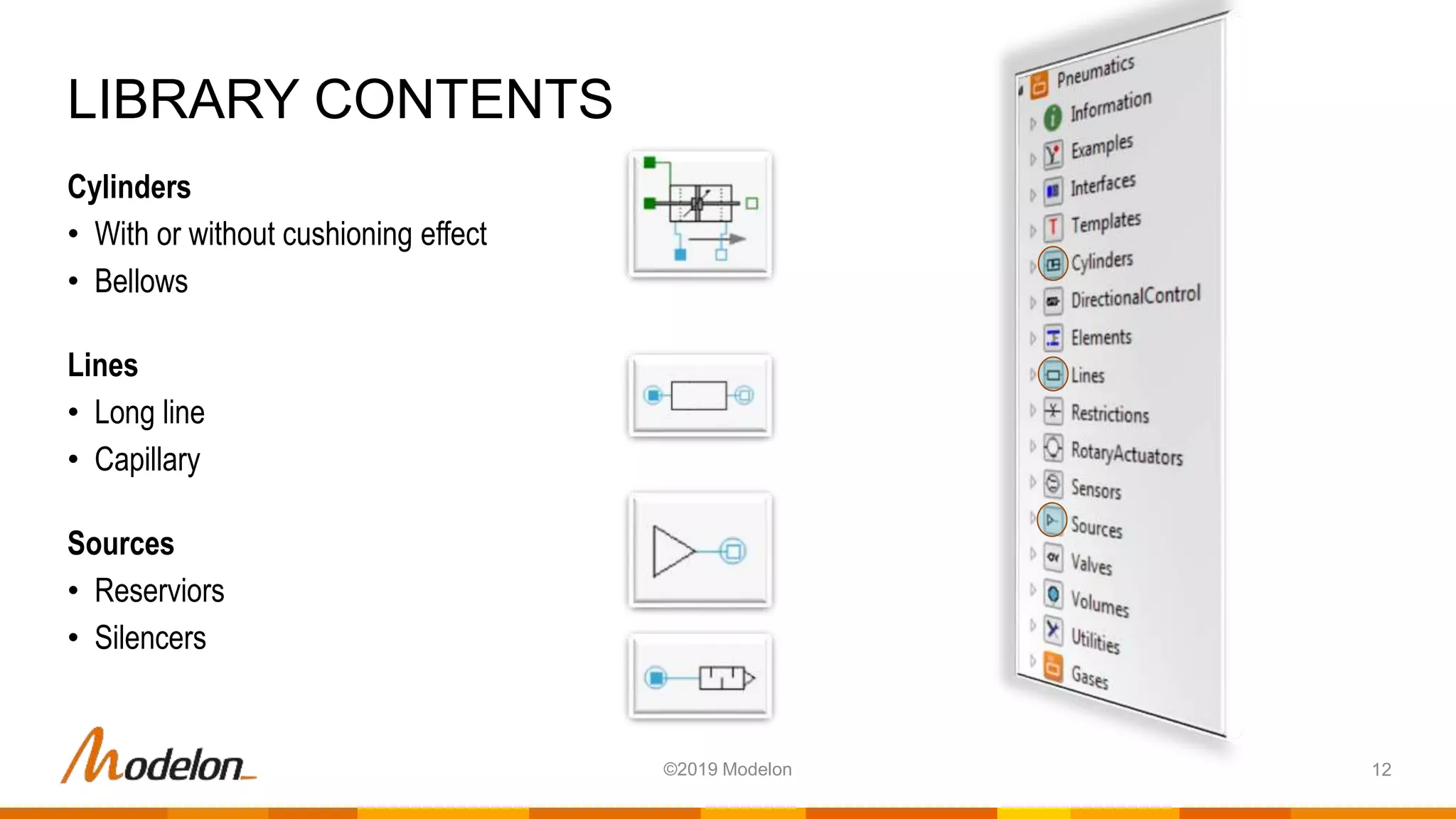
Cylinders
• With or without cushioning effect
• Bellows
Lines
• Long line
• Capillary
Sources
• Reserviors
• Silencers
LIBRARY CONTENTS
12©2019 Modelon
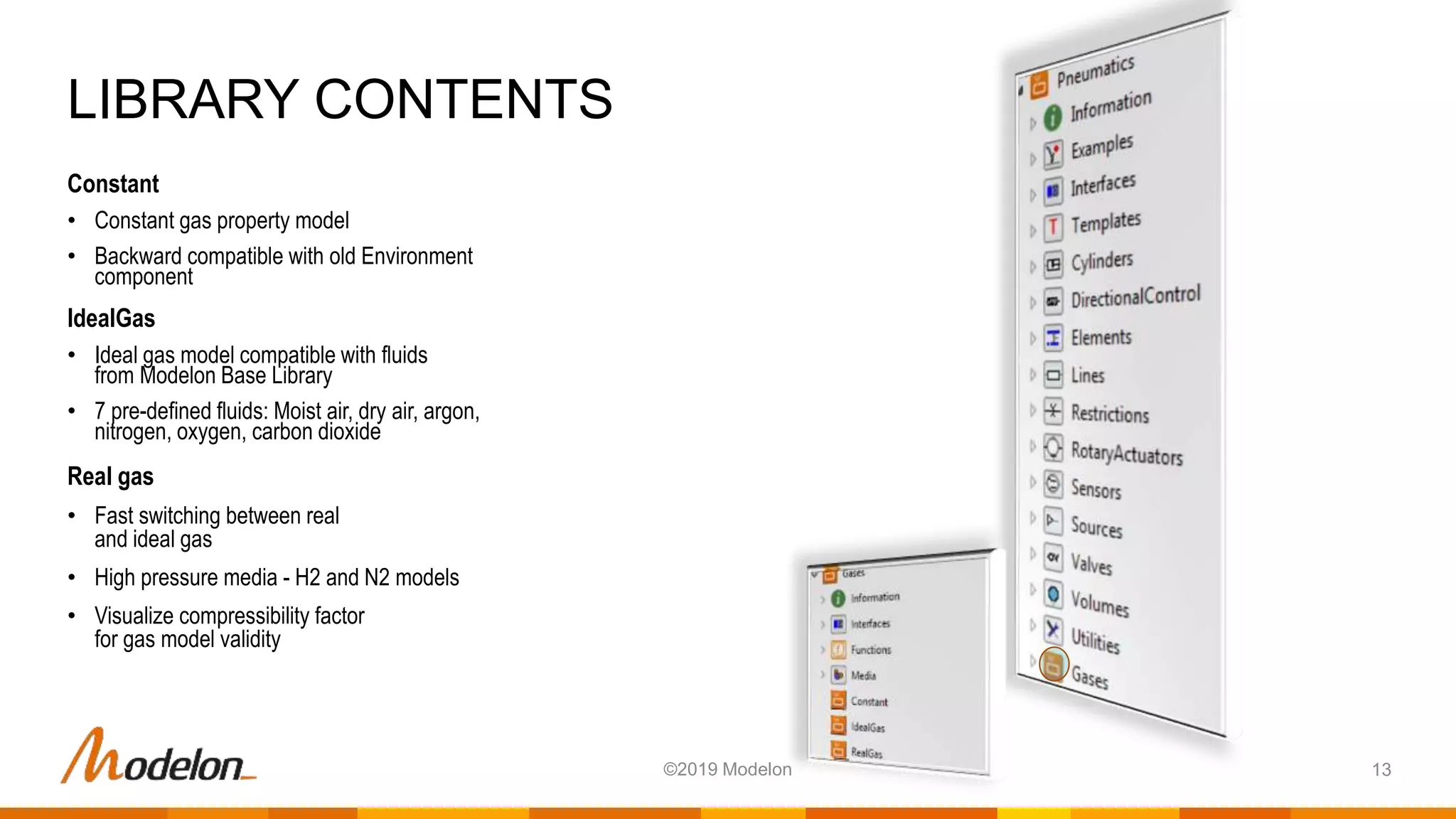
Constant
• Constant gas property model
• Backward compatible with old Environment
component
IdealGas
• Ideal gas model compatible with fluids
from Modelon Base Library
• 7 pre-defined fluids: Moist air, dry air, argon,
nitrogen, oxygen, carbon dioxide
Real gas
• Fast switching between real
and ideal gas
• High pressure media - H2 and N2 models
• Visualize compressibility factor
for gas model validity
LIBRARY CONTENTS
13©2019 Modelon
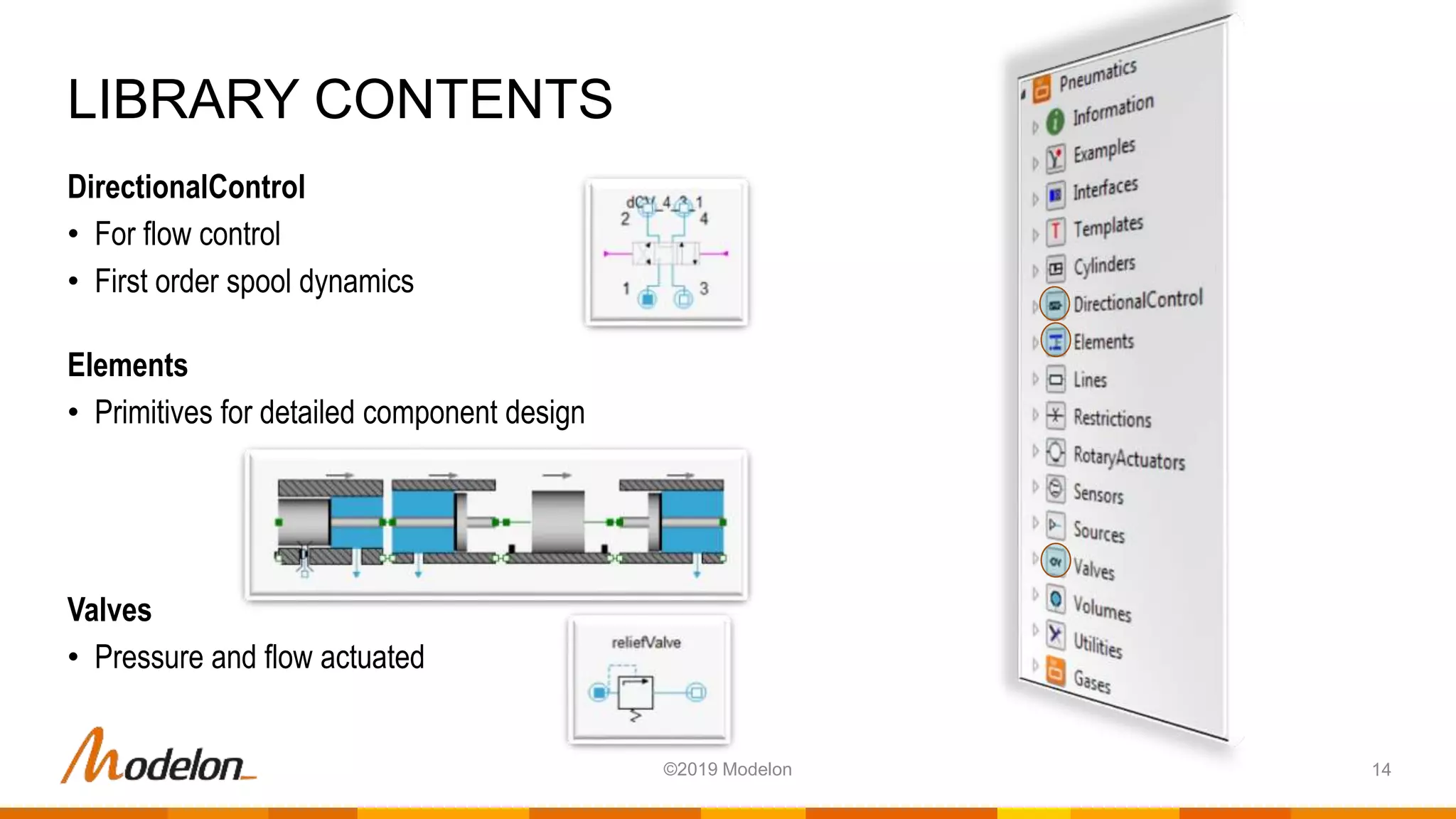
DirectionalControl
• For flow control
• First order spool dynamics
Elements
• Primitives for detailed component design
Valves
• Pressure and flow actuated
LIBRARY CONTENTS
14©2019 Modelon
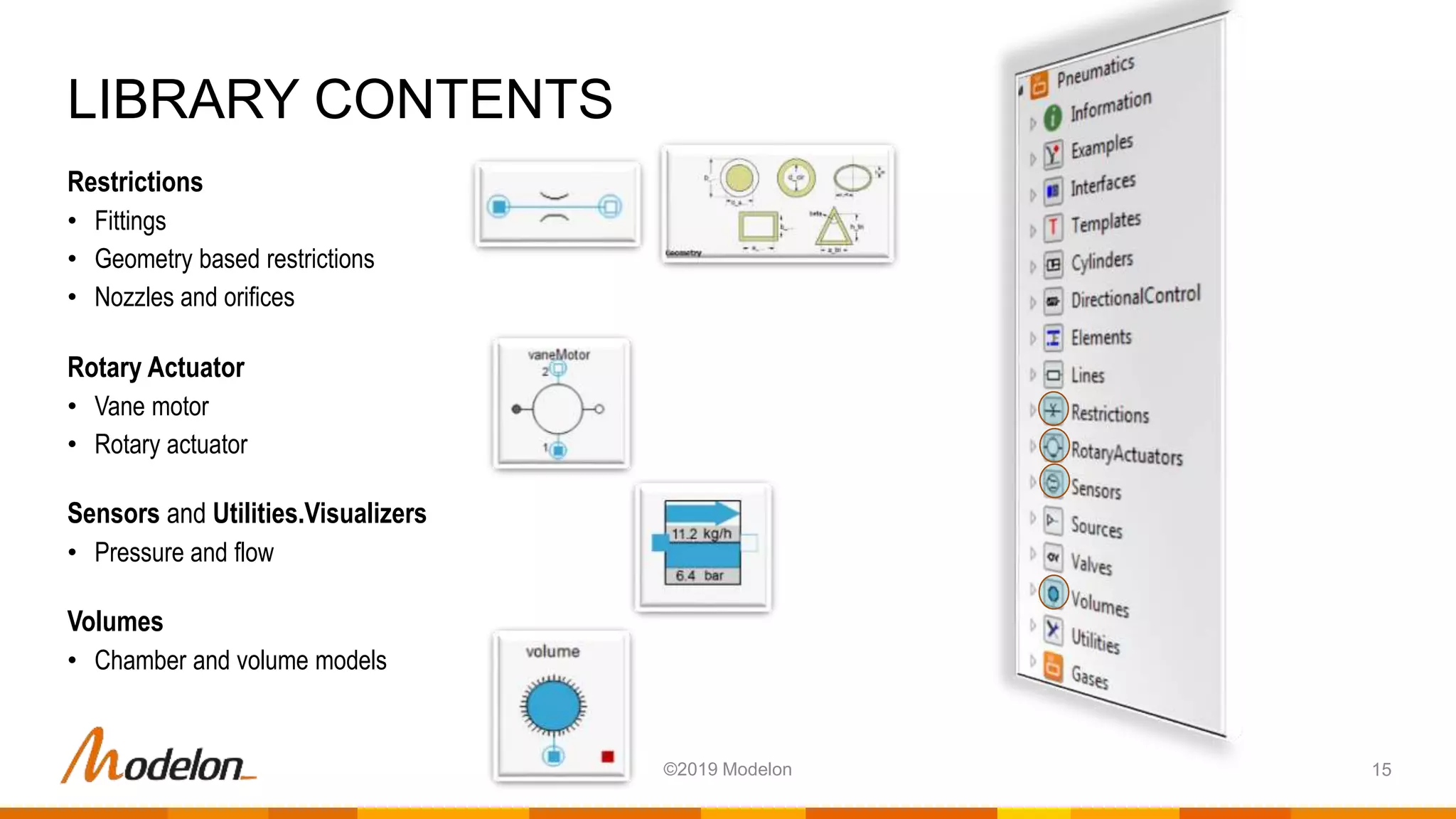
Restrictions
• Fittings
• Geometry based restrictions
• Nozzles and orifices
Rotary Actuator
• Vane motor
• Rotary actuator
Sensors and Utilities.Visualizers
• Pressure and flow
Volumes
• Chamber and volume models
LIBRARY CONTENTS
15©2019 Modelon
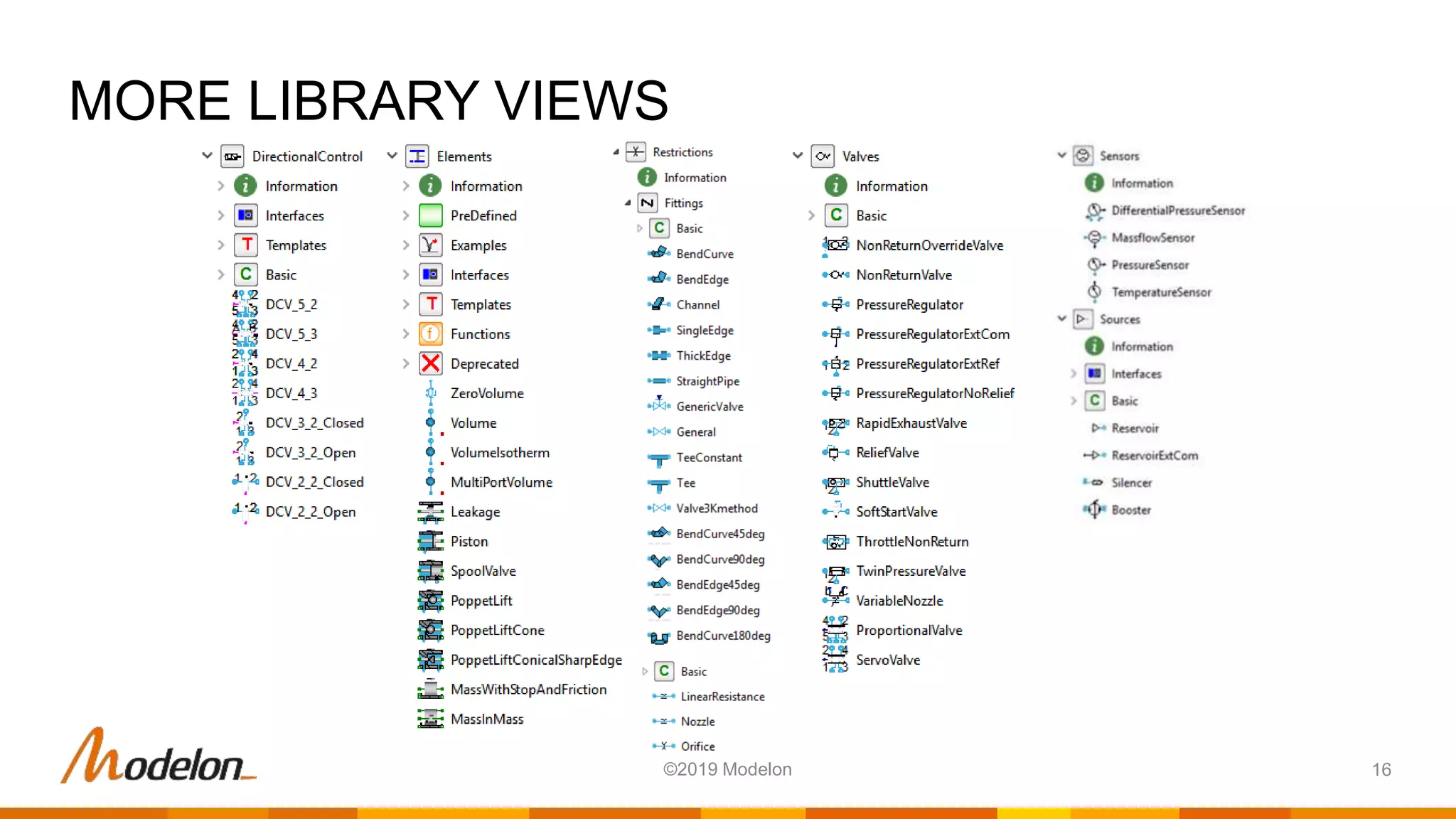
MORE LIBRARY VIEWS
16©2019 Modelon
©2019 Modelon.
MODELON COMPATIBILITY
17©2019 Modelon
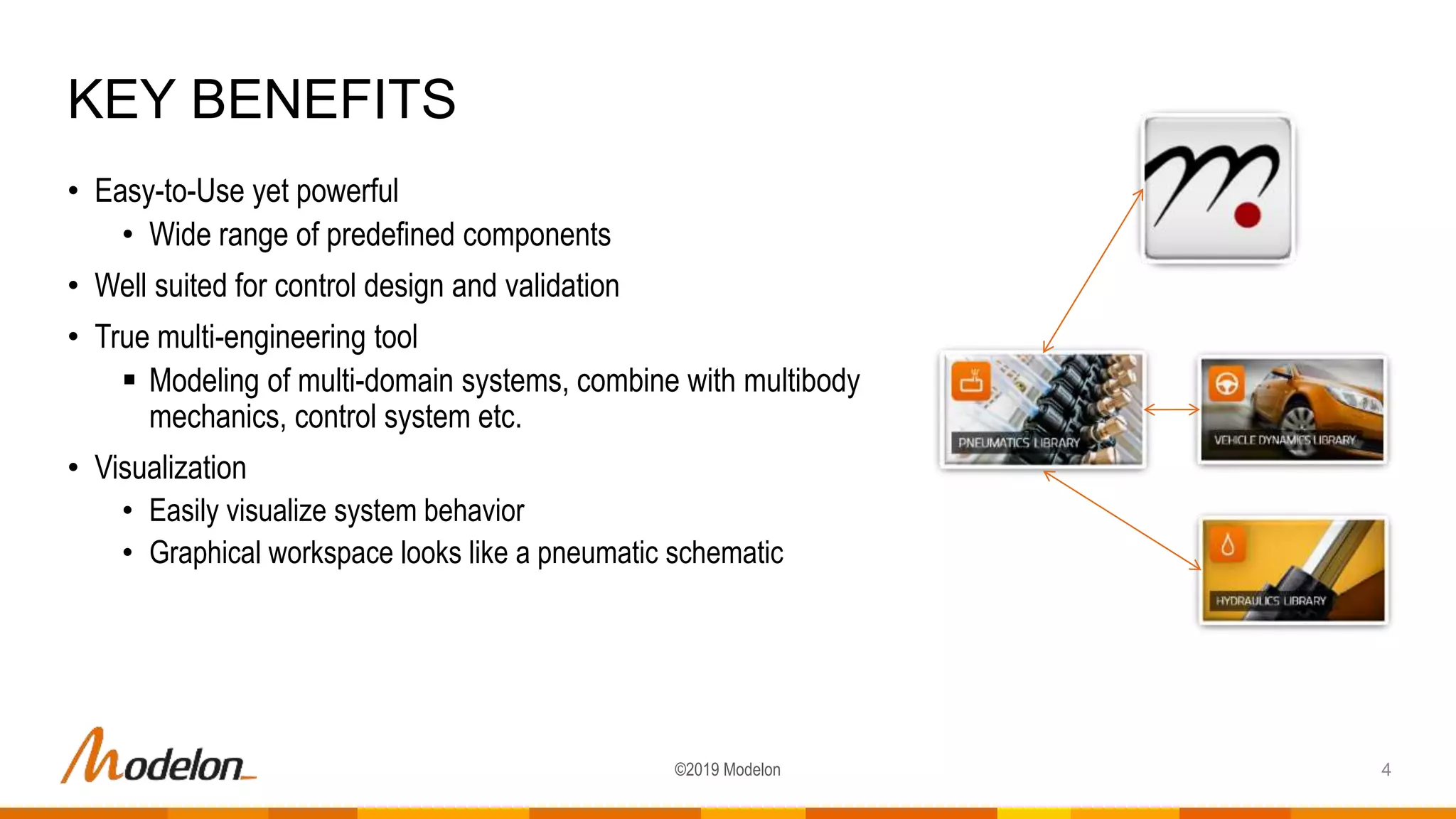
• Pneumatics Library can be combined with other Modelon libraries to solve specific engineering design
tasks.
• Interesting libraries include the
• Hydraulics Library
• Vehicle Dynamics Library
• These libraries can also be used as a stand-alone solution.
RECOMMENDED MODELON LIBRARY
COMPATIBILITY
18©2019 Modelon
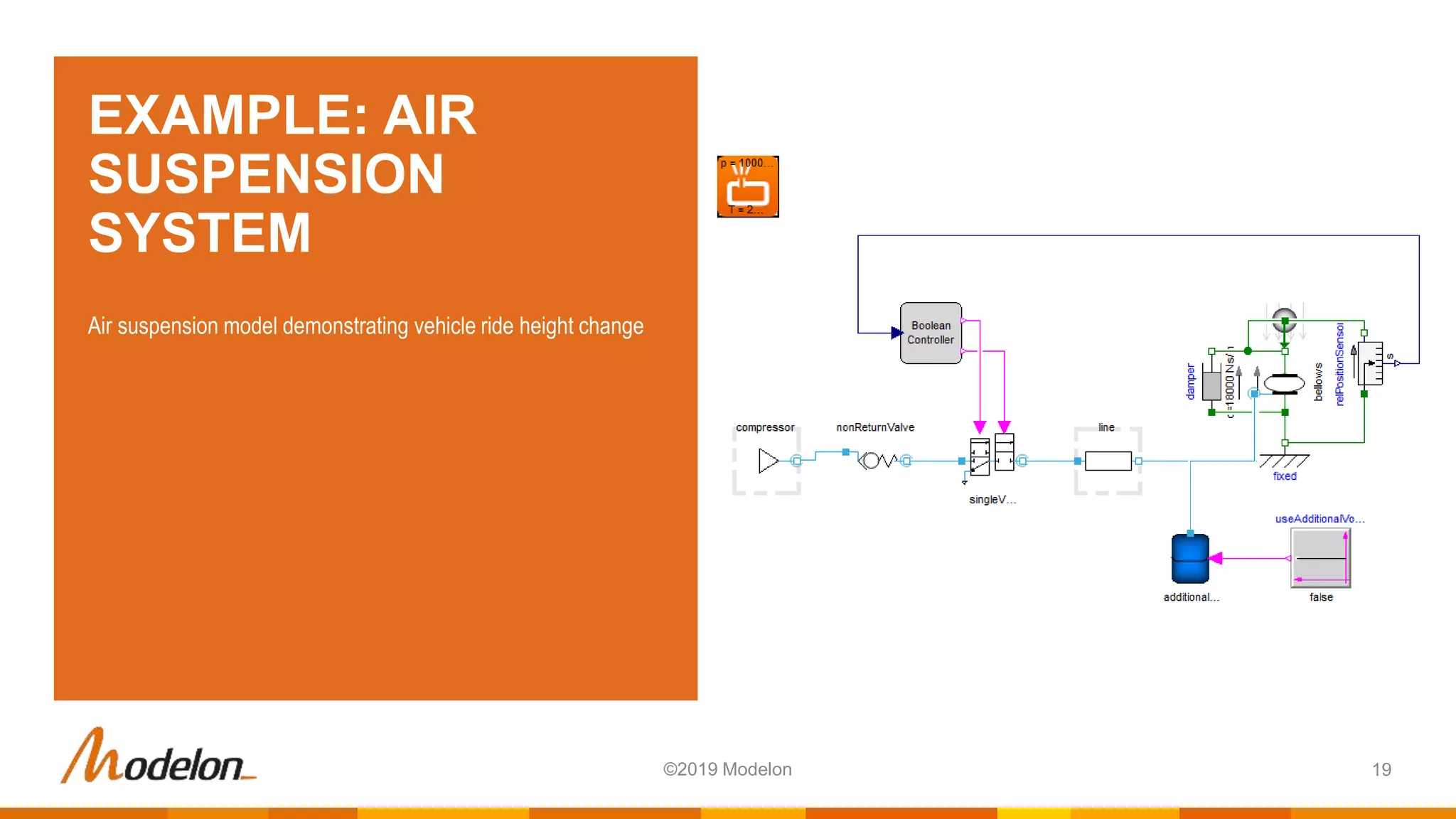
EXAMPLE: AIR
SUSPENSION
SYSTEM
Air suspension model demonstrating vehicle ride height change
19©2019 Modelon
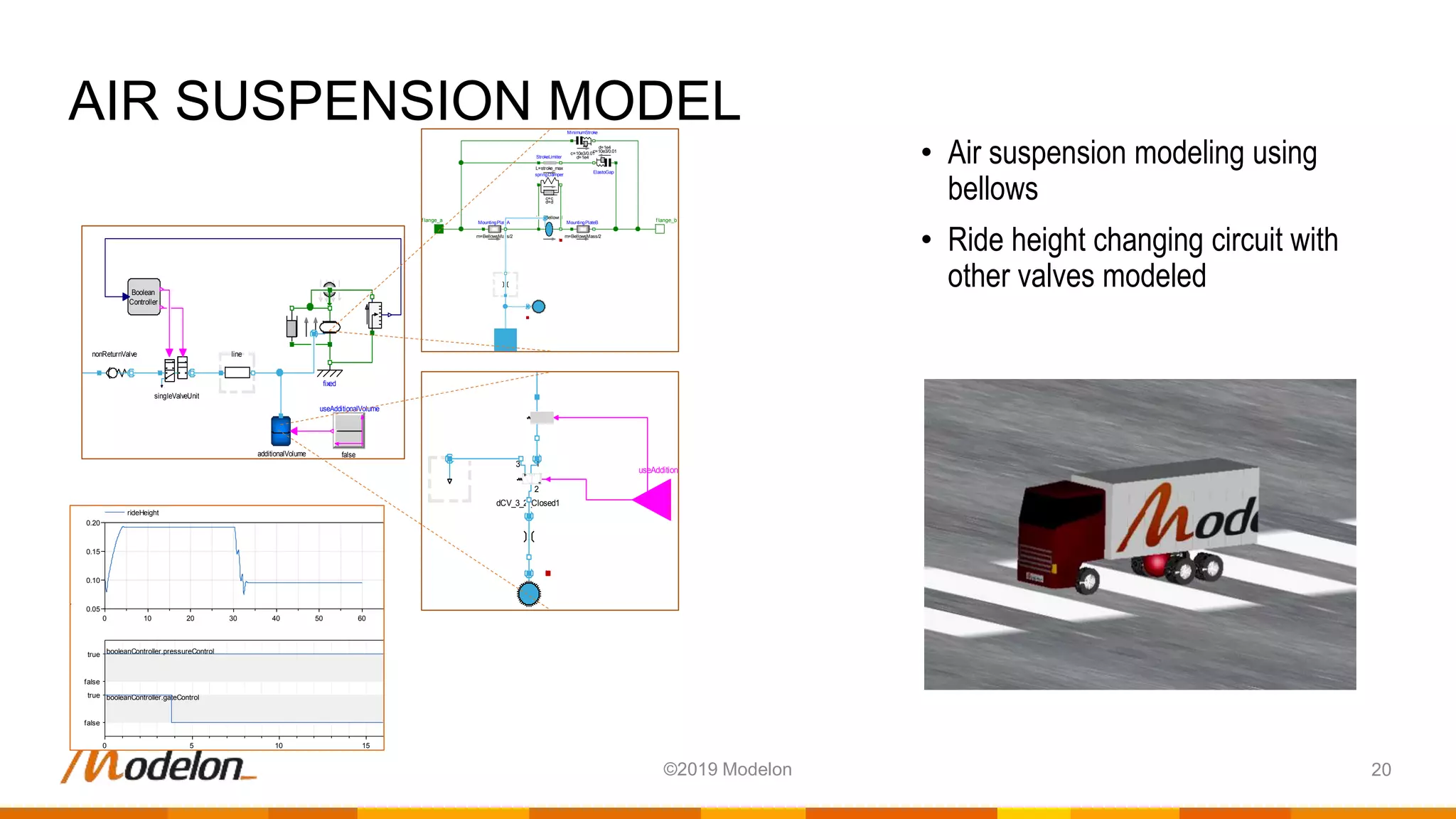
AIR SUSPENSION MODEL
20©2019 Modelon
• Air suspension modeling using
bellows
• Ride height changing circuit with
other valves modeled
fixed
compressor
p = 100000Pa
T = 293K
nonReturnValve line
useAdditionalVolume
falseadditionalVolume
singleValveUnit
Boolean
Controller
IdealBellows1
MountingPlateA
m=BellowsMass/2
MountingPlateB
m=BellowsMass/2
StrokeLimiter
L=stroke_max
ElastoGap1
c=10e3/0.01
d=1e4
springDamper
d=d
c=c
MinimumStroke
c=10e3/0.01
d=1e4
f lange_a f lange_b
multiPortVolume
13
2
dCV_3_2_Closed1
useAdditionalVolume
0 10 20 30 40 50 60
0.05
0.10
0.15
0.20
rideHeight
0 5 10 15
true
false
true
false
booleanController.pressureControl
booleanController.gateControl
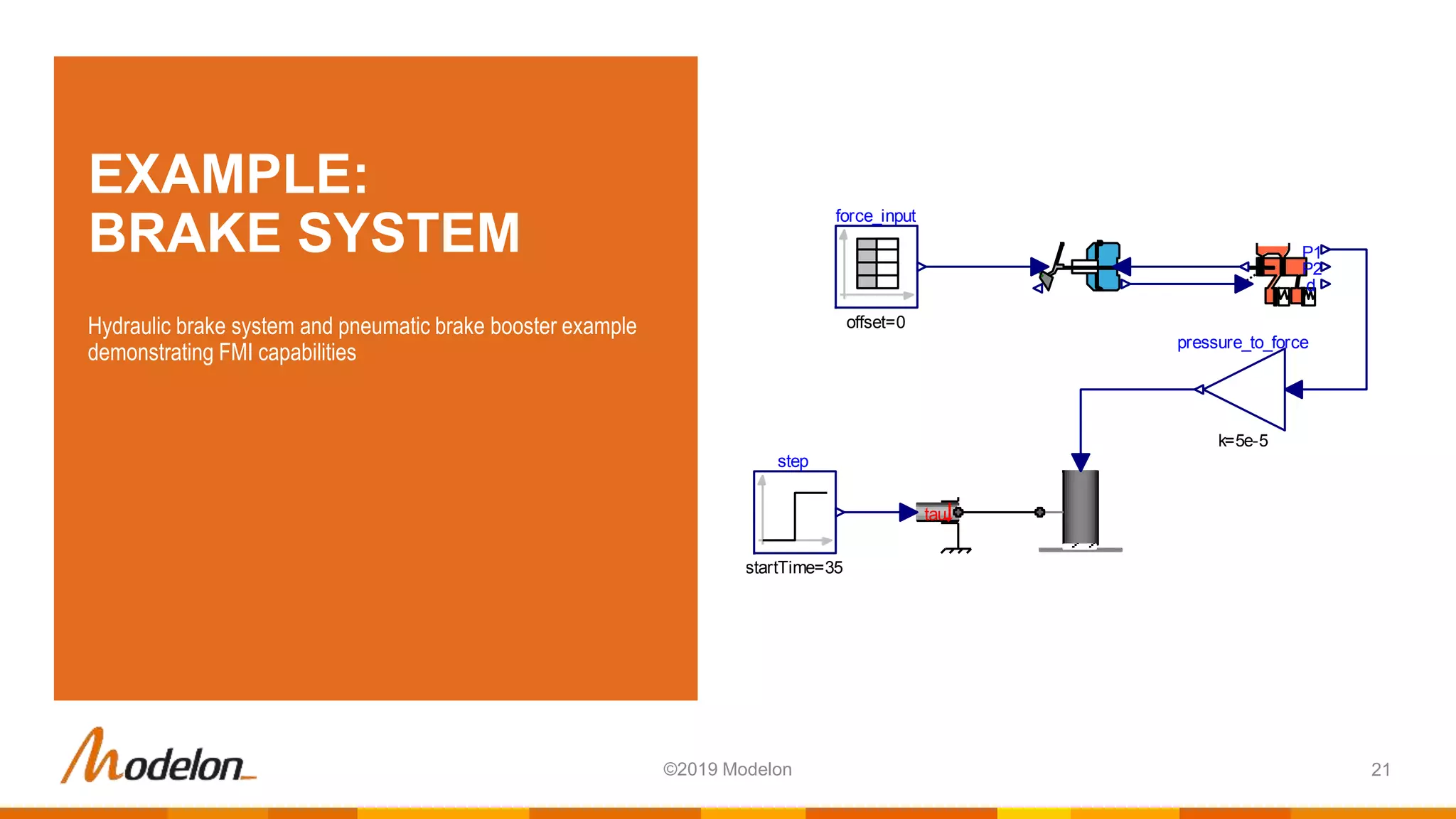
EXAMPLE:
BRAKE SYSTEM
Hydraulic brake system and pneumatic brake booster example
demonstrating FMI capabilities
force_input
offset=0
P1
d
P2
k=5e-5
pressure_to_force
tau
step
startTime=35
©2019 Modelon 21
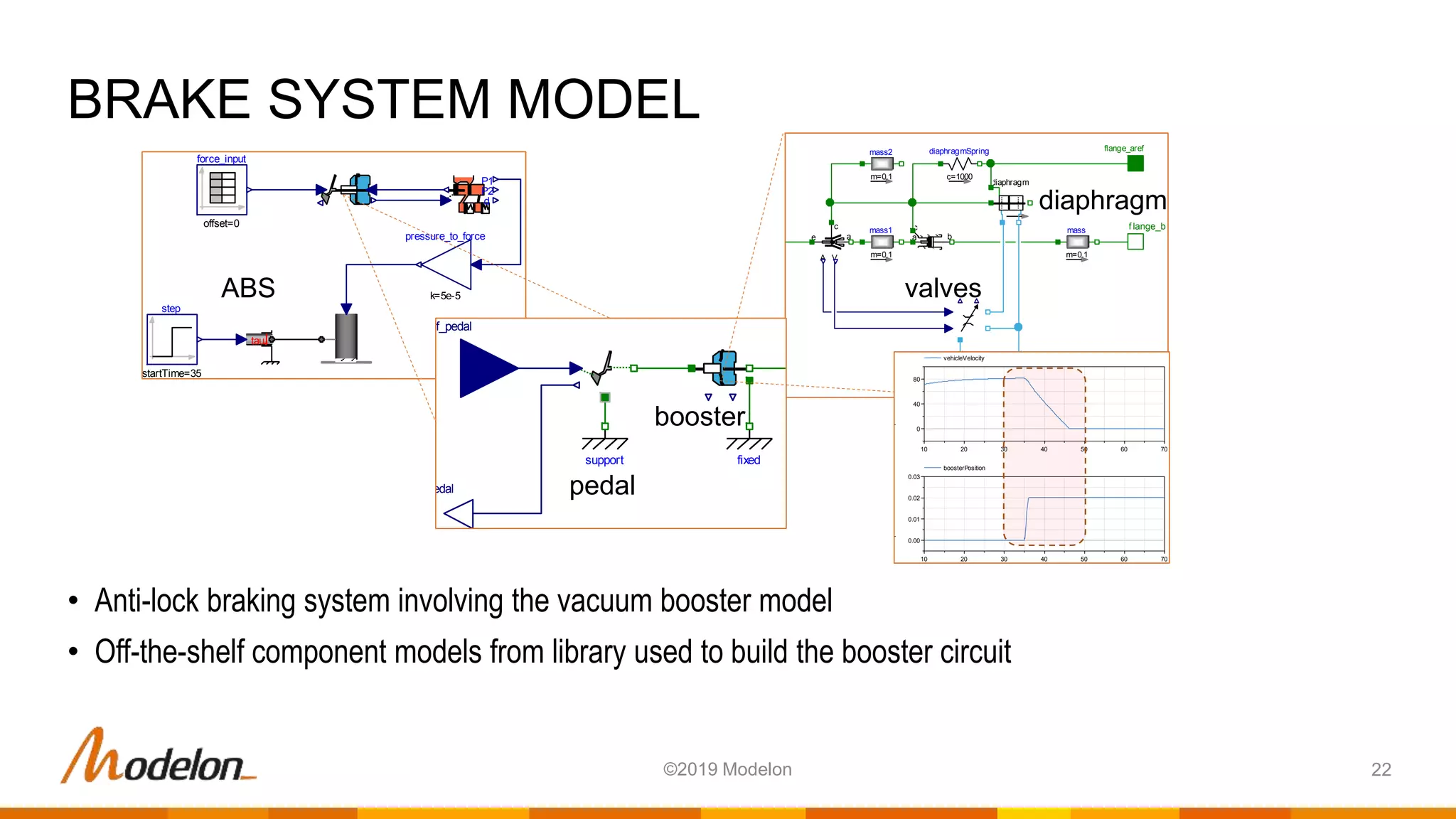
• Anti-lock braking system involving the vacuum booster model
• Off-the-shelf component models from library used to build the booster circuit
BRAKE SYSTEM MODEL
22©2019 Modelon
diaphragmSpring
c=1000
diaphragm
VA
e a
c
b
c
a
mass
m=0.1
mass1
m=0.1
mass2
m=0.1
p = 100000Pa
T = 293K
vacuum.port_2.m_flow*environment.rho0/max(1e-6, boosterValves.area_vacuumValve)
outflow
-atmosphere.port_2.m_flow*environment.rho0/max(1e-6, boosterValves.area_airValve)
inflow
flange_aref
f lange_a f lange_b
force_input
offset=0
P1
d
P2
k=5e-5
pressure_to_force
tau
step
startTime=35
ABS
support fixed
f
cylinder_force
f_cylinderf_pedal
s_pedal
s_booster
pedal
booster
diaphragm
valves
10 20 30 40 50 60 70
0
40
80
vehicleVelocity
10 20 30 40 50 60 70
0.00
0.01
0.02
0.03
boosterPosition
• Typical usage:
• Model Calibration and verification of existing designs
• Analyze system behavior of a new design
• New design plausible?
• Analyze possible design improvements
• Depends on Design goals
• Robustness of design
INDUSTRIAL EQUIPMENT
23©2019 Modelon
©2019 Modelon.
LATEST RELEASE: 2019.2
24©2019 Modelon
RELEASE: 2019.2
Enhancements
25©2019 Modelon
• Plot command scripts improved
• Icon animations for the components in Volumes package added

Pneumatics Library - Overview

  • 1.
  • 2.
     About ProductName  Key Benefits  Key Capabilities  Key Applications  Library Contents  Modelon Compatibility  Latest Release: 2019.2 AGENDA 2©2019 Modelon
  • 3.
    • Modelica libraryfor pneumatic systems and pneumatic circuits • Based on the ideal gas law assumption • Components • Most models needed for pneumatic applications available, both mobile and stationary • More can be built from basic building blocks • Open Code means user is in control • View, extend, modify models • Ideal for model sharing (encryption) • Simulation of pneumatic systems for • Overall system dynamics • Verification of dimensioning • Parameter studies ABOUT PNEUMATICS LIBRARY 3©2019 Modelon
  • 4.
    • Easy-to-Use yetpowerful • Wide range of predefined components • Well suited for control design and validation • True multi-engineering tool  Modeling of multi-domain systems, combine with multibody mechanics, control system etc. • Visualization • Easily visualize system behavior • Graphical workspace looks like a pneumatic schematic KEY BENEFITS 4©2019 Modelon
  • 5.
    • Integration ofpneumatic systems in wide range of multi-physics models • Parametric studies of designs • Deployment • Design of experiment • Optimization • List of applications • Industrial Equipment: • Road construction, drills, hammers etc. • Vehicles • Brake systems, air suspension KEY CAPABILITIES 5©2019 Modelon
  • 6.
  • 7.
    EXAMPLE: MOTOR CONTROL This examplemodel demonstrates a PID controller that tries to maintain the vane motor at a constant speed. By controlling the air pressure in to the motor the controller can control the speed of the vane motor. A load is model through a brake that is activated at 0.6 s. Pneumatic vane motors can be used is to start large engines e.g. industrial engines 7©2019 Modelon
  • 8.
    EXAMPLE: MULTI- POSITION CYLINDER Thisexample shows how easy even a complex systems can be modeled with Pneumatics Library. Multi position cylinders typically consist of two or three connected cylinders to reach three or four end positions. There is typically one port for every head-end chamber and one port for the connected rod-end chambers. In this example three double acting cylinders are used from the library. One of the cylinders (C3) has pneumatic stroke cushioning enabled, indicated by an arrow over the piston in the icon. The rods (Rod1 and Rod2) places the housing at the correct positions. The cylinders are connected by ElastoGaps. 8©2019 Modelon
  • 9.
    EXAMPLE: LINEAR ACTUATOR This exampleshows the principle of pneumatic stroke cushioning. A typical cylinder drive can very easily be modeled with the cylinder models in the library. 9©2019 Modelon
  • 10.
  • 11.
    • Standard packageorder • Information • Examples • Interfaces • Templates • Components by type • 2 Levels of components • Top level components for end user • Basic components are sub-components, building blocks for new, user-defined components LIBRARY CONTENTS 11©2019 Modelon
  • 12.
    Cylinders • With orwithout cushioning effect • Bellows Lines • Long line • Capillary Sources • Reserviors • Silencers LIBRARY CONTENTS 12©2019 Modelon
  • 13.
    Constant • Constant gasproperty model • Backward compatible with old Environment component IdealGas • Ideal gas model compatible with fluids from Modelon Base Library • 7 pre-defined fluids: Moist air, dry air, argon, nitrogen, oxygen, carbon dioxide Real gas • Fast switching between real and ideal gas • High pressure media - H2 and N2 models • Visualize compressibility factor for gas model validity LIBRARY CONTENTS 13©2019 Modelon
  • 14.
    DirectionalControl • For flowcontrol • First order spool dynamics Elements • Primitives for detailed component design Valves • Pressure and flow actuated LIBRARY CONTENTS 14©2019 Modelon
  • 15.
    Restrictions • Fittings • Geometrybased restrictions • Nozzles and orifices Rotary Actuator • Vane motor • Rotary actuator Sensors and Utilities.Visualizers • Pressure and flow Volumes • Chamber and volume models LIBRARY CONTENTS 15©2019 Modelon
  • 16.
  • 17.
  • 18.
    • Pneumatics Librarycan be combined with other Modelon libraries to solve specific engineering design tasks. • Interesting libraries include the • Hydraulics Library • Vehicle Dynamics Library • These libraries can also be used as a stand-alone solution. RECOMMENDED MODELON LIBRARY COMPATIBILITY 18©2019 Modelon
  • 19.
    EXAMPLE: AIR SUSPENSION SYSTEM Air suspensionmodel demonstrating vehicle ride height change 19©2019 Modelon
  • 20.
    AIR SUSPENSION MODEL 20©2019Modelon • Air suspension modeling using bellows • Ride height changing circuit with other valves modeled fixed compressor p = 100000Pa T = 293K nonReturnValve line useAdditionalVolume falseadditionalVolume singleValveUnit Boolean Controller IdealBellows1 MountingPlateA m=BellowsMass/2 MountingPlateB m=BellowsMass/2 StrokeLimiter L=stroke_max ElastoGap1 c=10e3/0.01 d=1e4 springDamper d=d c=c MinimumStroke c=10e3/0.01 d=1e4 f lange_a f lange_b multiPortVolume 13 2 dCV_3_2_Closed1 useAdditionalVolume 0 10 20 30 40 50 60 0.05 0.10 0.15 0.20 rideHeight 0 5 10 15 true false true false booleanController.pressureControl booleanController.gateControl
  • 21.
    EXAMPLE: BRAKE SYSTEM Hydraulic brakesystem and pneumatic brake booster example demonstrating FMI capabilities force_input offset=0 P1 d P2 k=5e-5 pressure_to_force tau step startTime=35 ©2019 Modelon 21
  • 22.
    • Anti-lock brakingsystem involving the vacuum booster model • Off-the-shelf component models from library used to build the booster circuit BRAKE SYSTEM MODEL 22©2019 Modelon diaphragmSpring c=1000 diaphragm VA e a c b c a mass m=0.1 mass1 m=0.1 mass2 m=0.1 p = 100000Pa T = 293K vacuum.port_2.m_flow*environment.rho0/max(1e-6, boosterValves.area_vacuumValve) outflow -atmosphere.port_2.m_flow*environment.rho0/max(1e-6, boosterValves.area_airValve) inflow flange_aref f lange_a f lange_b force_input offset=0 P1 d P2 k=5e-5 pressure_to_force tau step startTime=35 ABS support fixed f cylinder_force f_cylinderf_pedal s_pedal s_booster pedal booster diaphragm valves 10 20 30 40 50 60 70 0 40 80 vehicleVelocity 10 20 30 40 50 60 70 0.00 0.01 0.02 0.03 boosterPosition
  • 23.
    • Typical usage: •Model Calibration and verification of existing designs • Analyze system behavior of a new design • New design plausible? • Analyze possible design improvements • Depends on Design goals • Robustness of design INDUSTRIAL EQUIPMENT 23©2019 Modelon
  • 24.
    ©2019 Modelon. LATEST RELEASE:2019.2 24©2019 Modelon
  • 25.
    RELEASE: 2019.2 Enhancements 25©2019 Modelon •Plot command scripts improved • Icon animations for the components in Volumes package added