©2019 Modelon.
ELECTRIC POWER
LIBRARY
Overview
©2019 Modelon.
 About Electric Power Library
 Key Benefits
 Key Capabilities
 Key Applications
 Library Contents
 Modelon Compatibility
AGENDA
©2019 Modelon.
• Simulation of electric power systems for
• Testing of new control strategies
• Development and verification of new designs
• Commissioning
• Analysis of dynamics
• Failure investigation
• From generation to consumption of electric power
• Including transmission and distribution
• Developed together with power expert Hans-Juerg Wiesmann (ABB), Switzerland
ABOUT ELECTRIC POWER LIBRARY
©2019 Modelon.
• Well-suited for control design applications where simulations
early in the design process are valuable
• Multi-domain capabilities – power electronics, mechanics and
thermal dynamics can be captured in the same tool, saving time
and simplifying modeling
• Enables safe planning and commissioning tests by initial
practice in a virtual environment
• Get quick insights with fast and robust simulations
• Equation based, state-of-the-art representation of physics
provides accurate results
• Easy to integrate into any application domain
KEY BENEFITS
©2019 Modelon.
KEY CAPABILITIES
For use in a wide range of electric applications in multiple industries:
• Power generation systems and grids
• Autonomous electrical systems: aircraft, ships, trains, hybrid vehicles
• Wind power and renewables
• Power Electronics
• Islanding power generation
• Electrical drive systems, variable frequency drives
• Compatible with Thermal Power Library and Hydro Power Library
• Real-time capable
Flexible fidelity level ensures appropriate time frame resolution
• Average and switched inverter models
• Dynamic and steady-state
©2019 Modelon.
KEY APPLICATIONS
©2019 Modelon.
Stabilizing Hydro Power for the Electrical Grid
Objective
CASE
STUDY
Results
Using Modelon’s Hydro and Electric Power Library, engineers set
out to improve the understanding of Iceland’s Fossarvirkjun power
plant by investigating load rejection and exploring worst-case
scenarios during complete plant shut downs.
• Electrical grid that is better prepared to
handle disturbances and safety critical
scenarios
• Improved operation with a lower closing
time limit, enabling faster reactions to
critical disturbances
In collaboration with:
©2019 Modelon.
Over-Voltage Failure Investigation
Objective
CASE
STUDY
Results
Using Modelon’s Electric Power Library,
researchers set out to find the root-cause of an
over-voltage phenomenon in the Grunnåi power
station in Norway, which caused damage on the
equipment.
• Simulations bring understanding of the
system dynamics – the reactive power in
the grid is large enough to initiate self-
excitation of the asynchronous generators
• Correct protection relay settings crucial to
ensure safe operation and prevent over-
voltages
In collaboration with:
©2019 Modelon.
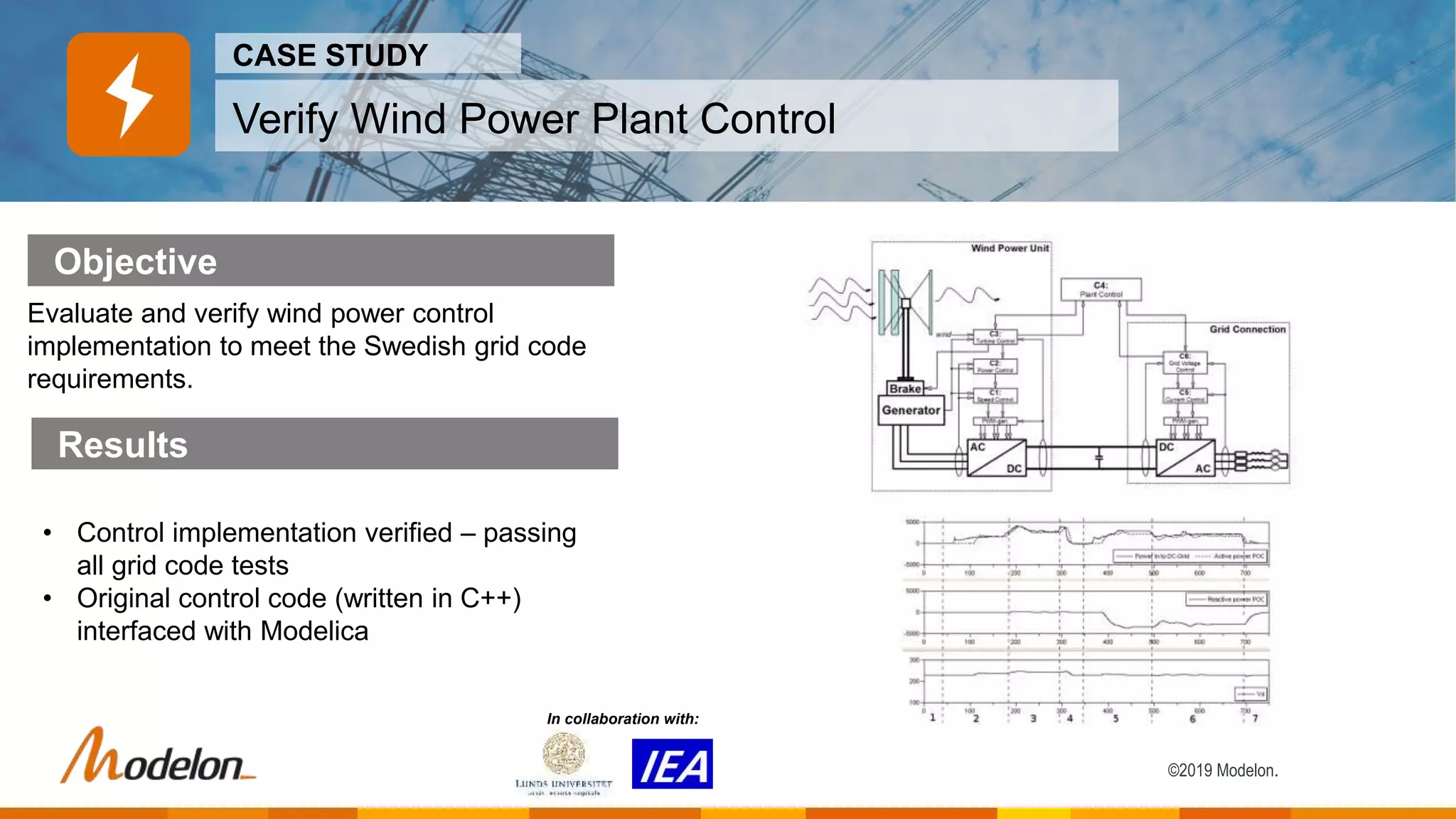
Verify Wind Power Plant Control
Objective
CASE STUDY
Results
Evaluate and verify wind power control
implementation to meet the Swedish grid code
requirements.
• Control implementation verified – passing
all grid code tests
• Original control code (written in C++)
interfaced with Modelica
In collaboration with:
©2019 Modelon.
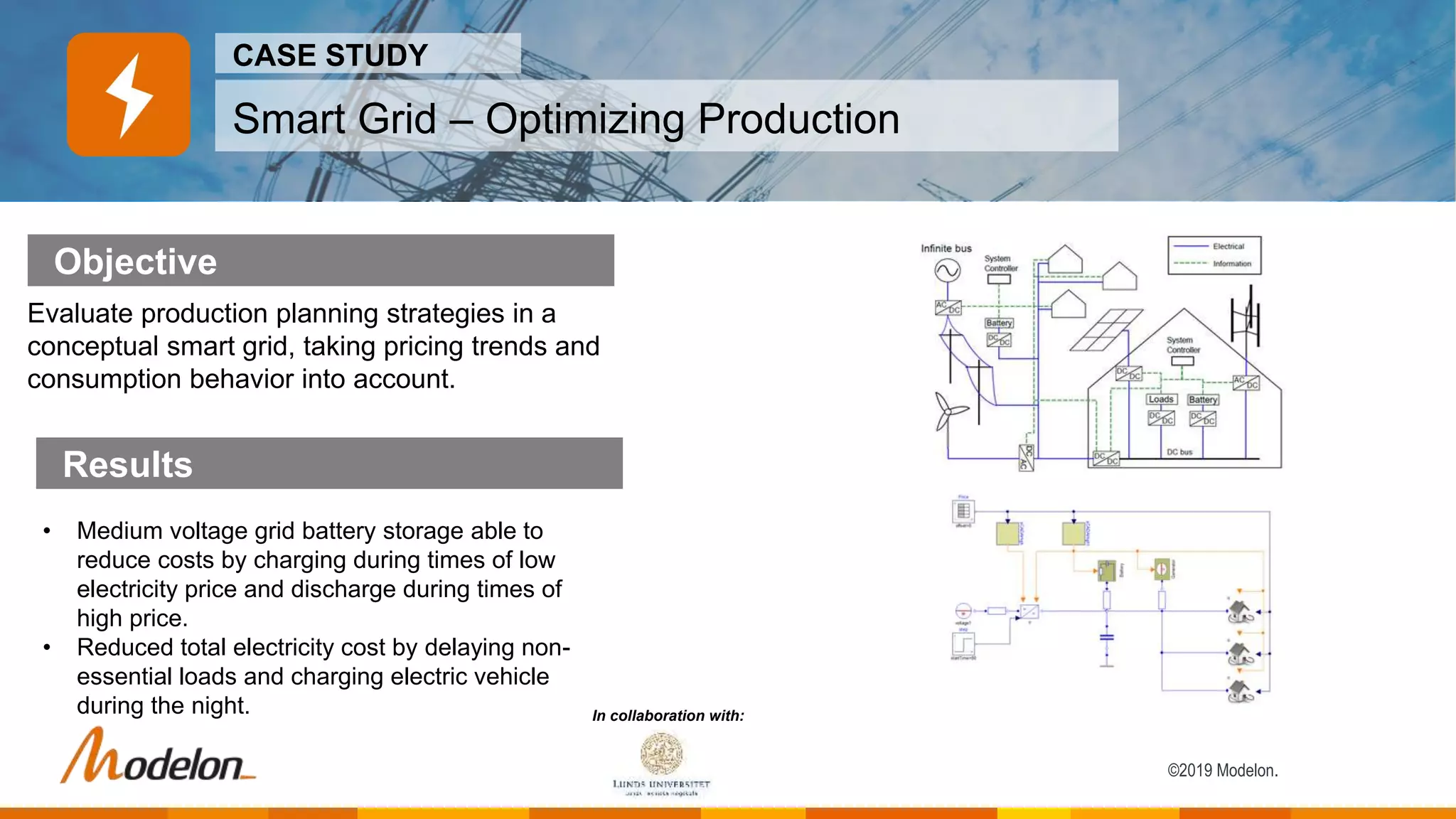
Smart Grid – Optimizing Production
Objective
CASE STUDY
Results
Evaluate production planning strategies in a
conceptual smart grid, taking pricing trends and
consumption behavior into account.
• Medium voltage grid battery storage able to
reduce costs by charging during times of low
electricity price and discharge during times of
high price.
• Reduced total electricity cost by delaying non-
essential loads and charging electric vehicle
during the night. In collaboration with:
©2019 Modelon.
LIBRARY CONTENTS
©2019 Modelon.
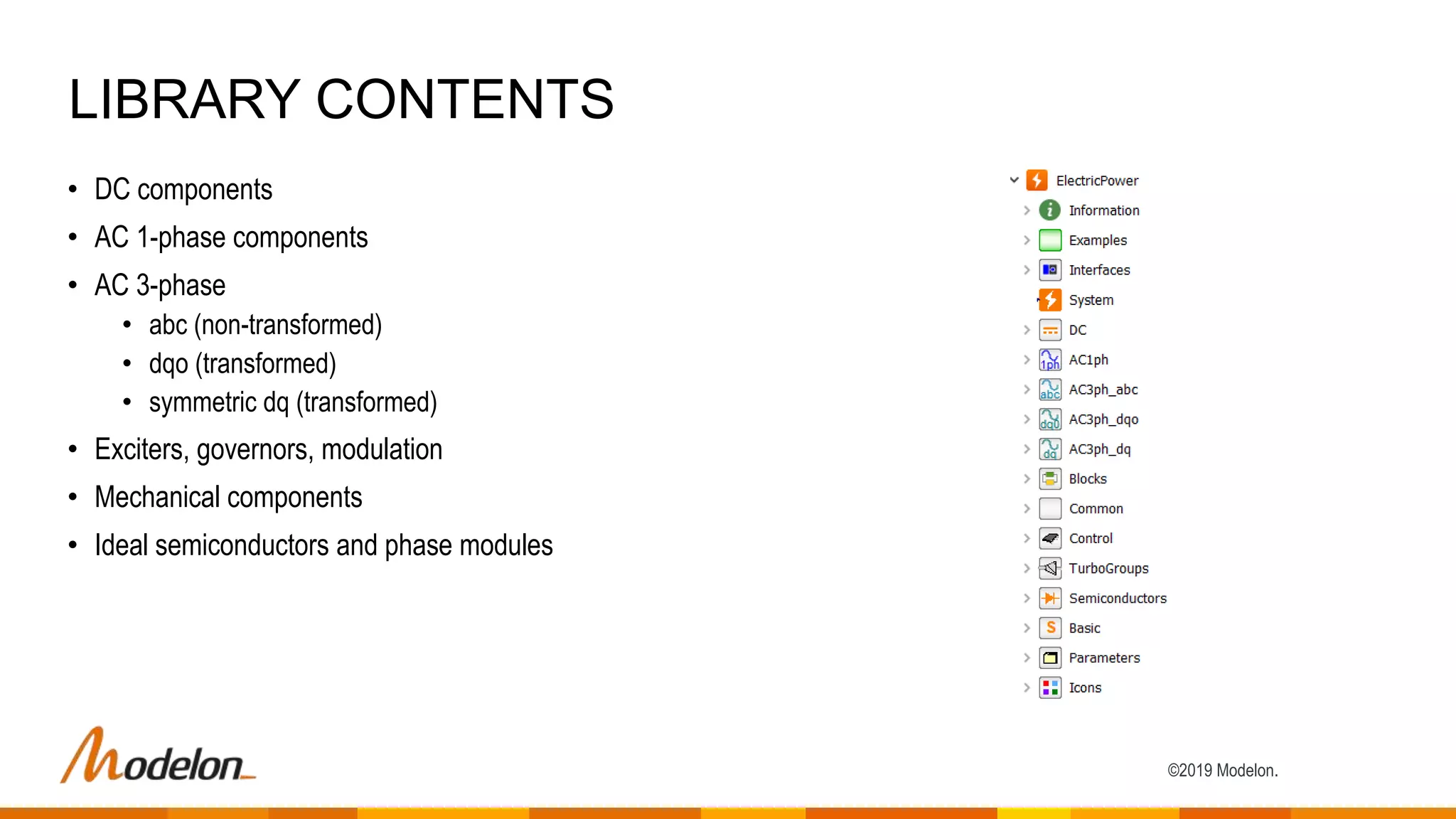
• DC components
• AC 1-phase components
• AC 3-phase
• abc (non-transformed)
• dqo (transformed)
• symmetric dq (transformed)
• Exciters, governors, modulation
• Mechanical components
• Ideal semiconductors and phase modules
LIBRARY CONTENTS
©2019 Modelon.
• 3-phase representations
• abc
• Most common, non-transformed
• Does not allow fast integration (AC is periodic), except in special cases
• dqo
• Using Park-transformed signals
• Rotating reference frame
• Fast integration of linear systems without loss of transient information
• dq
• Similar to dqo, but assumes balanced three phase currents
• Omitting zero component
LIBRARY CONTENTS
©2019 Modelon.
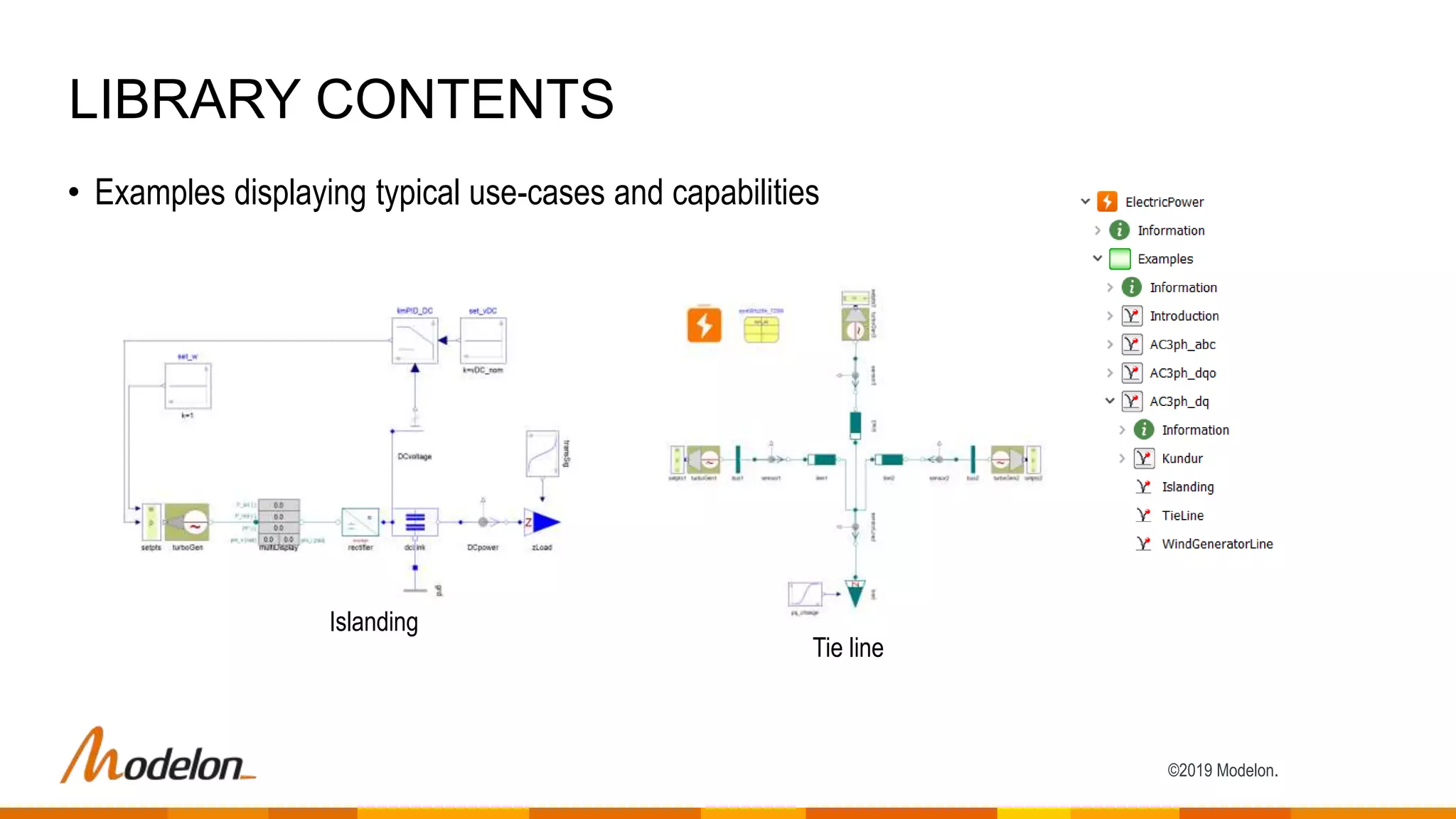
• Examples displaying typical use-cases and capabilities
LIBRARY CONTENTS
Islanding
Tie line
©2019 Modelon.
• Generators
• Turbine-generator systems
• Include electrical and mechanical models
• Replaceable architecture makes it possible to choose appropriate fidelity
level
LIBRARY CONTENTS
©2019 Modelon.
• Inverters and Rectifiers
• User can choose appropriate fidelity level:
• Switched
• Time averaged
• Switched details of current and voltage ignored
• Fast simulations suited for longer simulations and system studies
LIBRARY CONTENTS
©2019 Modelon.
• Lines
• Various transmission line models:
• PIline
• Transmission line modelled as discretized telegraph-equation, 'pi-elements’
• RXline
• Switched details of current and voltage ignored
• Fast models suited for longer simulations and system studies
• Support of fault simulation along the lines
LIBRARY CONTENTS
©2019 Modelon.
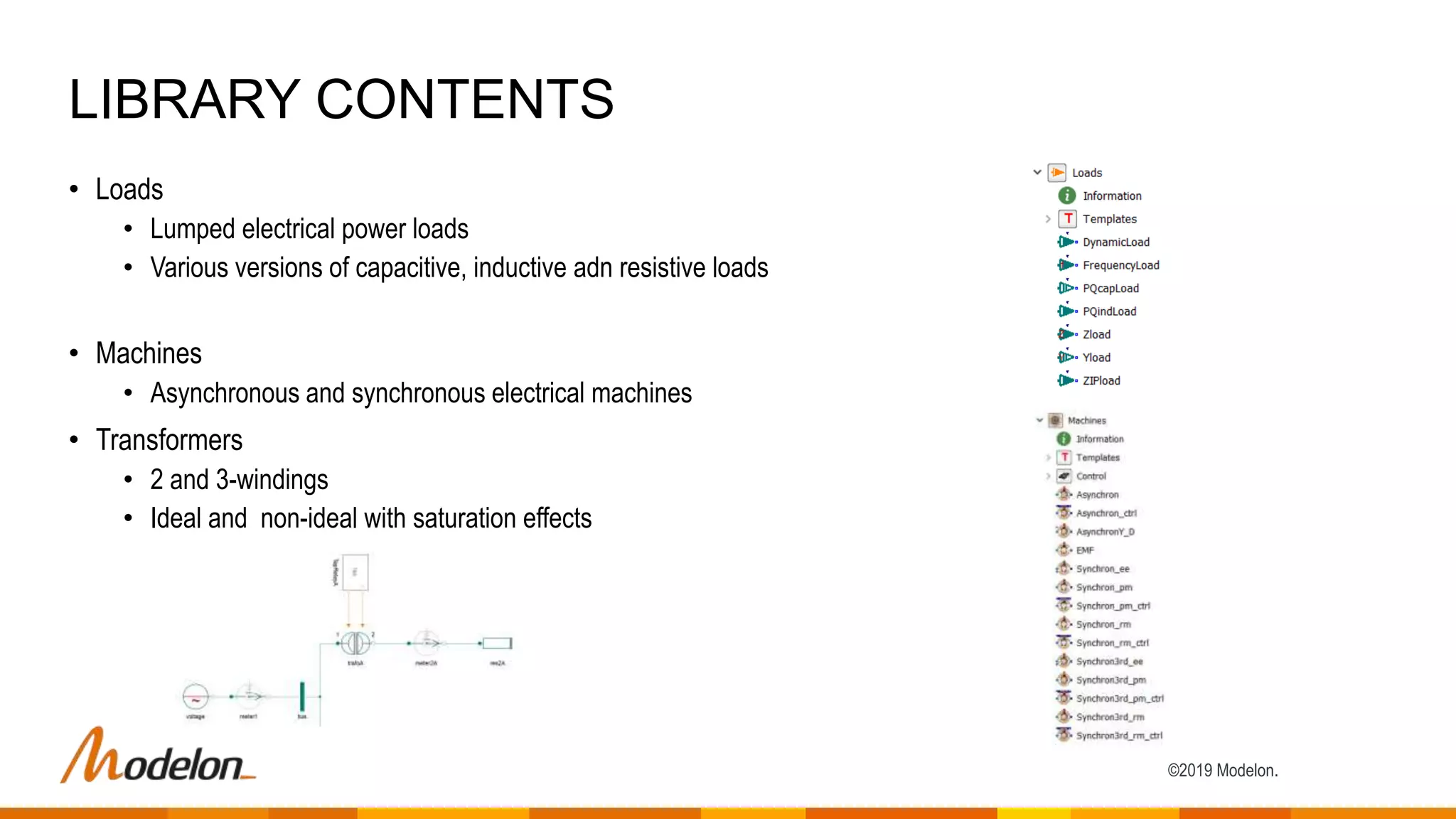
• Loads
• Lumped electrical power loads
• Various versions of capacitive, inductive adn resistive loads
• Machines
• Asynchronous and synchronous electrical machines
• Transformers
• 2 and 3-windings
• Ideal and non-ideal with saturation effects
LIBRARY CONTENTS
©2019 Modelon.
• Predefined data configurations
• Quickly set-up a system
• Cover standard components
• Breakers, lines, machines, semiconductors, transformers and
turbines
• SI or in pu- ('per unit') units option
LIBRARY CONTENTS
©2019 Modelon.
• System component
• System wide settings
• Transient or steady-state simulation mode
• Frequency type: parameter, signal, or average (machine-dependent)
system frequency
• Lower and upper limit-frequencies
LIBRARY CONTENTS
©2019 Modelon.
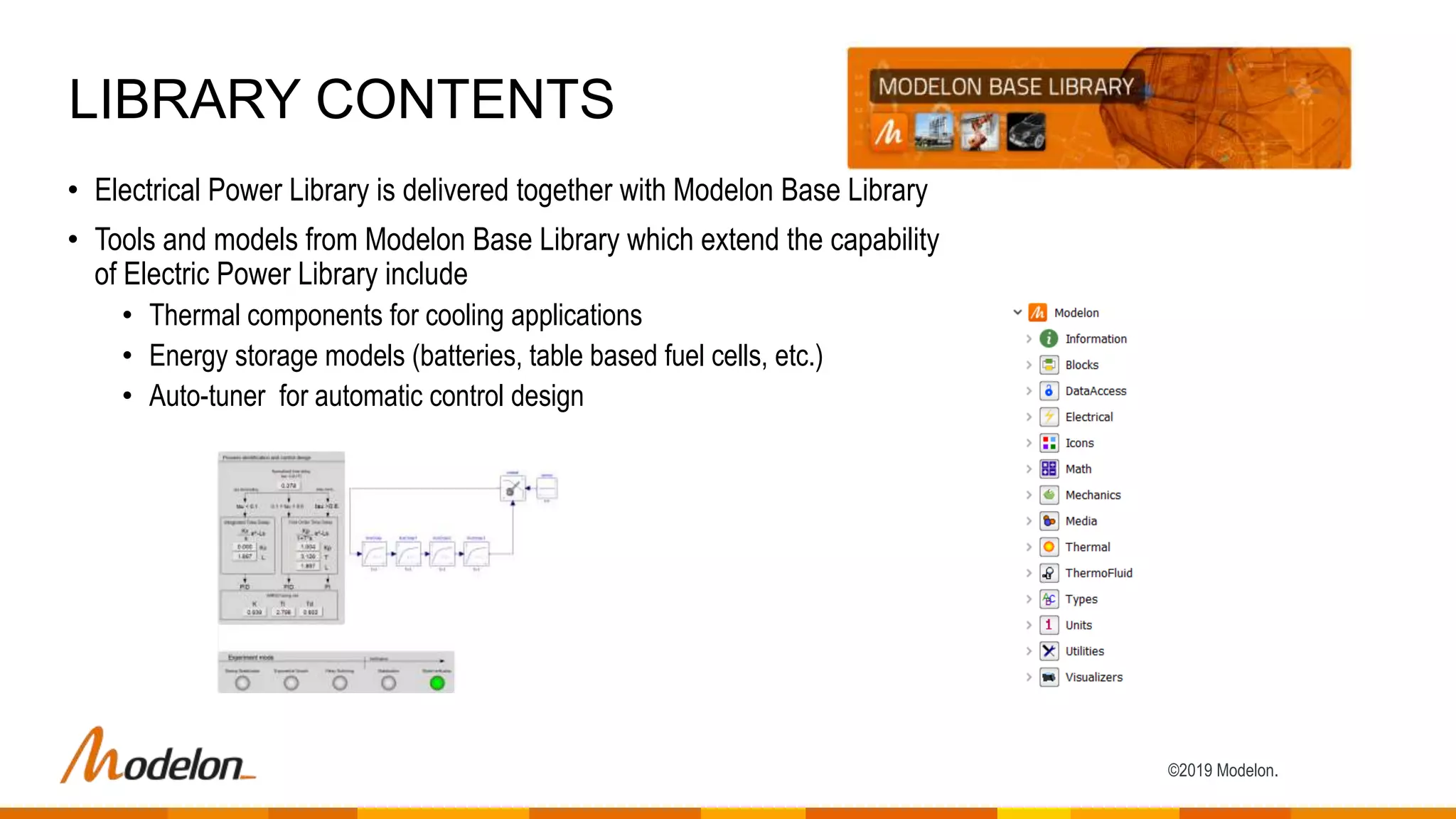
• Electrical Power Library is delivered together with Modelon Base Library
• Tools and models from Modelon Base Library which extend the capability
of Electric Power Library include
• Thermal components for cooling applications
• Energy storage models (batteries, table based fuel cells, etc.)
• Auto-tuner for automatic control design
LIBRARY CONTENTS
©2019 Modelon.
MODELON COMPATIBILITY
©2019 Modelon.
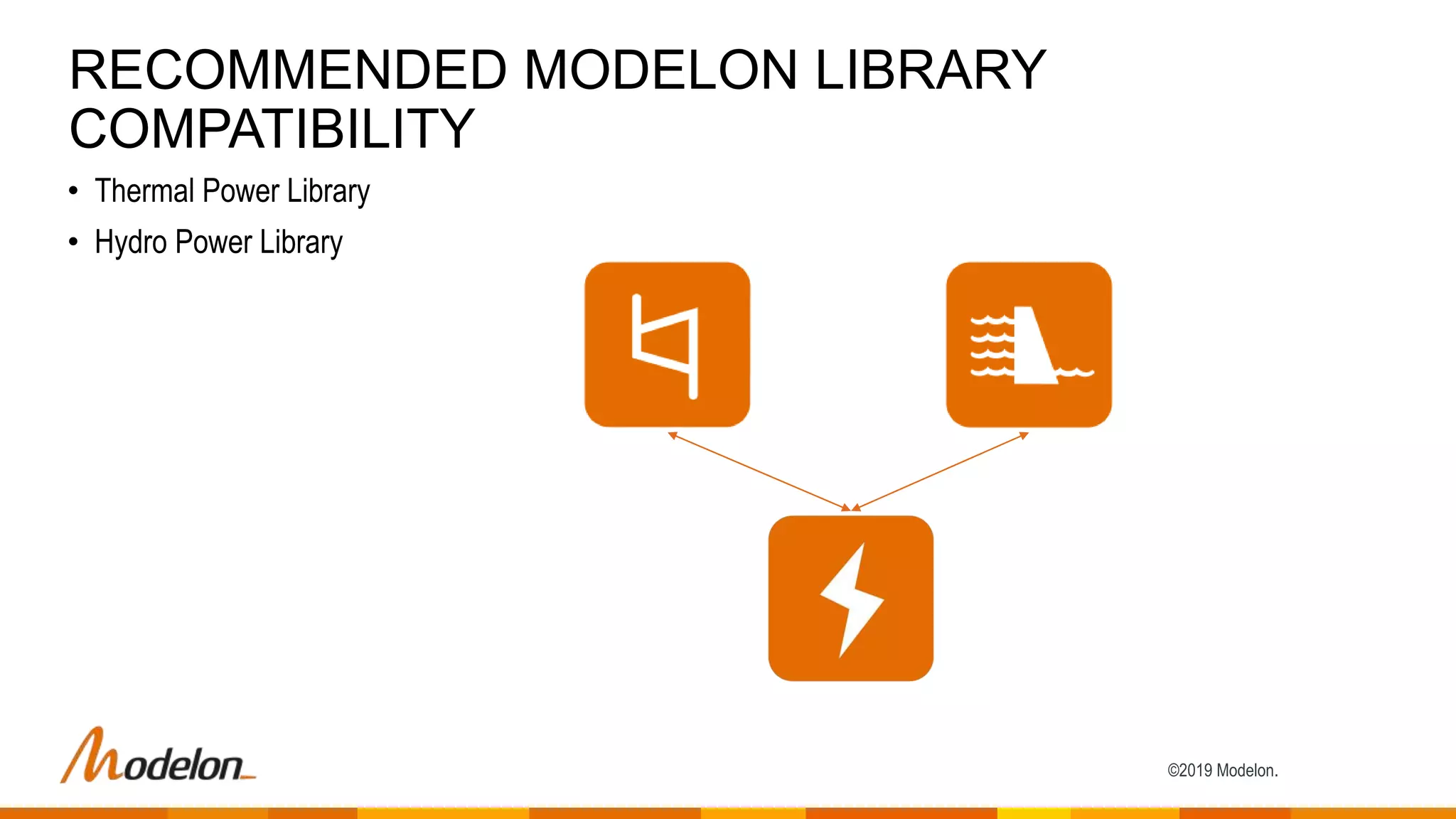
• Thermal Power Library
• Hydro Power Library
RECOMMENDED MODELON LIBRARY
COMPATIBILITY
©2019 Modelon.
LATEST RELEASE: 2019.2
24
©2019 Modelon.
RELEASE:2019.2
New Features
• Electric Power Library 2.7 is based on Modelon Base Library 3.4 and Modelica Standard
Library 3.2.3. It is also compatible with Modelica Standard Library 3.2.2.
25

Electric Power Library - Overview

  • 1.
  • 2.
    ©2019 Modelon.  AboutElectric Power Library  Key Benefits  Key Capabilities  Key Applications  Library Contents  Modelon Compatibility AGENDA
  • 3.
    ©2019 Modelon. • Simulationof electric power systems for • Testing of new control strategies • Development and verification of new designs • Commissioning • Analysis of dynamics • Failure investigation • From generation to consumption of electric power • Including transmission and distribution • Developed together with power expert Hans-Juerg Wiesmann (ABB), Switzerland ABOUT ELECTRIC POWER LIBRARY
  • 4.
    ©2019 Modelon. • Well-suitedfor control design applications where simulations early in the design process are valuable • Multi-domain capabilities – power electronics, mechanics and thermal dynamics can be captured in the same tool, saving time and simplifying modeling • Enables safe planning and commissioning tests by initial practice in a virtual environment • Get quick insights with fast and robust simulations • Equation based, state-of-the-art representation of physics provides accurate results • Easy to integrate into any application domain KEY BENEFITS
  • 5.
    ©2019 Modelon. KEY CAPABILITIES Foruse in a wide range of electric applications in multiple industries: • Power generation systems and grids • Autonomous electrical systems: aircraft, ships, trains, hybrid vehicles • Wind power and renewables • Power Electronics • Islanding power generation • Electrical drive systems, variable frequency drives • Compatible with Thermal Power Library and Hydro Power Library • Real-time capable Flexible fidelity level ensures appropriate time frame resolution • Average and switched inverter models • Dynamic and steady-state
  • 6.
  • 7.
    ©2019 Modelon. Stabilizing HydroPower for the Electrical Grid Objective CASE STUDY Results Using Modelon’s Hydro and Electric Power Library, engineers set out to improve the understanding of Iceland’s Fossarvirkjun power plant by investigating load rejection and exploring worst-case scenarios during complete plant shut downs. • Electrical grid that is better prepared to handle disturbances and safety critical scenarios • Improved operation with a lower closing time limit, enabling faster reactions to critical disturbances In collaboration with:
  • 8.
    ©2019 Modelon. Over-Voltage FailureInvestigation Objective CASE STUDY Results Using Modelon’s Electric Power Library, researchers set out to find the root-cause of an over-voltage phenomenon in the Grunnåi power station in Norway, which caused damage on the equipment. • Simulations bring understanding of the system dynamics – the reactive power in the grid is large enough to initiate self- excitation of the asynchronous generators • Correct protection relay settings crucial to ensure safe operation and prevent over- voltages In collaboration with:
  • 9.
    ©2019 Modelon. Verify WindPower Plant Control Objective CASE STUDY Results Evaluate and verify wind power control implementation to meet the Swedish grid code requirements. • Control implementation verified – passing all grid code tests • Original control code (written in C++) interfaced with Modelica In collaboration with:
  • 10.
    ©2019 Modelon. Smart Grid– Optimizing Production Objective CASE STUDY Results Evaluate production planning strategies in a conceptual smart grid, taking pricing trends and consumption behavior into account. • Medium voltage grid battery storage able to reduce costs by charging during times of low electricity price and discharge during times of high price. • Reduced total electricity cost by delaying non- essential loads and charging electric vehicle during the night. In collaboration with:
  • 11.
  • 12.
    ©2019 Modelon. • DCcomponents • AC 1-phase components • AC 3-phase • abc (non-transformed) • dqo (transformed) • symmetric dq (transformed) • Exciters, governors, modulation • Mechanical components • Ideal semiconductors and phase modules LIBRARY CONTENTS
  • 13.
    ©2019 Modelon. • 3-phaserepresentations • abc • Most common, non-transformed • Does not allow fast integration (AC is periodic), except in special cases • dqo • Using Park-transformed signals • Rotating reference frame • Fast integration of linear systems without loss of transient information • dq • Similar to dqo, but assumes balanced three phase currents • Omitting zero component LIBRARY CONTENTS
  • 14.
    ©2019 Modelon. • Examplesdisplaying typical use-cases and capabilities LIBRARY CONTENTS Islanding Tie line
  • 15.
    ©2019 Modelon. • Generators •Turbine-generator systems • Include electrical and mechanical models • Replaceable architecture makes it possible to choose appropriate fidelity level LIBRARY CONTENTS
  • 16.
    ©2019 Modelon. • Invertersand Rectifiers • User can choose appropriate fidelity level: • Switched • Time averaged • Switched details of current and voltage ignored • Fast simulations suited for longer simulations and system studies LIBRARY CONTENTS
  • 17.
    ©2019 Modelon. • Lines •Various transmission line models: • PIline • Transmission line modelled as discretized telegraph-equation, 'pi-elements’ • RXline • Switched details of current and voltage ignored • Fast models suited for longer simulations and system studies • Support of fault simulation along the lines LIBRARY CONTENTS
  • 18.
    ©2019 Modelon. • Loads •Lumped electrical power loads • Various versions of capacitive, inductive adn resistive loads • Machines • Asynchronous and synchronous electrical machines • Transformers • 2 and 3-windings • Ideal and non-ideal with saturation effects LIBRARY CONTENTS
  • 19.
    ©2019 Modelon. • Predefineddata configurations • Quickly set-up a system • Cover standard components • Breakers, lines, machines, semiconductors, transformers and turbines • SI or in pu- ('per unit') units option LIBRARY CONTENTS
  • 20.
    ©2019 Modelon. • Systemcomponent • System wide settings • Transient or steady-state simulation mode • Frequency type: parameter, signal, or average (machine-dependent) system frequency • Lower and upper limit-frequencies LIBRARY CONTENTS
  • 21.
    ©2019 Modelon. • ElectricalPower Library is delivered together with Modelon Base Library • Tools and models from Modelon Base Library which extend the capability of Electric Power Library include • Thermal components for cooling applications • Energy storage models (batteries, table based fuel cells, etc.) • Auto-tuner for automatic control design LIBRARY CONTENTS
  • 22.
  • 23.
    ©2019 Modelon. • ThermalPower Library • Hydro Power Library RECOMMENDED MODELON LIBRARY COMPATIBILITY
  • 24.
  • 25.
    ©2019 Modelon. RELEASE:2019.2 New Features •Electric Power Library 2.7 is based on Modelon Base Library 3.4 and Modelica Standard Library 3.2.3. It is also compatible with Modelica Standard Library 3.2.2. 25

Editor's Notes

  • #8 This case study details how one of Germany’s largest thermal power plants has improved their primary control reserves; resulting in an electric grid that can integrate a higher number of renewable energy sources, including wind and solar. Modelon’s Thermal Power Library enabled researchers to develop a model consisting of different sub-sections, coupled through fluid-connections and a control signal bus. Nearly 11,000 differential-algebraic equations are used to describe the system which includes about 500 thermodynamic states.
  • #9 This case study details how one of Germany’s largest thermal power plants has improved their primary control reserves; resulting in an electric grid that can integrate a higher number of renewable energy sources, including wind and solar. Modelon’s Thermal Power Library enabled researchers to develop a model consisting of different sub-sections, coupled through fluid-connections and a control signal bus. Nearly 11,000 differential-algebraic equations are used to describe the system which includes about 500 thermodynamic states.
  • #10 This case study details how one of Germany’s largest thermal power plants has improved their primary control reserves; resulting in an electric grid that can integrate a higher number of renewable energy sources, including wind and solar. Modelon’s Thermal Power Library enabled researchers to develop a model consisting of different sub-sections, coupled through fluid-connections and a control signal bus. Nearly 11,000 differential-algebraic equations are used to describe the system which includes about 500 thermodynamic states.
  • #11 This case study details how one of Germany’s largest thermal power plants has improved their primary control reserves; resulting in an electric grid that can integrate a higher number of renewable energy sources, including wind and solar. Modelon’s Thermal Power Library enabled researchers to develop a model consisting of different sub-sections, coupled through fluid-connections and a control signal bus. Nearly 11,000 differential-algebraic equations are used to describe the system which includes about 500 thermodynamic states.