Automated chaining of 
model transformations with 
incompatible metamodels 
Joint work with Francesco Basciani, Davide Di Ruscio, Ludovico Iovino 
Dipartimento di Ingegneria e Scienze 
dell’Informazione e Matematica 
Università degli Studi dell’Aquila 
Alfonso Pierantonio 
APierantonio
2 Summary 
Introduction 
Composition 
Problem Statement 
Automating the Chaining Process 
Enhancing Composability 
Metamodel Similarity 
Tool 
Conclusions 
APierantonio - ACM/IEEE 17th MoDELS, Valencia
3 Introduction 
Model transformations have a vital role in MDE because 
they are employed to bridge different domains and/or 
abstraction levels. 
New transformations can be developed by composing 
existing ones according to user requirements. 
Composing transformations is a complex problem: 
– transformations must be discovered and selected from different 
APierantonio - ACM/IEEE 17th MoDELS, Valencia 
and heterogeneous sources 
∙ eg., ATL Zoo, GitHub, etc. 
– the common way to compose transformations is to chain them, 
ie. by passing models from one transformation to another
4 External vs. Internal composition 
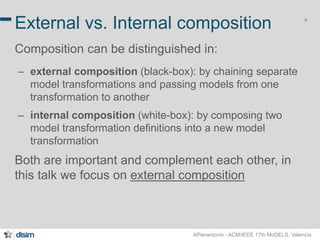
Composition can be distinguished in: 
– external composition (black-box): by chaining separate 
model transformations and passing models from one 
transformation to another 
– internal composition (white-box): by composing two 
model transformation definitions into a new model 
transformation 
Both are important and complement each other, in 
this talk we focus on external composition 
APierantonio - ACM/IEEE 17th MoDELS, Valencia
5 Problem statement 
Given two metamodels MMi and MMf we would like 
to understand whether there is a composition of 
existing transformations bridging them. 
MMi MMf 
MMf 
APierantonio - ACM/IEEE 17th MoDELS, Valencia
Problem statement 
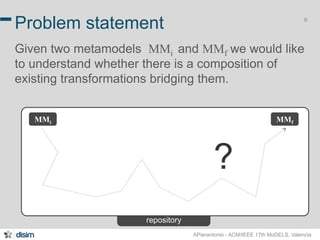
Given two metamodels MMi and MMf we would like 
to understand whether there is a composition of 
existing transformations bridging them. 
6 
MMi MMf 
APierantonio - ACM/IEEE 17th MoDELS, Valencia 
repository 
MMf 
?
7 
Problem statement 
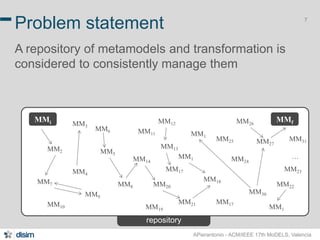
A repository of metamodels and transformation is 
considered to consistently manage them 
MMi MMf 
MM23 
APierantonio - ACM/IEEE 17th MoDELS, Valencia 
MM17 
repository 
MM2 
MM6 MM11 
MM4 
MM7 MM8 
MM14 
MM5 
MM12 
MM13 
MM3 
MM9 
MM20 
MM19 
MM26 
MM1 
MM25 MM27 
MM18 
MM21 
MM30 
MM10 
MM24 
MMf 
MM31 
MM1 
MM17 
MM22 
MM1 
…
8 External composition 
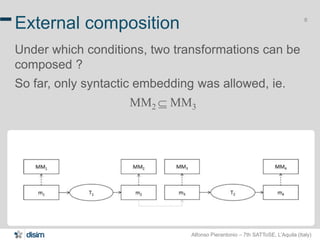
Under which conditions, two transformations can be 
composed ? 
So far, only syntactic embedding was allowed, ie. 
MM2  MM3 
Alfonso Pierantonio – 7th SATToSE, L’Aquila (Italy)
9 
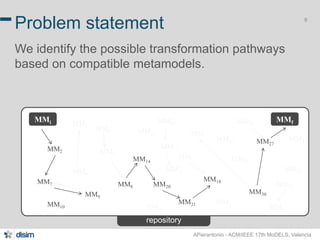
Problem statement 
We identify the possible transformation pathways 
based on compatible metamodels. 
MMi MMf 
MM23 
APierantonio - ACM/IEEE 17th MoDELS, Valencia 
repository 
MM2 
MM7 MM8 
MM14 
MM9 
MM20 
MM19 
MM27 
MM18 
MM MM21 10 
MMf 
MM1 
… 
MM6 MM11 
MM4 
MM5 
MM12 
MM13 
MM3 
MM17 
MM26 
MM1 
MM25 
MM24 
MM31 
MM1 
MM22 
MM1 
MM30
10 
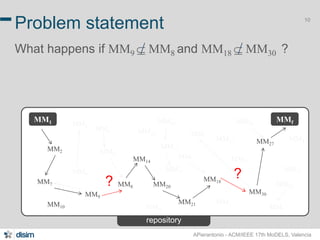
Problem statement 
What happens if MM MMand MM / 
MM? 
9 8 18 30 MM1 MMf 
MM23 
APierantonio - ACM/IEEE 17th MoDELS, Valencia 
repository 
MM2 
MM7 MM8 
MM14 
MM9 
MM20 
MM19 
MM27 
MM18 
MM MM21 10 
MMf 
MM1 
… 
MM6 MM11 
MM4 
MM5 
MM12 
MM13 
MM3 
MM17 
MM26 
MM1 
MM25 
MM24 
MM31 
MM1 
MM22 
MM1 
/ 
MM30 
? 
?
11 Goal 
The goal of this work is to enhance transformation 
composability by using co-evolution techniques. 
In many cases output and input metamodels have 
similar «informational» structures, for instance 
– subsequent versions of the same metamodel 
– state machines in UML 1.4 and UML 2.0 
Then, metamodel compatibility conditions which are 
too strong would discard transformations that 
potentially might be chained. 
APierantonio - ACM/IEEE 17th MoDELS, Valencia
Automating the chaining process
13 Chaining Process 
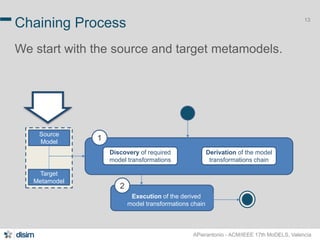
We start with the source and target metamodels. 
APierantonio - ACM/IEEE 17th MoDELS, Valencia 
Discovery of required 
model transformations 
Derivation of the model 
transformations chain 
Execution of the derived 
model transformations chain 
1 
2 
Source 
Model 
Target 
Metamodel
14 Chaining Process 
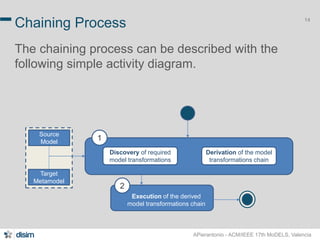
The chaining process can be described with the 
following simple activity diagram. 
APierantonio - ACM/IEEE 17th MoDELS, Valencia 
1 
Discovery of required 
model transformations 
2 
Derivation of the model 
transformations chain 
Source 
Model 
Target 
Metamodel 
Execution of the derived 
model transformations chain
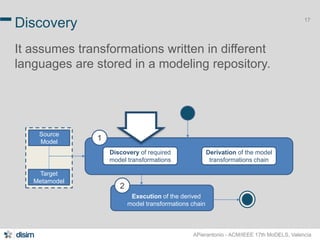
15 Discovery 
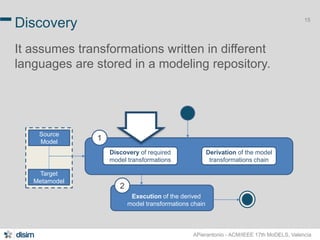
It assumes transformations written in different 
languages are stored in a modeling repository. 
APierantonio - ACM/IEEE 17th MoDELS, Valencia 
1 
Discovery of required 
model transformations 
2 
Derivation of the model 
transformations chain 
Execution of the derived 
model transformations chain 
Source 
Model 
Target 
Metamodel
16 Discovery 
MDE Forge 
It assumes transformations written in different 
languages are stored in a modeling repository. 
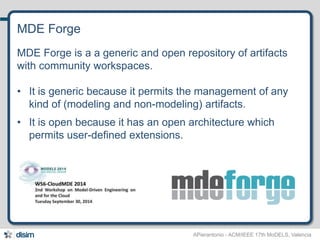
MDE Forge is a a generic and open repository of artifacts 
with community workspaces. 
• It is generic because it permits the management of any 
kind of (modeling and non-modeling) artifacts. 
• It is open because it has an open architecture which 
APierantonio - ACM/IEEE 17th MoDELS, Valencia 
permits user-defined extensions. 
1 
Discovery of required 
model transformations 
2 
Derivation of the model 
transformations chain 
Execution of the derived 
model transformations chain 
Source 
Model 
Target 
Metamodel
17 Discovery 
It assumes transformations written in different 
languages are stored in a modeling repository. 
APierantonio - ACM/IEEE 17th MoDELS, Valencia 
1 
Discovery of required 
model transformations 
2 
Derivation of the model 
transformations chain 
Execution of the derived 
model transformations chain 
Source 
Model 
Target 
Metamodel
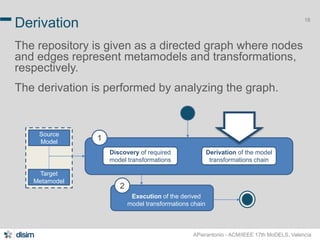
18 Derivation 
The repository is given as a directed graph where nodes 
and edges represent metamodels and transformations, 
respectively. 
The derivation is performed by analyzing the graph. 
APierantonio - ACM/IEEE 17th MoDELS, Valencia 
1 
Discovery of required 
model transformations 
2 
Derivation of the model 
transformations chain 
Execution of the derived 
model transformations chain 
Source 
Model 
Target 
Metamodel
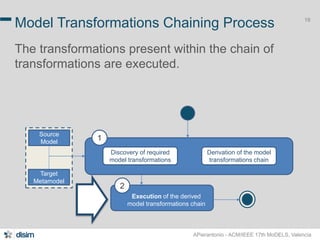
19 Model Transformations Chaining Process 
The transformations present within the chain of 
transformations are executed. 
APierantonio - ACM/IEEE 17th MoDELS, Valencia 
1 
Discovery of required 
model transformations 
2 
Derivation of the model 
transformations chain 
Execution of the derived 
model transformations chain 
Source 
Model 
Target 
Metamodel
20 
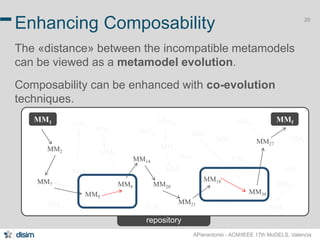
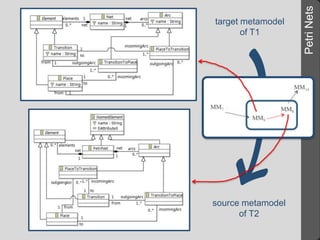
Enhancing Composability 
The «distance» between the incompatible metamodels 
can be viewed as a metamodel evolution. 
Composability can be enhanced with co-evolution 
techniques. 
MM1 MMf 
MM23 
APierantonio - ACM/IEEE 17th MoDELS, Valencia 
repository 
MM2 
MM7 MM8 
MM14 
MM9 
MM20 
MM19 
MM27 
MM18 
MM10 
MMf 
MM1 
… 
MM6 MM11 
MM4 
MM5 
MM12 
MM13 
MM3 
MM17 
MM26 
MM1 
MM25 
MM24 
MM31 
MM1 
MM22 
MM1 
MM21 
MM30
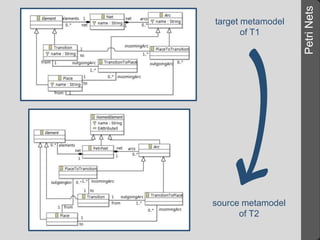
Petri Nets 
target metamodel 
of T1 
source metamodel 
of T2
Petri Nets 
target metamodel 
of T1 
source metamodel 
of T2
Petri Nets 
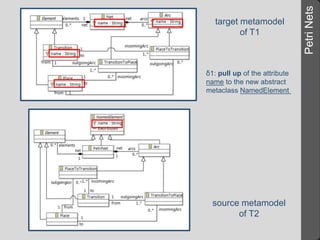
target metamodel 
of T1 
δ1: pull up of the attribute 
name to the new abstract 
metaclass NamedElement 
source metamodel 
of T2
Petri Nets 
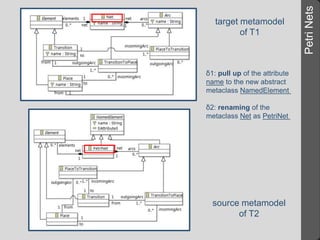
target metamodel 
of T1 
δ1: pull up of the attribute 
name to the new abstract 
metaclass NamedElement 
δ2: renaming of the 
metaclass Net as PetriNet 
source metamodel 
of T2
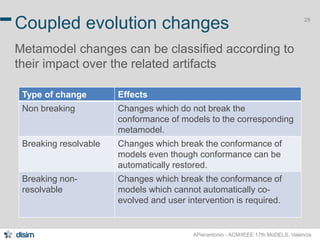
25 Coupled evolution changes 
Metamodel changes can be classified according to 
their impact over the related artifacts 
Type of change Effects 
Non breaking Changes which do not break the 
conformance of models to the corresponding 
metamodel. 
Breaking resolvable Changes which break the conformance of 
models even though conformance can be 
automatically restored. 
Breaking non-resolvable 
Changes which break the conformance of 
models which cannot automatically co-evolved 
and user intervention is required. 
APierantonio - ACM/IEEE 17th MoDELS, Valencia
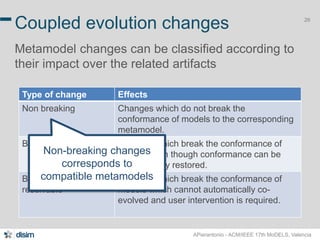
26 Coupled evolution changes 
Metamodel changes can be classified according to 
their impact over the related artifacts 
Type of change Effects 
Non breaking Changes which do not break the 
conformance of models to the corresponding 
metamodel. 
Breaking resolvable Changes which break the conformance of 
models even though conformance can be 
automatically restored. 
Breaking non-resolvable 
Changes which break the conformance of 
models which cannot automatically co-evolved 
and user intervention is required. 
APierantonio - ACM/IEEE 17th MoDELS, Valencia 
Non-breaking changes 
corresponds to 
compatible metamodels
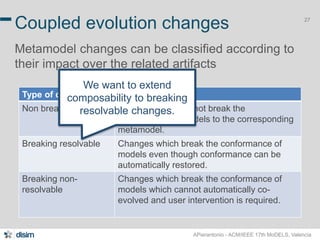
27 Coupled evolution changes 
Metamodel changes can be classified according to 
their impact over the related artifacts 
Type of change Effects 
Non breaking Changes which do not break the 
conformance of models to the corresponding 
metamodel. 
Breaking resolvable Changes which break the conformance of 
models even though conformance can be 
automatically restored. 
Breaking non-resolvable 
Changes which break the conformance of 
models which cannot automatically co-evolved 
and user intervention is required. 
APierantonio - ACM/IEEE 17th MoDELS, Valencia 
We want to extend 
composability to breaking 
resolvable changes.
repository 
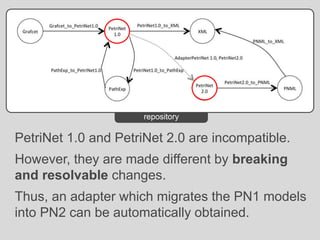
PetriNet 1.0 and PetriNet 2.0 are incompatible. 
However, they are made different by breaking 
and resolvable changes. 
Thus, an adapter which migrates the PN1 models 
into PN2 can be automatically obtained.
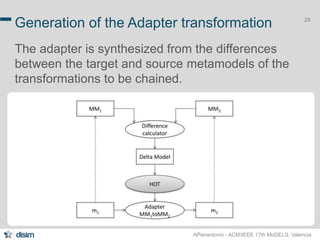
29 Generation of the Adapter transformation 
The adapter is synthesized from the differences 
between the target and source metamodels of the 
transformations to be chained. 
APierantonio - ACM/IEEE 17th MoDELS, Valencia
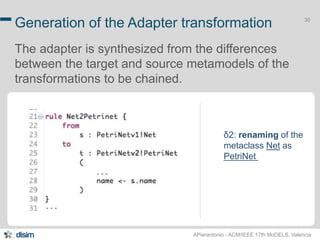
30 Generation of the Adapter transformation 
The adapter is synthesized from the differences 
between the target and source metamodels of the 
transformations to be chained. 
δ2: renaming of the 
metaclass Net as 
PetriNet 
APierantonio - ACM/IEEE 17th MoDELS, Valencia
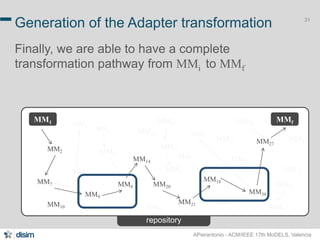
31 
Generation of the Adapter transformation 
Finally, we are able to have a complete 
transformation pathway from MMi to MMf 
MM1 MMf 
MM23 
APierantonio - ACM/IEEE 17th MoDELS, Valencia 
repository 
MM2 
MM7 MM8 
MM14 
MM9 
MM20 
MM19 
MM27 
MM18 
MM10 
MMf 
MM1 
… 
MM6 MM11 
MM4 
MM5 
MM12 
MM13 
MM3 
MM17 
MM26 
MM1 
MM25 
MM24 
MM31 
MM1 
MM22 
MM1 
MM21 
MM30
32 
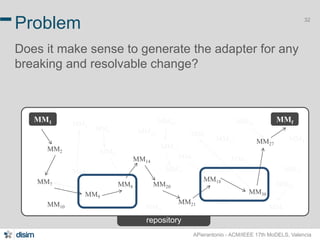
Problem 
Does it make sense to generate the adapter for any 
breaking and resolvable change? 
MM1 MMf 
MM23 
APierantonio - ACM/IEEE 17th MoDELS, Valencia 
repository 
MM2 
MM7 MM8 
MM14 
MM9 
MM20 
MM19 
MM27 
MM18 
MM10 
MMf 
MM1 
… 
MM6 MM11 
MM4 
MM5 
MM12 
MM13 
MM3 
MM17 
MM26 
MM1 
MM25 
MM24 
MM31 
MM1 
MM22 
MM1 
MM21 
MM30
33 
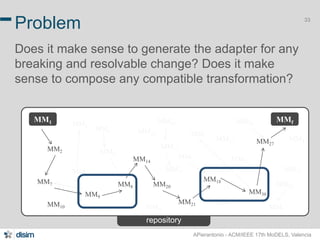
Problem 
Does it make sense to generate the adapter for any 
breaking and resolvable change? Does it make 
sense to compose any compatible transformation? 
MM1 MMf 
MM23 
APierantonio - ACM/IEEE 17th MoDELS, Valencia 
repository 
MM2 
MM7 MM8 
MM14 
MM9 
MM20 
MM19 
MM27 
MM18 
MM10 
MMf 
MM1 
… 
MM6 MM11 
MM4 
MM5 
MM12 
MM13 
MM3 
MM17 
MM26 
MM1 
MM25 
MM24 
MM31 
MM1 
MM22 
MM1 
MM21 
MM30
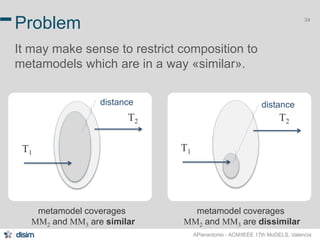
34 Problem 
It may make sense to restrict composition to 
metamodels which are in a way «similar». 
distance distance 
APierantonio - ACM/IEEE 17th MoDELS, Valencia 
T1 
T2 
metamodel coverages 
MM2 and MM3 are dissimilar 
T1 
T2 
metamodel coverages 
MM2 and MM3 are similar
35 Similarity function 
A similarity function between metamodels is defined 
and «measures» how similar two metamodels are. 
It is based on the Similarity Flooding algorithm used 
for schema matching and ontology alignment 
[Melnik et al, Falleri et 
APierantonio - ACM/IEEE 17th MoDELS, Valencia 
al] 
It is evaluated each time a new transformation is 
committed (deleted, or updated) into the repository 
and stored for later use.
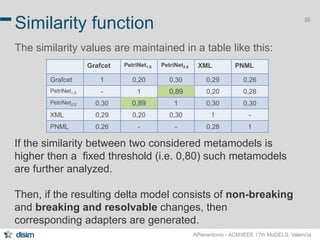
36 Similarity function 
The similarity values are maintained in a table like this: 
Grafcet PetriNet1.0 PetriNet2.0 XML PNML 
Grafcet 1 0,20 0,30 0,29 0,26 
PetriNet1.0 - 1 0,20 0,28 
PetriNet2.0 0,30 1 0,30 0,30 
XML 0,29 0,20 0,30 1 - 
PNML 0,26 - - 0,28 1 
If the similarity between two considered metamodels is 
higher then a fixed threshold (i.e. 0,80) such metamodels 
are further analyzed. 
Then, if the resulting delta model consists of non-breaking 
and breaking and resolvable changes, then 
corresponding adapters are generated. 
APierantonio - ACM/IEEE 17th MoDELS, Valencia 
0,89 
0,89
A component in MDE Forge has been designed. 
Implementation
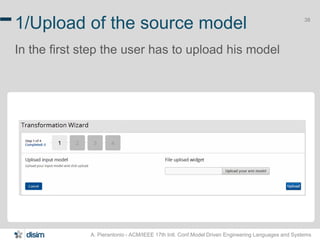
38 1/Upload of the source model 
In the first step the user has to upload his model 
A. Pierantonio - ACM/IEEE 17th Intl. Conf.Model Driven Engineering Languages and Systems
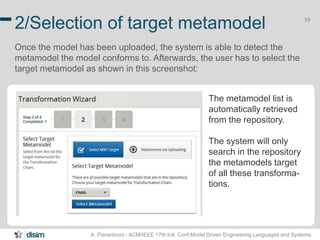
39 2/Selection of target metamodel 
Once the model has been uploaded, the system is able to detect the 
metamodel the model conforms to. Afterwards, the user has to select the 
target metamodel as shown in this screenshot: 
The metamodel list is 
automatically retrieved 
from the repository. 
The system will only 
search in the repository 
the metamodels target 
of all these transforma-tions. 
A. Pierantonio - ACM/IEEE 17th Intl. Conf.Model Driven Engineering Languages and Systems
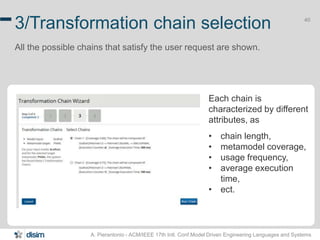
40 3/Transformation chain selection 
All the possible chains that satisfy the user request are shown. 
Each chain is 
characterized by different 
attributes, as 
• chain length, 
• metamodel coverage, 
• usage frequency, 
• average execution 
time, 
• ect. 
A. Pierantonio - ACM/IEEE 17th Intl. Conf.Model Driven Engineering Languages and Systems
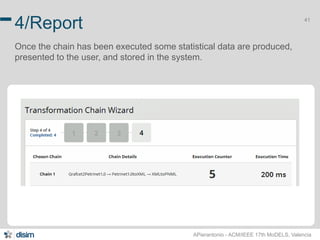
41 4/Report 
Once the chain has been executed some statistical data are produced, 
presented to the user, and stored in the system. 
APierantonio - ACM/IEEE 17th MoDELS, Valencia
Future Work and Conclusions
43 Conclusions 
The work aims at developing new transformations by 
composing existing ones according to user 
requirements. 
The proposed approach makes use of well-known co-evolution 
techniques to enhance the composability of 
transformations. 
Similarity metrics between metamodels are used in 
order to avoid information erosion. 
A repository of artifacts, called MDE Forge has been 
build in order to overcome the problem of the 
heterogeneity of the sources. 
APierantonio - ACM/IEEE 17th MoDELS, Valencia
44 Future work 
A major drawback is that the composition mechanism 
is purely syntactical, semantic properties must be 
taken into account 
– Well-formedness constraints must be considered 
– Some semantic description of the modeling language has 
also to be considered, eg. descriptive logics 
Breaking non resolvable changes must be taken into 
account by adopting partiality and uncertainty. 
Validation and experimentation necessary to correlate 
information erosion and similarity thresholds. 
APierantonio - ACM/IEEE 17th MoDELS, Valencia
Thank you.

Automated chaining of model transformations with incompatible metamodels

  • 1.
    Automated chaining of model transformations with incompatible metamodels Joint work with Francesco Basciani, Davide Di Ruscio, Ludovico Iovino Dipartimento di Ingegneria e Scienze dell’Informazione e Matematica Università degli Studi dell’Aquila Alfonso Pierantonio APierantonio
  • 2.
    2 Summary Introduction Composition Problem Statement Automating the Chaining Process Enhancing Composability Metamodel Similarity Tool Conclusions APierantonio - ACM/IEEE 17th MoDELS, Valencia
  • 3.
    3 Introduction Modeltransformations have a vital role in MDE because they are employed to bridge different domains and/or abstraction levels. New transformations can be developed by composing existing ones according to user requirements. Composing transformations is a complex problem: – transformations must be discovered and selected from different APierantonio - ACM/IEEE 17th MoDELS, Valencia and heterogeneous sources ∙ eg., ATL Zoo, GitHub, etc. – the common way to compose transformations is to chain them, ie. by passing models from one transformation to another
  • 4.
    4 External vs.Internal composition Composition can be distinguished in: – external composition (black-box): by chaining separate model transformations and passing models from one transformation to another – internal composition (white-box): by composing two model transformation definitions into a new model transformation Both are important and complement each other, in this talk we focus on external composition APierantonio - ACM/IEEE 17th MoDELS, Valencia
  • 5.
    5 Problem statement Given two metamodels MMi and MMf we would like to understand whether there is a composition of existing transformations bridging them. MMi MMf MMf APierantonio - ACM/IEEE 17th MoDELS, Valencia
  • 6.
    Problem statement Giventwo metamodels MMi and MMf we would like to understand whether there is a composition of existing transformations bridging them. 6 MMi MMf APierantonio - ACM/IEEE 17th MoDELS, Valencia repository MMf ?
  • 7.
    7 Problem statement A repository of metamodels and transformation is considered to consistently manage them MMi MMf MM23 APierantonio - ACM/IEEE 17th MoDELS, Valencia MM17 repository MM2 MM6 MM11 MM4 MM7 MM8 MM14 MM5 MM12 MM13 MM3 MM9 MM20 MM19 MM26 MM1 MM25 MM27 MM18 MM21 MM30 MM10 MM24 MMf MM31 MM1 MM17 MM22 MM1 …
  • 8.
    8 External composition Under which conditions, two transformations can be composed ? So far, only syntactic embedding was allowed, ie. MM2  MM3 Alfonso Pierantonio – 7th SATToSE, L’Aquila (Italy)
  • 9.
    9 Problem statement We identify the possible transformation pathways based on compatible metamodels. MMi MMf MM23 APierantonio - ACM/IEEE 17th MoDELS, Valencia repository MM2 MM7 MM8 MM14 MM9 MM20 MM19 MM27 MM18 MM MM21 10 MMf MM1 … MM6 MM11 MM4 MM5 MM12 MM13 MM3 MM17 MM26 MM1 MM25 MM24 MM31 MM1 MM22 MM1 MM30
  • 10.
    10 Problem statement What happens if MM MMand MM / MM? 9 8 18 30 MM1 MMf MM23 APierantonio - ACM/IEEE 17th MoDELS, Valencia repository MM2 MM7 MM8 MM14 MM9 MM20 MM19 MM27 MM18 MM MM21 10 MMf MM1 … MM6 MM11 MM4 MM5 MM12 MM13 MM3 MM17 MM26 MM1 MM25 MM24 MM31 MM1 MM22 MM1 / MM30 ? ?
  • 11.
    11 Goal Thegoal of this work is to enhance transformation composability by using co-evolution techniques. In many cases output and input metamodels have similar «informational» structures, for instance – subsequent versions of the same metamodel – state machines in UML 1.4 and UML 2.0 Then, metamodel compatibility conditions which are too strong would discard transformations that potentially might be chained. APierantonio - ACM/IEEE 17th MoDELS, Valencia
  • 12.
  • 13.
    13 Chaining Process We start with the source and target metamodels. APierantonio - ACM/IEEE 17th MoDELS, Valencia Discovery of required model transformations Derivation of the model transformations chain Execution of the derived model transformations chain 1 2 Source Model Target Metamodel
  • 14.
    14 Chaining Process The chaining process can be described with the following simple activity diagram. APierantonio - ACM/IEEE 17th MoDELS, Valencia 1 Discovery of required model transformations 2 Derivation of the model transformations chain Source Model Target Metamodel Execution of the derived model transformations chain
  • 15.
    15 Discovery Itassumes transformations written in different languages are stored in a modeling repository. APierantonio - ACM/IEEE 17th MoDELS, Valencia 1 Discovery of required model transformations 2 Derivation of the model transformations chain Execution of the derived model transformations chain Source Model Target Metamodel
  • 16.
    16 Discovery MDEForge It assumes transformations written in different languages are stored in a modeling repository. MDE Forge is a a generic and open repository of artifacts with community workspaces. • It is generic because it permits the management of any kind of (modeling and non-modeling) artifacts. • It is open because it has an open architecture which APierantonio - ACM/IEEE 17th MoDELS, Valencia permits user-defined extensions. 1 Discovery of required model transformations 2 Derivation of the model transformations chain Execution of the derived model transformations chain Source Model Target Metamodel
  • 17.
    17 Discovery Itassumes transformations written in different languages are stored in a modeling repository. APierantonio - ACM/IEEE 17th MoDELS, Valencia 1 Discovery of required model transformations 2 Derivation of the model transformations chain Execution of the derived model transformations chain Source Model Target Metamodel
  • 18.
    18 Derivation Therepository is given as a directed graph where nodes and edges represent metamodels and transformations, respectively. The derivation is performed by analyzing the graph. APierantonio - ACM/IEEE 17th MoDELS, Valencia 1 Discovery of required model transformations 2 Derivation of the model transformations chain Execution of the derived model transformations chain Source Model Target Metamodel
  • 19.
    19 Model TransformationsChaining Process The transformations present within the chain of transformations are executed. APierantonio - ACM/IEEE 17th MoDELS, Valencia 1 Discovery of required model transformations 2 Derivation of the model transformations chain Execution of the derived model transformations chain Source Model Target Metamodel
  • 20.
    20 Enhancing Composability The «distance» between the incompatible metamodels can be viewed as a metamodel evolution. Composability can be enhanced with co-evolution techniques. MM1 MMf MM23 APierantonio - ACM/IEEE 17th MoDELS, Valencia repository MM2 MM7 MM8 MM14 MM9 MM20 MM19 MM27 MM18 MM10 MMf MM1 … MM6 MM11 MM4 MM5 MM12 MM13 MM3 MM17 MM26 MM1 MM25 MM24 MM31 MM1 MM22 MM1 MM21 MM30
  • 21.
    Petri Nets targetmetamodel of T1 source metamodel of T2
  • 22.
    Petri Nets targetmetamodel of T1 source metamodel of T2
  • 23.
    Petri Nets targetmetamodel of T1 δ1: pull up of the attribute name to the new abstract metaclass NamedElement source metamodel of T2
  • 24.
    Petri Nets targetmetamodel of T1 δ1: pull up of the attribute name to the new abstract metaclass NamedElement δ2: renaming of the metaclass Net as PetriNet source metamodel of T2
  • 25.
    25 Coupled evolutionchanges Metamodel changes can be classified according to their impact over the related artifacts Type of change Effects Non breaking Changes which do not break the conformance of models to the corresponding metamodel. Breaking resolvable Changes which break the conformance of models even though conformance can be automatically restored. Breaking non-resolvable Changes which break the conformance of models which cannot automatically co-evolved and user intervention is required. APierantonio - ACM/IEEE 17th MoDELS, Valencia
  • 26.
    26 Coupled evolutionchanges Metamodel changes can be classified according to their impact over the related artifacts Type of change Effects Non breaking Changes which do not break the conformance of models to the corresponding metamodel. Breaking resolvable Changes which break the conformance of models even though conformance can be automatically restored. Breaking non-resolvable Changes which break the conformance of models which cannot automatically co-evolved and user intervention is required. APierantonio - ACM/IEEE 17th MoDELS, Valencia Non-breaking changes corresponds to compatible metamodels
  • 27.
    27 Coupled evolutionchanges Metamodel changes can be classified according to their impact over the related artifacts Type of change Effects Non breaking Changes which do not break the conformance of models to the corresponding metamodel. Breaking resolvable Changes which break the conformance of models even though conformance can be automatically restored. Breaking non-resolvable Changes which break the conformance of models which cannot automatically co-evolved and user intervention is required. APierantonio - ACM/IEEE 17th MoDELS, Valencia We want to extend composability to breaking resolvable changes.
  • 28.
    repository PetriNet 1.0and PetriNet 2.0 are incompatible. However, they are made different by breaking and resolvable changes. Thus, an adapter which migrates the PN1 models into PN2 can be automatically obtained.
  • 29.
    29 Generation ofthe Adapter transformation The adapter is synthesized from the differences between the target and source metamodels of the transformations to be chained. APierantonio - ACM/IEEE 17th MoDELS, Valencia
  • 30.
    30 Generation ofthe Adapter transformation The adapter is synthesized from the differences between the target and source metamodels of the transformations to be chained. δ2: renaming of the metaclass Net as PetriNet APierantonio - ACM/IEEE 17th MoDELS, Valencia
  • 31.
    31 Generation ofthe Adapter transformation Finally, we are able to have a complete transformation pathway from MMi to MMf MM1 MMf MM23 APierantonio - ACM/IEEE 17th MoDELS, Valencia repository MM2 MM7 MM8 MM14 MM9 MM20 MM19 MM27 MM18 MM10 MMf MM1 … MM6 MM11 MM4 MM5 MM12 MM13 MM3 MM17 MM26 MM1 MM25 MM24 MM31 MM1 MM22 MM1 MM21 MM30
  • 32.
    32 Problem Doesit make sense to generate the adapter for any breaking and resolvable change? MM1 MMf MM23 APierantonio - ACM/IEEE 17th MoDELS, Valencia repository MM2 MM7 MM8 MM14 MM9 MM20 MM19 MM27 MM18 MM10 MMf MM1 … MM6 MM11 MM4 MM5 MM12 MM13 MM3 MM17 MM26 MM1 MM25 MM24 MM31 MM1 MM22 MM1 MM21 MM30
  • 33.
    33 Problem Doesit make sense to generate the adapter for any breaking and resolvable change? Does it make sense to compose any compatible transformation? MM1 MMf MM23 APierantonio - ACM/IEEE 17th MoDELS, Valencia repository MM2 MM7 MM8 MM14 MM9 MM20 MM19 MM27 MM18 MM10 MMf MM1 … MM6 MM11 MM4 MM5 MM12 MM13 MM3 MM17 MM26 MM1 MM25 MM24 MM31 MM1 MM22 MM1 MM21 MM30
  • 34.
    34 Problem Itmay make sense to restrict composition to metamodels which are in a way «similar». distance distance APierantonio - ACM/IEEE 17th MoDELS, Valencia T1 T2 metamodel coverages MM2 and MM3 are dissimilar T1 T2 metamodel coverages MM2 and MM3 are similar
  • 35.
    35 Similarity function A similarity function between metamodels is defined and «measures» how similar two metamodels are. It is based on the Similarity Flooding algorithm used for schema matching and ontology alignment [Melnik et al, Falleri et APierantonio - ACM/IEEE 17th MoDELS, Valencia al] It is evaluated each time a new transformation is committed (deleted, or updated) into the repository and stored for later use.
  • 36.
    36 Similarity function The similarity values are maintained in a table like this: Grafcet PetriNet1.0 PetriNet2.0 XML PNML Grafcet 1 0,20 0,30 0,29 0,26 PetriNet1.0 - 1 0,20 0,28 PetriNet2.0 0,30 1 0,30 0,30 XML 0,29 0,20 0,30 1 - PNML 0,26 - - 0,28 1 If the similarity between two considered metamodels is higher then a fixed threshold (i.e. 0,80) such metamodels are further analyzed. Then, if the resulting delta model consists of non-breaking and breaking and resolvable changes, then corresponding adapters are generated. APierantonio - ACM/IEEE 17th MoDELS, Valencia 0,89 0,89
  • 37.
    A component inMDE Forge has been designed. Implementation
  • 38.
    38 1/Upload ofthe source model In the first step the user has to upload his model A. Pierantonio - ACM/IEEE 17th Intl. Conf.Model Driven Engineering Languages and Systems
  • 39.
    39 2/Selection oftarget metamodel Once the model has been uploaded, the system is able to detect the metamodel the model conforms to. Afterwards, the user has to select the target metamodel as shown in this screenshot: The metamodel list is automatically retrieved from the repository. The system will only search in the repository the metamodels target of all these transforma-tions. A. Pierantonio - ACM/IEEE 17th Intl. Conf.Model Driven Engineering Languages and Systems
  • 40.
    40 3/Transformation chainselection All the possible chains that satisfy the user request are shown. Each chain is characterized by different attributes, as • chain length, • metamodel coverage, • usage frequency, • average execution time, • ect. A. Pierantonio - ACM/IEEE 17th Intl. Conf.Model Driven Engineering Languages and Systems
  • 41.
    41 4/Report Oncethe chain has been executed some statistical data are produced, presented to the user, and stored in the system. APierantonio - ACM/IEEE 17th MoDELS, Valencia
  • 42.
    Future Work andConclusions
  • 43.
    43 Conclusions Thework aims at developing new transformations by composing existing ones according to user requirements. The proposed approach makes use of well-known co-evolution techniques to enhance the composability of transformations. Similarity metrics between metamodels are used in order to avoid information erosion. A repository of artifacts, called MDE Forge has been build in order to overcome the problem of the heterogeneity of the sources. APierantonio - ACM/IEEE 17th MoDELS, Valencia
  • 44.
    44 Future work A major drawback is that the composition mechanism is purely syntactical, semantic properties must be taken into account – Well-formedness constraints must be considered – Some semantic description of the modeling language has also to be considered, eg. descriptive logics Breaking non resolvable changes must be taken into account by adopting partiality and uncertainty. Validation and experimentation necessary to correlate information erosion and similarity thresholds. APierantonio - ACM/IEEE 17th MoDELS, Valencia
  • 45.

Editor's Notes

  • #19 Referring to a graph representation of the repository.
  • #20 Fin qui abbiamo visto solo il caso standard nel quale la compatibilità tra 2 MM è data semplicemente dall’NsURI (o dal nome del file, o dall’ID dell’artefatto salvato su DB)
  • #30 A partire da un modello delle differenze, che rappresenta le differenze tra 2 MM incompatibili, l’approccio è capace di generare trasformazioni di adattamento come quella del caso di studio tra PetriNet1.0 e PetriNet2.0 L’approccio si basa sulle HIGH ORDER TRANSFORMATION. Questo si è reso necessario per far fronte al problema della coupled evolution.
  • #31 A partire da un modello delle differenze, che rappresenta le differenze tra 2 MM incompatibili, l’approccio è capace di generare trasformazioni di adattamento come quella del caso di studio tra PetriNet1.0 e PetriNet2.0 L’approccio si basa sulle HIGH ORDER TRANSFORMATION. Questo si è reso necessario per far fronte al problema della coupled evolution.
  • #36 Another element to consider is the similarity function
  • #37 Another element to consider is the similarity function