ntccKMC: A Kripke-structure-based model checker for the
ntcc calculus
Cali
Mauricio Toro Bermudez,
in joint work with Jaime Arias,
Carlos Olarte and Camilo Rueda
AVISPA Research Group
Pontificia Universidad Javeriana - Cali
February, 2013
Outline
1 Introduction
2 Previous work
3 The Model Checking Technique
4 A Model for tcc Programs
5 A Logic for the Specification of Properties
6 The Model Checking Algorithm
7 Implementation
8 Concluding Remarks
2 / 49
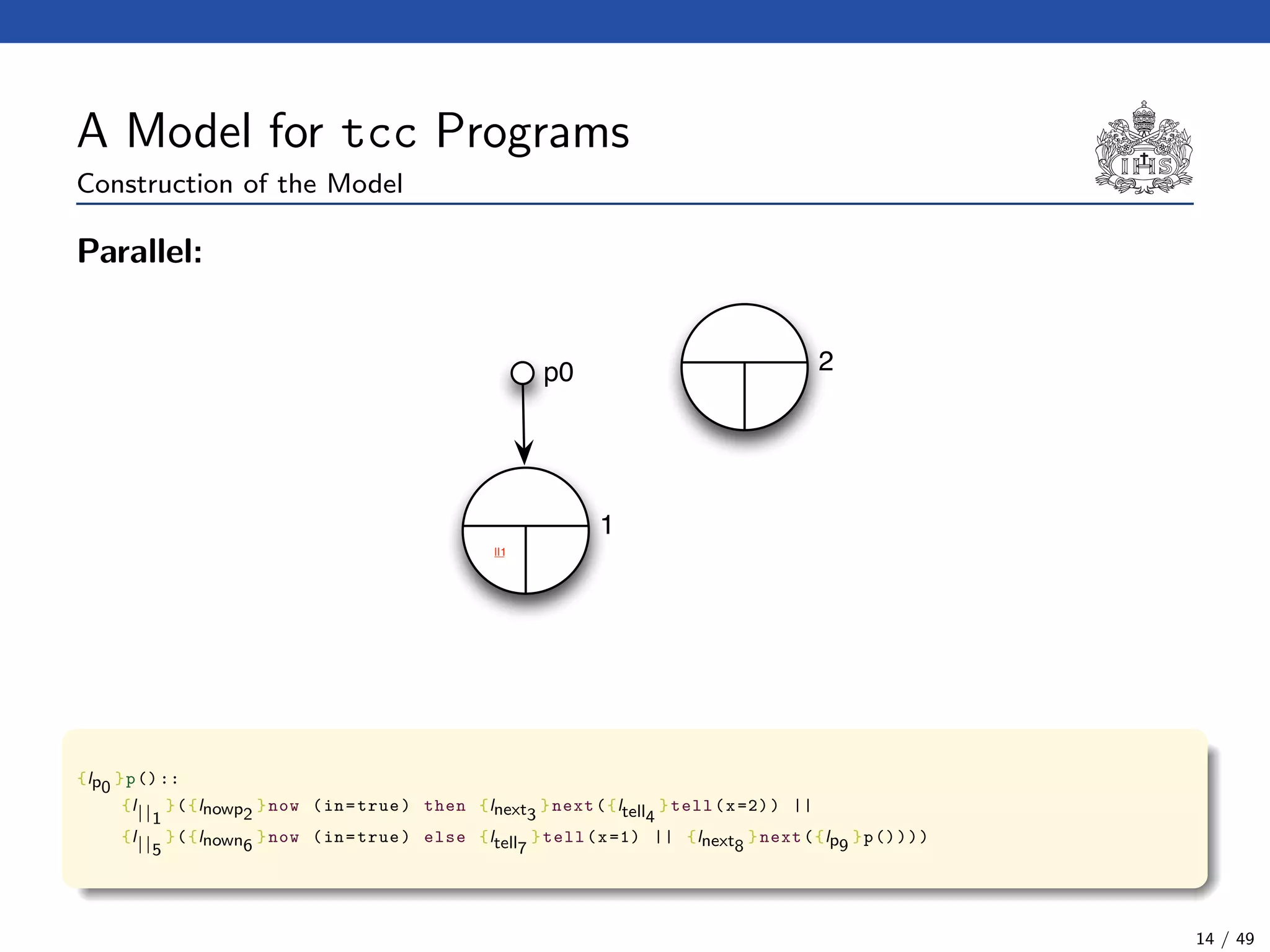
Motivation
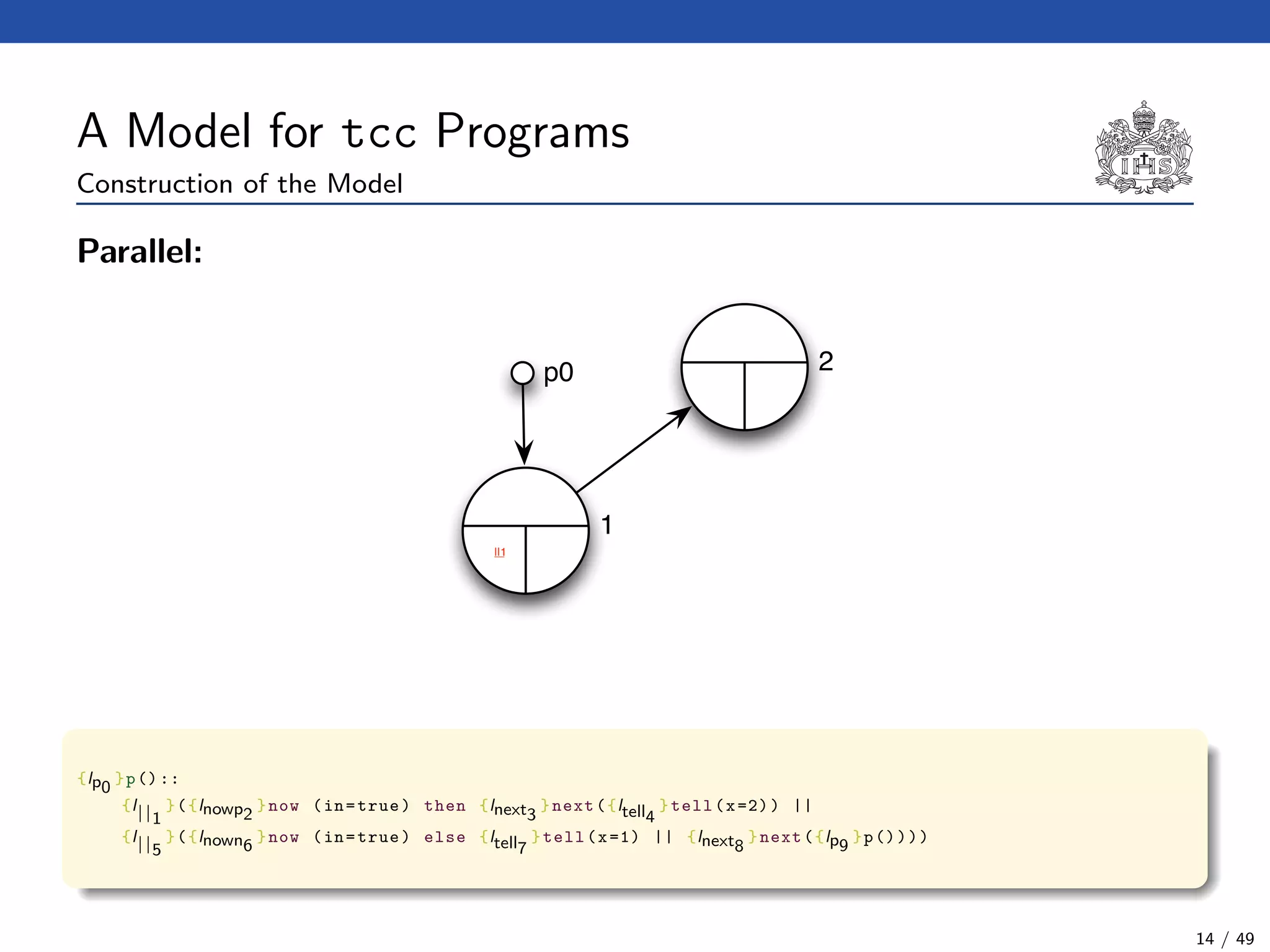
• Verification of ntcc programs is performed using inductive techniques since
the model does not provide automatic formal verification tools.
• Problems:
◦ Difficult
◦ Error prone
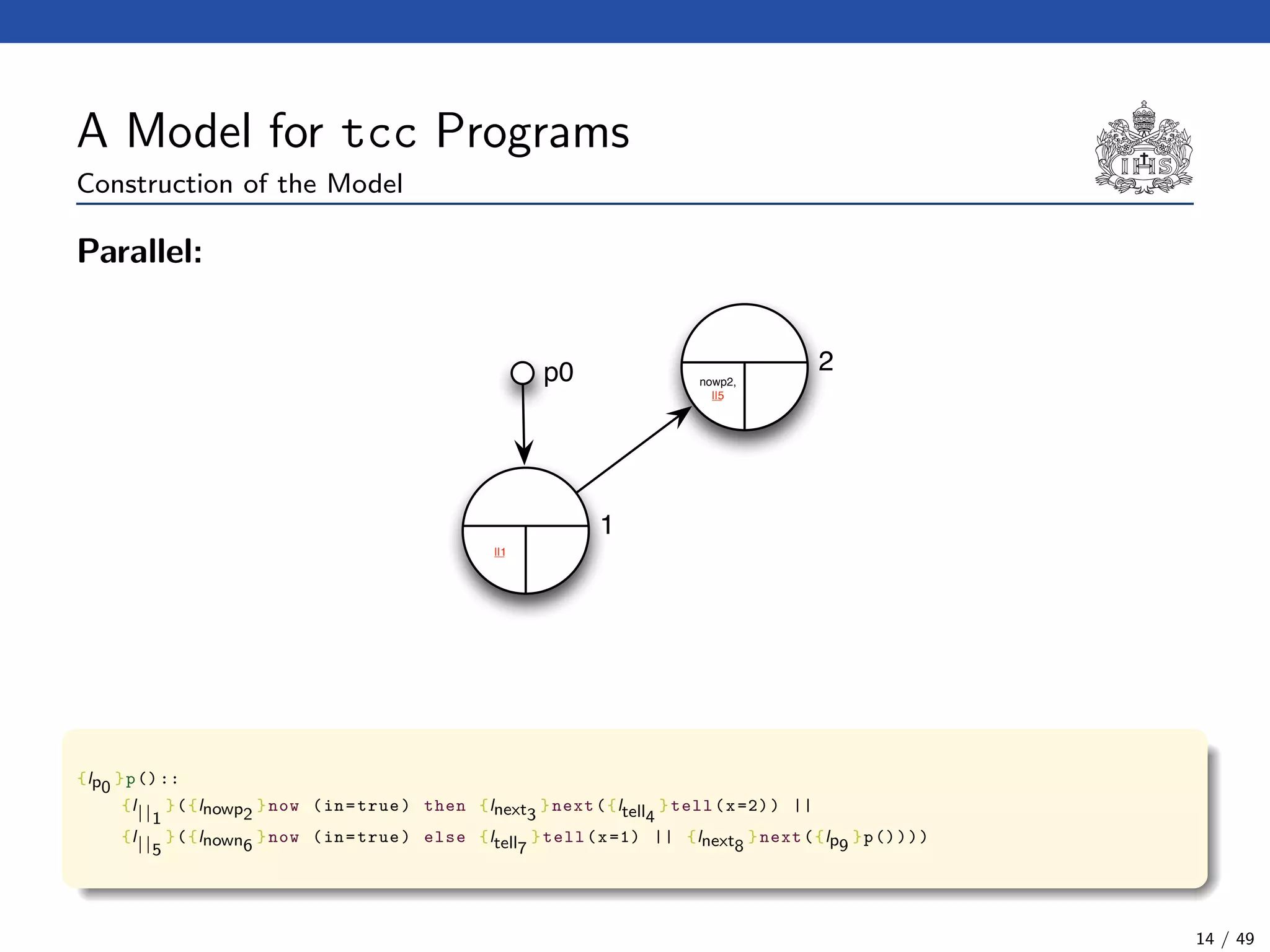
◦ Experts are required.
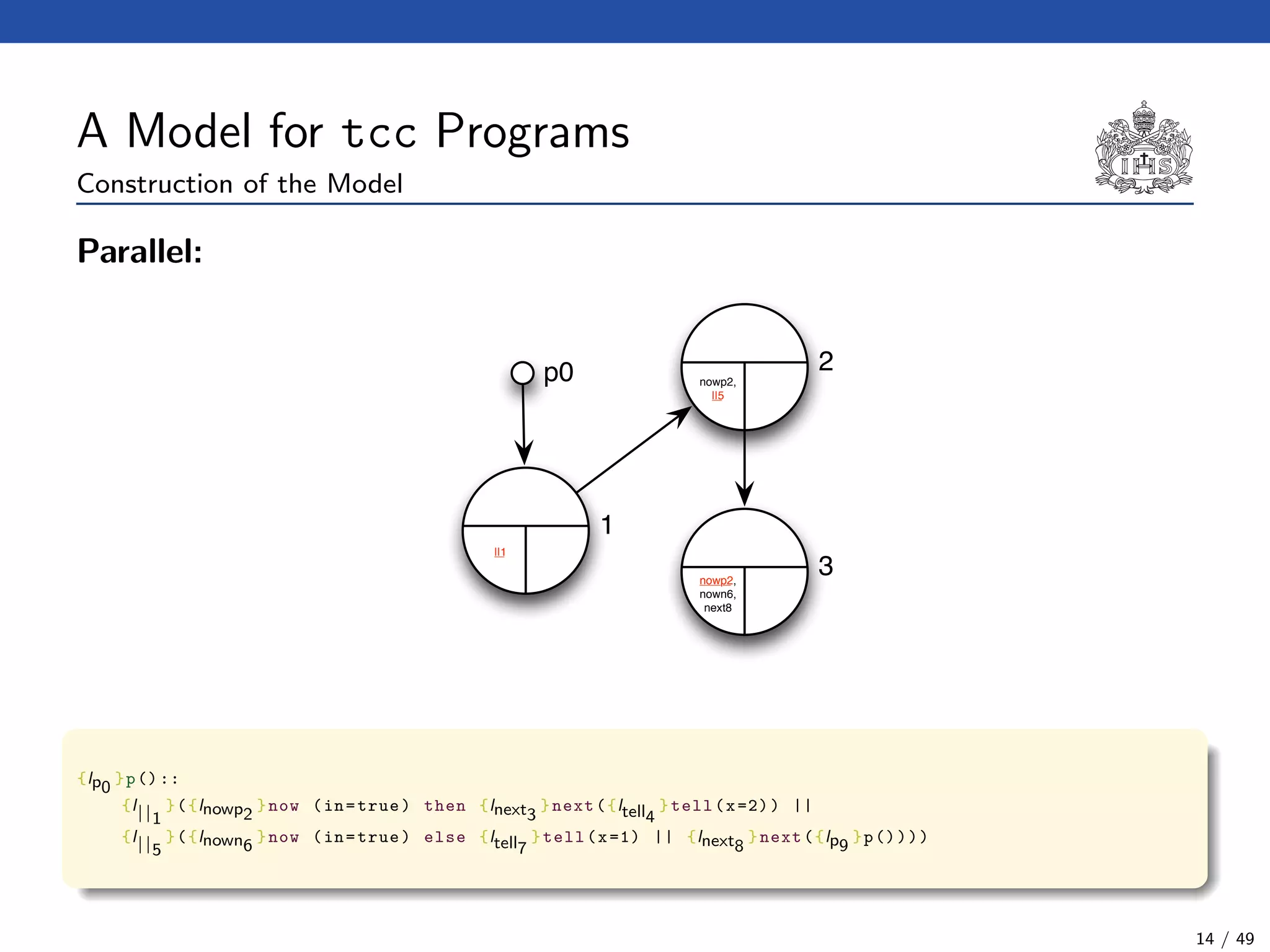
• Hubert Garavel [Gar08]: “...The research agenda for theoretical concur-
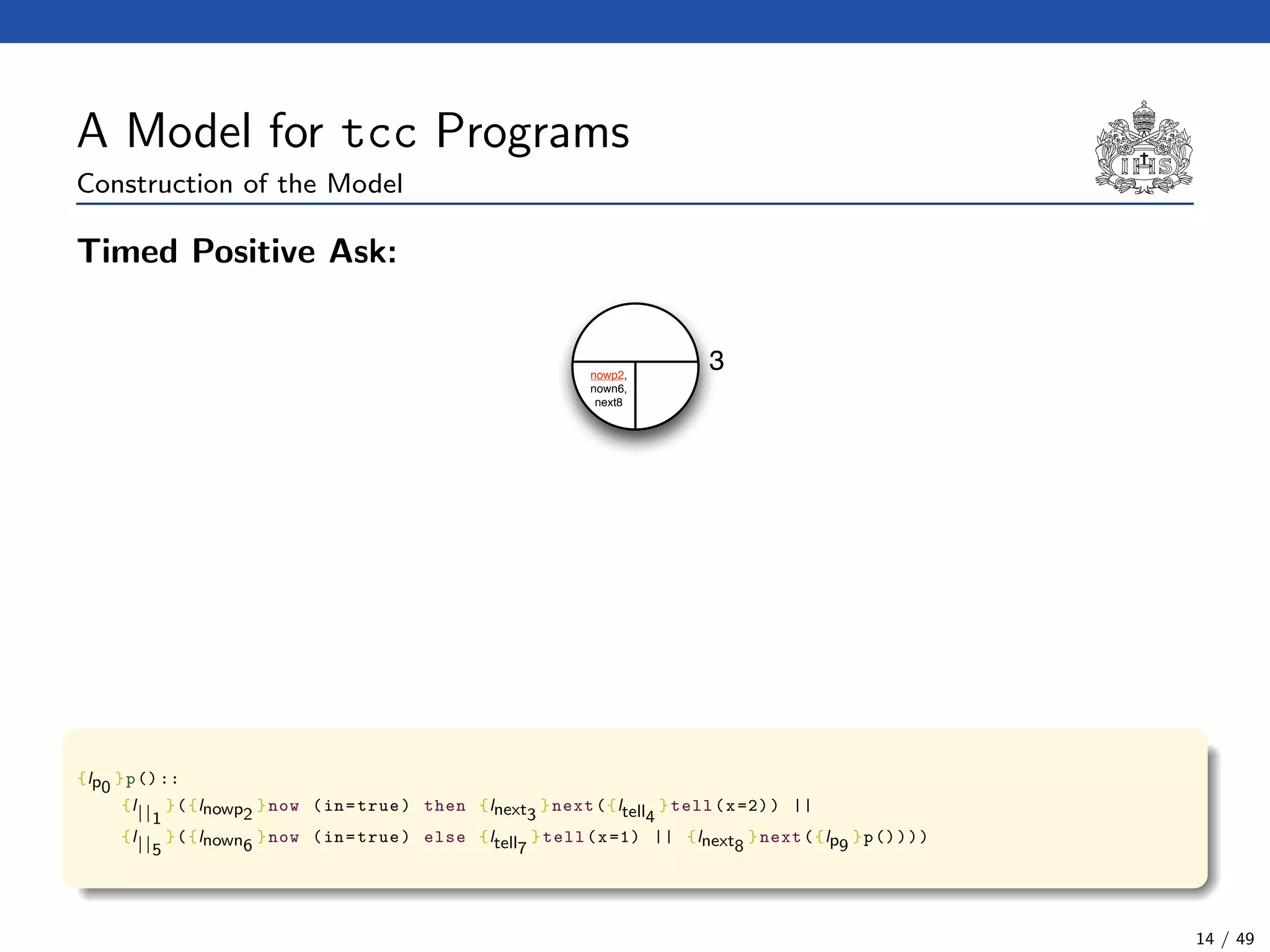
rency should therefore address the design of efficient algorithms for trans-
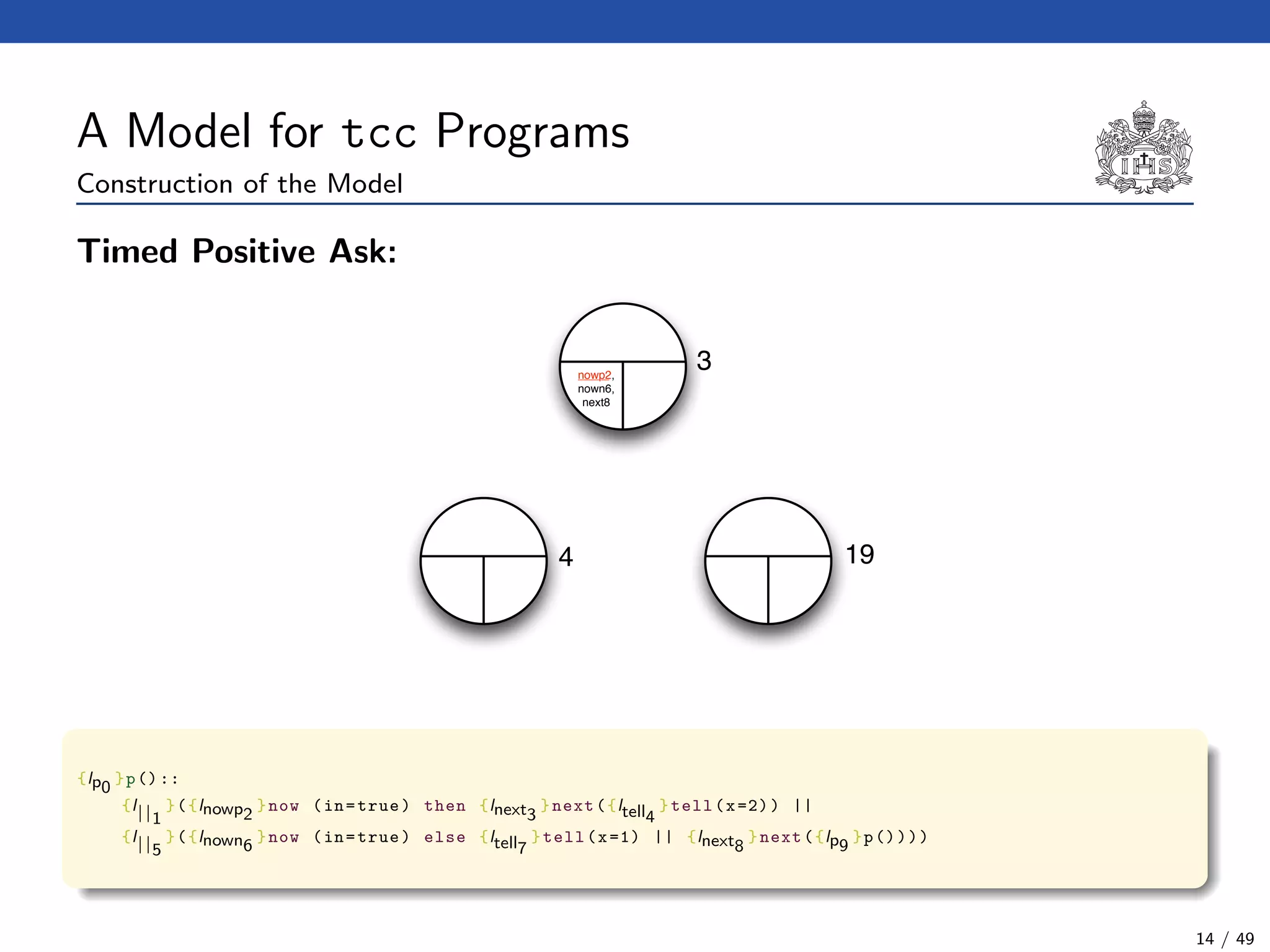
lating and verifying formal specifications of concurrent systems”.
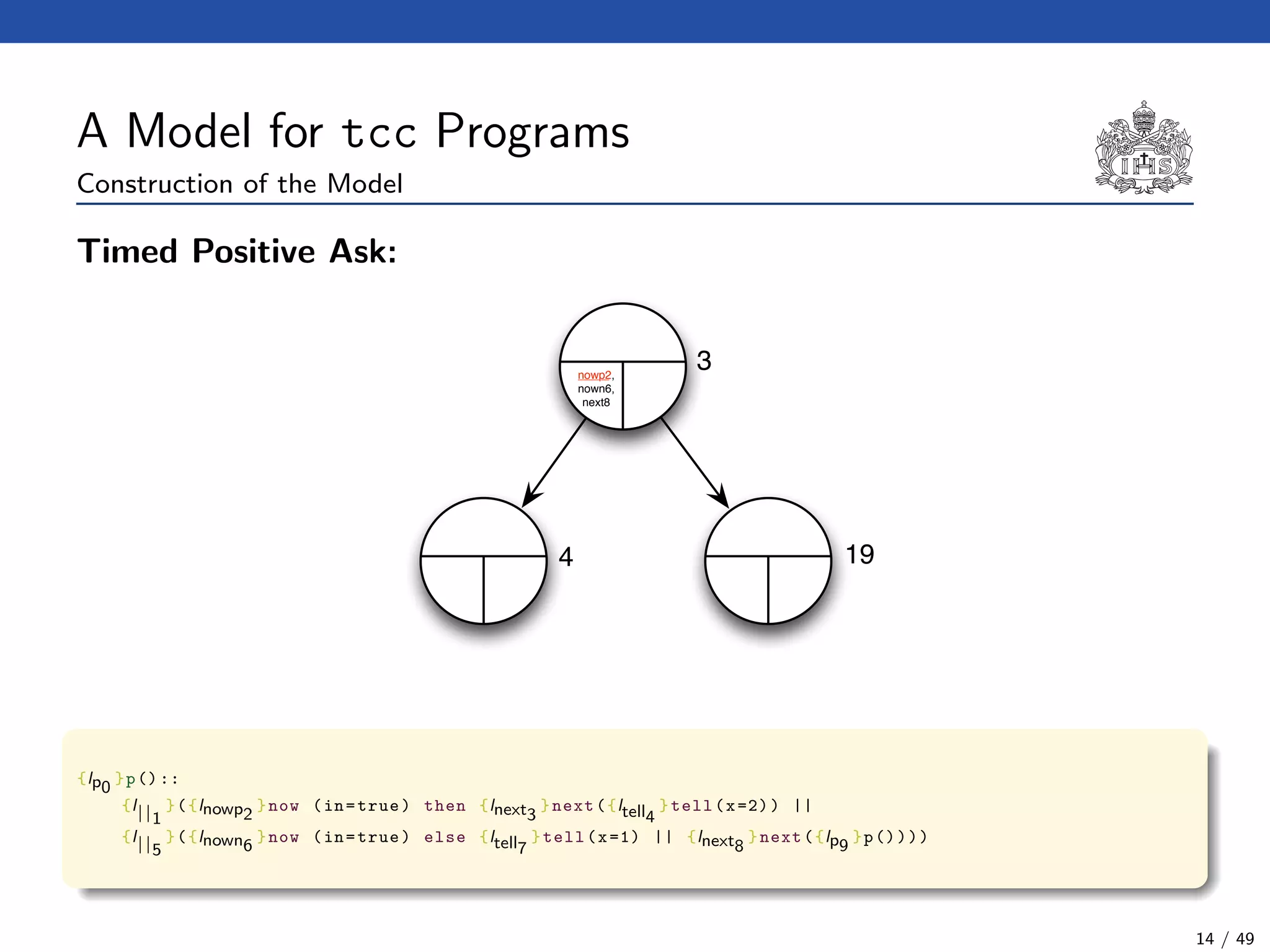
3 / 49
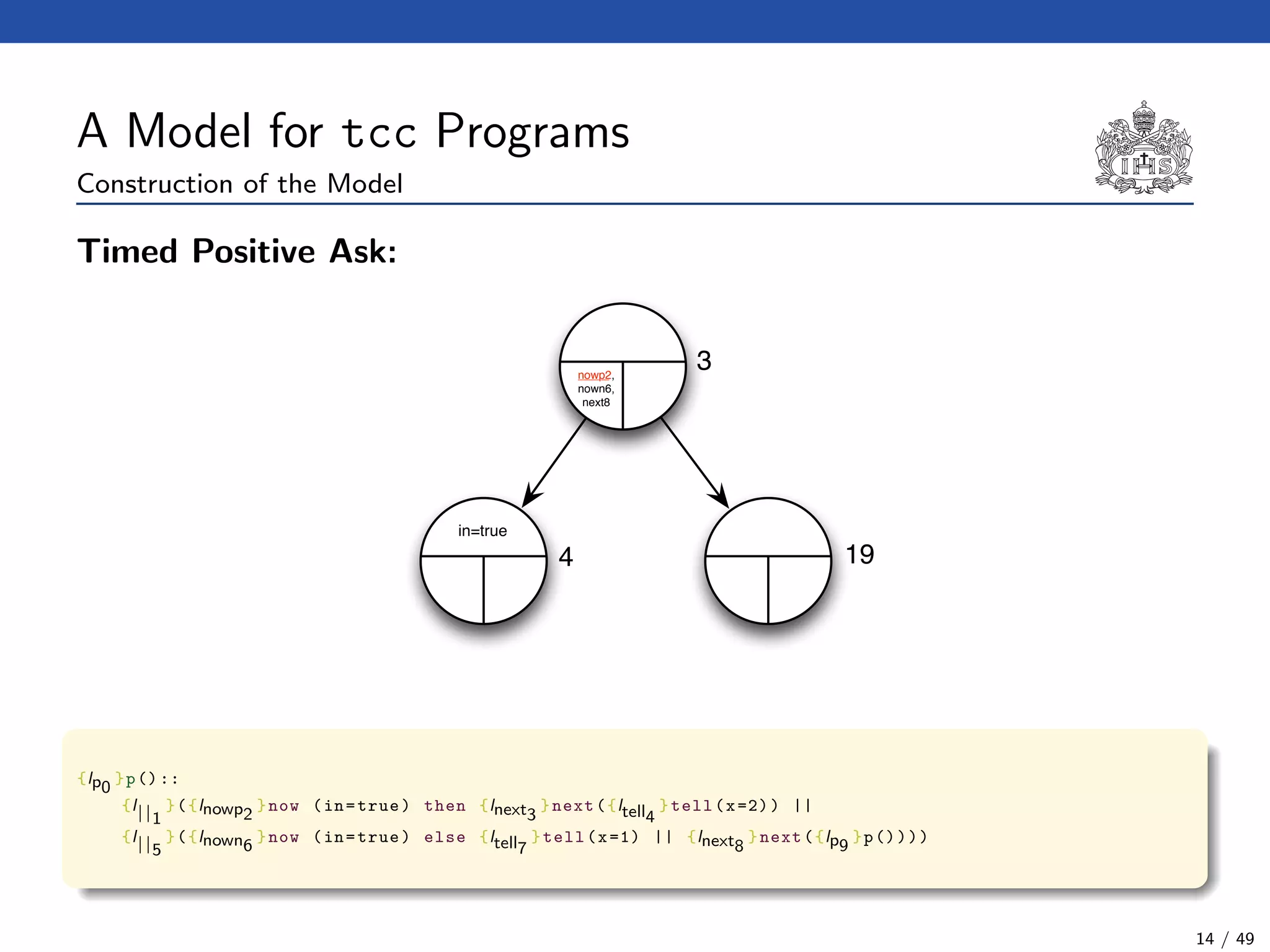
Motivation
• Model checking is an automated technique that, given a finite-state model
of a system and a formal property, systematically checks whether this
property holds for (a given state in) that model [CGP99].
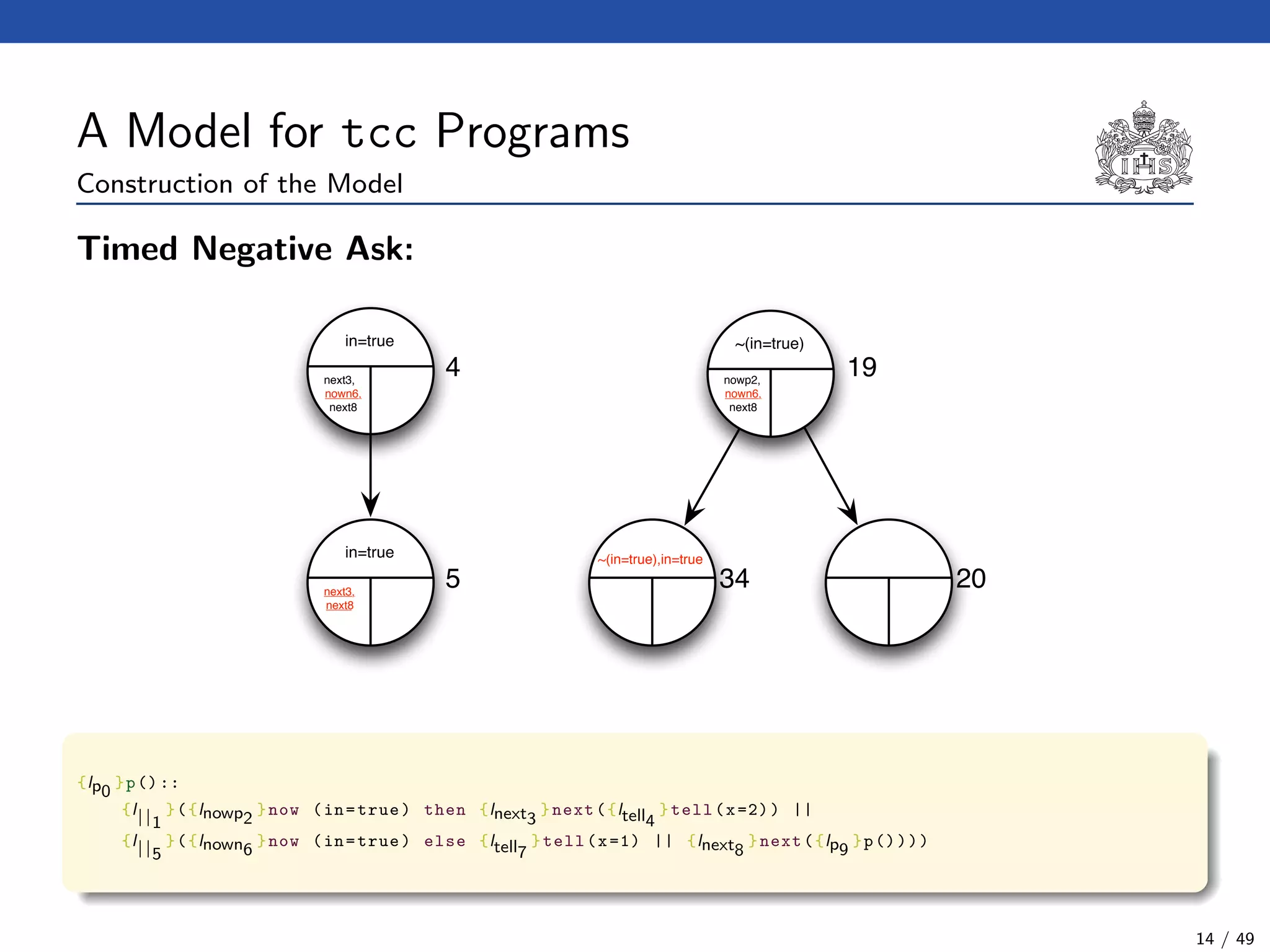
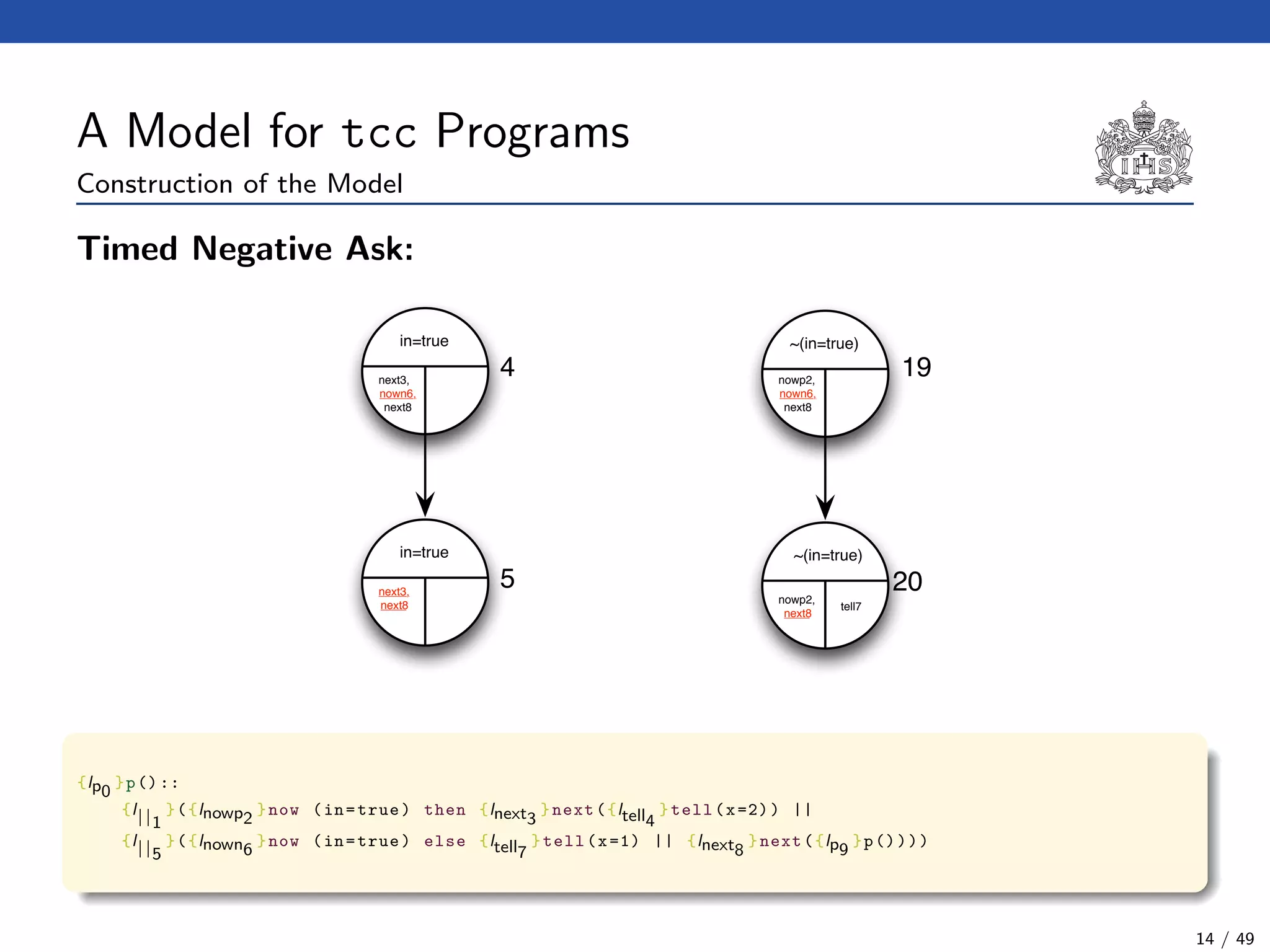
• Advantages
◦ Formal technique.
◦ Fully-automatic.
◦ Experts are not required.
◦ Counterexample.
• Drawback
◦ State-space explosion problem.
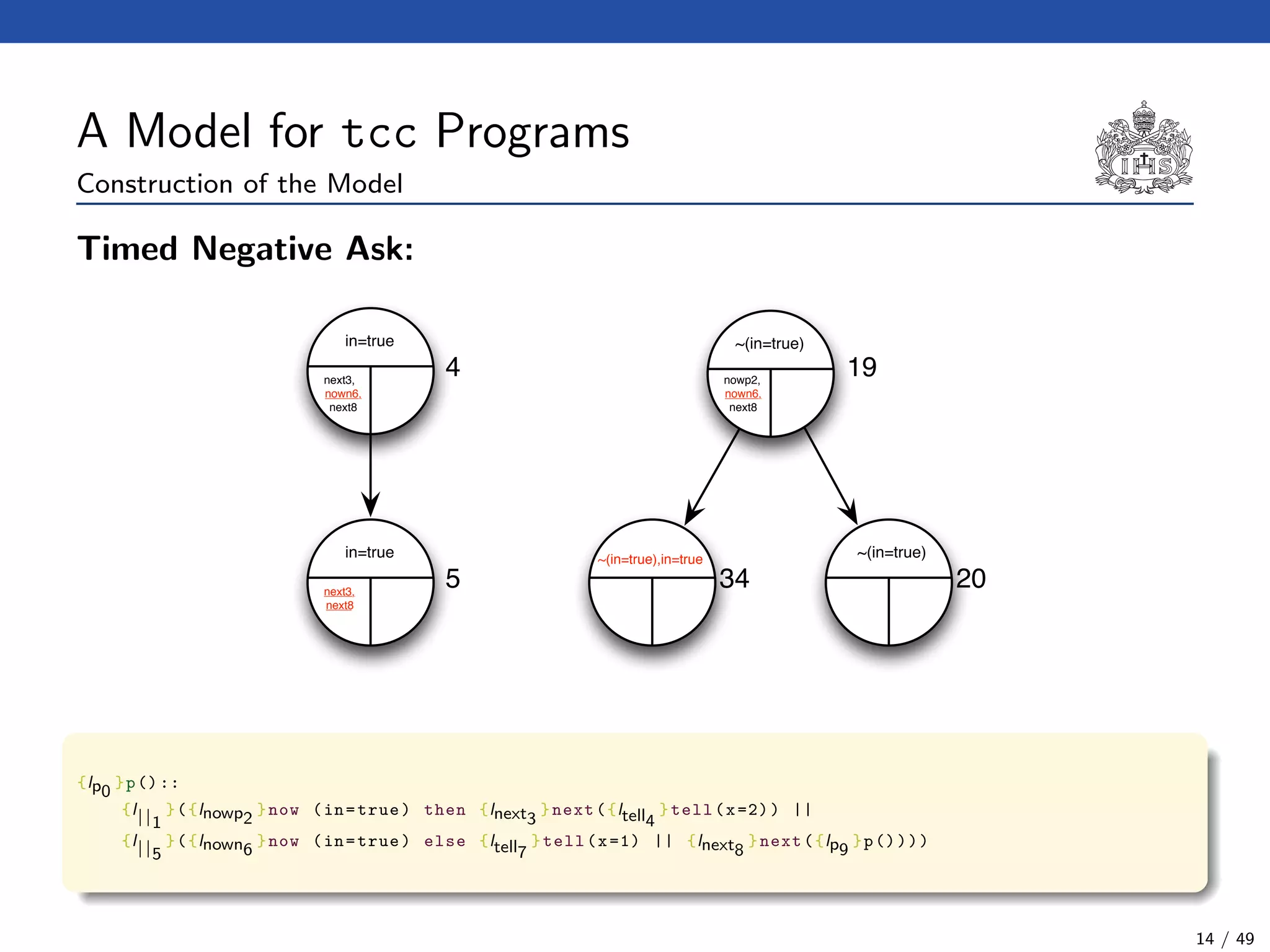
4 / 49
React-PLUS project
• REACT PLUS addresses the development and application of formal
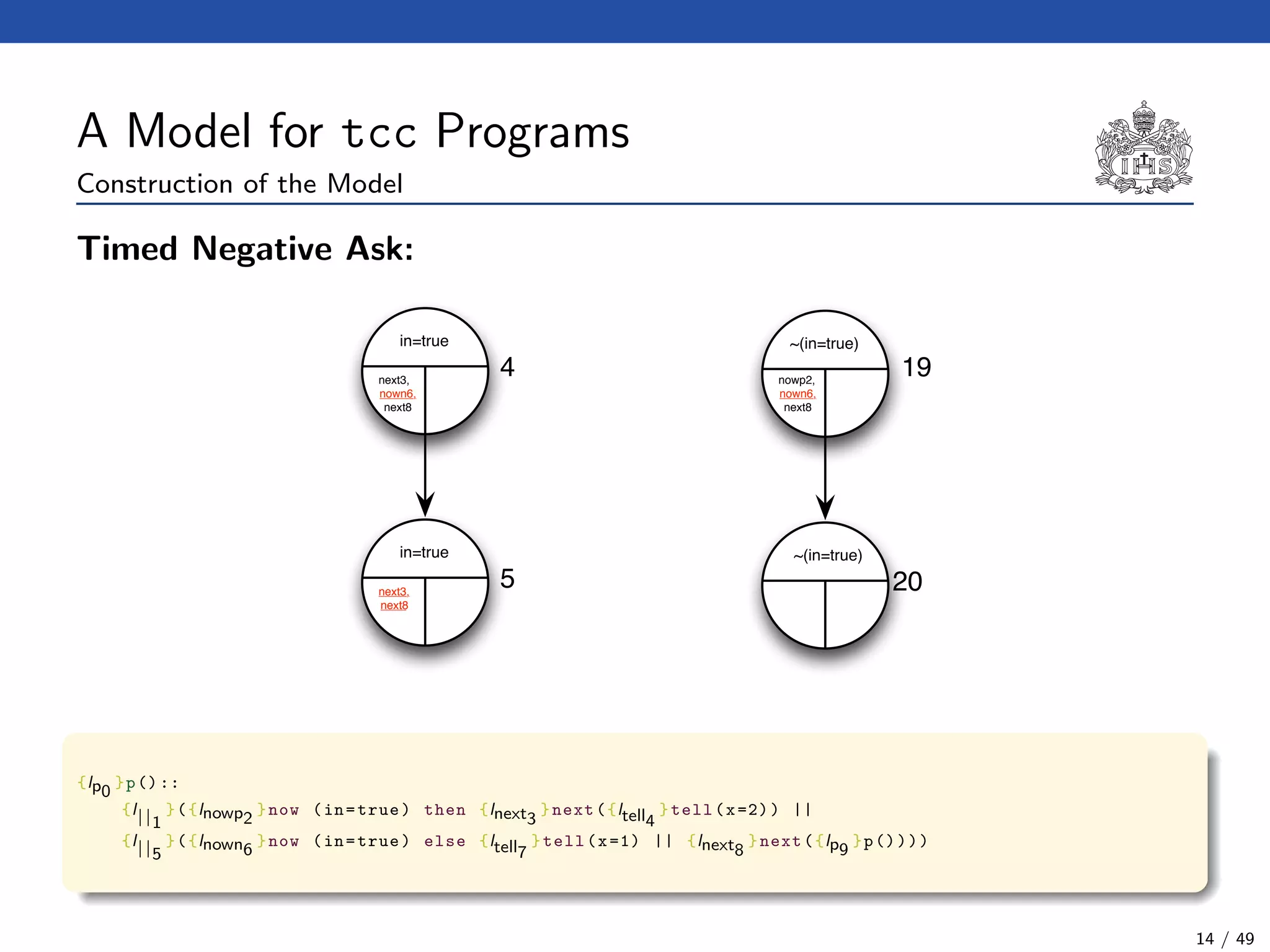
methods in real-life systems.
• It takes the challenging task of developing the underlying theory and
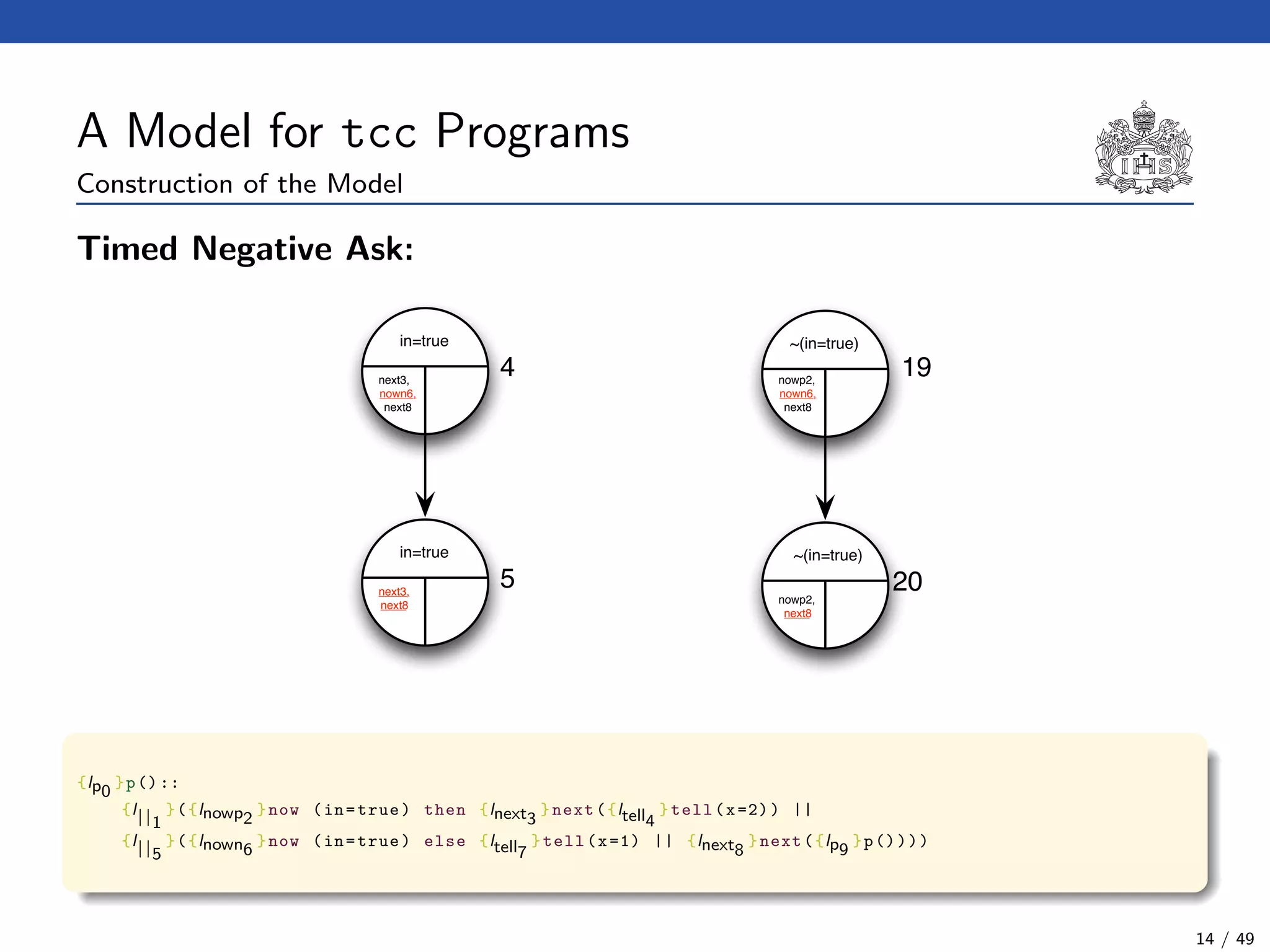
machine-assisted tools for verifying concurrent systems specified in a
formalism AVISPA has recently developed, the ntcc calculus.
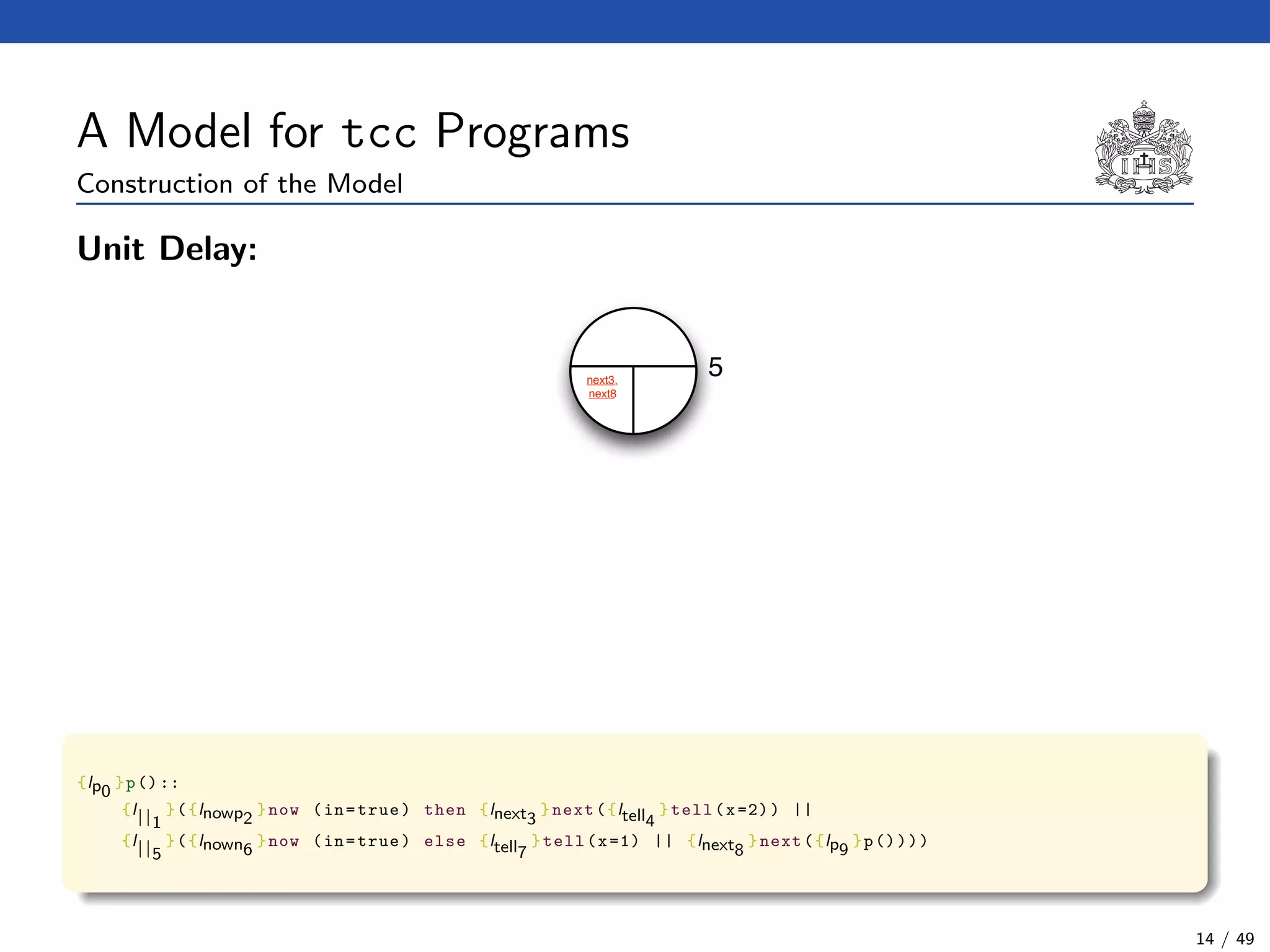
5 / 49
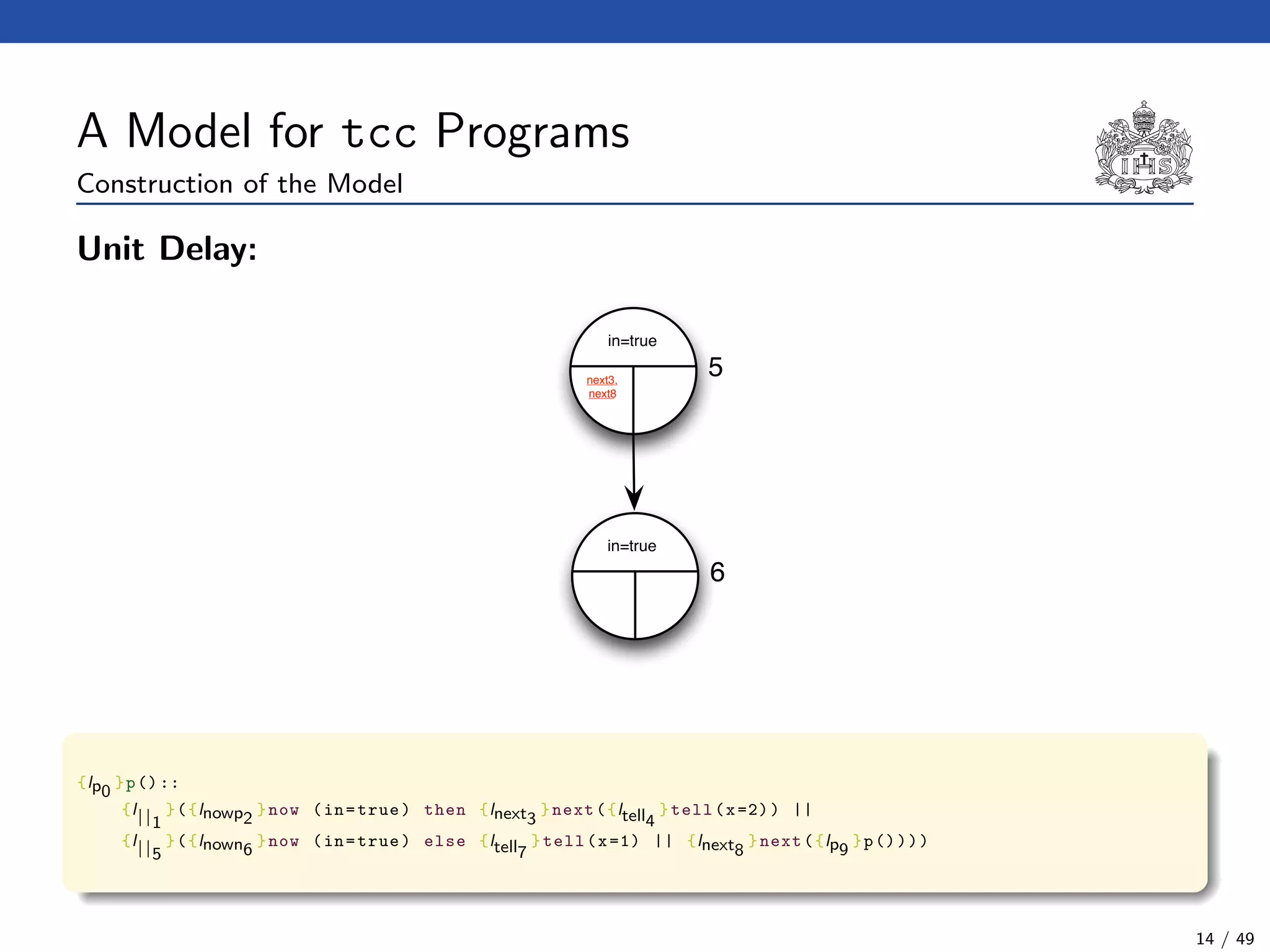
The problem
• At present, ntcc does not provide for the automatic, or even
machine-assisted, verification of system properties.
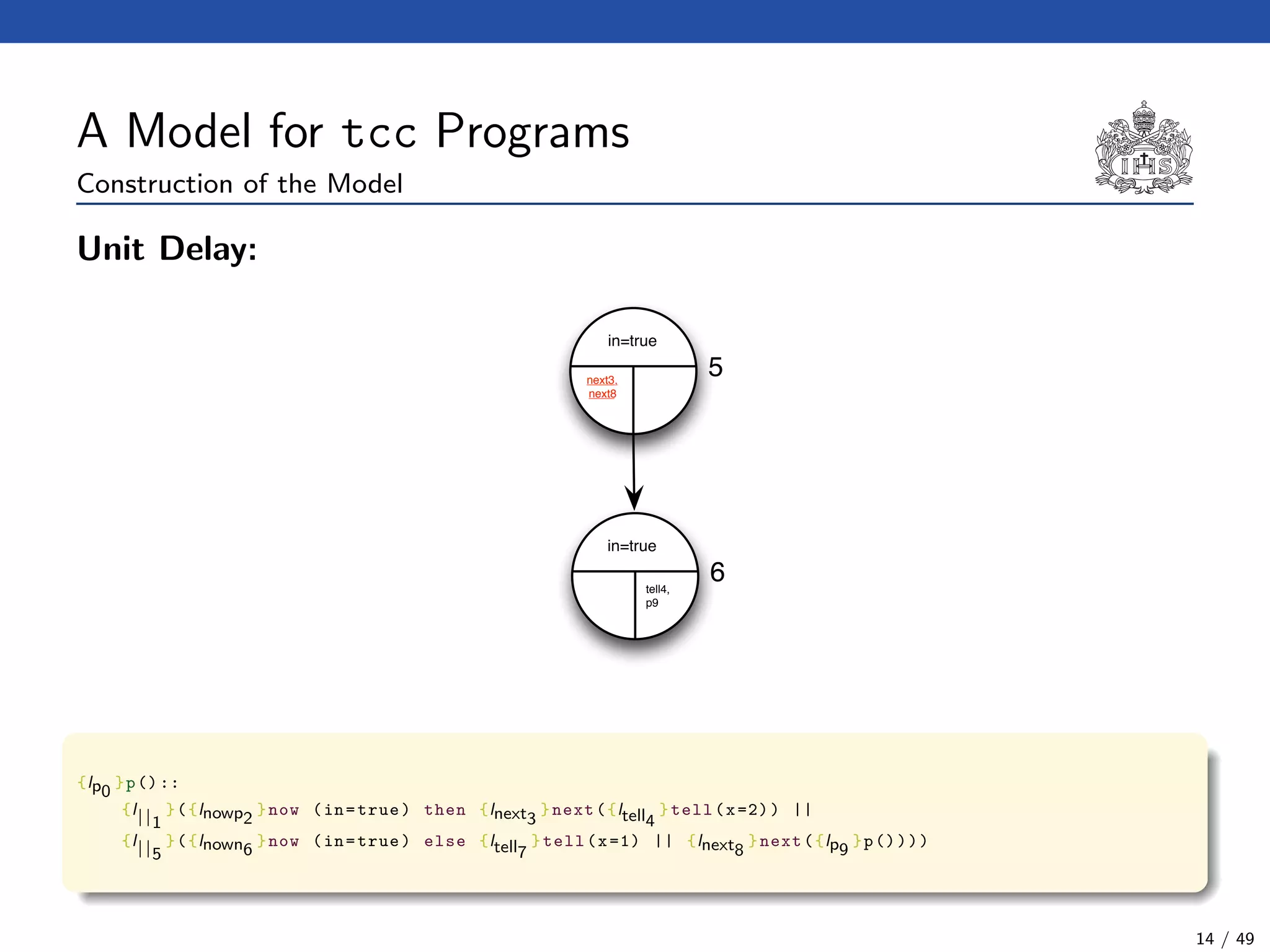
• Since we deal with complex and large systems, machine-assisted
verification is essential to our intended applications.
6 / 49
Outline
1 Introduction
2 Previous work
3 The Model Checking Technique
4 A Model for tcc Programs
5 A Logic for the Specification of Properties
6 The Model Checking Algorithm
7 Implementation
8 Concluding Remarks
7 / 49
Previous work
1. Given a ntcc process and a CLTL property, transform the process into a
B¨uchi automaton and the formula into a process [Val05].
8 / 49
Previous work
1. Given a ntcc process and a CLTL property, transform the process into a
B¨uchi automaton and the formula into a process [Val05].
2. Given a tccp process, a temporal logic property and a number n of time
units, generate a kripke structure and verify if the property satisfy such
structure [FV06].
8 / 49
Previous work
1. Given a ntcc process and a CLTL property, transform the process into a
B¨uchi automaton and the formula into a process [Val05].
2. Given a tccp process, a temporal logic property and a number n of time
units, generate a kripke structure and verify if the property satisfy such
structure [FV06].
3. Given a probabilistic ntcc process, a probabilistic CTL property and
sequence of n inputs (i.e., constraints), generate a discrete-time markov
chain, export the chain into PRISM model checker and verify the
property [TB09]. http://ntccrt.sourceforge.net
8 / 49
Previous work
1. Given a ntcc process and a CLTL property, transform the process into a
B¨uchi automaton and the formula into a process [Val05].
2. Given a tccp process, a temporal logic property and a number n of time
units, generate a kripke structure and verify if the property satisfy such
structure [FV06].
3. Given a probabilistic ntcc process, a probabilistic CTL property and
sequence of n inputs (i.e., constraints), generate a discrete-time markov
chain, export the chain into PRISM model checker and verify the
property [TB09]. http://ntccrt.sourceforge.net
4. Given a ntcc process, a CLTL property and a number n of time units,
generate a finite-state automaton that represents the process and another
one that represents the property, then verify if the process satisfies the
formula [TB12]. http://ntccmc.sourceforge.net
8 / 49
Outline
1 Introduction
2 Previous work
3 The Model Checking Technique
4 A Model for tcc Programs
5 A Logic for the Specification of Properties
6 The Model Checking Algorithm
7 Implementation
8 Concluding Remarks
9 / 49
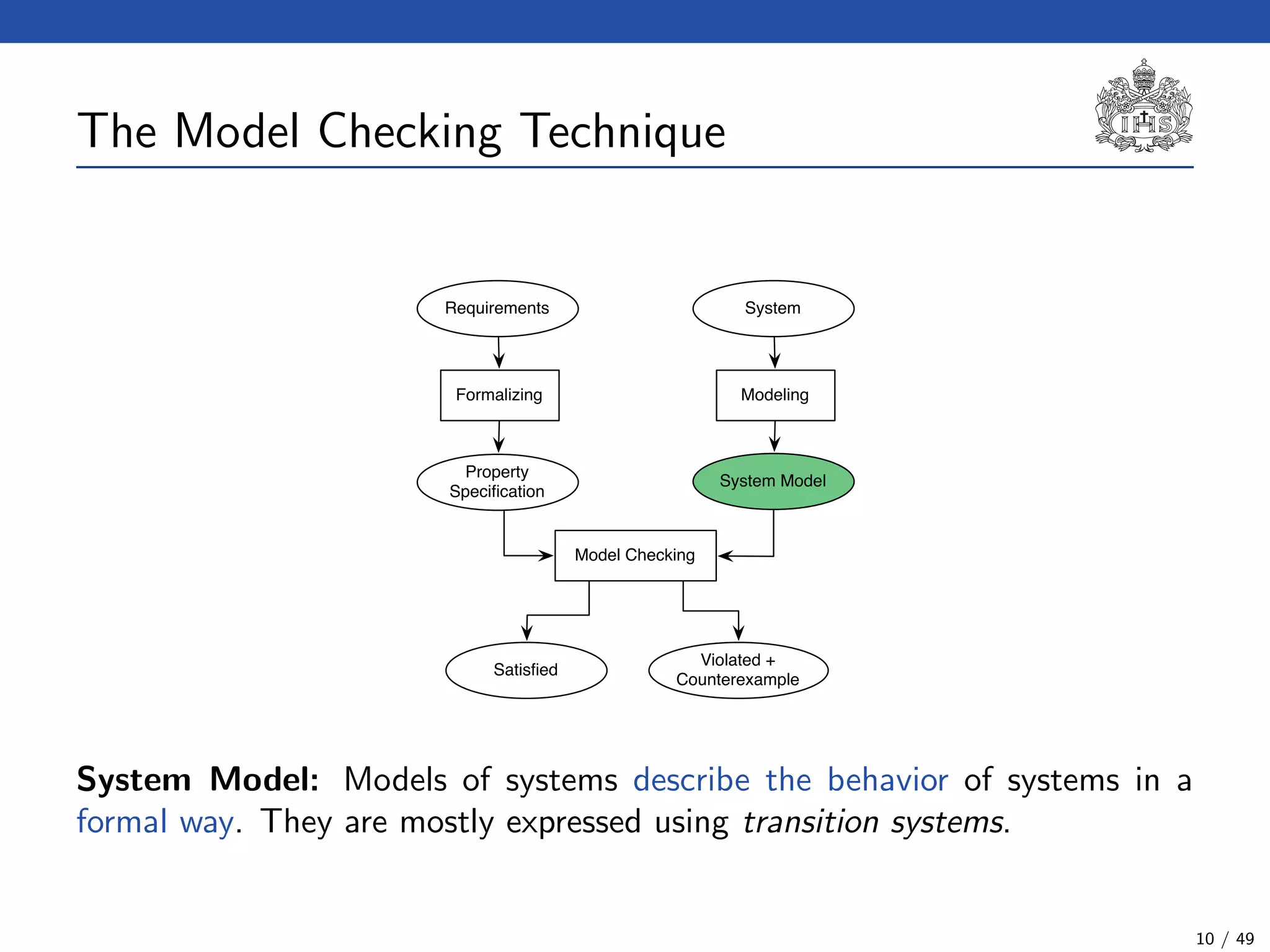
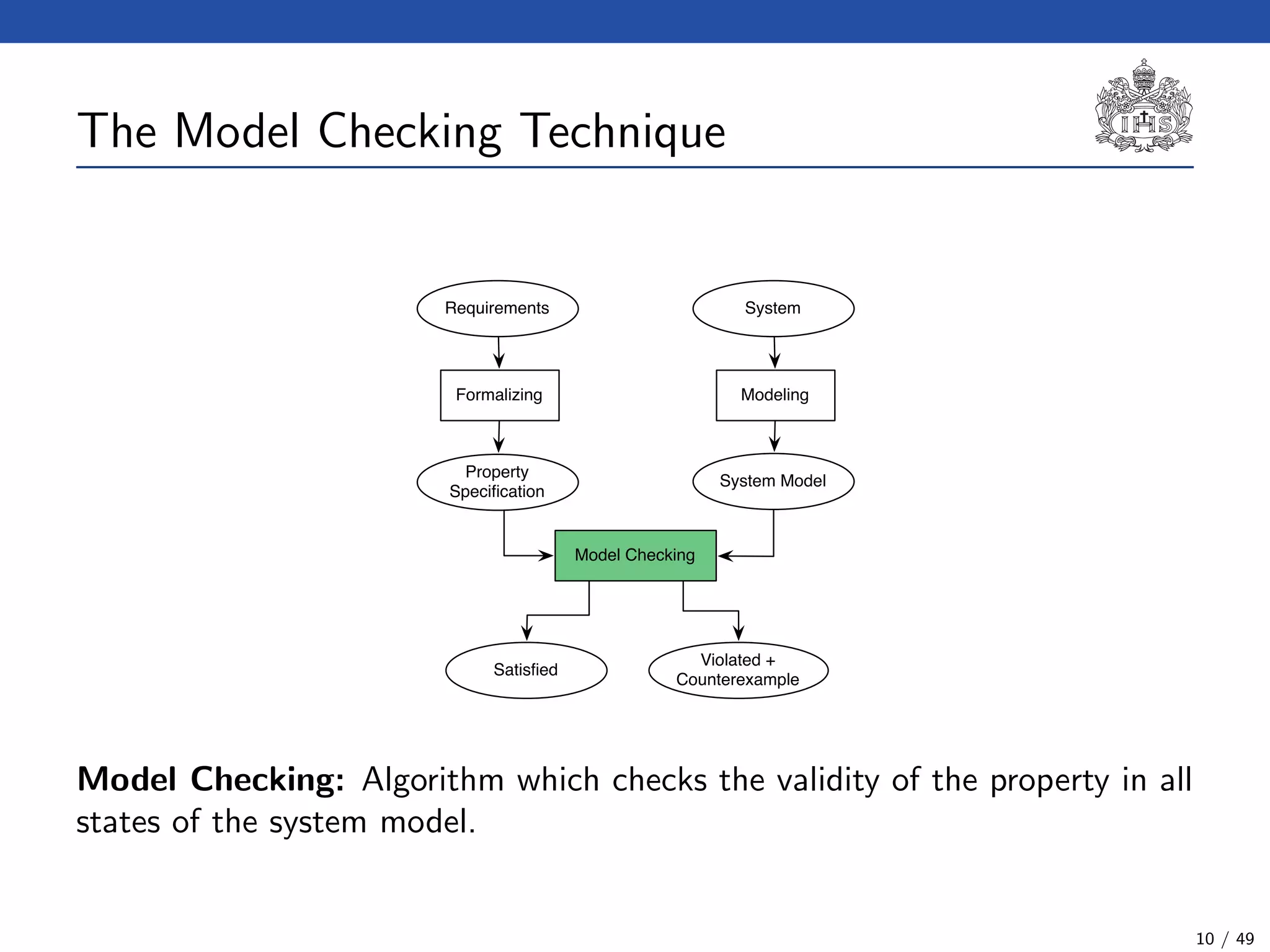
The Model Checking Technique
Requirements System
Formalizing Modeling
Property
Specification
System Model
Model Checking
Satisfied
Violated +
Counterexample
System Model: Models of systems describe the behavior of systems in a
formal way. They are mostly expressed using transition systems.
10 / 49
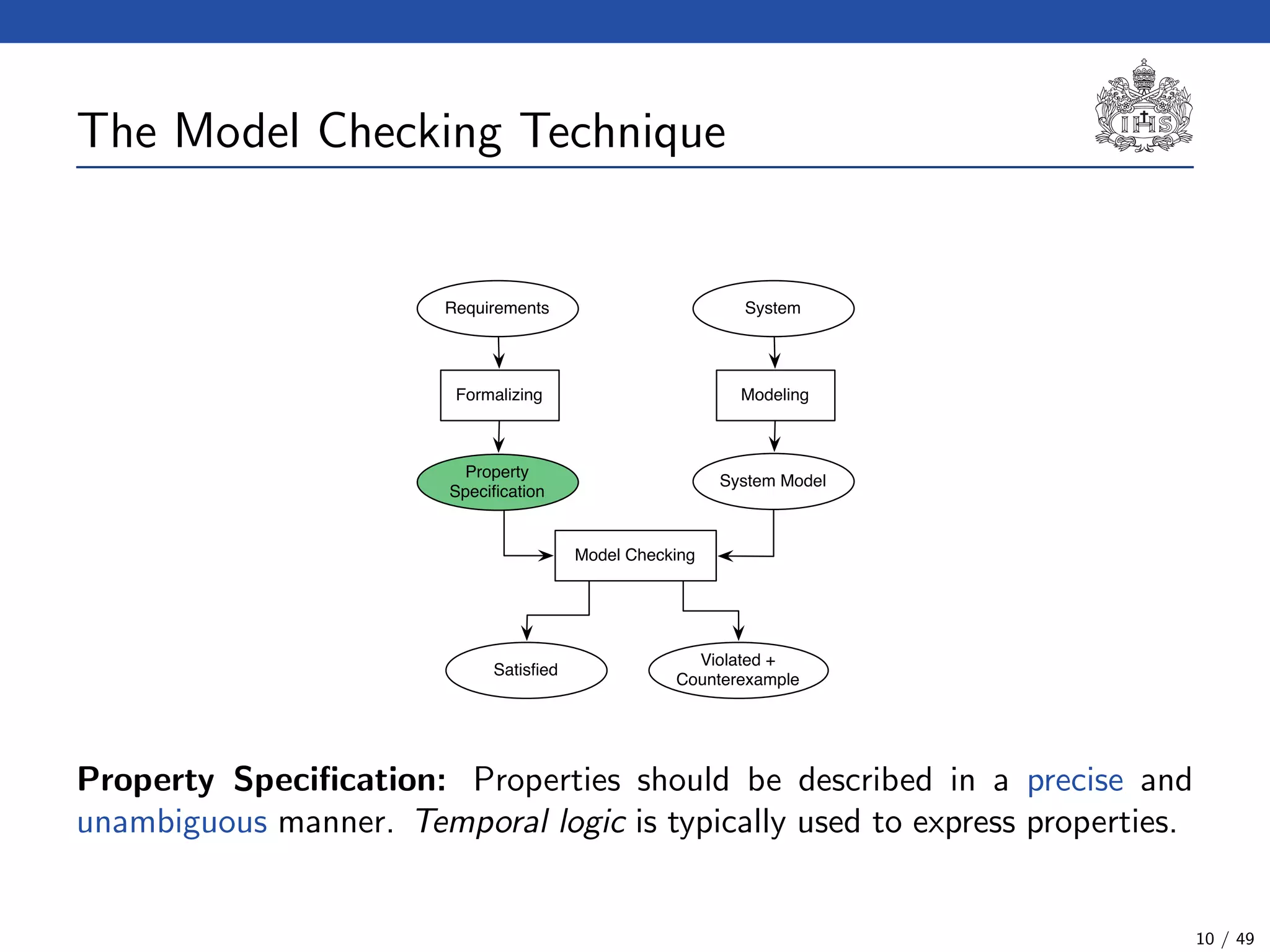
The Model Checking Technique
Requirements System
Formalizing Modeling
Property
Specification
System Model
Model Checking
Satisfied
Violated +
Counterexample
Property Specification: Properties should be described in a precise and
unambiguous manner. Temporal logic is typically used to express properties.
10 / 49
The Model Checking Technique
Requirements System
Formalizing Modeling
Property
Specification
System Model
Model Checking
Satisfied
Violated +
Counterexample
Model Checking: Algorithm which checks the validity of the property in all
states of the system model.
10 / 49
Outline
1 Introduction
2 Previous work
3 The Model Checking Technique
4 A Model for tcc Programs
5 A Logic for the Specification of Properties
6 The Model Checking Algorithm
7 Implementation
8 Concluding Remarks
11 / 49
A Model for tcc Programs
Program Labeling
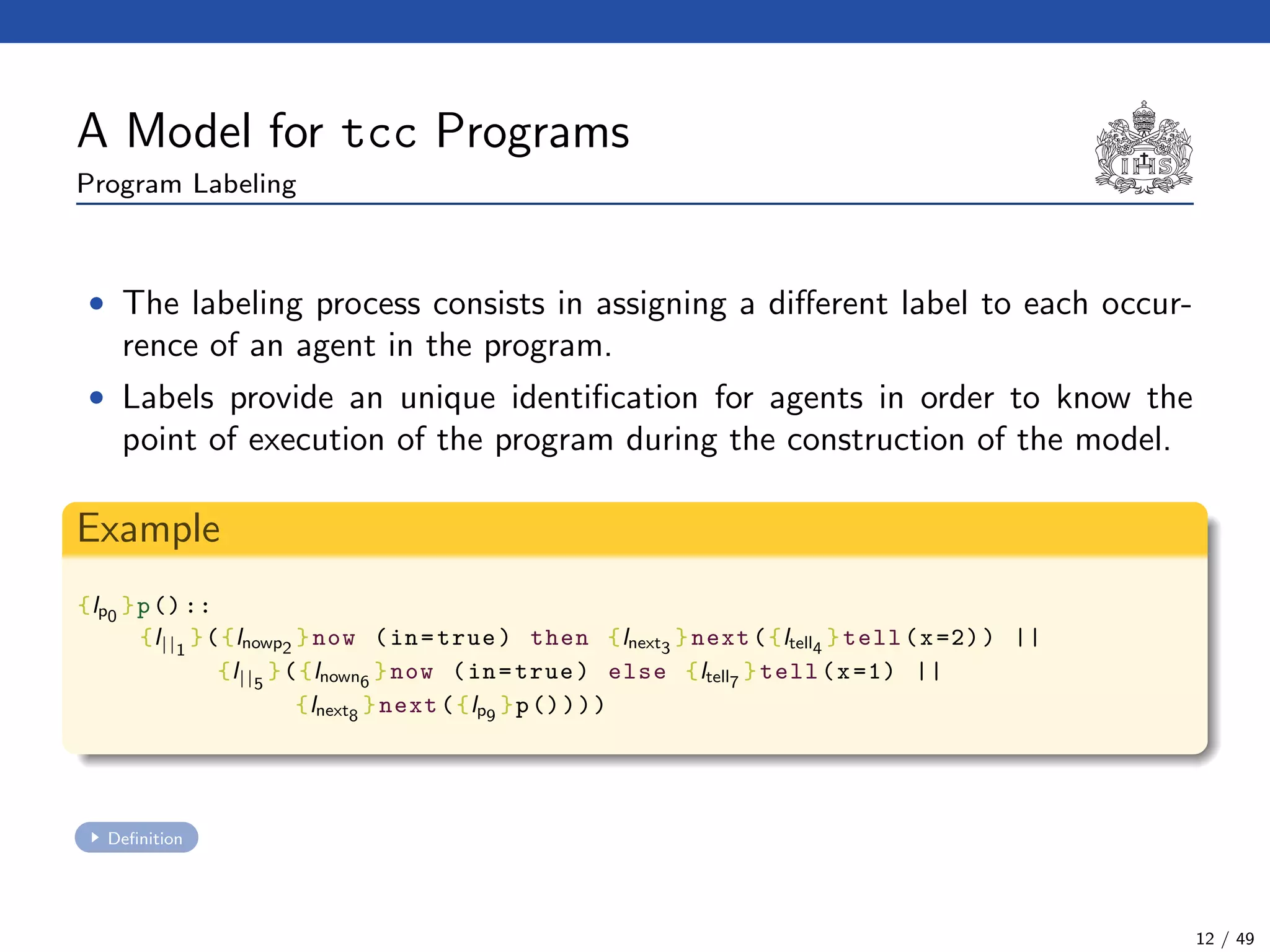
• The labeling process consists in assigning a different label to each occur-
rence of an agent in the program.
• Labels provide an unique identification for agents in order to know the
point of execution of the program during the construction of the model.
Example
{lp0
}p()::
{l||1
}({lnowp2
}now (in=true) then {lnext3
}next({ltell4
}tell(x=2)) ||
{l||5
}({lnown6
}now (in=true) else {ltell7
}tell(x=1) ||
{lnext8
}next({lp9
}p())))
Definition
12 / 49
A Model for tcc Programs
The tcc Structure
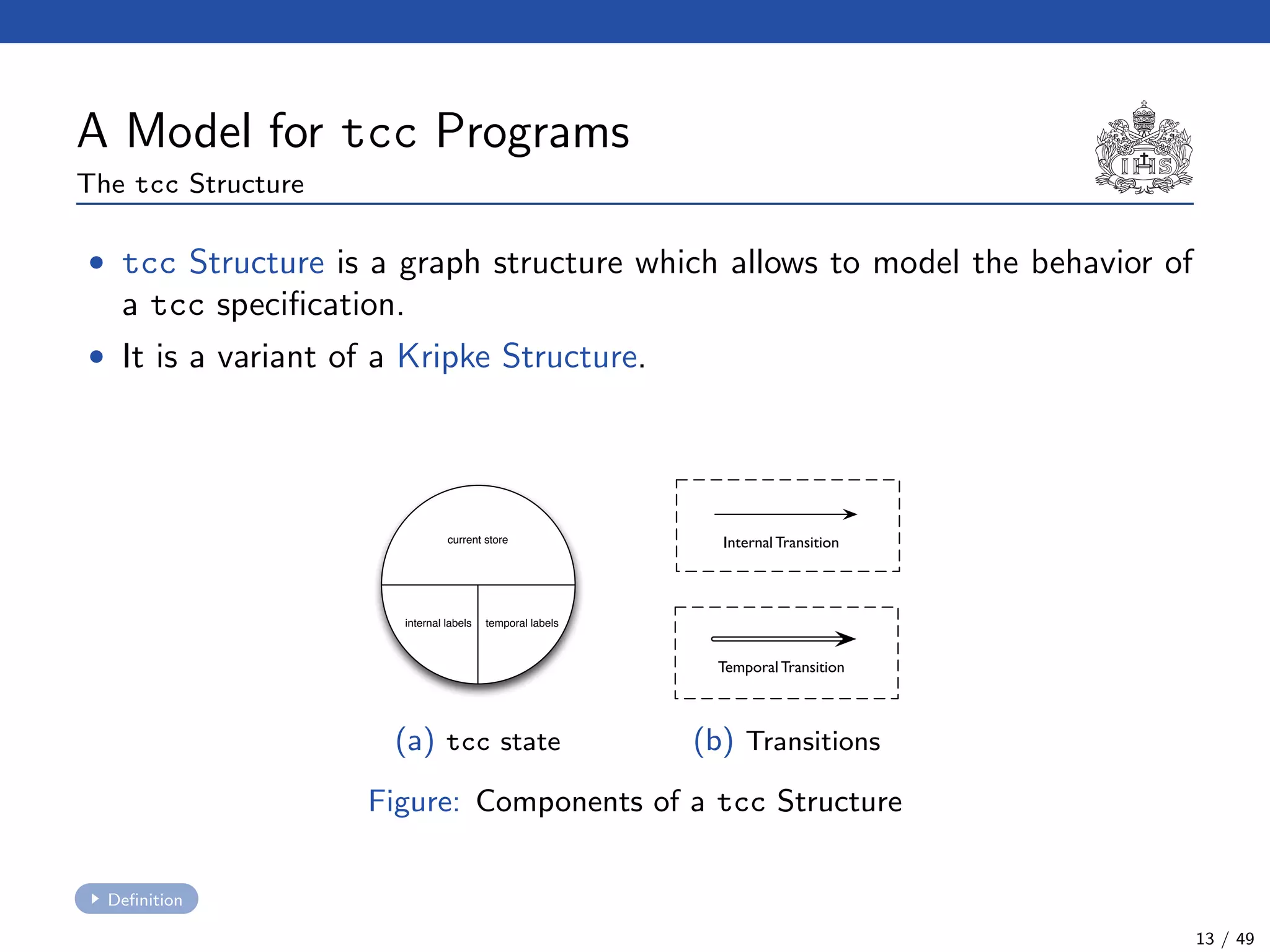
• tcc Structure is a graph structure which allows to model the behavior of
a tcc specification.
• It is a variant of a Kripke Structure.
current store
internal labels temporal labels
(a) tcc state
Internal Transition
Temporal Transition
(b) Transitions
Figure: Components of a tcc Structure
Definition
13 / 49
A Model for tcc Programs
Construction of the Model
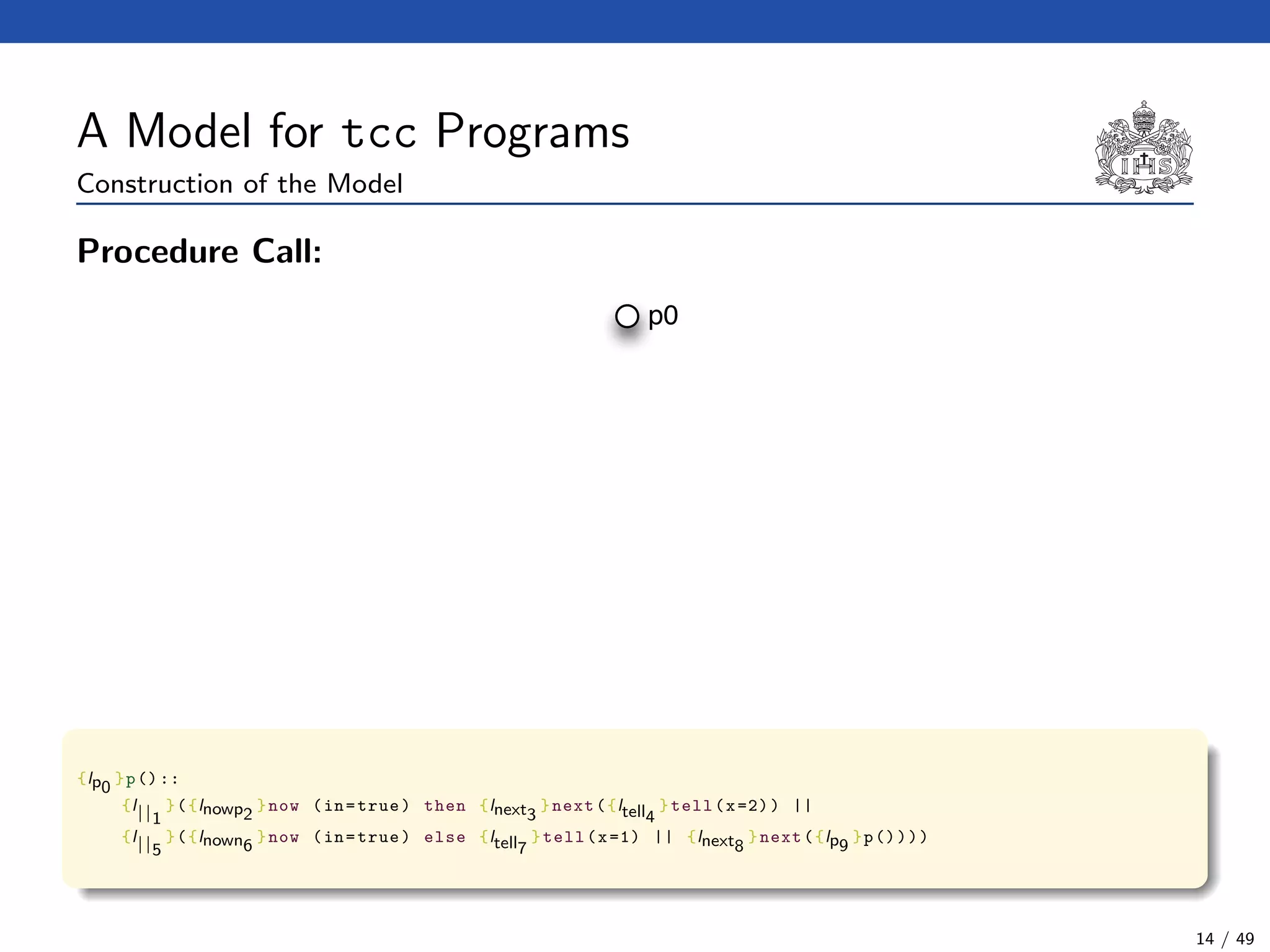
Procedure Call:
p0
{lp0
}p()::
{l||1
}({lnowp2
}now (in=true) then {lnext3
}next({ltell4
}tell(x=2)) ||
{l||5
}({lnown6
}now (in=true) else {ltell7
}tell(x=1) || {lnext8
}next({lp9
}p())))
14 / 49
A Model for tcc Programs
Construction of the Model
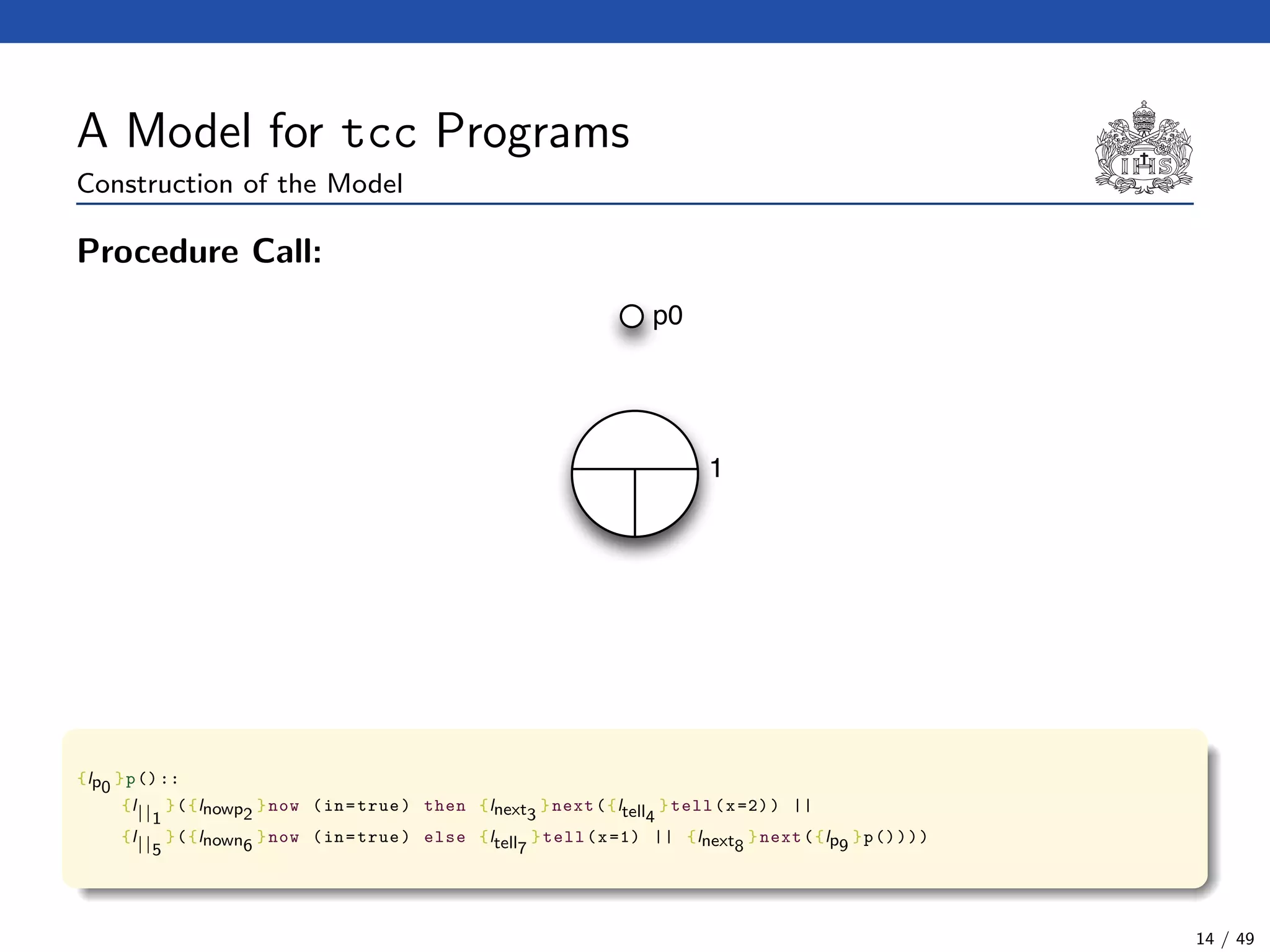
Procedure Call:
p0
1
{lp0
}p()::
{l||1
}({lnowp2
}now (in=true) then {lnext3
}next({ltell4
}tell(x=2)) ||
{l||5
}({lnown6
}now (in=true) else {ltell7
}tell(x=1) || {lnext8
}next({lp9
}p())))
14 / 49
A Model for tcc Programs
Construction of the Model
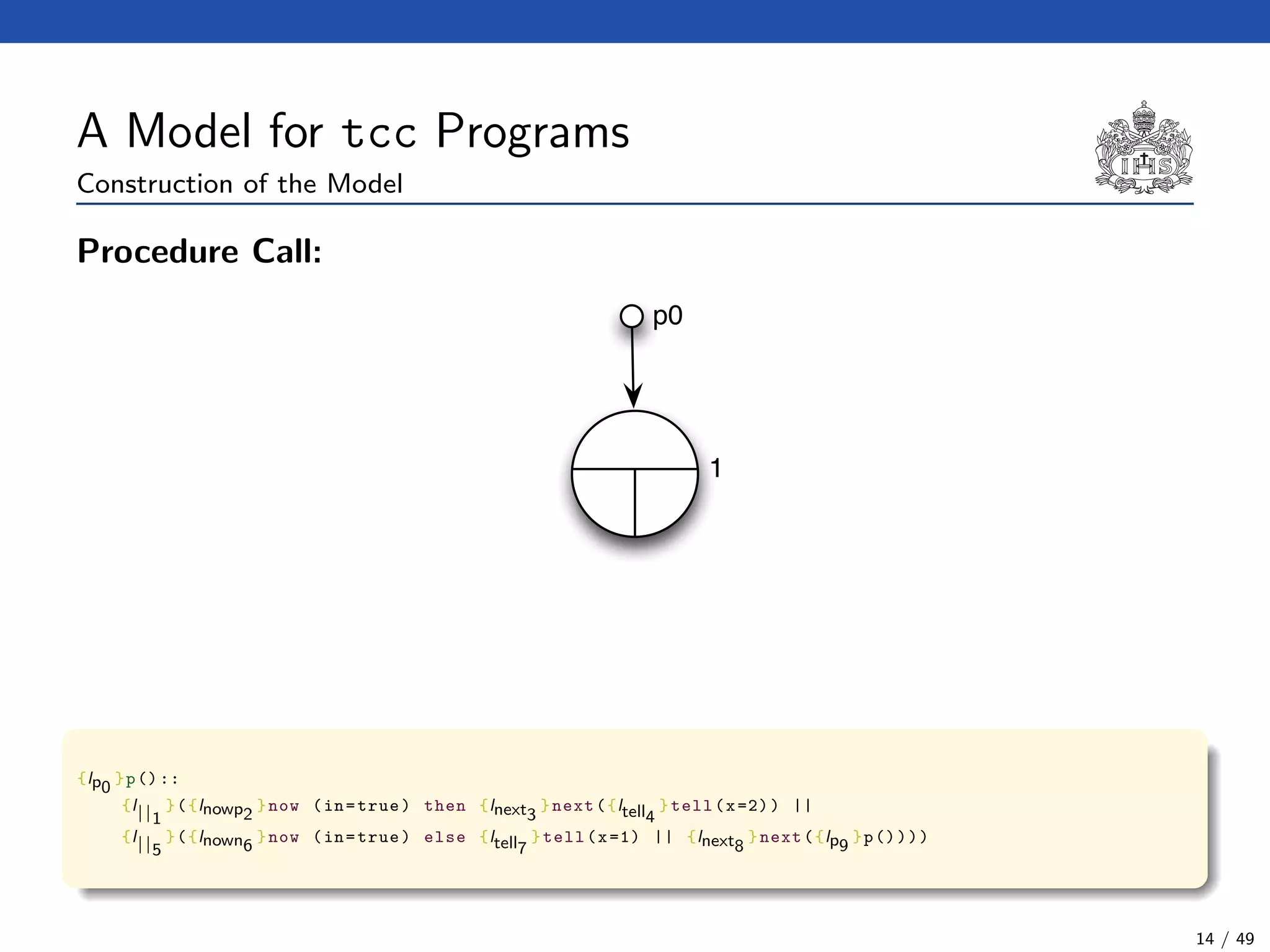
Procedure Call:
p0
1
{lp0
}p()::
{l||1
}({lnowp2
}now (in=true) then {lnext3
}next({ltell4
}tell(x=2)) ||
{l||5
}({lnown6
}now (in=true) else {ltell7
}tell(x=1) || {lnext8
}next({lp9
}p())))
14 / 49
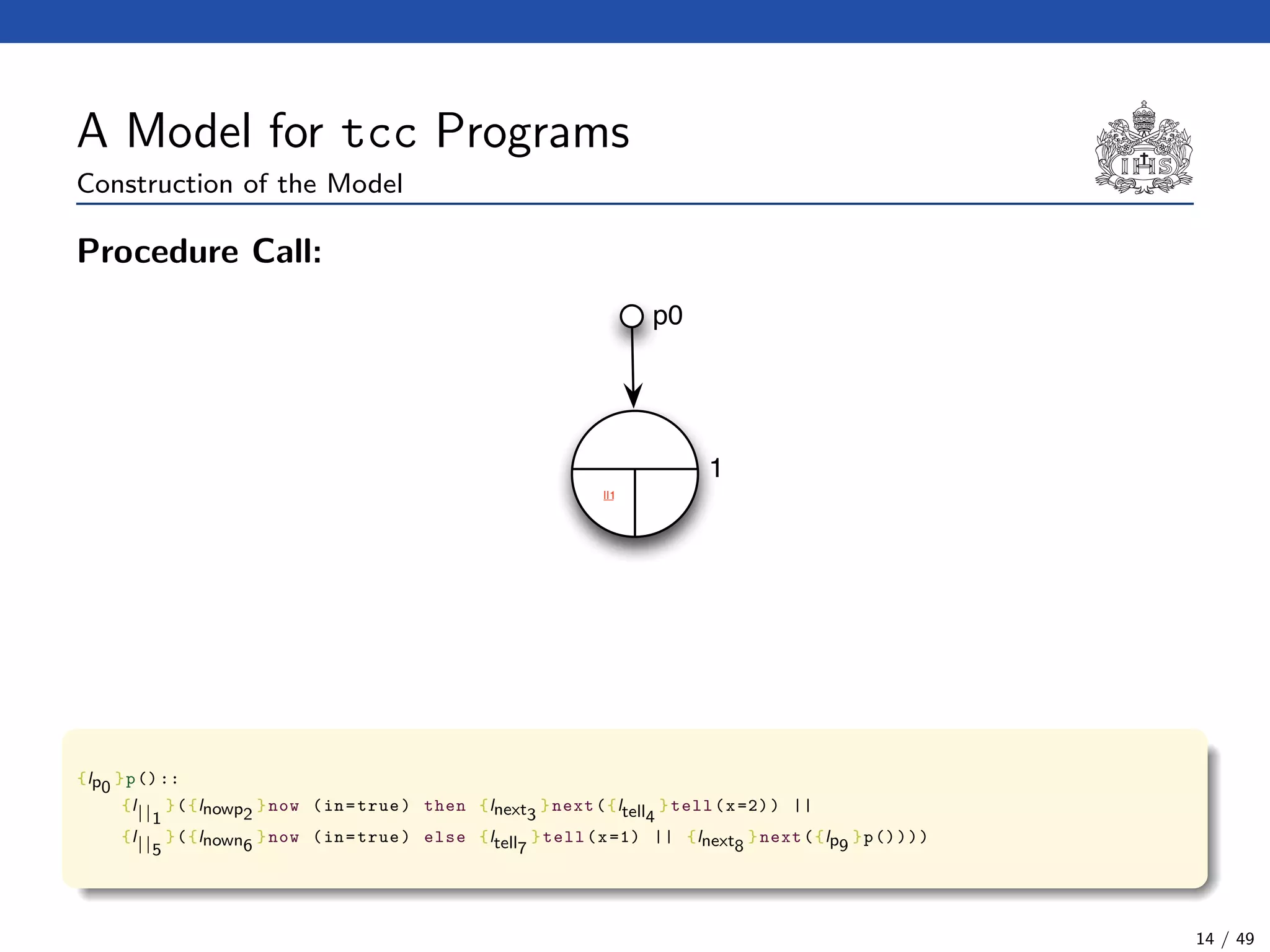
A Model for tcc Programs
Construction of the Model
Procedure Call:
p0
||1
1
{lp0
}p()::
{l||1
}({lnowp2
}now (in=true) then {lnext3
}next({ltell4
}tell(x=2)) ||
{l||5
}({lnown6
}now (in=true) else {ltell7
}tell(x=1) || {lnext8
}next({lp9
}p())))
14 / 49
A Model for tcc Programs
Construction of the Model
Parallel:
p0
||1
1
2
{lp0
}p()::
{l||1
}({lnowp2
}now (in=true) then {lnext3
}next({ltell4
}tell(x=2)) ||
{l||5
}({lnown6
}now (in=true) else {ltell7
}tell(x=1) || {lnext8
}next({lp9
}p())))
14 / 49
A Model for tcc Programs
Construction of the Model
Parallel:
p0
||1
1
2
{lp0
}p()::
{l||1
}({lnowp2
}now (in=true) then {lnext3
}next({ltell4
}tell(x=2)) ||
{l||5
}({lnown6
}now (in=true) else {ltell7
}tell(x=1) || {lnext8
}next({lp9
}p())))
14 / 49
A Model for tcc Programs
Construction of the Model
Parallel:
p0
||1
1
2
nowp2,
||5
{lp0
}p()::
{l||1
}({lnowp2
}now (in=true) then {lnext3
}next({ltell4
}tell(x=2)) ||
{l||5
}({lnown6
}now (in=true) else {ltell7
}tell(x=1) || {lnext8
}next({lp9
}p())))
14 / 49
A Model for tcc Programs
Construction of the Model
Parallel:
nowp2,
nown6,
next8
3
p0
||1
1
2
nowp2,
||5
{lp0
}p()::
{l||1
}({lnowp2
}now (in=true) then {lnext3
}next({ltell4
}tell(x=2)) ||
{l||5
}({lnown6
}now (in=true) else {ltell7
}tell(x=1) || {lnext8
}next({lp9
}p())))
14 / 49
A Model for tcc Programs
Construction of the Model
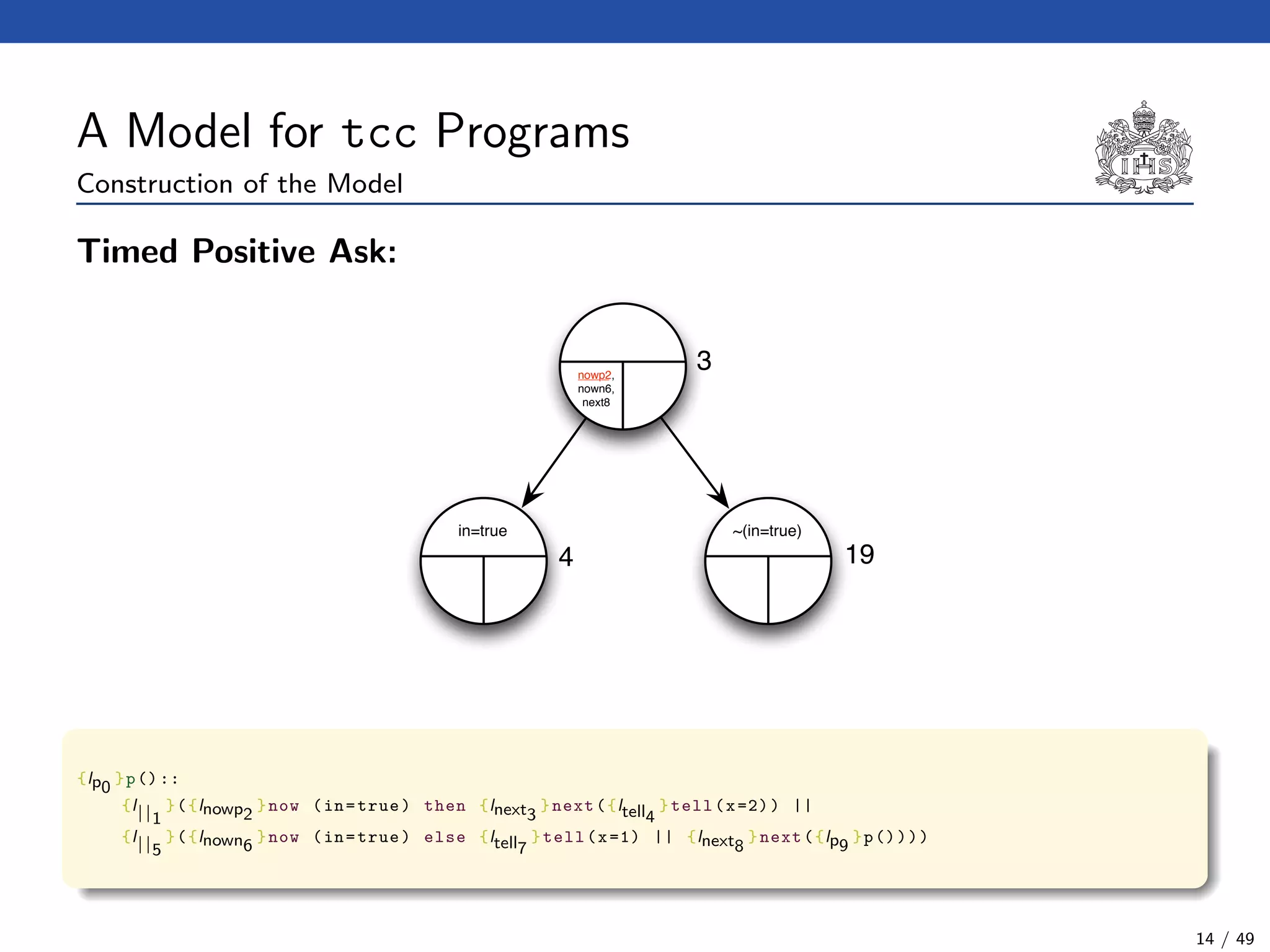
Timed Positive Ask:
nowp2,
nown6,
next8
3
{lp0
}p()::
{l||1
}({lnowp2
}now (in=true) then {lnext3
}next({ltell4
}tell(x=2)) ||
{l||5
}({lnown6
}now (in=true) else {ltell7
}tell(x=1) || {lnext8
}next({lp9
}p())))
14 / 49
A Model for tcc Programs
Construction of the Model
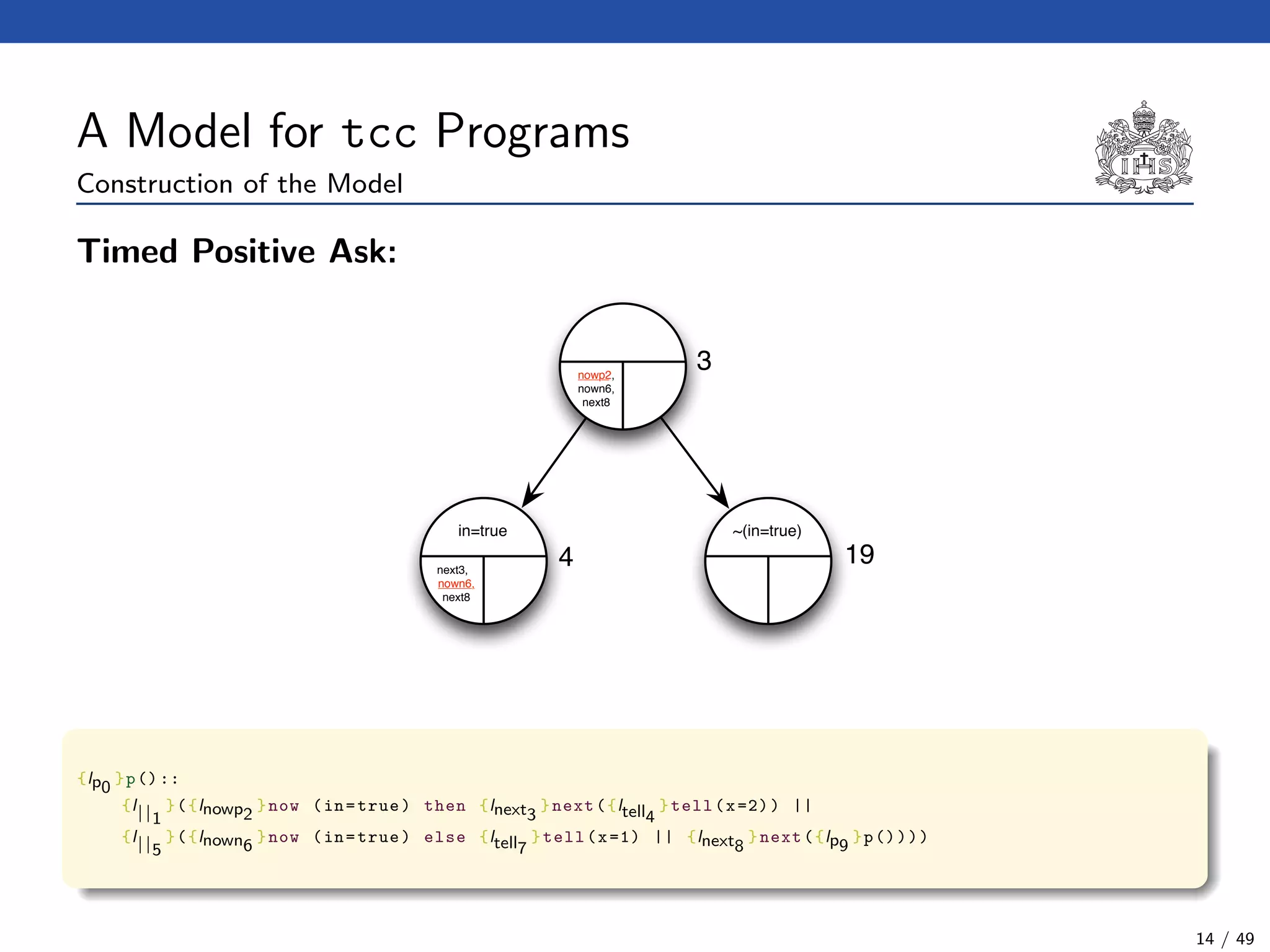
Timed Positive Ask:
nowp2,
nown6,
next8
3
4 19
{lp0
}p()::
{l||1
}({lnowp2
}now (in=true) then {lnext3
}next({ltell4
}tell(x=2)) ||
{l||5
}({lnown6
}now (in=true) else {ltell7
}tell(x=1) || {lnext8
}next({lp9
}p())))
14 / 49
A Model for tcc Programs
Construction of the Model
Timed Positive Ask:
nowp2,
nown6,
next8
3
4 19
{lp0
}p()::
{l||1
}({lnowp2
}now (in=true) then {lnext3
}next({ltell4
}tell(x=2)) ||
{l||5
}({lnown6
}now (in=true) else {ltell7
}tell(x=1) || {lnext8
}next({lp9
}p())))
14 / 49
A Model for tcc Programs
Construction of the Model
Timed Positive Ask:
nowp2,
nown6,
next8
in=true
3
4 19
{lp0
}p()::
{l||1
}({lnowp2
}now (in=true) then {lnext3
}next({ltell4
}tell(x=2)) ||
{l||5
}({lnown6
}now (in=true) else {ltell7
}tell(x=1) || {lnext8
}next({lp9
}p())))
14 / 49
A Model for tcc Programs
Construction of the Model
Timed Positive Ask:
nowp2,
nown6,
next8
~(in=true)in=true
3
4 19
{lp0
}p()::
{l||1
}({lnowp2
}now (in=true) then {lnext3
}next({ltell4
}tell(x=2)) ||
{l||5
}({lnown6
}now (in=true) else {ltell7
}tell(x=1) || {lnext8
}next({lp9
}p())))
14 / 49
A Model for tcc Programs
Construction of the Model
Timed Positive Ask:
nowp2,
nown6,
next8
~(in=true)in=true
3
4 19next3,
nown6,
next8
{lp0
}p()::
{l||1
}({lnowp2
}now (in=true) then {lnext3
}next({ltell4
}tell(x=2)) ||
{l||5
}({lnown6
}now (in=true) else {ltell7
}tell(x=1) || {lnext8
}next({lp9
}p())))
14 / 49
A Model for tcc Programs
Construction of the Model
Timed Positive Ask:
nowp2,
nown6,
next8
~(in=true)in=true
3
4 19next3,
nown6,
next8
nowp2,
nown6,
next8
{lp0
}p()::
{l||1
}({lnowp2
}now (in=true) then {lnext3
}next({ltell4
}tell(x=2)) ||
{l||5
}({lnown6
}now (in=true) else {ltell7
}tell(x=1) || {lnext8
}next({lp9
}p())))
14 / 49
A Model for tcc Programs
Construction of the Model
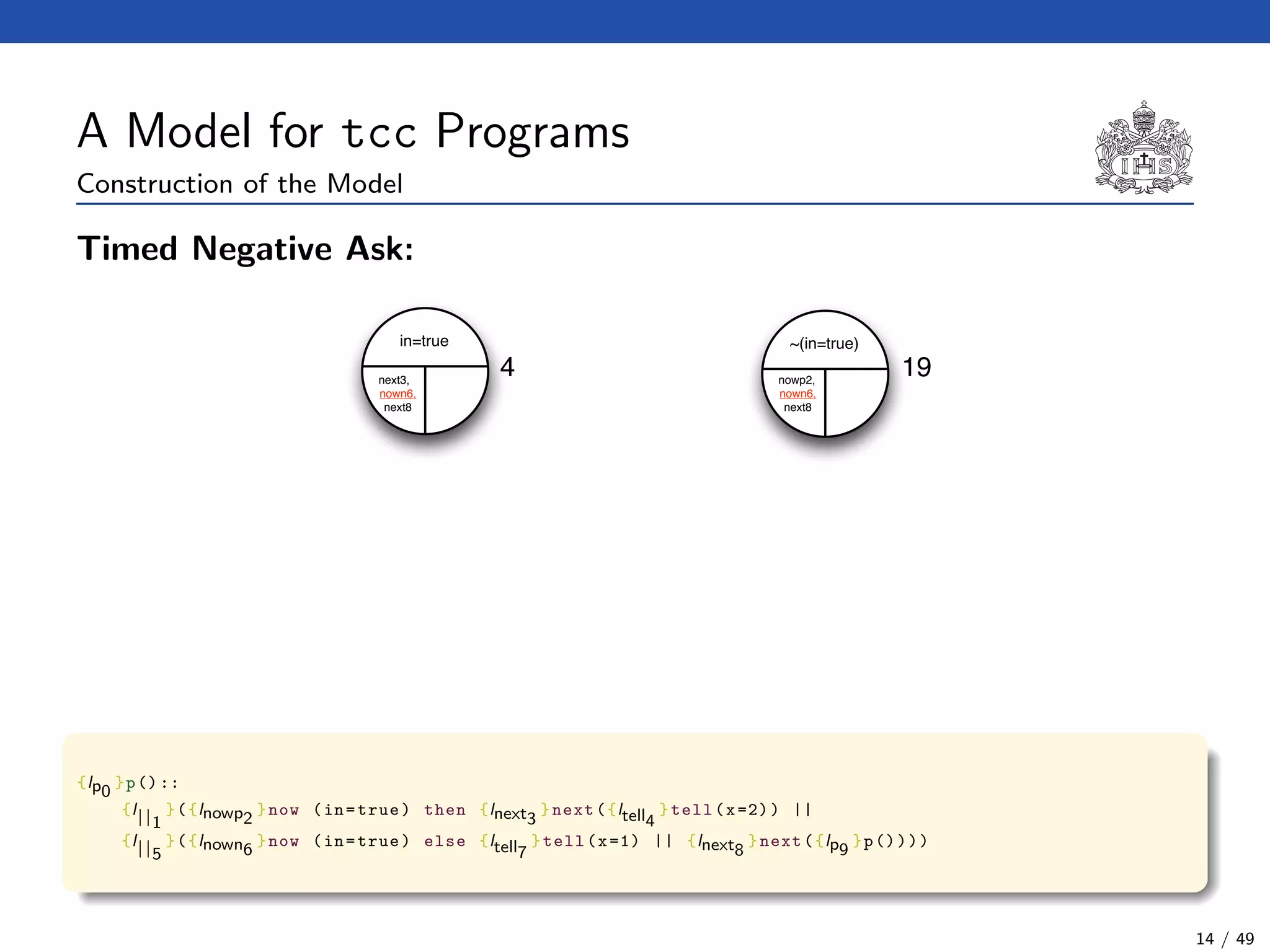
Timed Negative Ask:
~(in=true)in=true
4 19next3,
nown6,
next8
nowp2,
nown6,
next8
{lp0
}p()::
{l||1
}({lnowp2
}now (in=true) then {lnext3
}next({ltell4
}tell(x=2)) ||
{l||5
}({lnown6
}now (in=true) else {ltell7
}tell(x=1) || {lnext8
}next({lp9
}p())))
14 / 49
A Model for tcc Programs
Construction of the Model
Timed Negative Ask:
~(in=true)in=true
4 19next3,
nown6,
next8
nowp2,
nown6,
next8
5 33
{lp0
}p()::
{l||1
}({lnowp2
}now (in=true) then {lnext3
}next({ltell4
}tell(x=2)) ||
{l||5
}({lnown6
}now (in=true) else {ltell7
}tell(x=1) || {lnext8
}next({lp9
}p())))
14 / 49
A Model for tcc Programs
Construction of the Model
Timed Negative Ask:
~(in=true)in=true
4 19next3,
nown6,
next8
nowp2,
nown6,
next8
5 33
{lp0
}p()::
{l||1
}({lnowp2
}now (in=true) then {lnext3
}next({ltell4
}tell(x=2)) ||
{l||5
}({lnown6
}now (in=true) else {ltell7
}tell(x=1) || {lnext8
}next({lp9
}p())))
14 / 49
A Model for tcc Programs
Construction of the Model
Timed Negative Ask:
~(in=true)in=true
4 19next3,
nown6,
next8
nowp2,
nown6,
next8
in=true
5 33
{lp0
}p()::
{l||1
}({lnowp2
}now (in=true) then {lnext3
}next({ltell4
}tell(x=2)) ||
{l||5
}({lnown6
}now (in=true) else {ltell7
}tell(x=1) || {lnext8
}next({lp9
}p())))
14 / 49
A Model for tcc Programs
Construction of the Model
Timed Negative Ask:
~(in=true)in=true
4 19next3,
nown6,
next8
nowp2,
nown6,
next8
in=true
5
in=true,~(in=true)
33
{lp0
}p()::
{l||1
}({lnowp2
}now (in=true) then {lnext3
}next({ltell4
}tell(x=2)) ||
{l||5
}({lnown6
}now (in=true) else {ltell7
}tell(x=1) || {lnext8
}next({lp9
}p())))
14 / 49
A Model for tcc Programs
Construction of the Model
Timed Negative Ask:
~(in=true)in=true
4 19next3,
nown6,
next8
nowp2,
nown6,
next8
in=true
5
{lp0
}p()::
{l||1
}({lnowp2
}now (in=true) then {lnext3
}next({ltell4
}tell(x=2)) ||
{l||5
}({lnown6
}now (in=true) else {ltell7
}tell(x=1) || {lnext8
}next({lp9
}p())))
14 / 49
A Model for tcc Programs
Construction of the Model
Timed Negative Ask:
~(in=true)in=true
4 19next3,
nown6,
next8
nowp2,
nown6,
next8
in=true
5next3,
next8
{lp0
}p()::
{l||1
}({lnowp2
}now (in=true) then {lnext3
}next({ltell4
}tell(x=2)) ||
{l||5
}({lnown6
}now (in=true) else {ltell7
}tell(x=1) || {lnext8
}next({lp9
}p())))
14 / 49
A Model for tcc Programs
Construction of the Model
Timed Negative Ask:
~(in=true)in=true
4 19next3,
nown6,
next8
nowp2,
nown6,
next8
in=true
5next3,
next8
34 20
{lp0
}p()::
{l||1
}({lnowp2
}now (in=true) then {lnext3
}next({ltell4
}tell(x=2)) ||
{l||5
}({lnown6
}now (in=true) else {ltell7
}tell(x=1) || {lnext8
}next({lp9
}p())))
14 / 49
A Model for tcc Programs
Construction of the Model
Timed Negative Ask:
~(in=true)in=true
4 19next3,
nown6,
next8
nowp2,
nown6,
next8
in=true
5next3,
next8
34 20
{lp0
}p()::
{l||1
}({lnowp2
}now (in=true) then {lnext3
}next({ltell4
}tell(x=2)) ||
{l||5
}({lnown6
}now (in=true) else {ltell7
}tell(x=1) || {lnext8
}next({lp9
}p())))
14 / 49
A Model for tcc Programs
Construction of the Model
Timed Negative Ask:
~(in=true)in=true
4 19next3,
nown6,
next8
nowp2,
nown6,
next8
in=true
5next3,
next8
34
~(in=true),in=true
20
{lp0
}p()::
{l||1
}({lnowp2
}now (in=true) then {lnext3
}next({ltell4
}tell(x=2)) ||
{l||5
}({lnown6
}now (in=true) else {ltell7
}tell(x=1) || {lnext8
}next({lp9
}p())))
14 / 49
A Model for tcc Programs
Construction of the Model
Timed Negative Ask:
~(in=true)in=true
4 19next3,
nown6,
next8
nowp2,
nown6,
next8
in=true
5next3,
next8
34
~(in=true),in=true
20
~(in=true)
{lp0
}p()::
{l||1
}({lnowp2
}now (in=true) then {lnext3
}next({ltell4
}tell(x=2)) ||
{l||5
}({lnown6
}now (in=true) else {ltell7
}tell(x=1) || {lnext8
}next({lp9
}p())))
14 / 49
A Model for tcc Programs
Construction of the Model
Timed Negative Ask:
~(in=true)in=true
4 19next3,
nown6,
next8
nowp2,
nown6,
next8
in=true
5next3,
next8
20
~(in=true)
{lp0
}p()::
{l||1
}({lnowp2
}now (in=true) then {lnext3
}next({ltell4
}tell(x=2)) ||
{l||5
}({lnown6
}now (in=true) else {ltell7
}tell(x=1) || {lnext8
}next({lp9
}p())))
14 / 49
A Model for tcc Programs
Construction of the Model
Timed Negative Ask:
~(in=true)in=true
4 19next3,
nown6,
next8
nowp2,
nown6,
next8
in=true
5next3,
next8
20
~(in=true)
nowp2,
next8
{lp0
}p()::
{l||1
}({lnowp2
}now (in=true) then {lnext3
}next({ltell4
}tell(x=2)) ||
{l||5
}({lnown6
}now (in=true) else {ltell7
}tell(x=1) || {lnext8
}next({lp9
}p())))
14 / 49
A Model for tcc Programs
Construction of the Model
Timed Negative Ask:
~(in=true)in=true
4 19next3,
nown6,
next8
nowp2,
nown6,
next8
in=true
5next3,
next8
20
~(in=true)
nowp2,
next8
tell7
{lp0
}p()::
{l||1
}({lnowp2
}now (in=true) then {lnext3
}next({ltell4
}tell(x=2)) ||
{l||5
}({lnown6
}now (in=true) else {ltell7
}tell(x=1) || {lnext8
}next({lp9
}p())))
14 / 49
A Model for tcc Programs
Construction of the Model
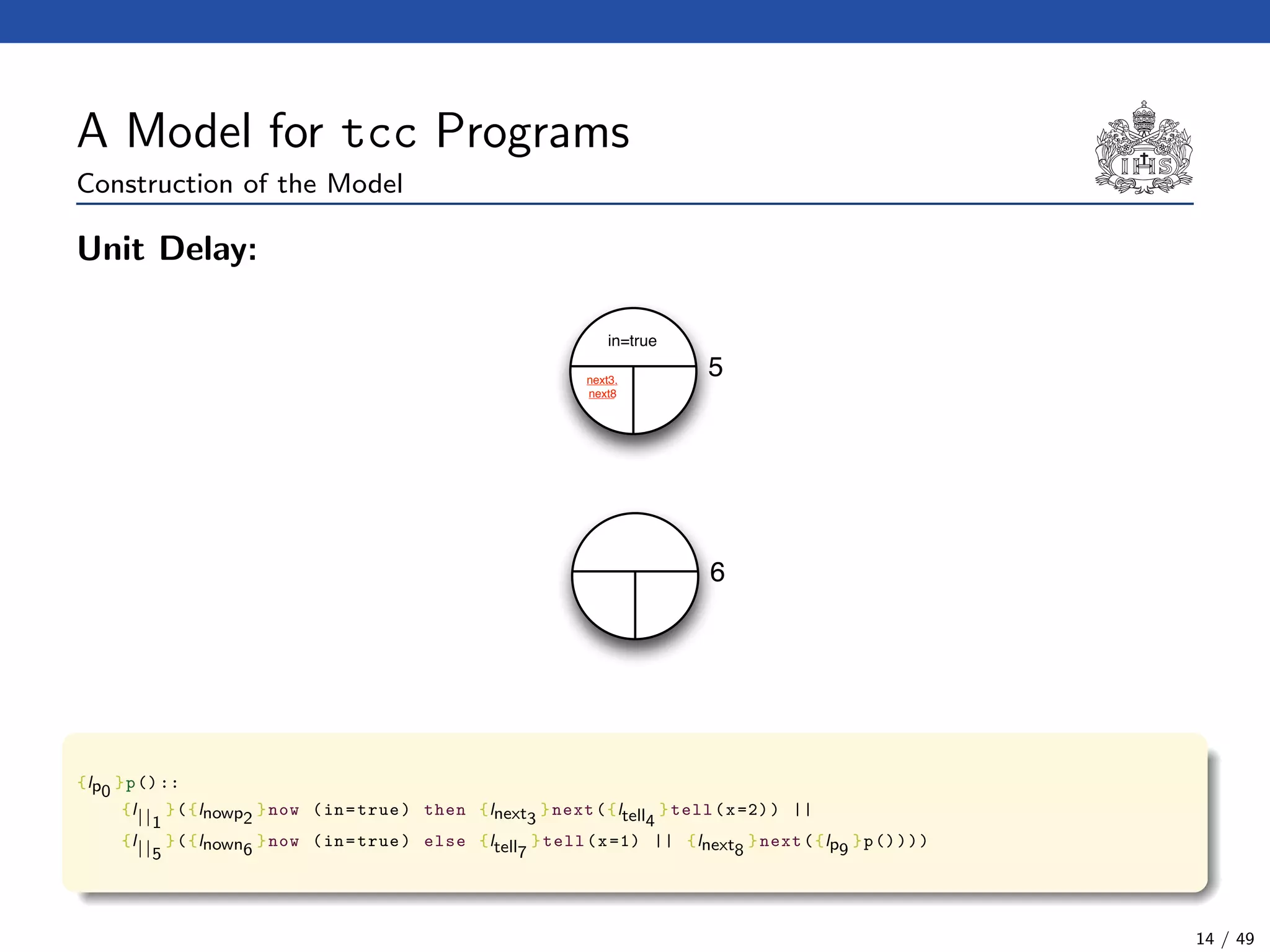
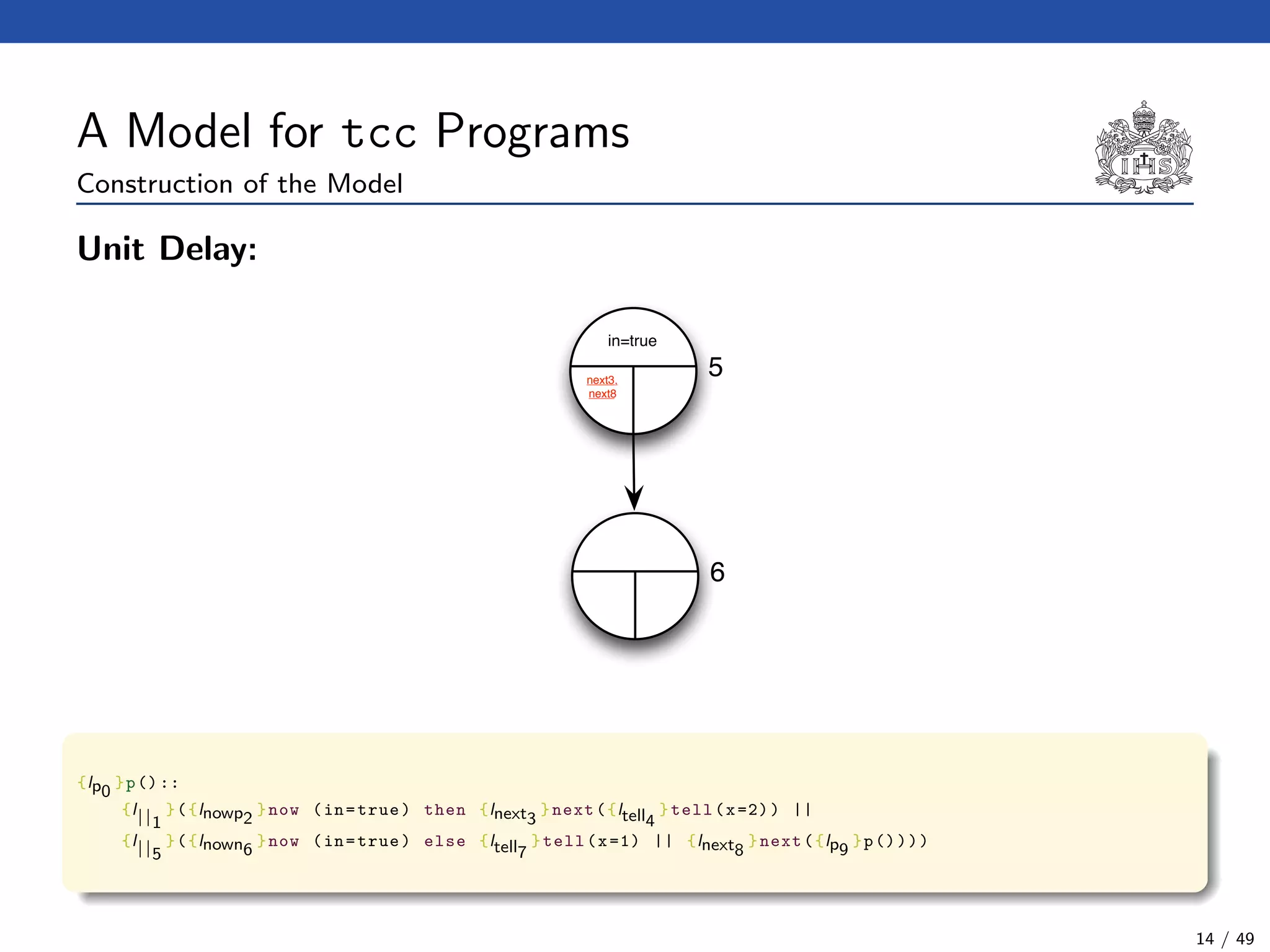
Unit Delay:
5next3,
next8
{lp0
}p()::
{l||1
}({lnowp2
}now (in=true) then {lnext3
}next({ltell4
}tell(x=2)) ||
{l||5
}({lnown6
}now (in=true) else {ltell7
}tell(x=1) || {lnext8
}next({lp9
}p())))
14 / 49
A Model for tcc Programs
Construction of the Model
Unit Delay:
in=true
5next3,
next8
6
{lp0
}p()::
{l||1
}({lnowp2
}now (in=true) then {lnext3
}next({ltell4
}tell(x=2)) ||
{l||5
}({lnown6
}now (in=true) else {ltell7
}tell(x=1) || {lnext8
}next({lp9
}p())))
14 / 49
A Model for tcc Programs
Construction of the Model
Unit Delay:
in=true
5next3,
next8
6
{lp0
}p()::
{l||1
}({lnowp2
}now (in=true) then {lnext3
}next({ltell4
}tell(x=2)) ||
{l||5
}({lnown6
}now (in=true) else {ltell7
}tell(x=1) || {lnext8
}next({lp9
}p())))
14 / 49
A Model for tcc Programs
Construction of the Model
Unit Delay:
in=true
5next3,
next8
6
in=true
{lp0
}p()::
{l||1
}({lnowp2
}now (in=true) then {lnext3
}next({ltell4
}tell(x=2)) ||
{l||5
}({lnown6
}now (in=true) else {ltell7
}tell(x=1) || {lnext8
}next({lp9
}p())))
14 / 49
A Model for tcc Programs
Construction of the Model
Unit Delay:
in=true
5next3,
next8
6tell4,
p9
in=true
{lp0
}p()::
{l||1
}({lnowp2
}now (in=true) then {lnext3
}next({ltell4
}tell(x=2)) ||
{l||5
}({lnown6
}now (in=true) else {ltell7
}tell(x=1) || {lnext8
}next({lp9
}p())))
14 / 49
A Model for tcc Programs
Construction of the Model
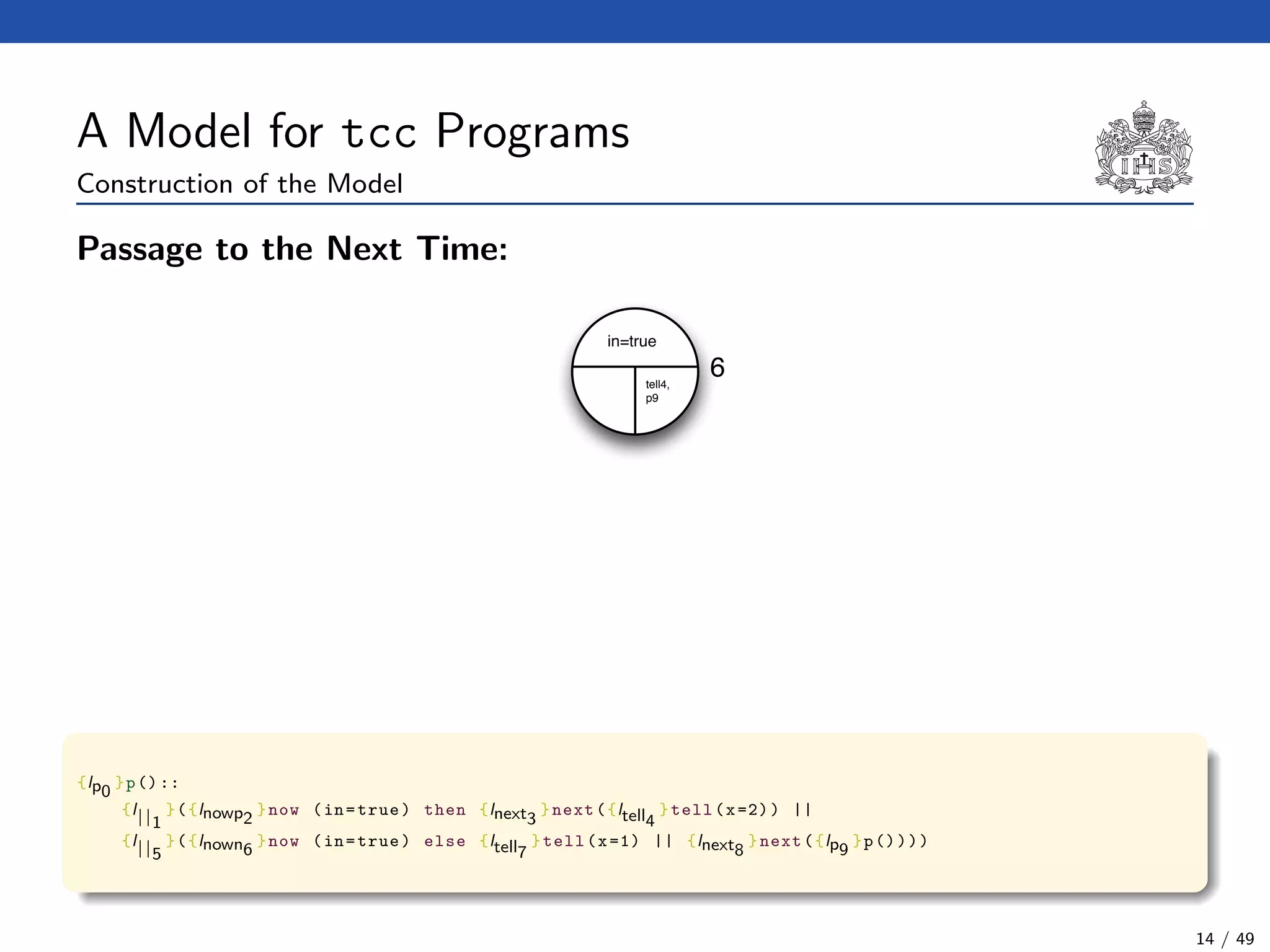
Passage to the Next Time:
6tell4,
p9
in=true
{lp0
}p()::
{l||1
}({lnowp2
}now (in=true) then {lnext3
}next({ltell4
}tell(x=2)) ||
{l||5
}({lnown6
}now (in=true) else {ltell7
}tell(x=1) || {lnext8
}next({lp9
}p())))
14 / 49
A Model for tcc Programs
Construction of the Model
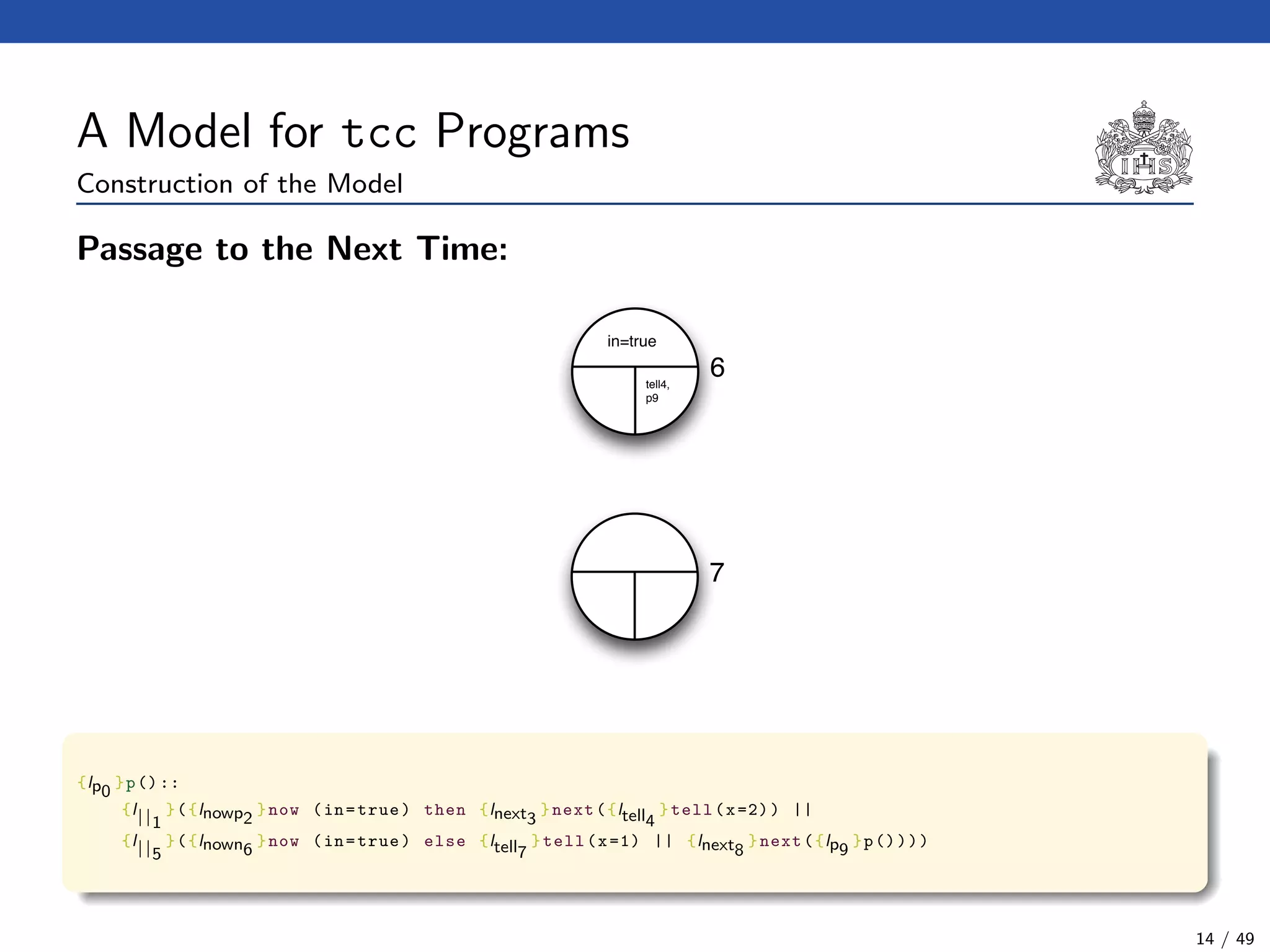
Passage to the Next Time:
6tell4,
p9
in=true
7
{lp0
}p()::
{l||1
}({lnowp2
}now (in=true) then {lnext3
}next({ltell4
}tell(x=2)) ||
{l||5
}({lnown6
}now (in=true) else {ltell7
}tell(x=1) || {lnext8
}next({lp9
}p())))
14 / 49
A Model for tcc Programs
Construction of the Model
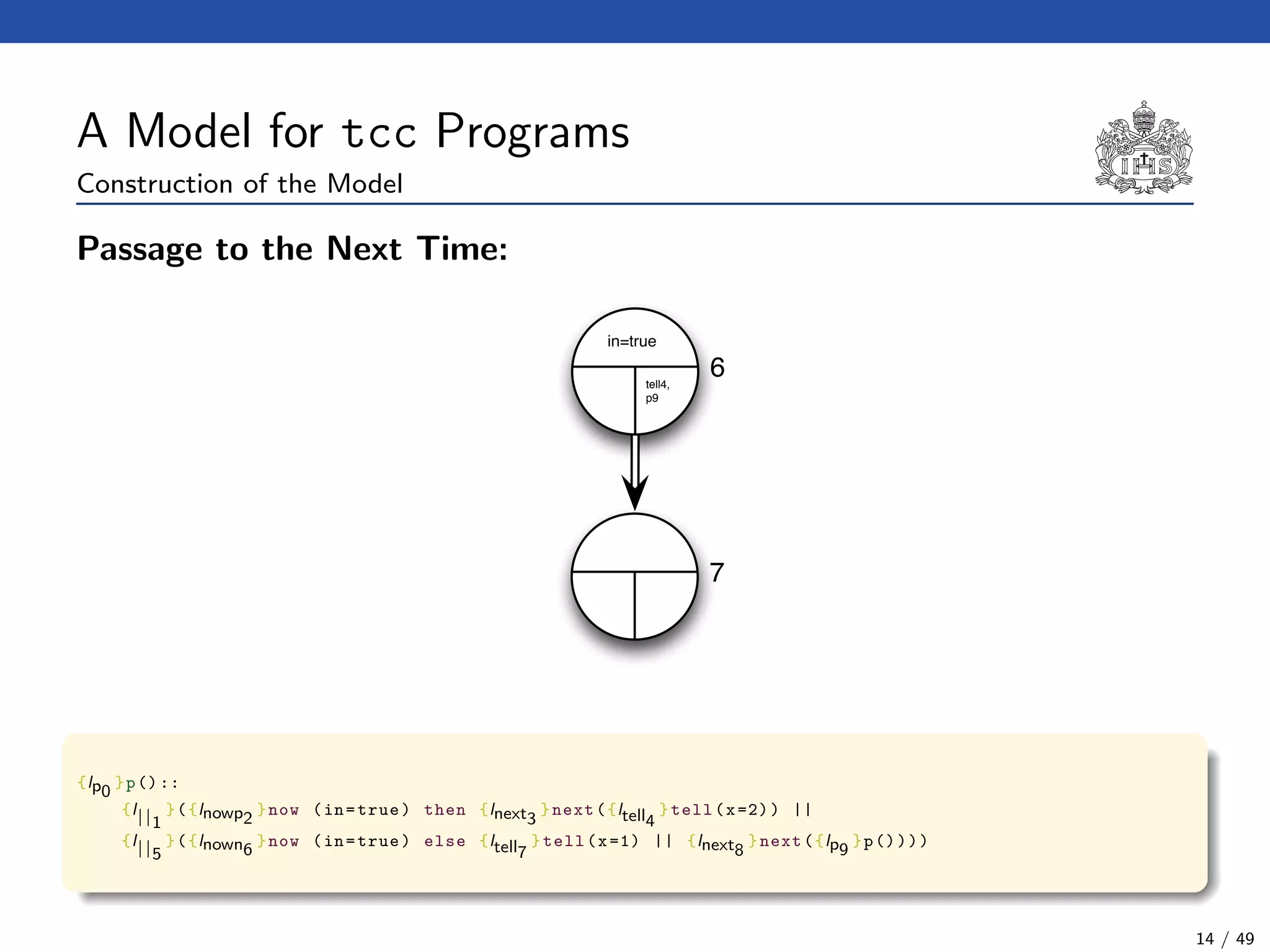
Passage to the Next Time:
6tell4,
p9
in=true
7
{lp0
}p()::
{l||1
}({lnowp2
}now (in=true) then {lnext3
}next({ltell4
}tell(x=2)) ||
{l||5
}({lnown6
}now (in=true) else {ltell7
}tell(x=1) || {lnext8
}next({lp9
}p())))
14 / 49
A Model for tcc Programs
Construction of the Model
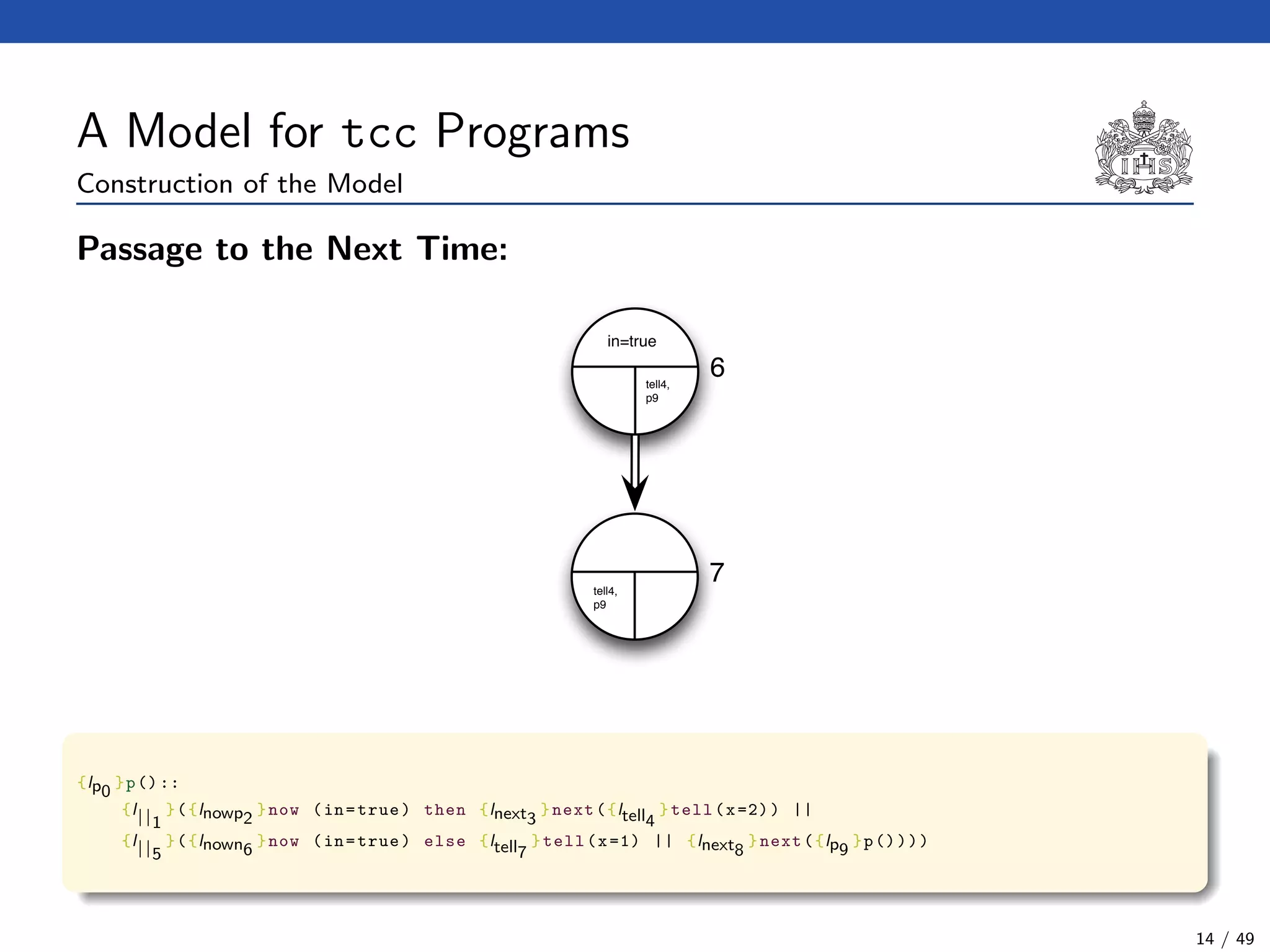
Passage to the Next Time:
6tell4,
p9
in=true
7tell4,
p9
{lp0
}p()::
{l||1
}({lnowp2
}now (in=true) then {lnext3
}next({ltell4
}tell(x=2)) ||
{l||5
}({lnown6
}now (in=true) else {ltell7
}tell(x=1) || {lnext8
}next({lp9
}p())))
14 / 49
A Model for tcc Programs
Construction of the Model
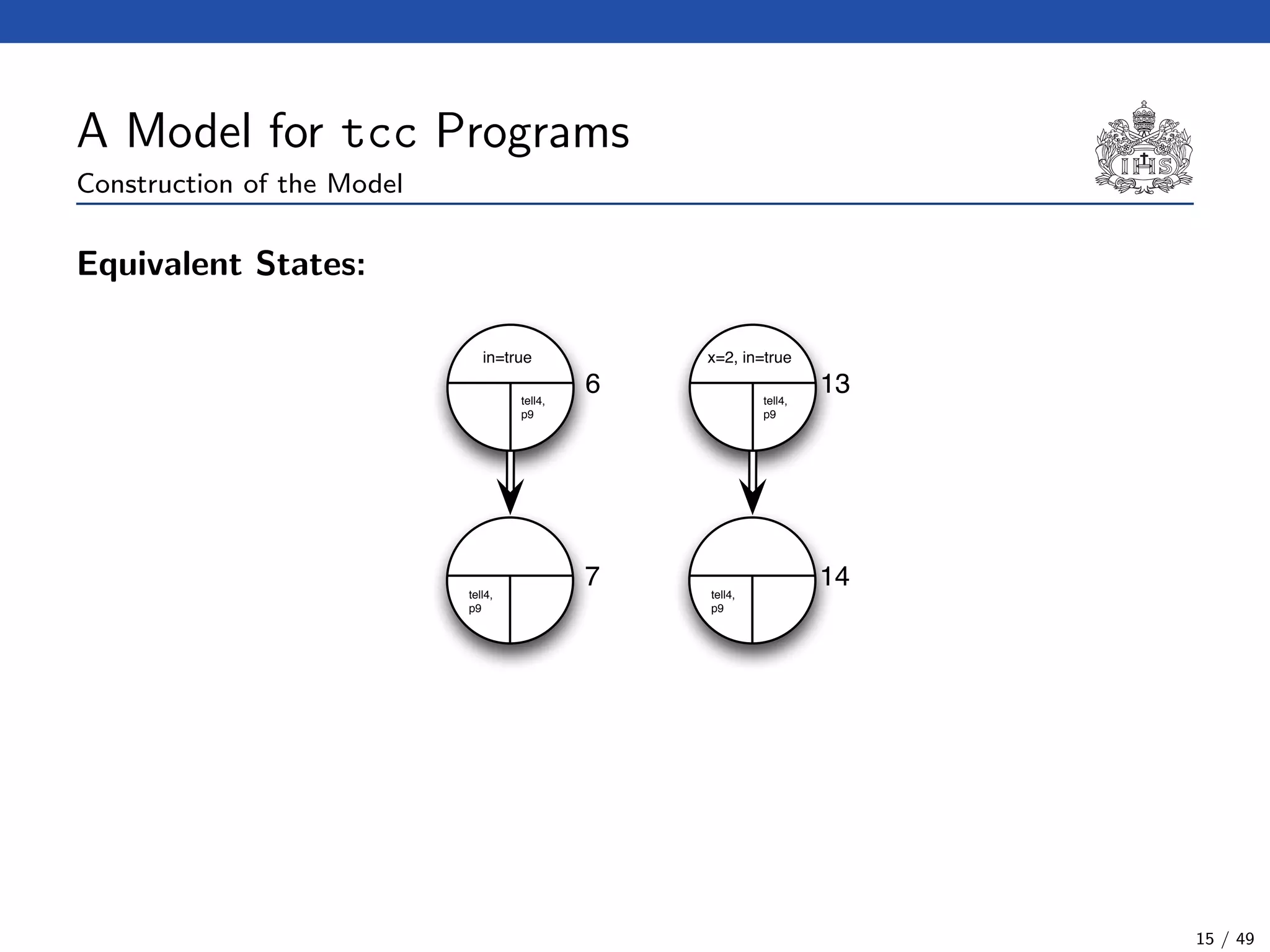
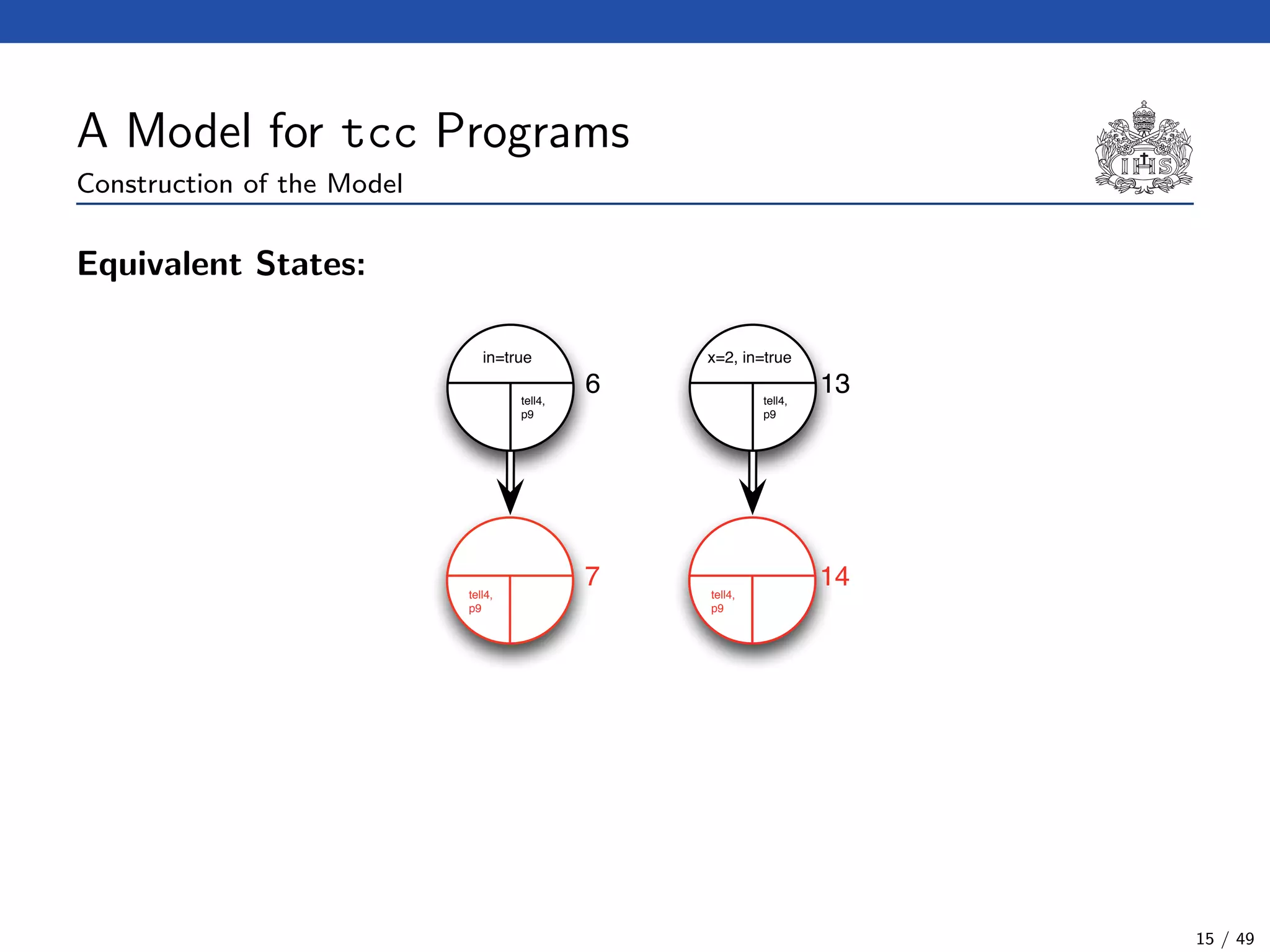
Equivalent States:
6tell4,
p9
in=true
7tell4,
p9
13tell4,
p9
x=2, in=true
14tell4,
p9
15 / 49
A Model for tcc Programs
Construction of the Model
Equivalent States:
6tell4,
p9
in=true
7tell4,
p9
13tell4,
p9
x=2, in=true
14tell4,
p9
15 / 49
A Model for tcc Programs
Construction of the Model
Equivalent States:
6tell4,
p9
in=true
7tell4,
p9
13tell4,
p9
x=2, in=true
15 / 49
A Model for tcc Programs
Construction of the Model
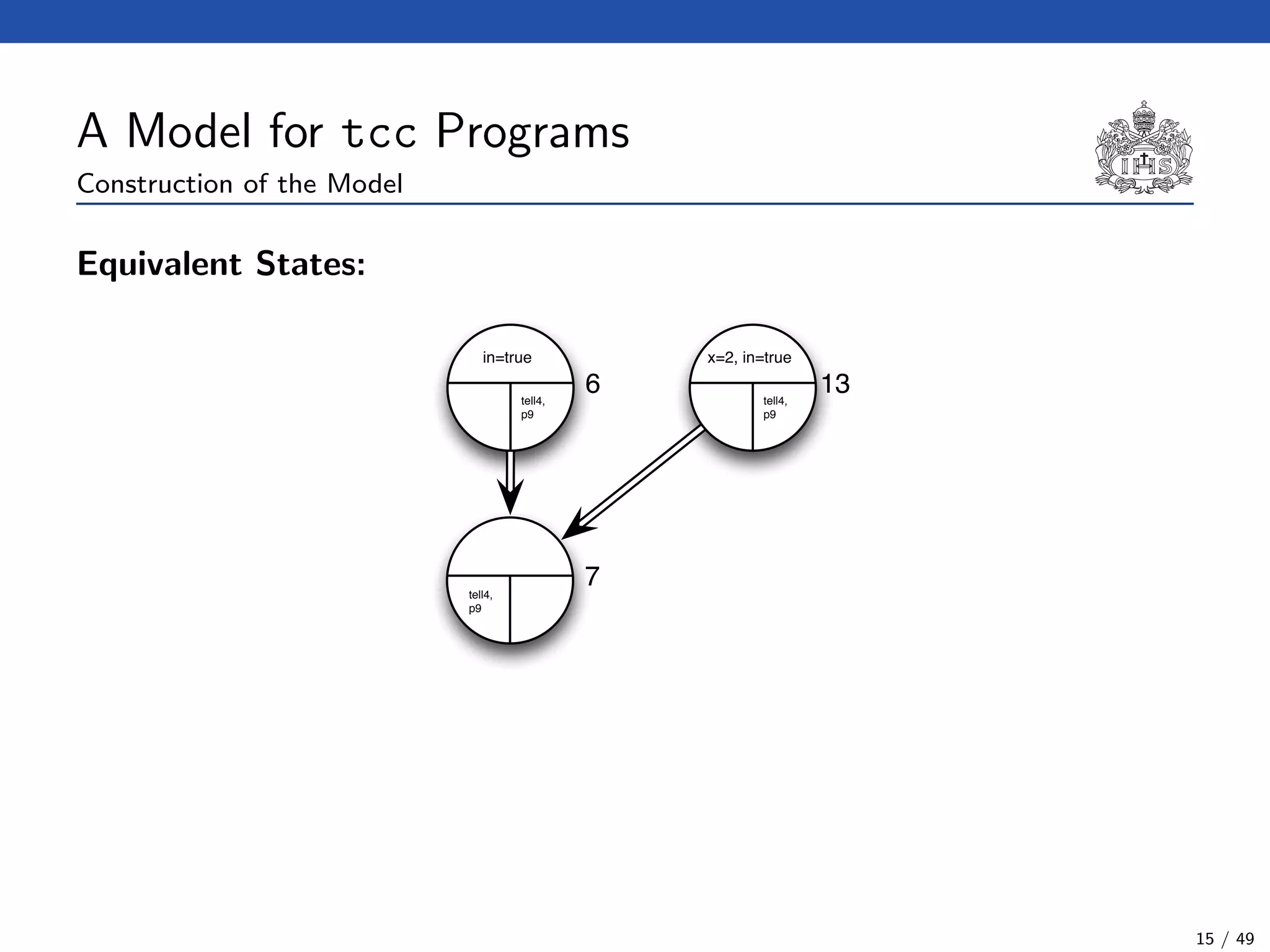
Equivalent States:
6tell4,
p9
in=true
7tell4,
p9
13tell4,
p9
x=2, in=true
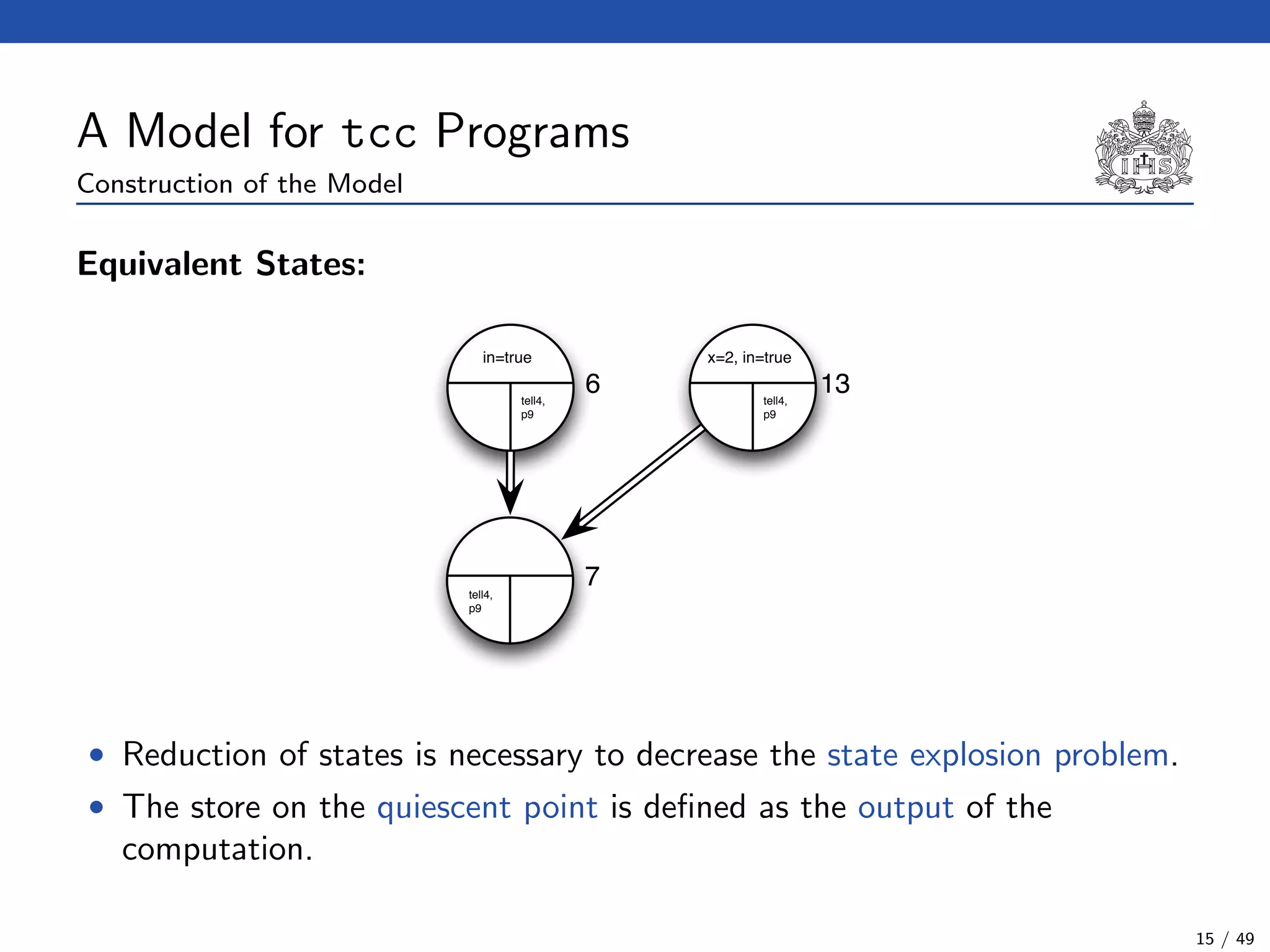
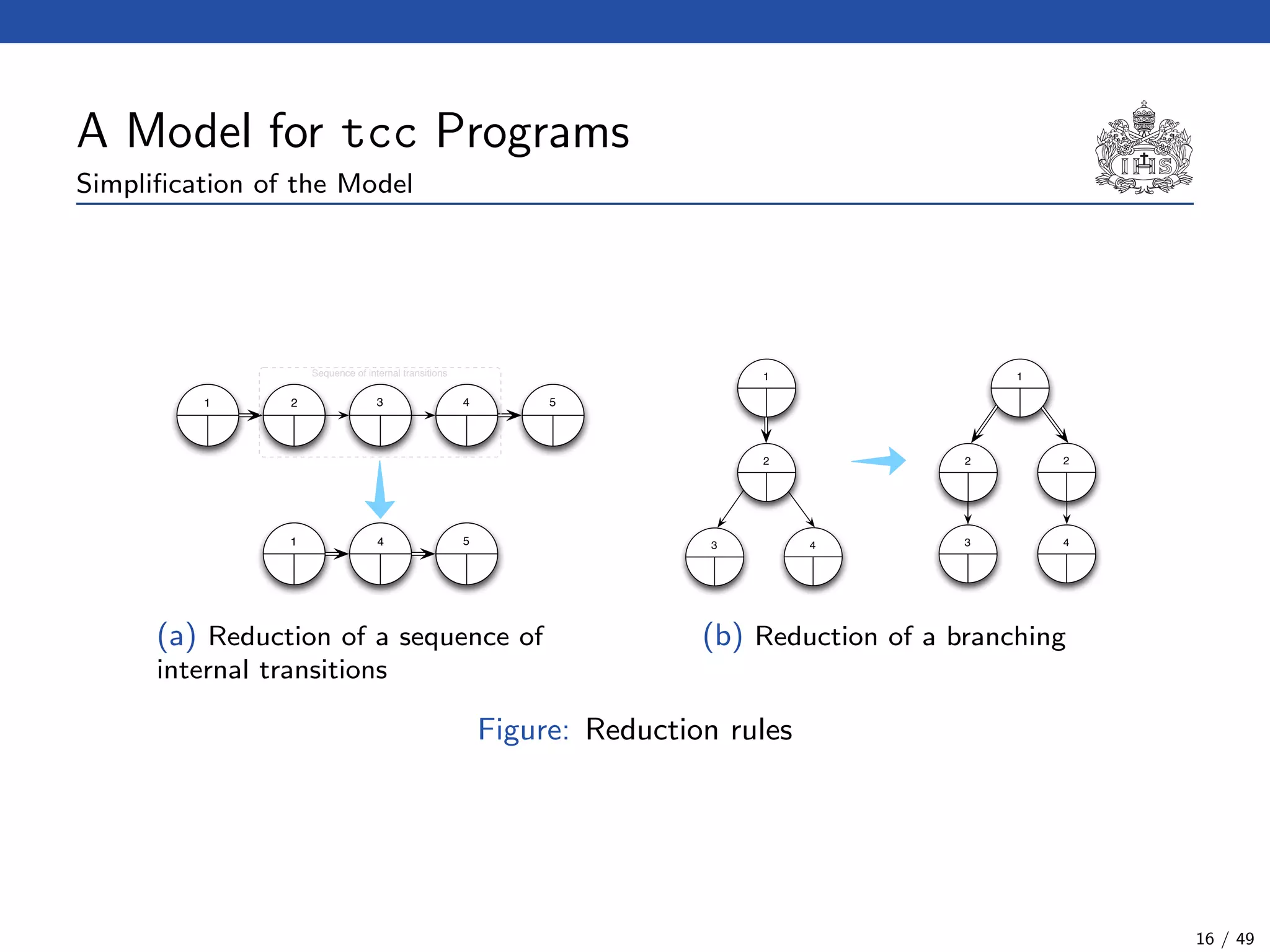
• Reduction of states is necessary to decrease the state explosion problem.
• The store on the quiescent point is defined as the output of the
computation.
15 / 49
A Model for tcc Programs
Simplification of the Model
1 54
1 2 3 4 5
Sequence of internal transitions
(a) Reduction of a sequence of
internal transitions
2
1
3 4
2 2
1
3 4
(b) Reduction of a branching
Figure: Reduction rules
16 / 49
Outline
1 Introduction
2 Previous work
3 The Model Checking Technique
4 A Model for tcc Programs
5 A Logic for the Specification of Properties
6 The Model Checking Algorithm
7 Implementation
8 Concluding Remarks
17 / 49
A Logic for the Specification of Properties
The ntcc Logic
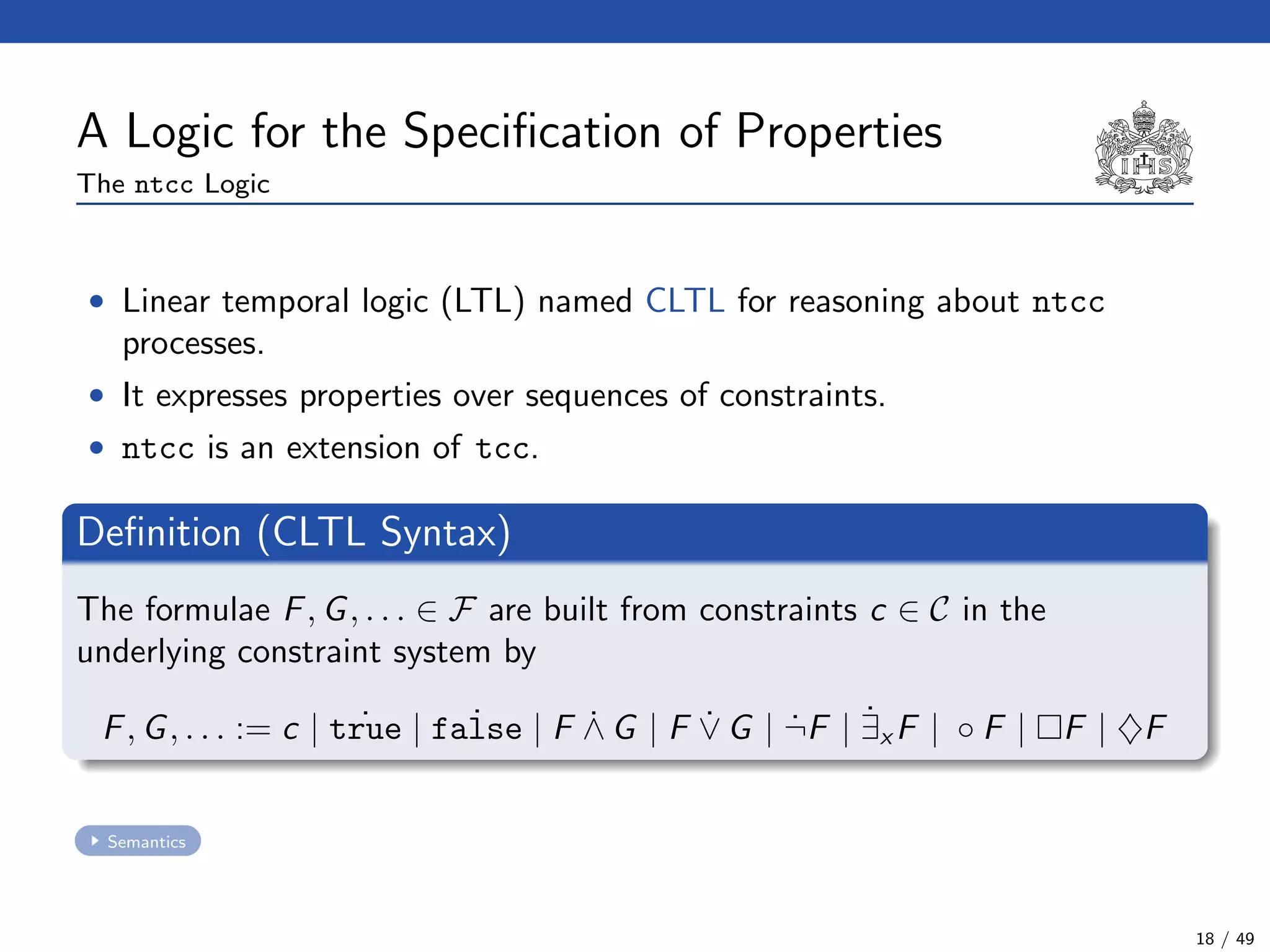
• Linear temporal logic (LTL) named CLTL for reasoning about ntcc
processes.
• It expresses properties over sequences of constraints.
• ntcc is an extension of tcc.
Definition (CLTL Syntax)
The formulae F, G, . . . ∈ F are built from constraints c ∈ C in the
underlying constraint system by
F, G, . . . := c | ˙true | ˙false | F ˙∧ G | F ˙∨ G | ˙¬F | ˙∃x F | ◦ F | F | ♦F
Semantics
18 / 49
Outline
1 Introduction
2 Previous work
3 The Model Checking Technique
4 A Model for tcc Programs
5 A Logic for the Specification of Properties
6 The Model Checking Algorithm
7 Implementation
8 Concluding Remarks
19 / 49
The Model Checking Algorithm
• Classical tableau algorithm for the LTL model checking
problem [CGP99, MP95, LP85].
• To prove that a property is satisfied, it is possible to prove that there is no
path in the model checking graph satisfying the negation of the formula.
20 / 49
The Model Checking Algorithm
Algorithm:
1. To construct the model checking graph using the negation of φ (i.e. ¬φ).
Definition
21 / 49
The Model Checking Algorithm
Algorithm:
1. To construct the model checking graph using the negation of φ (i.e. ¬φ).
Definition
◦ First of all, we have to compute the closure CL(¬φ). This closure is
reminiscent to the Fisher Ladner’s one [MP95, FL79]. Definition
21 / 49
The Model Checking Algorithm
Algorithm:
1. To construct the model checking graph using the negation of φ (i.e. ¬φ).
Definition
◦ First of all, we have to compute the closure CL(¬φ). This closure is
reminiscent to the Fisher Ladner’s one [MP95, FL79]. Definition
2. To look for a sequence such that starting from an initial node of the
graph that satisfies the negation of φ, it reaches a self-fulfilling strongly
connected component.
21 / 49
The Model Checking Algorithm
Algorithm:
1. To construct the model checking graph using the negation of φ (i.e. ¬φ).
Definition
◦ First of all, we have to compute the closure CL(¬φ). This closure is
reminiscent to the Fisher Ladner’s one [MP95, FL79]. Definition
2. To look for a sequence such that starting from an initial node of the
graph that satisfies the negation of φ, it reaches a self-fulfilling strongly
connected component.
3. If we find a self-fulfilling SCC in the graph, then the system satisfies the
property represented by the negated formula (i.e. the model does not
satisfy the property).
21 / 49
Outline
1 Introduction
2 Previous work
3 The Model Checking Technique
4 A Model for tcc Programs
5 A Logic for the Specification of Properties
6 The Model Checking Algorithm
7 Implementation
8 Concluding Remarks
22 / 49
Advantages and drawbacks of Arias’ prototype
• Advantages
◦ Does not require the number of time units as input
◦ The size of the closure of the formula is reasonable small
◦ State explosion is reduced due to tableau method
◦ Does not require a sequence of n inputs
◦ Does not require to compute automata complementation nor
determinization
23 / 49
Advantages and drawbacks of Arias’ prototype
• Advantages
◦ Does not require the number of time units as input
◦ The size of the closure of the formula is reasonable small
◦ State explosion is reduced due to tableau method
◦ Does not require a sequence of n inputs
◦ Does not require to compute automata complementation nor
determinization
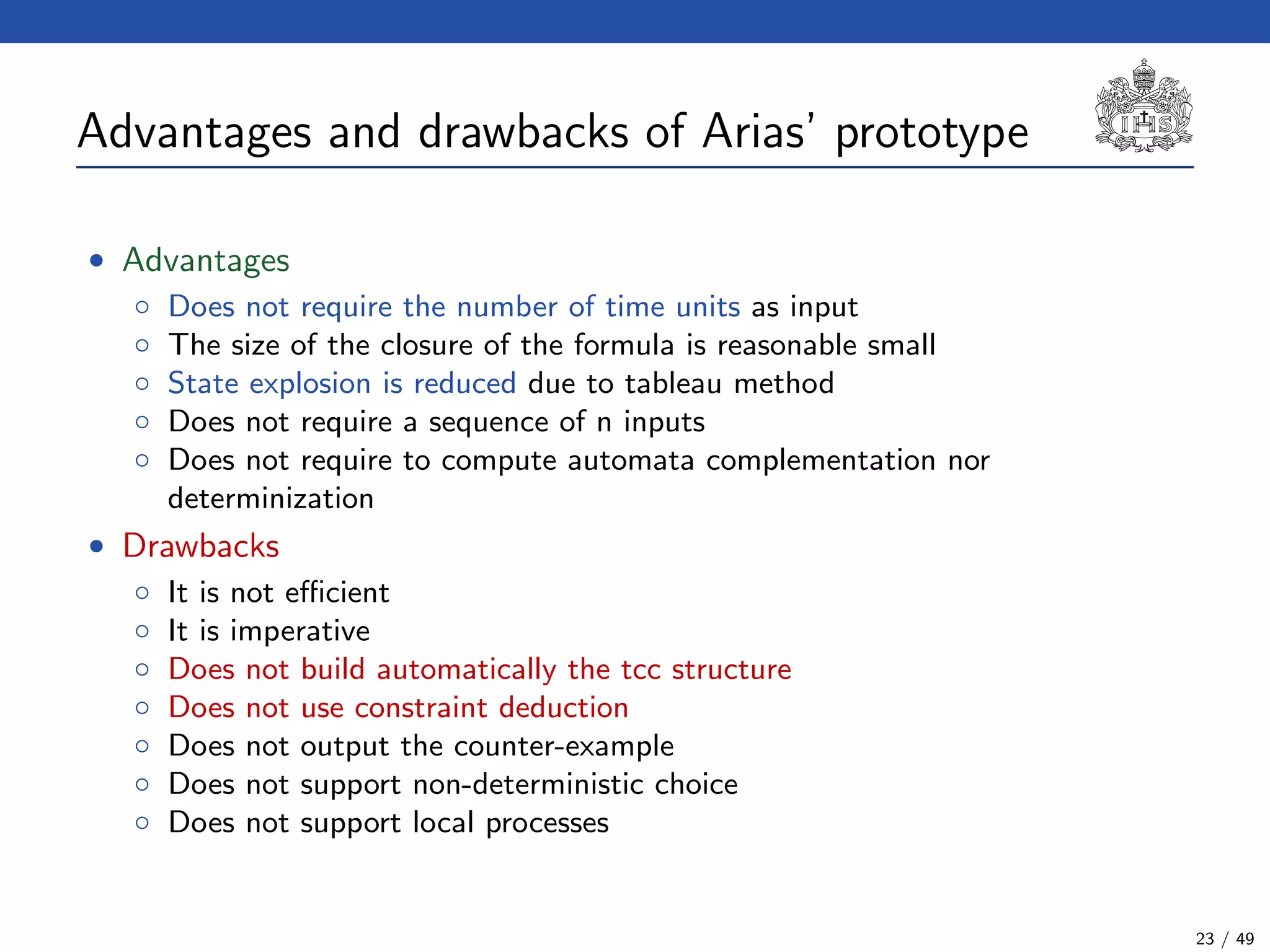
• Drawbacks
◦ It is not efficient
◦ It is imperative
◦ Does not build automatically the tcc structure
◦ Does not use constraint deduction
◦ Does not output the counter-example
◦ Does not support non-deterministic choice
◦ Does not support local processes
23 / 49
Advantages and drawbacks of Mozart/OZ’s
implementation
• To adapt the implementation to ntcc, instead of “now,else”, we use
“unless,next” and instead of procedure calls, we use “bang”
24 / 49
Advantages and drawbacks of Mozart/OZ’s
implementation
• To adapt the implementation to ntcc, instead of “now,else”, we use
“unless,next” and instead of procedure calls, we use “bang”
• Advantages
◦ Does not require the number of time units as input
◦ The size of the closure of the formula is reasonable small
◦ State explosion is reduced due to tableau method
◦ Does not require the a sequence of n inputs
◦ Does not require to compute automata complementation nor
determinization
◦ Is extended for ntcc syntax
◦ It is mostly declarative (functional)
◦ Builds automatically the ntcc structure
◦ Uses constraint deduction
◦ Exhibits the counter-example
24 / 49
Advantages and drawbacks of Mozart/OZ’s
implementation
• To adapt the implementation to ntcc, instead of “now,else”, we use
“unless,next” and instead of procedure calls, we use “bang”
• Advantages
◦ Does not require the number of time units as input
◦ The size of the closure of the formula is reasonable small
◦ State explosion is reduced due to tableau method
◦ Does not require the a sequence of n inputs
◦ Does not require to compute automata complementation nor
determinization
◦ Is extended for ntcc syntax
◦ It is mostly declarative (functional)
◦ Builds automatically the ntcc structure
◦ Uses constraint deduction
◦ Exhibits the counter-example
• Drawbacks
◦ Does not support non-deterministic choice
◦ Does not suppor local processes
24 / 49
Outline
1 Introduction
2 Previous work
3 The Model Checking Technique
4 A Model for tcc Programs
5 A Logic for the Specification of Properties
6 The Model Checking Algorithm
7 Implementation
8 Concluding Remarks
25 / 49
Summary
• At present, ntcc does not provide for the automatic, or even
machine-assisted, verification of system properties.
26 / 49
Summary
• At present, ntcc does not provide for the automatic, or even
machine-assisted, verification of system properties.
• Previous work on verification for ntcc has not been satisfactory
26 / 49
Summary
• At present, ntcc does not provide for the automatic, or even
machine-assisted, verification of system properties.
• Previous work on verification for ntcc has not been satisfactory
• The implementation of Arias’ algorithms in Mozart/OZ, ntccKMC
◦ Can be downloaded from http://ntcckmc.sourceforge.net
◦ Is extended for ntcc syntax
◦ Builds automatically the ntcc structure
◦ Uses constraint deduction
◦ Exhibits the counter-example
◦ Does not support non-deterministic choice (easy to solve)
◦ Does not support local processes (hard to solve)
26 / 49
Thank you!
References (1)
Edmund M. Clarke, Orna Grumberg, and Doron A. Peled.
Model Checking.
MIT Press, Cambridge, 1999.
Michael J. Fischer and Richard E. Ladner.
Propositional Dynamic Logic of Regular Programs.
Journal of Computer and System Sciences, 18(2):194–211, 1979.
Moreno Falaschi and Alicia Villanueva.
Automatic verification of timed concurrent constraint programs.
Theory and Practice of Logic Program, 6(4):265–300, 2006.
28 / 49
References (2)
Hubert Garavel.
Reflections on the Future of Concurrency Theory in General and
Process Calculi in Particular.
In Proceedings of LIX Colloquium on Emergent Trends in Concurrency
Theory, volume 209 of Electronic Notes in Theoretical Computer
Science, pages 149–164. Elsevier, 2008.
Orna Lichtenstein and Amir Pnueli.
Checking that Finite State Concurrent Programs Satisfy their Linear
Specification.
In Proceedings of the 12th ACM SIGACT-SIGPLAN Symposium on
Principles of Programming Languages, pages 97–107, New York, NY,
USA, 1985. ACM Press.
Zohar Manna and Amir Pnueli.
Temporal Verification of Reactive Systems: Safety.
Springer-Verlag New York, Inc., 1995.
29 / 49
References (3)
Vijay A. Saraswat, Radha Jagadeesan, and Vineet Gupta.
Programming in Timed Concurrent Constraint Languages.
In Constraint Programming: Proceedings 1993, NATO Advanced
Science Institute Series, pages 361–410, Berlin, 1994. Springer-Verlag.
Mauricio Toro-Berm´udez.
Towards a correct and efficient implementation of simulation and
verification tools for probabilistic ntcc.
Technical report, Pontificia Universidad Javeriana, May 2009.
Mauricio Toro-Berm´udez.
Structured Musical Interactive Scores (short).
PhD thesis, Universit´e de Bordeaux, 2012.
Frank D. Valencia.
Decidability of infinite-state timed ccp processes and first-order ltl.
Theor. Comput. Sci., 330(3):557–607, 2005.
30 / 49
The Model Checking Algorithm
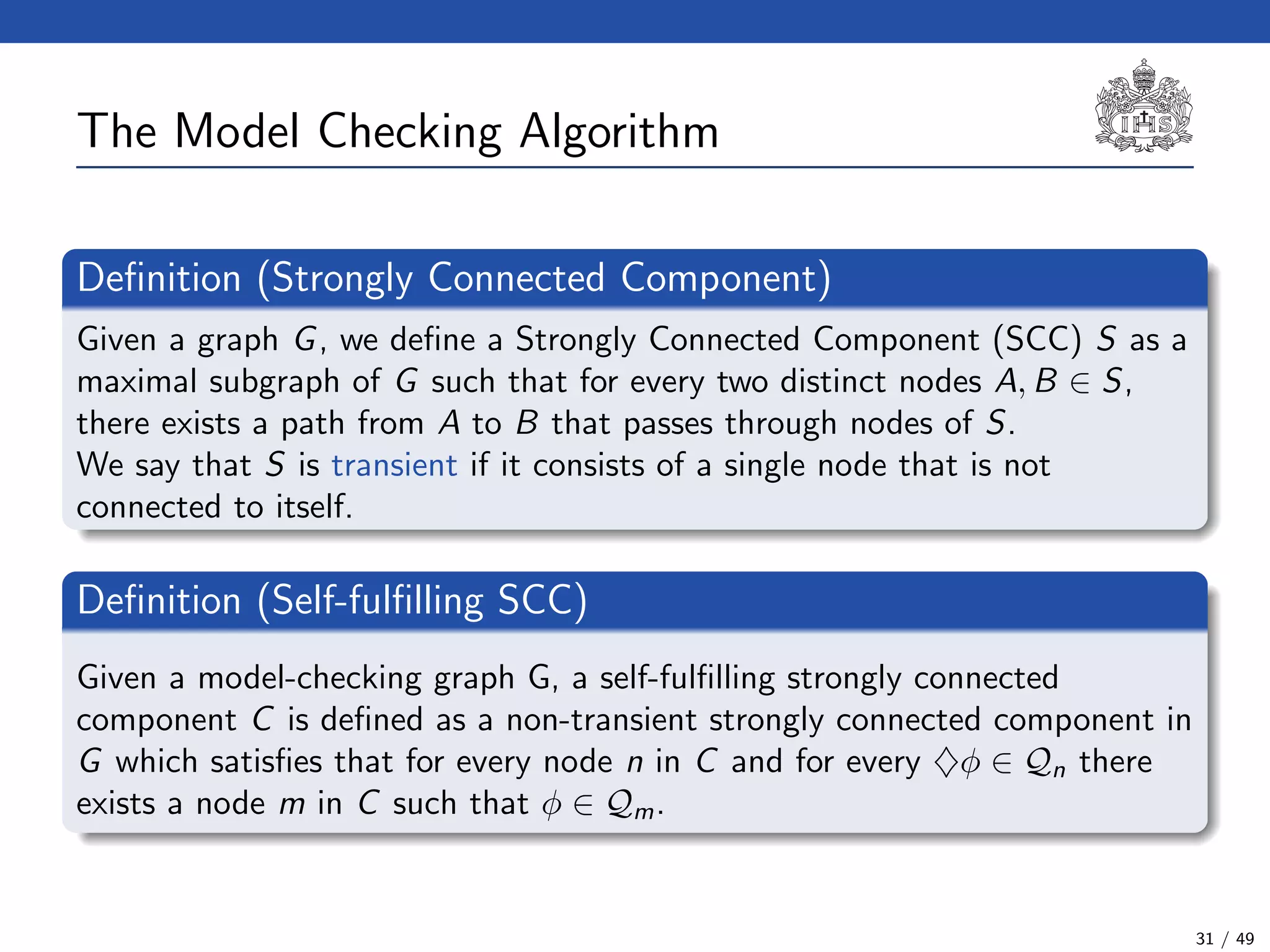
Definition (Strongly Connected Component)
Given a graph G, we define a Strongly Connected Component (SCC) S as a
maximal subgraph of G such that for every two distinct nodes A, B ∈ S,
there exists a path from A to B that passes through nodes of S.
We say that S is transient if it consists of a single node that is not
connected to itself.
Definition (Self-fulfilling SCC)
Given a model-checking graph G, a self-fulfilling strongly connected
component C is defined as a non-transient strongly connected component in
G which satisfies that for every node n in C and for every ♦φ ∈ Qn there
exists a node m in C such that φ ∈ Qm.
31 / 49
The tcc Calculus [SJG94]
Formal Syntax
(Agents) A ::= c (Tell)
| now c then A (Timed Positive Ask)
| now c else A (Timed Negative Ask)
| next A (Unit Delay)
| abort (Abort)
| skip (Skip)
| A || A (Parallel Composition)
| ∃x(A) (Hiding)
| g (Procedure Call)
(Procedure Calls) g ::= p(t1, . . . , tn)
(Declarations) D ::= g :: A (Definition)
| D.D (Conjunction)
(Programs) P ::= D.A
Return
32 / 49
The tcc Calculus [SJG94]
Formal Operational Semantics
Axioms for →. The binary relation → on configurations is the least relation satisfying the
rules :
(?, skip) → ?
(?, abort) → abort
(?, A || B) → (?, A, B)
(?, ∃x(A)) → (?, A[y/x]) (y not free in ?)
(?, p(t1, . . . , tn)) → (?, A[x1 → t1, . . . , xn → tn])
σ(?) c
(?, now c then A) → (?, A)
σ(?) c
(?, now c else B) → ?
Axioms for . The binary relation is the least relation satisfying the single rule :
∆, {now ci else Ai | i < n}
∆, {now ci else Ai | i < n}, {next Bj | j < m} {Ai | i < n}, {Bj | j < m}
Return
33 / 49
A Model for tcc Programs
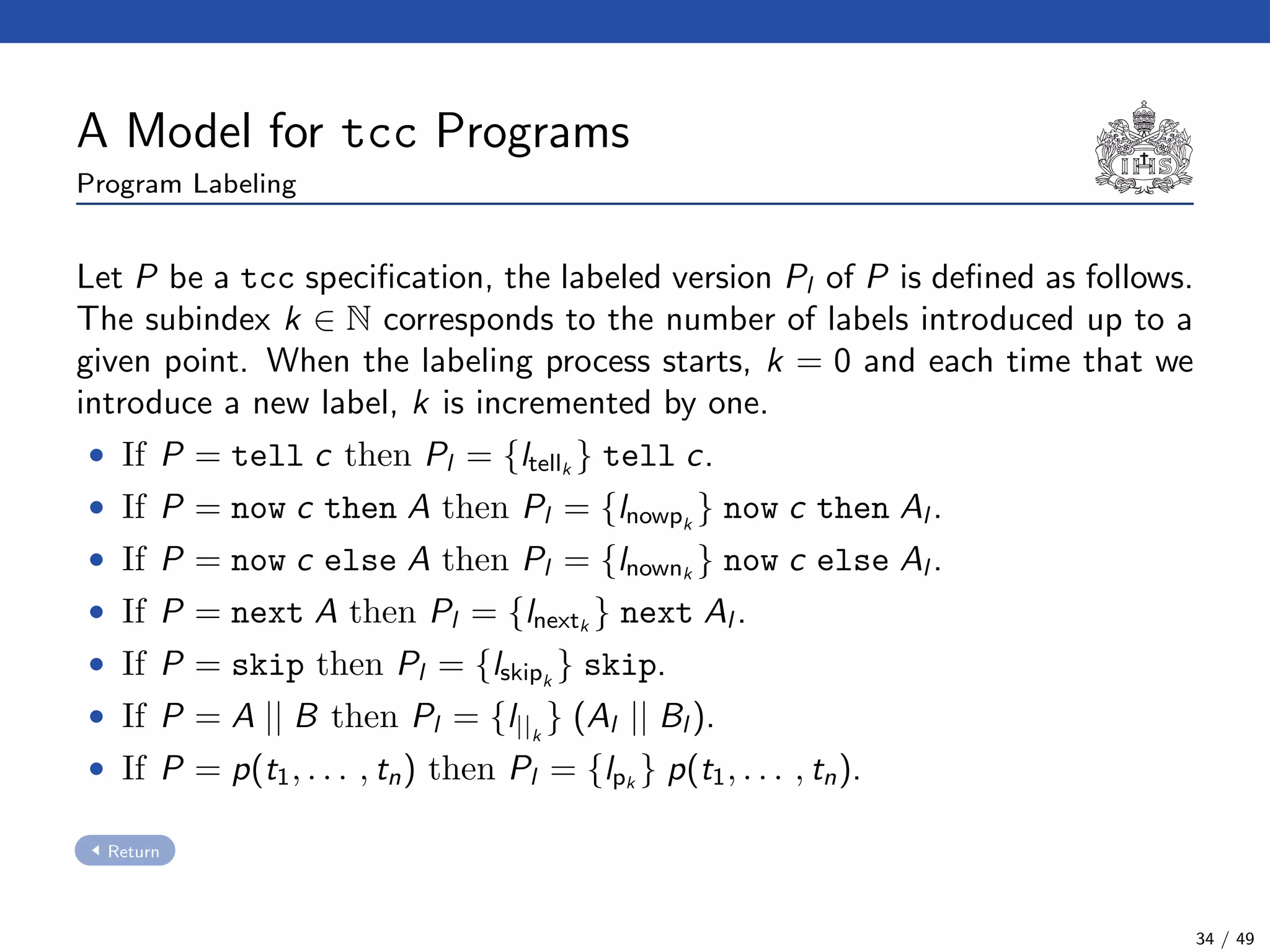
Program Labeling
Let P be a tcc specification, the labeled version Pl of P is defined as follows.
The subindex k ∈ N corresponds to the number of labels introduced up to a
given point. When the labeling process starts, k = 0 and each time that we
introduce a new label, k is incremented by one.
• If P = tell c then Pl = {ltellk
} tell c.
• If P = now c then A then Pl = {lnowpk
} now c then Al .
• If P = now c else A then Pl = {lnownk
} now c else Al .
• If P = next A then Pl = {lnextk
} next Al .
• If P = skip then Pl = {lskipk
} skip.
• If P = A || B then Pl = {l||k
} (Al || Bl ).
• If P = p(t1, . . . , tn) then Pl = {lpk
} p(t1, . . . , tn).
Return
34 / 49
A Model for tcc Programs
The tcc Structure
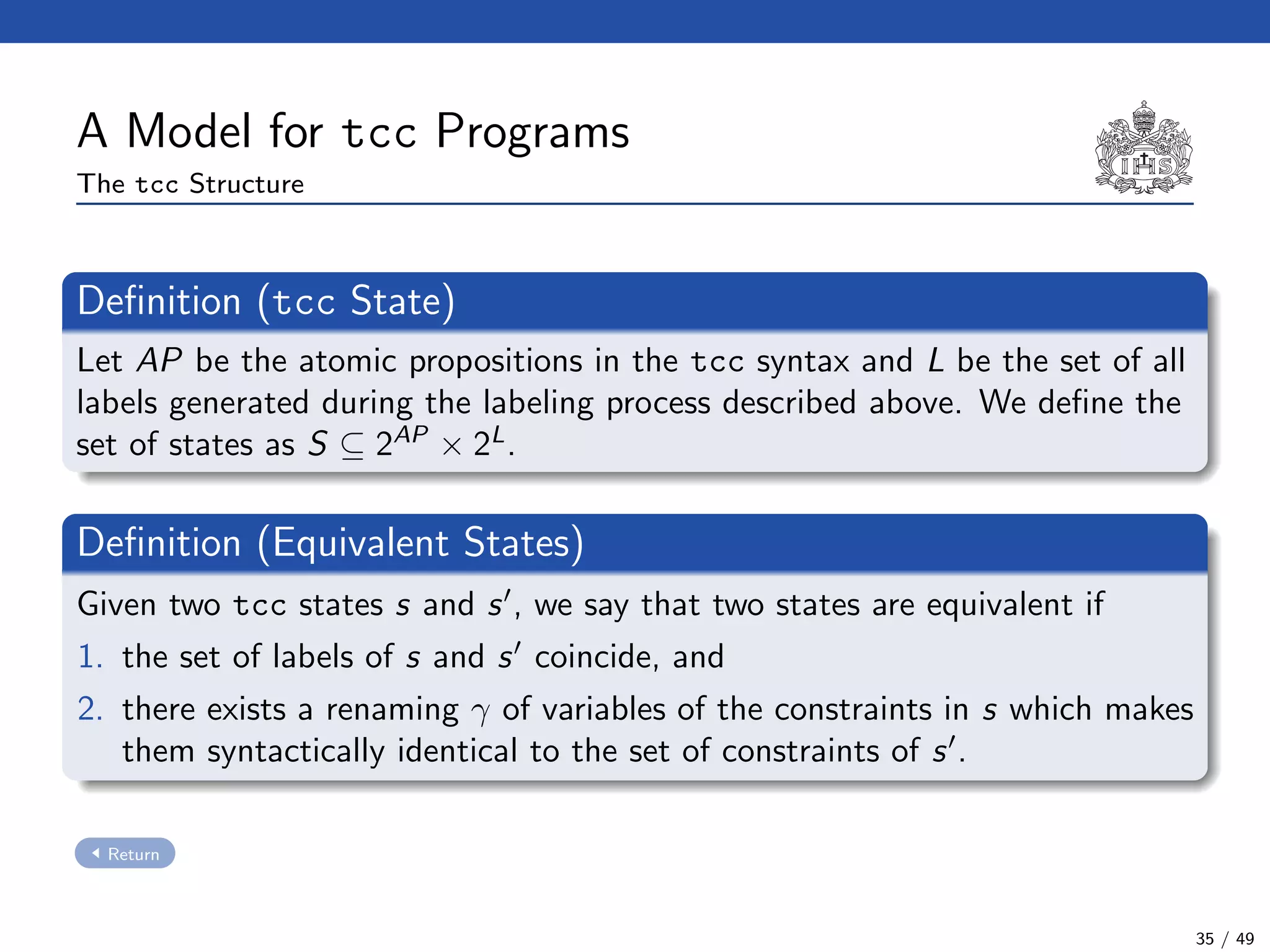
Definition (tcc State)
Let AP be the atomic propositions in the tcc syntax and L be the set of all
labels generated during the labeling process described above. We define the
set of states as S ⊆ 2AP
× 2L
.
Definition (Equivalent States)
Given two tcc states s and s , we say that two states are equivalent if
1. the set of labels of s and s coincide, and
2. there exists a renaming γ of variables of the constraints in s which makes
them syntactically identical to the set of constraints of s .
Return
35 / 49
A Model for tcc Programs
Construction of the Model
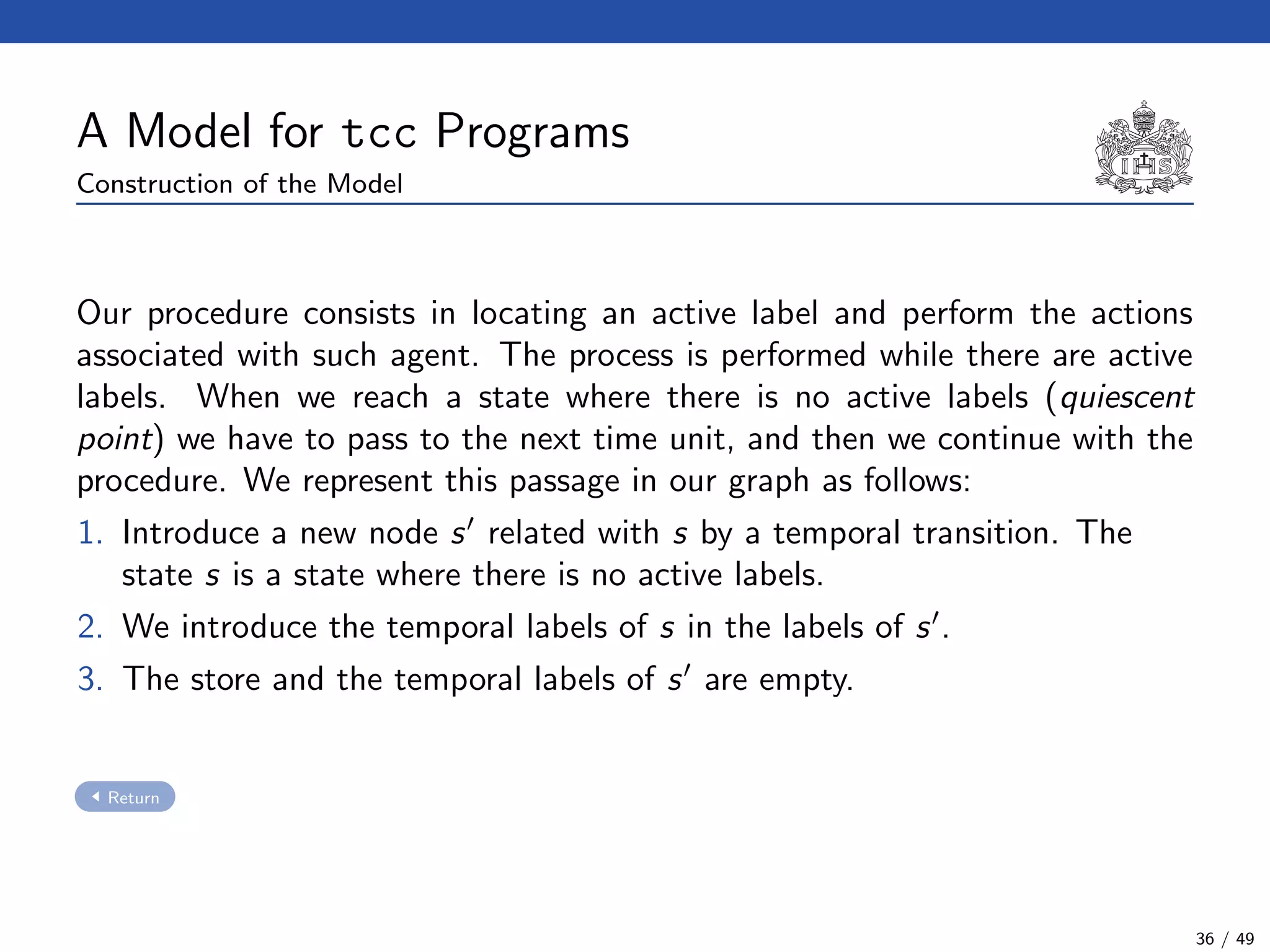
Our procedure consists in locating an active label and perform the actions
associated with such agent. The process is performed while there are active
labels. When we reach a state where there is no active labels (quiescent
point) we have to pass to the next time unit, and then we continue with the
procedure. We represent this passage in our graph as follows:
1. Introduce a new node s related with s by a temporal transition. The
state s is a state where there is no active labels.
2. We introduce the temporal labels of s in the labels of s .
3. The store and the temporal labels of s are empty.
Return
36 / 49
A Model for tcc Programs
Construction of the Model
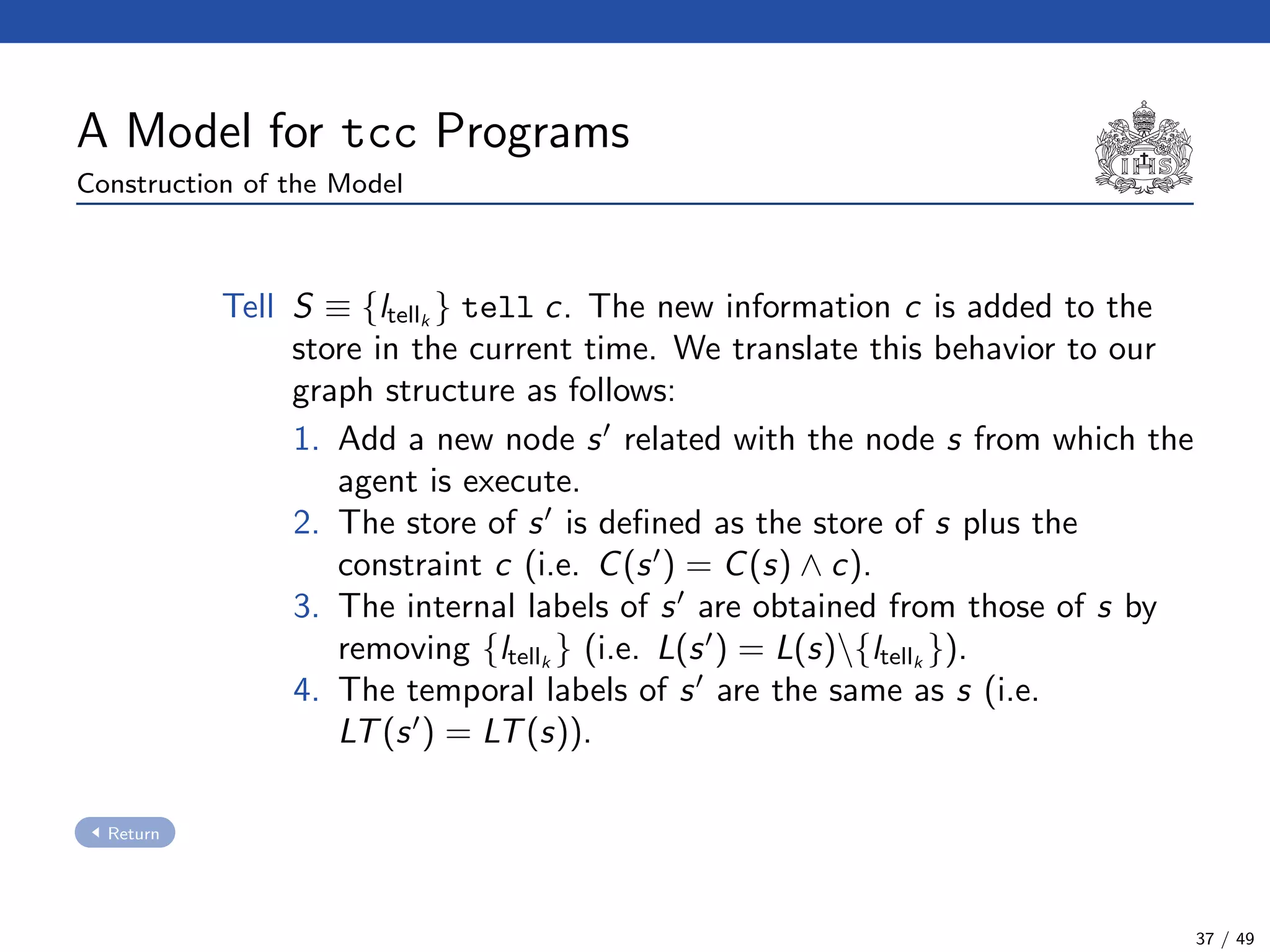
Tell S ≡ {ltellk
} tell c. The new information c is added to the
store in the current time. We translate this behavior to our
graph structure as follows:
1. Add a new node s related with the node s from which the
agent is execute.
2. The store of s is defined as the store of s plus the
constraint c (i.e. C(s ) = C(s) ∧ c).
3. The internal labels of s are obtained from those of s by
removing {ltellk
} (i.e. L(s ) = L(s){ltellk
}).
4. The temporal labels of s are the same as s (i.e.
LT(s ) = LT(s)).
Return
37 / 49
A Model for tcc Programs
Construction of the Model
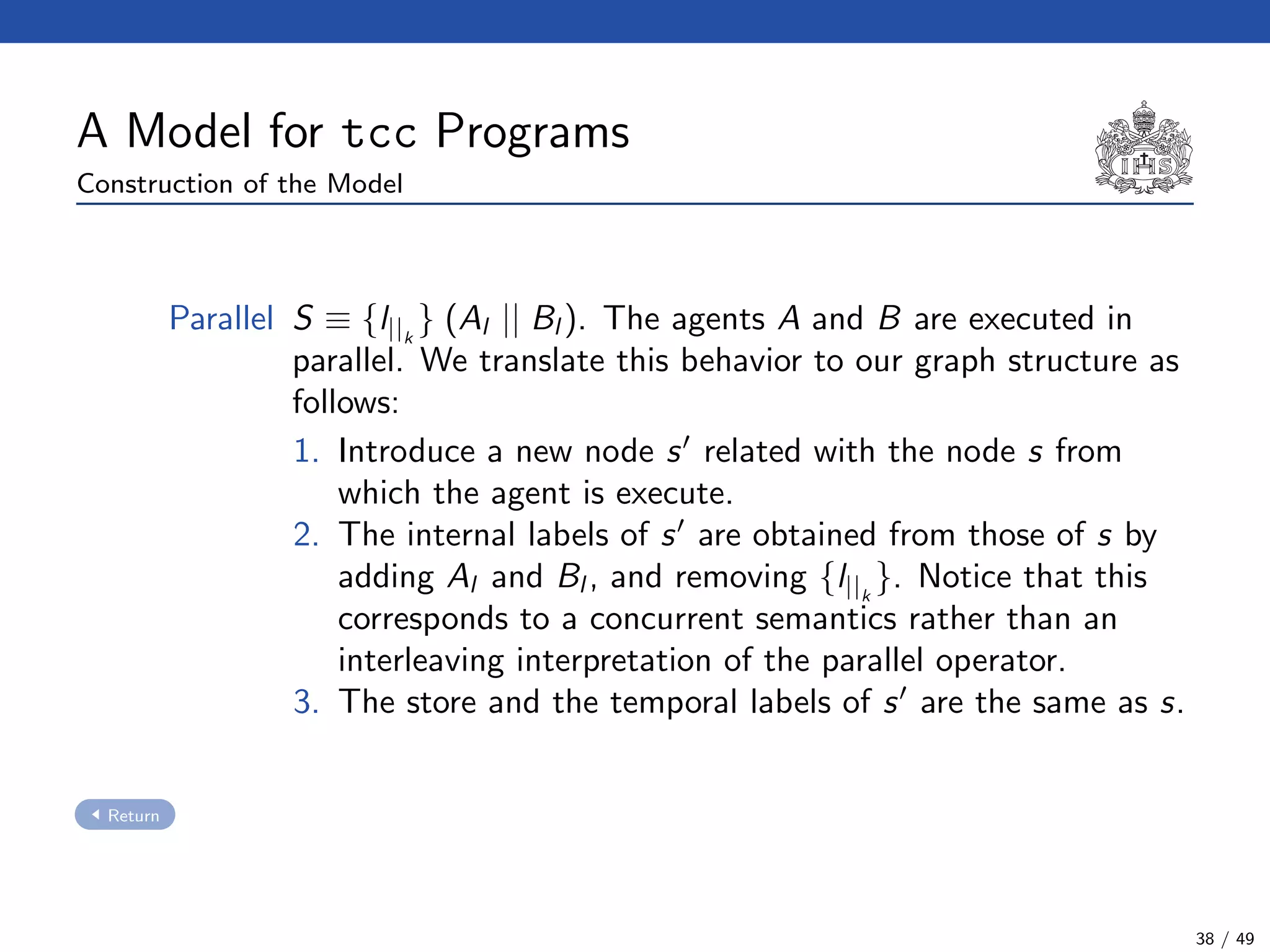
Parallel S ≡ {l||k
} (Al || Bl ). The agents A and B are executed in
parallel. We translate this behavior to our graph structure as
follows:
1. Introduce a new node s related with the node s from
which the agent is execute.
2. The internal labels of s are obtained from those of s by
adding Al and Bl , and removing {l||k
}. Notice that this
corresponds to a concurrent semantics rather than an
interleaving interpretation of the parallel operator.
3. The store and the temporal labels of s are the same as s.
Return
38 / 49
A Model for tcc Programs
Construction of the Model
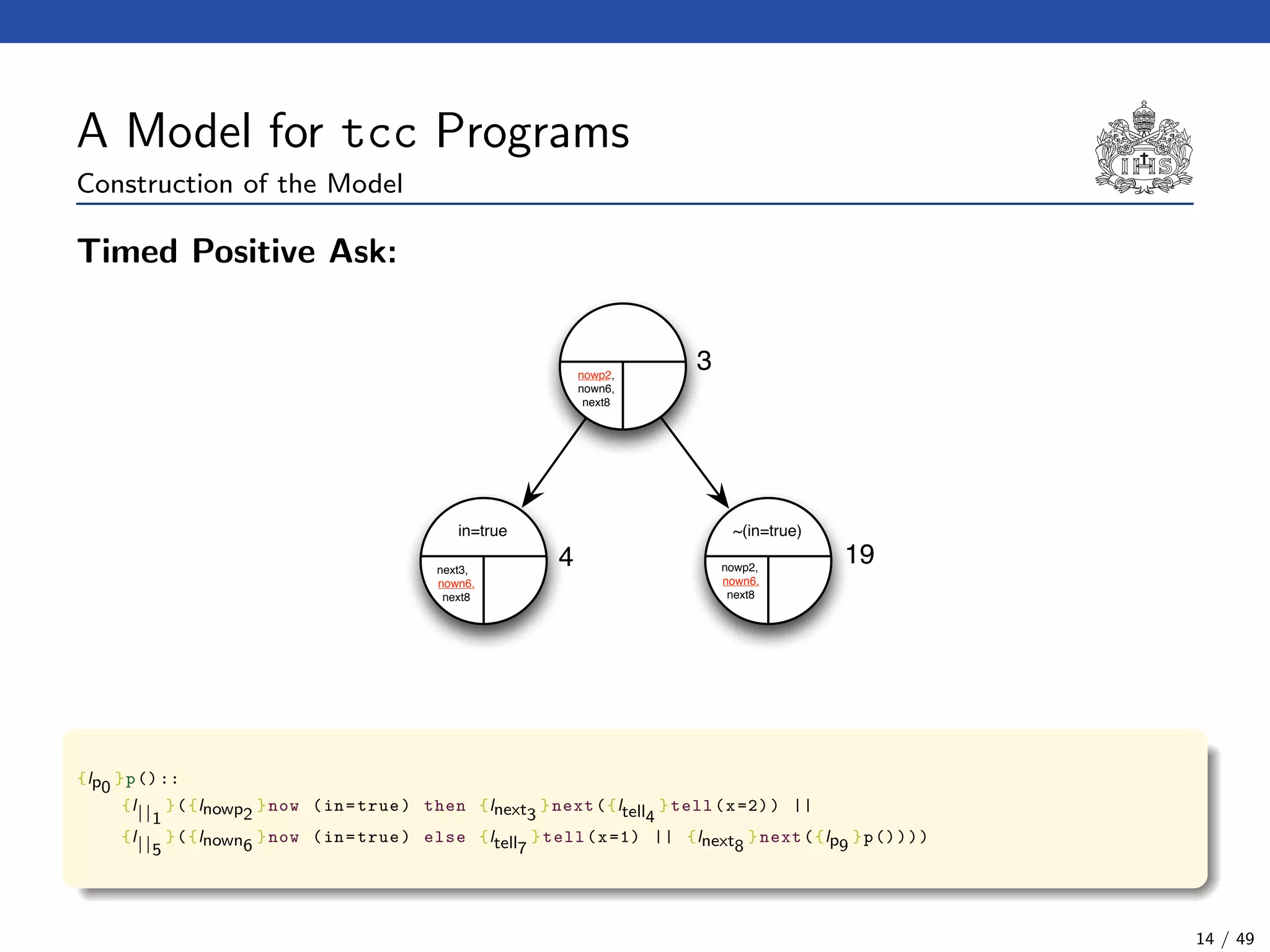
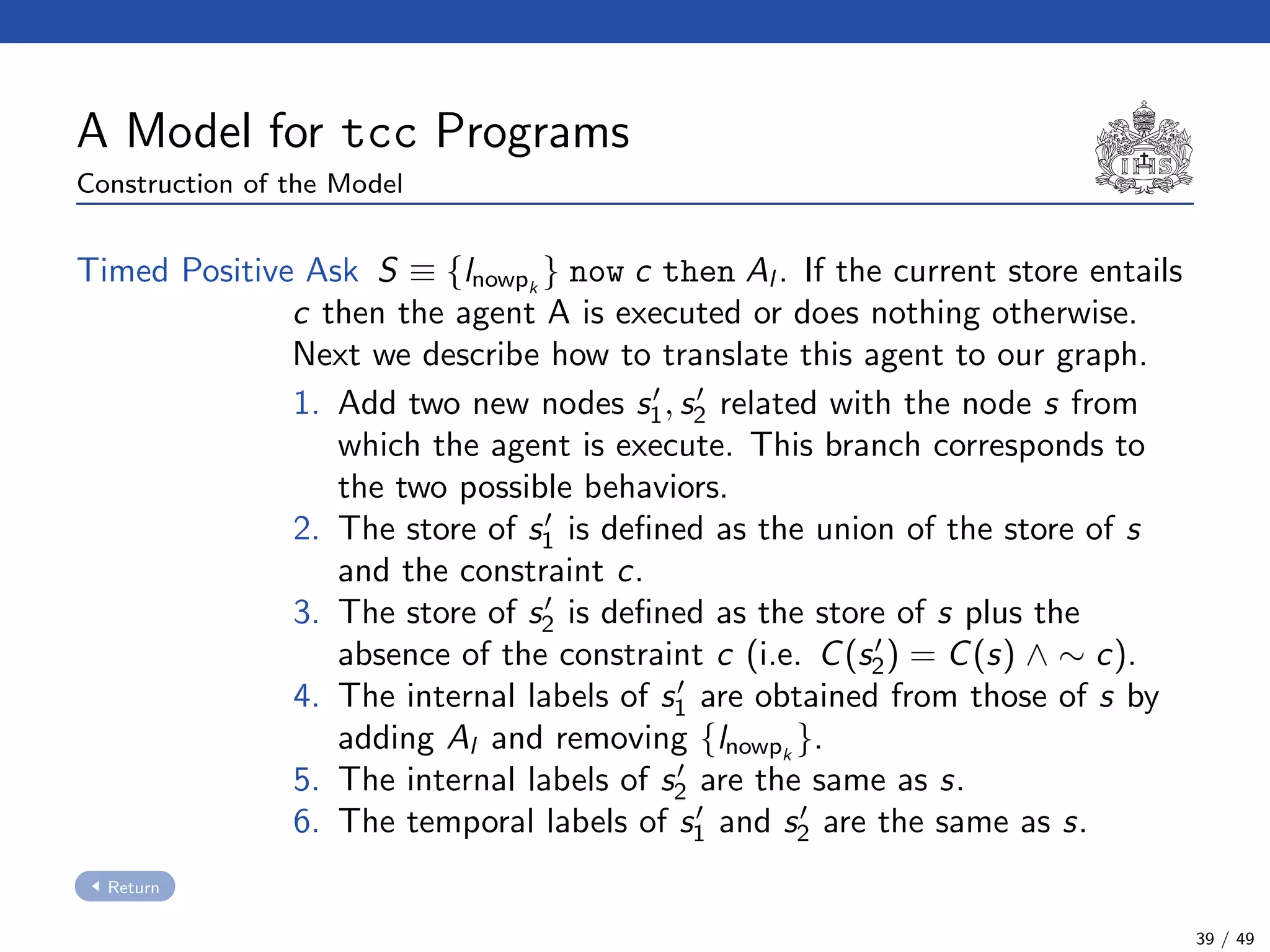
Timed Positive Ask S ≡ {lnowpk
} now c then Al . If the current store entails
c then the agent A is executed or does nothing otherwise.
Next we describe how to translate this agent to our graph.
1. Add two new nodes s1, s2 related with the node s from
which the agent is execute. This branch corresponds to
the two possible behaviors.
2. The store of s1 is defined as the union of the store of s
and the constraint c.
3. The store of s2 is defined as the store of s plus the
absence of the constraint c (i.e. C(s2) = C(s) ∧ ∼ c).
4. The internal labels of s1 are obtained from those of s by
adding Al and removing {lnowpk
}.
5. The internal labels of s2 are the same as s.
6. The temporal labels of s1 and s2 are the same as s.
Return
39 / 49
A Model for tcc Programs
Construction of the Model
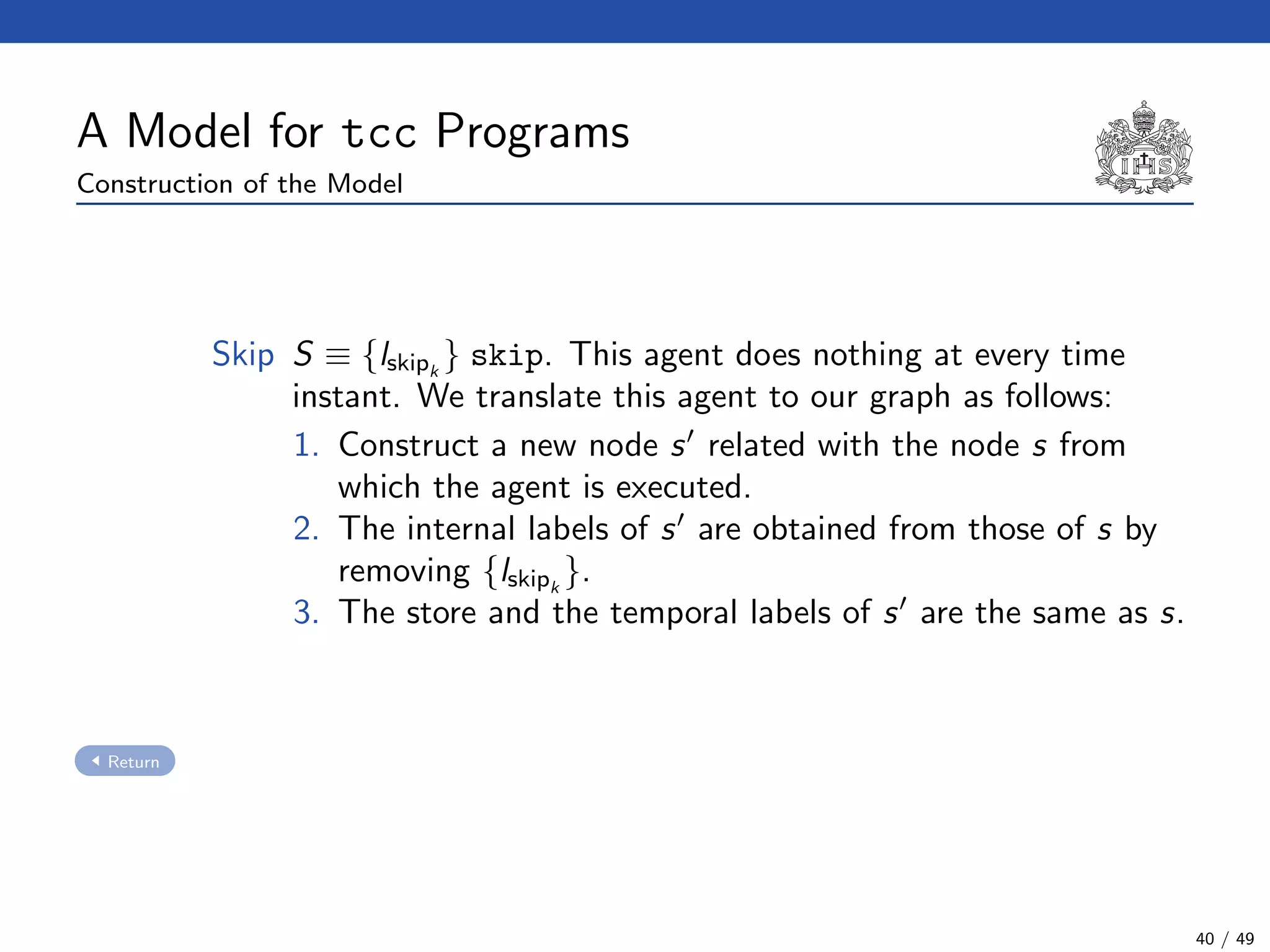
Skip S ≡ {lskipk
} skip. This agent does nothing at every time
instant. We translate this agent to our graph as follows:
1. Construct a new node s related with the node s from
which the agent is executed.
2. The internal labels of s are obtained from those of s by
removing {lskipk
}.
3. The store and the temporal labels of s are the same as s.
Return
40 / 49
A Model for tcc Programs
Construction of the Model
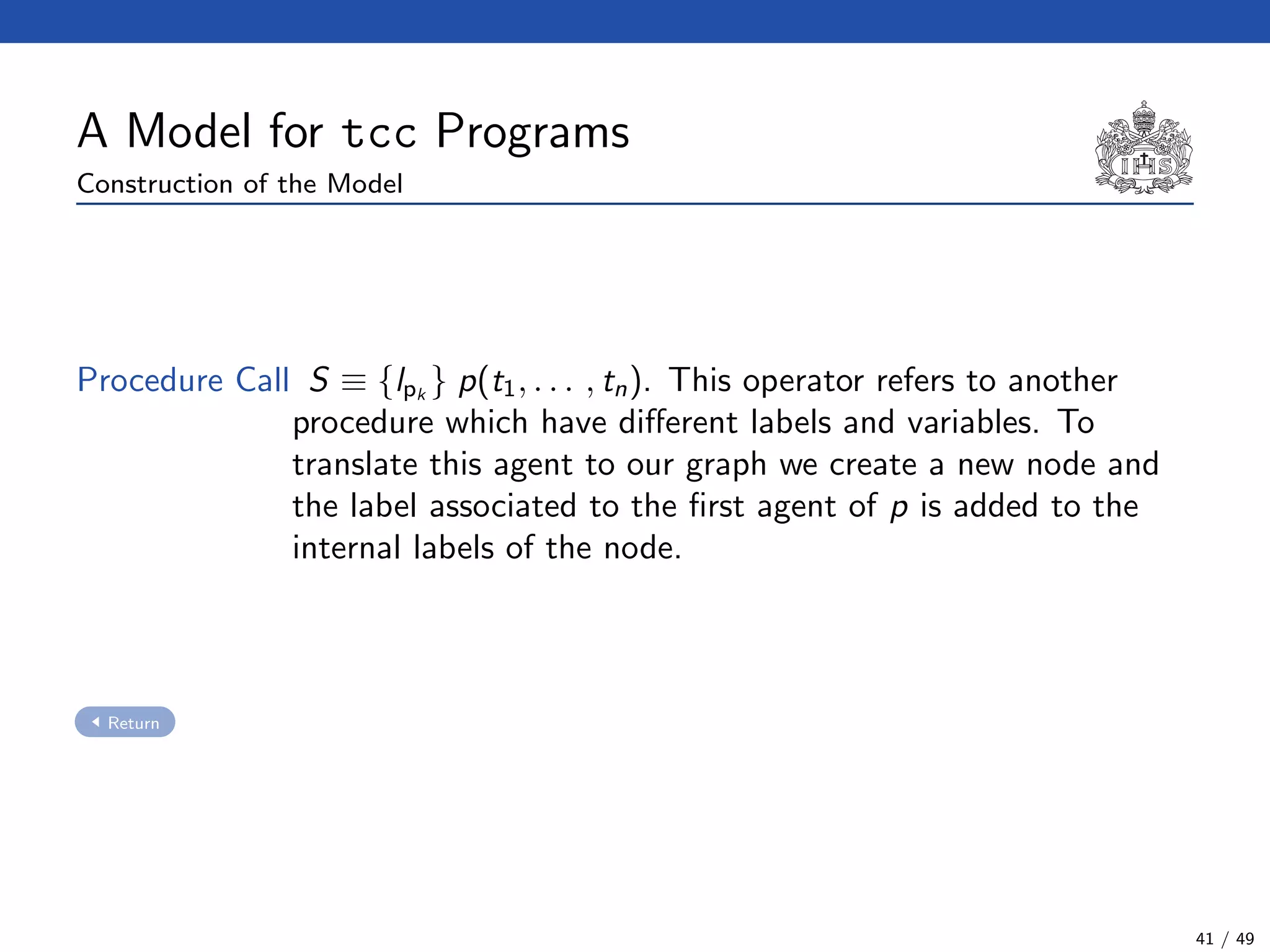
Procedure Call S ≡ {lpk
} p(t1, . . . , tn). This operator refers to another
procedure which have different labels and variables. To
translate this agent to our graph we create a new node and
the label associated to the first agent of p is added to the
internal labels of the node.
Return
41 / 49
A Model for tcc Programs
Construction of the Model
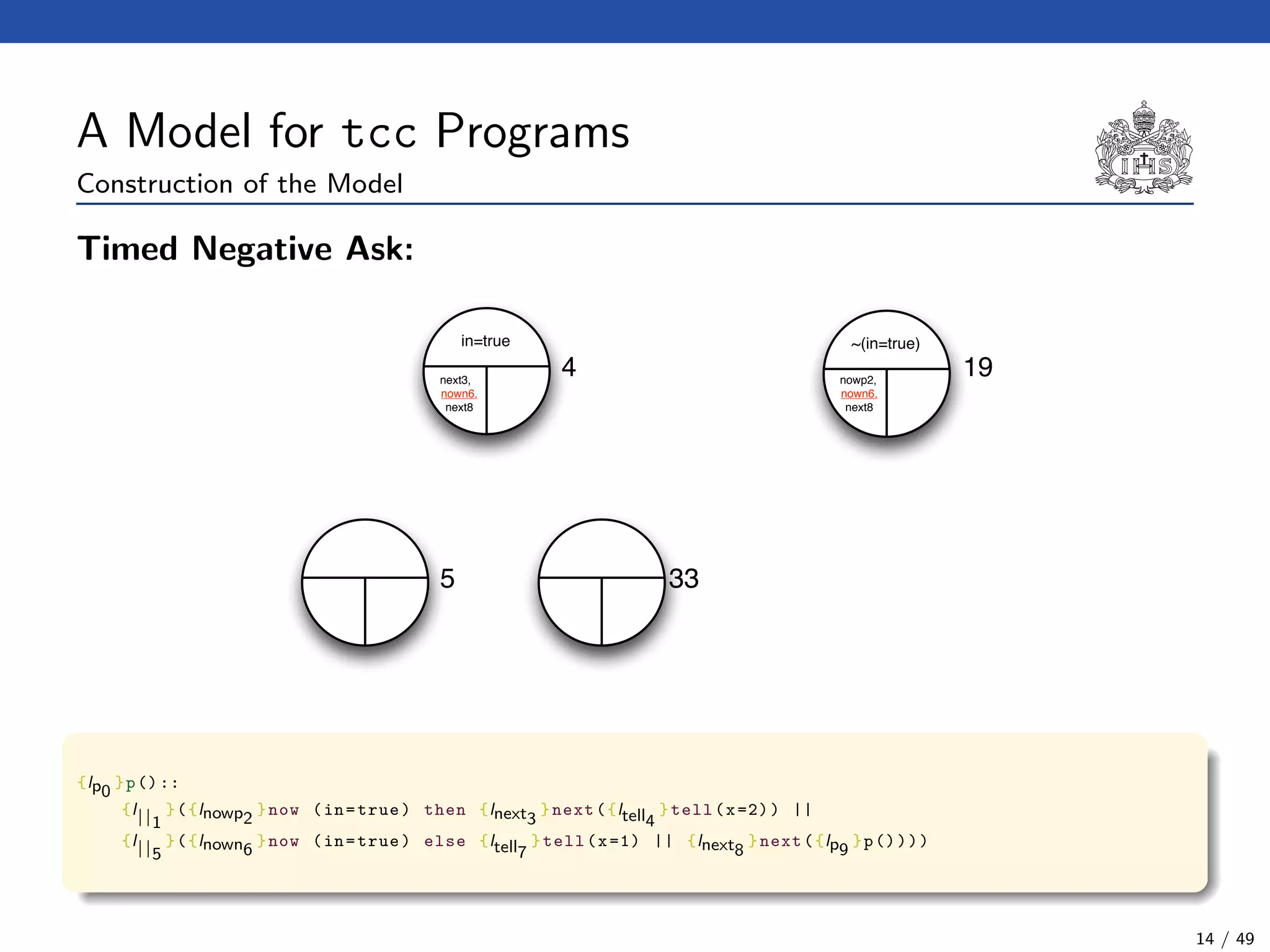
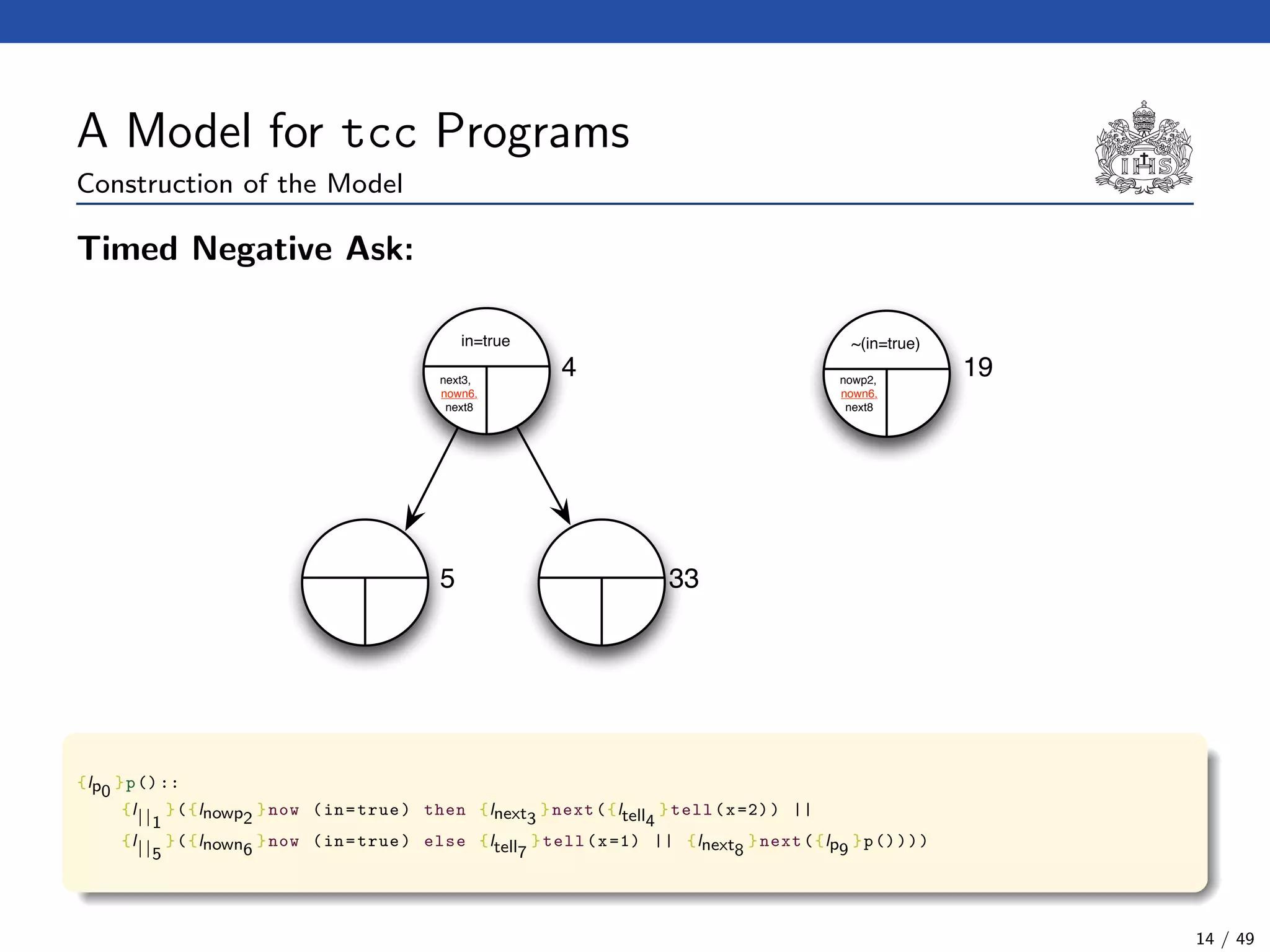
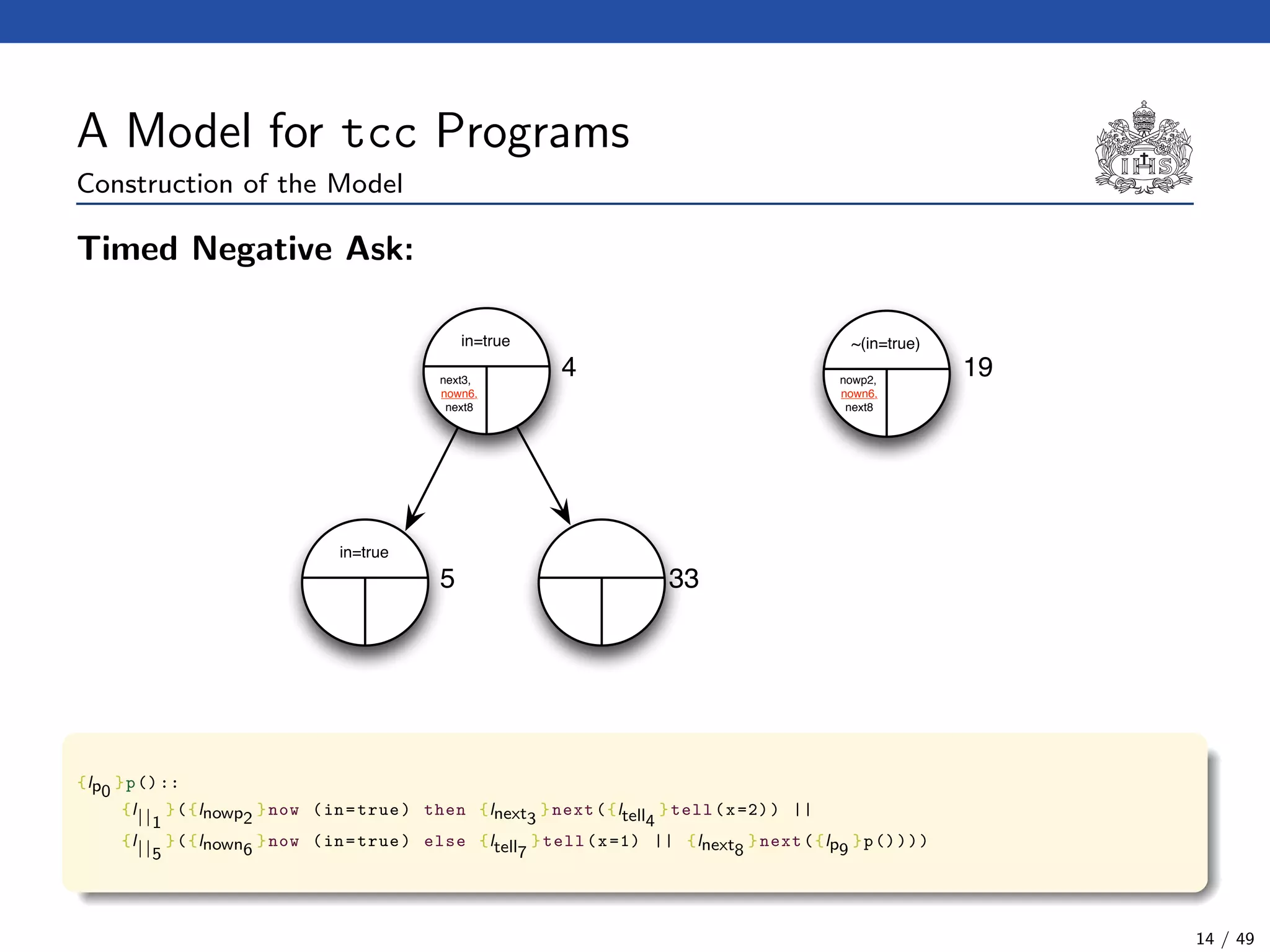
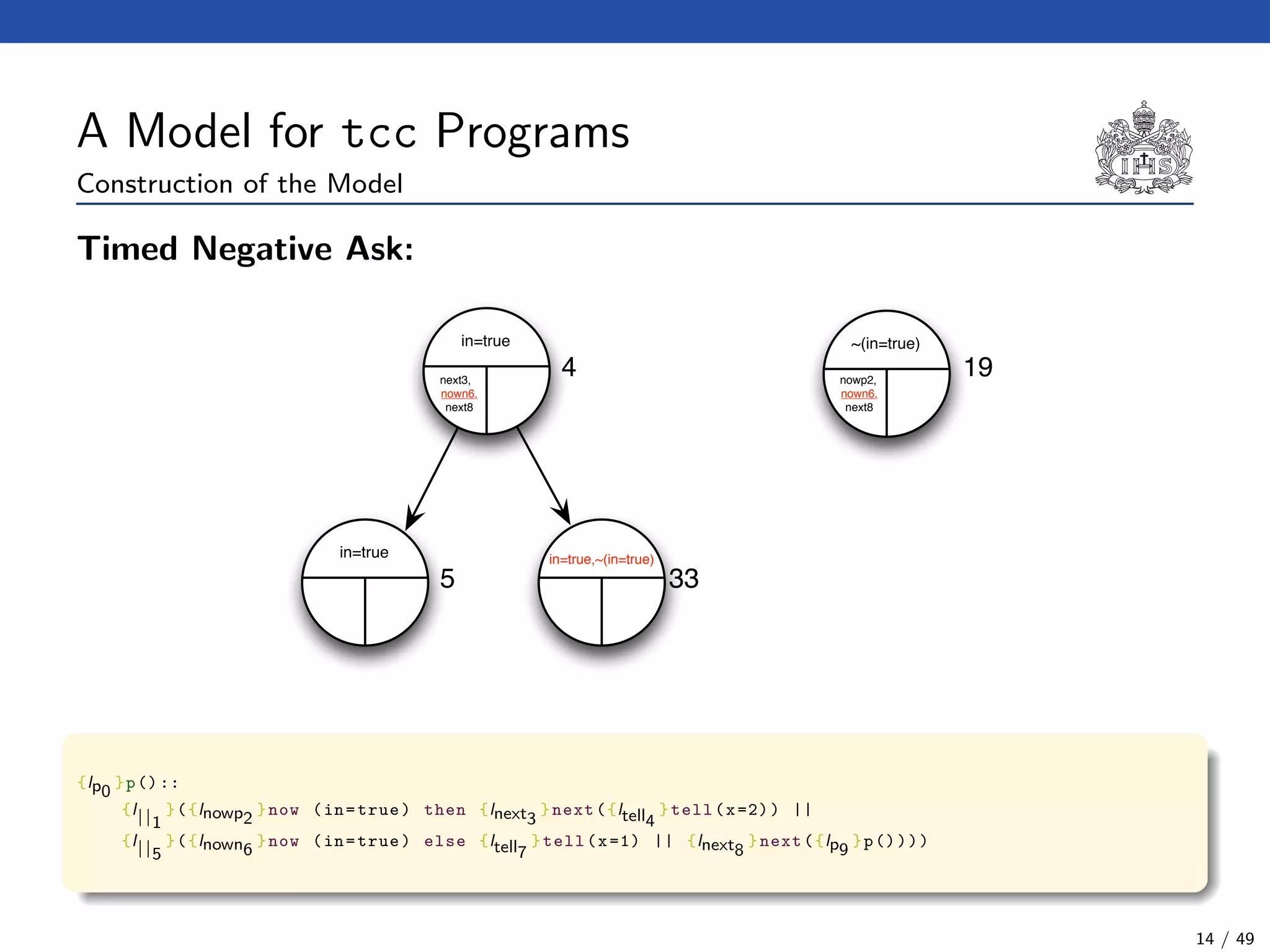
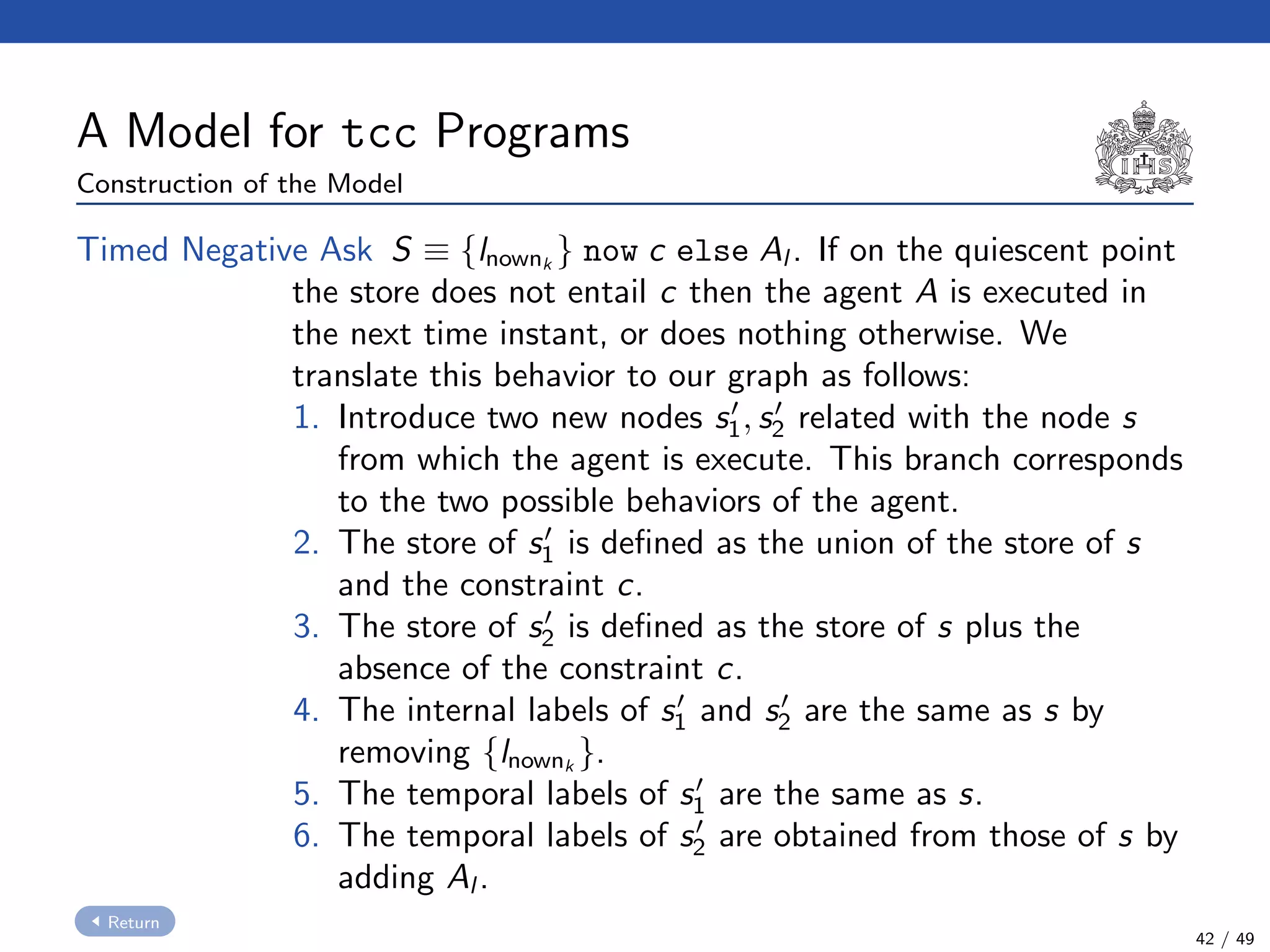
Timed Negative Ask S ≡ {lnownk
} now c else Al . If on the quiescent point
the store does not entail c then the agent A is executed in
the next time instant, or does nothing otherwise. We
translate this behavior to our graph as follows:
1. Introduce two new nodes s1, s2 related with the node s
from which the agent is execute. This branch corresponds
to the two possible behaviors of the agent.
2. The store of s1 is defined as the union of the store of s
and the constraint c.
3. The store of s2 is defined as the store of s plus the
absence of the constraint c.
4. The internal labels of s1 and s2 are the same as s by
removing {lnownk
}.
5. The temporal labels of s1 are the same as s.
6. The temporal labels of s2 are obtained from those of s by
adding Al .
Return
42 / 49
A Model for tcc Programs
Construction of the Model
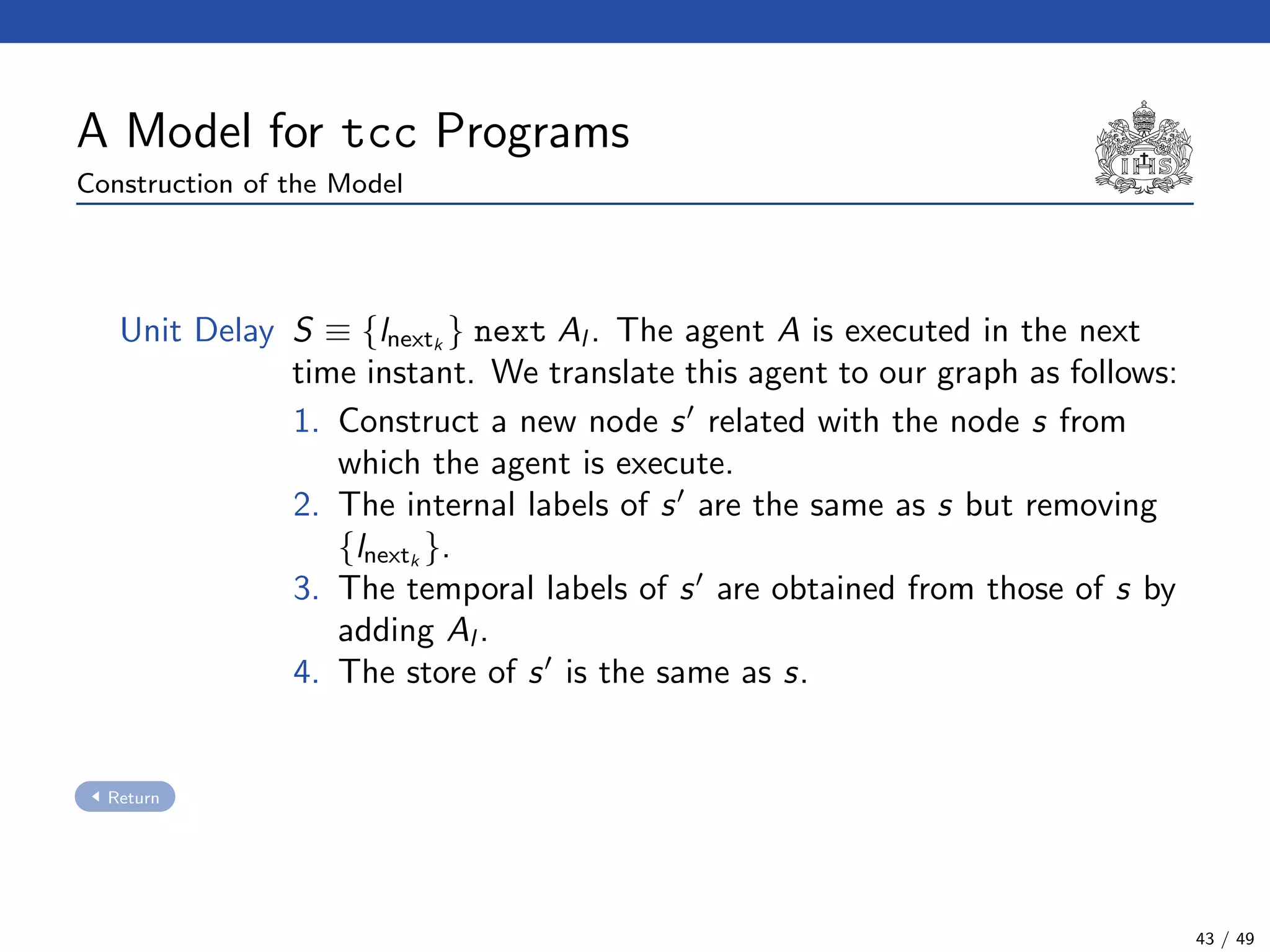
Unit Delay S ≡ {lnextk
} next Al . The agent A is executed in the next
time instant. We translate this agent to our graph as follows:
1. Construct a new node s related with the node s from
which the agent is execute.
2. The internal labels of s are the same as s but removing
{lnextk
}.
3. The temporal labels of s are obtained from those of s by
adding Al .
4. The store of s is the same as s.
Return
43 / 49
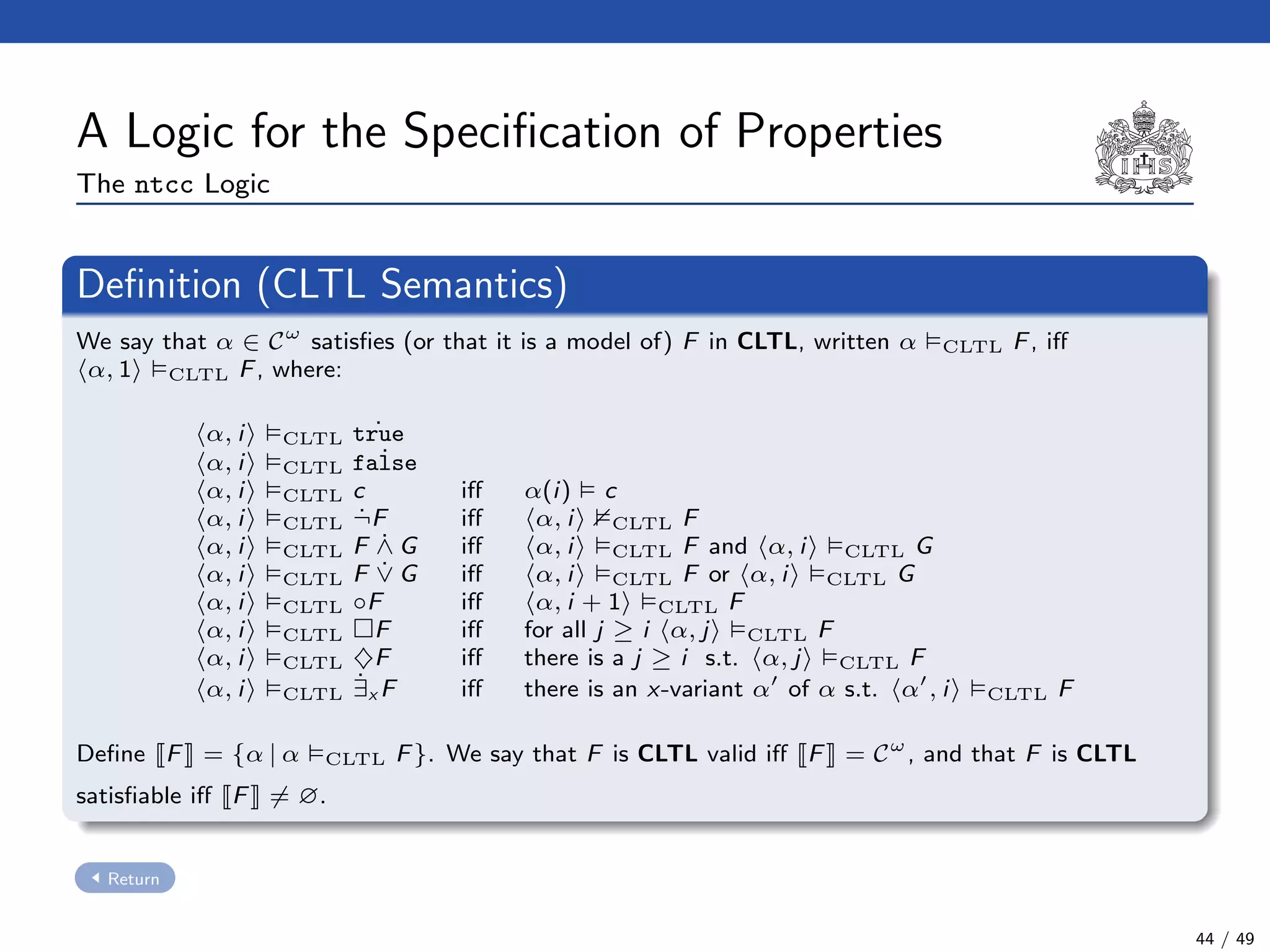
A Logic for the Specification of Properties
The ntcc Logic
Definition (CLTL Semantics)
We say that α ∈ Cω
satisfies (or that it is a model of) F in CLTL, written α CLTL F, iff
α, 1 CLTL F, where:
α, i CLTL ˙true
α, i CLTL ˙false
α, i CLTL c iff α(i) c
α, i CLTL ˙¬F iff α, i CLTL F
α, i CLTL F ˙∧ G iff α, i CLTL F and α, i CLTL G
α, i CLTL F ˙∨ G iff α, i CLTL F or α, i CLTL G
α, i CLTL ◦F iff α, i + 1 CLTL F
α, i CLTL F iff for all j ≥ i α, j CLTL F
α, i CLTL ♦F iff there is a j ≥ i s.t. α, j CLTL F
α, i CLTL
˙∃x F iff there is an x-variant α of α s.t. α , i CLTL F
Define F = {α | α CLTL F}. We say that F is CLTL valid iff F = Cω
, and that F is CLTL
satisfiable iff F = ∅.
Return
44 / 49
The Model Checking Algorithm
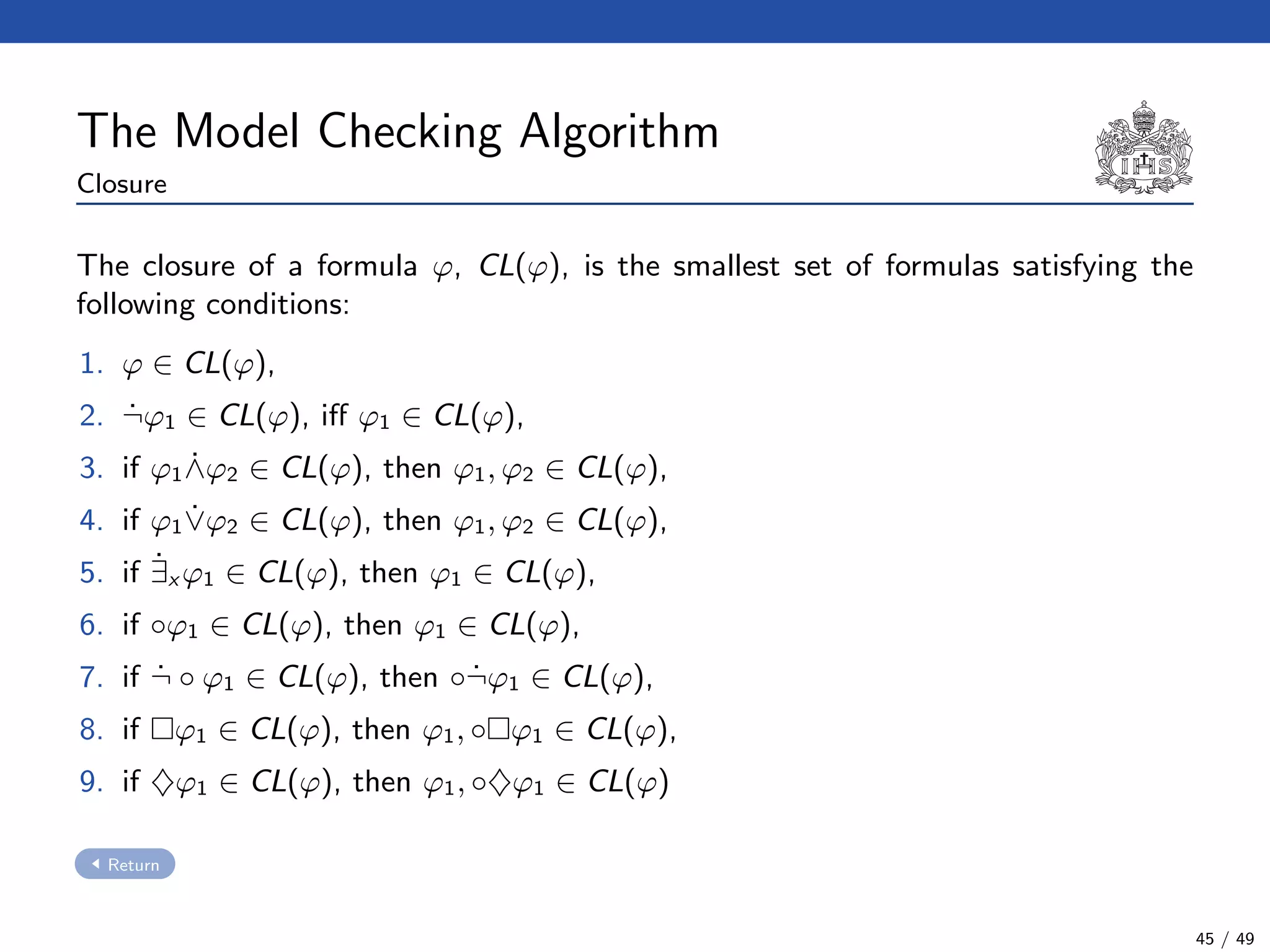
Closure
The closure of a formula ϕ, CL(ϕ), is the smallest set of formulas satisfying the
following conditions:
1. ϕ ∈ CL(ϕ),
2. ˙¬ϕ1 ∈ CL(ϕ), iff ϕ1 ∈ CL(ϕ),
3. if ϕ1 ˙∧ϕ2 ∈ CL(ϕ), then ϕ1, ϕ2 ∈ CL(ϕ),
4. if ϕ1 ˙∨ϕ2 ∈ CL(ϕ), then ϕ1, ϕ2 ∈ CL(ϕ),
5. if ˙∃x ϕ1 ∈ CL(ϕ), then ϕ1 ∈ CL(ϕ),
6. if ◦ϕ1 ∈ CL(ϕ), then ϕ1 ∈ CL(ϕ),
7. if ˙¬ ◦ ϕ1 ∈ CL(ϕ), then ◦ ˙¬ϕ1 ∈ CL(ϕ),
8. if ϕ1 ∈ CL(ϕ), then ϕ1, ◦ ϕ1 ∈ CL(ϕ),
9. if ♦ϕ1 ∈ CL(ϕ), then ϕ1, ◦♦ϕ1 ∈ CL(ϕ)
Return
45 / 49
The Model Checking Algorithm
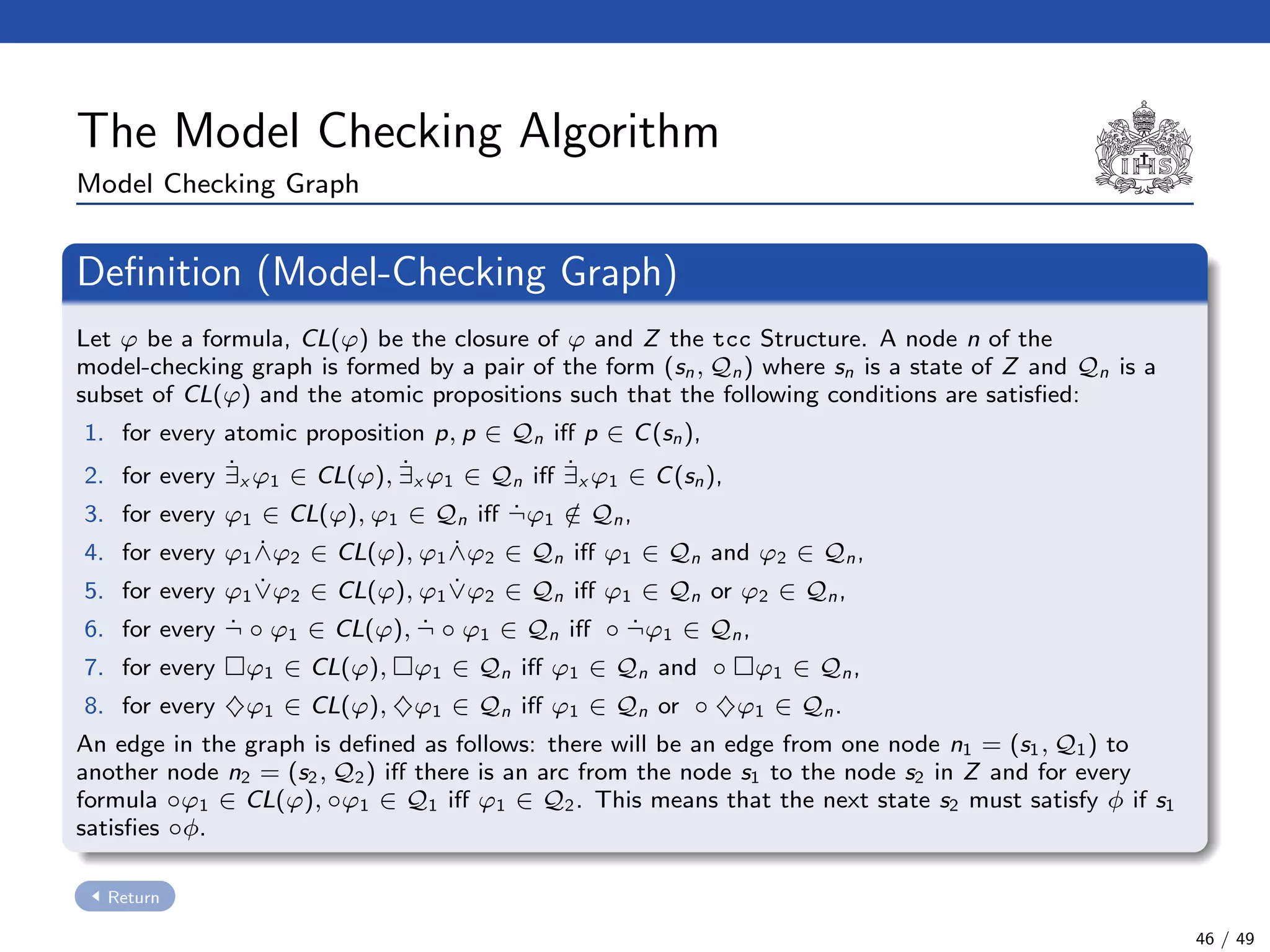
Model Checking Graph
Definition (Model-Checking Graph)
Let ϕ be a formula, CL(ϕ) be the closure of ϕ and Z the tcc Structure. A node n of the
model-checking graph is formed by a pair of the form (sn, Qn) where sn is a state of Z and Qn is a
subset of CL(ϕ) and the atomic propositions such that the following conditions are satisfied:
1. for every atomic proposition p, p ∈ Qn iff p ∈ C(sn),
2. for every ˙∃x ϕ1 ∈ CL(ϕ), ˙∃x ϕ1 ∈ Qn iff ˙∃x ϕ1 ∈ C(sn),
3. for every ϕ1 ∈ CL(ϕ), ϕ1 ∈ Qn iff ˙¬ϕ1 /∈ Qn,
4. for every ϕ1 ˙∧ϕ2 ∈ CL(ϕ), ϕ1 ˙∧ϕ2 ∈ Qn iff ϕ1 ∈ Qn and ϕ2 ∈ Qn,
5. for every ϕ1 ˙∨ϕ2 ∈ CL(ϕ), ϕ1 ˙∨ϕ2 ∈ Qn iff ϕ1 ∈ Qn or ϕ2 ∈ Qn,
6. for every ˙¬ ◦ ϕ1 ∈ CL(ϕ), ˙¬ ◦ ϕ1 ∈ Qn iff ◦ ˙¬ϕ1 ∈ Qn,
7. for every ϕ1 ∈ CL(ϕ), ϕ1 ∈ Qn iff ϕ1 ∈ Qn and ◦ ϕ1 ∈ Qn,
8. for every ♦ϕ1 ∈ CL(ϕ), ♦ϕ1 ∈ Qn iff ϕ1 ∈ Qn or ◦ ♦ϕ1 ∈ Qn.
An edge in the graph is defined as follows: there will be an edge from one node n1 = (s1, Q1) to
another node n2 = (s2, Q2) iff there is an arc from the node s1 to the node s2 in Z and for every
formula ◦ϕ1 ∈ CL(ϕ), ◦ϕ1 ∈ Q1 iff ϕ1 ∈ Q2. This means that the next state s2 must satisfy φ if s1
satisfies ◦φ.
Return
46 / 49
A Prototypical Tool
Closure
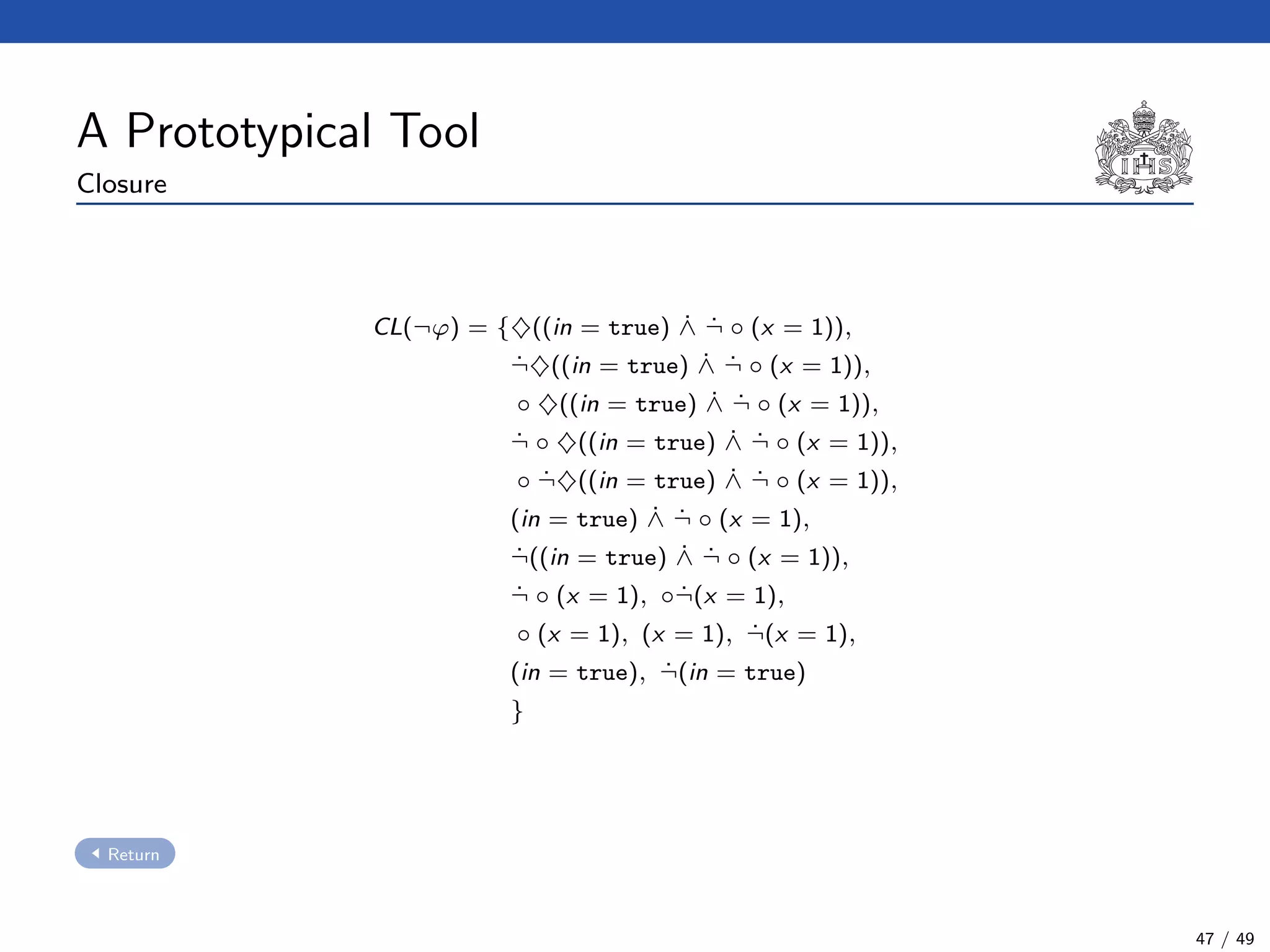
CL(¬ϕ) = {♦((in = true) ˙∧ ˙¬ ◦ (x = 1)),
˙¬♦((in = true) ˙∧ ˙¬ ◦ (x = 1)),
◦ ♦((in = true) ˙∧ ˙¬ ◦ (x = 1)),
˙¬ ◦ ♦((in = true) ˙∧ ˙¬ ◦ (x = 1)),
◦ ˙¬♦((in = true) ˙∧ ˙¬ ◦ (x = 1)),
(in = true) ˙∧ ˙¬ ◦ (x = 1),
˙¬((in = true) ˙∧ ˙¬ ◦ (x = 1)),
˙¬ ◦ (x = 1), ◦ ˙¬(x = 1),
◦ (x = 1), (x = 1), ˙¬(x = 1),
(in = true), ˙¬(in = true)
}
Return
47 / 49
A Prototypical Tool
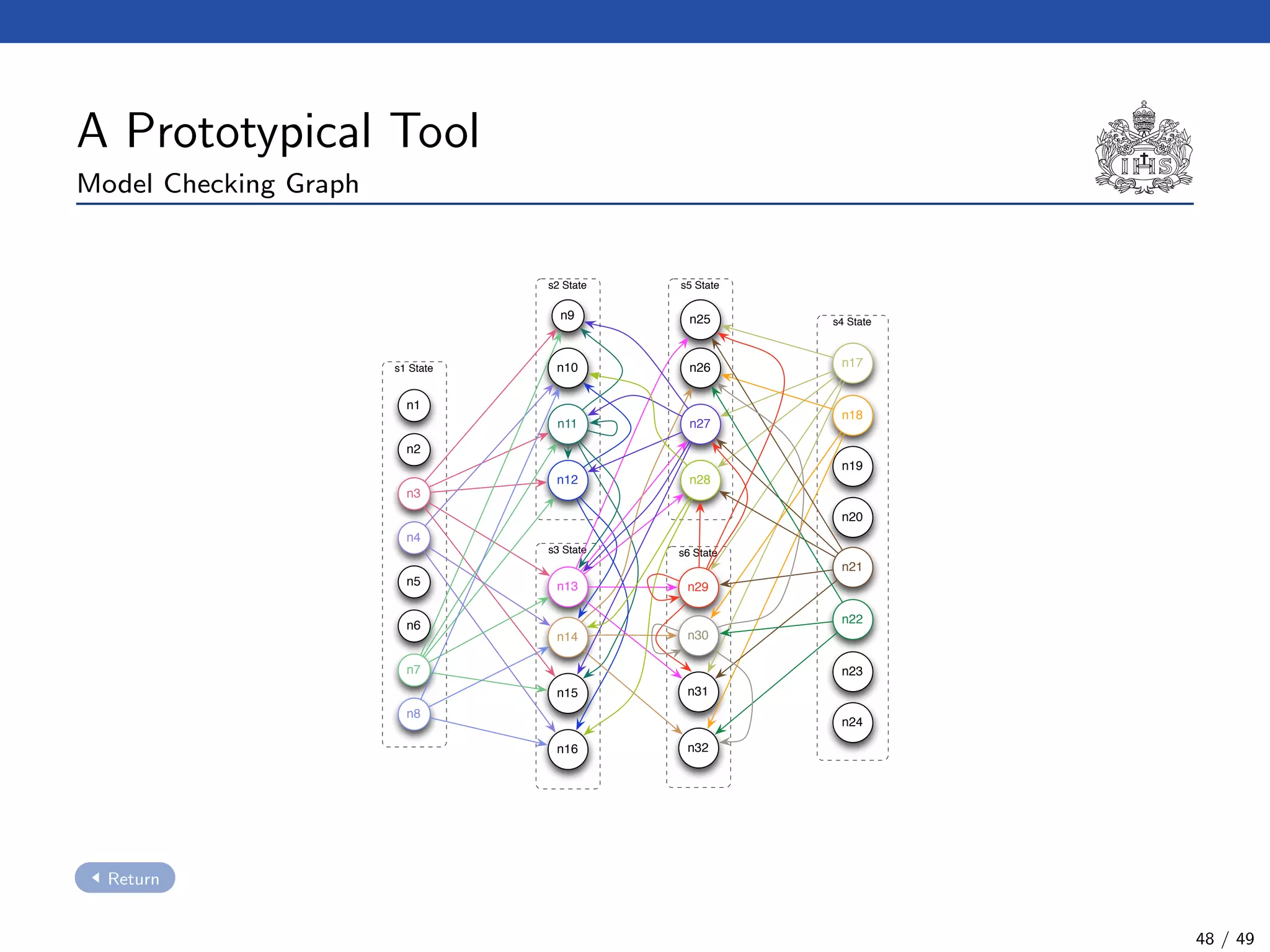
Model Checking Graph
s3 State
s2 State
s1 State
n1
n2
n3
n4
n5
n6
n7
n8
n9
n10
n12
n13
n14
n15
n16
s4 State
n17
n18
n19
n20
n21
n22
n23
n24
s5 State
n25
n26
n27
n28
s6 State
n29
n30
n31
n32
n11
Return
48 / 49
A Prototypical Tool
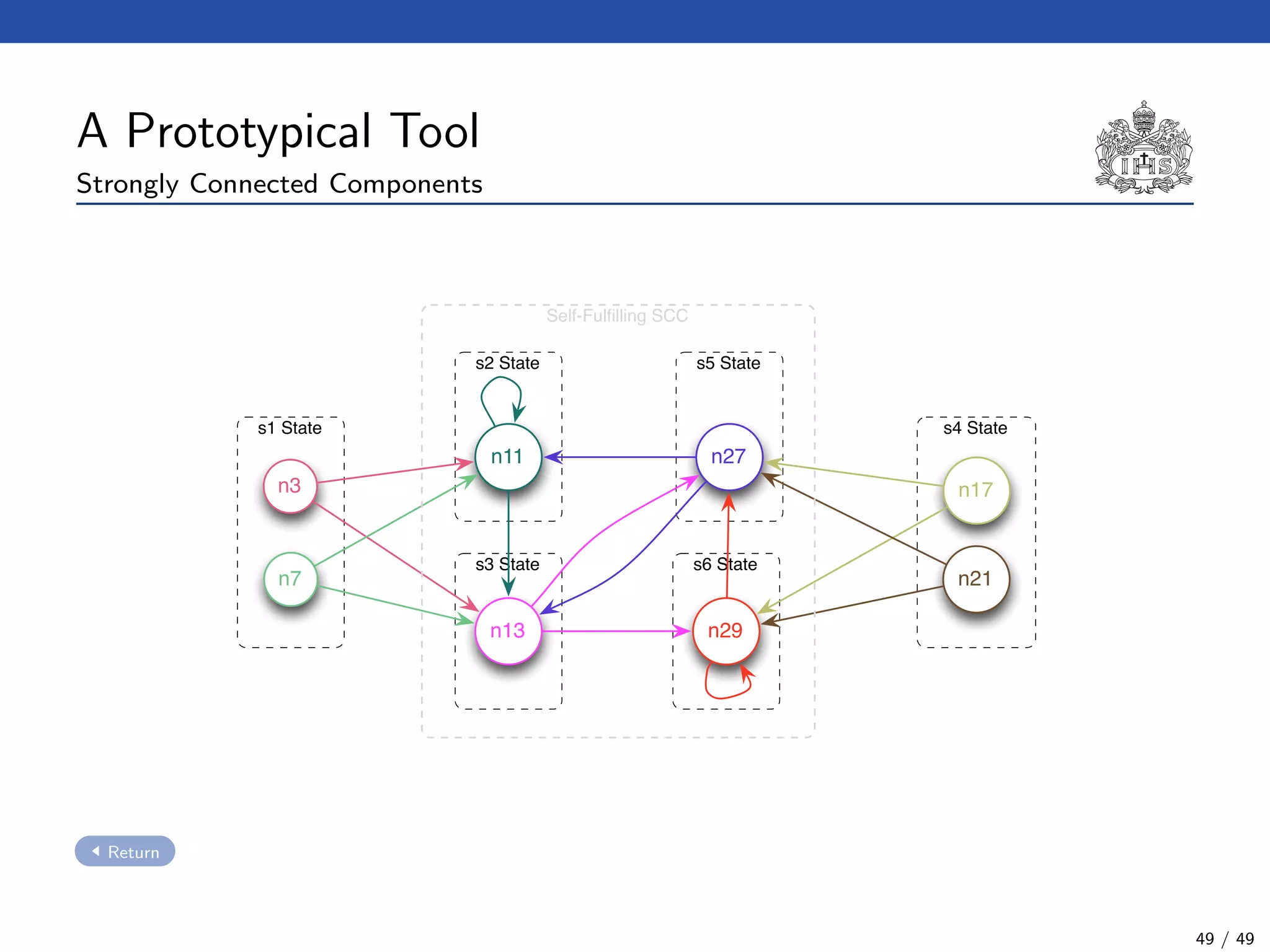
Strongly Connected Components
s3 State
s2 State
s1 State
n3
n7
n13
s4 State
n17
n21
s5 State
n27
s6 State
n29
n11
Self-Fulfilling SCC
Return
49 / 49

Model checker for NTCC

  • 1.
    ntccKMC: A Kripke-structure-basedmodel checker for the ntcc calculus Cali Mauricio Toro Bermudez, in joint work with Jaime Arias, Carlos Olarte and Camilo Rueda AVISPA Research Group Pontificia Universidad Javeriana - Cali February, 2013
  • 2.
    Outline 1 Introduction 2 Previouswork 3 The Model Checking Technique 4 A Model for tcc Programs 5 A Logic for the Specification of Properties 6 The Model Checking Algorithm 7 Implementation 8 Concluding Remarks 2 / 49
  • 3.
    Motivation • Verification ofntcc programs is performed using inductive techniques since the model does not provide automatic formal verification tools. • Problems: ◦ Difficult ◦ Error prone ◦ Experts are required. • Hubert Garavel [Gar08]: “...The research agenda for theoretical concur- rency should therefore address the design of efficient algorithms for trans- lating and verifying formal specifications of concurrent systems”. 3 / 49
  • 4.
    Motivation • Model checkingis an automated technique that, given a finite-state model of a system and a formal property, systematically checks whether this property holds for (a given state in) that model [CGP99]. • Advantages ◦ Formal technique. ◦ Fully-automatic. ◦ Experts are not required. ◦ Counterexample. • Drawback ◦ State-space explosion problem. 4 / 49
  • 5.
    React-PLUS project • REACTPLUS addresses the development and application of formal methods in real-life systems. • It takes the challenging task of developing the underlying theory and machine-assisted tools for verifying concurrent systems specified in a formalism AVISPA has recently developed, the ntcc calculus. 5 / 49
  • 6.
    The problem • Atpresent, ntcc does not provide for the automatic, or even machine-assisted, verification of system properties. • Since we deal with complex and large systems, machine-assisted verification is essential to our intended applications. 6 / 49
  • 7.
    Outline 1 Introduction 2 Previouswork 3 The Model Checking Technique 4 A Model for tcc Programs 5 A Logic for the Specification of Properties 6 The Model Checking Algorithm 7 Implementation 8 Concluding Remarks 7 / 49
  • 8.
    Previous work 1. Givena ntcc process and a CLTL property, transform the process into a B¨uchi automaton and the formula into a process [Val05]. 8 / 49
  • 9.
    Previous work 1. Givena ntcc process and a CLTL property, transform the process into a B¨uchi automaton and the formula into a process [Val05]. 2. Given a tccp process, a temporal logic property and a number n of time units, generate a kripke structure and verify if the property satisfy such structure [FV06]. 8 / 49
  • 10.
    Previous work 1. Givena ntcc process and a CLTL property, transform the process into a B¨uchi automaton and the formula into a process [Val05]. 2. Given a tccp process, a temporal logic property and a number n of time units, generate a kripke structure and verify if the property satisfy such structure [FV06]. 3. Given a probabilistic ntcc process, a probabilistic CTL property and sequence of n inputs (i.e., constraints), generate a discrete-time markov chain, export the chain into PRISM model checker and verify the property [TB09]. http://ntccrt.sourceforge.net 8 / 49
  • 11.
    Previous work 1. Givena ntcc process and a CLTL property, transform the process into a B¨uchi automaton and the formula into a process [Val05]. 2. Given a tccp process, a temporal logic property and a number n of time units, generate a kripke structure and verify if the property satisfy such structure [FV06]. 3. Given a probabilistic ntcc process, a probabilistic CTL property and sequence of n inputs (i.e., constraints), generate a discrete-time markov chain, export the chain into PRISM model checker and verify the property [TB09]. http://ntccrt.sourceforge.net 4. Given a ntcc process, a CLTL property and a number n of time units, generate a finite-state automaton that represents the process and another one that represents the property, then verify if the process satisfies the formula [TB12]. http://ntccmc.sourceforge.net 8 / 49
  • 12.
    Outline 1 Introduction 2 Previouswork 3 The Model Checking Technique 4 A Model for tcc Programs 5 A Logic for the Specification of Properties 6 The Model Checking Algorithm 7 Implementation 8 Concluding Remarks 9 / 49
  • 13.
    The Model CheckingTechnique Requirements System Formalizing Modeling Property Specification System Model Model Checking Satisfied Violated + Counterexample System Model: Models of systems describe the behavior of systems in a formal way. They are mostly expressed using transition systems. 10 / 49
  • 14.
    The Model CheckingTechnique Requirements System Formalizing Modeling Property Specification System Model Model Checking Satisfied Violated + Counterexample Property Specification: Properties should be described in a precise and unambiguous manner. Temporal logic is typically used to express properties. 10 / 49
  • 15.
    The Model CheckingTechnique Requirements System Formalizing Modeling Property Specification System Model Model Checking Satisfied Violated + Counterexample Model Checking: Algorithm which checks the validity of the property in all states of the system model. 10 / 49
  • 16.
    Outline 1 Introduction 2 Previouswork 3 The Model Checking Technique 4 A Model for tcc Programs 5 A Logic for the Specification of Properties 6 The Model Checking Algorithm 7 Implementation 8 Concluding Remarks 11 / 49
  • 17.
    A Model fortcc Programs Program Labeling • The labeling process consists in assigning a different label to each occur- rence of an agent in the program. • Labels provide an unique identification for agents in order to know the point of execution of the program during the construction of the model. Example {lp0 }p():: {l||1 }({lnowp2 }now (in=true) then {lnext3 }next({ltell4 }tell(x=2)) || {l||5 }({lnown6 }now (in=true) else {ltell7 }tell(x=1) || {lnext8 }next({lp9 }p()))) Definition 12 / 49
  • 18.
    A Model fortcc Programs The tcc Structure • tcc Structure is a graph structure which allows to model the behavior of a tcc specification. • It is a variant of a Kripke Structure. current store internal labels temporal labels (a) tcc state Internal Transition Temporal Transition (b) Transitions Figure: Components of a tcc Structure Definition 13 / 49
  • 19.
    A Model fortcc Programs Construction of the Model Procedure Call: p0 {lp0 }p():: {l||1 }({lnowp2 }now (in=true) then {lnext3 }next({ltell4 }tell(x=2)) || {l||5 }({lnown6 }now (in=true) else {ltell7 }tell(x=1) || {lnext8 }next({lp9 }p()))) 14 / 49
  • 20.
    A Model fortcc Programs Construction of the Model Procedure Call: p0 1 {lp0 }p():: {l||1 }({lnowp2 }now (in=true) then {lnext3 }next({ltell4 }tell(x=2)) || {l||5 }({lnown6 }now (in=true) else {ltell7 }tell(x=1) || {lnext8 }next({lp9 }p()))) 14 / 49
  • 21.
    A Model fortcc Programs Construction of the Model Procedure Call: p0 1 {lp0 }p():: {l||1 }({lnowp2 }now (in=true) then {lnext3 }next({ltell4 }tell(x=2)) || {l||5 }({lnown6 }now (in=true) else {ltell7 }tell(x=1) || {lnext8 }next({lp9 }p()))) 14 / 49
  • 22.
    A Model fortcc Programs Construction of the Model Procedure Call: p0 ||1 1 {lp0 }p():: {l||1 }({lnowp2 }now (in=true) then {lnext3 }next({ltell4 }tell(x=2)) || {l||5 }({lnown6 }now (in=true) else {ltell7 }tell(x=1) || {lnext8 }next({lp9 }p()))) 14 / 49
  • 23.
    A Model fortcc Programs Construction of the Model Parallel: p0 ||1 1 2 {lp0 }p():: {l||1 }({lnowp2 }now (in=true) then {lnext3 }next({ltell4 }tell(x=2)) || {l||5 }({lnown6 }now (in=true) else {ltell7 }tell(x=1) || {lnext8 }next({lp9 }p()))) 14 / 49
  • 24.
    A Model fortcc Programs Construction of the Model Parallel: p0 ||1 1 2 {lp0 }p():: {l||1 }({lnowp2 }now (in=true) then {lnext3 }next({ltell4 }tell(x=2)) || {l||5 }({lnown6 }now (in=true) else {ltell7 }tell(x=1) || {lnext8 }next({lp9 }p()))) 14 / 49
  • 25.
    A Model fortcc Programs Construction of the Model Parallel: p0 ||1 1 2 nowp2, ||5 {lp0 }p():: {l||1 }({lnowp2 }now (in=true) then {lnext3 }next({ltell4 }tell(x=2)) || {l||5 }({lnown6 }now (in=true) else {ltell7 }tell(x=1) || {lnext8 }next({lp9 }p()))) 14 / 49
  • 26.
    A Model fortcc Programs Construction of the Model Parallel: nowp2, nown6, next8 3 p0 ||1 1 2 nowp2, ||5 {lp0 }p():: {l||1 }({lnowp2 }now (in=true) then {lnext3 }next({ltell4 }tell(x=2)) || {l||5 }({lnown6 }now (in=true) else {ltell7 }tell(x=1) || {lnext8 }next({lp9 }p()))) 14 / 49
  • 27.
    A Model fortcc Programs Construction of the Model Timed Positive Ask: nowp2, nown6, next8 3 {lp0 }p():: {l||1 }({lnowp2 }now (in=true) then {lnext3 }next({ltell4 }tell(x=2)) || {l||5 }({lnown6 }now (in=true) else {ltell7 }tell(x=1) || {lnext8 }next({lp9 }p()))) 14 / 49
  • 28.
    A Model fortcc Programs Construction of the Model Timed Positive Ask: nowp2, nown6, next8 3 4 19 {lp0 }p():: {l||1 }({lnowp2 }now (in=true) then {lnext3 }next({ltell4 }tell(x=2)) || {l||5 }({lnown6 }now (in=true) else {ltell7 }tell(x=1) || {lnext8 }next({lp9 }p()))) 14 / 49
  • 29.
    A Model fortcc Programs Construction of the Model Timed Positive Ask: nowp2, nown6, next8 3 4 19 {lp0 }p():: {l||1 }({lnowp2 }now (in=true) then {lnext3 }next({ltell4 }tell(x=2)) || {l||5 }({lnown6 }now (in=true) else {ltell7 }tell(x=1) || {lnext8 }next({lp9 }p()))) 14 / 49
  • 30.
    A Model fortcc Programs Construction of the Model Timed Positive Ask: nowp2, nown6, next8 in=true 3 4 19 {lp0 }p():: {l||1 }({lnowp2 }now (in=true) then {lnext3 }next({ltell4 }tell(x=2)) || {l||5 }({lnown6 }now (in=true) else {ltell7 }tell(x=1) || {lnext8 }next({lp9 }p()))) 14 / 49
  • 31.
    A Model fortcc Programs Construction of the Model Timed Positive Ask: nowp2, nown6, next8 ~(in=true)in=true 3 4 19 {lp0 }p():: {l||1 }({lnowp2 }now (in=true) then {lnext3 }next({ltell4 }tell(x=2)) || {l||5 }({lnown6 }now (in=true) else {ltell7 }tell(x=1) || {lnext8 }next({lp9 }p()))) 14 / 49
  • 32.
    A Model fortcc Programs Construction of the Model Timed Positive Ask: nowp2, nown6, next8 ~(in=true)in=true 3 4 19next3, nown6, next8 {lp0 }p():: {l||1 }({lnowp2 }now (in=true) then {lnext3 }next({ltell4 }tell(x=2)) || {l||5 }({lnown6 }now (in=true) else {ltell7 }tell(x=1) || {lnext8 }next({lp9 }p()))) 14 / 49
  • 33.
    A Model fortcc Programs Construction of the Model Timed Positive Ask: nowp2, nown6, next8 ~(in=true)in=true 3 4 19next3, nown6, next8 nowp2, nown6, next8 {lp0 }p():: {l||1 }({lnowp2 }now (in=true) then {lnext3 }next({ltell4 }tell(x=2)) || {l||5 }({lnown6 }now (in=true) else {ltell7 }tell(x=1) || {lnext8 }next({lp9 }p()))) 14 / 49
  • 34.
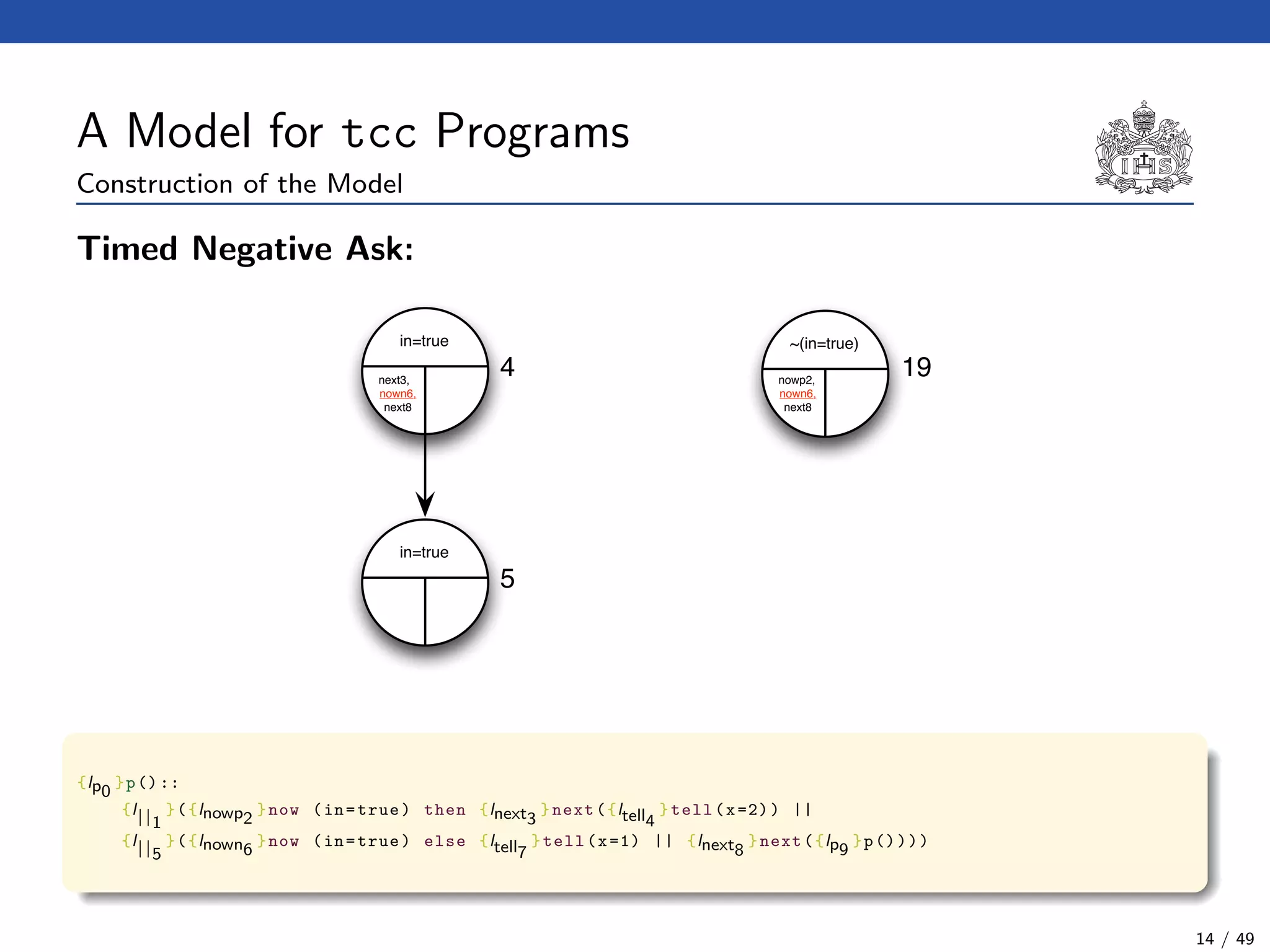
    A Model fortcc Programs Construction of the Model Timed Negative Ask: ~(in=true)in=true 4 19next3, nown6, next8 nowp2, nown6, next8 {lp0 }p():: {l||1 }({lnowp2 }now (in=true) then {lnext3 }next({ltell4 }tell(x=2)) || {l||5 }({lnown6 }now (in=true) else {ltell7 }tell(x=1) || {lnext8 }next({lp9 }p()))) 14 / 49
  • 35.
    A Model fortcc Programs Construction of the Model Timed Negative Ask: ~(in=true)in=true 4 19next3, nown6, next8 nowp2, nown6, next8 5 33 {lp0 }p():: {l||1 }({lnowp2 }now (in=true) then {lnext3 }next({ltell4 }tell(x=2)) || {l||5 }({lnown6 }now (in=true) else {ltell7 }tell(x=1) || {lnext8 }next({lp9 }p()))) 14 / 49
  • 36.
    A Model fortcc Programs Construction of the Model Timed Negative Ask: ~(in=true)in=true 4 19next3, nown6, next8 nowp2, nown6, next8 5 33 {lp0 }p():: {l||1 }({lnowp2 }now (in=true) then {lnext3 }next({ltell4 }tell(x=2)) || {l||5 }({lnown6 }now (in=true) else {ltell7 }tell(x=1) || {lnext8 }next({lp9 }p()))) 14 / 49
  • 37.
    A Model fortcc Programs Construction of the Model Timed Negative Ask: ~(in=true)in=true 4 19next3, nown6, next8 nowp2, nown6, next8 in=true 5 33 {lp0 }p():: {l||1 }({lnowp2 }now (in=true) then {lnext3 }next({ltell4 }tell(x=2)) || {l||5 }({lnown6 }now (in=true) else {ltell7 }tell(x=1) || {lnext8 }next({lp9 }p()))) 14 / 49
  • 38.
    A Model fortcc Programs Construction of the Model Timed Negative Ask: ~(in=true)in=true 4 19next3, nown6, next8 nowp2, nown6, next8 in=true 5 in=true,~(in=true) 33 {lp0 }p():: {l||1 }({lnowp2 }now (in=true) then {lnext3 }next({ltell4 }tell(x=2)) || {l||5 }({lnown6 }now (in=true) else {ltell7 }tell(x=1) || {lnext8 }next({lp9 }p()))) 14 / 49
  • 39.
    A Model fortcc Programs Construction of the Model Timed Negative Ask: ~(in=true)in=true 4 19next3, nown6, next8 nowp2, nown6, next8 in=true 5 {lp0 }p():: {l||1 }({lnowp2 }now (in=true) then {lnext3 }next({ltell4 }tell(x=2)) || {l||5 }({lnown6 }now (in=true) else {ltell7 }tell(x=1) || {lnext8 }next({lp9 }p()))) 14 / 49
  • 40.
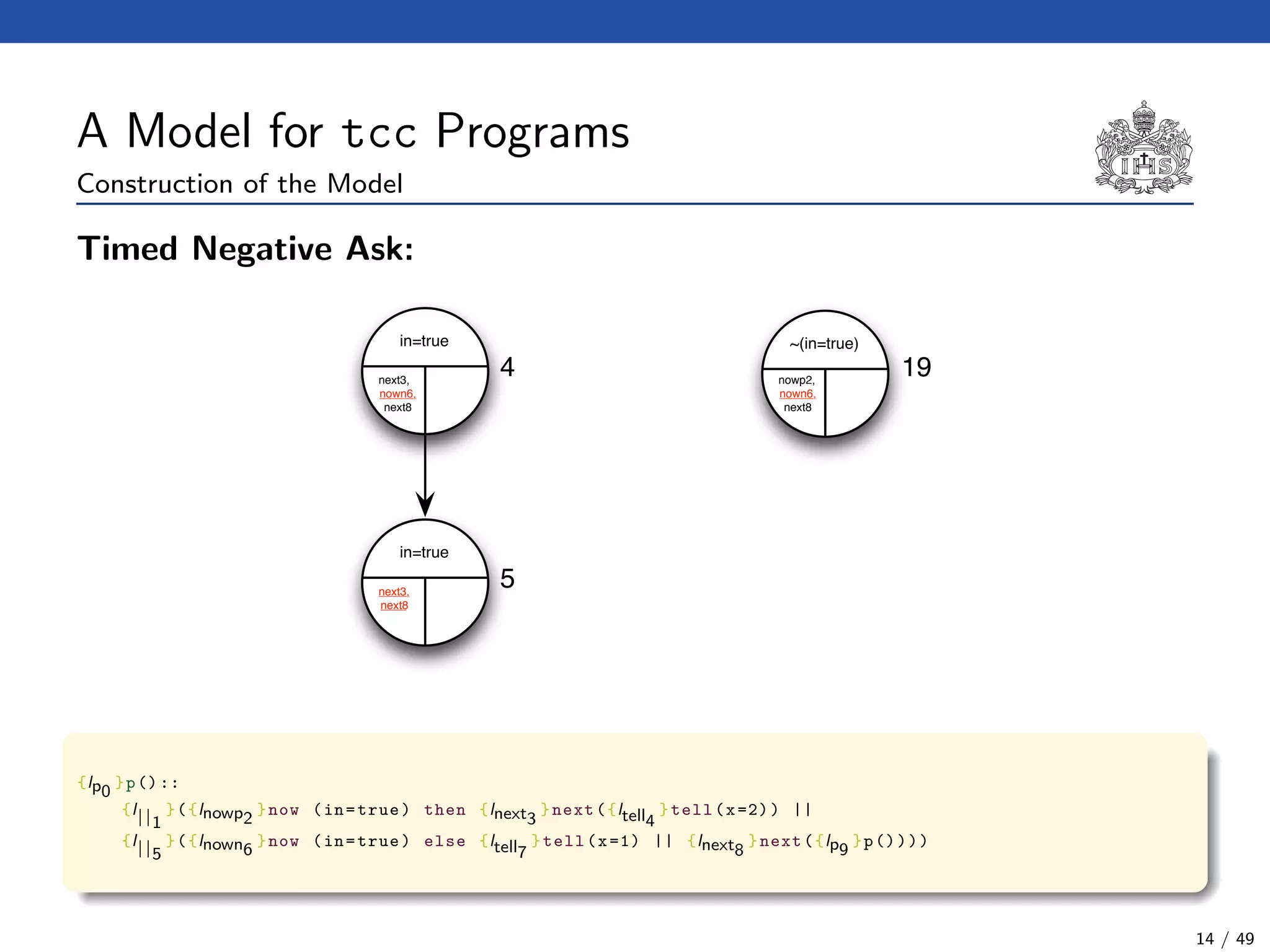
    A Model fortcc Programs Construction of the Model Timed Negative Ask: ~(in=true)in=true 4 19next3, nown6, next8 nowp2, nown6, next8 in=true 5next3, next8 {lp0 }p():: {l||1 }({lnowp2 }now (in=true) then {lnext3 }next({ltell4 }tell(x=2)) || {l||5 }({lnown6 }now (in=true) else {ltell7 }tell(x=1) || {lnext8 }next({lp9 }p()))) 14 / 49
  • 41.
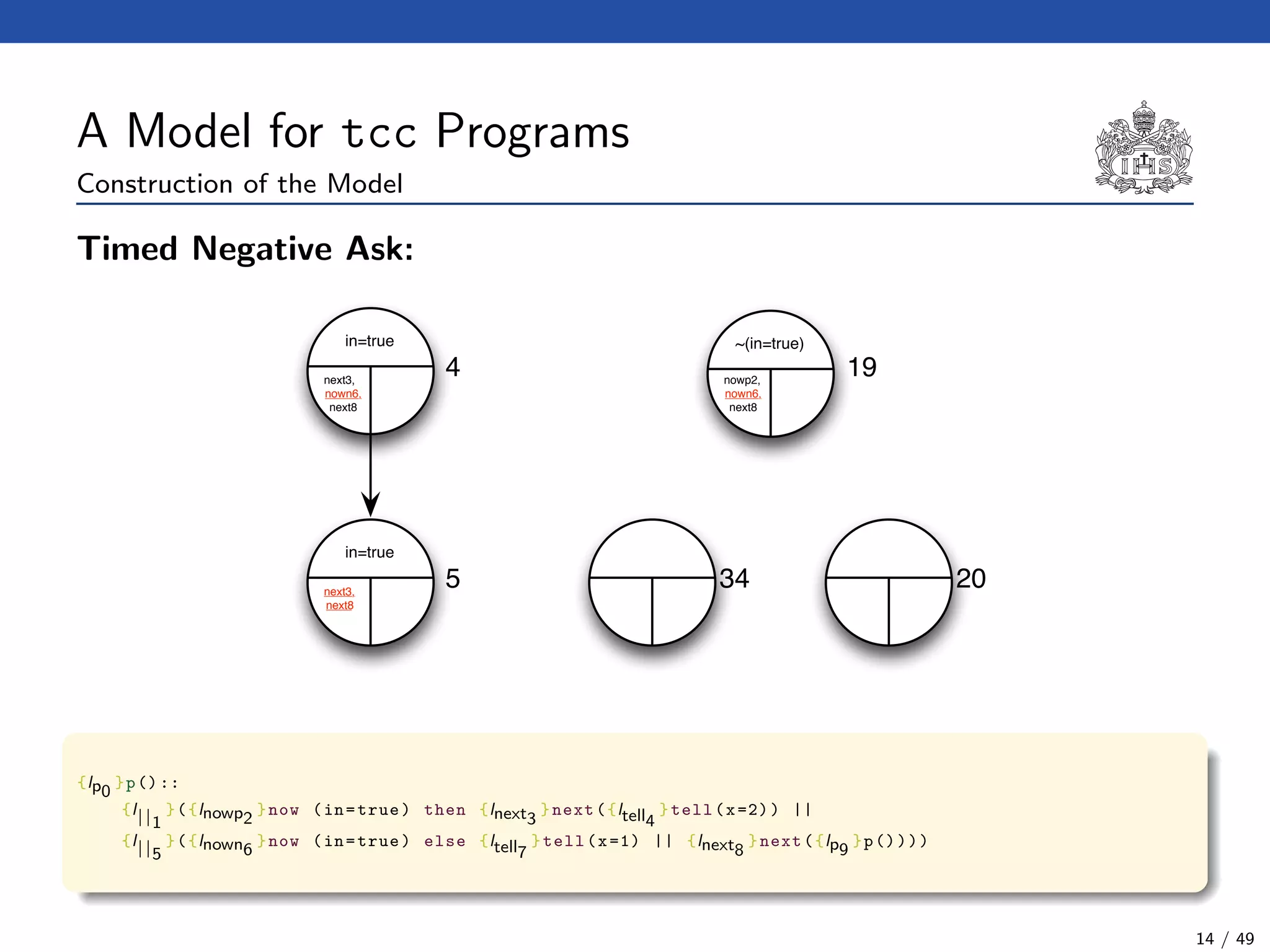
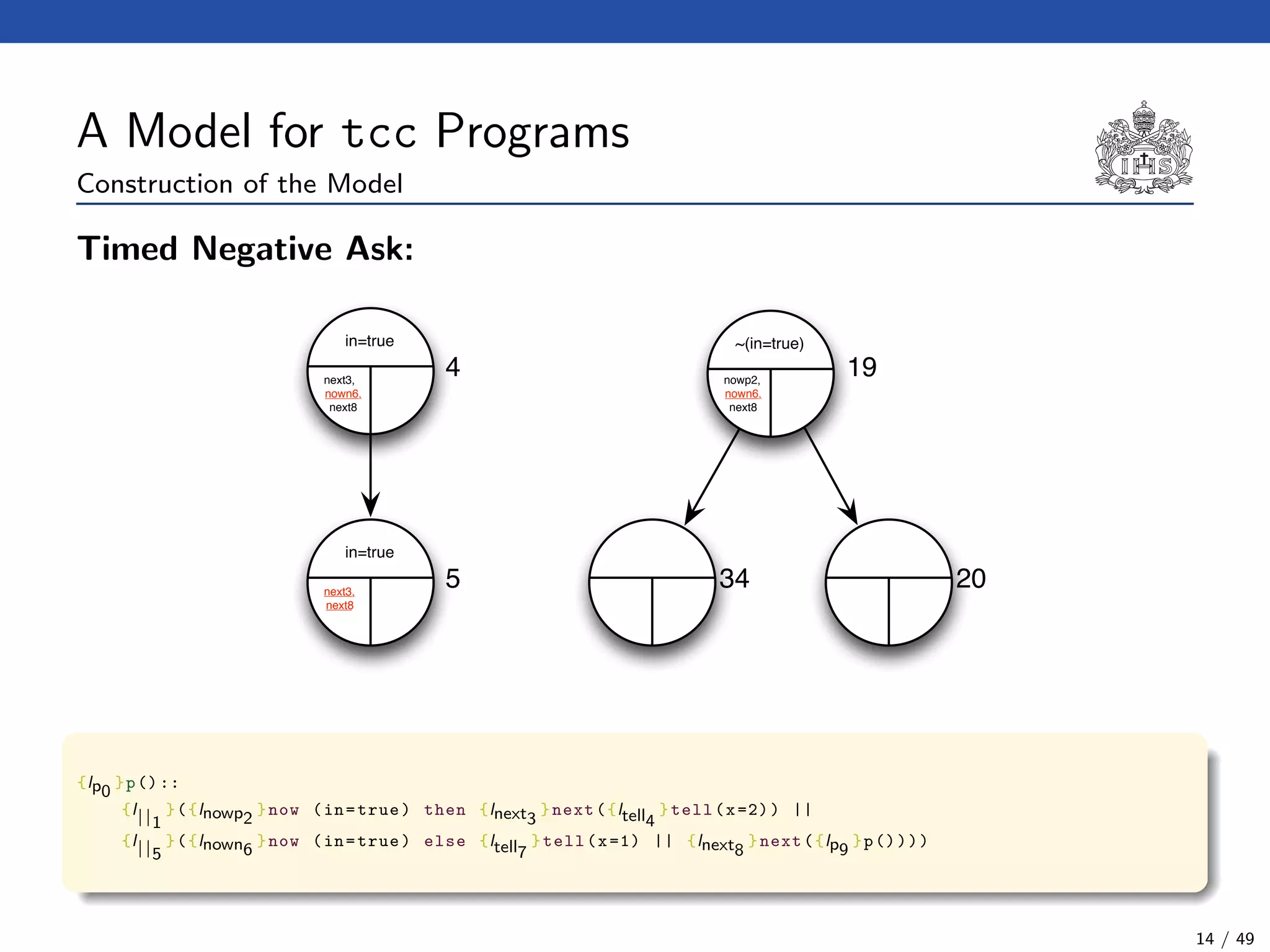
    A Model fortcc Programs Construction of the Model Timed Negative Ask: ~(in=true)in=true 4 19next3, nown6, next8 nowp2, nown6, next8 in=true 5next3, next8 34 20 {lp0 }p():: {l||1 }({lnowp2 }now (in=true) then {lnext3 }next({ltell4 }tell(x=2)) || {l||5 }({lnown6 }now (in=true) else {ltell7 }tell(x=1) || {lnext8 }next({lp9 }p()))) 14 / 49
  • 42.
    A Model fortcc Programs Construction of the Model Timed Negative Ask: ~(in=true)in=true 4 19next3, nown6, next8 nowp2, nown6, next8 in=true 5next3, next8 34 20 {lp0 }p():: {l||1 }({lnowp2 }now (in=true) then {lnext3 }next({ltell4 }tell(x=2)) || {l||5 }({lnown6 }now (in=true) else {ltell7 }tell(x=1) || {lnext8 }next({lp9 }p()))) 14 / 49
  • 43.
    A Model fortcc Programs Construction of the Model Timed Negative Ask: ~(in=true)in=true 4 19next3, nown6, next8 nowp2, nown6, next8 in=true 5next3, next8 34 ~(in=true),in=true 20 {lp0 }p():: {l||1 }({lnowp2 }now (in=true) then {lnext3 }next({ltell4 }tell(x=2)) || {l||5 }({lnown6 }now (in=true) else {ltell7 }tell(x=1) || {lnext8 }next({lp9 }p()))) 14 / 49
  • 44.
    A Model fortcc Programs Construction of the Model Timed Negative Ask: ~(in=true)in=true 4 19next3, nown6, next8 nowp2, nown6, next8 in=true 5next3, next8 34 ~(in=true),in=true 20 ~(in=true) {lp0 }p():: {l||1 }({lnowp2 }now (in=true) then {lnext3 }next({ltell4 }tell(x=2)) || {l||5 }({lnown6 }now (in=true) else {ltell7 }tell(x=1) || {lnext8 }next({lp9 }p()))) 14 / 49
  • 45.
    A Model fortcc Programs Construction of the Model Timed Negative Ask: ~(in=true)in=true 4 19next3, nown6, next8 nowp2, nown6, next8 in=true 5next3, next8 20 ~(in=true) {lp0 }p():: {l||1 }({lnowp2 }now (in=true) then {lnext3 }next({ltell4 }tell(x=2)) || {l||5 }({lnown6 }now (in=true) else {ltell7 }tell(x=1) || {lnext8 }next({lp9 }p()))) 14 / 49
  • 46.
    A Model fortcc Programs Construction of the Model Timed Negative Ask: ~(in=true)in=true 4 19next3, nown6, next8 nowp2, nown6, next8 in=true 5next3, next8 20 ~(in=true) nowp2, next8 {lp0 }p():: {l||1 }({lnowp2 }now (in=true) then {lnext3 }next({ltell4 }tell(x=2)) || {l||5 }({lnown6 }now (in=true) else {ltell7 }tell(x=1) || {lnext8 }next({lp9 }p()))) 14 / 49
  • 47.
    A Model fortcc Programs Construction of the Model Timed Negative Ask: ~(in=true)in=true 4 19next3, nown6, next8 nowp2, nown6, next8 in=true 5next3, next8 20 ~(in=true) nowp2, next8 tell7 {lp0 }p():: {l||1 }({lnowp2 }now (in=true) then {lnext3 }next({ltell4 }tell(x=2)) || {l||5 }({lnown6 }now (in=true) else {ltell7 }tell(x=1) || {lnext8 }next({lp9 }p()))) 14 / 49
  • 48.
    A Model fortcc Programs Construction of the Model Unit Delay: 5next3, next8 {lp0 }p():: {l||1 }({lnowp2 }now (in=true) then {lnext3 }next({ltell4 }tell(x=2)) || {l||5 }({lnown6 }now (in=true) else {ltell7 }tell(x=1) || {lnext8 }next({lp9 }p()))) 14 / 49
  • 49.
    A Model fortcc Programs Construction of the Model Unit Delay: in=true 5next3, next8 6 {lp0 }p():: {l||1 }({lnowp2 }now (in=true) then {lnext3 }next({ltell4 }tell(x=2)) || {l||5 }({lnown6 }now (in=true) else {ltell7 }tell(x=1) || {lnext8 }next({lp9 }p()))) 14 / 49
  • 50.
    A Model fortcc Programs Construction of the Model Unit Delay: in=true 5next3, next8 6 {lp0 }p():: {l||1 }({lnowp2 }now (in=true) then {lnext3 }next({ltell4 }tell(x=2)) || {l||5 }({lnown6 }now (in=true) else {ltell7 }tell(x=1) || {lnext8 }next({lp9 }p()))) 14 / 49
  • 51.
    A Model fortcc Programs Construction of the Model Unit Delay: in=true 5next3, next8 6 in=true {lp0 }p():: {l||1 }({lnowp2 }now (in=true) then {lnext3 }next({ltell4 }tell(x=2)) || {l||5 }({lnown6 }now (in=true) else {ltell7 }tell(x=1) || {lnext8 }next({lp9 }p()))) 14 / 49
  • 52.
    A Model fortcc Programs Construction of the Model Unit Delay: in=true 5next3, next8 6tell4, p9 in=true {lp0 }p():: {l||1 }({lnowp2 }now (in=true) then {lnext3 }next({ltell4 }tell(x=2)) || {l||5 }({lnown6 }now (in=true) else {ltell7 }tell(x=1) || {lnext8 }next({lp9 }p()))) 14 / 49
  • 53.
    A Model fortcc Programs Construction of the Model Passage to the Next Time: 6tell4, p9 in=true {lp0 }p():: {l||1 }({lnowp2 }now (in=true) then {lnext3 }next({ltell4 }tell(x=2)) || {l||5 }({lnown6 }now (in=true) else {ltell7 }tell(x=1) || {lnext8 }next({lp9 }p()))) 14 / 49
  • 54.
    A Model fortcc Programs Construction of the Model Passage to the Next Time: 6tell4, p9 in=true 7 {lp0 }p():: {l||1 }({lnowp2 }now (in=true) then {lnext3 }next({ltell4 }tell(x=2)) || {l||5 }({lnown6 }now (in=true) else {ltell7 }tell(x=1) || {lnext8 }next({lp9 }p()))) 14 / 49
  • 55.
    A Model fortcc Programs Construction of the Model Passage to the Next Time: 6tell4, p9 in=true 7 {lp0 }p():: {l||1 }({lnowp2 }now (in=true) then {lnext3 }next({ltell4 }tell(x=2)) || {l||5 }({lnown6 }now (in=true) else {ltell7 }tell(x=1) || {lnext8 }next({lp9 }p()))) 14 / 49
  • 56.
    A Model fortcc Programs Construction of the Model Passage to the Next Time: 6tell4, p9 in=true 7tell4, p9 {lp0 }p():: {l||1 }({lnowp2 }now (in=true) then {lnext3 }next({ltell4 }tell(x=2)) || {l||5 }({lnown6 }now (in=true) else {ltell7 }tell(x=1) || {lnext8 }next({lp9 }p()))) 14 / 49
  • 57.
    A Model fortcc Programs Construction of the Model Equivalent States: 6tell4, p9 in=true 7tell4, p9 13tell4, p9 x=2, in=true 14tell4, p9 15 / 49
  • 58.
    A Model fortcc Programs Construction of the Model Equivalent States: 6tell4, p9 in=true 7tell4, p9 13tell4, p9 x=2, in=true 14tell4, p9 15 / 49
  • 59.
    A Model fortcc Programs Construction of the Model Equivalent States: 6tell4, p9 in=true 7tell4, p9 13tell4, p9 x=2, in=true 15 / 49
  • 60.
    A Model fortcc Programs Construction of the Model Equivalent States: 6tell4, p9 in=true 7tell4, p9 13tell4, p9 x=2, in=true • Reduction of states is necessary to decrease the state explosion problem. • The store on the quiescent point is defined as the output of the computation. 15 / 49
  • 61.
    A Model fortcc Programs Simplification of the Model 1 54 1 2 3 4 5 Sequence of internal transitions (a) Reduction of a sequence of internal transitions 2 1 3 4 2 2 1 3 4 (b) Reduction of a branching Figure: Reduction rules 16 / 49
  • 62.
    Outline 1 Introduction 2 Previouswork 3 The Model Checking Technique 4 A Model for tcc Programs 5 A Logic for the Specification of Properties 6 The Model Checking Algorithm 7 Implementation 8 Concluding Remarks 17 / 49
  • 63.
    A Logic forthe Specification of Properties The ntcc Logic • Linear temporal logic (LTL) named CLTL for reasoning about ntcc processes. • It expresses properties over sequences of constraints. • ntcc is an extension of tcc. Definition (CLTL Syntax) The formulae F, G, . . . ∈ F are built from constraints c ∈ C in the underlying constraint system by F, G, . . . := c | ˙true | ˙false | F ˙∧ G | F ˙∨ G | ˙¬F | ˙∃x F | ◦ F | F | ♦F Semantics 18 / 49
  • 64.
    Outline 1 Introduction 2 Previouswork 3 The Model Checking Technique 4 A Model for tcc Programs 5 A Logic for the Specification of Properties 6 The Model Checking Algorithm 7 Implementation 8 Concluding Remarks 19 / 49
  • 65.
    The Model CheckingAlgorithm • Classical tableau algorithm for the LTL model checking problem [CGP99, MP95, LP85]. • To prove that a property is satisfied, it is possible to prove that there is no path in the model checking graph satisfying the negation of the formula. 20 / 49
  • 66.
    The Model CheckingAlgorithm Algorithm: 1. To construct the model checking graph using the negation of φ (i.e. ¬φ). Definition 21 / 49
  • 67.
    The Model CheckingAlgorithm Algorithm: 1. To construct the model checking graph using the negation of φ (i.e. ¬φ). Definition ◦ First of all, we have to compute the closure CL(¬φ). This closure is reminiscent to the Fisher Ladner’s one [MP95, FL79]. Definition 21 / 49
  • 68.
    The Model CheckingAlgorithm Algorithm: 1. To construct the model checking graph using the negation of φ (i.e. ¬φ). Definition ◦ First of all, we have to compute the closure CL(¬φ). This closure is reminiscent to the Fisher Ladner’s one [MP95, FL79]. Definition 2. To look for a sequence such that starting from an initial node of the graph that satisfies the negation of φ, it reaches a self-fulfilling strongly connected component. 21 / 49
  • 69.
    The Model CheckingAlgorithm Algorithm: 1. To construct the model checking graph using the negation of φ (i.e. ¬φ). Definition ◦ First of all, we have to compute the closure CL(¬φ). This closure is reminiscent to the Fisher Ladner’s one [MP95, FL79]. Definition 2. To look for a sequence such that starting from an initial node of the graph that satisfies the negation of φ, it reaches a self-fulfilling strongly connected component. 3. If we find a self-fulfilling SCC in the graph, then the system satisfies the property represented by the negated formula (i.e. the model does not satisfy the property). 21 / 49
  • 70.
    Outline 1 Introduction 2 Previouswork 3 The Model Checking Technique 4 A Model for tcc Programs 5 A Logic for the Specification of Properties 6 The Model Checking Algorithm 7 Implementation 8 Concluding Remarks 22 / 49
  • 71.
    Advantages and drawbacksof Arias’ prototype • Advantages ◦ Does not require the number of time units as input ◦ The size of the closure of the formula is reasonable small ◦ State explosion is reduced due to tableau method ◦ Does not require a sequence of n inputs ◦ Does not require to compute automata complementation nor determinization 23 / 49
  • 72.
    Advantages and drawbacksof Arias’ prototype • Advantages ◦ Does not require the number of time units as input ◦ The size of the closure of the formula is reasonable small ◦ State explosion is reduced due to tableau method ◦ Does not require a sequence of n inputs ◦ Does not require to compute automata complementation nor determinization • Drawbacks ◦ It is not efficient ◦ It is imperative ◦ Does not build automatically the tcc structure ◦ Does not use constraint deduction ◦ Does not output the counter-example ◦ Does not support non-deterministic choice ◦ Does not support local processes 23 / 49
  • 73.
    Advantages and drawbacksof Mozart/OZ’s implementation • To adapt the implementation to ntcc, instead of “now,else”, we use “unless,next” and instead of procedure calls, we use “bang” 24 / 49
  • 74.
    Advantages and drawbacksof Mozart/OZ’s implementation • To adapt the implementation to ntcc, instead of “now,else”, we use “unless,next” and instead of procedure calls, we use “bang” • Advantages ◦ Does not require the number of time units as input ◦ The size of the closure of the formula is reasonable small ◦ State explosion is reduced due to tableau method ◦ Does not require the a sequence of n inputs ◦ Does not require to compute automata complementation nor determinization ◦ Is extended for ntcc syntax ◦ It is mostly declarative (functional) ◦ Builds automatically the ntcc structure ◦ Uses constraint deduction ◦ Exhibits the counter-example 24 / 49
  • 75.
    Advantages and drawbacksof Mozart/OZ’s implementation • To adapt the implementation to ntcc, instead of “now,else”, we use “unless,next” and instead of procedure calls, we use “bang” • Advantages ◦ Does not require the number of time units as input ◦ The size of the closure of the formula is reasonable small ◦ State explosion is reduced due to tableau method ◦ Does not require the a sequence of n inputs ◦ Does not require to compute automata complementation nor determinization ◦ Is extended for ntcc syntax ◦ It is mostly declarative (functional) ◦ Builds automatically the ntcc structure ◦ Uses constraint deduction ◦ Exhibits the counter-example • Drawbacks ◦ Does not support non-deterministic choice ◦ Does not suppor local processes 24 / 49
  • 76.
    Outline 1 Introduction 2 Previouswork 3 The Model Checking Technique 4 A Model for tcc Programs 5 A Logic for the Specification of Properties 6 The Model Checking Algorithm 7 Implementation 8 Concluding Remarks 25 / 49
  • 77.
    Summary • At present,ntcc does not provide for the automatic, or even machine-assisted, verification of system properties. 26 / 49
  • 78.
    Summary • At present,ntcc does not provide for the automatic, or even machine-assisted, verification of system properties. • Previous work on verification for ntcc has not been satisfactory 26 / 49
  • 79.
    Summary • At present,ntcc does not provide for the automatic, or even machine-assisted, verification of system properties. • Previous work on verification for ntcc has not been satisfactory • The implementation of Arias’ algorithms in Mozart/OZ, ntccKMC ◦ Can be downloaded from http://ntcckmc.sourceforge.net ◦ Is extended for ntcc syntax ◦ Builds automatically the ntcc structure ◦ Uses constraint deduction ◦ Exhibits the counter-example ◦ Does not support non-deterministic choice (easy to solve) ◦ Does not support local processes (hard to solve) 26 / 49
  • 80.
  • 81.
    References (1) Edmund M.Clarke, Orna Grumberg, and Doron A. Peled. Model Checking. MIT Press, Cambridge, 1999. Michael J. Fischer and Richard E. Ladner. Propositional Dynamic Logic of Regular Programs. Journal of Computer and System Sciences, 18(2):194–211, 1979. Moreno Falaschi and Alicia Villanueva. Automatic verification of timed concurrent constraint programs. Theory and Practice of Logic Program, 6(4):265–300, 2006. 28 / 49
  • 82.
    References (2) Hubert Garavel. Reflectionson the Future of Concurrency Theory in General and Process Calculi in Particular. In Proceedings of LIX Colloquium on Emergent Trends in Concurrency Theory, volume 209 of Electronic Notes in Theoretical Computer Science, pages 149–164. Elsevier, 2008. Orna Lichtenstein and Amir Pnueli. Checking that Finite State Concurrent Programs Satisfy their Linear Specification. In Proceedings of the 12th ACM SIGACT-SIGPLAN Symposium on Principles of Programming Languages, pages 97–107, New York, NY, USA, 1985. ACM Press. Zohar Manna and Amir Pnueli. Temporal Verification of Reactive Systems: Safety. Springer-Verlag New York, Inc., 1995. 29 / 49
  • 83.
    References (3) Vijay A.Saraswat, Radha Jagadeesan, and Vineet Gupta. Programming in Timed Concurrent Constraint Languages. In Constraint Programming: Proceedings 1993, NATO Advanced Science Institute Series, pages 361–410, Berlin, 1994. Springer-Verlag. Mauricio Toro-Berm´udez. Towards a correct and efficient implementation of simulation and verification tools for probabilistic ntcc. Technical report, Pontificia Universidad Javeriana, May 2009. Mauricio Toro-Berm´udez. Structured Musical Interactive Scores (short). PhD thesis, Universit´e de Bordeaux, 2012. Frank D. Valencia. Decidability of infinite-state timed ccp processes and first-order ltl. Theor. Comput. Sci., 330(3):557–607, 2005. 30 / 49
  • 84.
    The Model CheckingAlgorithm Definition (Strongly Connected Component) Given a graph G, we define a Strongly Connected Component (SCC) S as a maximal subgraph of G such that for every two distinct nodes A, B ∈ S, there exists a path from A to B that passes through nodes of S. We say that S is transient if it consists of a single node that is not connected to itself. Definition (Self-fulfilling SCC) Given a model-checking graph G, a self-fulfilling strongly connected component C is defined as a non-transient strongly connected component in G which satisfies that for every node n in C and for every ♦φ ∈ Qn there exists a node m in C such that φ ∈ Qm. 31 / 49
  • 85.
    The tcc Calculus[SJG94] Formal Syntax (Agents) A ::= c (Tell) | now c then A (Timed Positive Ask) | now c else A (Timed Negative Ask) | next A (Unit Delay) | abort (Abort) | skip (Skip) | A || A (Parallel Composition) | ∃x(A) (Hiding) | g (Procedure Call) (Procedure Calls) g ::= p(t1, . . . , tn) (Declarations) D ::= g :: A (Definition) | D.D (Conjunction) (Programs) P ::= D.A Return 32 / 49
  • 86.
    The tcc Calculus[SJG94] Formal Operational Semantics Axioms for →. The binary relation → on configurations is the least relation satisfying the rules : (?, skip) → ? (?, abort) → abort (?, A || B) → (?, A, B) (?, ∃x(A)) → (?, A[y/x]) (y not free in ?) (?, p(t1, . . . , tn)) → (?, A[x1 → t1, . . . , xn → tn]) σ(?) c (?, now c then A) → (?, A) σ(?) c (?, now c else B) → ? Axioms for . The binary relation is the least relation satisfying the single rule : ∆, {now ci else Ai | i < n} ∆, {now ci else Ai | i < n}, {next Bj | j < m} {Ai | i < n}, {Bj | j < m} Return 33 / 49
  • 87.
    A Model fortcc Programs Program Labeling Let P be a tcc specification, the labeled version Pl of P is defined as follows. The subindex k ∈ N corresponds to the number of labels introduced up to a given point. When the labeling process starts, k = 0 and each time that we introduce a new label, k is incremented by one. • If P = tell c then Pl = {ltellk } tell c. • If P = now c then A then Pl = {lnowpk } now c then Al . • If P = now c else A then Pl = {lnownk } now c else Al . • If P = next A then Pl = {lnextk } next Al . • If P = skip then Pl = {lskipk } skip. • If P = A || B then Pl = {l||k } (Al || Bl ). • If P = p(t1, . . . , tn) then Pl = {lpk } p(t1, . . . , tn). Return 34 / 49
  • 88.
    A Model fortcc Programs The tcc Structure Definition (tcc State) Let AP be the atomic propositions in the tcc syntax and L be the set of all labels generated during the labeling process described above. We define the set of states as S ⊆ 2AP × 2L . Definition (Equivalent States) Given two tcc states s and s , we say that two states are equivalent if 1. the set of labels of s and s coincide, and 2. there exists a renaming γ of variables of the constraints in s which makes them syntactically identical to the set of constraints of s . Return 35 / 49
  • 89.
    A Model fortcc Programs Construction of the Model Our procedure consists in locating an active label and perform the actions associated with such agent. The process is performed while there are active labels. When we reach a state where there is no active labels (quiescent point) we have to pass to the next time unit, and then we continue with the procedure. We represent this passage in our graph as follows: 1. Introduce a new node s related with s by a temporal transition. The state s is a state where there is no active labels. 2. We introduce the temporal labels of s in the labels of s . 3. The store and the temporal labels of s are empty. Return 36 / 49
  • 90.
    A Model fortcc Programs Construction of the Model Tell S ≡ {ltellk } tell c. The new information c is added to the store in the current time. We translate this behavior to our graph structure as follows: 1. Add a new node s related with the node s from which the agent is execute. 2. The store of s is defined as the store of s plus the constraint c (i.e. C(s ) = C(s) ∧ c). 3. The internal labels of s are obtained from those of s by removing {ltellk } (i.e. L(s ) = L(s){ltellk }). 4. The temporal labels of s are the same as s (i.e. LT(s ) = LT(s)). Return 37 / 49
  • 91.
    A Model fortcc Programs Construction of the Model Parallel S ≡ {l||k } (Al || Bl ). The agents A and B are executed in parallel. We translate this behavior to our graph structure as follows: 1. Introduce a new node s related with the node s from which the agent is execute. 2. The internal labels of s are obtained from those of s by adding Al and Bl , and removing {l||k }. Notice that this corresponds to a concurrent semantics rather than an interleaving interpretation of the parallel operator. 3. The store and the temporal labels of s are the same as s. Return 38 / 49
  • 92.
    A Model fortcc Programs Construction of the Model Timed Positive Ask S ≡ {lnowpk } now c then Al . If the current store entails c then the agent A is executed or does nothing otherwise. Next we describe how to translate this agent to our graph. 1. Add two new nodes s1, s2 related with the node s from which the agent is execute. This branch corresponds to the two possible behaviors. 2. The store of s1 is defined as the union of the store of s and the constraint c. 3. The store of s2 is defined as the store of s plus the absence of the constraint c (i.e. C(s2) = C(s) ∧ ∼ c). 4. The internal labels of s1 are obtained from those of s by adding Al and removing {lnowpk }. 5. The internal labels of s2 are the same as s. 6. The temporal labels of s1 and s2 are the same as s. Return 39 / 49
  • 93.
    A Model fortcc Programs Construction of the Model Skip S ≡ {lskipk } skip. This agent does nothing at every time instant. We translate this agent to our graph as follows: 1. Construct a new node s related with the node s from which the agent is executed. 2. The internal labels of s are obtained from those of s by removing {lskipk }. 3. The store and the temporal labels of s are the same as s. Return 40 / 49
  • 94.
    A Model fortcc Programs Construction of the Model Procedure Call S ≡ {lpk } p(t1, . . . , tn). This operator refers to another procedure which have different labels and variables. To translate this agent to our graph we create a new node and the label associated to the first agent of p is added to the internal labels of the node. Return 41 / 49
  • 95.
    A Model fortcc Programs Construction of the Model Timed Negative Ask S ≡ {lnownk } now c else Al . If on the quiescent point the store does not entail c then the agent A is executed in the next time instant, or does nothing otherwise. We translate this behavior to our graph as follows: 1. Introduce two new nodes s1, s2 related with the node s from which the agent is execute. This branch corresponds to the two possible behaviors of the agent. 2. The store of s1 is defined as the union of the store of s and the constraint c. 3. The store of s2 is defined as the store of s plus the absence of the constraint c. 4. The internal labels of s1 and s2 are the same as s by removing {lnownk }. 5. The temporal labels of s1 are the same as s. 6. The temporal labels of s2 are obtained from those of s by adding Al . Return 42 / 49
  • 96.
    A Model fortcc Programs Construction of the Model Unit Delay S ≡ {lnextk } next Al . The agent A is executed in the next time instant. We translate this agent to our graph as follows: 1. Construct a new node s related with the node s from which the agent is execute. 2. The internal labels of s are the same as s but removing {lnextk }. 3. The temporal labels of s are obtained from those of s by adding Al . 4. The store of s is the same as s. Return 43 / 49
  • 97.
    A Logic forthe Specification of Properties The ntcc Logic Definition (CLTL Semantics) We say that α ∈ Cω satisfies (or that it is a model of) F in CLTL, written α CLTL F, iff α, 1 CLTL F, where: α, i CLTL ˙true α, i CLTL ˙false α, i CLTL c iff α(i) c α, i CLTL ˙¬F iff α, i CLTL F α, i CLTL F ˙∧ G iff α, i CLTL F and α, i CLTL G α, i CLTL F ˙∨ G iff α, i CLTL F or α, i CLTL G α, i CLTL ◦F iff α, i + 1 CLTL F α, i CLTL F iff for all j ≥ i α, j CLTL F α, i CLTL ♦F iff there is a j ≥ i s.t. α, j CLTL F α, i CLTL ˙∃x F iff there is an x-variant α of α s.t. α , i CLTL F Define F = {α | α CLTL F}. We say that F is CLTL valid iff F = Cω , and that F is CLTL satisfiable iff F = ∅. Return 44 / 49
  • 98.
    The Model CheckingAlgorithm Closure The closure of a formula ϕ, CL(ϕ), is the smallest set of formulas satisfying the following conditions: 1. ϕ ∈ CL(ϕ), 2. ˙¬ϕ1 ∈ CL(ϕ), iff ϕ1 ∈ CL(ϕ), 3. if ϕ1 ˙∧ϕ2 ∈ CL(ϕ), then ϕ1, ϕ2 ∈ CL(ϕ), 4. if ϕ1 ˙∨ϕ2 ∈ CL(ϕ), then ϕ1, ϕ2 ∈ CL(ϕ), 5. if ˙∃x ϕ1 ∈ CL(ϕ), then ϕ1 ∈ CL(ϕ), 6. if ◦ϕ1 ∈ CL(ϕ), then ϕ1 ∈ CL(ϕ), 7. if ˙¬ ◦ ϕ1 ∈ CL(ϕ), then ◦ ˙¬ϕ1 ∈ CL(ϕ), 8. if ϕ1 ∈ CL(ϕ), then ϕ1, ◦ ϕ1 ∈ CL(ϕ), 9. if ♦ϕ1 ∈ CL(ϕ), then ϕ1, ◦♦ϕ1 ∈ CL(ϕ) Return 45 / 49
  • 99.
    The Model CheckingAlgorithm Model Checking Graph Definition (Model-Checking Graph) Let ϕ be a formula, CL(ϕ) be the closure of ϕ and Z the tcc Structure. A node n of the model-checking graph is formed by a pair of the form (sn, Qn) where sn is a state of Z and Qn is a subset of CL(ϕ) and the atomic propositions such that the following conditions are satisfied: 1. for every atomic proposition p, p ∈ Qn iff p ∈ C(sn), 2. for every ˙∃x ϕ1 ∈ CL(ϕ), ˙∃x ϕ1 ∈ Qn iff ˙∃x ϕ1 ∈ C(sn), 3. for every ϕ1 ∈ CL(ϕ), ϕ1 ∈ Qn iff ˙¬ϕ1 /∈ Qn, 4. for every ϕ1 ˙∧ϕ2 ∈ CL(ϕ), ϕ1 ˙∧ϕ2 ∈ Qn iff ϕ1 ∈ Qn and ϕ2 ∈ Qn, 5. for every ϕ1 ˙∨ϕ2 ∈ CL(ϕ), ϕ1 ˙∨ϕ2 ∈ Qn iff ϕ1 ∈ Qn or ϕ2 ∈ Qn, 6. for every ˙¬ ◦ ϕ1 ∈ CL(ϕ), ˙¬ ◦ ϕ1 ∈ Qn iff ◦ ˙¬ϕ1 ∈ Qn, 7. for every ϕ1 ∈ CL(ϕ), ϕ1 ∈ Qn iff ϕ1 ∈ Qn and ◦ ϕ1 ∈ Qn, 8. for every ♦ϕ1 ∈ CL(ϕ), ♦ϕ1 ∈ Qn iff ϕ1 ∈ Qn or ◦ ♦ϕ1 ∈ Qn. An edge in the graph is defined as follows: there will be an edge from one node n1 = (s1, Q1) to another node n2 = (s2, Q2) iff there is an arc from the node s1 to the node s2 in Z and for every formula ◦ϕ1 ∈ CL(ϕ), ◦ϕ1 ∈ Q1 iff ϕ1 ∈ Q2. This means that the next state s2 must satisfy φ if s1 satisfies ◦φ. Return 46 / 49
  • 100.
    A Prototypical Tool Closure CL(¬ϕ)= {♦((in = true) ˙∧ ˙¬ ◦ (x = 1)), ˙¬♦((in = true) ˙∧ ˙¬ ◦ (x = 1)), ◦ ♦((in = true) ˙∧ ˙¬ ◦ (x = 1)), ˙¬ ◦ ♦((in = true) ˙∧ ˙¬ ◦ (x = 1)), ◦ ˙¬♦((in = true) ˙∧ ˙¬ ◦ (x = 1)), (in = true) ˙∧ ˙¬ ◦ (x = 1), ˙¬((in = true) ˙∧ ˙¬ ◦ (x = 1)), ˙¬ ◦ (x = 1), ◦ ˙¬(x = 1), ◦ (x = 1), (x = 1), ˙¬(x = 1), (in = true), ˙¬(in = true) } Return 47 / 49
  • 101.
    A Prototypical Tool ModelChecking Graph s3 State s2 State s1 State n1 n2 n3 n4 n5 n6 n7 n8 n9 n10 n12 n13 n14 n15 n16 s4 State n17 n18 n19 n20 n21 n22 n23 n24 s5 State n25 n26 n27 n28 s6 State n29 n30 n31 n32 n11 Return 48 / 49
  • 102.
    A Prototypical Tool StronglyConnected Components s3 State s2 State s1 State n3 n7 n13 s4 State n17 n21 s5 State n27 s6 State n29 n11 Self-Fulfilling SCC Return 49 / 49