Integrative Parallel Programming in HPC 
Victor Eijkhout 
2014/09/22
Introduction 
 Motivating example 
 Type system 
 Demonstration 
 Other applications 
 Tasks and processes 
 Task execution 
 Research 
 Conclusion 
GA Tech | 2014/09/22| 2
Introduction 
GA Tech | 2014/09/22| 3
My aims for a new parallel programming 
system 
1. There are many types of parallelism 
) Uniform treatment of parallelism 
2. Data movement is more important than computation 
) While acknowledging the realities of hardware 
3. CS theory seems to ignore HPC-type of parallelism 
) Strongly theory based 
IMP: Integrative Model for Parallelism 
GA Tech | 2014/09/22| 4
Design of a programming system 
One needs to distinguish: 
Programming model How does it look in code 
Execution model How is it actually executed 
Data model How is data placed and moved about 
Three dierent vocabularies! 
GA Tech | 2014/09/22| 5
Programming model 
Sequential semantics 
[A]n HPF program may be understood (and debugged) 
using sequential semantics, a deterministic world that we are 
comfortable with. Once again, as in traditional programming, 
the programmer works with a single address space, treating an 
array as a single, monolithic object, regardless of how it may 
be distributed across the memories of a parallel machine. 
(Nikhil 1993) 
As opposed to 
[H]umans are quickly overwhelmed by concurrency and
nd it much more dicult to reason about concurrent than 
sequential code. Even careful people miss possible interleavings 
among even simple collections of partially ordered operations. 
(Sutter and Larus 2005) 
GA Tech | 2014/09/22| 6
Programming model 
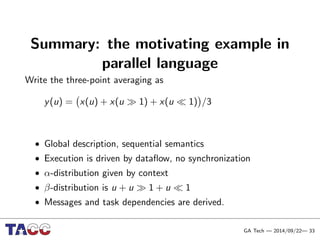
Sequential semantics is close to the mathematics of the problem. 
Note: sequential semantics in the programming model does not 
mean BSP synchronization in the execution. 
Also note: sequential semantics is subtly dierent from SPMD 
(but at least SPMD puts you in the asynchronous mindset) 
GA Tech | 2014/09/22| 7
Execution model 
Virtual machine: data 
ow. 
 Data 
ow expresses the essential dependencies in an 
algorithm. 
 Data 
ow applies to multiple parallelism models. 
 But it would be a mistake to program data
ow explicitly. 
GA Tech | 2014/09/22| 8
Data model 
Distribution: mapping from processors to data. 
(note: traditionally the other way around) 
Needed (and missing from existing systems such as UPC, HPF): 
 distributions need to be
rst-class objects: 
) we want an algebra of distributions 
 algorithms need to be expressed in distributions 
GA Tech | 2014/09/22| 9
Integrative Model for Parallelism (IMP) 
 Theoretical model for describing parallelism 
 Library (or maybe language) for describing operations on 
parallel data 
 Minimal, yet sucient, speci
cation of parallel aspects 
 Many aspects are formally derived (often as
rst-class 
objects), including messages and task dependencies. 
 ) Specify what, not how 
 ) Improve programmer productivity, code quality, eciency 
and robustness 
GA Tech | 2014/09/22| 10
Motivating example 
GA Tech | 2014/09/22| 11
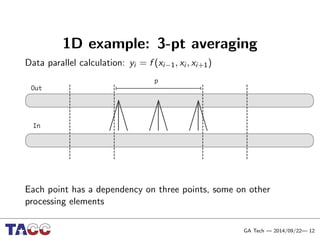
1D example: 3-pt averaging 
Data parallel calculation: yi = f (xi1; xi ; xi+1) 
Each point has a dependency on three points, some on other 
processing elements 
GA Tech | 2014/09/22| 12
;
; 
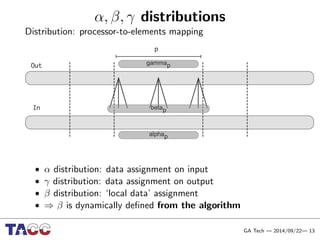
 distributions 
Distribution: processor-to-elements mapping 
  distribution: data assignment on input 
 
 distribution: data assignment on output
distribution: `local data' assignment 
 )
is dynamically de
ned from the algorithm 
GA Tech | 2014/09/22| 13
Data
ow 
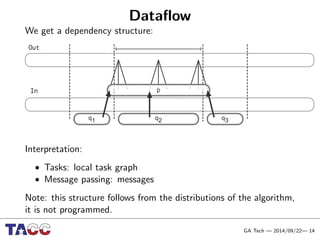
We get a dependency structure: 
Interpretation: 
 Tasks: local task graph 
 Message passing: messages 
Note: this structure follows from the distributions of the algorithm, 
it is not programmed. 
GA Tech | 2014/09/22| 14
Algorithms in the Integrative Model 
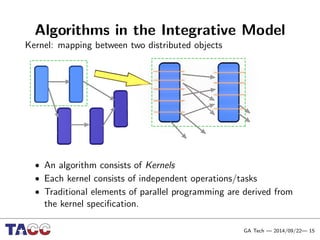
Kernel: mapping between two distributed objects 
 An algorithm consists of Kernels 
 Each kernel consists of independent operations/tasks 
 Traditional elements of parallel programming are derived from 
the kernel speci
cation. 
GA Tech | 2014/09/22| 15
Type system 
GA Tech | 2014/09/22| 16
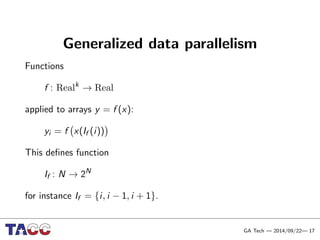
Generalized data parallelism 
Functions 
f : Realk ! Real 
applied to arrays y = f (x): 
yi = f 
 
x(If (i)) 
 
This de
nes function 
If : N ! 2N 
for instance If = fi ; i  1; i + 1g. 
GA Tech | 2014/09/22| 17
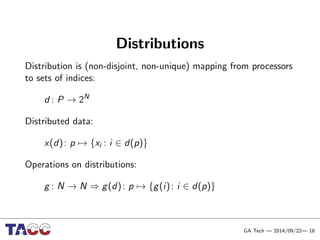
Distributions 
Distribution is (non-disjoint, non-unique) mapping from processors 
to sets of indices: 
d : P ! 2N 
Distributed data: 
x(d) : p7! fxi : i 2 d(p)g 
Operations on distributions: 
g : N ! N ) g(d) : p7! fg(i) : i 2 d(p)g 
GA Tech | 2014/09/22| 18
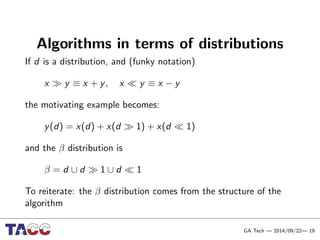
Algorithms in terms of distributions 
If d is a distribution, and (funky notation) 
x  y  x + y; x  y  x  y 
the motivating example becomes: 
y(d) = x(d) + x(d  1) + x(d  1) 
and the
distribution is
= d [ d  1 [ d  1 
To reiterate: the
distribution comes from the structure of the 
algorithm 
GA Tech | 2014/09/22| 19
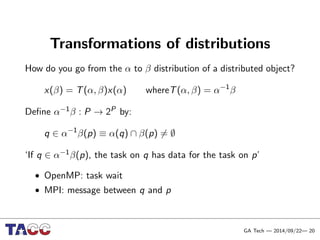
Transformations of distributions 
How do you go from the  to
distribution of a distributed object? 
x(
) = T(;
)x() whereT(;
) = 1
De
ne 1
: P ! 2P by: 
q 2 1
(p)  (q)
(p)6= ; 
`If q 2 1
(p), the task on q has data for the task on p' 
 OpenMP: task wait 
 MPI: message between q and p 
GA Tech | 2014/09/22| 20
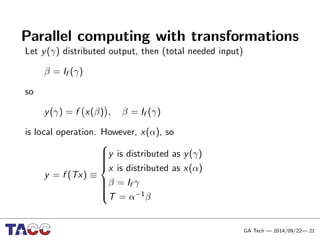
Parallel computing with transformations 
Let y(
) distributed output, then (total needed input)
= If (
) 
so 
y(
) = f 
 
x(
) 
 
;
= If (
) 
is local operation. However, x(), so 
y = f (Tx)  
8 
: 
y is distributed as y(
) 
x is distributed as x()
= If 
 
T = 1
GA Tech | 2014/09/22| 21
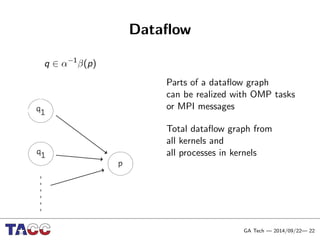
Data
ow 
q 2 1
(p) 
Parts of a data
ow graph 
can be realized with OMP tasks 
or MPI messages 
Total data
ow graph from 
all kernels and 
all processes in kernels 
GA Tech | 2014/09/22| 22

Integrative Parallel Programming in HPC

  • 1.
    Integrative Parallel Programmingin HPC Victor Eijkhout 2014/09/22
  • 2.
    Introduction Motivatingexample Type system Demonstration Other applications Tasks and processes Task execution Research Conclusion GA Tech | 2014/09/22| 2
  • 3.
    Introduction GA Tech| 2014/09/22| 3
  • 4.
    My aims fora new parallel programming system 1. There are many types of parallelism ) Uniform treatment of parallelism 2. Data movement is more important than computation ) While acknowledging the realities of hardware 3. CS theory seems to ignore HPC-type of parallelism ) Strongly theory based IMP: Integrative Model for Parallelism GA Tech | 2014/09/22| 4
  • 5.
    Design of aprogramming system One needs to distinguish: Programming model How does it look in code Execution model How is it actually executed Data model How is data placed and moved about Three dierent vocabularies! GA Tech | 2014/09/22| 5
  • 6.
    Programming model Sequentialsemantics [A]n HPF program may be understood (and debugged) using sequential semantics, a deterministic world that we are comfortable with. Once again, as in traditional programming, the programmer works with a single address space, treating an array as a single, monolithic object, regardless of how it may be distributed across the memories of a parallel machine. (Nikhil 1993) As opposed to [H]umans are quickly overwhelmed by concurrency and
  • 7.
    nd it muchmore dicult to reason about concurrent than sequential code. Even careful people miss possible interleavings among even simple collections of partially ordered operations. (Sutter and Larus 2005) GA Tech | 2014/09/22| 6
  • 8.
    Programming model Sequentialsemantics is close to the mathematics of the problem. Note: sequential semantics in the programming model does not mean BSP synchronization in the execution. Also note: sequential semantics is subtly dierent from SPMD (but at least SPMD puts you in the asynchronous mindset) GA Tech | 2014/09/22| 7
  • 9.
    Execution model Virtualmachine: data ow. Data ow expresses the essential dependencies in an algorithm. Data ow applies to multiple parallelism models. But it would be a mistake to program data ow explicitly. GA Tech | 2014/09/22| 8
  • 10.
    Data model Distribution:mapping from processors to data. (note: traditionally the other way around) Needed (and missing from existing systems such as UPC, HPF): distributions need to be
  • 11.
    rst-class objects: )we want an algebra of distributions algorithms need to be expressed in distributions GA Tech | 2014/09/22| 9
  • 12.
    Integrative Model forParallelism (IMP) Theoretical model for describing parallelism Library (or maybe language) for describing operations on parallel data Minimal, yet sucient, speci
  • 13.
    cation of parallelaspects Many aspects are formally derived (often as
  • 14.
    rst-class objects), includingmessages and task dependencies. ) Specify what, not how ) Improve programmer productivity, code quality, eciency and robustness GA Tech | 2014/09/22| 10
  • 15.
    Motivating example GATech | 2014/09/22| 11
  • 16.
    1D example: 3-ptaveraging Data parallel calculation: yi = f (xi1; xi ; xi+1) Each point has a dependency on three points, some on other processing elements GA Tech | 2014/09/22| 12
  • 17.
  • 18.
    ; distributions Distribution: processor-to-elements mapping distribution: data assignment on input distribution: data assignment on output
  • 19.
  • 20.
  • 21.
    ned from thealgorithm GA Tech | 2014/09/22| 13
  • 22.
    Data ow We geta dependency structure: Interpretation: Tasks: local task graph Message passing: messages Note: this structure follows from the distributions of the algorithm, it is not programmed. GA Tech | 2014/09/22| 14
  • 23.
    Algorithms in theIntegrative Model Kernel: mapping between two distributed objects An algorithm consists of Kernels Each kernel consists of independent operations/tasks Traditional elements of parallel programming are derived from the kernel speci
  • 24.
    cation. GA Tech| 2014/09/22| 15
  • 25.
    Type system GATech | 2014/09/22| 16
  • 26.
    Generalized data parallelism Functions f : Realk ! Real applied to arrays y = f (x): yi = f x(If (i)) This de
  • 27.
    nes function If: N ! 2N for instance If = fi ; i 1; i + 1g. GA Tech | 2014/09/22| 17
  • 28.
    Distributions Distribution is(non-disjoint, non-unique) mapping from processors to sets of indices: d : P ! 2N Distributed data: x(d) : p7! fxi : i 2 d(p)g Operations on distributions: g : N ! N ) g(d) : p7! fg(i) : i 2 d(p)g GA Tech | 2014/09/22| 18
  • 29.
    Algorithms in termsof distributions If d is a distribution, and (funky notation) x y x + y; x y x y the motivating example becomes: y(d) = x(d) + x(d 1) + x(d 1) and the
  • 30.
  • 31.
    = d [d 1 [ d 1 To reiterate: the
  • 32.
    distribution comes fromthe structure of the algorithm GA Tech | 2014/09/22| 19
  • 33.
    Transformations of distributions How do you go from the to
  • 34.
    distribution of adistributed object? x(
  • 35.
  • 36.
  • 37.
  • 38.
  • 39.
  • 40.
    : P !2P by: q 2 1
  • 41.
  • 42.
  • 43.
    (p), the taskon q has data for the task on p' OpenMP: task wait MPI: message between q and p GA Tech | 2014/09/22| 20
  • 44.
    Parallel computing withtransformations Let y( ) distributed output, then (total needed input)
  • 45.
    = If ( ) so y( ) = f x(
  • 46.
  • 47.
    = If ( ) is local operation. However, x(), so y = f (Tx) 8 : y is distributed as y( ) x is distributed as x()
  • 48.
    = If T = 1
  • 49.
    GA Tech |2014/09/22| 21
  • 50.
  • 51.
    (p) Parts ofa data ow graph can be realized with OMP tasks or MPI messages Total data ow graph from all kernels and all processes in kernels GA Tech | 2014/09/22| 22