Distributed online optimization over jointly connected
digraphs
David Mateos-N´u˜nez Jorge Cort´es
University of California, San Diego
{dmateosn,cortes}@ucsd.edu
Mathematical Theory of Networks and Systems
University of Groningen, July 7, 2014
1 / 30
Overview of this talk
Distributed optimization Online optimization
Case study: medical diagnosis
2 / 30
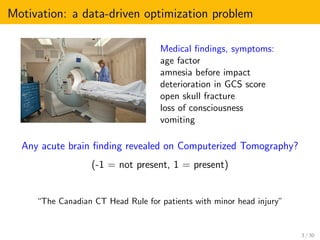
Motivation: a data-driven optimization problem
Medical findings, symptoms:
age factor
amnesia before impact
deterioration in GCS score
open skull fracture
loss of consciousness
vomiting
Any acute brain finding revealed on Computerized Tomography?
(-1 = not present, 1 = present)
“The Canadian CT Head Rule for patients with minor head injury”
3 / 30
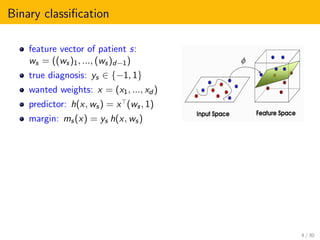
Binary classification
feature vector of patient s:
ws = ((ws)1, ..., (ws)d−1)
true diagnosis: ys ∈ {−1, 1}
wanted weights: x = (x1, ..., xd )
predictor: h(x, ws) = x (ws, 1)
margin: ms(x) = ys h(x, ws)
4 / 30
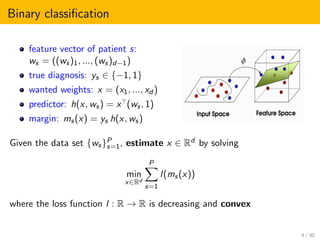
Binary classification
feature vector of patient s:
ws = ((ws)1, ..., (ws)d−1)
true diagnosis: ys ∈ {−1, 1}
wanted weights: x = (x1, ..., xd )
predictor: h(x, ws) = x (ws, 1)
margin: ms(x) = ys h(x, ws)
Given the data set {ws}P
s=1, estimate x ∈ Rd by solving
min
x∈Rd
P
s=1
l(ms(x))
where the loss function l : R → R is decreasing and convex
4 / 30
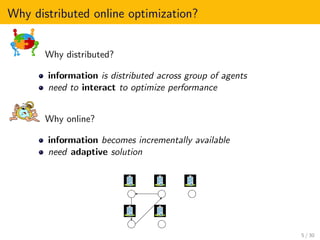
Why distributed online optimization?
Why distributed?
information is distributed across group of agents
need to interact to optimize performance
Why online?
information becomes incrementally available
need adaptive solution
5 / 30
Review of
distributed convex optimization
6 / 30
A distributed scenario
In the diagnosis example health center i ∈ {1, . . . , N}
manages a set of patients Pi
f (x) =
N
i=1 s∈Pi
l(ysh(x, ws)) =
N
i=1
f i
(x)
7 / 30
A distributed scenario
In the diagnosis example health center i ∈ {1, . . . , N}
manages a set of patients Pi
f (x) =
N
i=1 s∈Pi
l(ysh(x, ws)) =
N
i=1
f i
(x)
Goal: best predicting model w → h(x∗, w)
min
x∈Rd
N
i=1
f i
(x)
using “local information”
7 / 30
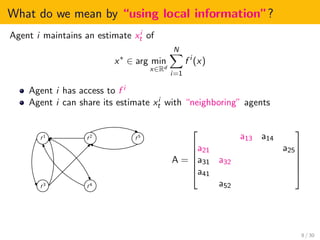
What do we mean by “using local information”?
Agent i maintains an estimate xi
t of
x∗
∈ arg min
x∈Rd
N
i=1
f i
(x)
Agent i has access to f i
Agent i can share its estimate xi
t with “neighboring” agents
f 1
f 2
f 3
f 4
f 5
A =






a13 a14
a21 a25
a31 a32
a41
a52






8 / 30
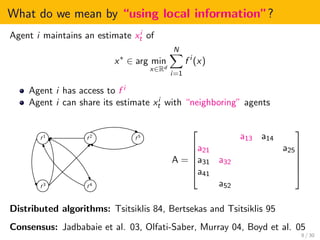
What do we mean by “using local information”?
Agent i maintains an estimate xi
t of
x∗
∈ arg min
x∈Rd
N
i=1
f i
(x)
Agent i has access to f i
Agent i can share its estimate xi
t with “neighboring” agents
f 1
f 2
f 3
f 4
f 5
A =






a13 a14
a21 a25
a31 a32
a41
a52






Distributed algorithms: Tsitsiklis 84, Bertsekas and Tsitsiklis 95
Consensus: Jadbabaie et al. 03, Olfati-Saber, Murray 04, Boyd et al. 05
8 / 30
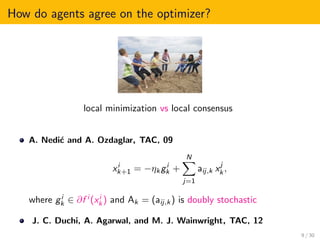
How do agents agree on the optimizer?
local minimization vs local consensus
9 / 30
How do agents agree on the optimizer?
local minimization vs local consensus
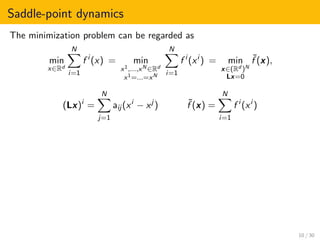
A. Nedi´c and A. Ozdaglar, TAC, 09
xi
k+1 = −ηkgi
k +
N
j=1
aij,k xj
k,
where gi
k ∈ ∂f i (xi
k) and Ak = (aij,k) is doubly stochastic
J. C. Duchi, A. Agarwal, and M. J. Wainwright, TAC, 12
9 / 30
Saddle-point dynamics
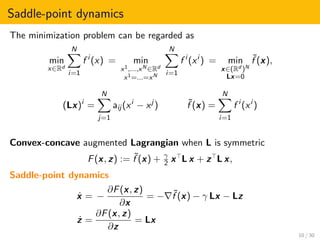
The minimization problem can be regarded as
min
x∈Rd
N
i=1
f i
(x) = min
x1,...,xN ∈Rd
x1=...=xN
N
i=1
f i
(xi
) = min
x∈(Rd )N
Lx=0
˜f (x),
(Lx)i
=
N
j=1
aij (xi
− xj
) ˜f (x) =
N
i=1
f i
(xi
)
10 / 30
Saddle-point dynamics
The minimization problem can be regarded as
min
x∈Rd
N
i=1
f i
(x) = min
x1,...,xN ∈Rd
x1=...=xN
N
i=1
f i
(xi
) = min
x∈(Rd )N
Lx=0
˜f (x),
(Lx)i
=
N
j=1
aij (xi
− xj
) ˜f (x) =
N
i=1
f i
(xi
)
Convex-concave augmented Lagrangian when L is symmetric
F(x, z) := ˜f (x) + γ
2 x L x + z L x,
Saddle-point dynamics
˙x = −
∂F(x, z)
∂x
= − ˜f (x) − γ Lx − Lz
˙z =
∂F(x, z)
∂z
= Lx
10 / 30
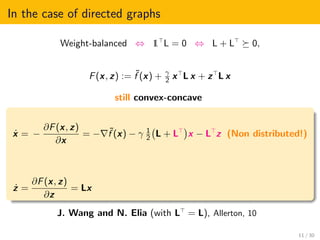
In the case of directed graphs
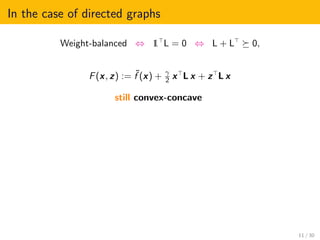
Weight-balanced ⇔ 1 L = 0 ⇔ L + L 0,
F(x, z) := ˜f (x) + γ
2 x L x + z L x
still convex-concave
11 / 30
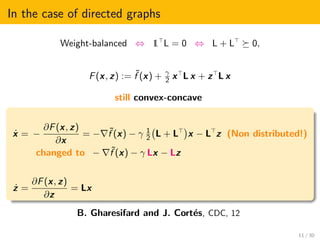
In the case of directed graphs
Weight-balanced ⇔ 1 L = 0 ⇔ L + L 0,
F(x, z) := ˜f (x) + γ
2 x L x + z L x
still convex-concave
˙x = −
∂F(x, z)
∂x
= − ˜f (x) − γ 1
2 L + L x − L z (Non distributed!)
˙z =
∂F(x, z)
∂z
= Lx
J. Wang and N. Elia (with L = L), Allerton, 10
11 / 30
In the case of directed graphs
Weight-balanced ⇔ 1 L = 0 ⇔ L + L 0,
F(x, z) := ˜f (x) + γ
2 x L x + z L x
still convex-concave
˙x = −
∂F(x, z)
∂x
= − ˜f (x) − γ 1
2 L + L x − L z (Non distributed!)
changed to − ˜f (x) − γ Lx − Lz
˙z =
∂F(x, z)
∂z
= Lx
B. Gharesifard and J. Cort´es, CDC, 12
11 / 30
Review of
online convex optimization
12 / 30
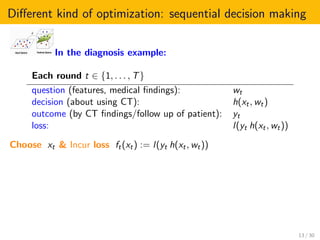
Different kind of optimization: sequential decision making
In the diagnosis example:
Each round t ∈ {1, . . . , T}
question (features, medical findings): wt
decision (about using CT): h(xt, wt)
outcome (by CT findings/follow up of patient): yt
loss: l(yt h(xt, wt))
Choose xt & Incur loss ft(xt) := l(yt h(xt, wt))
13 / 30
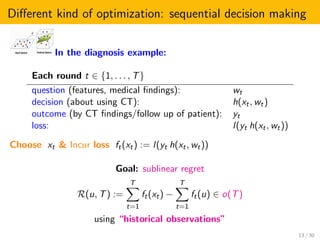
Different kind of optimization: sequential decision making
In the diagnosis example:
Each round t ∈ {1, . . . , T}
question (features, medical findings): wt
decision (about using CT): h(xt, wt)
outcome (by CT findings/follow up of patient): yt
loss: l(yt h(xt, wt))
Choose xt & Incur loss ft(xt) := l(yt h(xt, wt))
Goal: sublinear regret
R(u, T) :=
T
t=1
ft(xt) −
T
t=1
ft(u) ∈ o(T)
using “historical observations”
13 / 30
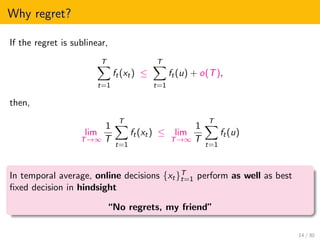
Why regret?
If the regret is sublinear,
T
t=1
ft(xt) ≤
T
t=1
ft(u) + o(T),
then,
lim
T→∞
1
T
T
t=1
ft(xt) ≤ lim
T→∞
1
T
T
t=1
ft(u)
In temporal average, online decisions {xt}T
t=1 perform as well as best
fixed decision in hindsight
“No regrets, my friend”
14 / 30
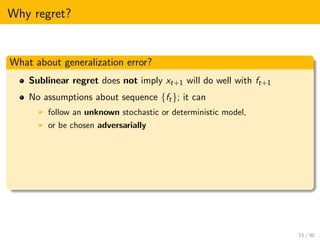
Why regret?
What about generalization error?
Sublinear regret does not imply xt+1 will do well with ft+1
No assumptions about sequence {ft}; it can
follow an unknown stochastic or deterministic model,
or be chosen adversarially
15 / 30
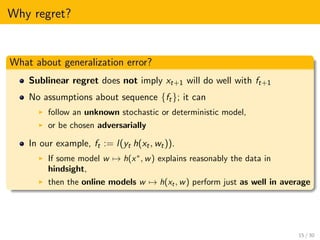
Why regret?
What about generalization error?
Sublinear regret does not imply xt+1 will do well with ft+1
No assumptions about sequence {ft}; it can
follow an unknown stochastic or deterministic model,
or be chosen adversarially
In our example, ft := l(yt h(xt, wt)).
If some model w → h(x∗
, w) explains reasonably the data in
hindsight,
then the online models w → h(xt, w) perform just as well in average
15 / 30
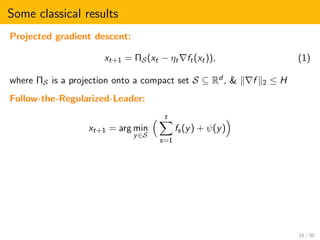
Some classical results
Projected gradient descent:
xt+1 = ΠS(xt − ηt ft(xt)), (1)
where ΠS is a projection onto a compact set S ⊆ Rd , & f 2 ≤ H
Follow-the-Regularized-Leader:
xt+1 = arg min
y∈S
t
s=1
fs(y) + ψ(y)
16 / 30
Some classical results
Projected gradient descent:
xt+1 = ΠS(xt − ηt ft(xt)), (1)
where ΠS is a projection onto a compact set S ⊆ Rd , & f 2 ≤ H
Follow-the-Regularized-Leader:
xt+1 = arg min
y∈S
t
s=1
fs(y) + ψ(y)
Martin Zinkevich, 03
(1) achieves O(
√
T) regret under convexity with ηt = 1√
t
Elad Hazan, Amit Agarwal, and Satyen Kale, 07
(1) achieves O(log T) regret under p-strong convexity with ηt = 1
pt
Others: Online Newton Step, Follow the Regularized Leader, etc.
16 / 30
Done with the review
Now... we combine the two frameworks
Previous work and limitations
our coordination algorithm in the online case
theorems of O(
√
T) & O(log T) agent regrets
simulations
outline of the proof
17 / 30
Combining both frameworks
18 / 30
Resuming the diagnosis example:
Health center i ∈ {1, . . . , N} takes care of a set of patients Pi
t at time t
f i
(x) =
T
t=1 s∈Pi
t
l(ysh(x, ws)) =
T
t=1
f i
t (x)
19 / 30
Resuming the diagnosis example:
Health center i ∈ {1, . . . , N} takes care of a set of patients Pi
t at time t
f i
(x) =
T
t=1 s∈Pi
t
l(ysh(x, ws)) =
T
t=1
f i
t (x)
Goal: sublinear agent regret
Rj
(u, T) :=
T
t=1
N
i=1
f i
t (xj
t ) −
T
t=1
N
i=1
f i
t (u) ≤ o(T)
using “local information” & “historical observations”
19 / 30
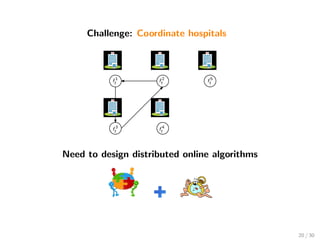
Challenge: Coordinate hospitals
f 1
t f 2
t
f 3
t f 4
t
f 5
t
Need to design distributed online algorithms
20 / 30
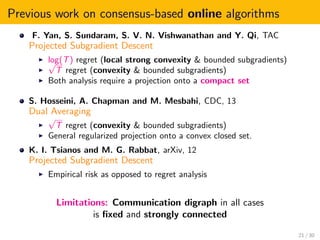
Previous work on consensus-based online algorithms
F. Yan, S. Sundaram, S. V. N. Vishwanathan and Y. Qi, TAC
Projected Subgradient Descent
log(T) regret (local strong convexity & bounded subgradients)√
T regret (convexity & bounded subgradients)
Both analysis require a projection onto a compact set
S. Hosseini, A. Chapman and M. Mesbahi, CDC, 13
Dual Averaging
√
T regret (convexity & bounded subgradients)
General regularized projection onto a convex closed set.
K. I. Tsianos and M. G. Rabbat, arXiv, 12
Projected Subgradient Descent
Empirical risk as opposed to regret analysis
Limitations: Communication digraph in all cases
is fixed and strongly connected
21 / 30
Our contributions (informally)
time-varying communication digraphs under B-joint connectivity &
weight-balanced
unconstrained optimization (no projection step onto a bounded set)
log T regret (local strong convexity & bounded subgradients)
√
T regret (convexity & β-centrality with β ∈ (0, 1] & bounded
subgradients)
22 / 30
Our contributions (informally)
time-varying communication digraphs under B-joint connectivity &
weight-balanced
unconstrained optimization (no projection step onto a bounded set)
log T regret (local strong convexity & bounded subgradients)
√
T regret (convexity & β-centrality with β ∈ (0, 1] & bounded
subgradients)
x∗
x
−ξx
f i
t is β-central in Z ⊆ Rd  X∗,
where X∗ = x∗ : 0 ∈ ∂f i
t (x∗) ,
if ∀x ∈ Z, ∃x∗ ∈ X∗ such that
−ξx (x∗ − x)
ξx 2 x∗ − x 2
≥ β,
for each ξx ∈ ∂f i
t (x).
22 / 30
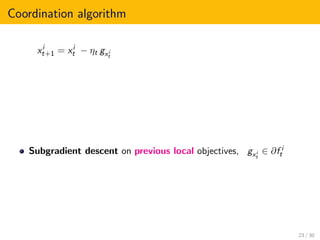
Coordination algorithm
xi
t+1 = xi
t − ηt gxi
t
Subgradient descent on previous local objectives, gxi
t
∈ ∂f i
t
23 / 30
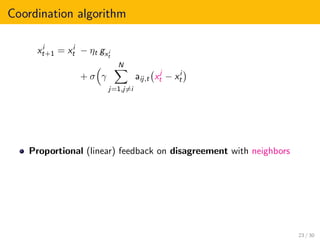
Coordination algorithm
xi
t+1 = xi
t − ηt gxi
t
+ σ γ
N
j=1,j=i
aij,t xj
t − xi
t
Proportional (linear) feedback on disagreement with neighbors
23 / 30
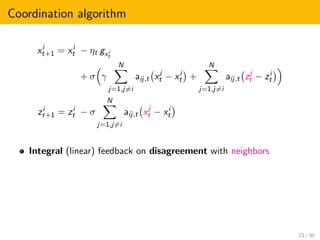
Coordination algorithm
xi
t+1 = xi
t − ηt gxi
t
+ σ γ
N
j=1,j=i
aij,t xj
t − xi
t +
N
j=1,j=i
aij,t zj
t − zi
t
zi
t+1 = zi
t − σ
N
j=1,j=i
aij,t xj
t − xi
t
Integral (linear) feedback on disagreement with neighbors
23 / 30
Coordination algorithm
xi
t+1 = xi
t − ηt gxi
t
+ σ γ
N
j=1,j=i
aij,t xj
t − xi
t +
N
j=1,j=i
aij,t zj
t − zi
t
zi
t+1 = zi
t − σ
N
j=1,j=i
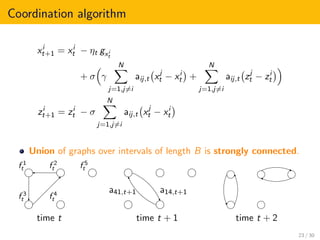
aij,t xj
t − xi
t
Union of graphs over intervals of length B is strongly connected.
f 1
t f 2
t
f 3
t f 4
t
f 5
t
time t time t + 1
a14,t+1a41,t+1
time t + 2
23 / 30
Coordination algorithm
xi
t+1 = xi
t − ηt gxi
t
+ σ γ
N
j=1,j=i
aij,t xj
t − xi
t +
N
j=1,j=i
aij,t zj
t − zi
t
zi
t+1 = zi
t − σ
N
j=1,j=i
aij,t xj
t − xi
t
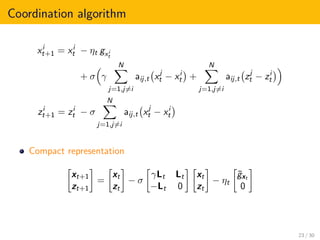
Compact representation
xt+1
zt+1
=
xt
zt
− σ
γLt Lt
−Lt 0
xt
zt
− ηt
˜gxt
0
23 / 30
Coordination algorithm
xi
t+1 = xi
t − ηt gxi
t
+ σ γ
N
j=1,j=i
aij,t xj
t − xi
t +
N
j=1,j=i
aij,t zj
t − zi
t
zi
t+1 = zi
t − σ
N
j=1,j=i
aij,t xj
t − xi
t
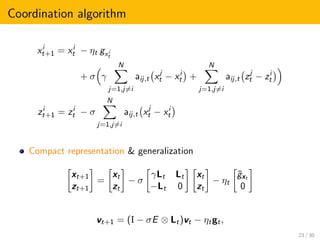
Compact representation & generalization
xt+1
zt+1
=
xt
zt
− σ
γLt Lt
−Lt 0
xt
zt
− ηt
˜gxt
0
vt+1 = (I − σE ⊗ Lt)vt − ηtgt,
23 / 30
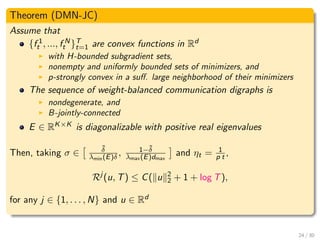
Theorem (DMN-JC)
Assume that
{f 1
t , ..., f N
t }T
t=1 are convex functions in Rd
with H-bounded subgradient sets,
nonempty and uniformly bounded sets of minimizers, and
p-strongly convex in a suff. large neighborhood of their minimizers
The sequence of weight-balanced communication digraphs is
nondegenerate, and
B-jointly-connected
E ∈ RK×K is diagonalizable with positive real eigenvalues
Then, taking σ ∈
˜δ
λmin(E)δ , 1−˜δ
λmax(E)dmax
and ηt = 1
p t ,
Rj
(u, T) ≤ C( u 2
2 + 1 + log T),
for any j ∈ {1, . . . , N} and u ∈ Rd
24 / 30
Theorem (DMN-JC)
Assume that
{f 1
t , ..., f N
t }T
t=1 are convex functions in Rd
with H-bounded subgradient sets,
nonempty and uniformly bounded sets of minimizers, and
p-strongly convex in a suff. large neighborhood of their minimizers
The sequence of weight-balanced communication digraphs is
nondegenerate, and
B-jointly-connected
E ∈ RK×K is diagonalizable with positive real eigenvalues
Substituting strong convexity by β-centrality, for β ∈ (0, 1],
Rj
(u, T) ≤ C u 2
2
√
T,
for any j ∈ {1, . . . , N} and u ∈ Rd
24 / 30
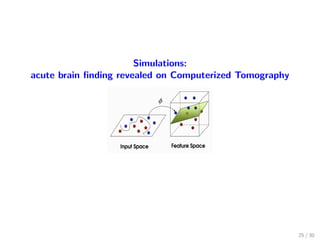
Simulations:
acute brain finding revealed on Computerized Tomography
25 / 30
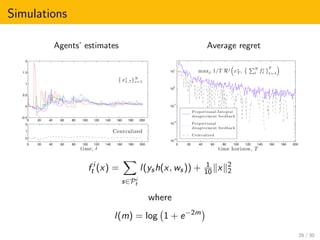
Simulations
Agents’ estimates
0 20 40 60 80 100 120 140 160 180 200
−0.5
0
0.5
1
1.5
2
{ xi
t,7}N
i=1
0 20 40 60 80 100 120 140 160 180 200
0
1
2
time, t
Centralized
Average regret
0 20 40 60 80 100 120 140 160 180 200
10
−3
10
−2
10
−1
10
0
10
1
time horizon, T
maxj 1/T Rj
x∗
T ,
N
i f i
t
T
t=1
Proportional-Integral
disagreement feedback
Proportional
disagreement feedback
Centralized
f i
t (x) =
s∈Pi
t
l(ysh(x, ws)) + 1
10 x 2
2
where
l(m) = log 1 + e−2m
26 / 30
Outline of the proof
Analysis of network regret
RN (u, T) :=
T
t=1
N
i=1
f i
t (xi
t ) −
T
t=1
N
i=1
f i
t (u)
ISS with respect to agreement
ˆLKvt 2 ≤ CI v1 2 1 −
˜δ
4N2
t−1
B
+ CU max
1≤s≤t−1
us 2,
Agent regret bound in terms of {ηt}t≥1 and initial conditions
Boundedness of online estimates under β-centrality (β ∈ (0, 1] )
Doubling trick to obtain O(
√
T) agent regret
Local strong convexity ⇒ β-centrality
ηt = 1
p t to obtain O(log T) agent regret
27 / 30
Conclusions and future work
Conclusions
Distributed online convex optimization over jointly connected
digraphs,
submitted to IEEE Transactions on Network Science and Engineering
(can be found in the webpage of Jorge Cort´es)
Relevant for regression & classification that play a crucial role in
machine learning, computer vision, etc.
Future work
Refine guarantees under
model for evolution
of objective functions
28 / 30
Future directions in data-driven optimization problems
Distributed strategies for...
feature selection
semi-supervised learning
29 / 30
Thank you for listening!
Contact: David Mateos-N´u˜nez and Jorge Cort´es, at UC San Diego
30 / 30

slides_online_optimization_david_mateos

  • 1.
    Distributed online optimizationover jointly connected digraphs David Mateos-N´u˜nez Jorge Cort´es University of California, San Diego {dmateosn,cortes}@ucsd.edu Mathematical Theory of Networks and Systems University of Groningen, July 7, 2014 1 / 30
  • 2.
    Overview of thistalk Distributed optimization Online optimization Case study: medical diagnosis 2 / 30
  • 3.
    Motivation: a data-drivenoptimization problem Medical findings, symptoms: age factor amnesia before impact deterioration in GCS score open skull fracture loss of consciousness vomiting Any acute brain finding revealed on Computerized Tomography? (-1 = not present, 1 = present) “The Canadian CT Head Rule for patients with minor head injury” 3 / 30
  • 4.
    Binary classification feature vectorof patient s: ws = ((ws)1, ..., (ws)d−1) true diagnosis: ys ∈ {−1, 1} wanted weights: x = (x1, ..., xd ) predictor: h(x, ws) = x (ws, 1) margin: ms(x) = ys h(x, ws) 4 / 30
  • 5.
    Binary classification feature vectorof patient s: ws = ((ws)1, ..., (ws)d−1) true diagnosis: ys ∈ {−1, 1} wanted weights: x = (x1, ..., xd ) predictor: h(x, ws) = x (ws, 1) margin: ms(x) = ys h(x, ws) Given the data set {ws}P s=1, estimate x ∈ Rd by solving min x∈Rd P s=1 l(ms(x)) where the loss function l : R → R is decreasing and convex 4 / 30
  • 6.
    Why distributed onlineoptimization? Why distributed? information is distributed across group of agents need to interact to optimize performance Why online? information becomes incrementally available need adaptive solution 5 / 30
  • 7.
    Review of distributed convexoptimization 6 / 30
  • 8.
    A distributed scenario Inthe diagnosis example health center i ∈ {1, . . . , N} manages a set of patients Pi f (x) = N i=1 s∈Pi l(ysh(x, ws)) = N i=1 f i (x) 7 / 30
  • 9.
    A distributed scenario Inthe diagnosis example health center i ∈ {1, . . . , N} manages a set of patients Pi f (x) = N i=1 s∈Pi l(ysh(x, ws)) = N i=1 f i (x) Goal: best predicting model w → h(x∗, w) min x∈Rd N i=1 f i (x) using “local information” 7 / 30
  • 10.
    What do wemean by “using local information”? Agent i maintains an estimate xi t of x∗ ∈ arg min x∈Rd N i=1 f i (x) Agent i has access to f i Agent i can share its estimate xi t with “neighboring” agents f 1 f 2 f 3 f 4 f 5 A =       a13 a14 a21 a25 a31 a32 a41 a52       8 / 30
  • 11.
    What do wemean by “using local information”? Agent i maintains an estimate xi t of x∗ ∈ arg min x∈Rd N i=1 f i (x) Agent i has access to f i Agent i can share its estimate xi t with “neighboring” agents f 1 f 2 f 3 f 4 f 5 A =       a13 a14 a21 a25 a31 a32 a41 a52       Distributed algorithms: Tsitsiklis 84, Bertsekas and Tsitsiklis 95 Consensus: Jadbabaie et al. 03, Olfati-Saber, Murray 04, Boyd et al. 05 8 / 30
  • 12.
    How do agentsagree on the optimizer? local minimization vs local consensus 9 / 30
  • 13.
    How do agentsagree on the optimizer? local minimization vs local consensus A. Nedi´c and A. Ozdaglar, TAC, 09 xi k+1 = −ηkgi k + N j=1 aij,k xj k, where gi k ∈ ∂f i (xi k) and Ak = (aij,k) is doubly stochastic J. C. Duchi, A. Agarwal, and M. J. Wainwright, TAC, 12 9 / 30
  • 14.
    Saddle-point dynamics The minimizationproblem can be regarded as min x∈Rd N i=1 f i (x) = min x1,...,xN ∈Rd x1=...=xN N i=1 f i (xi ) = min x∈(Rd )N Lx=0 ˜f (x), (Lx)i = N j=1 aij (xi − xj ) ˜f (x) = N i=1 f i (xi ) 10 / 30
  • 15.
    Saddle-point dynamics The minimizationproblem can be regarded as min x∈Rd N i=1 f i (x) = min x1,...,xN ∈Rd x1=...=xN N i=1 f i (xi ) = min x∈(Rd )N Lx=0 ˜f (x), (Lx)i = N j=1 aij (xi − xj ) ˜f (x) = N i=1 f i (xi ) Convex-concave augmented Lagrangian when L is symmetric F(x, z) := ˜f (x) + γ 2 x L x + z L x, Saddle-point dynamics ˙x = − ∂F(x, z) ∂x = − ˜f (x) − γ Lx − Lz ˙z = ∂F(x, z) ∂z = Lx 10 / 30
  • 16.
    In the caseof directed graphs Weight-balanced ⇔ 1 L = 0 ⇔ L + L 0, F(x, z) := ˜f (x) + γ 2 x L x + z L x still convex-concave 11 / 30
  • 17.
    In the caseof directed graphs Weight-balanced ⇔ 1 L = 0 ⇔ L + L 0, F(x, z) := ˜f (x) + γ 2 x L x + z L x still convex-concave ˙x = − ∂F(x, z) ∂x = − ˜f (x) − γ 1 2 L + L x − L z (Non distributed!) ˙z = ∂F(x, z) ∂z = Lx J. Wang and N. Elia (with L = L), Allerton, 10 11 / 30
  • 18.
    In the caseof directed graphs Weight-balanced ⇔ 1 L = 0 ⇔ L + L 0, F(x, z) := ˜f (x) + γ 2 x L x + z L x still convex-concave ˙x = − ∂F(x, z) ∂x = − ˜f (x) − γ 1 2 L + L x − L z (Non distributed!) changed to − ˜f (x) − γ Lx − Lz ˙z = ∂F(x, z) ∂z = Lx B. Gharesifard and J. Cort´es, CDC, 12 11 / 30
  • 19.
    Review of online convexoptimization 12 / 30
  • 20.
    Different kind ofoptimization: sequential decision making In the diagnosis example: Each round t ∈ {1, . . . , T} question (features, medical findings): wt decision (about using CT): h(xt, wt) outcome (by CT findings/follow up of patient): yt loss: l(yt h(xt, wt)) Choose xt & Incur loss ft(xt) := l(yt h(xt, wt)) 13 / 30
  • 21.
    Different kind ofoptimization: sequential decision making In the diagnosis example: Each round t ∈ {1, . . . , T} question (features, medical findings): wt decision (about using CT): h(xt, wt) outcome (by CT findings/follow up of patient): yt loss: l(yt h(xt, wt)) Choose xt & Incur loss ft(xt) := l(yt h(xt, wt)) Goal: sublinear regret R(u, T) := T t=1 ft(xt) − T t=1 ft(u) ∈ o(T) using “historical observations” 13 / 30
  • 22.
    Why regret? If theregret is sublinear, T t=1 ft(xt) ≤ T t=1 ft(u) + o(T), then, lim T→∞ 1 T T t=1 ft(xt) ≤ lim T→∞ 1 T T t=1 ft(u) In temporal average, online decisions {xt}T t=1 perform as well as best fixed decision in hindsight “No regrets, my friend” 14 / 30
  • 23.
    Why regret? What aboutgeneralization error? Sublinear regret does not imply xt+1 will do well with ft+1 No assumptions about sequence {ft}; it can follow an unknown stochastic or deterministic model, or be chosen adversarially 15 / 30
  • 24.
    Why regret? What aboutgeneralization error? Sublinear regret does not imply xt+1 will do well with ft+1 No assumptions about sequence {ft}; it can follow an unknown stochastic or deterministic model, or be chosen adversarially In our example, ft := l(yt h(xt, wt)). If some model w → h(x∗ , w) explains reasonably the data in hindsight, then the online models w → h(xt, w) perform just as well in average 15 / 30
  • 25.
    Some classical results Projectedgradient descent: xt+1 = ΠS(xt − ηt ft(xt)), (1) where ΠS is a projection onto a compact set S ⊆ Rd , & f 2 ≤ H Follow-the-Regularized-Leader: xt+1 = arg min y∈S t s=1 fs(y) + ψ(y) 16 / 30
  • 26.
    Some classical results Projectedgradient descent: xt+1 = ΠS(xt − ηt ft(xt)), (1) where ΠS is a projection onto a compact set S ⊆ Rd , & f 2 ≤ H Follow-the-Regularized-Leader: xt+1 = arg min y∈S t s=1 fs(y) + ψ(y) Martin Zinkevich, 03 (1) achieves O( √ T) regret under convexity with ηt = 1√ t Elad Hazan, Amit Agarwal, and Satyen Kale, 07 (1) achieves O(log T) regret under p-strong convexity with ηt = 1 pt Others: Online Newton Step, Follow the Regularized Leader, etc. 16 / 30
  • 27.
    Done with thereview Now... we combine the two frameworks Previous work and limitations our coordination algorithm in the online case theorems of O( √ T) & O(log T) agent regrets simulations outline of the proof 17 / 30
  • 28.
  • 29.
    Resuming the diagnosisexample: Health center i ∈ {1, . . . , N} takes care of a set of patients Pi t at time t f i (x) = T t=1 s∈Pi t l(ysh(x, ws)) = T t=1 f i t (x) 19 / 30
  • 30.
    Resuming the diagnosisexample: Health center i ∈ {1, . . . , N} takes care of a set of patients Pi t at time t f i (x) = T t=1 s∈Pi t l(ysh(x, ws)) = T t=1 f i t (x) Goal: sublinear agent regret Rj (u, T) := T t=1 N i=1 f i t (xj t ) − T t=1 N i=1 f i t (u) ≤ o(T) using “local information” & “historical observations” 19 / 30
  • 31.
    Challenge: Coordinate hospitals f1 t f 2 t f 3 t f 4 t f 5 t Need to design distributed online algorithms 20 / 30
  • 32.
    Previous work onconsensus-based online algorithms F. Yan, S. Sundaram, S. V. N. Vishwanathan and Y. Qi, TAC Projected Subgradient Descent log(T) regret (local strong convexity & bounded subgradients)√ T regret (convexity & bounded subgradients) Both analysis require a projection onto a compact set S. Hosseini, A. Chapman and M. Mesbahi, CDC, 13 Dual Averaging √ T regret (convexity & bounded subgradients) General regularized projection onto a convex closed set. K. I. Tsianos and M. G. Rabbat, arXiv, 12 Projected Subgradient Descent Empirical risk as opposed to regret analysis Limitations: Communication digraph in all cases is fixed and strongly connected 21 / 30
  • 33.
    Our contributions (informally) time-varyingcommunication digraphs under B-joint connectivity & weight-balanced unconstrained optimization (no projection step onto a bounded set) log T regret (local strong convexity & bounded subgradients) √ T regret (convexity & β-centrality with β ∈ (0, 1] & bounded subgradients) 22 / 30
  • 34.
    Our contributions (informally) time-varyingcommunication digraphs under B-joint connectivity & weight-balanced unconstrained optimization (no projection step onto a bounded set) log T regret (local strong convexity & bounded subgradients) √ T regret (convexity & β-centrality with β ∈ (0, 1] & bounded subgradients) x∗ x −ξx f i t is β-central in Z ⊆ Rd X∗, where X∗ = x∗ : 0 ∈ ∂f i t (x∗) , if ∀x ∈ Z, ∃x∗ ∈ X∗ such that −ξx (x∗ − x) ξx 2 x∗ − x 2 ≥ β, for each ξx ∈ ∂f i t (x). 22 / 30
  • 35.
    Coordination algorithm xi t+1 =xi t − ηt gxi t Subgradient descent on previous local objectives, gxi t ∈ ∂f i t 23 / 30
  • 36.
    Coordination algorithm xi t+1 =xi t − ηt gxi t + σ γ N j=1,j=i aij,t xj t − xi t Proportional (linear) feedback on disagreement with neighbors 23 / 30
  • 37.
    Coordination algorithm xi t+1 =xi t − ηt gxi t + σ γ N j=1,j=i aij,t xj t − xi t + N j=1,j=i aij,t zj t − zi t zi t+1 = zi t − σ N j=1,j=i aij,t xj t − xi t Integral (linear) feedback on disagreement with neighbors 23 / 30
  • 38.
    Coordination algorithm xi t+1 =xi t − ηt gxi t + σ γ N j=1,j=i aij,t xj t − xi t + N j=1,j=i aij,t zj t − zi t zi t+1 = zi t − σ N j=1,j=i aij,t xj t − xi t Union of graphs over intervals of length B is strongly connected. f 1 t f 2 t f 3 t f 4 t f 5 t time t time t + 1 a14,t+1a41,t+1 time t + 2 23 / 30
  • 39.
    Coordination algorithm xi t+1 =xi t − ηt gxi t + σ γ N j=1,j=i aij,t xj t − xi t + N j=1,j=i aij,t zj t − zi t zi t+1 = zi t − σ N j=1,j=i aij,t xj t − xi t Compact representation xt+1 zt+1 = xt zt − σ γLt Lt −Lt 0 xt zt − ηt ˜gxt 0 23 / 30
  • 40.
    Coordination algorithm xi t+1 =xi t − ηt gxi t + σ γ N j=1,j=i aij,t xj t − xi t + N j=1,j=i aij,t zj t − zi t zi t+1 = zi t − σ N j=1,j=i aij,t xj t − xi t Compact representation & generalization xt+1 zt+1 = xt zt − σ γLt Lt −Lt 0 xt zt − ηt ˜gxt 0 vt+1 = (I − σE ⊗ Lt)vt − ηtgt, 23 / 30
  • 41.
    Theorem (DMN-JC) Assume that {f1 t , ..., f N t }T t=1 are convex functions in Rd with H-bounded subgradient sets, nonempty and uniformly bounded sets of minimizers, and p-strongly convex in a suff. large neighborhood of their minimizers The sequence of weight-balanced communication digraphs is nondegenerate, and B-jointly-connected E ∈ RK×K is diagonalizable with positive real eigenvalues Then, taking σ ∈ ˜δ λmin(E)δ , 1−˜δ λmax(E)dmax and ηt = 1 p t , Rj (u, T) ≤ C( u 2 2 + 1 + log T), for any j ∈ {1, . . . , N} and u ∈ Rd 24 / 30
  • 42.
    Theorem (DMN-JC) Assume that {f1 t , ..., f N t }T t=1 are convex functions in Rd with H-bounded subgradient sets, nonempty and uniformly bounded sets of minimizers, and p-strongly convex in a suff. large neighborhood of their minimizers The sequence of weight-balanced communication digraphs is nondegenerate, and B-jointly-connected E ∈ RK×K is diagonalizable with positive real eigenvalues Substituting strong convexity by β-centrality, for β ∈ (0, 1], Rj (u, T) ≤ C u 2 2 √ T, for any j ∈ {1, . . . , N} and u ∈ Rd 24 / 30
  • 43.
    Simulations: acute brain findingrevealed on Computerized Tomography 25 / 30
  • 44.
    Simulations Agents’ estimates 0 2040 60 80 100 120 140 160 180 200 −0.5 0 0.5 1 1.5 2 { xi t,7}N i=1 0 20 40 60 80 100 120 140 160 180 200 0 1 2 time, t Centralized Average regret 0 20 40 60 80 100 120 140 160 180 200 10 −3 10 −2 10 −1 10 0 10 1 time horizon, T maxj 1/T Rj x∗ T , N i f i t T t=1 Proportional-Integral disagreement feedback Proportional disagreement feedback Centralized f i t (x) = s∈Pi t l(ysh(x, ws)) + 1 10 x 2 2 where l(m) = log 1 + e−2m 26 / 30
  • 45.
    Outline of theproof Analysis of network regret RN (u, T) := T t=1 N i=1 f i t (xi t ) − T t=1 N i=1 f i t (u) ISS with respect to agreement ˆLKvt 2 ≤ CI v1 2 1 − ˜δ 4N2 t−1 B + CU max 1≤s≤t−1 us 2, Agent regret bound in terms of {ηt}t≥1 and initial conditions Boundedness of online estimates under β-centrality (β ∈ (0, 1] ) Doubling trick to obtain O( √ T) agent regret Local strong convexity ⇒ β-centrality ηt = 1 p t to obtain O(log T) agent regret 27 / 30
  • 46.
    Conclusions and futurework Conclusions Distributed online convex optimization over jointly connected digraphs, submitted to IEEE Transactions on Network Science and Engineering (can be found in the webpage of Jorge Cort´es) Relevant for regression & classification that play a crucial role in machine learning, computer vision, etc. Future work Refine guarantees under model for evolution of objective functions 28 / 30
  • 47.
    Future directions indata-driven optimization problems Distributed strategies for... feature selection semi-supervised learning 29 / 30
  • 48.
    Thank you forlistening! Contact: David Mateos-N´u˜nez and Jorge Cort´es, at UC San Diego 30 / 30