prabha.reddy95@gmail.com
Definition:
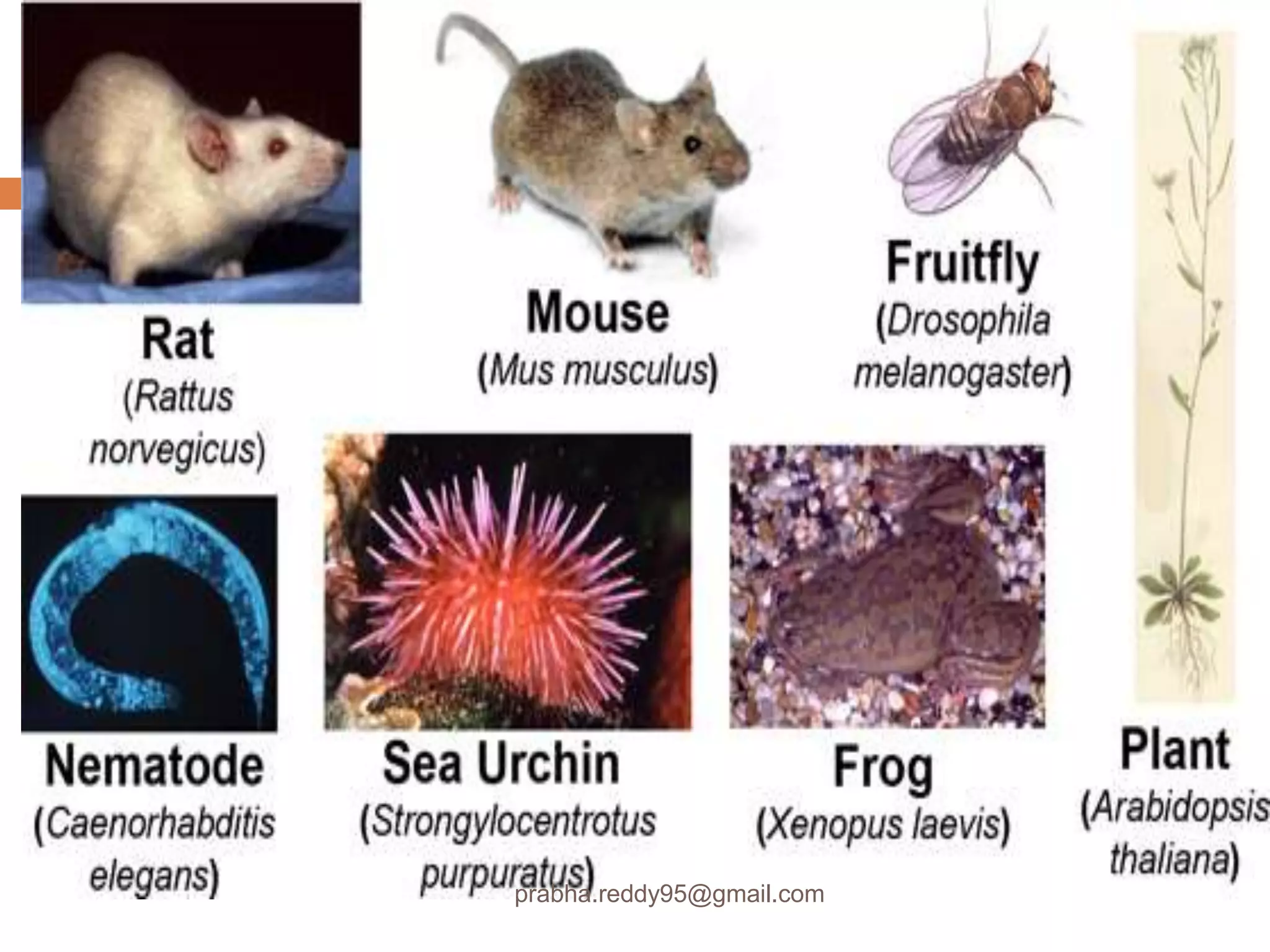
Model organisms are a small number
of species that have been extensively
studied. What has been learnt from
model organisms has been
extrapolated to include other species
in the hope of understanding
developmental, metabolic and
biological pathways that are conservedprabha.reddy95@gmail.com
Why use model
organisms?
Many of the things we study in Biology,
such as disease, development and genetics
needs to be studied in the body (in vivo), to
see how pathways and signals, for
example, really work.
 Realistically always studying these in
humans would be extremely expensive, not
to mention potentially unsafe and unethical.
prabha.reddy95@gmail.com
We use model organisms instead as they
provide amazing insight that cannot be
gained from lab equipment.
We use model organisms instead as they
provide amazing insight that cannot be
gained from lab equipment.
 What we learn about that animal can
then be used to predict what happens in
other animals. This is because all living
organisms have evolved from the same
ancestor and many pathways are the same
across different species.prabha.reddy95@gmail.com
What makes a good model
organism?
A model organism must be easy
to look after in the laboratory.
 They are nearly always small and
do not need a lot of space, have an
easy feeding regime and they must
not be dangerous to work with.
prabha.reddy95@gmail.com
 There are many species that would
make good model organisms, many of
the model organisms used most
frequently were selected because of the
extensive knowledge we already have of
them from previous research.
prabha.reddy95@gmail.com
Fruit
fly
prabha.reddy95@gmail.com
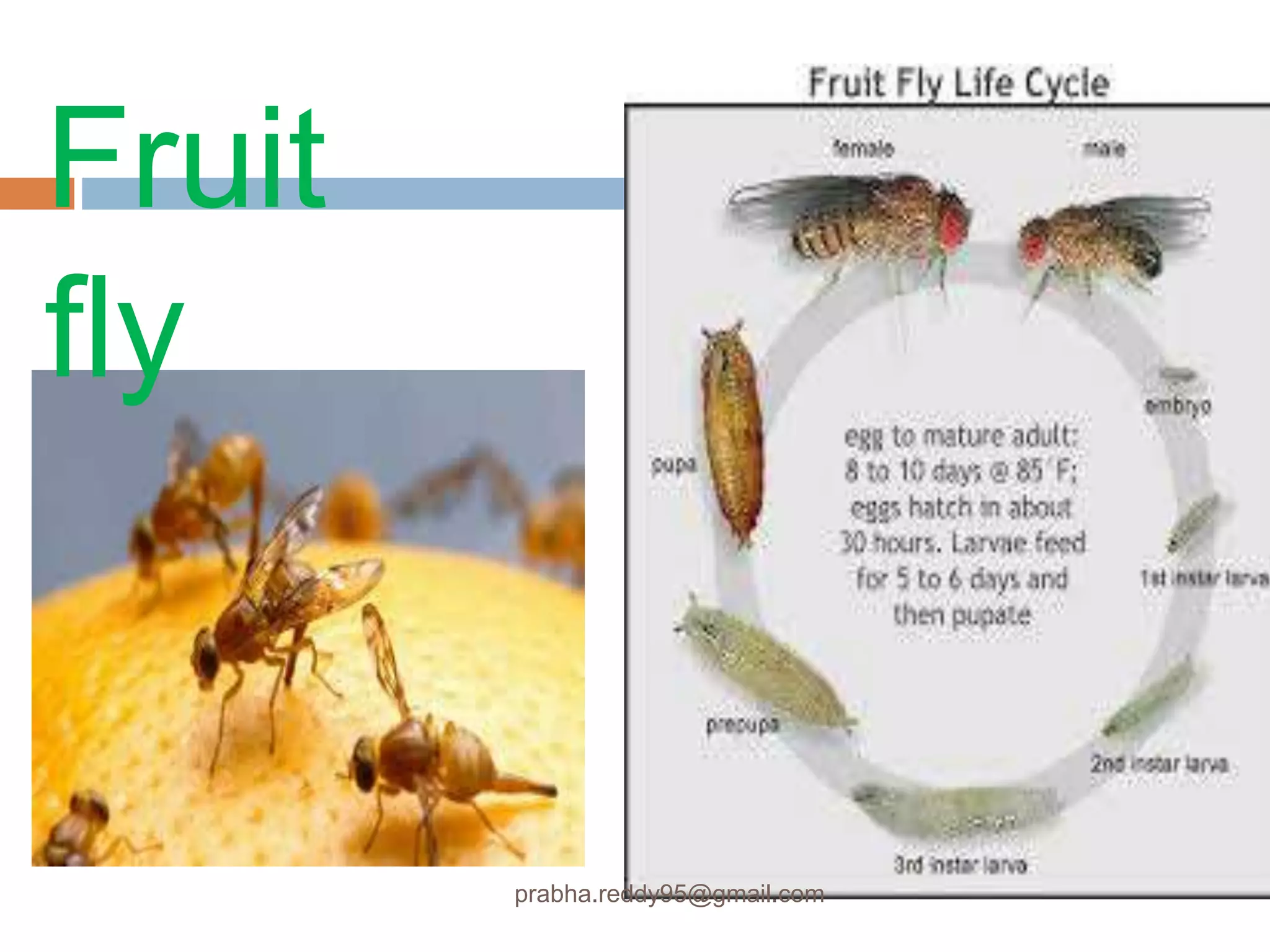
The fruit fly (Drosophila
melanogaster)
was first chosen as a model organism by
geneticist T.H. Morgan and intensively
studied by generations of geneticists after
him.
The fruit fly is small and easily grown in
the laboratory.
It has a generation time of only two weeks
and produces many offspring.
Embryos develop outside the mother’sprabha.reddy95@gmail.com
Amenable to large scale mutational screens to
identify genes involved in particular functions
e.g. forming the right body parts in the right
place. So flies with mutated versions of all
genes in the genome have been isolated.
In addition, there are vast amounts of
information on its genes and other aspects of its
biology. The genome has been sequenced and
is contains 13,600 genes.
prabha.reddy95@gmail.com
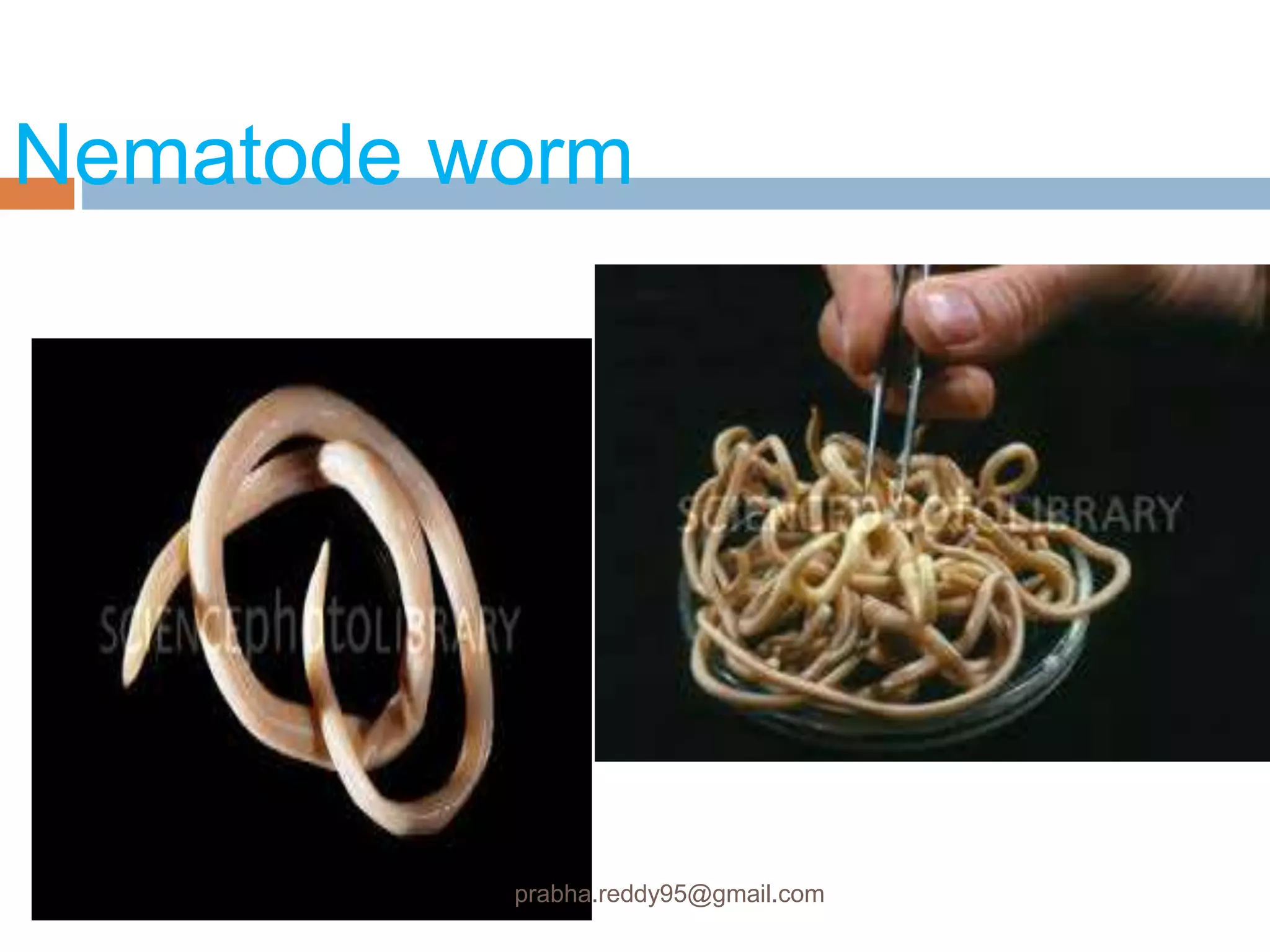
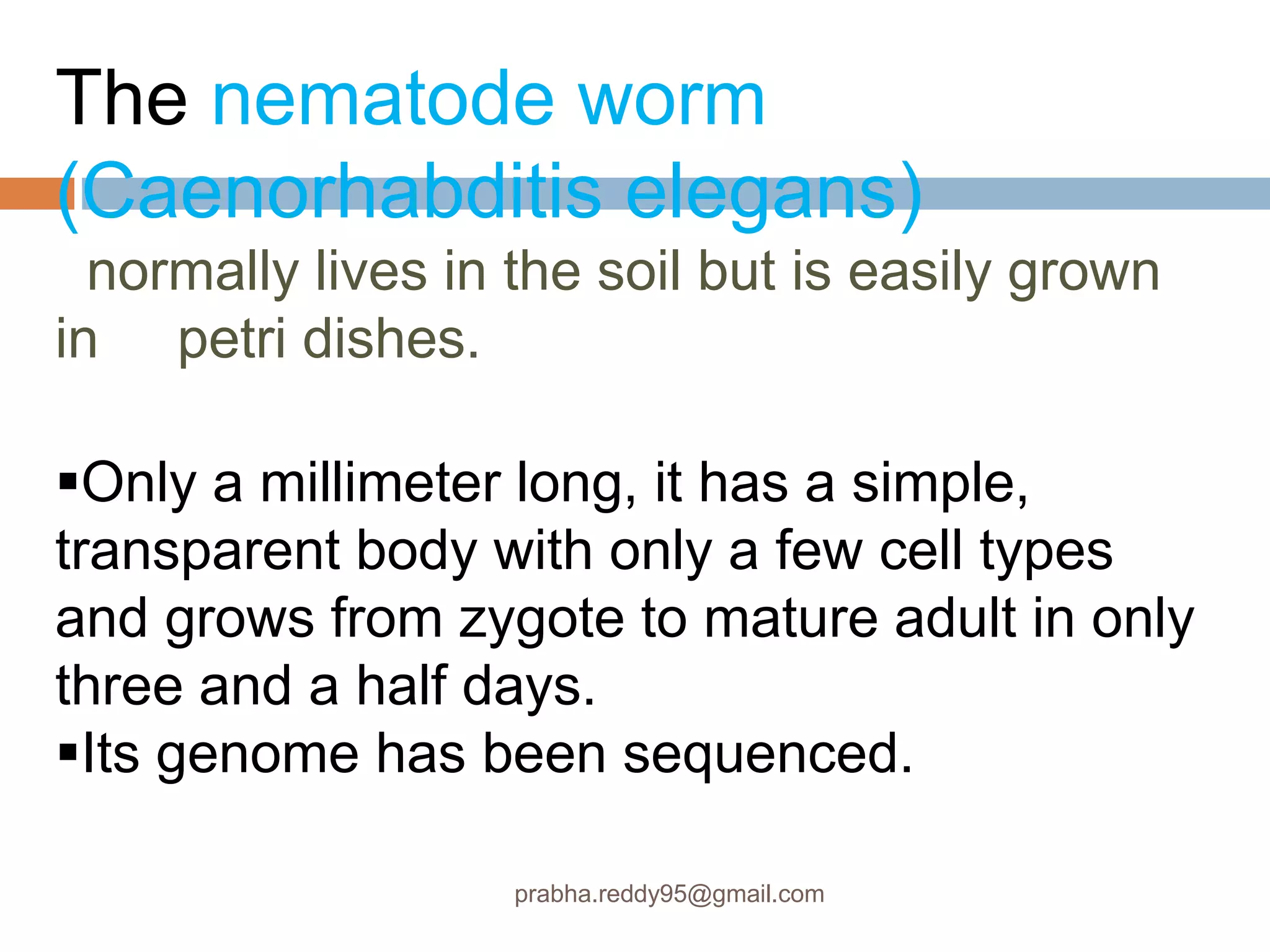
Nematode worm
prabha.reddy95@gmail.com
The nematode worm
(Caenorhabditis elegans)
normally lives in the soil but is easily grown
in petri dishes.
Only a millimeter long, it has a simple,
transparent body with only a few cell types
and grows from zygote to mature adult in only
three and a half days.
Its genome has been sequenced.
prabha.reddy95@gmail.com
 It is easy to identify mutant animals: Because
individuals are hermaphrodites, it is easy to
detect recessive mutations: Self-fertilization of
heterozygotes will produce some homozygous
recessive offspring with mutant phenotypes.
 The huge advantage is its simplicity: every
adult C. elegans has exactly (only) 959
somatic cells. These arise from the zygote in
virtually the same way for every
individual.
prabha.reddy95@gmail.com
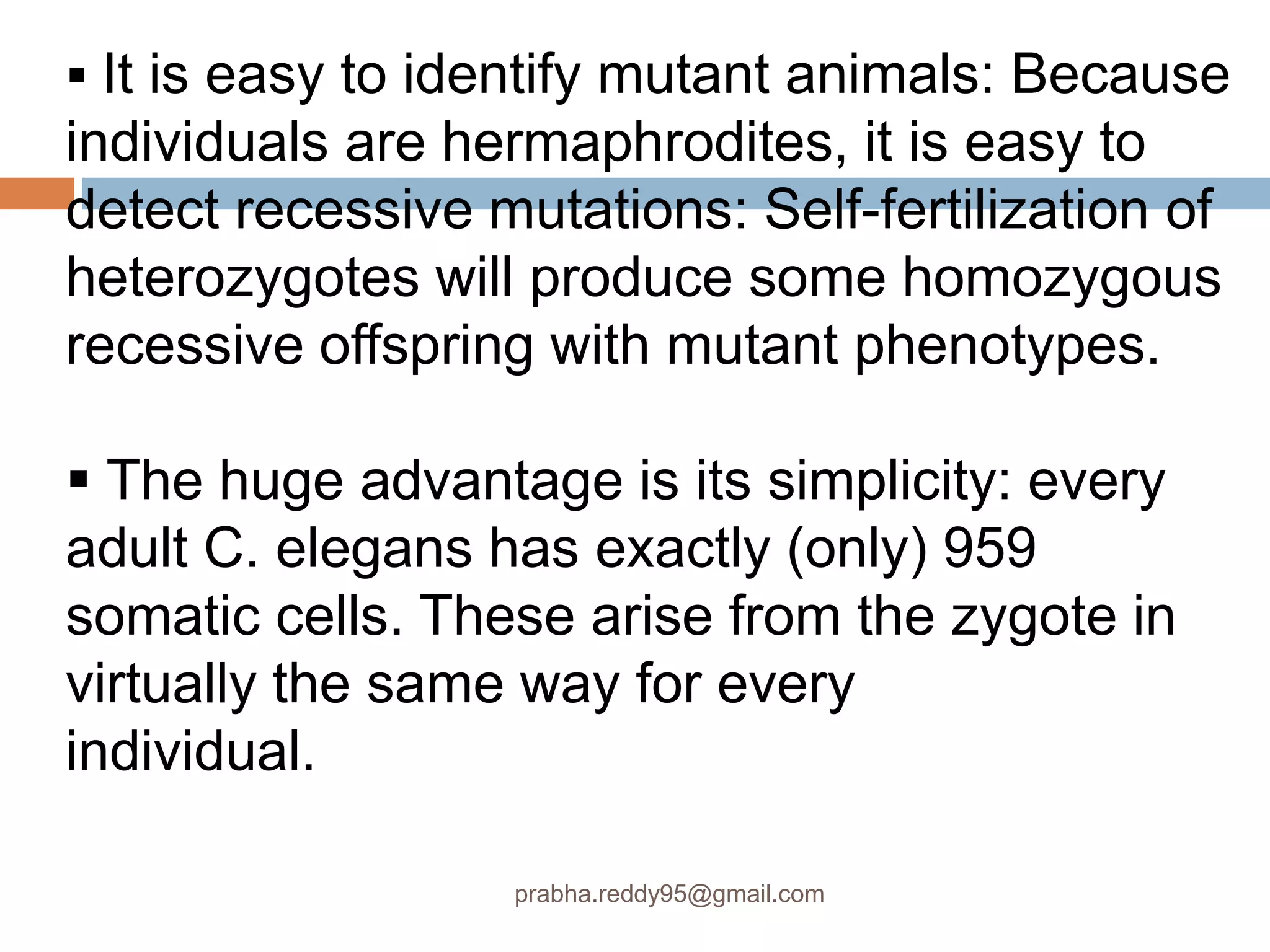
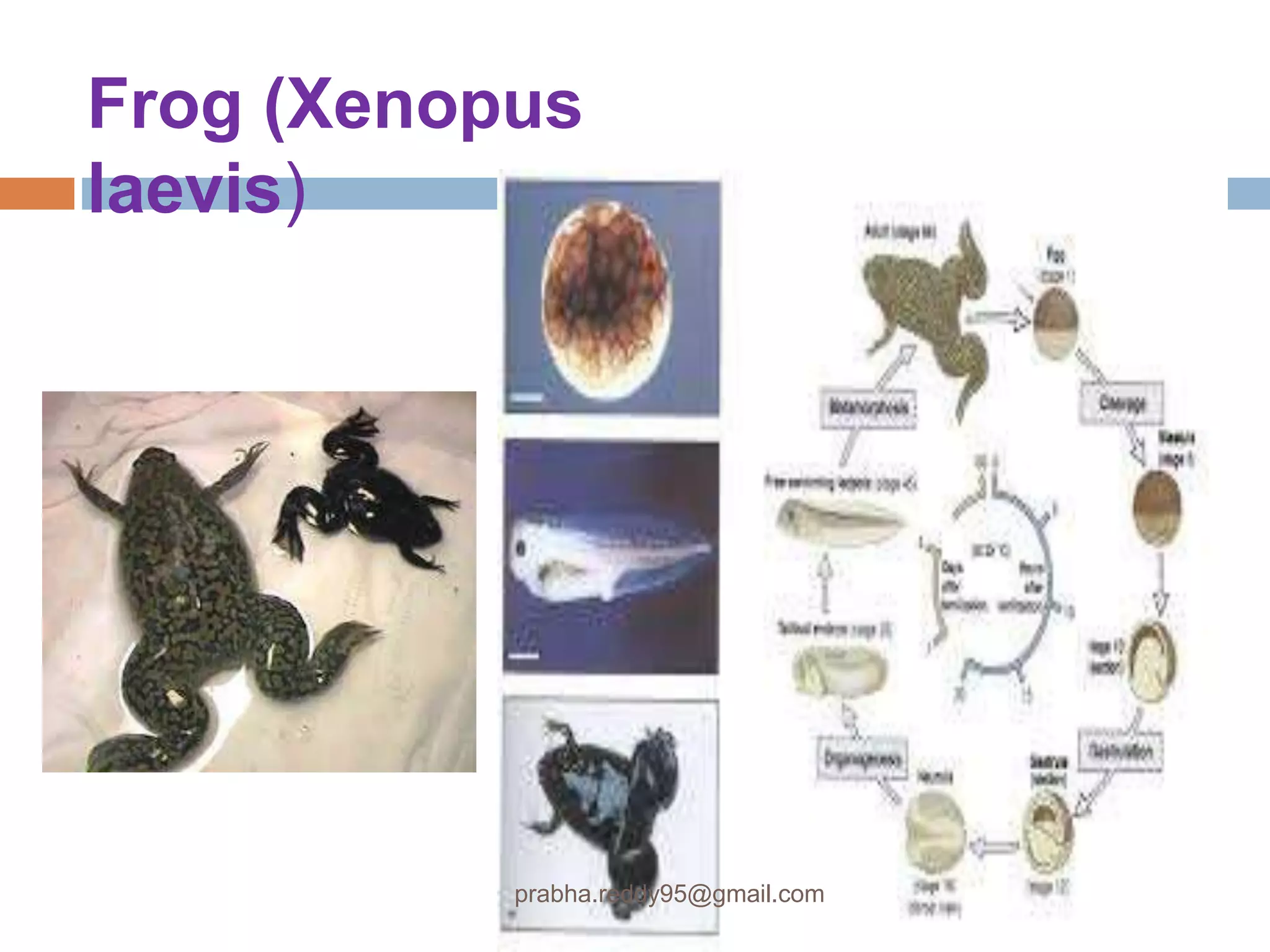
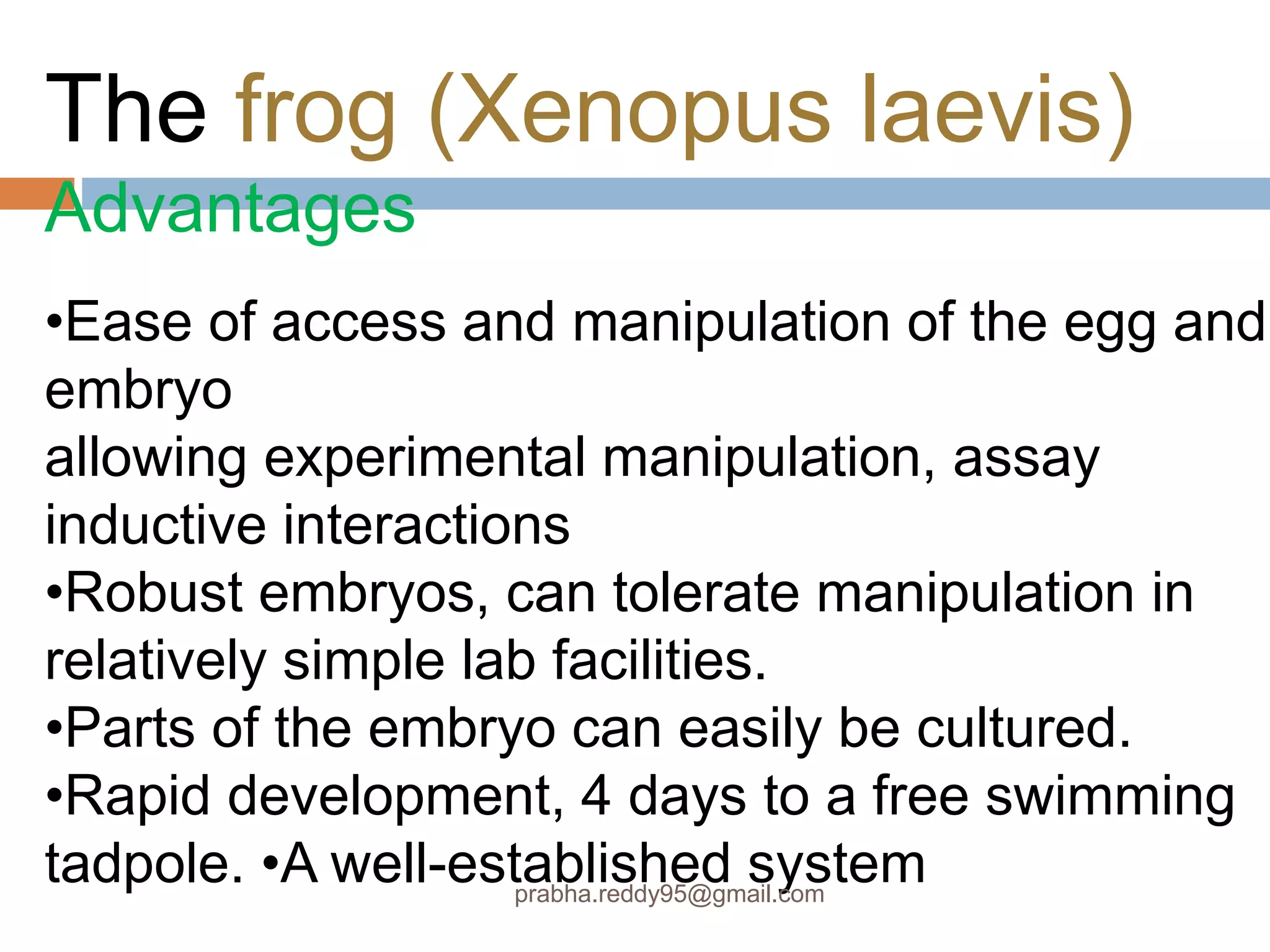
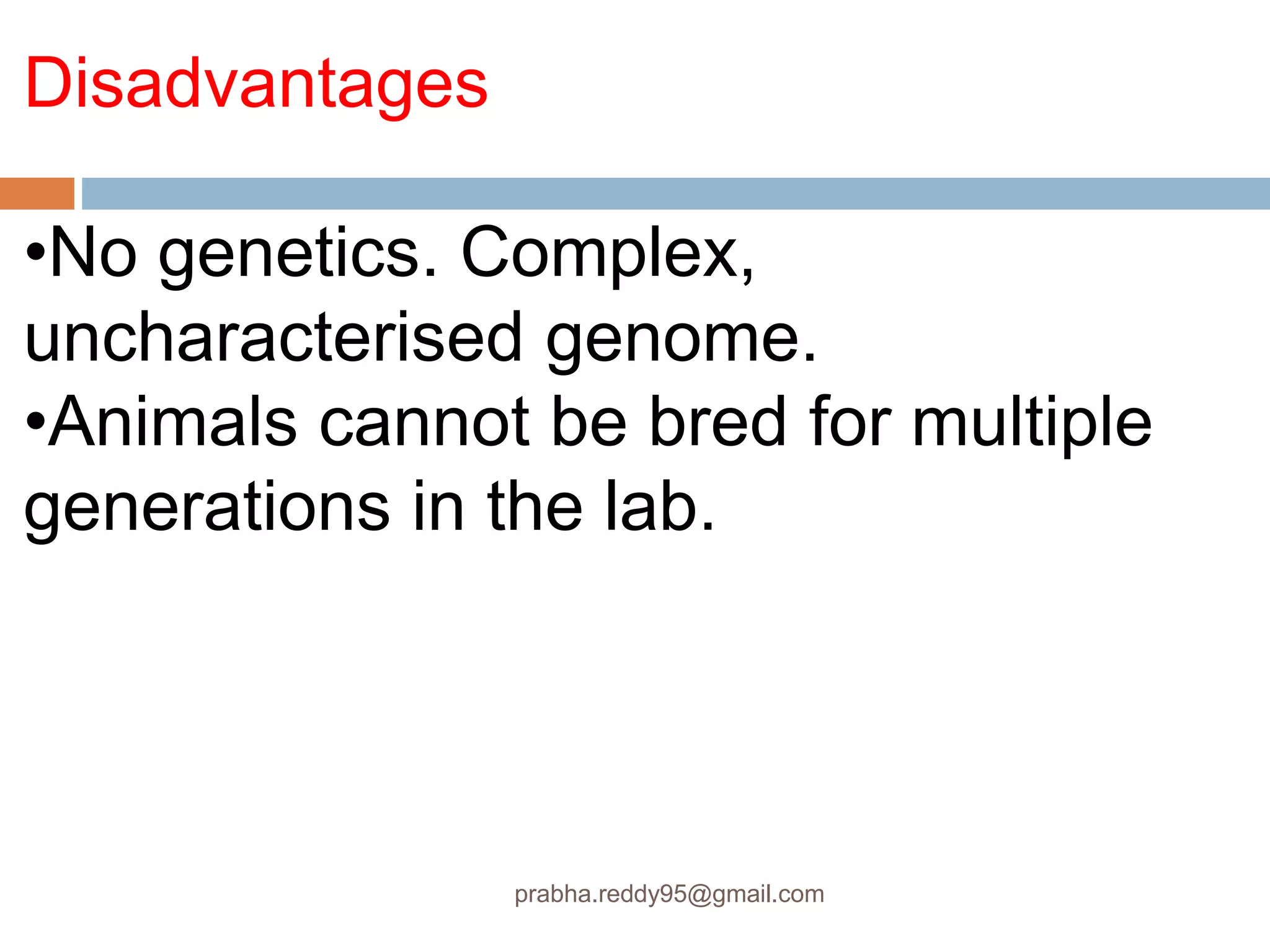
Frog (Xenopus
laevis)
prabha.reddy95@gmail.com
The frog (Xenopus laevis)
Advantages
•Ease of access and manipulation of the egg and
embryo
allowing experimental manipulation, assay
inductive interactions
•Robust embryos, can tolerate manipulation in
relatively simple lab facilities.
•Parts of the embryo can easily be cultured.
•Rapid development, 4 days to a free swimming
tadpole. •A well-established systemprabha.reddy95@gmail.com
Disadvantages
•No genetics. Complex,
uncharacterised genome.
•Animals cannot be bred for multiple
generations in the lab.
prabha.reddy95@gmail.com
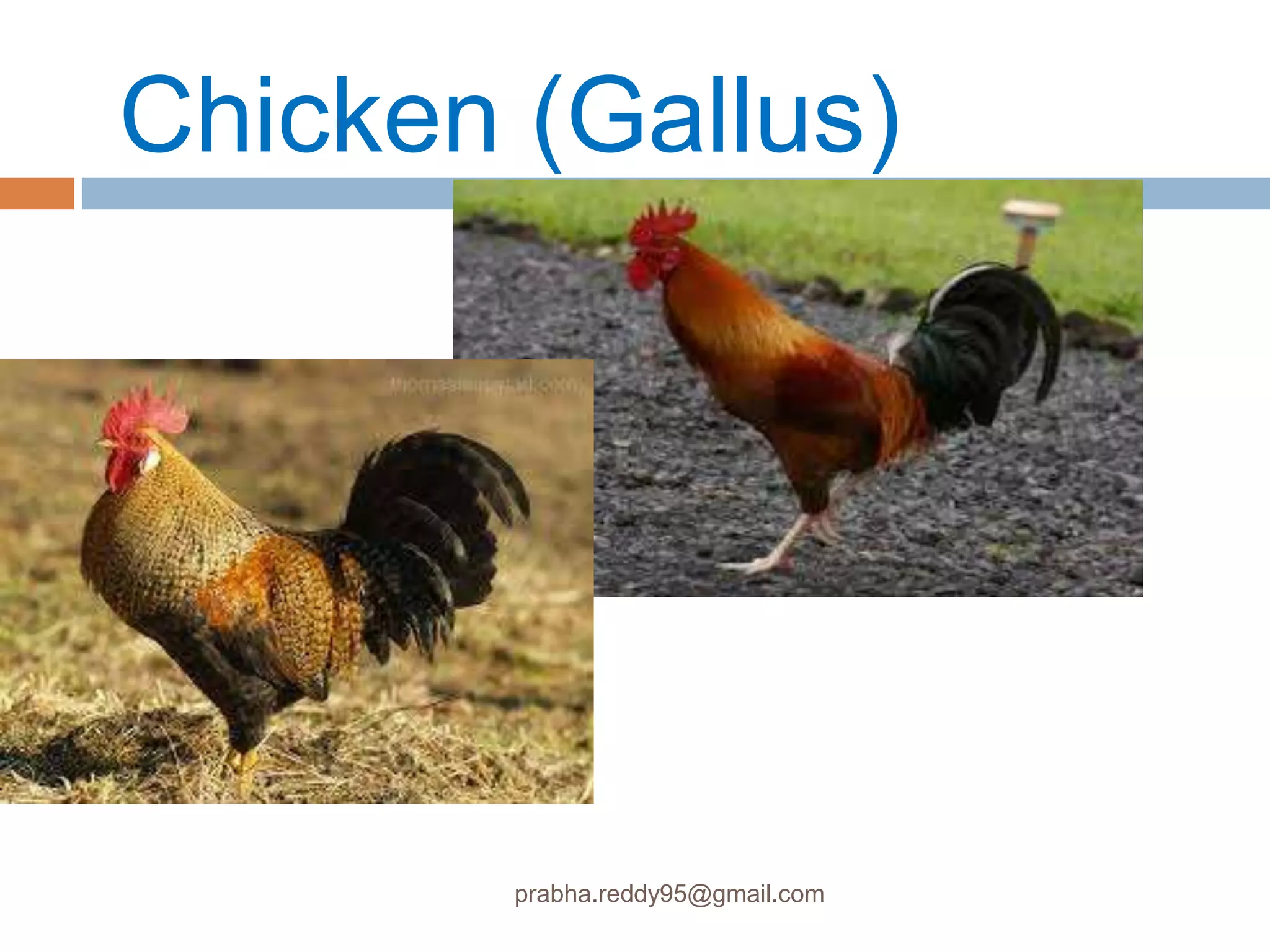
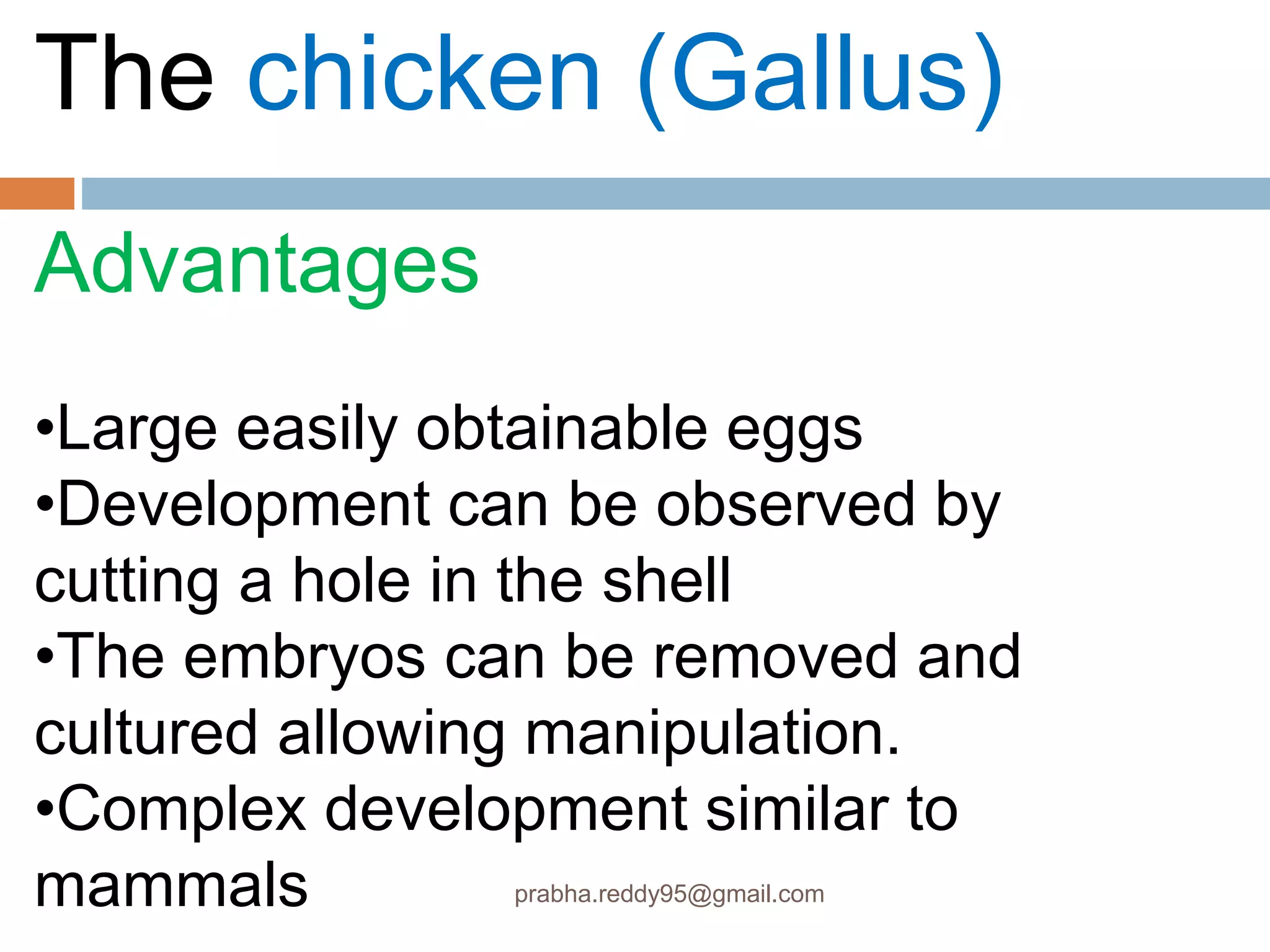
Chicken (Gallus)
prabha.reddy95@gmail.com
The chicken (Gallus)
Advantages
•Large easily obtainable eggs
•Development can be observed by
cutting a hole in the shell
•The embryos can be removed and
cultured allowing manipulation.
•Complex development similar to
mammals prabha.reddy95@gmail.com
•Methods developed for cell lineage
analysis allows experimental
manipulation and cell lineage
studies
Disadvantages
•Not good for classical genetics. It
has a complex genome with many
small prabha.reddy95@gmail.com
Mouse (Mus musculus)
prabha.reddy95@gmail.com
The mouse (Mus musculus)
has a long history as a mammalian model of
development.
•Much is known about its biology, including its
genes.
•The genome is well characterized and almost
completely sequenced
•Sophisticated and elaborate techniques exist
to manipulate mouse genes:transgenic mice
and
ƒmice in which particular genes are “knocked
out” by mutation. prabha.reddy95@gmail.com
Disadvantages:
Mice are complex animals with a genome
as large as ours, and their embryos
develop in the mother’s uterus, hidden
from view.
•The embryo develops in utero and is
inaccessible.
•Embryo culture is difficult and limited.
•The generation interval is long (3
months) prabha.reddy95@gmail.com
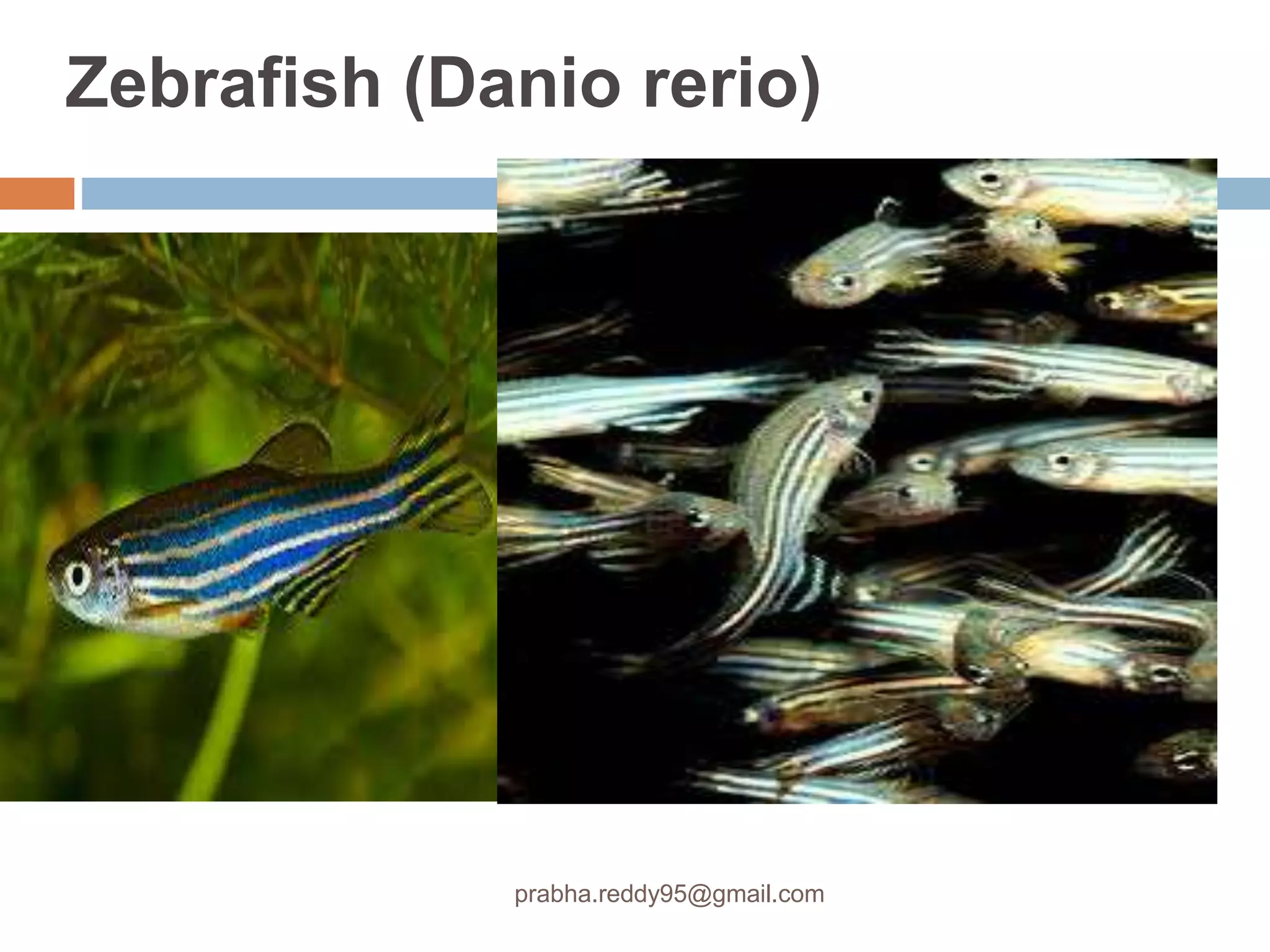
Zebrafish (Danio rerio)
prabha.reddy95@gmail.com
The zebrafish (Danio rerio)
was more recently chosen and developed
because it has a unique combination of
advantages: It combines the advantages of
large, accessible, easily observable eggs and
embryos with advantages for carrying out
genetic studies i.e. ease of breeding in the
laboratory and small simple genome.
•These small fish (2 - 4 cm long) are easy to
breed in the laboratory in large numbers.
prabha.reddy95@gmail.com
•The transparent embryos develop outside the
mother’s body so are very easy to
Observe
•The transparent embryos develop outside the
mother’s body so are very easy to Observe.
•Although generation time is two to four months,
the early stages of development proceed
quickly.
-By 24 hours after fertilization, most tissues and
early versions of the organs have formed.
-After two days, the fish hatches out of the egg
case.
prabha.reddy95@gmail.com
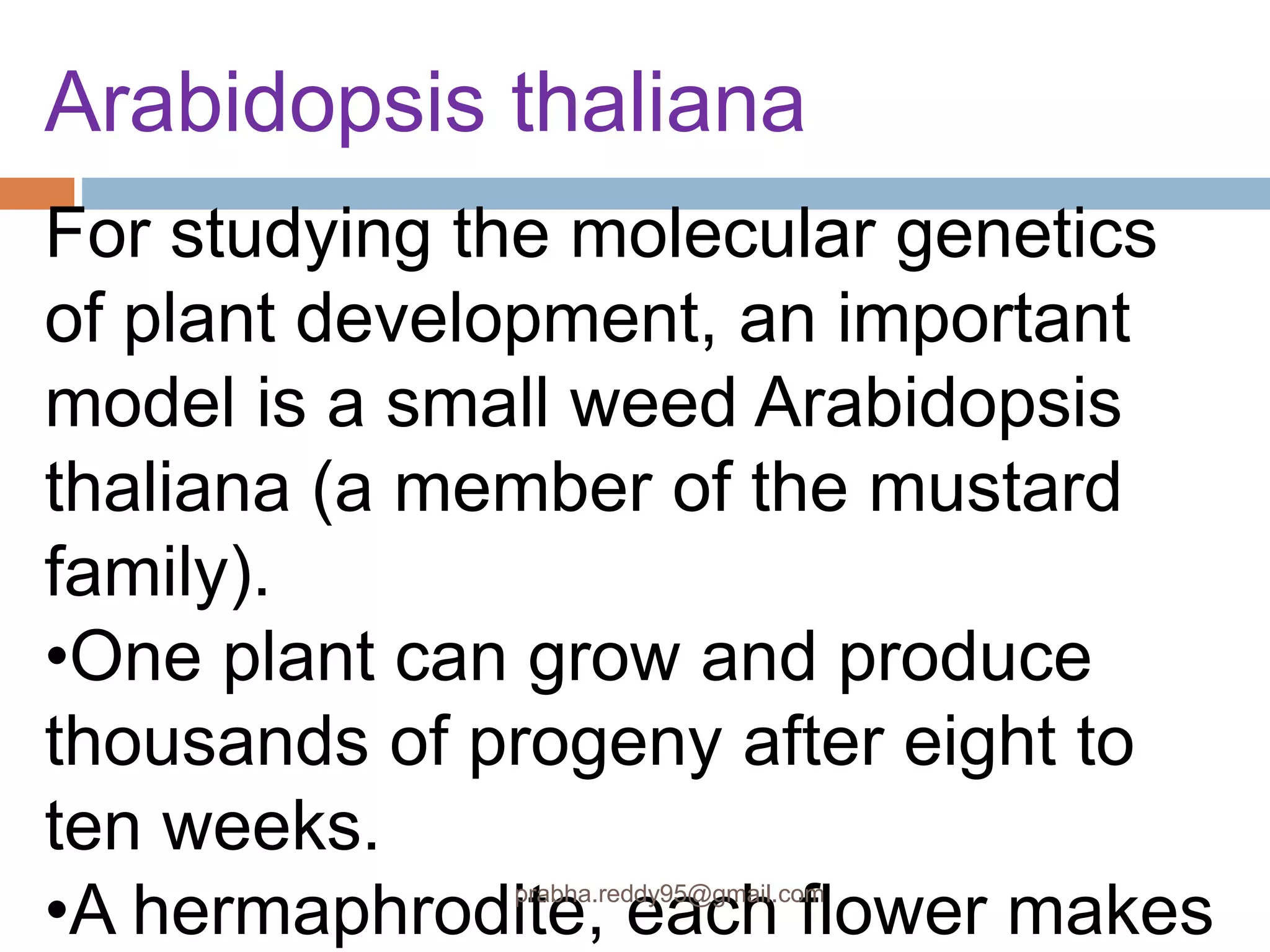
Arabidopsis thaliana
prabha.reddy95@gmail.com
Arabidopsis thaliana
For studying the molecular genetics
of plant development, an important
model is a small weed Arabidopsis
thaliana (a member of the mustard
family).
•One plant can grow and produce
thousands of progeny after eight to
ten weeks.
•A hermaphrodite, each flower makesprabha.reddy95@gmail.com
•For gene manipulation research,
scientists can induce cultured cells to
take up foreign DNA (genetic
transformation).
•Its relatively small genome, about 100
million nucleotide pairs, has already
been sequenced.
prabha.reddy95@gmail.com

Model oranisms used in genetics

  • 1.
  • 2.
    Definition: Model organisms area small number of species that have been extensively studied. What has been learnt from model organisms has been extrapolated to include other species in the hope of understanding developmental, metabolic and biological pathways that are conservedprabha.reddy95@gmail.com
  • 3.
    Why use model organisms? Manyof the things we study in Biology, such as disease, development and genetics needs to be studied in the body (in vivo), to see how pathways and signals, for example, really work.  Realistically always studying these in humans would be extremely expensive, not to mention potentially unsafe and unethical. prabha.reddy95@gmail.com
  • 4.
    We use modelorganisms instead as they provide amazing insight that cannot be gained from lab equipment. We use model organisms instead as they provide amazing insight that cannot be gained from lab equipment.  What we learn about that animal can then be used to predict what happens in other animals. This is because all living organisms have evolved from the same ancestor and many pathways are the same across different species.prabha.reddy95@gmail.com
  • 5.
    What makes agood model organism? A model organism must be easy to look after in the laboratory.  They are nearly always small and do not need a lot of space, have an easy feeding regime and they must not be dangerous to work with. prabha.reddy95@gmail.com
  • 6.
     There aremany species that would make good model organisms, many of the model organisms used most frequently were selected because of the extensive knowledge we already have of them from previous research. prabha.reddy95@gmail.com
  • 7.
  • 8.
  • 9.
  • 10.
    The fruit fly(Drosophila melanogaster) was first chosen as a model organism by geneticist T.H. Morgan and intensively studied by generations of geneticists after him. The fruit fly is small and easily grown in the laboratory. It has a generation time of only two weeks and produces many offspring. Embryos develop outside the mother’sprabha.reddy95@gmail.com
  • 11.
    Amenable to largescale mutational screens to identify genes involved in particular functions e.g. forming the right body parts in the right place. So flies with mutated versions of all genes in the genome have been isolated. In addition, there are vast amounts of information on its genes and other aspects of its biology. The genome has been sequenced and is contains 13,600 genes. prabha.reddy95@gmail.com
  • 12.
  • 13.
    The nematode worm (Caenorhabditiselegans) normally lives in the soil but is easily grown in petri dishes. Only a millimeter long, it has a simple, transparent body with only a few cell types and grows from zygote to mature adult in only three and a half days. Its genome has been sequenced. prabha.reddy95@gmail.com
  • 14.
     It iseasy to identify mutant animals: Because individuals are hermaphrodites, it is easy to detect recessive mutations: Self-fertilization of heterozygotes will produce some homozygous recessive offspring with mutant phenotypes.  The huge advantage is its simplicity: every adult C. elegans has exactly (only) 959 somatic cells. These arise from the zygote in virtually the same way for every individual. prabha.reddy95@gmail.com
  • 15.
  • 16.
    The frog (Xenopuslaevis) Advantages •Ease of access and manipulation of the egg and embryo allowing experimental manipulation, assay inductive interactions •Robust embryos, can tolerate manipulation in relatively simple lab facilities. •Parts of the embryo can easily be cultured. •Rapid development, 4 days to a free swimming tadpole. •A well-established systemprabha.reddy95@gmail.com
  • 17.
    Disadvantages •No genetics. Complex, uncharacterisedgenome. •Animals cannot be bred for multiple generations in the lab. prabha.reddy95@gmail.com
  • 18.
  • 19.
    The chicken (Gallus) Advantages •Largeeasily obtainable eggs •Development can be observed by cutting a hole in the shell •The embryos can be removed and cultured allowing manipulation. •Complex development similar to mammals prabha.reddy95@gmail.com
  • 20.
    •Methods developed forcell lineage analysis allows experimental manipulation and cell lineage studies Disadvantages •Not good for classical genetics. It has a complex genome with many small prabha.reddy95@gmail.com
  • 21.
  • 22.
    The mouse (Musmusculus) has a long history as a mammalian model of development. •Much is known about its biology, including its genes. •The genome is well characterized and almost completely sequenced •Sophisticated and elaborate techniques exist to manipulate mouse genes:transgenic mice and ƒmice in which particular genes are “knocked out” by mutation. prabha.reddy95@gmail.com
  • 23.
    Disadvantages: Mice are complexanimals with a genome as large as ours, and their embryos develop in the mother’s uterus, hidden from view. •The embryo develops in utero and is inaccessible. •Embryo culture is difficult and limited. •The generation interval is long (3 months) prabha.reddy95@gmail.com
  • 24.
  • 25.
    The zebrafish (Daniorerio) was more recently chosen and developed because it has a unique combination of advantages: It combines the advantages of large, accessible, easily observable eggs and embryos with advantages for carrying out genetic studies i.e. ease of breeding in the laboratory and small simple genome. •These small fish (2 - 4 cm long) are easy to breed in the laboratory in large numbers. prabha.reddy95@gmail.com
  • 26.
    •The transparent embryosdevelop outside the mother’s body so are very easy to Observe •The transparent embryos develop outside the mother’s body so are very easy to Observe. •Although generation time is two to four months, the early stages of development proceed quickly. -By 24 hours after fertilization, most tissues and early versions of the organs have formed. -After two days, the fish hatches out of the egg case. prabha.reddy95@gmail.com
  • 27.
  • 28.
    Arabidopsis thaliana For studyingthe molecular genetics of plant development, an important model is a small weed Arabidopsis thaliana (a member of the mustard family). •One plant can grow and produce thousands of progeny after eight to ten weeks. •A hermaphrodite, each flower makesprabha.reddy95@gmail.com
  • 29.
    •For gene manipulationresearch, scientists can induce cultured cells to take up foreign DNA (genetic transformation). •Its relatively small genome, about 100 million nucleotide pairs, has already been sequenced. prabha.reddy95@gmail.com
  • 30.