EXPERIMENTAL
DEVELOPMENTAL BIOLOGY
(MODEL ORGANISMS)
Presented by Deepakshi Gayen
Reg No: 23LBMS26
MSc Biochemistry
Experimental Developmental
Biology:
Experimental developmental
biology involves controlled
experiments to investigate the
processes by which organisms
develop.
Research goals to understand:
 Cellular differentiation (how
cells become specialized).
 Morphogenesis (how tissues and
organs form).
 Ethics and Practicality: Easier
than working directly with
humans.
 Genetic Homology: Many
organisms share genes with
humans.
Criteria for Selecting Model
Organisms:
 Practical Features: Short
generation times, small size, and
high reproductive rate.
 Genetic Tractability: Genetic
tools (e.g., CRISPR/Cas9,
organs form).
 Organogenesis (formation of
functional organs).
Model organisms:
Model organisms are non-human
species that are studied to
understand biological processes
and how they relate to other
organisms.
Importance of Model Organisms:
 Reproducibility: Same species
can be used worldwide.
 Genetic Tractability: Genetic
tools (e.g., CRISPR/Cas9,
knockouts).
 Ease of Observation: Ability to
visualize development (e.g.,
transparent embryos).
 Conservation of Pathways:
Similar developmental pathways
(e.g., Hox genes, signaling
cascades) between model
organisms and humans.
Why Drosophila?
 One of the first genetically tractable
organisms used in developmental
research (T.H. Morgan, early 1900s).
 Short life cycle (10 days from egg to
adult).
 Four pairs of chromosomes
 14000 Genes, sequenced genome
and 2/3 of human disease genes have
Discoveries & Future Aspects:
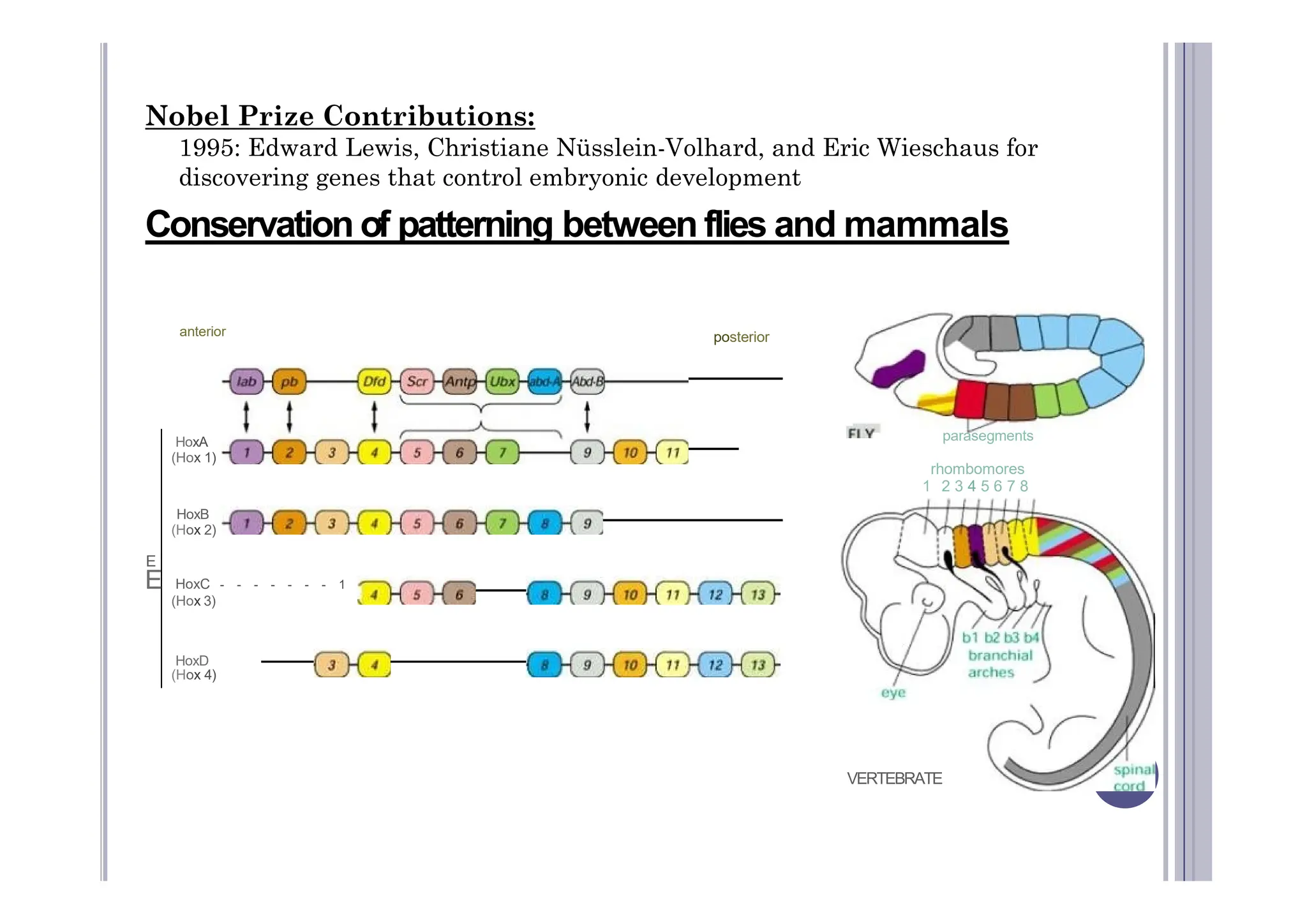
 Discovery of homeotic (Hox) genes
Control the body plan of an organism.
 Study of pattern formation:
Establishment of anterior-posterior and
dorsal-ventral axes.
 Discovery of maternal effect genes
like bicoid: Control early patterning
of embryos.
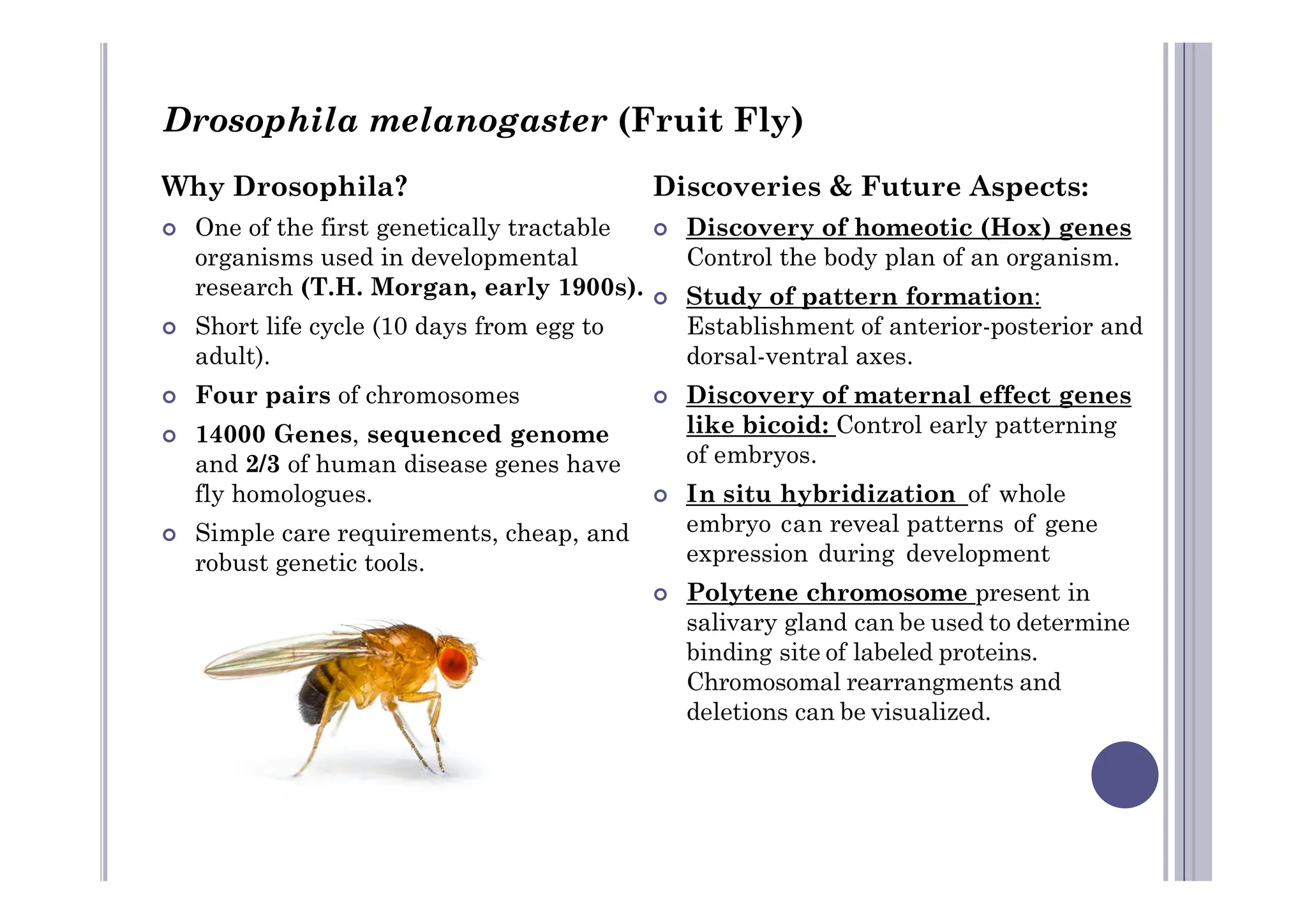
Drosophila melanogaster (Fruit Fly)
and 2/3 of human disease genes have
fly homologues.
 Simple care requirements, cheap, and
robust genetic tools.
of embryos.
 In situ hybridization of whole
embryo can reveal patterns of gene
expression during development
 Polytene chromosome present in
salivary gland can be used to determine
binding site of labeled proteins.
Chromosomal rearrangments and
deletions can be visualized.
Nobel Prize Contributions:
1995: Edward Lewis, Christiane Nüsslein-Volhard, and Eric Wieschaus for
discovering genes that control embryonic development
Conservation of patterning between flies and mammals
anterior posterior
HoxA
(Hox 1)
parasegments
rhombomores
(Hox 1)
HoxB
(Hox 2)
E
E HoxC - - - - - - - 1
(Hox 3)
HoxD
(Hox 4)
rhombomores
1 2 3 4 5 6 7 8
VERTEBRATE
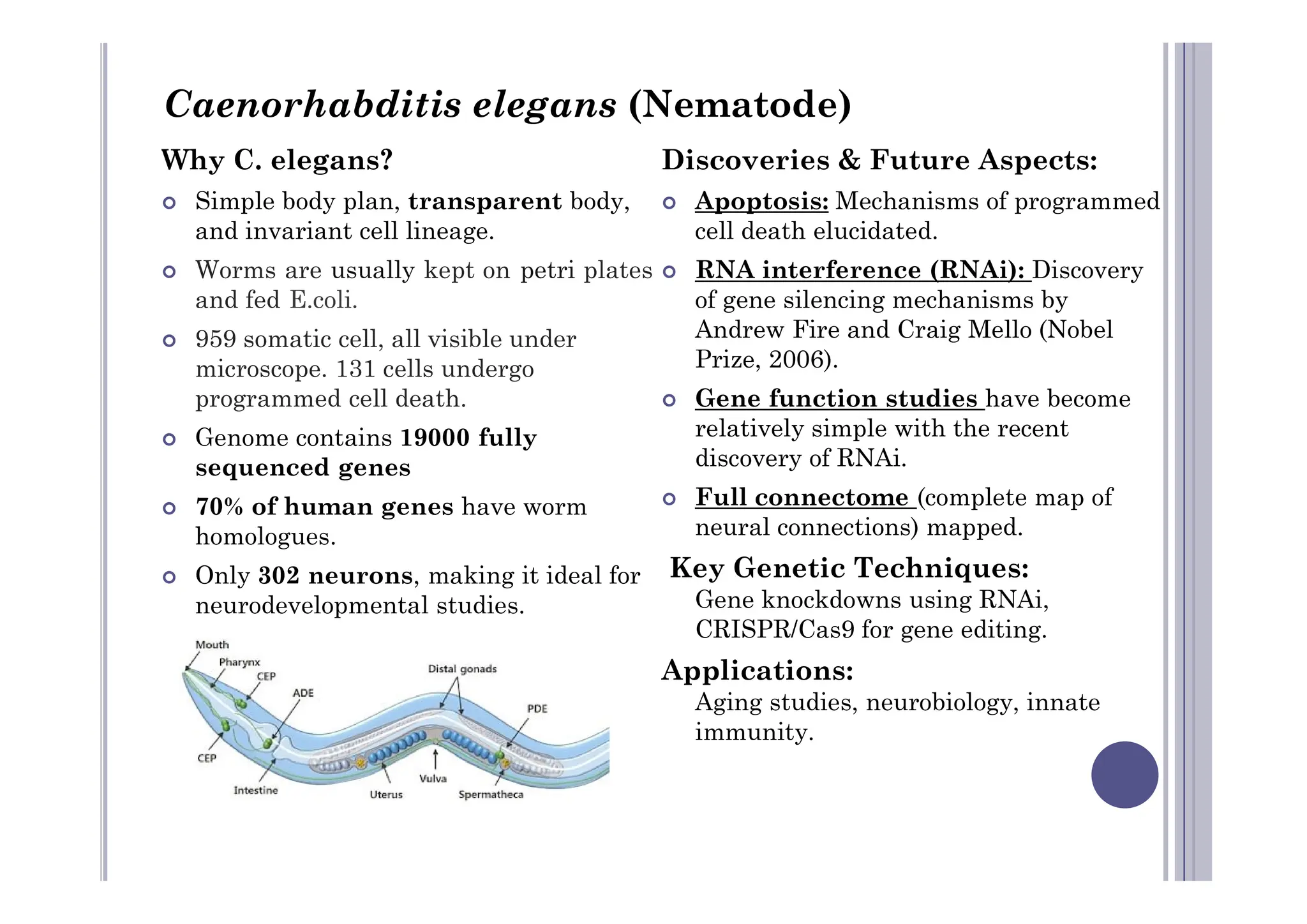
Why C. elegans?
 Simple body plan, transparent body,
and invariant cell lineage.
 Worms are usually kept on petri plates
and fed E.coli.
 959 somatic cell, all visible under
microscope. 131 cells undergo
programmed cell death.
 Genome contains 19000 fully
sequenced genes
Discoveries & Future Aspects:
 Apoptosis: Mechanisms of programmed
cell death elucidated.
 RNA interference (RNAi): Discovery
of gene silencing mechanisms by
Andrew Fire and Craig Mello (Nobel
Prize, 2006).
 Gene function studies have become
relatively simple with the recent
discovery of RNAi.
Caenorhabditis elegans (Nematode)
sequenced genes
 70% of human genes have worm
homologues.
 Only 302 neurons, making it ideal for
neurodevelopmental studies.
discovery of RNAi.
 Full connectome (complete map of
neural connections) mapped.
Key Genetic Techniques:
Gene knockdowns using RNAi,
CRISPR/Cas9 for gene editing.
Applications:
Aging studies, neurobiology, innate
immunity.
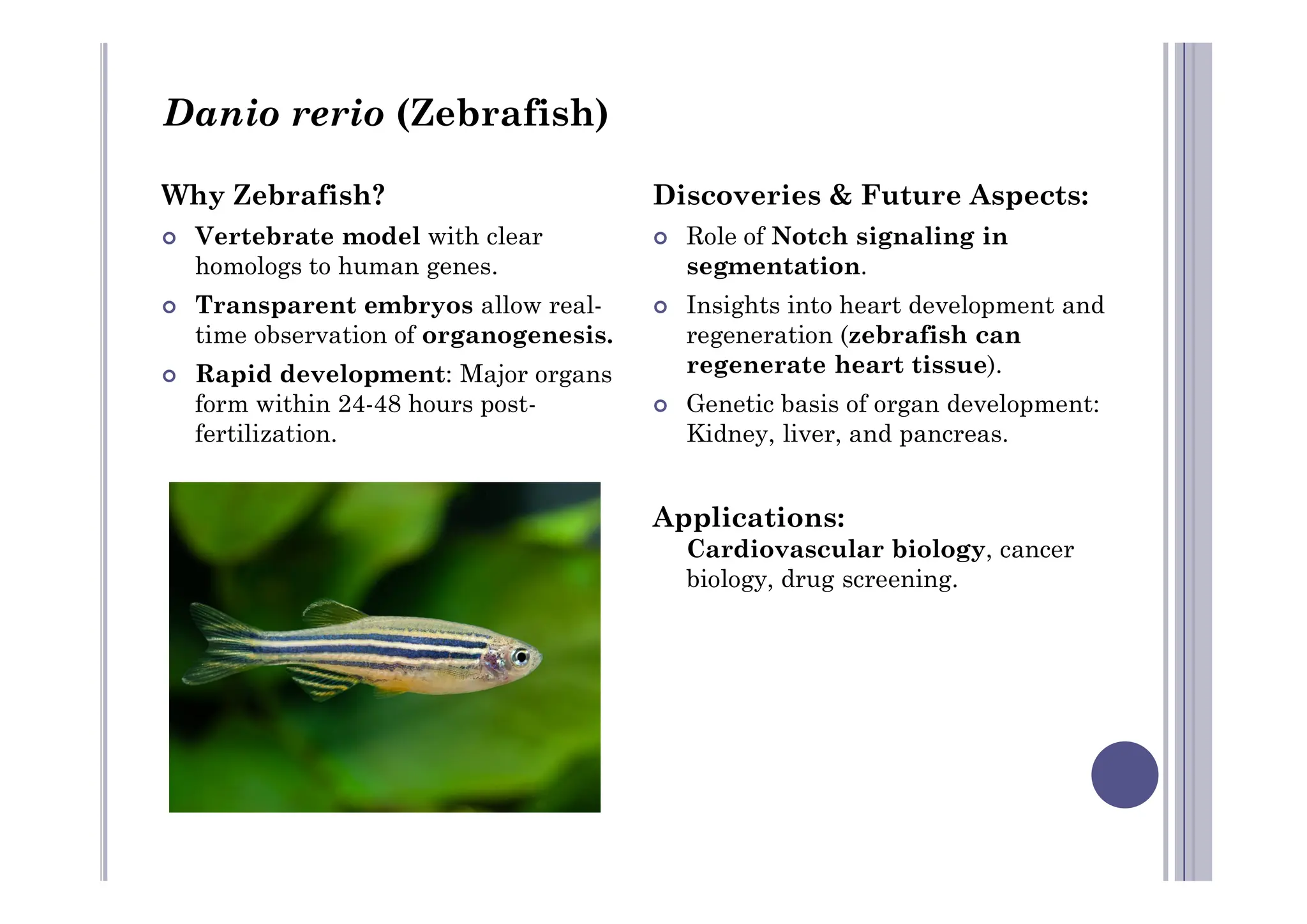
Why Zebrafish?
 Vertebrate model with clear
homologs to human genes.
 Transparent embryos allow real-
time observation of organogenesis.
 Rapid development: Major organs
form within 24-48 hours post-
fertilization.
Discoveries & Future Aspects:
 Role of Notch signaling in
segmentation.
 Insights into heart development and
regeneration (zebrafish can
regenerate heart tissue).
 Genetic basis of organ development:
Kidney, liver, and pancreas.
Danio rerio (Zebrafish)
Applications:
Cardiovascular biology, cancer
biology, drug screening.
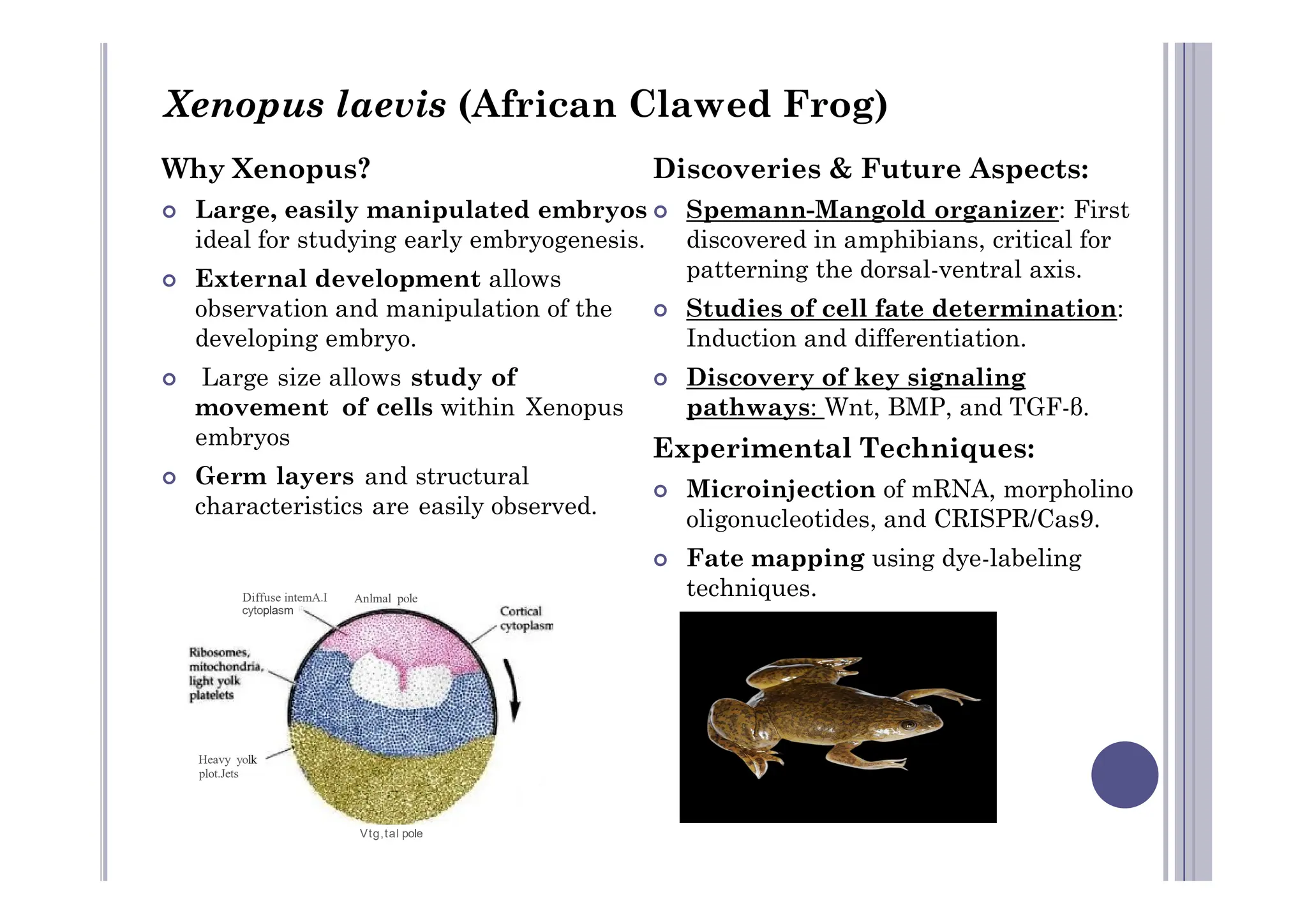
Why Xenopus?
 Large, easily manipulated embryos
ideal for studying early embryogenesis.
 External development allows
observation and manipulation of the
developing embryo.
 Large size allows study of
movement of cells within Xenopus
embryos
Germ layers and structural
Discoveries & Future Aspects:
 Spemann-Mangold organizer: First
discovered in amphibians, critical for
patterning the dorsal-ventral axis.
 Studies of cell fate determination:
Induction and differentiation.
 Discovery of key signaling
pathways: Wnt, BMP, and TGF-β.
Experimental Techniques:
Xenopus laevis (African Clawed Frog)
 Germ layers and structural
characteristics are easily observed.
Experimental Techniques:
 Microinjection of mRNA, morpholino
oligonucleotides, and CRISPR/Cas9.
 Fate mapping using dye-labeling
techniques.
Diffuse intemA.I
cytoplasm
Anlmal pole
Heavy yolk
plot.Jets
Vtg,tal pole
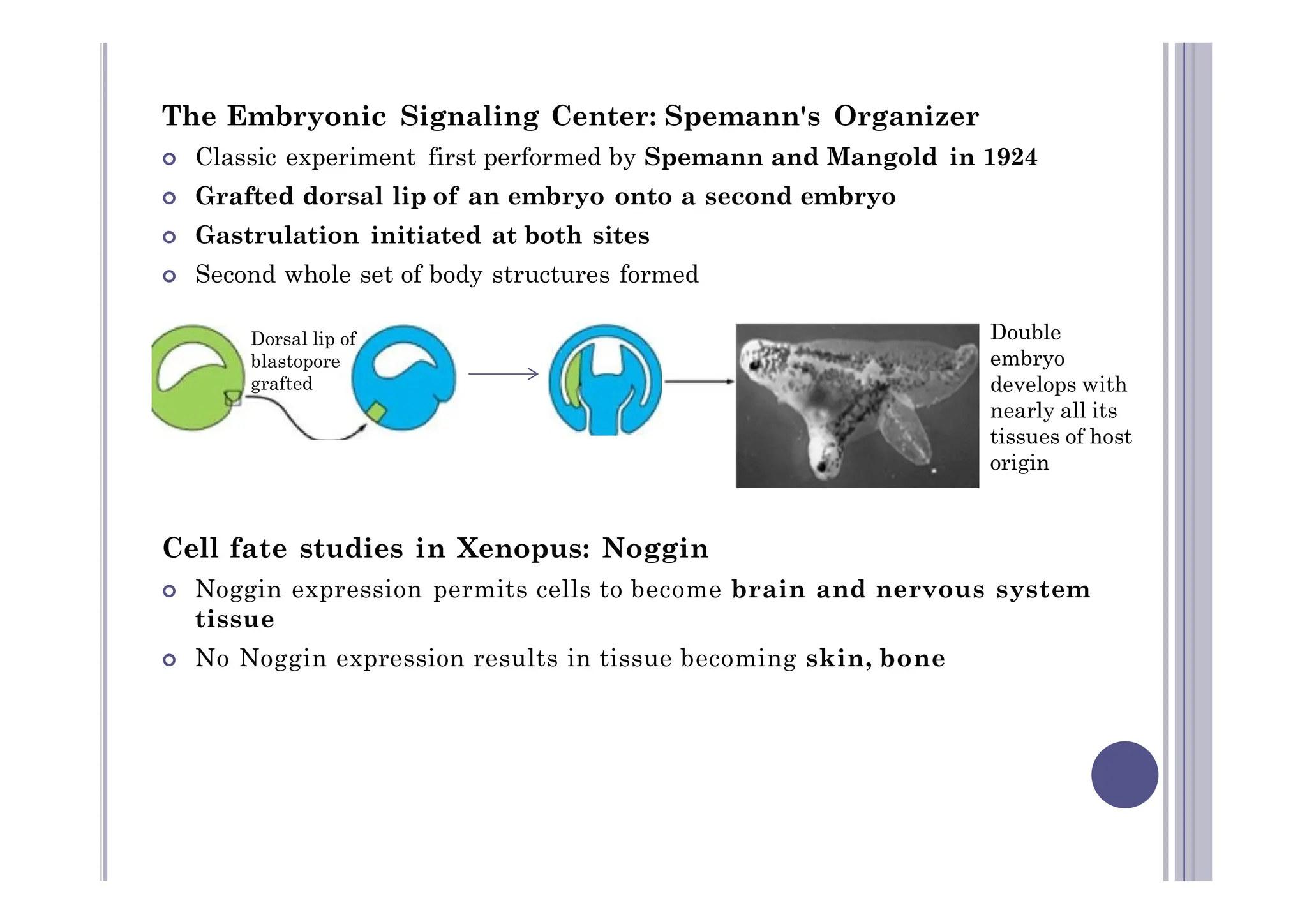
The Embryonic Signaling Center: Spemann's Organizer
 Classic experiment first performed by Spemann and Mangold in 1924
 Grafted dorsal lip of an embryo onto a second embryo
 Gastrulation initiated at both sites
 Second whole set of body structures formed
Double
embryo
develops with
nearly all its
tissues of host
origin
Dorsal lip of
blastopore
grafted
Cell fate studies in Xenopus: Noggin
 Noggin expression permits cells to become brain and nervous system
tissue
 No Noggin expression results in tissue becoming skin, bone
origin
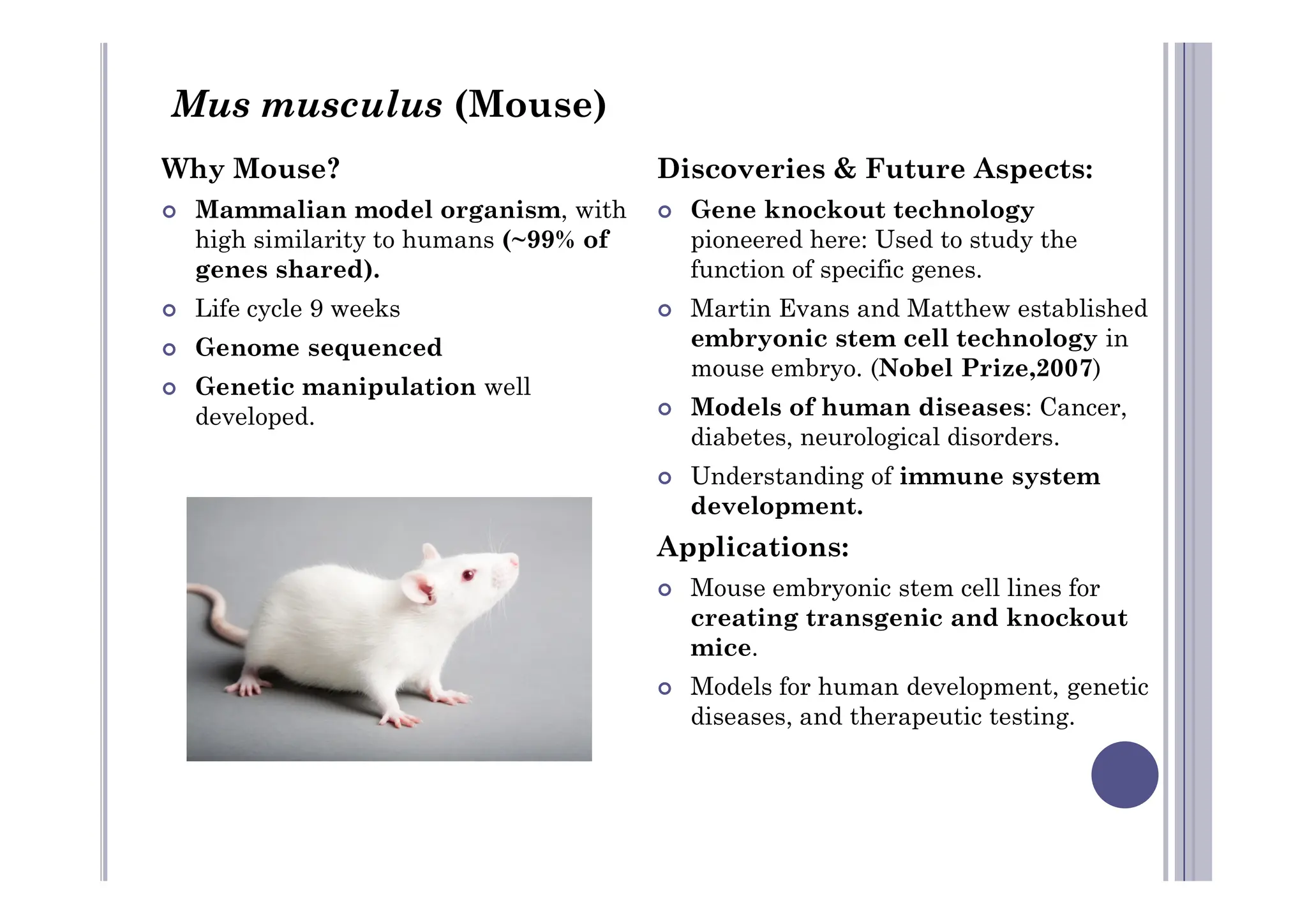
Why Mouse?
 Mammalian model organism, with
high similarity to humans (~99% of
genes shared).
 Life cycle 9 weeks
 Genome sequenced
 Genetic manipulation well
developed.
Discoveries & Future Aspects:
 Gene knockout technology
pioneered here: Used to study the
function of specific genes.
 Martin Evans and Matthew established
embryonic stem cell technology in
mouse embryo. (Nobel Prize,2007)
 Models of human diseases: Cancer,
diabetes, neurological disorders.
Understanding of immune system
Mus musculus (Mouse)
 Understanding of immune system
development.
Applications:
 Mouse embryonic stem cell lines for
creating transgenic and knockout
mice.
 Models for human development, genetic
diseases, and therapeutic testing.
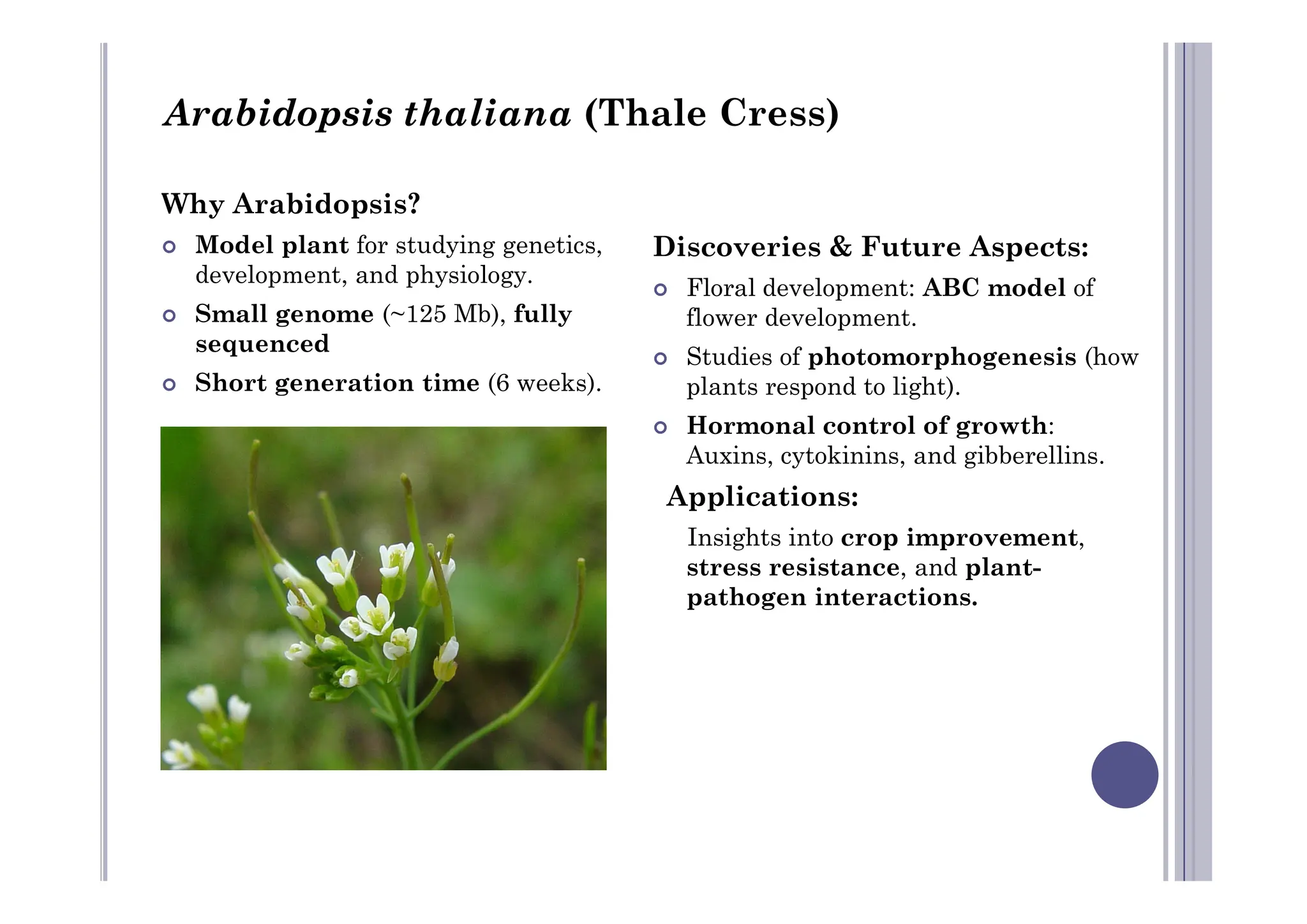
Why Arabidopsis?
 Model plant for studying genetics,
development, and physiology.
 Small genome (~125 Mb), fully
sequenced
 Short generation time (6 weeks).
Discoveries & Future Aspects:
 Floral development: ABC model of
flower development.
 Studies of photomorphogenesis (how
plants respond to light).
 Hormonal control of growth:
Auxins, cytokinins, and gibberellins.
Arabidopsis thaliana (Thale Cress)
Auxins, cytokinins, and gibberellins.
Applications:
Insights into crop improvement,
stress resistance, and plant-
pathogen interactions.
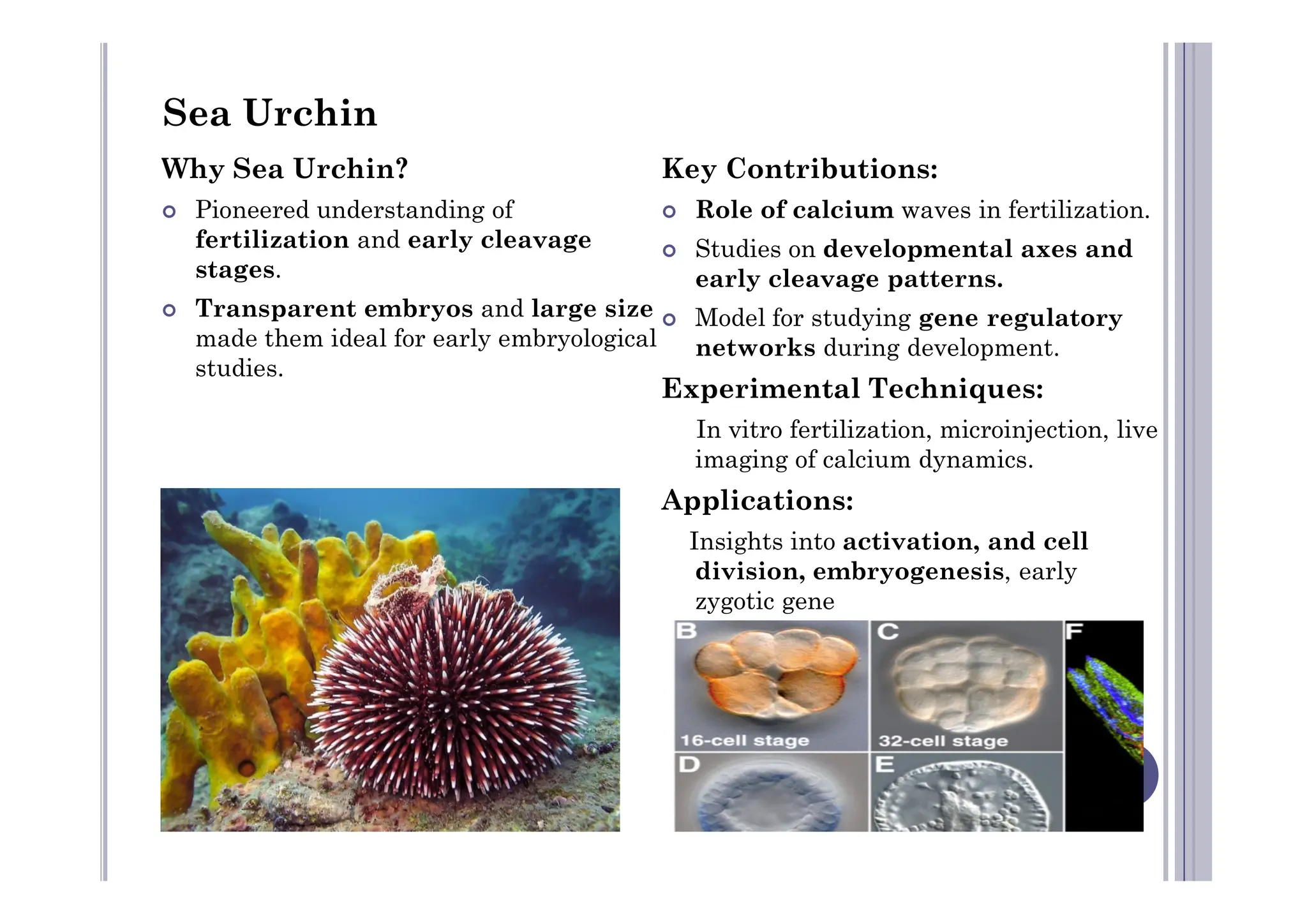
Why Sea Urchin?
 Pioneered understanding of
fertilization and early cleavage
stages.
 Transparent embryos and large size
made them ideal for early embryological
studies.
Key Contributions:
 Role of calcium waves in fertilization.
 Studies on developmental axes and
early cleavage patterns.
 Model for studying gene regulatory
networks during development.
Experimental Techniques:
In vitro fertilization, microinjection, live
imaging of calcium dynamics.
Sea Urchin
imaging of calcium dynamics.
Applications:
Insights into activation, and cell
division, embryogenesis, early
zygotic gene
Deepakshi dev bio presentation_124928.pdf

Deepakshi dev bio presentation_124928.pdf

  • 1.
    EXPERIMENTAL DEVELOPMENTAL BIOLOGY (MODEL ORGANISMS) Presentedby Deepakshi Gayen Reg No: 23LBMS26 MSc Biochemistry
  • 2.
    Experimental Developmental Biology: Experimental developmental biologyinvolves controlled experiments to investigate the processes by which organisms develop. Research goals to understand:  Cellular differentiation (how cells become specialized).  Morphogenesis (how tissues and organs form).  Ethics and Practicality: Easier than working directly with humans.  Genetic Homology: Many organisms share genes with humans. Criteria for Selecting Model Organisms:  Practical Features: Short generation times, small size, and high reproductive rate.  Genetic Tractability: Genetic tools (e.g., CRISPR/Cas9, organs form).  Organogenesis (formation of functional organs). Model organisms: Model organisms are non-human species that are studied to understand biological processes and how they relate to other organisms. Importance of Model Organisms:  Reproducibility: Same species can be used worldwide.  Genetic Tractability: Genetic tools (e.g., CRISPR/Cas9, knockouts).  Ease of Observation: Ability to visualize development (e.g., transparent embryos).  Conservation of Pathways: Similar developmental pathways (e.g., Hox genes, signaling cascades) between model organisms and humans.
  • 3.
    Why Drosophila?  Oneof the first genetically tractable organisms used in developmental research (T.H. Morgan, early 1900s).  Short life cycle (10 days from egg to adult).  Four pairs of chromosomes  14000 Genes, sequenced genome and 2/3 of human disease genes have Discoveries & Future Aspects:  Discovery of homeotic (Hox) genes Control the body plan of an organism.  Study of pattern formation: Establishment of anterior-posterior and dorsal-ventral axes.  Discovery of maternal effect genes like bicoid: Control early patterning of embryos. Drosophila melanogaster (Fruit Fly) and 2/3 of human disease genes have fly homologues.  Simple care requirements, cheap, and robust genetic tools. of embryos.  In situ hybridization of whole embryo can reveal patterns of gene expression during development  Polytene chromosome present in salivary gland can be used to determine binding site of labeled proteins. Chromosomal rearrangments and deletions can be visualized.
  • 4.
    Nobel Prize Contributions: 1995:Edward Lewis, Christiane Nüsslein-Volhard, and Eric Wieschaus for discovering genes that control embryonic development Conservation of patterning between flies and mammals anterior posterior HoxA (Hox 1) parasegments rhombomores (Hox 1) HoxB (Hox 2) E E HoxC - - - - - - - 1 (Hox 3) HoxD (Hox 4) rhombomores 1 2 3 4 5 6 7 8 VERTEBRATE
  • 5.
    Why C. elegans? Simple body plan, transparent body, and invariant cell lineage.  Worms are usually kept on petri plates and fed E.coli.  959 somatic cell, all visible under microscope. 131 cells undergo programmed cell death.  Genome contains 19000 fully sequenced genes Discoveries & Future Aspects:  Apoptosis: Mechanisms of programmed cell death elucidated.  RNA interference (RNAi): Discovery of gene silencing mechanisms by Andrew Fire and Craig Mello (Nobel Prize, 2006).  Gene function studies have become relatively simple with the recent discovery of RNAi. Caenorhabditis elegans (Nematode) sequenced genes  70% of human genes have worm homologues.  Only 302 neurons, making it ideal for neurodevelopmental studies. discovery of RNAi.  Full connectome (complete map of neural connections) mapped. Key Genetic Techniques: Gene knockdowns using RNAi, CRISPR/Cas9 for gene editing. Applications: Aging studies, neurobiology, innate immunity.
  • 6.
    Why Zebrafish?  Vertebratemodel with clear homologs to human genes.  Transparent embryos allow real- time observation of organogenesis.  Rapid development: Major organs form within 24-48 hours post- fertilization. Discoveries & Future Aspects:  Role of Notch signaling in segmentation.  Insights into heart development and regeneration (zebrafish can regenerate heart tissue).  Genetic basis of organ development: Kidney, liver, and pancreas. Danio rerio (Zebrafish) Applications: Cardiovascular biology, cancer biology, drug screening.
  • 7.
    Why Xenopus?  Large,easily manipulated embryos ideal for studying early embryogenesis.  External development allows observation and manipulation of the developing embryo.  Large size allows study of movement of cells within Xenopus embryos Germ layers and structural Discoveries & Future Aspects:  Spemann-Mangold organizer: First discovered in amphibians, critical for patterning the dorsal-ventral axis.  Studies of cell fate determination: Induction and differentiation.  Discovery of key signaling pathways: Wnt, BMP, and TGF-β. Experimental Techniques: Xenopus laevis (African Clawed Frog)  Germ layers and structural characteristics are easily observed. Experimental Techniques:  Microinjection of mRNA, morpholino oligonucleotides, and CRISPR/Cas9.  Fate mapping using dye-labeling techniques. Diffuse intemA.I cytoplasm Anlmal pole Heavy yolk plot.Jets Vtg,tal pole
  • 8.
    The Embryonic SignalingCenter: Spemann's Organizer  Classic experiment first performed by Spemann and Mangold in 1924  Grafted dorsal lip of an embryo onto a second embryo  Gastrulation initiated at both sites  Second whole set of body structures formed Double embryo develops with nearly all its tissues of host origin Dorsal lip of blastopore grafted Cell fate studies in Xenopus: Noggin  Noggin expression permits cells to become brain and nervous system tissue  No Noggin expression results in tissue becoming skin, bone origin
  • 9.
    Why Mouse?  Mammalianmodel organism, with high similarity to humans (~99% of genes shared).  Life cycle 9 weeks  Genome sequenced  Genetic manipulation well developed. Discoveries & Future Aspects:  Gene knockout technology pioneered here: Used to study the function of specific genes.  Martin Evans and Matthew established embryonic stem cell technology in mouse embryo. (Nobel Prize,2007)  Models of human diseases: Cancer, diabetes, neurological disorders. Understanding of immune system Mus musculus (Mouse)  Understanding of immune system development. Applications:  Mouse embryonic stem cell lines for creating transgenic and knockout mice.  Models for human development, genetic diseases, and therapeutic testing.
  • 10.
    Why Arabidopsis?  Modelplant for studying genetics, development, and physiology.  Small genome (~125 Mb), fully sequenced  Short generation time (6 weeks). Discoveries & Future Aspects:  Floral development: ABC model of flower development.  Studies of photomorphogenesis (how plants respond to light).  Hormonal control of growth: Auxins, cytokinins, and gibberellins. Arabidopsis thaliana (Thale Cress) Auxins, cytokinins, and gibberellins. Applications: Insights into crop improvement, stress resistance, and plant- pathogen interactions.
  • 11.
    Why Sea Urchin? Pioneered understanding of fertilization and early cleavage stages.  Transparent embryos and large size made them ideal for early embryological studies. Key Contributions:  Role of calcium waves in fertilization.  Studies on developmental axes and early cleavage patterns.  Model for studying gene regulatory networks during development. Experimental Techniques: In vitro fertilization, microinjection, live imaging of calcium dynamics. Sea Urchin imaging of calcium dynamics. Applications: Insights into activation, and cell division, embryogenesis, early zygotic gene