M odals -  P robability and  C ertainty
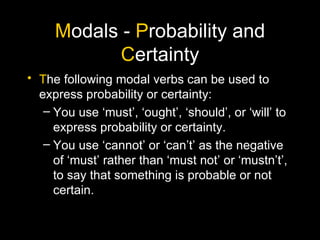
M odals -  P robability and  C ertainty T he following modal verbs can be used to express probability or certainty: You use ‘must’, ‘ought’, ‘should’, or ‘will’ to express probability or certainty. You use ‘cannot’ or ‘can’t’ as the negative of ‘must’ rather than ‘must not’ or ‘mustn’t’, to say that something is probable or not certain.
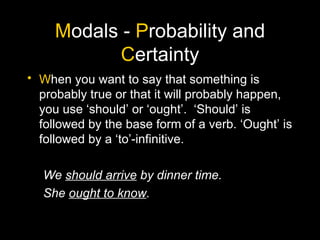
M odals -  P robability and  C ertainty W hen you want to say that something is probably true or that it will probably happen, you use ‘should’ or ‘ought’.  ‘Should’ is followed by the base form of a verb. ‘Ought’ is followed by a ‘to’-infinitive. We  should arrive  by dinner time. She  ought to know .
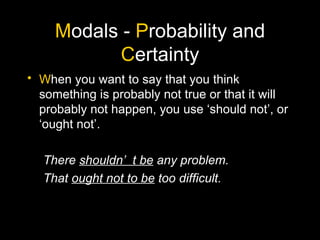
M odals -  P robability and  C ertainty W hen you want to say that you think something is probably not true or that it will probably not happen, you use ‘should not’, or ‘ought not’. There  shouldn’t be  any problem. That  ought not to be  too difficult.
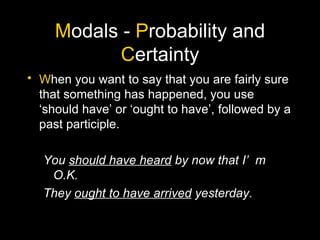
M odals -  P robability and  C ertainty W hen you want to say that you are fairly sure that something has happened, you use ‘should have’ or ‘ought to have’, followed by a past participle. You  should have heard  by now that I’m O.K. They  ought to have arrived  yesterday.
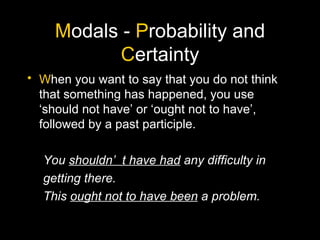
M odals -  P robability and  C ertainty W hen you want to say that you do not think that something has happened, you use ‘should not have’ or ‘ought not to have’, followed by a past participle. You  shouldn’t have had  any difficulty in getting there. This  ought not to have been  a problem.
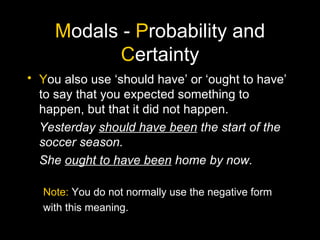
M odals -  P robability and  C ertainty Y ou also use ‘should have’ or ‘ought to have’ to say that you expected something to happen, but that it did not happen. Yesterday  should have been  the start of the soccer season. She  ought to have been  home by now. Note:  You do not normally use the negative form with this meaning.
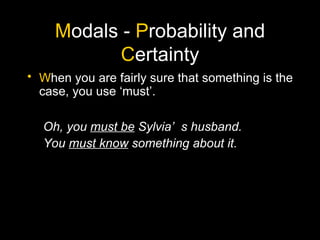
M odals -  P robability and  C ertainty W hen you are fairly sure that something is the case, you use ‘must’. Oh, you  must be  Sylvia’s husband. You  must know  something about it.
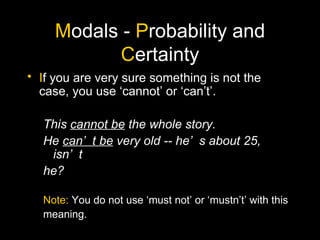
M odals -  P robability and  C ertainty I f you are very sure something is not the case, you use ‘cannot’ or ‘can’t’. This  cannot be  the whole story. He  can’t be  very old -- he’s about 25, isn’t he? Note:  You do not use ‘must not’ or ‘mustn’t’ with this meaning.
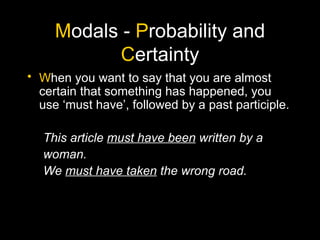
M odals -  P robability and  C ertainty W hen you want to say that you are almost certain that something has happened, you use ‘must have’, followed by a past participle. This article  must have been  written by a woman. We  must have taken  the wrong road.
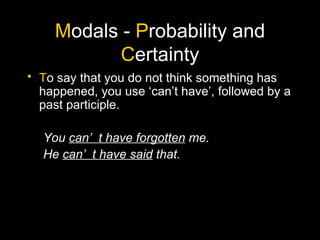
M odals -  P robability and  C ertainty T o say that you do not think something has happened, you use ‘can’t have’, followed by a past participle. You  can’t have forgotten  me. He  can’t have said  that.
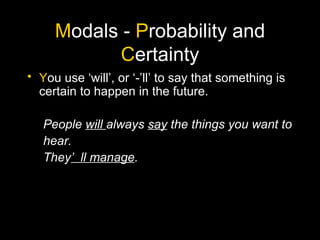
M odals -  P robability and  C ertainty Y ou use ‘will’, or ‘-’ll’ to say that something is certain to happen in the future. People  will  always  say  the things you want to hear. They ’ll manage .
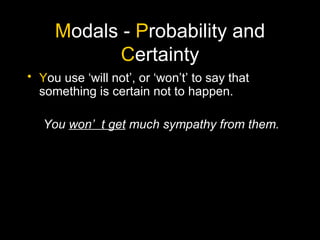
M odals -  P robability and  C ertainty Y ou use ‘will not’, or ‘won’t’ to say that something is certain not to happen. You  won’t get  much sympathy from them.
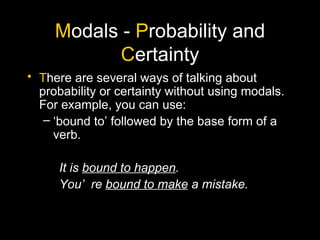
M odals -  P robability and  C ertainty T here are several ways of talking about probability or certainty without using modals. For example, you can use: ‘ bound to’ followed by the base form of a verb.  It is  bound to happen . You’re  bound to make  a mistake.
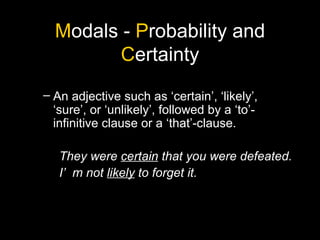
M odals -  P robability and  C ertainty An adjective such as ‘certain’, ‘likely’, ‘sure’, or ‘unlikely’, followed by a ‘to’-infinitive clause or a ‘that’-clause. They were  certain  that you were defeated. I’m not  likely  to forget it.
Q uestions? For more slide presentations visit:

Modals - Probability and Certainty

  • 1.
    M odals - P robability and C ertainty
  • 2.
    M odals - P robability and C ertainty T he following modal verbs can be used to express probability or certainty: You use ‘must’, ‘ought’, ‘should’, or ‘will’ to express probability or certainty. You use ‘cannot’ or ‘can’t’ as the negative of ‘must’ rather than ‘must not’ or ‘mustn’t’, to say that something is probable or not certain.
  • 3.
    M odals - P robability and C ertainty W hen you want to say that something is probably true or that it will probably happen, you use ‘should’ or ‘ought’. ‘Should’ is followed by the base form of a verb. ‘Ought’ is followed by a ‘to’-infinitive. We should arrive by dinner time. She ought to know .
  • 4.
    M odals - P robability and C ertainty W hen you want to say that you think something is probably not true or that it will probably not happen, you use ‘should not’, or ‘ought not’. There shouldn’t be any problem. That ought not to be too difficult.
  • 5.
    M odals - P robability and C ertainty W hen you want to say that you are fairly sure that something has happened, you use ‘should have’ or ‘ought to have’, followed by a past participle. You should have heard by now that I’m O.K. They ought to have arrived yesterday.
  • 6.
    M odals - P robability and C ertainty W hen you want to say that you do not think that something has happened, you use ‘should not have’ or ‘ought not to have’, followed by a past participle. You shouldn’t have had any difficulty in getting there. This ought not to have been a problem.
  • 7.
    M odals - P robability and C ertainty Y ou also use ‘should have’ or ‘ought to have’ to say that you expected something to happen, but that it did not happen. Yesterday should have been the start of the soccer season. She ought to have been home by now. Note: You do not normally use the negative form with this meaning.
  • 8.
    M odals - P robability and C ertainty W hen you are fairly sure that something is the case, you use ‘must’. Oh, you must be Sylvia’s husband. You must know something about it.
  • 9.
    M odals - P robability and C ertainty I f you are very sure something is not the case, you use ‘cannot’ or ‘can’t’. This cannot be the whole story. He can’t be very old -- he’s about 25, isn’t he? Note: You do not use ‘must not’ or ‘mustn’t’ with this meaning.
  • 10.
    M odals - P robability and C ertainty W hen you want to say that you are almost certain that something has happened, you use ‘must have’, followed by a past participle. This article must have been written by a woman. We must have taken the wrong road.
  • 11.
    M odals - P robability and C ertainty T o say that you do not think something has happened, you use ‘can’t have’, followed by a past participle. You can’t have forgotten me. He can’t have said that.
  • 12.
    M odals - P robability and C ertainty Y ou use ‘will’, or ‘-’ll’ to say that something is certain to happen in the future. People will always say the things you want to hear. They ’ll manage .
  • 13.
    M odals - P robability and C ertainty Y ou use ‘will not’, or ‘won’t’ to say that something is certain not to happen. You won’t get much sympathy from them.
  • 14.
    M odals - P robability and C ertainty T here are several ways of talking about probability or certainty without using modals. For example, you can use: ‘ bound to’ followed by the base form of a verb. It is bound to happen . You’re bound to make a mistake.
  • 15.
    M odals - P robability and C ertainty An adjective such as ‘certain’, ‘likely’, ‘sure’, or ‘unlikely’, followed by a ‘to’-infinitive clause or a ‘that’-clause. They were certain that you were defeated. I’m not likely to forget it.
  • 16.
    Q uestions? Formore slide presentations visit: