

COME TO ME AND I WILL READ YOUR FUTURE!
YOUR DECISIONS COULD PREDICT YOUR FUTURE
FUTURE PROBABILITY.
THERE IS ALWAYS A DEGREE OF PROBABILITY FOR SOMETHING TO HAPPEN.
THE QUESTION IS, HOW DO KNOW THAT POSSIBILITY ?
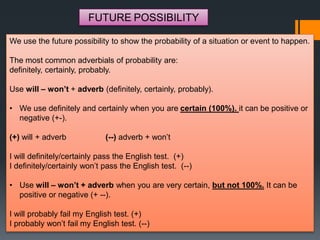
FUTURE POSSIBILITY
We use the future possibility to show the probability of a situation or event to happen.
The most common adverbials of probability are:
definitely, certainly, probably.
Use will – won’t + adverb (definitely, certainly, probably).
• We use definitely and certainly when you are certain (100%). it can be positive or
negative (+-).
(+) will + adverb (--) adverb + won’t
I will definitely/certainly pass the English test. (+)
I definitely/certainly won’t pass the English test. (--)
• Use will – won’t + adverb when you are very certain, but not 100%. It can be
positive or negative (+ --).
I will probably fail my English test. (+)
I probably won’t fail my English test. (--)
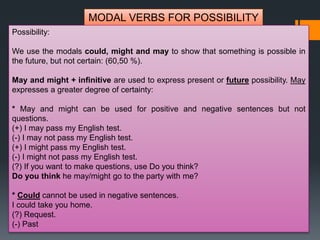
MODAL VERBS FOR POSSIBILITY
Possibility:
We use the modals could, might and may to show that something is possible in
the future, but not certain: (60,50 %).
May and might + infinitive are used to express present or future possibility. May
expresses a greater degree of certainty:
* May and might can be used for positive and negative sentences but not
questions.
(+) I may pass my English test.
(-) I may not pass my English test.
(+) I might pass my English test.
(-) I might not pass my English test.
(?) If you want to make questions, use Do you think?
Do you think he may/might go to the party with me?
* Could cannot be used in negative sentences.
I could take you home.
(?) Request.
(-) Past

Future possibility 1

  • 1.
    COME TO MEAND I WILL READ YOUR FUTURE!
  • 4.
    YOUR DECISIONS COULDPREDICT YOUR FUTURE
  • 5.
    FUTURE PROBABILITY. THERE ISALWAYS A DEGREE OF PROBABILITY FOR SOMETHING TO HAPPEN. THE QUESTION IS, HOW DO KNOW THAT POSSIBILITY ?
  • 6.
    FUTURE POSSIBILITY We usethe future possibility to show the probability of a situation or event to happen. The most common adverbials of probability are: definitely, certainly, probably. Use will – won’t + adverb (definitely, certainly, probably). • We use definitely and certainly when you are certain (100%). it can be positive or negative (+-). (+) will + adverb (--) adverb + won’t I will definitely/certainly pass the English test. (+) I definitely/certainly won’t pass the English test. (--) • Use will – won’t + adverb when you are very certain, but not 100%. It can be positive or negative (+ --). I will probably fail my English test. (+) I probably won’t fail my English test. (--)
  • 7.
    MODAL VERBS FORPOSSIBILITY Possibility: We use the modals could, might and may to show that something is possible in the future, but not certain: (60,50 %). May and might + infinitive are used to express present or future possibility. May expresses a greater degree of certainty: * May and might can be used for positive and negative sentences but not questions. (+) I may pass my English test. (-) I may not pass my English test. (+) I might pass my English test. (-) I might not pass my English test. (?) If you want to make questions, use Do you think? Do you think he may/might go to the party with me? * Could cannot be used in negative sentences. I could take you home. (?) Request. (-) Past