MODAL VERBS FOR
DEDUCTIONS
Developed by alinaemma@gmail.com
Modal verbs for certainty
 Certainty
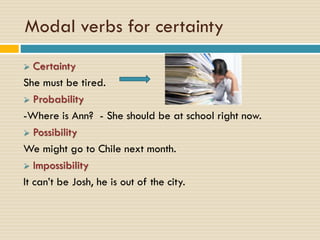
She must be tired.
 Probability
-Where is Ann? - She should be at school right now.
 Possibility
We might go to Chile next month.
 Impossibility
It can’t be Josh, he is out of the city.
Modals
 Third person singular has no – S
She must be tired (NOT: she musts…)
 Questions and negations are formed without DO
You mustn’t go there! Should I? It cannot be true!
 After modals (except OUGHT) we use infinitives
without TO
I can’t swim (NOT: I can’t to swim)
Image retrieved from: www.sodahead.com
Modals + infinitives
 Modals can be
followed by
 PERFECT
 PROGRESSIVE
 and PASSIVE
infinitives
 You should have told
me earlier.
 I should be studying,
not playing with my
phone.
 They must be cured as
soon as possible.
MUST
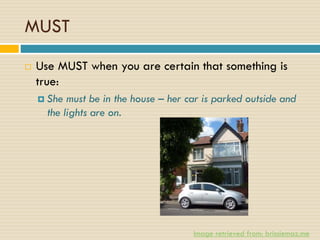
 Use MUST when you are certain that something is
true:
 She must be in the house – her car is parked outside and
the lights are on.
Image retrieved from: brissiemaz.me
CAN’T
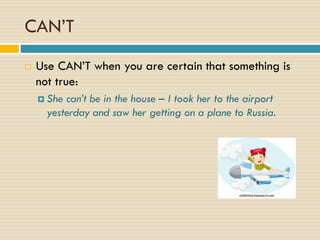
 Use CAN’T when you are certain that something is
not true:
 She can’t be in the house – I took her to the airport
yesterday and saw her getting on a plane to Russia.
SHOULD/SHOULDN’T
 Use SHOULD/SHOULDN’T when you are not sure
that something or not, but you think there is a good
possibility that you could be right:
 She should be home by now – she left her office an hour
ago.
 I can install this app myself – it shouldn’t be too difficult.
OUGHT TO/OUGHT NOT TO
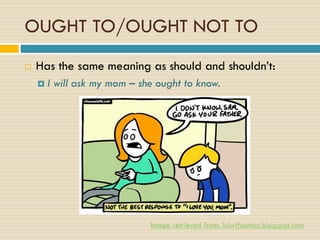
 Has the same meaning as should and shouldn’t:
 I will ask my mom – she ought to know.
Image retrieved from: lolwtfcomics.blogspot.com
WILL and WILL NOT/WON’T
 WILL has a similar meaning to MUST, and WON’T
has a similar meaning to CAN’T. We use WILL and
WON’T when we talk about normal, typical actions
which are expected:
 - There is someone at the door!
- That will be Mary, she always returns home at this time.
 - Let’s go and get something to it.
- No, the canteen won’t be open yet. Let’s go in an hour.
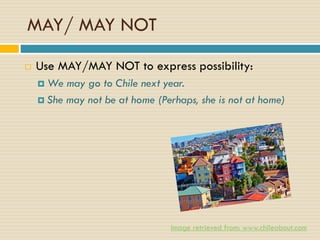
MAY/ MAY NOT
 Use MAY/MAY NOT to express possibility:
 We may go to Chile next year.
 She may not be at home (Perhaps, she is not at home)
Image retrieved from: www.chileabout.com
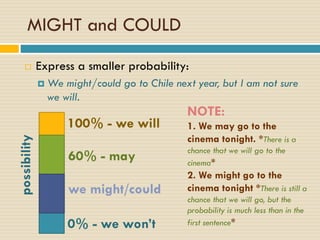
MIGHT and COULD
 Express a smaller probability:
 We might/could go to Chile next year, but I am not sure
we will.
possibility
100% - we will
0% - we won’t
we might/could
60% - may
NOTE:
1. We may go to the
cinema tonight. *There is a
chance that we will go to the
cinema*
2. We might go to the
cinema tonight *There is still a
chance that we will go, but the
probability is much less than in the
first sentence*
MIGHT and COULD
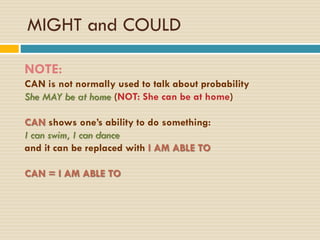
NOTE:
CAN is not normally used to talk about probability
She MAY be at home (NOT: She can be at home)
CAN shows one’s ability to do something:
I can swim, I can dance
and it can be replaced with I AM ABLE TO
CAN = I AM ABLE TO
Let’s practice
 Complete the sentences with the correct modal
either in the positive or negative form, sometimes
more than one option is possible
Image retrieved from: mercercognitivepsychology.pbworks.com
Let’s practice
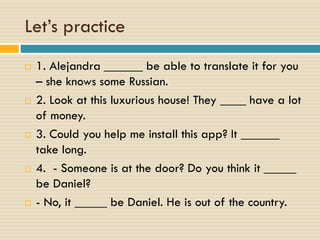
 1. Alejandra ______ be able to translate it for you
– she knows some Russian.
 2. Look at this luxurious house! They ____ have a lot
of money.
 3. Could you help me install this app? It ______
take long.
 4. - Someone is at the door? Do you think it _____
be Daniel?
 - No, it _____ be Daniel. He is out of the country.
Let’s practice
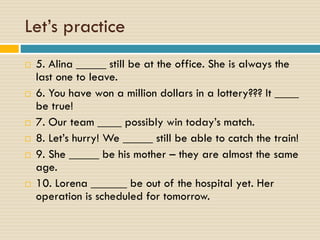
 5. Alina _____ still be at the office. She is always the
last one to leave.
 6. You have won a million dollars in a lottery??? It ____
be true!
 7. Our team ____ possibly win today’s match.
 8. Let’s hurry! We _____ still be able to catch the train!
 9. She _____ be his mother – they are almost the same
age.
 10. Lorena ______ be out of the hospital yet. Her
operation is scheduled for tomorrow.
Have Fun Learning 

Modal verbs for deductions

  • 1.
  • 2.
    Modal verbs forcertainty  Certainty She must be tired.  Probability -Where is Ann? - She should be at school right now.  Possibility We might go to Chile next month.  Impossibility It can’t be Josh, he is out of the city.
  • 3.
    Modals  Third personsingular has no – S She must be tired (NOT: she musts…)  Questions and negations are formed without DO You mustn’t go there! Should I? It cannot be true!  After modals (except OUGHT) we use infinitives without TO I can’t swim (NOT: I can’t to swim) Image retrieved from: www.sodahead.com
  • 4.
    Modals + infinitives Modals can be followed by  PERFECT  PROGRESSIVE  and PASSIVE infinitives  You should have told me earlier.  I should be studying, not playing with my phone.  They must be cured as soon as possible.
  • 5.
    MUST  Use MUSTwhen you are certain that something is true:  She must be in the house – her car is parked outside and the lights are on. Image retrieved from: brissiemaz.me
  • 6.
    CAN’T  Use CAN’Twhen you are certain that something is not true:  She can’t be in the house – I took her to the airport yesterday and saw her getting on a plane to Russia.
  • 7.
    SHOULD/SHOULDN’T  Use SHOULD/SHOULDN’Twhen you are not sure that something or not, but you think there is a good possibility that you could be right:  She should be home by now – she left her office an hour ago.  I can install this app myself – it shouldn’t be too difficult.
  • 8.
    OUGHT TO/OUGHT NOTTO  Has the same meaning as should and shouldn’t:  I will ask my mom – she ought to know. Image retrieved from: lolwtfcomics.blogspot.com
  • 9.
    WILL and WILLNOT/WON’T  WILL has a similar meaning to MUST, and WON’T has a similar meaning to CAN’T. We use WILL and WON’T when we talk about normal, typical actions which are expected:  - There is someone at the door! - That will be Mary, she always returns home at this time.  - Let’s go and get something to it. - No, the canteen won’t be open yet. Let’s go in an hour.
  • 10.
    MAY/ MAY NOT Use MAY/MAY NOT to express possibility:  We may go to Chile next year.  She may not be at home (Perhaps, she is not at home) Image retrieved from: www.chileabout.com
  • 11.
    MIGHT and COULD Express a smaller probability:  We might/could go to Chile next year, but I am not sure we will. possibility 100% - we will 0% - we won’t we might/could 60% - may NOTE: 1. We may go to the cinema tonight. *There is a chance that we will go to the cinema* 2. We might go to the cinema tonight *There is still a chance that we will go, but the probability is much less than in the first sentence*
  • 12.
    MIGHT and COULD NOTE: CANis not normally used to talk about probability She MAY be at home (NOT: She can be at home) CAN shows one’s ability to do something: I can swim, I can dance and it can be replaced with I AM ABLE TO CAN = I AM ABLE TO
  • 13.
    Let’s practice  Completethe sentences with the correct modal either in the positive or negative form, sometimes more than one option is possible Image retrieved from: mercercognitivepsychology.pbworks.com
  • 14.
    Let’s practice  1.Alejandra ______ be able to translate it for you – she knows some Russian.  2. Look at this luxurious house! They ____ have a lot of money.  3. Could you help me install this app? It ______ take long.  4. - Someone is at the door? Do you think it _____ be Daniel?  - No, it _____ be Daniel. He is out of the country.
  • 15.
    Let’s practice  5.Alina _____ still be at the office. She is always the last one to leave.  6. You have won a million dollars in a lottery??? It ____ be true!  7. Our team ____ possibly win today’s match.  8. Let’s hurry! We _____ still be able to catch the train!  9. She _____ be his mother – they are almost the same age.  10. Lorena ______ be out of the hospital yet. Her operation is scheduled for tomorrow.
  • 16.