USE MODAL
VERBS, NOUNS
AND ADVERBS
APPROPRIATELY
MODAL VERBS
Modal Verbs are auxiliary or helping verbs which
modify or change the meaning of the main verbs.
You use modal verbs in giving advice or
suggestions, in making requests, or in giving
predictions and prohibitions
WHAT IS AN INFINITIVE
VERB?
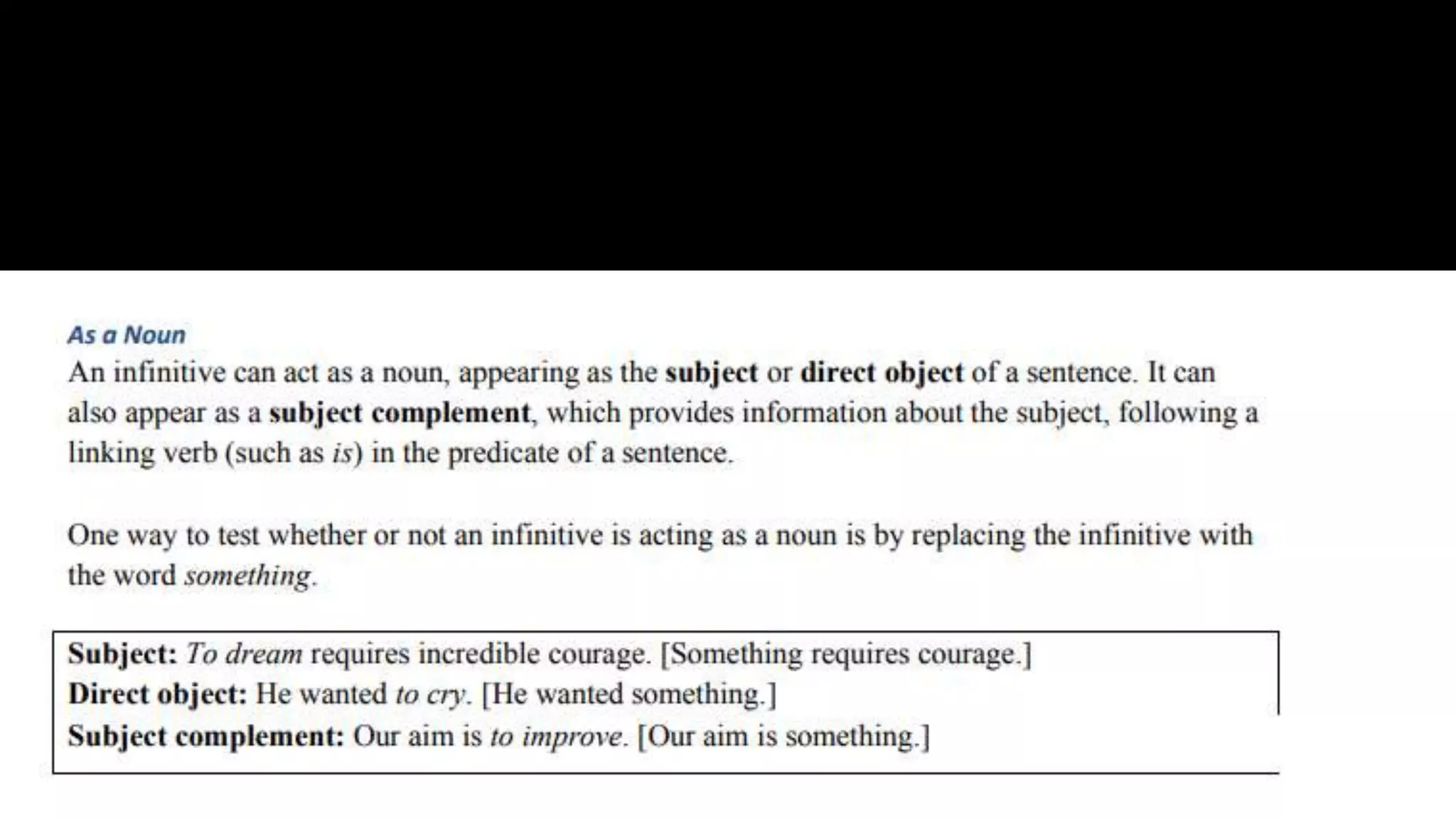
An infinitive is a verbal, a verb form or
construction that plays the role of a
different part of speech in a sentence.
WHY ARE MODAL VERBS
IMPORTANT?
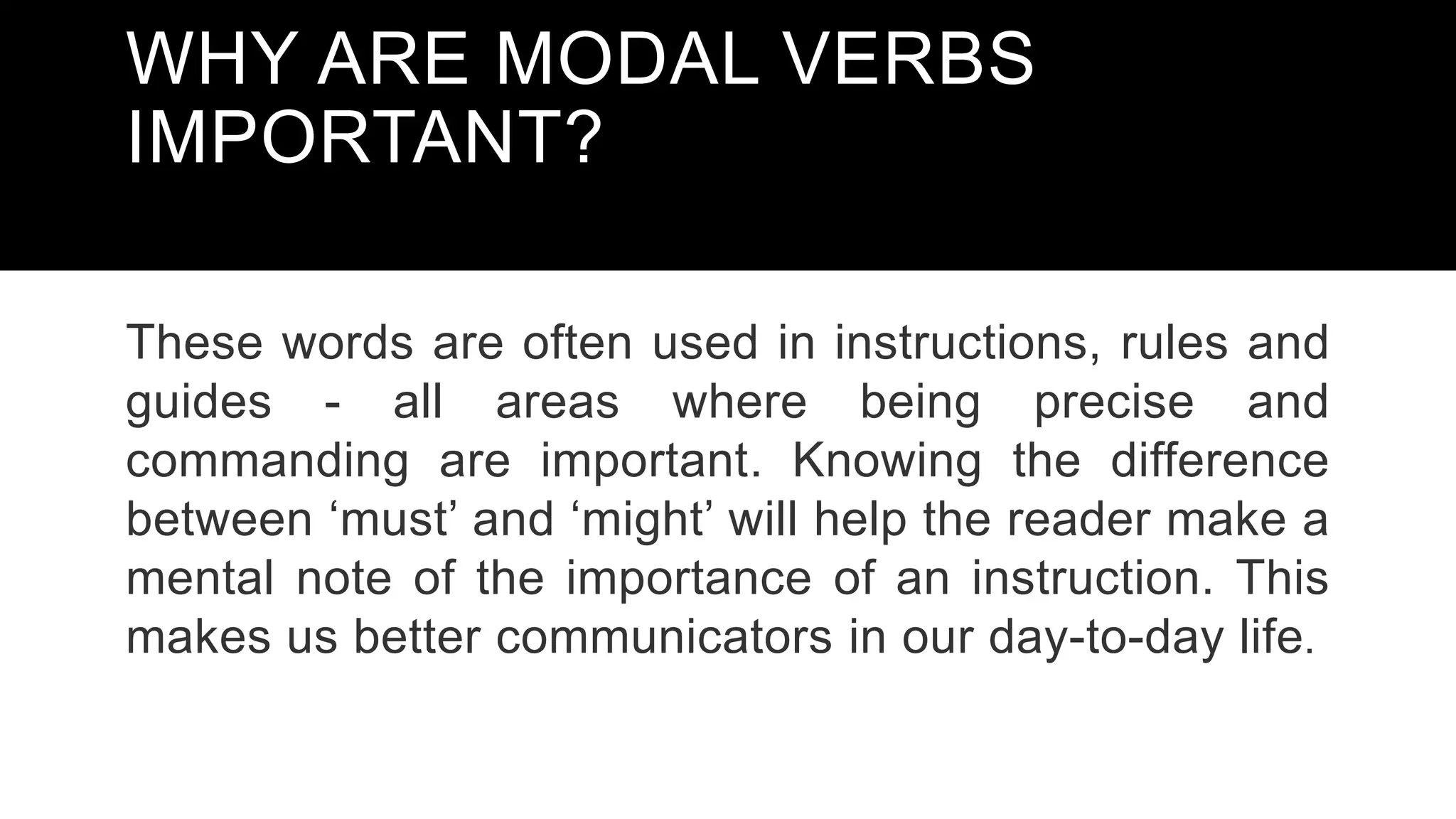
These words are often used in instructions, rules and
guides - all areas where being precise and
commanding are important. Knowing the difference
between ‘must’ and ‘might’ will help the reader make a
mental note of the importance of an instruction. This
makes us better communicators in our day-to-day life.
CAN, COULD, BE ABLE
TO
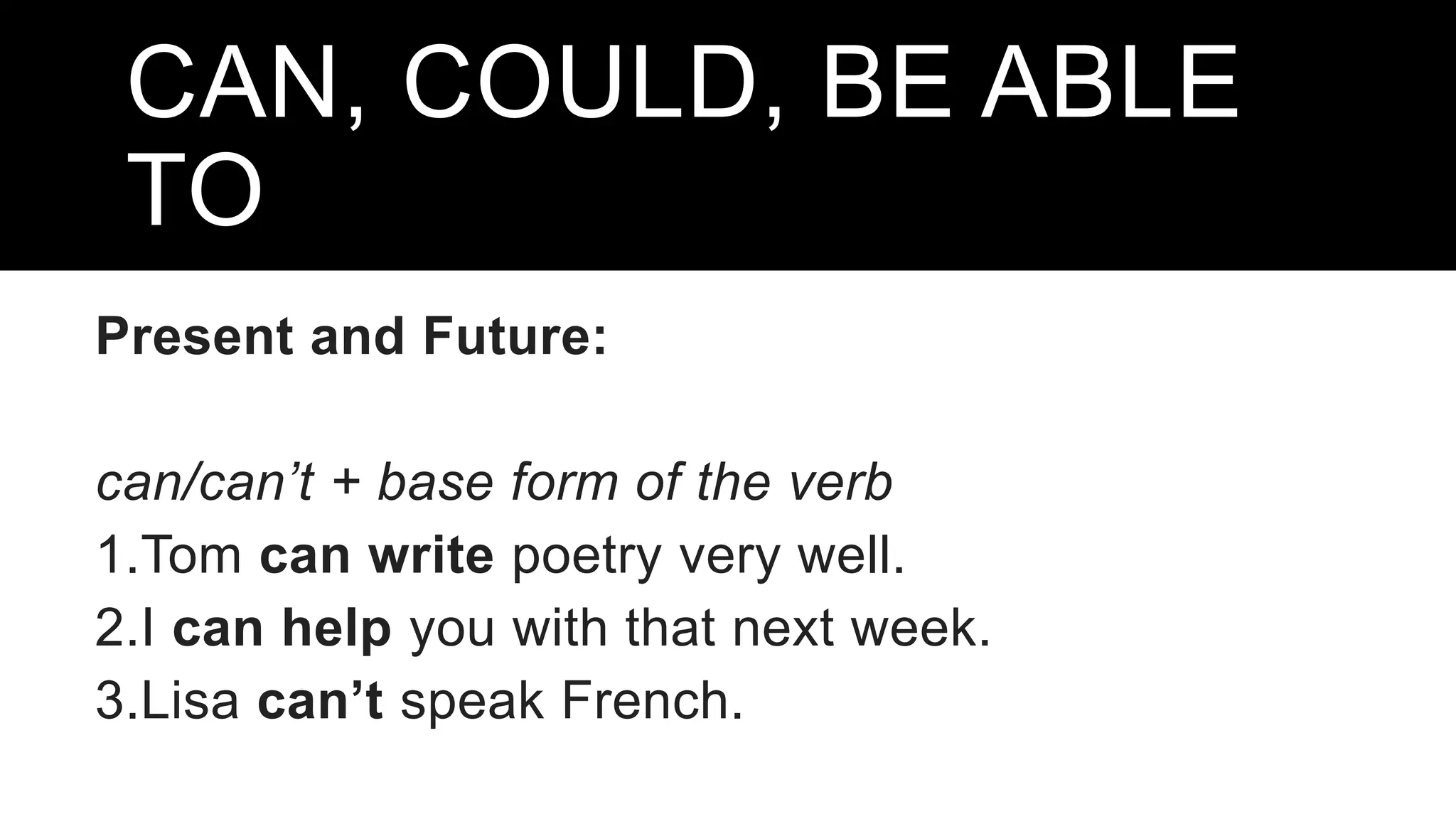
Present and Future:
can/can’t + base form of the verb
1.Tom can write poetry very well.
2.I can help you with that next week.
3.Lisa can’t speak French.
AS AN ADJECTIVE
Infinitives can also be placed after any noun in a sentence, acting as
an adjective.
Describing a Subject: The best person to consult is your counselor
[whom you should consult].
Describing an Object: The teacher assigned several exercises to
complete [exercises that must
be completed].
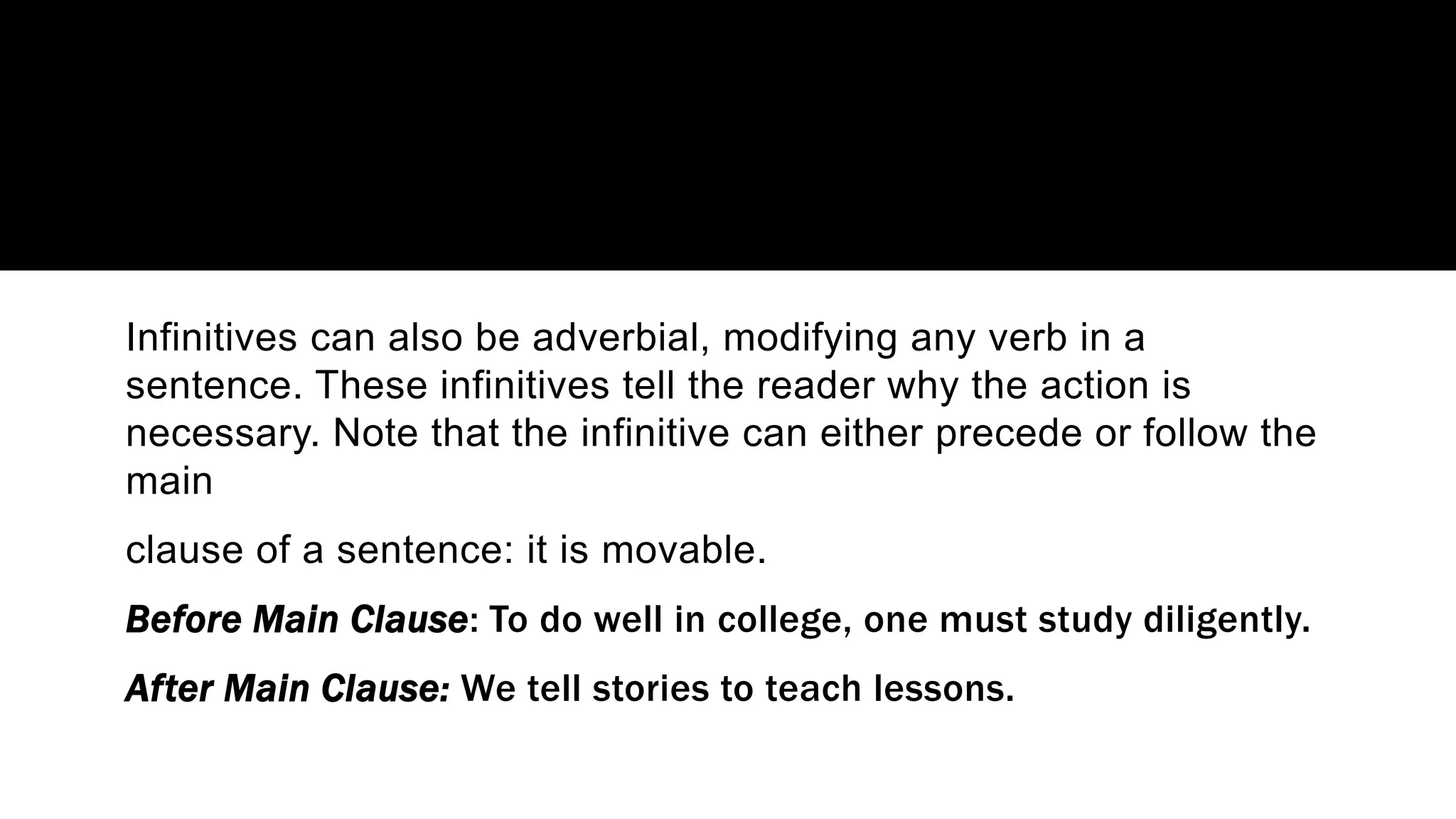
Infinitives can also be adverbial, modifying any verb in a
sentence. These infinitives tell the reader why the action is
necessary. Note that the infinitive can either precede or follow the
main
clause of a sentence: it is movable.
Before Main Clause: To do well in college, one must study diligently.
After Main Clause: We tell stories to teach lessons.
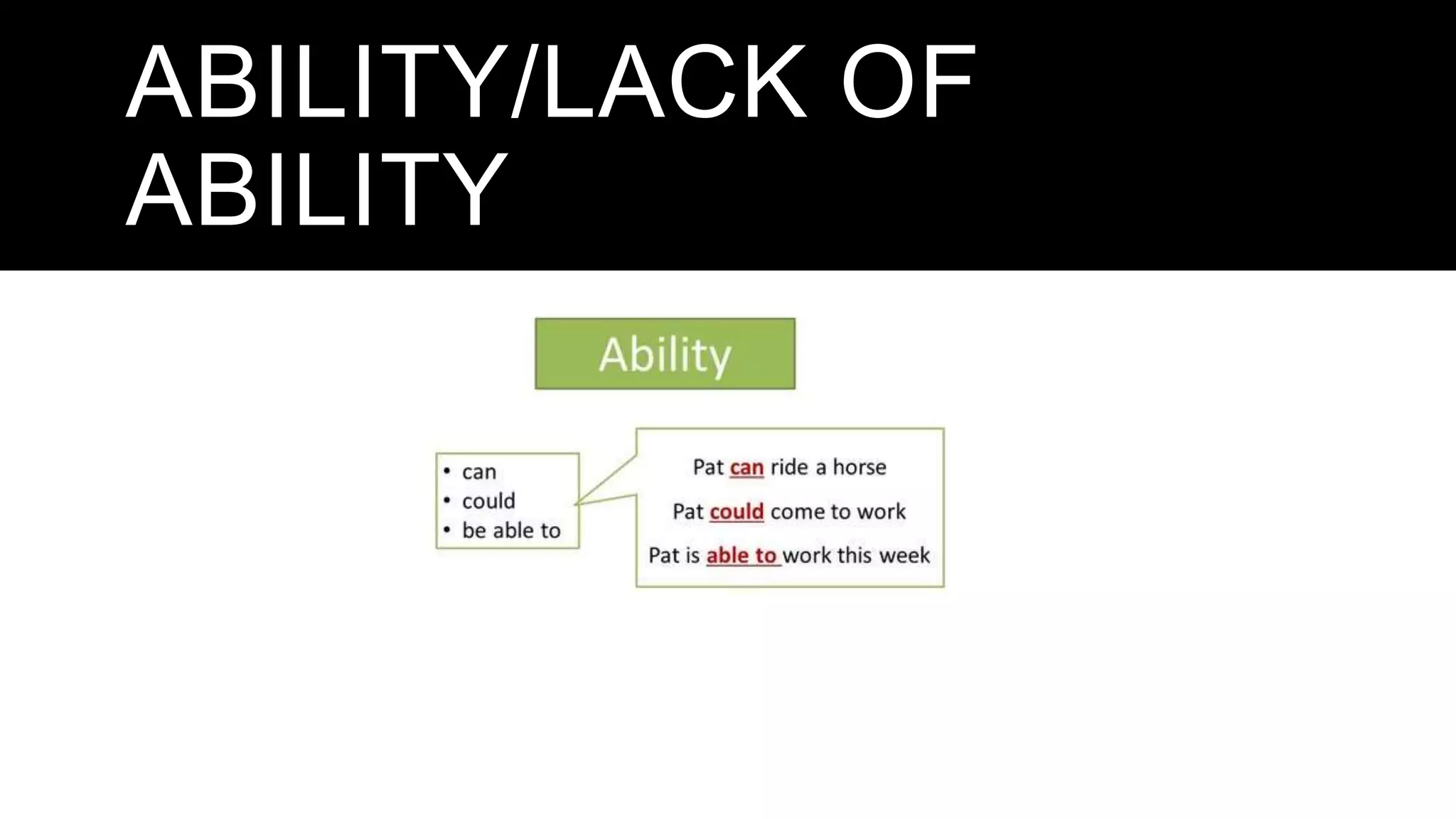
ABILITY/LACK OF
ABILITY
am / is / are / will be + able to + base form of the verb
am not/ isn’t / aren’t/ won’t be + able to + base form of the verb
1. Mike is able to solve complicated math equations
2. The support team will be able to help you in about ten minutes.
3. I won’t be able to visit you next summer.
COULD / COULDN’T
Past:
could / couldn’t + base form of the verb
was / were + able to + base form of the verb
wasn’t / weren’t + able to + base form of the verb
hasn’t / haven’t + been able to + base form of the verb
1.I wasn’t able to visit her in the hospital.
2.He hasn’t been able to get in touch with the client yet.
POSSIBILITY /
IMPOSSIBILITY
May and might + infinitive are used to
express present or future
possibility. May expresses a greater
degree of certainty:
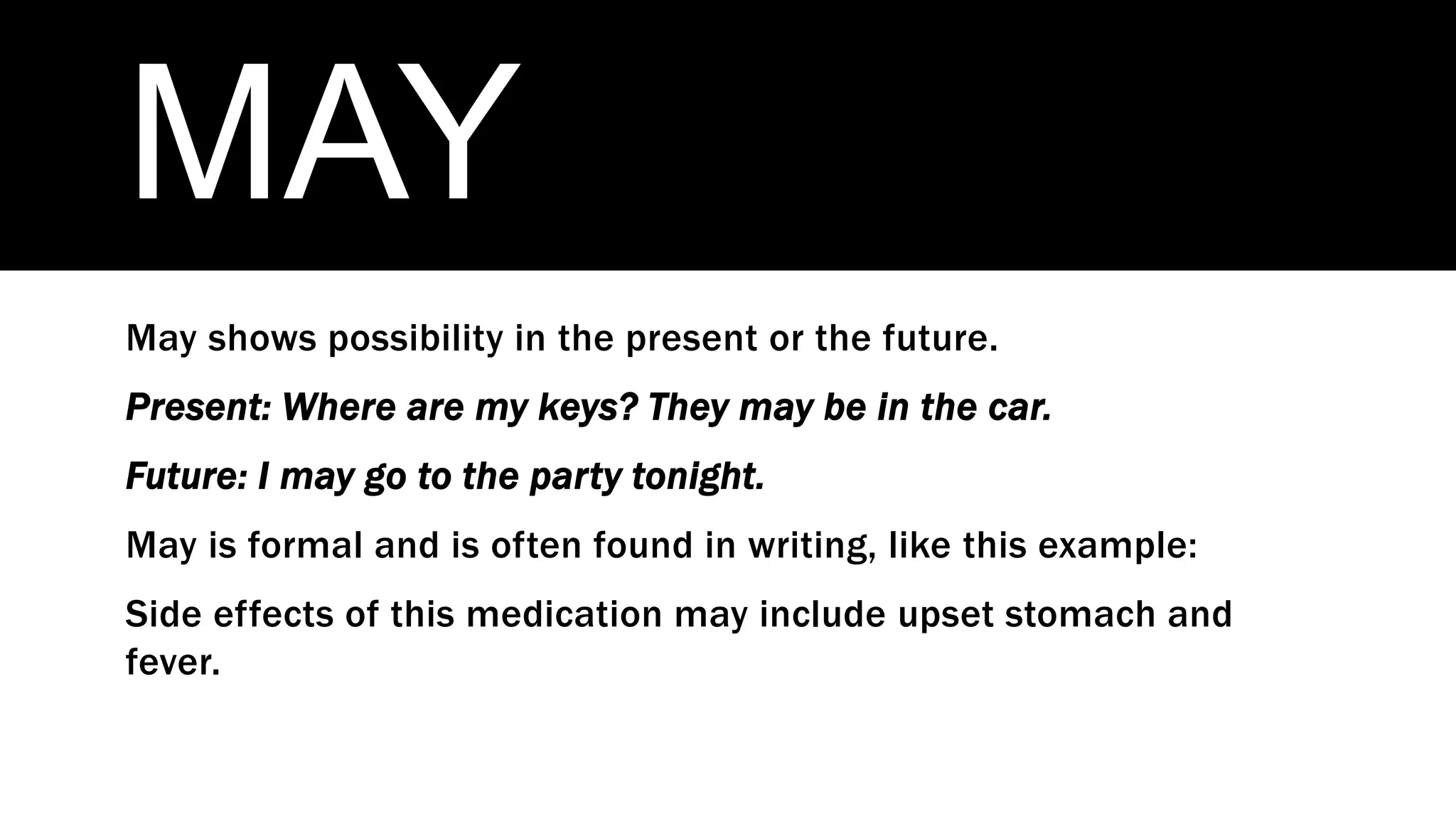
MAY
May shows possibility in the present or the future.
Present: Where are my keys? They may be in the car.
Future: I may go to the party tonight.
May is formal and is often found in writing, like this example:
Side effects of this medication may include upset stomach and
fever.
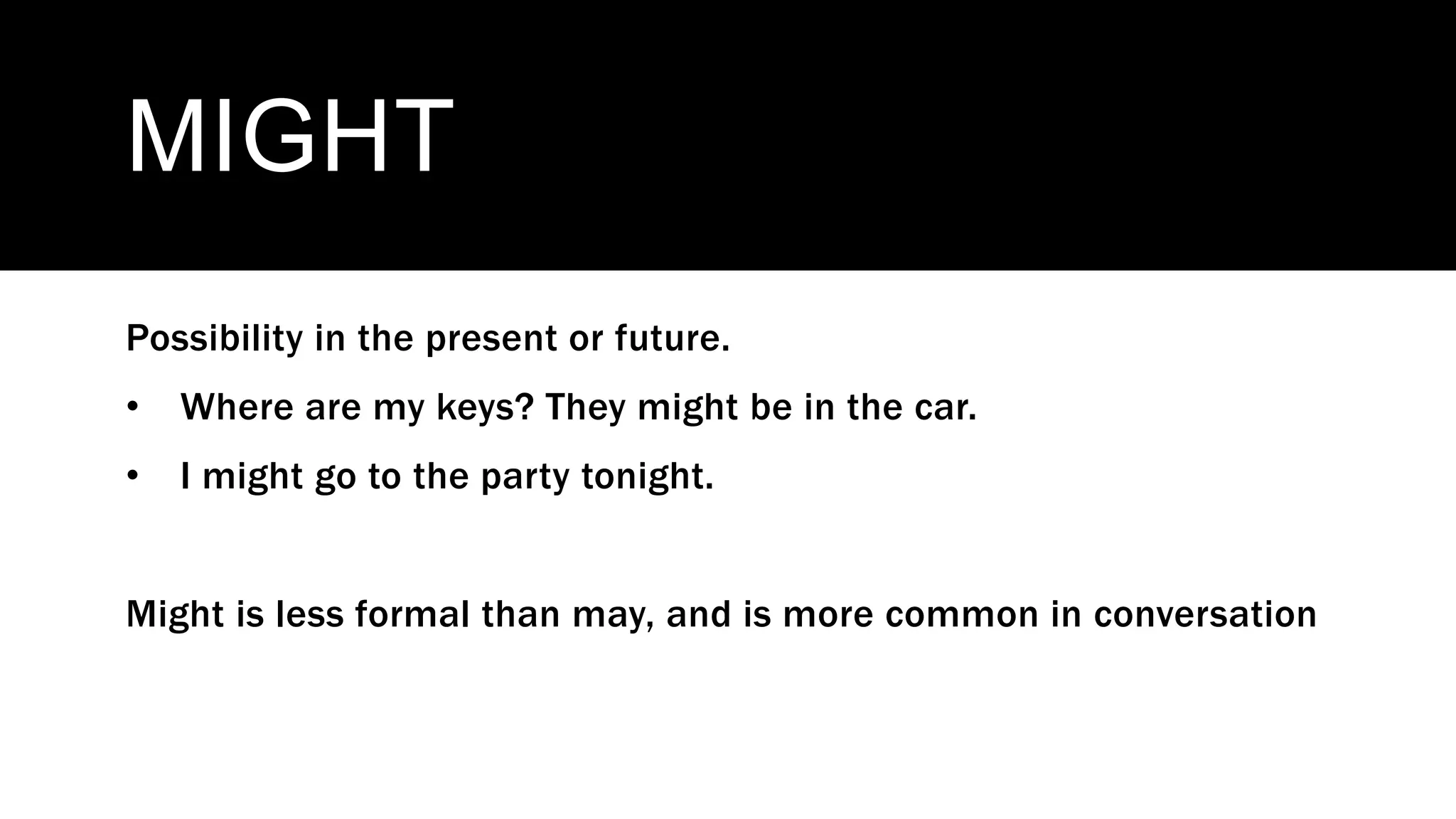
MIGHT
Possibility in the present or future.
• Where are my keys? They might be in the car.
• I might go to the party tonight.
Might is less formal than may, and is more common in conversation
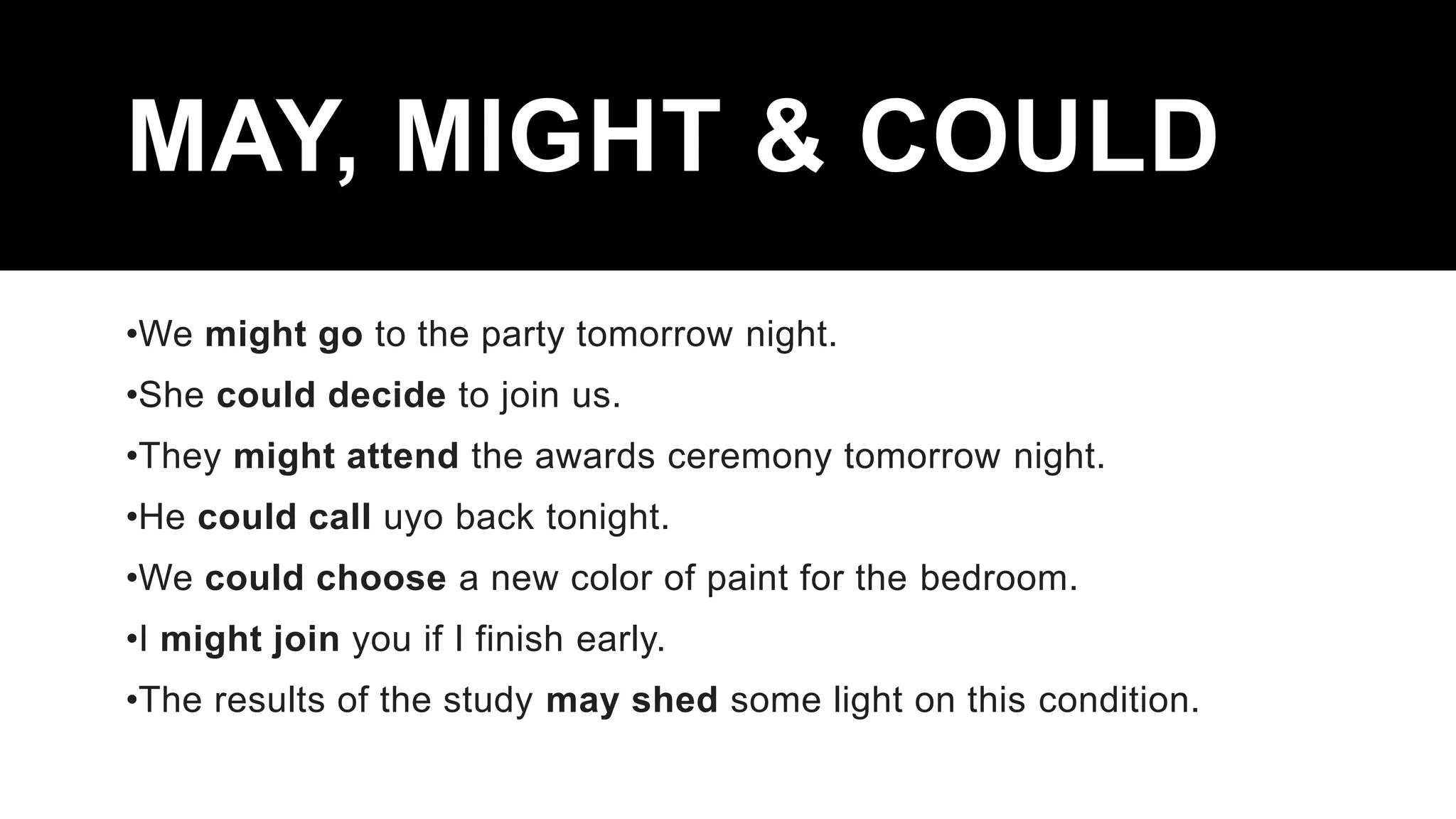
MAY, MIGHT & COULD
•We might go to the party tomorrow night.
•She could decide to join us.
•They might attend the awards ceremony tomorrow night.
•He could call uyo back tonight.
•We could choose a new color of paint for the bedroom.
•I might join you if I finish early.
•The results of the study may shed some light on this condition.
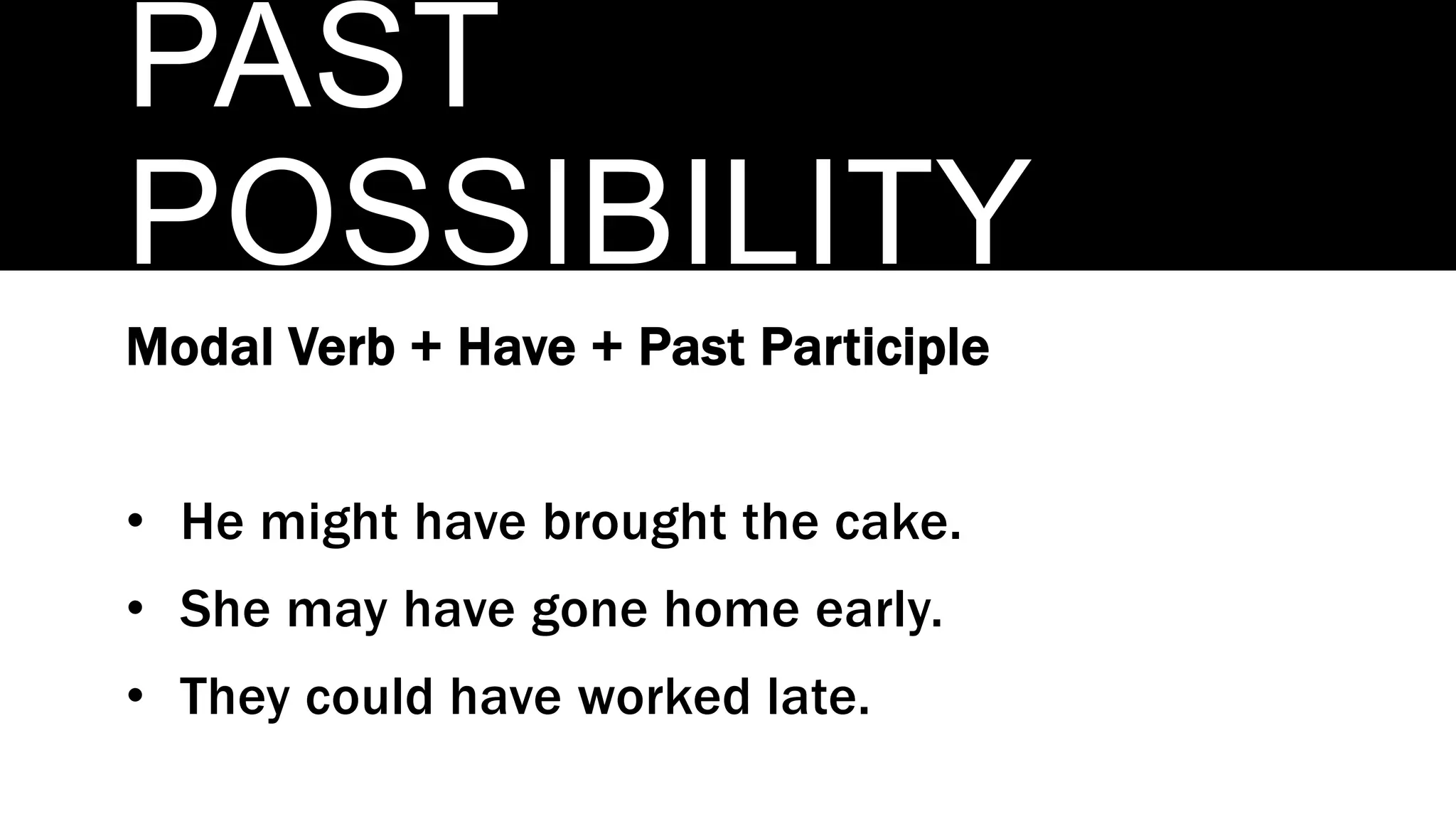
PAST
POSSIBILITY
Modal Verb + Have + Past Participle
• He might have brought the cake.
• She may have gone home early.
• They could have worked late.
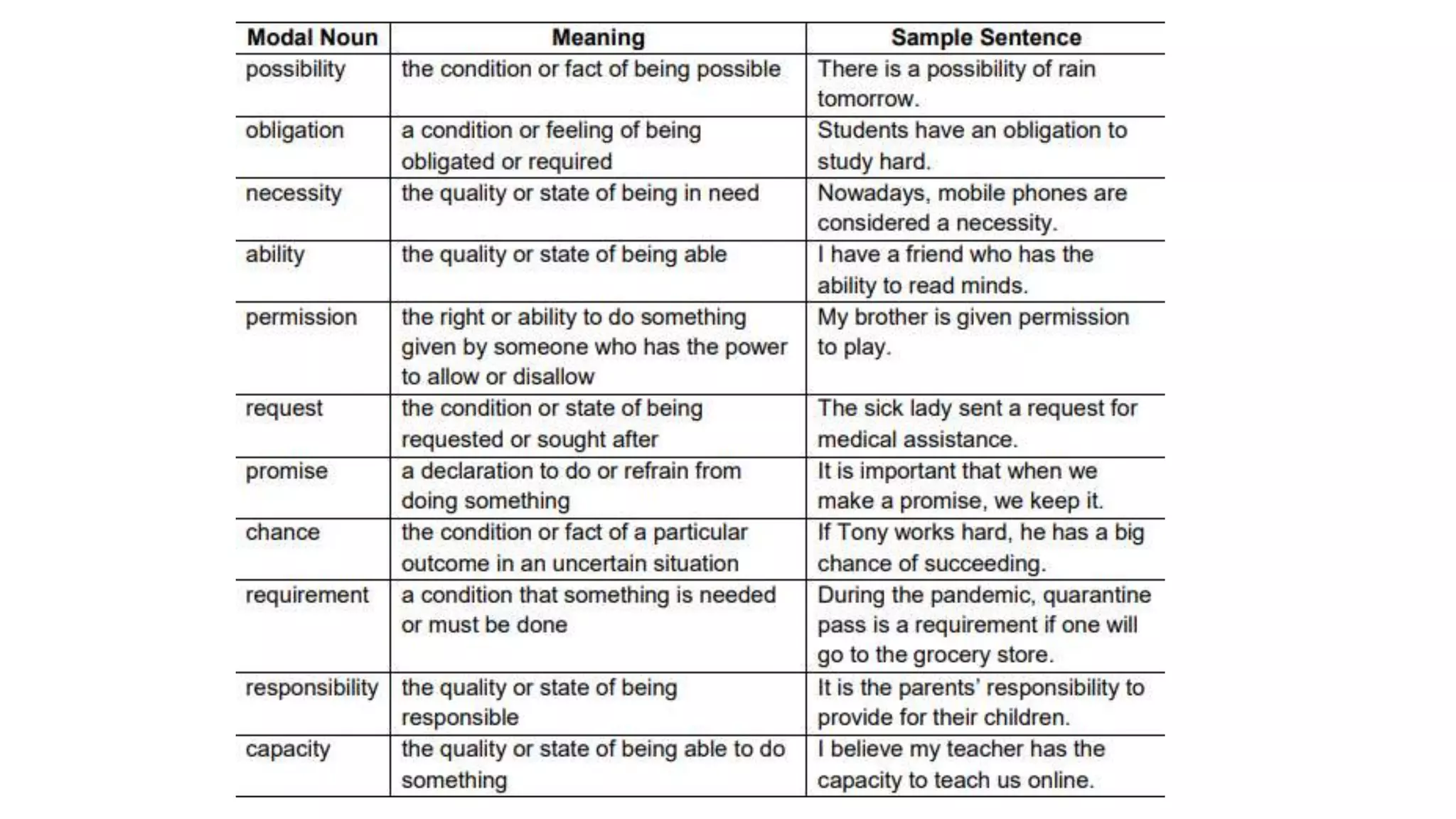
MODAL NOUNS
Modal Nouns are used to express various moods
through its application in a sentence. Words like
necessity, permission, capacity, possibility,
responsibility, obligation, chance, promise,
requirement, request, and ability are modal
nouns examples.
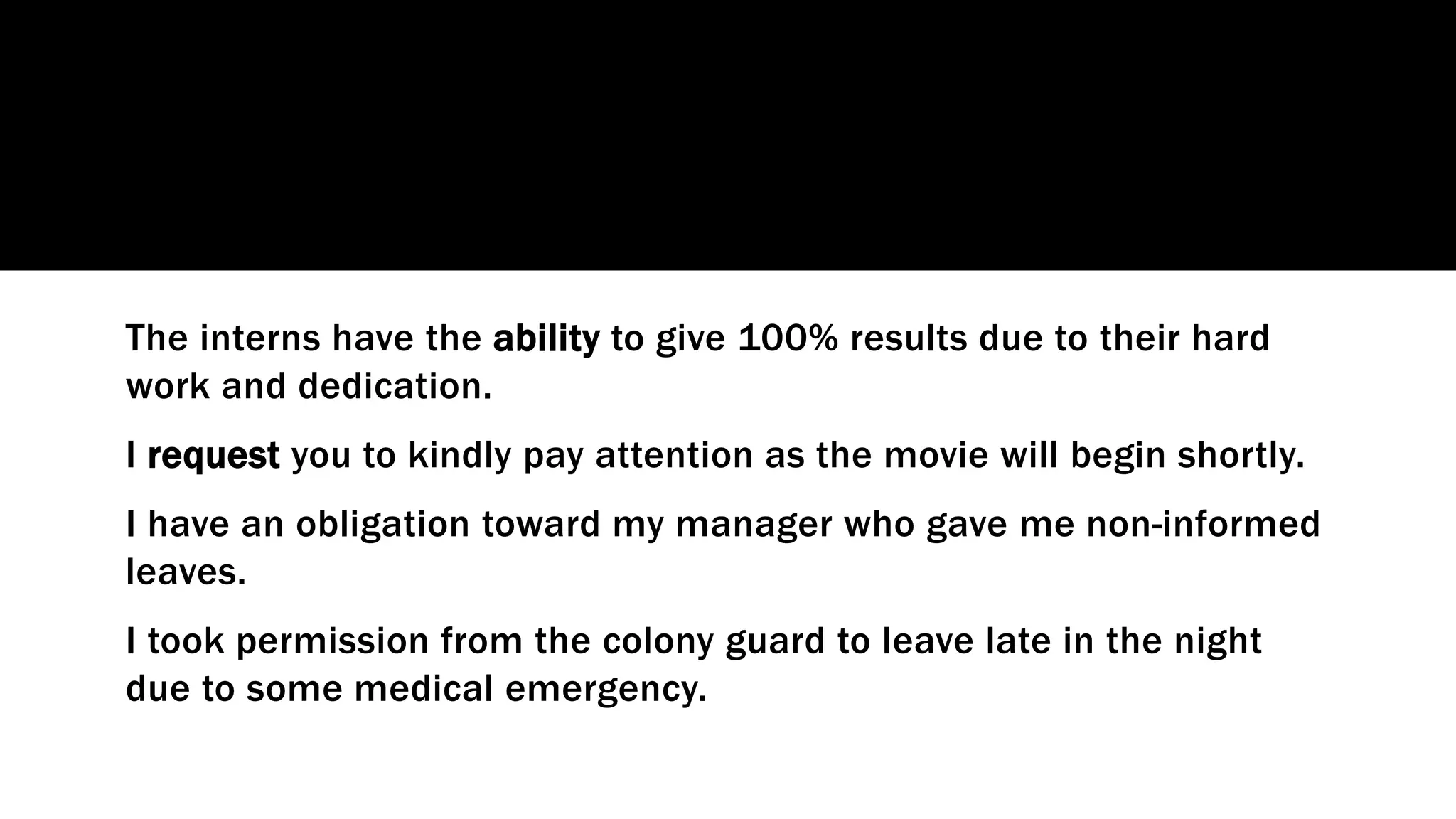
The interns have the ability to give 100% results due to their hard
work and dedication.
I request you to kindly pay attention as the movie will begin shortly.
I have an obligation toward my manager who gave me non-informed
leaves.
I took permission from the colony guard to leave late in the night
due to some medical emergency.
WHAT IS ADVERB
A word or phrase that modifies or qualifies
an adjective, verb, or other adverb or a word
group, expressing a relation of place, time,
circumstance, manner, cause, degree, etc.
(e.g., gently, quite, then, there ).
ADVERBS AND VERBS
Adverbs often modify verbs. This means that they describe the way
an action is happening.
Phillip sings loudly in the shower.
My cat waits impatiently for his food.
I will seriously consider your suggestion.
When? She always arrives early.
How? He drives carefully.
Where? They go everywhere together.
In what way? She eats slowly.
To what extent? It is terribly hot.
• The dog ran.
• The dog ran excitedly.
TYPES OF
ADVERBS
ADVERBS OF MANNER
An adverb of manner will explain how an action is
carried out. Very often adverbs of manner are
adjectives with -ly added to the end, but this is
certainly not always the case. In fact, some
adverbs of manner will have the same spelling as
the adjective form.
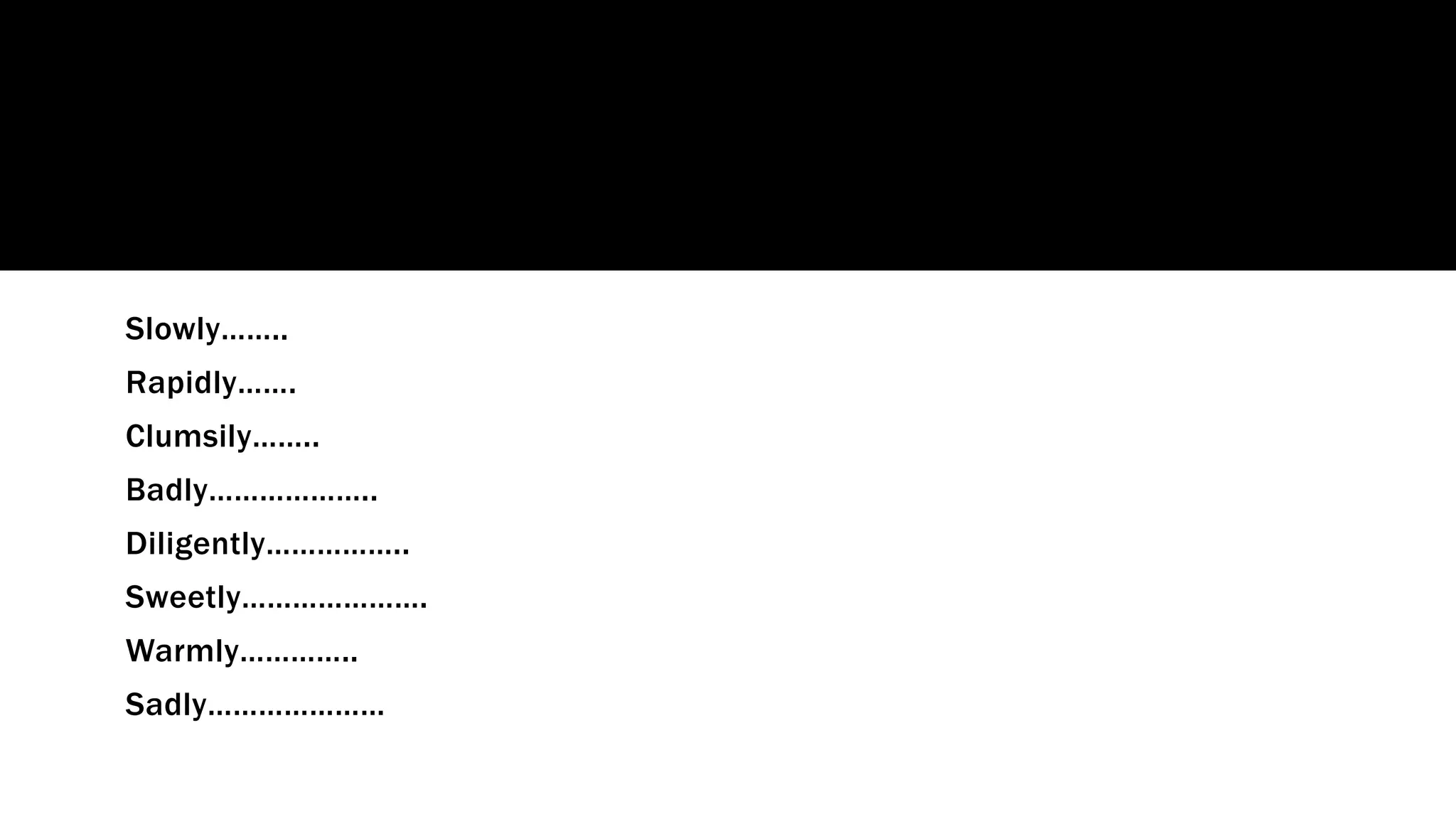
Slowly……..
Rapidly…….
Clumsily……..
Badly………………..
Diligently……………..
Sweetly………………….
Warmly…………..
Sadly…………………
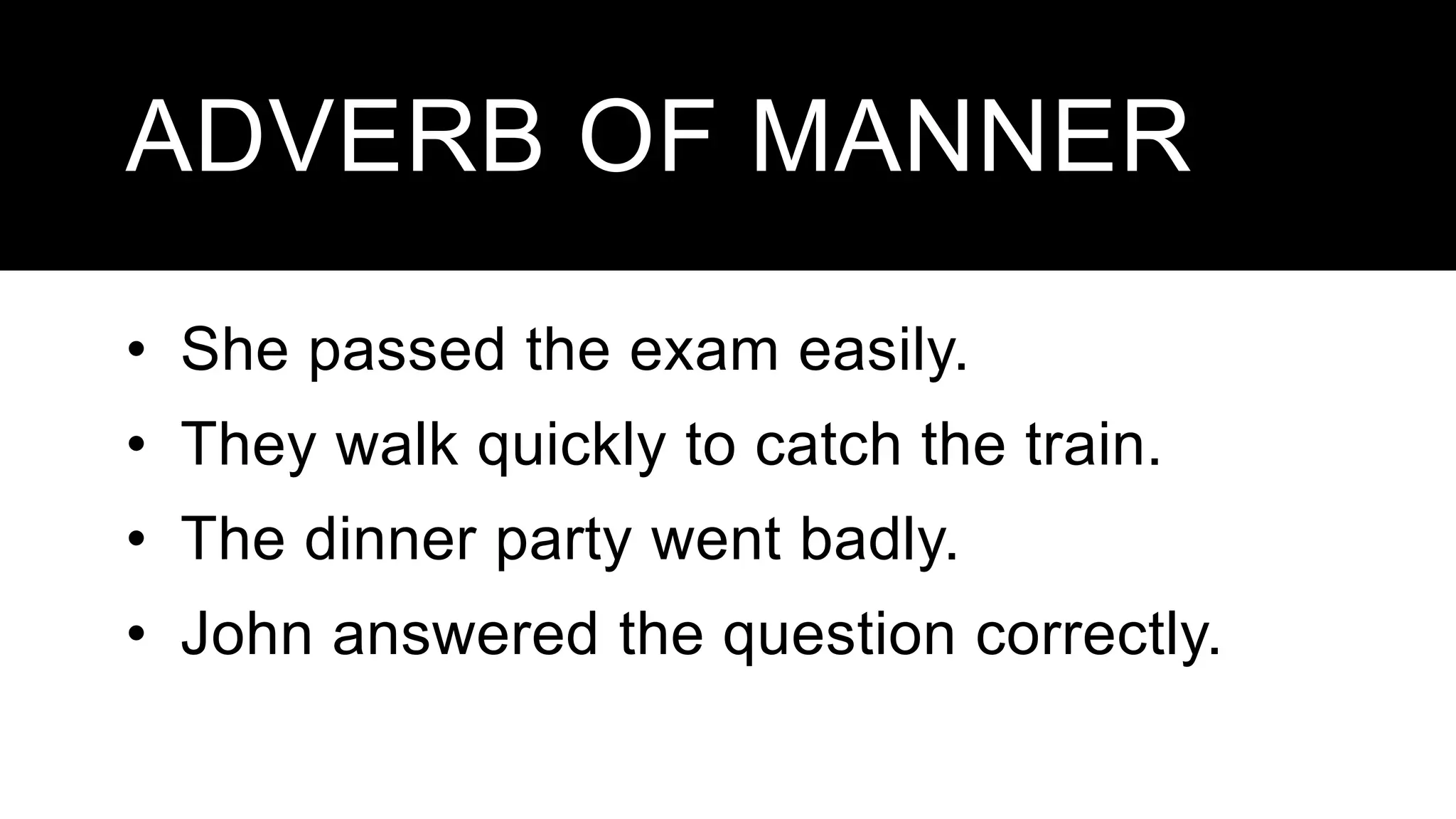
ADVERB OF MANNER
• She passed the exam easily.
• They walk quickly to catch the train.
• The dinner party went badly.
• John answered the question correctly.
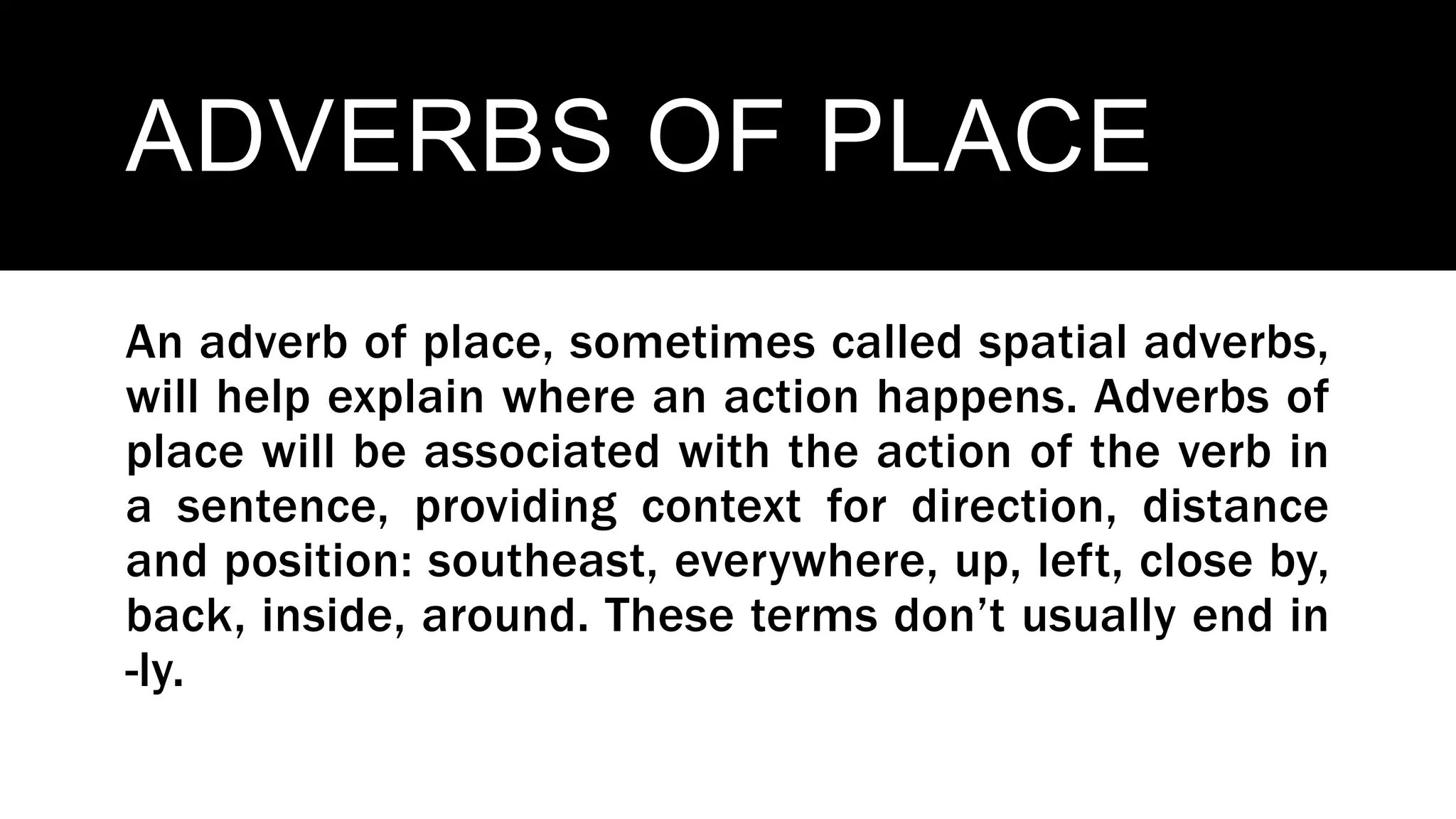
ADVERBS OF PLACE
An adverb of place, sometimes called spatial adverbs,
will help explain where an action happens. Adverbs of
place will be associated with the action of the verb in
a sentence, providing context for direction, distance
and position: southeast, everywhere, up, left, close by,
back, inside, around. These terms don’t usually end in
-ly.
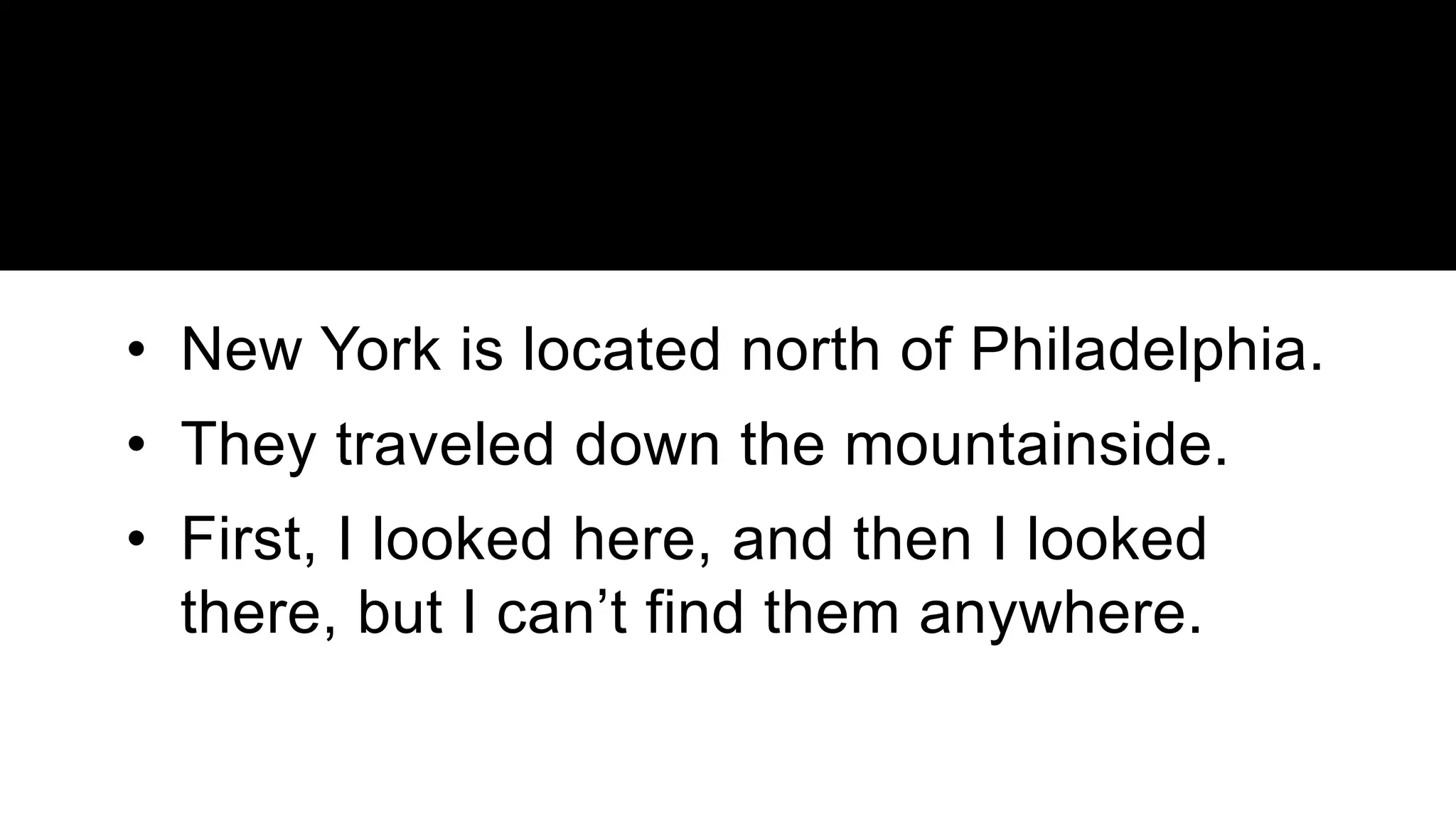
• New York is located north of Philadelphia.
• They traveled down the mountainside.
• First, I looked here, and then I looked
there, but I can’t find them anywhere.
ADVERBS OF
FREQUENCY
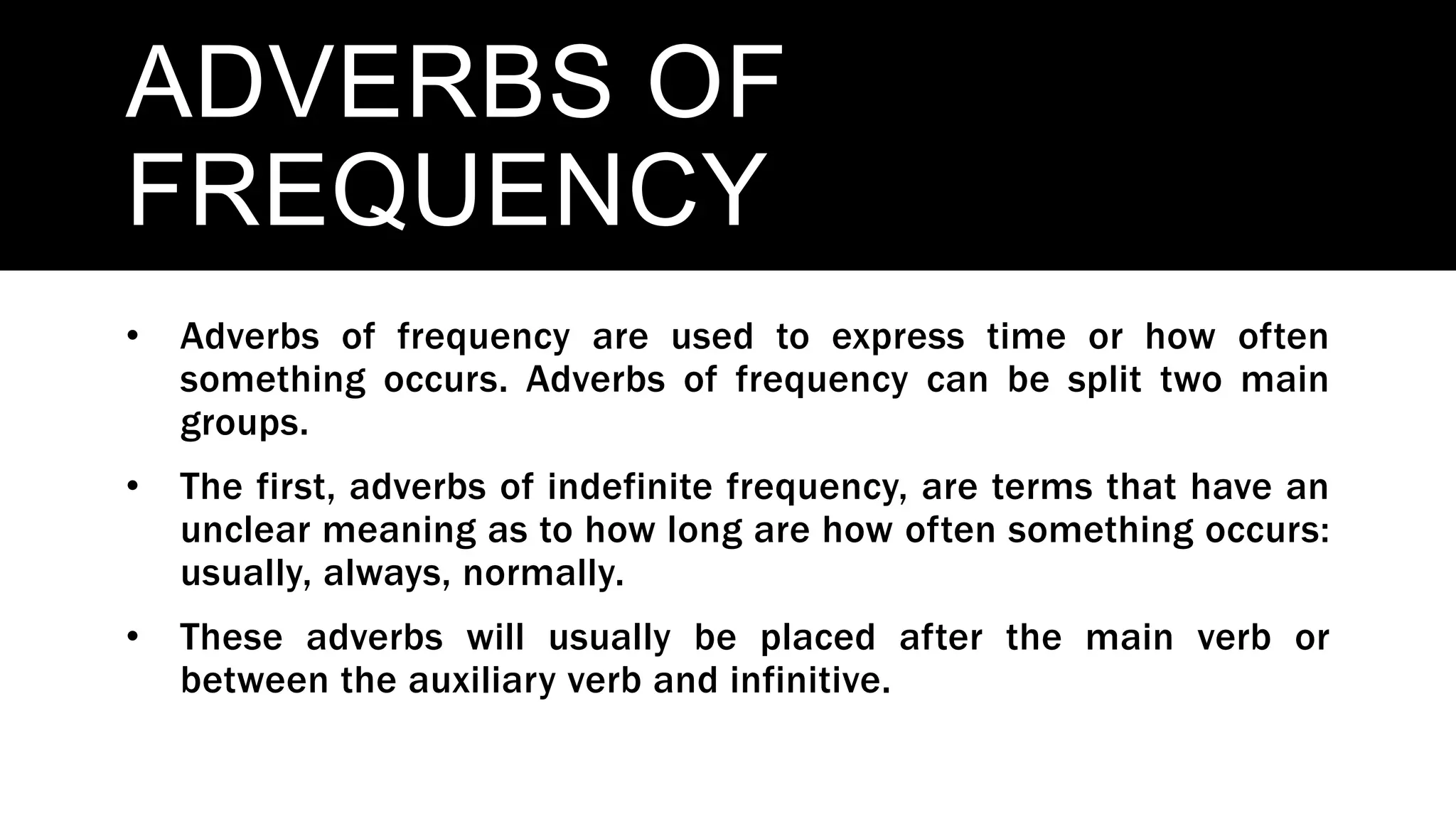
• Adverbs of frequency are used to express time or how often
something occurs. Adverbs of frequency can be split two main
groups.
• The first, adverbs of indefinite frequency, are terms that have an
unclear meaning as to how long are how often something occurs:
usually, always, normally.
• These adverbs will usually be placed after the main verb or
between the auxiliary verb and infinitive.
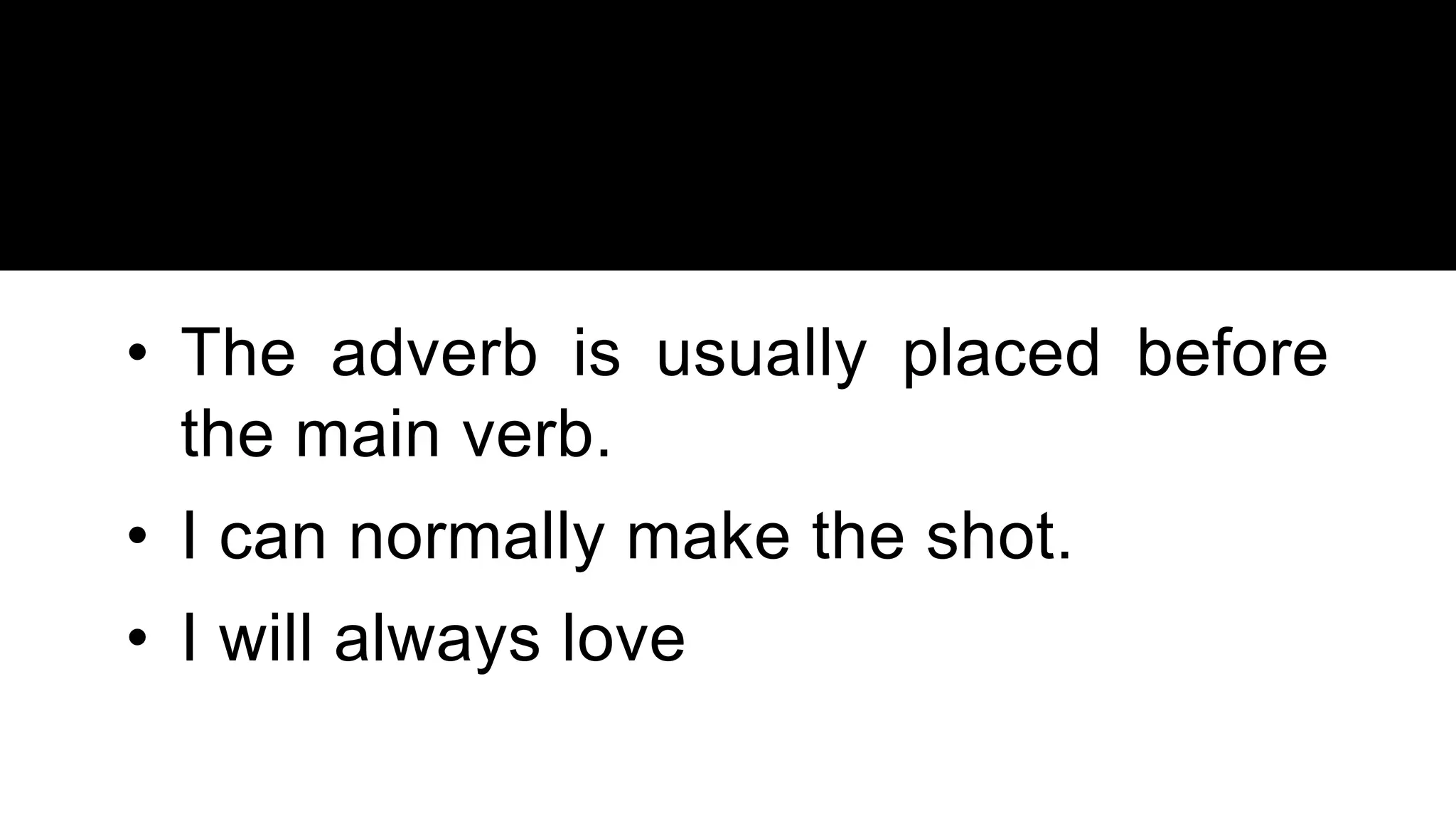
• The adverb is usually placed before
the main verb.
• I can normally make the shot.
• I will always love
ADVERBS OF TIME
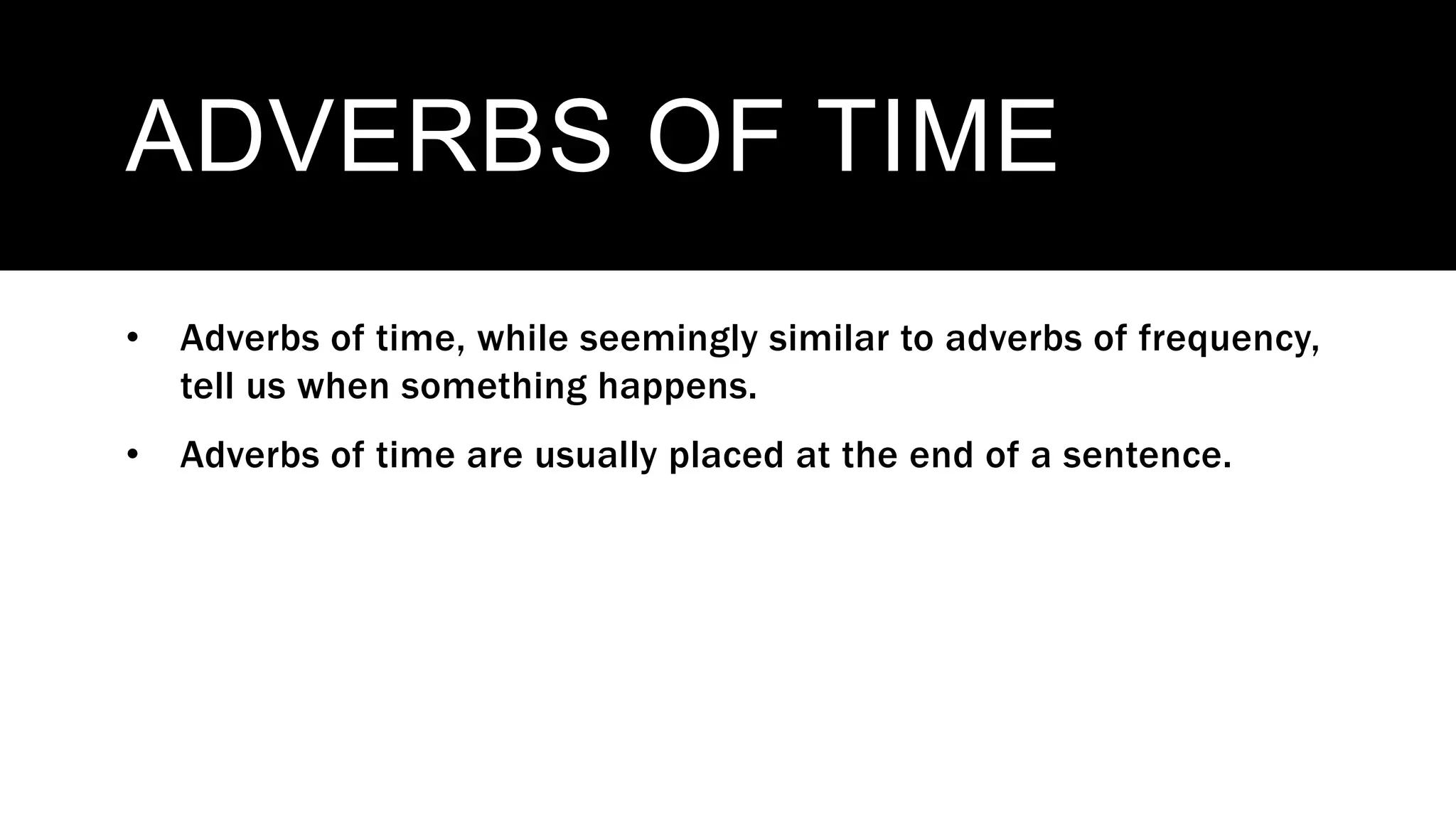
• Adverbs of time, while seemingly similar to adverbs of frequency,
tell us when something happens.
• Adverbs of time are usually placed at the end of a sentence.
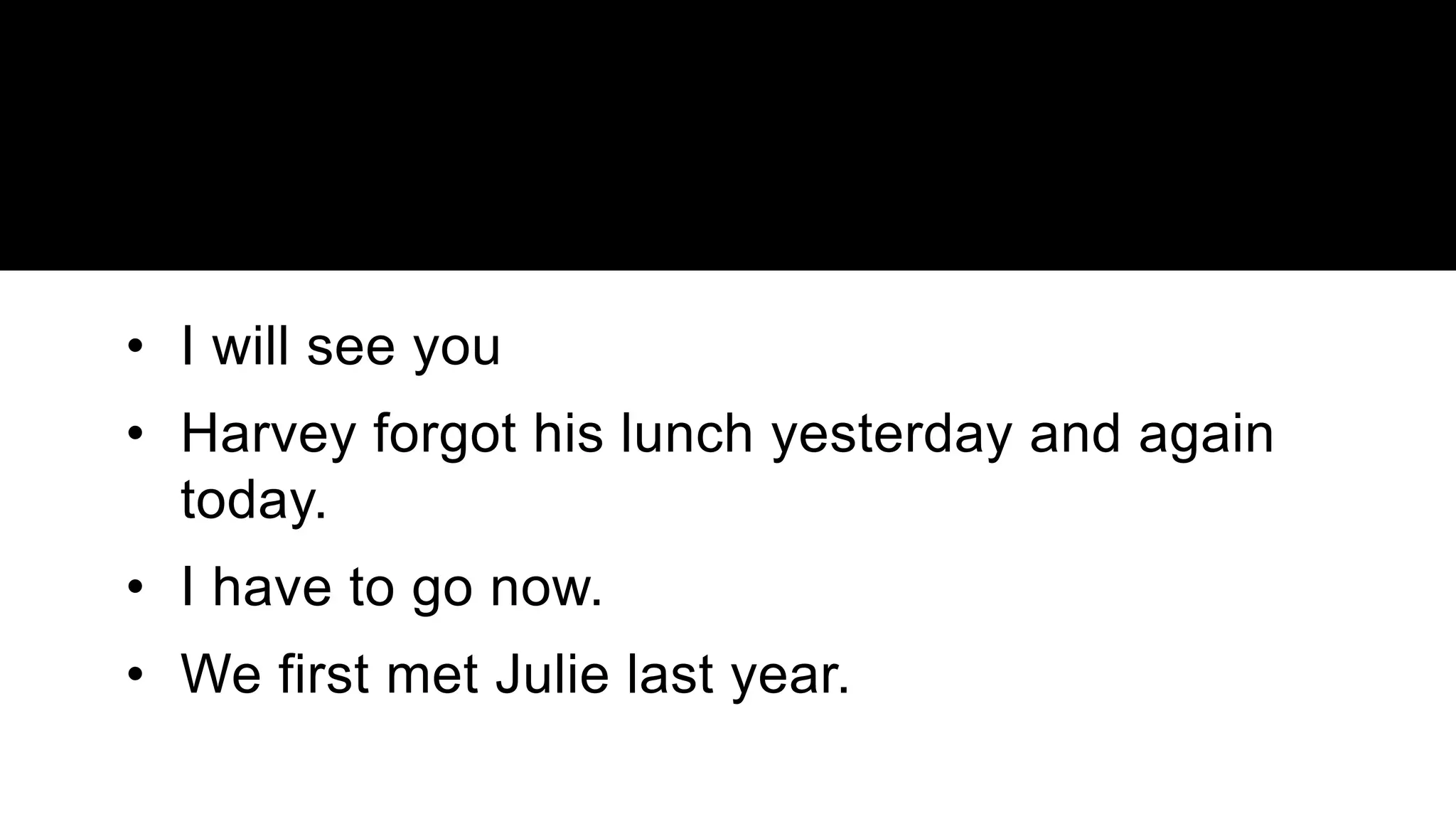
• I will see you
• Harvey forgot his lunch yesterday and again
today.
• I have to go now.
• We first met Julie last year.
ADVERBS OF PURPOSE
• Adverbs of purpose, sometimes called adverbs of reason, help to
describe why something happened.
• They can come in the form of individual words – so, since, thus,
because – but also clauses – so that, in order to.
• I was sick, thus didn’t go to work today.
• I started jogging so that I wouldn’t be late.
• Because I was late, I jogged a little faster.
• Since it’s your birthday, I will buy you a gift.
ADVERB POSITION WITH
VERBS
• This can be a bit trickier because, it will depend on the type of
adverb – place, position, time etc. – and there are many
exceptions to the rules.
• Adverbs of manner or place are usually positioned at the end of
the sentence:
• She laughed timidly.
• I stroked the cat gently.
• Janine lived here.
• There is money everywhere.
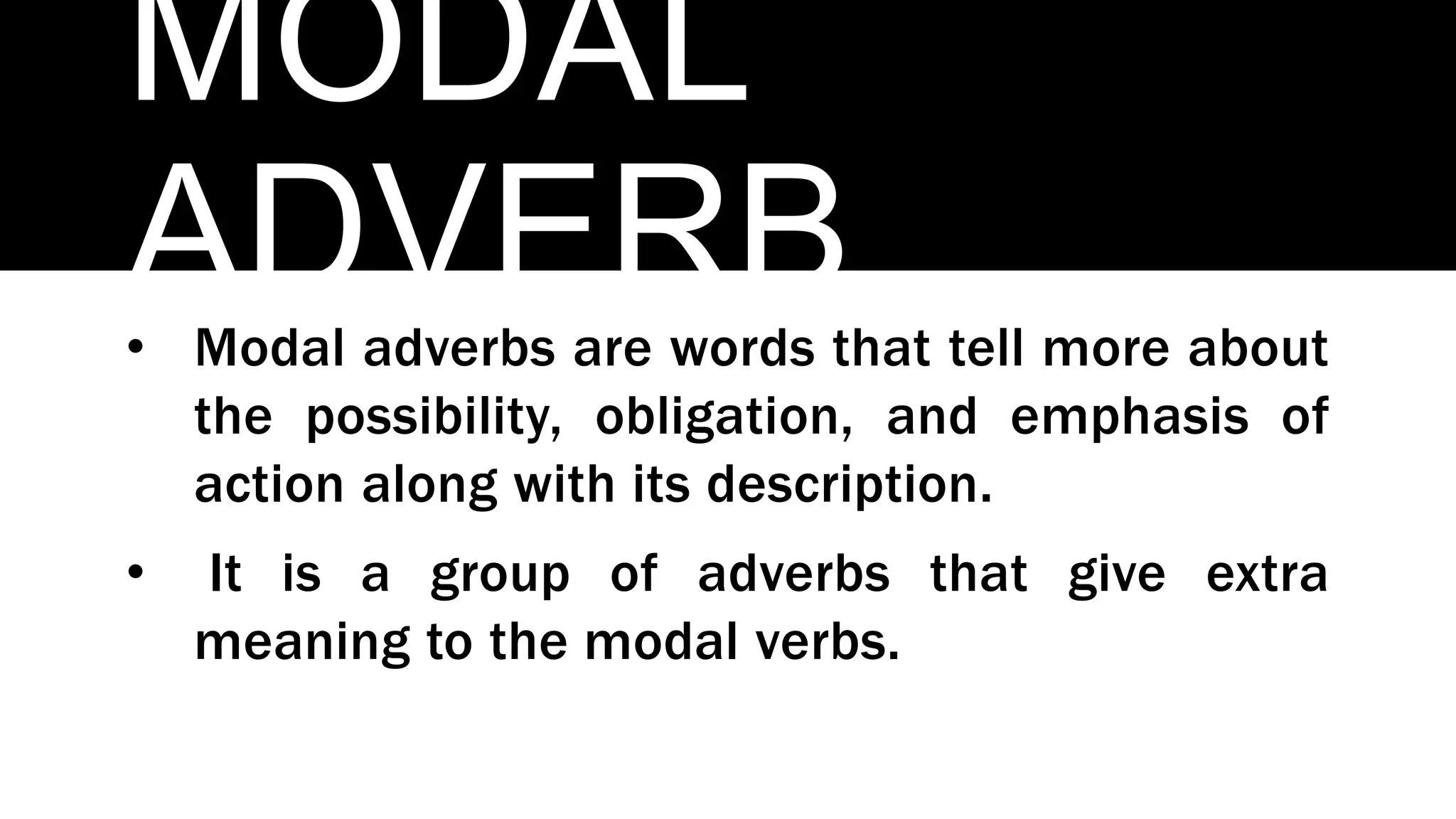
MODAL
ADVERB
• Modal adverbs are words that tell more about
the possibility, obligation, and emphasis of
action along with its description.
• It is a group of adverbs that give extra
meaning to the modal verbs.
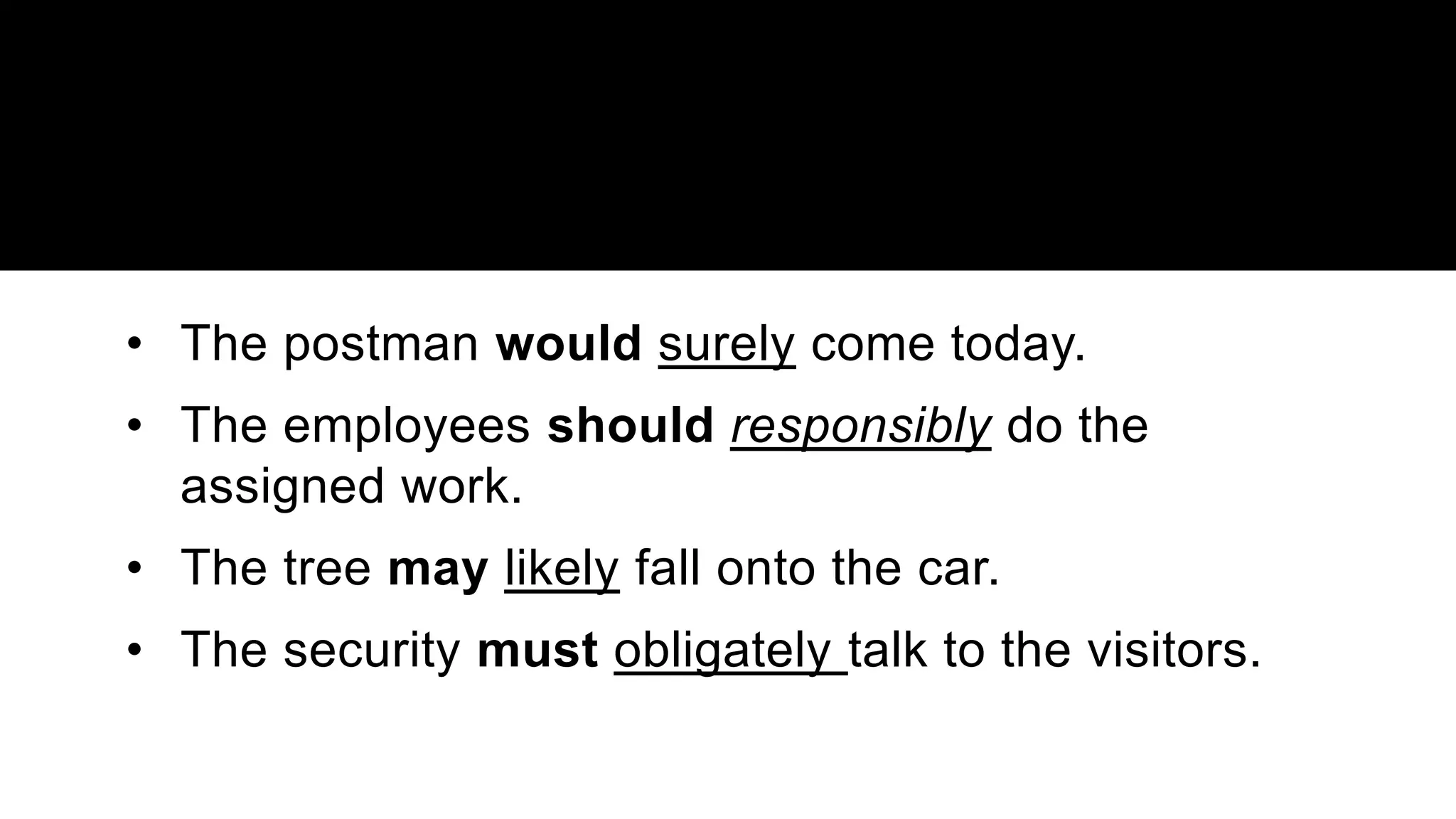
• The postman would surely come today.
• The employees should responsibly do the
assigned work.
• The tree may likely fall onto the car.
• The security must obligately talk to the visitors.

Modals.pptx

  • 1.
    USE MODAL VERBS, NOUNS ANDADVERBS APPROPRIATELY
  • 2.
    MODAL VERBS Modal Verbsare auxiliary or helping verbs which modify or change the meaning of the main verbs. You use modal verbs in giving advice or suggestions, in making requests, or in giving predictions and prohibitions
  • 5.
    WHAT IS ANINFINITIVE VERB? An infinitive is a verbal, a verb form or construction that plays the role of a different part of speech in a sentence.
  • 7.
    WHY ARE MODALVERBS IMPORTANT? These words are often used in instructions, rules and guides - all areas where being precise and commanding are important. Knowing the difference between ‘must’ and ‘might’ will help the reader make a mental note of the importance of an instruction. This makes us better communicators in our day-to-day life.
  • 8.
    CAN, COULD, BEABLE TO Present and Future: can/can’t + base form of the verb 1.Tom can write poetry very well. 2.I can help you with that next week. 3.Lisa can’t speak French.
  • 9.
    AS AN ADJECTIVE Infinitivescan also be placed after any noun in a sentence, acting as an adjective. Describing a Subject: The best person to consult is your counselor [whom you should consult]. Describing an Object: The teacher assigned several exercises to complete [exercises that must be completed].
  • 10.
    Infinitives can alsobe adverbial, modifying any verb in a sentence. These infinitives tell the reader why the action is necessary. Note that the infinitive can either precede or follow the main clause of a sentence: it is movable. Before Main Clause: To do well in college, one must study diligently. After Main Clause: We tell stories to teach lessons.
  • 11.
  • 12.
    am / is/ are / will be + able to + base form of the verb am not/ isn’t / aren’t/ won’t be + able to + base form of the verb 1. Mike is able to solve complicated math equations 2. The support team will be able to help you in about ten minutes. 3. I won’t be able to visit you next summer.
  • 13.
    COULD / COULDN’T Past: could/ couldn’t + base form of the verb was / were + able to + base form of the verb wasn’t / weren’t + able to + base form of the verb hasn’t / haven’t + been able to + base form of the verb 1.I wasn’t able to visit her in the hospital. 2.He hasn’t been able to get in touch with the client yet.
  • 14.
    POSSIBILITY / IMPOSSIBILITY May andmight + infinitive are used to express present or future possibility. May expresses a greater degree of certainty:
  • 15.
    MAY May shows possibilityin the present or the future. Present: Where are my keys? They may be in the car. Future: I may go to the party tonight. May is formal and is often found in writing, like this example: Side effects of this medication may include upset stomach and fever.
  • 16.
    MIGHT Possibility in thepresent or future. • Where are my keys? They might be in the car. • I might go to the party tonight. Might is less formal than may, and is more common in conversation
  • 17.
    MAY, MIGHT &COULD •We might go to the party tomorrow night. •She could decide to join us. •They might attend the awards ceremony tomorrow night. •He could call uyo back tonight. •We could choose a new color of paint for the bedroom. •I might join you if I finish early. •The results of the study may shed some light on this condition.
  • 18.
    PAST POSSIBILITY Modal Verb +Have + Past Participle • He might have brought the cake. • She may have gone home early. • They could have worked late.
  • 19.
    MODAL NOUNS Modal Nounsare used to express various moods through its application in a sentence. Words like necessity, permission, capacity, possibility, responsibility, obligation, chance, promise, requirement, request, and ability are modal nouns examples.
  • 21.
    The interns havethe ability to give 100% results due to their hard work and dedication. I request you to kindly pay attention as the movie will begin shortly. I have an obligation toward my manager who gave me non-informed leaves. I took permission from the colony guard to leave late in the night due to some medical emergency.
  • 22.
    WHAT IS ADVERB Aword or phrase that modifies or qualifies an adjective, verb, or other adverb or a word group, expressing a relation of place, time, circumstance, manner, cause, degree, etc. (e.g., gently, quite, then, there ).
  • 23.
    ADVERBS AND VERBS Adverbsoften modify verbs. This means that they describe the way an action is happening. Phillip sings loudly in the shower. My cat waits impatiently for his food. I will seriously consider your suggestion.
  • 24.
    When? She alwaysarrives early. How? He drives carefully. Where? They go everywhere together. In what way? She eats slowly. To what extent? It is terribly hot.
  • 25.
    • The dogran. • The dog ran excitedly.
  • 26.
  • 27.
    ADVERBS OF MANNER Anadverb of manner will explain how an action is carried out. Very often adverbs of manner are adjectives with -ly added to the end, but this is certainly not always the case. In fact, some adverbs of manner will have the same spelling as the adjective form.
  • 28.
  • 29.
    ADVERB OF MANNER •She passed the exam easily. • They walk quickly to catch the train. • The dinner party went badly. • John answered the question correctly.
  • 30.
    ADVERBS OF PLACE Anadverb of place, sometimes called spatial adverbs, will help explain where an action happens. Adverbs of place will be associated with the action of the verb in a sentence, providing context for direction, distance and position: southeast, everywhere, up, left, close by, back, inside, around. These terms don’t usually end in -ly.
  • 31.
    • New Yorkis located north of Philadelphia. • They traveled down the mountainside. • First, I looked here, and then I looked there, but I can’t find them anywhere.
  • 32.
    ADVERBS OF FREQUENCY • Adverbsof frequency are used to express time or how often something occurs. Adverbs of frequency can be split two main groups. • The first, adverbs of indefinite frequency, are terms that have an unclear meaning as to how long are how often something occurs: usually, always, normally. • These adverbs will usually be placed after the main verb or between the auxiliary verb and infinitive.
  • 33.
    • The adverbis usually placed before the main verb. • I can normally make the shot. • I will always love
  • 34.
    ADVERBS OF TIME •Adverbs of time, while seemingly similar to adverbs of frequency, tell us when something happens. • Adverbs of time are usually placed at the end of a sentence.
  • 35.
    • I willsee you • Harvey forgot his lunch yesterday and again today. • I have to go now. • We first met Julie last year.
  • 36.
    ADVERBS OF PURPOSE •Adverbs of purpose, sometimes called adverbs of reason, help to describe why something happened. • They can come in the form of individual words – so, since, thus, because – but also clauses – so that, in order to.
  • 37.
    • I wassick, thus didn’t go to work today. • I started jogging so that I wouldn’t be late. • Because I was late, I jogged a little faster. • Since it’s your birthday, I will buy you a gift.
  • 38.
    ADVERB POSITION WITH VERBS •This can be a bit trickier because, it will depend on the type of adverb – place, position, time etc. – and there are many exceptions to the rules. • Adverbs of manner or place are usually positioned at the end of the sentence:
  • 39.
    • She laughedtimidly. • I stroked the cat gently. • Janine lived here. • There is money everywhere.
  • 40.
    MODAL ADVERB • Modal adverbsare words that tell more about the possibility, obligation, and emphasis of action along with its description. • It is a group of adverbs that give extra meaning to the modal verbs.
  • 41.
    • The postmanwould surely come today. • The employees should responsibly do the assigned work. • The tree may likely fall onto the car. • The security must obligately talk to the visitors.