USED TO / WOULD
Used to / would
• We use both of these to talk about things in the past which we
don't do now or are not happening now.
• Sometimes both 'used to' and 'would' are OK - sometimes only
'used to'.
Some examples of 'used to‘
"I used to live in Manchester, but I moved to London last year."
"When he was at school, he used to play football every Saturday."
"She used to hate her job until she got a promotion."
All of these sentences describe actions or situations in the past, which are
finished now; living in Manchester, playing football every Saturday, hating her
job - these are all finished now.
• We use 'used to' to talk about
actions or situations that
continued for some time in the
past, not for events which
happened suddenly or just for
a moment.
• So we can't say: 'I used to
have a really good idea when I
was brushing my teeth this
morning,' because 'having a
really good idea' happens
suddenly - in one moment.
• Here are some examples using 'would':
• "When he was at university, he would sleep
until noon at the weekends."
•
"My sister lived in Australia for many years, but
she would always come home for Christmas."
•
"I would always forget my homework, until the
teacher threatened to punish me."
• These sentences are about situations in the
past, which are finished.
• However, it's important to notice that all the
sentences, here, are about actions or
situations which were repeated again and
again and again.
• Sleeping until noon at the weekends, coming
home for Christmas, forgetting my homework -
all these things were repeated many times,
again and again and again.
• This is the difference between 'would' and
'used to' -
We only use 'would' to describe actions or
situations that were repeated again and
again and again...
But we use 'used to' for any extended
action or situation in the past.
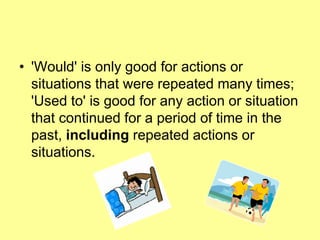
• 'Would' is only good for actions or
situations that were repeated many times;
'Used to' is good for any action or situation
that continued for a period of time in the
past, including repeated actions or
situations.
Look at the three examples of 'used to' sentences, and
see if we can change them into 'would' sentences.
• Here's the first example again:
"I used to live in Manchester, but I moved to
London last year."
Can we use 'would' instead of 'used to' here?
No, we can't, because 'living in Manchester'
wasn't repeated again and again and again.
• It's simply a situation in the past. Therefore,
only 'used to' is good in this sentence.
• The second example again:
" When he was at school, he used to play football every
Saturday."
Here, we're talking about 'playing football every
Saturday'. This is an action that was repeated many
times, so we can also say:
•
"When he was at school, he would play football every
Saturday".
• 'Used to' and 'would' are both good here, and the
meaning is the same.
• Finally, the third example
again:
"She used to hate her
job until she got a
promotion."
Did she 'hate her job'
many times?
No, this isn't a repeated
action, so in this example
'would' isn't possible. We
have to use 'used to'.
Childhood memories
“My parents used to take us out for
dinner every Sunday night for dinner
(and ice cream, sometimes, if it was
summer). Both parents worked, so we
didn't often do family meals during the
week. We would talk, play games
(mostly educational trivia), and enjoy
each other's company. “
• “I grew up in Georgia, and my
grandparents live in Florida. I used to go
down and stay with them for a month or 6
weeks in the summer. Some of my favorite
times were on Sunday mornings when my
grandfather would pick me up after
Sunday school in his old Dodge truck and
we would drive down to the river, stopping
at a convenience store along the way to
pick up some little snack or toy.”
“My dad would sometimes come and take
me out of school at lunch time and we'd go
to lunch together.”
“My favourite uncle would always sit down
and talk with me for an hour when he
visited but he never talked down to me. He
treated me as a little adult.”
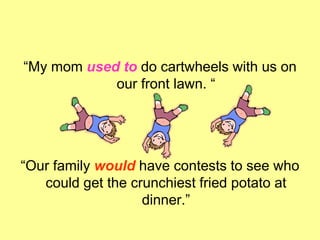
“My mom used to do cartwheels with us on
our front lawn. “
“Our family would have contests to see who
could get the crunchiest fried potato at
dinner.”

Would and used to

  • 1.
    USED TO /WOULD
  • 2.
    Used to /would • We use both of these to talk about things in the past which we don't do now or are not happening now. • Sometimes both 'used to' and 'would' are OK - sometimes only 'used to'. Some examples of 'used to‘ "I used to live in Manchester, but I moved to London last year." "When he was at school, he used to play football every Saturday." "She used to hate her job until she got a promotion." All of these sentences describe actions or situations in the past, which are finished now; living in Manchester, playing football every Saturday, hating her job - these are all finished now.
  • 3.
    • We use'used to' to talk about actions or situations that continued for some time in the past, not for events which happened suddenly or just for a moment. • So we can't say: 'I used to have a really good idea when I was brushing my teeth this morning,' because 'having a really good idea' happens suddenly - in one moment.
  • 4.
    • Here aresome examples using 'would': • "When he was at university, he would sleep until noon at the weekends." • "My sister lived in Australia for many years, but she would always come home for Christmas." • "I would always forget my homework, until the teacher threatened to punish me."
  • 5.
    • These sentencesare about situations in the past, which are finished. • However, it's important to notice that all the sentences, here, are about actions or situations which were repeated again and again and again. • Sleeping until noon at the weekends, coming home for Christmas, forgetting my homework - all these things were repeated many times, again and again and again.
  • 6.
    • This isthe difference between 'would' and 'used to' - We only use 'would' to describe actions or situations that were repeated again and again and again... But we use 'used to' for any extended action or situation in the past.
  • 7.
    • 'Would' isonly good for actions or situations that were repeated many times; 'Used to' is good for any action or situation that continued for a period of time in the past, including repeated actions or situations.
  • 8.
    Look at thethree examples of 'used to' sentences, and see if we can change them into 'would' sentences. • Here's the first example again: "I used to live in Manchester, but I moved to London last year." Can we use 'would' instead of 'used to' here? No, we can't, because 'living in Manchester' wasn't repeated again and again and again. • It's simply a situation in the past. Therefore, only 'used to' is good in this sentence.
  • 9.
    • The secondexample again: " When he was at school, he used to play football every Saturday." Here, we're talking about 'playing football every Saturday'. This is an action that was repeated many times, so we can also say: • "When he was at school, he would play football every Saturday". • 'Used to' and 'would' are both good here, and the meaning is the same.
  • 10.
    • Finally, thethird example again: "She used to hate her job until she got a promotion." Did she 'hate her job' many times? No, this isn't a repeated action, so in this example 'would' isn't possible. We have to use 'used to'.
  • 11.
    Childhood memories “My parentsused to take us out for dinner every Sunday night for dinner (and ice cream, sometimes, if it was summer). Both parents worked, so we didn't often do family meals during the week. We would talk, play games (mostly educational trivia), and enjoy each other's company. “
  • 12.
    • “I grewup in Georgia, and my grandparents live in Florida. I used to go down and stay with them for a month or 6 weeks in the summer. Some of my favorite times were on Sunday mornings when my grandfather would pick me up after Sunday school in his old Dodge truck and we would drive down to the river, stopping at a convenience store along the way to pick up some little snack or toy.”
  • 13.
    “My dad wouldsometimes come and take me out of school at lunch time and we'd go to lunch together.” “My favourite uncle would always sit down and talk with me for an hour when he visited but he never talked down to me. He treated me as a little adult.”
  • 14.
    “My mom usedto do cartwheels with us on our front lawn. “ “Our family would have contests to see who could get the crunchiest fried potato at dinner.”