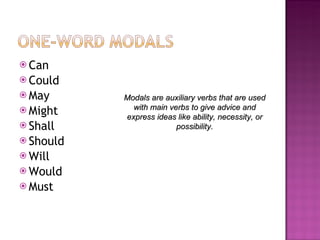
Can Could May Might Shall Should Will Would Must Modals are auxiliary verbs that are used with main verbs to give advice and express ideas like ability, necessity, or possibility.
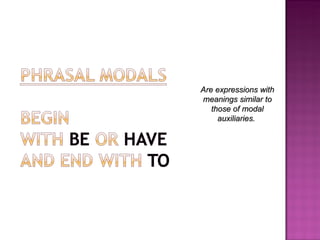
Are expressions with meanings similar to those of modal auxiliaries.
 
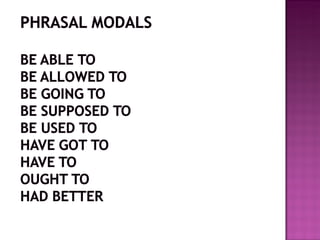
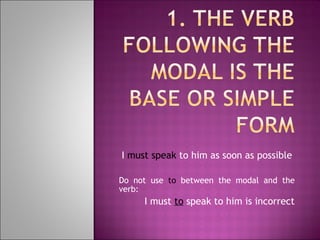
I  must speak  to him as soon as possible Do not use  to  between the modal and the verb: I must  to  speak to him is incorrect
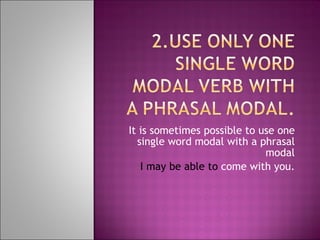
It is sometimes possible to use one single word modal with a phrasal modal I may be able to  come with you.
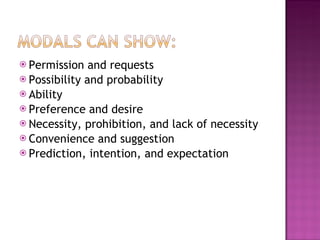
Permission and requests Possibility and probability Ability Preference and desire Necessity, prohibition, and lack of necessity Convenience and suggestion Prediction, intention, and expectation
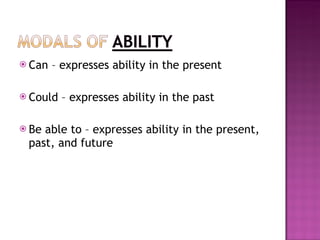
Can – expresses ability in the present Could – expresses ability in the past Be able to – expresses ability in the present, past, and future
Must Have to Have got to Should Ought to May Might Could
Must, have to, have got to When the speaker is convinced that the situation is almost certainly true.
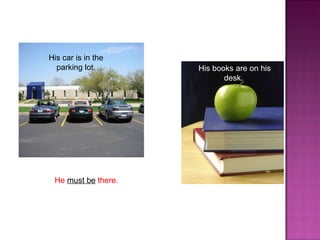
He  must be  there. His books are on his desk.  His car is in the parking lot. His car is in the parking lot.
May, might, could He  might be  home.  I don’t really know.
Can’t, couldn’t The food  can’t  be gone. He  couldn’t  be in Colombia.  I saw him yesterday.
Will Be going to Should Ought to May Might  Could
Will, be going to, should, ought to To express certainty about a situation or event predicted - usually used with an adverb: probably, possibly… I will probably come to the party.
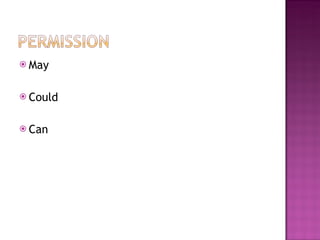
May Could Can
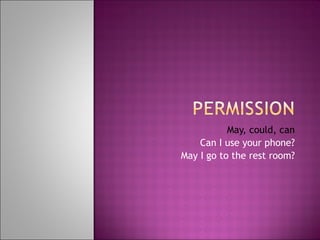
May, could, can Can I use your phone? May I go to the rest room?
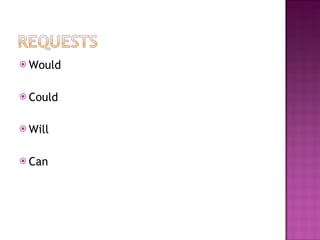
Would Could Will Can
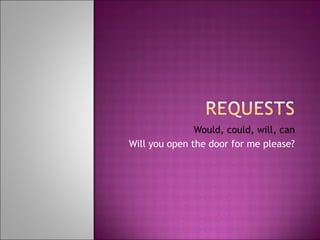
Would, could, will, can Will you open the door for me please?
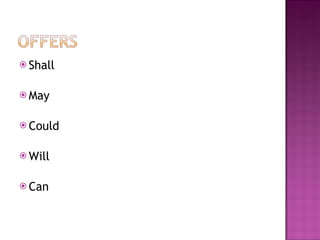
Shall May Could Will Can
Shall, may, could, will, can May I carry  the books for you?
Should, ought to Ought to is not used in the negative You  ought to  go home if you aren’t feeling well. The city  should  fix the hole in the road.
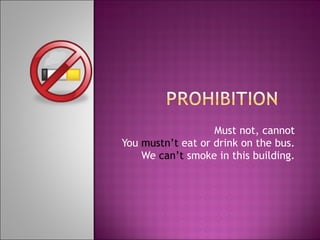
Must not, cannot You  mustn’t  eat or drink on the bus. We  can’t  smoke in this building.
Must, have to You  have to  take the car back to the dealer. I  must see  my advisor before I register.
Would rather, would prefer We  would rather  go out in the evening. I   would prefer to  take my car
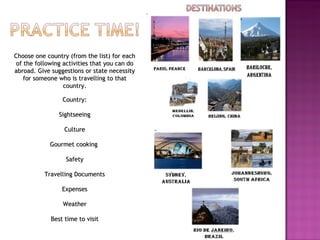
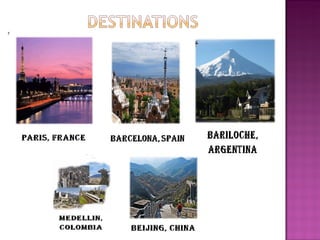
Choose one country (from the list) for each of the following activities that you can do abroad. Give suggestions or state necessity for someone who is travelling to that country.   Country:   Sightseeing                      Culture                       Gourmet cooking                       Safety   Travelling Documents                       Expenses   Weather   Best time to visit


Modals

  • 1.
  • 2.
    Can Could MayMight Shall Should Will Would Must Modals are auxiliary verbs that are used with main verbs to give advice and express ideas like ability, necessity, or possibility.
  • 3.
    Are expressions withmeanings similar to those of modal auxiliaries.
  • 4.
  • 5.
    I mustspeak to him as soon as possible Do not use to between the modal and the verb: I must to speak to him is incorrect
  • 6.
    It is sometimespossible to use one single word modal with a phrasal modal I may be able to come with you.
  • 7.
    Permission and requestsPossibility and probability Ability Preference and desire Necessity, prohibition, and lack of necessity Convenience and suggestion Prediction, intention, and expectation
  • 8.
    Can – expressesability in the present Could – expresses ability in the past Be able to – expresses ability in the present, past, and future
  • 9.
    Must Have toHave got to Should Ought to May Might Could
  • 10.
    Must, have to,have got to When the speaker is convinced that the situation is almost certainly true.
  • 11.
    He mustbe there. His books are on his desk. His car is in the parking lot. His car is in the parking lot.
  • 12.
    May, might, couldHe might be home. I don’t really know.
  • 13.
    Can’t, couldn’t Thefood can’t be gone. He couldn’t be in Colombia. I saw him yesterday.
  • 14.
    Will Be goingto Should Ought to May Might Could
  • 15.
    Will, be goingto, should, ought to To express certainty about a situation or event predicted - usually used with an adverb: probably, possibly… I will probably come to the party.
  • 16.
  • 17.
    May, could, canCan I use your phone? May I go to the rest room?
  • 18.
  • 19.
    Would, could, will,can Will you open the door for me please?
  • 20.
  • 21.
    Shall, may, could,will, can May I carry the books for you?
  • 22.
    Should, ought toOught to is not used in the negative You ought to go home if you aren’t feeling well. The city should fix the hole in the road.
  • 23.
    Must not, cannotYou mustn’t eat or drink on the bus. We can’t smoke in this building.
  • 24.
    Must, have toYou have to take the car back to the dealer. I must see my advisor before I register.
  • 25.
    Would rather, wouldprefer We would rather go out in the evening. I would prefer to take my car
  • 26.
    Choose one country(from the list) for each of the following activities that you can do abroad. Give suggestions or state necessity for someone who is travelling to that country.   Country:   Sightseeing                      Culture                       Gourmet cooking                       Safety   Travelling Documents                       Expenses   Weather   Best time to visit
  • 27.
  • 28.