Modal Forms
Modal Forms
Modal Forms
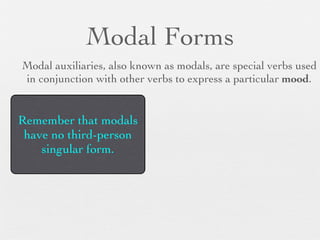
Modal auxiliaries, also known as modals, are special verbs used
in conjunction with other verbs to express a particular mood.
Modal Forms
Modal auxiliaries, also known as modals, are special verbs used
in conjunction with other verbs to express a particular mood.


Remember that modals
 have no third-person
    singular form.
Modal Forms
Modal auxiliaries, also known as modals, are special verbs used
in conjunction with other verbs to express a particular mood.


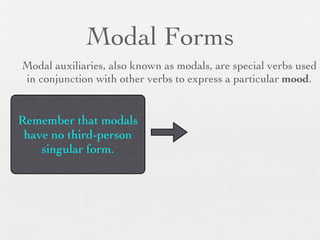
Remember that modals
 have no third-person
    singular form.
Modal Forms
Modal auxiliaries, also known as modals, are special verbs used
in conjunction with other verbs to express a particular mood.

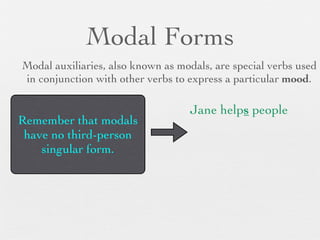
                                   Jane helps people
Remember that modals
 have no third-person
    singular form.
Modal Forms
Modal auxiliaries, also known as modals, are special verbs used
in conjunction with other verbs to express a particular mood.

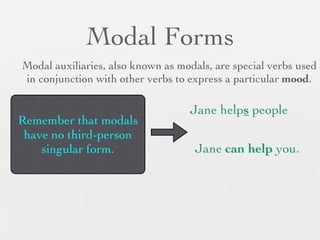
                                   Jane helps people
Remember that modals
 have no third-person
    singular form.                  Jane can help you.
Function of modals
Function of modals
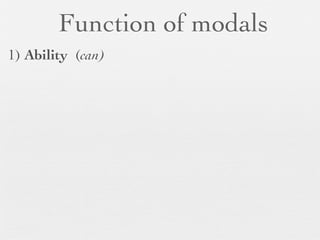
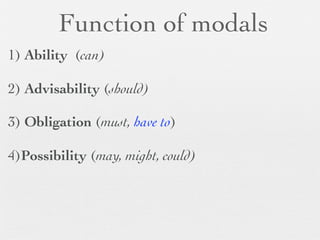
1) Ability (can)
Function of modals
1) Ability (can)

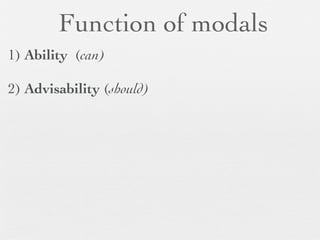
2) Advisability (should)
Function of modals
1) Ability (can)

2) Advisability (should)

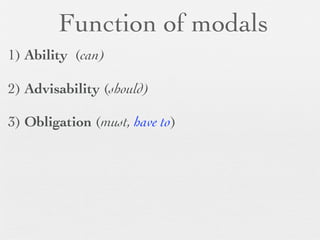
3) Obligation (must, have to)
Function of modals
1) Ability (can)

2) Advisability (should)

3) Obligation (must, have to)

4)Possibility (may, might, could)
Function of modals
1) Ability (can)

2) Advisability (should)

3) Obligation (must, have to)

4)Possibility (may, might, could)

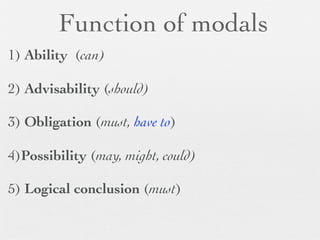
5) Logical conclusion (must)
Function of modals
1) Ability (can)

2) Advisability (should)

3) Obligation (must, have to)

4)Possibility (may, might, could)

5) Logical conclusion (must)

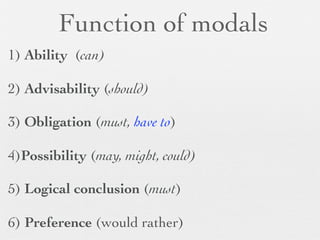
6) Preference (would rather)
Function of modals
1) Ability (can)
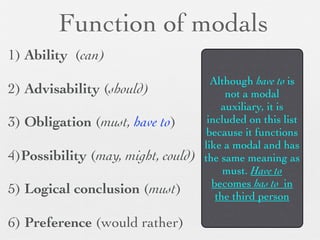
                                      Although have to is
2) Advisability (should)                 not a modal
                                        auxiliary, it is
3) Obligation (must, have to)        included on this list
                                     because it functions
                                    like a modal and has
4)Possibility (may, might, could)   the same meaning as
                                         must. Have to
                                      becomes has to in
5) Logical conclusion (must)           the third person

6) Preference (would rather)
1. Ability (can)


Example       Past form
1. Ability (can)


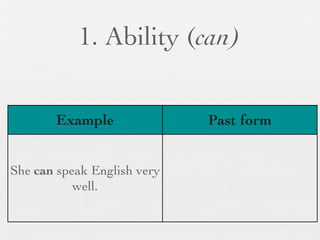
       Example               Past form


She can speak English very
           well.
1. Ability (can)


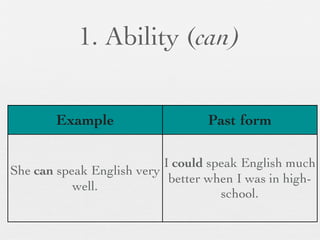
        Example                   Past form

                           I could speak English much
She can speak English very
                            better when I was in high-
           well.
                                     school.
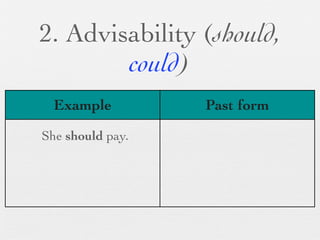
2. Advisability (should,
        could)
 Example        Past form
2. Advisability (should,
        could)
  Example         Past form

She should pay.
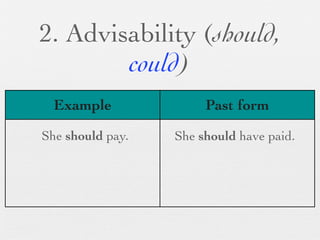
2. Advisability (should,
        could)
  Example              Past form

She should pay.   She should have paid.
2. Advisability (should,
            could)
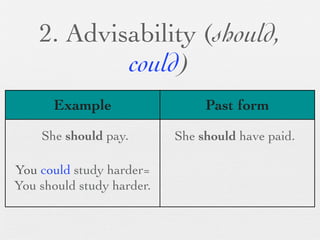
      Example                   Past form

    She should pay.        She should have paid.

You could study harder=
You should study harder.
2. Advisability (should,
            could)
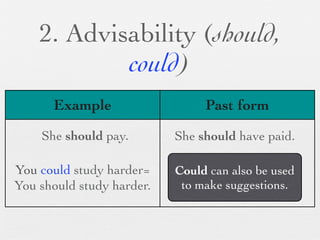
      Example                   Past form

    She should pay.        She should have paid.

You could study harder=    Could can also be used
You should study harder.    to make suggestions.
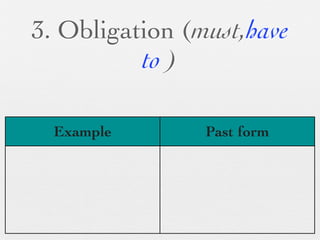
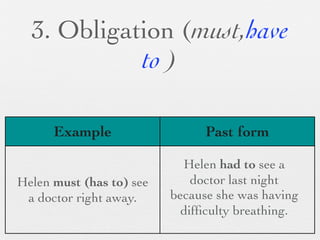
3. Obligation (must,have
          to )

  Example       Past form
3. Obligation (must,have
            to )

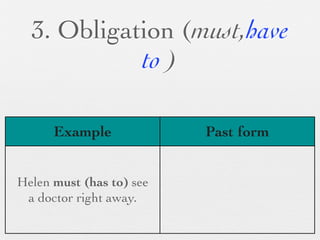
      Example             Past form


Helen must (has to) see
 a doctor right away.
3. Obligation (must,have
            to )

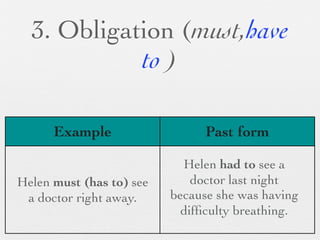
      Example                   Past form

                            Helen had to see a
Helen must (has to) see       doctor last night
 a doctor right away.     because she was having
                            difficulty breathing.
3. Obligation (must,have
            to )

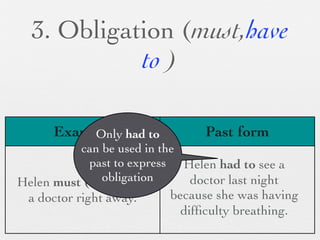
      Example had to
          Only                   Past form
           can be used in the
             past to express Helen had to see a
               obligation
Helen must (has to) see         doctor last night
 a doctor right away.       because she was having
                              difficulty breathing.
3. Obligation (must,have
            to )

      Example                   Past form

                            Helen had to see a
Helen must (has to) see       doctor last night
 a doctor right away.     because she was having
                            difficulty breathing.
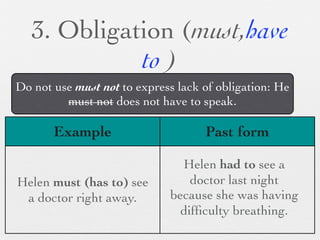
3. Obligation (must,have
             to )
Do not use must not to express lack of obligation: He
         must not does not have to speak.

       Example                      Past form

                               Helen had to see a
Helen must (has to) see          doctor last night
 a doctor right away.        because she was having
                               difficulty breathing.
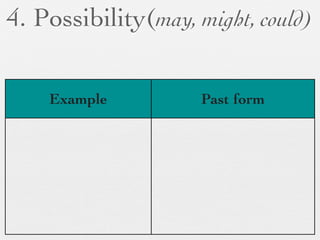
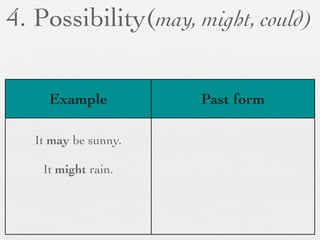
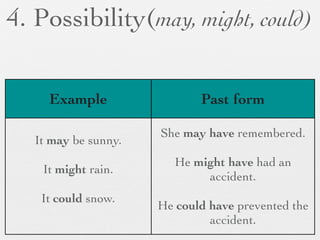
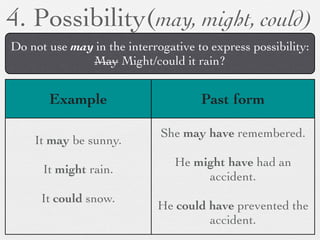
4. Possibility(may, might, could)

    Example         Past form
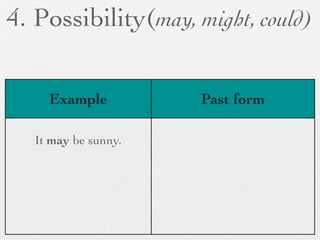
4. Possibility(may, might, could)

     Example          Past form

   It may be sunny.
4. Possibility(may, might, could)

     Example          Past form

   It may be sunny.

    It might rain.
4. Possibility(may, might, could)

     Example          Past form

   It may be sunny.

    It might rain.

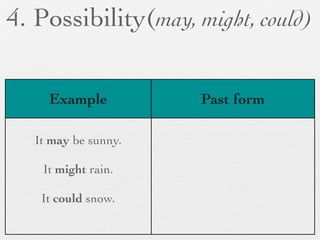
    It could snow.
4. Possibility(may, might, could)

     Example                Past form

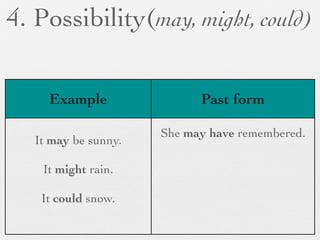
                      She may have remembered.
   It may be sunny.

    It might rain.

    It could snow.
4. Possibility(may, might, could)

     Example                Past form

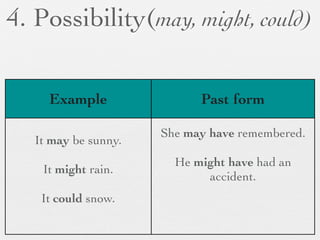
                      She may have remembered.
   It may be sunny.
                        He might have had an
    It might rain.
                             accident.
    It could snow.
4. Possibility(may, might, could)

     Example                 Past form

                      She may have remembered.
   It may be sunny.
                         He might have had an
    It might rain.
                              accident.
    It could snow.
                      He could have prevented the
                               accident.
4. Possibility(may, might, could)
Do not use may in the interrogative to express possibility:
              May Might/could it rain?


       Example                       Past form

                             She may have remembered.
    It may be sunny.
                                He might have had an
      It might rain.
                                     accident.
      It could snow.
                             He could have prevented the
                                      accident.
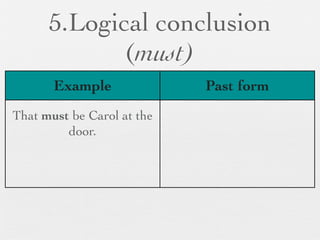
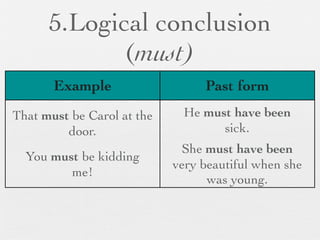
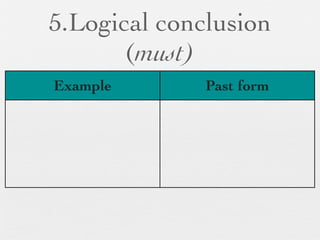
5.Logical conclusion
       (must)
Example       Past form
5.Logical conclusion
             (must)
       Example              Past form
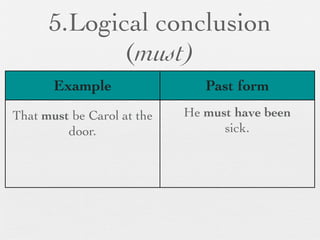
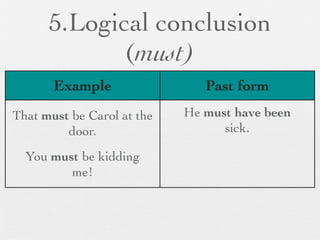
That must be Carol at the
         door.
5.Logical conclusion
             (must)
       Example                 Past form
That must be Carol at the   He must have been
         door.                    sick.
5.Logical conclusion
             (must)
       Example                 Past form
That must be Carol at the   He must have been
         door.                    sick.

  You must be kidding
         me!
5.Logical conclusion
             (must)
       Example                   Past form
That must be Carol at the    He must have been
         door.                     sick.
                             She must have been
  You must be kidding
                            very beautiful when she
         me!
                                  was young.
7(d). Preference (would
        rather)
 Example       Past form
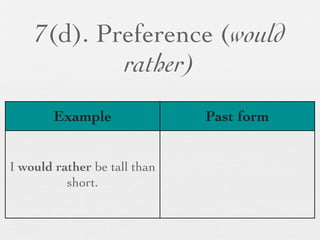
7(d). Preference (would
            rather)
        Example               Past form


I would rather be tall than
          short.
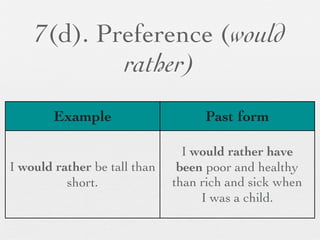
7(d). Preference (would
            rather)
        Example                    Past form

                                I would rather have
I would rather be tall than    been poor and healthy
          short.              than rich and sick when
                                   I was a child.
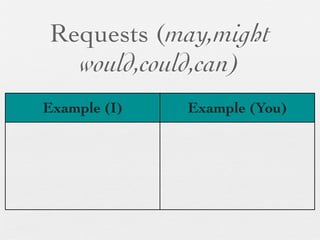
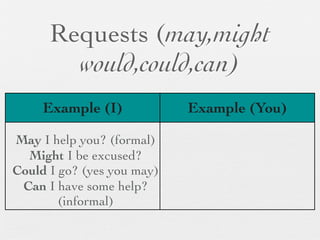
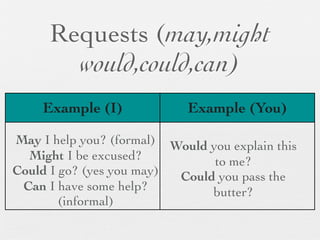
Requests (may,might
  would,could,can)
Example (I)   Example (You)
Requests (may,might
       would,could,can)
    Example (I)            Example (You)

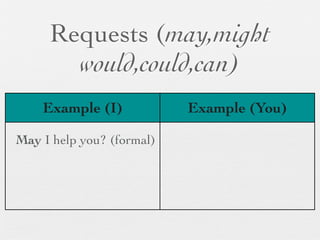
May I help you? (formal)
Requests (may,might
       would,could,can)
    Example (I)            Example (You)

May I help you? (formal)
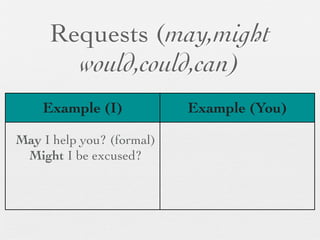
 Might I be excused?
Requests (may,might
        would,could,can)
     Example (I)            Example (You)

May I help you? (formal)
  Might I be excused?
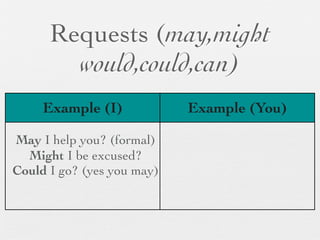
Could I go? (yes you may)
Requests (may,might
        would,could,can)
     Example (I)            Example (You)

May I help you? (formal)
  Might I be excused?
Could I go? (yes you may)
 Can I have some help?
        (informal)
Requests (may,might
        would,could,can)
     Example (I)            Example (You)

May I help you? (formal) Would you explain this
  Might I be excused?           to me?
Could I go? (yes you may) Could you pass the
 Can I have some help?         butter?
        (informal)
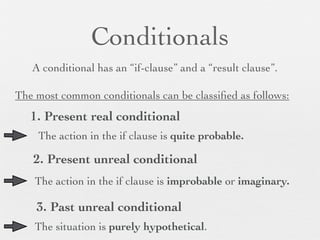
Conditionals
Conditionals
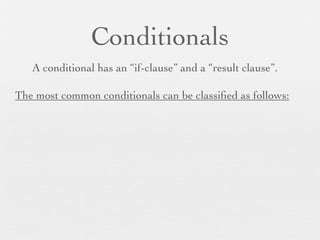
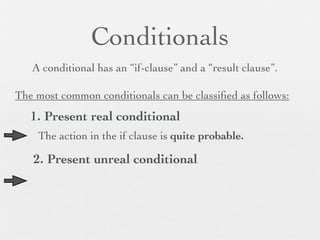
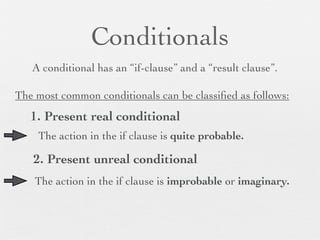
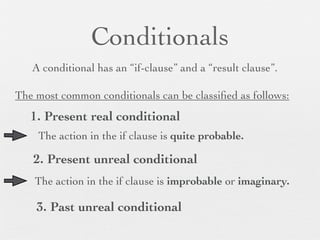
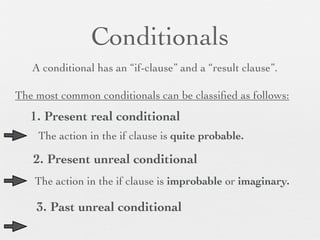
A conditional has an “if-clause” and a “result clause”.
Conditionals
   A conditional has an “if-clause” and a “result clause”.

The most common conditionals can be classified as follows:
Conditionals
   A conditional has an “if-clause” and a “result clause”.

The most common conditionals can be classified as follows:
   1. Present real conditional
Conditionals
   A conditional has an “if-clause” and a “result clause”.

The most common conditionals can be classified as follows:
   1. Present real conditional
Conditionals
   A conditional has an “if-clause” and a “result clause”.

The most common conditionals can be classified as follows:
   1. Present real conditional
    The action in the if clause is quite probable.
Conditionals
   A conditional has an “if-clause” and a “result clause”.
The most common conditionals can be classified as follows:
   1. Present real conditional
    The action in the if clause is quite probable.

   2. Present unreal conditional
Conditionals
   A conditional has an “if-clause” and a “result clause”.

The most common conditionals can be classified as follows:
   1. Present real conditional
    The action in the if clause is quite probable.

   2. Present unreal conditional
Conditionals
   A conditional has an “if-clause” and a “result clause”.

The most common conditionals can be classified as follows:
   1. Present real conditional
    The action in the if clause is quite probable.

   2. Present unreal conditional
    The action in the if clause is improbable or imaginary.
Conditionals
   A conditional has an “if-clause” and a “result clause”.

The most common conditionals can be classified as follows:
   1. Present real conditional
    The action in the if clause is quite probable.

   2. Present unreal conditional
    The action in the if clause is improbable or imaginary.

    3. Past unreal conditional
Conditionals
   A conditional has an “if-clause” and a “result clause”.

The most common conditionals can be classified as follows:
   1. Present real conditional
    The action in the if clause is quite probable.

   2. Present unreal conditional
    The action in the if clause is improbable or imaginary.

    3. Past unreal conditional
Conditionals
   A conditional has an “if-clause” and a “result clause”.

The most common conditionals can be classified as follows:
   1. Present real conditional
    The action in the if clause is quite probable.

   2. Present unreal conditional
    The action in the if clause is improbable or imaginary.

    3. Past unreal conditional
    The situation is purely hypothetical.
Conditionals

Modals 212

  • 1.
  • 2.
  • 3.
    Modal Forms Modal auxiliaries,also known as modals, are special verbs used in conjunction with other verbs to express a particular mood.
  • 4.
    Modal Forms Modal auxiliaries,also known as modals, are special verbs used in conjunction with other verbs to express a particular mood. Remember that modals have no third-person singular form.
  • 5.
    Modal Forms Modal auxiliaries,also known as modals, are special verbs used in conjunction with other verbs to express a particular mood. Remember that modals have no third-person singular form.
  • 6.
    Modal Forms Modal auxiliaries,also known as modals, are special verbs used in conjunction with other verbs to express a particular mood. Jane helps people Remember that modals have no third-person singular form.
  • 7.
    Modal Forms Modal auxiliaries,also known as modals, are special verbs used in conjunction with other verbs to express a particular mood. Jane helps people Remember that modals have no third-person singular form. Jane can help you.
  • 8.
  • 9.
    Function of modals 1)Ability (can)
  • 10.
    Function of modals 1)Ability (can) 2) Advisability (should)
  • 11.
    Function of modals 1)Ability (can) 2) Advisability (should) 3) Obligation (must, have to)
  • 12.
    Function of modals 1)Ability (can) 2) Advisability (should) 3) Obligation (must, have to) 4)Possibility (may, might, could)
  • 13.
    Function of modals 1)Ability (can) 2) Advisability (should) 3) Obligation (must, have to) 4)Possibility (may, might, could) 5) Logical conclusion (must)
  • 14.
    Function of modals 1)Ability (can) 2) Advisability (should) 3) Obligation (must, have to) 4)Possibility (may, might, could) 5) Logical conclusion (must) 6) Preference (would rather)
  • 15.
    Function of modals 1)Ability (can) Although have to is 2) Advisability (should) not a modal auxiliary, it is 3) Obligation (must, have to) included on this list because it functions like a modal and has 4)Possibility (may, might, could) the same meaning as must. Have to becomes has to in 5) Logical conclusion (must) the third person 6) Preference (would rather)
  • 16.
  • 17.
    1. Ability (can) Example Past form She can speak English very well.
  • 18.
    1. Ability (can) Example Past form I could speak English much She can speak English very better when I was in high- well. school.
  • 19.
    2. Advisability (should, could) Example Past form
  • 20.
    2. Advisability (should, could) Example Past form She should pay.
  • 21.
    2. Advisability (should, could) Example Past form She should pay. She should have paid.
  • 22.
    2. Advisability (should, could) Example Past form She should pay. She should have paid. You could study harder= You should study harder.
  • 23.
    2. Advisability (should, could) Example Past form She should pay. She should have paid. You could study harder= Could can also be used You should study harder. to make suggestions.
  • 24.
    3. Obligation (must,have to ) Example Past form
  • 25.
    3. Obligation (must,have to ) Example Past form Helen must (has to) see a doctor right away.
  • 26.
    3. Obligation (must,have to ) Example Past form Helen had to see a Helen must (has to) see doctor last night a doctor right away. because she was having difficulty breathing.
  • 27.
    3. Obligation (must,have to ) Example had to Only Past form can be used in the past to express Helen had to see a obligation Helen must (has to) see doctor last night a doctor right away. because she was having difficulty breathing.
  • 28.
    3. Obligation (must,have to ) Example Past form Helen had to see a Helen must (has to) see doctor last night a doctor right away. because she was having difficulty breathing.
  • 29.
    3. Obligation (must,have to ) Do not use must not to express lack of obligation: He must not does not have to speak. Example Past form Helen had to see a Helen must (has to) see doctor last night a doctor right away. because she was having difficulty breathing.
  • 30.
    4. Possibility(may, might,could) Example Past form
  • 31.
    4. Possibility(may, might,could) Example Past form It may be sunny.
  • 32.
    4. Possibility(may, might,could) Example Past form It may be sunny. It might rain.
  • 33.
    4. Possibility(may, might,could) Example Past form It may be sunny. It might rain. It could snow.
  • 34.
    4. Possibility(may, might,could) Example Past form She may have remembered. It may be sunny. It might rain. It could snow.
  • 35.
    4. Possibility(may, might,could) Example Past form She may have remembered. It may be sunny. He might have had an It might rain. accident. It could snow.
  • 36.
    4. Possibility(may, might,could) Example Past form She may have remembered. It may be sunny. He might have had an It might rain. accident. It could snow. He could have prevented the accident.
  • 37.
    4. Possibility(may, might,could) Do not use may in the interrogative to express possibility: May Might/could it rain? Example Past form She may have remembered. It may be sunny. He might have had an It might rain. accident. It could snow. He could have prevented the accident.
  • 38.
    5.Logical conclusion (must) Example Past form
  • 39.
    5.Logical conclusion (must) Example Past form That must be Carol at the door.
  • 40.
    5.Logical conclusion (must) Example Past form That must be Carol at the He must have been door. sick.
  • 41.
    5.Logical conclusion (must) Example Past form That must be Carol at the He must have been door. sick. You must be kidding me!
  • 42.
    5.Logical conclusion (must) Example Past form That must be Carol at the He must have been door. sick. She must have been You must be kidding very beautiful when she me! was young.
  • 43.
    7(d). Preference (would rather) Example Past form
  • 44.
    7(d). Preference (would rather) Example Past form I would rather be tall than short.
  • 45.
    7(d). Preference (would rather) Example Past form I would rather have I would rather be tall than been poor and healthy short. than rich and sick when I was a child.
  • 46.
    Requests (may,might would,could,can) Example (I) Example (You)
  • 47.
    Requests (may,might would,could,can) Example (I) Example (You) May I help you? (formal)
  • 48.
    Requests (may,might would,could,can) Example (I) Example (You) May I help you? (formal) Might I be excused?
  • 49.
    Requests (may,might would,could,can) Example (I) Example (You) May I help you? (formal) Might I be excused? Could I go? (yes you may)
  • 50.
    Requests (may,might would,could,can) Example (I) Example (You) May I help you? (formal) Might I be excused? Could I go? (yes you may) Can I have some help? (informal)
  • 51.
    Requests (may,might would,could,can) Example (I) Example (You) May I help you? (formal) Would you explain this Might I be excused? to me? Could I go? (yes you may) Could you pass the Can I have some help? butter? (informal)
  • 52.
  • 53.
    Conditionals A conditional hasan “if-clause” and a “result clause”.
  • 54.
    Conditionals A conditional has an “if-clause” and a “result clause”. The most common conditionals can be classified as follows:
  • 55.
    Conditionals A conditional has an “if-clause” and a “result clause”. The most common conditionals can be classified as follows: 1. Present real conditional
  • 56.
    Conditionals A conditional has an “if-clause” and a “result clause”. The most common conditionals can be classified as follows: 1. Present real conditional
  • 57.
    Conditionals A conditional has an “if-clause” and a “result clause”. The most common conditionals can be classified as follows: 1. Present real conditional The action in the if clause is quite probable.
  • 58.
    Conditionals A conditional has an “if-clause” and a “result clause”. The most common conditionals can be classified as follows: 1. Present real conditional The action in the if clause is quite probable. 2. Present unreal conditional
  • 59.
    Conditionals A conditional has an “if-clause” and a “result clause”. The most common conditionals can be classified as follows: 1. Present real conditional The action in the if clause is quite probable. 2. Present unreal conditional
  • 60.
    Conditionals A conditional has an “if-clause” and a “result clause”. The most common conditionals can be classified as follows: 1. Present real conditional The action in the if clause is quite probable. 2. Present unreal conditional The action in the if clause is improbable or imaginary.
  • 61.
    Conditionals A conditional has an “if-clause” and a “result clause”. The most common conditionals can be classified as follows: 1. Present real conditional The action in the if clause is quite probable. 2. Present unreal conditional The action in the if clause is improbable or imaginary. 3. Past unreal conditional
  • 62.
    Conditionals A conditional has an “if-clause” and a “result clause”. The most common conditionals can be classified as follows: 1. Present real conditional The action in the if clause is quite probable. 2. Present unreal conditional The action in the if clause is improbable or imaginary. 3. Past unreal conditional
  • 63.
    Conditionals A conditional has an “if-clause” and a “result clause”. The most common conditionals can be classified as follows: 1. Present real conditional The action in the if clause is quite probable. 2. Present unreal conditional The action in the if clause is improbable or imaginary. 3. Past unreal conditional The situation is purely hypothetical.
  • 64.