Modal Forms
Modal Forms
Modal Forms
Modal auxiliaries are a special class of words that indicate
  things such as ability (can) and obligation (must).
Modal Forms
  Modal auxiliaries are a special class of words that indicate
    things such as ability (can) and obligation (must).


Remember that modals
 have no third-person
    singular form.
Modal Forms
  Modal auxiliaries are a special class of words that indicate
    things such as ability (can) and obligation (must).


Remember that modals
 have no third-person
    singular form.
Modal Forms
  Modal auxiliaries are a special class of words that indicate
    things such as ability (can) and obligation (must).

                                    Jane helps people
Remember that modals
 have no third-person
    singular form.
Modal Forms
  Modal auxiliaries are a special class of words that indicate
    things such as ability (can) and obligation (must).

                                    Jane helps people
Remember that modals
 have no third-person
    singular form.                   Jane can help you.
Function of modals
Function of modals
1) Ability (can)
Function of modals
1) Ability (can)
2) Polite requests (may, would,
could, can)
Function of modals
1) Ability (can)
2) Polite requests (may, would,
could, can)
3) Advice (should, ought to)
Function of modals
1) Ability (can)
2) Polite requests (may, would,
could, can)
3) Advice (should, ought to)
4) Obligation (must, have to)
Function of modals
1) Ability (can)
2) Polite requests (may, would,
could, can)
3) Advice (should, ought to)
4) Obligation (must, have to)
5)Probability (must)
Function of modals
1) Ability (can)
2) Polite requests (may, would,
could, can)
3) Advice (should, ought to)
4) Obligation (must, have to)
5)Probability (must)
6)Possibility (can, could, might,
may)
Function of modals
1) Ability (can)
2) Polite requests (may, would,
could, can)
3) Advice (should, ought to)
4) Obligation (must, have to)
5)Probability (must)
6)Possibility (can, could, might,
may)
7) Conditional, past habit
(would), desire (would like),
preference (would rather).
Function of modals
1) Ability (can)
2) Polite requests (may, would,
could, can)
                                      Although have to is
3) Advice (should, ought to)             not a modal
4) Obligation (must, have to)           auxiliary, it is
5)Probability (must)                 included on this list
                                     because it functions
6)Possibility (can, could, might,   like a modal and has
may)                                the same meaning as
7) Conditional, past habit               must. Have to
                                      becomes has to in
(would), desire (would like),          the third person
preference (would rather).
1. Ability (can)


Example       Past form
1. Ability (can)


       Example               Past form


She can speak English very
           well.
1. Ability (can)


        Example                   Past form

                           I could speak English much
She can speak English very
                            better when I was in high-
           well.
                                     school.
2. Polite requests (may,
    would,could,can)
 Example        Past form
2. Polite requests (may,
       would,could,can)
       Example             Past form
May I help you? (formal)
2. Polite requests (may,
       would,could,can)
       Example             Past form
May I help you? (formal)
Would you like some tea?
2. Polite requests (may,
        would,could,can)
       Example               Past form
May I help you? (formal)
Would you like some tea?
Could you pass the butter?
2. Polite requests (may,
        would,could,can)
       Example               Past form
May I help you? (formal)
Would you like some tea?
Could you pass the butter?
 Can I have some help?
       (informal)
3. Advice (should, ought
          to)

 Example        Past form
3. Advice (should, ought
              to)

       Example              Past form

Alan should see a lawyer.
3. Advice (should, ought
              to)

       Example              Past form

Alan should see a lawyer.
 Karen ought to do her
         work.
3. Advice (should, ought
              to)

       Example                    Past form
                             He should have seen a
Alan should see a lawyer.   lawyer before signing the
 Karen ought to do her              contract.
         work.
3. Advice (should, ought
              to)

       Example                    Past form
                             He should have seen a
Alan should see a lawyer.   lawyer before signing the
 Karen ought to do her              contract.
         work.              Karen ought to have done
                                her work sooner.
4. Obligation (must,have
          to )

  Example       Past form
4. Obligation (must,have
            to )

      Example             Past form


Helen must (has to) see
 a doctor right away.
4. Obligation (must,have
            to )

      Example                 Past form
                           Helen had to see a
                            doctor last night
Helen must (has to) see   because because she
 a doctor right away.     was having difficulty
                               breathing.
5. Probability (must)
Example       Past form
5. Probability (must)
     Example            Past form


Kay must be home now.
5. Probability (must)
     Example                  Past form

                        She must have been very
Kay must be home now.    beautiful when she was
                                 young.
6. Possibility (can ,could,
      might, may)
 Example         Past form
6. Possibility (can ,could,
       might, may)
    Example            Past form
You can shop online.
6. Possibility (can ,could,
       might, may)
    Example            Past form
You can shop online.

Dan could help you.
6. Possibility (can ,could,
        might, may)
     Example             Past form
 You can shop online.

 Dan could help you.

Mary might do the job.
6. Possibility (can ,could,
        might, may)
     Example             Past form
 You can shop online.

 Dan could help you.

Mary might do the job.

 Ann may help them.
6. Possibility (can ,could,
        might, may)
     Example                    Past form
 You can shop online.    I could shop online when I
                             had my credit card.
 Dan could help you.

Mary might do the job.

 Ann may help them.
6. Possibility (can ,could,
        might, may)
     Example                    Past form
 You can shop online.    I could shop online when I
                             had my credit card.
 Dan could help you.     You could have helped me
                               but you didn’t.
Mary might do the job.

 Ann may help them.
6. Possibility (can ,could,
        might, may)
     Example                    Past form
 You can shop online.    I could shop online when I
                             had my credit card.
 Dan could help you.     You could have helped me
                               but you didn’t.
Mary might do the job.   Mary might have done the
                                    job.
 Ann may help them.
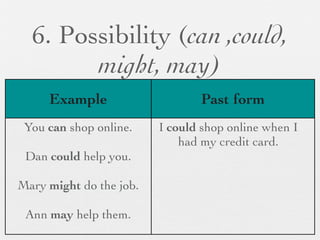
6. Possibility (can ,could,
        might, may)
     Example                     Past form
 You can shop online.    I could shop online when I
                             had my credit card.
 Dan could help you.     You could have helped me
                               but you didn’t.
Mary might do the job.   Mary might have done the
                                    job.
 Ann may help them.      Ann may have told him the
                                   secret.
7(a). Conditional
Example      Past form
7(a). Conditional
        Example               Past form


If I had time, I would help
   her (expresses a wish)
7(a). Conditional
        Example                  Past form
                              If I had studied the
                               piano when I was
If I had time, I would help
                              young I would have
   her (expresses a wish)
                               become a concert
                                 pianist by now.
7 (b). Past habit (would)
  Example       Past form
7 (b). Past habit (would)
  Example           Past form


             As a youth, I would spend
              hours at my best friend’s
             house. (expresses a habit)
7(c). Desire (would like)
  Example       Past form
7(c). Desire (would like)
      Example              Past form


I woud like some coffee.
7(c). Desire (would like)
      Example                Past form

                           I would have liked
                           some coffee but the
I woud like some coffee.
                           coffee machine was
                                 broken.
7(d). Preference (would
        rather)
 Example       Past form
7(d). Preference (would
            rather)
        Example               Past form


I would rather be tall than
          short.
7(d). Preference (would
            rather)
        Example                    Past form

                                I would rather have
I would rather be tall than    been poor and healthy
          short.              than rich and sick when
                                   I was a child.

Modals

  • 1.
  • 2.
  • 3.
    Modal Forms Modal auxiliariesare a special class of words that indicate things such as ability (can) and obligation (must).
  • 4.
    Modal Forms Modal auxiliaries are a special class of words that indicate things such as ability (can) and obligation (must). Remember that modals have no third-person singular form.
  • 5.
    Modal Forms Modal auxiliaries are a special class of words that indicate things such as ability (can) and obligation (must). Remember that modals have no third-person singular form.
  • 6.
    Modal Forms Modal auxiliaries are a special class of words that indicate things such as ability (can) and obligation (must). Jane helps people Remember that modals have no third-person singular form.
  • 7.
    Modal Forms Modal auxiliaries are a special class of words that indicate things such as ability (can) and obligation (must). Jane helps people Remember that modals have no third-person singular form. Jane can help you.
  • 8.
  • 9.
    Function of modals 1)Ability (can)
  • 10.
    Function of modals 1)Ability (can) 2) Polite requests (may, would, could, can)
  • 11.
    Function of modals 1)Ability (can) 2) Polite requests (may, would, could, can) 3) Advice (should, ought to)
  • 12.
    Function of modals 1)Ability (can) 2) Polite requests (may, would, could, can) 3) Advice (should, ought to) 4) Obligation (must, have to)
  • 13.
    Function of modals 1)Ability (can) 2) Polite requests (may, would, could, can) 3) Advice (should, ought to) 4) Obligation (must, have to) 5)Probability (must)
  • 14.
    Function of modals 1)Ability (can) 2) Polite requests (may, would, could, can) 3) Advice (should, ought to) 4) Obligation (must, have to) 5)Probability (must) 6)Possibility (can, could, might, may)
  • 15.
    Function of modals 1)Ability (can) 2) Polite requests (may, would, could, can) 3) Advice (should, ought to) 4) Obligation (must, have to) 5)Probability (must) 6)Possibility (can, could, might, may) 7) Conditional, past habit (would), desire (would like), preference (would rather).
  • 16.
    Function of modals 1)Ability (can) 2) Polite requests (may, would, could, can) Although have to is 3) Advice (should, ought to) not a modal 4) Obligation (must, have to) auxiliary, it is 5)Probability (must) included on this list because it functions 6)Possibility (can, could, might, like a modal and has may) the same meaning as 7) Conditional, past habit must. Have to becomes has to in (would), desire (would like), the third person preference (would rather).
  • 17.
  • 18.
    1. Ability (can) Example Past form She can speak English very well.
  • 19.
    1. Ability (can) Example Past form I could speak English much She can speak English very better when I was in high- well. school.
  • 20.
    2. Polite requests(may, would,could,can) Example Past form
  • 21.
    2. Polite requests(may, would,could,can) Example Past form May I help you? (formal)
  • 22.
    2. Polite requests(may, would,could,can) Example Past form May I help you? (formal) Would you like some tea?
  • 23.
    2. Polite requests(may, would,could,can) Example Past form May I help you? (formal) Would you like some tea? Could you pass the butter?
  • 24.
    2. Polite requests(may, would,could,can) Example Past form May I help you? (formal) Would you like some tea? Could you pass the butter? Can I have some help? (informal)
  • 25.
    3. Advice (should,ought to) Example Past form
  • 26.
    3. Advice (should,ought to) Example Past form Alan should see a lawyer.
  • 27.
    3. Advice (should,ought to) Example Past form Alan should see a lawyer. Karen ought to do her work.
  • 28.
    3. Advice (should,ought to) Example Past form He should have seen a Alan should see a lawyer. lawyer before signing the Karen ought to do her contract. work.
  • 29.
    3. Advice (should,ought to) Example Past form He should have seen a Alan should see a lawyer. lawyer before signing the Karen ought to do her contract. work. Karen ought to have done her work sooner.
  • 30.
    4. Obligation (must,have to ) Example Past form
  • 31.
    4. Obligation (must,have to ) Example Past form Helen must (has to) see a doctor right away.
  • 32.
    4. Obligation (must,have to ) Example Past form Helen had to see a doctor last night Helen must (has to) see because because she a doctor right away. was having difficulty breathing.
  • 33.
  • 34.
    5. Probability (must) Example Past form Kay must be home now.
  • 35.
    5. Probability (must) Example Past form She must have been very Kay must be home now. beautiful when she was young.
  • 36.
    6. Possibility (can,could, might, may) Example Past form
  • 37.
    6. Possibility (can,could, might, may) Example Past form You can shop online.
  • 38.
    6. Possibility (can,could, might, may) Example Past form You can shop online. Dan could help you.
  • 39.
    6. Possibility (can,could, might, may) Example Past form You can shop online. Dan could help you. Mary might do the job.
  • 40.
    6. Possibility (can,could, might, may) Example Past form You can shop online. Dan could help you. Mary might do the job. Ann may help them.
  • 41.
    6. Possibility (can,could, might, may) Example Past form You can shop online. I could shop online when I had my credit card. Dan could help you. Mary might do the job. Ann may help them.
  • 42.
    6. Possibility (can,could, might, may) Example Past form You can shop online. I could shop online when I had my credit card. Dan could help you. You could have helped me but you didn’t. Mary might do the job. Ann may help them.
  • 43.
    6. Possibility (can,could, might, may) Example Past form You can shop online. I could shop online when I had my credit card. Dan could help you. You could have helped me but you didn’t. Mary might do the job. Mary might have done the job. Ann may help them.
  • 44.
    6. Possibility (can,could, might, may) Example Past form You can shop online. I could shop online when I had my credit card. Dan could help you. You could have helped me but you didn’t. Mary might do the job. Mary might have done the job. Ann may help them. Ann may have told him the secret.
  • 45.
  • 46.
    7(a). Conditional Example Past form If I had time, I would help her (expresses a wish)
  • 47.
    7(a). Conditional Example Past form If I had studied the piano when I was If I had time, I would help young I would have her (expresses a wish) become a concert pianist by now.
  • 48.
    7 (b). Pasthabit (would) Example Past form
  • 49.
    7 (b). Pasthabit (would) Example Past form As a youth, I would spend hours at my best friend’s house. (expresses a habit)
  • 50.
    7(c). Desire (wouldlike) Example Past form
  • 51.
    7(c). Desire (wouldlike) Example Past form I woud like some coffee.
  • 52.
    7(c). Desire (wouldlike) Example Past form I would have liked some coffee but the I woud like some coffee. coffee machine was broken.
  • 53.
    7(d). Preference (would rather) Example Past form
  • 54.
    7(d). Preference (would rather) Example Past form I would rather be tall than short.
  • 55.
    7(d). Preference (would rather) Example Past form I would rather have I would rather be tall than been poor and healthy short. than rich and sick when I was a child.