Modal Verbs
(Upstream Advanced)
Logical Assumptions/Deductions
(+)
 MUST: sure/certain that sth is true
Used in affirmative sentences, it
expresses positive logical beliefs or
deductions:
You have been practising all day,
you must be exhausted.
Logical Assumptions/Deductions
(-)
 CAN’T/COULDN’T: certain that sth is
NOT true/real.
Used in negations, express negative
logical assumptions:
That can’t be my husband, he’s in
London.
Possibility (General
Possibility)
 CAN+ PRESENT INFINITIVE: general
possibility, sth theoretically possible; not
used for a specific situation.
You can have milk or juice.
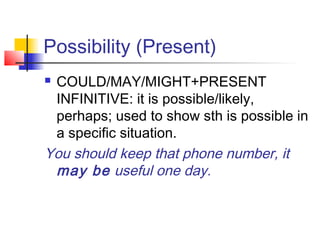
Possibility (Present)
 COULD/MAY/MIGHT+PRESENT
INFINITIVE: it is possible/likely,
perhaps; used to show sth is possible in
a specific situation.
You should keep that phone number, it
may be useful one day.
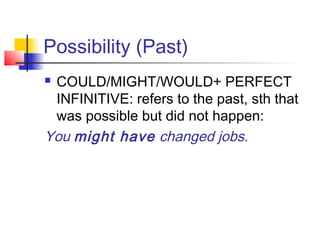
Possibility (Past)
 COULD/MIGHT/WOULD+ PERFECT
INFINITIVE: refers to the past, sth that
was possible but did not happen:
You might have changed jobs.
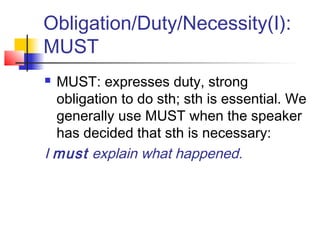
Obligation/Duty/Necessity(I):
MUST
 MUST: expresses duty, strong
obligation to do sth; sth is essential. We
generally use MUST when the speaker
has decided that sth is necessary:
I must explain what happened.
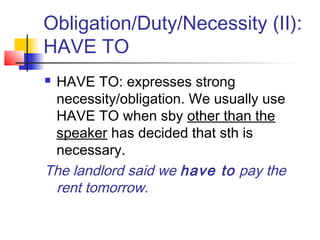
Obligation/Duty/Necessity (II):
HAVE TO
 HAVE TO: expresses strong
necessity/obligation. We usually use
HAVE TO when sby other than the
speaker has decided that sth is
necessary.
The landlord said we have to pay the
rent tomorrow.
 NOTE: MUST and HAVE TO have
different meanings in questions.
- Do I have to pay the full amount now?
(Is it necessary for me…?)
- Must I stay for the whole meeting? (Do
you insist that I…?)
Obligation/Duty/Necessity (III):
SHOULD/OUGHT TO
 SHOULD/OUGHT TO: express duty,
weak obligation. These are less
emphatic than MUST/HAVE TO:
You should think about it before you
make a final decision.
Obligation/Duty/Necessity(I):
NEED
 NEED: It is necessary to.
You need to work until late tonight.
NOTE: NEED can be used as a modal
verb or as a main verb with no change
in meaning:
Need I put more oil in my car?
Do I need to put more oil in my car?
Absence of necessity
(Present)
 NEEDN’T/DON’T HAVE TO/DON’T
NEED TO+PRESENT INFINITIVE: it
isn’t necessary to do sth (in the
present/future)
You don’t need to drive me home, I will
take a cab.
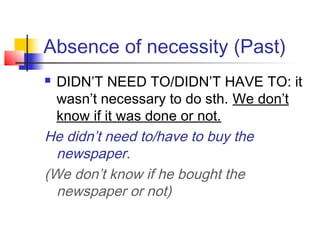
Absence of necessity (Past)
 DIDN’T NEED TO/DIDN’T HAVE TO: it
wasn’t necessary to do sth. We don’t
know if it was done or not.
He didn’t need to/have to buy the
newspaper.
(We don’t know if he bought the
newspaper or not)
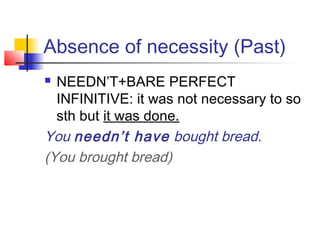
Absence of necessity (Past)
 NEEDN’T+BARE PERFECT
INFINITIVE: it was not necessary to so
sth but it was done.
You needn’t have bought bread.
(You brought bread)
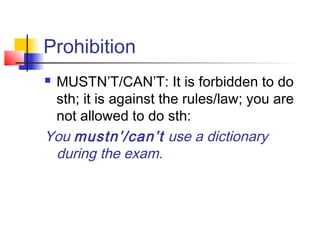
Prohibition
 MUSTN’T/CAN’T: It is forbidden to do
sth; it is against the rules/law; you are
not allowed to do sth:
You mustn’/can’t use a dictionary
during the exam.
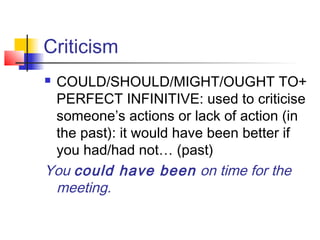
Criticism
 COULD/SHOULD/MIGHT/OUGHT TO+
PERFECT INFINITIVE: used to criticise
someone’s actions or lack of action (in
the past): it would have been better if
you had/had not… (past)
You could have been on time for the
meeting.

Modal verbs