The Academic Essay
  Perspectives (Brent Davies, 2010)
The Academic Essay

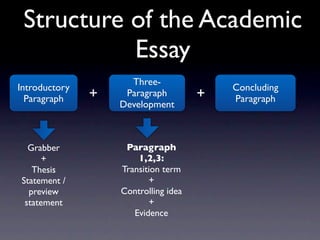
The academic essay is a formal, structured piece of
 writing consisting of an introductory paragraph, a
  three-paragraph development and a concluding
                     paragraph.
The Academic Essay
The Academic Essay
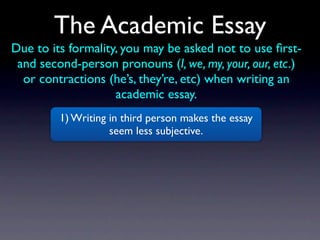
Due to its formality, you may be asked not to use first-
 and second-person pronouns (I, we, my, your, our, etc.)
  or contractions (he’s, they’re, etc) when writing an
                    academic essay.
The Academic Essay
Due to its formality, you may be asked not to use first-
 and second-person pronouns (I, we, my, your, our, etc.)
  or contractions (he’s, they’re, etc) when writing an
                    academic essay.
         1) Writing in third person makes the essay
                    seem less subjective.
The Academic Essay
Due to its formality, you may be asked not to use first-
 and second-person pronouns (I, we, my, your, our, etc.)
  or contractions (he’s, they’re, etc) when writing an
                    academic essay.
         1) Writing in third person makes the essay
                    seem less subjective.

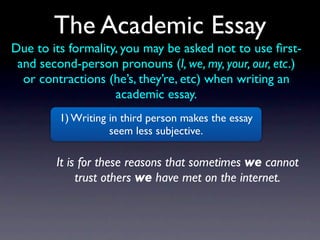
        It is for these reasons that sometimes we cannot
             trust others we have met on the internet.
The Academic Essay
Due to its formality, you may be asked not to use first-
 and second-person pronouns (I, we, my, your, our, etc.)
  or contractions (he’s, they’re, etc) when writing an
                    academic essay.
             1) Writing in third person makes the essay
                        seem less subjective.

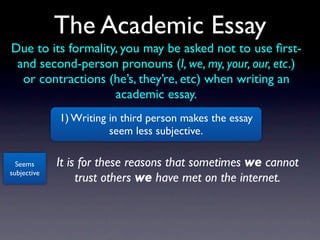
  Seems      It is for these reasons that sometimes we cannot
subjective
                  trust others we have met on the internet.
The Academic Essay
Due to its formality, you may be asked not to use first-
 and second-person pronouns (I, we, my, your, our, etc.)
  or contractions (he’s, they’re, etc) when writing an
                    academic essay.
              1) Writing in third person makes the essay
                         seem less subjective.

  Seems       It is for these reasons that sometimes we cannot
subjective
                   trust others we have met on the internet.

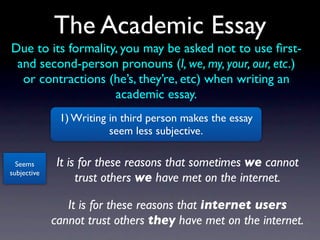
                It is for these reasons that internet users
             cannot trust others they have met on the internet.
The Academic Essay
 Due to its formality, you may be asked not to use first-
  and second-person pronouns (I, we, my, your, our, etc.)
   or contractions (he’s, they’re, etc) when writing an
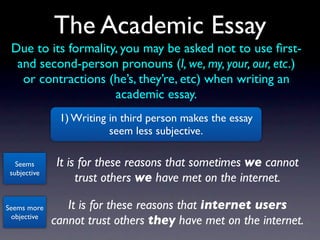
                     academic essay.
               1) Writing in third person makes the essay
                          seem less subjective.

   Seems       It is for these reasons that sometimes we cannot
 subjective
                    trust others we have met on the internet.

Seems more       It is for these reasons that internet users
 objective
              cannot trust others they have met on the internet.
The Academic Essay
The Academic Essay
A title page, research and referencing may also be
                     required.
The Academic Essay
A title page, research and referencing may also be
                     required.

        For more information on research and
      referencing, see “Appendix A: Researching,
              Referencing and Revising.”
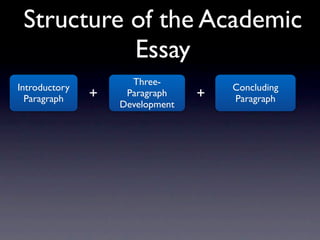
Structure of the Academic
           Essay
                     Three-
Introductory                         Concluding
  Paragraph    +    Paragraph    +   Paragraph
                   Development
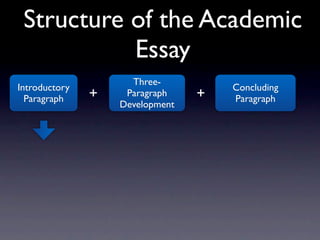
Structure of the Academic
           Essay
                     Three-
Introductory                         Concluding
  Paragraph    +    Paragraph    +   Paragraph
                   Development
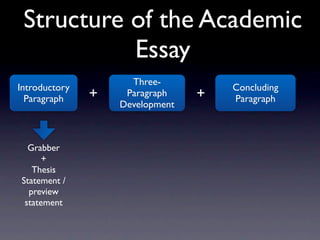
Structure of the Academic
           Essay
                     Three-
Introductory                         Concluding
  Paragraph    +    Paragraph    +   Paragraph
                   Development


  Grabber
      +
   Thesis
Statement /
  preview
 statement
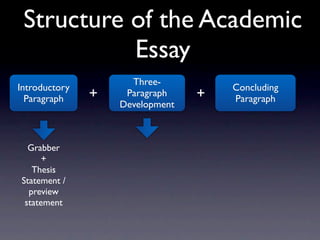
Structure of the Academic
           Essay
                     Three-
Introductory                         Concluding
  Paragraph    +    Paragraph    +   Paragraph
                   Development


  Grabber
      +
   Thesis
Statement /
  preview
 statement
Structure of the Academic
           Essay
                     Three-
Introductory                              Concluding
  Paragraph    +    Paragraph         +   Paragraph
                   Development


  Grabber           Paragraph
      +                1,2,3:
   Thesis          Transition term
Statement /               +
  preview          Controlling idea
 statement                +
                      Evidence
Structure of the Academic
           Essay
                     Three-
Introductory                              Concluding
  Paragraph    +    Paragraph         +   Paragraph
                   Development


  Grabber           Paragraph
      +                1,2,3:
   Thesis          Transition term
Statement /               +
  preview          Controlling idea
 statement                +
                      Evidence
Structure of the Academic
           Essay
                     Three-
Introductory                              Concluding
  Paragraph    +    Paragraph         +   Paragraph
                   Development


  Grabber           Paragraph
      +                1,2,3:               Summary
   Thesis          Transition term          statement
Statement /               +                      +
  preview          Controlling idea          Clincher
 statement                +
                      Evidence
The 4-S Test
The 4-S Test
An effective essay is based on a subject that passes
                    the 4-S test.
The 4-S Test
The subject must be:

1. Single
The 4-S Test
 The subject must be:

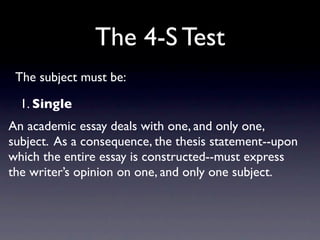
  1. Single
An academic essay deals with one, and only one,
subject. As a consequence, the thesis statement--upon
which the entire essay is constructed--must express
the writer’s opinion on one, and only one subject.
The 4-S Test
 The subject must be:

2. Significant
The 4-S Test
 The subject must be:

2. Significant
An academic essay is written to be read. In an
educational setting, the reader is typically your teacher
and perhaps one or more of your classmates.Your
teacher and your classmates deserve to read essays on
meaningful subjects.
The 4-S Test
The subject must be:

3. Specific
The 4-S Test
 The subject must be:

 3. Specific
Academic essays are brief. The more specific your
thesis statement, the more justice you can do to the
topic selected; for example, instead of writing about
war, write about the internment of Japanese-Canadian
citizens during World War II.
The 4-S Test
 The subject must be:

4. Supportable
The 4-S Test
 The subject must be:

4. Supportable

An academic essay requires that you prove your point
(your thesis). If you can’t support your thesis
statement, change it.
The Introductory Paragraph
 The first sentence of the introductory paragraph
      should grab the reader’s attention. Not
surprisingly, this first sentence is often referred to
   as a grabber. Effective grabber techniques
 include (but are not limited to) using quotations
                 definitions and facts.
The Introductory Paragraph
     The introductory paragraph must end with a
thesis statement, an affirmative statement that
expresses the writer’s opinion about the subject of
 the essay, and may be followed by a list of two or
    three main points to be used to support your
 thesis. When the thesis statement is followed by a
 list of main points, it is referred to as a preview
                    statement.
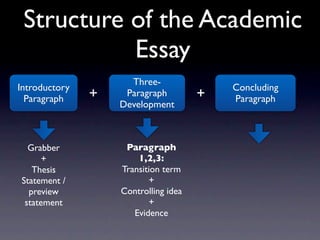
Three-Paragraph development
The first sentence of each paragraph in the
development is the topic sentence of the
paragraph. The topic sentence is the controlling
idea of the paragraph. Each topic sentence begins
with a transition term such as First, Second, and
Third or To begin, To continue, and To finish and is
backed up with evidence: statistics, expert opinion
or example. Ideally, different types of evidence are
used in the development.
Transition Terms


Transition terms lend coherence to a text,
indicating relationships between ideas.
Read the transition words on p.10
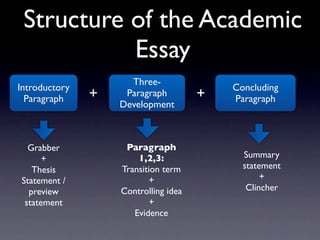
Concluding Paragraph


The first sentence of the concluding paragraph is a
summary statement, a paraphrase of the
thesis statement and topic sentences. The summary
statement begins with a transition term such as To
sum up, In summary,To conclude or In conclusion.
Concluding Paragraph

The last sentence of the concluding paragraph is
the clincher, a technique used to encourage the
reader to reflect upon the essay. Effective clincher
techniques include (but are not limited to)
connecting with the introduction, asking a
rhetorical question (question for which no answer
is expected or offering a suggestion.

212 the academic essay

  • 1.
    The Academic Essay Perspectives (Brent Davies, 2010)
  • 2.
    The Academic Essay Theacademic essay is a formal, structured piece of writing consisting of an introductory paragraph, a three-paragraph development and a concluding paragraph.
  • 3.
  • 4.
    The Academic Essay Dueto its formality, you may be asked not to use first- and second-person pronouns (I, we, my, your, our, etc.) or contractions (he’s, they’re, etc) when writing an academic essay.
  • 5.
    The Academic Essay Dueto its formality, you may be asked not to use first- and second-person pronouns (I, we, my, your, our, etc.) or contractions (he’s, they’re, etc) when writing an academic essay. 1) Writing in third person makes the essay seem less subjective.
  • 6.
    The Academic Essay Dueto its formality, you may be asked not to use first- and second-person pronouns (I, we, my, your, our, etc.) or contractions (he’s, they’re, etc) when writing an academic essay. 1) Writing in third person makes the essay seem less subjective. It is for these reasons that sometimes we cannot trust others we have met on the internet.
  • 7.
    The Academic Essay Dueto its formality, you may be asked not to use first- and second-person pronouns (I, we, my, your, our, etc.) or contractions (he’s, they’re, etc) when writing an academic essay. 1) Writing in third person makes the essay seem less subjective. Seems It is for these reasons that sometimes we cannot subjective trust others we have met on the internet.
  • 8.
    The Academic Essay Dueto its formality, you may be asked not to use first- and second-person pronouns (I, we, my, your, our, etc.) or contractions (he’s, they’re, etc) when writing an academic essay. 1) Writing in third person makes the essay seem less subjective. Seems It is for these reasons that sometimes we cannot subjective trust others we have met on the internet. It is for these reasons that internet users cannot trust others they have met on the internet.
  • 9.
    The Academic Essay Due to its formality, you may be asked not to use first- and second-person pronouns (I, we, my, your, our, etc.) or contractions (he’s, they’re, etc) when writing an academic essay. 1) Writing in third person makes the essay seem less subjective. Seems It is for these reasons that sometimes we cannot subjective trust others we have met on the internet. Seems more It is for these reasons that internet users objective cannot trust others they have met on the internet.
  • 10.
  • 11.
    The Academic Essay Atitle page, research and referencing may also be required.
  • 12.
    The Academic Essay Atitle page, research and referencing may also be required. For more information on research and referencing, see “Appendix A: Researching, Referencing and Revising.”
  • 13.
    Structure of theAcademic Essay Three- Introductory Concluding Paragraph + Paragraph + Paragraph Development
  • 14.
    Structure of theAcademic Essay Three- Introductory Concluding Paragraph + Paragraph + Paragraph Development
  • 15.
    Structure of theAcademic Essay Three- Introductory Concluding Paragraph + Paragraph + Paragraph Development Grabber + Thesis Statement / preview statement
  • 16.
    Structure of theAcademic Essay Three- Introductory Concluding Paragraph + Paragraph + Paragraph Development Grabber + Thesis Statement / preview statement
  • 17.
    Structure of theAcademic Essay Three- Introductory Concluding Paragraph + Paragraph + Paragraph Development Grabber Paragraph + 1,2,3: Thesis Transition term Statement / + preview Controlling idea statement + Evidence
  • 18.
    Structure of theAcademic Essay Three- Introductory Concluding Paragraph + Paragraph + Paragraph Development Grabber Paragraph + 1,2,3: Thesis Transition term Statement / + preview Controlling idea statement + Evidence
  • 19.
    Structure of theAcademic Essay Three- Introductory Concluding Paragraph + Paragraph + Paragraph Development Grabber Paragraph + 1,2,3: Summary Thesis Transition term statement Statement / + + preview Controlling idea Clincher statement + Evidence
  • 20.
  • 21.
    The 4-S Test Aneffective essay is based on a subject that passes the 4-S test.
  • 22.
    The 4-S Test Thesubject must be: 1. Single
  • 23.
    The 4-S Test The subject must be: 1. Single An academic essay deals with one, and only one, subject. As a consequence, the thesis statement--upon which the entire essay is constructed--must express the writer’s opinion on one, and only one subject.
  • 24.
    The 4-S Test The subject must be: 2. Significant
  • 25.
    The 4-S Test The subject must be: 2. Significant An academic essay is written to be read. In an educational setting, the reader is typically your teacher and perhaps one or more of your classmates.Your teacher and your classmates deserve to read essays on meaningful subjects.
  • 26.
    The 4-S Test Thesubject must be: 3. Specific
  • 27.
    The 4-S Test The subject must be: 3. Specific Academic essays are brief. The more specific your thesis statement, the more justice you can do to the topic selected; for example, instead of writing about war, write about the internment of Japanese-Canadian citizens during World War II.
  • 28.
    The 4-S Test The subject must be: 4. Supportable
  • 29.
    The 4-S Test The subject must be: 4. Supportable An academic essay requires that you prove your point (your thesis). If you can’t support your thesis statement, change it.
  • 30.
    The Introductory Paragraph The first sentence of the introductory paragraph should grab the reader’s attention. Not surprisingly, this first sentence is often referred to as a grabber. Effective grabber techniques include (but are not limited to) using quotations definitions and facts.
  • 31.
    The Introductory Paragraph The introductory paragraph must end with a thesis statement, an affirmative statement that expresses the writer’s opinion about the subject of the essay, and may be followed by a list of two or three main points to be used to support your thesis. When the thesis statement is followed by a list of main points, it is referred to as a preview statement.
  • 32.
    Three-Paragraph development The firstsentence of each paragraph in the development is the topic sentence of the paragraph. The topic sentence is the controlling idea of the paragraph. Each topic sentence begins with a transition term such as First, Second, and Third or To begin, To continue, and To finish and is backed up with evidence: statistics, expert opinion or example. Ideally, different types of evidence are used in the development.
  • 33.
    Transition Terms Transition termslend coherence to a text, indicating relationships between ideas. Read the transition words on p.10
  • 34.
    Concluding Paragraph The firstsentence of the concluding paragraph is a summary statement, a paraphrase of the thesis statement and topic sentences. The summary statement begins with a transition term such as To sum up, In summary,To conclude or In conclusion.
  • 35.
    Concluding Paragraph The lastsentence of the concluding paragraph is the clincher, a technique used to encourage the reader to reflect upon the essay. Effective clincher techniques include (but are not limited to) connecting with the introduction, asking a rhetorical question (question for which no answer is expected or offering a suggestion.