Grammar I Modal Auxiliaries and related verbs
General Characteristics: Verbs like *can *may  are called Modal Auxiliaries; though we often refer to them simply as modal verbs or modal. Frequently Uses: Ask for permission Grant permission  Give/receive advice Make/respond : requests and offers, etc. Modals have two major functions: 1-  Primary : when they closely reflect meanings Ability :  can------  I can type really fast. could--  Sara could speak three languages by the age of six. Permission:  may--  You may leave early. might  Migth I borrow your jacket? Prediction: will--  It will rain soon. would  I would feel better after this medicine * shall(after  I/We)-  Can  we find our way home?-I´m sure we shall. Escapable obligation or duty:  should-   You should do as you´re told. ought to  You ought to be right. Inescapable obligation must-  You must be quiet! Absence of obligation: needn´t-  You needn´t wait.
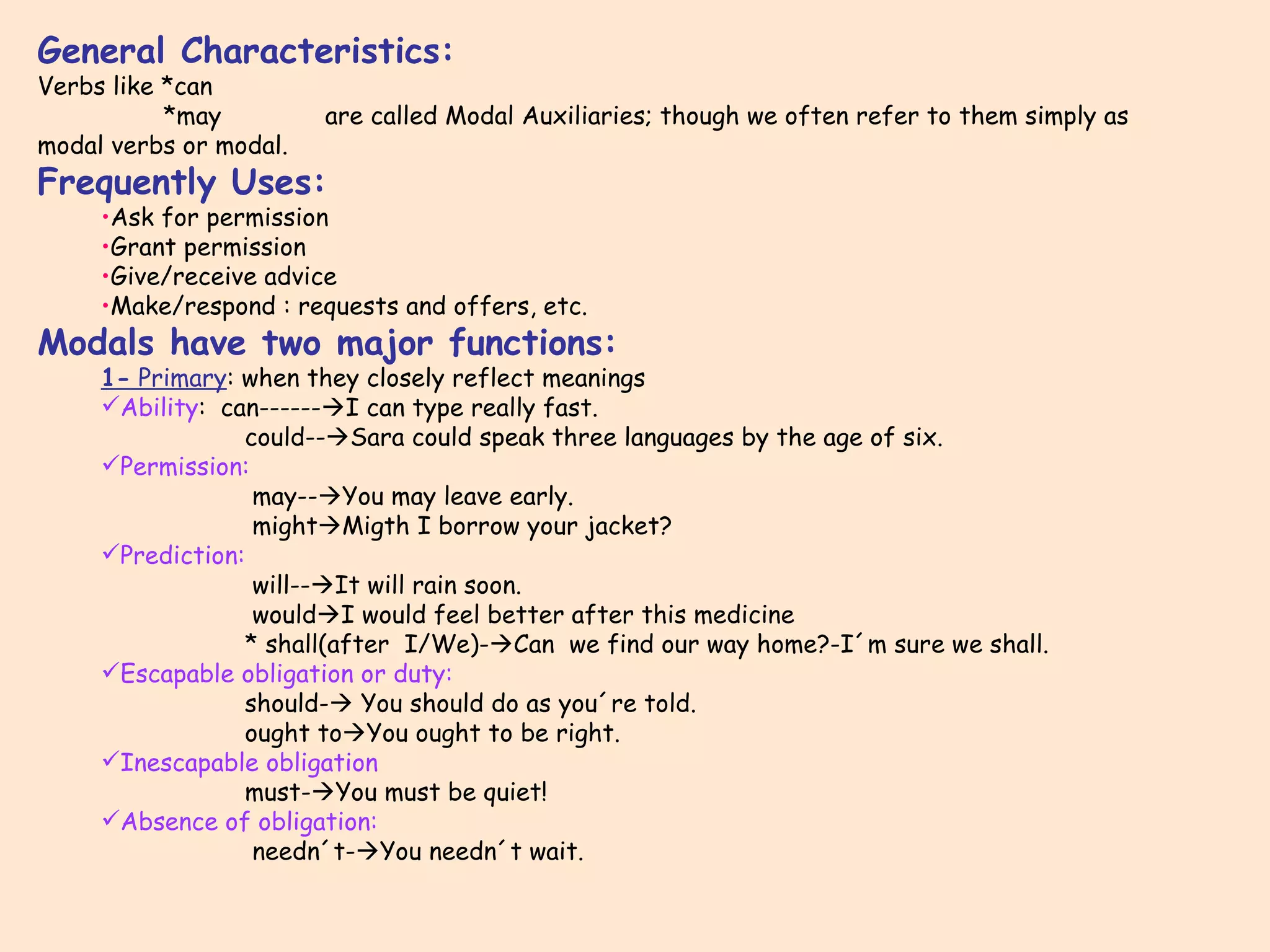
2-   Secondary :( nine of the modal auxiliaries-not shall- can be used to express the degree of certainty /uncertainty a speaker feels about a possibility:
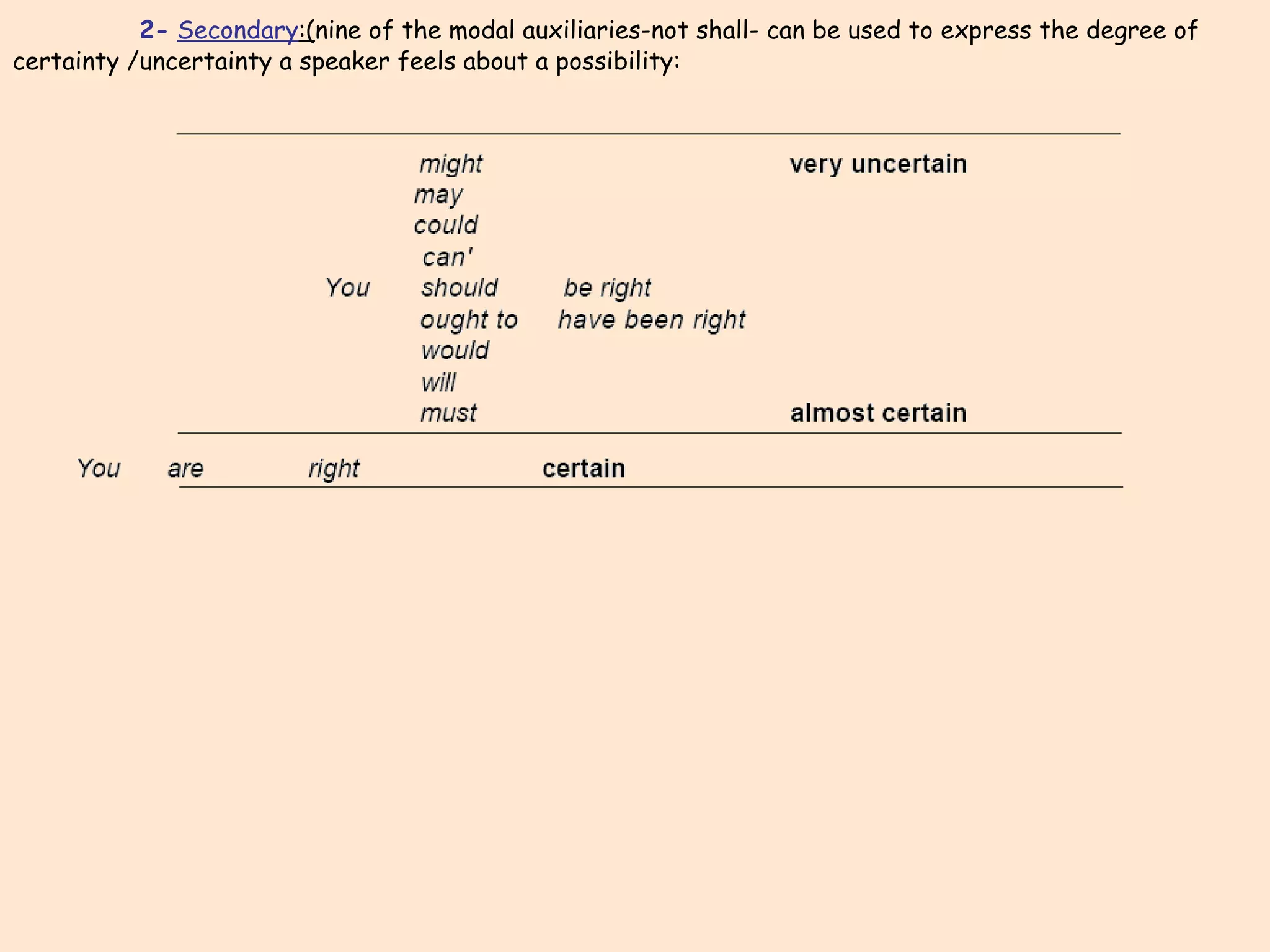
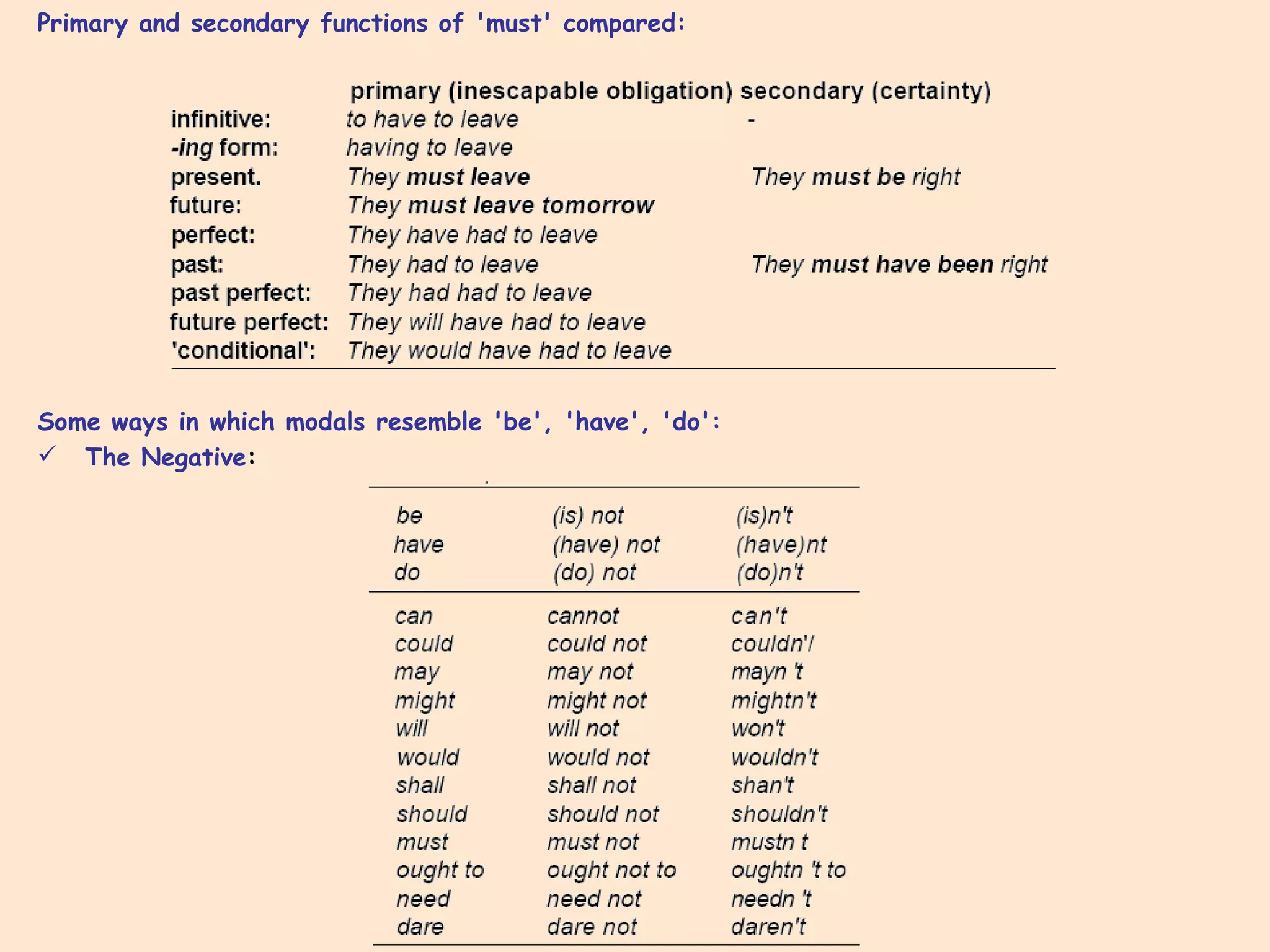
Primary and secondary functions of 'must' compared:   Some ways in which modals resemble 'be', 'have', 'do': The Negative :
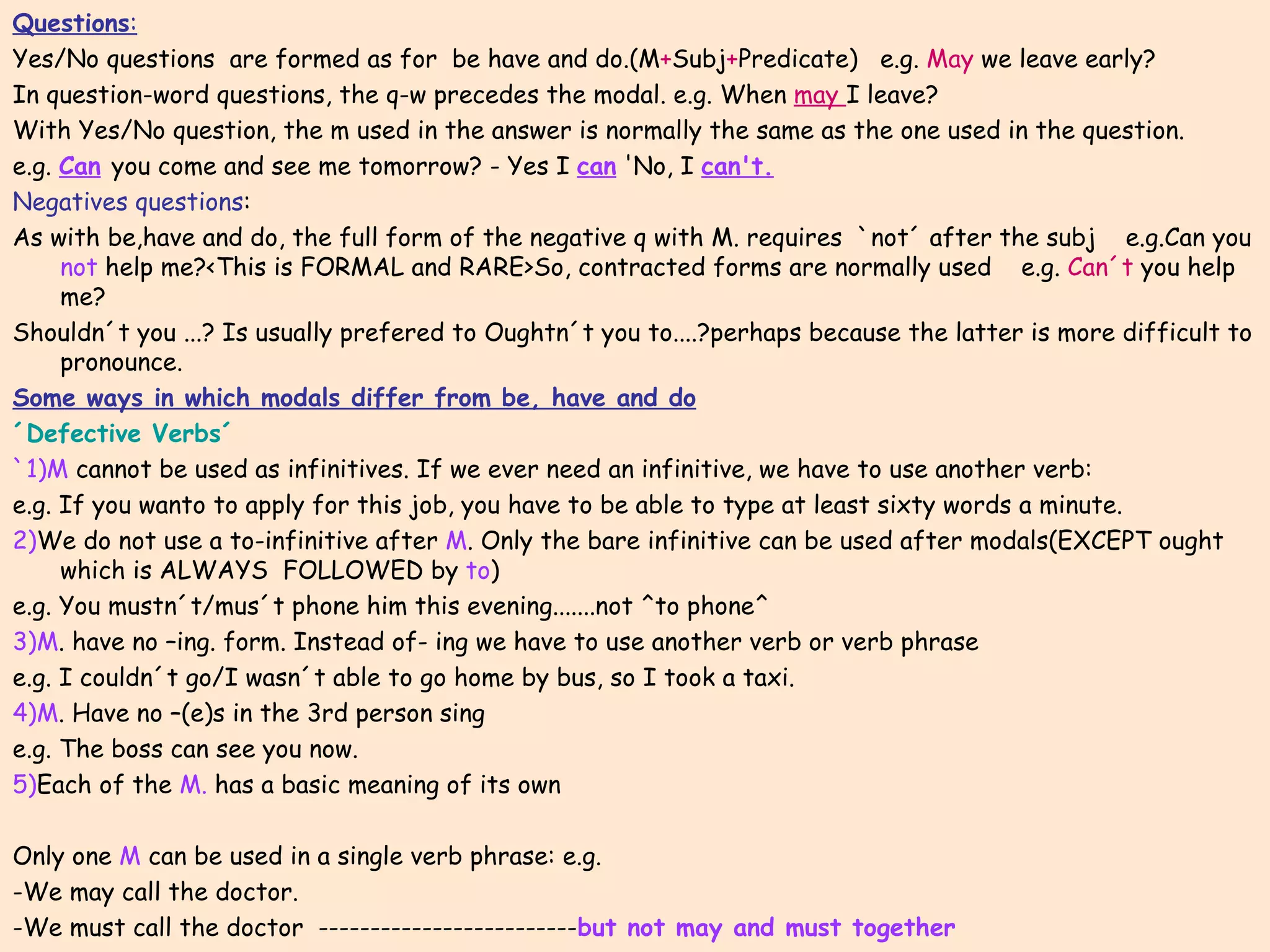
Questions : Yes/No questions  are formed as for  be have and do.(M + Subj + Predicate)  e.g.  May  we leave early? In question-word questions, the q-w precedes the modal. e.g. When  may  I leave? With Yes/No question, the m used in the answer is normally the same as the one used in the question. e.g.  Can   you come and see me tomorrow? - Yes I  can  'No, I  can't. Negatives questions : As with be,have and do, the full form of the negative q with M. requires  `not´ after the subj  e.g.Can you  not  help me?<This is FORMAL and RARE>So, contracted forms are normally used  e.g.  Can´t  you help me? Shouldn´t you ...? Is usually prefered to Oughtn´t you to....?perhaps because the latter is more difficult to pronounce. Some ways in which modals differ from be, have and do ´Defective Verbs´ `1)M  cannot be used as infinitives. If we ever need an infinitive, we have to use another verb: e.g. If you wanto to apply for this job, you have to be able to type at least sixty words a minute. 2) We do not use a to-infinitive after  M . Only the bare infinitive can be used after modals(EXCEPT ought which is ALWAYS  FOLLOWED by  to ) e.g. You mustn´t/mus´t phone him this evening.......not ^to phone^ 3)M . have no –ing. form. Instead of- ing we have to use another verb or verb phrase e.g. I couldn´t go/I wasn´t able to go home by bus, so I took a taxi. 4)M . Have no –(e)s in the 3rd person sing  e.g. The boss can see you now. 5) Each of the  M.  has a basic meaning of its own Only one  M  can be used in a single verb phrase: e.g.  -We may call the doctor. -We must call the doctor  ------------------------- but not may and must together
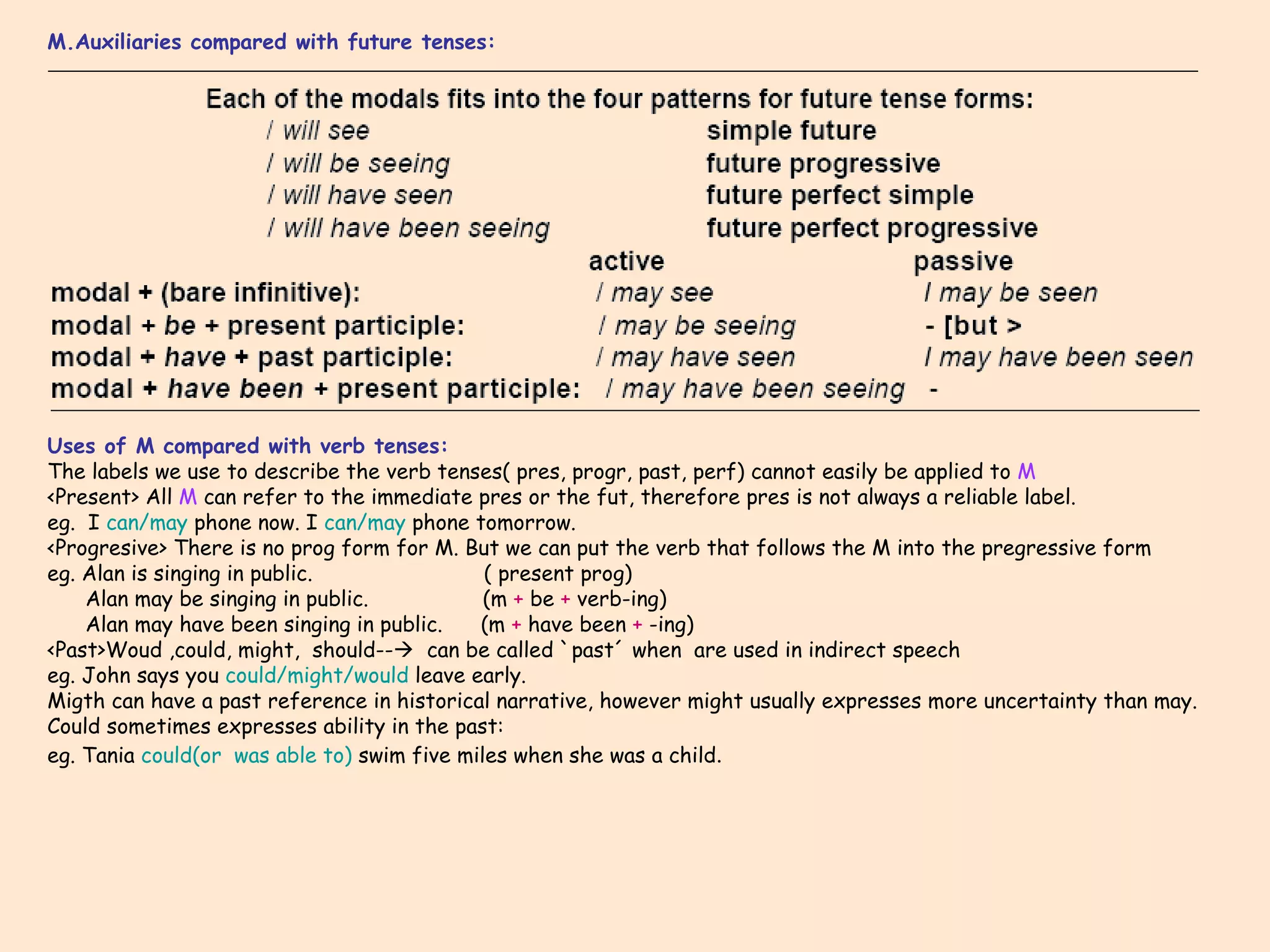
M.Auxiliaries compared with future tenses: Uses of M compared with verb tenses: The labels we use to describe the verb tenses( pres, progr, past, perf) cannot easily be applied to  M <Present> All  M  can refer to the immediate pres or the fut, therefore pres is not always a reliable label. eg.  I  can/may  phone now. I  can/may  phone tomorrow. <Progresive> There is no prog form for M. But we can put the verb that follows the M into the pregressive form eg. Alan is singing in public.  ( present prog) Alan may be singing in public.  (m  +  be  +  verb-ing) Alan may have been singing in public.  (m  +  have been  +  -ing) <Past>Woud ,could, might,  should--    can be called `past´ when  are used in indirect speech eg. John says you  could/might/would  leave early. Migth can have a past reference in historical narrative, however might usually expresses more uncertainty than may. Could sometimes expresses ability in the past: eg. Tania  could(or  was able to)  swim five miles when she was a child .
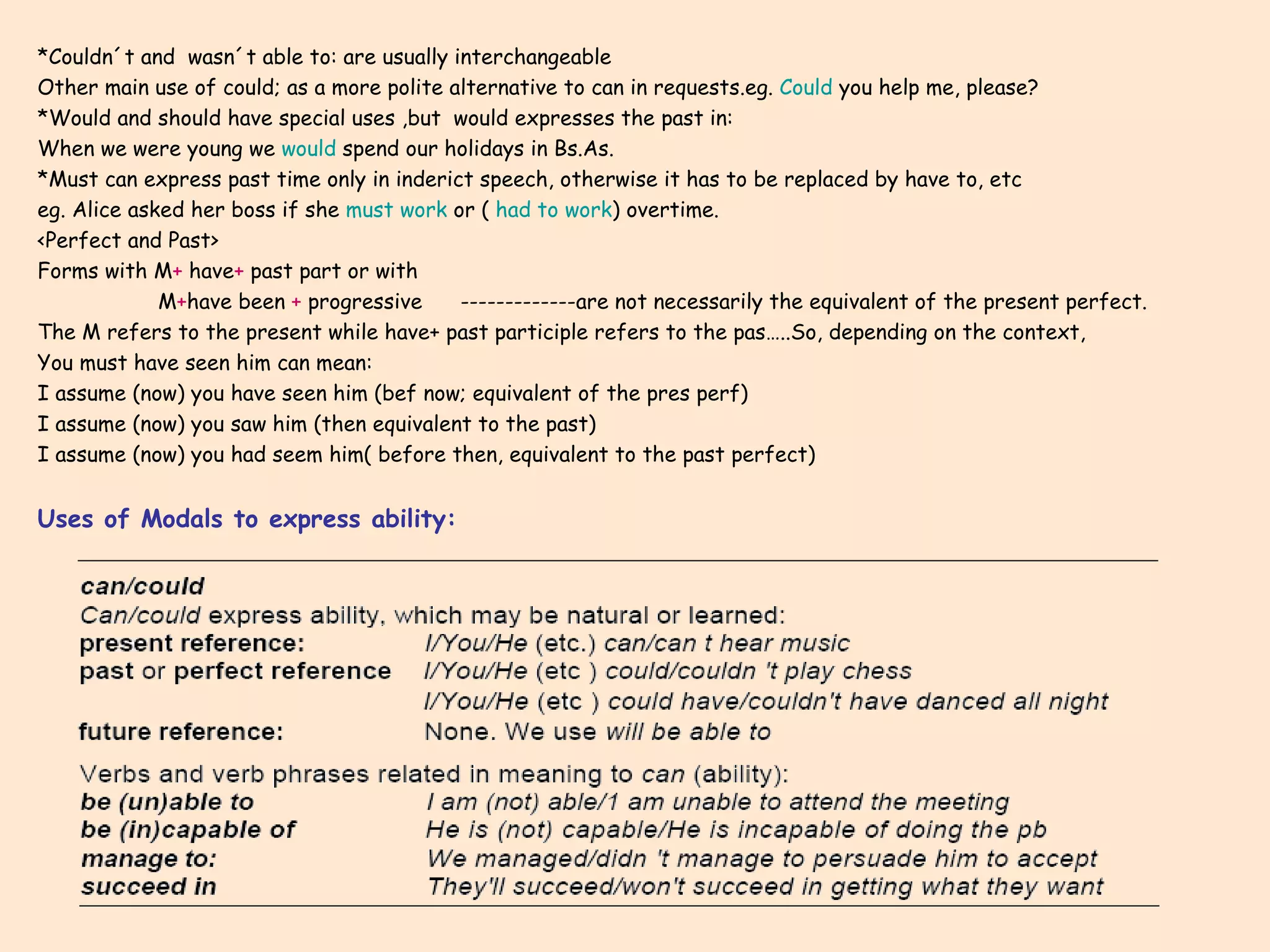
*Couldn´t and  wasn´t able to: are usually interchangeable Other main use of could; as a more polite alternative to can in requests.eg.  Could  you help me, please? *Would and should have special uses ,but  would expresses the past in:  When we were young we  would  spend our holidays in Bs.As. *Must can express past time only in inderict speech, otherwise it has to be replaced by have to, etc eg. Alice asked her boss if she  must work  or (  had to work ) overtime. <Perfect and Past>  Forms with M +  have +  past part or with  M + have been  +  progressive  -------------are not necessarily the equivalent of the present perfect. The M refers to the present while have+ past participle refers to the pas…..So, depending on the context, You must have seen him can mean: I assume (now) you have seen him (bef now; equivalent of the pres perf)  I assume (now) you saw him (then equivalent to the past) I assume (now) you had seem him( before then, equivalent to the past perfect)  Uses of Modals to express ability:
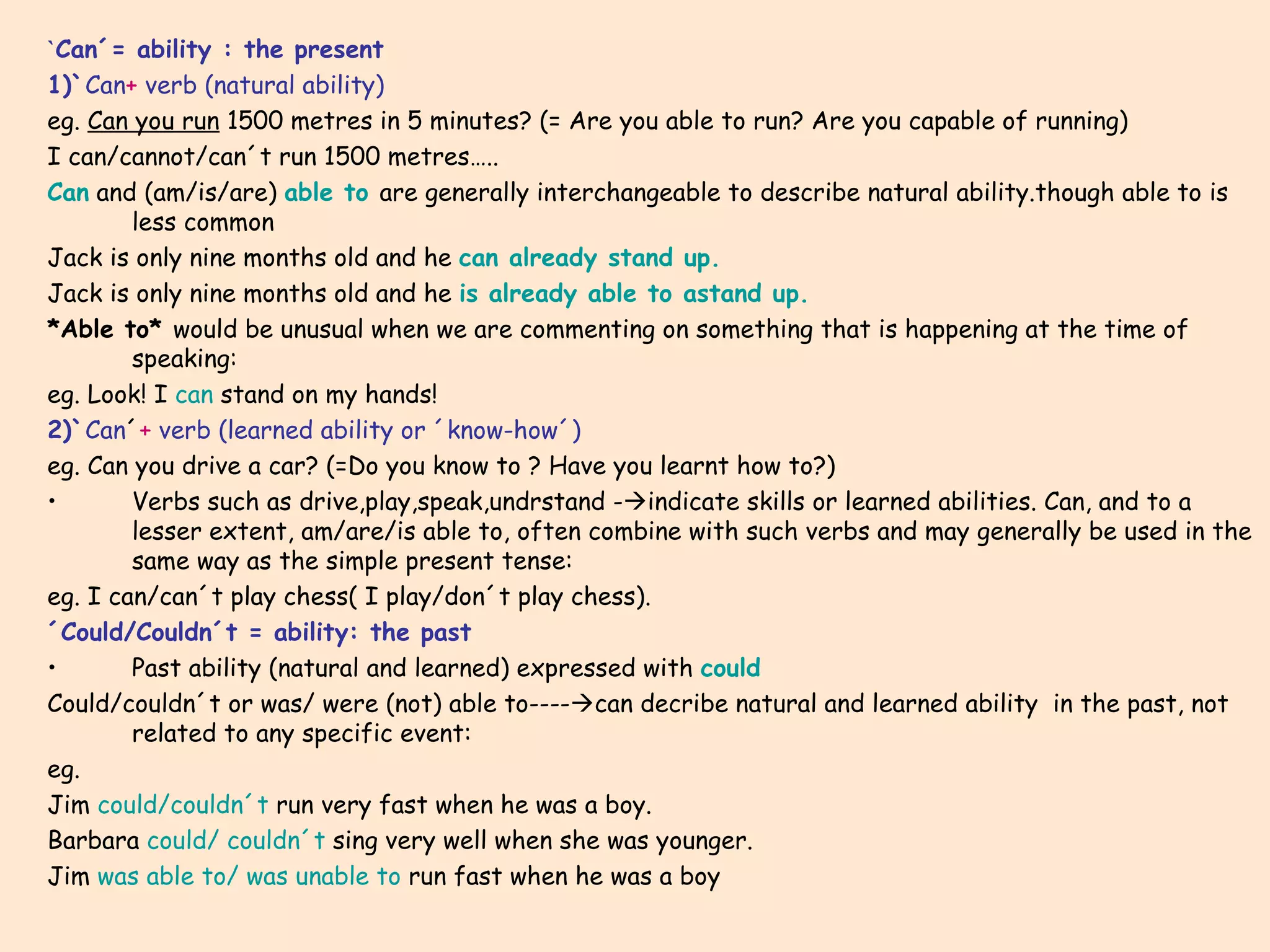
` Can´= ability : the present 1)` Can +  verb (natural ability) eg.  Can you run  1500 metres in 5 minutes? (= Are you able to run? Are you capable of running) I can/cannot/can´t run 1500 metres….. Can  and (am/is/are)  able to   are generally interchangeable to describe natural ability.though able to is less common Jack is only nine months old and he  can already stand up. Jack is only nine months old and he  is already able to astand up. *Able to*  would be unusual when we are commenting on something that is happening at the time of speaking: eg. Look! I  can  stand on my hands! 2)` Can ´ +   verb (learned ability or ´know-how´) eg. Can you drive a car? (=Do you know to ? Have you learnt how to?) Verbs such as drive,play,speak,undrstand -  indicate skills or learned abilities. Can, and to a lesser extent, am/are/is able to, often combine with such verbs and may generally be used in the same way as the simple present tense: eg. I can/can´t play chess( I play/don´t play chess). ´Could/Couldn´t = ability: the past Past ability (natural and learned) expressed with  could Could/couldn´t or was/ were (not) able to----  can decribe natural and learned ability  in the past, not related to any specific event: eg. Jim  could/couldn´t  run very fast when he was a boy. Barbara  could/ couldn´t  sing very well when she was younger. Jim  was able to/ was unable to  run fast when he was a boy
Another often use to talk about or describe past abilities:  used to  -  be able to eg. I used to be able to hold my breath for one minute under water. * Could and was ( or would be) able to  occur after reporting verbs: eg. He said he could see me next week. 2) The past: could  +  verb: achievement after effort Could and was/were aable to can be interchangeable when we refer to acquisition of a skill after effort: I tried again and found I could swim/ was able to swim. *Could cannot normally be used when we are describing the successful completion of  a specific action Was/were able to, managed to or succededed in + -ing  must be used instead.- eg. In the end they    were able to rescue     the cat on the roof. “  “  “  “   managed to rescue     “  “  “  “  “ . “  “  “  “     succeeded in rescuing     “  “  “  “  “ . If an action was not successfully completed, we can use couldn´t. eg. They tried for hours, but they couldn´t save the cat. (or weren´t able to, didn´t manage to, etc.) *Could can be used when we are asking about a specific action ( as opposed to describing it ): Could they rescue the cat on the roof?( did they manage to? ) -No, they couldn´t .It was too difficult. However an affirmative response requires an alternative to could: -Yes, they managed to. (Not ´could´)
´ Can/could´ +  verbs of perception: Verbs like see, hear, smell, rarely occur in the progressive. Can and to a lesser extent, am/is/are able to, combine with such verbs to indicate that we can see, hear, smell,etc something happening at the moment of speaking. In such cases  can has a grammatical function equivalent to the simple present in statements and to do/does in questions and negatives. eg. I  can smell  something burning I  can´t see  anyone. *Could can be used in place of the simple past in the same way:  eg. I listened carefully, but  couldn´t hear  anything. *Can/could can be used with verbs suggesting “ understanding” : I  can/can´t  understand why he decided to retire at 50. I  could/couldn´t  “  “  “  had decided to retire at 50. *Couldn´t/Can´t cannot be replaced by the simple present or simple past when conveying the idea ´beyond (my)control´ I  can´t /couldn´t imagine  what would be like to live in a hot climate .( Not * don´t/didn´t*) ´ Could´ and ´would be able to´ : We can use can as an unreal past in the sense of ´would  be able to´. When we do this, an if-clause is something implied: Could +  never has the sense of `would never be able to´  eg. I could never put up with such inefficiency if I were running an office. Could is often used to express surprise,anger, etc, in the present: I could eat my hat. I could slap your face!
´ Could have´ and ´would have been able to´: We don´t use can/can´t have + past participle to express ability or capacity. We use them for possibility or conjecture( He can´t have told you anything I don´t already know) However, in conditional sentences and implied conditionals we may use could have+past participle ( in place of would have been able to) to refer to ability or capacity that was not used owing to personal  failure or lack of opportunity If I hadn´t been for the freezing wind and blinding snow, the rescue party could have reached the injured man before nightfall. Ability in tenses other than present and past If we need to express abilitty in other tense combinations ( future or present perf, then the appropiate forms of be able to, manage to or succeeded in must be used: I´ll be able toto pass my driving test after I´ve had a few lessons.  I´ve been trying to contact him, but I haven´t managed to. *Can referring to ability,skill, or perception, is usable in clauses after if and when to refer to the future: If you can pass ( or are able to pass )your driving test at the first attempt, I´ll be very surprised. Expressing ability with ´can´ and ´could´in the passive: Passive constructions with can and could, indicating ability, are possible where the senses allows: This car can only be driven by a midget. The lecture couldn´t be understood by anyone present. The injured men could have been reached if heavy equipment had been available during the rescue operation.
Can/   could = capability/ possibility: Can + be+ adject. or noun   has the effect of ´is sometimes´or ´is often´and refers to capability or possibility. It can be replace by  be capable of + -ing , but not by am/are/is able to: -It can be quite cold in Cairo in January. (=It was sometimes-or often-quite cold) -He can be very naughty. *Could has the same effect in the past: -It could be quite cold in Cairo in January when I lived there. (= It was sometimes –or often-quite cold.) -He could be very naughty when he was a little boy. *Could can also have a future reference in this kind of context: It could be quite cold when you get to Cairo.
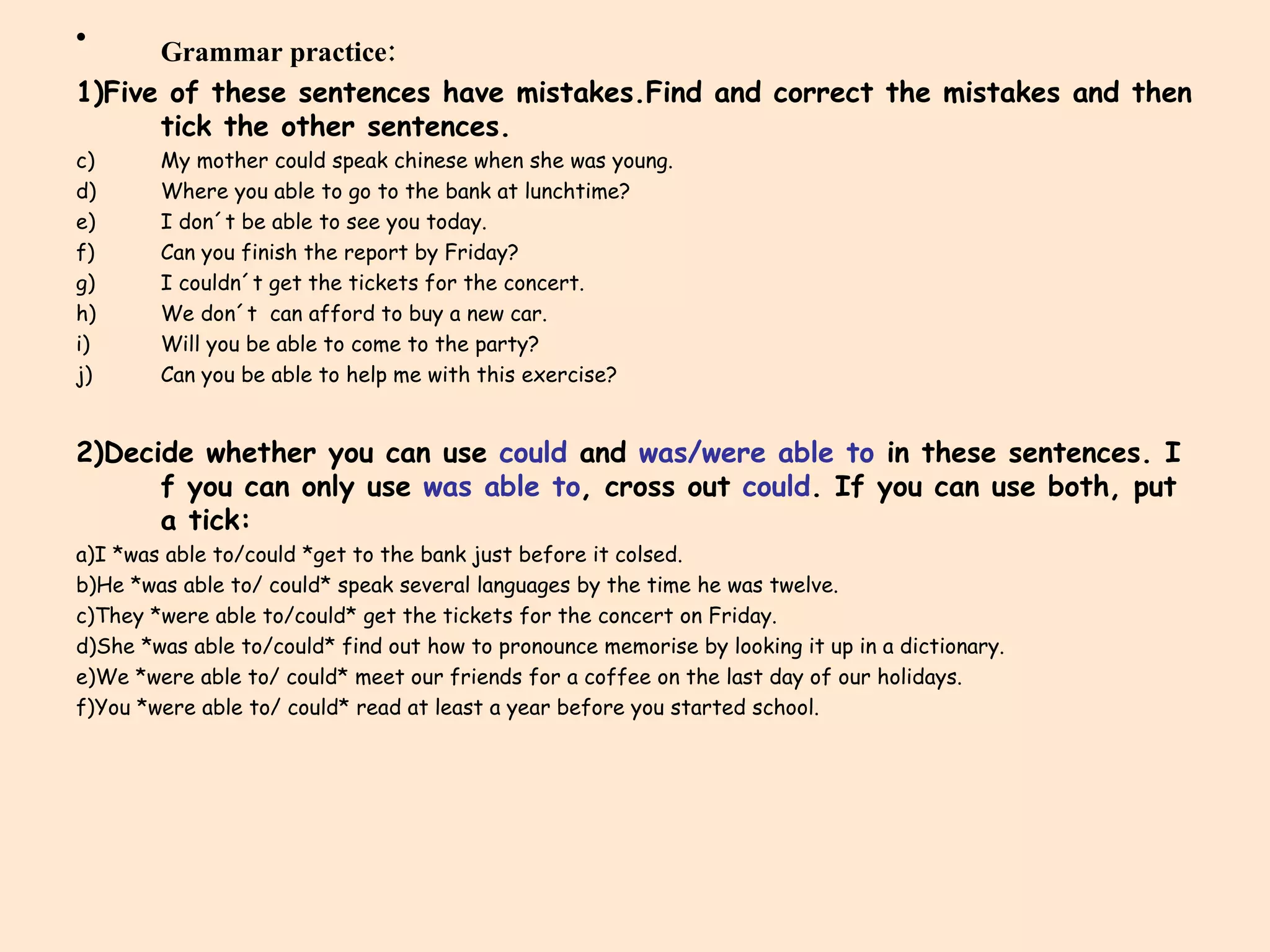
Grammar practice: 1)Five of these sentences have mistakes.Find and correct the mistakes and then tick the other sentences. My mother could speak chinese when she was young. Where you able to go to the bank at lunchtime? I don´t be able to see you today. Can you finish the report by Friday? I couldn´t get the tickets for the concert. We don´t  can afford to buy a new car. Will you be able to come to the party? Can you be able to help me with this exercise? 2)Decide whether you can use  could  and  was/were able to  in these sentences. I f you can only use  was able to , cross out  could . If you can use both, put a tick: a)I *was able to/could *get to the bank just before it colsed. b)He *was able to/ could* speak several languages by the time he was twelve. c)They *were able to/could* get the tickets for the concert on Friday. d)She *was able to/could* find out how to pronounce memorise by looking it up in a dictionary. e)We *were able to/ could* meet our friends for a coffee on the last day of our holidays. f)You *were able to/ could* read at least a year before you started school.
Bibliografia: Longman -English Grammar by L. G. Alexander. Longman-Going for Gold, Intermediate by Sally Burgess with Richard Acklam and Araminta Crace. Profesora: Graciela Tutuy Año: 2009

Modals general characteristics- Modals of Ability

  • 1.
    Grammar I ModalAuxiliaries and related verbs
  • 2.
    General Characteristics: Verbslike *can *may are called Modal Auxiliaries; though we often refer to them simply as modal verbs or modal. Frequently Uses: Ask for permission Grant permission Give/receive advice Make/respond : requests and offers, etc. Modals have two major functions: 1- Primary : when they closely reflect meanings Ability : can------  I can type really fast. could--  Sara could speak three languages by the age of six. Permission: may--  You may leave early. might  Migth I borrow your jacket? Prediction: will--  It will rain soon. would  I would feel better after this medicine * shall(after I/We)-  Can we find our way home?-I´m sure we shall. Escapable obligation or duty: should-  You should do as you´re told. ought to  You ought to be right. Inescapable obligation must-  You must be quiet! Absence of obligation: needn´t-  You needn´t wait.
  • 3.
    2- Secondary :( nine of the modal auxiliaries-not shall- can be used to express the degree of certainty /uncertainty a speaker feels about a possibility:
  • 4.
    Primary and secondaryfunctions of 'must' compared: Some ways in which modals resemble 'be', 'have', 'do': The Negative :
  • 5.
    Questions : Yes/Noquestions are formed as for be have and do.(M + Subj + Predicate) e.g. May we leave early? In question-word questions, the q-w precedes the modal. e.g. When may I leave? With Yes/No question, the m used in the answer is normally the same as the one used in the question. e.g. Can you come and see me tomorrow? - Yes I can 'No, I can't. Negatives questions : As with be,have and do, the full form of the negative q with M. requires `not´ after the subj e.g.Can you not help me?<This is FORMAL and RARE>So, contracted forms are normally used e.g. Can´t you help me? Shouldn´t you ...? Is usually prefered to Oughtn´t you to....?perhaps because the latter is more difficult to pronounce. Some ways in which modals differ from be, have and do ´Defective Verbs´ `1)M cannot be used as infinitives. If we ever need an infinitive, we have to use another verb: e.g. If you wanto to apply for this job, you have to be able to type at least sixty words a minute. 2) We do not use a to-infinitive after M . Only the bare infinitive can be used after modals(EXCEPT ought which is ALWAYS FOLLOWED by to ) e.g. You mustn´t/mus´t phone him this evening.......not ^to phone^ 3)M . have no –ing. form. Instead of- ing we have to use another verb or verb phrase e.g. I couldn´t go/I wasn´t able to go home by bus, so I took a taxi. 4)M . Have no –(e)s in the 3rd person sing e.g. The boss can see you now. 5) Each of the M. has a basic meaning of its own Only one M can be used in a single verb phrase: e.g. -We may call the doctor. -We must call the doctor ------------------------- but not may and must together
  • 6.
    M.Auxiliaries compared withfuture tenses: Uses of M compared with verb tenses: The labels we use to describe the verb tenses( pres, progr, past, perf) cannot easily be applied to M <Present> All M can refer to the immediate pres or the fut, therefore pres is not always a reliable label. eg. I can/may phone now. I can/may phone tomorrow. <Progresive> There is no prog form for M. But we can put the verb that follows the M into the pregressive form eg. Alan is singing in public. ( present prog) Alan may be singing in public. (m + be + verb-ing) Alan may have been singing in public. (m + have been + -ing) <Past>Woud ,could, might, should--  can be called `past´ when are used in indirect speech eg. John says you could/might/would leave early. Migth can have a past reference in historical narrative, however might usually expresses more uncertainty than may. Could sometimes expresses ability in the past: eg. Tania could(or was able to) swim five miles when she was a child .
  • 7.
    *Couldn´t and wasn´t able to: are usually interchangeable Other main use of could; as a more polite alternative to can in requests.eg. Could you help me, please? *Would and should have special uses ,but would expresses the past in: When we were young we would spend our holidays in Bs.As. *Must can express past time only in inderict speech, otherwise it has to be replaced by have to, etc eg. Alice asked her boss if she must work or ( had to work ) overtime. <Perfect and Past> Forms with M + have + past part or with M + have been + progressive -------------are not necessarily the equivalent of the present perfect. The M refers to the present while have+ past participle refers to the pas…..So, depending on the context, You must have seen him can mean: I assume (now) you have seen him (bef now; equivalent of the pres perf) I assume (now) you saw him (then equivalent to the past) I assume (now) you had seem him( before then, equivalent to the past perfect) Uses of Modals to express ability:
  • 8.
    ` Can´= ability: the present 1)` Can + verb (natural ability) eg. Can you run 1500 metres in 5 minutes? (= Are you able to run? Are you capable of running) I can/cannot/can´t run 1500 metres….. Can and (am/is/are) able to are generally interchangeable to describe natural ability.though able to is less common Jack is only nine months old and he can already stand up. Jack is only nine months old and he is already able to astand up. *Able to* would be unusual when we are commenting on something that is happening at the time of speaking: eg. Look! I can stand on my hands! 2)` Can ´ + verb (learned ability or ´know-how´) eg. Can you drive a car? (=Do you know to ? Have you learnt how to?) Verbs such as drive,play,speak,undrstand -  indicate skills or learned abilities. Can, and to a lesser extent, am/are/is able to, often combine with such verbs and may generally be used in the same way as the simple present tense: eg. I can/can´t play chess( I play/don´t play chess). ´Could/Couldn´t = ability: the past Past ability (natural and learned) expressed with could Could/couldn´t or was/ were (not) able to----  can decribe natural and learned ability in the past, not related to any specific event: eg. Jim could/couldn´t run very fast when he was a boy. Barbara could/ couldn´t sing very well when she was younger. Jim was able to/ was unable to run fast when he was a boy
  • 9.
    Another often useto talk about or describe past abilities: used to - be able to eg. I used to be able to hold my breath for one minute under water. * Could and was ( or would be) able to occur after reporting verbs: eg. He said he could see me next week. 2) The past: could + verb: achievement after effort Could and was/were aable to can be interchangeable when we refer to acquisition of a skill after effort: I tried again and found I could swim/ was able to swim. *Could cannot normally be used when we are describing the successful completion of a specific action Was/were able to, managed to or succededed in + -ing must be used instead.- eg. In the end they  were able to rescue  the cat on the roof. “ “ “ “  managed to rescue  “ “ “ “ “ . “ “ “ “  succeeded in rescuing  “ “ “ “ “ . If an action was not successfully completed, we can use couldn´t. eg. They tried for hours, but they couldn´t save the cat. (or weren´t able to, didn´t manage to, etc.) *Could can be used when we are asking about a specific action ( as opposed to describing it ): Could they rescue the cat on the roof?( did they manage to? ) -No, they couldn´t .It was too difficult. However an affirmative response requires an alternative to could: -Yes, they managed to. (Not ´could´)
  • 10.
    ´ Can/could´ + verbs of perception: Verbs like see, hear, smell, rarely occur in the progressive. Can and to a lesser extent, am/is/are able to, combine with such verbs to indicate that we can see, hear, smell,etc something happening at the moment of speaking. In such cases can has a grammatical function equivalent to the simple present in statements and to do/does in questions and negatives. eg. I can smell something burning I can´t see anyone. *Could can be used in place of the simple past in the same way: eg. I listened carefully, but couldn´t hear anything. *Can/could can be used with verbs suggesting “ understanding” : I can/can´t understand why he decided to retire at 50. I could/couldn´t “ “ “ had decided to retire at 50. *Couldn´t/Can´t cannot be replaced by the simple present or simple past when conveying the idea ´beyond (my)control´ I can´t /couldn´t imagine what would be like to live in a hot climate .( Not * don´t/didn´t*) ´ Could´ and ´would be able to´ : We can use can as an unreal past in the sense of ´would be able to´. When we do this, an if-clause is something implied: Could + never has the sense of `would never be able to´ eg. I could never put up with such inefficiency if I were running an office. Could is often used to express surprise,anger, etc, in the present: I could eat my hat. I could slap your face!
  • 11.
    ´ Could have´and ´would have been able to´: We don´t use can/can´t have + past participle to express ability or capacity. We use them for possibility or conjecture( He can´t have told you anything I don´t already know) However, in conditional sentences and implied conditionals we may use could have+past participle ( in place of would have been able to) to refer to ability or capacity that was not used owing to personal failure or lack of opportunity If I hadn´t been for the freezing wind and blinding snow, the rescue party could have reached the injured man before nightfall. Ability in tenses other than present and past If we need to express abilitty in other tense combinations ( future or present perf, then the appropiate forms of be able to, manage to or succeeded in must be used: I´ll be able toto pass my driving test after I´ve had a few lessons.  I´ve been trying to contact him, but I haven´t managed to. *Can referring to ability,skill, or perception, is usable in clauses after if and when to refer to the future: If you can pass ( or are able to pass )your driving test at the first attempt, I´ll be very surprised. Expressing ability with ´can´ and ´could´in the passive: Passive constructions with can and could, indicating ability, are possible where the senses allows: This car can only be driven by a midget. The lecture couldn´t be understood by anyone present. The injured men could have been reached if heavy equipment had been available during the rescue operation.
  • 12.
    Can/ could = capability/ possibility: Can + be+ adject. or noun  has the effect of ´is sometimes´or ´is often´and refers to capability or possibility. It can be replace by be capable of + -ing , but not by am/are/is able to: -It can be quite cold in Cairo in January. (=It was sometimes-or often-quite cold) -He can be very naughty. *Could has the same effect in the past: -It could be quite cold in Cairo in January when I lived there. (= It was sometimes –or often-quite cold.) -He could be very naughty when he was a little boy. *Could can also have a future reference in this kind of context: It could be quite cold when you get to Cairo.
  • 13.
    Grammar practice: 1)Fiveof these sentences have mistakes.Find and correct the mistakes and then tick the other sentences. My mother could speak chinese when she was young. Where you able to go to the bank at lunchtime? I don´t be able to see you today. Can you finish the report by Friday? I couldn´t get the tickets for the concert. We don´t can afford to buy a new car. Will you be able to come to the party? Can you be able to help me with this exercise? 2)Decide whether you can use could and was/were able to in these sentences. I f you can only use was able to , cross out could . If you can use both, put a tick: a)I *was able to/could *get to the bank just before it colsed. b)He *was able to/ could* speak several languages by the time he was twelve. c)They *were able to/could* get the tickets for the concert on Friday. d)She *was able to/could* find out how to pronounce memorise by looking it up in a dictionary. e)We *were able to/ could* meet our friends for a coffee on the last day of our holidays. f)You *were able to/ could* read at least a year before you started school.
  • 14.
    Bibliografia: Longman -EnglishGrammar by L. G. Alexander. Longman-Going for Gold, Intermediate by Sally Burgess with Richard Acklam and Araminta Crace. Profesora: Graciela Tutuy Año: 2009